Most dried orange garland guides show you a pretty branch on Pinterest and send you to the craft store — then you get home and realize nobody told you how far apart the slices should sit, or why yours smelled musty by New Year’s. Consider this the fix.
We spent serious time combing Etsy, Amazon, and Michaels to bring you only what’s worth your attention this year — plus a stack of projects you can pull off for the price of a bag of oranges. Everything here sits between $8 and $120, whether you’re buying or DIYing.
Inside you’ll find 20 curated ideas, from evergreen-and-citrus garlands and velvet-ribbon citrus ornaments to clove-studded slices, stair-rail medallions, and autumn leaf wreaths — with budget and luxury versions compared side by side. And stay until the end — we break down the most common mistakes that can ruin these looks.
Dried citrus is having a real moment in 2026 because holiday decor has swung hard toward the handmade: saves for dehydrating citrus keep climbing as people hunt for decor that’s compostable, cheap, and doesn’t look like it came off a big-box shelf. 📌 Save this to Pinterest for later — you’ll want to revisit these ideas.
1. Dried Orange Slices and Dark Beads on Thin White Cord
Two circles do all the work here: bright, translucent orange discs and smaller matte brown spheres, strung on a cord so thin it nearly disappears. The white cord matters more than you’d expect — against light grey siding it reads as empty space, so the garland looks like it’s floating rather than roped. And because the dark beads are noticeably smaller than the orange slices, your eye gets a steady beat of large-small-large instead of one repetitive row.
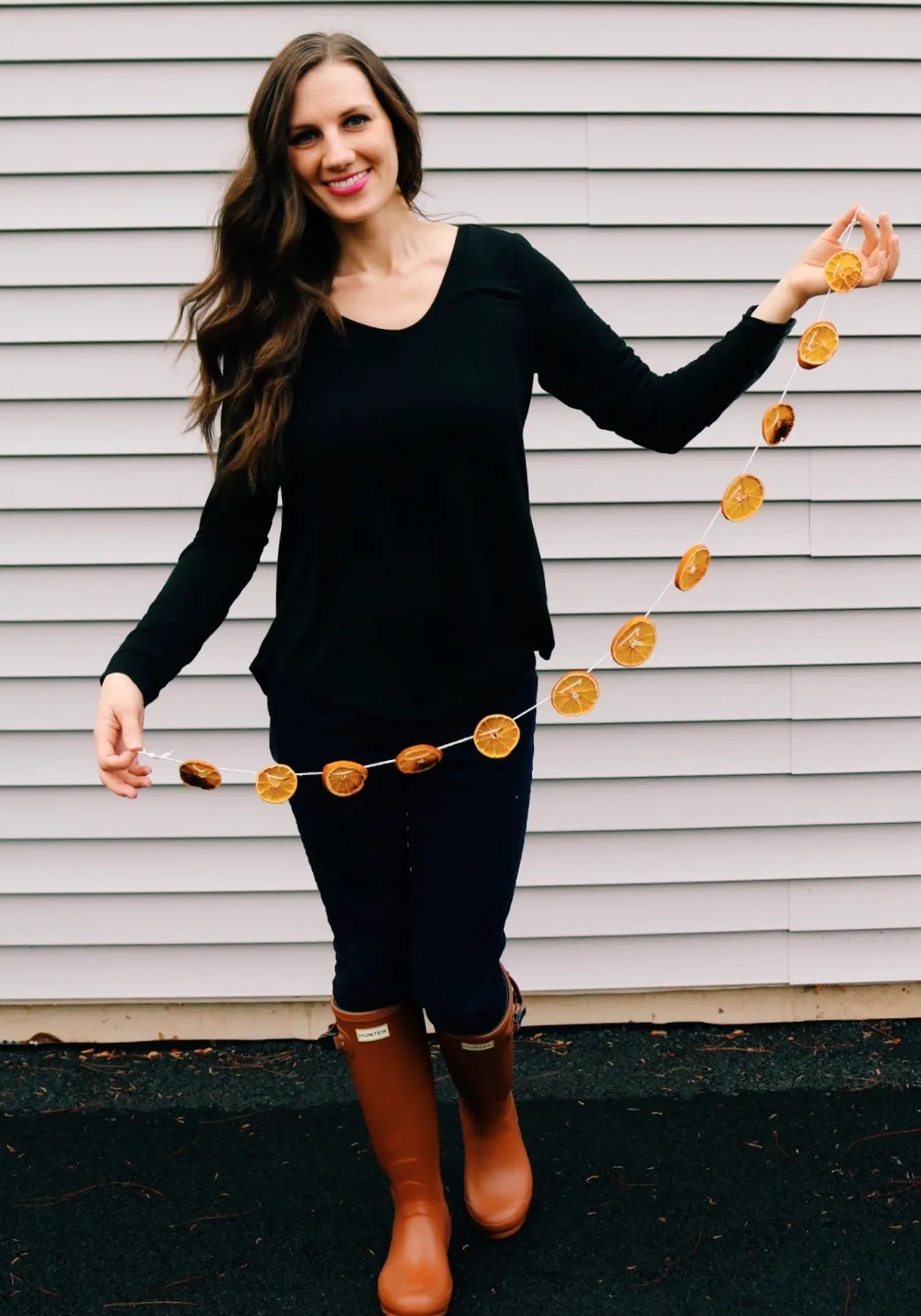
- 3 lb bag of navel oranges (about 40 slices): $5–$8
- 1.5 mm white waxed cotton cord, 20 yards: $4–$7
- Dark wood beads, 100 count, 12 mm: $8–$14
- Large-eye embroidery needle: $2–$4
- Food dehydrator, optional: $40–$70 (your oven works for free)
Total: $19–$33 if you already own an oven. Budget alternative: skip the beads and push whole cloves into the rind instead — roughly $12 total, and you gain a scent that lasts the whole season.
2. Dried Orange Ornament with Red Satin Ribbon on Fir
The wire hanger is the difference between handmade and homemade-looking. Use 20-gauge floral wire and pierce the rind about 3/8 inch in from the edge — never through the pith in the middle, which crumbles and drops the slice. Bend a small hook inside the top, then twist the two ends together above it. A 1-inch satin ribbon tied in a single flat knot hides the wire completely and gives you that crisp red pop against dark fir needles.
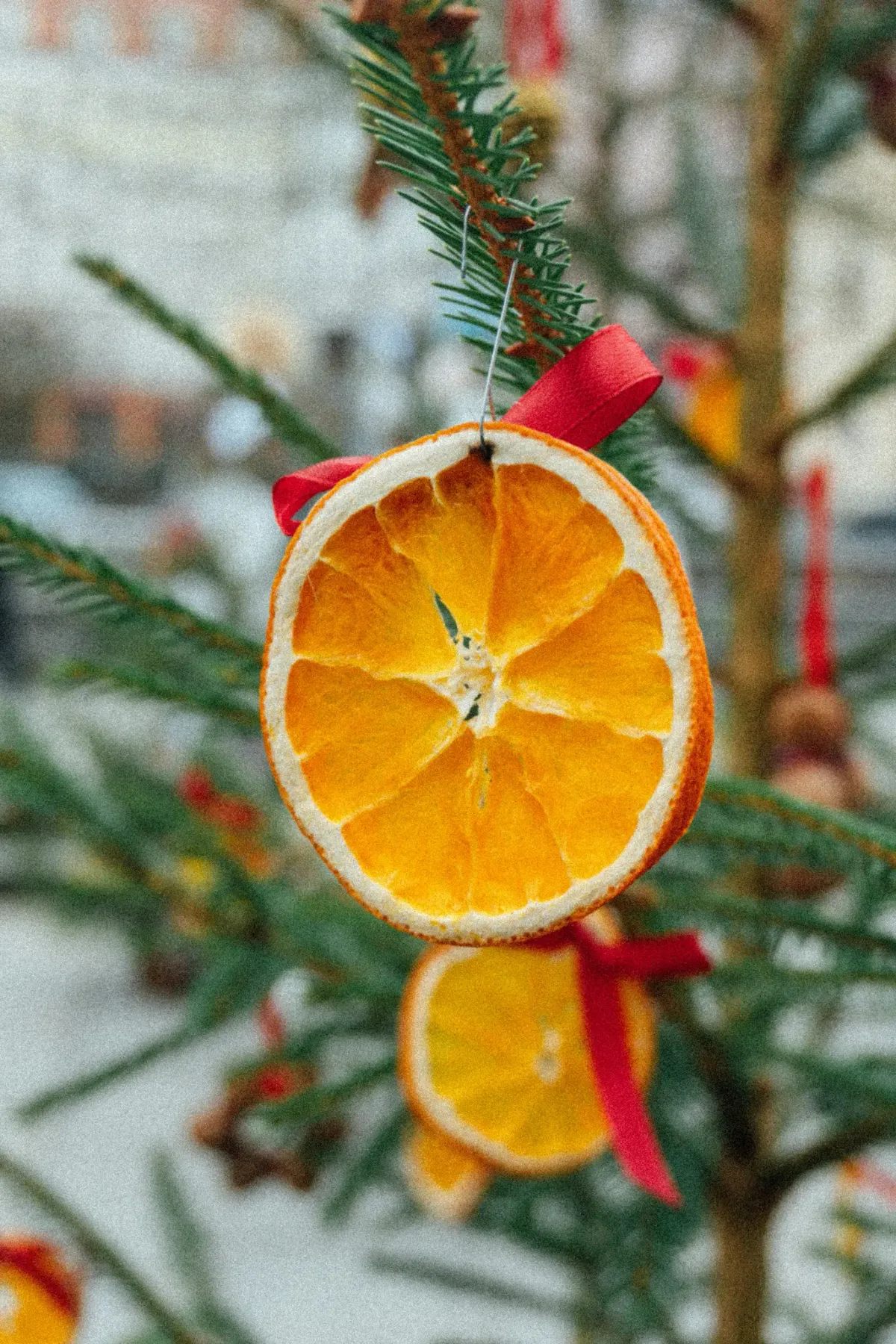
- Slice oranges 1/4 inch thick and blot both sides with paper towel.
- Bake at 200°F on a wire rack for 3–4 hours, flipping at the 2-hour mark, until the rind is leathery and the center is dry to the touch.
- Cool completely — warm slices tear.
- Thread 20-gauge wire through the rind, twist a loop, and tie on a 10-inch length of satin ribbon.
About 4 hours of mostly hands-off time, roughly $2 per ornament once you’ve bought the oranges and ribbon.
3. Fall Citrus Garland Styling in Warm Amber and Cream
Think of it as 70% warm citrus — orange, amber, a few burnt-sienna slices — plus 20% deep grounding neutrals like walnut-brown cinnamon or charcoal twine, and 10% cream or off-white. That last 10% is what keeps a fall garland from turning muddy; it might be pale apple slices, a length of ecru ribbon, or bare wooden beads. Swap the citrus for pomegranate and the cream for ivory felt, and the identical math reads winter instead of autumn.
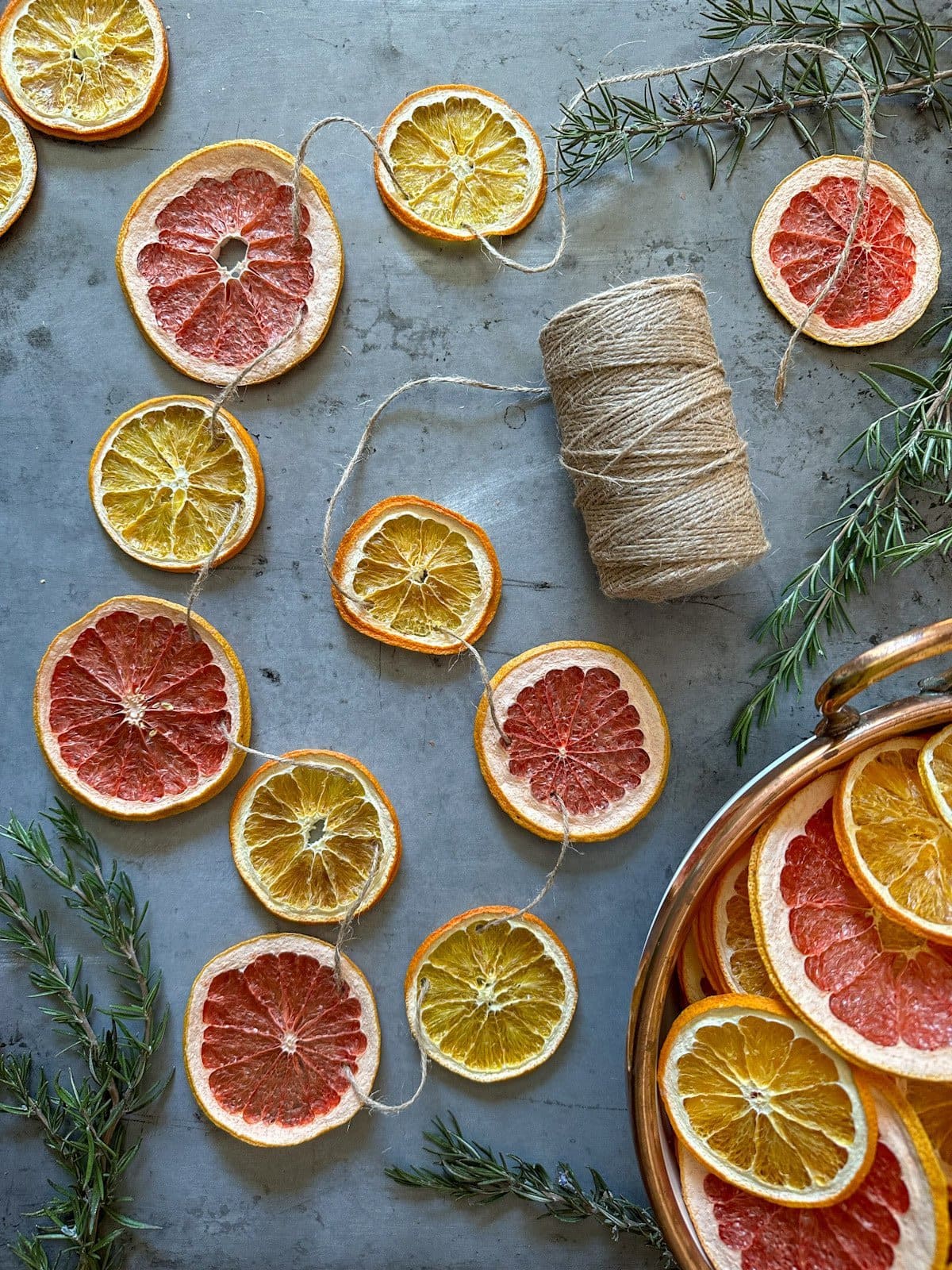
Here’s the thing nobody mentions about fall citrus garlands: dried slices fade. Within a season or two that vivid translucence dulls to flat rust, and near a bright window it happens faster. Store garlands in a dark bin with a silica packet between seasons and you’ll get three or four good years. Compare with Idea #13 — same citrus, much brighter room.
4. Dark Green String and Dried Citrus on Weathered Wood
You can build five or six feet of this for under $15.
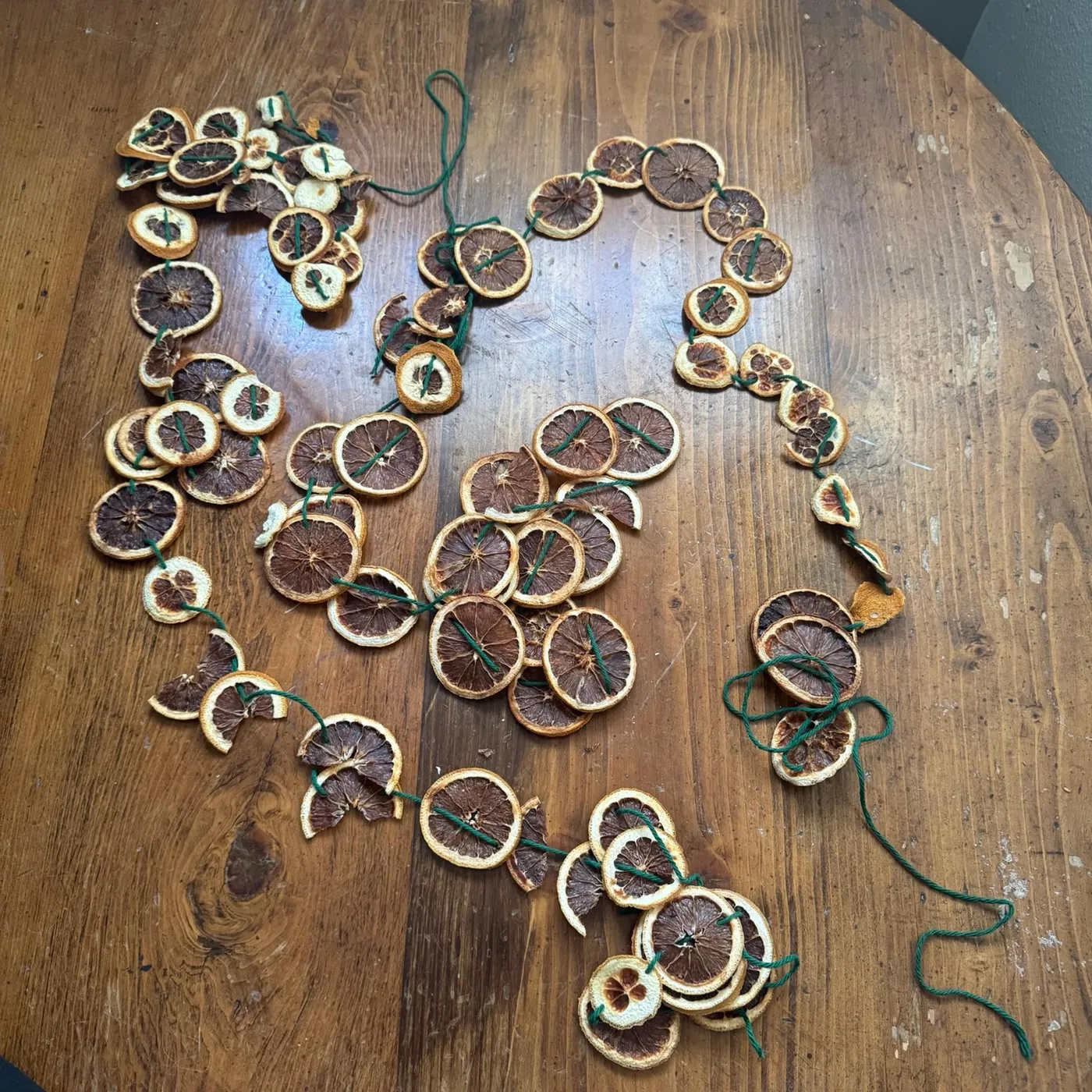
- Oranges: $4 at Aldi or Walmart
- Forest green cotton string, 50 yards: $3 at Michaels or Dollar Tree
- Needle: $2
- Thrifted wooden board or bowl to style it on: $3–$8 at Goodwill or Facebook Marketplace
That’s it. No dehydrator required — a 200°F oven and a wire cooling rack do the same job. If you’d rather buy finished, Etsy sellers list 6-foot dried citrus garlands from $28 to $60, which is fair once you count their electricity and fruit.
String color is the quiet decision that makes or breaks this look. Dark green or brown cord visually disappears into the slices, so the garland reads as a floating line of citrus — exactly what’s happening on that wood grain. White or cream cord makes every slice look individually tied and reads more Scandinavian. Pick one and stay consistent: switching cord color halfway through is the fastest way to make a handmade piece look improvised.
5. Cinnamon Bundles, Popcorn, and Orange on Evergreen
The bundled cinnamon sticks at the top are the whole point. Popcorn and dried orange are classics, but they’re flat — two-dimensional discs and puffs. A tight bundle of four or five cinnamon sticks tied with dark string breaks the silhouette outward, giving the garland actual depth and a scent that hits you before you see it. Take the bundles away and you still have a nice country garland, but it goes right back to being flat.
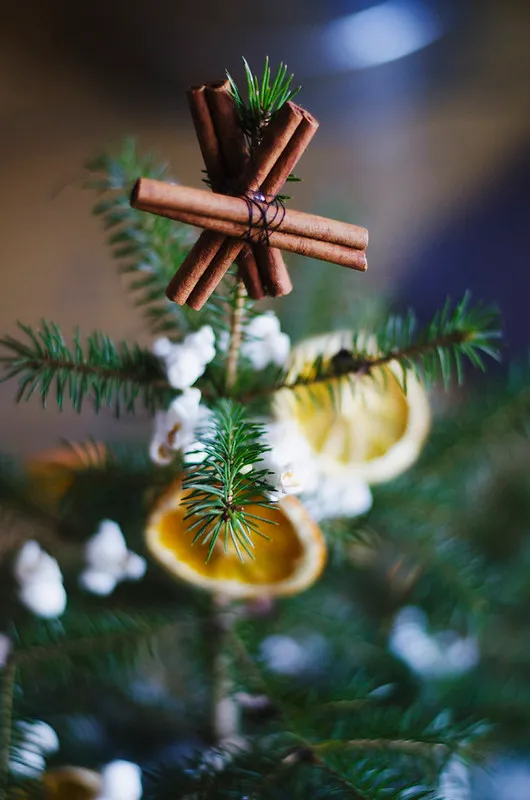
- Bundle 4–6 cinnamon sticks with dark cotton string, wrapping twice and knotting at the back.
- Leave one long tail for attaching it to the branch.
- Thread orange slices on a separate cord at 2-inch intervals.
- Wind the orange cord through the evergreen, then wire a bundle over the top every 12–14 inches.
- Add popcorn last — it’s light, so it rides on the surface.
Bundles run about $1.50 each. Use air-popped popcorn left out 24 hours to firm up; buttered popcorn attracts everything you don’t want.
6. Evergreen and Backlit Orange Garland Across a Bright Corner
Two things are happening. First, backlighting: dried orange slices are translucent, and hung near a window they glow like stained glass while everything around them stays dark green and quiet. Second, the drape. This garland is swagged across a corner rather than pulled straight, so your eye travels down and back up instead of sliding past. Off-white walls and a white window frame do the rest by giving the orange nothing to compete with.
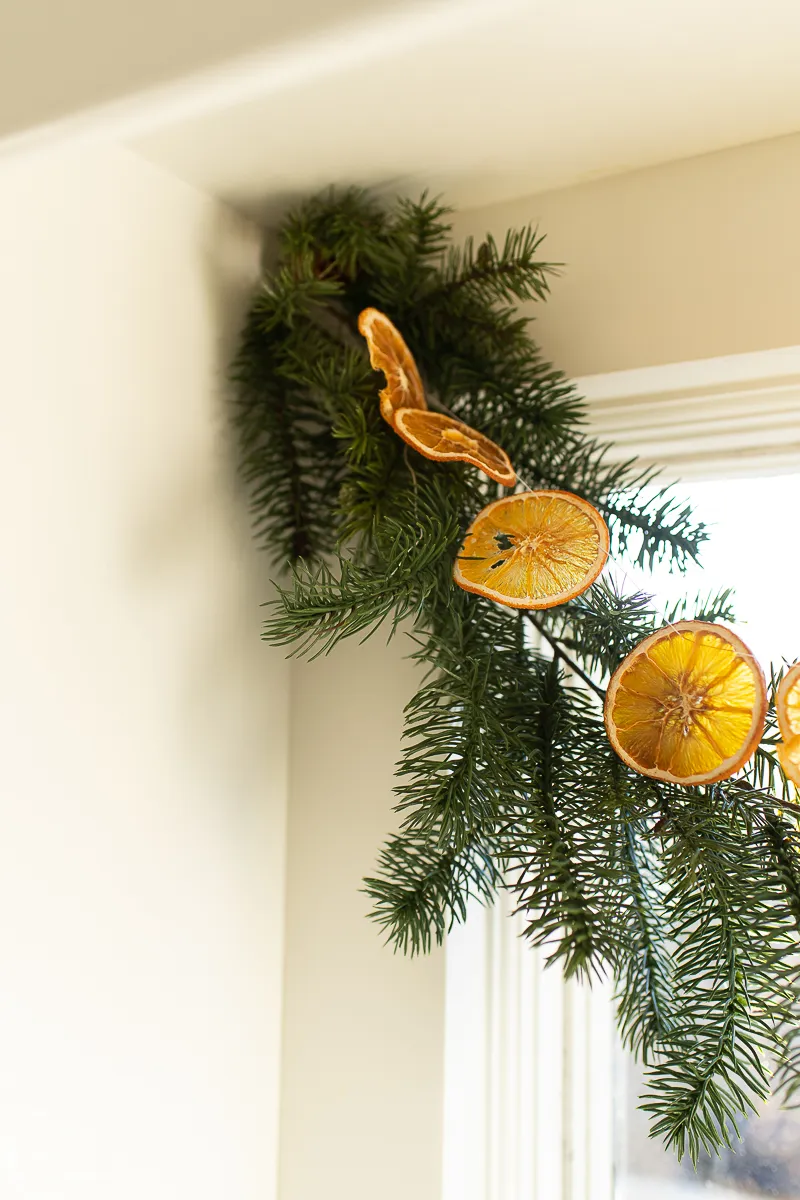
Corners are forgiving, which is why this is the version to steal for a small apartment. You need a window frame or corner with at least 30 inches of horizontal run and about 20 inches of drop for one swag. Ceiling height barely matters as long as the garland lands below eye level when you’re seated — around 60 to 66 inches off the floor. For a long straight mantel run instead, see Idea #16.
7. Star Anise Center and Bright Yellow Ribbon on Pine
Press the star anise into the slice while the orange is still warm from the oven — the pith is soft and the pod sinks in and stays put. Once the slice is fully cool and brittle, the same pod just sits on top and slides off the moment someone brushes past it. Ribbon width matters too: 3/8 inch satin reads delicate against pine needles, while anything wider than an inch turns into a boxy bow that fights the small scale of the ornament.
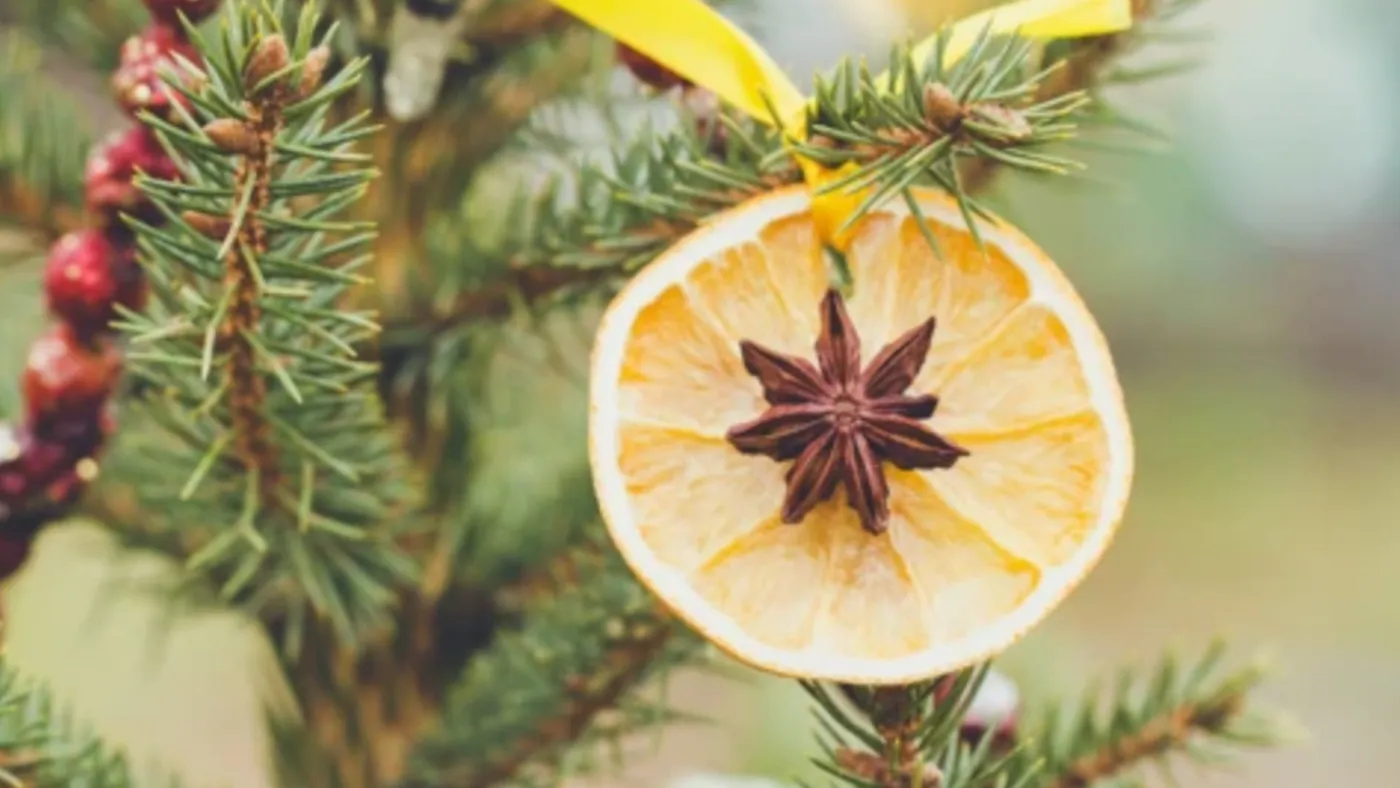
The star anise in the center is the one thing. It’s a single brown pod, maybe the size of a dime, and it changes how the whole ornament reads — suddenly it’s a medallion with a focal point instead of a plain disc. It also layers a second scent on top of the orange rather than blending in. Lose it and this is a generic dried orange slice; keep it and people lean in closer to look.
8. Chestnuts, Cinnamon Sticks, and Citrus Ready to String
Chestnuts look gorgeous for about six weeks. They’re the first thing to go — they shrink, dull, and can grow a fine white bloom if your house runs humid. Cinnamon sticks last for years; dried orange slices last two to four seasons if kept dry. Store everything in a sealed bin with a silica packet, and re-crisp slices in a 200°F oven for 10 minutes before reusing. If you have pets or toddlers, skip chestnuts entirely — they look enough like candy to be a swallowing hazard.
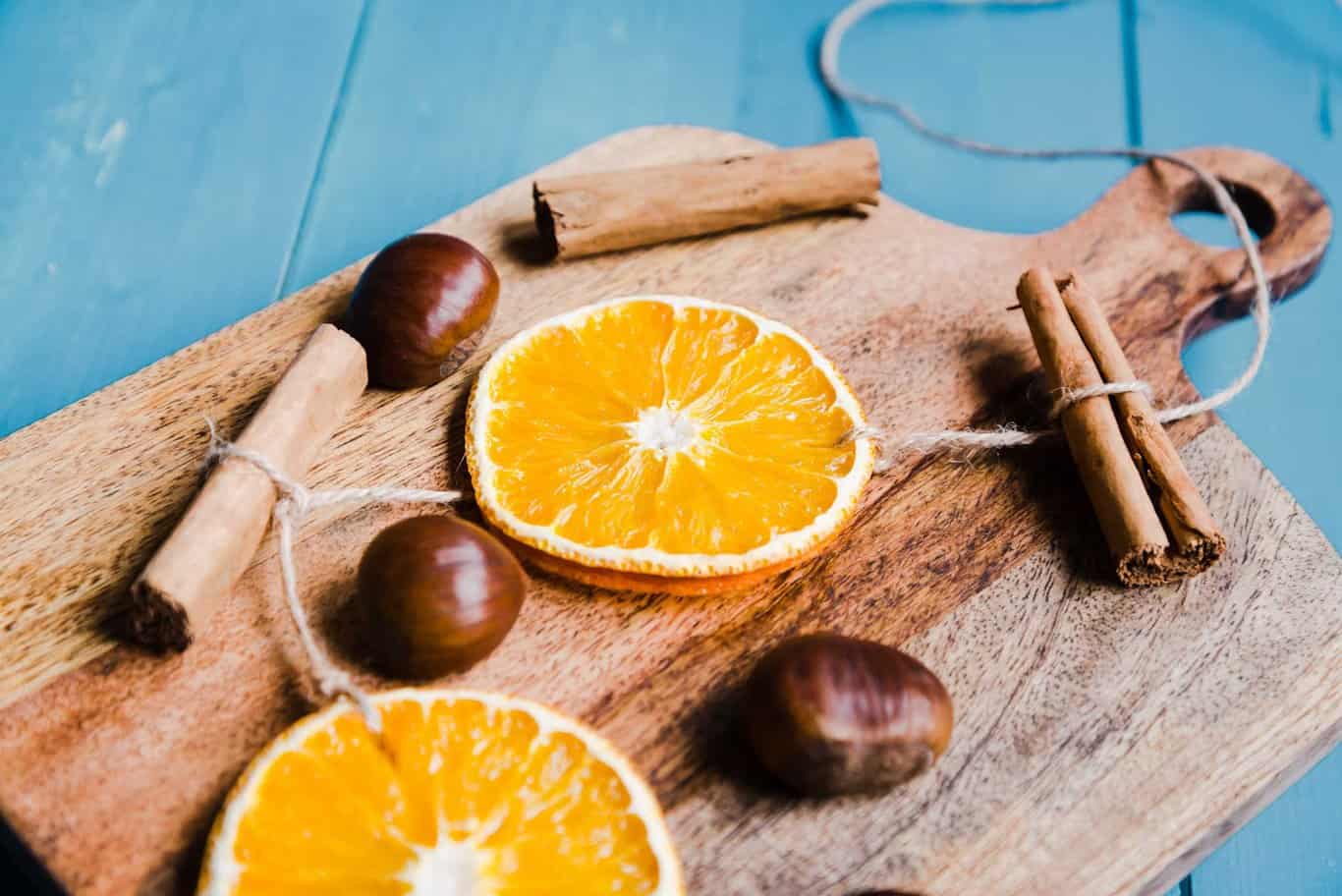
Whole chestnuts are cheapest at an Asian grocery or international market, often $3 to $5 a pound versus $9 at a specialty store. Cinnamon in bulk bags runs about $8 for 50 sticks rather than $5 for six in a jar, and light twine is a dollar-store staple. All in, you can assemble a full garland’s worth of components for $18–$25, against $45–$70 for a finished artisan garland of the same length.
9. Clove-Studded Slices and Curled Ribbon on Coniferous Foliage
2026’s holiday decor has swung hard toward the compostable. Searches for dehydrating citrus and natural Christmas garlands keep climbing, and the reason is practical as much as aesthetic: people are tired of storing plastic. Cloves, cinnamon, and dried citrus hit a sweet spot — cheap, incredible-smelling, and green-bin friendly when the season ends. The clove-studded slices here are an old Williamsburg trick that never actually left.
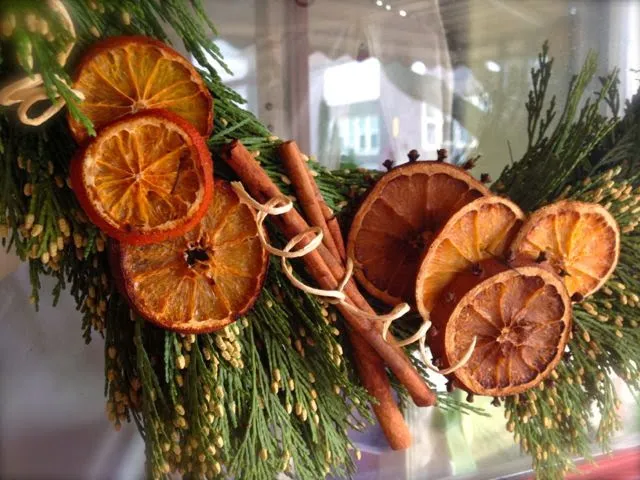
Roughly 55% deep forest green foliage, 30% warm orange-brown dried citrus, 10% light beige from that curled ribbon and the small pale seed pods, and 5% dark accents from the cloves. That’s a much greener ratio than the orange-heavy garlands in Idea #1, which is exactly why this one reads elegant instead of rustic. To shift it toward spring, keep the math and trade the cinnamon tones for pale birch and dried lemon.
10. Crafting Station: Spruce, Pine Cones, and Star-Anise Slices
- Let the slices cool completely — at least an hour on the rack.
- Pick the prettiest 20; set cracked ones aside for potpourri.
- Thread twine through a sharp needle and pierce each slice 1/4 inch in from the rind edge.
- Knot between slices, leaving a half-inch gap so air can move.
- Wire small spruce sprigs and pine cones on top every 10 inches.
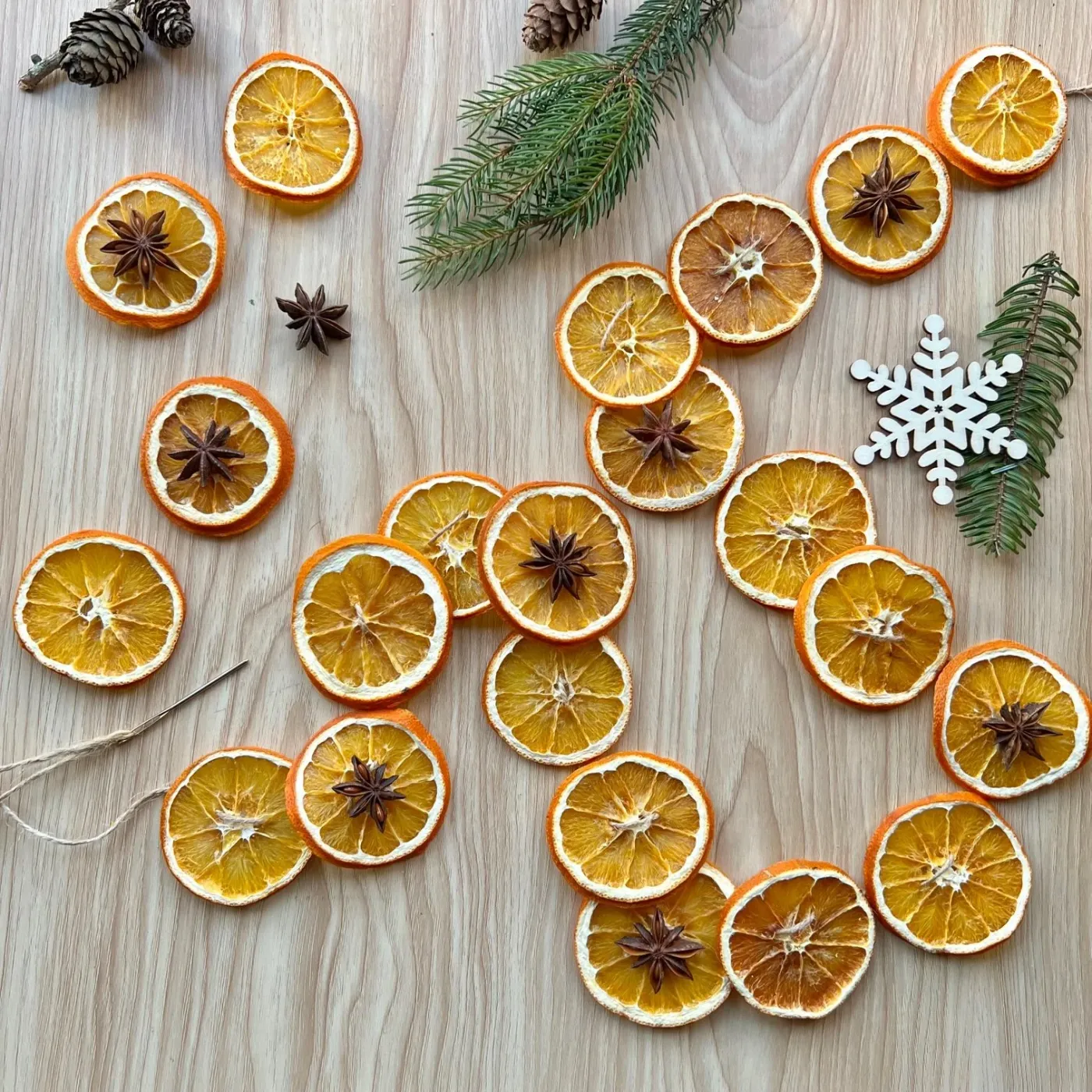
About 45 minutes of assembly for 4 feet. Cost runs roughly $12 plus the oranges. Do it on a light wood surface where you can see what you’re doing — and where stray star anise won’t vanish into a dark rug.
- Measure the run first — a 6-foot garland takes about 30 slices, not 12.
- Check which direction light comes from; translucent slices want light behind them.
- Confirm you have an airtight bin big enough to store it flat.
- Decide whether this is one-season decor or a piece you’ll keep for years.
11. Citrus, Pine, and Cinnamon Strung Across a Dark Cabinet
Dark wood furniture is the best backdrop dried citrus ever gets. The cabinet’s brown tones sit close enough to the orange that nothing clashes, but dark enough that the slices pop like little lights behind the glass. Notice the twine — natural hemp tone, nothing glossy — which keeps the whole thing in one warm family. It’s also hung in a shallow swag rather than pulled tight, so it reads as drapery instead of a decoration stuck to the front of a cabinet.
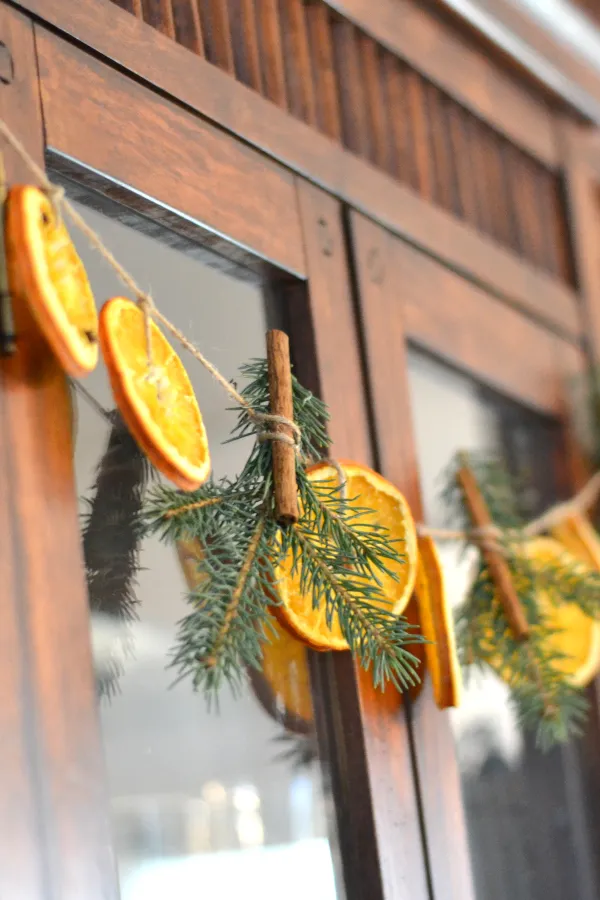
- Cinnamon sticks, 4 oz bag: $6–$9
- Fresh pine or fir bundle: $8–$15 (or free from a tree trim)
- Oranges, 3 lb: $5–$8
- Natural hemp twine: $4
- 20-gauge floral wire: $4–$6
Total: $27–$42 for a 6-foot garland. Budget alternative: skip the fresh pine, grab a single faux cedar garland from Michaels on sale for $15, and wire the citrus on top. Nobody will know from across the room.
12. Orange, Bay Leaf, and Wooden Bead Garland at a Craft Table
Fresh bay leaves look wonderful and then dry brittle — expect a few to snap by the end of the season, so string extras. Dried orange rind is tougher than it looks, but a standard office hole puncher will crack the slice every time; use a sharp needle and pierce 1/4 inch in from the edge. Also worth knowing: bay keeps its color better away from direct sun, so a wreath-shaped version of this belongs indoors, not on a front door.
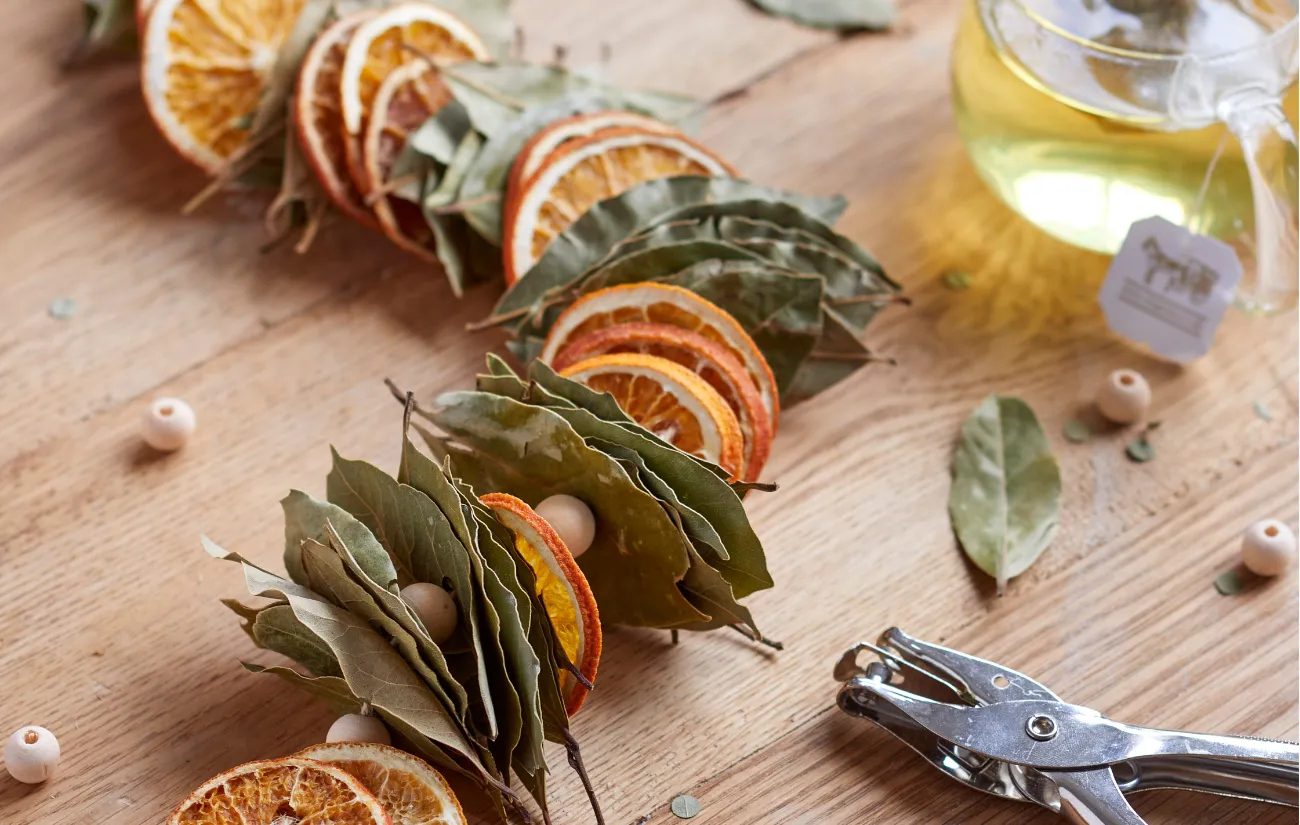
The wooden beads are the one thing. They’re the reason this garland can still be hanging in February without looking like a leftover. Everything else — the orange, the bay — is botanical and seasonal; the beads are just warm, matte, neutral. They give your eye somewhere to rest between bright slices. Swap them for more fruit and it becomes strictly holiday decor. Keep them and it works on a stair rail or kitchen wall all winter, like Idea #18.
13. Thin Orange Slices and Evergreen Sprigs on a White Window
This is the version that keeps showing up in 2026 mood boards, and it’s easy to see why: it costs almost nothing, it photographs beautifully against a white frame, and it disappears politely when the season ends. There’s a broader shift at play too — people are decorating one or two spots really well instead of every surface. A single window treatment does more for a room than a dozen small tchotchkes, and it takes one afternoon.
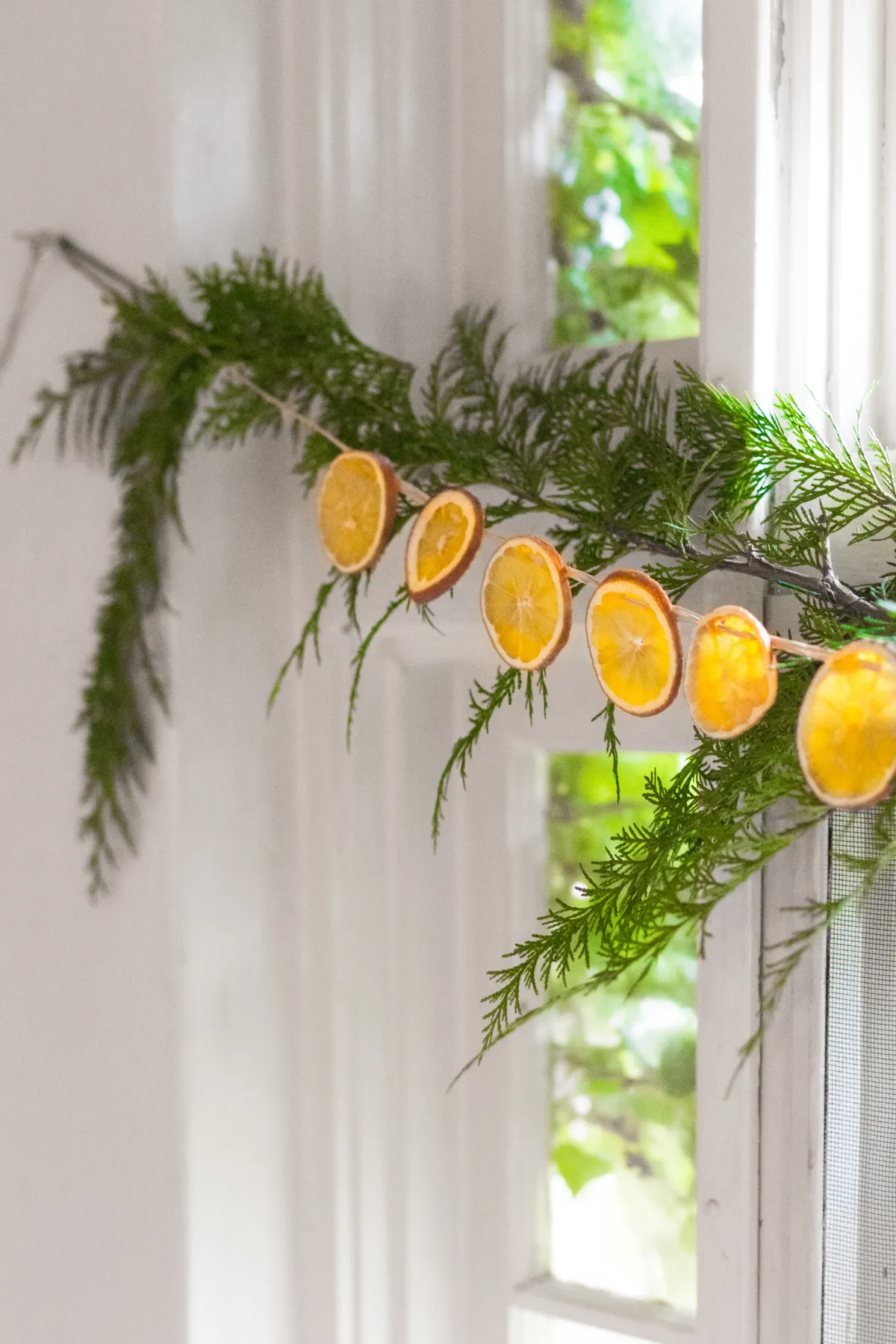
A standard double-hung window is 30 to 36 inches wide, the sweet spot for this treatment. You’ll want about 8 slices per foot of run, so roughly 25 slices for a 3-foot span. Skip it on anything wider than 60 inches — the garland sags in the middle and needs a second anchor point. Tall or arched windows should go with a straight mantel or cabinet run instead, like Idea #11.
14. Cranberry, Sage, and Pink-Strung Dried Fruit Garland
Cranberries are the most underrated spacer in garland-making. Pierced end to end, they give you a natural 1-inch gap between slices, which keeps air moving so nothing molds — and they add a deep red bead that reads festive without a single piece of tinsel. Buy fresh cranberries the week you plan to make it; once they soften they’re useless. Plan on composting the whole thing after the season, since cranberries don’t dry well on the string.
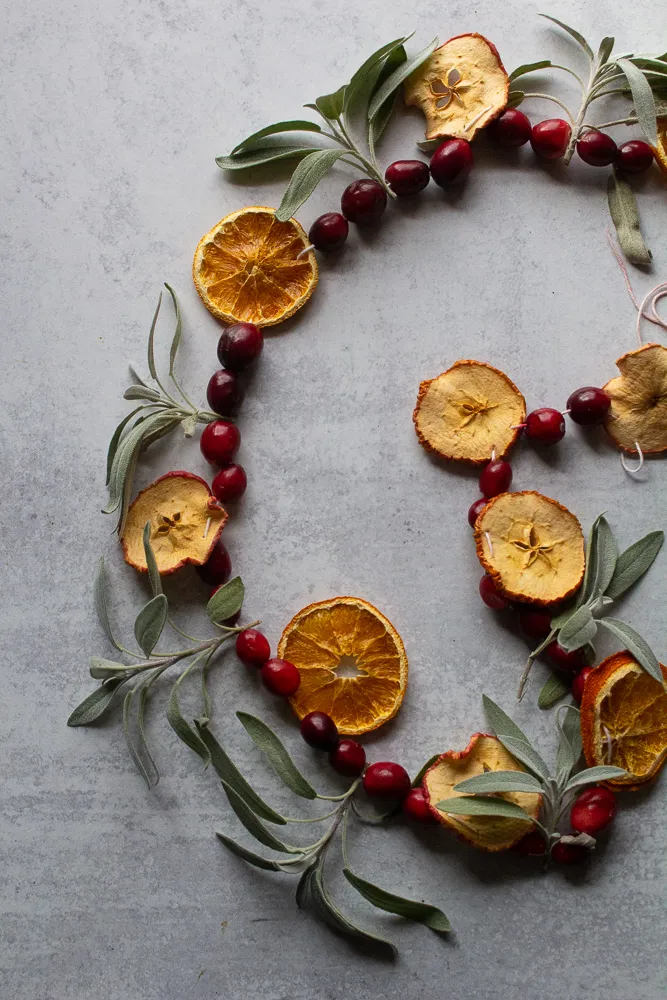
- 2 lb oranges, 1 lb apples: $6–$9
- Fresh cranberries, 12 oz: $3–$4
- One bunch fresh sage: $3
- Pink cotton string, 50 yards: $4
- Needle: $2
Total: $18–$22 for about 8 feet. Budget alternative: buy markdown fruit — bruised apples dehydrate exactly as well as perfect ones, and grocery stores discount them constantly. Same garland for under $10.
15. Two-Tone Citrus Ornament with a Rust Velvet Ribbon Bow
There’s a formula in the two slices: one deep amber-orange, one paler yellow-orange, stacked and tied as a single unit. Roughly 60% saturated orange, 30% pale citrus, 10% rust velvet. The pale slice is doing the work of a highlight — without it, the double slice reads as one flat disc and the bow has nothing to sit against. Switch the ribbon to deep green and you get a classic Christmas look; keep the rust and you get something warmer and more vintage.
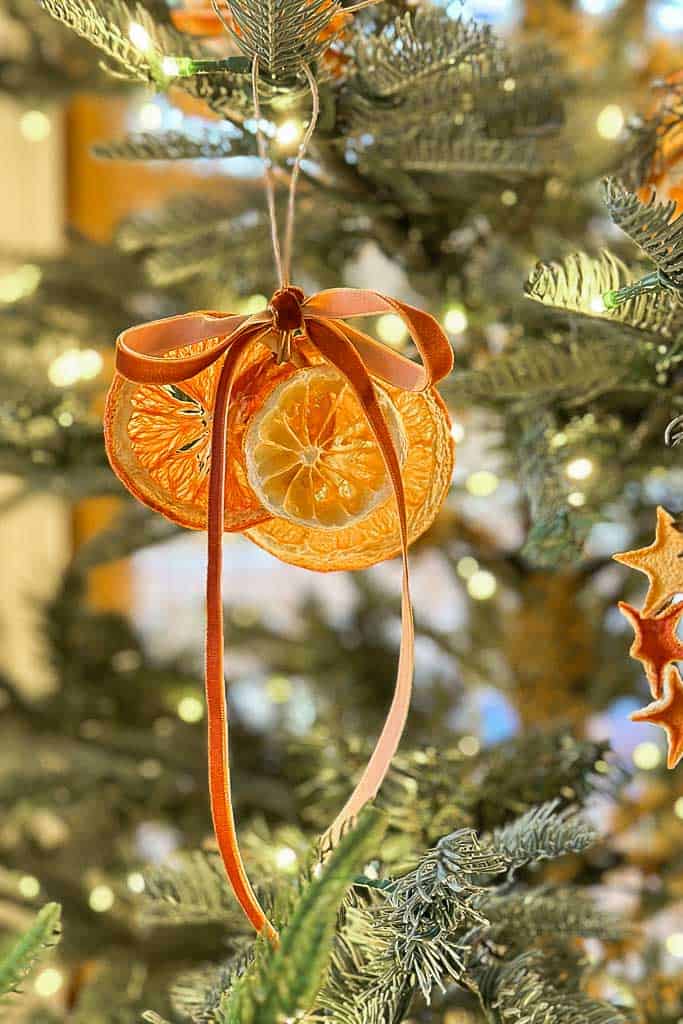
- Pick two slices of noticeably different color — one from the rind end, one from the center.
- Stack them and pierce both together with 20-gauge wire, 3/8 inch from the edge.
- Twist a loop above the stack.
- Tie a velvet ribbon bow with 6-inch tails over the wire.
- Hang on a branch that’s already near a warm light so the slices glow.
About 10 minutes each and roughly $1.50 in materials.
16. Citrus, Globe Lights, and Red Balls Over a Stone Fireplace
Real evergreen dries fast over a fireplace — that’s the trade-off. Plan on replacing branches every three to four weeks, or accept that needles will start dropping by early January. Keep the garland at least 12 inches above the firebox opening, and never let a strand of lights sit directly against the stone where heat collects. Dried citrus handles ambient warmth fine but goes brittle near direct heat.
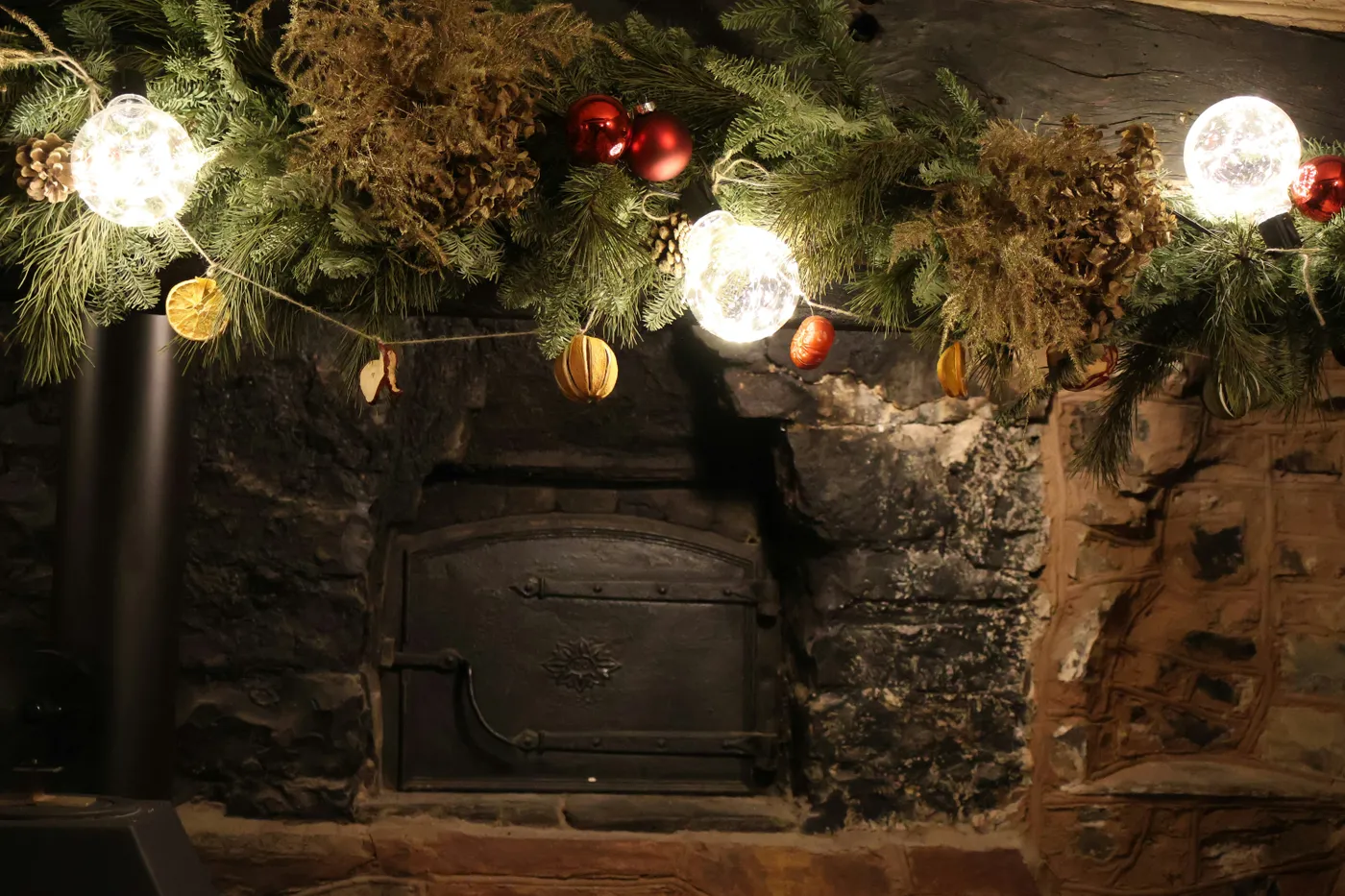
The stone does the heavy lifting. A dark, rough, matte surface reflects nothing, so warm globe bulbs and translucent orange slices become the only glow in the frame — instant contrast. The small red ornaments add a single saturated note you’d notice even in a blurry photo. And the scale is right: this garland is thick, roughly 8 to 10 inches deep, which is what a fireplace opening this size actually needs.
17. Classic Indoor Dried Fruit Garland, Straight and Simple
If you’d rather buy than bake, Etsy and Amazon both carry dried orange garlands, and prices split cleanly: mass-produced 6-footers run $15 to $28 with thin, uniform slices, while small-shop versions run $45 to $90 with thicker slices and better string. The middle ground is a $22 kit — pre-dried slices, twine, and a needle — which saves you four hours of oven time. Walmart also sells 3-foot dried citrus strands around $10 during the holidays.
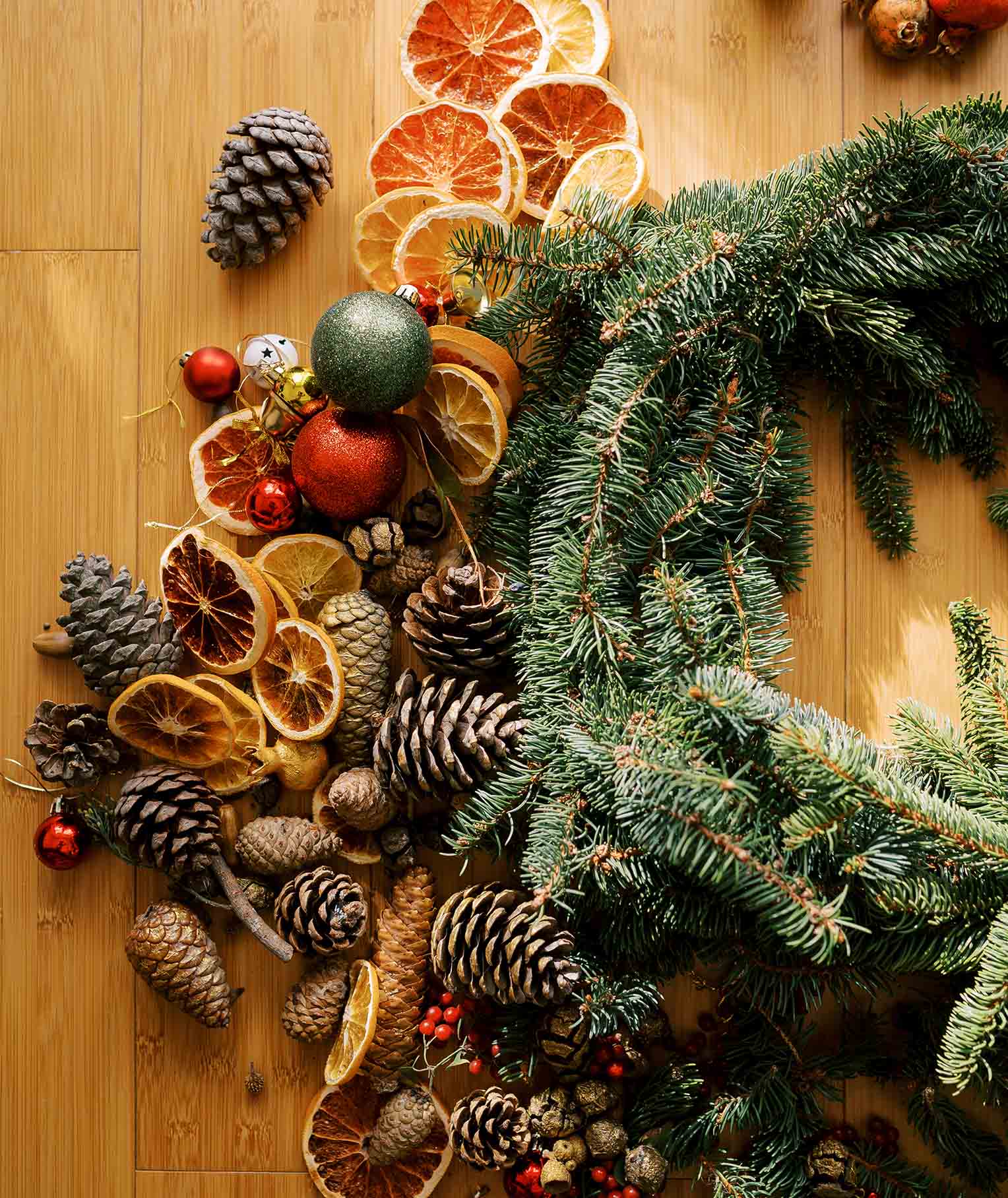
One thing to check before hanging a long straight garland indoors: dried citrus is heavier than it looks. Forty slices on cotton twine comes in around a pound, which is plenty to pull a small nail out of drywall. Use a proper hook or a screw-in cup hook for anything over 4 feet, and anchor both ends. If you rent and can’t make holes, adhesive hooks rated for 2 pounds will hold — just clean the wall first.
18. Stacked Orange Slices, Bay Leaves, and Beads on a Stair Rail
The doubled slices are the one thing. Each orange element is actually two slices stacked — sometimes matched, sometimes one orange and one lighter — so from across the room they read as solid medallions rather than thin, see-through discs. That single decision is what makes this garland feel substantial on a staircase, where you’re usually viewing it from ten feet away. Single slices at that distance just look like flecks.
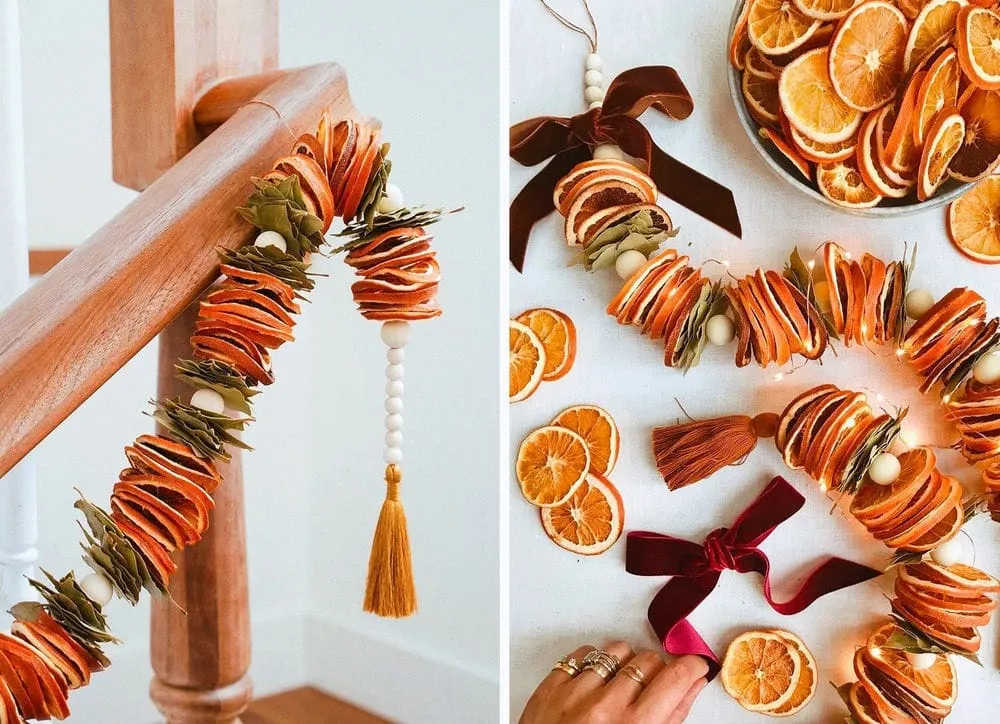
Stair rails are one of the few places a garland can go long. For a standard 8-foot run of railing, plan on 10 to 12 stacked medallions, spaced 8 to 10 inches apart, and let the tail drape at the newel post. Watch the height: the garland should hang below the rail, not wrap over it, or hands catch on it every trip down. This is the long-run counterpart to the window treatment in Idea #13. Add a mustard tassel or a deep red velvet bow at the bottom to finish it.
19. Layered Citrus, Cloves, and Cinnamon with Cream Raffia Ties
- Confirm your oranges are thin-skinned — navel and Valencia dry faster than thick-skinned varieties.
- Set aside a full afternoon; oven-drying is 3 to 4 hours plus cooling time.
- Check that your oven’s lowest setting actually holds at 200°F — many run hotter and scorch the edges.
- Make sure you have flat storage; slices crack when they’re stacked.
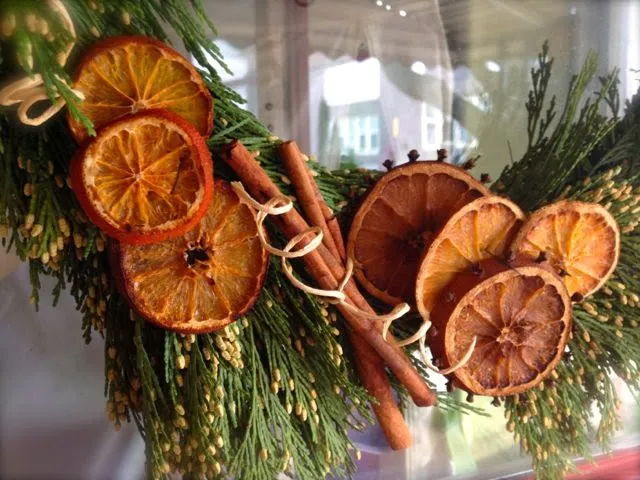
Cloves are strong. Push them into the rind, not the pith, and use 5 to 7 per slice — more than that and the whole garland smells like a dentist’s office. Whole cloves also make slices brittle, since every hole becomes a stress point; if you need this to survive storage, stud only the slices you plan to display and keep a plain backup set in the bin. Cream raffia ties are charming and last about a season before they fray and shed.
20. Faux Autumn Leaf Wreaths and Garland in Russet Tones
With faux leaves, the tell is uniformity. Real garlands have leaves that twist, curl, and face different directions; mass-produced stems line up like a marching band. Fix it in ten minutes: hold the piece up, then rotate about a third of the leaves by hand — bend the wire stems so some face backward and some point up. Bend five or six leaves at the very tip downward so they droop. Nobody can articulate why it looks better, but everyone notices.
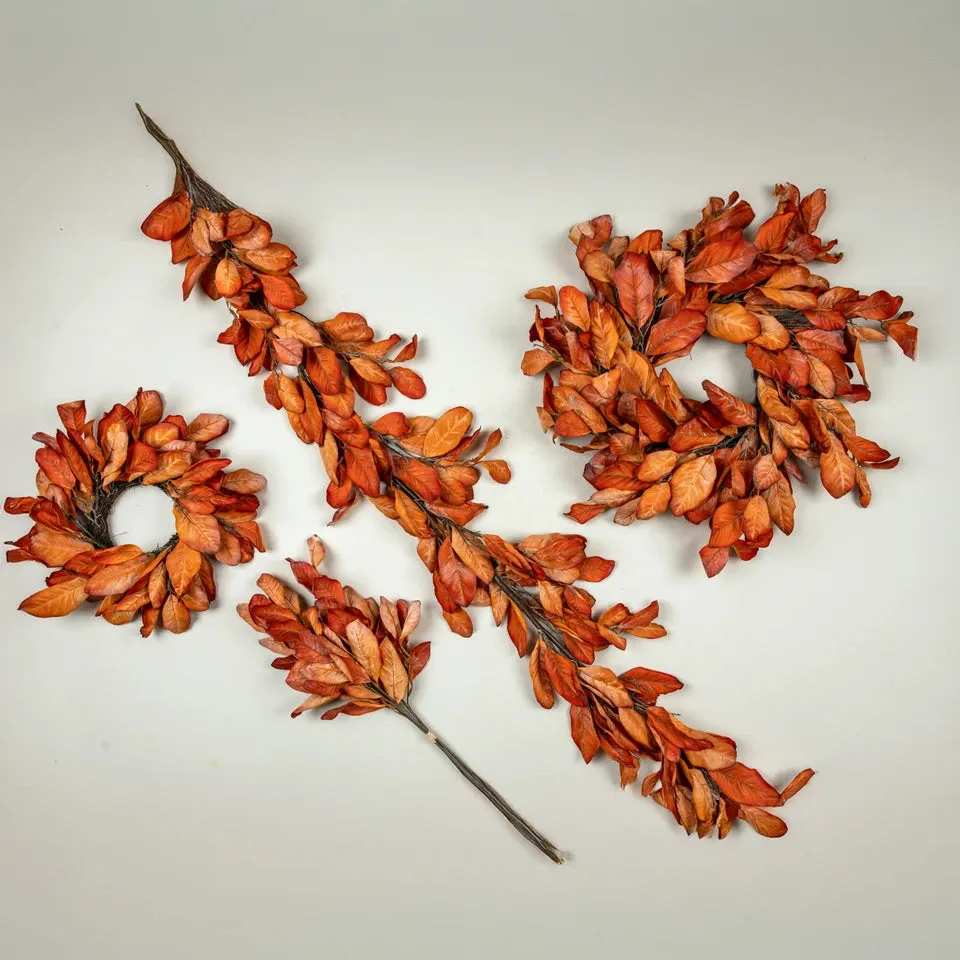
About 65% warm orange and russet, 25% mid-brown, 10% pale beige highlights. Because faux leaves come pre-dyed, you’re working with the colors you bought — so buy two or three shades in the same size and alternate them as you attach. A wreath made from a single shade flattens out; mixing three gives it the depth a real hedge has. The same formula works in spring with two greens and a cream.
Go Peel Some Oranges — You’re Four Hours From a Garland
Pick one idea, buy a bag of oranges, and give it an afternoon — the beginner-friendly version in Idea #1 is the easiest place to start, and the cranberry-spacer garland in Idea #14 is the one people always ask about. Whatever you choose, the three mistakes above are the difference between a garland that still looks beautiful in January and one you’re tossing out in a week. 📌 Pin this guide now so it’s waiting for you when the oranges go on sale.