22 Jaw-Dropping Christmas Centerpiece Ideas for Your Holiday Table That Will Amaze Your Guests in 2026

You know that feeling when you finally spot the centerpiece that makes the whole table look intentional, and you can already picture it on your own dining room? That’s the goal of everything below.
We spent serious time digging through Etsy, Target, World Market, and Amazon to bring you only what’s worth your attention this year — everything from an $8 pack of berry sprigs to a $220 garland-and-candle setup, and we narrowed hundreds of options down to 22 that actually deliver.
Inside: traditional red-and-green tables, rustic pinecone-and-mercury-glass styling, full-on glam gold, and one very committed peacock. Budget and luxury versions sit side by side so you can see exactly where the money goes, and the 2026 shift toward centerpieces that stay up all season — not just on dinner night — runs through every one of them.
And stay until the end — we break down the most common mistakes that can ruin these looks. 📌 Save this to Pinterest for later — you’ll want to revisit these ideas.
1. Crystal Taper Candles on Pine Garland Over Red Linen
Two colors do all the heavy lifting: a deep red cloth running the full length of the table, and forest green pine laid over it in one continuous sweep. What keeps that classic pairing from sliding into greeting-card territory is the white — white ceramic trees, small white pillar candles, white plates under clear glass. Three white moments, repeated down the table, give the eye somewhere to rest. Then the tapers finish the job: red, yellow, and gold at deliberately uneven heights, which is what makes the light feel alive instead of staged.
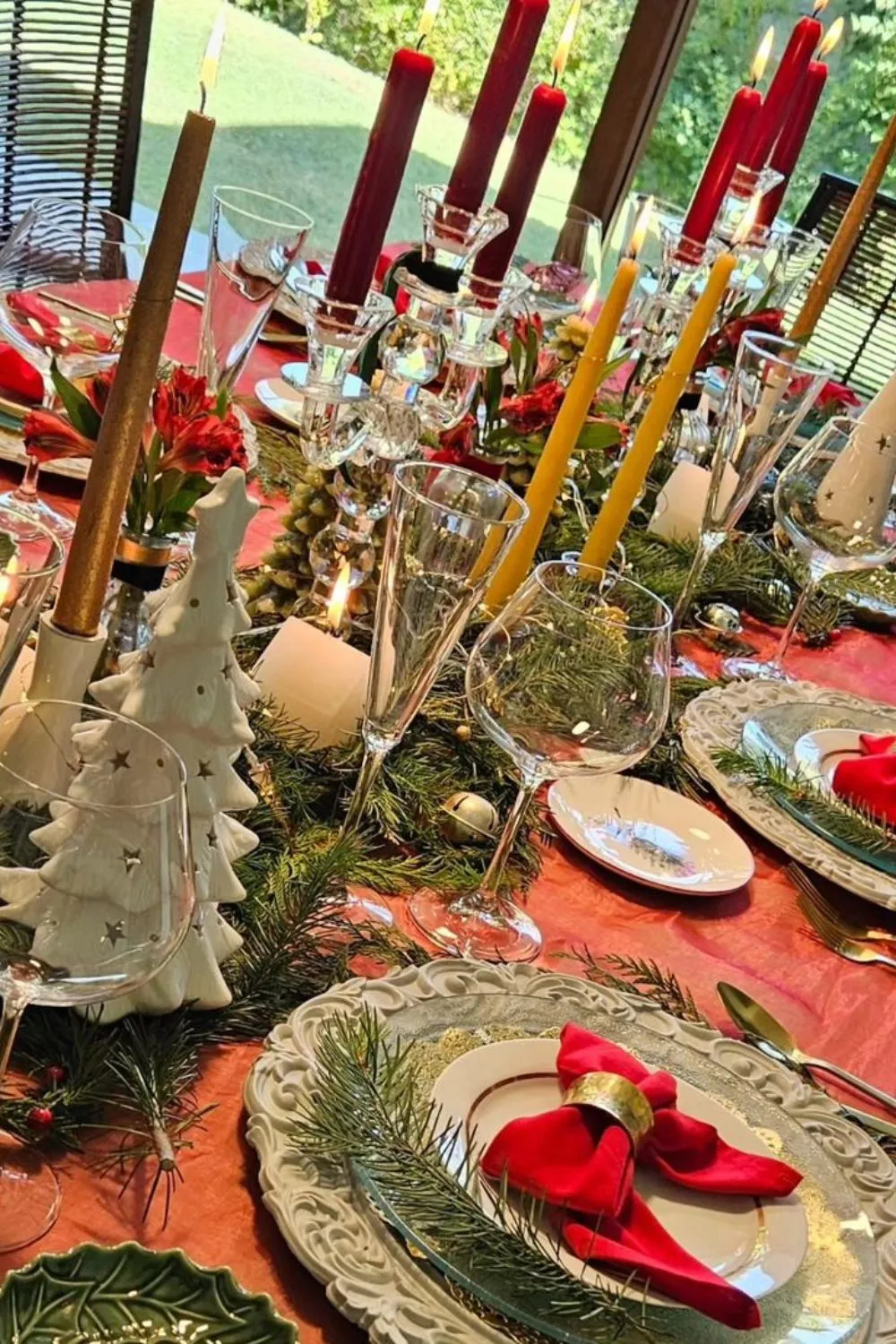
- Red cloth, velvet napkins, gold rings — $70–$150
- Pine garland plus white ceramic trees — $60–$140
- Crystal taper holders and mixed tapers — $45–$110
- Charger plates, glass and white dinner plates — $80–$180
Cheaper version: Marketplace chargers, dollar-store ribbon instead of napkin rings, and two thin garlands braided into one thick one.
2. A Rustic Ring of Evergreen Around One Red Pillar Candle
Strip everything away except the lit red pillar candle and you’d still have a centerpiece. That’s the test. The evergreens, pinecones, and berries are all arranged around one warm point of light, and every other element — matte red baubles, satin ribbon, natural pinecones — exists to keep that flame from looking lonely. Take the candle out and you have a wreath lying flat. Take a pinecone out and nobody notices. One light, one job.
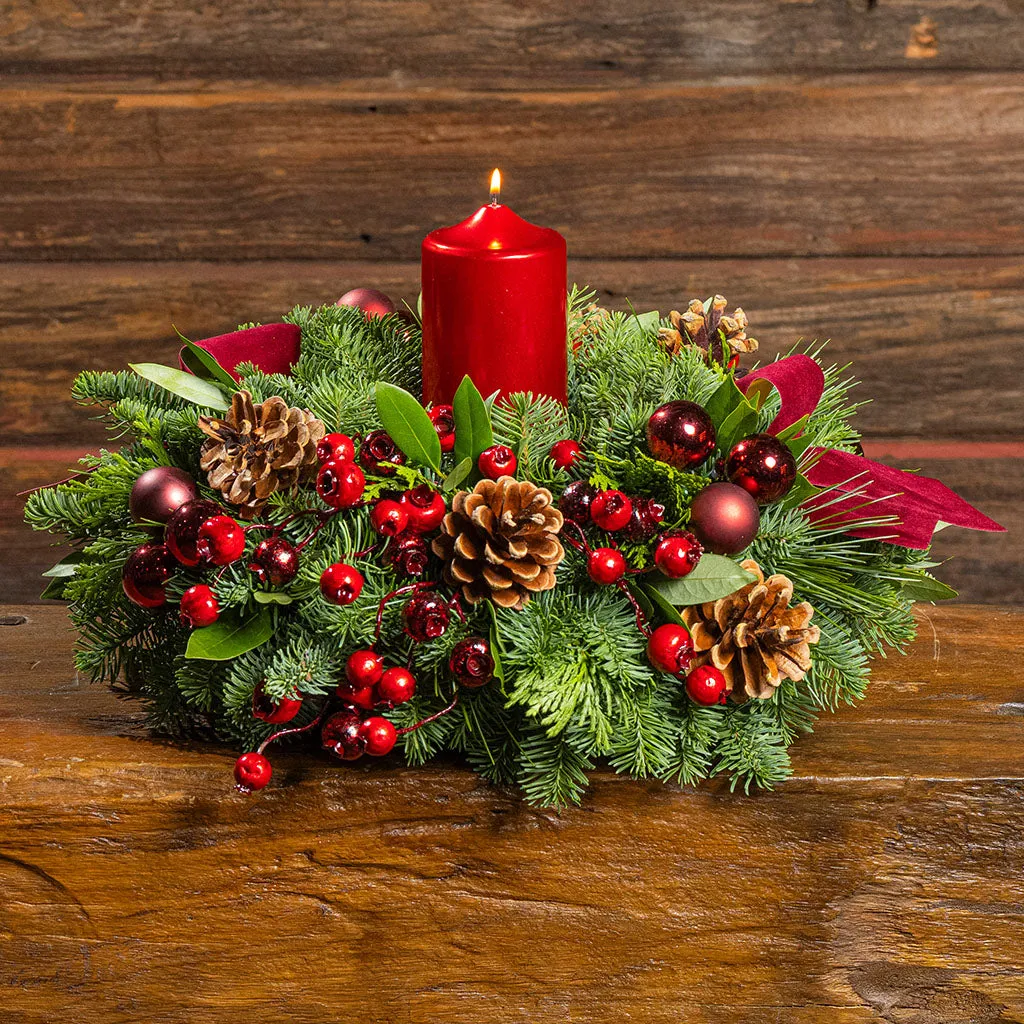
This shape wants a round or square table between 36 and 48 inches across. The ring itself should finish 12–14 inches wide so there’s still 18 inches of clear space at every seat — that’s the number that actually matters, not the table size. Push it to 18 inches on a 60-inch round and it still works, but it’s no longer a table you eat at comfortably. For a long rectangular table, Idea #14 takes the same green-and-red idea and puts it in a hurricane glass.
3. White Berries, Grey Pillars, and Velvet Bows on Pale Oak
The formula runs about 55% pale oak and white linen, 25% evergreen, 15% silver-white (berries, ornaments, those grey pillar candles), and 5% actual color — just the velvet bows on the plates. Swap the oak for walnut and the silver for warm brass and it goes moodier without changing shape. The one rule worth keeping: the runner stays lighter than the table beneath it. If your table is already pale, go two shades darker with a natural linen runner instead of white.
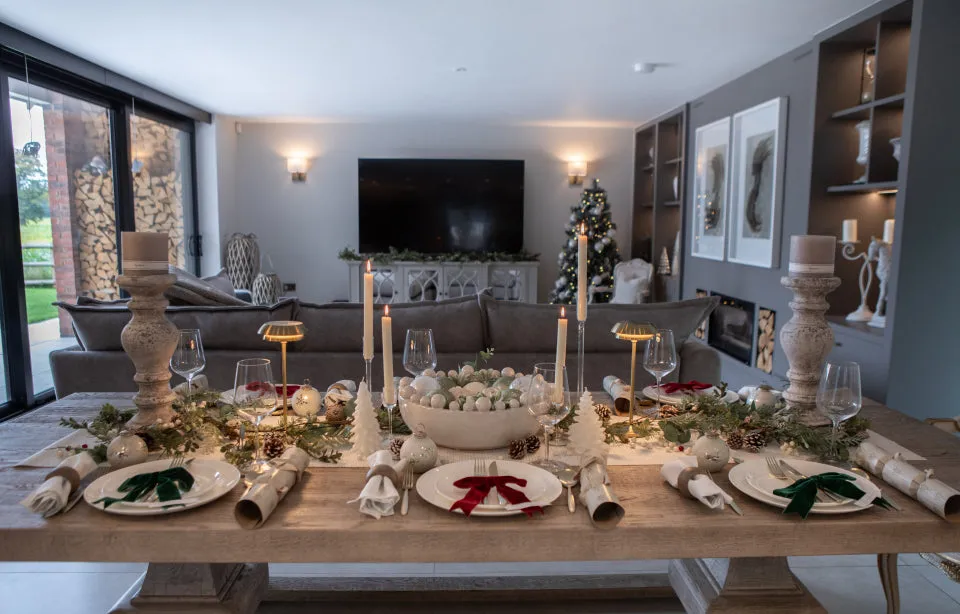
This is the temperature a lot of holiday tables have moved toward over the last few seasons — the green does the decorating and the red is a garnish. It got there partly because wood-toned dining tables came back, and partly because hosting got more relaxed. You can leave this setup out from Thanksgiving through New Year and it never feels dated. White berries and grey candles will still look right in 2028; the velvet bows are the only part with a shelf life, and honestly, they’re the fun part.
4. A Run of White Urns Packed With Red Berries
- Two white textured urns or footed vases — $50–$120
- Conifer foliage, dark red accents, bright red berries — $60–$150
- Gold-tone goblets, set of four — $40–$90
- Silver-rimmed plates and a white cloth — $70–$160
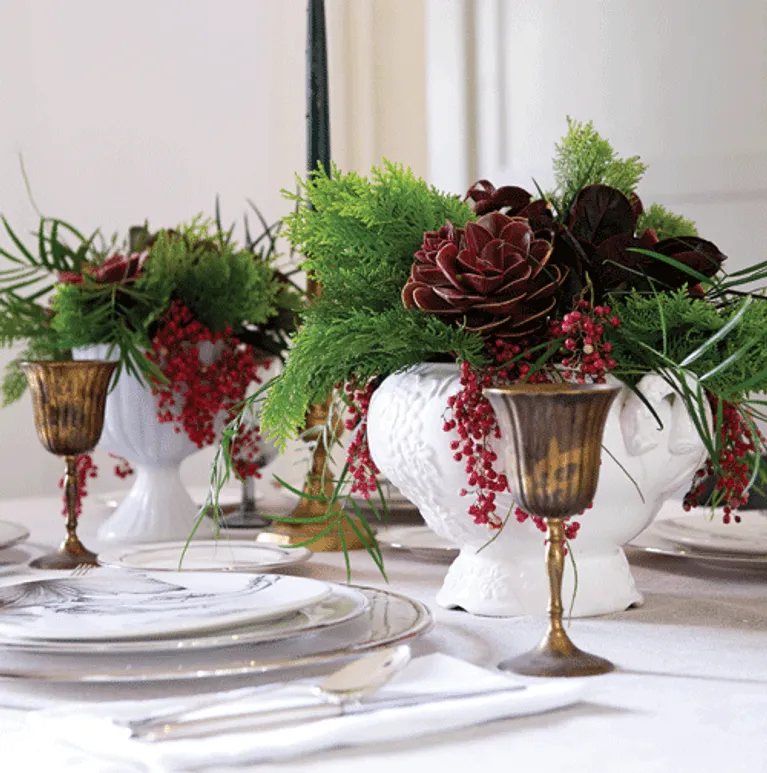
Trimmed-down route: thrift-store ceramic urns at $10–$20 each, grocery-store greenery, and secondhand brass goblets.
Building one urn, step by step:
- Soak a block of floral foam, tape it into the urn, and lock it down with a crisscross of clear tape.
- Set three conifer branches low and wide first — they hide the mechanics and set the footprint.
- Add the dark red accents in a loose triangle, not a circle. Symmetry kills this shape.
- Tuck the bright red berries at the outer edges, where they’ll catch the most light.
- Fill the gaps, then spin the urn a quarter turn and fix whatever you missed.
Twenty minutes per urn, about $25–$40 in materials if you’re buying grocery greenery.
5. White Pillar Candle, Gold Leaves, and Pomegranate-Red Fruit
Dried gold leaves, berries, and pinecones sitting inches from a live flame is a beautiful arrangement and an honest fire risk — the softly lit tree in the background of a styled shot won’t warn you about that. Either keep the flame inside a glass sleeve taller than your tallest dried element, or switch to a battery pillar with a moving wick. One more thing: pinecones collected from outside should be baked at 200°F for 30 minutes first, or you’ll bring sap and small insects indoors with them.
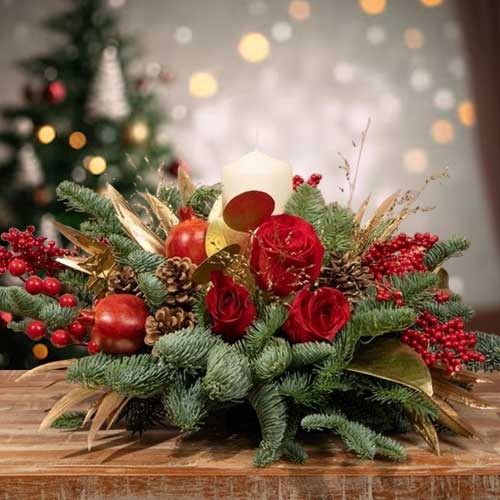
Keep the top of the arrangement at or under 12 inches from the table surface — that’s the measurement that lets seated guests see each other. If you want height, get it from the tree in the background, not the centerpiece. And when you’re dropping a white candle into red-and-green styling, place it slightly off-center rather than dead middle. The eye reads an off-center white as intentional and a perfectly centered one as a mistake.
6. The DIY Prep Table: Floral Foam, Lilies, and a Turquoise Pot
A florist-built version of this runs $85–$150 and lasts maybe a week. The DIY route — a foam block ($4), a grocery bunch of lilies ($12), a pack of berry sprigs ($6), plus foliage clipped from your own yard — lands under $30 for the same volume. Glitter pinecones are the easiest thing to make at home: school glue, fine gold glitter, twenty minutes, basically free if you already pick up pinecones on walks. Keep the foam cage and the pot and you’re at $20 next December.
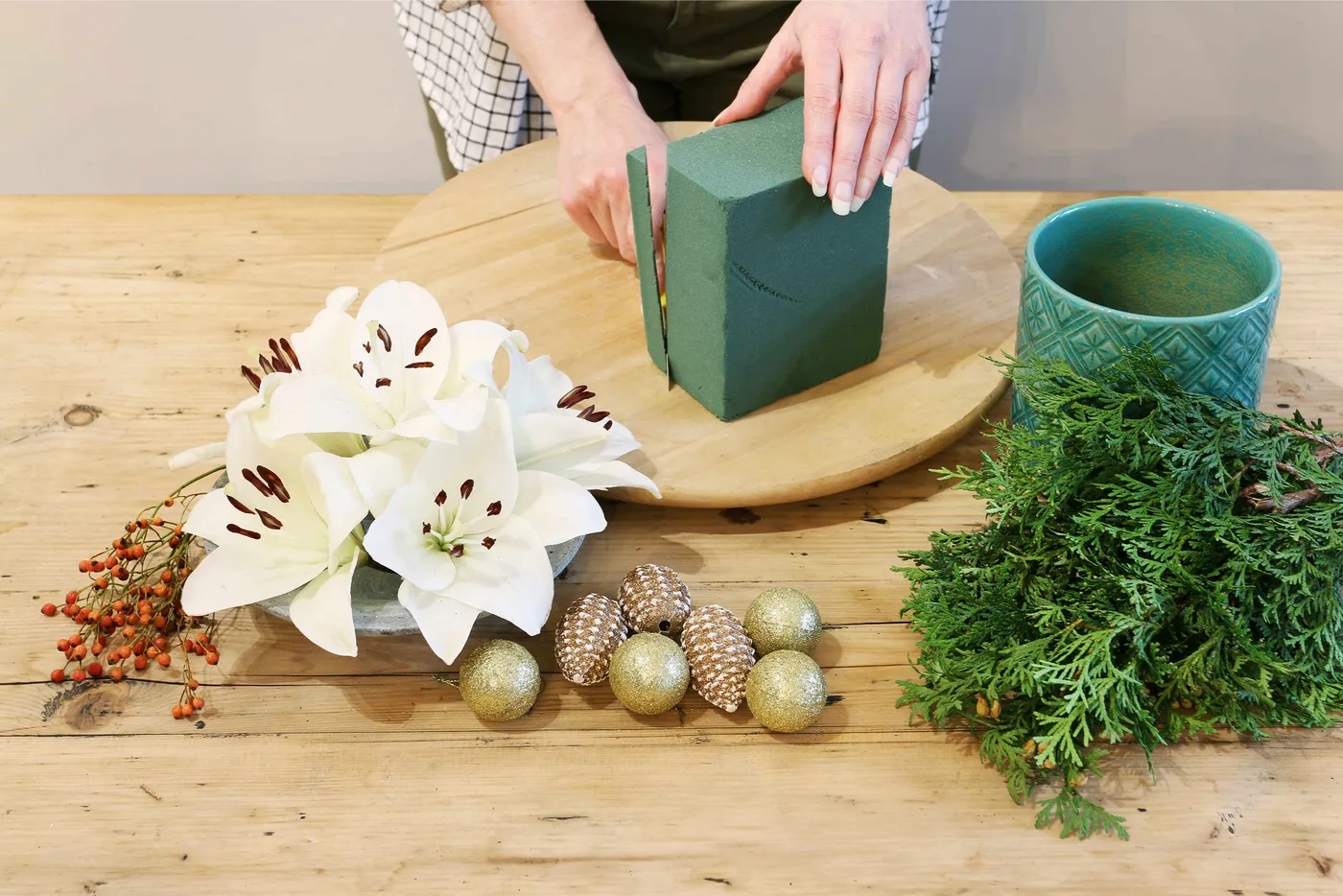
The turquoise pot is the element doing the most work here, and it’s the one piece worth spending on. Turquoise sits nearly across from red-orange on the color wheel, so it sharpens every berry in the arrangement without adding a fourth holiday color. Swap it for white or gold and the whole thing collapses into “nice, seen it.” Thrift stores are full of textured ceramic pots in exactly this blue-green, usually under $15.
7. Variegated Holly With Matte and Shiny Red Baubles
Plan on 16–18 inches for the base, because this greenery spreads wider than it looks from above, and a table under 40 inches will feel crowded fast. On a narrow table, drop to a smaller hoop of foliage and let the red ribbon run down the runner instead. If your dining room doubles as a workspace, park the whole thing on a 20-inch round tray you can lift off in one move — the tray handles this footprint with a little overhang and saves you rebuilding it every Monday.
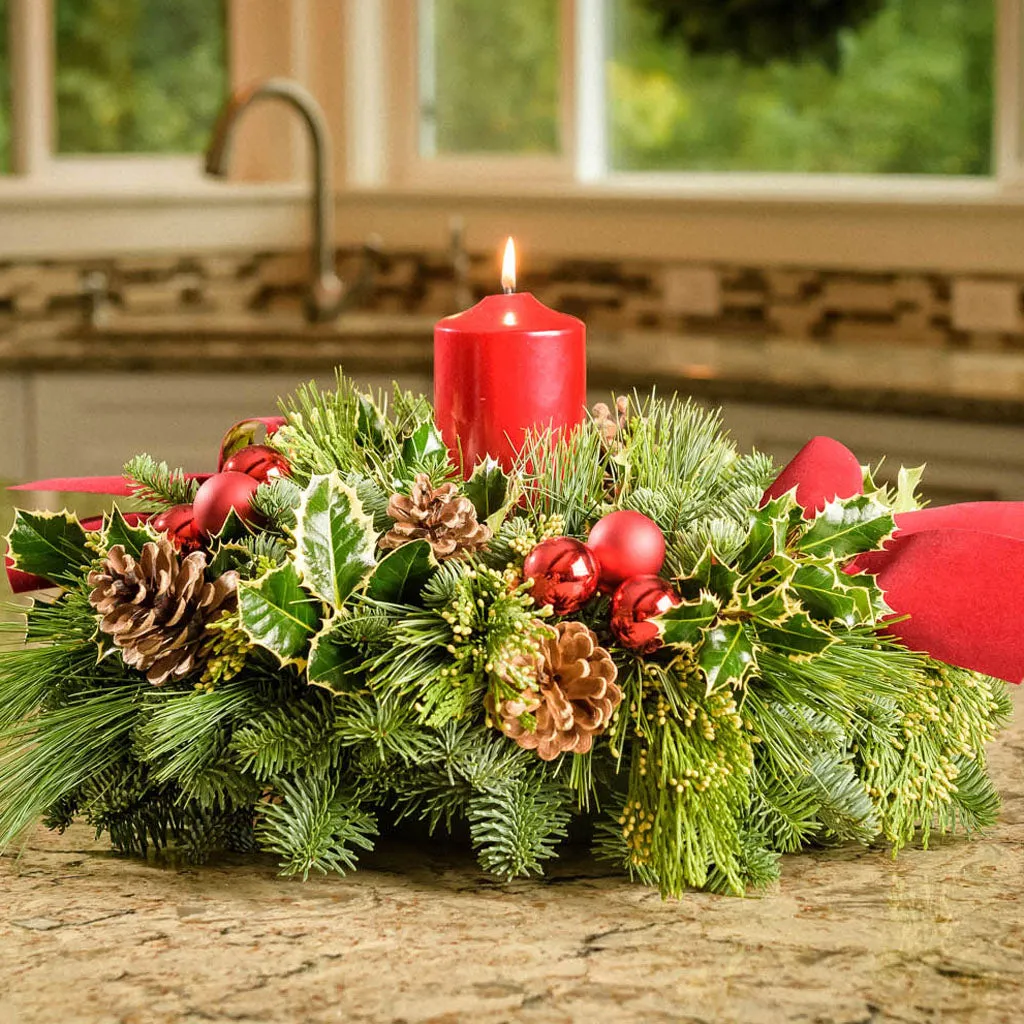
Two things are doing the work. First, the holly: those cream-edged variegated leaves break up solid green and give the arrangement a lighter, almost silvery outline, which is why it holds up against a dark table. Second, the ornaments are deliberately mismatched in finish — matte red next to shiny red — and that finish contrast reads as depth from across the room. Match them all shiny and the whole thing flattens into one red mass. Same color, different surface, sudden dimension.
8. Disco Balls, Mini Pies, and a Gold-Fringe Tablecloth
That gold-fringe skirt is a cloth layered over a fitted base cloth, not a skirted table on its own — otherwise you see straight through the fringe to the table legs the second someone sits down. Buy fringe trim by the yard and hem-tape it to a plain white cloth 1 inch off the floor. Second tip: cap yourself at two metallics. Gold fringe plus silver disco balls plus brass cutlery is one too many, which is exactly why the chargers and shell plates here stay matte and quiet.
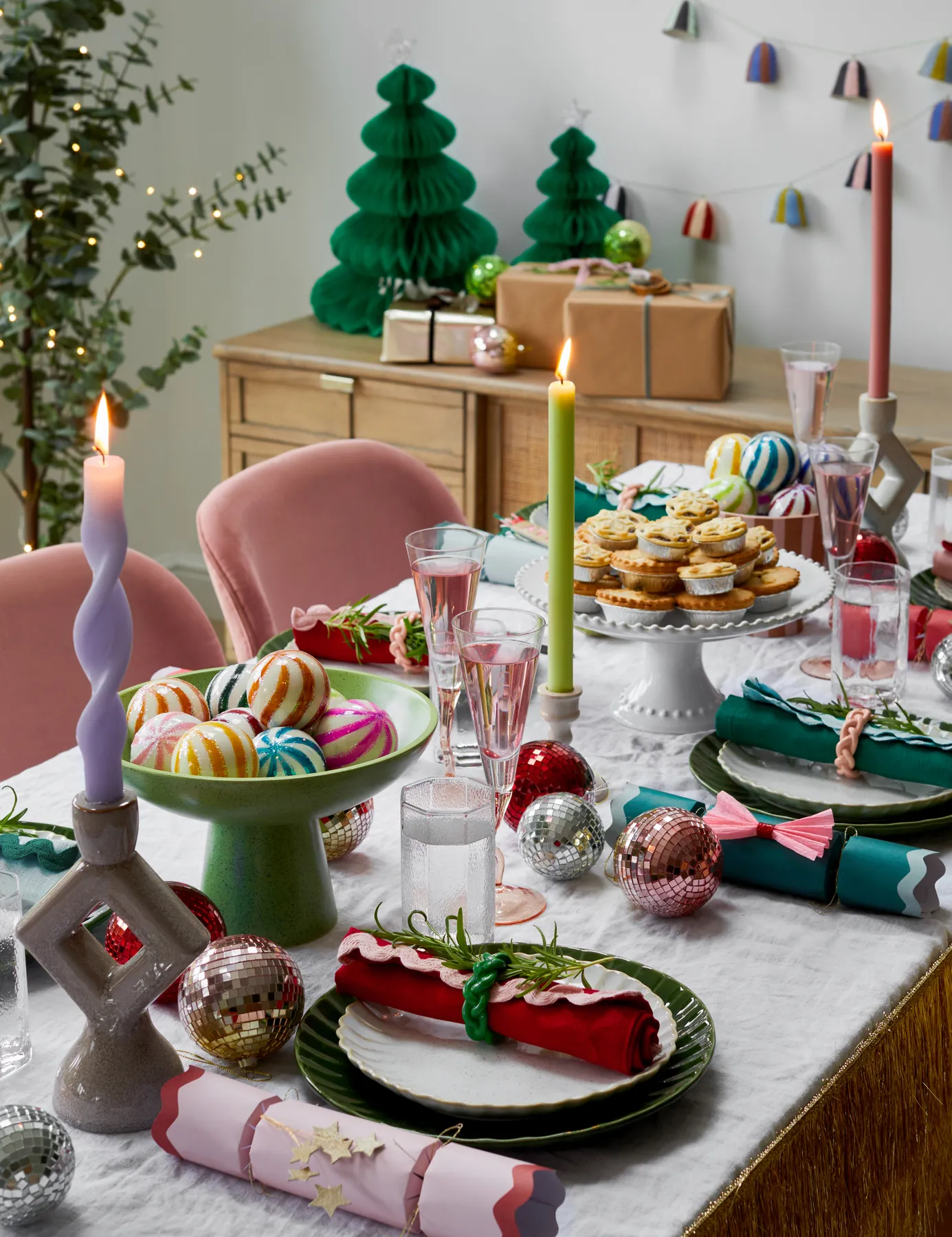
Call it 45% white (cloth, plates, cake stand), 25% green, 20% rose pink and gold, and 10% silver disco. The trick is that the playful part is capped at a tenth of the table — that’s what keeps a disco ball reading as a choice instead of a theme. Want it calmer? Trade the rose pink for soft butter yellow and the formula holds. Want it louder? Push disco to 20% and pull white back to 35%, but keep one solid white anchor so the eye still lands somewhere.
9. Three Gold Cone Vases: Peonies, Orchids, Frosted Ferns
Cream peonies in December are a budget decision, not an aesthetic one — expect $6–$10 a stem, sometimes more, and they’ll open and drop within four days. The orchids are the fragile part; those yellow-green blooms bruise if they’re crowded against the pine. Build these the day before, keep them cool and out of direct sun, and check that your gold vases are actually watertight — some decorative finishes are painted on the inside and standing water will lift them right off.
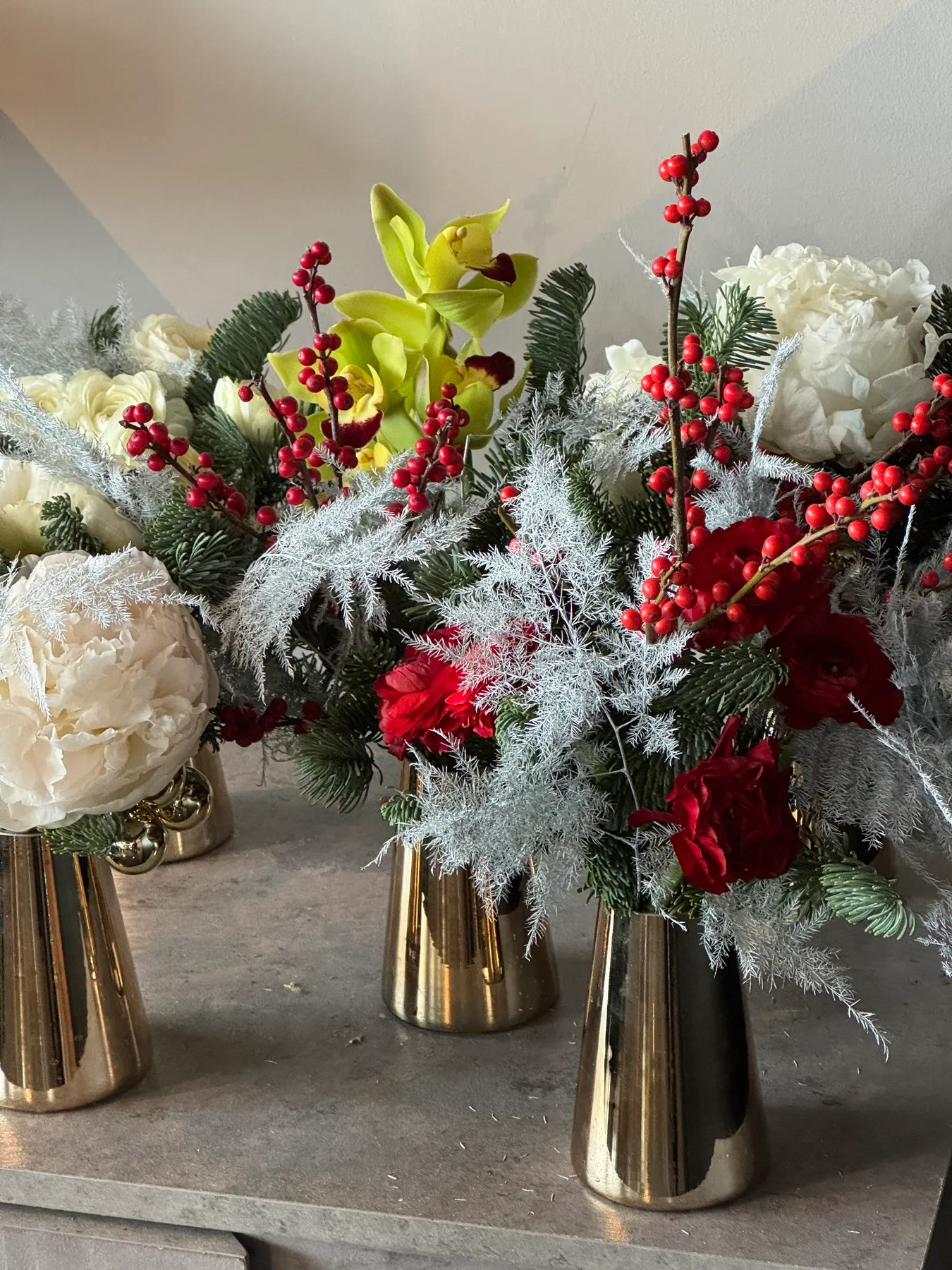
Three gold cone vases at retail run $30–$60 each. Spray-paint thrifted glass or ceramic cones with gold metallic and you’re in about $8 apiece — shape is what matters here, not material. Swap peonies for white carnations (around $1.50 a stem, two weeks of vase life), keep the pine and berries real, and use one orchid stem instead of a cluster. Same silhouette, roughly $45 total instead of $180. Idea #21 is the clear-vase version of this same recipe.
10. Bubble Vases of Red and White Roses Down the Table
Repetition. One arrangement in a clear bubble vase is a centerpiece; five matching ones marching down the table is a design decision. The identical vase height is what does it — every arrangement sits at the same level, so the eye reads rhythm instead of a cluster. If you had to cut everything else, keep the matching vessels and shrink the flowers. Mismatched vases holding the same roses would lose the entire effect, which tells you how much of this look is the containers and how little is the blooms.
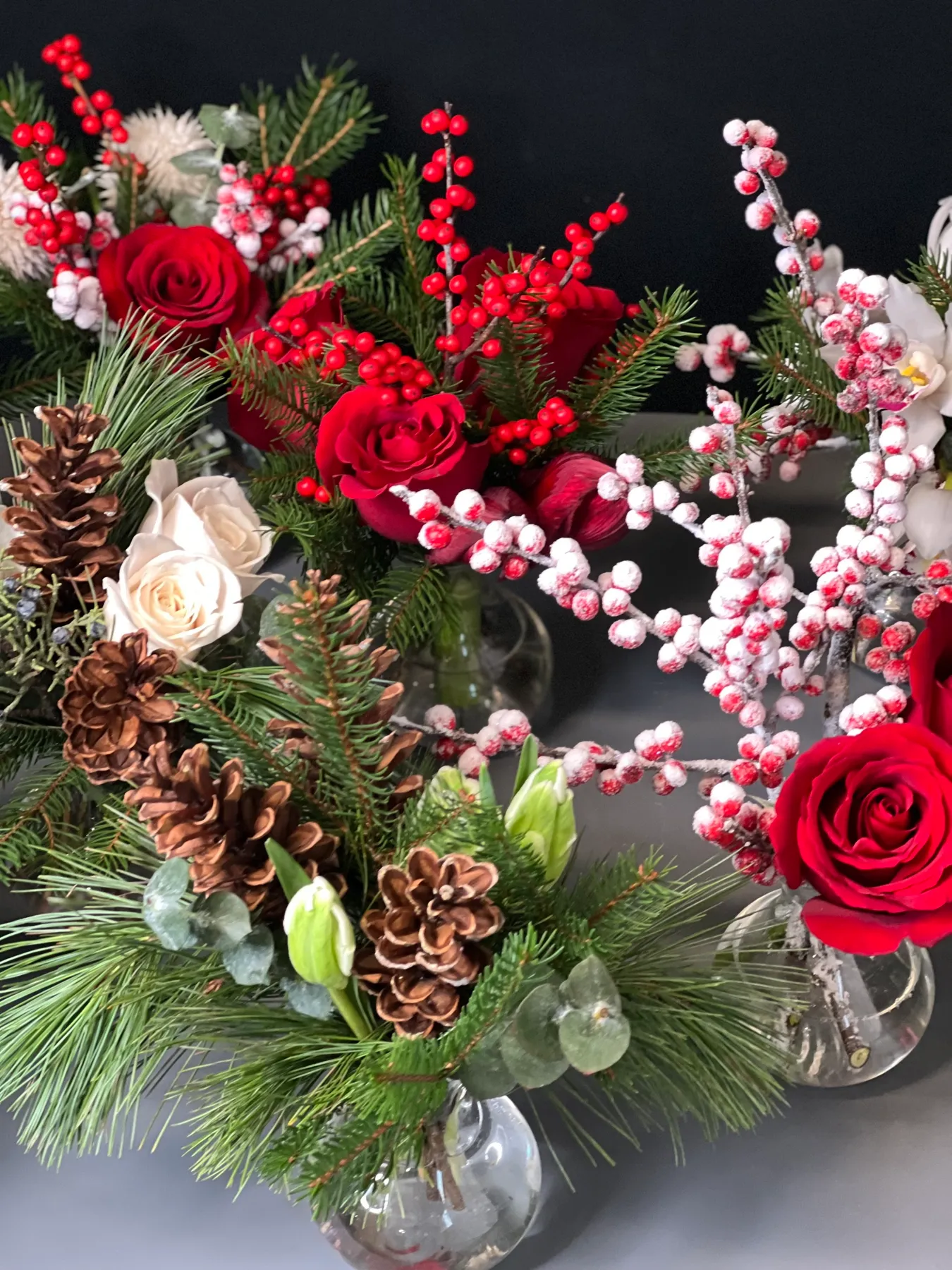
Five small arrangements suit a table 72 inches or longer; at 60 inches, three is plenty. Space them 14–16 inches apart on center and keep each under 9 inches tall, or you’ll cut the sightline. Bubble vases in the 4–5 inch range are the sweet spot — big enough for three roses and a sprig of pine, small enough to see over. Shorter tables do better with the single low ring in Idea #2.
11. Cream Herringbone Napkins on Glittering Gold Placemats
Glitter is the honest cost of this look. A glitter placemat sheds for the first three or four uses, so shake each one out over a trash can before it ever reaches the table, and never stack them in storage. Fresh garland drops needles the moment your house gets dry — mist it every other day and keep it away from heat vents, or you’ll be vacuuming daily by week two. Cotton bolls stay pristine for years; dust them with a dry brush rather than a damp cloth, which mats the fibers.
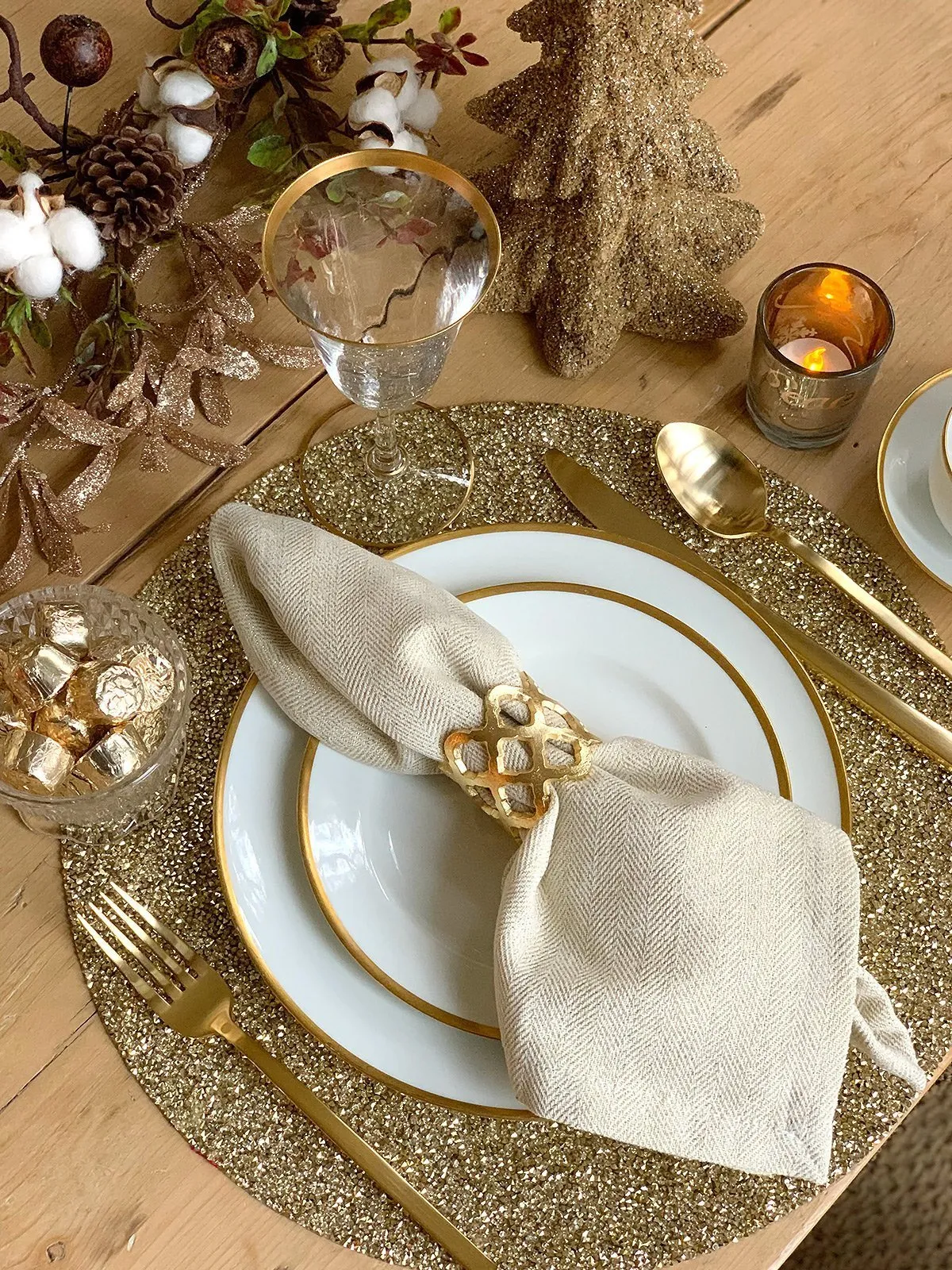
Placemat sizing is the quiet mistake on most glam tables. A rectangular placemat should extend about 2 inches past the plate on each side, which puts you at 15–16 inches wide for a standard 10.5-inch dinner plate. Go bigger and it reads as a scrap of tablecloth. Then set the plate directly on the placemat with no charger between them — with a gold glitter mat and a gold-rimmed plate, a charger would be a third gold edge, and that’s one too many.
12. A Peacock on the Napkin: Teal and Gold Place Setting
- Peacock napkin ornaments, set of four — $24–$60
- Gold placemats, set of four — $30–$70
- White plates with gold rims, set of four — $50–$110
- Teal textured glasses, set of four — $28–$65
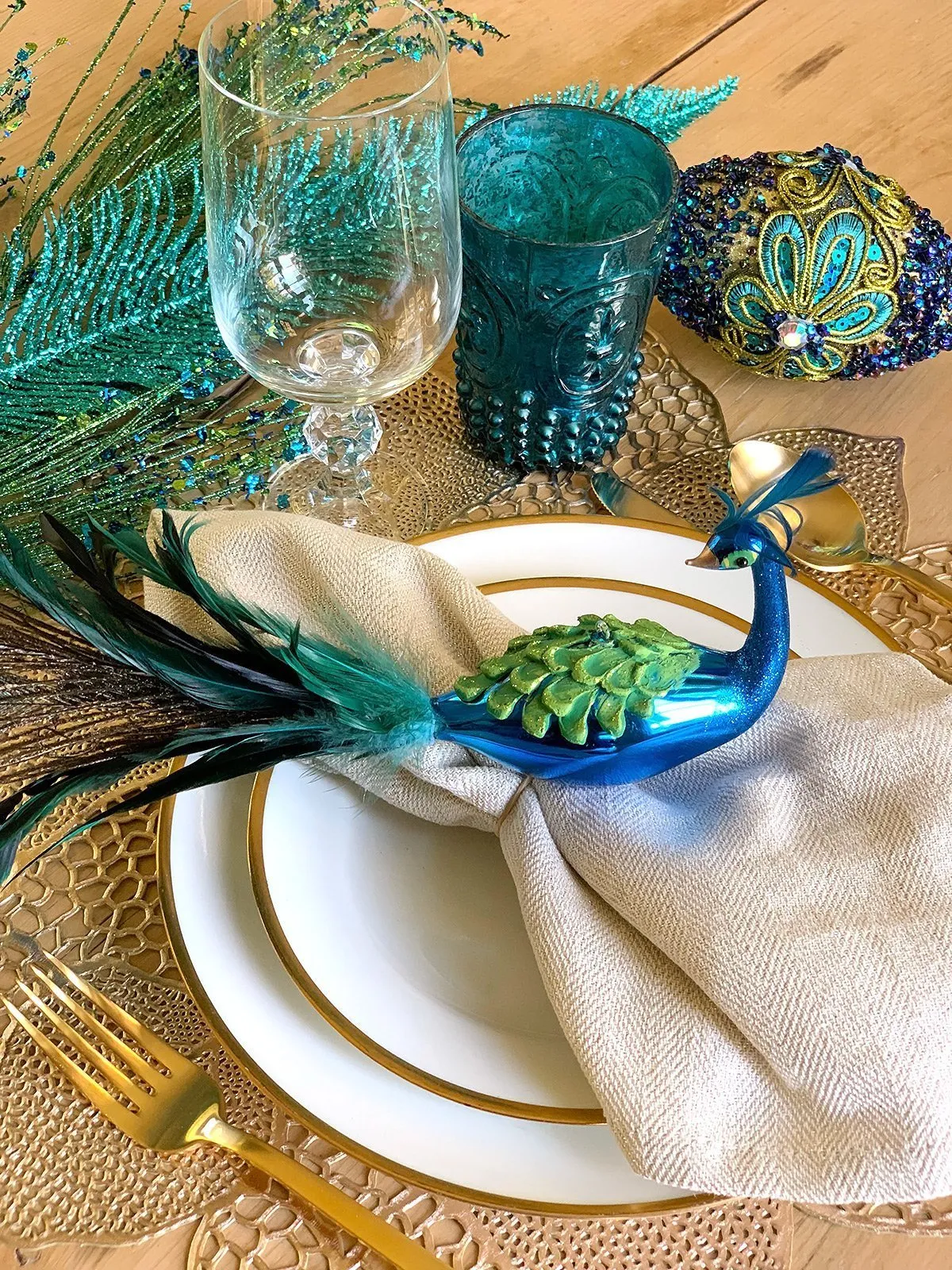
Trim it by using one peacock ornament per two settings and swapping the glasses for tinted dollar-store stemware.
Teal and gold are near-complements, so the color story snaps together without a single red or green ornament in sight. What makes it feel luxurious instead of costume-y is restraint on size: the peacock is small, it sits on the napkin rather than beside the plate, and it stays the only figurative object at the setting. Two of them would tip straight into novelty. The white plate with the gold rim is quietly doing the hardest job — separating a busy placemat from a busy ornament so nothing competes.
13. Fringed Skirt, Deer Statue, and Potted Amaryllis
A round table 42–60 inches across is where this lives best, and it needs a 36-inch walkway on at least two sides because the fringed cloth spreads wider than the tabletop itself. Keep the deer around 18–24 inches tall — any taller and it eclipses the amaryllis. If your table sits near a doorway like this one, leave 42 inches of clear floor in front of the door swing. Working with a small entry table instead? Skip the deer and keep the fringed cloth, the potted amaryllis, and the votives.
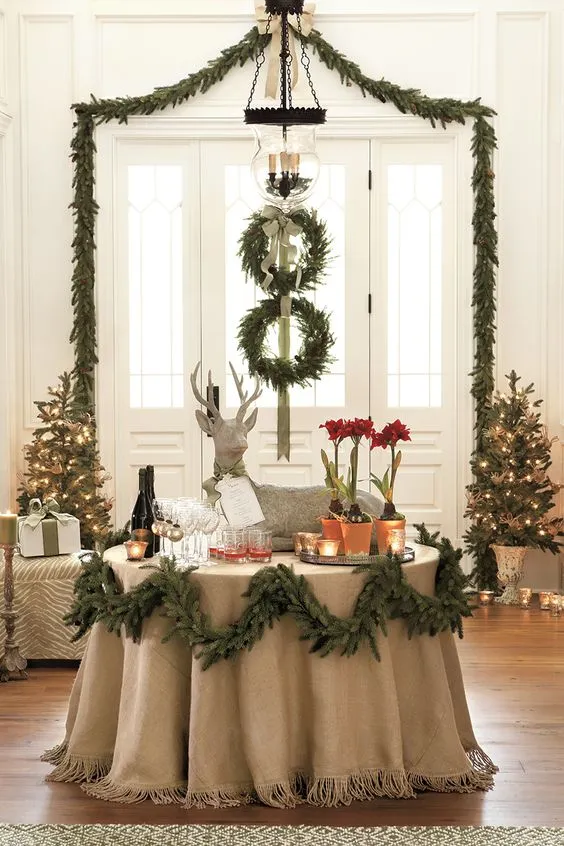
Woodland styling keeps circling back because it solves a real hosting problem: it looks dressed without looking themed, and it ages gracefully past December 25. This is the softer end of the traditional revival — natural linen, moss, deer, living plants instead of foil. Amaryllis is a big part of why it’s having a moment; bulbs sell for $8–$15 in fall and bloom right on schedule for the holidays. That’s a very 2026 kind of luxury: slow, alive, and cheaper than a florist.
14. Deep Red Roses and a Hurricane Candle on Polished Wood
- Set the hurricane in the center and fill the base with an inch of water or damp sand so the glass can’t slide.
- Drop in the pillar candle first — everything else gets built around it, never the other way around.
- Ring the base with evergreen, working in one direction, keeping the lowest branches to hide the glass edge.
- Add roses and carnations in three loose clusters rather than evenly spaced around the circle.
- Finish with berries and shiny ornaments, then tie the bow and let the tails fall toward the table.
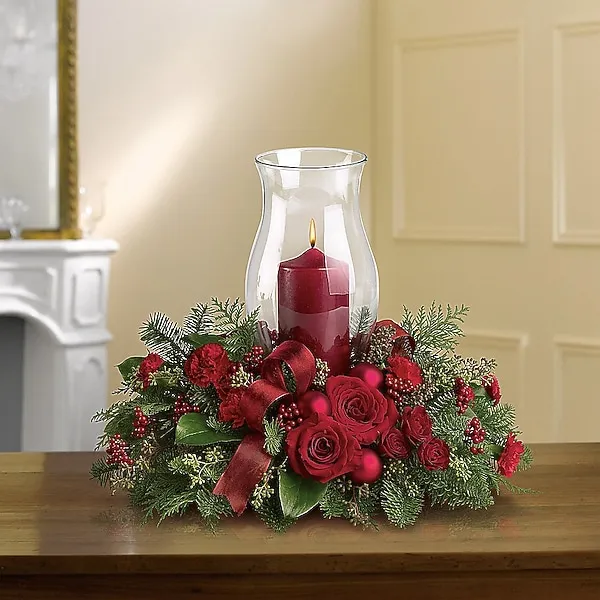
Thirty minutes, $50–$75 in materials, and it holds about five days if you refresh the water. If you’d rather skip roses entirely, Idea #5 gets a similar feeling with a white pillar and pomegranate-red fruit.
Roughly 50% green, 30% deep red, 15% polished dark wood, 5% glass and ribbon shine. The wood here is acting as a color, not a background — that dark polished surface bounces candlelight back up into the arrangement. Put this exact centerpiece on pale oak and it goes soft, almost summery; add more stain and it turns theatrical. Keep your reds in one family: a crimson pillar with an oxblood rose reads deliberate. Mix crimson with orange-red and it reads accidental.
15. Galvanized Buckets With Mercury Glass and Taper Candles
Galvanized buckets and water are not friends. Left wet, the zinc coating will spot and eventually rust from the inside, and a rusty bucket will leave a ring on light wood. Line each one with a cheap plastic insert or a glass jar, and never let water sit in them more than a day or two. If these are a set you plan to keep, dry them completely before storage. That’s the difference between a one-season prop and something you pull out for a decade.
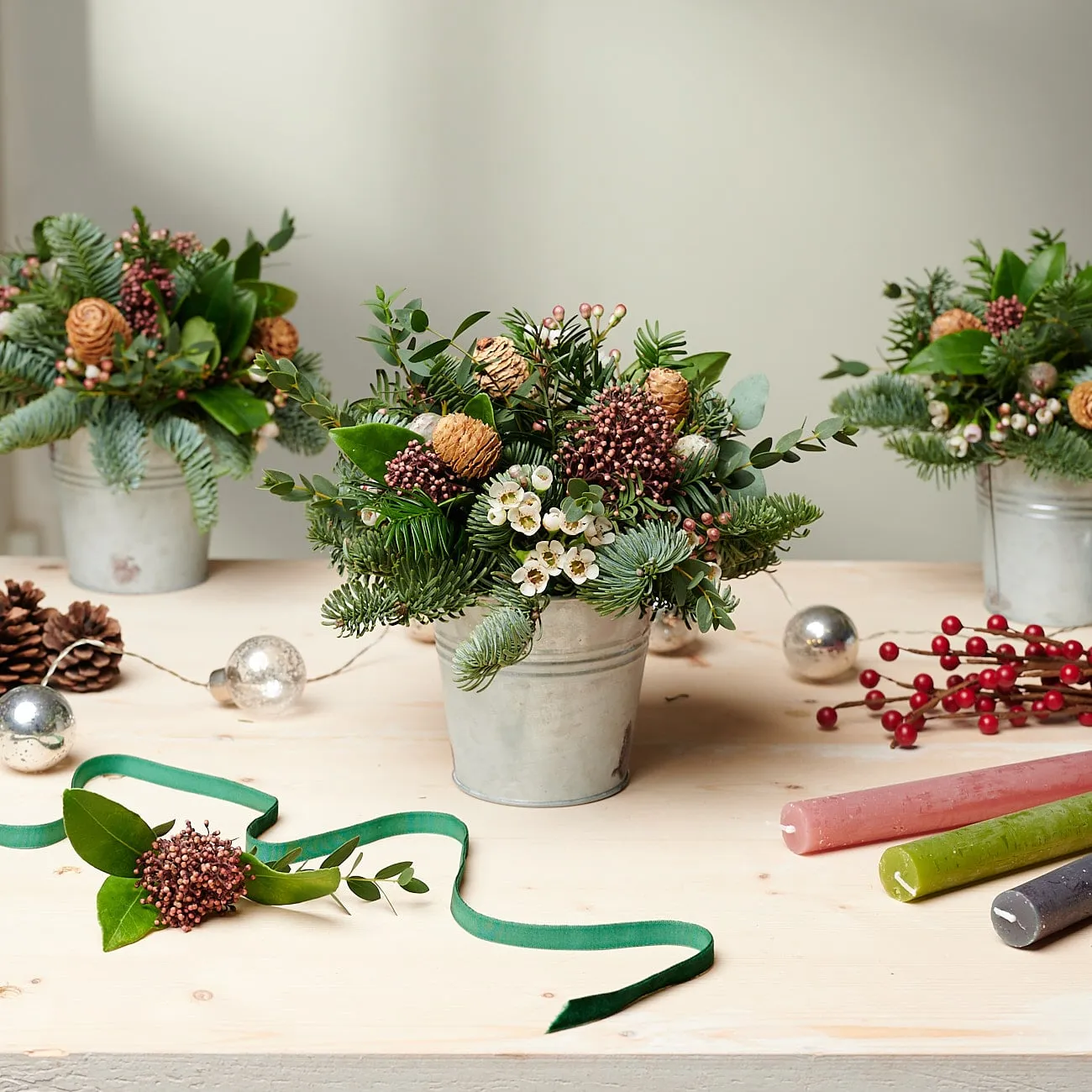
Three galvanized buckets run $6–$12 each at a hardware store — the identical ones sold as “holiday planters” cost triple at a gift shop. Mercury glass is where the fun is: vintage pieces go $15–$40 each, but dollar-store glass ornaments sprayed with mirror-finish paint look convincing from across the table. Taper candles in pink, green, and grey are about $2 each at Walmart. The whole arrangement comes in under $60 and looks like a farmhouse-market find.
16. Red, Blush, and White Blooms on a Checkered Cloth
The checkered cloth is what turns a big pretty bouquet into an actual tablescape. Without it, the arrangement floats on nothing; with it, the deep red and blush blooms have a grid to sit against, and the brown in the check picks up the evergreen stems. Notice how the blush pink roses bridge the deep red and the white anemones — that middle tone is what stops the palette from splitting into two opposing camps. Lose the cloth and you lose the anchor.
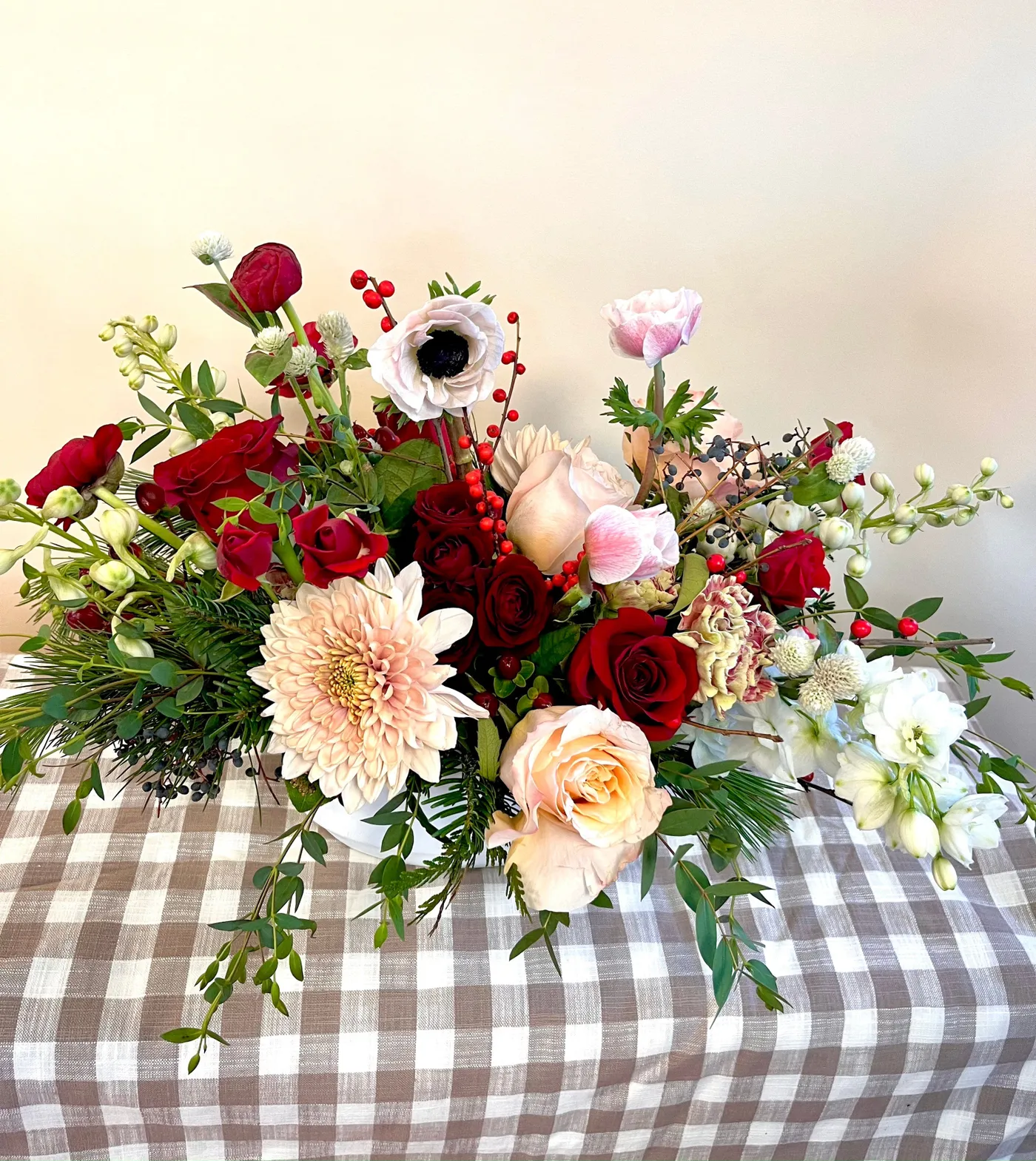
For a bouquet this size, aim for a diameter about one-third of your table’s width and a total height under 10 inches above the surface. On a 54-inch round that’s an 18-inch arrangement; on a 40-inch bistro table, 13 inches. Any wider and your guests eat with their elbows pinned in. Also, arrange it in your hand, not in the vase: spiral the stems so each bloom faces outward, tie it, then drop it into a vessel already filled with water and a pinch of flower food.
17. A Berry-Topped Cake as the Centerpiece, With Pomegranates
This is a setup for tables that are actually occupied, including small ones. It works down to a 30-inch bistro table or a kitchen island that doubles as dining space, because the centerpiece stays about 10 inches tall and 12 inches wide. The cake stand lifts the focal point to eye level while the runner and candles stay low, which keeps the sightlines open. Compare with Idea #4 — that urn arrangement needs a wider table, but the candle heights work out the same.
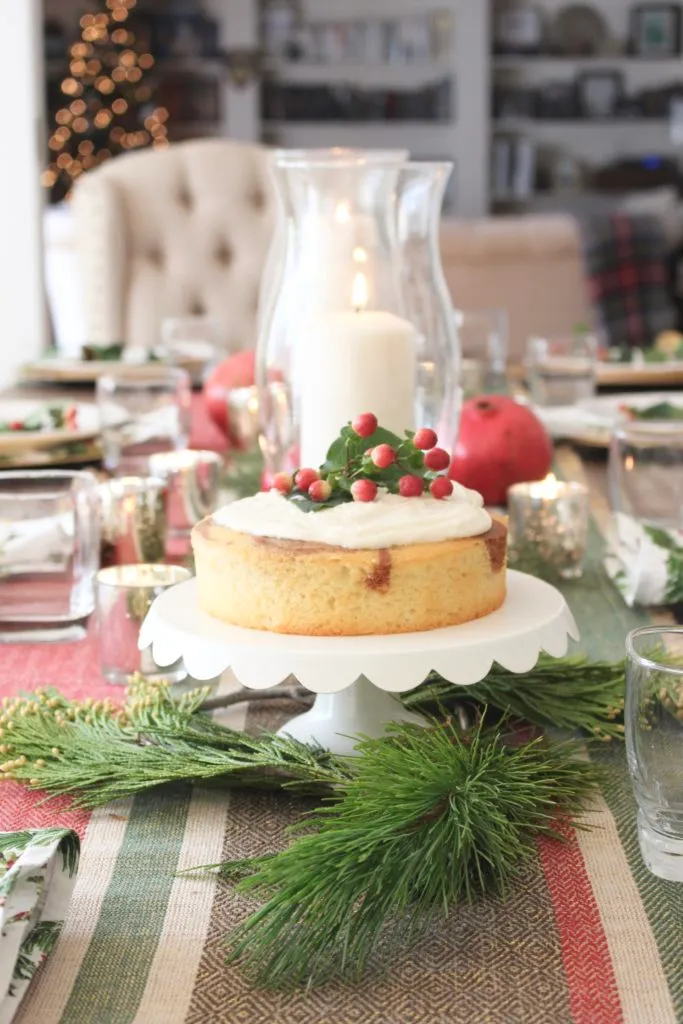
Food as a centerpiece is the oldest host trick there is, and it works because it gives people permission to look. The cake stand does the vertical lifting so the greenery doesn’t have to, and the pomegranates solve the dead-space problem at the ends of the runner — they’re decoration, and then they’re dessert. The candle strategy matters too: clear hurricanes and low mercury votives, no tapers at all. Nothing tall enough to block a conversation, which is exactly what you want at a meal you’re sitting down to eat.
18. A Polka-Dot Ribbon Woven Through a Mini Evergreen
- Small conical evergreen, 18–24 inches — $22–$45
- Red berry sprays, set of six — $12–$30
- Polka-dot ribbon, 15–20 feet — $8–$18
- Small pinecones and a dark ceramic pot — $14–$35
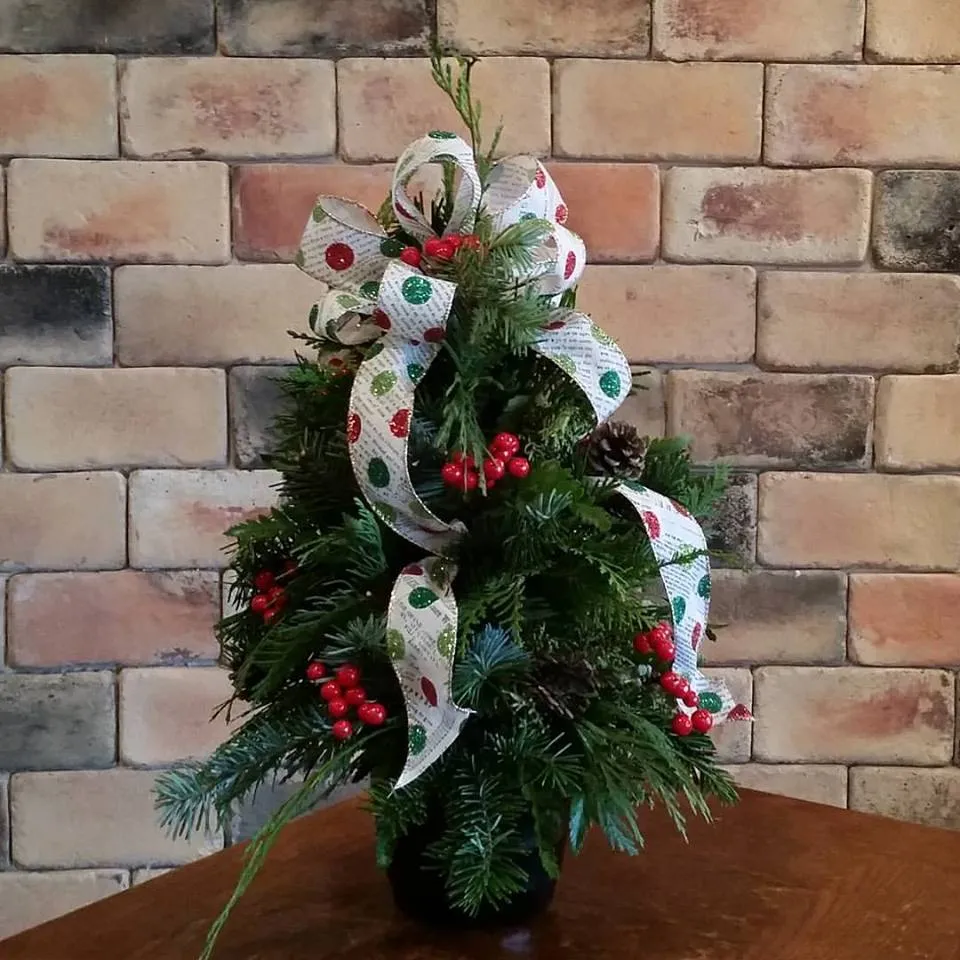
Cheaper route: clip a branch from the yard, set it in a thrifted pot with floral foam, and reuse last year’s ribbon.
Then:
- Anchor the tree in a small pot with foam and moss so it can’t tip.
- Start the ribbon at the back and weave it in and out of the branches every 5–6 inches.
- Wire berry sprays into the gaps the ribbon left open, pointing outward.
- Press pinecones into the foam near the base, clustered three or four at a time.
- Step back three feet and judge it as a silhouette, then fill any flat spots.
About 25 minutes, and it rebuilds in 10 if you store the ribbon wound around a card.
19. Bottle Brush Trees on a Board, Holly Napkins Below
Bottle brush trees shed dyed bristles, and they shed onto a light grey cloth — that’s the one drawback of an otherwise effortless setup. Give them a shake outside before they ever land on the table, and set them on the wooden board instead of directly on linen. Wax is the other thing: on a wood board it lifts easily with a warm iron and paper towel, but on fabric it’s an afternoon of your life. And real garland near a candle dries out and turns brittle within about two weeks.
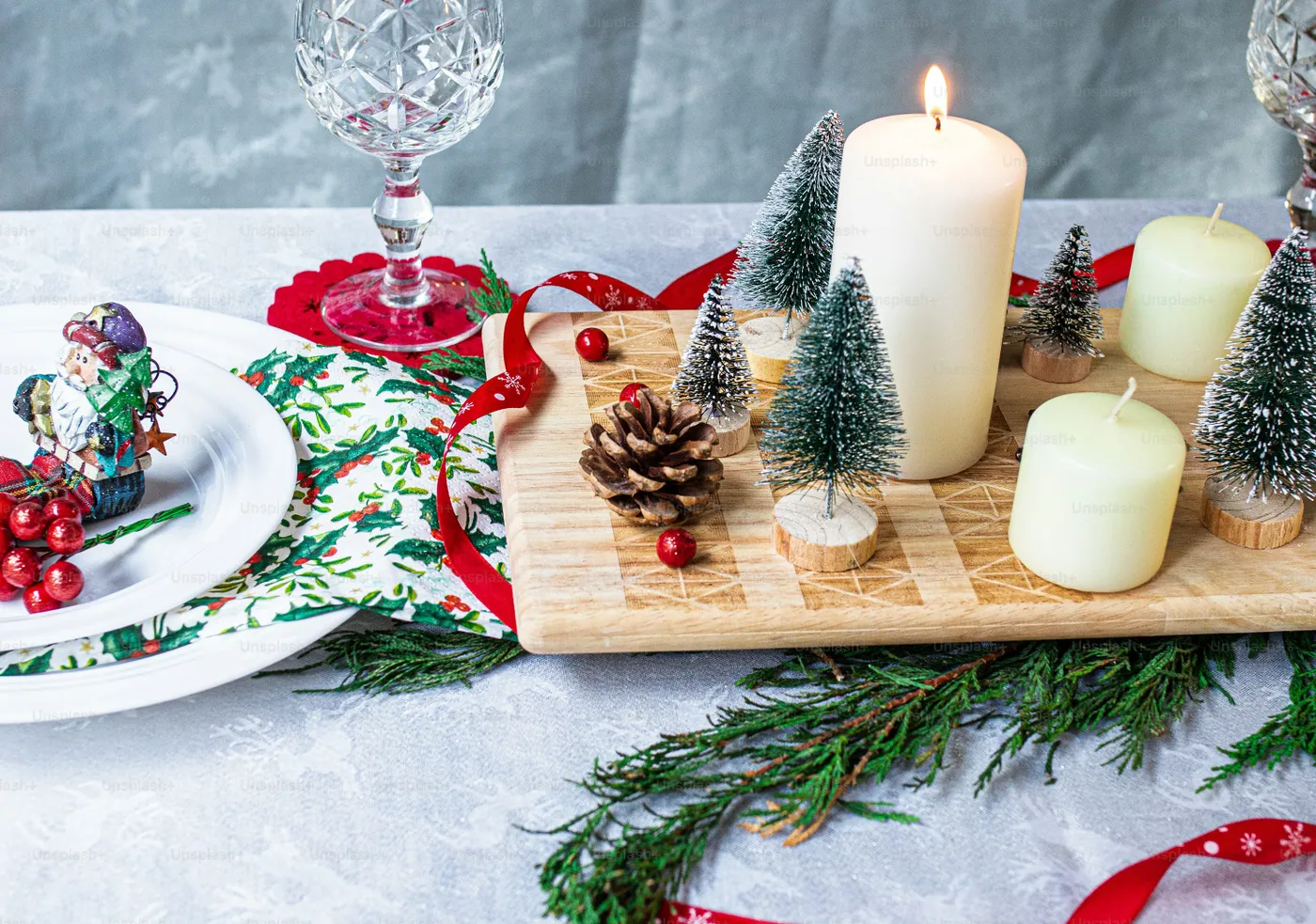
Call it 45% light wood and cream (board, candles, trees), 30% green, 15% red between the berries and the ribbon, and 10% white and grey cloth. The ribbon is the thread that ties it together — the snowflake pattern repeats on the napkins, so the red doesn’t feel like it arrived from nowhere. Trade the cream candles for deep green and you get a moodier, more woodland feel from the identical layout. Trade the grey cloth for tan and it warms up several degrees.
20. The Hedgehog Planter That Steals the Whole Table
Novelty planters are one of the best-kept thrift secrets — ceramic animals show up constantly for $5–$15, and HomeGoods sells new ones for under $25. Fill any of them the same way: a small foam block, a handful of evergreen, three berry sprigs, two pinecones. Total cost, about $30 including greenery. If you already own a red poinsettia, that’s the other half of the look for free — slide it in beside the planter rather than behind it, so it looks like it belongs. Idea #18 is the cone-tree version of this small side arrangement.
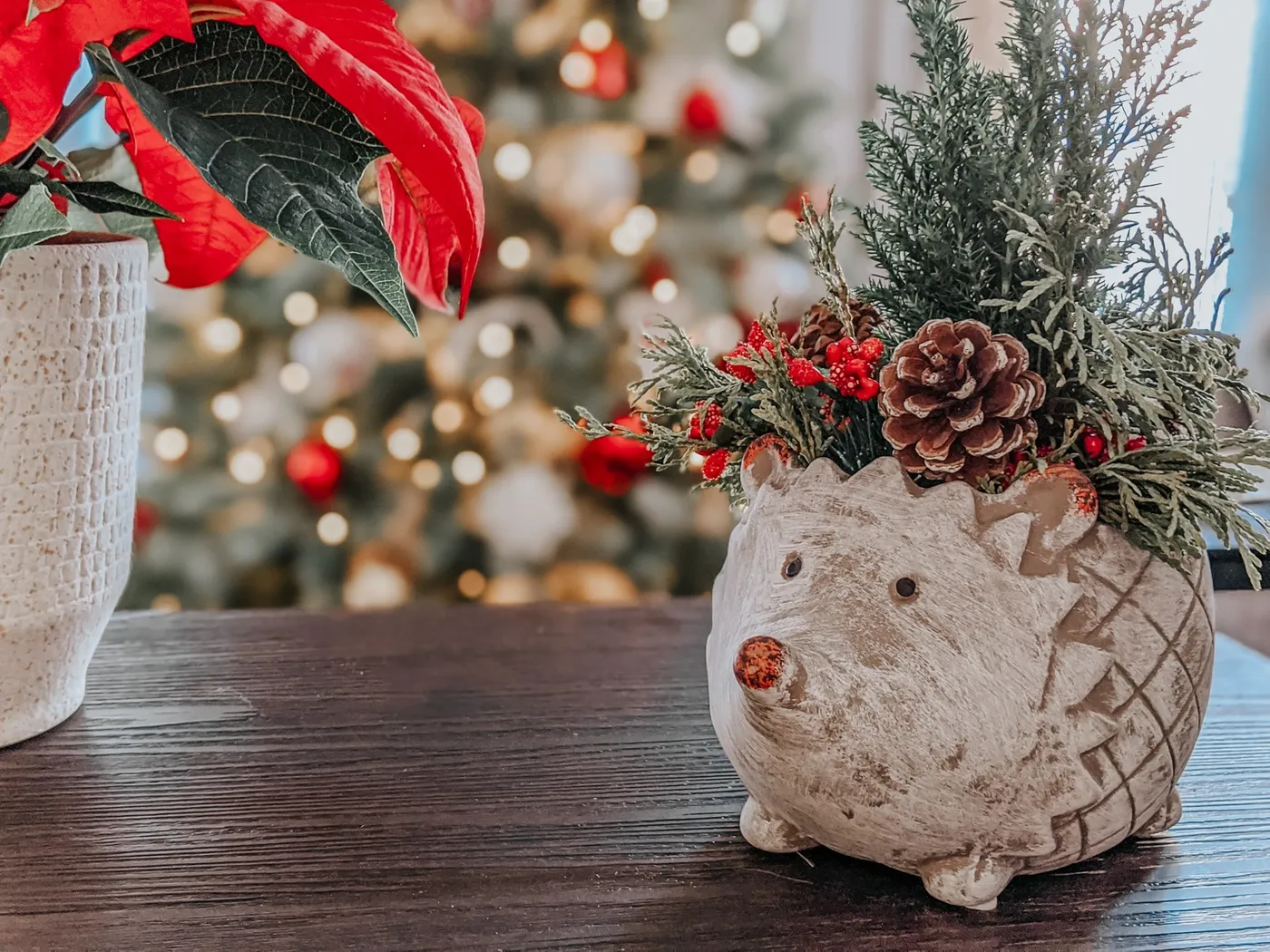
Poinsettias are mildly toxic to cats and dogs — rarely fatal, but the milky sap irritates mouths and stomachs, and it will irritate your skin too. With a curious pet, keep the plant high or go faux for the season. Before you buy a cute planter, check that it’s watertight or line it, because a painted interior will flake once it gets wet. And this centerpiece wants a table you don’t lean on heavily; a small potted arrangement tips far easier than you’d expect.
21. Carnations, Alstroemeria, and Pampas in a Clear Vase
Carnations are the best-value holiday flower nobody talks about: $1–$2 a stem, two weeks of vase life, and they hold their shape without any real arranging skill. Alstroemeria is the same story at a slightly higher price. To keep pampas looking full instead of floppy, mist the plumes lightly with hairspray before they go in and don’t handle them afterward. One more: strip every leaf below the waterline, or you’ll have cloudy water and a smell in three days.
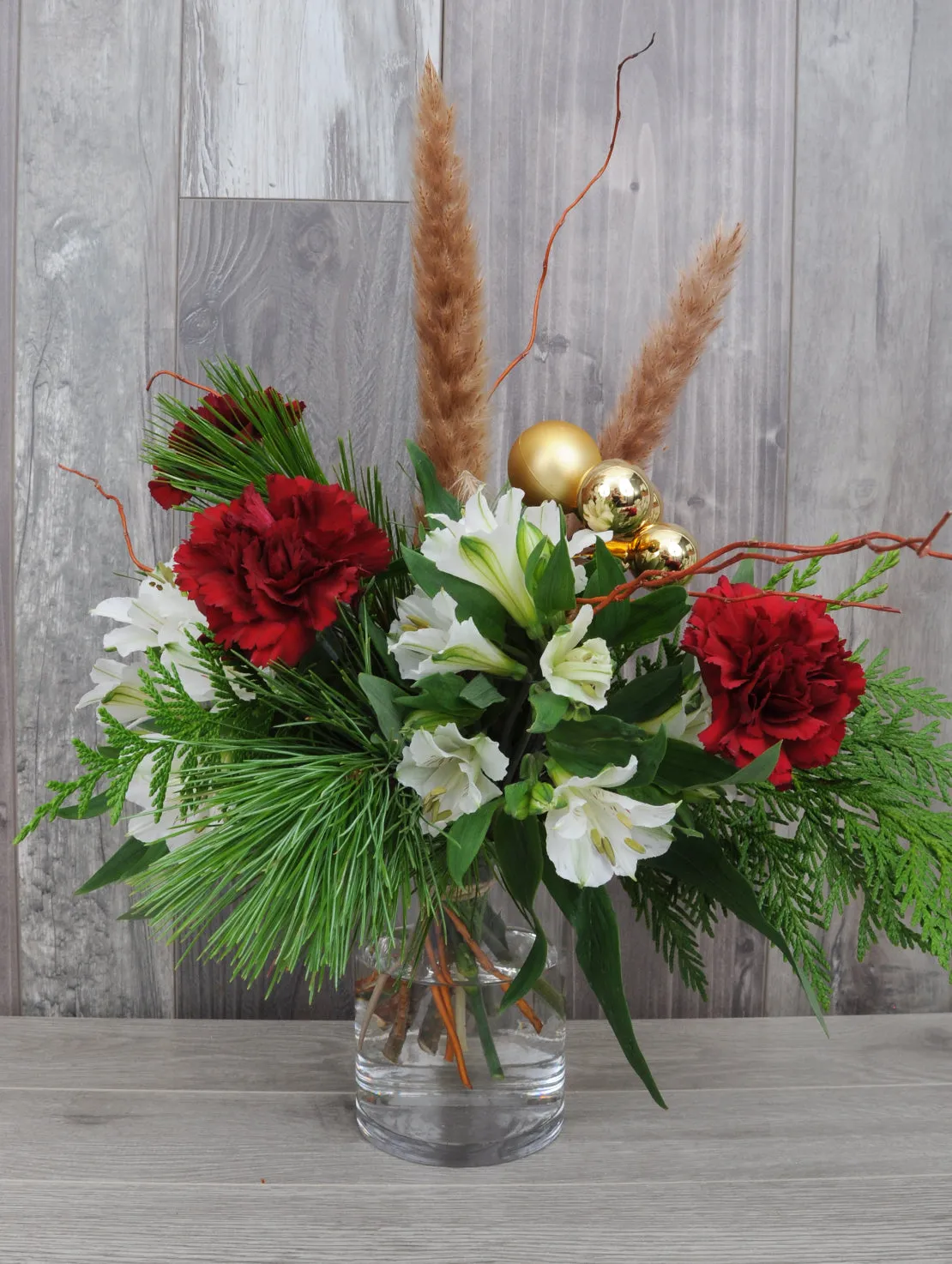
The pampas grass is the element that changes everything. Two or three stems turn a red-and-white grocery bouquet into something that looks commissioned, and it costs almost nothing. It works because it’s a texture nobody expects in a Christmas arrangement — all that feathery tan against shiny gold baubles and pine needles gives the eye a break between the red and the green. Take it out and you still have a perfectly pleasant vase of carnations. Leave it in and people ask where you got the arrangement.
22. Green Ceramic Trees and Plaid Reindeer on Patterned Linen
- Lay the patterned cloth first and press it flat — wrinkles fight a bold pattern.
- Build the centerpiece on a tray so you can lift it off when you actually need the table.
- Group the figurines in odd numbers, three at most, at slightly different heights.
- Match the napkin bows to the dominant pattern color, not to the flowers.
- Add the crackers last, at a slight angle, so they read as part of the setting.
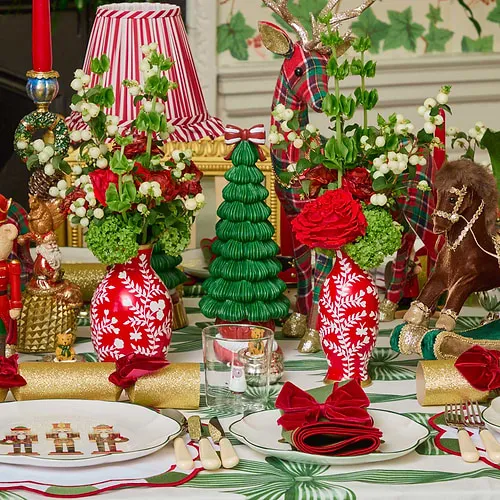
About 20 minutes once the centerpiece is made, and the whole thing stores in one bin. If you want the same playful energy without any pattern, Idea #8 is the place to look.
Ceramic Christmas trees are back in a serious way — the vintage ones with the little light holes fetch real money on resale, and new reproductions sell out every November. Call it grandma-core, call it the traditional revival, but the appeal is that these pieces look collected rather than purchased. Mixing a green ceramic tree with a tartan plaid reindeer and a busy patterned cloth is the opposite of minimalism, and that’s the whole point: after years of beige, people want a table that looks like it has a story.
Set the Table You Keep Saving Photos Of
You don’t need all 22 of these — one candle, one bowl of greenery, and one thing that makes you smile when you walk past the table is genuinely enough. Start with the idea that fits the table you already own, and build on it over a few weekends instead of trying to do everything on December 23.
📌 Pin your favorite to your holiday board now — you’ll thank yourself when it’s time to actually set the table.