23 Jaw-Dropping Christmas Pathway Lights Ideas That Will Make Your Yard Shine Brighter Than Ever in 2026

You know that feeling when you’re scrolling at 11 p.m., a front walk glowing warm amber slides past, and you think — my yard could never look like that? It can, and it’s usually less about budget than about where you point the light. We spent serious time browsing Lowe’s, Target and Amazon to bring you only what’s actually worth your attention this year, across price points from about $12 to $430.
Inside you’ll find 23 curated ideas covering warm amber landscape lighting, classic red-and-green tradition, multi-color whimsy and modern solar minimalism — with budget and luxury versions compared side by side, and every idea shoppable with direct product links. And stay until the end — we break down the most common mistakes that can ruin these looks. This post contains affiliate links; if you buy through them we may earn a small commission at no extra cost to you.
Warm-white layered lighting is the story of 2026: Pinterest saves for quiet, architectural holiday curb appeal keep climbing while inflatables quietly fall out of favor.
📌 Save this to Pinterest for later — you’ll want to revisit these ideas.
1. Curved Brick Walk Lit by Warm Conical Path Lights
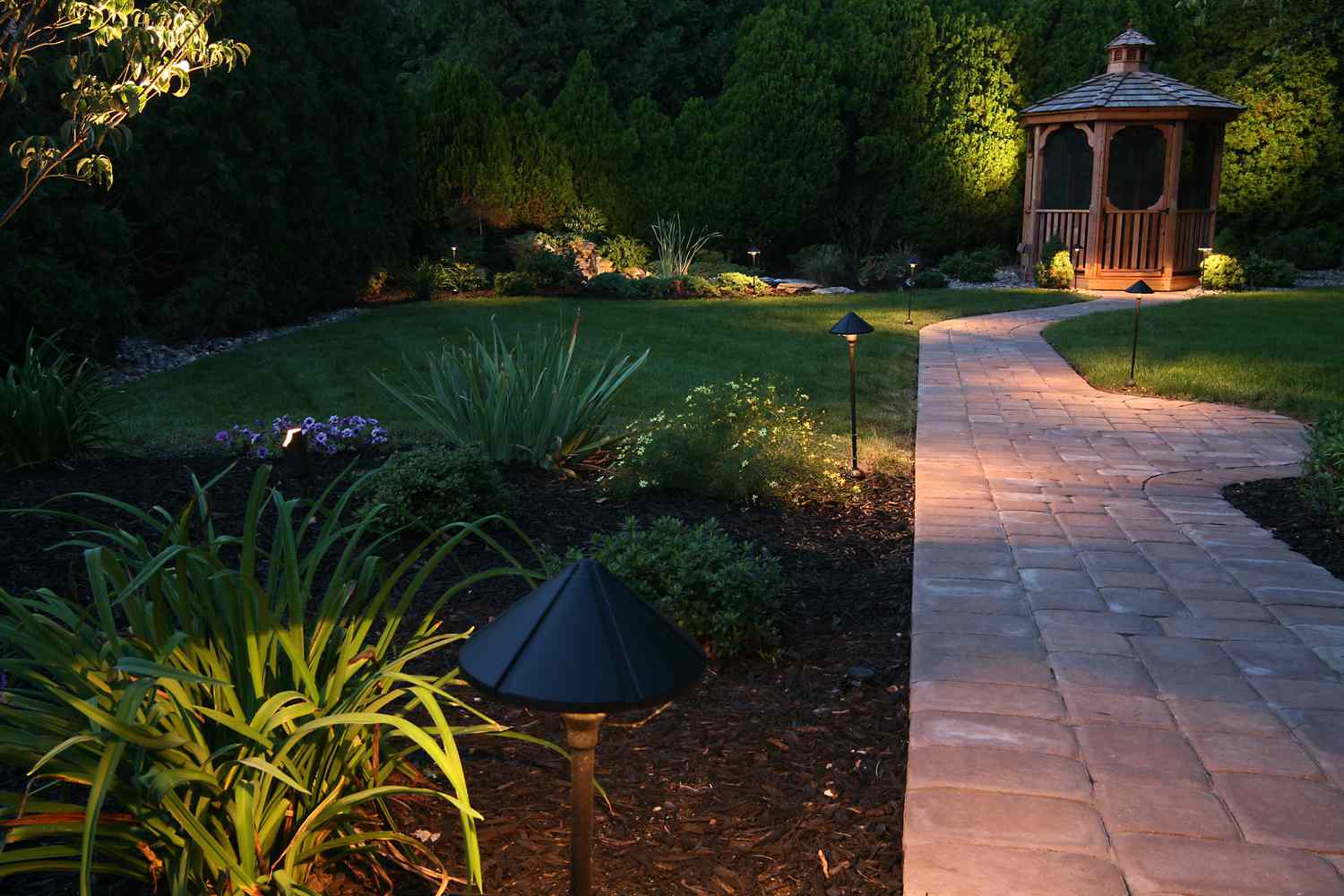
The magic isn’t the fixtures — it’s the curve. A straight walk tells your eye to hurry; a gentle S-curve slows it down, and low conical stakes set along the outer edge make that curve readable after dark. Notice how the light stays pooled at ground level while the mulch and plantings stay dim. That contrast between a glowing footpath and a dark garden bed is what keeps it understated instead of runway-bright.
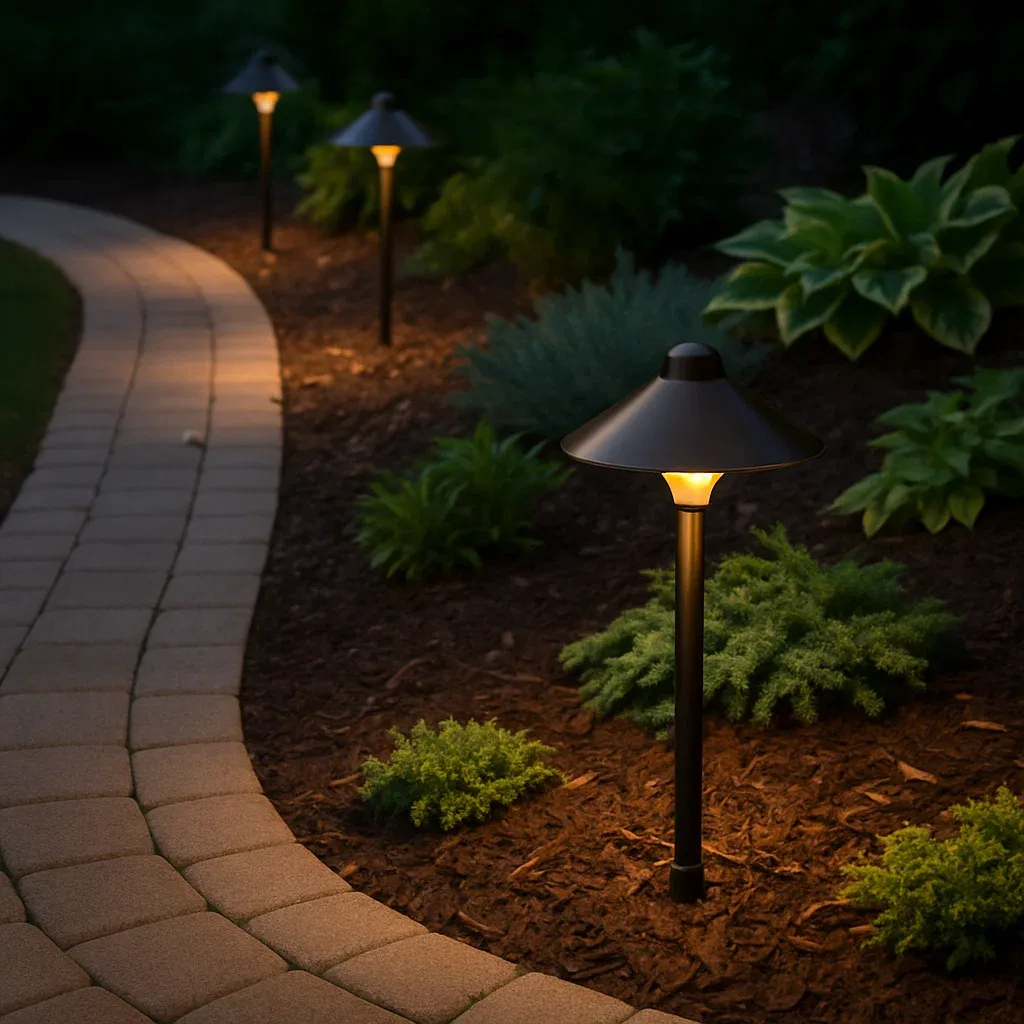
Space fixtures 6 to 8 feet apart — roughly your path width plus three feet — and keep the lens 18 to 24 inches above grade. Aim each head slightly across the pavers rather than straight down; that grazing angle reveals the brick texture and hides glare from anyone walking toward the house. Stick to 2700K bulbs, and cap the run at 8 to 10 fixtures per 12-volt transformer so the last light in line doesn’t dim.
2. Snowy Winding Walk With Vertical Lights and Tree Wraps
The reason this look is everywhere on Pinterest right now is layering. A few years ago the classic move was one big inflatable and a single spotlight; in 2026 the pull is toward quiet, architectural light — a lit path, wrapped shrubs, a house glowing softly from within. Call it the warm-envelope look. It photographs beautifully in snow because every surface bounces that amber back, and it ages better than novelty decor you’ll be tired of by January.
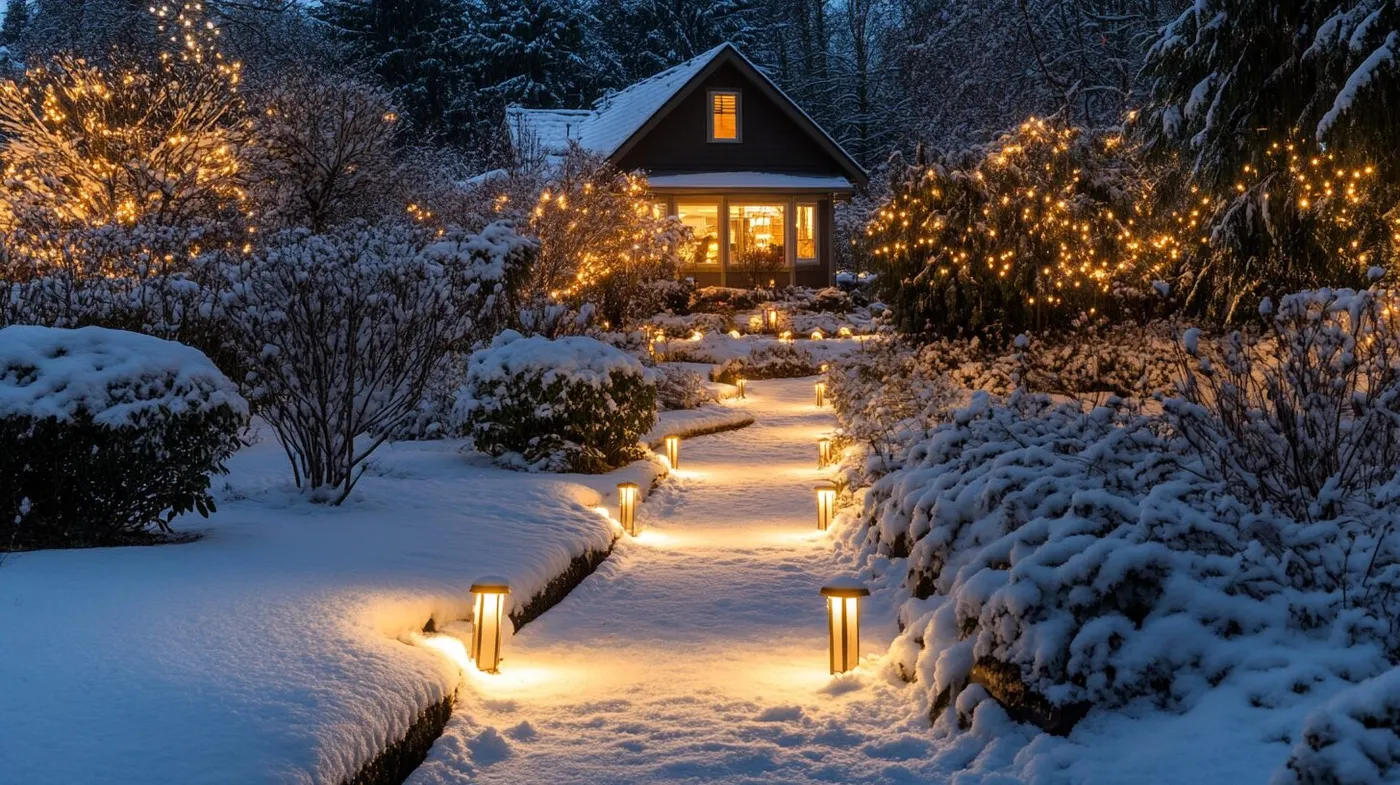
The single element holding this together is the shared color temperature. The vertical path lights, the shrub wraps and the string lights in the trees are all the same warm tone, so the eye reads one continuous ribbon of light from the walk to the treeline. Swap in even one cool-white strand and the whole scene goes patchy. Buy your strands in one order, from one brand, so the warmth matches.
3. Stone Steps and Retaining Walls With Hidden Riser Lights
- Measure each riser and confirm there’s 2 to 3 inches of stone depth for the housing.
- Mark one consistent height, usually the second course up from the tread.
- Core-drill or notch, then run low-voltage cable through conduit behind the wall.
- Seal every penetration with exterior silicone — freeze-thaw finds open holes.
- Size the transformer at least 20% above total wattage.
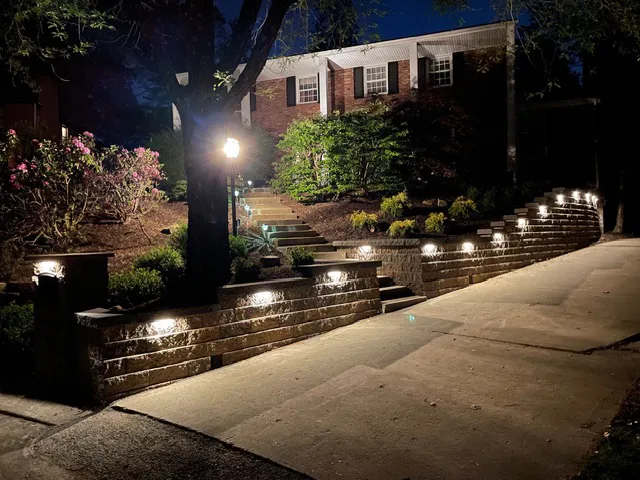
Budget a weekend for six to eight steps: about $45 to $120 per fixture, plus $60 to $150 in cable and conduit.
Retrofitting lights into an existing stone wall is a job you can’t undo, so know what you’re signing up for. One hole in the wrong spot leaves a visible scar, and an unsealed penetration lets water behind the wall.
- Confirm the wall is yours to drill — not shared or rented.
- Check for irrigation lines and downspouts before you cut.
- Assume one fixture will need re-sealing every few years.
If that sounds like too much, a low-voltage stake set along the base gets you 80% of the effect with none of the commitment.
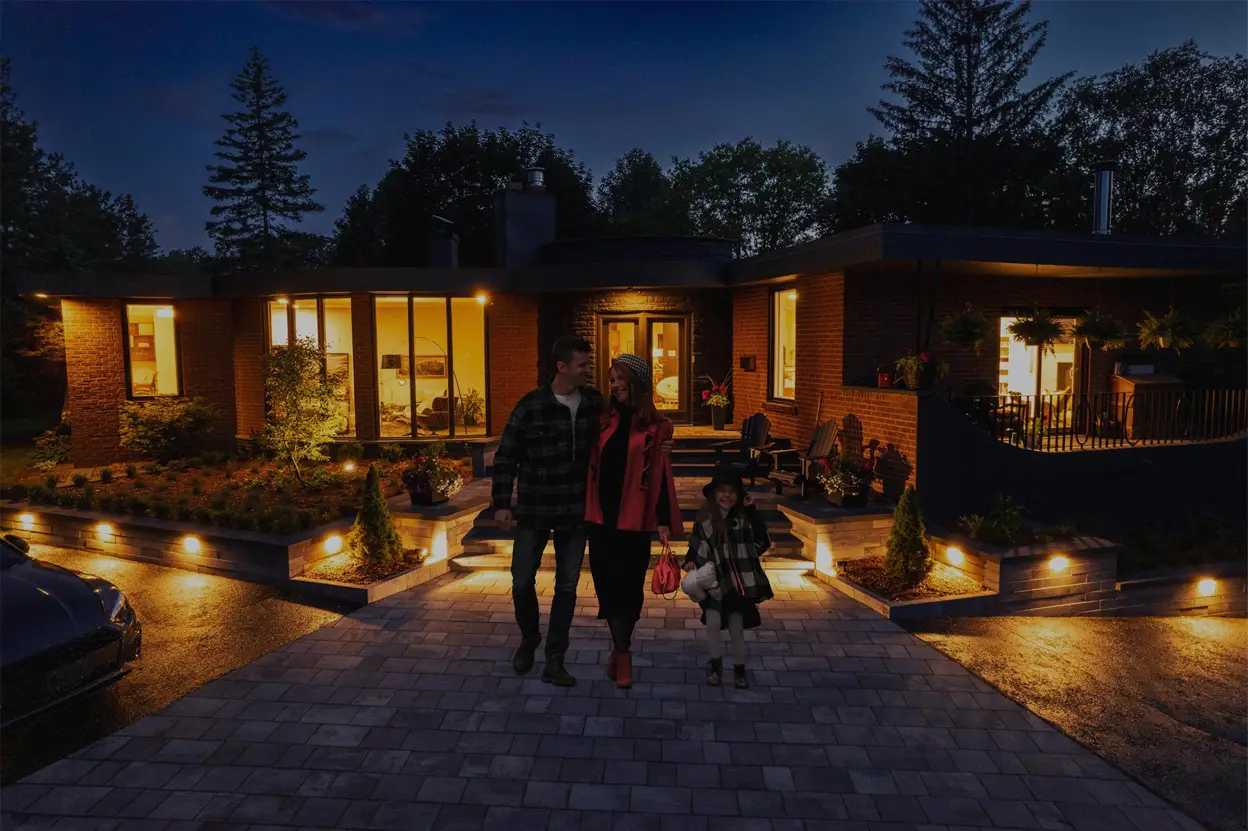
4. Modern Brick Entry With Embedded Wall-Wash Lights
This composition runs on a simple ratio: roughly 70% hardscape neutrals, 20% warm light, 10% greenery. Dark grey pavers and red-brown brick do the heavy lifting; the embedded wall lights carry the mood; low evergreen shrubs keep it from feeling like a parking deck. It’s the modern cousin of Idea #1‘s brick walk — same low glow, sharper geometry. Swap in warm limestone and the formula still holds.
- Interlocking pavers, 200 sq ft: $900–$2,200
- Embedded step and wall lights, 8–10: $360–$1,100
- 12V transformer and cable: $120–$280
- Evergreen shrubs and mulch: $150–$400
- Pro installation, optional: $800–$2,500
Total: about $2,300–$6,500 DIY, or $3,100–$9,000 done for you.
Cut it in half by keeping your existing concrete, staking in warm LED path lights ($60–$140 for a six-pack) and edging beds with dark mulch.
5. Colonial Facade Outlined in Warm White, Walkway to Match
What sells this house is that the roofline lights and the walkway lights are the same color. Everything sits at a warm 2700K, so the roof, the porch and the path read as one envelope instead of three separate projects. Change the path lights to cool white and the facade instantly looks colder and cheaper. Buy both from the same line, and if you’re mixing old and new strands, test them side by side before you climb the ladder.
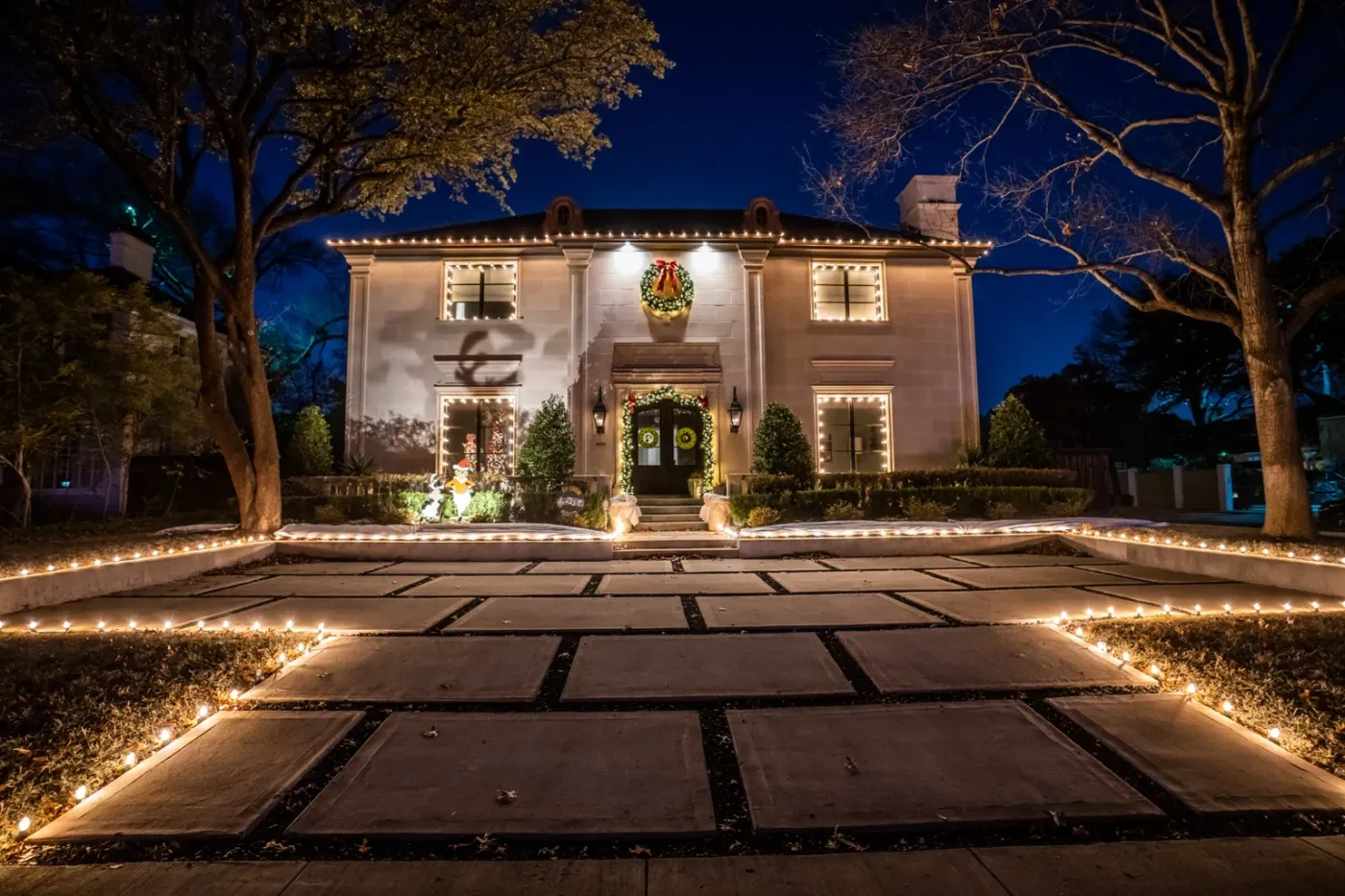
Full-facade outlining is a big-house move. It wants at least 55 to 60 feet of frontage, a two-story roofline and a walkway long enough to justify repetition — think 40 feet or more. On a 25-foot-wide ranch the same treatment looks frantic. If your yard is smaller, Idea #1‘s low path glow will flatter the proportions you actually have.
6. Tiered Garden Patio With Uplit Trees and a Fire Pit
You don’t need a landscape architect for this. Solar uplights aimed into the canopy ($8–$15 each at Walmart or Amazon) get you the dramatic tree wash for a fraction of a wired system, and Facebook Marketplace is full of used Adirondack chairs at $25–$60. Build the fire pit ring from a $90 concrete kit, or skip it entirely and set out a portable propane one for about $130. Same mood, a third of the cost.
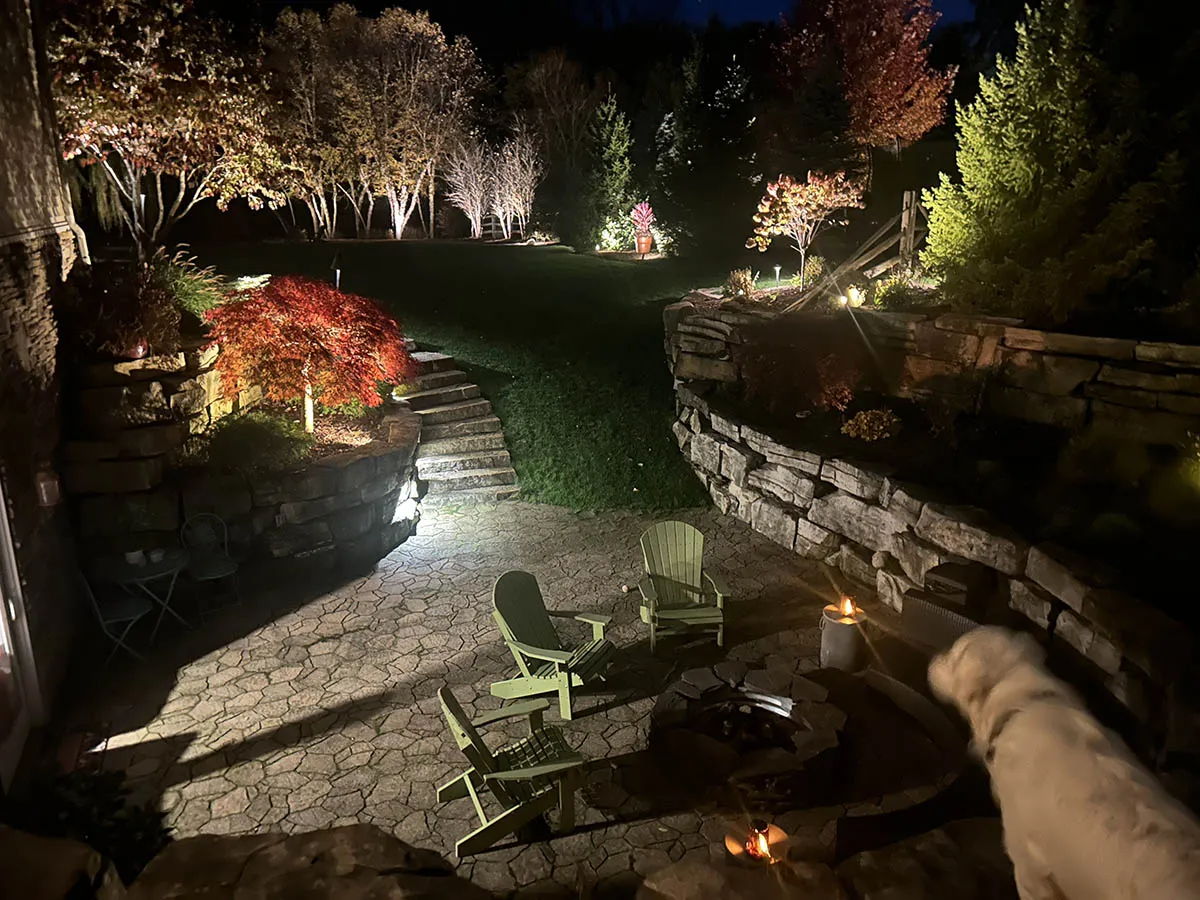
Three things are doing the work here. First, the tiers: retaining walls give the light somewhere to land, so a single fixture reads across two or three levels. Second, the uplights sit at the base of the trunks and shoot upward — that low-to-high direction feels dramatic in a way downlighting never does. Third, the fire pit acts as a second, flickering light source at eye level, balancing all those cool blue shadows.
7. Rainbow Globe Path Lights on Black Stakes and Faux Snow
Multicolor works best when the fixtures themselves stay quiet. Here the black stakes and simple globes disappear, so all you register is color. Keep the globes at 14 to 16 inches tall and space them a consistent 5 feet apart — uneven spacing is what makes colorful paths look messy rather than playful. Then pick three colors max. Pink, green and purple always look intentional together; six colors never do.
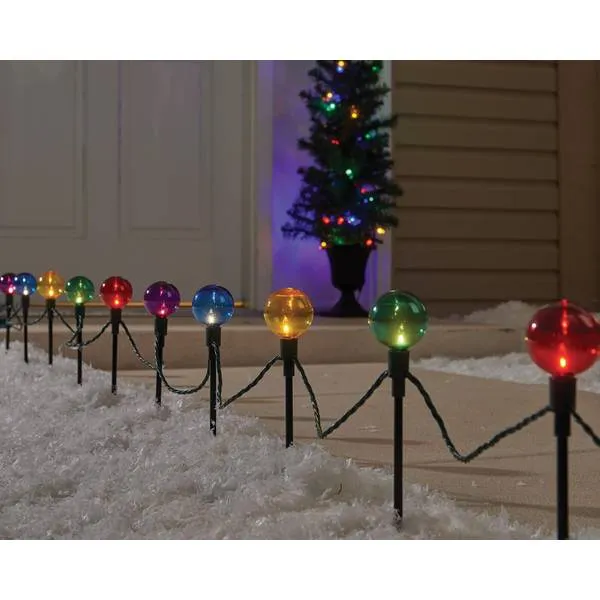
A word on artificial snow: it photographs wonderfully and behaves terribly in wind. Lightweight batting blows into the neighbor’s yard, and the plastic versions yellow after a season or two outdoors. If you have dogs, skip it — it shreds. Real snow does the job free, and if you live somewhere warm, white gravel or light-toned mulch along the path edge gives you the same bright contrast without the March cleanup.
8. Red, Green and White Lights Outlining a Brick Two-Story
Traditional color means traditional upkeep. Incandescent strands last roughly 2,000 to 3,000 hours and will fade or drop a section within a season or two; LEDs run five to ten times longer and cut the electricity bill from about $30–$50 a month to under $5 for the same house. Sun and cold make cheap green wire brittle, so store strands in a labeled bin, coiled loosely around a cardboard spool, and plan on replacing 15% of them each year no matter what the box promised.
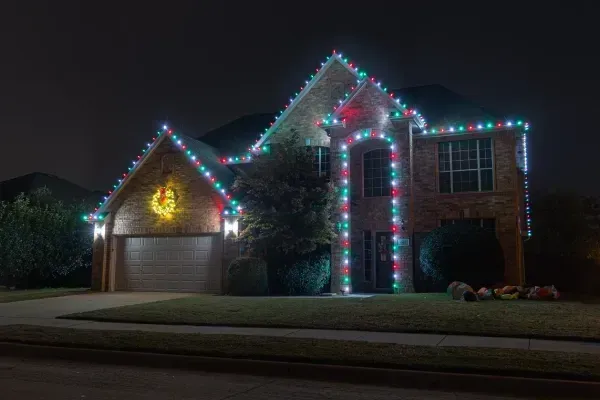
Red-and-green outlining needs architecture to trace. Two stories, gables, an arched entry, a garage bump-out — the more rooflines, the more it reads as deliberate. On a single-story with a flat roofline, the same treatment can look like an outline drawing with nothing inside it. Under about 2,000 square feet of facade, put the color on the walkway instead with something like Idea #10‘s staked warm LEDs, and keep the roof one quiet color.
9. A Warm Light Tunnel Over the Garden Path
- Set two rows of 8-foot black metal poles, 3 feet outside each path edge.
- Run a galvanized guide wire between opposing poles at 7 feet high, anchored at both ends.
- Zip-tie a warm white strand every 12 to 18 inches along the wire, sagging each run slightly.
- Add a second, lower run at 4 feet along the sides so the walls of the tunnel glow too.
- Plug into an outdoor smart timer set for 4:30 p.m. to 11 p.m.
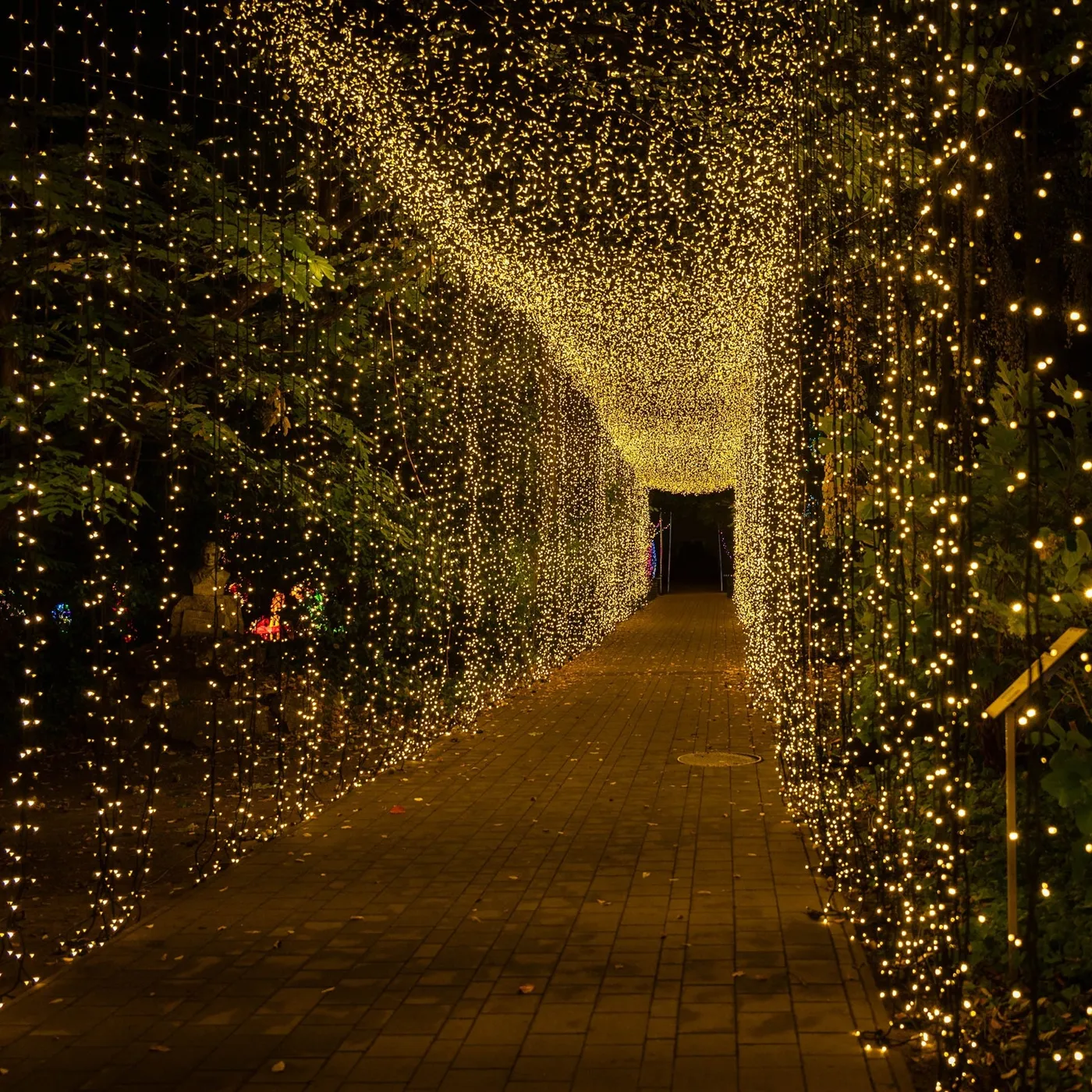
One weekend, about $180 to $450 in strands and hardware for a 20-foot path.
It’s the density, not the length. A tunnel that works has light every 12 to 18 inches overhead — sparse strands read as a sad clothesline instead of a passage. If the budget is tight, shorten the run rather than stretching the lights further apart. A 12-foot tunnel packed with light is far more magical than a 30-foot one you can see straight through.
10. Staked Warm LEDs Pushing Through Snow Along a Stone Walk
- Warm LED stake lights, 12-pack: $45–$110
- Low-voltage transformer, if wired: $60–$140
- Extension cable, 50 ft: $25–$60
- Solar stake alternative, 8-pack: $35–$70
- Outdoor smart timer: $20–$40
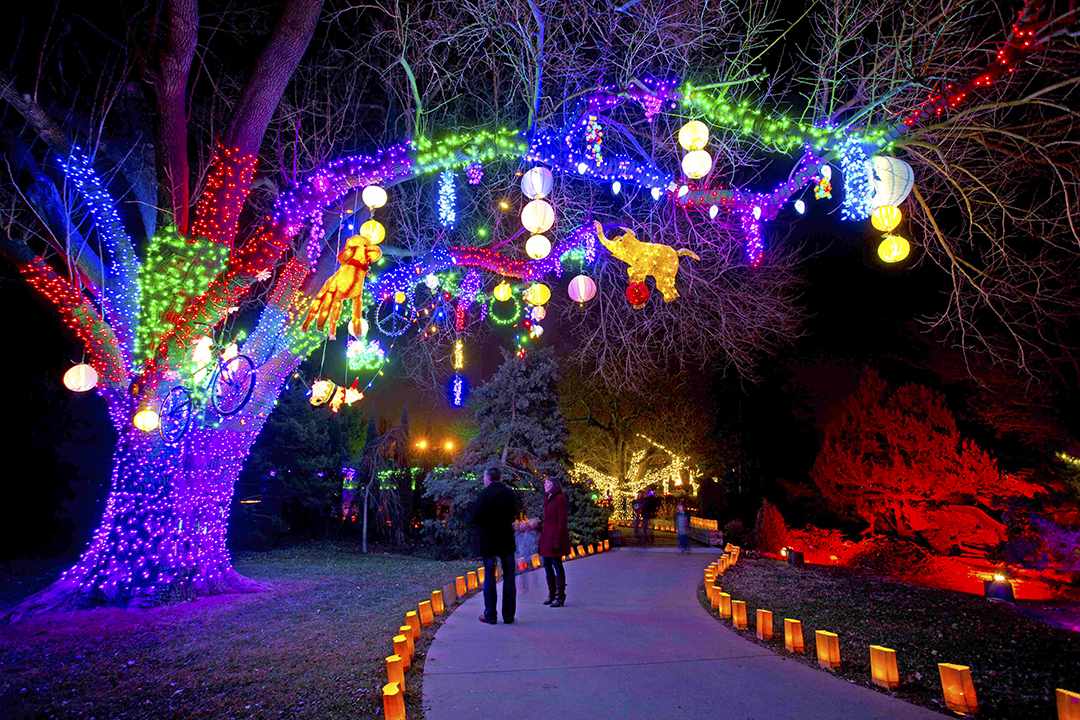
Total: $150–$350 for a wired run, or $55–$110 solar.
Trim it further by buying a 12-pack of solar stakes on sale in late November — same glow, zero wiring, roughly $5 per light.
Snow changes the math on staked lights. A fixture standing 18 inches tall in October can be buried by January, and burying a wired connection in snowmelt is how transformers fail. Look for IP65 or better ratings and keep the plug block above the snow line, on a stake or under an inverted bucket. If your path gets shoveled or plowed, set fixtures back about 6 inches and note where they are — you’ll be digging them out anyway.
11. Patio Perimeter Glow With Stone Pillars and Grasses
Here’s the formula: 50% dark structure (stone walls, pillars, night), 30% mid-tone planting, 20% warm uplight. The stone gives the light something to graze across; ornamental grasses catch it in a soft blur; the foliage above returns it. You can rebuild this with any hard material — brick pillars instead of stacked stone, warm gravel instead of pavers — as long as you keep that 20% of light low and warm and let everything else stay shadowed.
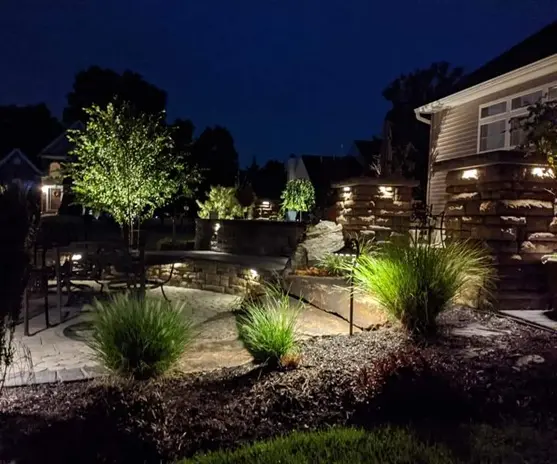
Integrated pillar lights are gorgeous and expensive. A far cheaper route: two or three well-placed uplights per pillar base ($25–$60 each), or a couple of clamp-on spotlights from Target aimed upward through the grasses. Add a $30 solar path set along the bed edge. You’ll lose the seamless wall wash, but standing on the patio at night, almost nobody can tell the difference.
12. Curved Stone Patio With Post Lights and Uplit Maples
Post lights along a curved path should shrink as the path recedes. Set the tallest, brightest post near the house and step down in height or wattage as you move out — 30 inches at the door, 20 at the bend, 16 at the far end. It sounds fussy, but it’s the same trick painters use: distance reads as depth only when brightness falls away. Uniform posts on a long curve flatten the whole yard.
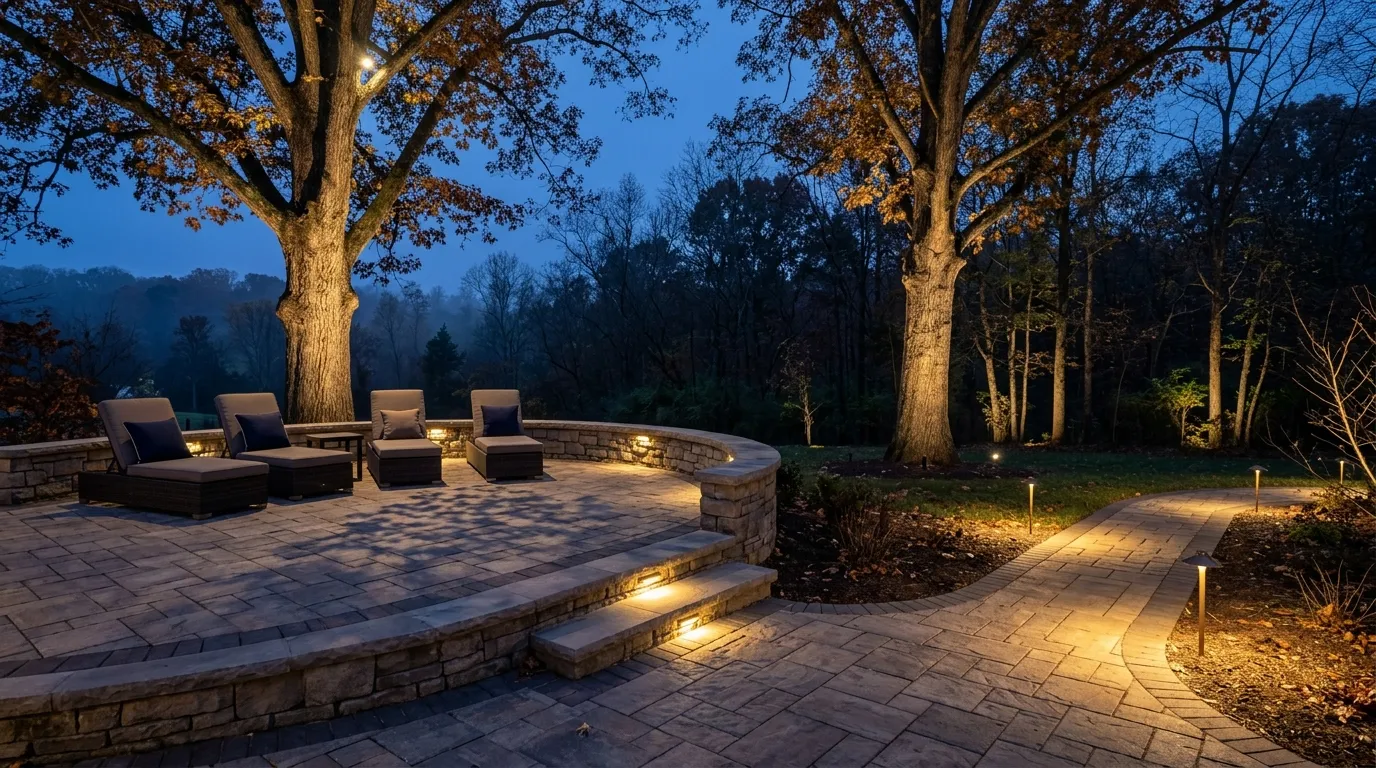
Two principles are quietly operating. The first is contrast — cool dusk-blue sky against warm amber ground light, which is why this scene looks expensive at 5:45 p.m. and flat at noon. The second is the rule of thirds: the wall, the patio and the trees each occupy roughly a band of the view, so nothing competes. The uplit maples aren’t decoration; they’re the backdrop keeping the patio from floating in black space.
13. Globe Path Lights Along a Curving Drive and Lit Roofline
Uniform globe lights along a long driveway need distance to work. Plan on one fixture every 10 to 12 feet on both sides, which means 20 to 30 lights for a 150-foot drive — and a transformer sized at 100 watts or more to carry them. Under about 60 feet of drive, the repetition gets claustrophobic and the fixtures start to look like a runway. Shorter runs do better with sparse ground lights instead.
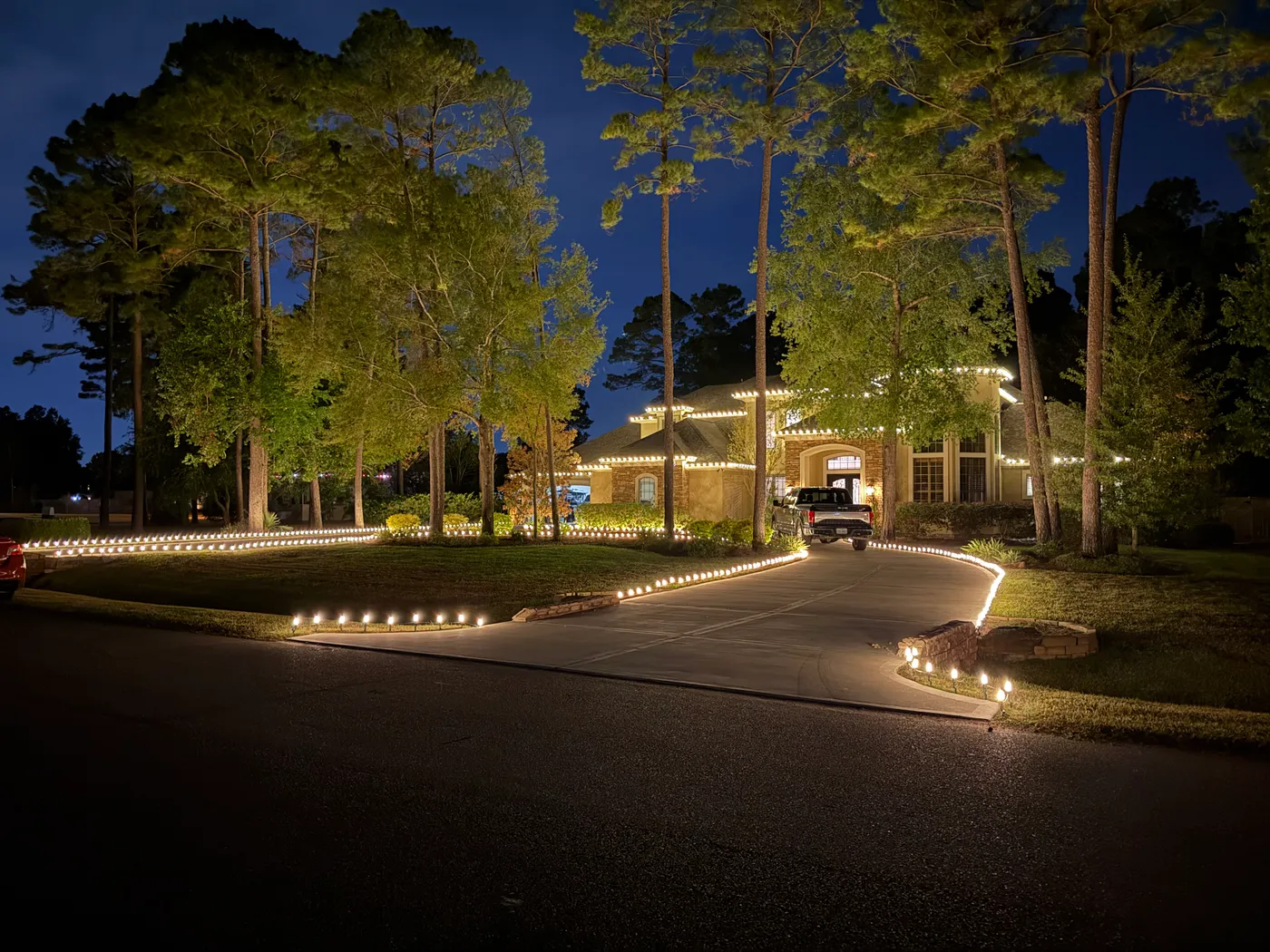
Uniform globes are the quiet 2026 answer to a decade of maximalist holiday yards. They read as architecture rather than decoration — the same reason matte black fixtures and warm 2700K have taken over exterior design. Pinterest saves for minimal Christmas curb appeal climb every November, and this is the style driving it. The upside: nothing here dates. You’ll still like these lights in 2035.
Kit it out as 60% dark landscape, 25% warm white light, 10% evergreen, 5% stone veneer. The dark lawn and shrubs are the canvas; the lights are the drawing; the stone and evergreens add just enough texture to keep it from going graphic. Swap the globes for small spotlights and the ratio stays identical — you’ve simply changed the shape of the same 25%.
14. Oversized Lighted Candy Cane Anchoring a Snowy Yard
- Measure the sightline from the street — the candy cane should be visible the second you turn in.
- Check wind exposure; a 6-foot decoration needs staked guy lines or a weighted base.
- Confirm an outdoor outlet within reach, or plan on a 25-foot heavy-gauge extension.
- Decide the color story now: red and white reads classic, and icicle lights on the eaves can match.
- Claim a dry off-season storage spot — these pieces are bulky and hate damp basements.
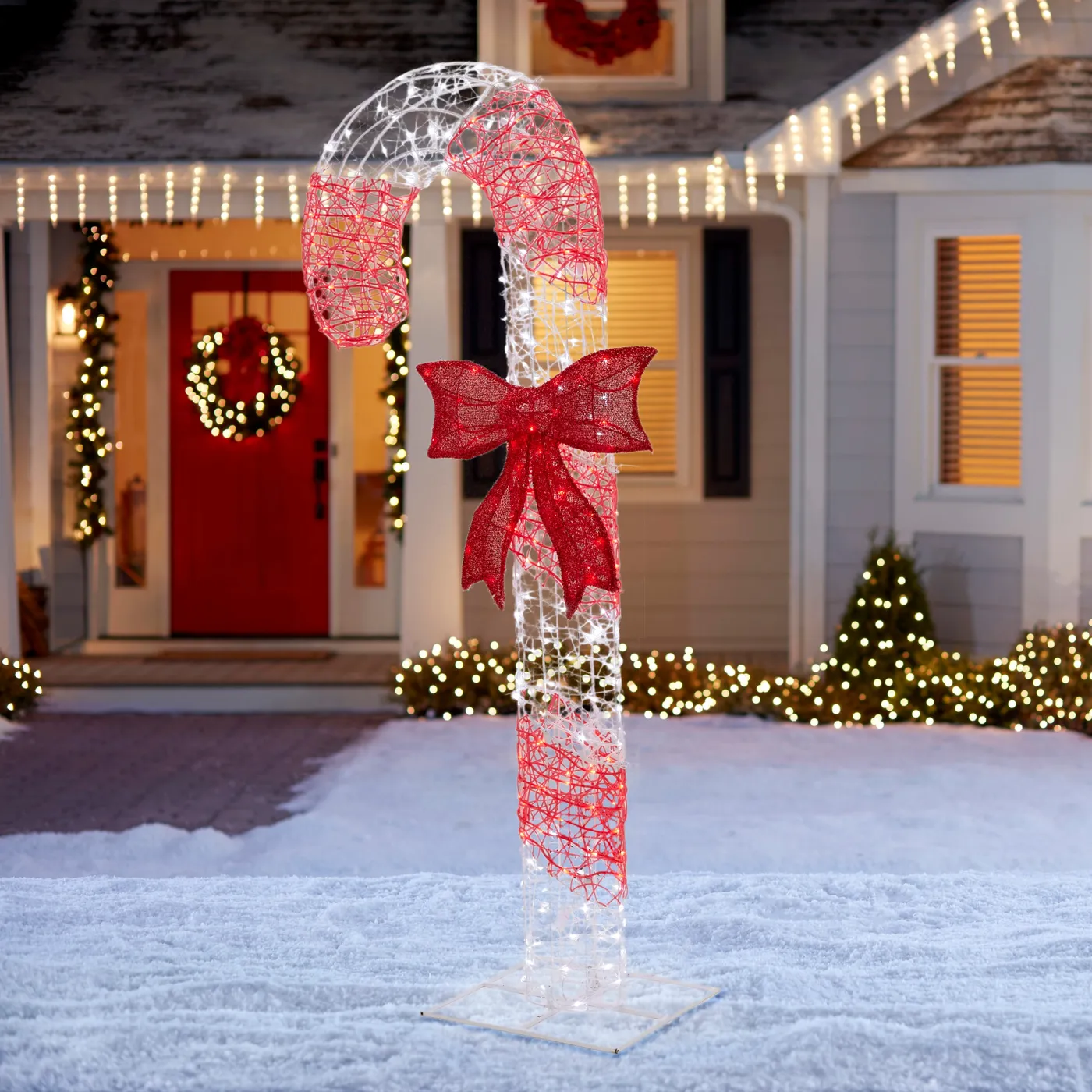
The red glitter bow is what makes this work. Without it, an illuminated candy cane is just a glowing stripe; with it, the piece has a focal point and a bit of personality. That one detail also ties the yard together — the red echoes the front door and the wreath, so the decoration reads as part of the house instead of dropped in the snow in front of it. Keep one accent color and repeat it three times.
15. Pink, Green and Purple Trees Wrapping a Garden Path
Wrapping a mature tree in colored lights looks like a $2,000 job and rarely is. Two strands of 100-count colored LEDs run about $20–$35 each at Target or Walmart, and wraparound coverage follows the trunk and main branches only — you’re not lighting the canopy. Do three trees for under $200. The low fence border is the same trick: a 33-foot multicolor strand, about $15, clipped along the rail. It reads festive because of the repetition, not the cost. Compare with Idea #7 — same color-first energy, smaller scale.
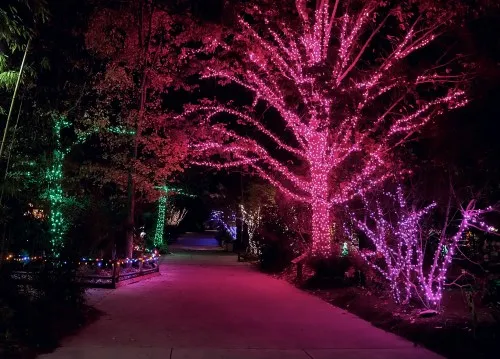
Wrap from the bottom up, spiraling at roughly a 6-inch pitch, and keep the strand snug against the bark so it doesn’t sag by New Year’s. Reserve a different palette per plant rather than mixing all three colors on one shrub — this yard works because pink lives on the big trees, green on the mid-size ones and purple stays low on the bushes. Give each layer eight to ten feet of separation so the colors land as bands, not noise.
16. Ground Lights Tracing a Curved Drive and Step Stones
- Walk the drive at night and mark where you actually lose the edge or your footing.
- Set lights 10 to 12 feet apart on the outer curve, closer on tight bends.
- Keep fixtures 12 to 15 inches off the pavement so plows and tires clear them.
- Run cable in a shallow trench on the lawn side, never through the driveway.
- Add two or three uplights into the red-foliage tree as a visual anchor.
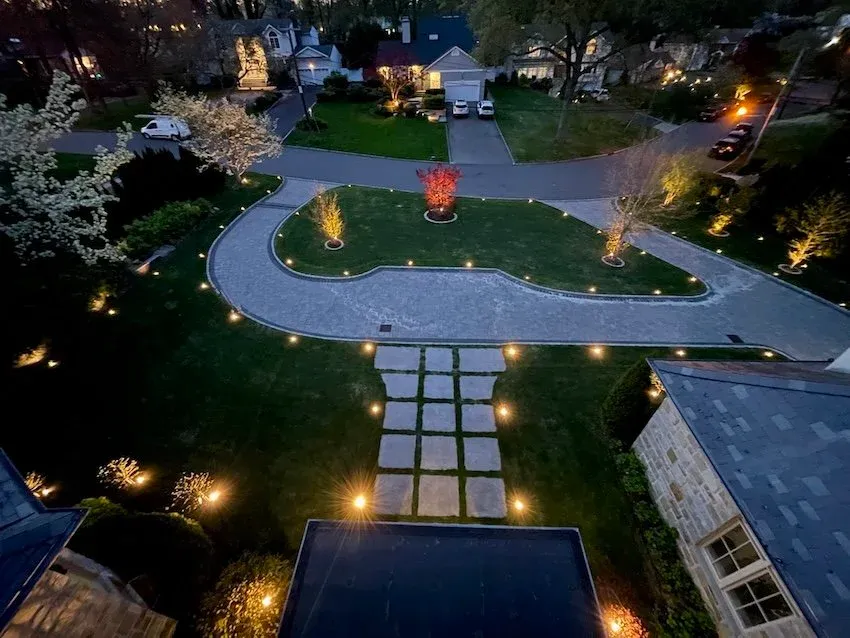
Roughly a weekend for 20 lights, about $260 to $550 in fixtures and cable.
Ground lights are the hardest-working fixtures on a property and they show it. Expect to clear leaves and grit from the lens a few times a season, and to re-seat anything clipped by a tire or a shovel. Cheap die-cast housings pit and fade within three years; powder-coated aluminum or brass costs more up front and still looks new at year ten. Budget $60 to $150 a year for lenses, stakes and the occasional failed fixture.
17. Trunk-Wrapped Trees Framing a Curving Paver Walk
Wrapping trunks rather than canopies is a discipline. Lit trunks become vertical columns, which makes a low path feel taller and gives the eye something to travel up. The second move is the color split: warm white on the near trees, cooler blue-white far in the distance. That small temperature shift creates atmospheric depth, the way a painter fades the far hills. Uniform color throughout would flatten the whole scene into a wall of glow.
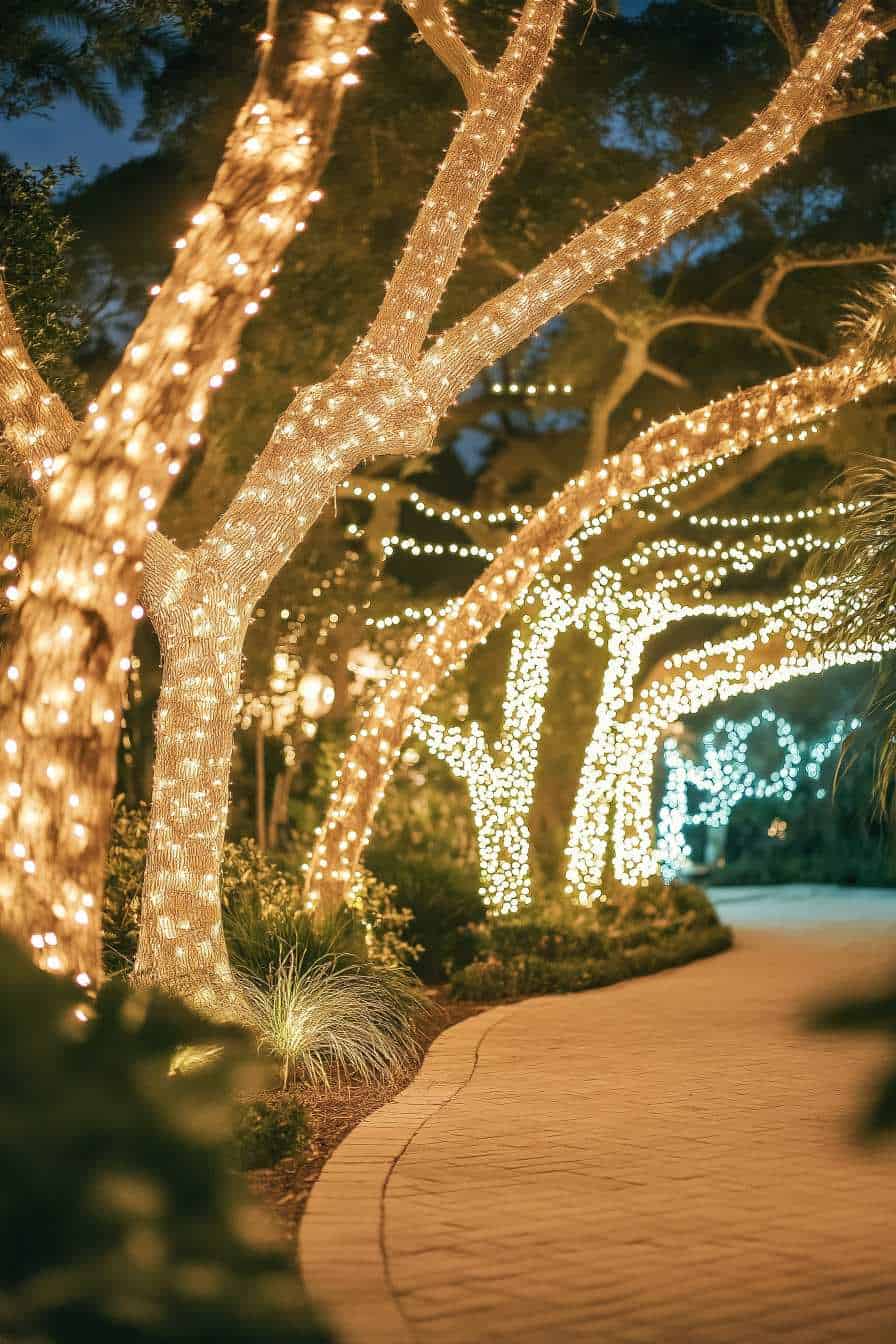
- Warm white LED strands, 6 × 100-count: $60–$150
- Outdoor extension cords, 3 × 25 ft: $30–$60
- Zip ties and clips: $10–$20
- Smart outdoor timer: $20–$40
- Paver path, if new, 200 sq ft: $1,400–$3,000
Total: $120–$270 for the lighting alone.
Save more by wrapping only the two or three trees closest to the walk and letting the rest go dark — the eye fills in the rest.
18. Gravel Patio Gatherings Under Draped String Lights
String lights over a gravel patio are wonderful and mildly high-maintenance. Gravel migrates — into the lawn, onto the stepping stones, into the house — so plan on raking it back every few weeks. Bulbs in open sockets collect water and bugs; look for commercial-grade strands with sealed sockets, and hang the lowest bulb no less than 8 feet above the seating so tall guests stop flinching. And check your tree branches before you drill anything.
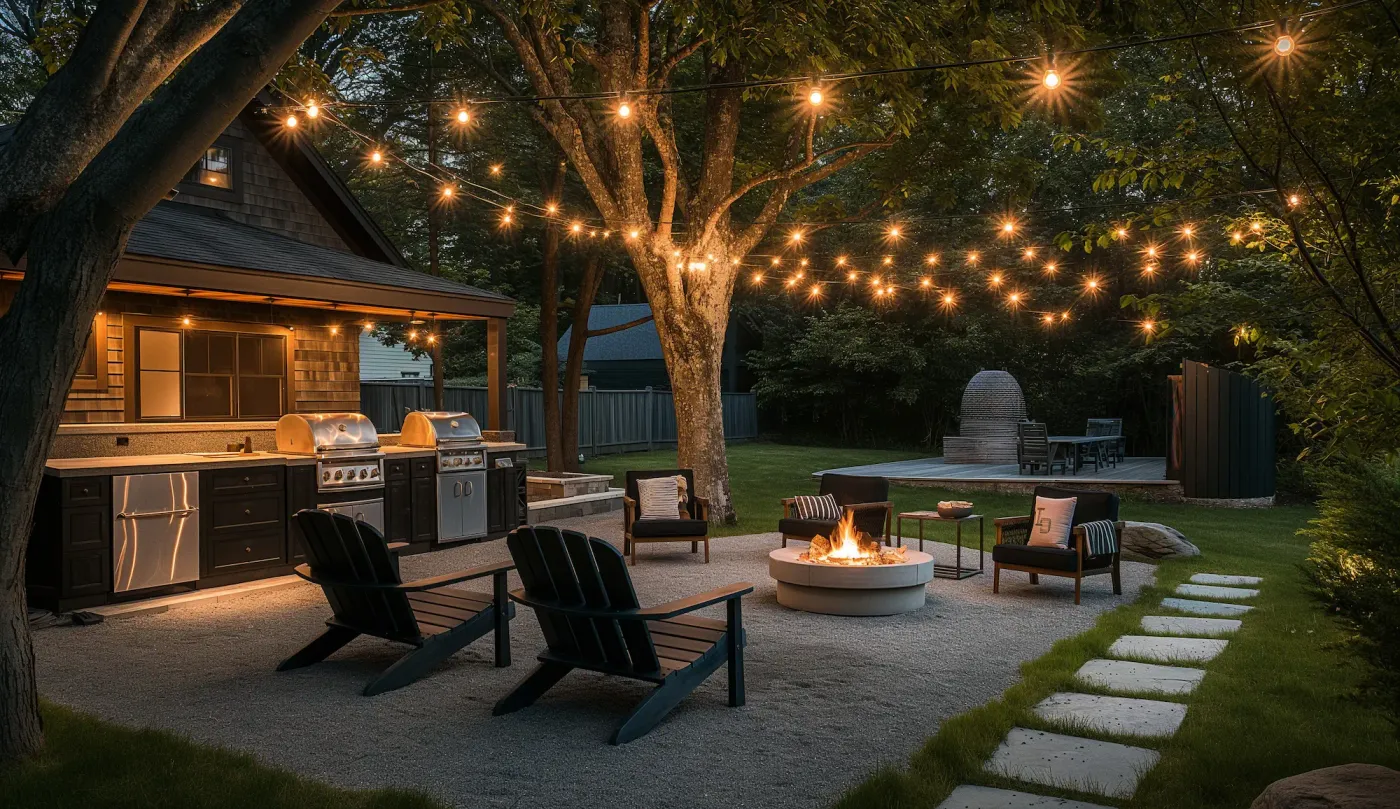
A fire pit, an outdoor kitchen and a tree full of string lights can hit $15,000 fast. The comfort version costs a fraction: a $130 portable propane fire pit, $60 in commercial-grade string lights, $90 for four Adirondack chairs from Marketplace, and a bag of pea gravel to top off the seating area. The gathering is about the circle of chairs and the glow, not the stainless steel. Layer in Idea #6‘s uplighting later if you want the drama.
19. Snow-Dusted Stone Path With a Lit Reindeer at the Bend
Put the figure where the path turns. A bend is a natural reveal — the eye follows the lights and finds the reindeer exactly when the walk changes direction. Keep the bordering strands a consistent 10 to 12 inches from the pavers so the snow line stays clean, and add two or three frosted orb lights near the figure rather than lighting the deer itself too brightly. Backlit, it reads as a silhouette; over-lit, it reads as plastic.
This is a small-yard idea and a good one. A path of 15 to 30 feet with a single evergreen cluster and one figure is plenty — the snow does half the decorating. Anything over 40 feet and one reindeer looks lonely at the end of it; you’d want a pair, or a small herd staged at intervals. For longer runs, borrow the rhythm from Idea #17 and let wrapped trees carry the distance.
20. Stone Entry Wrapped in Warm White With Garland Rails
- Measure your railings — garland needs about 1.5× the rail length to swag properly.
- Check which way wind hits that entry; bows and garland shred on exposed corners.
- Count outlets and total wattage before you plug in twelve strands.
- Test one strand per box — nothing’s worse than re-stringing in the cold.
- Decide where the extension cords will hide before guests arrive, not after.
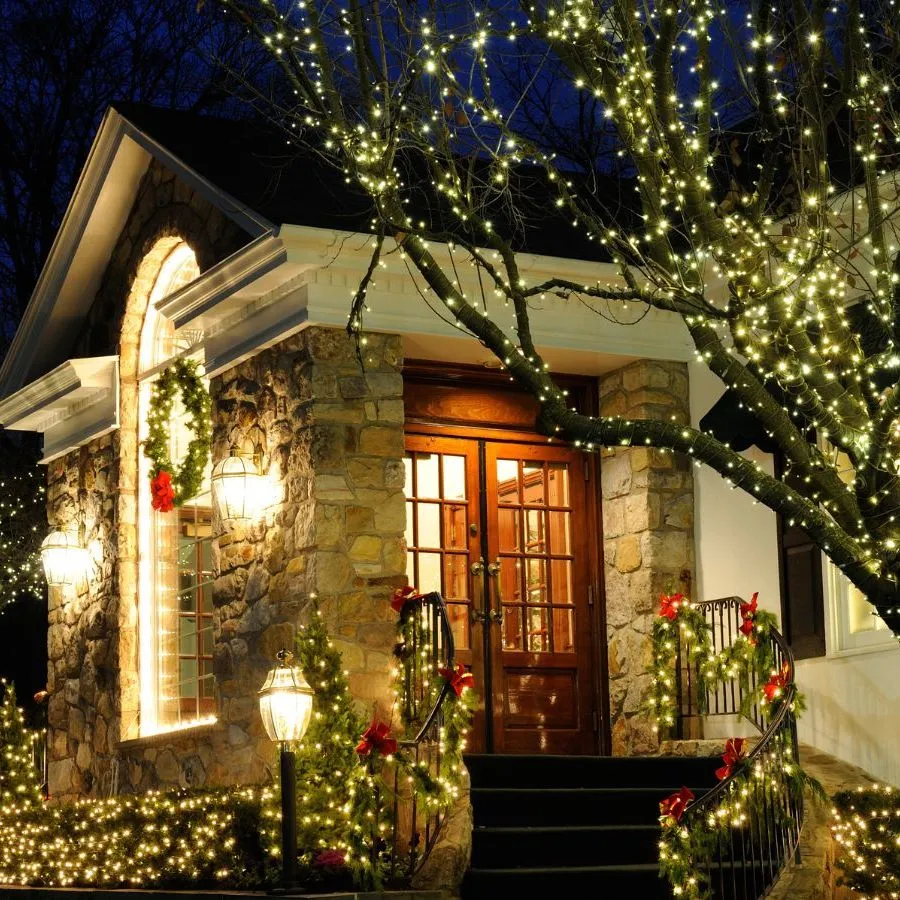
The garland is the piece that turns a lit entry into a decorated one. Strands alone light a house; green swag and red bows give it a season, a palette and a little formality. Notice how the bows sit at consistent intervals along the railing rather than clustered — that rhythm is what makes it look installed by a professional. If you add only one thing to a plain lit entry this year, make it the garland.
21. Two Modern Path Lights, Two Color Temperatures
- Choose the near fixture first — something warm, 2700K to 3000K, that flatters greens and yellows.
- Set it 4 to 6 feet back from the path edge and aim the beam across the planting, not down it.
- Place the second fixture 25 to 40 feet further on, where the purple flowers sit.
- Try a cooler 4000K lamp there to create depth — or match it if you want calm.
- Shade both from above so light lands on plants, not on passersby.
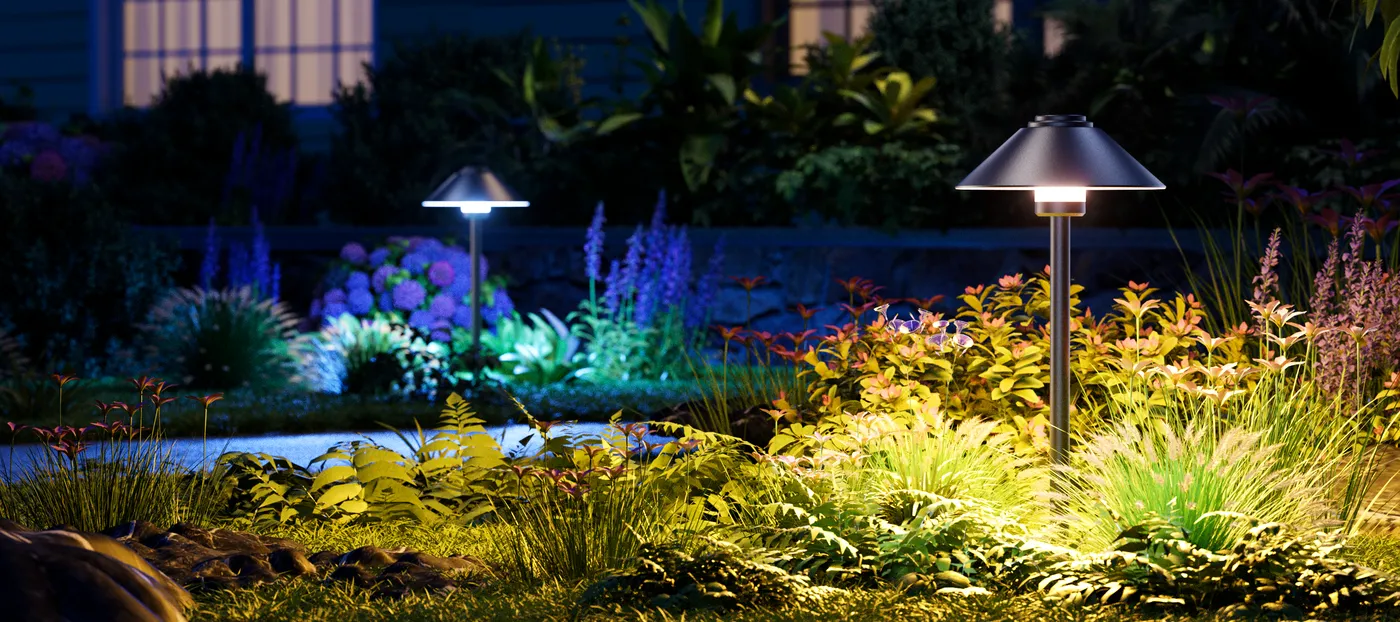
Under an hour once the low-voltage line is set; fixtures run $60 to $180 each.
The trade-off with color-mixing is that you’re now maintaining two different lamps. They age at different rates, so the near light may go amber-shifted a year before the far one does, and a mismatched pair is immediately noticeable in a garden this spare. Buy one spare lamp of each type now, wipe the glass monthly — hard water and pollen cut output noticeably — and expect to replace both every four to six years.
22. Red, Green and Blue Reflections on a Wet Driveway
Three colors, three jobs: 40% red on the evergreen beside the drive, 35% green on the bare deciduous trees, 25% blue outlining the house and turret. Nothing is mixed within a single plant, which is why it stays legible from the street. You can swap the palette — amber, copper and warm white would look equally deliberate — as long as each color owns its own layer and the brightest one stays lowest to the ground.
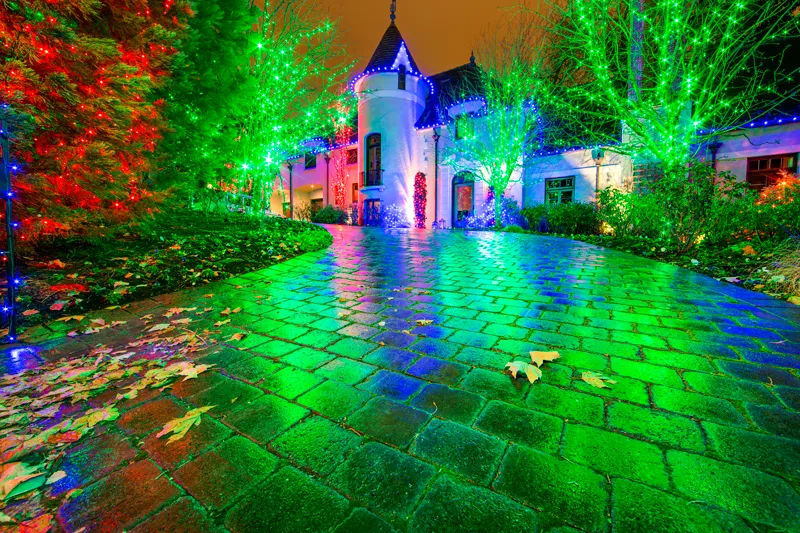
Wet pavement is the hidden hero. A damp driveway doubles every light source, throwing color down the length of the yard and turning the walk into part of the display. That’s why this scene looks richer after rain than in dry air. The other move is the shape of the house itself — arches, a turret, strong verticals — which gives all that color somewhere to land instead of floating in the dark.
Saturated multi-color is back on Pinterest in a way it hasn’t been since the early 2000s, and the driver is nostalgia. After years of minimalist warm-white everything, people are saving bold, playful yards again — the kind that get kids out of the car slowly. Will it date? Some of it, yes. But a three-color scheme tied to your house’s architecture holds up far better than whatever was trending the year you bought the strands.
23. Solar Ribbed-Glass Path Lights Around a Garden Pond
Ribbed glass is doing specific work: it breaks up the LED point source and throws a softer, wider pool of light, which is exactly what you want near water. Place them 4 to 6 feet apart, angled so the beam hits the pebble edge rather than the pond itself — light striking open water just disappears. And check your solar panels’ exposure before you commit; a fixture under tree cover will run two hours and quit.
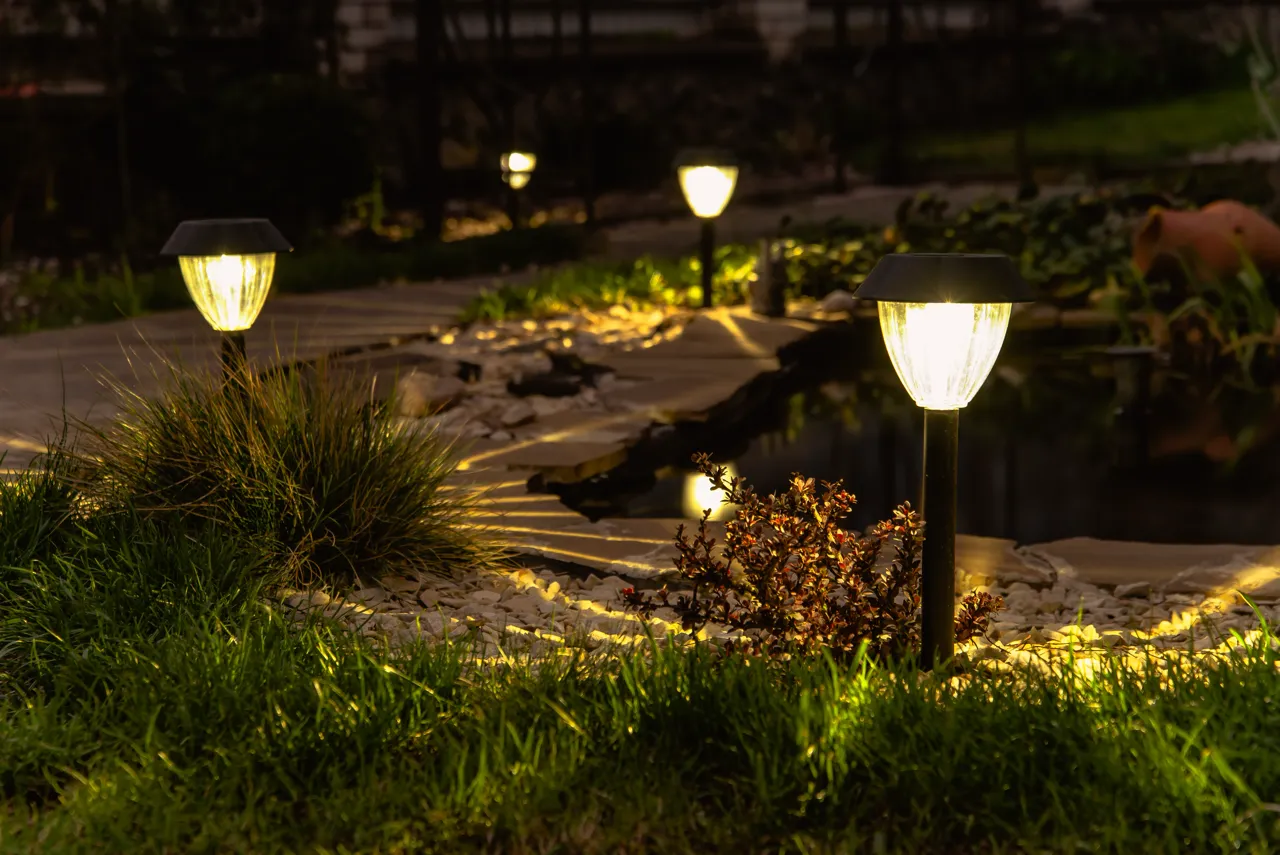
- Solar ribbed-glass path lights, 6-pack: $45–$110
- Decorative pebbles, 3 bags: $30–$60
- Stepping stones, 8: $60–$180
- Replacement rechargeable batteries, annual: $12–$25
- Wired alternative, 6 fixtures plus transformer: $280–$600
Total: $135–$350 solar, or $280–$600 wired.
Cheaper still: buy the six-pack in a two-for-one bundle in spring, when garden centers clear out last year’s packaging.
Your Front Walk, After Dark
Start with one thing: the path. Get the color temperature consistent, set the fixtures low and evenly spaced, and you’ll be surprised how quickly the rest of the yard tells you what it needs next. Everything above works at some price point — solar stakes and Marketplace chairs count just as much as a wired system and a stone retaining wall.
📌 Pin your favorite idea to your holiday board now, so when November rolls around you’re shopping from a plan instead of a panic.