You know the feeling — you’re forty pins deep, and every colorful Christmas tree you save looks effortlessly joyful in someone else’s living room and slightly chaotic in yours.
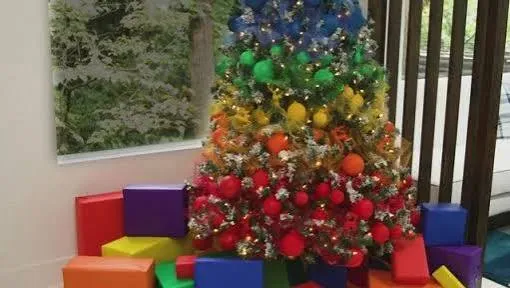
We spent serious time browsing Target, Walmart, Etsy, Anthropologie, and Amazon to bring you only what’s worth your attention this year, and the range runs from $9 ornament sets to $600 full-size trees. After filtering through hundreds of options, we narrowed it down to 24 ideas that actually deliver — covering jewel-tone glam, retro glass, pastel whimsy, and flat-out maximalist color.
Budget and luxury versions sit side by side, so you can see exactly where the money matters and where it absolutely doesn’t. Color is having a moment in 2026, and it’s less about matching sets than about sequence, contrast, and one or two anchor hues doing the heavy lifting.
And stay until the end — we break down the most common mistakes that can ruin these looks.
📌 Save this to Pinterest for later — you’ll want to revisit these ideas.
1. A Gradient-Lit Light Tree That Changes Color as It Rises
The magic here isn’t the number of colors — it’s the order they appear in. Blue and green hold the top of the tree, yellow and red take the middle, and purple and pink glow at the base, so your eye travels the full height instead of bouncing around. Because the lights sit against a dark sky and snow, every hue reads clean rather than muddy. Sequence is doing the work that a bigger budget usually can’t.
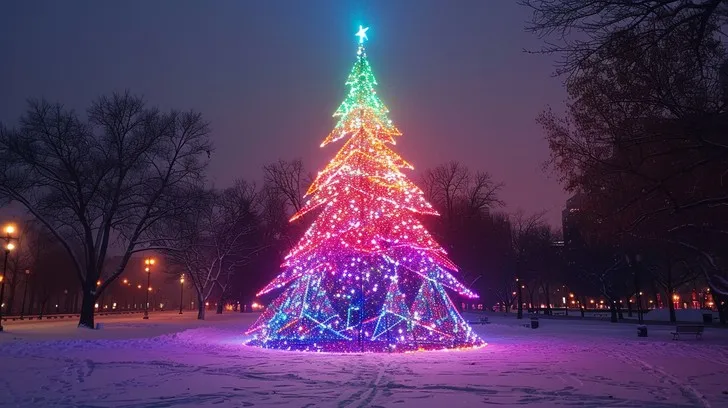
A gradient needs vertical room. The light-built version here stands in an open park, but the home version works from about seven feet up — anything shorter and you can’t fit four clean color zones without them blurring into each other. Give it a dark backdrop, like a charcoal wall or an unlit corner, so the saturated colors have something to glow against. Working with an eight-foot ceiling? Try the warm-white approach in Idea #3 instead.
2. Red, Silver, and Storybook Glass on Green Branches
If you took away the clear glass baubles with the little white village scenes inside, this would still be a perfectly nice red-and-silver tree — and you’d never look twice at it. Those scenes are the reason people walk over and lean in. They turn decoration into a story, and because they’re clear, they let the greenery and the lights read straight through instead of blocking them.
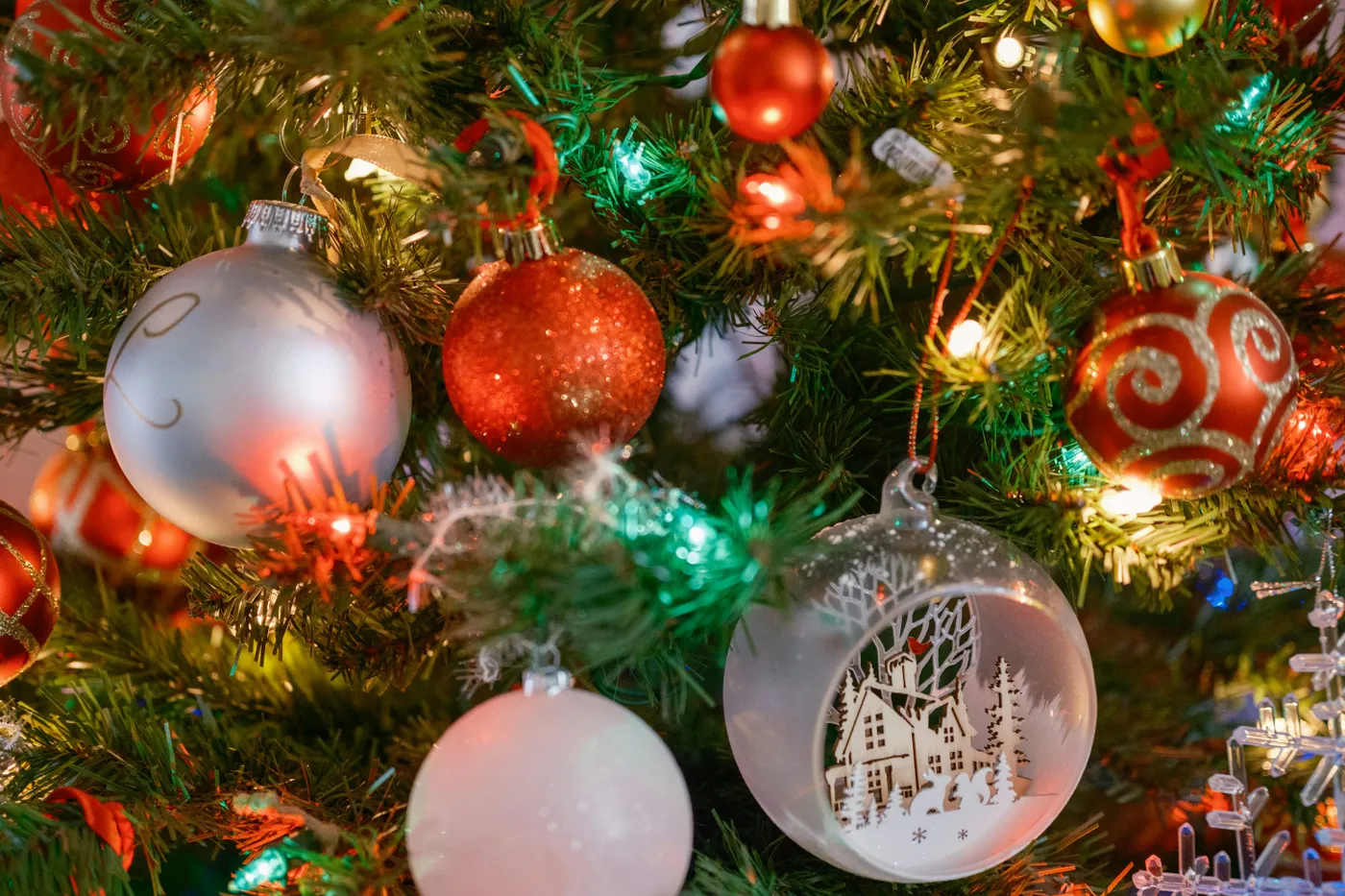
Work in three ornament sizes and no more: roughly 2.5-inch, 4-inch, and 6-inch. Hang the largest baubles in the lower third where the branches are strongest, the midsize ones through the middle, and the smallest at the top. On a 7-foot tree that’s about 90 to 110 ornaments total, and the clear glass ones belong at eye level, where people actually look.
3. Red, Yellow, and Black Baubles Under Warm White Glow
Here’s the math: about 70% of the visual weight is dark green foliage, 20% is warm white light, and just 10% is color — red, yellow, and a handful of black baubles that read as soft shadow. That imbalance is why it feels rich instead of loud. To swap the palette, keep the same 70/20/10 split and trade red-yellow-black for teal, copper, and cream. The formula holds even when the colors change completely.
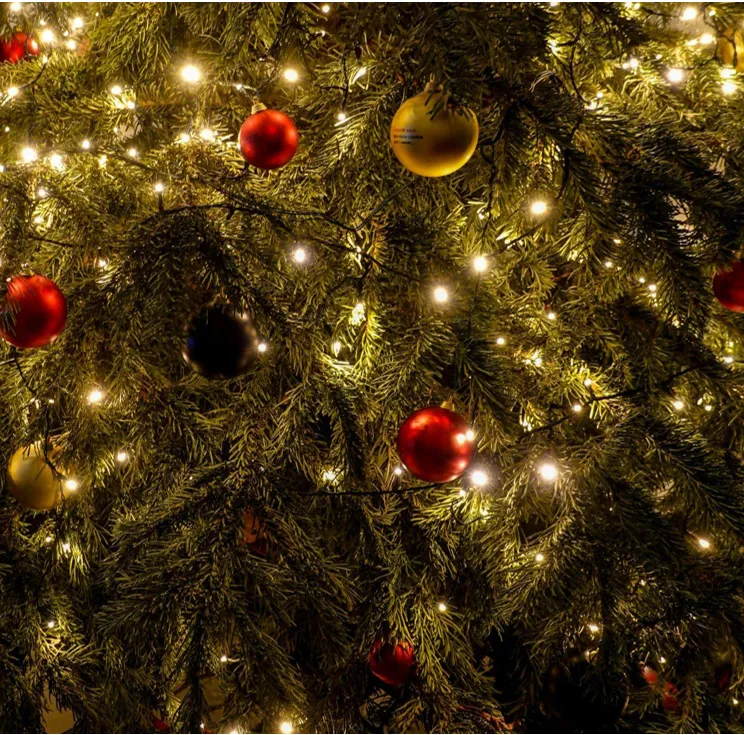
Black ornaments are beautiful in person and stubborn in photos — they can read as empty holes where branches should be. Hang them behind a lighter bauble or a sprig of greenery so they catch a rim of light. Also, warm white lights on a tree this dense go dim in daylight, so add a second strand on the side facing the room rather than doubling up on the back.
4. Retro Glass Baubles Straight Out of a 1970s Catalog
Vintage-shaped glass is back in a big way for 2026, and it isn’t nostalgia for nostalgia’s sake — it’s a reaction to a decade of identical plastic spheres. Shoppers are hunting flea markets and estate sales for indented glass, hand-painted stripes, and that slightly faded shine you simply can’t buy new. Irregular finishes are exactly what make a branch feel collected rather than purchased.
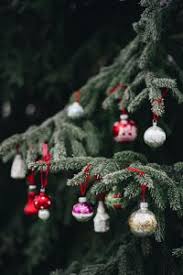
Nobody needs to pay collector prices. Box lots of old glass ornaments turn up at thrift stores for $5 to $15, and estate sales late on the second day are goldmines. Fill gaps with a $20 set of new glass-look baubles in the same faded palette, then hang one vintage piece per branch cluster so your eye catches each one. Compare with Idea #15 for the handmade, made-from-scratch end of that same nostalgic streak.
5. A Full, Color-Packed Tree with a Nutcracker Cart Beside It
- Full 7.5-ft tree: $250–$600
- Multicolor LED strands, if not pre-lit: $30–$60
- Mixed-size ornament set: $80–$200
- Ribbon garland, 3 rolls: $25–$45
- Patterned tree skirt: $40–$90
- Rolling cart, nutcracker, three tinsel trees: $120–$300
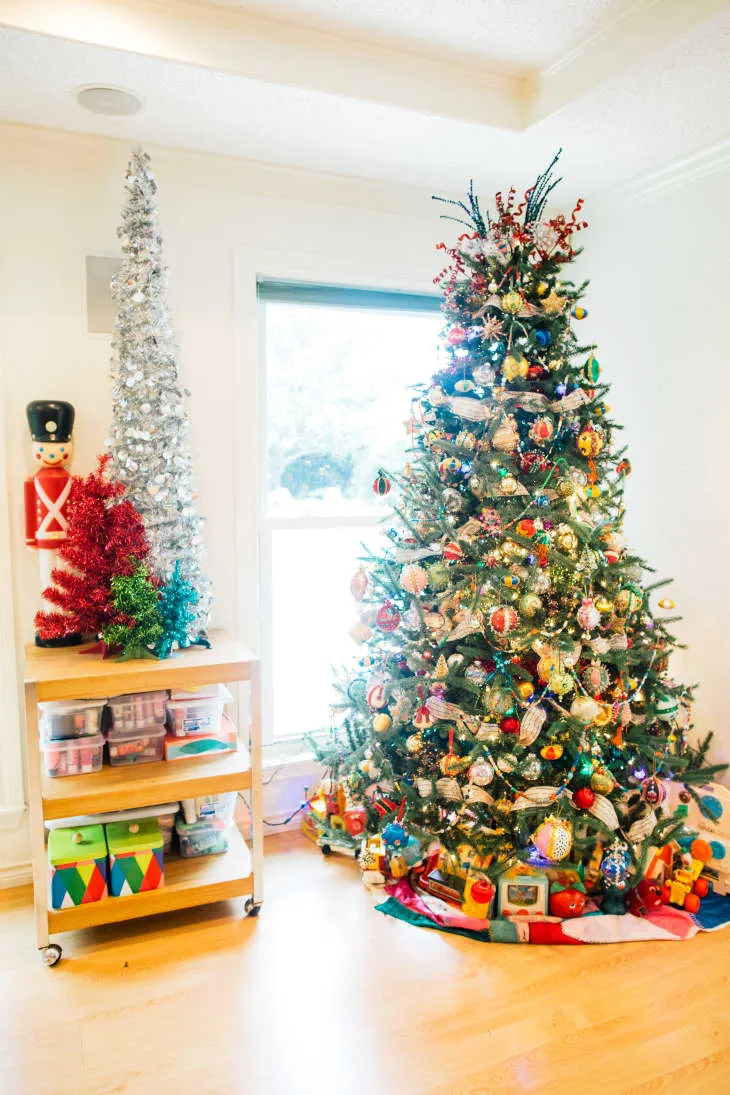
The cart is doing more than holding decor — it gives the corner a second vertical element at a different height, which is why the tree doesn’t feel like one lonely cone. Keep the tallest object on the cart below the midpoint of the tree, around three feet, so the eye still finishes on the ornaments. Line up the silver, red, and green tinsel trees in that order; it echoes the ornaments without repeating them.
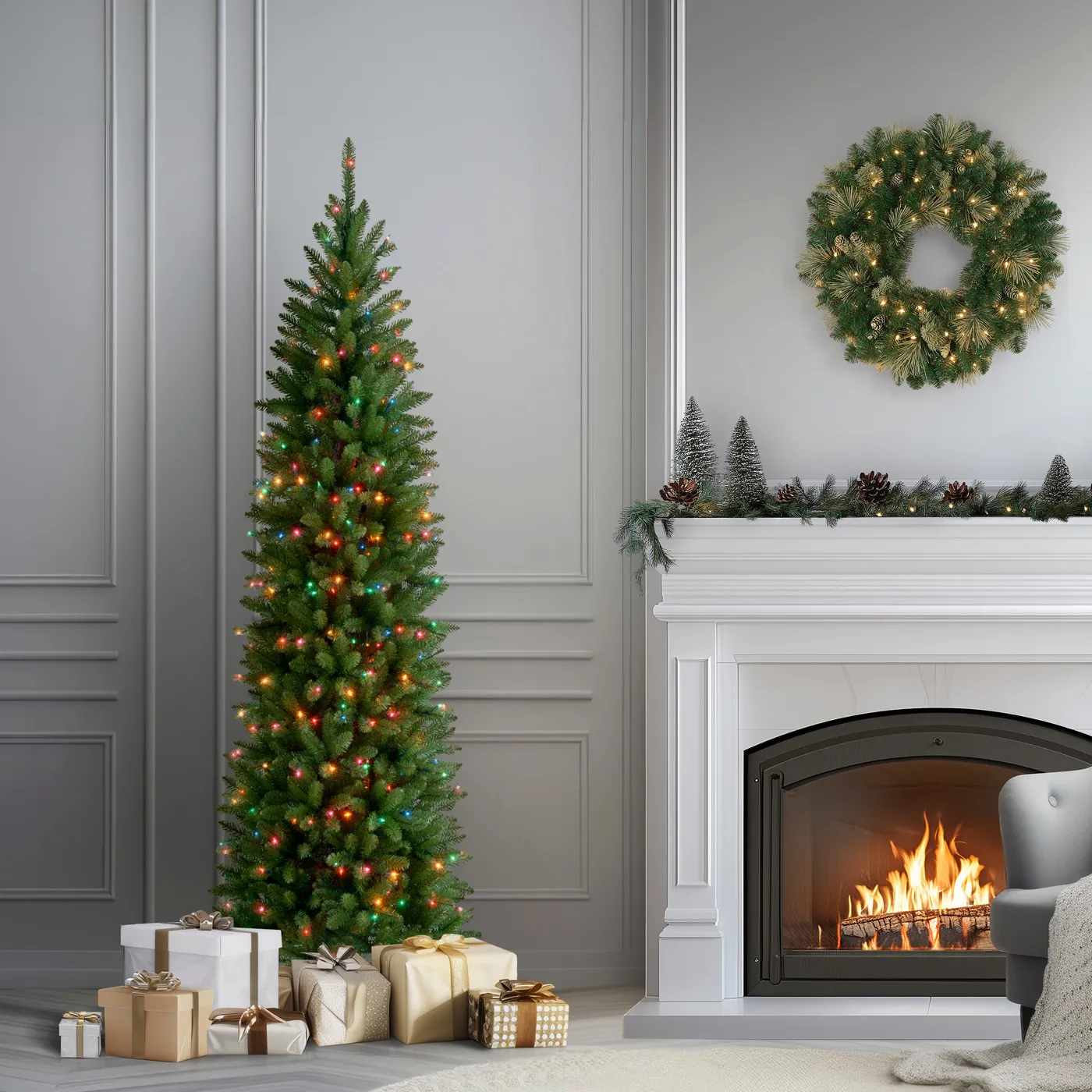
6. A Slim Multicolor Pre-Lit Tree Beside a White Fireplace
Slim trees are brilliant in tight corners and terrible at hiding things. They hold maybe half the ornaments of a full tree, and with no interior depth, anything you hang sits right on the silhouette. Multicolor lights also run cooler in tone than warm white, which can make a white fireplace wall feel clinical after dark. Keep a table lamp on in the room so the tree isn’t your only light source.
- Measure the mantel and add 12 inches so the garland drapes past both ends.
- Fluff every branch outward, away from the wall, before hanging.
- Zip-tie the garland to two small hooks underneath the mantel shelf.
- Tuck in three bottlebrush trees and a few pinecones, spaced unevenly.
- Loop warm white fairy lights on top last, so the cord hides in the greenery.
Time: about 45 minutes. Cost: $35 to $70 if you already own the lights.
7. Ombré Rainbow Ornaments on a Black Christmas Tree
Roughly half the drama is the black tree, about 40% is the ombré ornament run from gold and green through blue and purple down to pink, and 10% is the gold star holding the top. Remove the dark base and you’d have a pleasant rainbow tree; keep it and every color gains saturation. To swap palettes, keep the gradient moving top to bottom and simply shift the starting hue.
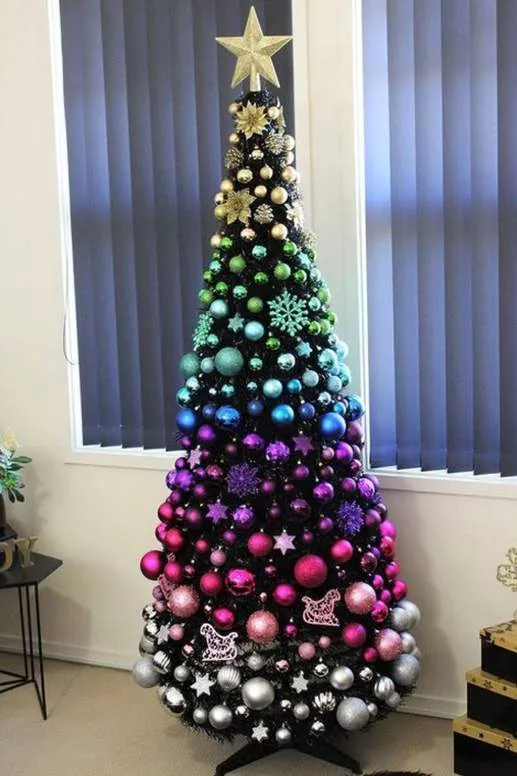
It’s the black tree. On a green tree this same ombré would still be pretty, but the dark branches make the lower purples and pinks look lit from within, and the golds at the top read almost metallic. Not ready to commit to all-black? A deep charcoal-green tree gets you about 70% of the effect and is far easier to resell or pass along later.
8. One Glittery Silver Bauble Against a Wall of Colored Bokeh
Glitter is a commitment. Expect a fine silver dust on the branches, the floor, and your hands through the first season, so hang glittered baubles above a hard floor rather than a pale rug. Frosted branch tips are the other offender — they trap dust and look grey by February. A can of compressed air and a soft makeup brush bring both back to life in about ten minutes.
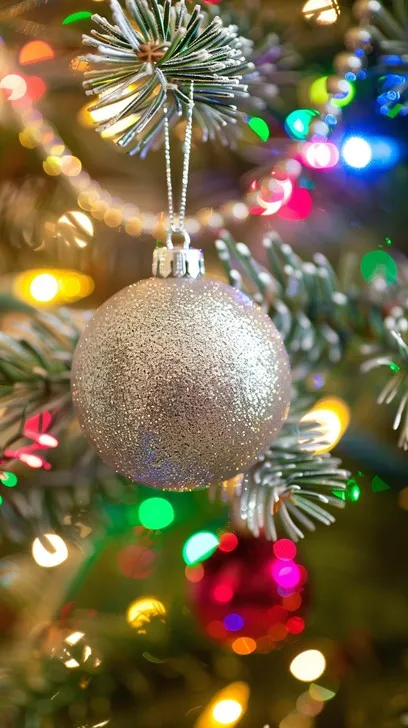
This close-up look works on any tree, but the lights have to be dense enough to blur at arm’s length. On a 4-foot tree, aim for 100 to 150 lights; on a 7-footer, 400 to 600. Frosted tips read best against a dark backdrop, so if your tree sits in front of a white wall, use a deeper tree skirt and let the bokeh do the work after dark, when the room lights come down.
9. A Beaded Mini Tree Sharing a Shelf with Silver Tinsel
- Buy a 9- to 12-inch foam cone and about 5,000 mixed seed beads.
- Work in rows from the bottom, pinning one bead at a time with short sequin pins.
- Overlap each row by about a third so no foam shows through.
- Finish the top with a tight bead cluster and one larger bead.
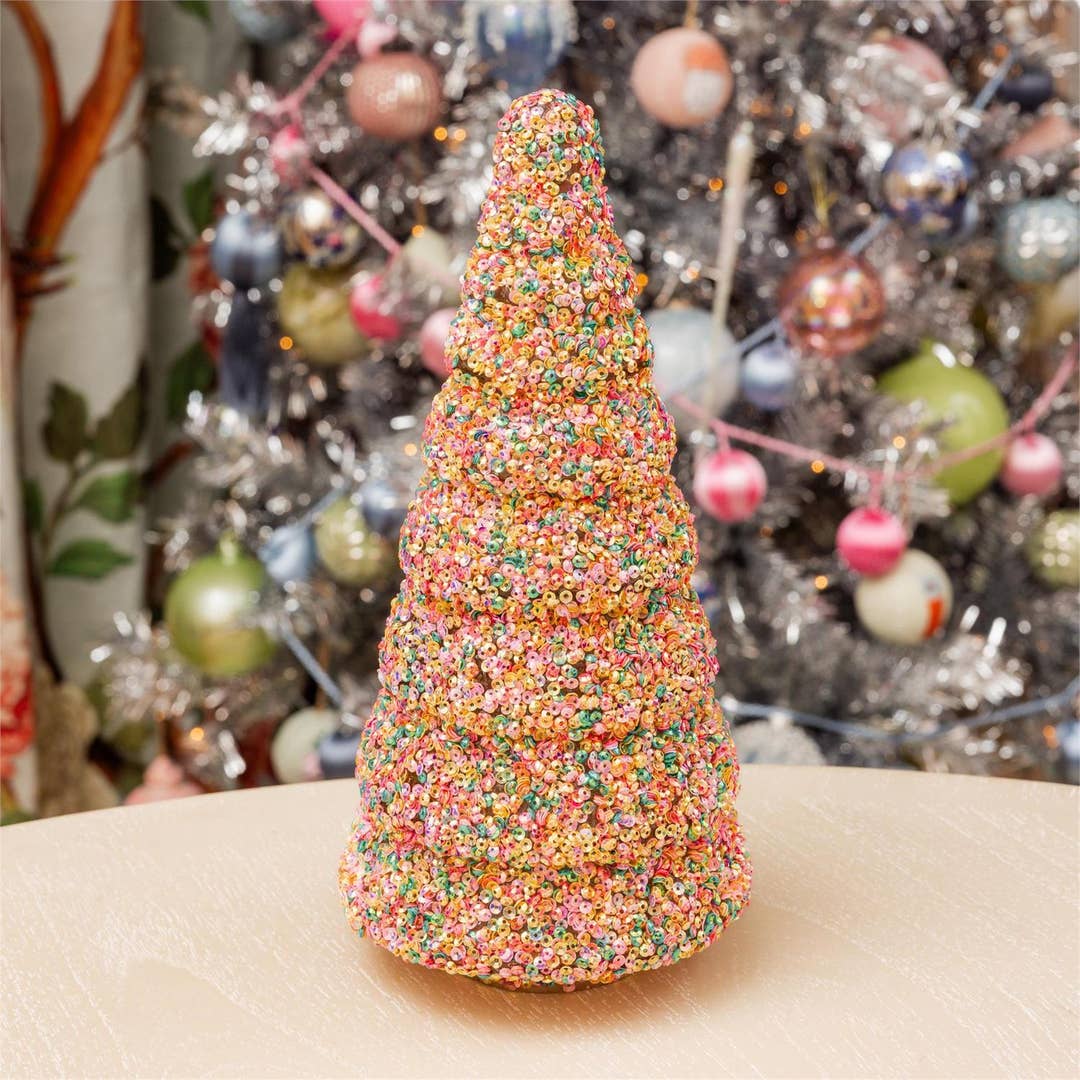
Time: three to four evenings. Cost: about $25. It’s the kind of project that’s better with a movie on.
Tinsel trees have a reputation problem they don’t deserve. A 4-foot silver tinsel tree runs $25 to $45 at Walmart or Target, and because the branches are metallic, you need far fewer ornaments to make it look full — eight to twelve pastel baubles will do. Style it behind a small beaded tree on the same tabletop and the two sizes read as one intentional display. Compare with Idea #20, where a clear topper does similar reflective work.
10. A Tiny Multicolor Tree Next to a Ribbon-Tied Candle
The red fabric wrapped around the base instead of a skirt. It costs about two dollars, takes thirty seconds, and it’s the reason this looks styled rather than set down. A fabric wrap hugs the trunk line and keeps a small tree’s proportions honest, while a full skirt would swallow it whole. The same trick works on a bedside table or a kitchen counter all December long.
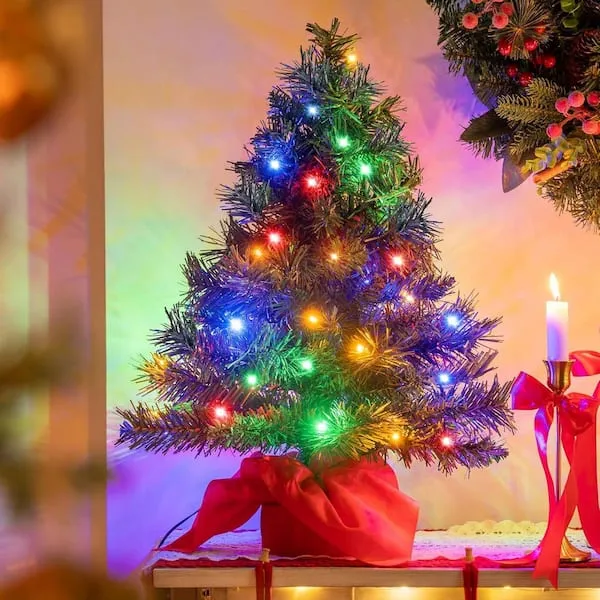
Small-format trees are the quiet story of 2026 — not because people have less space, but because they’re styling more than one room. A tabletop tree with multicolor lights, a single candle, and one textile underneath is the easiest way to carry holiday color into a hallway, a guest bath, or a desk without committing to a second full-size tree.
11. Multicolor Lights Against a Blue Painted Brick Fireplace
Cool blue brick plus multicolor LED is a lot of cool at once. Keep every lamp in the room at 2700K and dim them to about 60% after dark — the multicolor bulbs then read as jewel tones rather than candy. If your room has a single overhead fixture, put it on a dimmer before you decorate. It’s a $25 switch and it changes the entire mood of the tree after sunset.
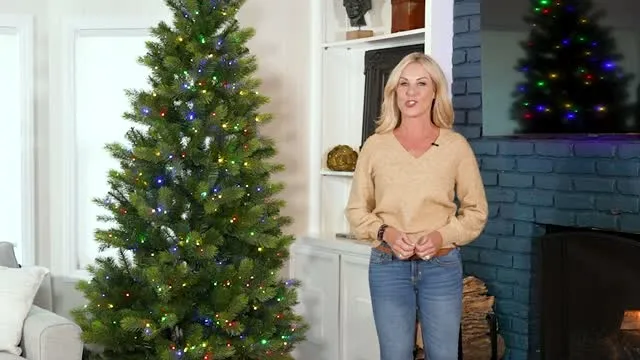
Photograph your tree before you commit to the whole strand. Multicolor LEDs vary wildly in saturation — some reds lean orange, some blues lean green — and against a saturated wall like this one, a mismatched strand looks muddy. Buy one box, plug it in against the wall, and look at it from your sofa with the room lights off. Then buy the rest.
12. Glossy Red, Matte Gold, and Teal Icicles in Close Rows
About 60% of this tree is dark green foliage with warm white and cool blue light mixed through it, 25% is the classic red-and-gold pairing, and 15% is the teal-and-silver accent doing all the surprising work. The ratio matters more than the specific colors: swap teal for blush and you should drop the reds slightly and pick up more silver, or the tree turns sweet on you.

Frosted berry clusters and flocked accents shed, so expect a small drift of white under the tree by January — a hard floor or a low-pile rug saves you an hour of vacuuming. Silver and teal icicle ornaments have a second flaw: the finish dulls with fingerprints and dust. Wipe each one with a dry microfiber cloth when you pack them, not when you unpack them next year.
13. A Snowman Topper Crowning a Red-and-Blue Flocked Tree
The snowman’s hat and scarf are the exact red and light blue used in the ornaments and striped ribbons below. That single repeated detail is what makes the tree look designed instead of decorated. Swap the topper for a plain star and the whole thing loosens — still festive, just no longer one idea. Pick your topper first, then pull two of its colors into the ornaments underneath.
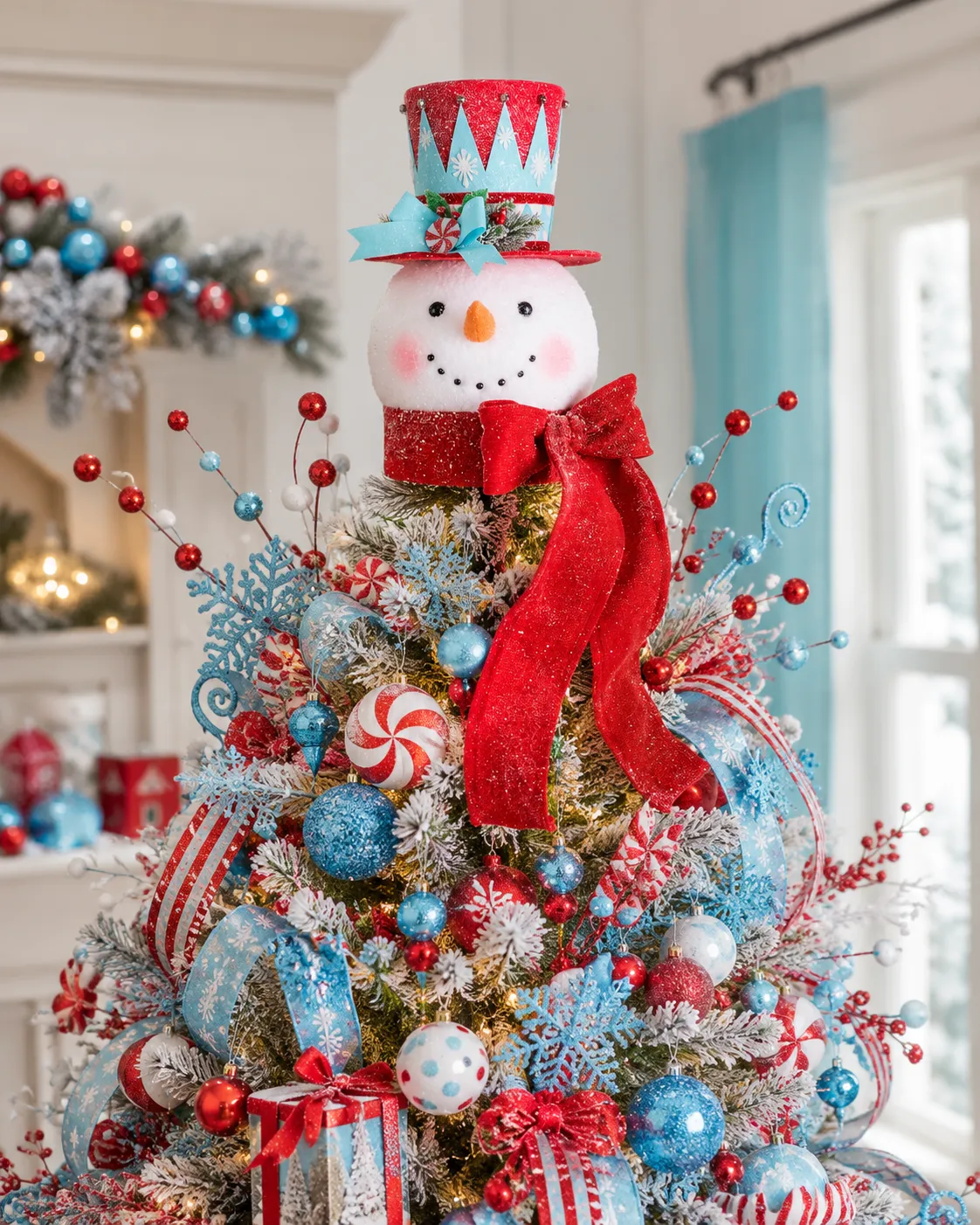
- Clip the top four inches of the tree’s leader branch to a single strong point.
- Slide the topper’s cone or coil base down over that point, never beside it.
- Thread a thin green zip tie through the base and around the branch.
- Step back ten feet to check the lean, then adjust the lowest branches, not the topper.
Time: 10 minutes. Cost: a dollar for zip ties. A lean almost always comes from the tree, not the star.
14. Big Glossy Baubles, Small Matte Ones, Abstract Art Behind
Two things are happening. First, size contrast: large glossy red, blue, green, and gold baubles sit low and deep, while small matte pink, purple, and light blue spheres fill gaps up top. Second, the abstract painting on the wall repeats the ornament palette, so the tree belongs to the room instead of floating in front of it. That echo is free if you already own art with reds and blues in it.

Flocked trees cost real money, but flocking spray is about $12 a can and a 6-foot tree takes two. Buy an inexpensive green tree, spray it outdoors on a dry day, and let it cure overnight. Then mix one $30 set of oversized glossy baubles with a $12 set of small matte ones — the size jump, not the price tag, is what sells the look.
15. Pixel-Perfect Perler Bead Baubles Hung on Twine
- Build a circular bauble pattern on a large pegboard, roughly 15 rows across.
- Iron both sides on medium heat under parchment until the beads fuse flat.
- Poke a small hole near the top and thread natural twine through it.
- Repeat in single bold colors rather than mixing hues inside one ornament.
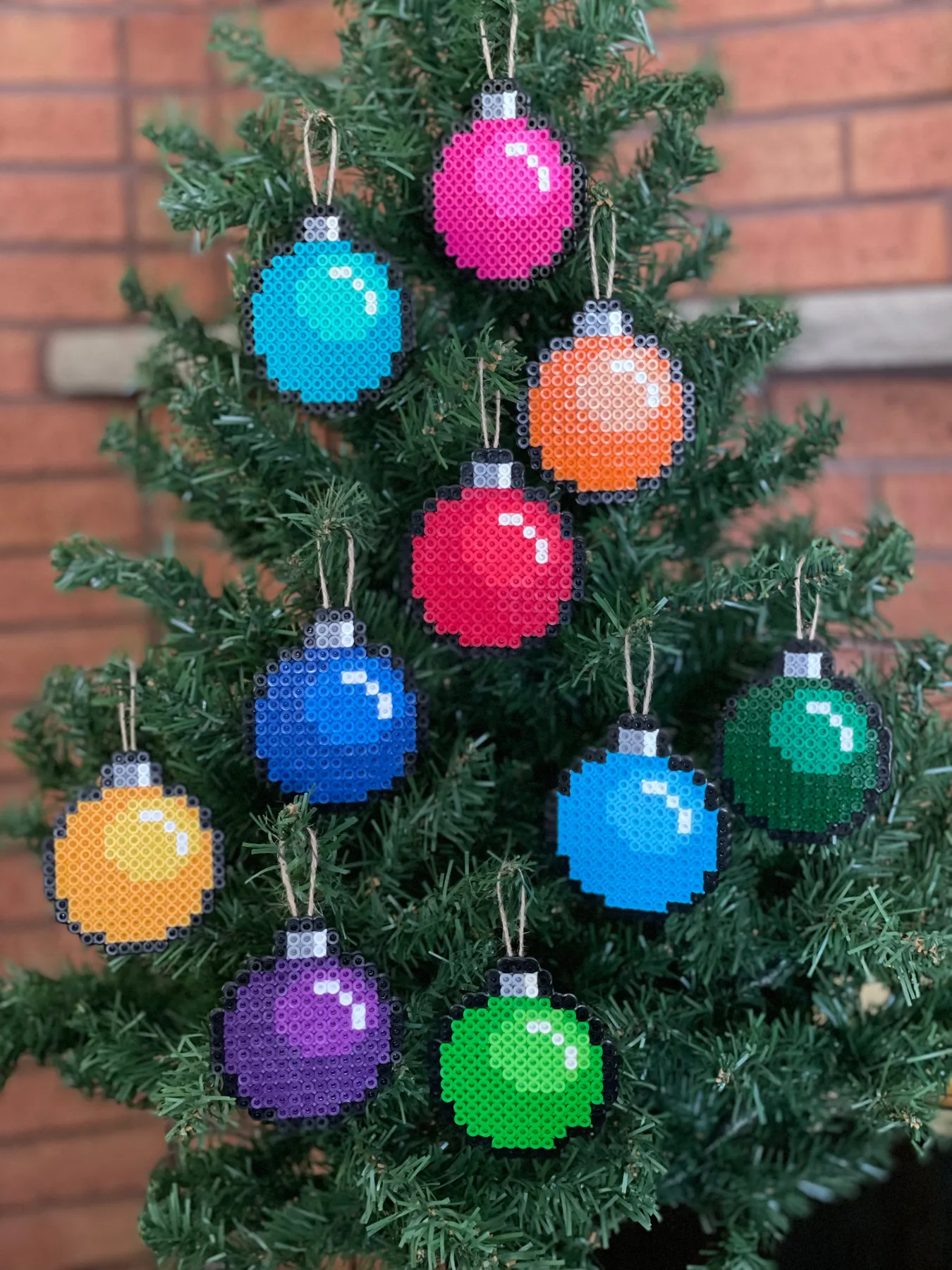
Time: about 25 minutes per ornament plus ironing. Cost: roughly $1.50 each in beads.
These ornaments have flat, graphic faces, so they disappear the moment they overlap. Hang three at most in any one square foot of branches, and keep a hand’s width of greenery between them. The black outlines and grey caps already frame each one, so the tree doesn’t need to help. On a 6-foot tree, twenty to twenty-five is plenty; more and it turns into a craft fair.
16. The Neighborhood Tree: Multicolor Lights at Dusk
Community trees went from civic obligation to actual destination. Towns are lighting them earlier, adding projections and warming stations, and people are planning whole evenings around the switch-on. That’s reshaping home decorating too — a big, unapologetically multicolored tree in the front window is back in fashion, because it reads as an invitation rather than a private display.
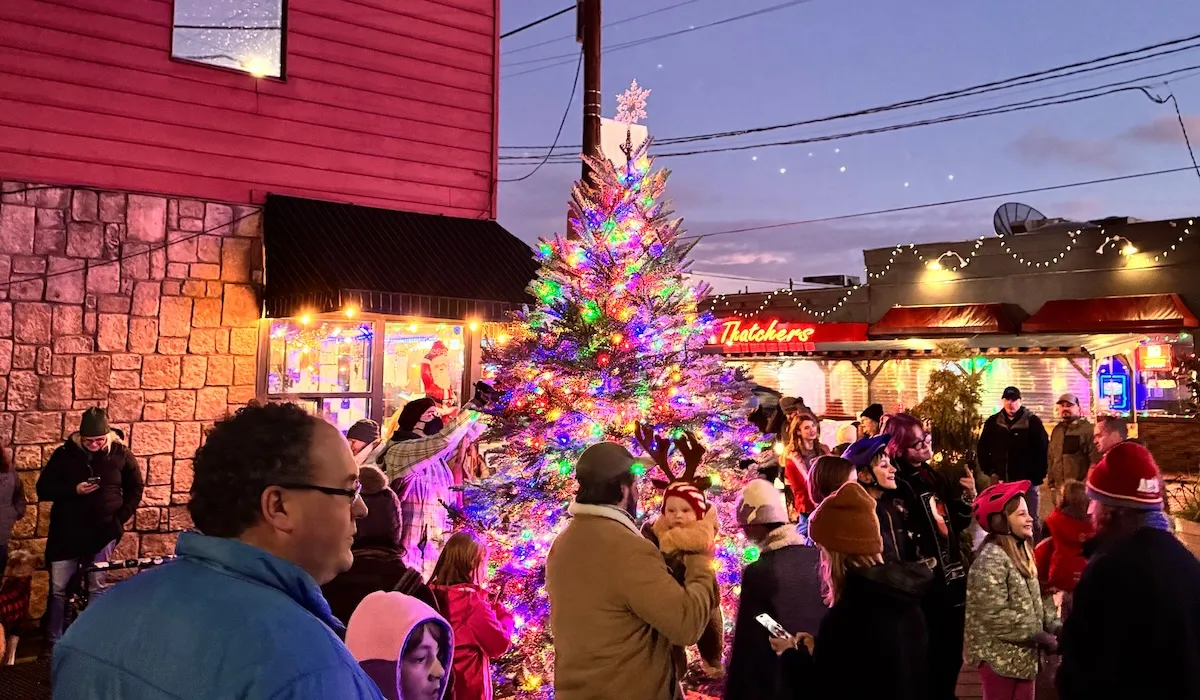
Scale changes the rules. A public tree here is viewed from 20 feet or more, so multicolor bulbs blend into a soft glow. A front-yard tree seen from the sidewalk — 15 to 30 feet away — needs about 100 lights per foot of height to read the same way. Any closer and the individual bulbs separate. If your tree is visible from the street, over-light it; nobody has ever said a window tree was too bright.
17. One Tree, Two Light Settings: Warm White Meets Multicolor
Split a pre-lit tree down the middle instead of mixing strands. Keep the warm white side facing wherever you sit in the evening — it flatters skin tones and upholstery — and point the multicolor half toward a hallway, entry, or window. On a 7-foot dual-color tree you’re looking at roughly 300 warm white and 300 multicolor bulbs, and the divider sits on the tree’s vertical seam, which a wide ribbon hides perfectly.
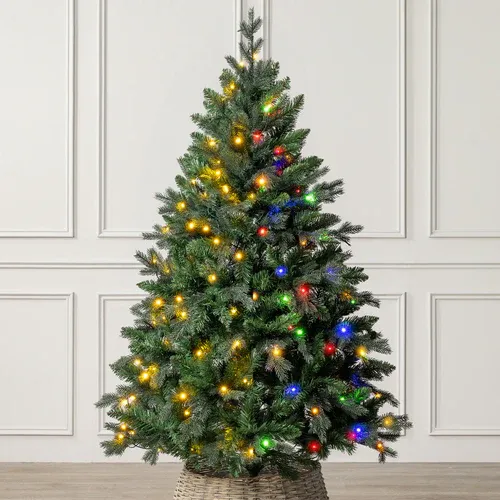
Dual-color trees only work if the strands switch independently. If both run off one plug with no remote, you’ll get a hard line down the middle and no way to soften it. Check the control box before you buy; a foot pedal or remote is worth the extra $30. The woven basket collar hides plenty of sins, but it needs a level floor and a tree stand no wider than its rim.
18. Fiber Optic Twinkle with Snowflakes on the Wall
- 4-ft fiber optic tree: $45–$90
- Clear internally lit ornaments: $15–$30
- Yellow star topper: $8–$15
- Snowflake light projector: $25–$60
- Tree stand or collar: $15–$40
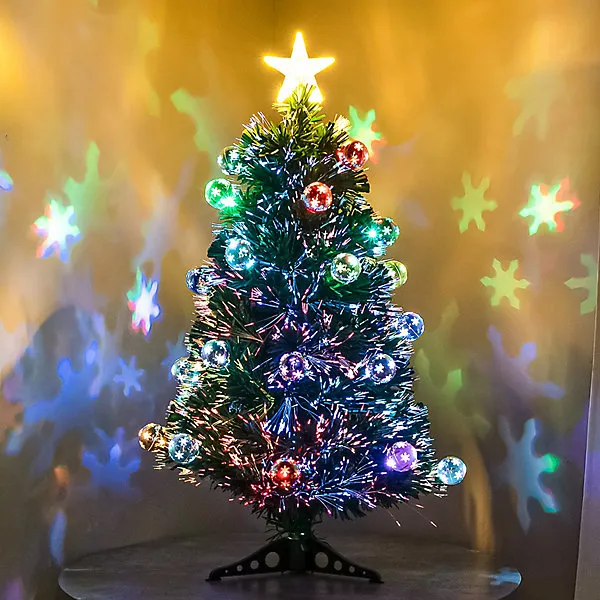
The tree itself is small, but the snowflake projections throw colored light onto the wall behind it, which doubles the perceived size and fills a whole corner with almost no floor space. Your eye reads the wall first, then the tree. That’s the trick worth stealing even without a fiber optic tree: put light on the surface behind it, never just inside it.
19. A Pastel Dessert Tree with a Matching Mantel Garland
Heavy flocking is lovely in December and dusty by March. Vacuum it with a brush attachment on the lowest setting before you pack it, and store the tree upright if you have the closet height — laying a flocked tree down flattens the snow permanently. Pastel fabric skirts and cream textiles show every smudge, so spot-clean them with cool water and never a hot wash.
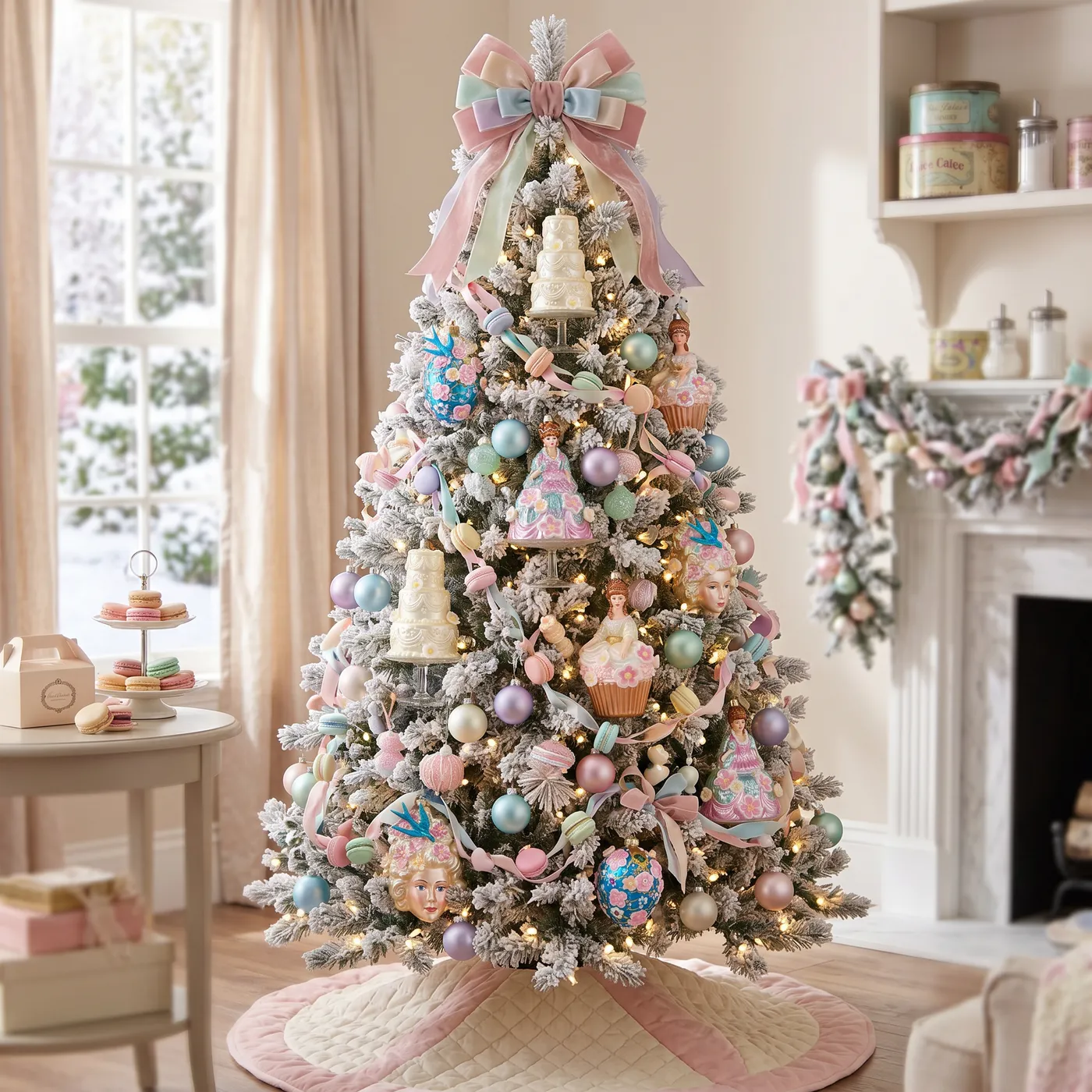
The garland on the mantel. Without it, this is a beautiful object in a room that has nothing to do with it. Repeating the pastel ribbon and a few cake and doll-figure ornaments across the fireplace pulls the whole view together, and it costs almost nothing if you bought ribbon by the roll. One small echo on a side table finishes it — see Idea #6 for the wiring details.
20. A Clear Beaded Star Topper That Soaks Up Every Light Color
Topper sizing is where most trees go wrong. A star should span roughly one-fifth to one-quarter of your tree’s widest point — about 8 to 10 inches on a 7-footer, 5 to 6 inches on a 4-foot tabletop tree. Trees under 5 feet rarely need a topper at all; a dense cluster of three ornaments balances the silhouette better than an oversized star ever will.
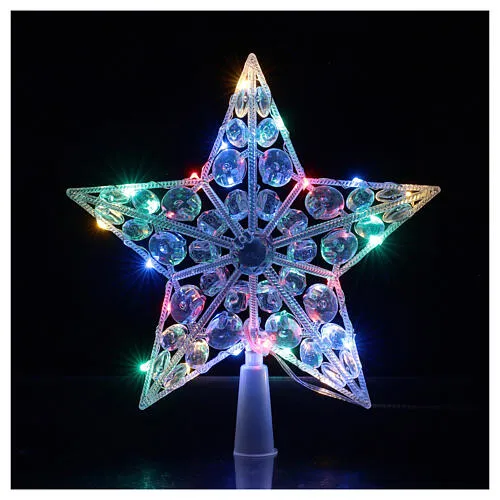
Because this star is clear, it takes on whatever color sits closest to it. Hang two or three clear or frosted baubles in the top 12 inches so the topper has something to reflect, and keep red and green bulbs away from the immediate area — they’ll tint the whole thing. If yours reads dull, a single warm white bulb tucked inside the open frame fixes it instantly.
21. Magenta, Lime, and Gold, Grounded by a Red and Silver Base
Roughly 40% green foliage, 45% jewel-tone ornaments in magenta, purple, blue, and lime, and 15% gold to keep the saturation from going flat. Warm white lights are doing invisible work here — under cool LED these same ornaments would look plastic. Want it calmer? Hold the ratio and swap magenta and lime for teal and copper, which reads rich instead of loud.
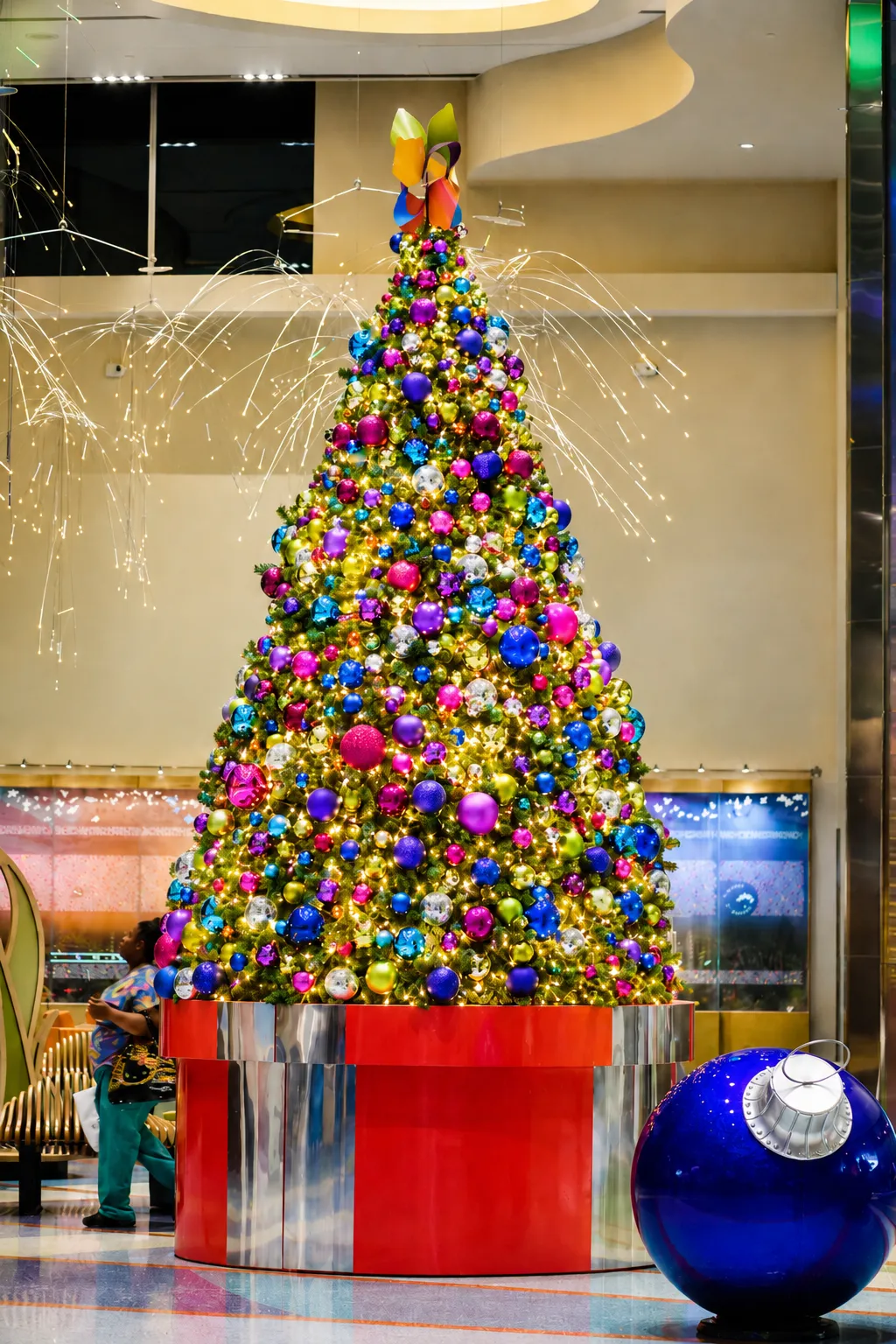
Oversized jewel-tone baubles are the cheapest way to fill a big tree. A set of six 6-inch shatterproof ornaments runs $20 to $35 at Walmart or Target, and a dozen covers a 7-foot tree’s sightlines. For the red-and-silver base, a painted storage drum or a wide galvanized tub lined with wrapping paper gets the same graphic punch for under $30. See Idea #5 for a wood-and-tinsel take on the same layered idea.
22. Disco Balls, Mushrooms, and a Dark Wall Behind
Eclectic maximalism isn’t going anywhere in 2026 — it just got weirder. Disco ball ornaments, mushrooms, and abstract glass shapes are the fastest-moving category in holiday decor right now, and the reason is simple: they’re collectible without being precious. You can add one a year, mix in a thrift find, and the tree only gets better. No combination is wrong, and that’s exactly the point. It pairs beautifully with the jewel tones in Idea #21.
- 7.5-ft unlit tree: $200–$450
- Multicolor glass and novelty ornaments: $150–$400
- Disco ball ornaments, set of six: $18–$40
- Large star topper: $15–$45
- Warm white string lights: $25–$50
- Tree collar and area rug: $60–$180
23. Glittered Leaf Picks Mixed Between Bright Baubles
Insert picks at a 45-degree angle, pointing out and slightly down, so they echo the natural droop of the branches. On a 7-foot tree, 12 to 18 picks is the sweet spot, and odd numbers group better than even ones — cluster them in threes rather than spreading them evenly. Trim any wire stem that pokes through into the interior of the tree.
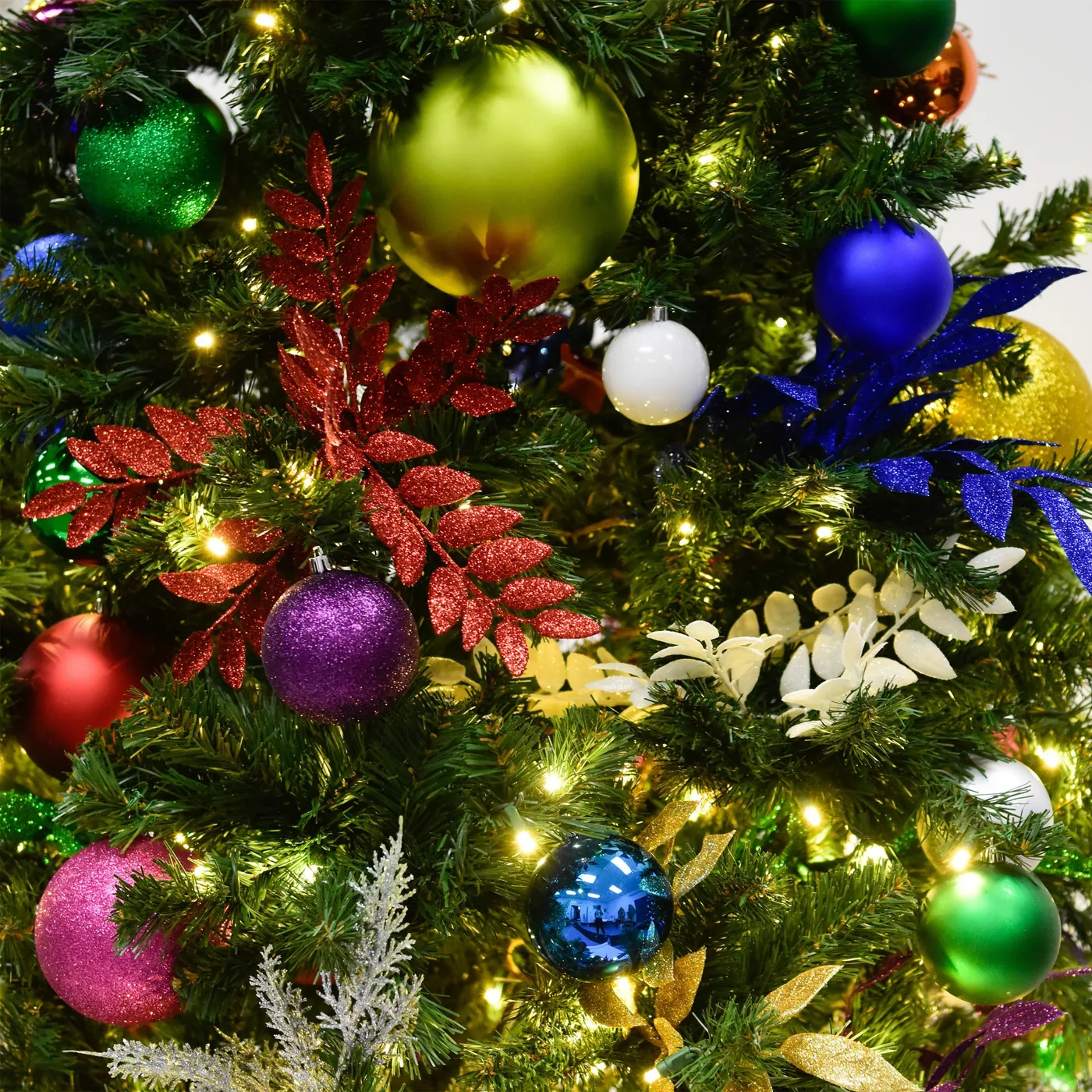
The glitter-dusted leaf and branch picks. Baubles give you color and shine, but they can’t give you texture, and on a tree packed this densely, texture is what keeps the eye moving. Picks also fill the hollow pockets between branches in seconds. Take them out and the same ornaments suddenly look crowded instead of abundant.
24. A Tabletop Fiber Optic Tree with a Ribboned Deer
Fiber optic branches are thin and mostly hollow, so keep ornaments light — a glass bauble over three inches will pull a tip down permanently. The light lives in the tips, which means anything you hang partially blocks it. Stick to berries, small clips, and a topper. If the strand ever flickers, check the base connection before you assume the tree is finished.
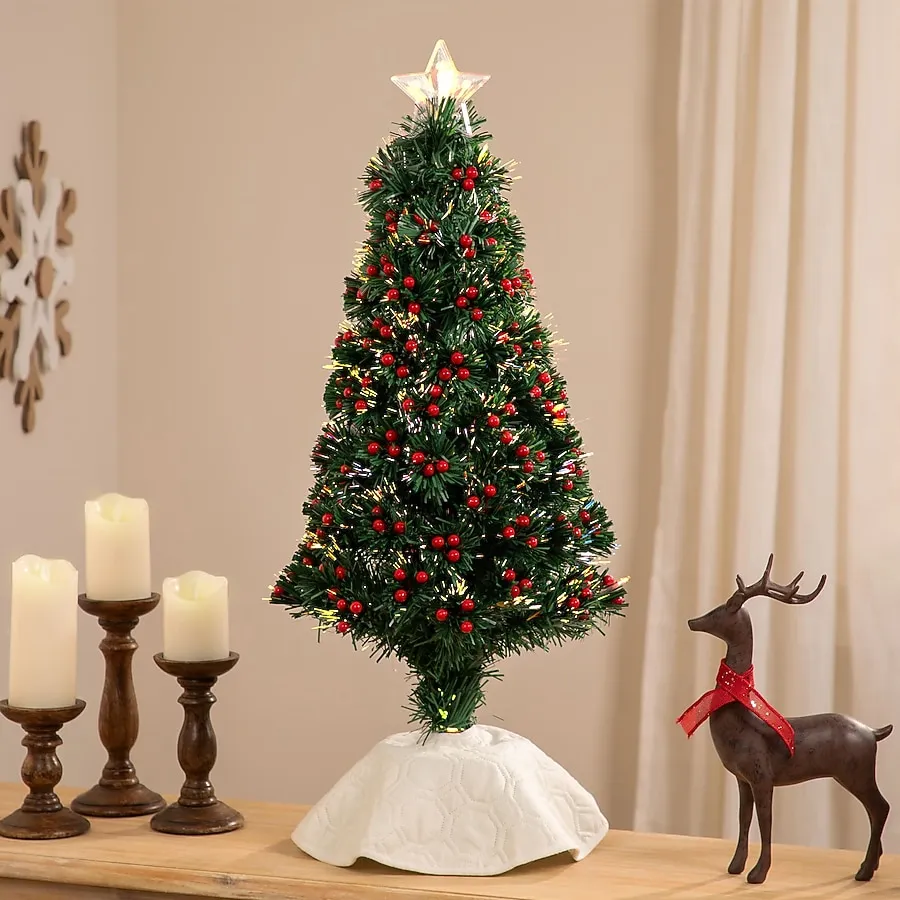
Three objects at three heights: the tree, the deer, and the candles. That staggered arrangement is why a 24-inch tree can hold down an entire console table. Nothing here is expensive — a quilted skirt, a deer figurine with a ribbon, two candle holders — but the grouping reads as a scene rather than a pile of decor. Group in threes and change the height every time.
Pick Your Colors, Then Turn the Lights On
Colorful trees aren’t about collecting every hue you love — they’re about choosing two or three and letting them repeat until the whole thing feels intentional. Start with one anchor color, one metallic, and the lights you already own, then build from there a season at a time.
📌 Pin your favorite from these 24 ideas so it’s waiting for you when the decorations come down from the attic.