You know that feeling when you finally spot the outdoor Christmas tree that would make your whole yard make sense — and then you see the price tag? Same. So we spent weeks digging through Lowe’s, Amazon, Home Depot, Walmart, and Target to find the trees, light structures, and glow-and-go pieces that actually look good from the street in 2026, from a $29 wireframe cone to a $1,899 pre-lit showpiece.
Inside you’ll find 29 curated ideas spanning glam gold-and-white entrances, warm-white traditional rooflines, multicolor maximalist yards, and rustic handmade trees — with budget and luxury versions compared side by side and every idea shoppable with direct product links. In 2026 the shift is toward one strong focal point instead of a yard full of noise, which is exactly why so many of these designs lean on a single hero tree. And stay until the end — we break down the most common mistakes that can ruin these looks.
📌 Save this to Pinterest for later — you’ll want to revisit these ideas.
1. Gold-and-White Glamour on a Grand Stone Entrance
The oversized metallic and white ornaments scattered up the stone steps are what make this entrance feel designed instead of merely decorated. Without them you’d have a pretty but predictable lit doorway — the flocked miniature trees, the illuminated garland, and the wicker reindeer would read as three separate displays that happen to share a porch. At 8 to 14 inches across, those scattered baubles are the only element stitching the snow-dusted steps, the wreath, and the lit snowflakes into one continuous moment.
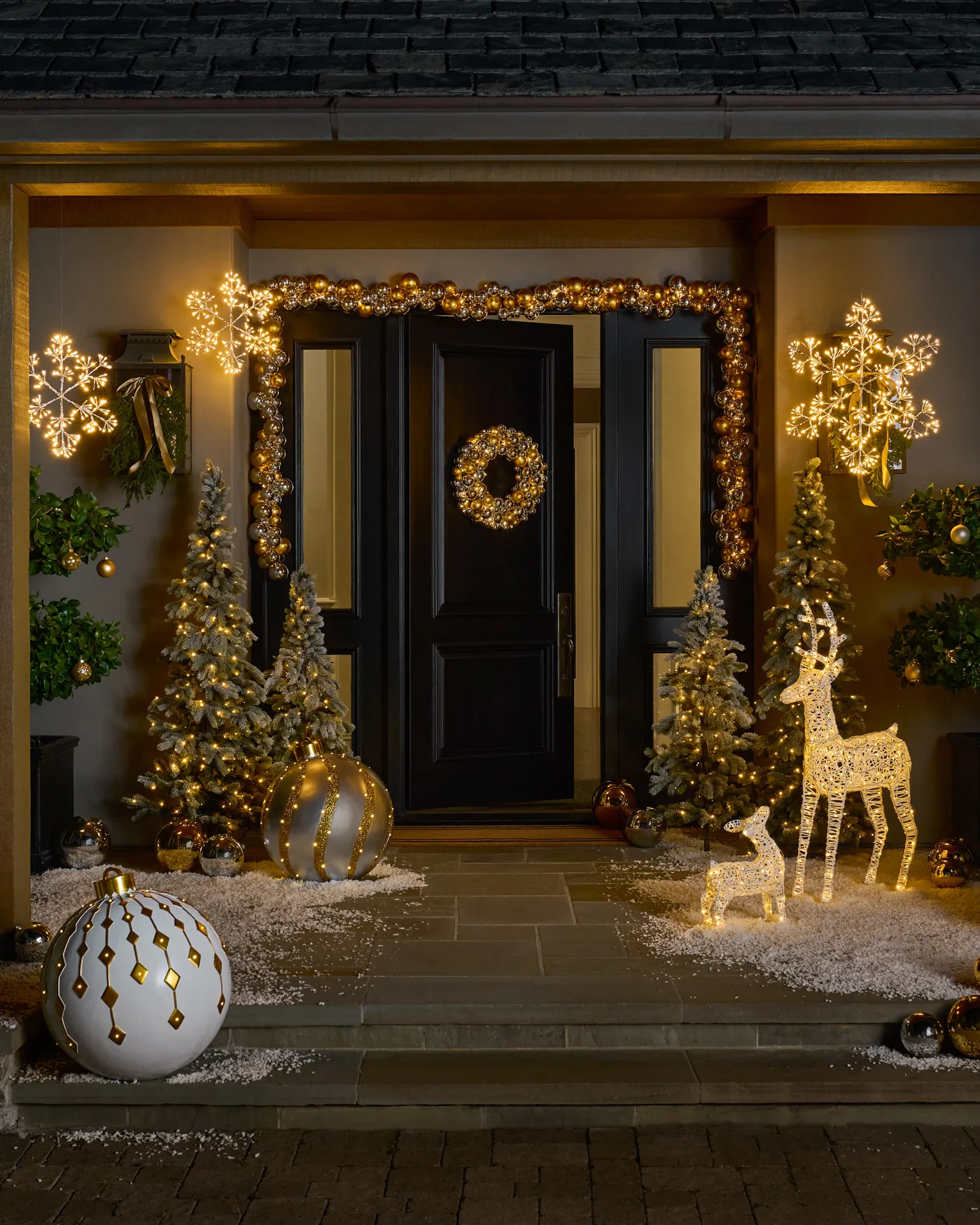
- Structure: flocked pre-lit miniature trees, set of three — $180-$450
- Lighting: illuminated garland, wreath, and snowflakes — $120-$380
- Decor: oversized metallic and white baubles, 12-pack — $60-$180
- Figures: illuminated wicker reindeer, pair — $150-$500
- Details: faux snow, stakes, outdoor timer — $40-$90
- Total: $550-$1,600
Budget alternative: skip the reindeer entirely and keep the flocked trees plus the baubles — roughly $300-$500 for the same glamorous read from the sidewalk.
2. Warm White Soffit Lights and Fully Wrapped Trees
Two principles carry this facade. First, line quality: every strand follows an architectural edge — roof peaks, dormer frames, gutter runs — so the house reads as a single drawing rather than a scatter of dots. Second, the wrapped trees. Wrapping the trunk and main branches instead of draping strands over the canopy makes the light climb upward like it’s growing out of the ground. Warm white against stone, stucco, and dark wood shutters keeps the whole scene on one temperature.
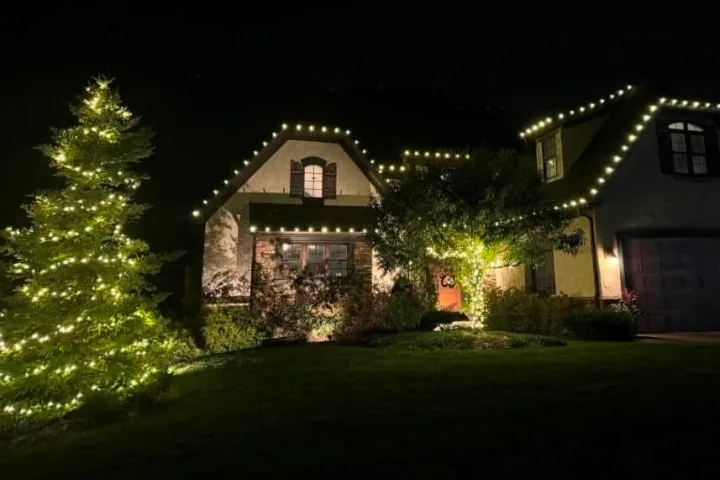
- Measure the roofline and dormers, then add 20% slack for peaks.
- Clip warm white strands along the gutter line first — that’s your anchor.
- Wrap tree trunks in a tight spiral, keeping turns about 4 inches apart.
- Continue onto the two or three largest branches, stopping before the fine twigs.
- Run everything into one outdoor timer set for 5 p.m. to 11 p.m.
Time: 5-7 hours for a two-story facade plus two trees. Materials: $220-$400 in lights and clips.
3. A Maximalist Inflatable Yard With Icicle Lights Everywhere
Inflatables took a beating in the mid-2010s when everyone owned the same mildly sad snowman. They’re back in 2026 — bigger, better lit, and usually part of a whole-yard scheme instead of a lone figure on a lawn. The multi-tiered inflatable tree with Santa and snowman, the lit reindeer pulling a sleigh, the blue snowflakes and icicle lights: this is the more-is-more school that Pinterest keeps rewarding. It photographs brilliantly, kids lose their minds over it, and setup takes an afternoon instead of a weekend.
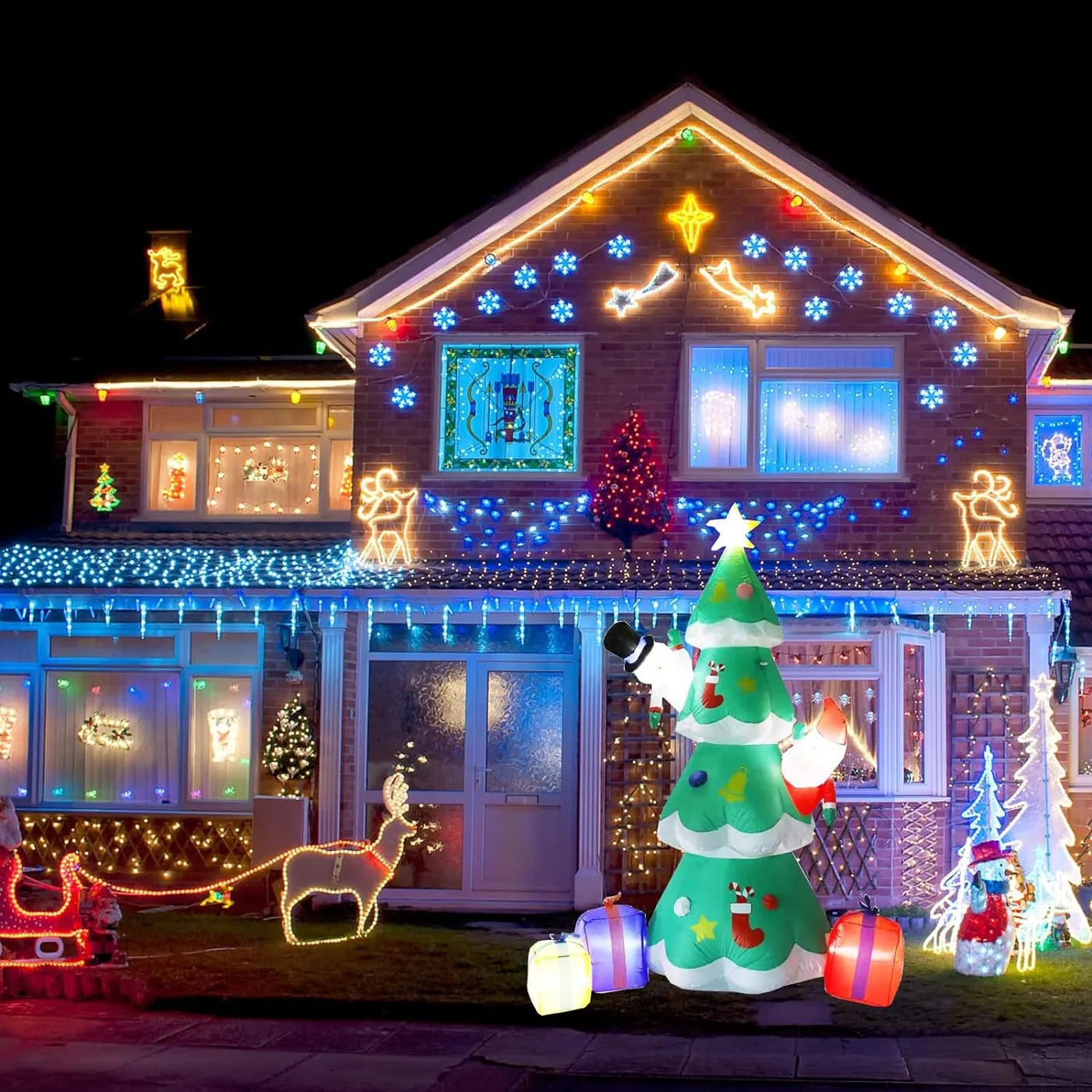
You don’t need a designer budget here. Inflatable tree bundles run $80-$160 at Walmart or Amazon, reindeer-and-sleigh sets land around $70-$120, and icicle lights are the cheapest way to fake volume along a roofline at $20-$40 per 300 bulbs from Target. Light-up snowflakes are $12-$30 each, and used ones show up on Facebook Marketplace for half that by early November. A scene this dense costs roughly $350-$700 new, or closer to $200 if you shop secondhand first.
4. Red-and-White Lights on a Porch-Wrapped Two-Story
Assign one color temperature per surface and never let them cross. On this house, warm white stays on the architecture — rooflines, porch eaves, columns — while red lives on the shrubs and foundation evergreens. If you want a third color, put it on standalone forms like the star in the bare tree or the lit nutcracker figures out in the yard. Your eye reads the house first, then the landscape. Mixing colors on the same plane is what makes a display look noisy instead of layered.
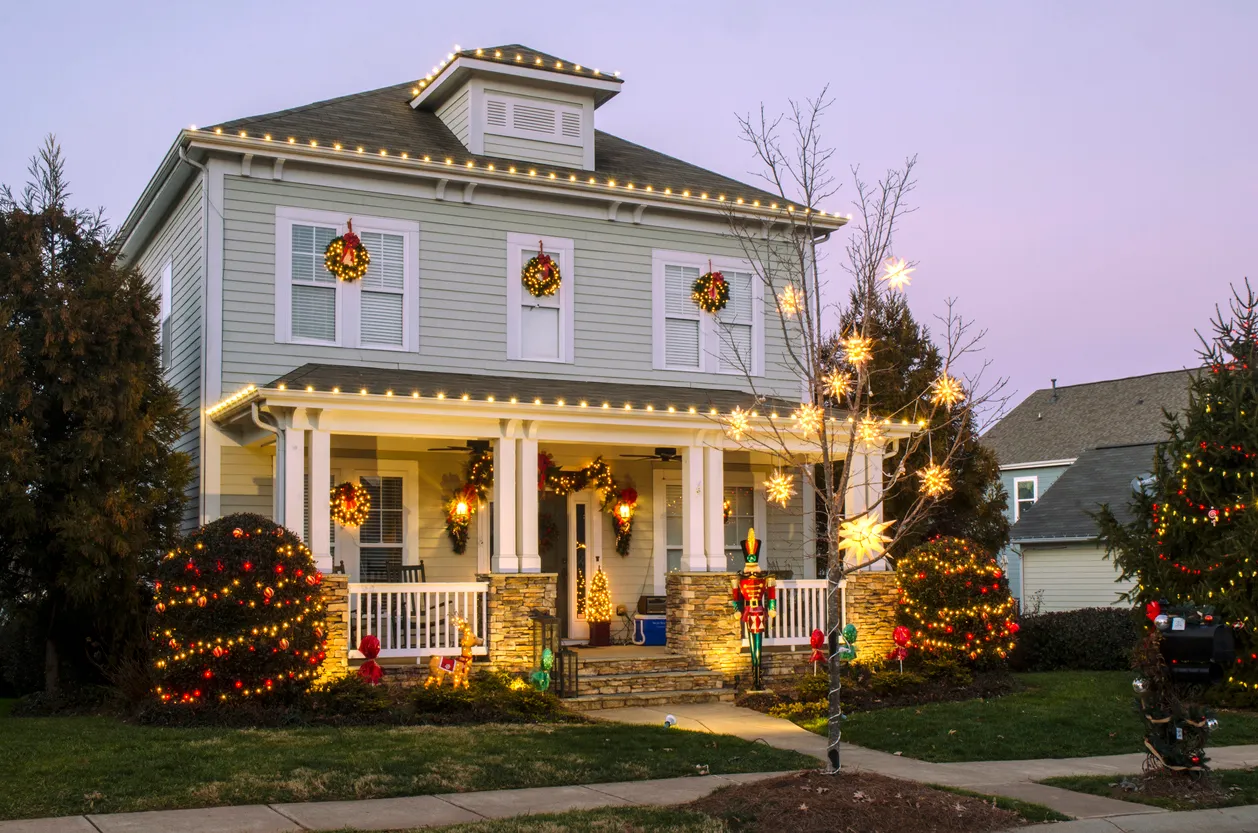
This layout wants a two-story facade with at least 40 feet of frontage and a porch 8 feet deep or more. The stone columns give you four vertical surfaces for wreaths, and the foundation shrubs need to be 3 feet tall minimum so the red lights actually read from the street. On a smaller single-story ranch, borrow the approach and not the footprint — see Idea #12 for a slim, one-tree version that fills a modest yard without crowding it.
5. A Multicolor Light Cone With a White Wire Deer
- Multi-colored cone tree, 6-8 ft — $90-$260
- White light-up deer figure, 3-4 ft — $70-$200
- White mini lights for wrapping three background trees — $45-$120
- Stakes, extension cords, outdoor timer — $30-$70
- Total: $235-$650
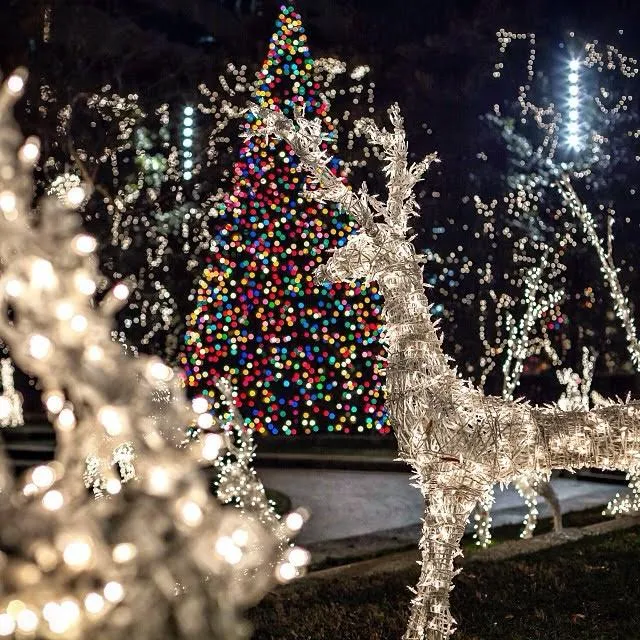
Budget alternative: swap the multi-colored cone for a secondhand 7-foot pre-lit tree from Facebook Marketplace ($40-$80) and add multicolor strands yourself — about $120 all in.
The white wire deer is the whole trick. Everything else in this yard is color: the cone throws red, green, blue, and yellow at the sky while the wrapped trees wash the background in white. One figure rendered in solid, unbroken white gives your eye somewhere to land. Remove it and the same yard becomes an undifferentiated field of lights. Compare with Idea #6 — same instinct, but gold instead of white.
6. Arched Entryway With Light-Strand Cones and Gift Boxes
- Anchor two light-strand cones at the outer edges of the arch — never dead center.
- Wrap the arch in green garland, then weave warm white mini lights through it.
- Zip-tie gold bows and small floral picks at the arch’s highest curve.
- Place a traditional evergreen with ornaments between the cones for depth.
- Stack red wrapped boxes on the grass just off the walkway — never on it.
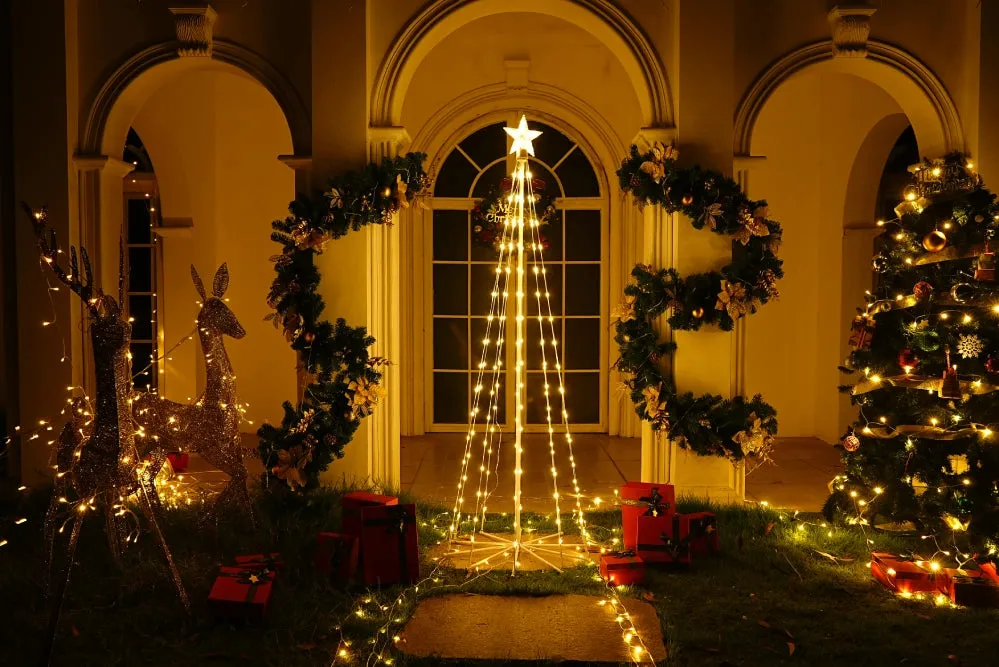
Time: 3-4 hours for a single entry. Materials: $180-$320.
The $40 version of those gift boxes: plain cardboard boxes from a shipping store, glossy red paper from the dollar store, and a brick inside each to weigh them down. From the sidewalk they’re indistinguishable. Light-strand cones run $30-$60 at Walmart, and a light-up glitter reindeer is $45-$90 at Target or about half that used. Garland is where people overspend — a $25 garland with $12 of warm white lights woven in beats a $120 pre-lit one.
Three things to check first. Arched entryways create wind tunnels, so anything tall and light needs sandbag or stake anchoring. Gift boxes on grass look charming for two weeks and soggy after one rain, so line them with trash bags. And if the entry is shared or commercial, find out whether you’re allowed to stake the ground or drill the masonry, because both are usually restricted.
7. A Warm Yellow Cone Against a Blue-Lit Stone Facade
Put your two strongest colors at two different distances. Here, warm yellow owns the foreground tree while bright blue outlines the stone building behind it. Because blue and yellow sit opposite each other on the color wheel, the tree pops forward and the building recedes — instant depth in a flat yard. Keep each color on its own circuit and its own timer channel so you can dial the balance without re-running a single strand.
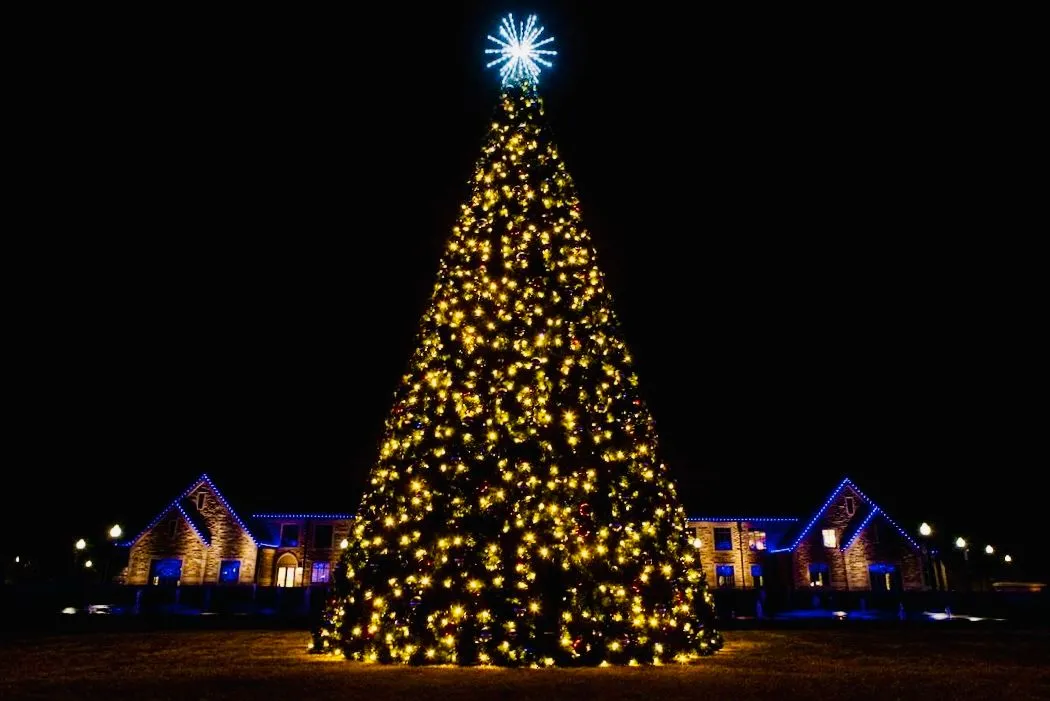
60% warm yellow light on the hero tree + 30% bright blue on the architecture + 10% white sparkle from the starburst topper. That’s the formula. To swap it, keep the percentages and change the hues: white tree, warm amber building, silver topper reads elegant. Red tree, green building, gold topper goes classic Santa. Just never split that dominant 60% across two colors — that’s the move that flattens a display into mush.
8. Pom-Pom Ornaments on a Snowy Cabin Porch Tree
Pom-poms and snow are a gorgeous combination and a genuinely bad one for wet climates. Felt and yarn absorb moisture, freeze, and droop within a single season — and if they’re glued on, they take paint or flocking with them when they come off. If your porch gets driven snow, look for pom-poms on wire hooks you can pull indoors after each storm, or switch to painted wood beads. Same playful look, none of the mush.
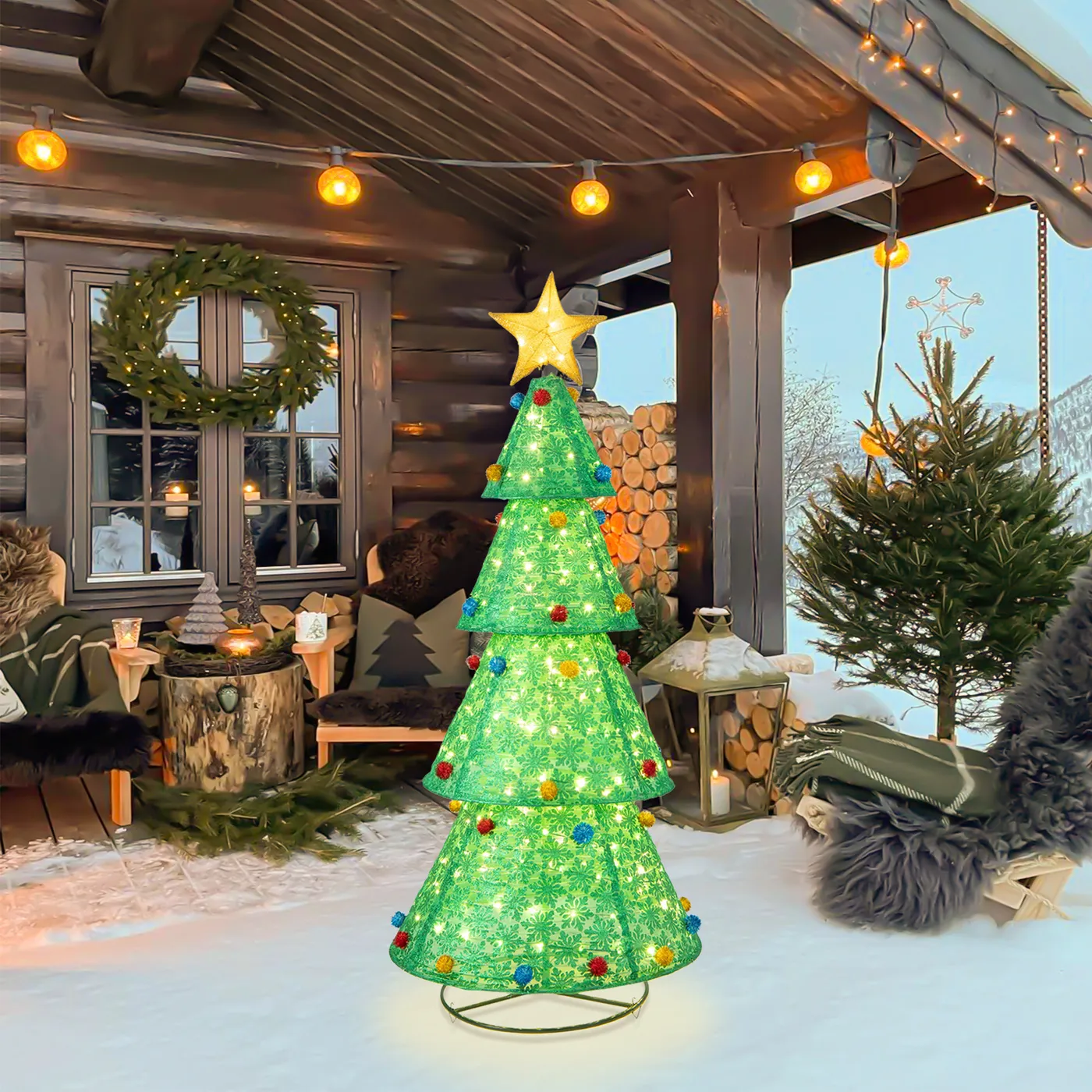
- Measure porch depth — you need at least 4 feet of clearance around the tree.
- Confirm your outdoor outlet is GFCI-protected and within 25 feet.
- Check whether the tree is rated for wet locations or dry-only.
- Lock your color story before you shop — three colors maximum.
- Weigh the base down; a snowy, windy porch will tip a light tree.
9. Black Planters, Red Berries, and Zero Clutter
The matching black planters are doing more work than any ornament here. Two lit evergreen topiaries in identical black pots, a black lantern beneath each, and a black door behind them — that repetition creates a frame, and the red berry wreath becomes the only thing your eye can land on. Swap those planters for mismatched terracotta and the entry goes from elegant to accidental in about four seconds.
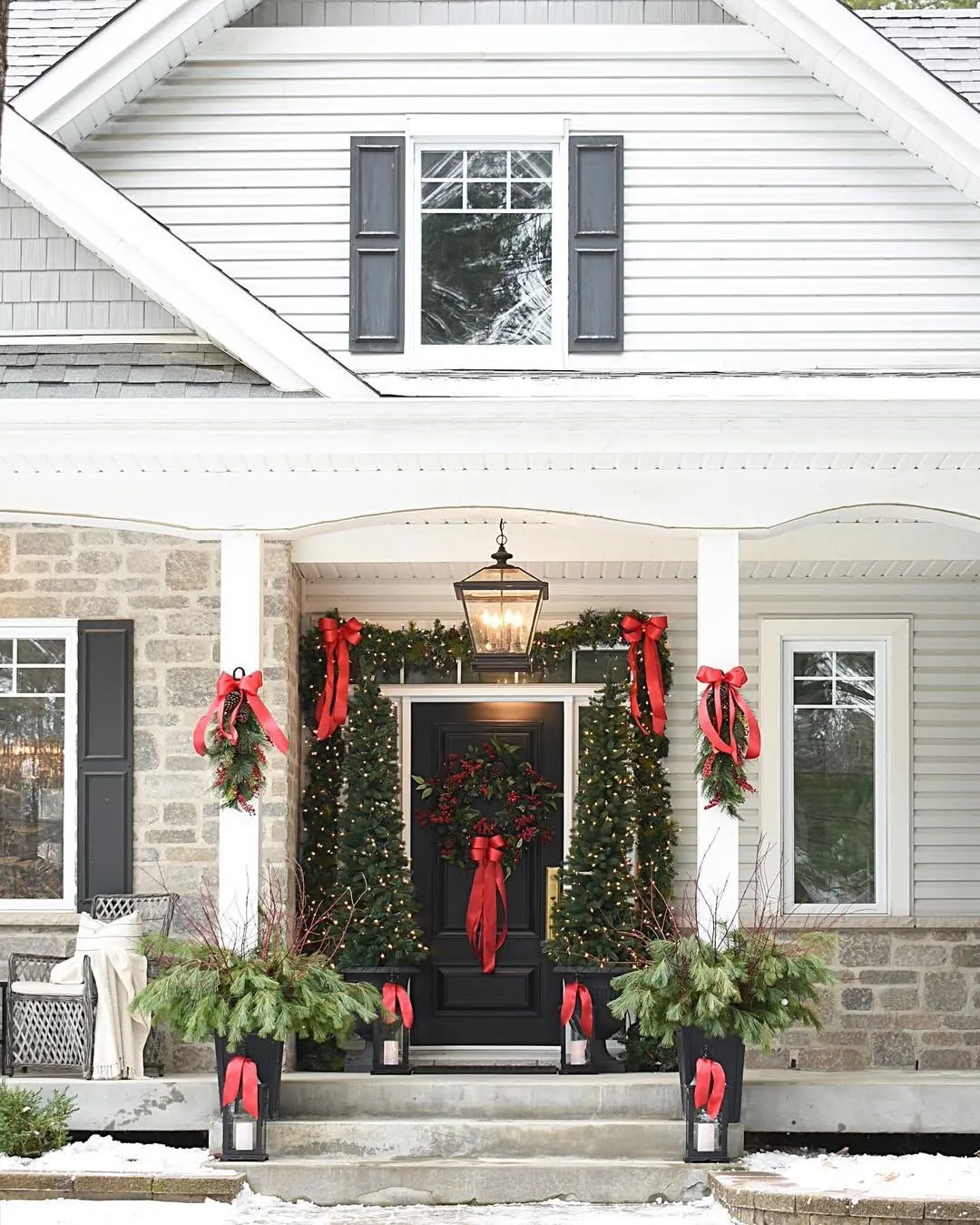
Topiaries and berry wreaths are low-maintenance compared to live garland, but not zero. Budget 15-20 minutes each fall to fluff and re-shape the topiaries, and plan on replacing burnt-out mini-light sections every two to three seasons. Fabric berry picks fade in direct sun, so bring them in by January. Real cedar garland over a door needs misting twice a week and drops needles on your steps — faux garland just needs a rinse and a full dry before it goes back in the bin.
10. White and Gold Ornaments on a Tall Outdoor Fir
Two ornament colors, two finishes, one tree. White spheres in matte and pearl, gold spheres in shiny and satin, warm white lights underneath doing the rest. The formula: 50% white ornaments + 40% gold + 10% light glow showing through the branches. Swap white for silver and the whole thing turns icy; swap gold for copper and it lands warmer and more modern. Adding a third ornament color is the single move that turns an elegant tree into a busy one.
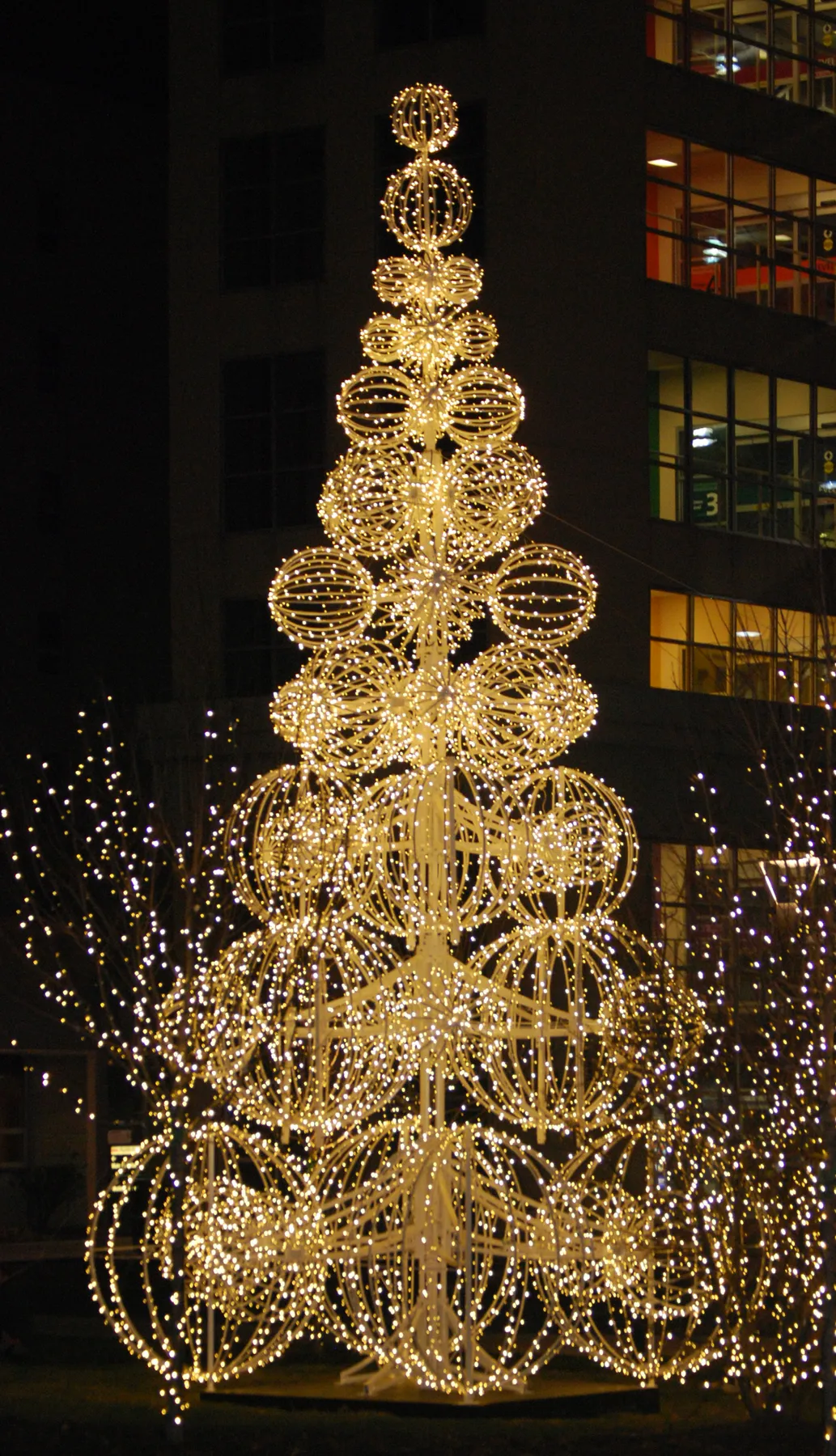
Scale your ornaments in three sizes and hang the big ones first. On a tree over 8 feet, use 6-inch spheres in the lower third, 4-inch in the middle, and 2.5-inch near the top — it exaggerates the height instead of flattening it. Hang the largest ornaments 6 to 10 inches inside the branch tips so they sit in the tree rather than on it. You’ll need roughly 100-150 ornaments for a 7-foot tree and 200+ for a 10-footer.
11. A Wooden Plank Tree You Can Build in an Afternoon
This entire tree costs about what one pre-lit 6-footer costs. Three 8-foot cedar boards from a home center run $30-$45 total, a box of exterior screws is $10, and red pom-poms are $8 per 50-pack at the dollar store or Target. Cut the planks in descending lengths, screw them to a central upright, and you’re finished for under $70. It won’t light up — but against green foliage and white flowering shrubs, raw wood and red dots read beautifully in daylight.
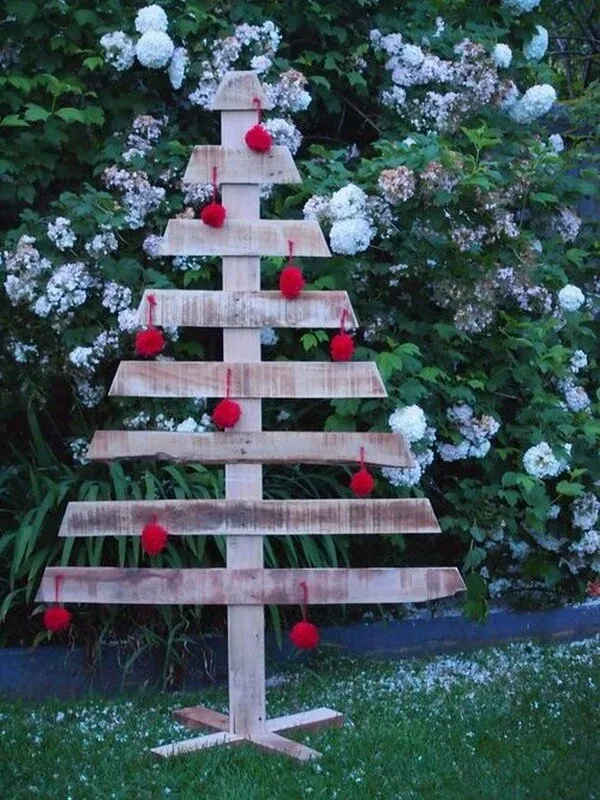
- Cut five to seven planks in 6-inch descending lengths, widest at the bottom.
- Attach a vertical 2×4 to a weighted base or drive a ground stake.
- Screw planks horizontally to the 2×4, alternating sides for stability.
- Sand the rough edges and seal with exterior stain or clear coat.
- Hot-glue pom-poms in a loose diagonal pattern — don’t grid them.
Time: 2-3 hours. Materials: $60-$90.
12. A Slim White LED Tree That Reads Modern, Not Kitschy
This silhouette is built for narrow frontage. At roughly 5 to 7 feet tall and under 2 feet wide, a white LED tree fits walkways as tight as 3 feet and won’t crowd a single-car drive. It needs a level surface — lawn, gravel, or pavers all work — and at least 10 feet of visual distance from the front door so it doesn’t compete with the entry. Working with a much wider yard? Idea #22 uses one large evergreen to fill the same role at triple the scale.
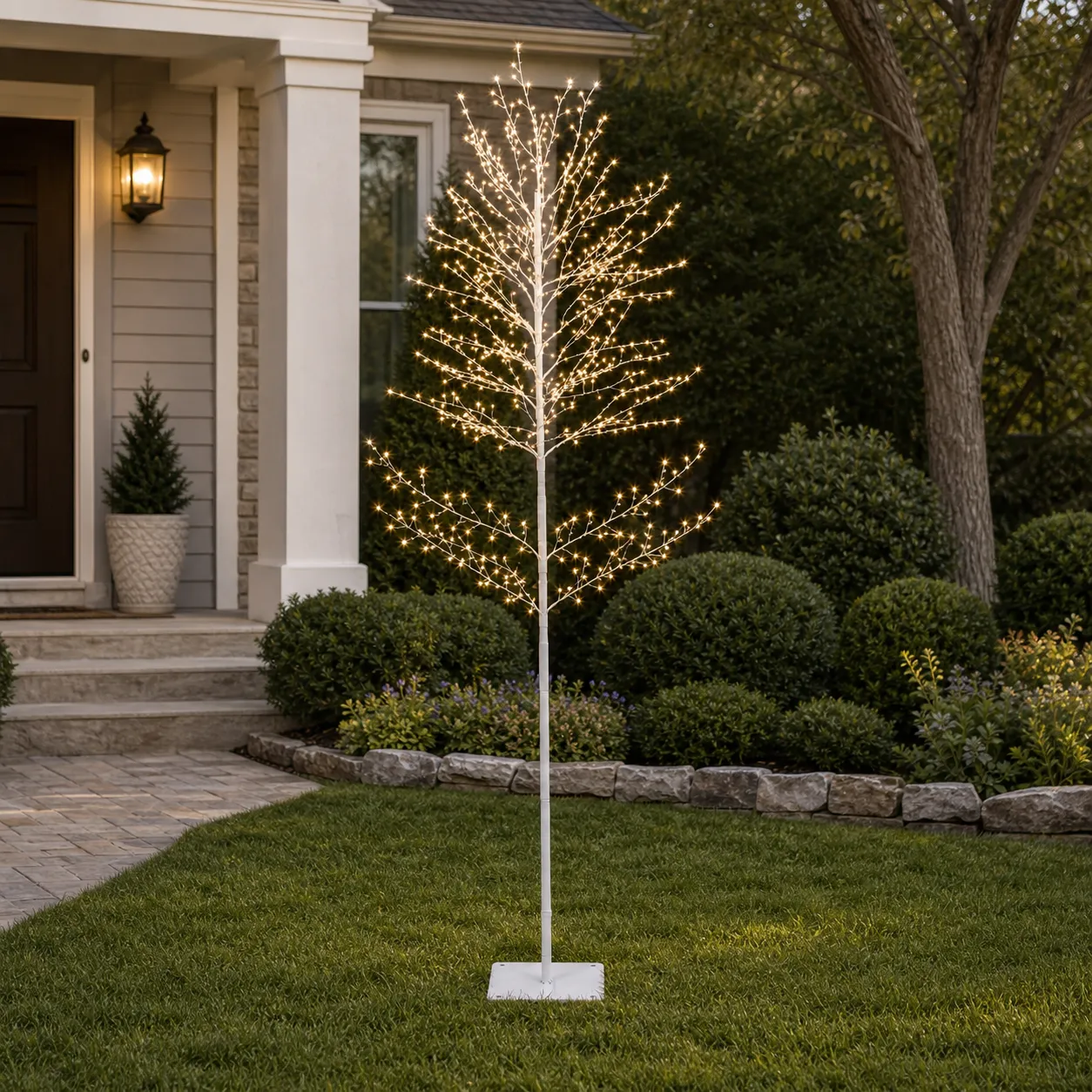
Two things are happening here and both are restraint. The form is simple — no ornaments, no ribbon, no color — so warm white light against green lawn does all the talking. And the white structure disappears behind its own glow, which means at night you see a column of light, not a fake tree. That’s why it reads modern. Next to a green artificial tree in the same spot, it’s quieter and somehow more noticeable.
13. Royal Blue Ornaments on a Patio Tree at Twilight
- Pre-lit outdoor tree, 7-9 ft — $300-$900
- Royal blue and light blue ornaments, 80-120 pieces — $90-$220
- Wrapped gift boxes in blue and cream, 6-10 — $50-$140
- Landscape uplights for the background trees — $80-$200
- Deep blue outdoor cushions — $120-$400
- Total: $640-$1,860
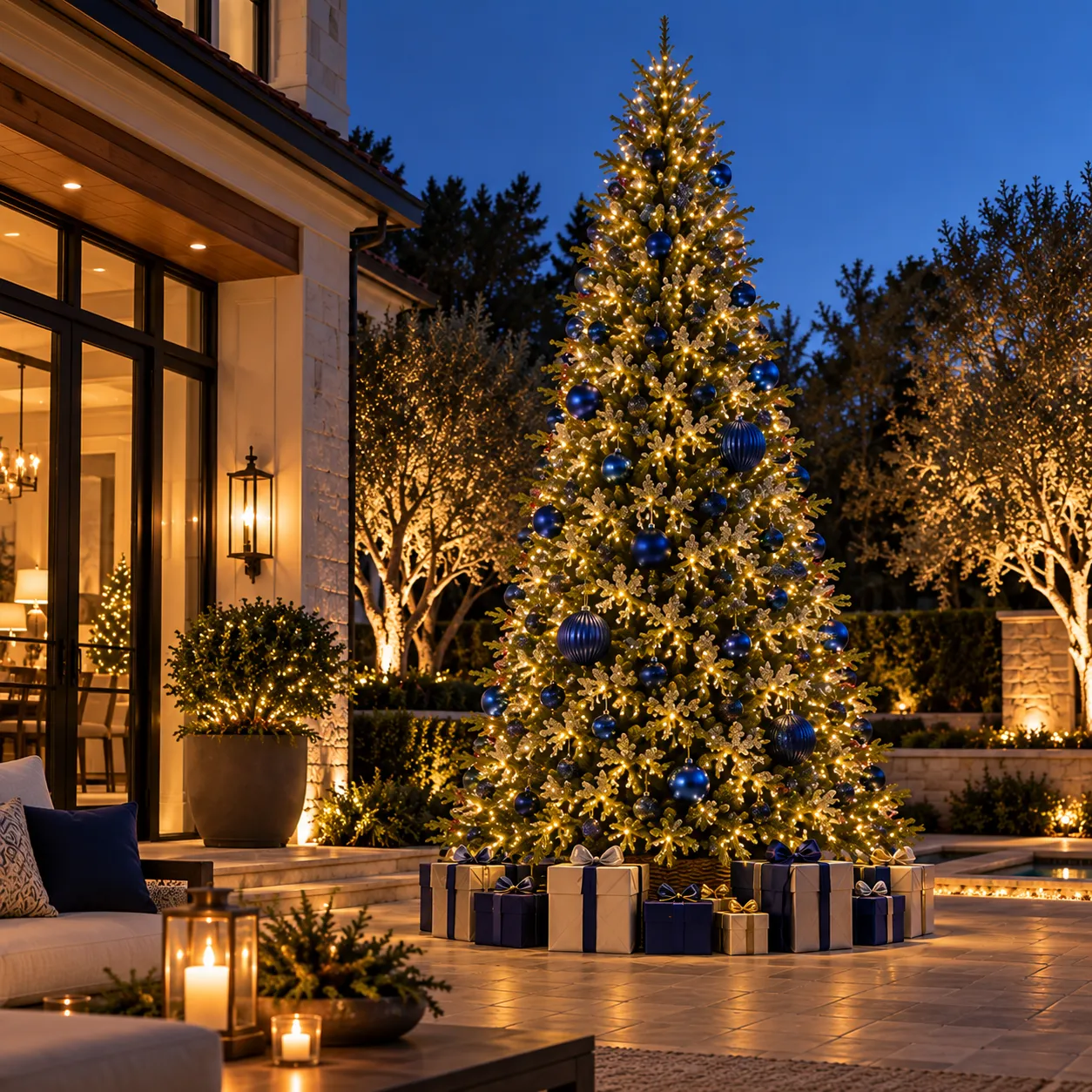
Budget alternative: keep the tree, the ornaments, and the gifts, then skip the uplights and new cushions — about $450-$1,000 for the same twilight effect.
Blue Christmas decorating has quietly become the modern alternative to red-and-green, and it’s everywhere on 2026 Pinterest boards. Two reasons: blue photographs beautifully at twilight while the sky still holds light, and it works with almost any exterior material — stone, stucco, white trim, dark wood. It also sidesteps the candy-cane association, which is exactly why people who dislike traditional holiday decor tend to land here first.
14. Frosted Trees in Wooden Planters, Gold and White Only
The matching wooden planters are the element you can’t remove. Frosted trees on their own are everywhere right now; drop them into tall natural-wood boxes and suddenly you have architecture — the planters lift the trees off the snow, hide the ugly plastic bases, and give two separate trees a shared visual weight. Switch to plastic or metal pots and the frost and gold ornaments start looking like a party-store display instead of a proper entrance.
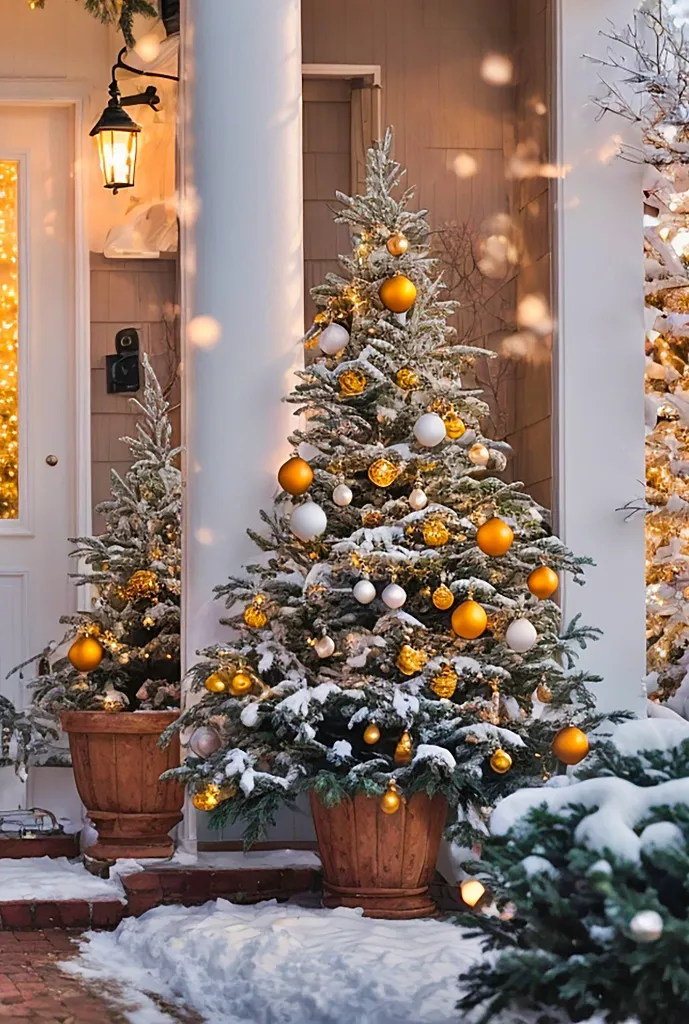
Two frosted trees flanking a door want an entry at least 6 feet wide, with 18 to 24 inches of clear space on each side of the frame. Planter height matters more than tree height: 24-inch planters holding 5- to 6-foot trees give you the classic proportion. On a stoop narrower than 4 feet, use one tree and one lantern instead. For a wider porch that can carry more, Idea #15 shows the same setup with a lit wreath and lanterns added.
15. Flocked Evergreens Flanking a Dark Blue Door
Flocked trees need contrast behind them to read as snowy rather than just grey. A dark blue panel door with brass hardware does that instantly — cool white flocking against saturated blue, warm brass tying the whole thing together. If your door is white or cream, add a dark doormat and dark planters to create the same edge, or the flocking will vanish into the siding. And keep the wreath lit: unlit greenery over a dark door disappears entirely at dusk.
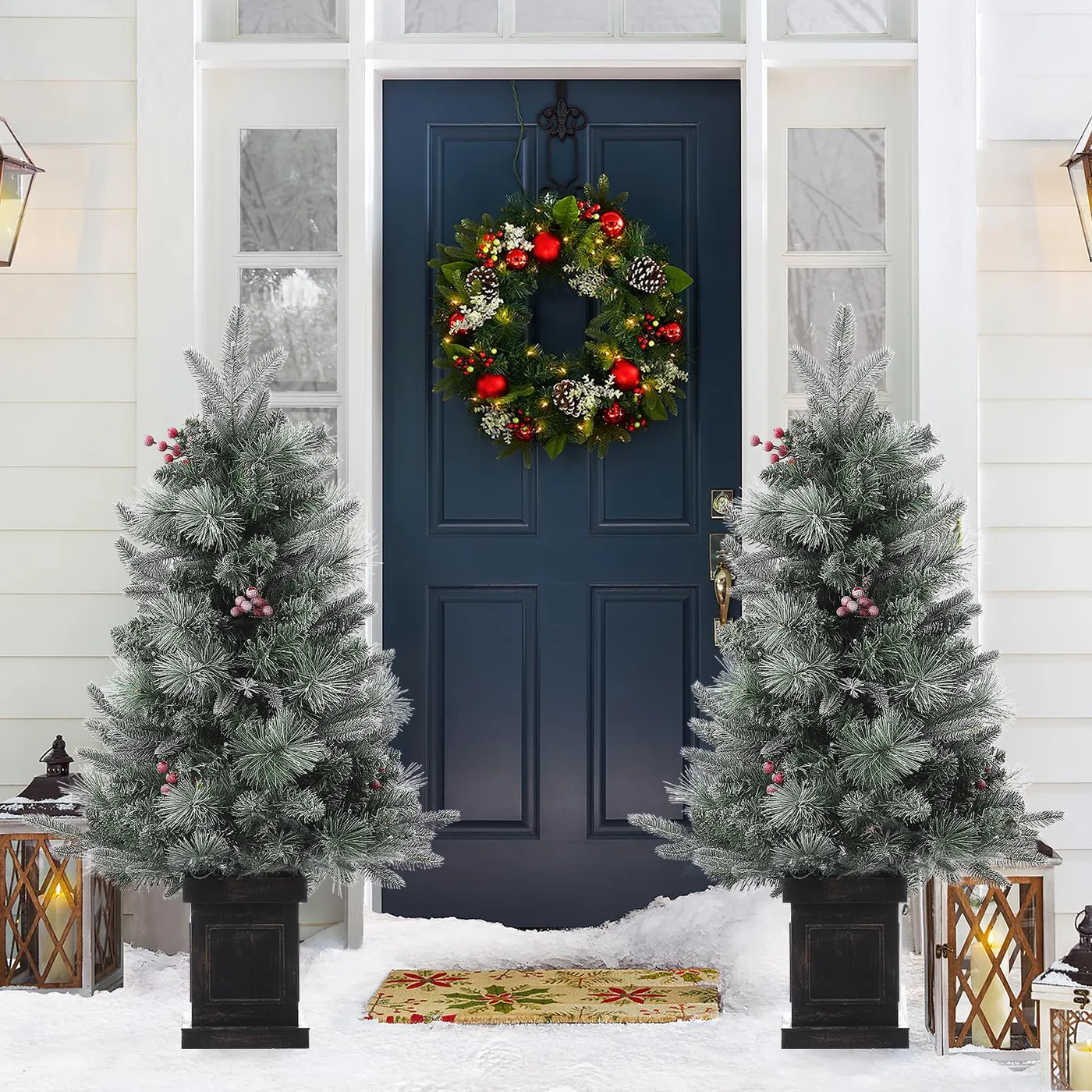
White flocking looks fantastic for about three seasons before it starts going patchy — UV, rain, and handling all thin it out. Store flocked trees in a breathable bag, never vacuum-sealed, and don’t shake them aggressively when you unpack. Real snow on real steps means slip risk: a textured doormat helps, but add grit or a heated mat if your entry faces north. Also verify your wreath’s lights are rated for wet locations, not just damp.
16. Curtain Lights and a Fire Pit Under a Snowy Pergola
- Run a single warm white strand along the pergola’s main beams first.
- Hang curtain lights across the back span — that’s your backdrop.
- Weave garland down the posts and secure it with clear zip ties.
- Cluster potted evergreens at the corners and light two or three of them.
- Add plaid cushions and a wool blanket basket near the fire pit.
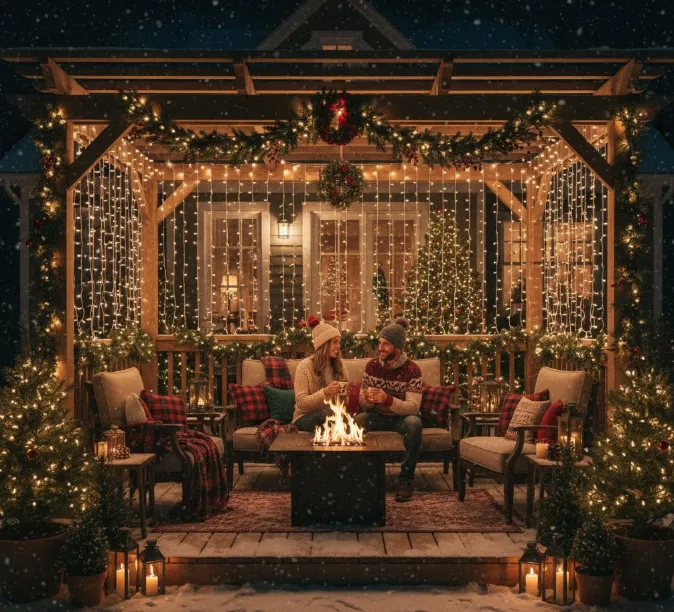
Time: 4-6 hours. Materials: $250-$500 for lights and garland.
70% warm white light + 20% evergreen green + 10% deep red plaid. That’s the recipe for a cold-weather outdoor room that still feels warm, and the lights carry it because they’re the only genuinely warm element in a snowy, blue-toned environment. Swap the plaid for charcoal-and-white blanket stripes and the space turns modern-rustic. Swap the warm white bulbs for amber and it goes full cabin.
17. The Wireframe Cone: Maximum Glow, Minimum Storage
A dark wireframe disappears at night, so all you see is a cone of light — that’s the entire appeal. There’s no green foliage fighting the warm white bulbs, no flocking shedding onto the lawn, and no branches to fluff every November. The light reads as a solid volume from the street, which is why these show up so often on larger lawns where a decorated tree would have to be enormous to carry the same presence.
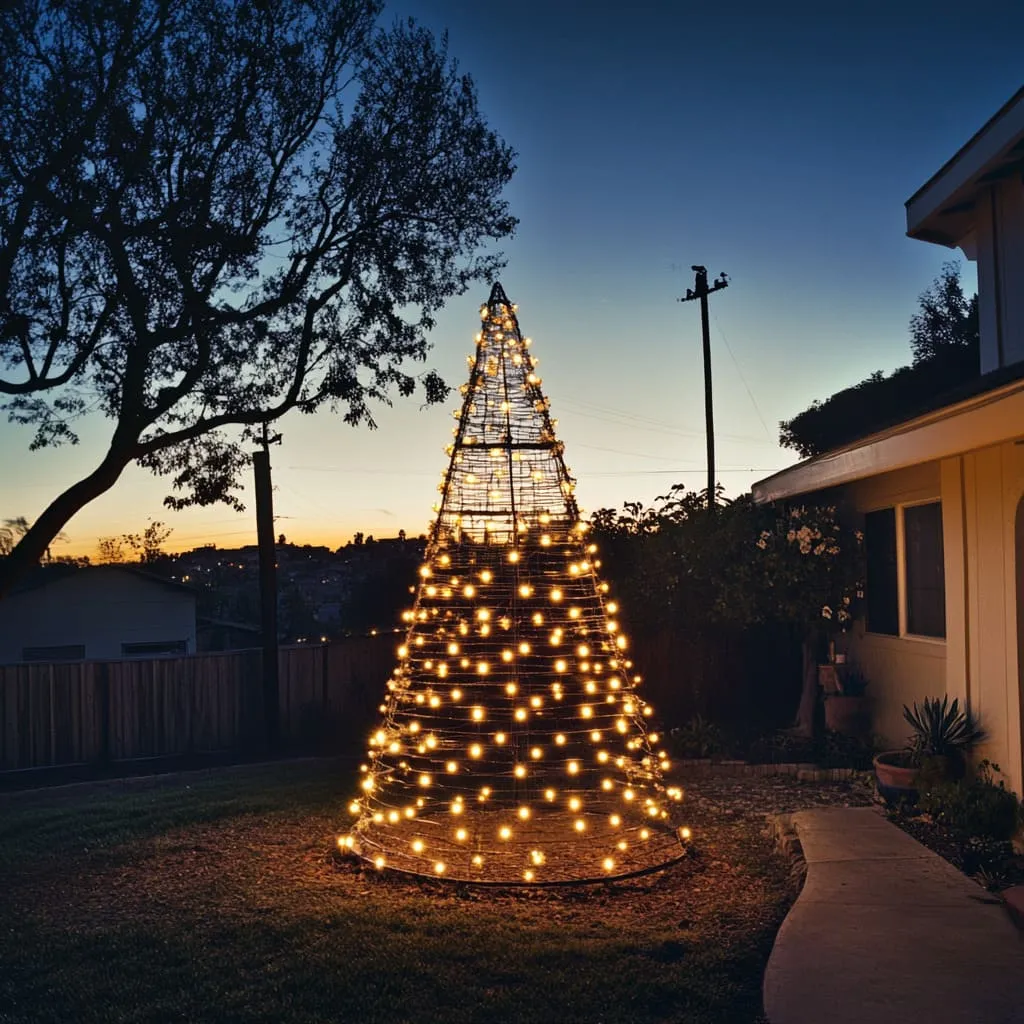
- Wireframe cone structure, 6-10 ft — $120-$400
- Warm white string lights, 600-1,200 bulbs — $60-$160
- Ground stakes and guy lines — $20-$40
- Heavy-duty outdoor cord and timer — $35-$70
- Total: $235-$670
Budget alternative: build the cone from welded wire fencing or nested tomato cages and wrap it by hand — about $90-$150 total plus a Saturday afternoon.
18. Multicolor Lights Against Snow and Stone Facades
Snow is your ally for looks and your enemy for hardware. Multicolored LEDs handle cold without complaint, but the connectors collect moisture — wrap every plug with self-sealing silicone tape before the first freeze and recheck after each thaw. Snow also reflects light back up, so you can get away with roughly 25% fewer bulbs than on bare ground for the same perceived brightness. Still, expect to replace one or two dead strands per season.
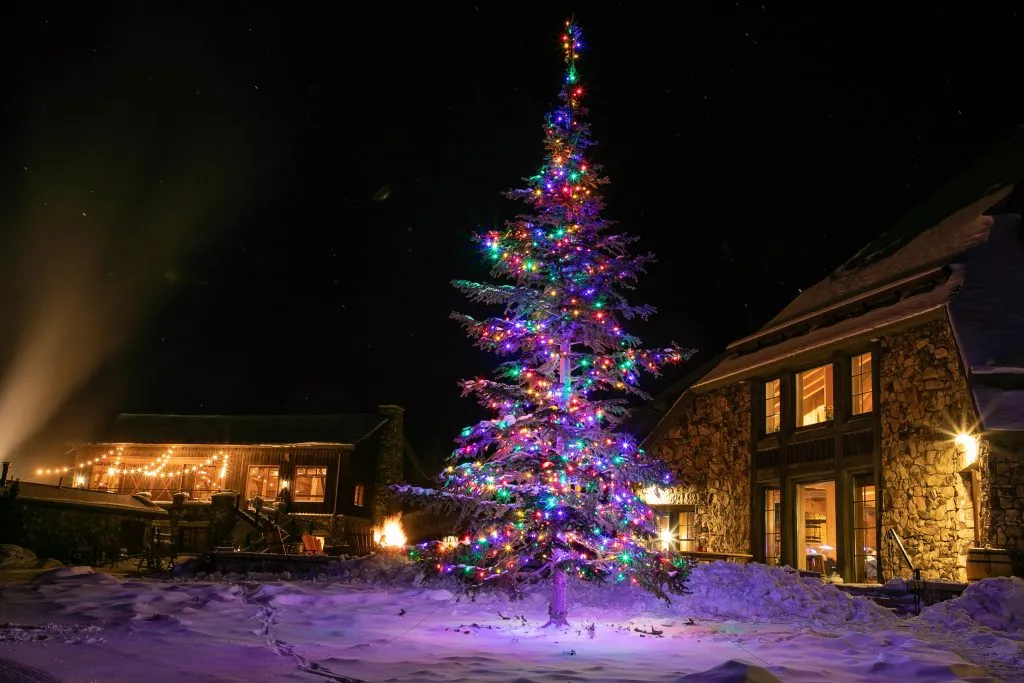
This is a big-yard move. The tree reads as a focal point from 50 to 100 feet away, so it needs at least 30 feet of open lawn in front of it or you’re essentially lighting a hedge. The stone buildings behind sit 40 to 60 feet back, which is what gives the display real depth. On a typical suburban lot, scale down to a 7- to 9-foot tree and skip the second lit structure — Idea #20 shows how a single cone handles a smaller site.
19. A Lit Fireplace, Garlanded Posts, and One Decorated Tree
Anchor your garland to the architecture, not to the furniture. Here the garland follows the pergola posts and headers, which means the light structure is fixed and the seating can move around without disturbing anything. Keep garland runs at least 7 feet above the floor so nobody walks into them, and put the timer on the fireplace circuit so the fire and the lights come up together at dusk. That’s the moment everyone photographs.
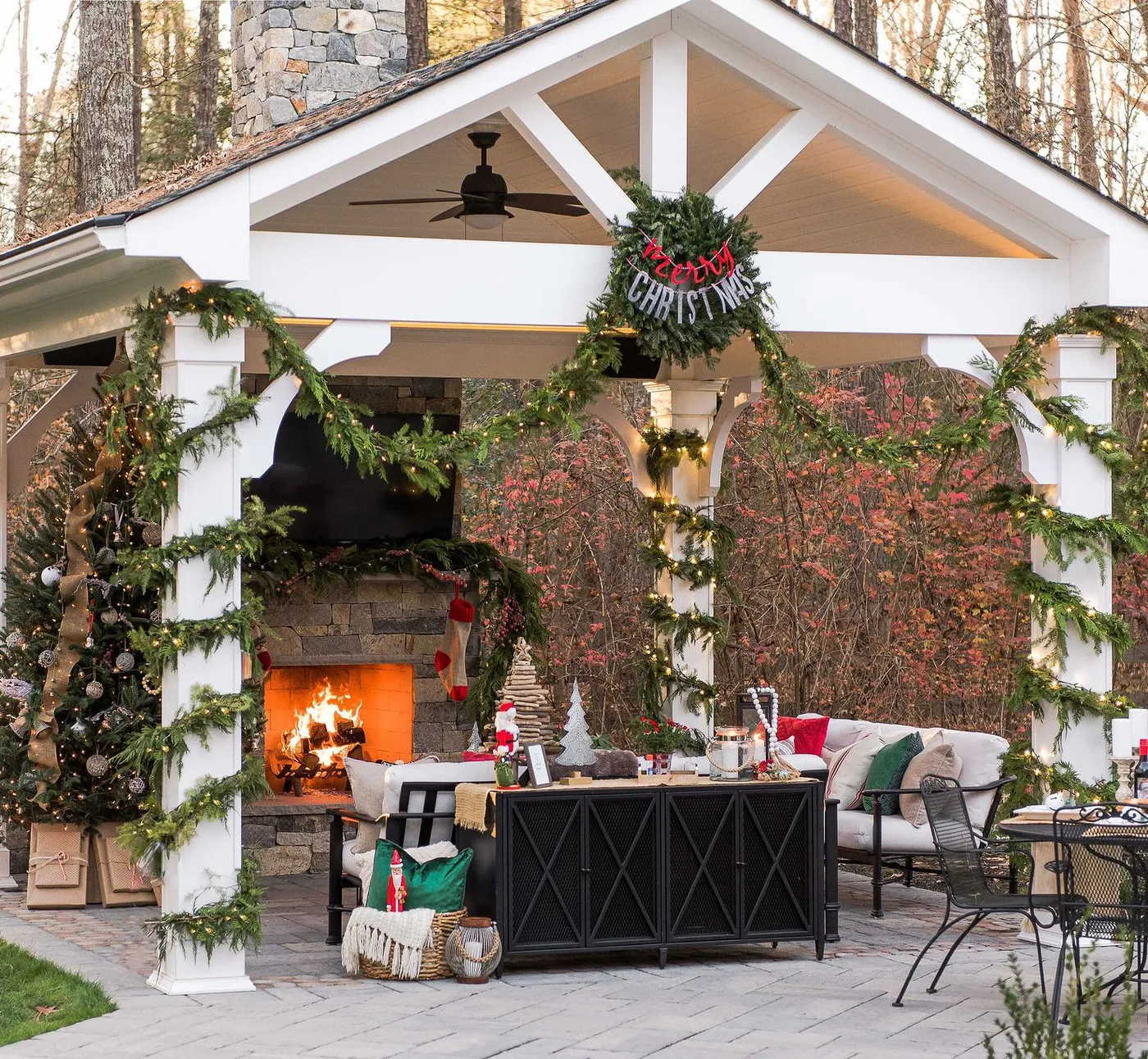
The lit stone fireplace is the element that turns this into a room instead of a decorated patio. Take it away and you have garland, a tree, and pillows sitting in the cold. With it, everything else has a center and a reason to be there at all. If you don’t have a built-in fireplace, a propane fire table in the same position does about 80% of the work for a fraction of the cost.
20. Red and Blue Lights That Battle a Sunset
Uplighting mature trees in magenta and cyan started in landscape design and crossed into holiday decor around 2023 — and it’s the fastest-growing pattern in outdoor Christmas lighting this year. The appeal is that it doesn’t look like Christmas at all; it looks like a light festival. Pair it with a red-and-blue cone tree at dusk and the effect turns theatrical rather than traditional, which is exactly what people who are bored of their own display want.
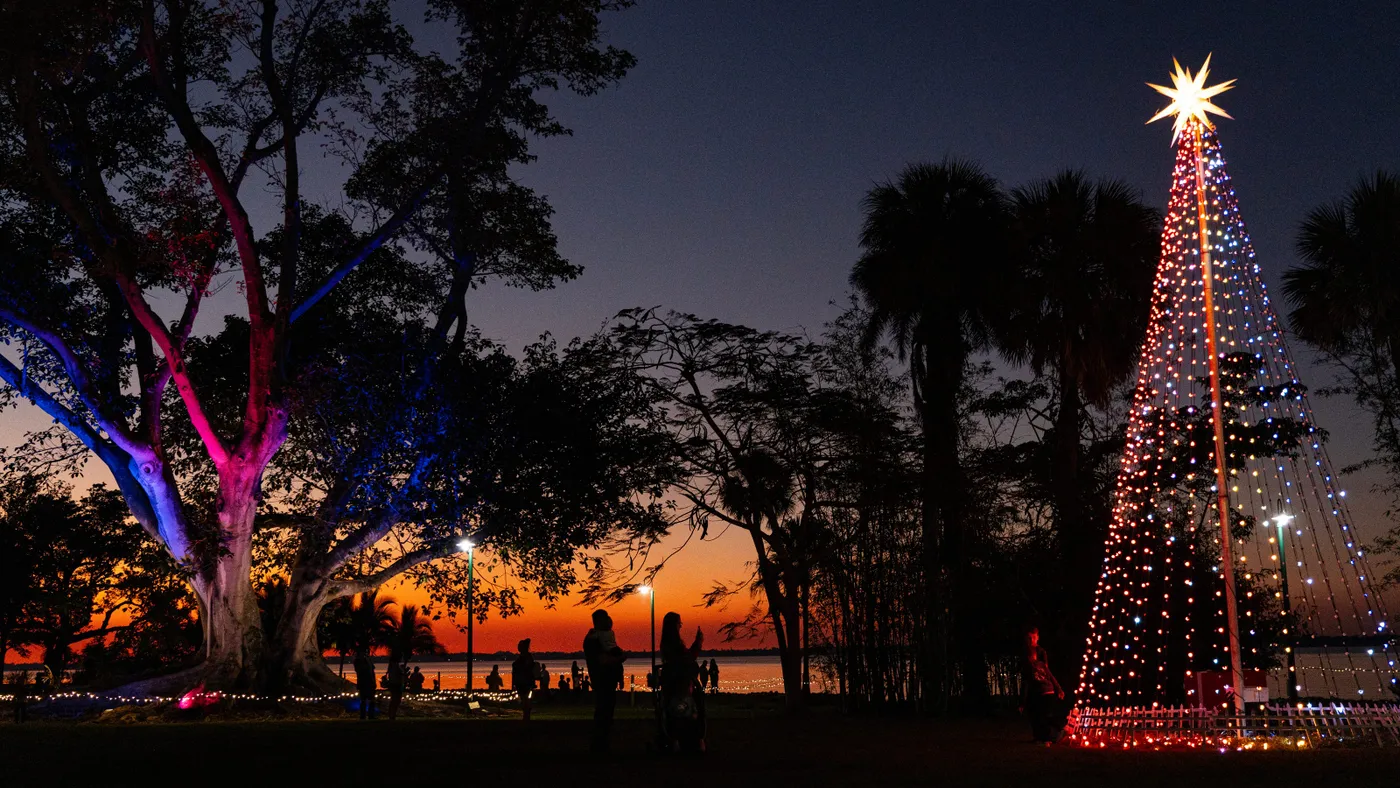
Colored uplights are cheaper than they sound. Two RGB LED floodlights with a remote run $40-$80 on Amazon, a cone tree strung in red and blue is $90-$180 at Walmart or Home Depot (or $50 used), and a star topper adds $15-$30. Total for the whole sunset scene: about $150-$300. Aim the floods 8-10 feet up the trunk at a 30-degree angle so the light rakes the bark instead of washing it flat.
21. Two Trees Sharing One Red, Gold, and Lime Story
When two trees share a palette, vary the scale instead of the colors. The foreground tree carries large, vivid red, gold, and green ornaments; the background tree repeats those exact hues in smaller sizes with vertical light strands for height. That’s 60% matching palette + 30% scale contrast + 10% light variation. Do the reverse — identical ornament sizes on both trees — and they flatten into one blurry mass by the second night.
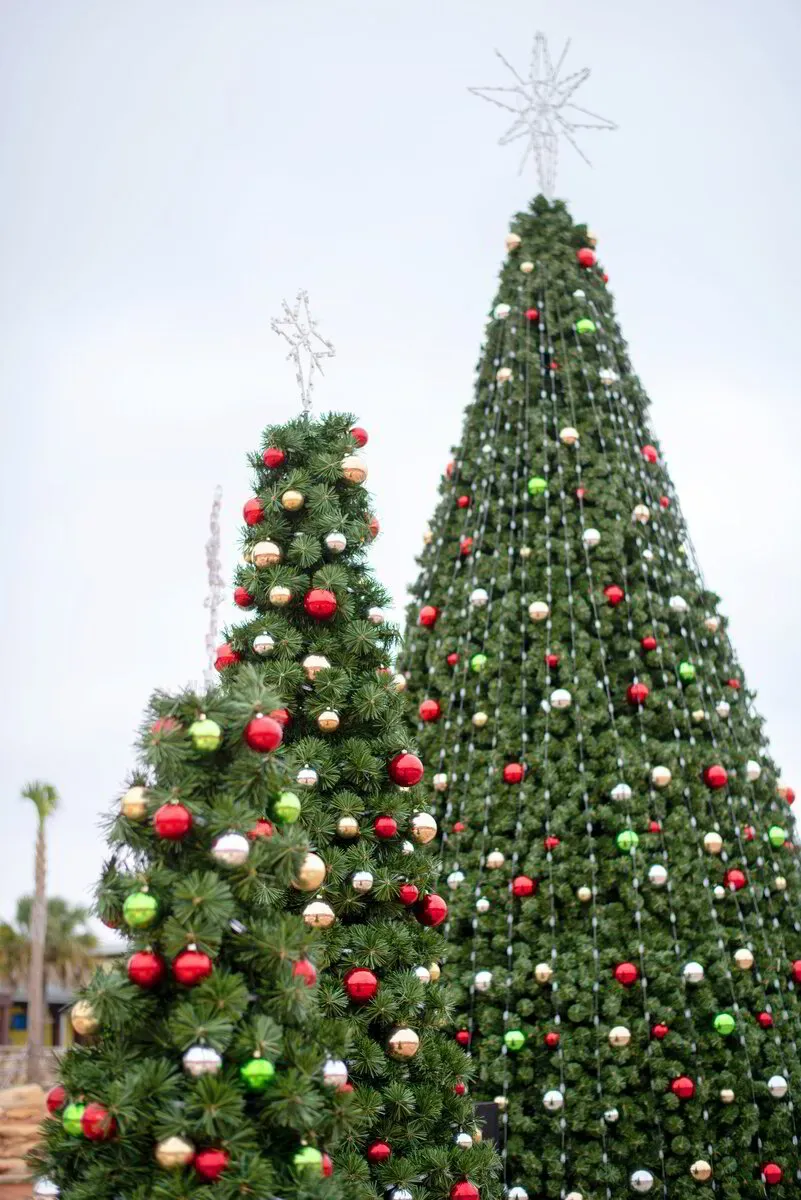
- Two large artificial trees, 7-9 ft — $360-$1,300
- Shatterproof ornaments, 200+ pieces — $150-$400
- Integrated string lights if not pre-lit — $70-$180
- Two star toppers — $30-$90
- Stakes, weights, extension cords — $40-$90
- Total: $650-$2,060
Budget alternative: one large tree plus one smaller companion, splitting a single ornament set between them — about $400-$700.
22. One Big Evergreen, Warm White Lights Only
Here’s the rule of thumb worth remembering: roughly 100 warm white bulbs per foot of tree height for a dense, professional look. One tree can carry a whole front yard if it is at least 12 feet tall with 20 feet of lawn to let it breathe. This one sits on grass with bare deciduous trees behind it, and that silhouetted backdrop keeps it from looking lonely. On a smaller lot, Idea #17 gets the same single-focal-point effect from a wireframe cone that stores flat.
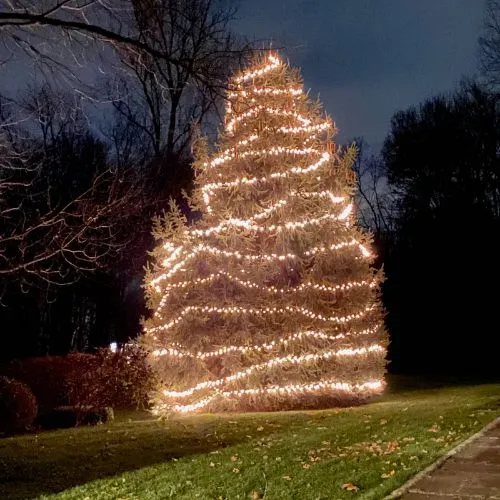
One big tree means one big failure point. If the strands in the top third quit, you’re re-wrapping from a ladder in January. Run your lights on two or three separate circuits so a single outage doesn’t kill the whole tree, and use a plug-in timer rather than a photocell — photocells love to trigger at 4 p.m. in December. Also rake before you wrap: wet cords and fallen leaves are a terrible combination.
23. Glass Orb Cones That Glow From the Inside
These structures work because the light source is hidden inside rather than clipped to the surface. If you’re building your own, use a rigid wire cone frame with a single warm-white or color-changing bulb at the center base, then hang orbs on the outside in decreasing sizes. Keep 6 to 8 inches between orbs so the eye can see through to the internal glow — pack them tighter and you lose the whole effect. Ballast the base with sand.
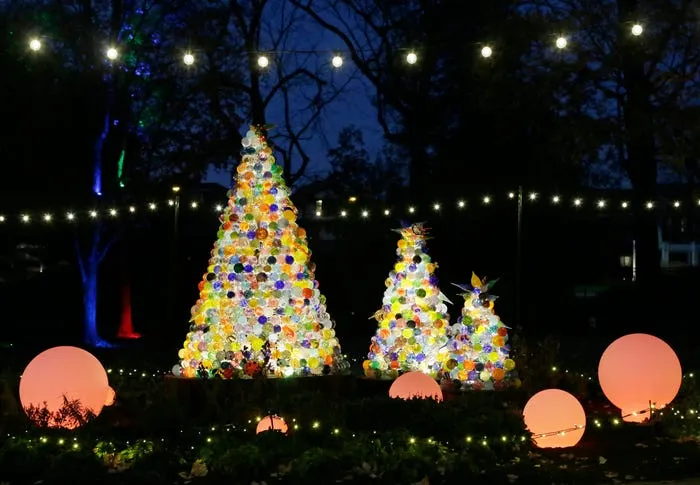
Three cones at three heights is a composition, not a collection. The largest anchors the left, the smallest tucks in behind, and the glowing orange spheres on the ground extend the same visual language horizontally so the display doesn’t stop at knee height. Overhead white string lights cap it — meaning light arrives from below, middle, and above. That’s why it reads as an installation rather than a yard display.
24. Neighborhood Maximalism: Two Yards, Zero Restraint
- Start with rooflines — icicle lights on every eave and gable first.
- Wrap trunks and shrubs in multicolor strands, keeping one color per shrub.
- Place tall structures (cones, skeletal trees) so they break the roofline visually.
- Add figures last: snowmen, oversized baubles, light-up ornaments at ground level.
- Split the whole display across at least four outlets on separate timers.
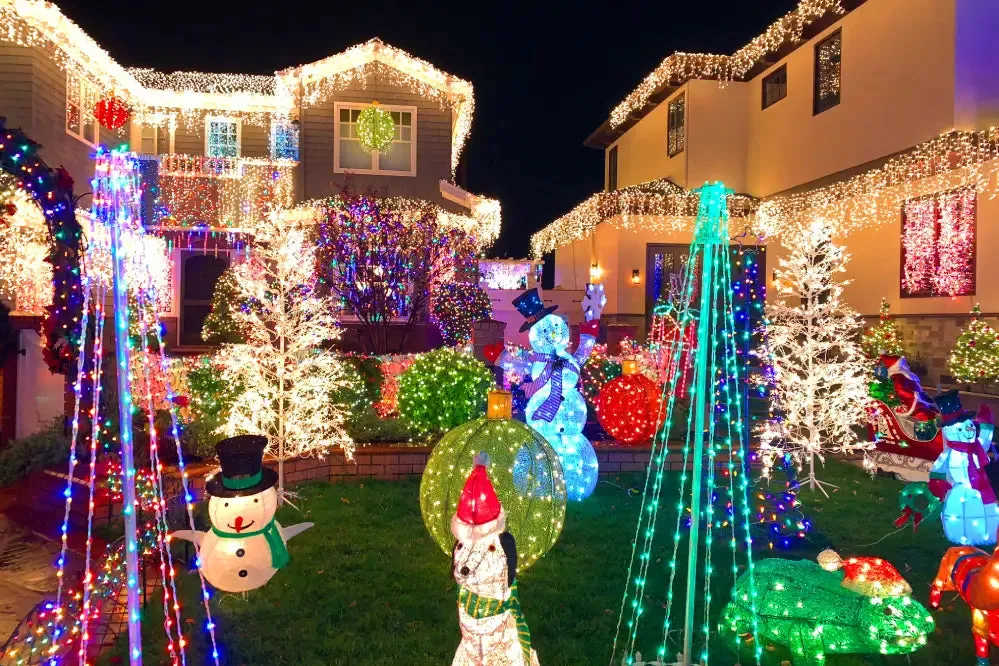
Time: 20-30 hours across a full weekend. Materials: $900-$2,500 depending on yard size.
- Add up the amperage — never exceed 80% of a 15-amp circuit.
- Count your outdoor outlets and map which strands plug in where.
- Check HOA rules on light color, display hours, and figure height.
- Buy 25% more extension cords than you think you need.
- Confirm you have dry, above-freezing days for the install.
25. A Slim Snowy Fir With Quiet Warm White Lights
- Slim artificial fir, 7-9 ft, pre-lit — $180-$550
- Extra warm white strands for density — $40-$90
- Weighted base or ground stake — $25-$60
- Outdoor timer and cord covers — $30-$60
- Total: $275-$760
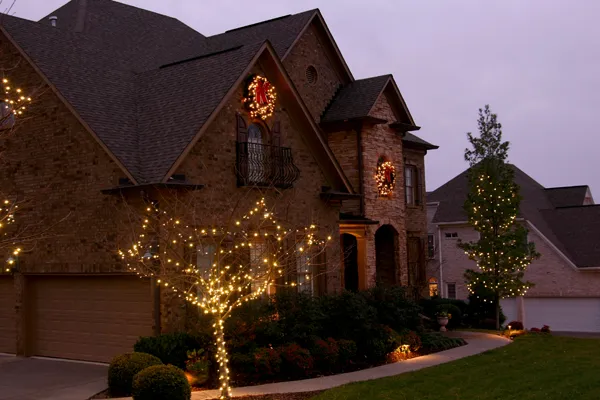
Budget alternative: a real potted fir from a nursery runs $60-$140 and can go in the ground in spring — same silhouette, no storage bin.
Snow on warm LED bulbs melts, refreezes, and can crack the lens over a few seasons. That’s not a problem this year; it’s a problem in year four. Shake heavy snow off the lower branches after storms so the weight doesn’t bend the frame. Real firs need water every two weeks even in winter when potted, and any potted tree brought indoors over the holidays needs to re-acclimate before it goes back outside. For the rest of the common failures, see our mistakes breakdown.
26. A Potted Evergreen With Pinecones, Berries, and Plaid
Everything in this arrangement is inexpensive and reusable. A small potted evergreen runs $25-$50, a bundle of mixed pine and cedar boughs is $15-$30 at a garden center (or free if you trim your own), red berry sprays are $6-$12, white-tipped pinecones are about $8 a bag, and white twig branches are $5-$10. The plaid ribbon bow is the splurge at $10-$18. Total: roughly $70-$120, and most of it comes back out of the pot next year.
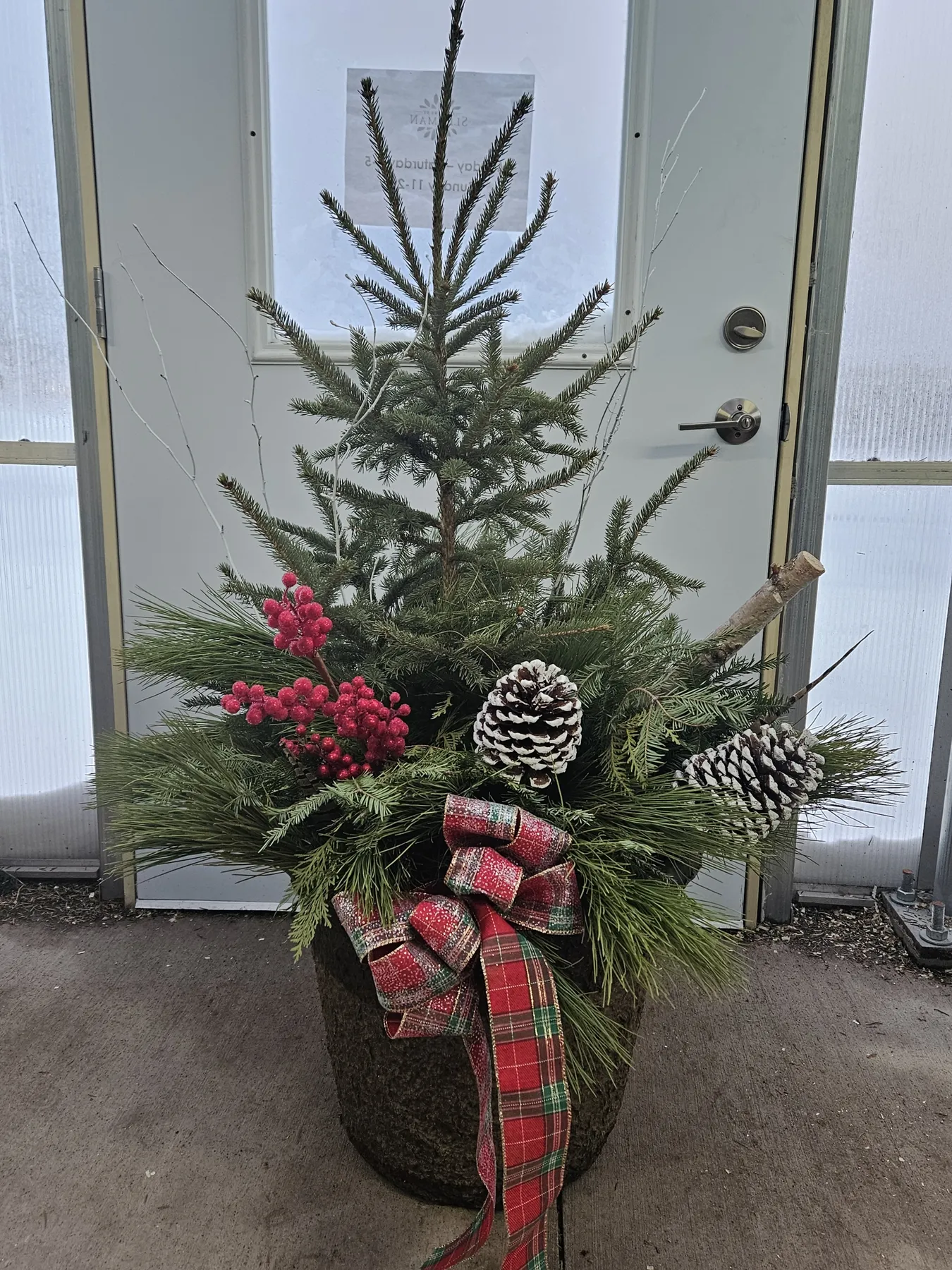
The red-and-green plaid bow is the piece holding it together. Without it, this is a neutral evergreen arrangement with red accents — pleasant, forgettable, the kind of thing you’d walk right past. The bow introduces pattern, which nothing else here has, and it echoes the red berries at a larger scale. It’s also sitting slightly off-center on the pot, which is what keeps the whole thing from looking like a store display.
27. Icicle Lights and a Purple Wash on the Facade
Icicle lights hang in 8- to 18-inch drops and look best on eaves at least 10 feet off the ground — lower than that and they crowd the windows. Blue and white icicles across a two-story roofline need roughly 40 to 60 feet of product. The purple accent wash works here because the house is light-colored; on dark brick, the same purple simply disappears. Compare with Idea #4, which puts red on the shrubs instead of washing the facade.
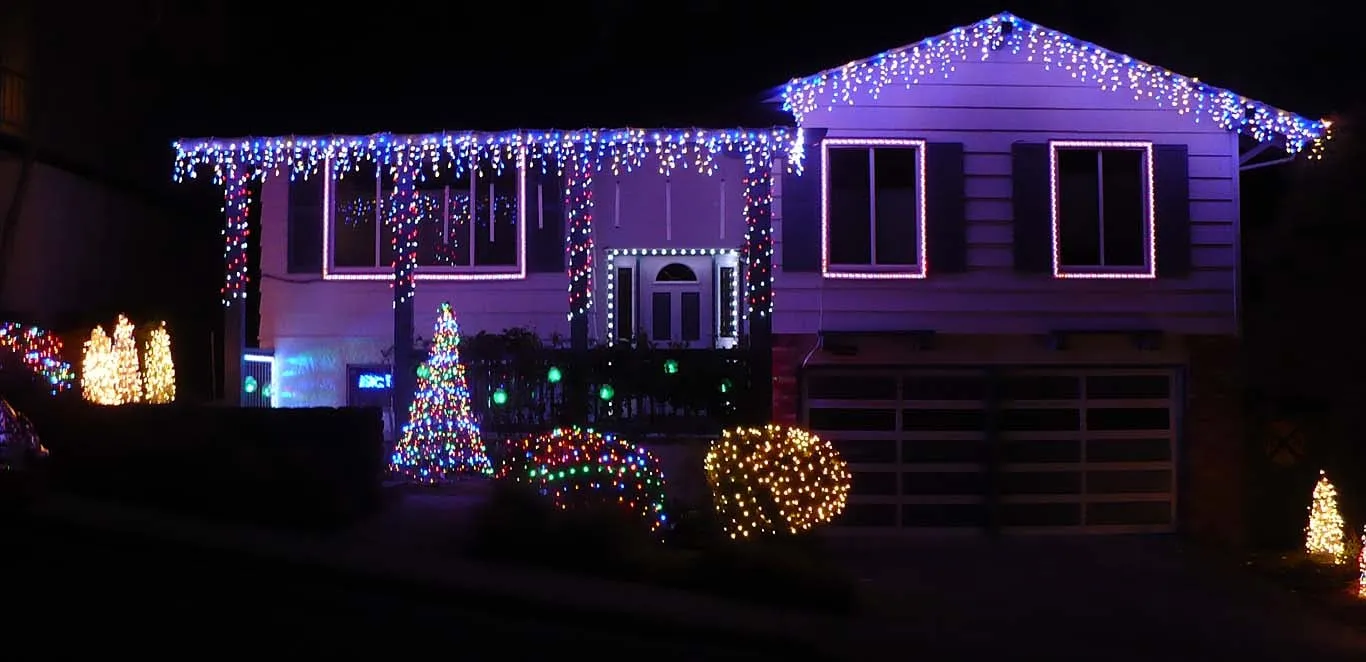
Wash lights point up; graze lights point across. For a facade effect like this, set two to four RGB floodlights 6 to 8 feet back from the wall and aim them upward at about 60 degrees, so the light spreads into a soft triangle rather than a hard circle. Run them on a separate remote-controlled circuit from the icicles. Fifteen minutes of careful aiming is the difference between a mood and a purple blob.
28. A Pre-Lit Tree on a Snow-Dusted Stone Porch
Pre-lit trees fail in predictable ways: an entire section dies because one bulb lost contact, and the fuse is almost never the culprit. Buy one with replaceable strand sections rather than a single hardwired harness. Also, faux snow on a stone porch looks pristine until it rains and tracks inside — a coarse mat and a boot tray at the door will save your floors. And skip real candles in those lanterns if you have kids or pets.
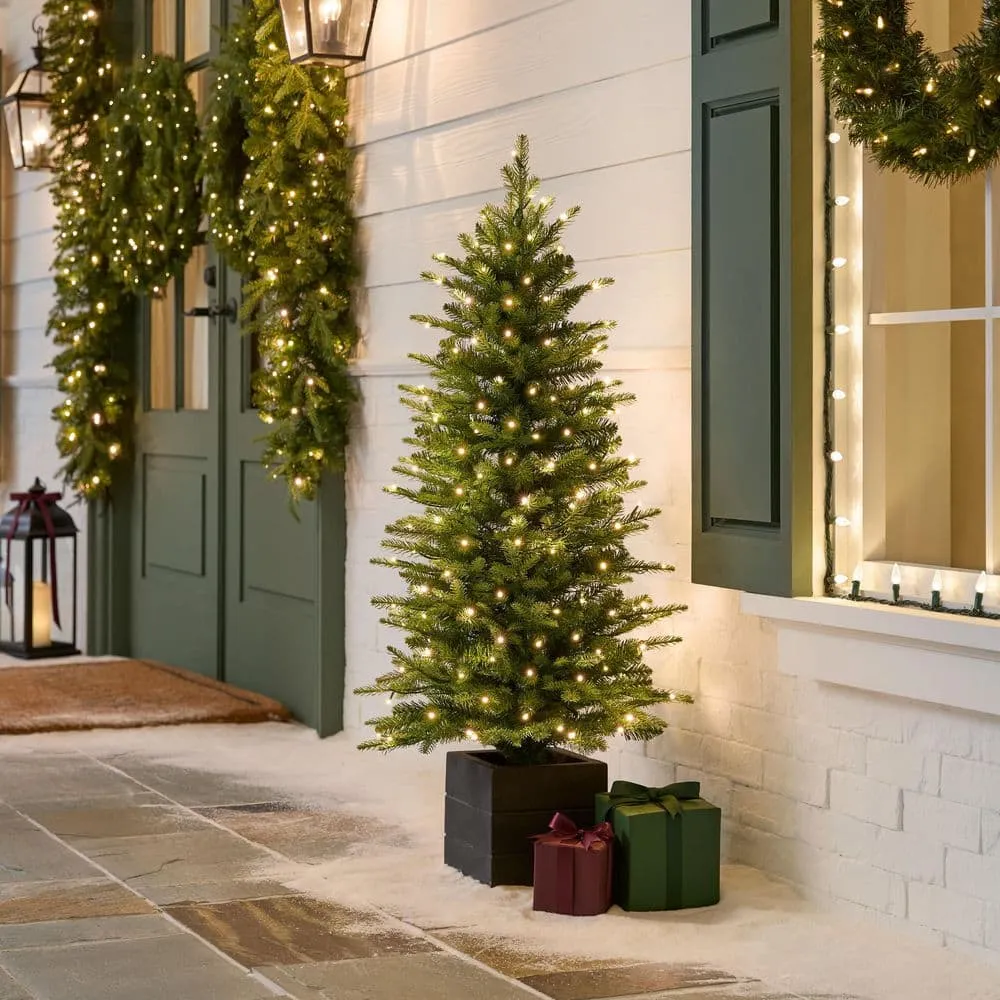
- Set the planter first, then drop in a sandbag for wind resistance.
- Assemble the tree, plug it in, and confirm every section lights before decorating.
- Add garland to the door frame and weave lights through it evenly.
- Hang the wreath at eye level, centered between the door top and the frame.
- Place gift boxes on the far side of the planter so the walkway stays clear.
Time: 90 minutes. Materials: about $150-$350.
29. The Civic Tree: A Star Topper and a Poinsettia Stage
- Towering artificial tree, 15-25 ft — $2,500-$9,000
- Commercial-grade LED strands, green/red/white/blue — $600-$1,800
- Illuminated star topper — $200-$600
- Potted poinsettias, 30-60 plants — $300-$900
- Oversized wrapped gift boxes — $200-$500
- Total: $3,800-$12,800

Budget alternative: rent a pre-lit commercial tree for the season — roughly $1,200-$3,500 installed, with storage and takedown included.
- Confirm the tree’s weight rating for your surface — pavers crack, turf sinks.
- Reserve a certified electrician if you’re pulling more than 20 amps.
- Check permits for any structure over 15 feet in a public space.
- Plan for wind loading: guy lines or ballast above 12 feet.
- Schedule takedown before your ground freezes solid.
From the Sidewalk to the Front Door: Go Make It Glow
Pick one hero element, get your color temperature right, and let the rest of the yard support it — that’s genuinely all that separates a display people slow down for from one they scroll past. Start with the idea that matches your actual frontage, not the one with the prettiest photo, and build outward from there. 📌 Pin your favorite to your Holiday Exterior board now — you’ll want it handy the weekend you finally drag the bins out of the garage.