You know that feeling when you finally find the centerpiece that looks exactly right for your table — and it costs less than the candles you were about to buy anyway? That’s the energy we chased down for this one.
We spent serious time digging through Anthropologie, Target, World Market, Etsy, and a handful of small florists and vintage sellers to pull together only what’s worth your attention this year. Everything here sits between $12 and $390 depending on which version you build, so there’s a real option for whatever your table budget actually is.
Inside you’ll find 29 curated centerpieces covering traditional red-and-green, quiet winter white, blue-and-white chinoiserie, rustic-foraged, and one unhinged pink flamingo. Budget and luxury versions are compared side by side, and every idea comes with real numbers so you can plan instead of guess. 2026 is the year of the edible centerpiece — real citrus, clove-studded oranges, pomegranates split open on the runner — because everyone’s feed has officially had enough plastic.
Save this post now — you’ll want it when you’re ready to shop.
1. A Dark Wood Tray, Loose Pine, and One Very Red Bow
The single element doing the heaviest lifting here isn’t the greenery or the ornaments — it’s the shallow dark wooden tray underneath them. It draws a boundary. Without it, those pine sprigs, the pine cone, and the red and dark patterned baubles would read as clutter scattered across a table; inside it, they read as one deliberate composition. It also means you can lift the whole centerpiece off in one motion when the turkey needs the space back.

Measure your tray at roughly one-third the length of your table — on a standard 72-inch table that’s a 24-inch tray with 24 inches of bare wood breathing on either side. Then keep the tallest point, usually the candle or the bow, under 12 inches so nobody has to lean sideways to talk to their sister-in-law. The tray silhouette is what makes the whole thing feel placed rather than sprinkled.
2. The Hurricane Candle That Anchors an Embroidered Cloth
Two things are working quietly here. First, scale contrast: one tall glass hurricane next to a low ring of pinecones, berries, and foliage gives the eye a clear hierarchy — you always know where to land. Second, the glass itself. A hurricane shields a live flame from the cross-breeze every dining room has, which means the candle actually stays lit through dinner instead of dying at the salad course.
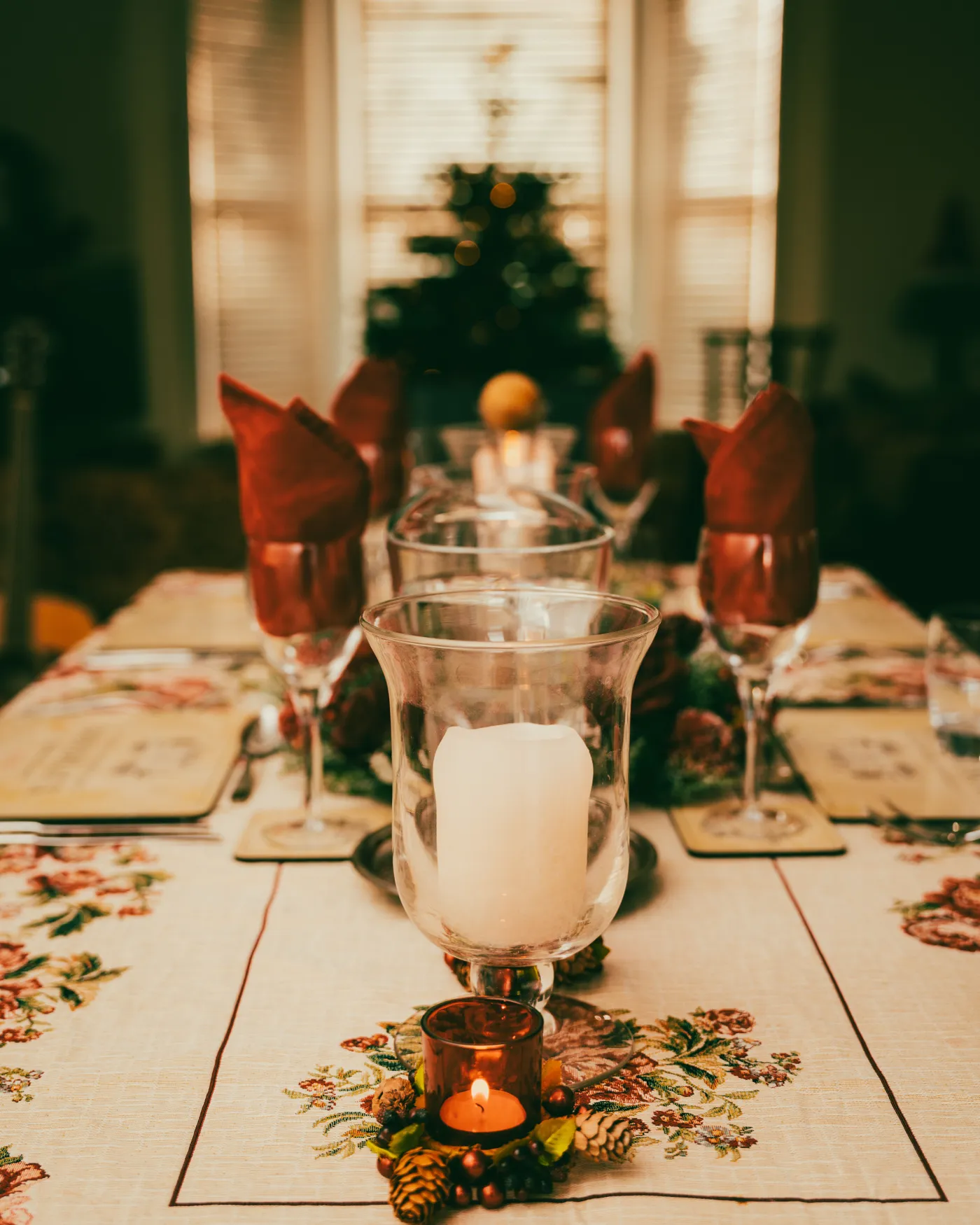
This layout asks for a table at least 36 inches wide, because that pinecone ring needs room to spread without crowding the place settings. A 60- to 72-inch table is the sweet spot. Working with something narrower — a 30-inch apartment table, say — switch to a single hurricane and skip the ring entirely, or borrow the low-profile approach in Idea #15.
3. Red Roses and a Gold Glitter Star in a Sack-Cloth Vase
- Gold textured sack-style vase: $18–$45
- Red roses, one dozen from the grocery store: $15–$30
- White chrysanthemums plus filler: $12–$25
- Evergreen sprigs, pinecones, mini baubles: $10–$20
- Gold glitter star topper: $5–$12
- Total: $60–$132
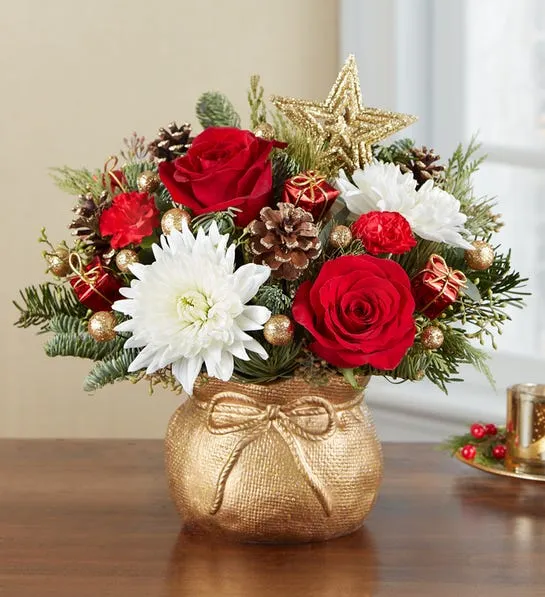
Budget alternative: skip the florist entirely, buy two grocery bunches, and use a $6 thrift-store urn with a coat of gold spray paint. You land around $45 and lose only the vase texture.
The ratio that makes this work is about 55% green filler, 30% red bloom, 10% white bloom, and 5% gold sparkle. That’s why it reads festive instead of like a Valentine’s bouquet — the green does more work than the red does. Swap the red roses for burgundy dahlias and the gold star for a copper one, and the formula survives intact.
4. The Charcuterie Board That Doubles as Dinner and Decor
- Choose a board at least 18 inches long so the food spreads instead of stacking.
- Anchor four cheeses at the corners, cut in different shapes — wedge, round, crumble, slice.
- Fold cured meats into loose ribbons and tuck them between the cheeses, not on top.
- Fill every gap with crackers, nuts, dried fruit, and olives until no wood shows through.
- Ring the board with pine branches and frosted pinecones, keeping them off the food.
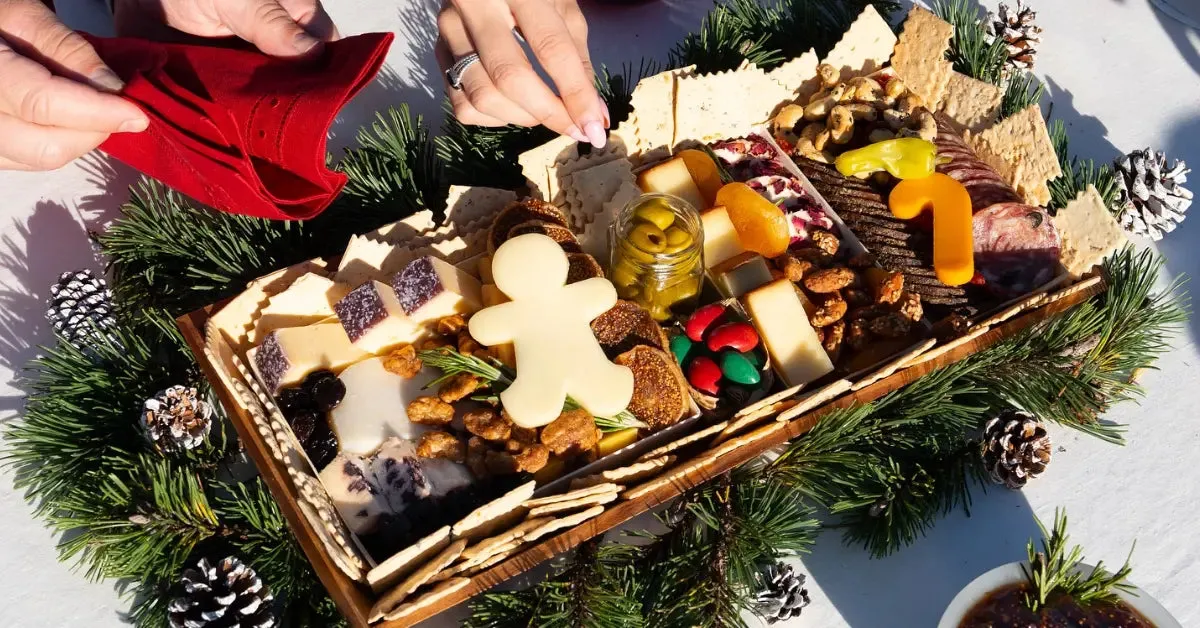
Roughly 40 minutes of assembly and $35–$60 in groceries, depending on how fancy your cheese counter gets.
this centerpiece gets eaten, which is the whole point, but it also can’t sit out all evening. Cheese and cured meat want to stay under two hours at room temperature, so set the board out right before guests arrive rather than at four in the afternoon. If you have a dog with a long reach or a toddler at table height, park the board at the far end and keep the pine sprigs well away from anything edible.
5. A Lush Evergreen Garland Beside a Gold-Beaded Charger
A single store-bought garland always looks skimpy. Buy two 6-foot strands and twist them together in opposite directions so the branch tips face both ways — the result reads three times as expensive for the price of one extra strand. Then let the ends spill about 6 inches past the table edge instead of stopping them dead at the corner.
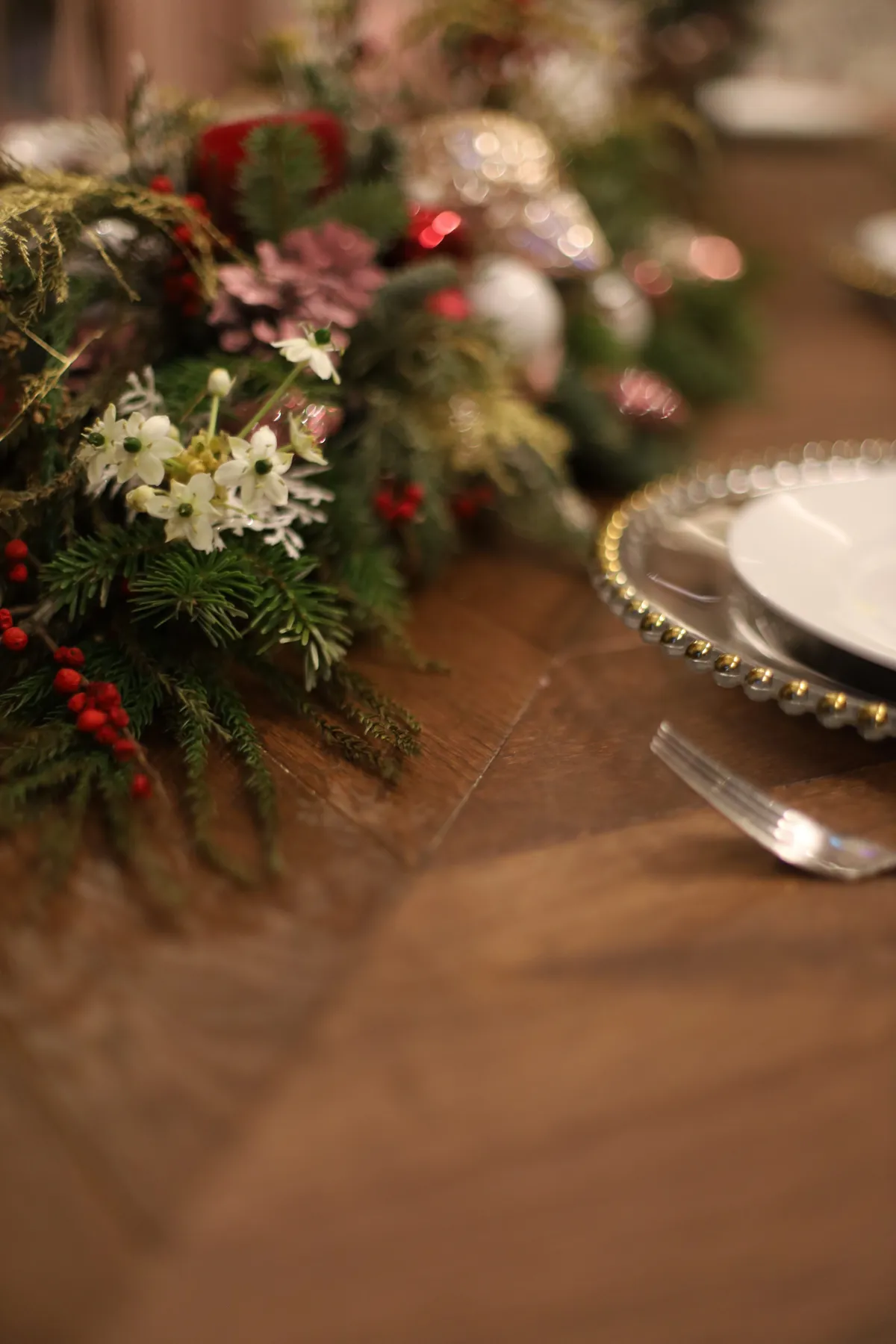
Strip this table down and the one piece holding it together is the clear charger with the beaded gold rim. It catches the light the garland throws and gives a plain white plate a reason to be there. Remove it and the setting drops straight to nice but forgettable. You don’t need new dishes for this effect — chargers are the cheapest upgrade in tablescaping.
6. A Golden Deer in a Woven Basket of Evergreens
You don’t need a florist for this one. A $6 thrift-store basket, a bundle of grocery-store evergreen, a bag of gold ornaments from the dollar store, and one small deer figurine — $8 at a craft store, or free if you already have one in the decoration bin. Total spend lands under $30 for a centerpiece that fills a four-foot run of table. This is the budget version of Idea #3, if you want the florist take on the same feeling.
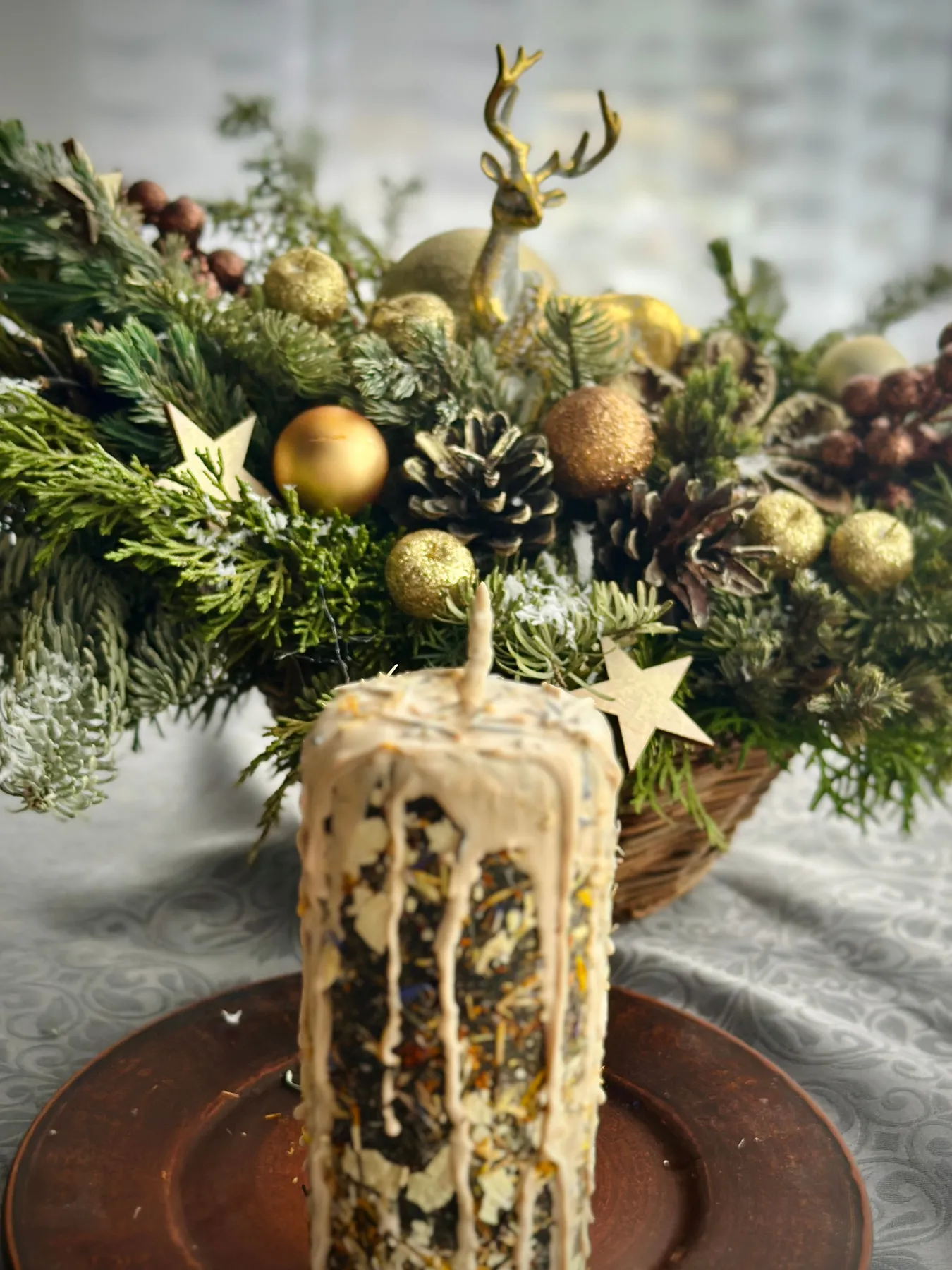
The basket is having a moment for a reason. After years of polished, matching, store-bought holiday decor, the 2026 tablescape conversation has swung hard toward things that look gathered rather than purchased — woven, wooden, mossy, slightly imperfect. It photographs beautifully and it ages well, which is more than you can say for most trends that start on Pinterest.
7. A Hollow Log, Three Pinecones, and a Velvet Bow
- Source a 14–18 inch log, or buy a bark-covered trough planter — the look is nearly identical.
- If you’re hollowing it yourself, drill a line of 2-inch holes and chisel out the channel.
- Line the cavity with plastic wrap so sap doesn’t stain the tabletop.
- Pack in damp floral foam or moss, then push evergreen sprigs in starting from the ends.
- Tie the velvet bow around the front and wire in the pinecones and berries last.
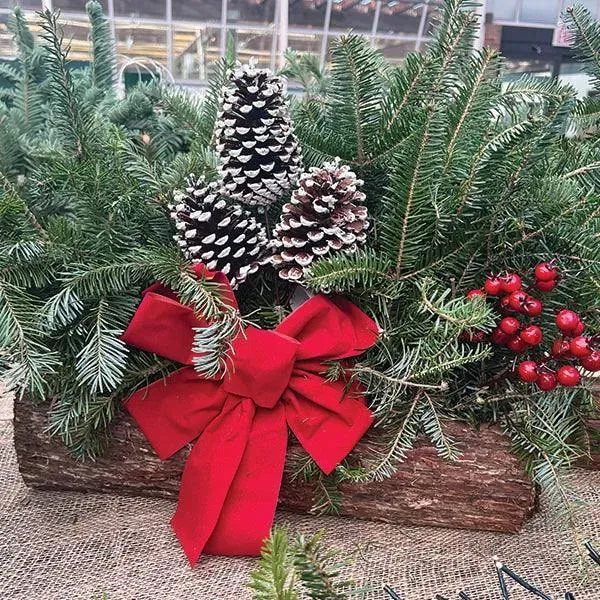
About two hours and $25–$45 in materials, most of which you probably already own.
A log centerpiece is heavier than it looks — a 16-inch section can run 8 to 12 pounds, so think twice before setting it on a thin veneer table without a felt pad underneath. Fresh-cut wood also weeps sap for the first week; seal the cut ends or line the hollow with plastic. And real branches will start dropping needles by week three. Nobody will know if you go faux.
8. A Distressed White Lantern Wreathed in Frosted Berries
Frosted and glittered pieces shed, and there’s no way around it. Expect a light dusting of white flakes on your tablecloth for the first week, and store everything in tissue-lined bins rather than one big garbage bag, or next December you’ll be shaking glitter out of your carpet again. The battery LED inside the lantern wants a fresh set roughly every 40 hours of use, so buy rechargeables and keep a spare pair in the sideboard drawer.
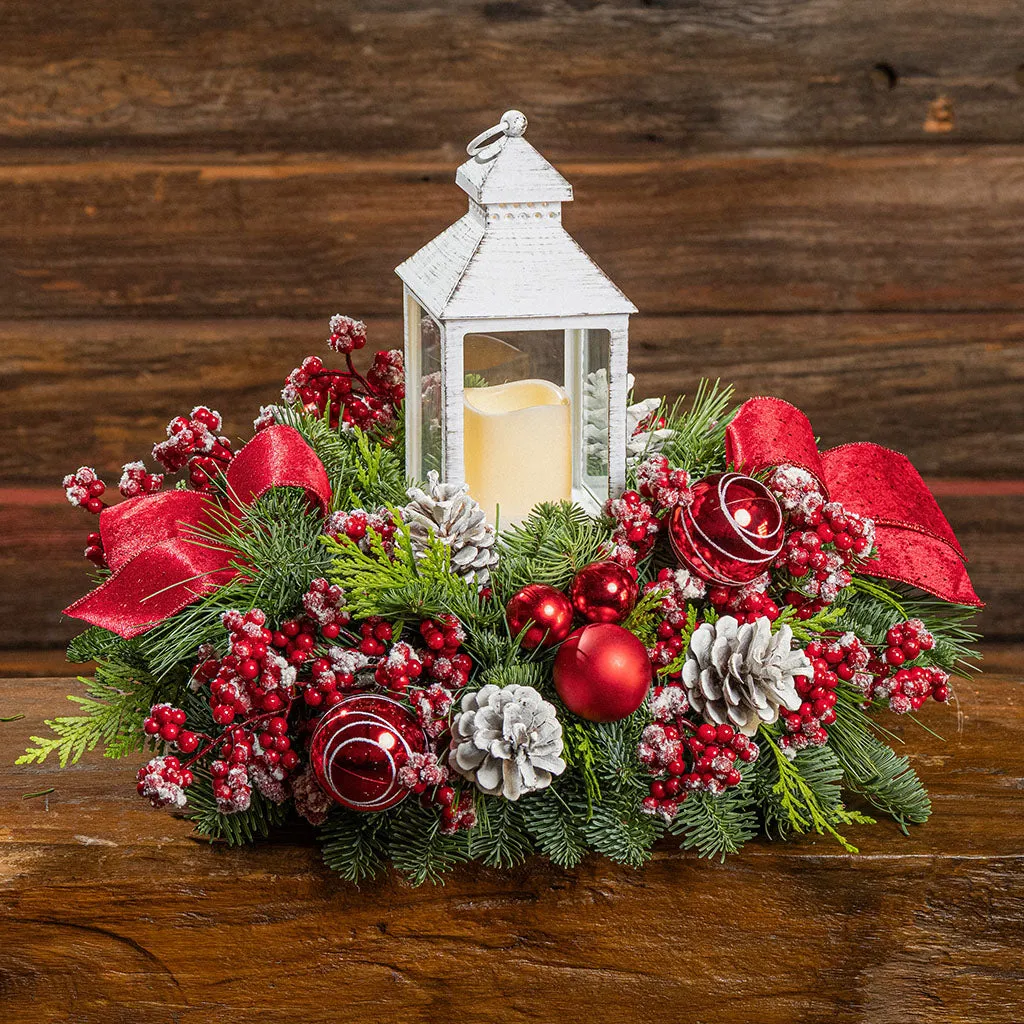
Place the lantern one-third of the way along the table rather than dead center. Perfect symmetry reads formal and a little static; a lantern set off-axis instantly makes an arrangement feel styled instead of staged. Keep the top of the lantern below seated eye level — around 14 inches above the tabletop — so the light glows up into the greenery rather than straight into someone’s face.
9. White Roses, a Cream Candle, and Frosted Pinecones
The formula runs about 65% evergreen, 25% white bloom and frosted pinecone, 10% cream candle. That heavy green-to-white ratio is what keeps a winter-white arrangement from looking like a wedding leftover — the white stays an accent instead of becoming the whole story. Trade the roses for white tulips in a different season, or swap pinecones for seeded eucalyptus if you want it to last past December.
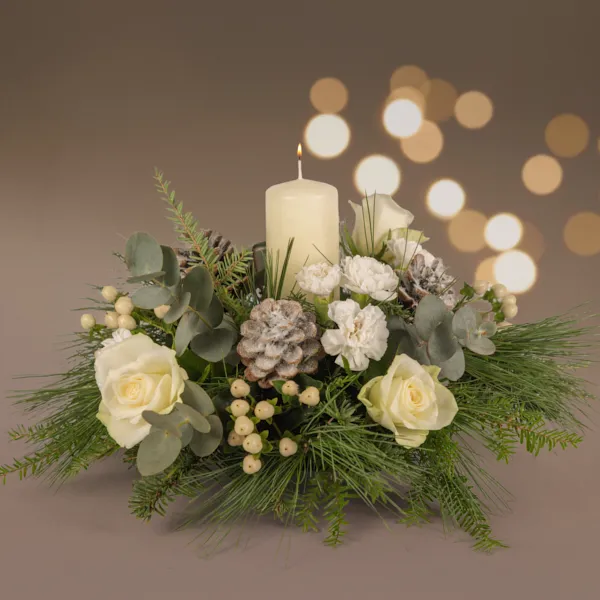
What really sells this is the light behind it. Warm golden bokeh in the background turns a fairly simple palette into something cinematic, so if you’re recreating it, put the arrangement in front of a lit tree, a lamp, or a window full of string lights. The other quiet win is density: the foliage is packed tight with no visible container, which makes the whole thing look grown rather than arranged.
10. A Tiny Rosemary Wreath on a Navy Plaid Plate
The rosemary wreath is the tell. It’s maybe four inches across, costs almost nothing, and instantly makes a stack of plates look like someone with a plan designed it. Remove it and you still have a lovely blue plaid setting — but you lose the this-seat-was-saved-for-you feeling that makes guests actually sit down and stay a while.
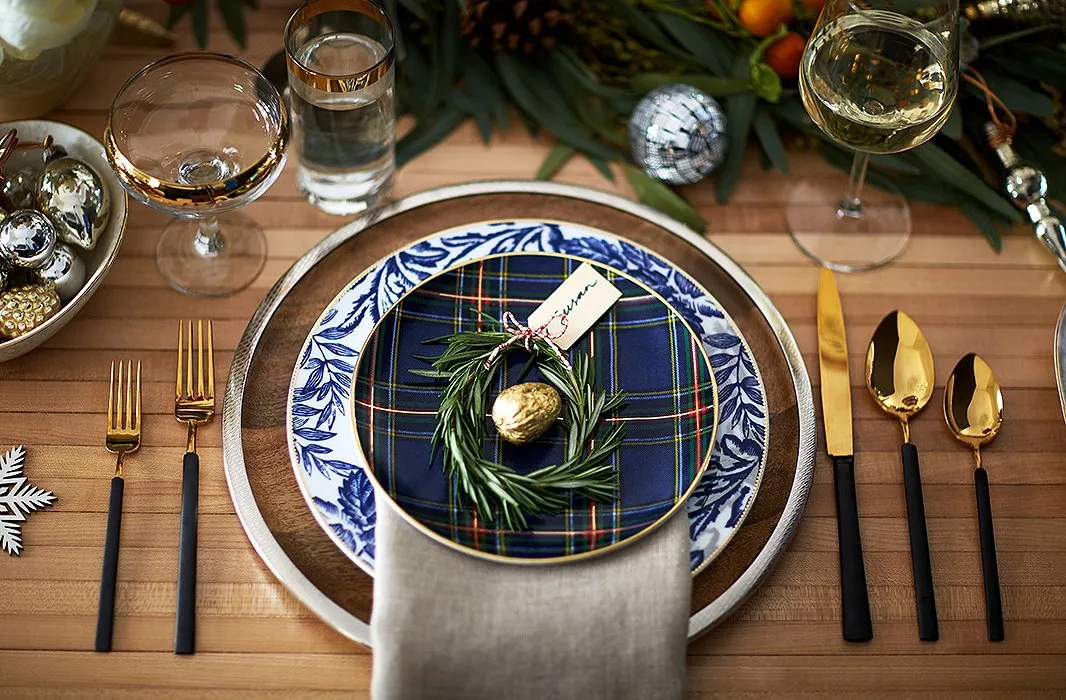
- Wooden charger: $6–$14 each
- Blue botanical dinner plate: $8–$20 each
- Plaid salad plate: $5–$15 each
- Gold-and-black flatware, service for four: $25–$60
- Gold-rimmed glassware: $4–$10 each
- Rosemary sprigs plus gold nuts: $10 total
- Total for four settings: $150–$330
Budget alternative: skip the chargers and layer the two plates right on the bare wood. You save about $50 and lose almost nothing visually.
11. A Tall Evergreen-and-Apple Centerpiece on a Round Table
A tall centerpiece only works on a round table 48 inches or wider, and only if the arrangement clears eye level — roughly 30 inches above the floor when everyone’s seated. Anything hovering between 15 and 28 inches is the worst of both worlds: too tall to see over, too short to see through. On a 60-inch round, a 24-inch-wide centerpiece leaves 18 inches per setting, which is exactly enough. Narrower tables should look at Idea #2 instead.
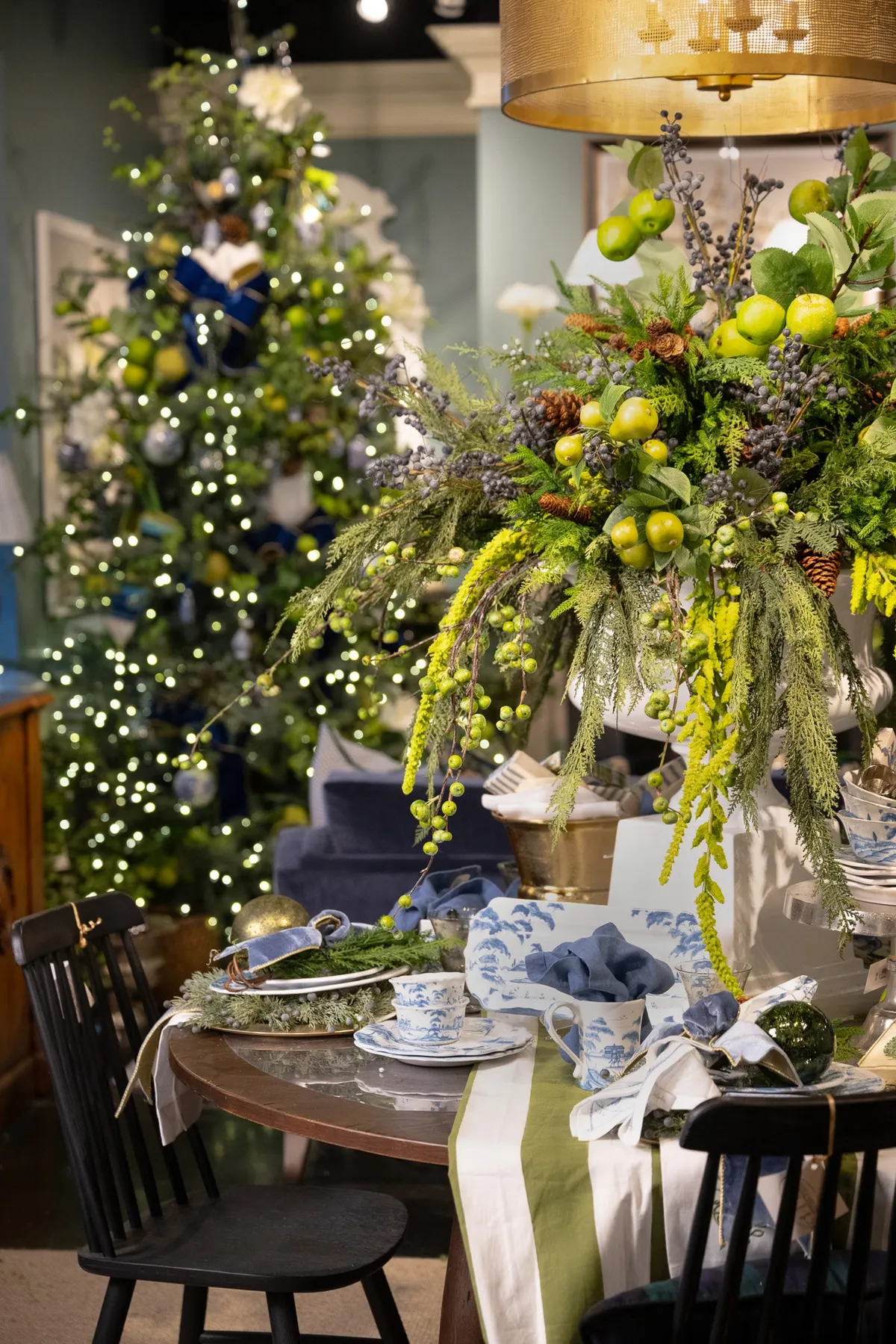
Three repetitions are doing the work here: green in the centerpiece, green in the striped runner, green in the tree behind. Blue shows up on the china and again in the berries, so nothing feels orphaned. The black spindle chairs then hold the whole thing down — without that dark anchor, all that green and blue would float. The gold chandelier is the only warm note in the room, and it’s enough.
12. Red Roses and White Lilies in a Polished Gold Bowl
Gold bowls are shockingly cheap at thrift stores — $4 to $9 for something that looks like this. Give it two coats of metallic gold spray paint, let it cure 24 hours, and drop in a plastic cup before the flowers go anywhere near it. Grocery-store roses and lilies run $20 to $35 for the whole arrangement versus $150 and up from a florist. Same look, roughly a fifth of the price.
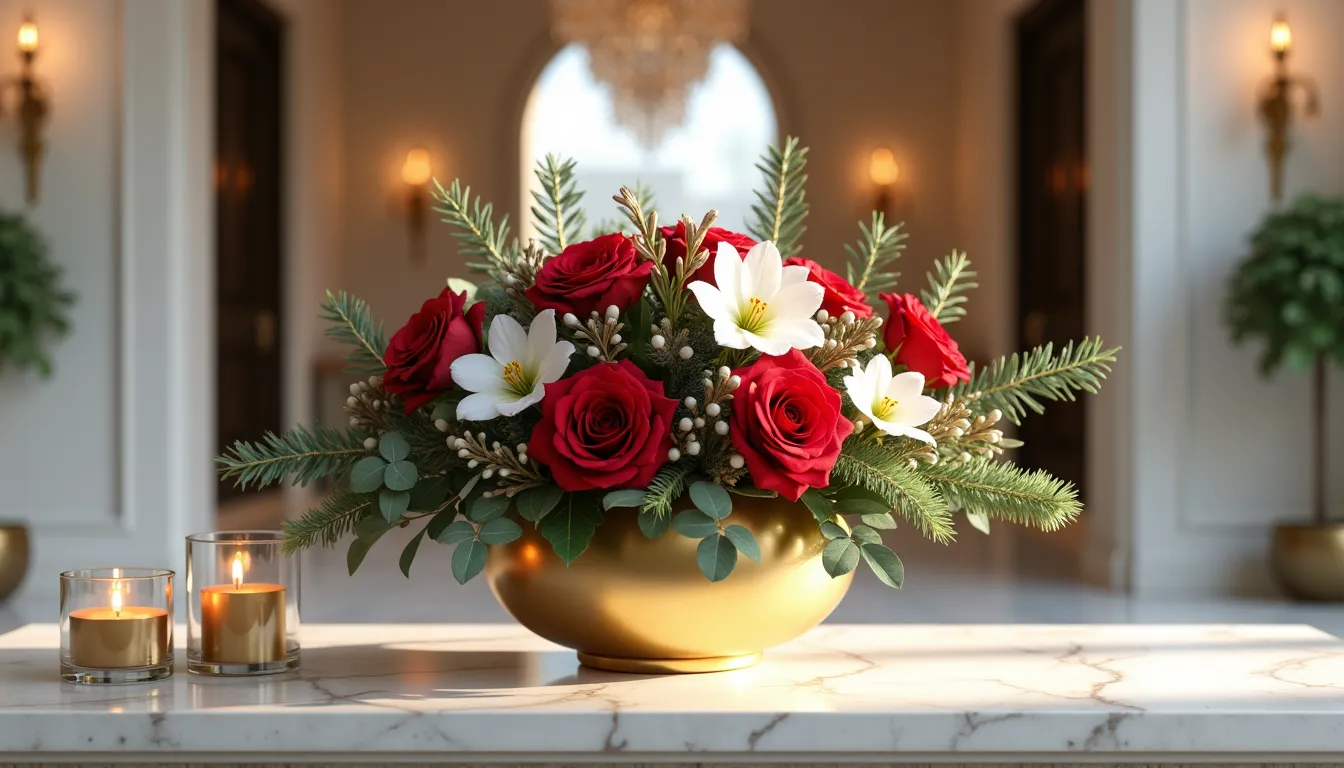
Lilies are beautiful and slightly high-maintenance: the pollen stains fabric permanently, so snip the anthers off with a paper towel before they open. Change the water every two days and re-cut the stems at an angle for a full week instead of four days. The bowl itself just needs a dry wipe — polish it too often and the finish dulls.
- Measure the free center run of your table before buying the bowl.
- Check that the bowl is actually watertight — many decorative ones aren’t.
- Confirm your stone or marble surface is sealed so water rings don’t set.
- Have a plastic liner and floral foam on hand before the flowers arrive.
13. Pomegranates, Taper Candles, and Copper Mugs
- Lay a runner of evergreen down the center, letting the ends trail past the plates.
- Cut two pomegranates in half and nestle them cut-side up in the greenery.
- Space taper candles every 12 inches, alternating red and grey holders.
- Tuck berries and small sprigs into every gap until no runner shows through.
- Set the gingerbread cookies on the plates last — they’re the first thing to disappear.
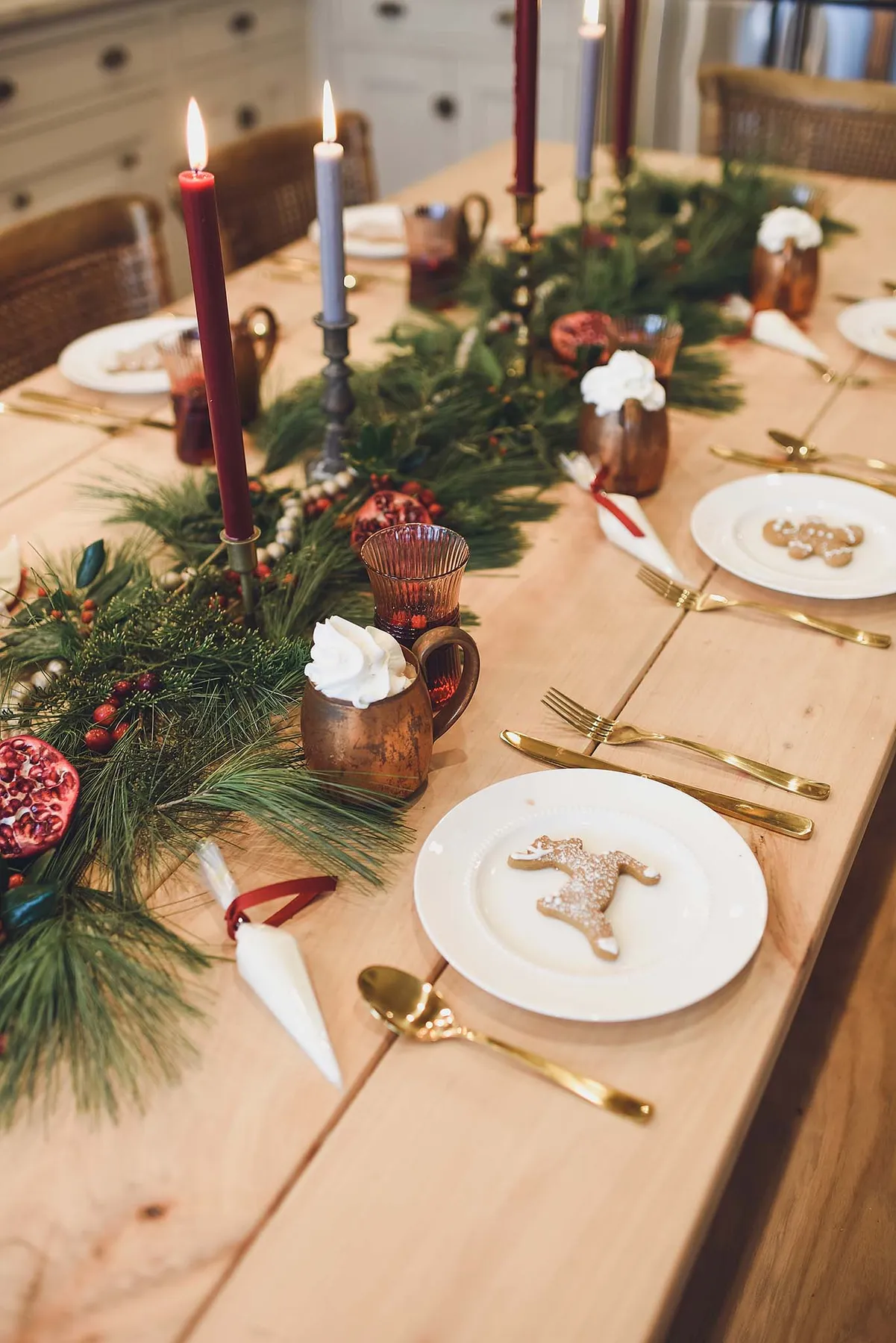
About 30 minutes and $30–$50, most of it at the grocery store.
Thirty inches is the magic distance between taper candles. Any closer and the flames merge into one blob of light; any farther and the table reads underlit. Always use a holder with a wide cup, and never let a taper burn below 2 inches. For a runner, buy one good garland and one cheap one, then lace them together so the nicer branches sit on top.
14. One Pillar Candle in a Dark Green Holder
- Mixed faux evergreen stems, six to eight: $24–$48
- Dark green candle holder: $8–$18
- Pillar candle: $6–$14
- Pinecones, gathered or bagged: $0–$8
- Frosted berry sprays: $6–$14
- Total: $44–$102
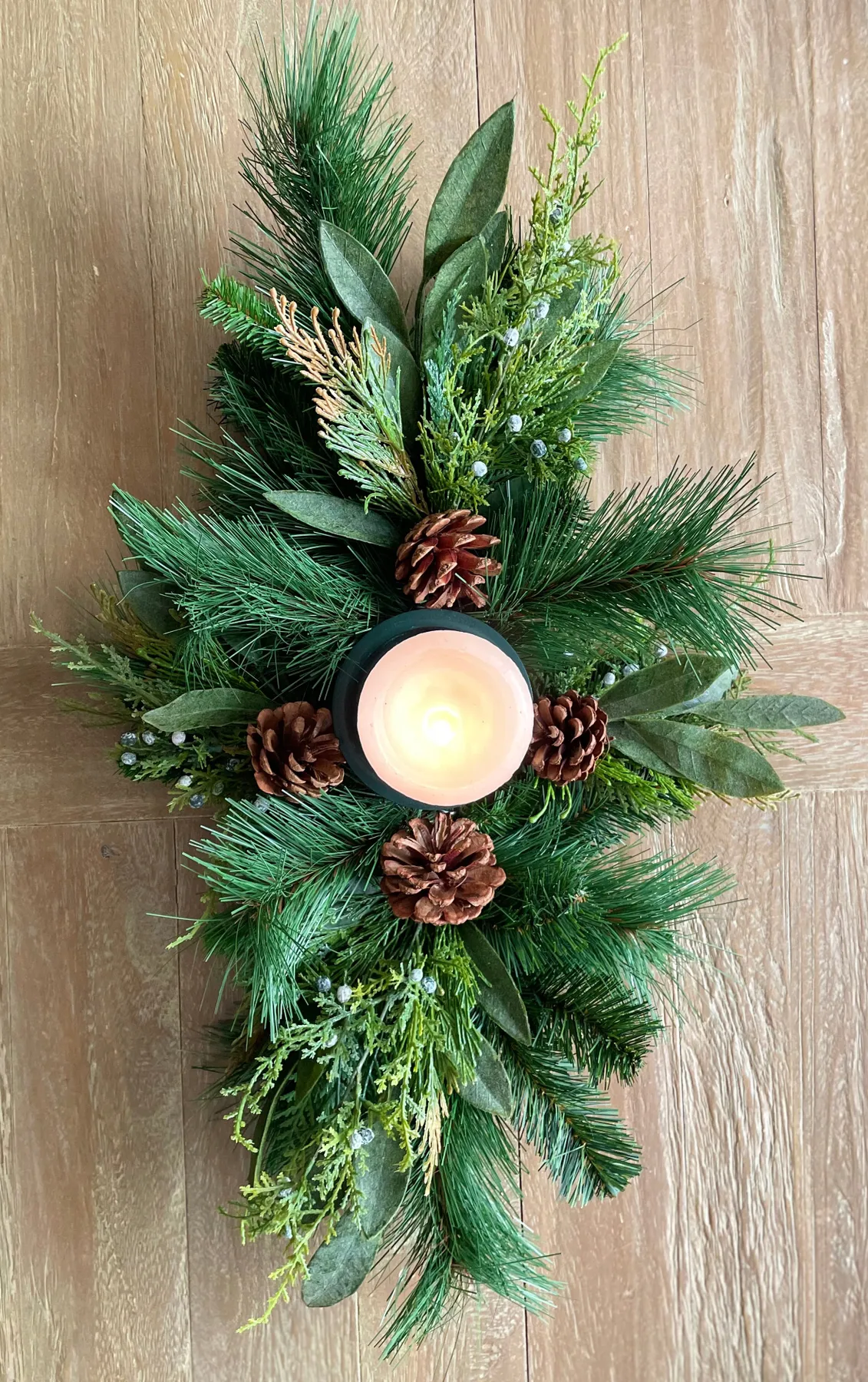
Budget alternative: skip the berry sprays and use three pinecones plus a sprig of cedar from the yard. The total drops to roughly $35 and the silhouette doesn’t change at all.
A live flame next to dry evergreen is a real fire risk, not a hypothetical one. Keep at least 6 inches between the top of the candle and the nearest branch, trim the wick to a quarter inch, and never leave the room with it lit. If you have a cat that treats tables like trampolines, get the battery version — it looks nearly identical through a candlelit dinner and you won’t spend the evening flinching.
15. White Taper Candles Rising Straight Out of a Green Runner
Sink your tapers into clear glass cups, then bury the cups in the greenery. The glass catches every drip and you won’t be scraping wax off a tablecloth on the 26th. Space them every 10 to 12 inches and vary the heights by 2 inches so the flames don’t line up in a boring row. Wire the garland to the cups with florist wire so nothing shifts when someone reaches for the salt.
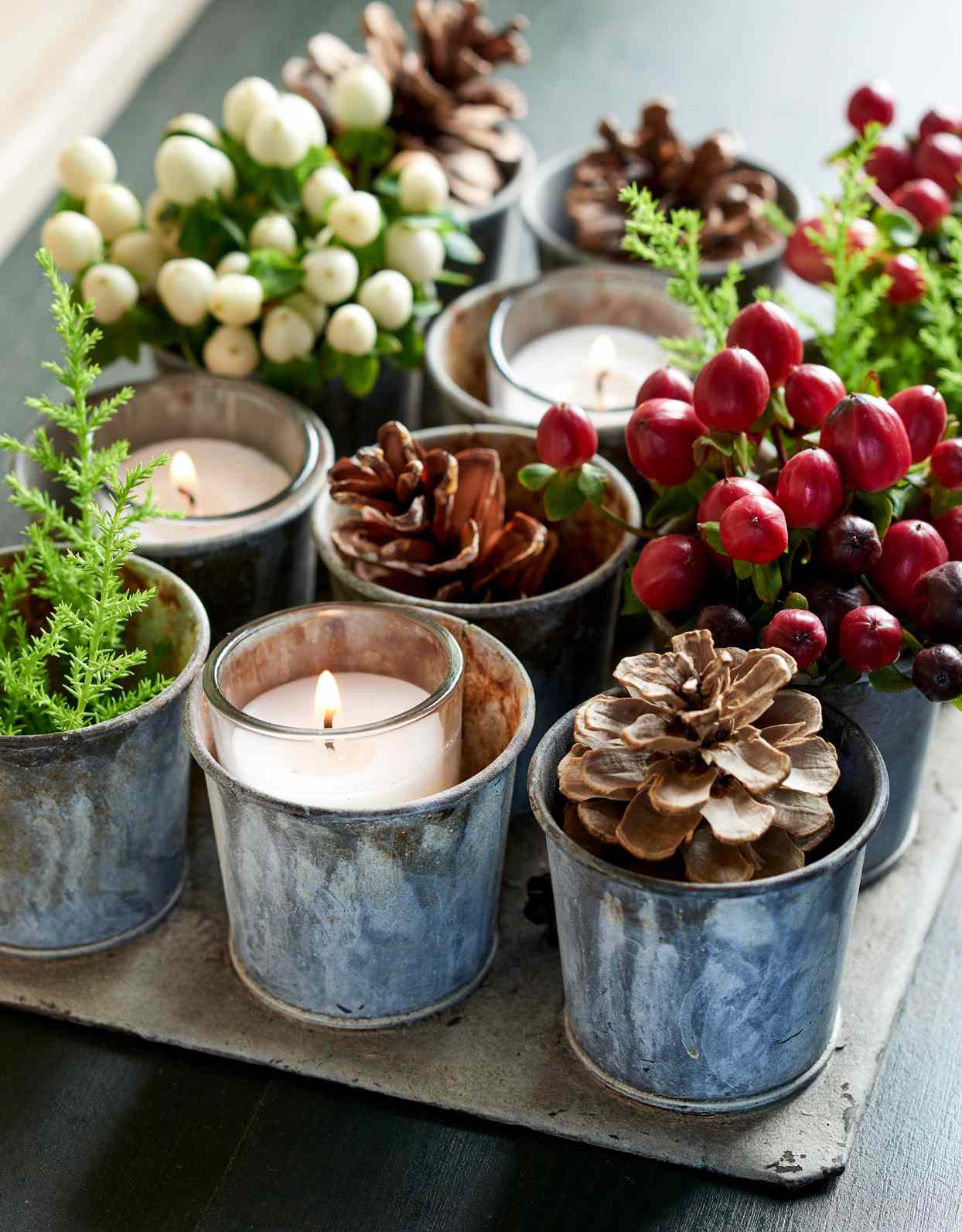
A garland this long needs a table of at least 72 inches to look intentional; on a 48-inch table the same garland reads like a crowd. Aim for the greenery to cover two-thirds of the center run and leave the last 6 inches at each end bare. Shorter table? Run the garland in a loose S rather than a straight line — it eats less length.
16. Festive Table Decor That Carries You Into New Year’s
The smartest decorating move of the season happens on December 27th: you strip the red and green, keep the candles and the metallics, and add a little sparkle. Bridge decor — pieces that work for both Christmas and New Year’s Eve — has quietly become its own Pinterest category, and it exists for a simple reason. Nobody wants to redecorate twice in one week.
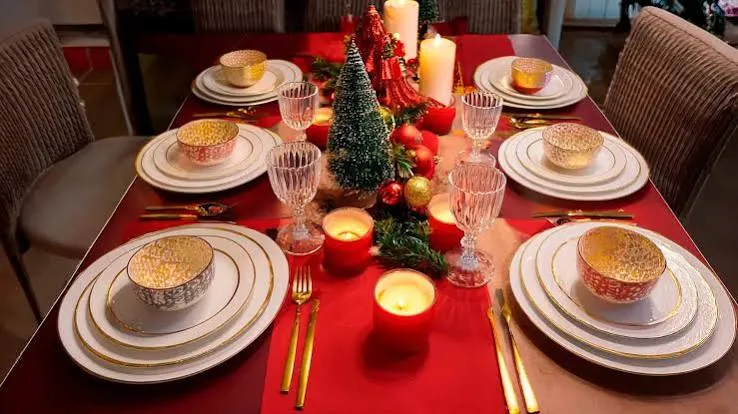
Reuse what you already bought. Keep the metallic ornaments, swap the evergreen for eucalyptus or magnolia leaves, and pull the red berries out entirely — that single subtraction shifts the palette from Christmas to New Year’s Eve. Two gold spray-painted thrift-store candle holders cost about $6. See Idea #5 for the Christmas version of this exact table.
17. A Potted Rosemary With Red and Gold Baubles
- Start with a healthy 6-inch rosemary plant in a plain nursery pot.
- Wrap the pot in a square of fabric and tie it with ribbon so the plastic disappears.
- Bend small wire hooks over the branch tips and hang three to five mini baubles.
- Keep it watered — rosemary in a heated dining room dries out fast.
- Set it between the plate and the taper candles so it reads as part of the table, not a stray plant.
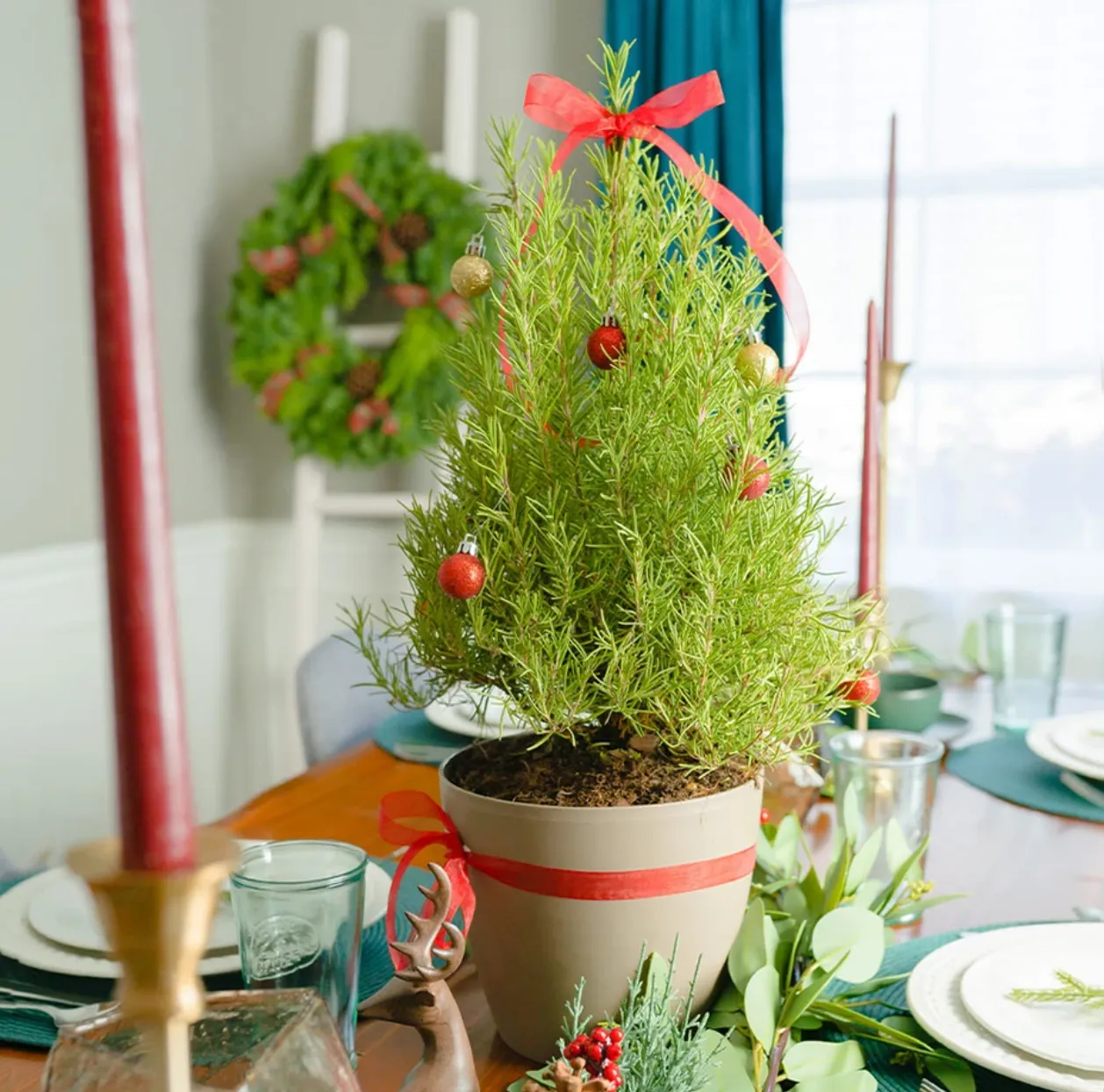
Ten minutes and $12–$20, and the whole thing costs less than a single grocery bouquet.
What makes this work isn’t the baubles — you can buy those anywhere. It’s that the centerpiece is alive. It smells like a kitchen, it lasts past New Year’s if you water it, and it gives you something to do with the thing once the table’s cleared. Compare that to a plastic arrangement you’ll box up in nine days.
18. Birch Branches and Pinecones in a Metallic Pot
The vertical is the entire point. Birch branches shooting 30 inches up give the table a silhouette most centerpieces never have, and because they’re bare you can see straight through them — height without a blocked sightline. The white bark against deep green and brown pinecones is also a color-temperature contrast: cool birch against warm bronze, which is exactly why the metallic pot doesn’t feel like an afterthought.
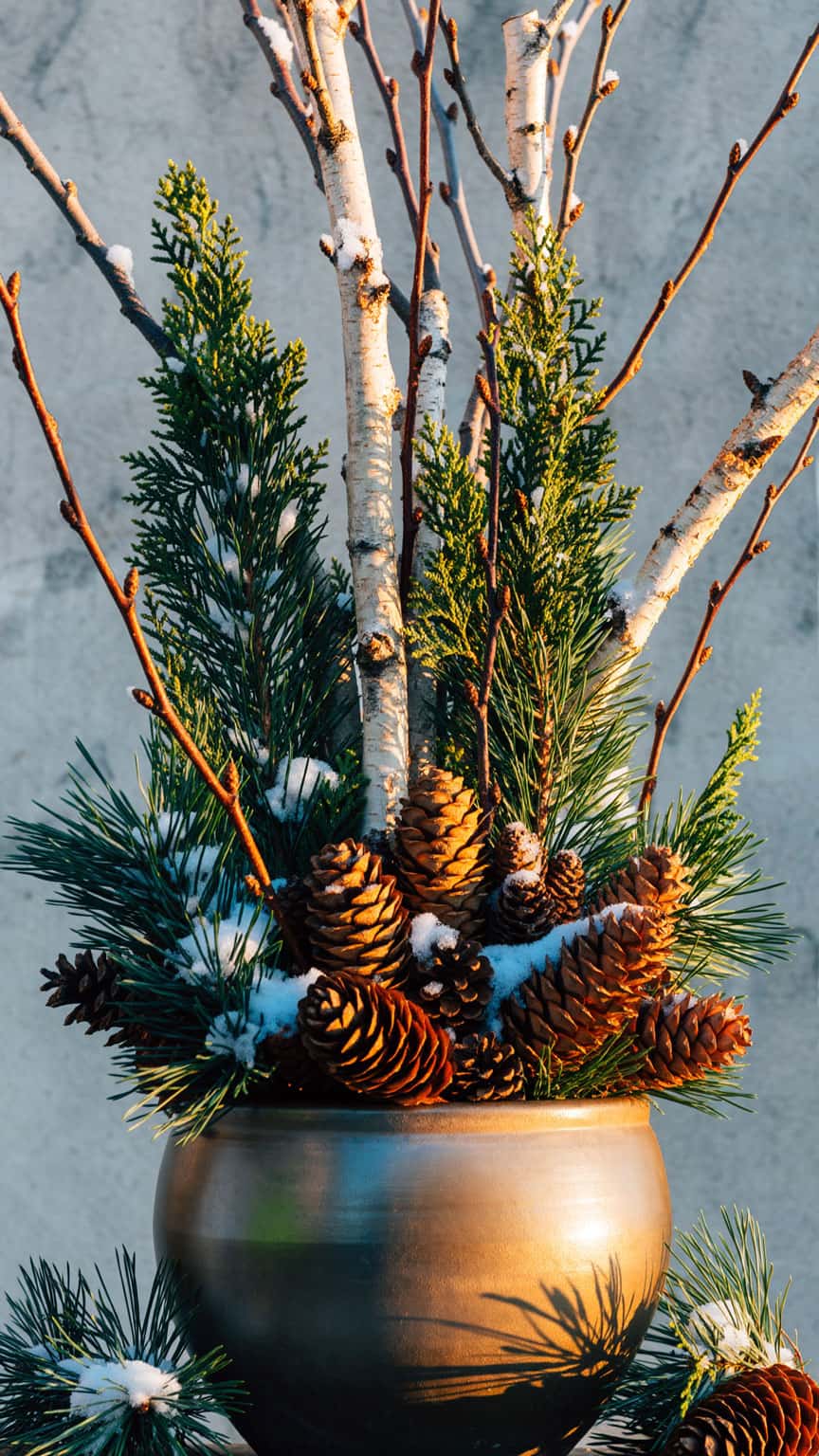
Faux snow sheds, birch bark flakes, and pinecones drop their little scales, so plan on a weekly vacuum around the table. Real birch also goes brittle within a few weeks, so handle it once and then leave it alone. Want zero upkeep? Buy pre-frosted stems and seal the pinecones with a matte spray before you build anything.
19. Red Dahlias, Poinsettias, and Two Lit Pillar Candles
This one flips the usual ratio: about 75% red, 20% green, 5% gold. It works because the red is broken up by texture — roses, poinsettias, dahlias, and tulips all read differently even though they’re the same color — and because the green is dark enough to act as shadow rather than competition. Swap any one flower type for a different shade, burgundy or coral or blush, and the formula holds.
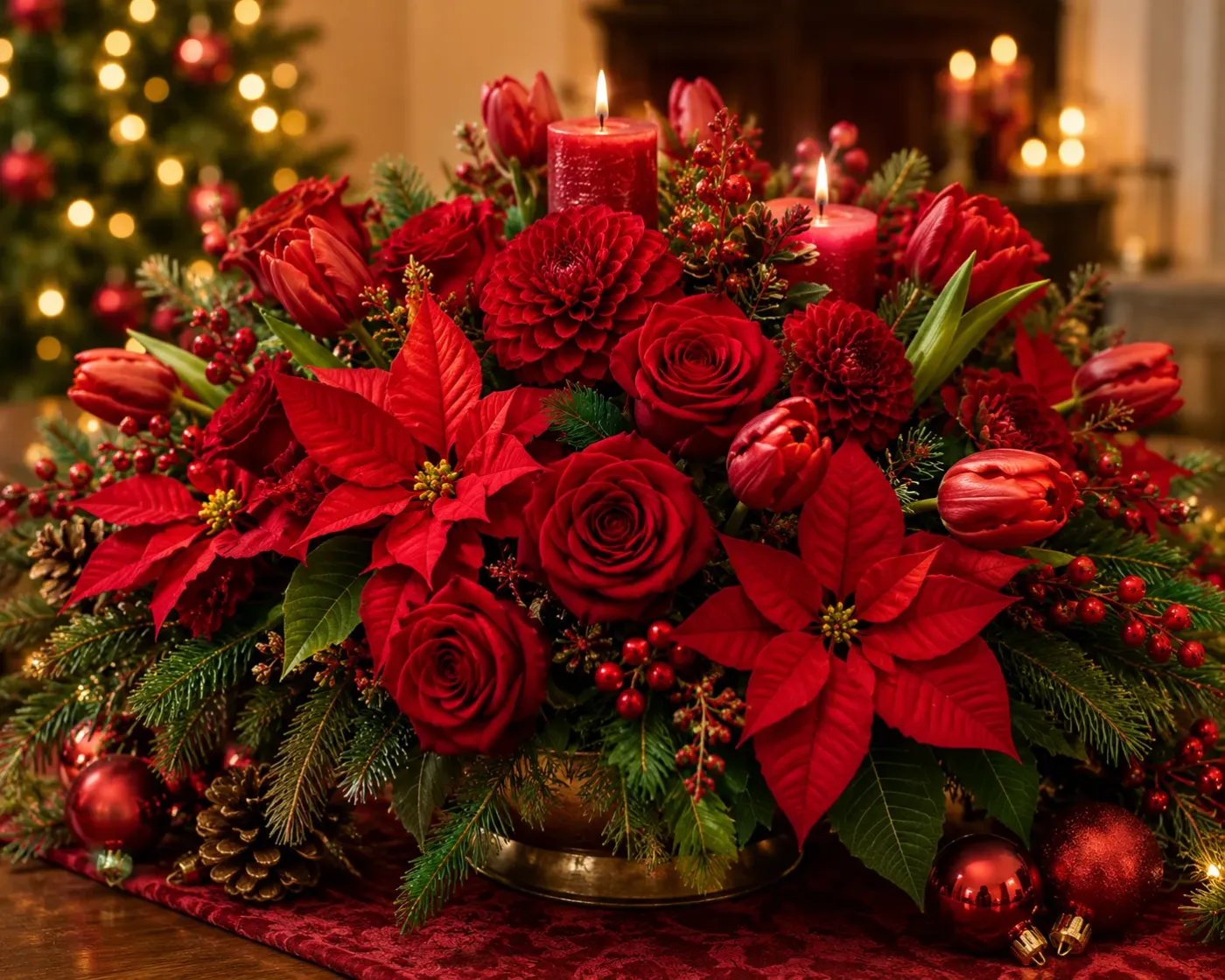
Two practical warnings. Poinsettia sap stains tablecloths and irritates skin, so wear gloves while arranging and keep cut ends off fabric. And lit pillar candles inside dried florals is the single most common holiday centerpiece mistake — if you want real flame, keep wicks at least 8 inches from anything that isn’t glass or metal. Otherwise use LED pillars. Nobody notices after the second glass of wine.
20. Blue Thistles and an Embroidered Reindeer Runner
This setup is happiest on a table 72 to 96 inches long. The runner runs the full length and the garland on top takes about two-thirds of that, so a shorter table means a shorter garland — one 6-foot strand instead of two. High-back chairs like these also need 30 inches of clearance behind them, so measure the room before you commit to a table this size.
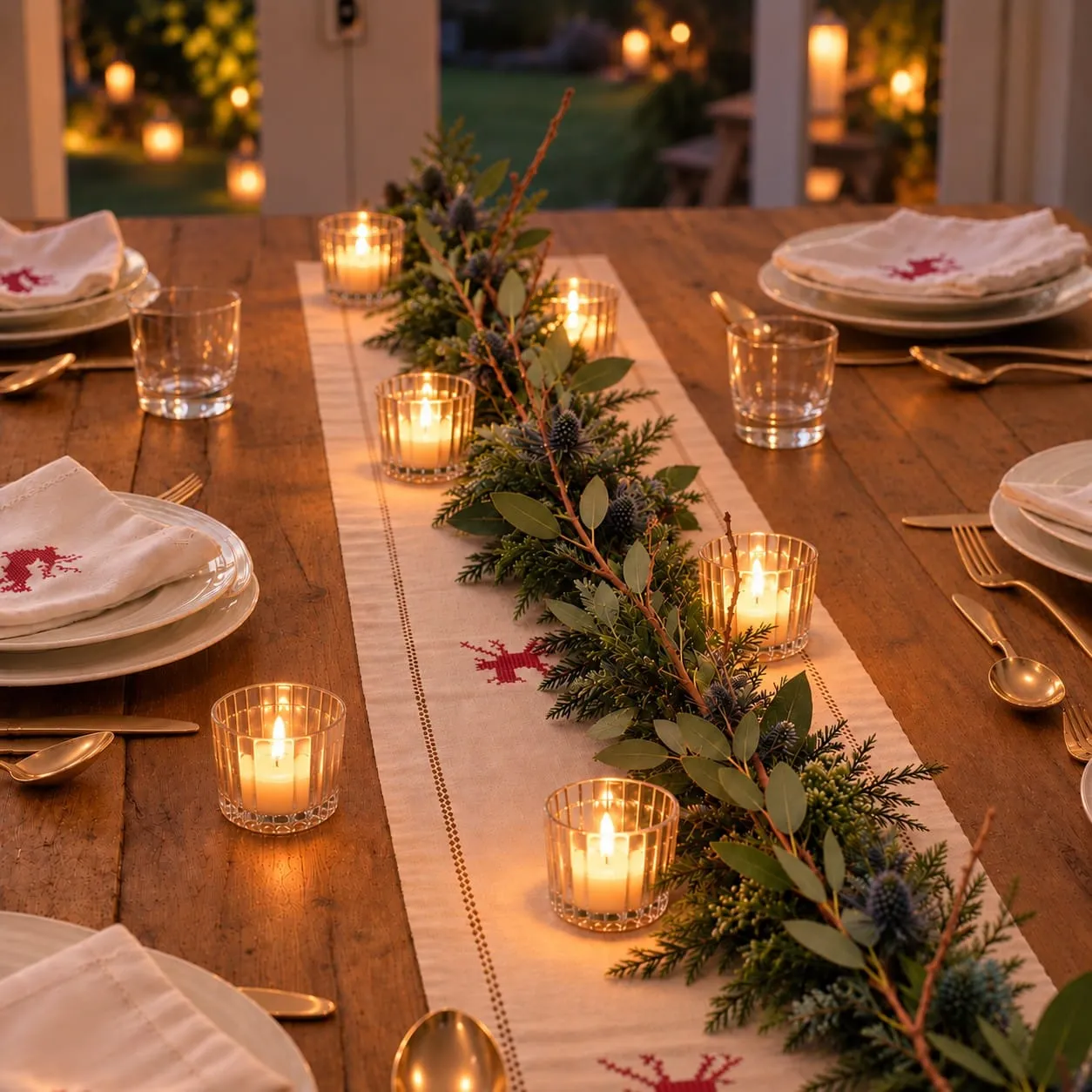
- Embroidered reindeer runner: $20–$45
- Mixed garland, two strands: $36–$70
- Blue thistle stems, six: $12–$24
- Ribbed glass votive holders, six: $18–$36
- LED or real votives: $8–$16
- Total: $94–$191
Budget alternative: a plain cream runner plus a single evergreen garland gets you 80% of the effect for around $45.
21. Warm LED Pillars on Stacked Wood Candle Holders
Vary your candle heights by at least 2 inches and cap the tallest at 14 inches above the table. Three pillars at 4, 6, and 8 inches read as a deliberate grouping; three at the same height read as a shelf display. Warm-white LEDs between 2700K and 3000K match real candlelight — anything above 4000K goes blue and instantly looks like a hotel lobby.
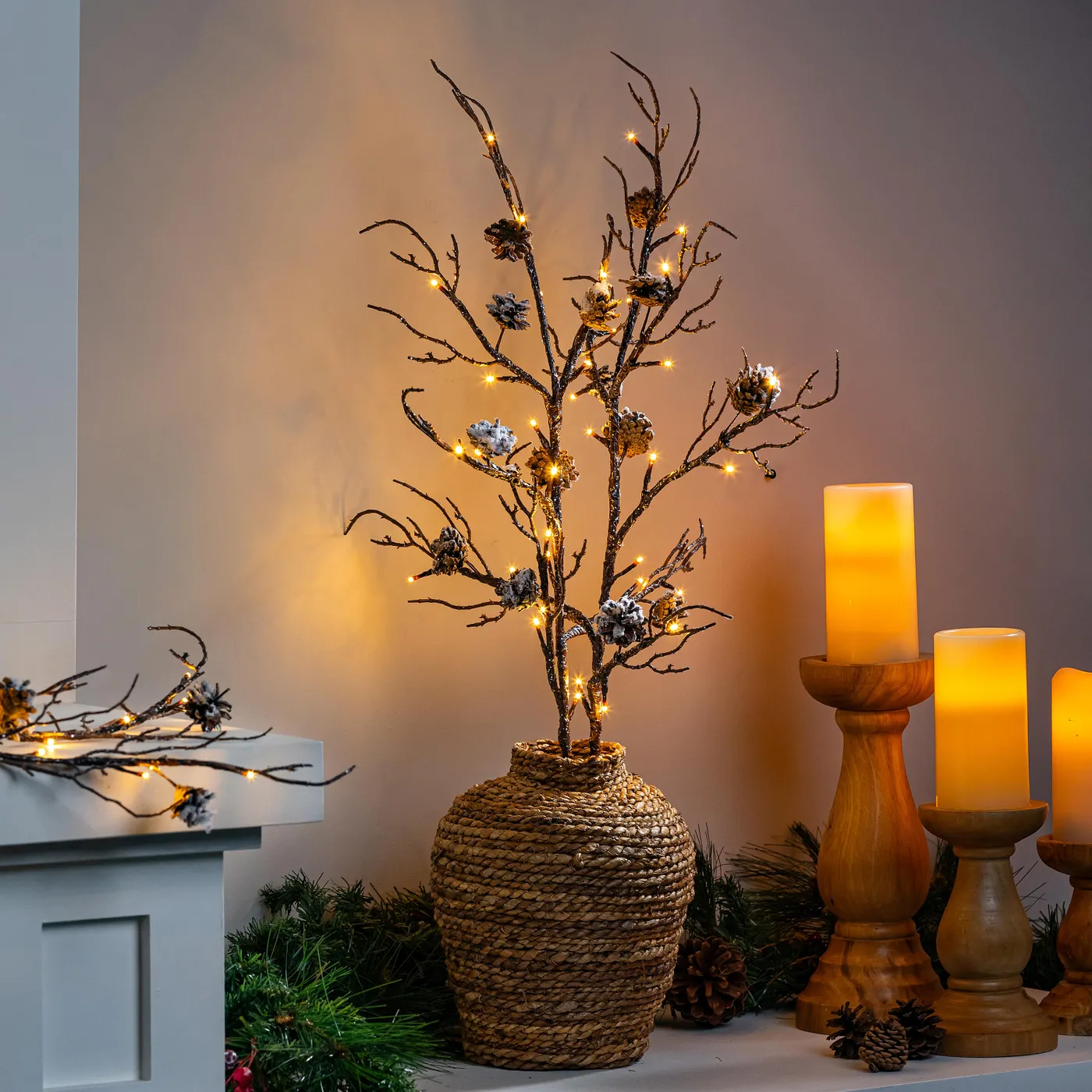
Wooden candle holders are a Saturday afternoon project: a 4×4 fence post, a miter saw, and three different lengths gets you the whole set for about $12. LED pillars run $8 to $15 each at any big-box store, and the woven basket vase is a thrift find. Idea #21 takes the same warm-light idea and scales it way up.
- Confirm your outlet or battery situation before buying corded lights.
- Check that the basket base is wide enough not to tip when nudged.
- Measure ceiling height to tabletop before committing to tall branches.
- Decide real flame or LED before buying holders — the cup sizes differ.
22. A Gold Star in a Shallow Bowl of Pinecones and Mercury Glass
Mercury glass is the unsung hero of holiday tablescaping. It reflects candlelight in a soft, mottled way that clear glass can’t, and it makes a $4 votive look like something from an antique shop. The shallow bowl keeps everything below eye level, so the arrangement fills the table without owning it. And the pale gold star gives the composition a single unmistakable focal point — one per centerpiece is plenty.
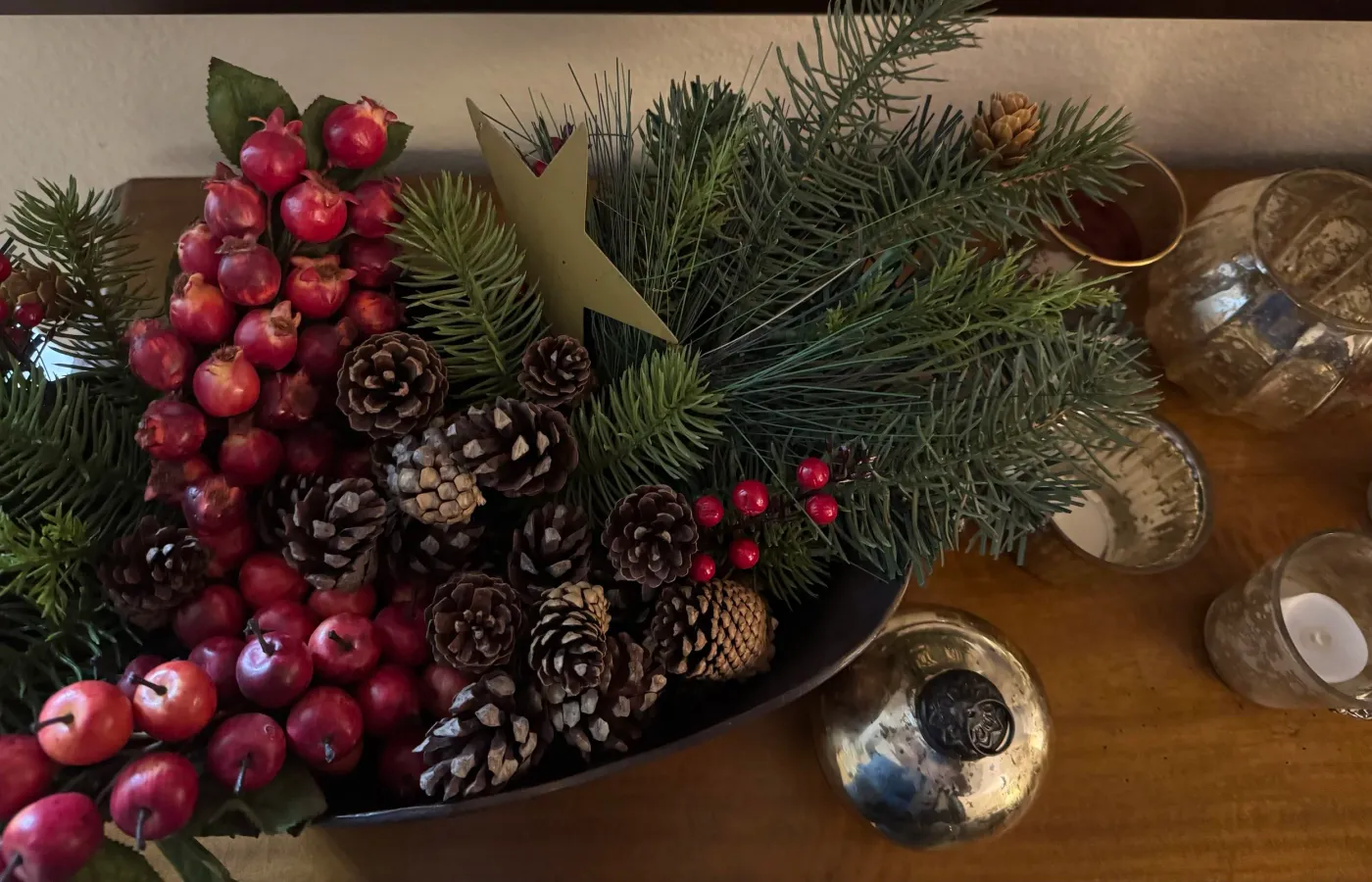
A shallow bowl in the 12- to 16-inch range suits tables 48 to 72 inches long. Below 48 inches, drop to a 10-inch bowl and two votives instead of four, or the table starts feeling crowded before the plates even land. This is also the most renter-friendly idea in the bunch — nothing here requires a hole in a wall.
23. A Pink Flamingo in a Santa Hat, Because Why Not
Take the flamingo away and you have a very pretty pink-and-green table that looks like a bridal shower. Keep it, and the whole thing becomes a story. That’s the rule with whimsy: one absurd object, committed to fully, surrounded by otherwise disciplined design. The cabbage tureen and the gold bamboo placemats are doing the adult work so the flamingo is allowed to be the joke.
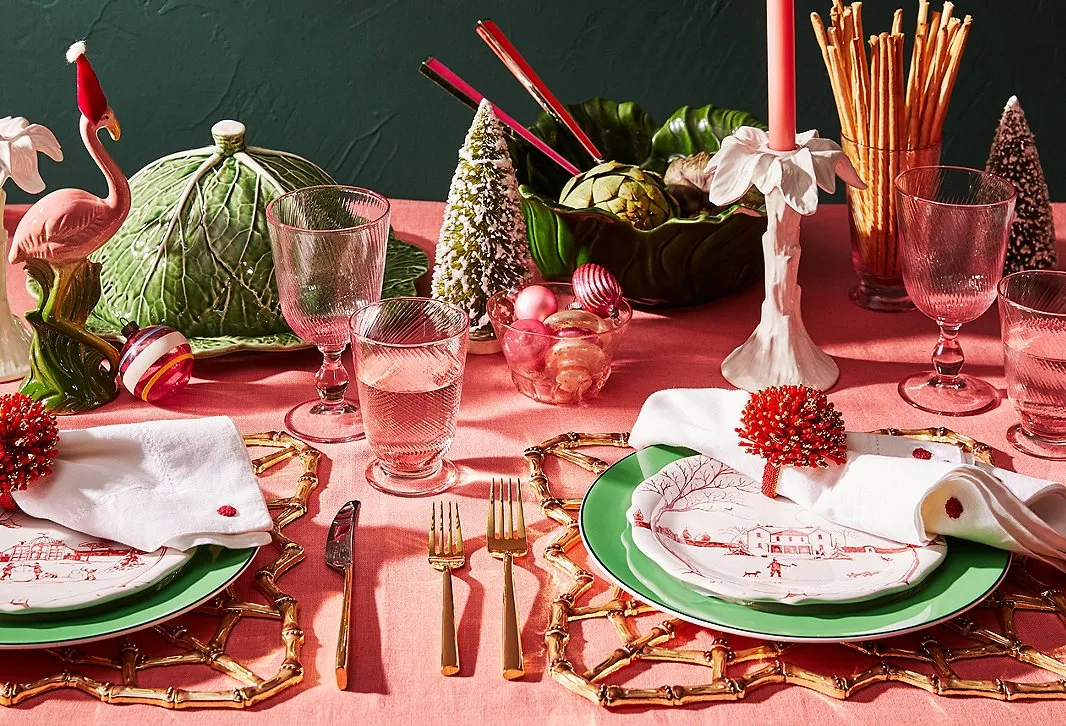
Whimsical tablescaping has been climbing on Pinterest for three seasons straight, and 2026 is the year it stopped being ironic. Part of it is the kids’ table becoming the fun table; part of it is a broader backlash against beige minimalism. Whether pink flamingos survive past this year is anyone’s guess, but the impulse to make a table funny is here to stay.
24. A Woven Cornucopia Filled With Fruit and Evergreen
A woven cornucopia tips forward the moment you load the mouth end, so weight the back with a bag of marbles or a couple of ceramic tiles hidden under the fabric. If you’re using real fruit, line the horn with plastic — a leaking pear will ruin a linen runner in about ten minutes flat. Faux fruit is the practical call here, and the modern versions look convincing enough at arm’s length.
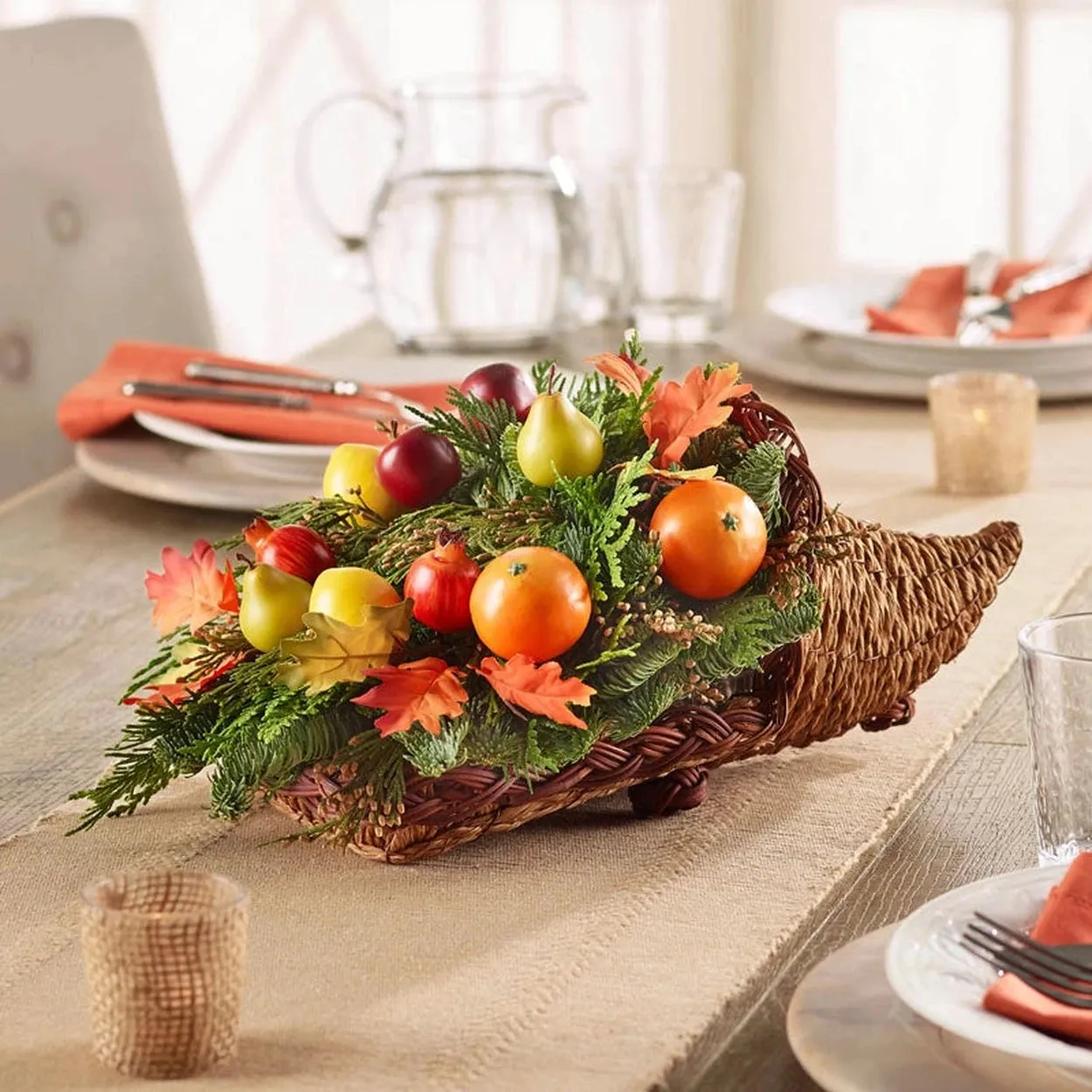
The mix runs about 50% evergreen, 30% fruit, 20% leaves and twigs. That middle 30% is what makes it feel abundant rather than tidy, because abundance needs volume, not just color. You can shift the whole thing from Thanksgiving to Christmas by swapping the orange leaves for red berries and the yellow pears for pomegranates. Same skeleton, different holiday.
25. Lemons and Clove-Studded Oranges in a Wooden Box
- Find a wooden box or crate roughly 16 inches long and line it with plastic.
- Pack in damp floral foam, then push evergreen sprigs in at a 45-degree angle.
- Stud whole oranges with 20 to 30 cloves each — this is the slow, satisfying part.
- Nestle the fruit into the greenery, cut sides facing out so the color shows.
- Tuck blue-grey berry clusters into the gaps to cool the whole palette down.
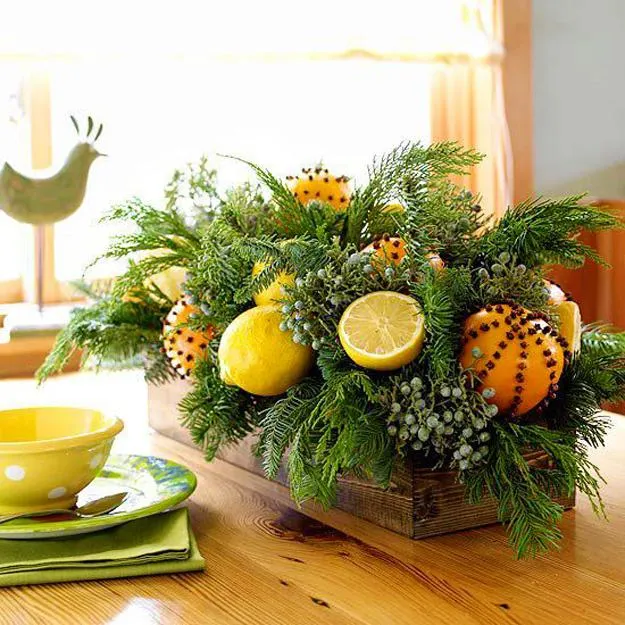
About an hour and $25–$40, and your dining room will smell incredible for two weeks.
Clove-studded oranges scent a room for roughly two weeks before they dry out, and once dried they last for years as decor instead of compost. Push the cloves in a tight band rather than scattering them, since a dense pattern hides the holes as the orange shrinks. One more thing: citrus sitting in wet floral foam molds fast, so rest the fruit on top of the greenery, never in it.
26. Red Carnations, a Red Candle, and a Gold-Edged Ribbon
- Grey textured container: $10–$22
- Red carnations, one dozen: $10–$18
- White chrysanthemums: $8–$14
- Evergreen stems: $10–$18
- Red pillar candle: $6–$12
- Gold-edged red ribbon: $5–$10
- Total: $49–$94
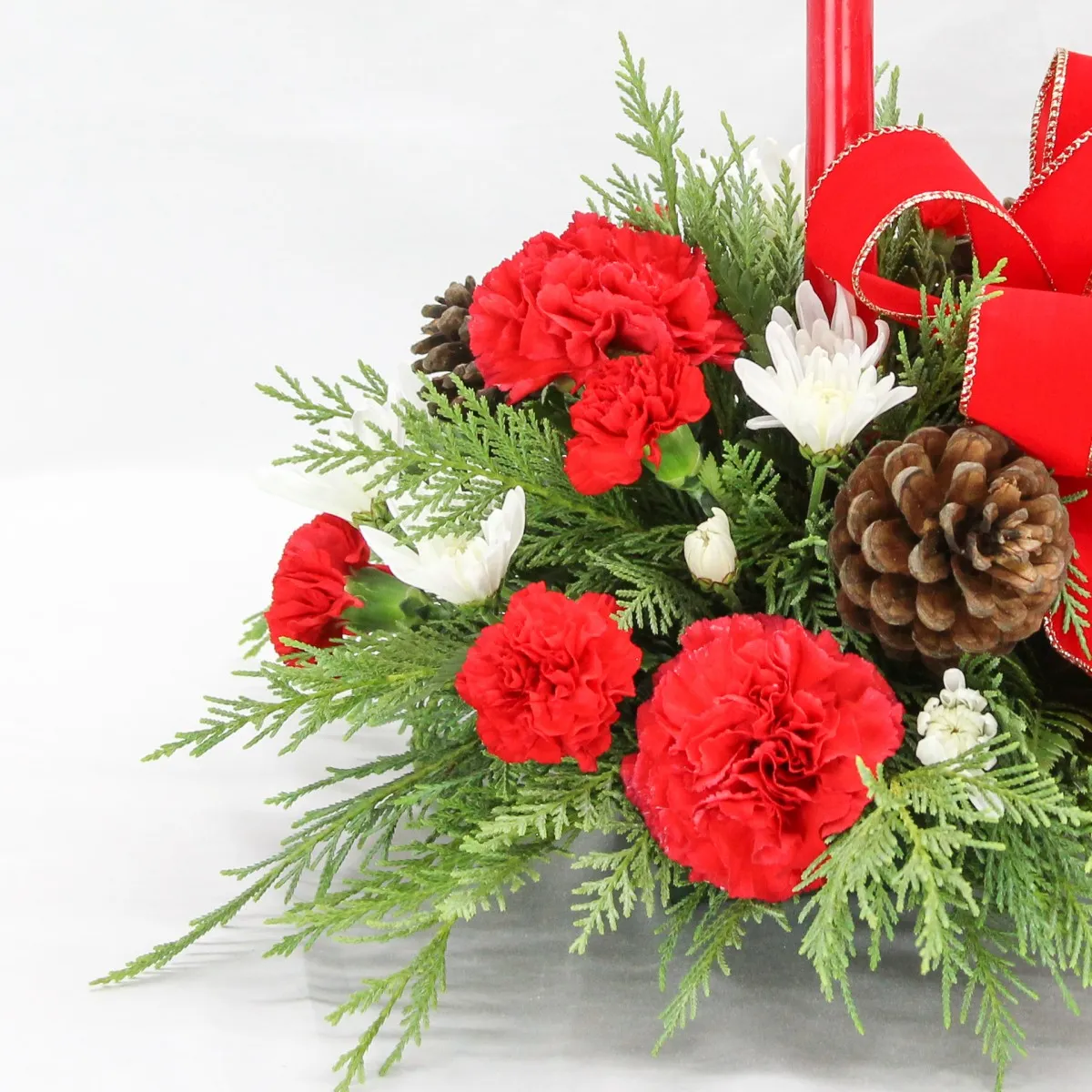
Budget alternative: carnations are the cheapest long-lasting flower at any grocery store. Skip the mums and double the carnations for about $35 total.
It’s the ribbon that ties this together, literally. A plain red ribbon would vanish against the carnations; the gold edge gives it a border, so it reads as a deliberate graphic line instead of a blob of red. Wrap it around the container and up over the candle in one continuous run. That single detail is the difference between flowers in a pot and an arrangement.
27. Poinsettias and White Roses Against a Snowy Window
Deep red poinsettias against creamy white roses is a contrast in both hue and finish — matte petals next to glossy holly leaves next to powdery bloom. That texture layering is what keeps a two-color arrangement from looking flat. The snowy window behind isn’t incidental either: backlighting a red-and-white arrangement makes the red glow, which is exactly why this one photographs so well.
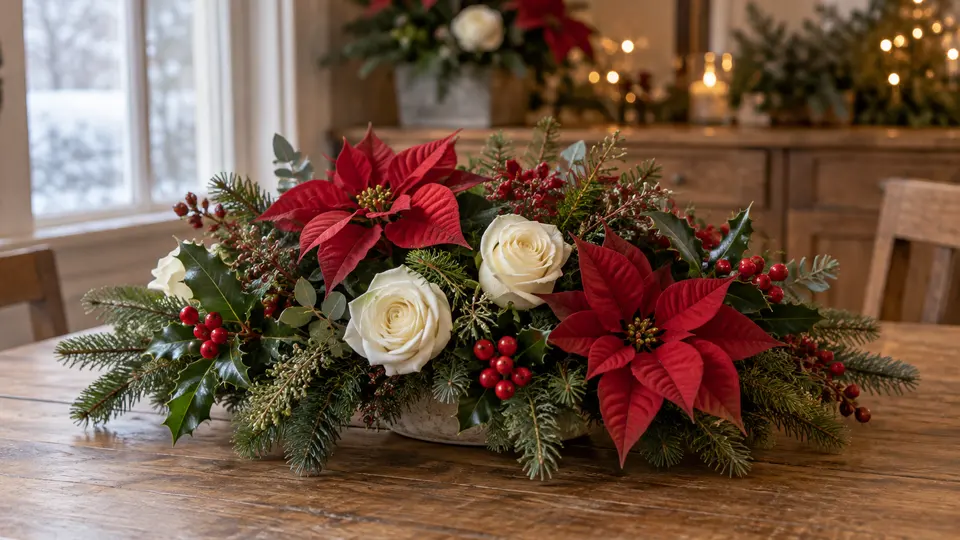
This is a big arrangement. Plan on 24 inches of width minimum, which means a table 60 inches or longer. It also wants to be the only thing on the center run — adding candles or a runner at this scale gets busy fast. Smaller dining rooms should borrow the palette rather than the proportions and scale down to a 14-inch version, like the one in Idea #27.
28. Red Roses and White Lilies in a Ribbed Glass Bowl
The ribbed glass bowl is the sleeper here. Vintage ones turn up at thrift stores and estate sales for $8 to $15, and the vertical ribs do most of the visual work for you. Fill it with grocery-store roses at $12 a dozen, one bunch of lilies at $10, and a $6 bundle of evergreen. Under $50 for a centerpiece that reads four times that.
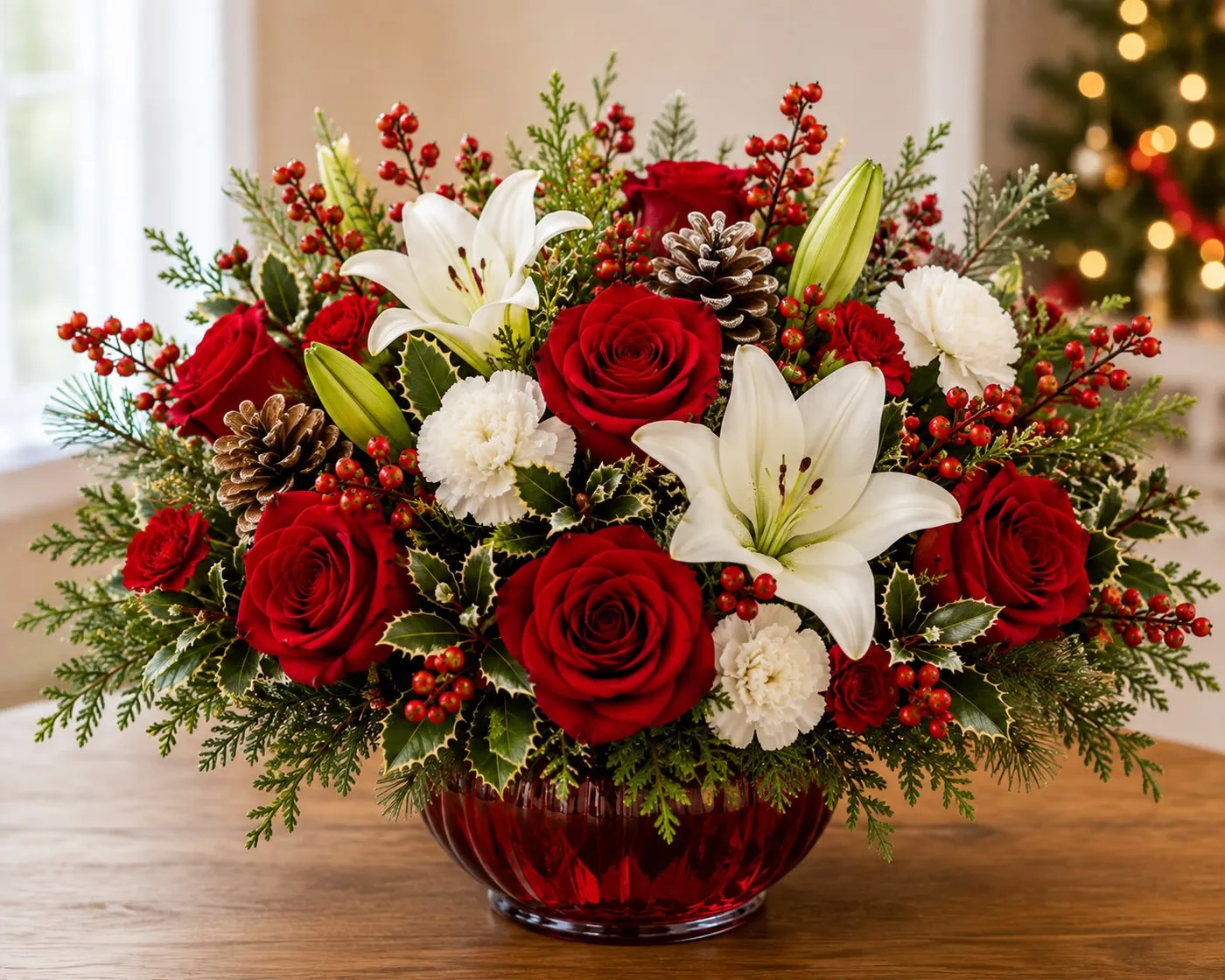
Clear glass is unforgiving: you’ll see every browned stem end and every cloudy day of old water, so change it every other day. A bowl this size takes close to a gallon, which is heavier than it sounds once full — set it down and leave it there. Put a rubber mat or felt pad underneath so it doesn’t scratch a wood table when someone inevitably slides it over.
29. A Garland of Real Lemons, Oranges, and Pears
Real fruit is gorgeous for about five days and then it starts to negotiate. Citrus holds up best; pears and apples go soft fastest, so check daily and pull anything that’s spotting. Expect a few fruit flies by the end of the week — a small dish of cider vinegar tucked behind the garland handles them. Swap in fresh fruit on Christmas Eve and you’ll get through the holiday without a single brown spot.
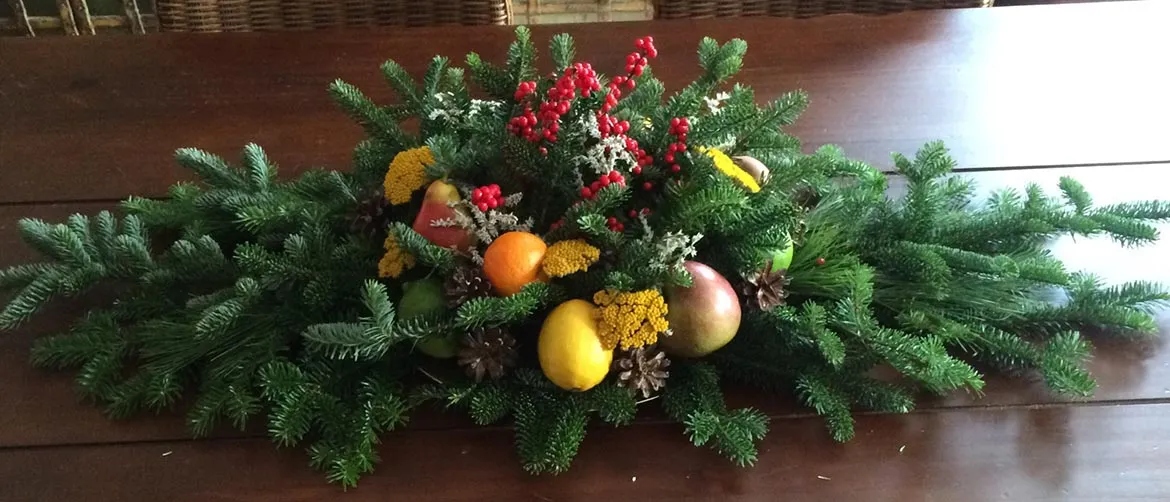
- Buy the fruit one or two days before the event, never a week ahead.
- Wash and dry everything thoroughly — moisture speeds rot.
- Test that the garland sits flat before adding any weight.
- Keep a bowl nearby for the fruit you’ll pull out mid-week.
Your Table Is the First Thing They See in December
Start with one thing — a tray, a hurricane, a hollowed log, a potted rosemary — and let the rest of the table follow from there. You don’t need to build all 29 of these; you need one that fits your table’s length, your budget, and the amount of effort you actually have left in December.
📌 Pin your favorites now so they’re waiting for you when the tree goes up.