Still scrolling past farmhouse Christmas trees that look nothing like the ones you actually pinned? Same here. The trees people fall hardest for aren’t the expensive ones — they’re the ones styled with an actual plan. We spent weeks combing through Target, Walmart, Etsy, Anthropologie, and Amazon listings from $12 to $650 to pull together the 29 farmhouse Christmas trees worth copying this year, from rustic woodland trees heavy with pinecones and buffalo check to neutral flocked trees dressed in burlap, silver, and dried citrus. We compare budget and luxury versions side by side on several of them. Farmhouse Christmas decorating in 2026 has shifted hard toward natural textures — dried oranges, eucalyptus, felt, wood slices — and away from glitter overload. And stay until the end — we break down the most common mistakes that can ruin these looks. 📌 Save this to Pinterest for later — you’ll want to revisit these ideas.
1. White-and-Gold Tree with a Light Wood Mantel
A white-and-gold tree only works when something in the room is doing the grounding. Here it’s the light wood mantel and the floating shelves beside the fireplace — the same warm timber tone repeats at three heights, so the tree never floats in a sea of white. The ornaments stay in one narrow lane: stars, glass globes, a few folded paper designs, all white or gold. Nothing competes. The bead garland adds a horizontal rhythm that keeps your eye moving up the tree instead of stopping dead on one sparkly bauble.
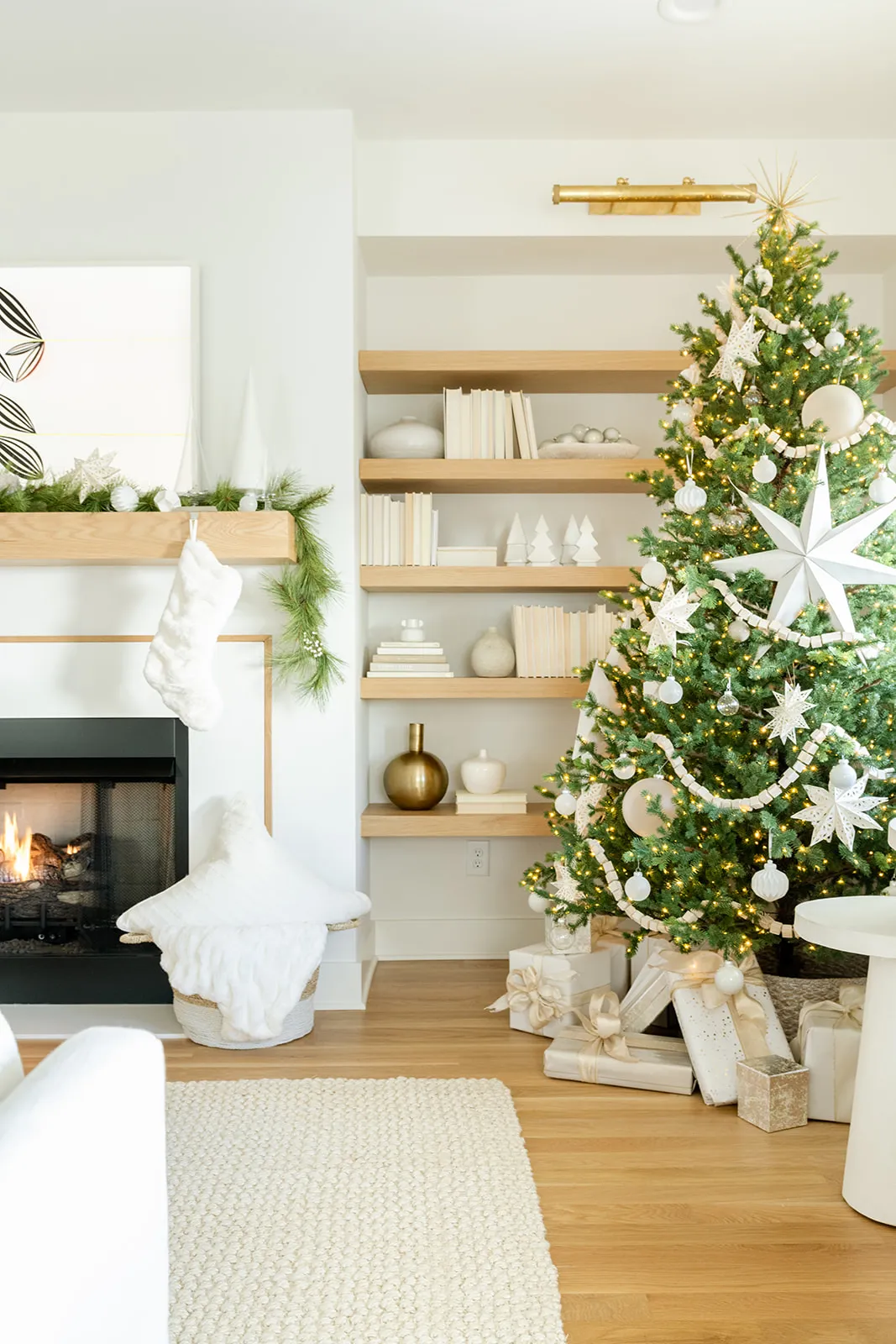
Wire your garland before anything else goes on. Run the bead strand in loose, sagging loops from the top third of the tree down — roughly three loops per vertical foot — and secure each loop to a branch tip with floral wire rather than wrapping it tight around the trunk. Tight wrapping is why so many trees look roped instead of draped. Then hang ornaments so the largest sit deep in the branches and the smallest sit at the tips. That depth is what makes a white-and-gold tree read as expensive rather than sparse.
2. Heavily Flocked Tree Dressed in Birch and Plaid
- Flocked 7.5-ft tree: $180–$650
- Warm white string lights, if not pre-lit: $25–$60
- Birch bark picks, plaid ribbon, frosted berry sprays: $40–$90
- White metal bucket bells and ornaments: $30–$85
- Thick cream rug under the tree: $120–$400
- Neutral wrapping paper, ribbon, gift boxes: $35–$70
Total: roughly $430 to $1,355. Budget alternative: skip the flocked tree and buy a plain green one, then dust it yourself with spray snow for about $25. You get the frost without paying for it twice.
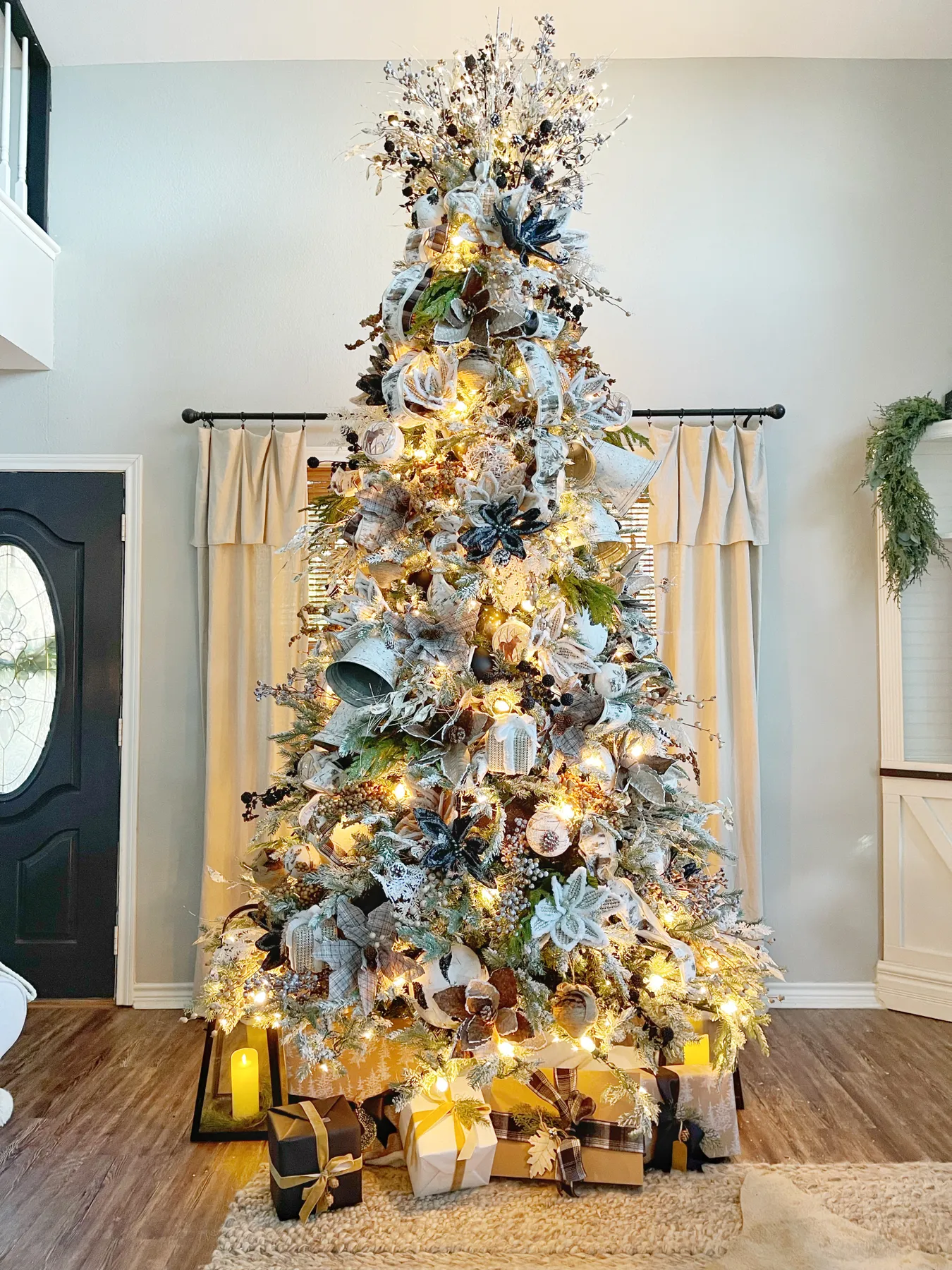
Flocking is the messiest thing you can invite into a living room. It sheds every time you brush past, it drops onto whatever rug sits underneath, and it darkens over a few seasons if you store the tree somewhere humid. A thick cream rug under a flocked tree looks gorgeous in photos and looks like a snowdrift you cannot vacuum by January. If you want the look without the cleanup, choose a lightly frosted tree and keep a lint roller in the closet.
3. Red and Silver Ornaments in a Dark Wood Crate Collar
It’s the dark red wooden crate collar. Swap it for a fabric skirt and this becomes a perfectly fine, perfectly forgettable red-and-silver setup. The crate does two jobs at once: it hides the stand without looking like something you’d find under a bed, and its deep barn-red tone repeats the ornaments at floor level, so the color story doesn’t just start at the bottom branches. On a wood floor, it anchors the whole composition.
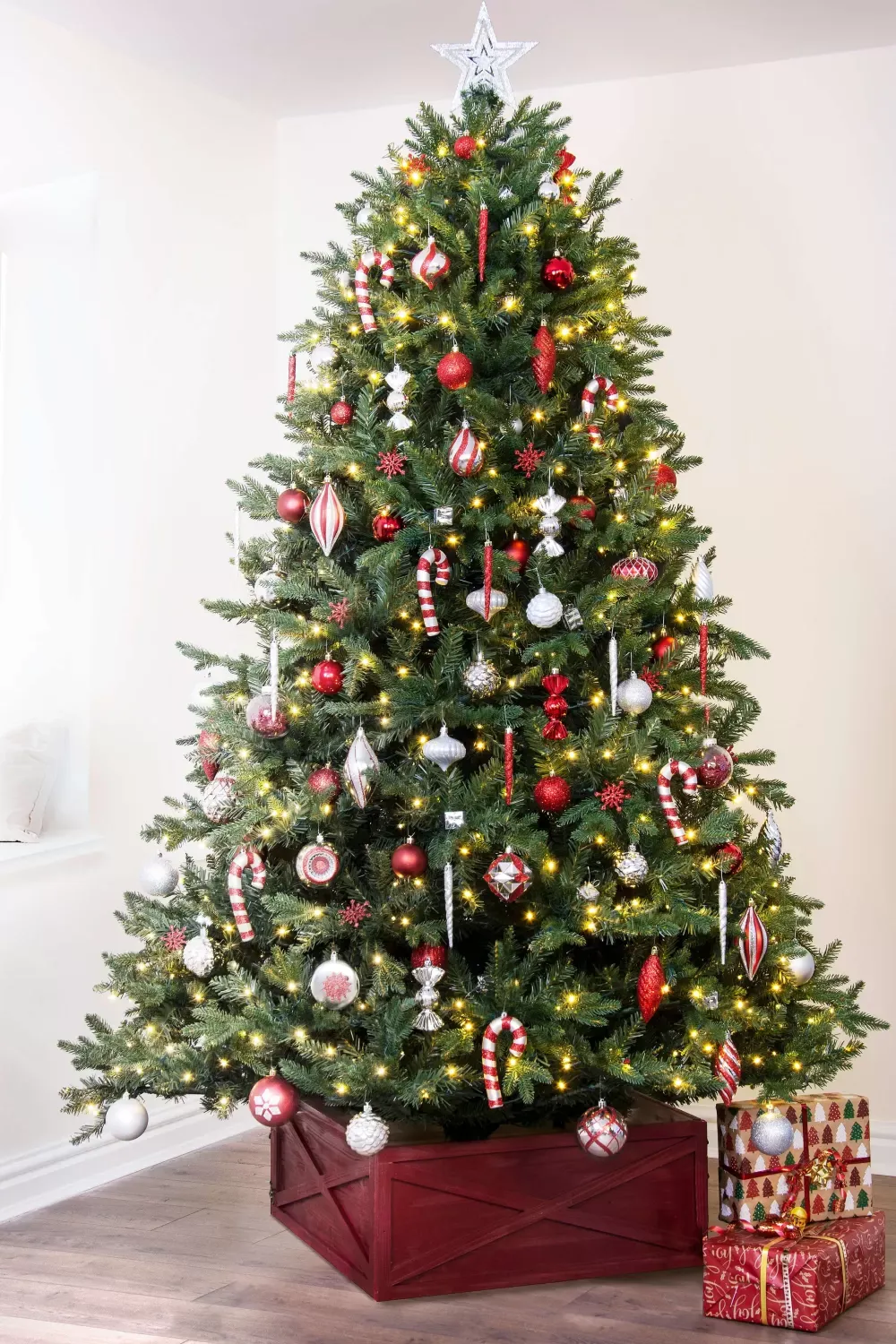
The formula here is 55% forest green + 30% true red + 10% silver + 5% warm white light and dark wood. To shift the mood without buying anything new, trade the silver for brushed gold and the tree reads warmer and older; trade it for matte white and the same red-and-green suddenly feels crisp and modern. Keep red at roughly a third of the ornaments — past that, the glittery star topper stops reading as the focal point.
4. Flocked Tree with Velvet Bows Beside a Stone Fireplace
The flocked-and-velvet look is one of the easiest to fake. A plain green tree from Walmart, a $22 can of spray snow, and four yards of olive velvet ribbon cut into 12-inch strips will get you most of this scene for under $200. Brown kraft paper and jute twine handle the gifts — about $15 total. Check Facebook Marketplace in early November; that’s when people offload last year’s trees, and a good faux tree runs $40 to $80 instead of $400.
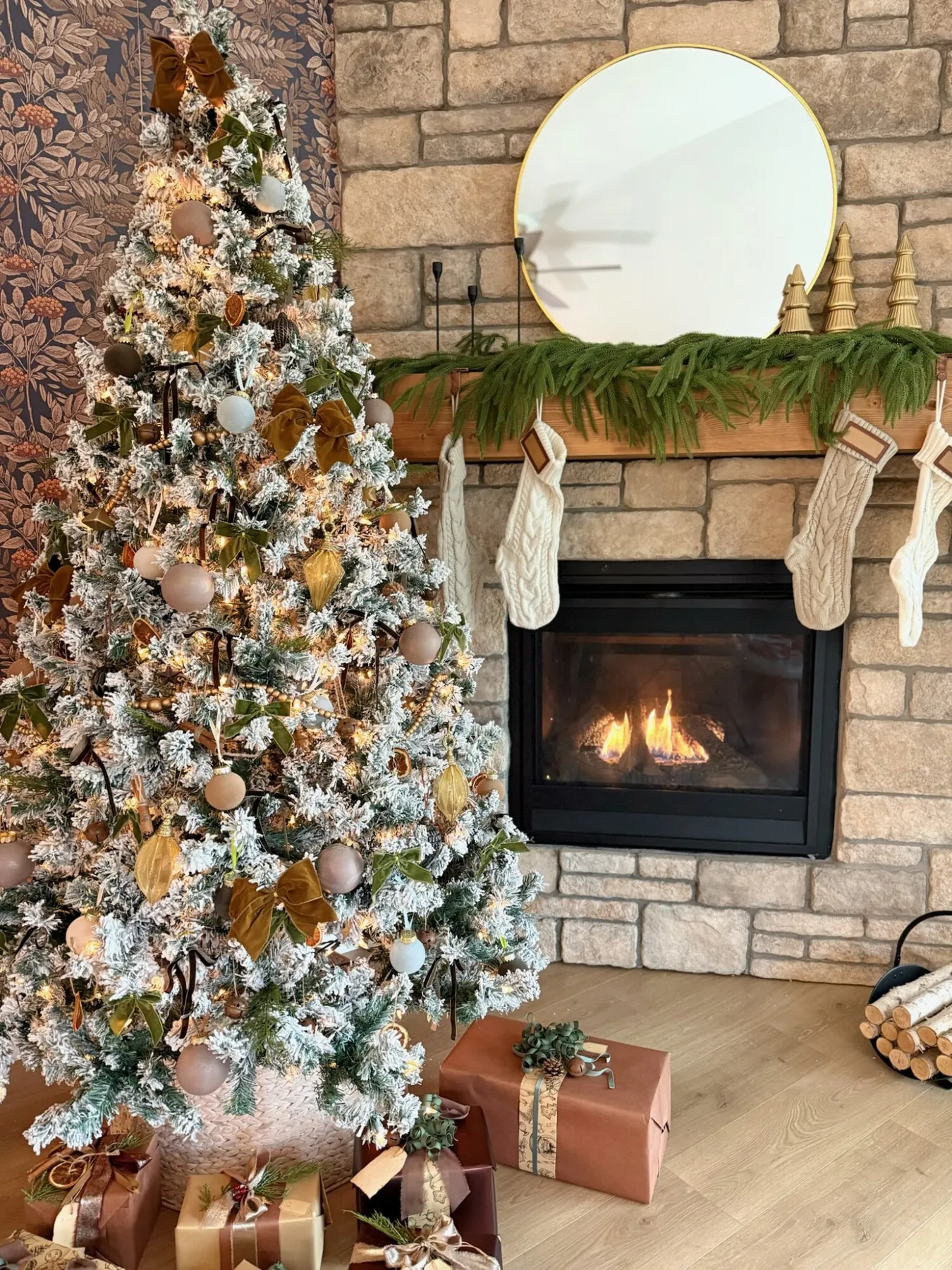
- Cut velvet ribbon into 12-inch strips and fold each into a loop, pinching the middle.
- Wrap floral wire around the pinch point and twist until firm — no sewing, no glue.
- Trim the tails on a diagonal so they don’t fray straight across.
- Hook each bow onto a branch tip, spacing them 8 to 10 inches apart.
- Fluff the loops by hand so they face slightly outward, not flat against the tree.
Time: about 45 minutes for ten bows. Cost: roughly $12 in ribbon plus $4 in wire.
5. Whitewashed Planks, Flocked Tree, and a Gold Geometric Mirror
White on white only works when the textures disagree. This corner stacks a matte whitewashed plank wall, a flocked tree, a shaggy rug, and crocheted pouf stools — four different surfaces in nearly the same color, which is exactly why it reads calm instead of flat. If your room is short on texture, add one nubby element (a knit throw, a jute rug, a rough ceramic pot) for every two smooth ones. And hang the mirror so its bottom edge clears the mantel by 6 to 8 inches; the gold frame stays the only warm note in the room.
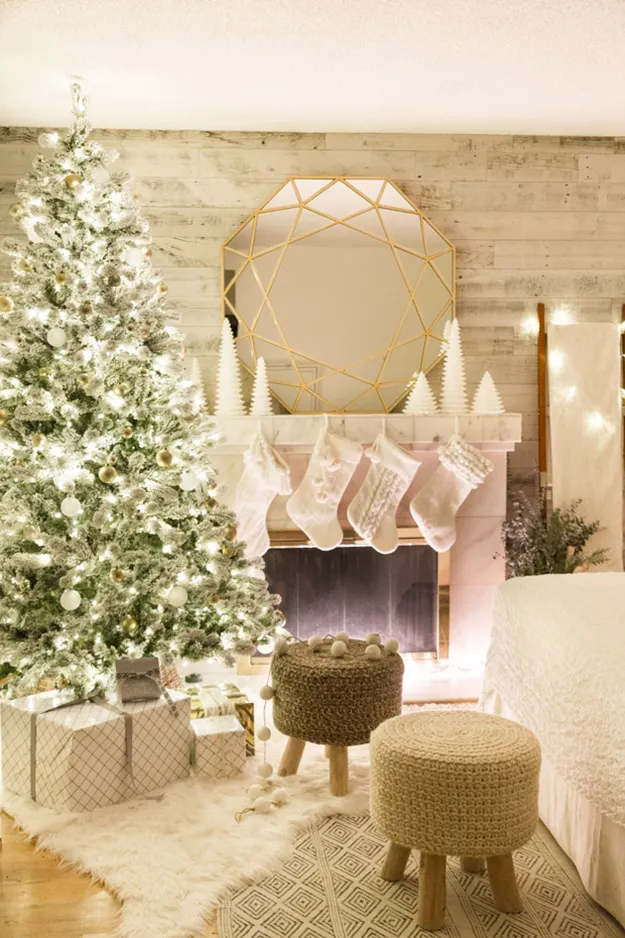
This setup is built for rooms around 12 by 14 feet with 8-foot ceilings, where a 7 or 7.5-foot tree still leaves breathing room above the topper. In anything narrower than 10 feet, the flocked tree plus a shaggy rug plus pouf stools will start to feel crowded — swap the poufs for a single slim bench. If your ceilings are 9 feet or higher, go up a tree size and look at Idea #24 for a taller, brighter approach.
6. Velvet Bows and Merry Christmas Script Banners
Nostalgic Christmas is having a real moment. The script banners, the deep red velvet, the arched gold mirror — this is the grandmillennial read on farmhouse, and it’s all over Pinterest heading into 2026. What’s driving it: people are tired of all-neutral trees that photograph beautifully and feel a little cold in person. Red-and-green with gold trim has staying power because it isn’t really a trend — it’s what your grandmother did, with better ribbon.
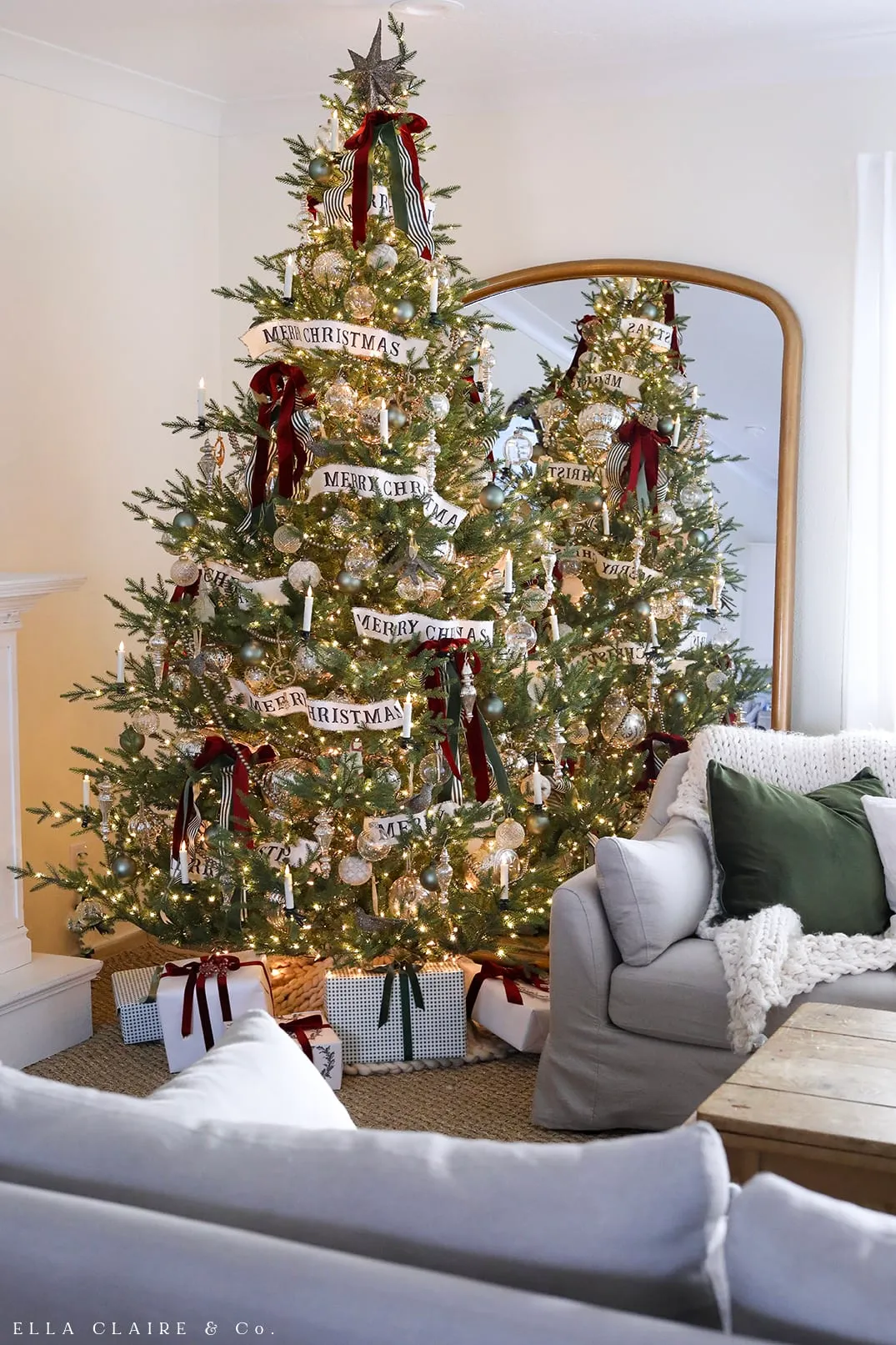
- 7.5-ft pre-lit tree: $200–$550
- Red velvet ribbon, 4 rolls: $24–$60
- Green and white striped ribbon: $12–$30
- Script banner set: $15–$40
- Glass and sage ornaments, 60–80 pieces: $60–$180
- White knit tree skirt: $25–$70
- Arched gold mirror: $90–$320
Total: about $425 to $1,250. You can cut the mirror entirely and still get the look — the ribbons are what people notice.
7. A Fully Lit Green Tree in a Blue and White Planter
A densely lit tree inside a ceramic planter is a stunning combination and an electrical one. If the tree is real, the planter has to hold a water bucket inside it — you can’t water ceramic directly, and a pot with no drainage will rot the trunk. If it’s artificial, the planter needs 20 to 30 pounds of sand or pea gravel in the bottom, or one bump takes the whole thing down. Both versions also run warm. Unplug the lights before bed.
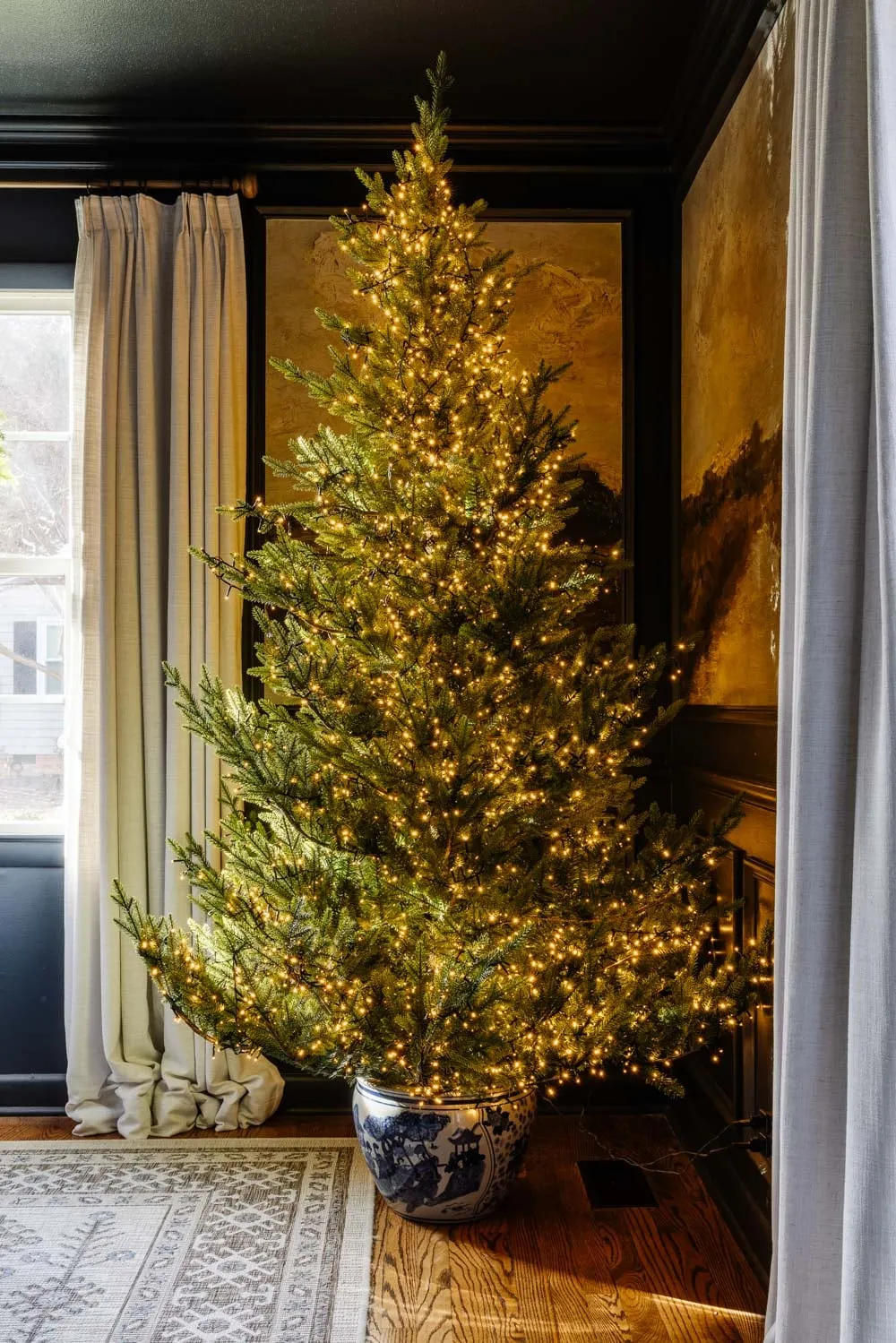
The blue and white ceramic planter is the entire personality of this tree. A skirt would have hidden the base and disappeared; the planter turns the bottom third of the composition into a design moment, and its pattern gives the eye something to land on besides green. It also visually cools the room, which matters in a space with dark wood floors and warm string lights everywhere. Lose the planter and this is just another lit tree in a corner.
8. Buffalo Check Ribbon and Wooden Woodland Creatures
60% evergreen base + 20% buffalo check + 15% natural wood and pinecone + 5% silver. The plaid is doing the heavy lifting, so keep it to ribbon and one or two ornaments — more than that and the tree starts reading as a cabin in a catalog. Swap the red-and-black check for green-and-cream and the same formula turns soft and understated. Swap the wooden deer for little ceramic houses and it goes traditional. The percentages don’t change.
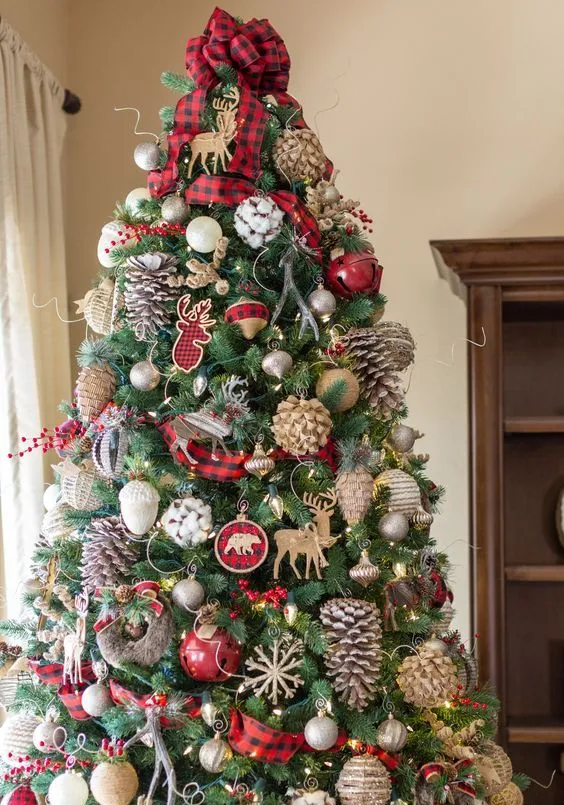
Real pinecones shed. They drop scales every time they’re touched and more every time they’re stored, so expect a small pile under the tree by New Year’s. Cotton ball ornaments yellow with dust and don’t wash well — blow them off with a hair dryer on cool instead. Store buffalo check ribbon rolled around a cardboard tube, never folded; the crease lines never come out. Budget about $15 a year to replace the pieces that give up.
9. Folk Art Ornaments on a Mini Tree in a Wooden Crate
- Set the tree in the crate, then pack the gap with newspaper or a folded towel so it can’t wobble.
- Thread two light strands through the branches from the inside out — never wrap the trunk.
- Hang the largest ornaments in the bottom third, where a small tree carries the most visual weight.
- Place taller wrapped boxes at the back and small ones in front, so the base steps down.
- Step back three feet and fill any bare patches before you call it done.
About 40 minutes start to finish, and the crate does most of the styling work for you.
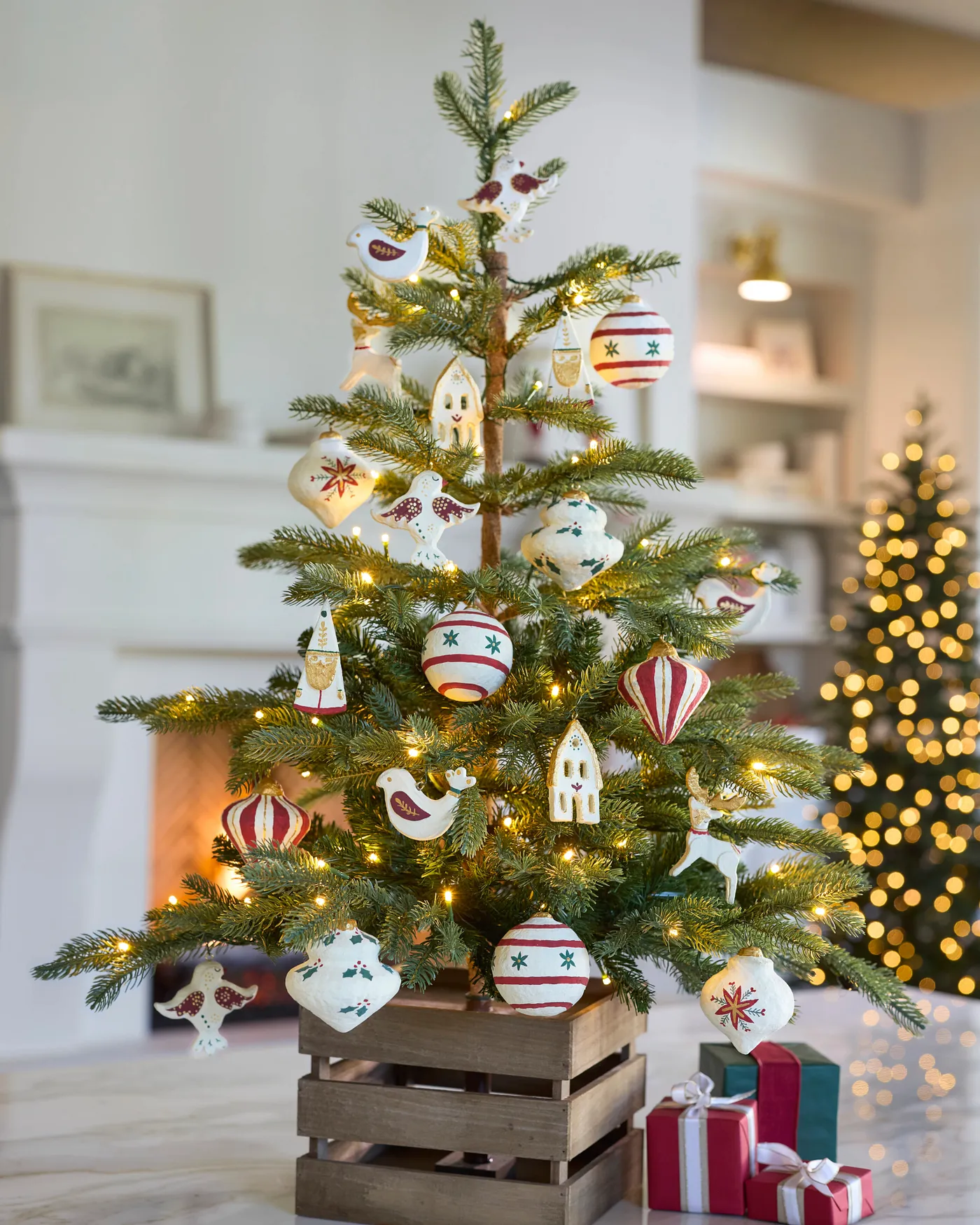
A wooden crate is one of the cheapest upgrades in Christmas decorating. Thrift stores and Facebook Marketplace sell old fruit crates for $5 to $15, and hardware stores carry unfinished ones for under $20. Add a coat of matte polyurethane and you’re finished. For ornaments, dollar stores now stock decent paper-mache and wooden shapes — mix in three or four nicer pieces from Target so it doesn’t look entirely budget. It’s the same trick used in Idea #14, just in a different material.
10. Frosted Branches with a Red Wooden Button Ornament
This tree works because the ornament sizes are all over the place. A big flat wooden button, a buffalo plaid fabric star, tiny glitter berries, thin glass icicles, sparkly snowflakes — five different scales in one view. A tree decorated with 60 identical baubles has no hierarchy; the eye doesn’t know where to land and eventually stops looking. Mixing a 5-inch statement piece with 1-inch filler creates rhythm, and the frosted branches give every ornament a lighter background to sit against.

Rule of thumb: 8 to 10 ornaments per foot of tree height, split roughly 60% filler, 30% medium, and 10% statement pieces. On a 7-foot tree that’s about 60 ornaments — and only six of them should be the big, weird, attention-grabbing ones. Hang the largest deep in the branches near the trunk so they look nested rather than stuck on. Then use picks and berry sprigs to bridge gaps instead of adding more ornaments.
11. Flocked Tree with Red Berries and a Cream Skirt
This is a tall-tree-lower-ceiling scenario: a 7.5-foot flocked tree looks best with ceilings from 8 to 9 feet, leaving 6 to 12 inches of air above the topper. The room here reads around 12 by 16 feet, which is why the tree can stand beside a fireplace without either feeling cramped. Under 10 feet wide, drop to a 6.5-foot tree and a narrower skirt — and if your space is genuinely tight, Idea #22 shows what shelf-level decorating can do when a full tree won’t fit.
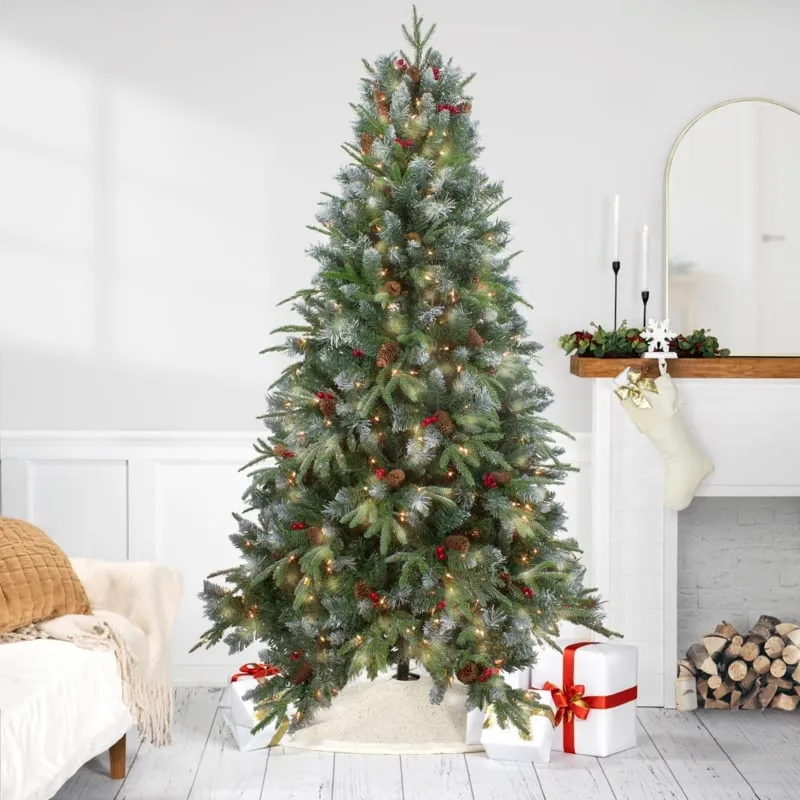
- Measure ceiling height to the inch, then subtract the topper — 6 inches of clearance is the bare minimum before the tip bends.
- Mark the tree’s footprint on the floor with painter’s tape and live with it for a week before buying.
- Check which wall outlet you’ll use and whether a 9-foot cord actually reaches.
- Confirm your storage space can take a 7.5-foot tree box in the off-season.
- Decide live or artificial now — flocked trees are almost always artificial, and live trees don’t hold faux snow.
12. Dried Orange Slices Against White Shiplap
- Natural-look artificial tree, 7 ft: $150–$500
- Dried orange slice ornaments, 20 pieces: $18–$45
- Reddish dried foliage picks, 6 stems: $24–$60
- Galvanized metal tree collar: $28–$70
- Greenery garland for the mantel: $30–$85
- Brass candlesticks, pair: $22–$60
- Round gold-framed mirror: $80–$250
Total: roughly $350 to $1,070. Cut the mirror and candlesticks and you’re near $230 — the tree still carries the room.
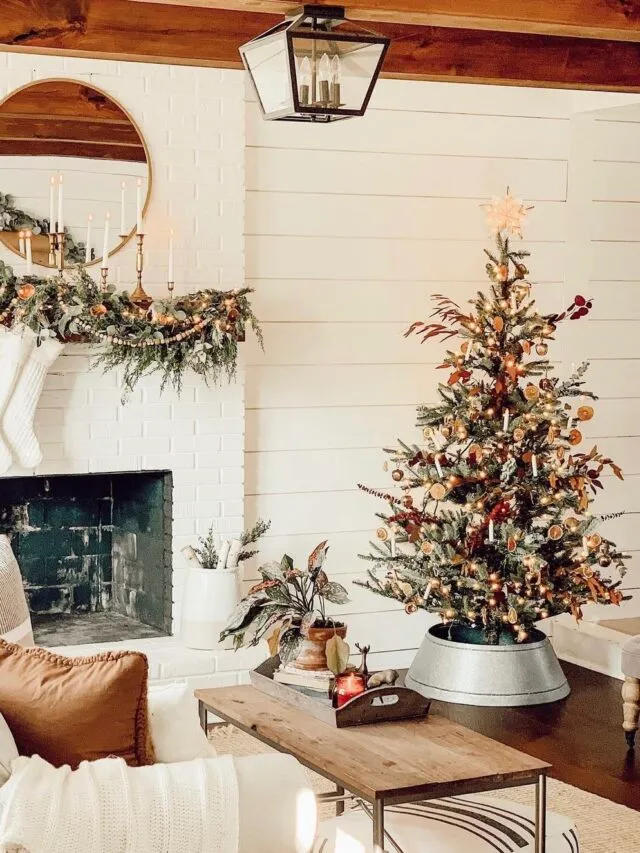
Natural, almost edible-looking tree decor has been building for a few years and shows no sign of slowing in 2026. Dried citrus, olive branches, eucalyptus, cinnamon sticks. The appeal is partly aesthetic and partly that people are tired of plastic sparkle. Dried orange slices cost about $1 each when you make them yourself, they smell faintly of citrus for a season, and they compost when you’re done. It’s the rare trend that’s both cheaper and better looking.
13. Eucalyptus and Dried Grasses Instead of Tinsel
The dried elements. Not the ornaments, not the lights — the eucalyptus, olive branches, and dried grasses tucked into the branches. Without them this is a cream-and-sage tree with little house ornaments, which is pleasant and completely ordinary. With them you get depth, a matte texture that catches light differently than glass or metal, and a faintly overgrown quality that makes an artificial tree look like it grew that way.
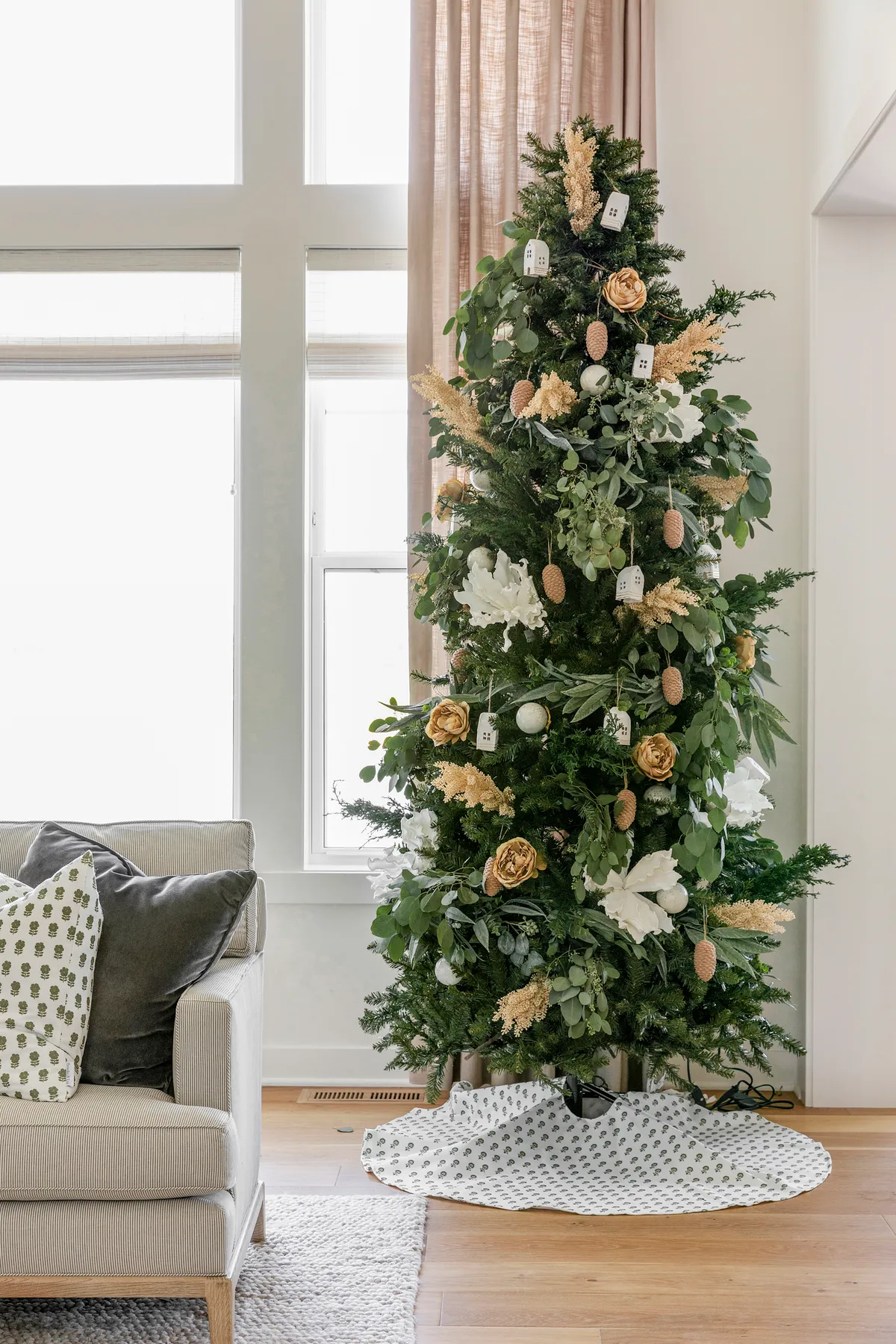
Two things are happening. First, matte against shine: dried stems absorb light while ornaments reflect it, so the tree has a top layer and a bottom layer instead of one flat sparkle. Second, color temperature discipline — everything lives in the green-to-cream-to-soft-gold range, with no true red or cool silver interrupting it. That narrow palette is why the striped sofa in the background doesn’t fight the tree.
14. A Pre-Lit Tree Tucked in a Woven Basket
A woven basket around a tree base is charming right up until it meets water. If your tree is live, the basket wicks moisture, stains the floor, and eventually smells like a wet basement. Use a plastic liner and empty the reservoir weekly, or commit to artificial. Baskets also hide a wobbly stand, which means you won’t notice the tree leaning until it’s leaning a lot — check the base every few days, especially in a house with pets or toddlers.
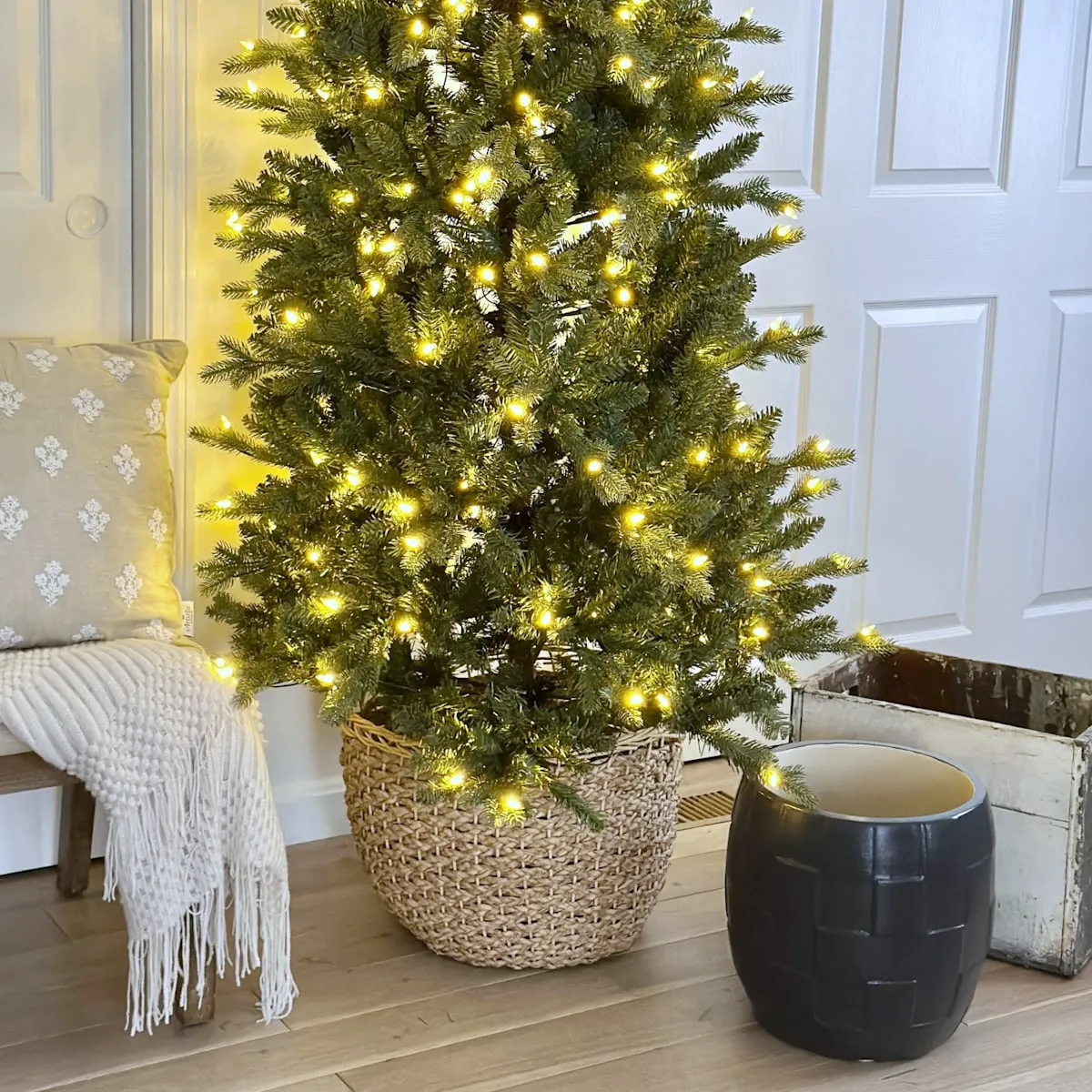
Woven baskets are the cheapest tree-collar alternative out there. Target and Walmart both run large seagrass baskets in the $25 to $45 range, and HomeGoods almost always has something in the $30s. A chunky knit throw and an embroidered pillow are classic thrift finds at $6 to $12 each. If you already own a big basket, you’re $0 away from this look. Compare it to the galvanized collar in Idea #25 for a cooler, more industrial take.
15. Felt Mushrooms and Tiny Wooden Nutcrackers
Felt and wood ornaments are the most kid-and-pet-friendly decor on this list — they bounce, they don’t shatter, and a felt mushroom survives a golden retriever’s tail better than a glass globe. The catch is weight distribution. Anything heavier than 3 ounces belongs in the top third of the tree, where branches are densest. And if you have a toddler, anchor the tree to a wall stud with a 2-inch nylon strap rated for 50 pounds. It costs $8 and takes four minutes.
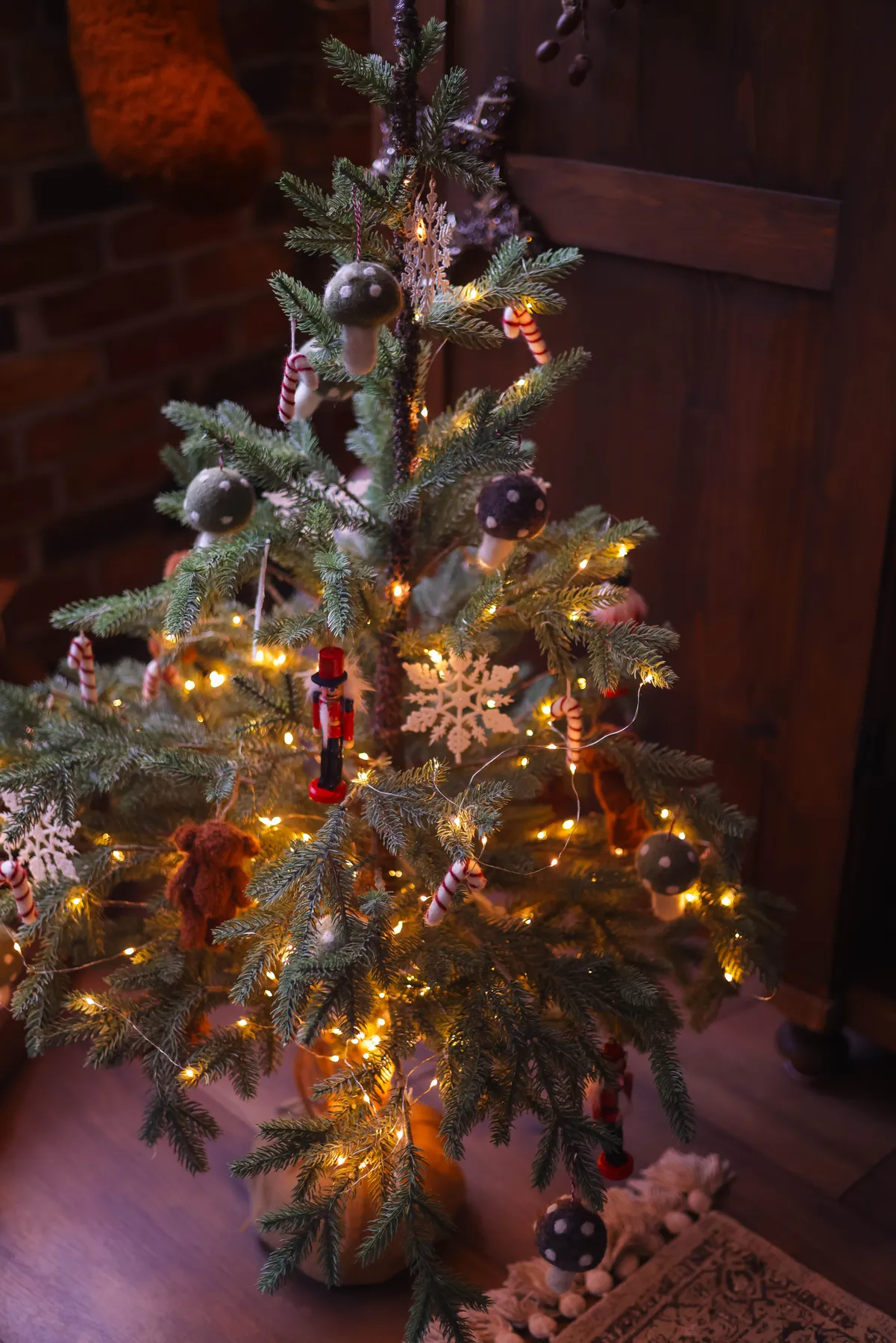
The mix here runs about 55% evergreen and warm light + 25% natural brown and burlap + 15% red and white accents + 5% soft yellow glow. That formula scales down beautifully — a 4-foot tabletop version with the same proportions looks just as intentional. To warm it further, swap white snowflakes for cream. To cool it off, trade red candy canes for deep burgundy or forest green. Change one category, keep the rest.
16. Deer Globes and Black-and-White Florals on Flocked Branches
Heavily flocked branches plus oversized floral picks equals dust. Flocking is textured and grabs everything, and large fabric ornaments are hard to wipe clean. Once a season, take the tree outside — or into a garage — and blow it out with a leaf blower on low, which sounds ridiculous and works better than any cloth. Expect flocking to shed for the first two or three setups, and store the tree in a breathable bag rather than a sealed bin, or the frost turns yellow.
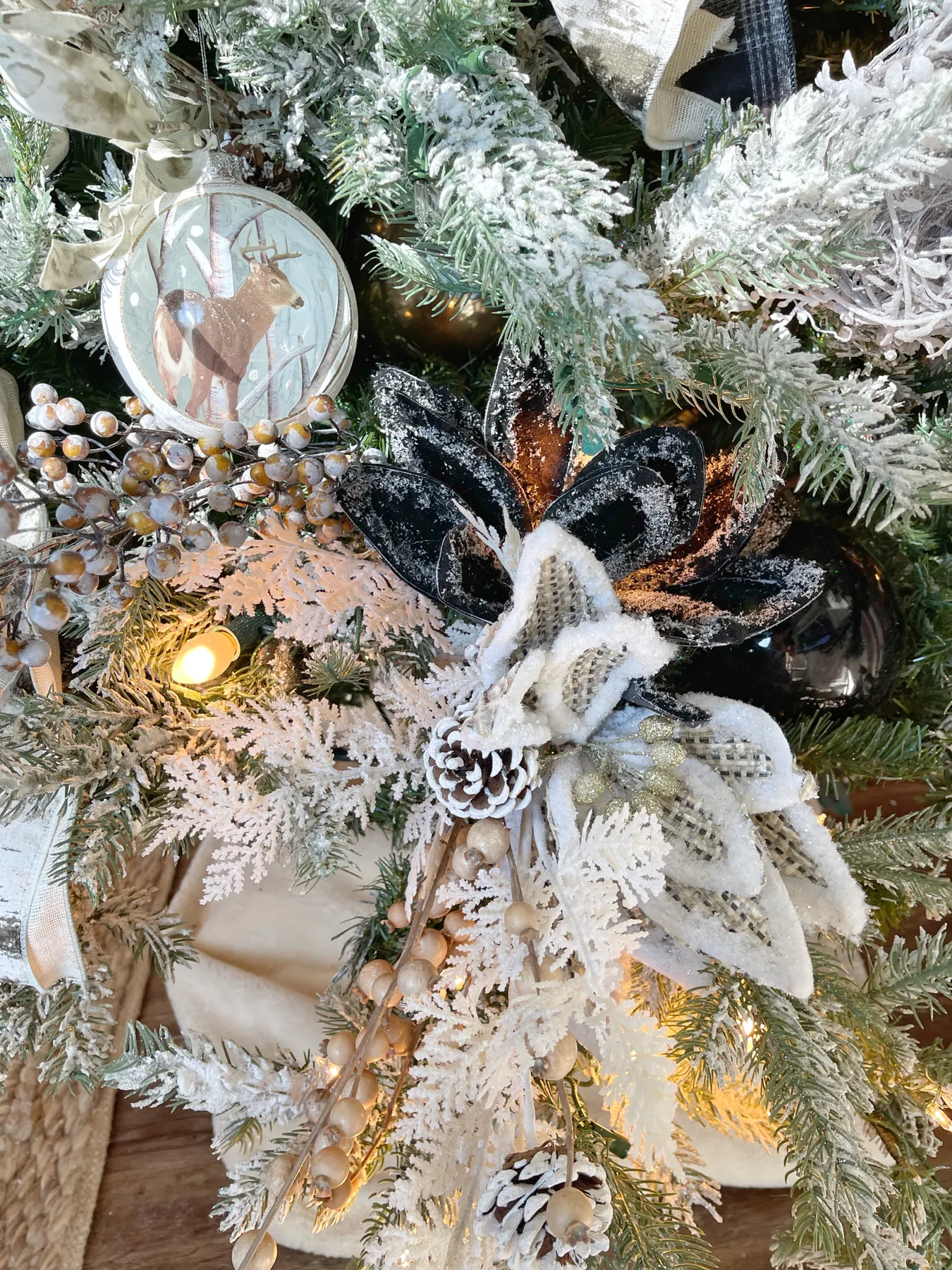
Dense, wide trees like this one need room to be seen. A tree with a 50-inch base wants at least 4 feet of clear space around it, which puts the minimum comfortable room size around 12 by 14 feet. In a smaller room, the same design works on a 6.5-foot tree if you cut the floral picks down to five or six large pieces instead of a dozen. For narrow spaces, look at the tabletop approach in Idea #17 — same palette, a fraction of the footprint.
17. A Frosted Tabletop Tree with Cinnamon and Citrus
- Slice oranges 1/8 inch thick — thicker slices stay damp and mold in storage.
- Blot the slices with paper towel, then lay them on a parchment-lined sheet pan.
- Bake at 200°F for 2.5 to 3 hours, flipping once at the halfway mark.
- Cool completely on a wire rack — they should feel like stiff leather, not brittle chips.
- Thread with twine and hang, or tuck loose slices into the tree and the dough bowl.
Two hours of hands-off oven time, about $4 in oranges, and they last for years if stored dry.
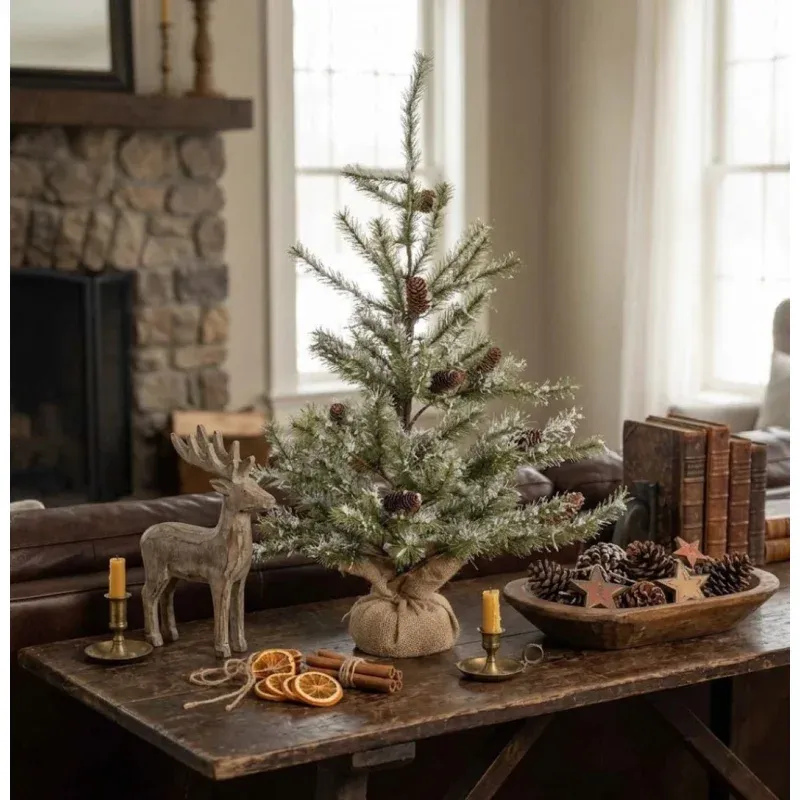
The burlap wrap around the base of that little frosted tree. It’s a nothing detail — probably $2 worth of fabric — and it’s what makes a tabletop tree look styled instead of plopped down. Burlap hides the plastic pot, adds roughness against the frosted branches, and ties the tree visually to the dough bowl of pinecones beside it. A plain terracotta pot would have done none of that.
18. Wood Slice Snowmen and a Peace on Earth Sign
- Artificial tree, 7 ft: $130–$450
- Wood slice ornaments, or make them from a $12 log: $20–$55
- Wooden peace on earth sign: $12–$35
- Burlap ribbon, 2 rolls: $14–$32
- Shiny and matte silver ornaments, 50 pieces: $45–$120
- Galvanized metal snowflake ornaments, set of 6: $18–$40
Total: about $240 to $730. The wood slice snowmen are a two-hour DIY if you own a drill — that alone saves $30.
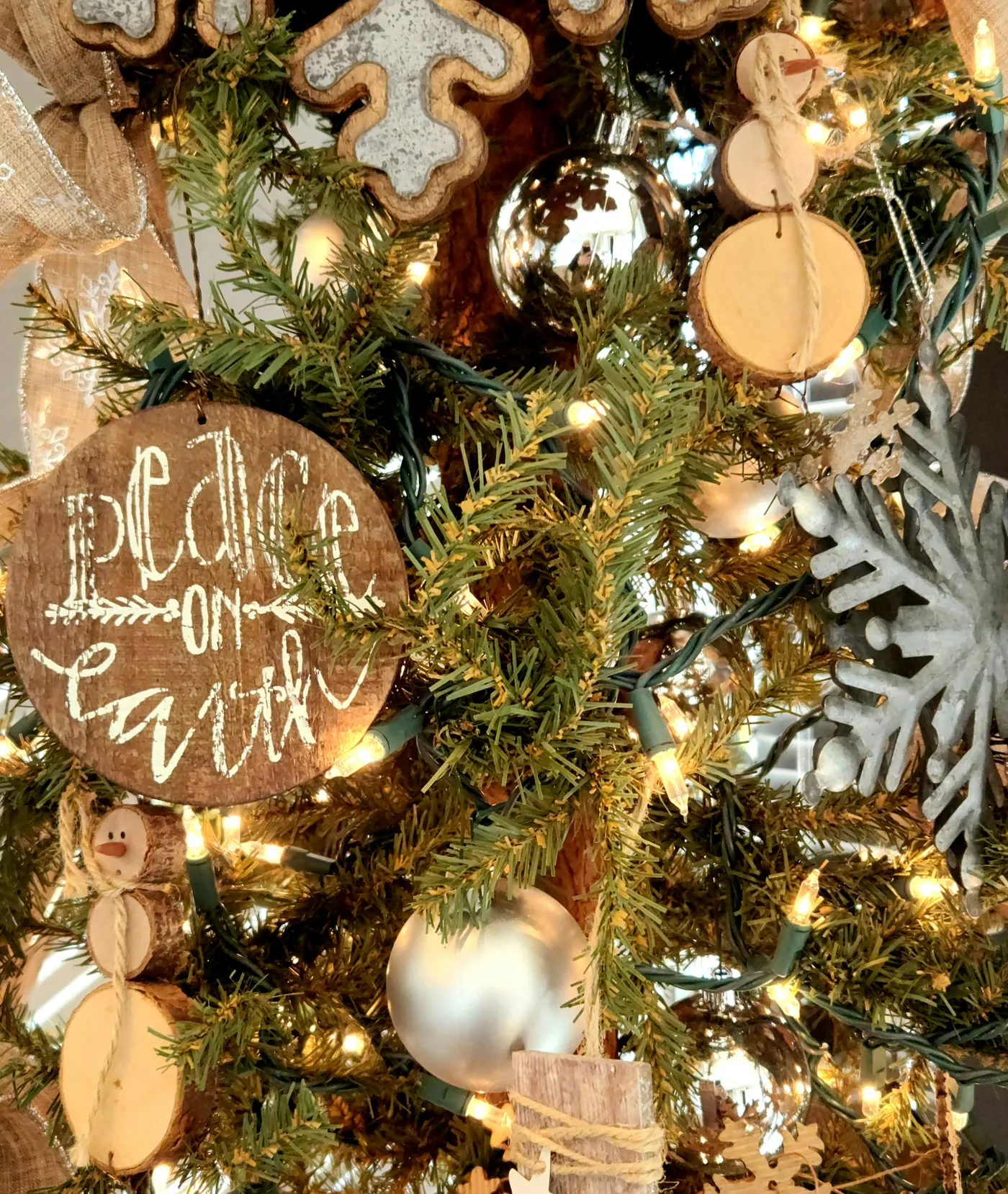
Silver only stays cozy when you mix finishes. All-shiny silver under cool white lights looks like a jewelry store display; all-matte goes muddy. Aim for roughly half shiny and half matte, and run warm white lights — 2700K to 3000K — never cool white. Also vary the shapes: rounds, flat snowflakes, one or two mirrored discs. One finish and one shape is a tree that looks like it came out of a single box.
19. A Gold Nutcracker Staircase and Entryway
Collector Christmas is back, and the nutcracker staircase is its most visible expression. It’s the same impulse behind vintage ornament collecting and thrifted Santa figurines — people want decor that accumulates over years instead of being replaced every November. Nutcrackers specifically have had a resurgence that’s equal parts ballet-core and nostalgia. Because a collection takes years to build, this look has real staying power.
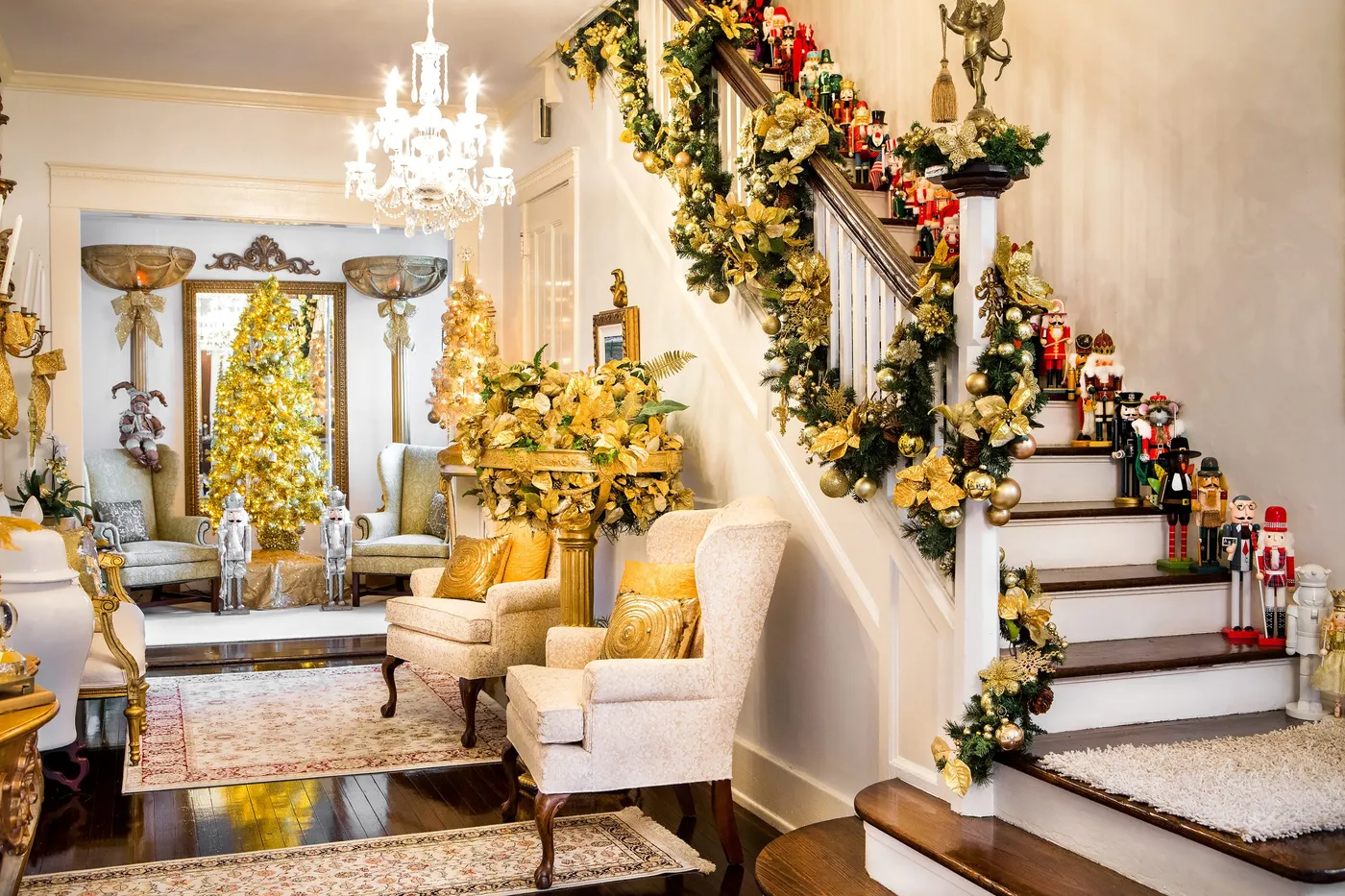
It’s repetition with variation. A nutcracker on every other stair tread creates a rhythm the eye follows upward, and the garland on the railing echoes that diagonal line so the staircase reads as one continuous gesture rather than a railing plus a pile of dolls. The gold theme — swagged ornaments, gold cushions, a lit gold tree glimpsed through the doorway — keeps the corners from getting busy. If the tree were red and the garland silver, this would fall apart. Idea #20 takes the same gold idea and scales it down to one corner.
20. Champagne Ornaments with a Gold Sequin Skirt
Champagne ornaments are surprisingly cheap if you buy them by the tube rather than as curated sets — dollar stores and Walmart sell 20-packs in that soft gold for around $8. A gold sequin tree skirt from Amazon runs $20 to $35. The wooden ladder holding knit stockings is a Facebook Marketplace staple at $15 to $40, and the stockings are a $6 skein of chunky yarn and an evening of knitting, or $12 at Target. The big-ticket item is the flocked tree, and swapping it for a plain one saves $200 or more.
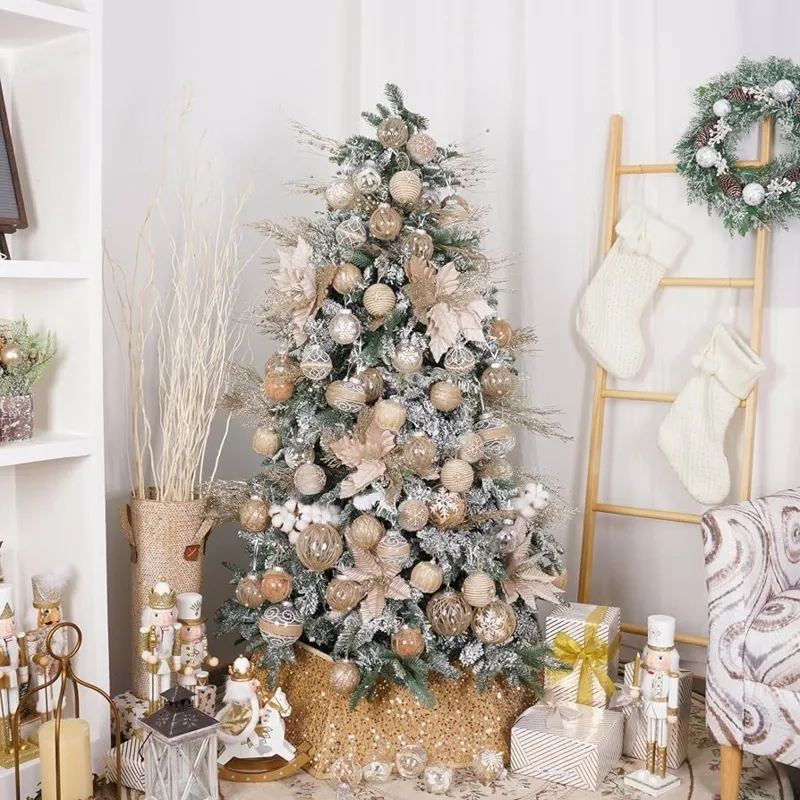
Sequin skirts shed, and they shed onto everything. Expect to find individual sequins in the rug, on the dog, and inside the vacuum for months. They also slide, so tape the tree stand to the floor or the skirt migrates every time someone walks past. On the ladder: a freestanding decorative ladder with stockings on it will absolutely be climbed by a toddler. Lean it into a corner or strap it to the wall if you have small kids.
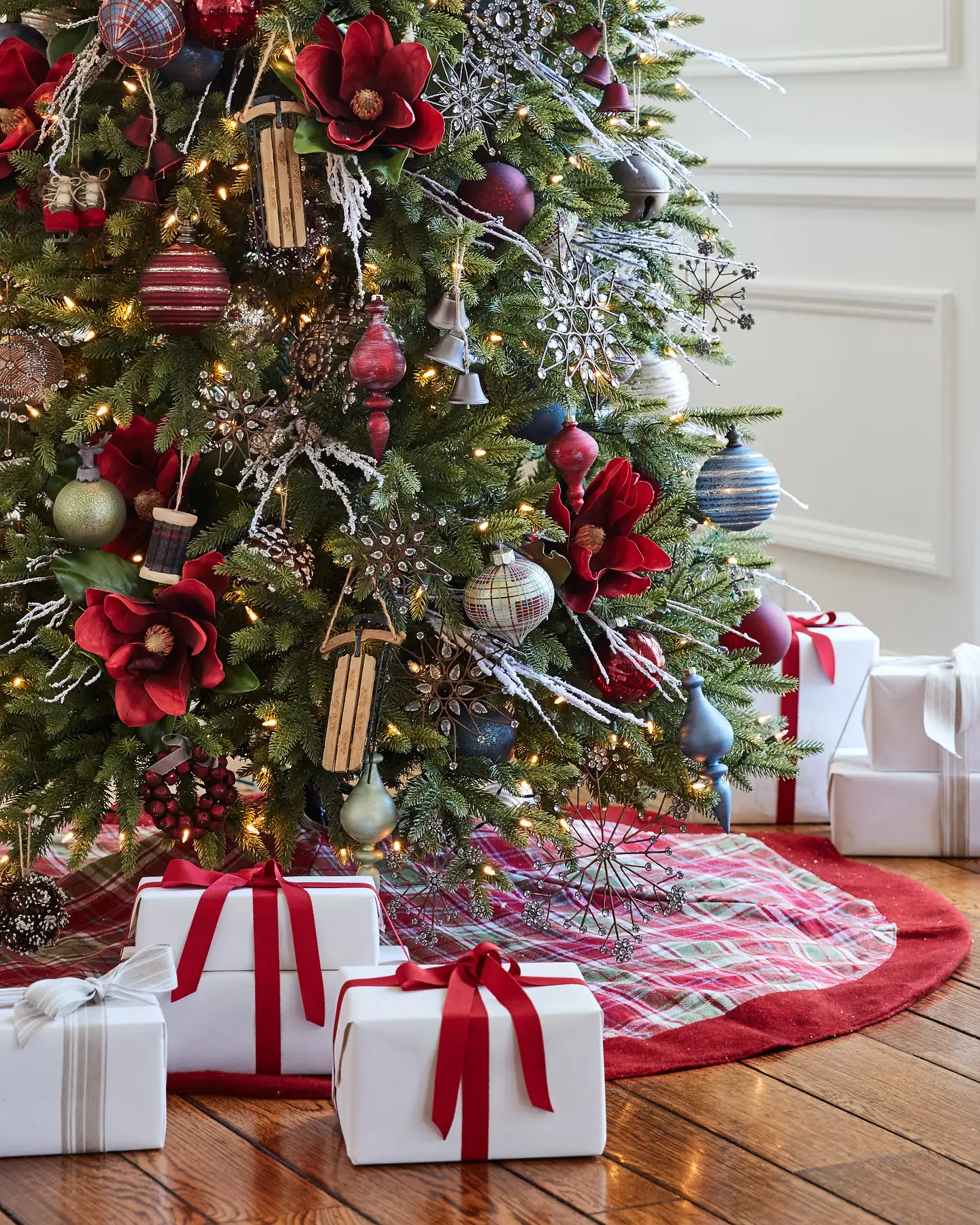
21. Red Magnolias and Plaid Baubles on a Pre-Lit Tree
45% forest green + 30% deep red + 15% plaid and navy + 10% distressed silver. The navy in the plaid is doing quiet work — it keeps the red from going candy-cane and gives the whole tree a slightly older, more collected feel. Swap the navy-plaid baubles for cream-on-red checks and the palette turns sweeter and more country. Drop the magnolias and you lose a huge chunk of the visual volume; add more instead and it tips into craft-store territory.
- Count your existing red and green ornaments before buying anything — you probably need fewer than you think.
- Check the tree skirt size against the tree’s base; 48 inches is the safe default for a 7.5-foot tree.
- Decide how many picks and floral stems go on each tier before you start, or you’ll overbuy.
- Confirm your ribbon is wire-edged. Unwired plaid won’t hold a bow shape.
- Test the lights before decorating. It’s much worse to find a dead strand afterward.
22. Pinecone Trees on a White Shelf with a Candle
Small-space Christmas, and possibly the most useful idea here if you live in an apartment. Two shelves, 10 to 14 inches of vertical clearance each, and you’re done. The pinecone trees run 8 to 12 inches tall, which means the shelf above them needs at least 4 inches of air or the arrangement feels stuffed. Pair this with a tabletop tree and you’ve decorated an entire living room in under 6 square feet — see Idea #26 for the tree half of that equation.
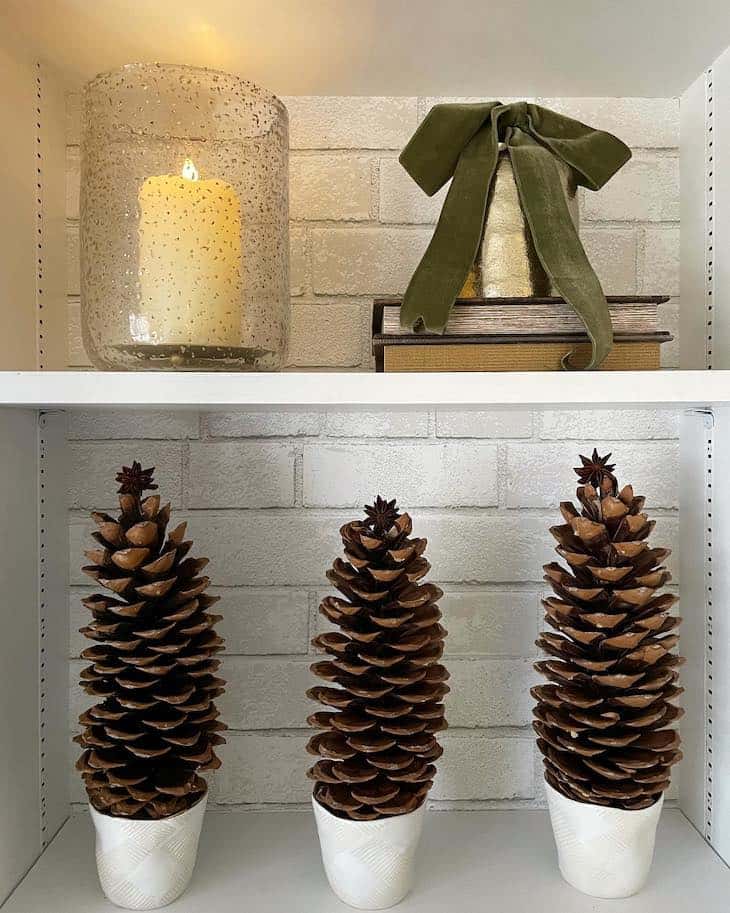
- Collect or buy 20 to 30 pinecones and bake them at 200°F for 30 minutes to kill anything living in them.
- Hot-glue the pinecones into a pyramid, widest ring on the bottom, working upward.
- Set the finished cone in a small white pot with a ring of hot glue at the base.
- Glue a single star anise to the top as the tree’s star.
- Let everything cure for an hour before moving it.
Roughly 30 minutes of hands-on work, about $15 for three trees.
23. A Felt Owl, a Spotted Deer, and Pinecones
The reason this close-up looks rich is depth, not quantity. Large pieces like the felt owl and the spotted deer sit pushed back toward the trunk, while pinecones and berry sprigs hang nearer the tips. That 4-to-6-inch depth difference is what keeps a tree from looking flat. When you add ornaments, work from the inside out: heaviest and largest first, close to the trunk, then medium pieces mid-branch, then lightweight sprigs at the tips.
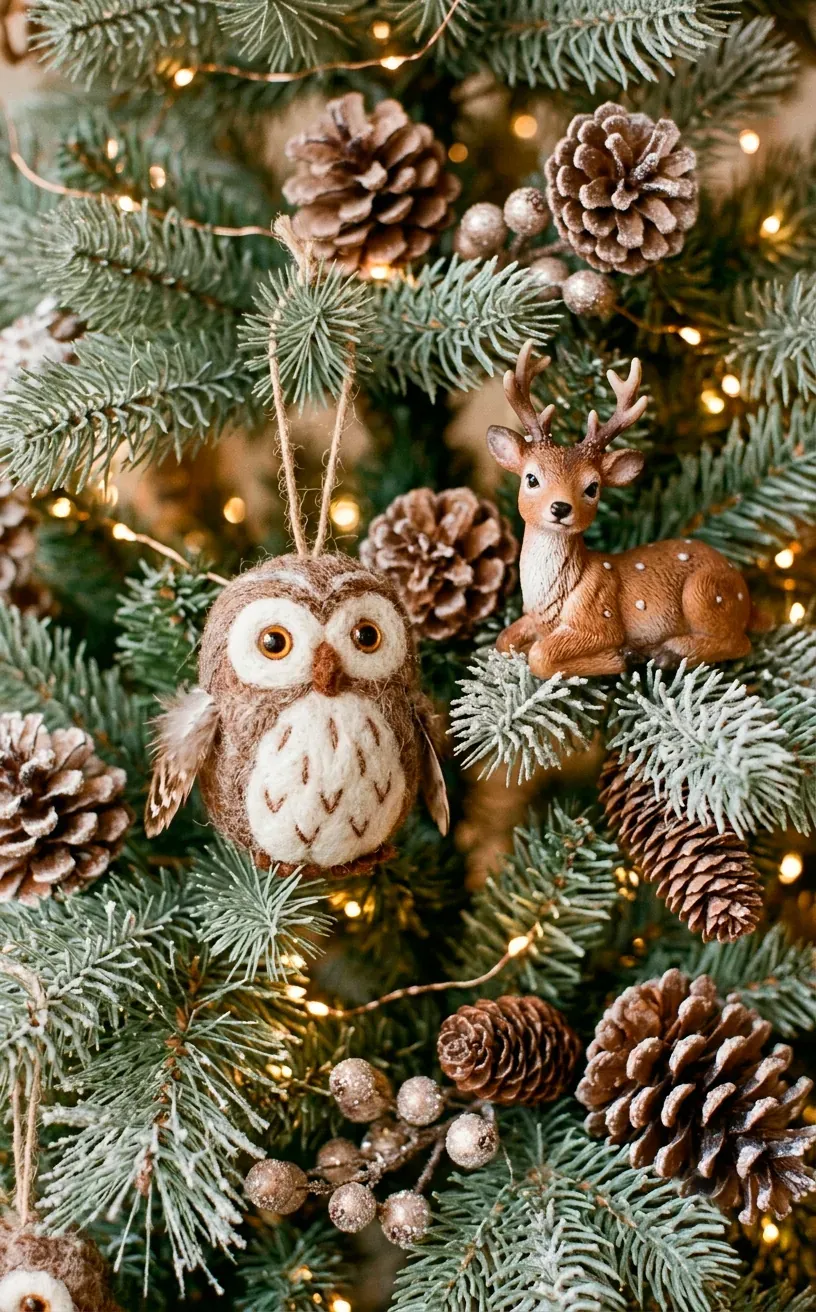
Glitter is a commitment. Glittery berry sprigs shed onto flocked branches, and once it’s in the flocking you won’t get it out — the tree slowly becomes a glitter tree over three or four seasons. Felt ornaments collect pet hair and lint and need a lint roller every few weeks. Store felt pieces in a breathable cotton bag, not plastic, so they don’t hold moisture and smell musty next December.
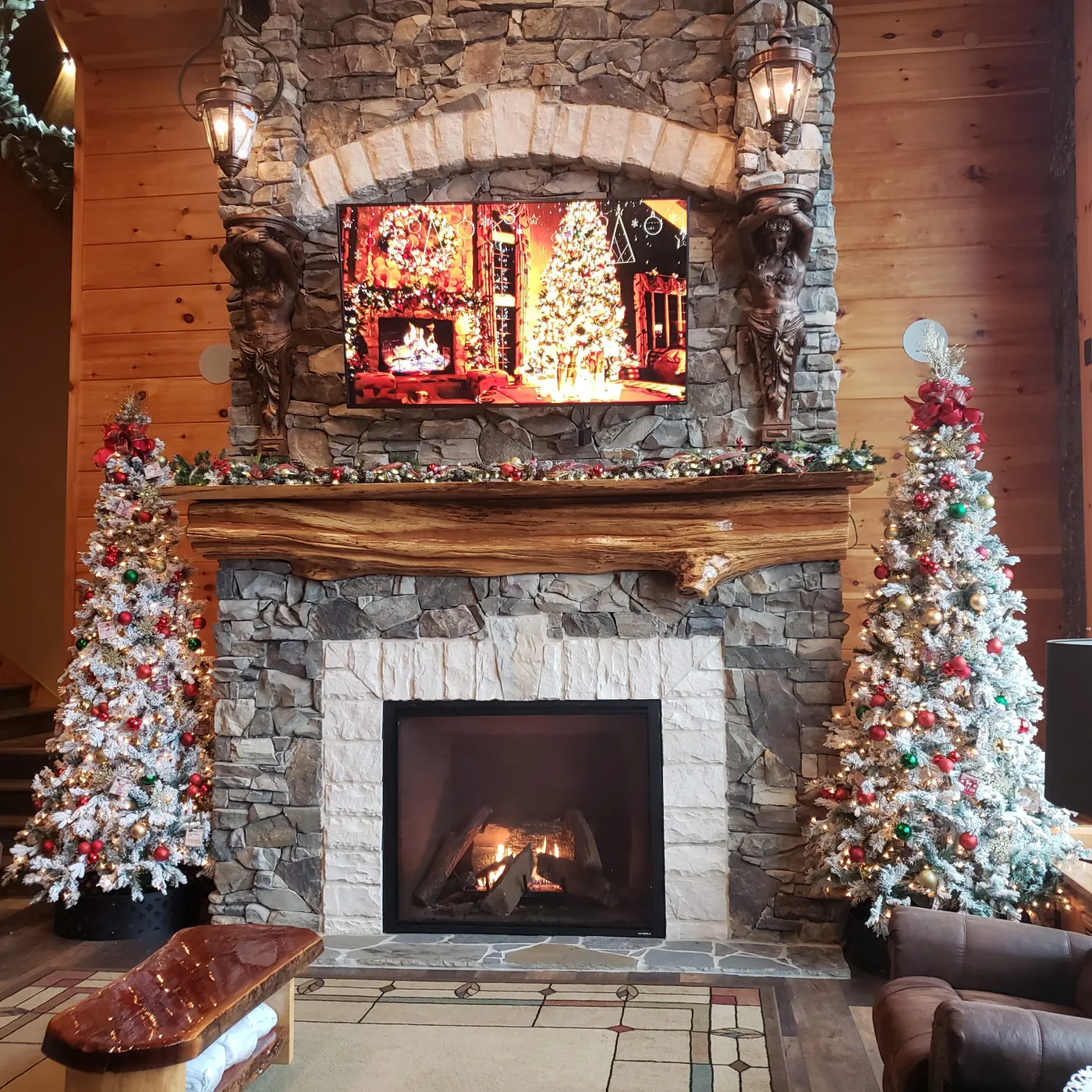
24. White Poinsettias in a White Wooden Collar
The white wooden tree collar. Against a dark wood floor, that plain painted box gives the tree a base and a border at the same time — it stops the eye at floor level instead of letting the tree dissolve into the room. A fabric skirt would have gone soft and shapeless here; the collar’s straight lines match the clean look of the ornaments. It also happens to be the easiest thing on this list to build from scrap plywood.
- Tall artificial tree, 7.5–8 ft: $180–$600
- White wooden tree collar: $45–$120, or build one for $20 in materials
- White and silver ornaments, 70 pieces: $55–$150
- White poinsettia picks, 8 stems: $20–$48
- Warm white lights if not pre-lit: $25–$55
Total: about $325 to $970.
25. A Bare Natural Tree Standing in a Galvanized Bucket
Galvanized buckets and water don’t get along. The zinc coating reacts with moisture over time, and the bottom will start to spot and eventually rust through — usually right onto your wood floor. Line the bucket with a plastic tub that actually holds water, and put a waterproof mat or a cork coaster underneath. Also, a live tree packed in stone or gravel has no water access at all. The stones at the surface are fine for looks, but the reservoir underneath has to be real.
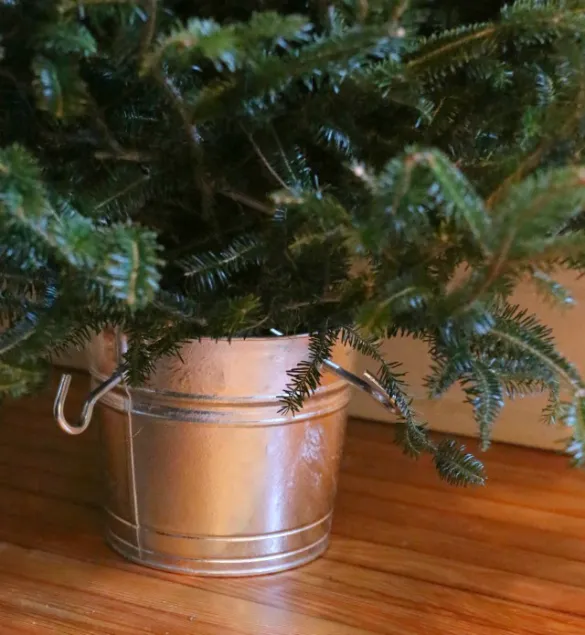
80% natural dark green + 15% galvanized silver + 5% light wood floor. This is the most stripped-back formula in the collection, and it only works because the green is doing almost all the talking. Add one category and it shifts fast: a red ribbon turns it rustic-craft, cream ornaments make it Scandinavian, and a single strand of warm lights makes it cozy rather than austere. Keep the bucket empty of everything but the tree.
26. Pink and Green Vintage Glass on a Small Pine
Vintage glass ornaments are the best-value collectible in Christmas decorating. Estate sales, church sales, and thrift stores sell them for $1 to $3 each, and a shoebox full is plenty for a small tree. A galvanized bucket is $12 to $18 at any hardware store — cheaper than a decorative pot. The sparsely branched pine is the point: fewer branches means fewer ornaments needed. Total spend for a tree like this one lands under $80, and the ornaments appreciate rather than depreciate. See Idea #9 for the tabletop version of this same thrift-first approach.
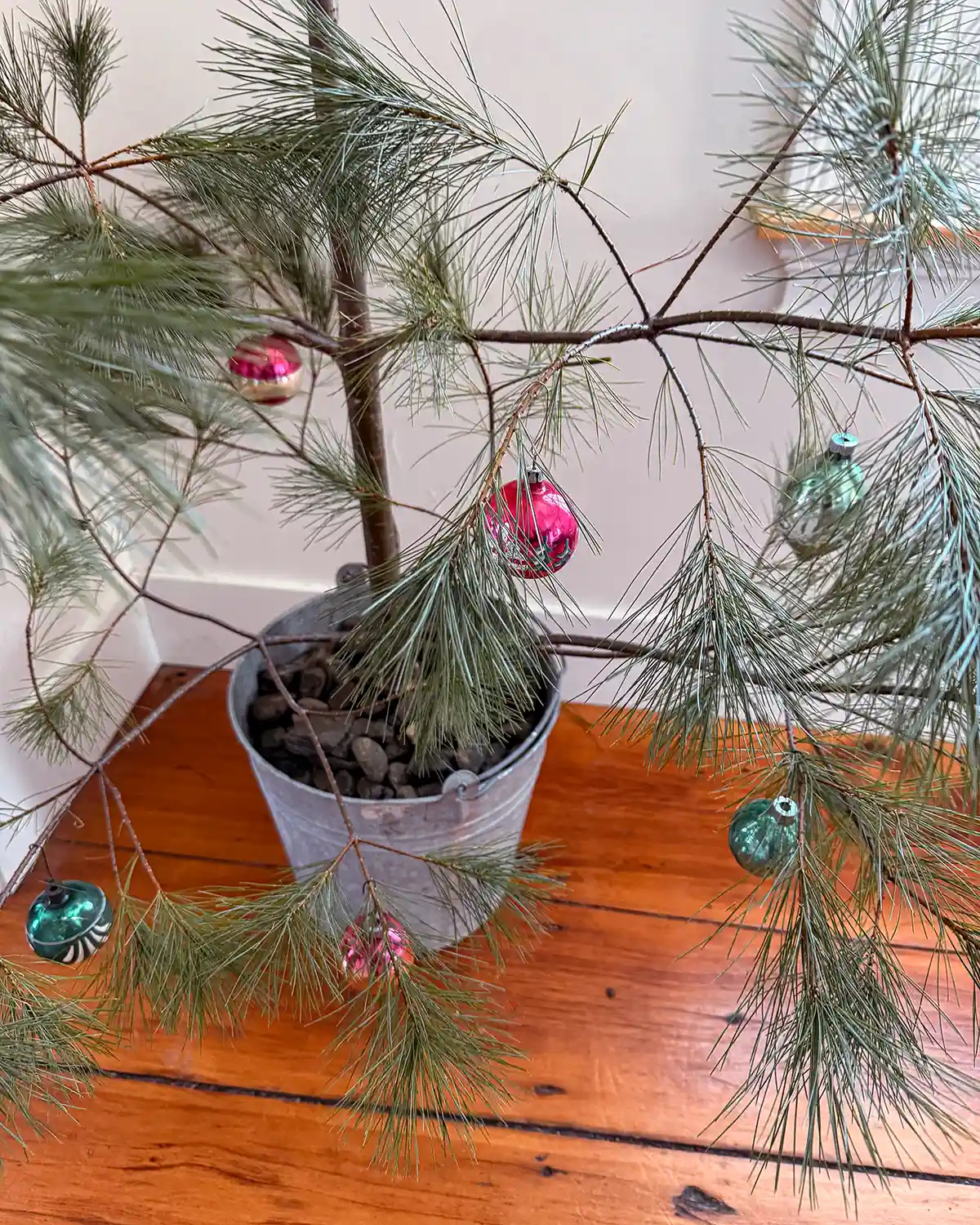
Negative space. A sparse tree with 15 ornaments has more visual interest than a dense tree with 100, because you can actually see each ornament. The pink and green glass pieces read as individual objects instead of texture, and the gaps between branches become part of the composition. The constraint is real, though: on a sparse tree, every ornament is a focal point, and anything you don’t love will be the first thing you notice.
27. Gold Gifts and Lanterns Under a Wooden Star
Style the base in odd numbers and three heights. Group lanterns and candles in threes and fives, and vary the heights by roughly double — 6 inches, 12 inches, 18 inches. That stepped grouping is what makes a tree base look styled instead of scattered. When candles or lanterns sit under a tree, keep live flames at least 18 inches from the lowest branches, or skip real candles entirely and use battery pillars with a flicker setting.
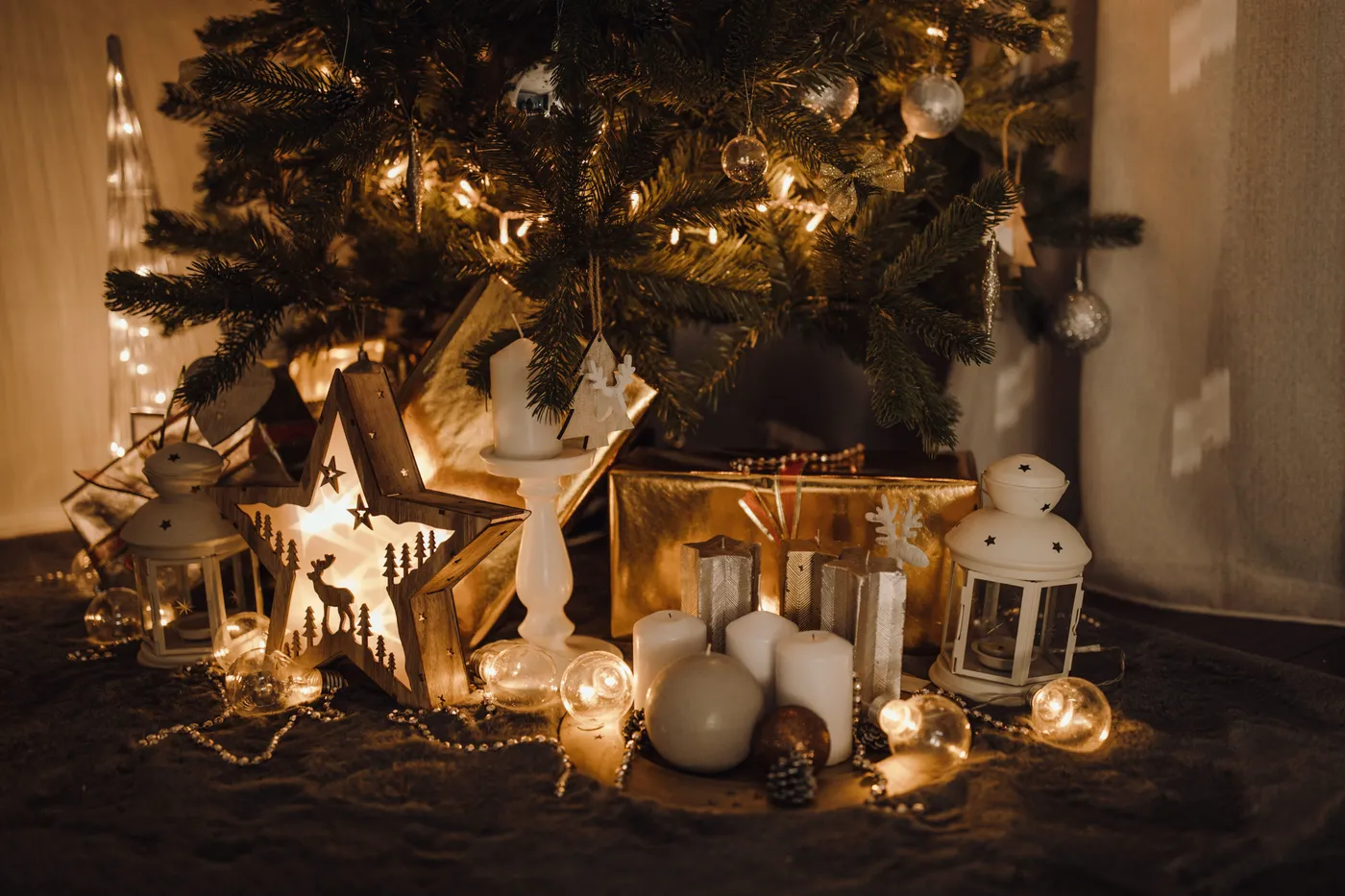
- Clear the floor and lay a flat rug or mat so the arrangement has a defined edge.
- Set the largest lantern or the wooden star at the back, slightly off-center.
- Build outward with medium pieces, leaving at least one gap of empty rug.
- Add the small items last — candles, loose ornaments, a few gold boxes.
- Turn off the room lights and check how the glow reads before you adjust anything.
About 30 minutes, and most of it is furniture-shifting.
28. Dried Hydrangeas and Fabric Ball Garland
Garland scale is the most common mistake on a tall tree. Fabric ball garlands should be at least 1.5 inches in diameter on a 7-foot tree or they vanish into the branches — measure before you buy the tiny 1-inch version. Dried hydrangea clusters should each be roughly the size of a softball and spaced 10 to 14 inches apart. On a 6-foot tree, halve those numbers. For a corner-friendly alternative to a full tree, Idea #24 keeps a similar neutral palette on a large scale.
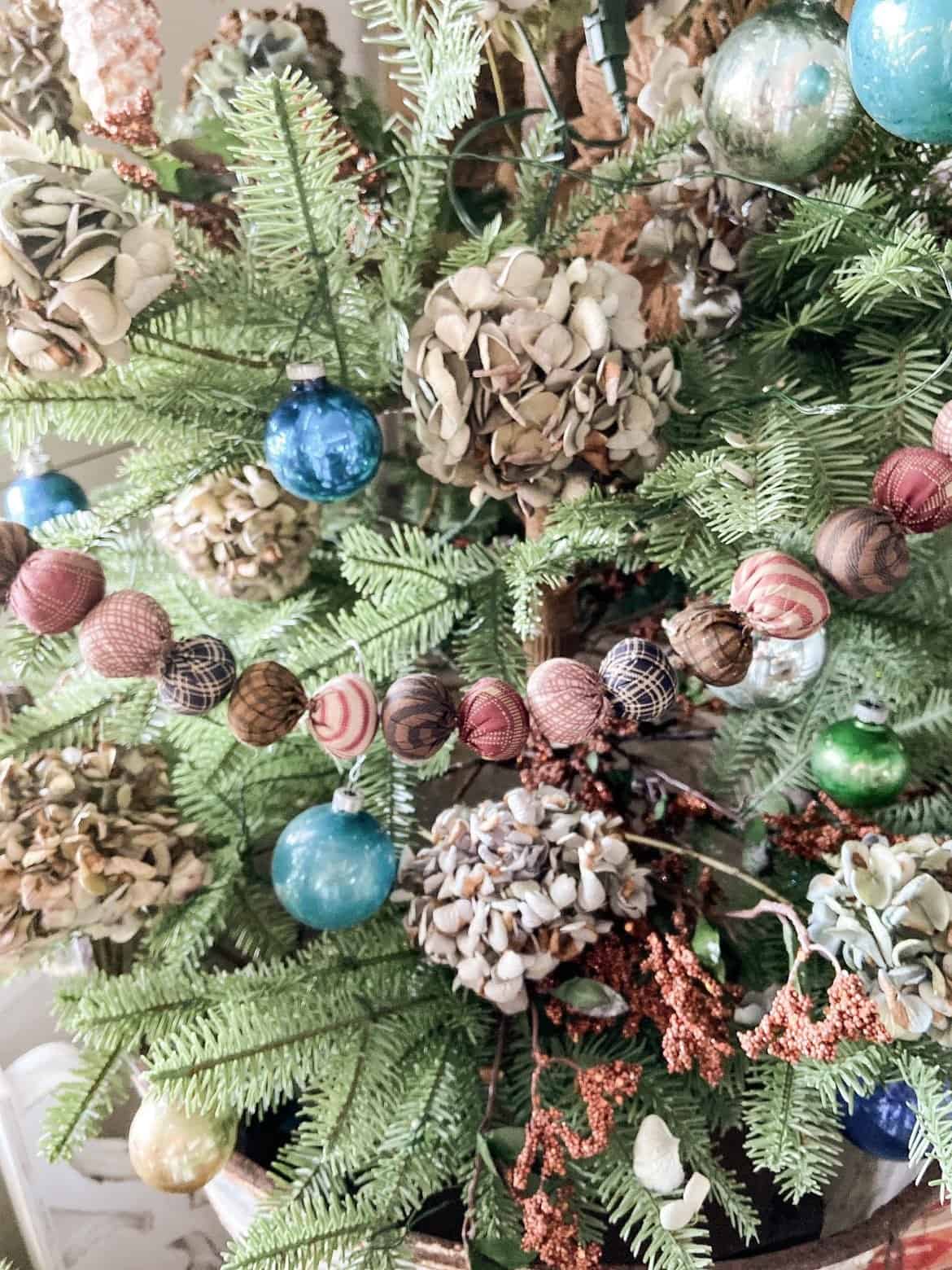
Dried florals on Christmas trees went from a niche DIY to a mainstream look, and 2026 is the year it fully settles in. The appeal is sustainability-adjacent without being preachy — hydrangeas and grasses can be reused for years, they compost eventually, and they photograph with a softness plastic picks can’t fake. Muted blue and green glass ornaments in faded tones are part of the same shift away from high-contrast, high-shine decorating.
29. Burlap Ribbon and Silver Ornaments on a Farmhouse Tree
- Lay your burlap ribbon alongside the tree to check the width — 4 inches is the minimum that reads from across a room.
- Test the galvanized collar on the floor before tree setup day and do a scratch test on a hidden spot.
- Sketch ornament placement on paper: half silver, half white, pinecones as filler.
- Confirm the collar diameter is at least 6 inches wider than your tree stand.
- Decide which way the tree’s good side faces — every tree has one.
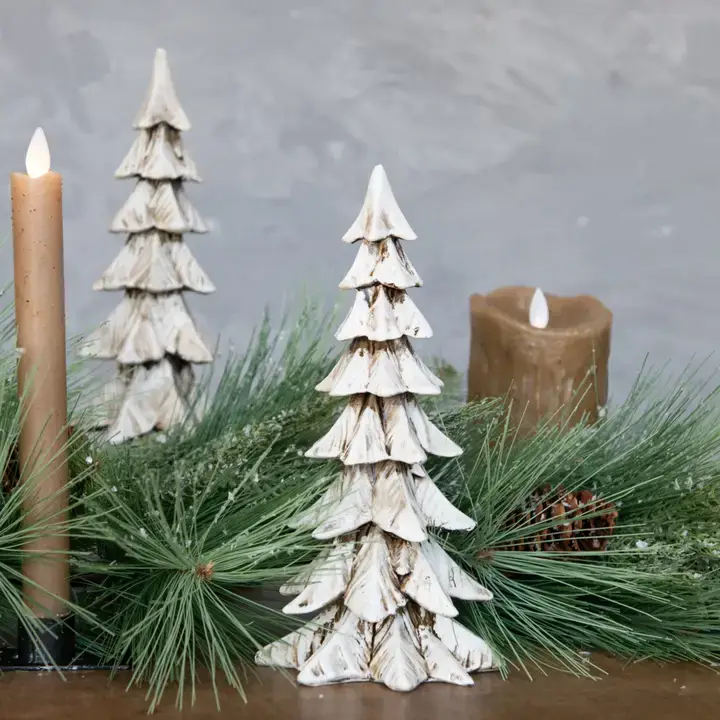
Burlap sheds almost as much as flocking. It drops fibers, it has a smell for the first week, and it’s rough enough to snag knit stockings. If you’re sensitive to texture or dust, buy a burlap-look ribbon in woven polyester instead — same look, far less mess. Galvanized collars also scratch wood floors, so put a felt pad under the rim. And against white shiplap, a metal collar will show every fingerprint.
Your Farmhouse Tree, Your Rules
Somewhere in these 29 trees there’s a version of yours — maybe it’s the dried citrus against shiplap, maybe it’s the crate collar, maybe it’s just a galvanized bucket and fifteen thrifted glass ornaments. Start with the base and the palette, and let the rest accumulate year after year. Pin the ones you love now, because by the time you’re dragging boxes down from the attic, you’ll want the reference right in front of you. Happy trimming.