You’ve saved forty Christmas tables to a Pinterest board and still can’t decide between red-and-green traditional and something much quieter — that’s exactly why this guide exists.
We spent weeks combing through Trader Joe’s, Target, Walmart, Amazon, and Etsy for pieces that actually look like the photo once they’re on your table, and compared notes with the setups real hosts pulled off this season. Thirty ideas made the cut, and most of them land somewhere between $40 and $600.
Inside you’ll find traditional reds, snowy whites, jewel-toned maximalism, Nordic naturals, and minimalist winter settings — with budget and luxury versions side by side and direct product links, so you can see where the money matters and where it truly doesn’t. A few links here are affiliate links, which means we may earn a small commission at no cost to you.
The 2026 shift is real: tables are getting quieter and more natural, with real branches, matte ceramics, and candlelight doing work that glitter used to do.
And stay until the end — we break down the most common mistakes that can ruin these looks.
📌 Save this to Pinterest for later — you’ll want to revisit these ideas.
1. Silver Mercury Glass Trees on a Pine-Printed Runner
A runner printed with green pine branches does something quietly clever: it establishes the botanical theme before a single ornament lands, so the centerpiece reads as planned rather than accumulated. The mercury glass cone trees repeat one silhouette at three or four different heights and in two finishes, which turns a scattering of objects into a collection. Because the palette holds at silver, white, and green with only a whisper of gold, the green glass votives actually register as color instead of competing for attention.
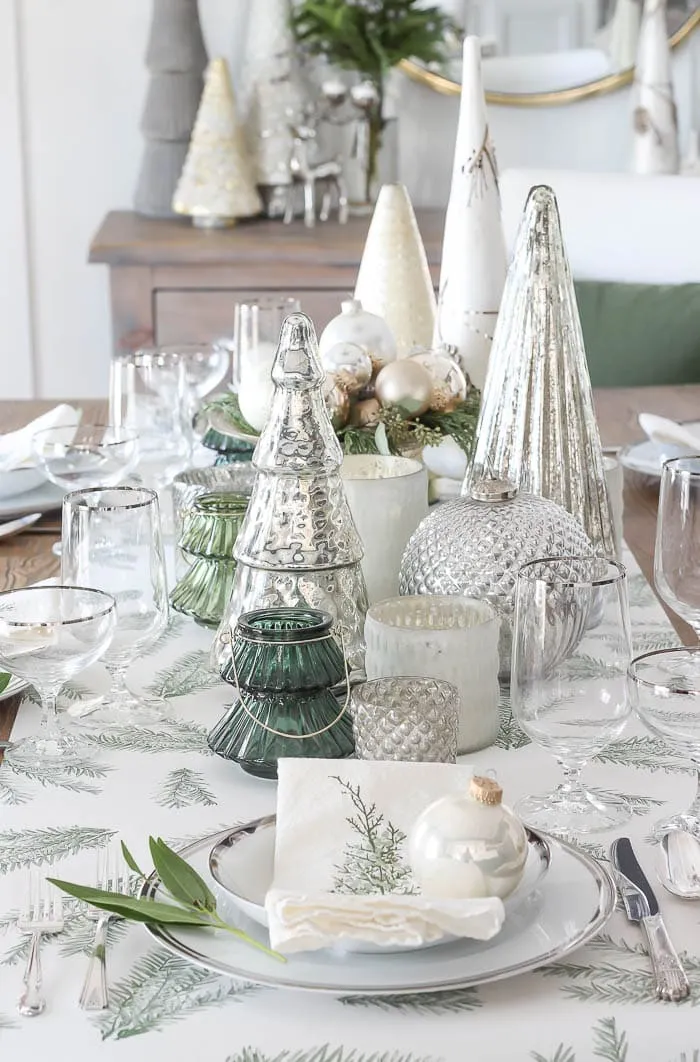
- Mercury glass cone trees in mixed heights, 3–5: $36–$120
- Pine-print runner plus green-embroidered napkins: $30–$70
- Green glass votives and tealights: $18–$45
- Silver, gold, and white sphere ornaments: $15–$40
- White plates with silver rims, set of four: $40–$140
- Total: $139–$415
Budget alternative: lay a plain white cloth and tuck real pine sprigs under each plate instead of buying the printed runner, then mix thrifted silver ornaments with dollar-store mercury cones. Same sparkle, about $60.
2. One Lit Red Pillar Candle Buried in Evergreen
Keep a centerpiece under 12 inches tall — that’s roughly the height where guests stop being able to see the person sitting across from them. On a 60-inch round table, cap the arrangement at 10 inches tall and 14 inches wide, and leave a bare 12 inches of tabletop in front of every plate so there’s somewhere to set a glass down. Want real drama? Send the height to the two ends of a rectangular table instead of the middle.
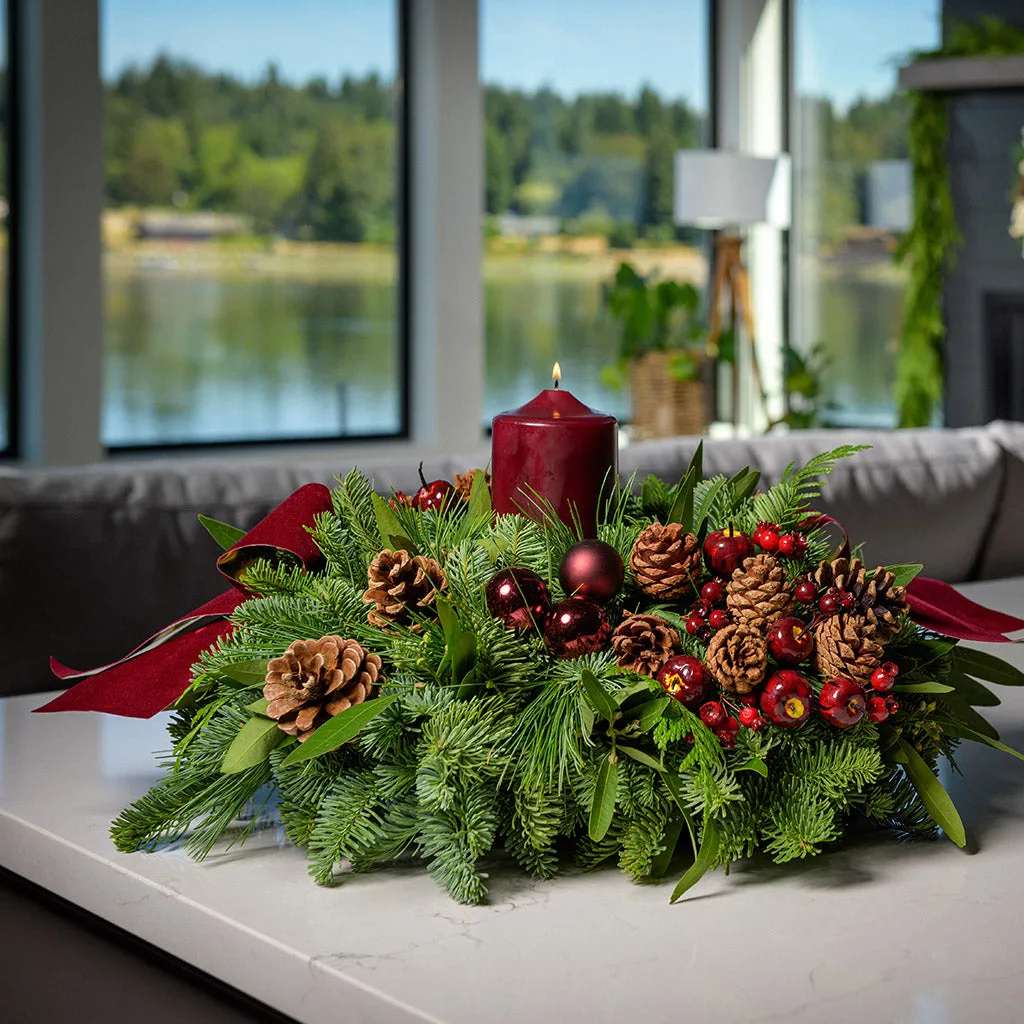
The lit dark red pillar candle is the entire point. Without it you have a pleasant pile of evergreen, pinecones, and berries — pretty, but static. The flame gives the arrangement a pulse and a focal point, and the same dark red pulls the glossy ornaments and berry clusters into one story instead of three competing reds. Swap it for a white candle and the warmth flattens instantly.
3. Layered Gold Chargers Under a Fairy-Lit Garland
- Mixed greenery garland, 6 ft: $35–$90
- Gold charger plates, set of four: $28–$80
- Gold-rimmed white dinner plates, set of four: $45–$160
- White tapers with metallic holders, pair: $20–$55
- Battery fairy lights with a timer: $12–$30
- Total: $140–$415
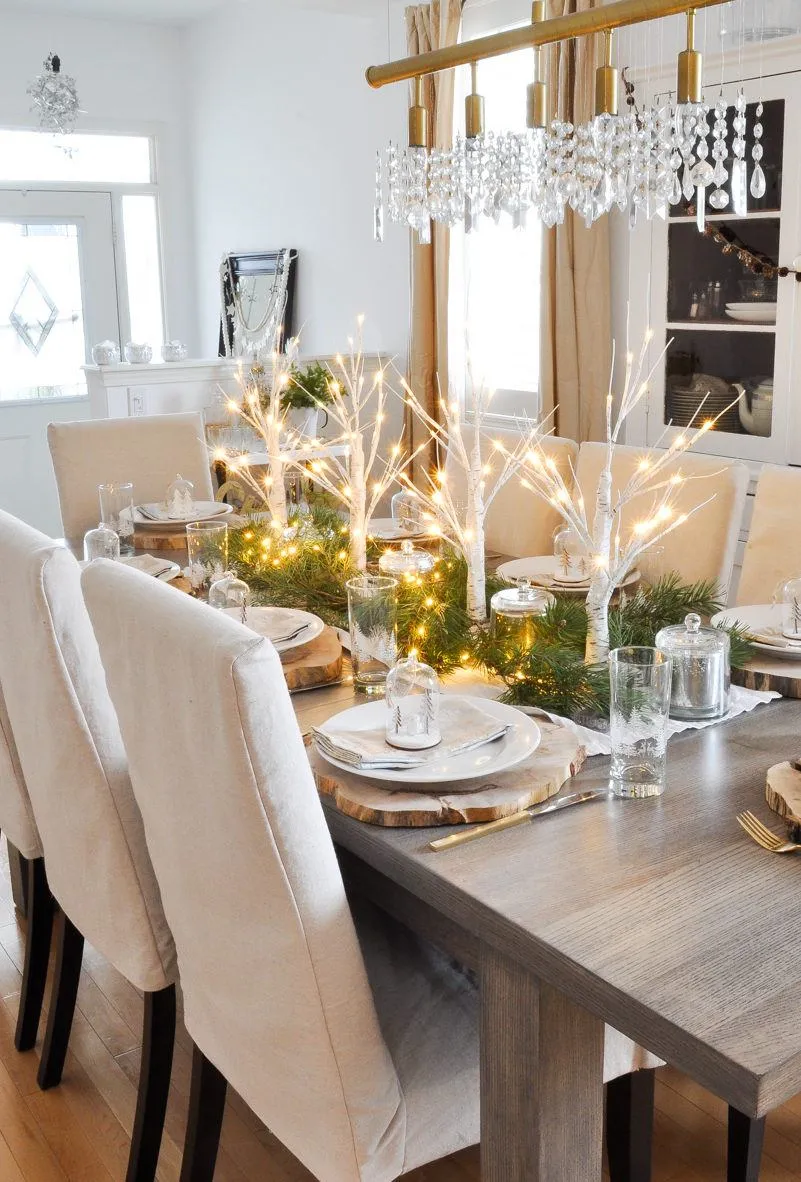
Budget alternative: buy a plain green garland and wire in your own pinecones and a strand of lights — that alone cuts $40. Walmart chargers run about $3 each, and a thrifted set of gold-rim china usually costs less than a single new place setting.
This layout needs a rectangular table at least 60 inches long, because the garland has to run the length without crowding the outer settings. It’s happiest in a dining room of roughly 10 by 12 feet with a standard 8-foot ceiling — plenty of height for tapers without the room feeling tented. On a 48-inch round, split the garland into two short swags and borrow the hurricane-lamp approach from Idea #27 at the center instead.
4. Festive Dinner Table Arrangements That Fit the Actual Room
Here’s the thing nobody mentions in the pretty tablescape posts: chair clearance. A dining chair needs 30 to 36 inches of open floor behind it to pull out comfortably, and a sideboard pushed against the wall will quietly kill that. Before you commit to a wide garland or an oversized centerpiece, walk the room and measure the pull-out space. A 96-inch table that seats eight comfortably will feel cramped with ten, no matter how beautifully it’s styled.
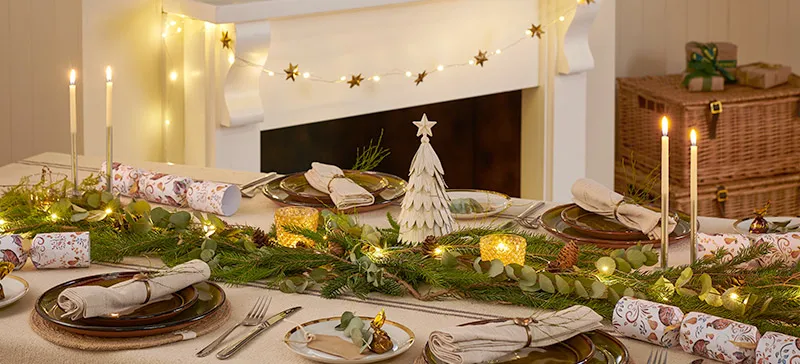
Once the fit is right, use a formula instead of improvising. For a table of eight: 60 percent goes to the base — cloth, runner, placemats — 25 percent to the centerpiece, 10 percent to candles and glassware, and 5 percent to one accent color. Roughly 100 inches of garland covers a 96-inch table with a little spill at each end. Swap the accent color every year and the base stays exactly the same.
5. Tiny Bottle Brush Trees and Velvet Ribbon Napkins
- Press the napkins flat, then fold each into a loose 4-by-10-inch rectangle.
- Lay a small pine sprig along the center, pointing toward the top edge.
- Cut 18 inches of 5/8-inch dark green velvet ribbon and wrap it around the middle.
- Tie a single knot rather than a bow, so the ends fall like a tail.
- Trim both ribbon ends on a sharp diagonal to keep them from fraying.
- Tuck a tiny white-berry sprig under the knot at the last second.
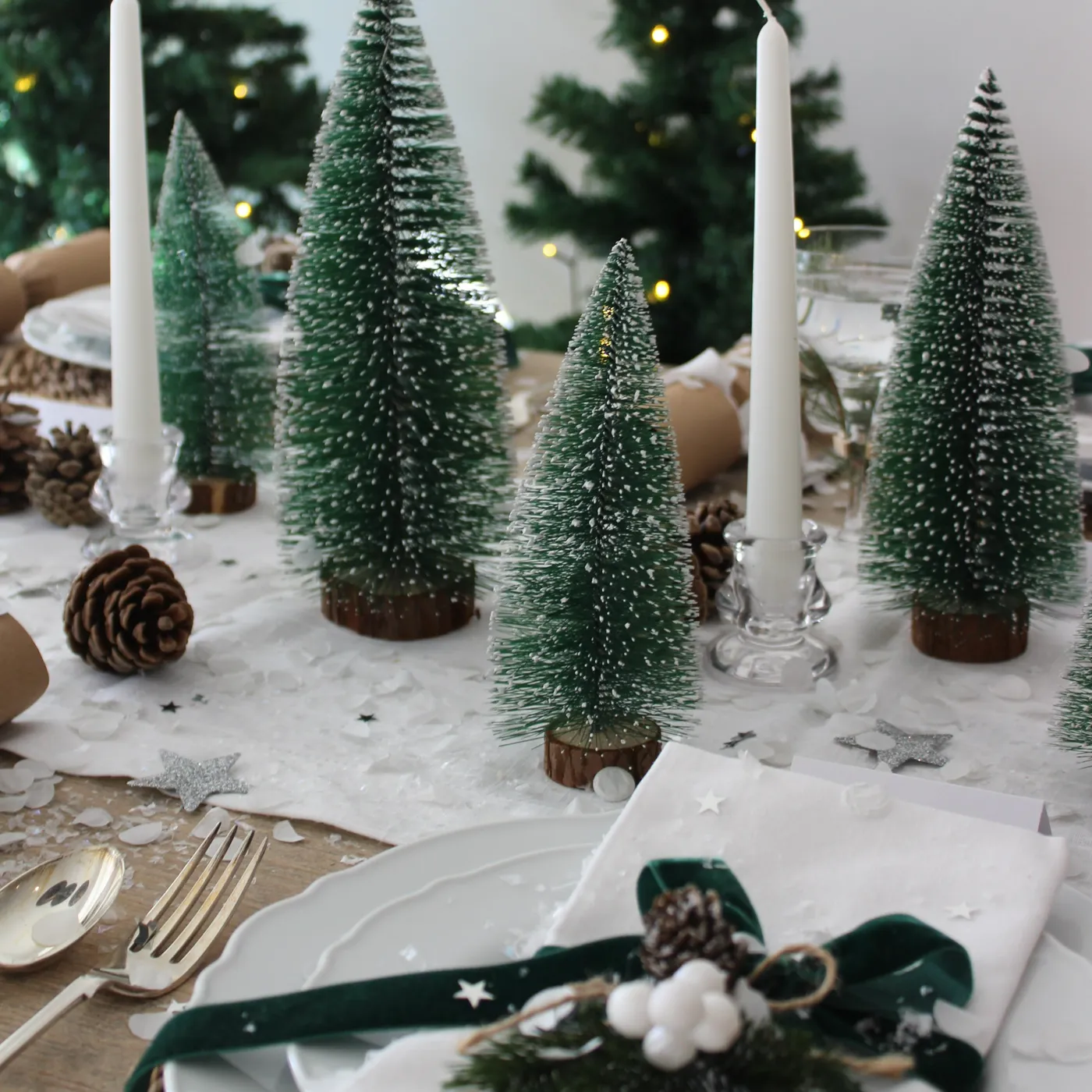
Ten minutes for six napkins, about $12 in ribbon and $6 in sprigs.
The dark green velvet ribbon is what separates this from every other snowy white table. Black would feel severe, satin would look like a gift shop, and silver would vanish against the white plates — velvet absorbs light instead of reflecting it, which is why the green reads as depth rather than decoration. Skip the ribbon and the whole setting goes soft and anonymous.
6. Plush Gnomes and Brass Candlesticks on a Scratched Farm Table
You don’t need heirloom china for this one. Target and Walmart sell gnome-motif dinnerware for $4 to $8 a plate, and dollar-store plush gnomes run $1.25 apiece. Thrift stores are lousy with brass candlesticks for $2 to $5 a pair — a little polish brings back the shine in five minutes. Fresh evergreen branches are free if you have a tree, $12 if you don’t, and striped linen napkins from HomeGoods land around $20. Total: roughly $85 for six settings.
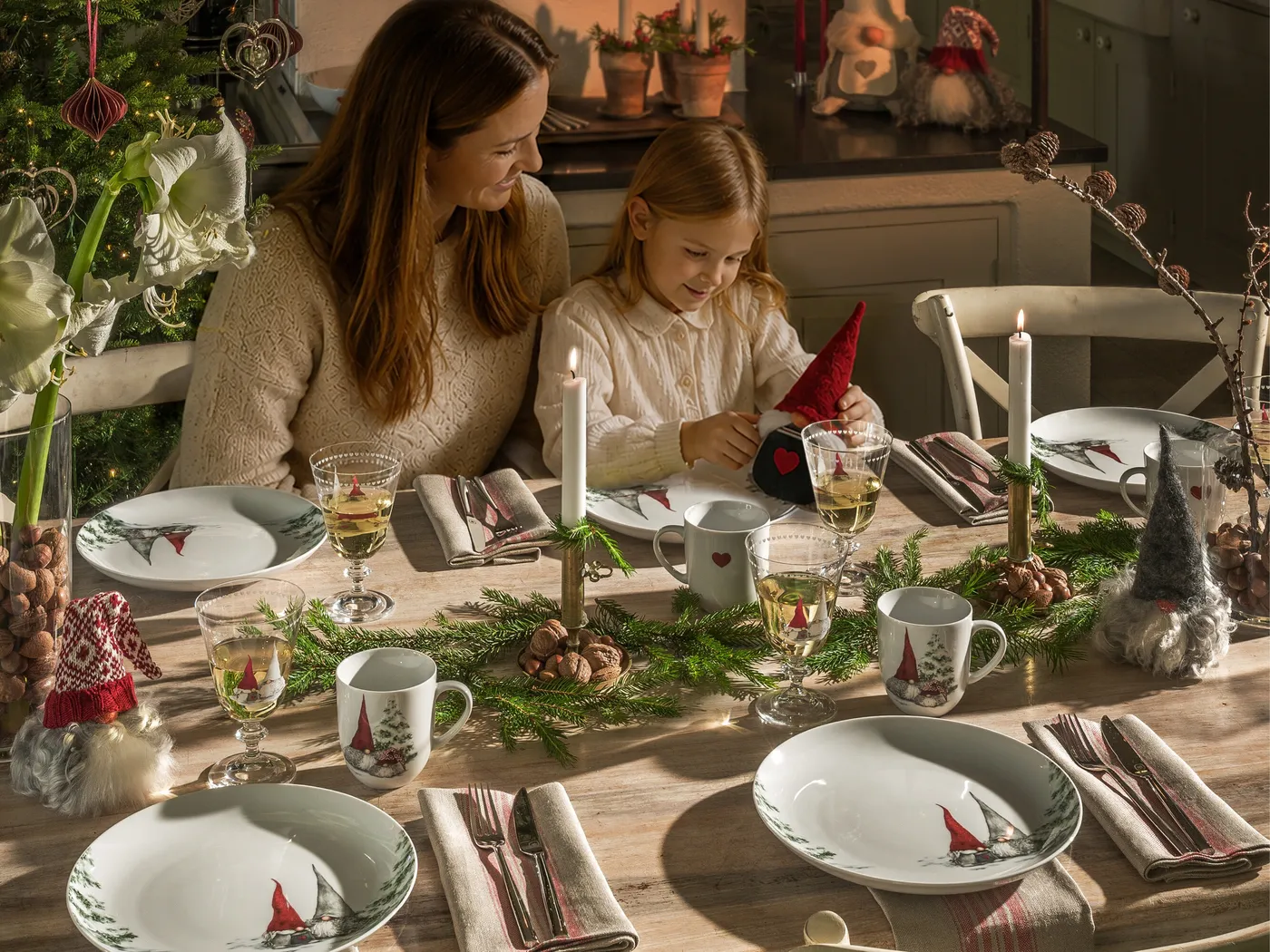
Choose one whimsical motif and repeat it exactly twice — once on the dinnerware, once in a single plush figure per pair of guests. Past that, the table stops reading as charming and starts reading as a toy shelf. One more thing: brushed cotton and felt catch stray sparks faster than you’d expect, so keep every gnome at least 6 inches back from a flame and pull the brass holders forward so the tapers sit clear of the branches.
7. Moss, Pillar Candles, and a Pinecone at Every Napkin
This formula runs 60 percent warm wood and cream, 25 percent forest green, 10 percent gold, and 5 percent white. The moss and pillar candles carry the green, the striped placemats hold the cream, and the gold lives almost entirely in the cutlery and the ribbon — which is why it reads as restrained rather than gilded. Swap the moss for preserved cedar and nothing changes. Swap the gold cutlery for matte black and the whole table slides toward modern Nordic.
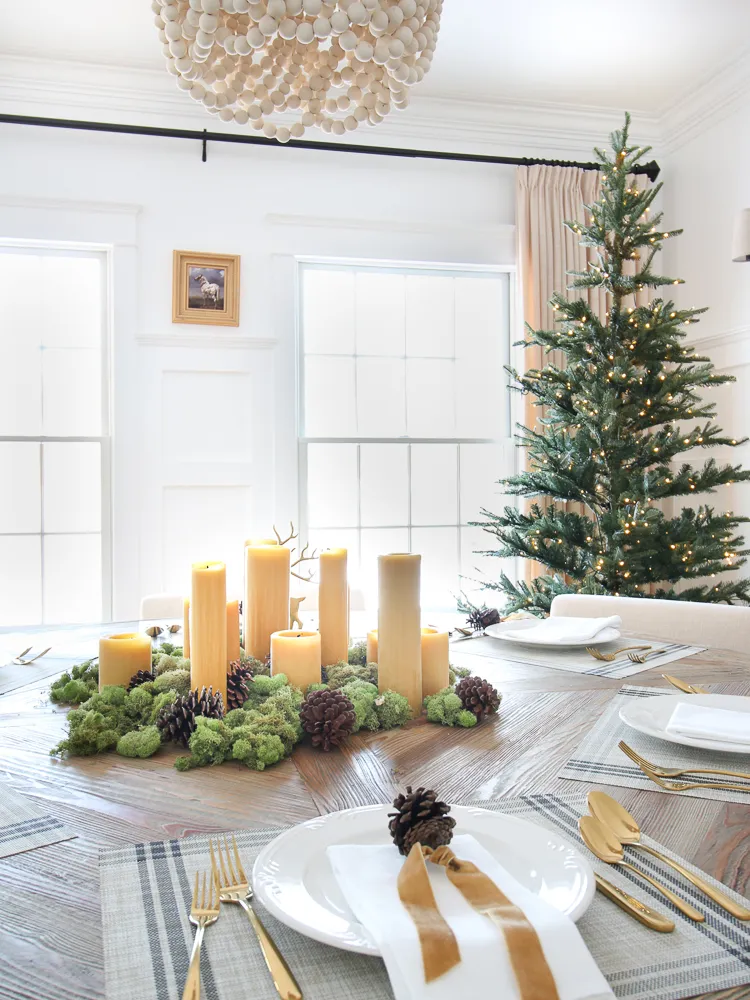
This one wants a rectangular table between 72 and 96 inches, where you can cluster pillar candles in odd numbers down the center without blocking anyone. Ceiling height matters less than you’d think; even an 8-foot ceiling handles a candle cluster under 14 inches tall. In a room under 120 square feet, skip the pre-lit tree in the corner and build the same mood with the glass vase display in Idea #20 — greenery without the footprint.
8. Eucalyptus Garland with Matte Red and Velvet Green Baubles
Eucalyptus is the reason this reads sophisticated instead of Santa. Its silvery-green leaves sit somewhere between gray and green, so matte red baubles lose that candy-cane cheerfulness and velvet-finish green ones look almost black in low light. Two matte textures plus one glossy element — the crystal glassware — keeps the table from going flat, and the beige linen stops the red from screaming. It’s a lesson in finish, not color.
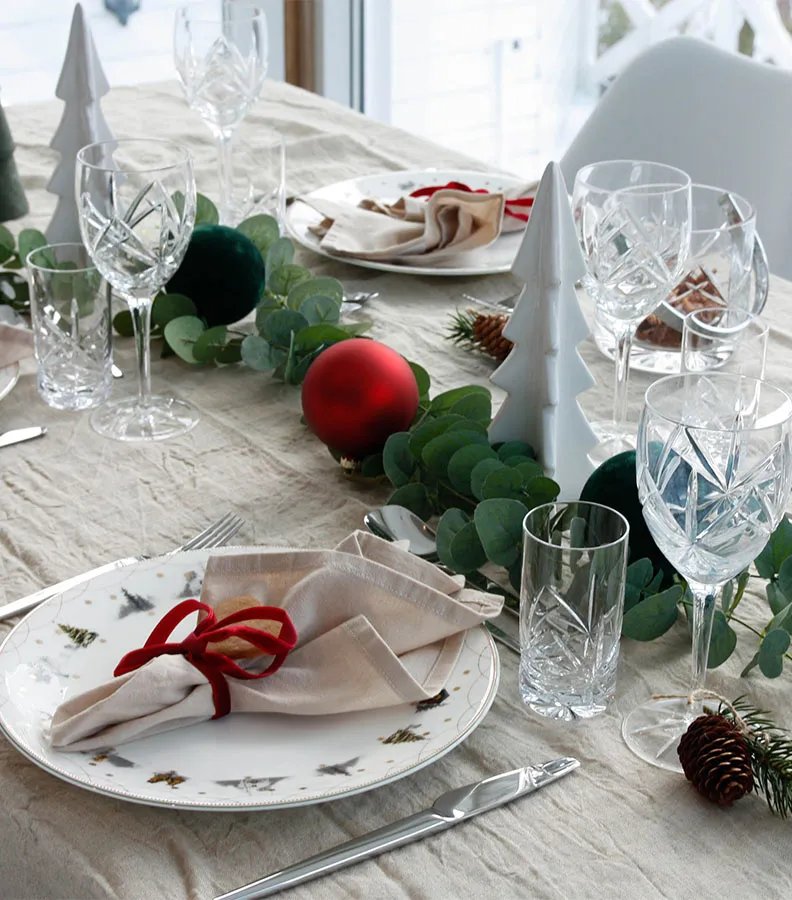
Real eucalyptus dries in five to seven days and starts dropping leaves the moment it does, so plan to swap in faux for anything past Christmas Day. Matte-finish ornaments show fingerprints and dust — a quick pass with a microfiber cloth before guests arrive solves it. And those beige linen napkins with red ribbon? Linen wrinkles, so press them the morning of, not the night before, and spot-treat any ribbon dye before it sets.
9. A Wire Bowl Stuffed With Evergreen, Glitter, and Ornaments
- Wire or mesh bowl, 12–14 in: $20–$60
- Evergreen branches, foraged or florist: $0–$45
- Mixed gold and silver ornaments: $18–$50
- Striped table runner: $18–$45
- Christmas crackers, set of six: $15–$40
- Total: $71–$240
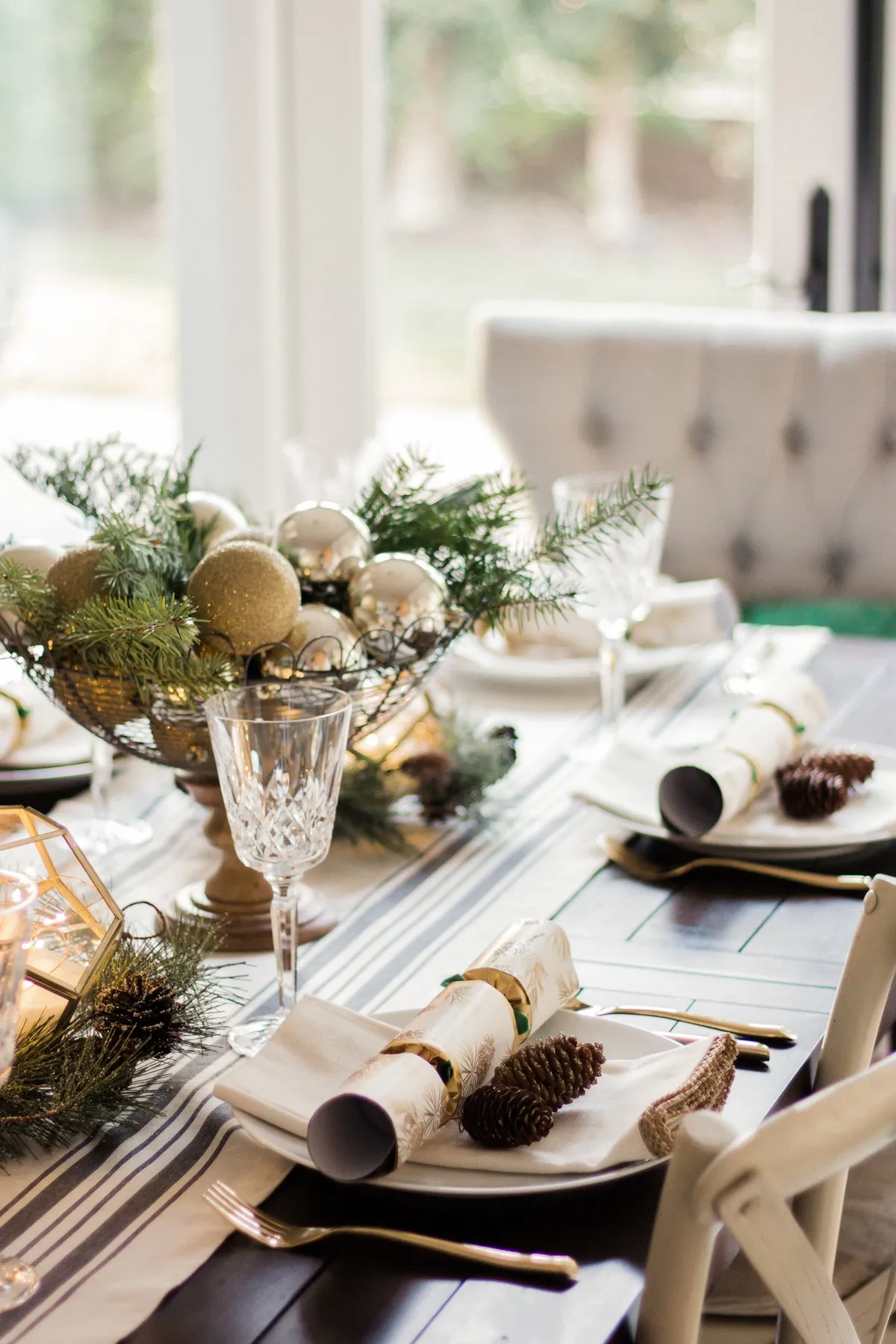
Budget alternative: a wire basket from a thrift store costs $4 and looks identical once it’s full. Clip branches from your yard or ask a tree lot for offcuts — most will hand them over free. Ornaments from last year’s clearance bin at 70 percent off do the same job as new ones.
The wire bowl works because you can see through it, so branches read as volume instead of mass. Line the bottom with floral foam or a rolled towel so nothing collapses when someone bumps the table, then build outward in a spiral so greenery spills 3 to 4 inches past the rim. Cap the height at 14 inches on a table seating six, and pile the ornaments low and to one side so the bowl has a front and a back.
10. Gold Beaded Cone Trees and a Geometric Runner
Roughly 50 percent cream and white, 30 percent metallic split between gold and silver rather than committing to one, 15 percent clear glass, 5 percent green. The split metallic is the sleeper move: gold beaded trees standing next to silver-and-gold ornaments in glass hurricanes means nothing looks like a matching set, which is exactly why it looks collected. Trade the gold for warm brass and the formula still holds. Trade it for rose gold and the table turns softer and more romantic.
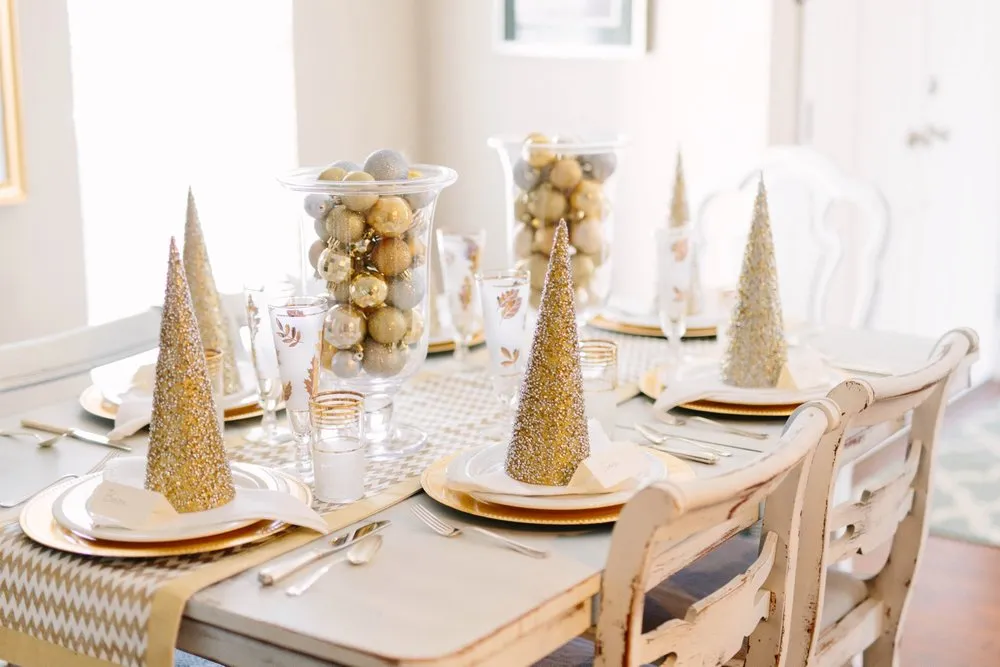
The beaded cone trees are the splurge, so hack them. Dollar Tree sells beaded cone forms for $1.25 that look convincing after a coat of metallic spray paint. Facebook Marketplace is full of clear glass hurricanes at $5 apiece, and thrift shops price gold chargers at $2 to $4 each. For the geometric runner, buy a plain white cloth and tape down a gold ribbon stripe — about $15 and fifteen minutes.
11. Fairy Lights Woven Through Real Boughs on Rustic Linen
The cozy-cottage Christmas revival is the biggest table trend heading into 2026, and it isn’t the same thing as farmhouse rustic. What’s driving it is a reaction to years of perfectly coordinated, store-bought tablescapes — people want tables that look assembled from things they already own. Illustrated and hand-painted dinnerware, real boughs, and slightly rumpled linen all tell that story. It has staying power because it’s a mood, not a color, so it survives whatever palette comes next.
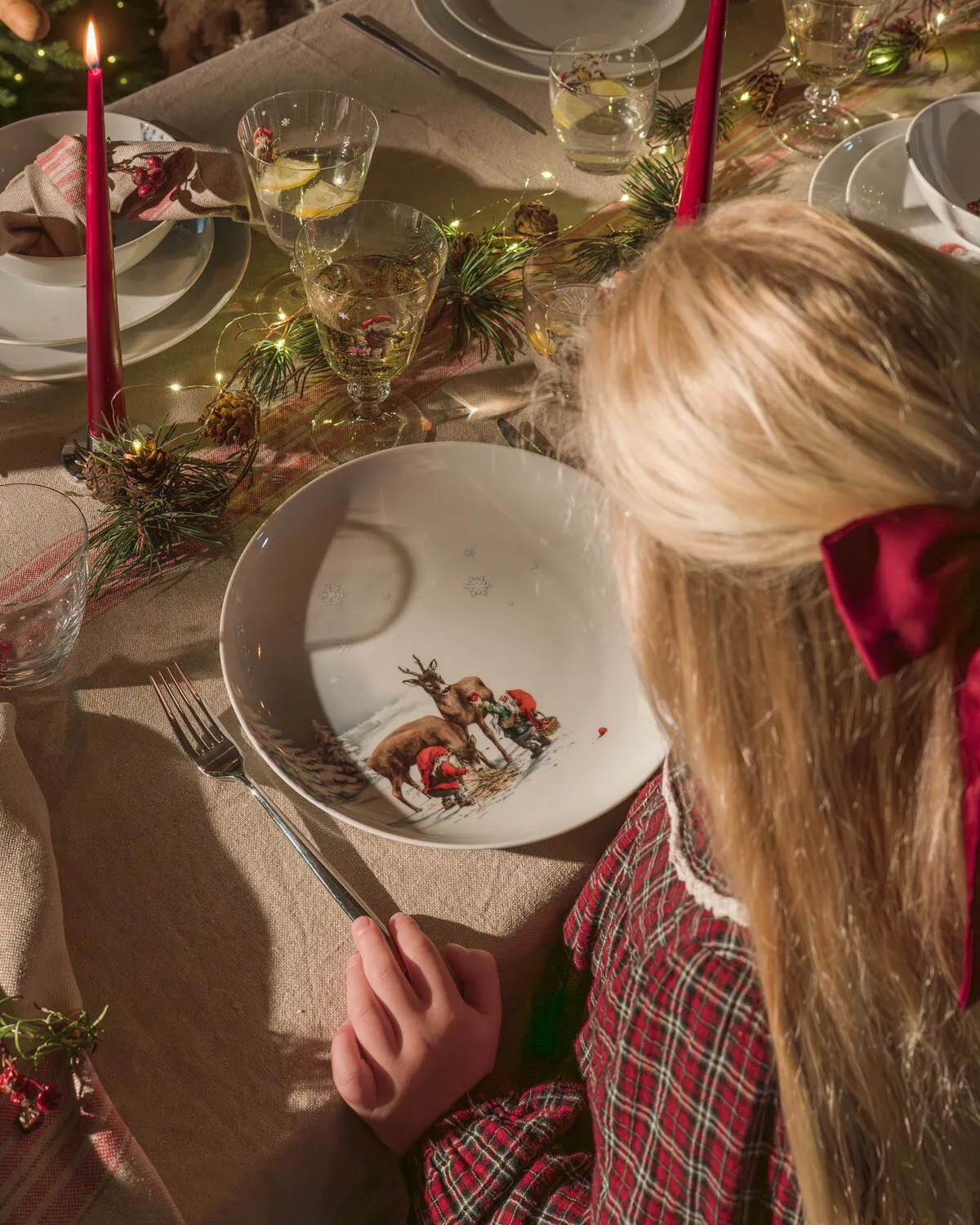
- Pick a copper or green-wire strand with a built-in timer; hide the battery pack under a folded napkin.
- Lay the boughs in a loose line and run the wire underneath first, so no plastic shows on top.
- Weave in and out every 6 to 8 inches, leaving slack so the branches can settle.
- Add pinecones and berries after the lights so they sit on the surface instead of getting buried.
- Switch it on an hour before dinner — LEDs run cool, so fresh greens won’t dry out.
About 25 minutes and $25 for a 6-foot strand.
12. White Ceramic House Luminaries Under a Brass Pendant
The ceramic houses are the whole trick. A centerpiece made of branches and candles looks like decor; a little village of glowing houses looks like a place. They add a second scale — small objects that pull the eye in close — and because the light comes from inside rather than above, the effect holds up even after the overhead lights go off. Take them away and you’re left with a nice arrangement and no story.
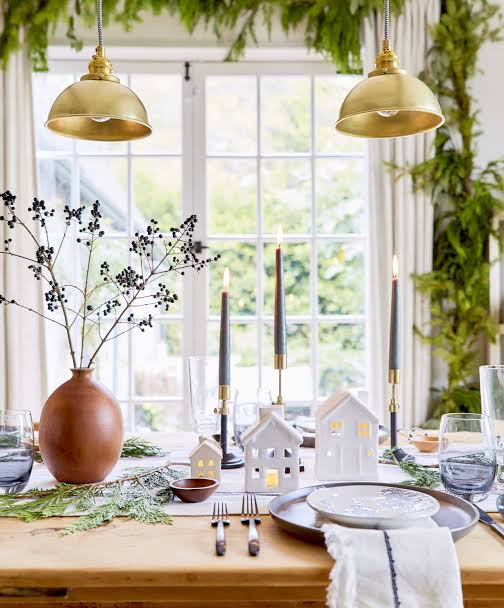
Real tealights inside ceramic houses get surprisingly hot, and a draft can topple a flame you can’t see. The unglazed kind can scorch a tablecloth in under twenty minutes. Use LED tealights for anything longer than a couple of hours, or set each house on a coaster or a wood slice to protect the table. And if you have a cat that treats the dining table as a highway, this is the one idea on this list to skip.
13. Jewel-Toned Ornaments Tangled Into a Green Garland
Color this saturated only works because it’s confined to a single line. The garland runs down the center as one ribbon of pink, teal, purple, gold, and white, while everything at eye level stays gold, white, and green. The teal napkins and gold beaded placemats repeat two of those colors, tying the table together without adding a single new element. Remove the restraint at the place settings and the centerpiece turns into a pile.
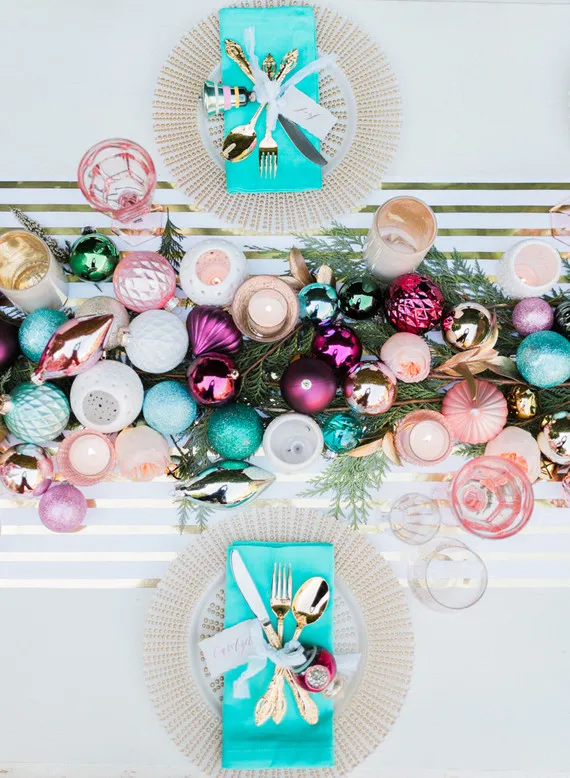
- Faux greenery garland, 6 ft: $25–$70
- Assorted ornaments in pink, teal, purple, gold, white: $30–$90
- Gold beaded placemats, set of four: $30–$85
- Teal napkins, set of four: $16–$40
- Votive holders and candles: $20–$55
- Total: $121–$340
Budget alternative: hit the after-Christmas bins in January — jewel tones are always the last to sell out, often at 80 percent off. A plain green garland plus a bag of mixed ornaments gets you 90 percent of this look for about $45.
14. Winter Wonderland in Silver, Moss, and a Blue Goblet
This setting is built for six to eight seats under a standard ceiling. The beaded plates and the patterned blue goblet add height at every place setting, so the centerpiece can stay low and horizontal — a garland running the length of the table is all you need. In a dining room of roughly 12 by 14 feet it fills the space without crowding. On a smaller table, pare back to plain white plates and look at the all-horizontal setup in Idea #19 instead.
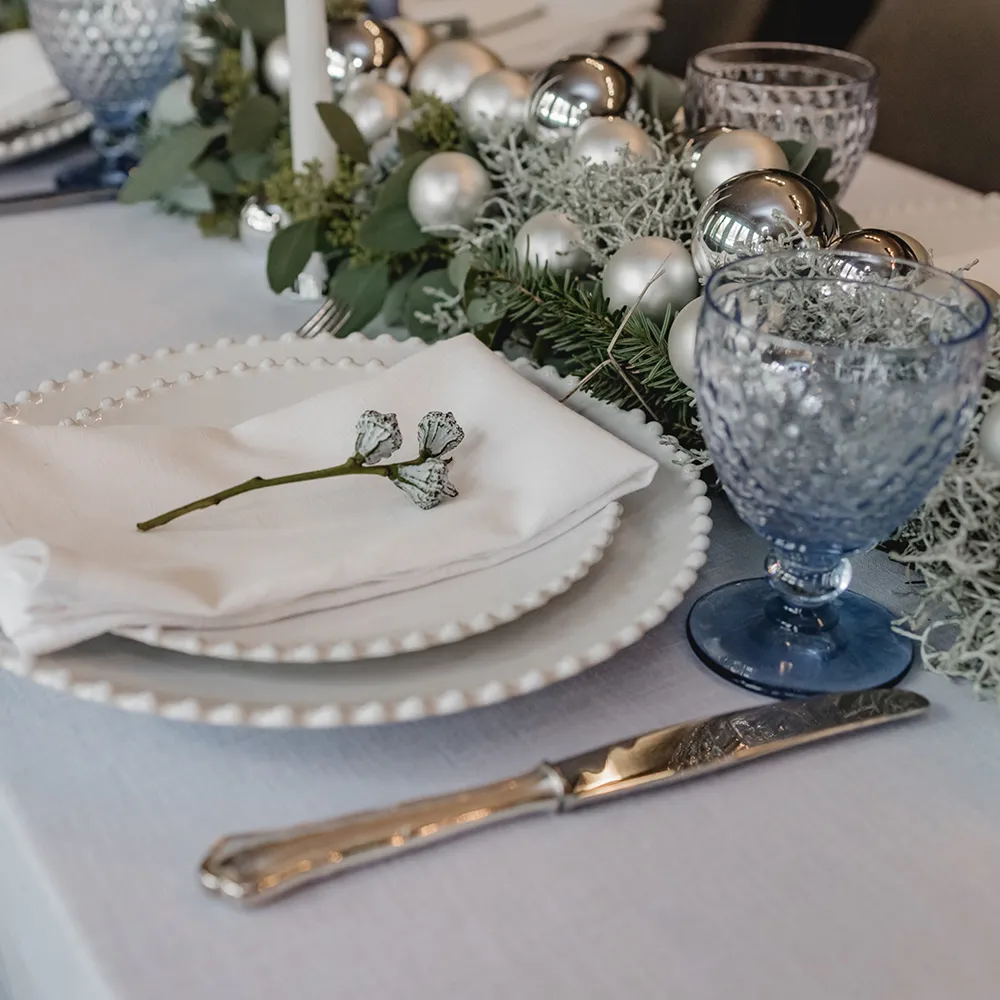
That single dried eucalyptus pod on the napkin is doing more work than it looks like. It’s the one organic, irregular shape in a very geometric setting, and it keeps the beaded chargers from feeling fussy. Use one stem per napkin, skip the ribbon entirely, and lay it on the diagonal so it points toward the center of the table rather than straight up. Two pods per napkin is one too many — restraint is what makes it look European.
15. Candy-Striped Linens with Gnome Dinnerware and Red Tulips
A red-and-white striped cloth plus illustrated plates plus gold-rimmed glasses is three loud elements competing for the same attention. It works in soft December daylight, but under a chandelier at 7 p.m. it can tip into visual noise. Stripes also show every wine drip and wax spatter, and with that much going on you lose the ability to add anything — no crackers, no place cards, no second accent. Pick two of the three loud pieces and let the third stay quiet.
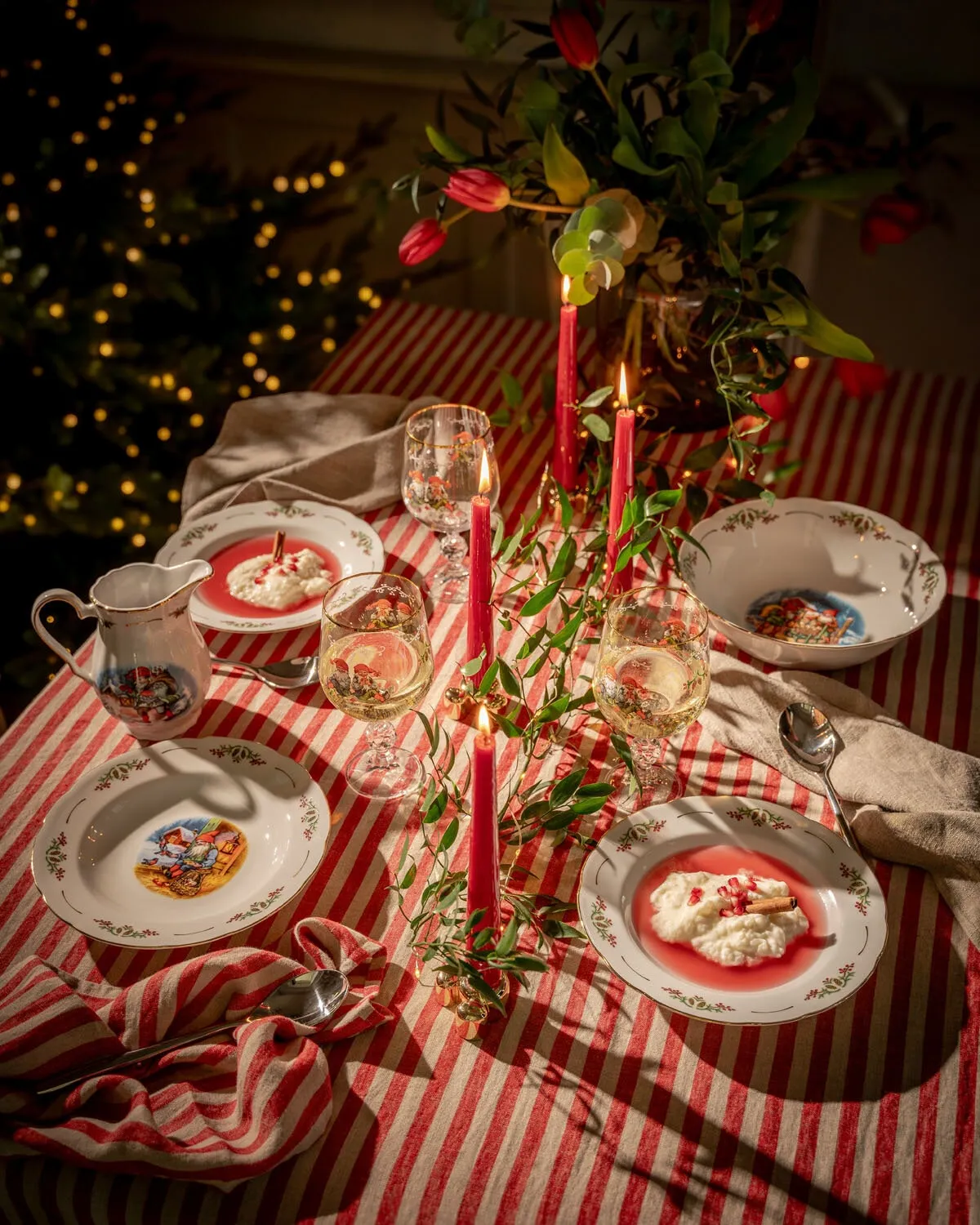
Tulips in December are $3 to $5 a stem and last about four days. Grocery-store carnations in red and cream cost a third of that and outlast them, and an amaryllis bulb you force yourself costs about $8 and gives you two weeks. The striped cloth turns up at HomeGoods around $25, patterned gnome plates run $4 to $8 at Target and Walmart, and gold-rimmed wine glasses are about $3 each at dollar stores.
16. A Beaded Skier Placemat and a Candy Cane on the Napkin
- Start with a scalloped felt or cork base cut to about 15 inches round.
- Sketch a simple skier silhouette in chalk — one figure, roughly 4 inches tall.
- Glue seed beads in rows, working one color at a time so they don’t mix.
- Let each figure dry flat for an hour before starting the next, or the beads slide.
- Seal with a thin coat of matte craft varnish and cure overnight.
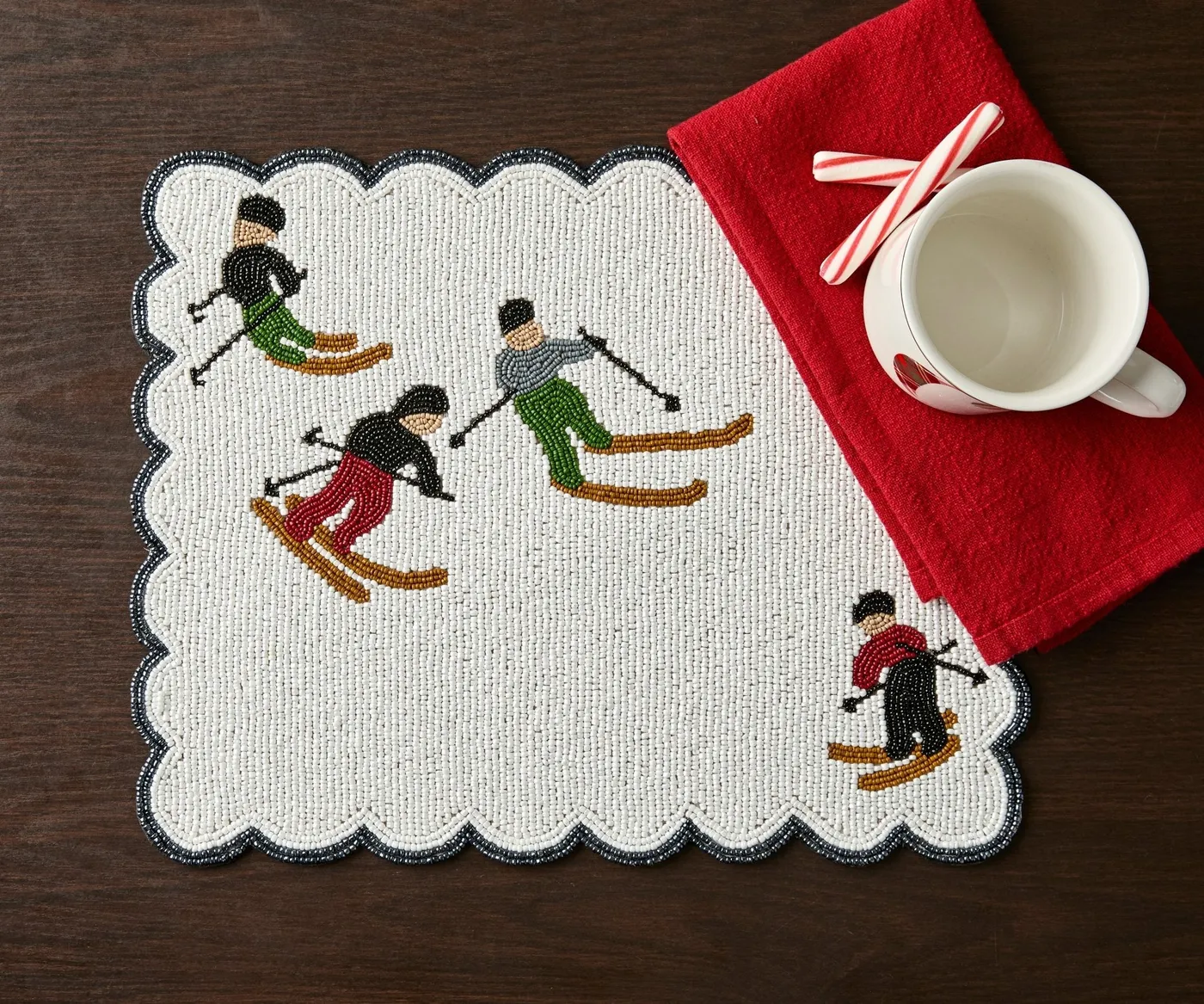
About two hours per placemat and $12 in materials.
Beadwork and hand-drawn winter figures are outselling minimalist ornament sets on Etsy right now, part of the broader grandmillennial pull toward things that look handmade. This kind of piece has staying power because it isn’t tied to a color story — the same skier placemat works with red and green, with blue and silver, or on a table that’s almost entirely white. It’s the detail guests pick up and turn over in their hands.
17. Light Green Stripes and Purple-Tinged Foliage Down a Long Table
Roughly 65 percent light green and white stripes, 20 percent fresh greens, 10 percent the reddish-purple foliage, 5 percent clear glass and silver. The striped cloth is doing the heavy lifting — it’s the only pattern, and it’s a quiet one, so the purple-toned stems read as an intentional accent rather than a random flower. Swap the purple foliage for deep burgundy and the mood gets warmer. Swap it for silvery gray greens and it turns distinctly coastal.
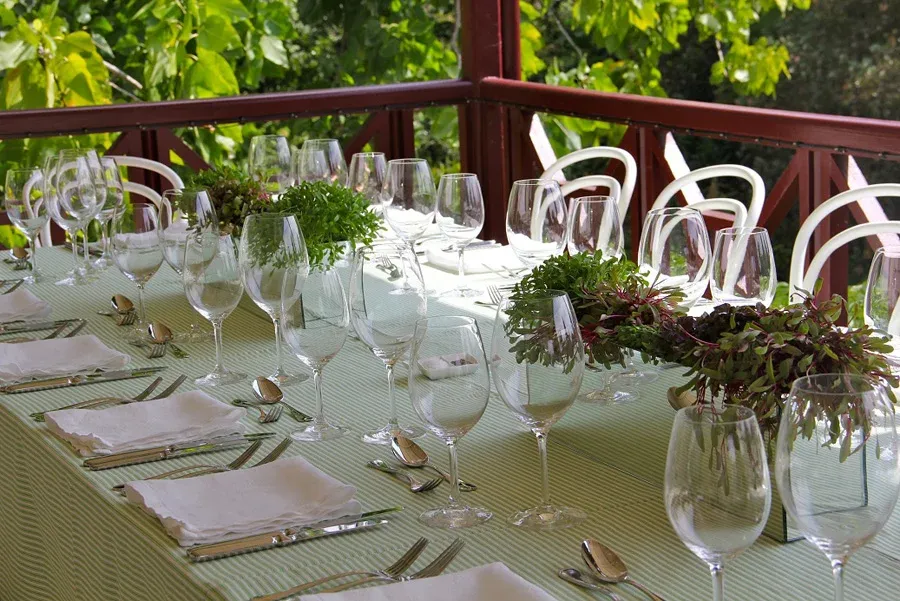
Fresh foliage in a warm house droops within a day unless the stems sit in water — cluster them in small glass vessels tucked under the greenery rather than laying them bare on the cloth. Pale green and white cotton show gravy and red wine instantly, so treat the cloth with a fabric protector before the first dinner. And if that flatware is real sterling, budget twenty minutes of polishing afterward; stainless looks nearly identical under candlelight.
18. An Evergreen Canopy Hanging Over a Round White Table
Overhead greenery is the tablescape idea everyone saved this year, and the appeal is obvious: it turns dinner into an event and photographs beautifully from a seated angle, which is how most of us actually experience a holiday table. It scratches the same itch as maximalism without adding clutter at eye level. That said, it’s a trend with a short lifespan in any single home, so hang it for a season or two rather than building it permanently into your dining room.
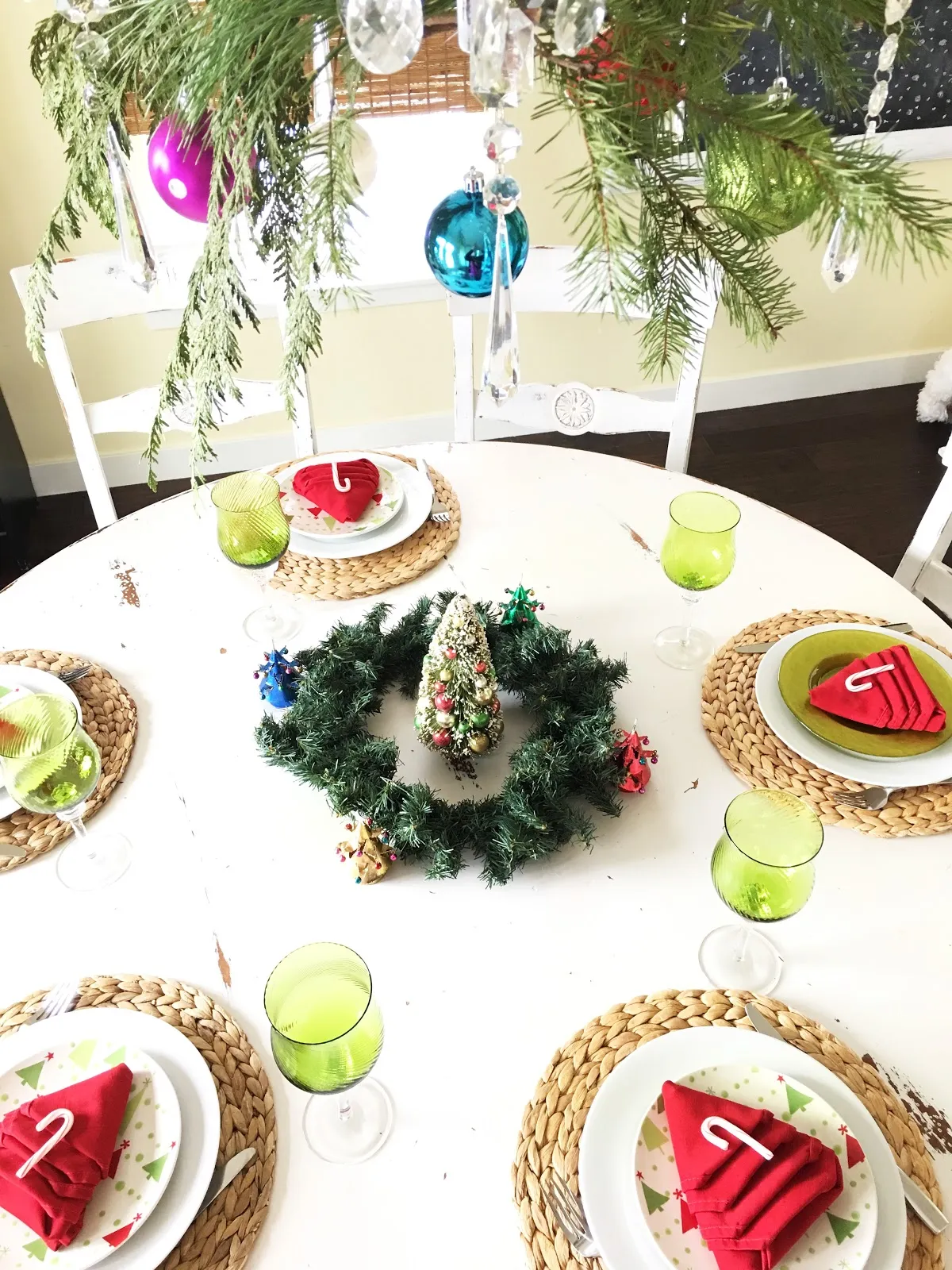
Hang with ceiling hooks rated for at least 20 pounds, anchored into a joist and never drywall alone. Use fishing line so the suspension disappears, and keep the lowest branches a full 3 feet above the tallest candle flame. Aim for a 30-inch gap between the greenery and the tabletop — tighter than that and the room starts to feel tented, especially under a standard 8-foot ceiling. Fluff the branches outward, not downward.
19. Gray Plates, Black Flatware, and Paper Stars on the Wall
Restraint is the entire design here. Plain white linen and soft gray plates create a canvas so quiet that three small evergreen sprigs and a few pinecones actually register as decoration — most tables need four times that much greenery to make the same impression. The matte black cutlery grounds the pale palette, and the black-and-white paper stars on the blank wall behind the table extend the same language upward. Nothing here is expensive. Everything here is edited.
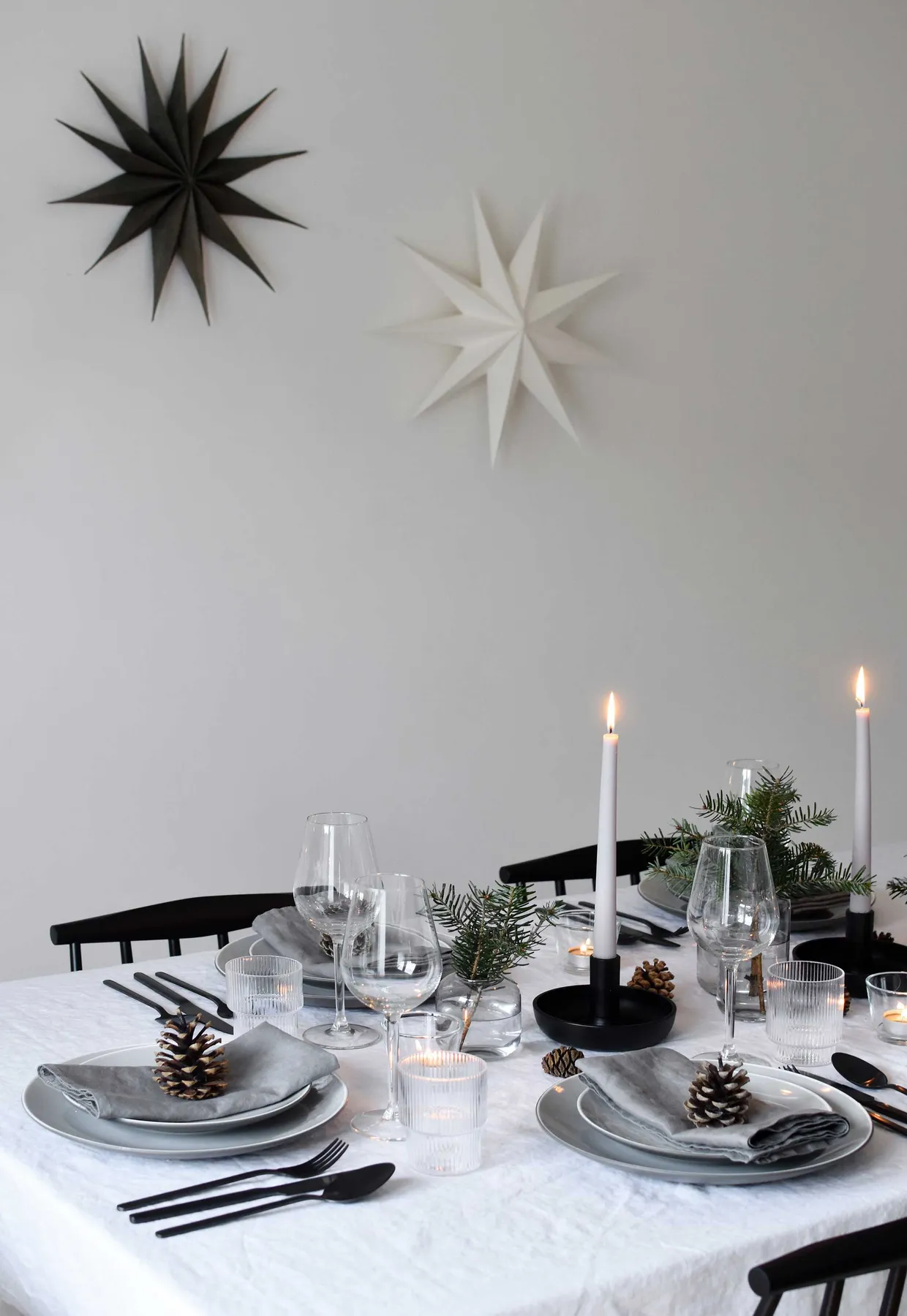
- Measure your table — this look needs a clear 60 inches minimum.
- Decide whether you can live with pressed white linen, which shows every drop.
- Check that the wall behind the table is plain enough for paper stars to read.
- Inspect matte black flatware for water spots before guests arrive.
- Set a $150 ceiling if you don’t already own gray plates and black cutlery.
20. White-Washed Branches and Frosted Pinecones in Glass
- Bake clean pinecones at 200°F for 30 minutes to deal with anything living inside.
- Mix white craft paint with water, one part paint to three parts water.
- Dip the branch tips and roll the pinecones quickly, then shake off the excess.
- While the pinecones are still tacky, dust them with fine white glitter.
- Let everything dry a full 24 hours before it goes anywhere near linen.
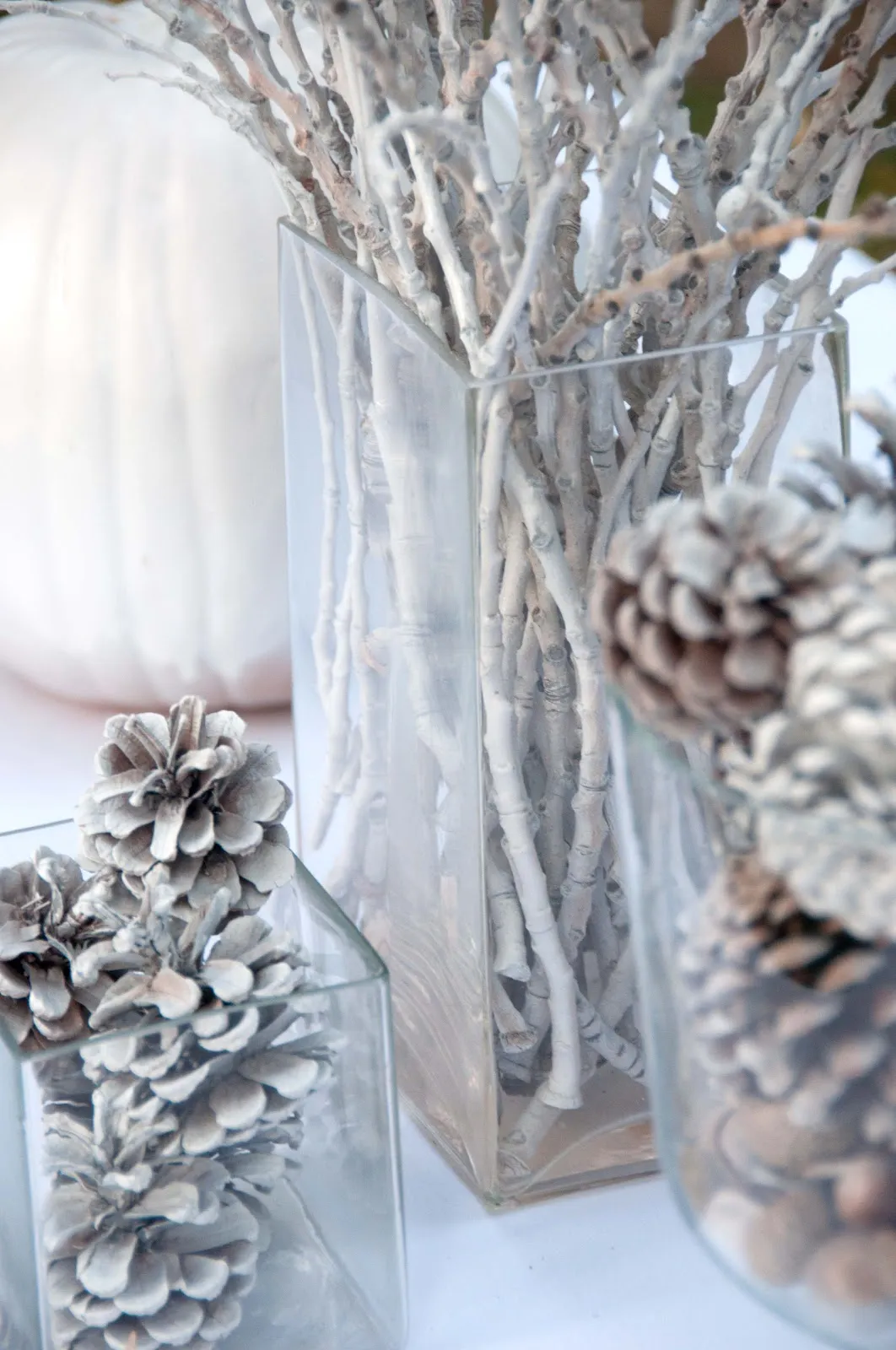
Roughly $15 in supplies and a 40-minute active window.
The clear rectangular glass vases are what make this read as winter rather than Christmas. Because you can see through them, the branches appear to float and the display stays visually light — a ceramic vase would ground it, quiet it, and make the whole thing look heavier than it is. Rectangular also means a narrow footprint, which is exactly why this works on a table with no room for a real centerpiece.
21. Building a Winter Wonderland Centerpiece That Doesn’t Look Cheap
Two things ruin winter wonderland centerpieces: shedding and disappearing. Faux snow and glitter migrate — by dessert there’s glitter in the butter — so put anything sparkly on a tray with a lip rather than directly on the cloth. The other problem is white on white: a pale centerpiece on a pale cloth at night becomes a rumor. You need one dark or metallic anchor, whether that’s a wood slice, a black tray, or a few silver ornaments mixed through.
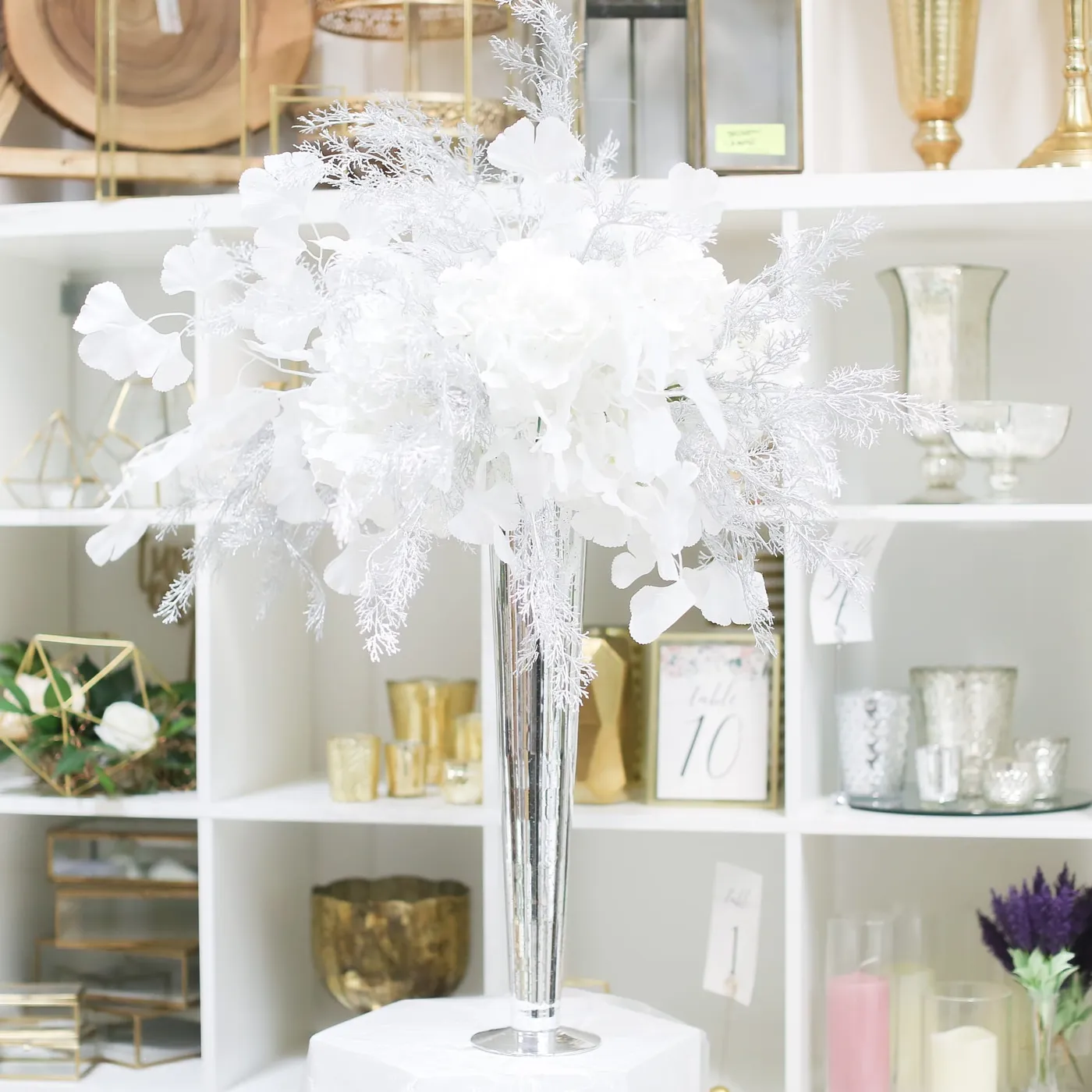
- Frosted branches or white-washed stems: $12–$40
- White and silver ornaments: $20–$55
- Tray or wood slice base: $10–$35
- Faux snow or batting: $8–$20
- Votive candles and holders: $15–$35
- Total: $65–$185
Budget alternative: batting from the craft aisle costs $5 and hides the mechanics better than any bagged snow. A single wood slice from a craft store runs about $10 and instantly makes a budget centerpiece look intentional.
22. A Bow Napkin Ring and a Plate of Cookies at Every Seat
This is the friendliest setting in the guide, and the charm is doing the work, not the budget. Dollar Tree candy canes run $1.25 a box, and a plain clear glass plate shows off chocolate chip cookies better than any holiday china. Patterned bow napkin rings are about $12 for a set of four on Amazon, or you can tie real ribbon bows for $4. Thrifted beaded placemats turn up constantly for $3 to $6. Figure roughly $60 for a table of eight. Compare with Idea #16, which uses a similar beaded mat in a much more formal way.
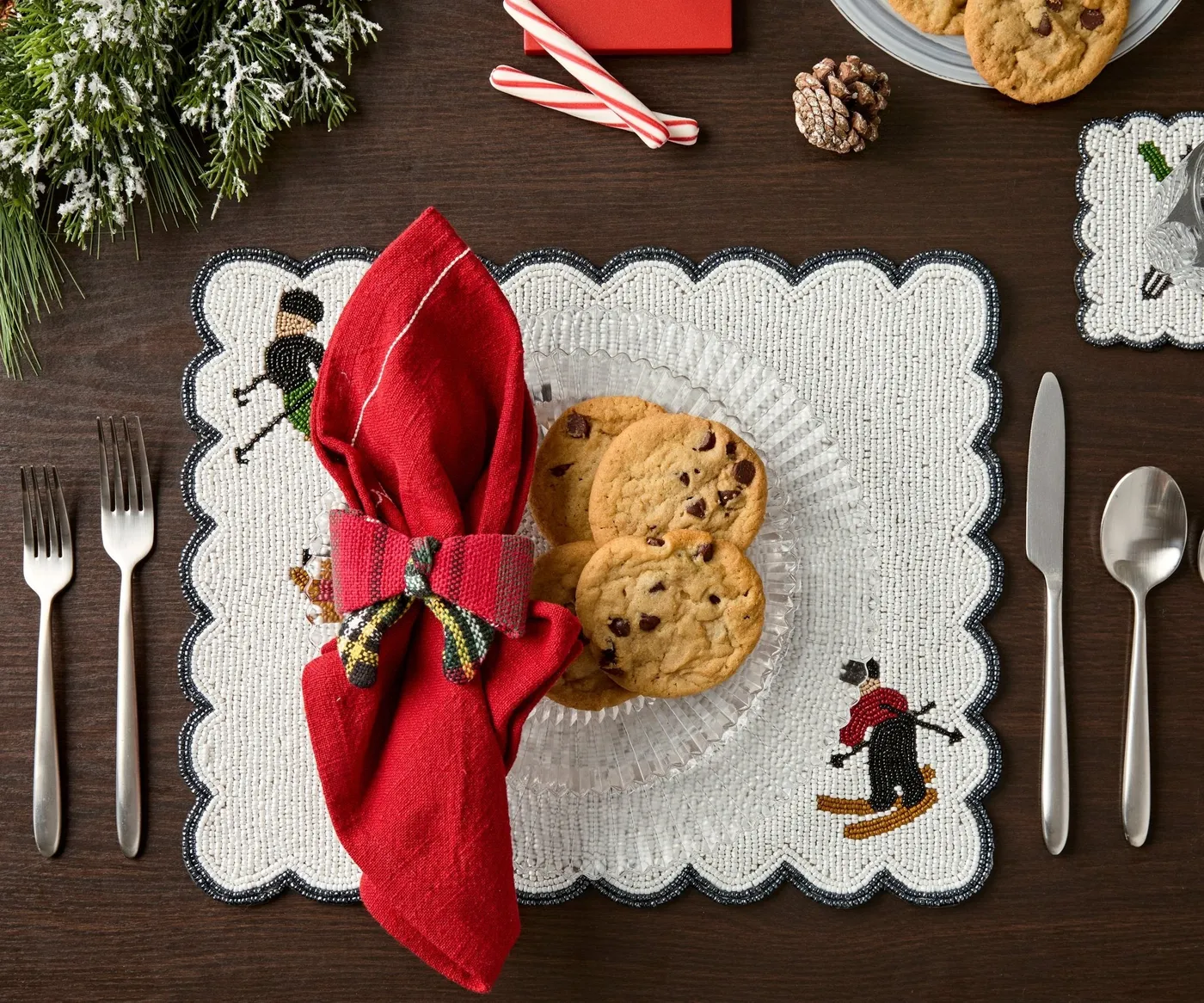
- Press the linen napkins flat — a wrinkled napkin makes a sloppy bow.
- Fold into thirds lengthwise, then fold in half to find the center.
- Pinch the center and pull it through the ring, or wrap a 12-inch ribbon twice.
- Make two loops, pull them tight, then adjust the tails.
- Trim the tails on a sharp diagonal and keep them under 4 inches.
Five minutes total for six napkins, and hand-washing linen means they’ll outlast every paper napkin you own.
23. Flocked Garland, Brown Tapers, and Ornate Brass Candlesticks
Standard taper candles have a 7/8-inch base, and vintage European holders often take a thinner 5/8-inch stick — check before you buy, or you’ll be wedging foil into a family heirloom. A dab of sticky wax keeps a loose taper from wobbling. Use odd numbers, vary heights by 2 to 3 inches so the flames don’t line up, and keep every taper at least 6 inches from the nearest branch. Three mismatched brass holders beat six matching ones every time.
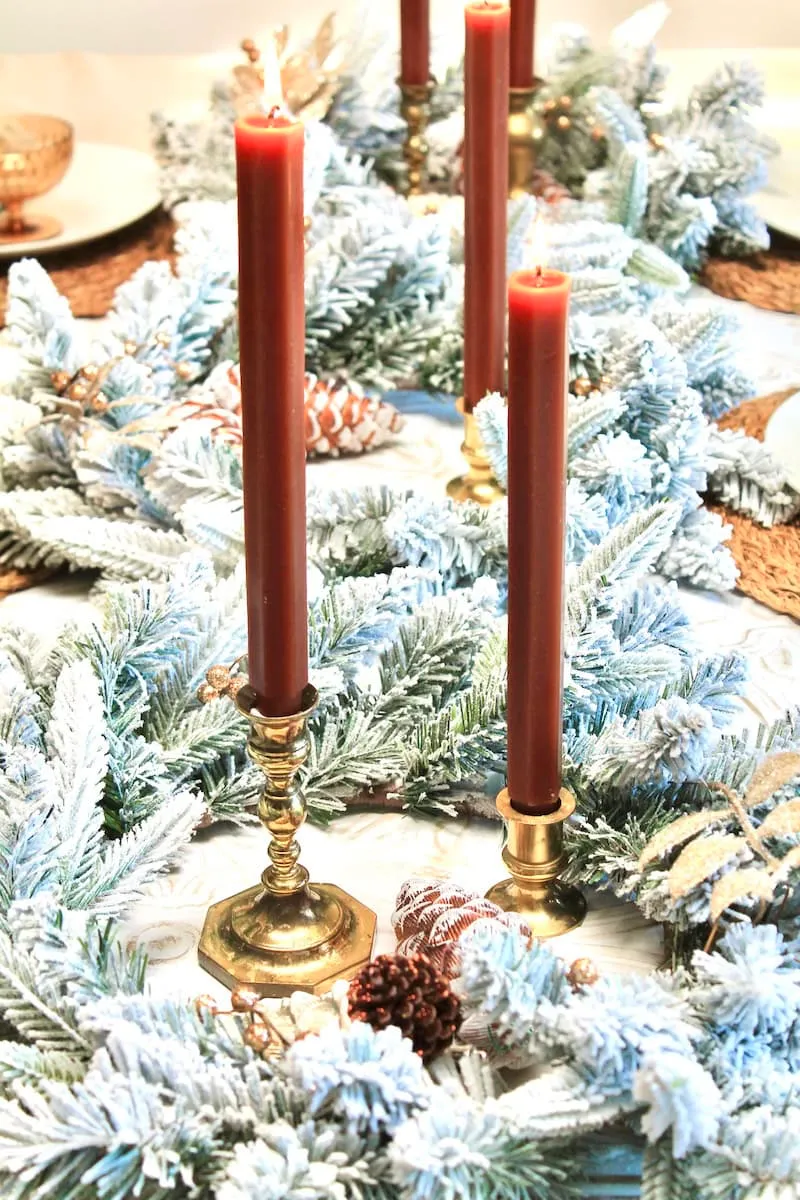
Flocked greenery is cool and slightly gray, dark reddish-brown candles are warm and earthy, and unpolished brass sits right between them. That’s a three-part temperature sandwich, and it’s why this arrangement looks expensive without a single red bow or Santa anywhere on the table. The gold berries are the only true sparkle, which makes them read as deliberate. Swap the brown tapers for white and the whole thing goes flat and ordinary.
24. Golden Poinsettias and Beaded Candle Holders on Raw Wood
- Evergreen garland, 6 ft: $30–$85
- White pillar candles with gold beaded holders, set of three: $35–$95
- Gold glitter poinsettia picks, set of six: $14–$35
- Red-and-gold patterned napkins, set of four: $20–$45
- Diamond-pattern champagne flutes, set of four: $25–$70
- Total: $124–$330
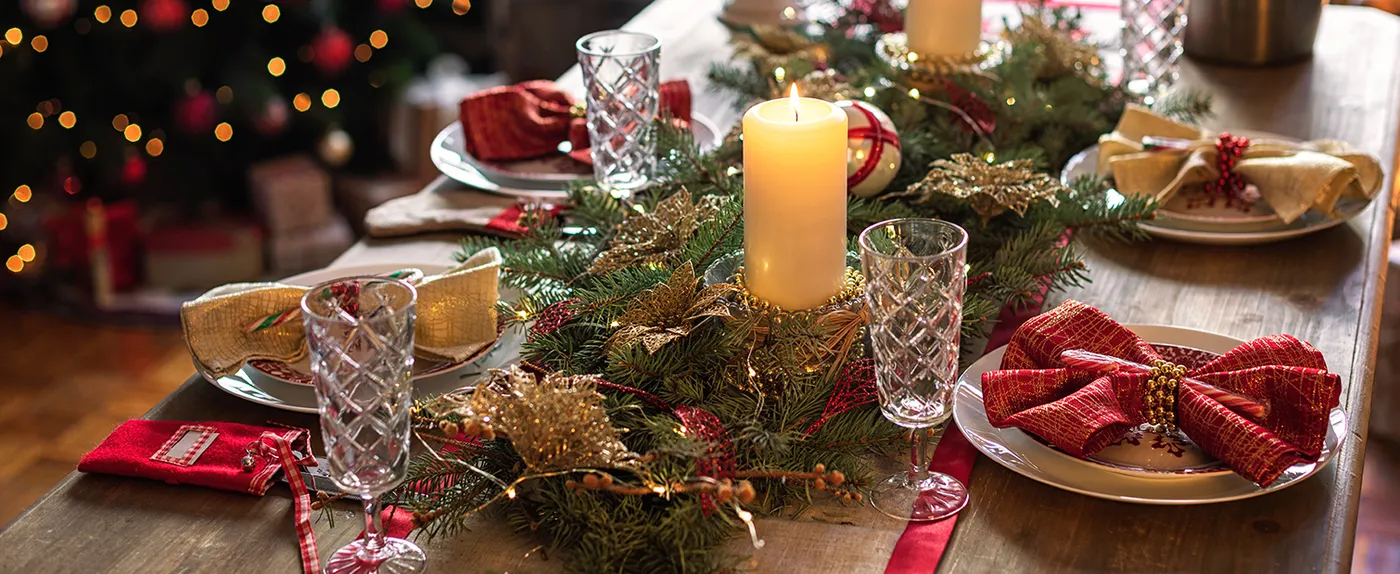
Budget alternative: pick up poinsettia picks the week after Thanksgiving with a 50 percent coupon, and use plain white pillar candles in thrifted brass holders instead of beaded ones — that alone saves $50. Dollar-store champagne flutes with a diamond texture are surprisingly convincing at $1.25 each.
Glitter on an unsealed wood table is permanent, so put a runner or a felt pad under anything sparkly before the first guest arrives. Pillar candles tunnel when you blow them out instead of snuffing them, which cuts their usable life roughly in half. And diamond-cut glass holds water spots — hand dry rather than air dry, or the pattern goes cloudy by New Year’s.
25. A Single Matte White Plate on Grey-Blue Texture
About 70 percent matte white and grey-blue, 20 percent pine green, 7 percent deep red, and 3 percent gold. The matte finishes are what make it work — glossy white against grey-blue would read like a bathroom tile sample, while matte absorbs light and lets a single pine sprig be the star. Swap the gold cutlery for brushed steel and the setting turns Nordic. Swap grey-blue for warm charcoal and it gets moodier and a touch more dramatic.
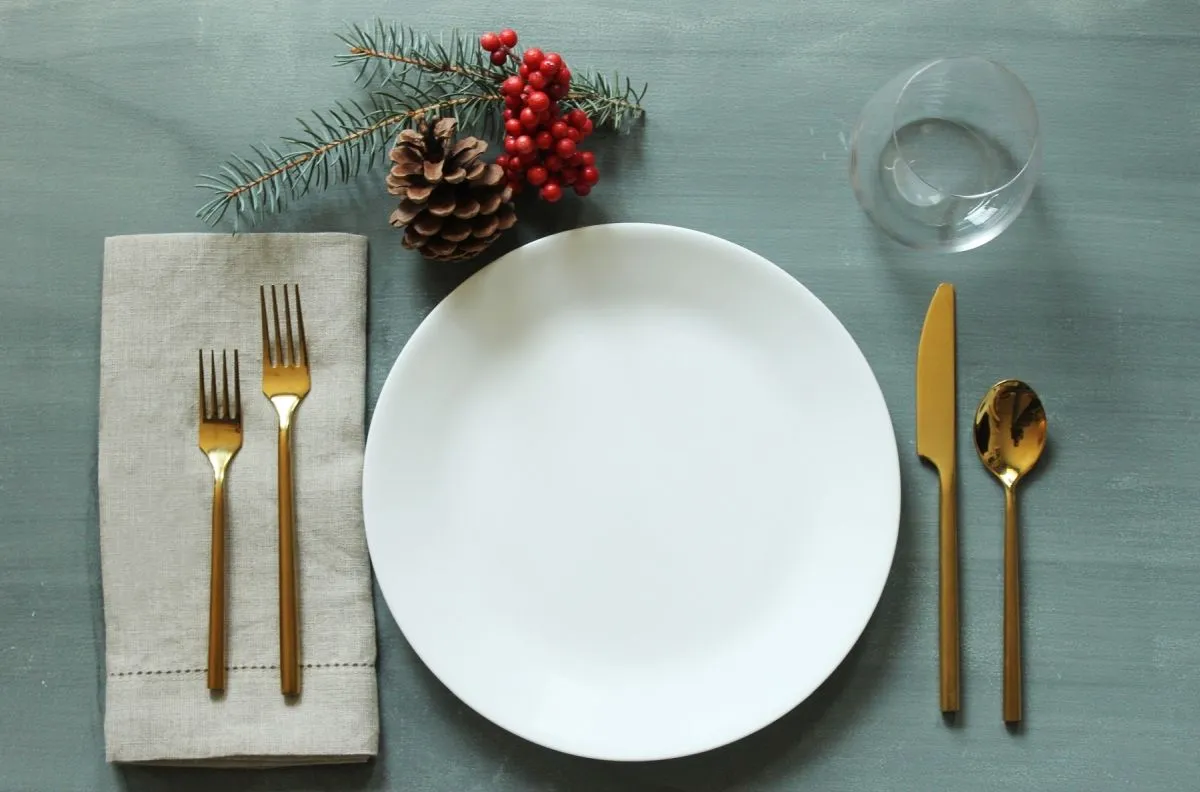
- Lay your plate on the surface in daylight — matte white and grey-blue can go flat under warm bulbs.
- Check the napkin size against the plate; 20 inches square is the sweet spot.
- Make sure the pinecone rests inside the rim without touching where food goes.
- Confirm your cutlery is true gold-toned, not brass, if you want it to stay bright.
- Budget $90 minimum for six complete settings.
26. Walnuts in the Garland and Black Candle Holders
Black candle holders only feel intentional when something else on the table echoes them — here it’s the dark shadow lines under the plates and the contrast against pale linen. If your table is all warm wood and cream, switch to matte charcoal or aged iron so the contrast reads as a decision rather than a mistake. Keep tapers at least 10 inches tall so the flames clear the garland entirely, and let the nuts sit loosely rather than in neat rows.
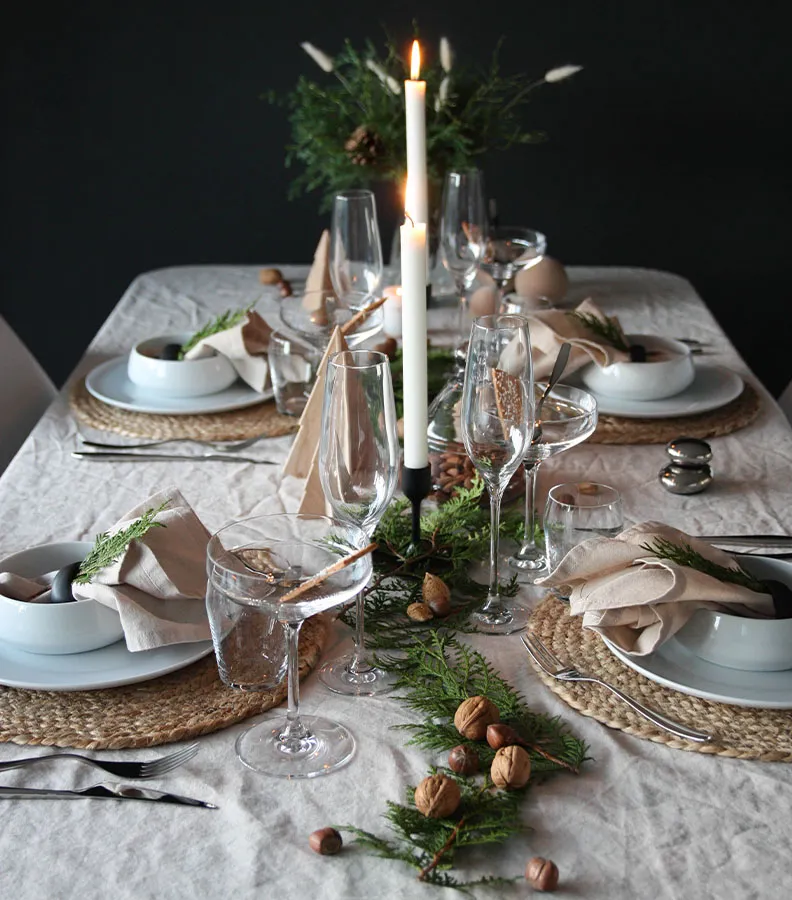
Unshelled walnuts and hazelnuts cost about $6 a pound and deliver instant Nordic styling — skip the $40 dried-fruit garland and buy two pounds of mixed nuts instead. Round woven placemats are $3 to $5 each at IKEA and Walmart, and thrift stores price them around a dollar. Plain white ceramic plates from a restaurant supply store run about $3 apiece, and they’ll outlast every seasonal set you’d buy at a craft store.
27. Red Placemats Under Glass Hurricane Lamps
The glass hurricanes are the pivot point. They do three jobs at once: they keep the flame steady in a draft, they multiply the glow against the white cloth, and they add vertical height without the sightline problem of a tall centerpiece. Without them you have a garland and some red placemats — pleasant, but the table stops feeling like an occasion. If the red is too much for your room, borrow the calmer version from Idea #3, which uses the same garland with gold instead.
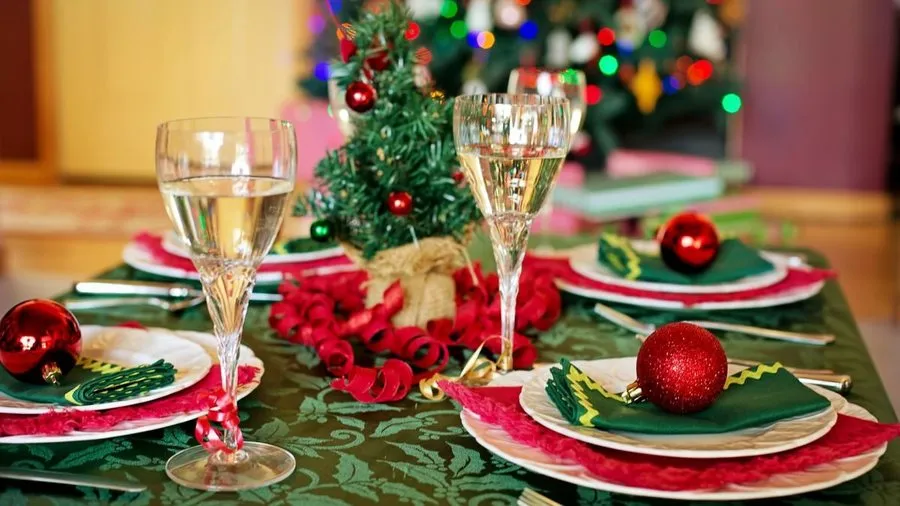
Red placemats on a white cloth will bleed if they get damp, so test each one with a wet cloth before the meal. Wax spatter on white linen is a two-hour job, so snuff the candles rather than blowing them out. And glass hurricanes get hot at the base within about twenty minutes, so give each one a felt pad or coaster underneath. Check the fresh berries in the garland and swap them once they start to shrivel.
28. Floating Ornaments in Water-Filled Glass Cylinders
- Use shatterproof ornaments — glass looks better but reads murky underwater.
- Fill each cylinder three-quarters with room-temperature water; cold water clouds the glass.
- Drop in ornaments one at a time; three per vase is right for a 6-inch cylinder.
- Add one drop of clear dish soap to break surface tension so they settle evenly.
- Arrange the three heights in a triangle, then scatter snowflake cutouts around the base.
- Top up the water every other day — it evaporates faster near a heat vent.
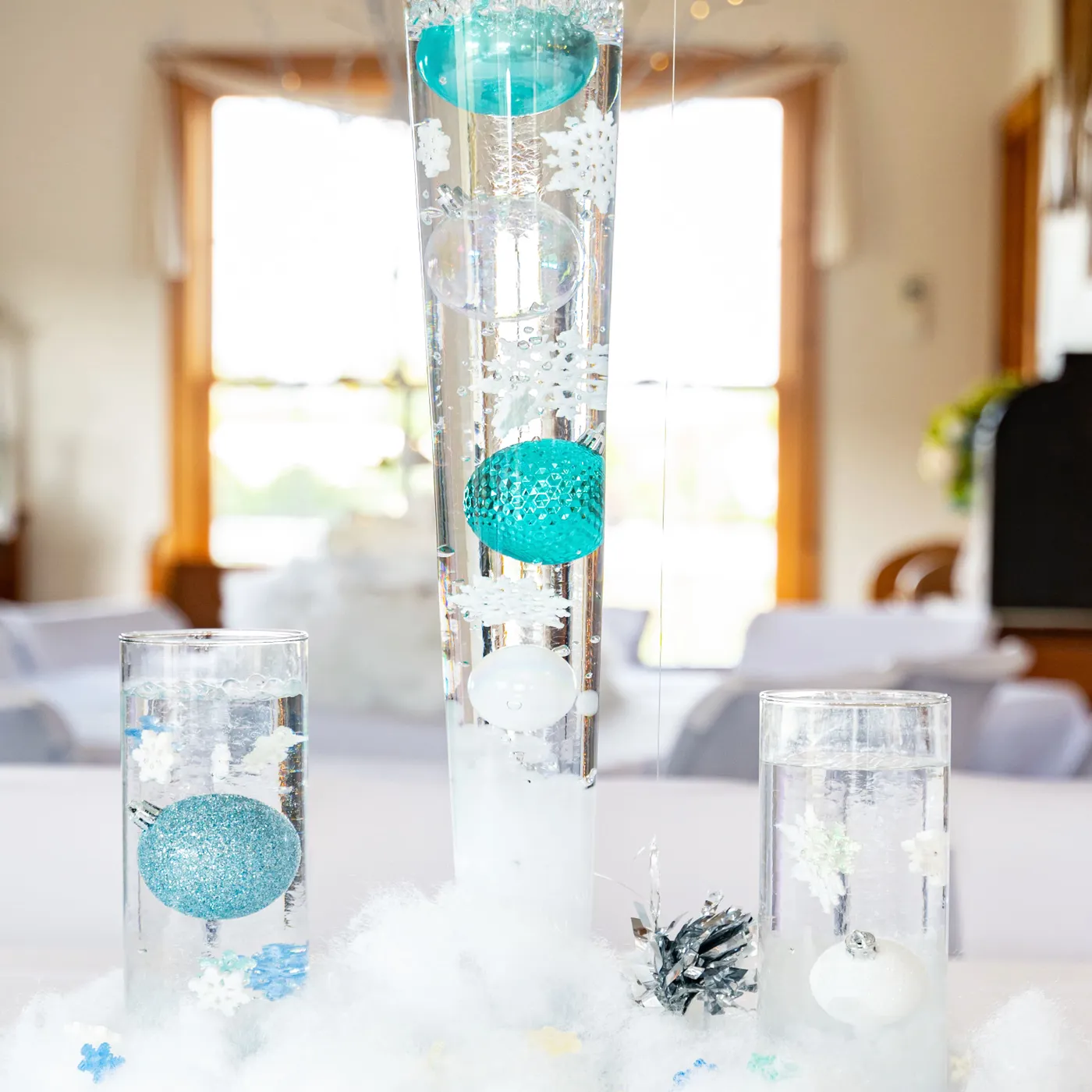
Fifteen minutes and about $20 if you already own the vases.
Clear glass cylinders are $4 to $9 at Dollar Tree, Walmart, and IKEA, and a bag of shatterproof ornaments in teal, ice blue, and white runs about $12 at Target. Cotton batting from the craft aisle stands in for faux snow at $5 and won’t shed the way glitter does. The whole centerpiece comes in under $40, and it stores flat for next year.
29. Silver Reindeer and Frosted Branches on a Wood Slice
The wood slice base isn’t just rustic charm — it gives a wide, stable footprint so a tall vase and spread branches don’t tip when someone reaches across the table. It also anchors the arrangement visually, which means this works on tables from 48 inches up rather than only on long ones. Two silver charger plates at the outer settings are enough to carry the theme. On a table seating four, use one vase; on eight, keep the triangle of heights and add a second reindeer. Same icy idea, quieter, in Idea #14.
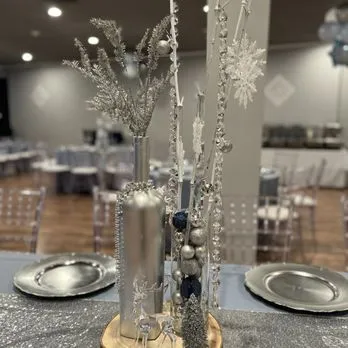
Blue and silver has quietly overtaken red and green in the winter category, largely because it can stay up through January without looking late. This palette reads as seasonal rather than strictly Christmas, which is why tablescapes built around it are among the fastest-growing holiday searches on Pinterest this year — and why they’re a smarter buy if you’d rather not pack everything away on December 26.
30. One Repeatable Formula for Seven Festive Table Settings
Every holiday table that actually photographs well follows the same skeleton: a neutral base layer, one botanical element repeated down the center, two or three candles, and a single accent color used at least three times. Strip away any one of those and the table looks either empty or chaotic — which is why you can mix pieces from a dozen different sources as long as the skeleton holds. The details change every year. The structure doesn’t.
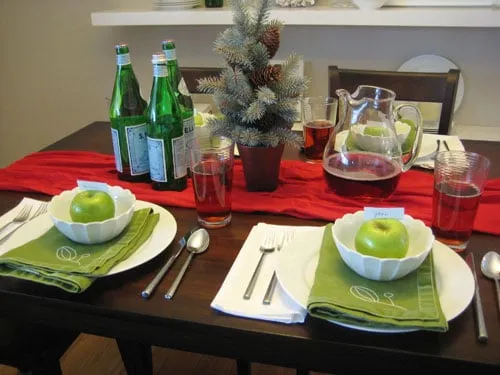
Set the table two days early and photograph it from where you’ll actually sit, not standing overhead. Nine times out of ten the centerpiece turns out to be 3 to 4 inches too tall or too wide, and the flatware looks scattered from a seated angle even when it’s perfectly spaced on the tabletop. Fix those two things — height and flatware line — and the table reads as designed rather than decorated.
Light the Candles — Your Table Is Ready
You don’t need all thirty of these — you need one that fits your table, your light, and the amount of energy you actually have left in December. Pick a palette, borrow two details from the setups above, and let the candles do the heavy lifting.
Pin this guide now so it’s waiting for you again next year, and if you try one of these tables, we’d love to hear which one won.