You know that feeling when a Christmas tree photo stops your scroll at 11 p.m. and suddenly nothing else will do? That happened to us about forty times while pulling this together. We dug through Balsam Hill, Anthropologie, Target, Crate & Barrel, and West Elm to find the trees, trims, and tabletop details actually worth your money this year — everything from an $18 ornament set to a $1,200 statement tree. Inside you’ll find 30 curated ideas spanning flocked neutrals, vintage pink tinsel, jewel-toned formals, coastal blues, and full-on gold maximalism, with budget and luxury versions compared side by side. Nostalgic, hyper-personal color is the story of the season: search interest in non-traditional trees keeps climbing as people move away from one-size-fits-all red and green. And stay until the end — we break down the most common mistakes that can ruin these looks. 📌 Save this to Pinterest for later — you’ll want to revisit these ideas.
This post contains affiliate links. If you buy through them, we may earn a small commission at no extra cost to you.
1. Flocked Pre-Lit Tree in a Warm Rustic Cabin Corner
The whole trick is temperature contrast: a snowy, cool-toned flocked tree standing in a room built from warm materials — light wood floors, a wooden mantel over grey stone, a woven wicker log basket. Strip that warmth away and flocking reads flat and faintly sterile. The big window does quiet work too, framing real snow-dusted evergreens so the tree’s pale branches feel like an extension of the landscape rather than a decoration dropped into the corner.
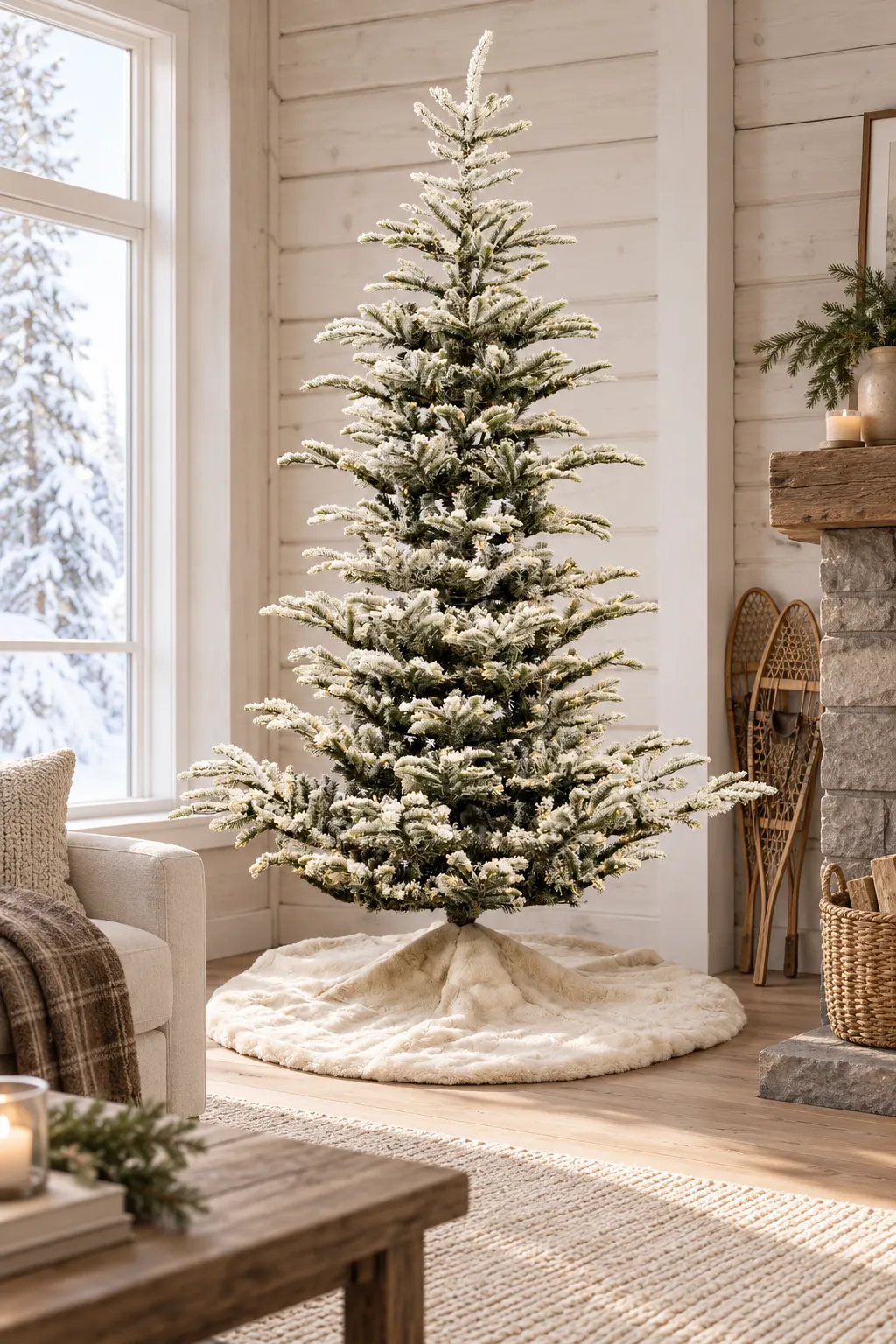
Even a pre-lit tree needs supplemental light to look expensive. Add two 100-bulb warm white strands — one woven deep against the trunk, one threaded just under the outer branch tips. That inner-outer double layer is what makes a flocked tree glow from the inside instead of looking lit from the front. Keep every bulb at 2700K; anything cooler will fight the cream faux fur skirt pooled at the base.
2. Gold, White and Dark Brown Tree in a Slipcovered Living Room
Here’s the formula: 60% quiet white base (the slipcovered sectional, the chunky off-white rug, pale walls), 25% warm gold in the ornaments and woven wall baskets, 10% deep brown on the coffee table and a handful of baubles, 5% grey plaid for texture. Swap gold for copper and the tree still works. Swap the slipcover for oatmeal and the room goes softer — the percentages stay exactly the same.
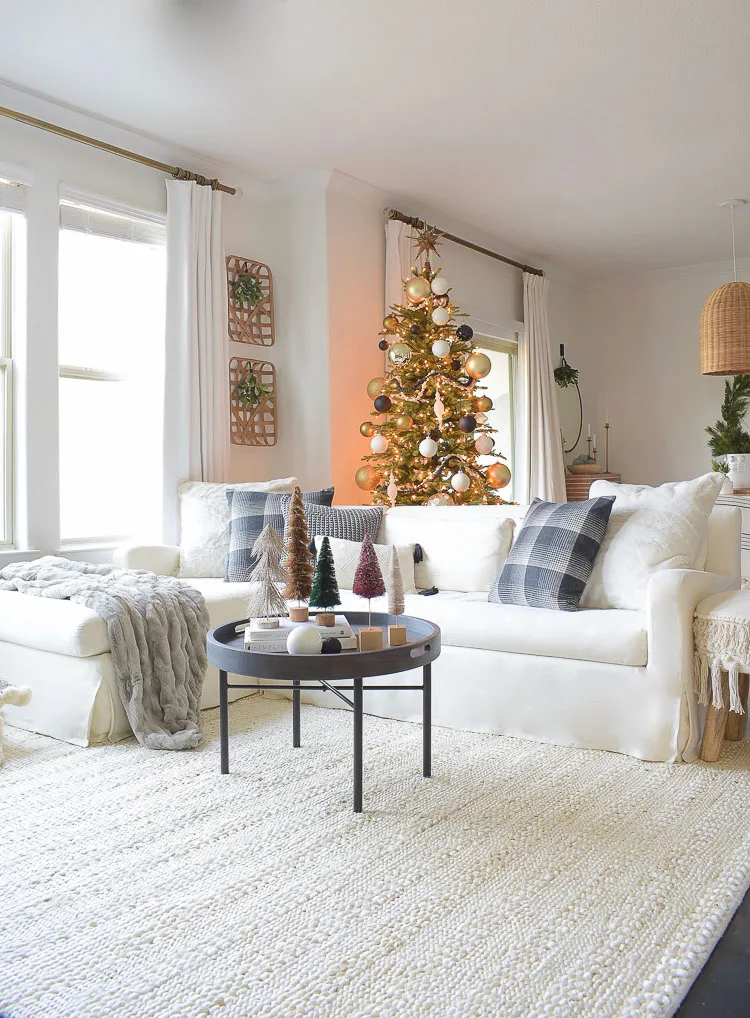
It’s the miniature bottle brush trees clustered on the round dark coffee table. They repeat the tree’s silhouette at one-twentieth the scale, which is why the room feels composed instead of merely decorated. Take them away and you still have a pretty living room with a tree in it. Keep them and the eye travels from tabletop up to branches — a conversation instead of a single shout.
3. Flocked Tree with Blush, Pearl and Warm White in a Grey Room
Blush-and-pearl trees spent a few seasons as a niche Pinterest thing and crossed over hard this year. The reason is practical: soft pink and white photograph beautifully in the light-filled, grey-walled rooms that dominated recent renovations, and they photograph even better on a phone. It’s the most shareable palette going, and it’s likely to stick — pastels at Christmas stopped reading as trendy a couple of years back and started reading as classic.
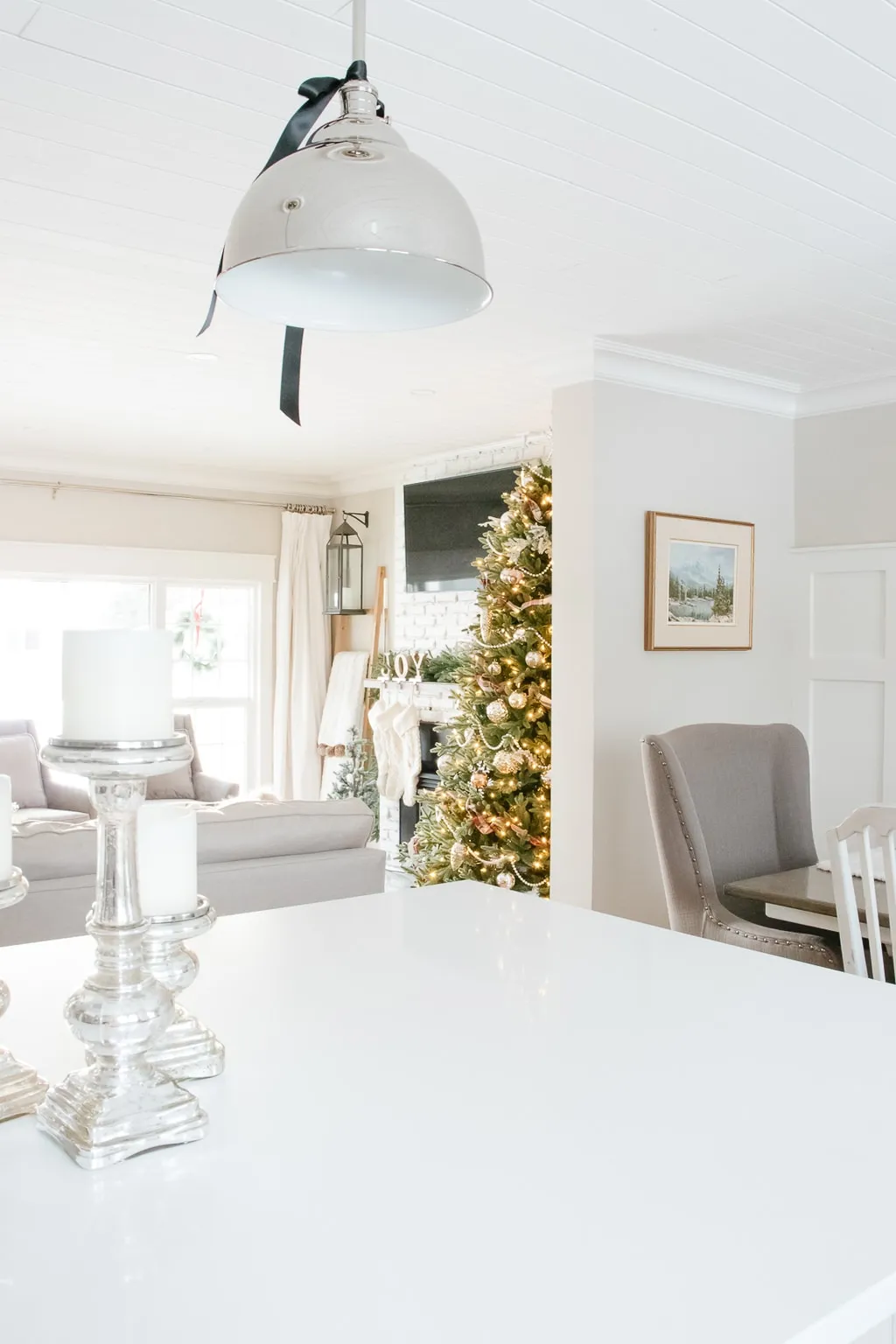
- Flocked pre-lit 7.5 ft tree: $180–$450
- Blush, white and gold ornaments plus pearl garland: $90–$220
- White knit stockings and tree skirt: $45–$120
- Mantel styling (JOY letters, candles, greenery): $30–$80
- Extra warm white string lights: $20–$40
Total: roughly $365–$910. Budget alternative: buy a plain 7 ft green tree and a can of snow spray, then spend the savings on ornaments. The blush palette is what people remember, not the flocking.
4. Flocked Tree Beside a White Dining Table with Red and Silver
Let’s build the garland runner that turns that white X-base table into a centerpiece:
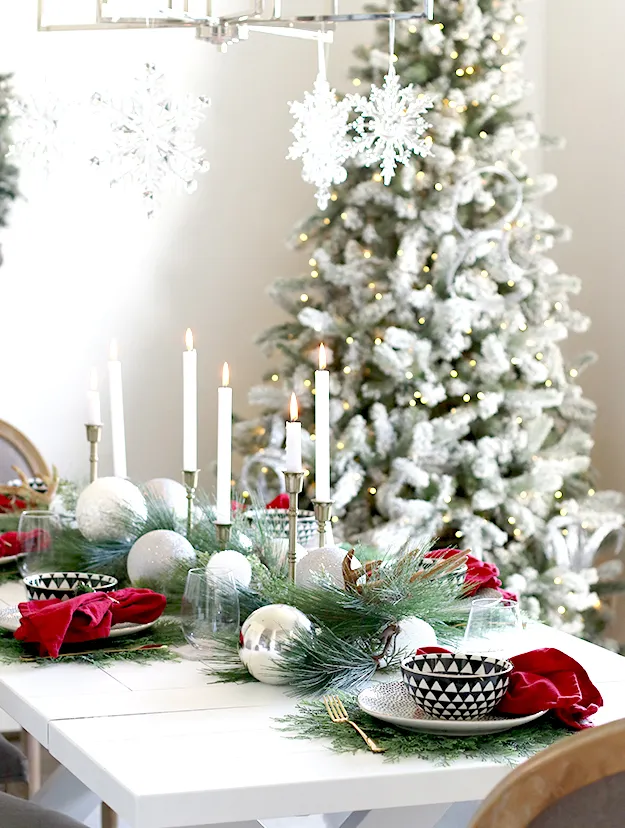
- Measure the table and buy fresh or faux cedar at 1.5x that length so it can pool slightly at each end.
- Lay a strip of floral wire down the center and twist branch clusters on every 8 inches.
- Tuck in silver ornaments and a few white pinecones for a mix of reflection and matte contrast.
- Set brass taper holders on top, then finish each place with a red velvet napkin and a black-and-white bowl.
- Step back to standing height — the runner should never block eye contact across the table.
Roughly 45 minutes and $40–$70 in materials.
This composition wants a dining table at least 60 inches long and 36 wide; narrower and the garland plus candles crowd out the plates. Ceiling height matters less than window placement — the flocked tree sits on the window side, so leave three feet of clearance from the table’s end. Working with a smaller dining room? Idea #12 shows how twin mini trees do the same festive work in a fraction of the footprint.
5. Gold and Purple Accents on a Formal Tree Across Two Rooms
Two trees, two rooms, one palette — it works, but only if the ornaments are genuinely shared. Buying a second tree’s worth of purple and blue baubles that don’t match the first set is the fastest way to make a formal house look like two different holidays. Be honest about the cream plush carpet too: tinsel plus plush equals vacuuming every other day. Leave the tinsel off and you save yourself the chore entirely.
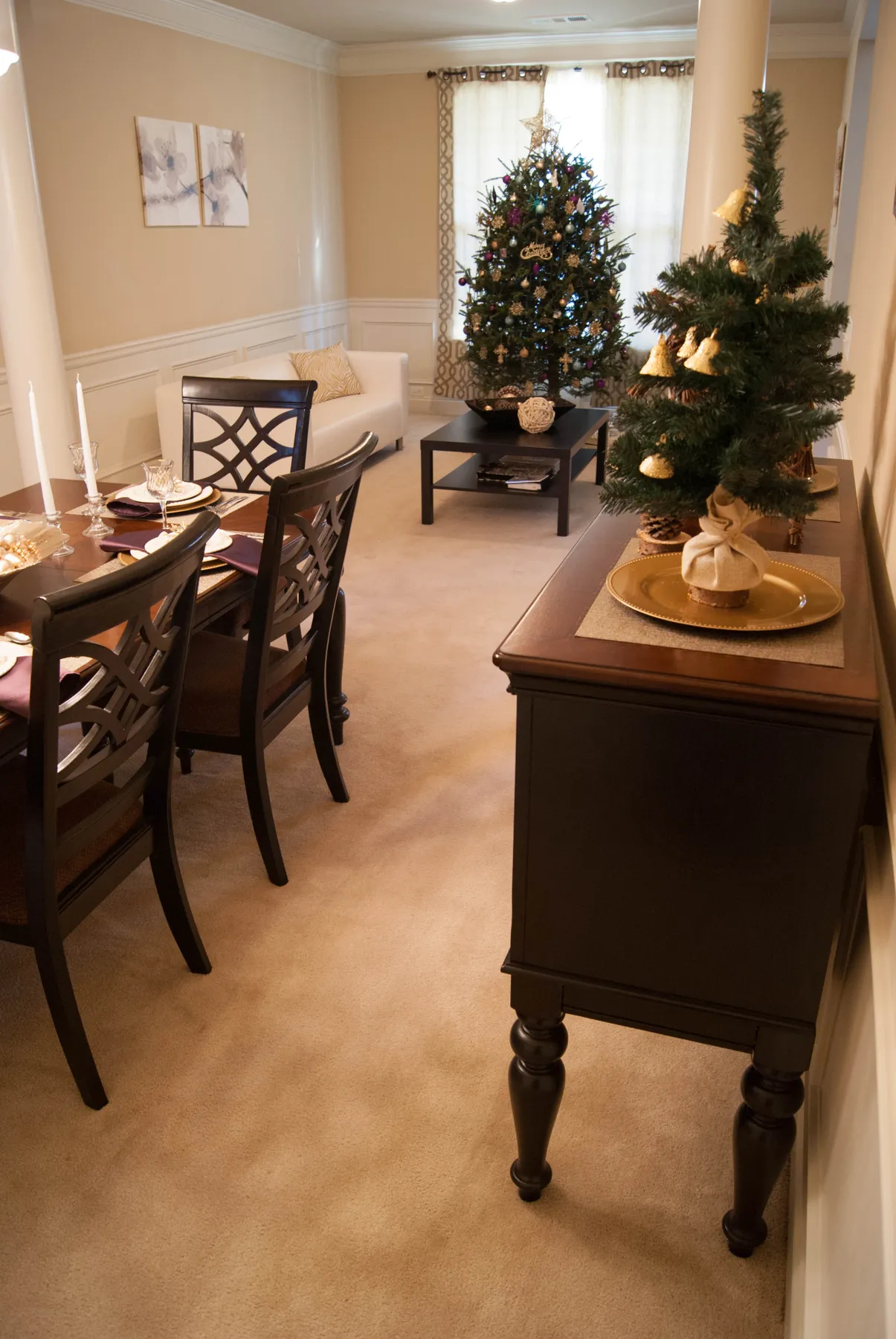
60% cream and dark wood — walls, wainscoting, buffet, dining table. 25% gold, doing the heavy lifting on the chargers, the star topper and the bell ornaments. 10% purple in the napkins and a slice of the baubles. 5% forest green from the tree itself. The trick is that purple appears exactly twice, so it reads as intentional rather than themed. Swap purple for burgundy and the formula holds.
6. Rose Gold Flocked Tree Under a Gold Geometric Chandelier
The gold geometric chandelier. It hangs right in the tree’s sightline and repeats the same angular metal language as the terrariums below — that’s what turns a nice flocked tree into a coordinated vignette. Lose the chandelier and the terrariums start to look like random objects. The rule underneath it: if you’re decorating with a strong shape, echo it at least twice, at different scales, in the same room.
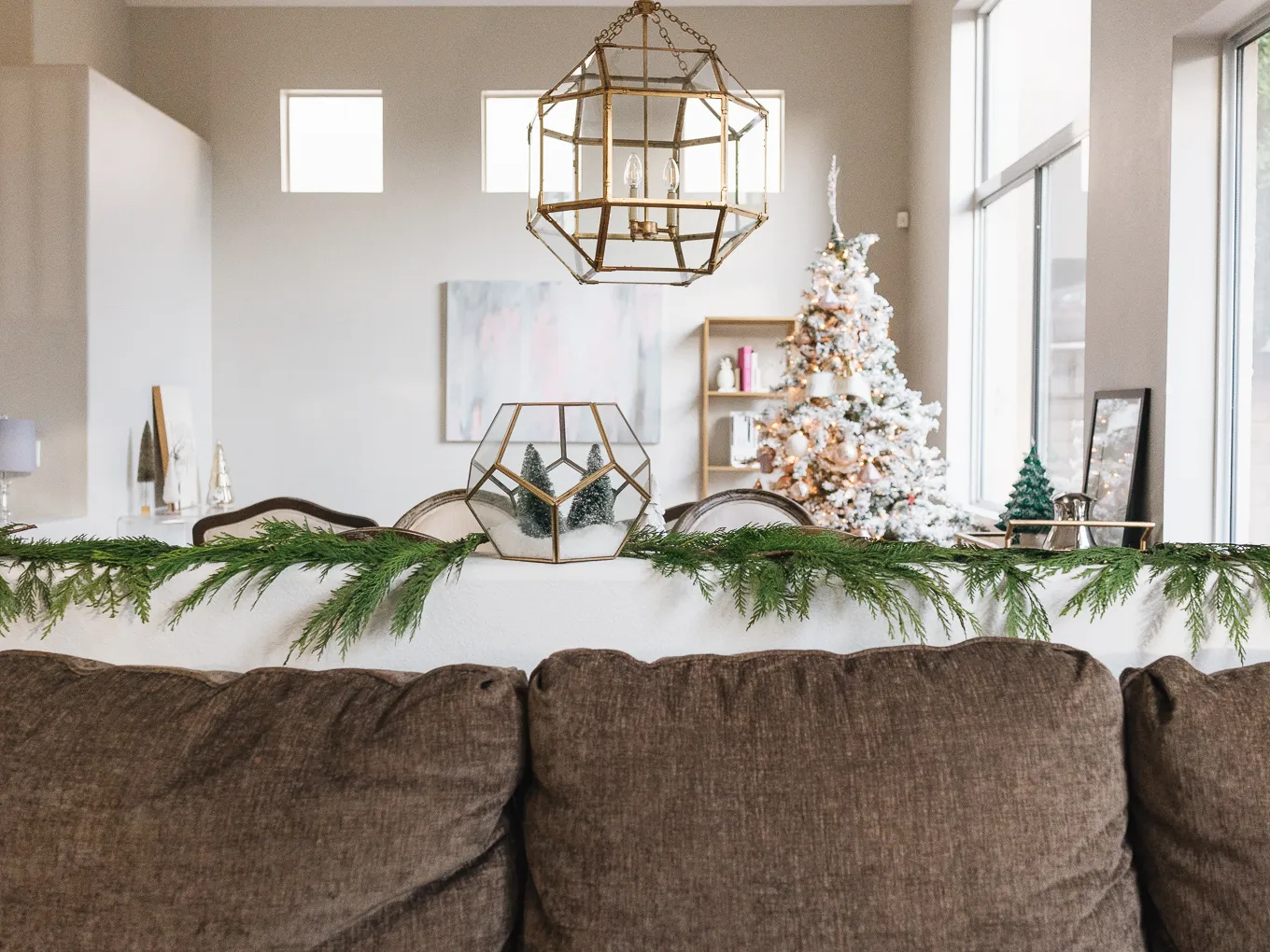
Rose gold ornaments vanish on a flocked tree once the room goes dark. Place them within 12 inches of a bulb so warm light bounces off the metal, and push the blush and white pieces out toward the branch tips where they catch ambient light. Roughly 70% of your ornaments should sit within a bulb’s reach — the rest are daytime decoration.
7. Vintage Pink Tree with Bright, Nostalgic Color
Vintage trees are the sleeper trend of the season. Retro pink and pastel trees have been climbing on resale sites for a few years running, driven partly by nostalgia and partly by how well bold color performs against the white and grey walls people actually have now. The color is loud; the silhouette is simple. That combination is why it works in rooms where a full red-and-green tree would feel heavy.
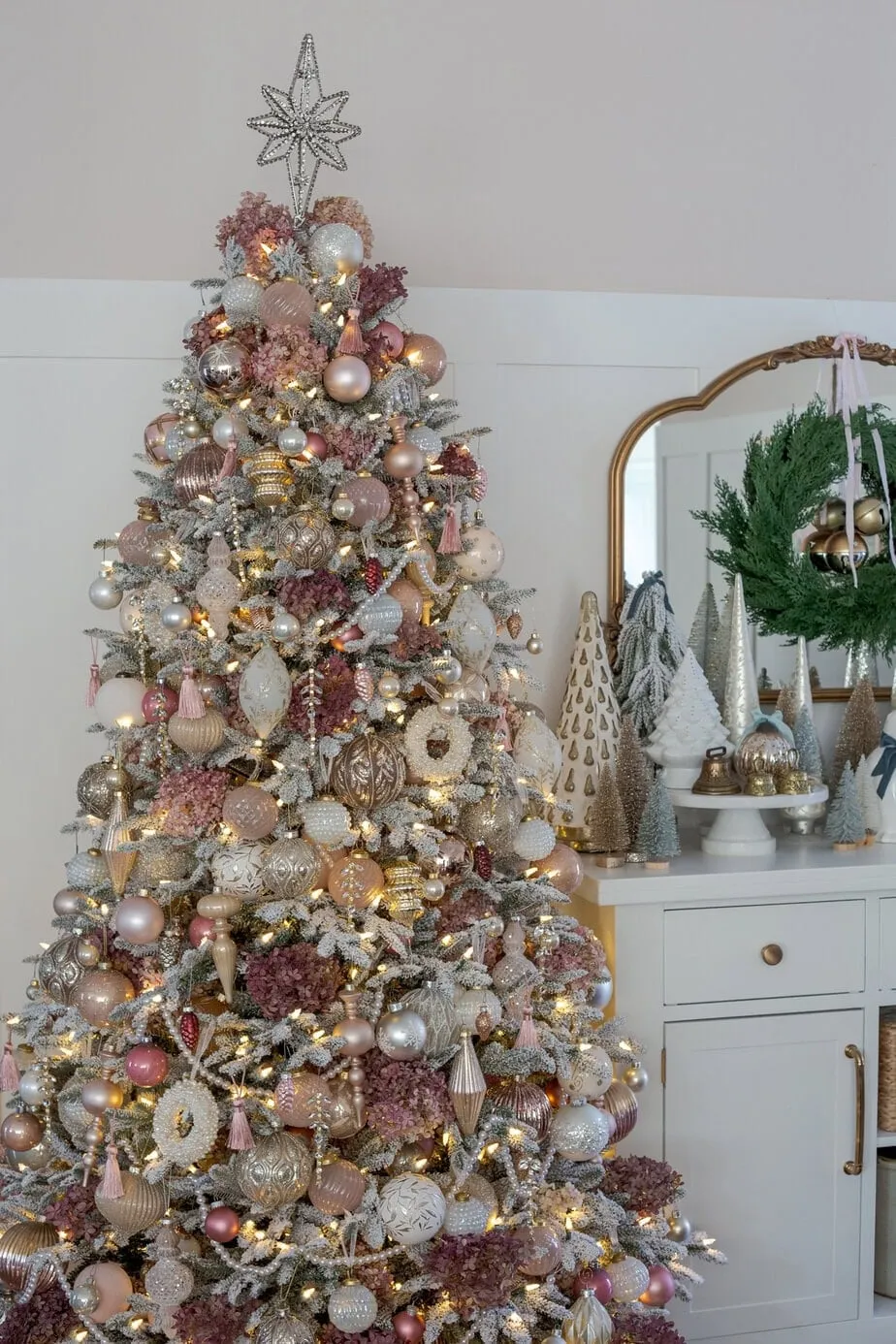
Two things are doing the work here: saturation and scale. A single saturated hue means your eye has nowhere else to go, which makes a compact tree read as a deliberate object rather than a shrunken version of a big one. With no ornaments competing for attention, the color is the entire design. Restraint is what makes loud color look expensive.
8. Neutral Tree with Gold and Silver-Gold Spheres and a Bouclé Chair
- Pre-lit 7.5 ft tree: $200–$500
- Gold and silver-gold sphere ornaments, half smooth half textured: $80–$200
- Light beige fabric tree skirt: $40–$90
- Extra warm white string lights: $20–$40
- Tree topper: $25–$70
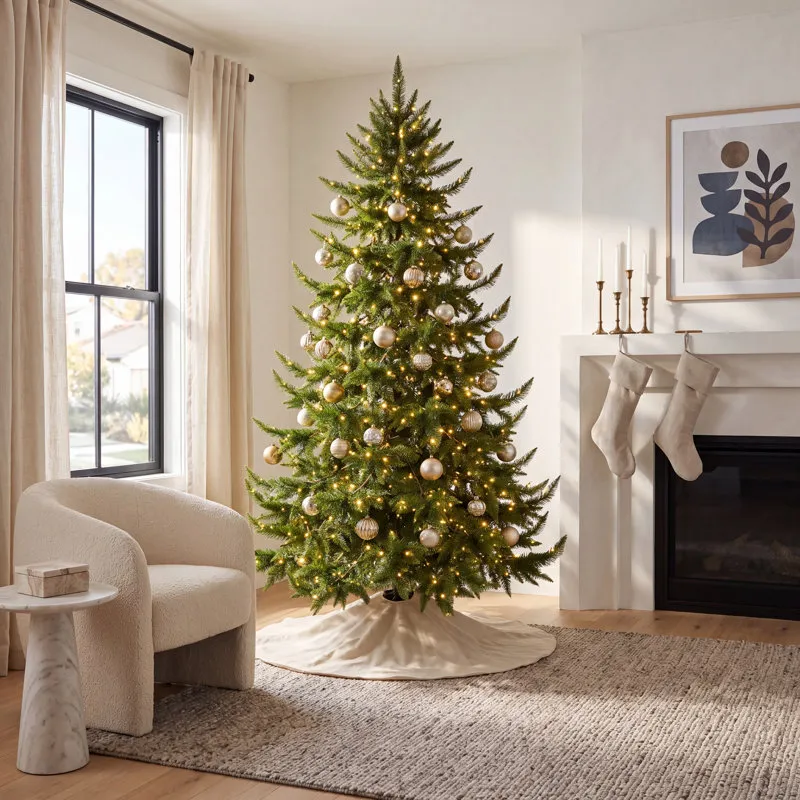
Total: roughly $365–$900. Budget alternative: a $60 plain tree plus two $15 ornament multipacks in two different finishes gets you 80% of the look. The texture mix — half smooth, half hammered or beaded — matters far more than the brand.
Neutral trees are unforgiving. With no red or green to hide behind, every gap in the branches shows. Fluff for a solid hour, branch by branch, and buy more ornaments than feels reasonable: a 7.5 ft tree needs 150–200 pieces at this scale, not the 60 that come in a starter kit. The white fireplace and cream bouclé chair also attract flocking dust, so keep a lint roller nearby.
9. Floor-to-Ceiling Gold Tree in a Wallpapered Formal Dining Room
You don’t need a floor-to-ceiling tree to get the opulence. A 7.5 ft tree loaded with 200 gold and silver ornaments, real glass garland draped on the mantel, and gold-wrapped packages underneath reads grand from the doorway. Shop ornaments in mixed lots at estate sales and on Facebook Marketplace — vintage gold glass still goes for $1–$3 a piece versus $8 new. Skimp on the tree, spend on the shine.
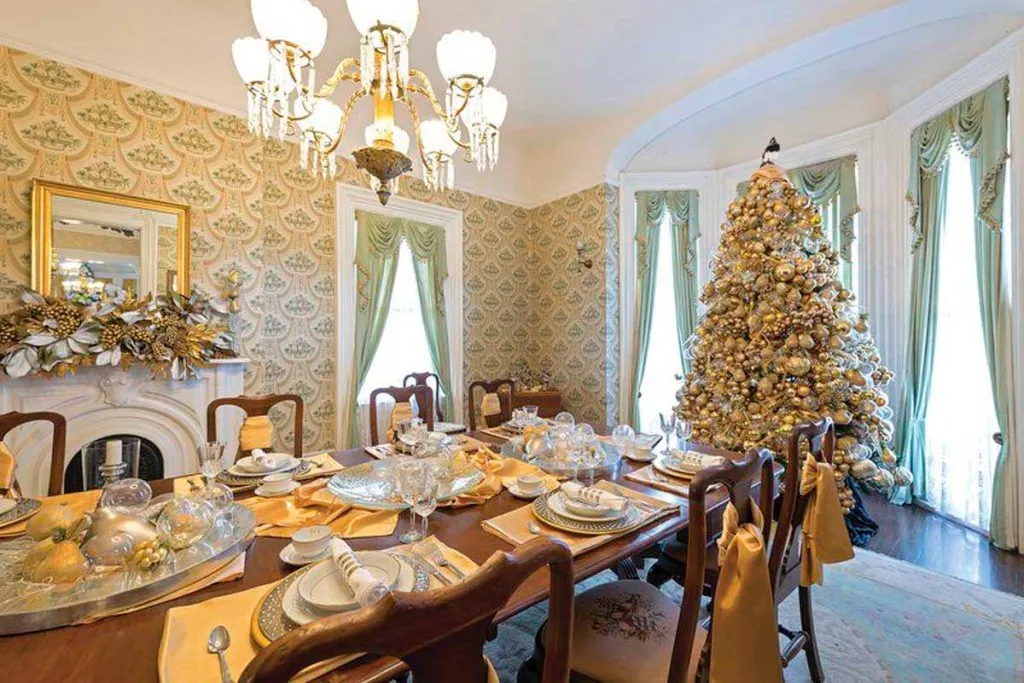
That much gold means fingerprints. Glass and metallic ornaments want a wipedown with a microfiber cloth once a season, and heavy ornament loads sag branches, so check for bent wire every few days on a natural tree. Crystal on the chandelier collects dust year-round; a ten-minute pass with a hairdryer on cool does more than you’d expect. Plan on two hours of setup and two hours of takedown.
10. Flocked Tree with Feather Garland and White Ribbon-Wrapped Gifts
Here’s the feather-boa garland that makes this tree look frosted:
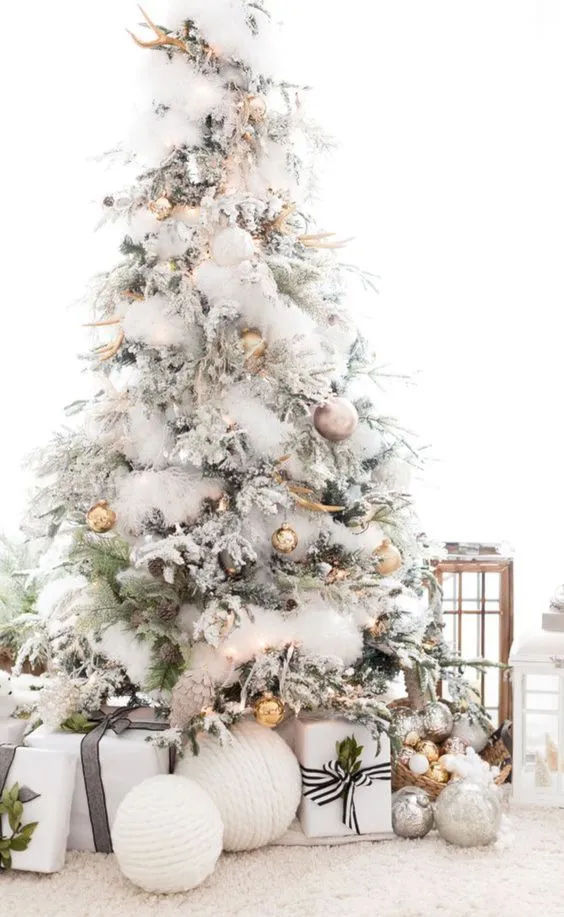
- Buy 3–4 white feather boas (about $12 each) for a 7.5 ft tree.
- Start at the top, spiral down, and secure with small zip ties every 10 inches — never wrap tightly.
- Add the warm string lights after the garland so the glow comes through the feathers, not around them.
- Hang gold and silver baubles on top of the fluff where metal can catch the light.
- Pile white wrapped gifts and knitted spheres at the base so the bottom stays grounded.
Roughly 90 minutes and $60–$90 in materials.
Feather garland plus flocking can tip into cloud territory. Anchor it with two or three dark matte elements — antler picks and black-ribboned packages here — so the whites have something to sit against. A rule that travels well: for every three light-textured pieces on a white tree, add one dark or metal one. That’s the difference between wintery and washed out.
11. Real Tree Draped in Multicolor Velvet Ribbon Bows
The velvet ribbons. Eleven or twelve of them, in gold, rust, olive, dusty pink and pale blue, tied into soft bows and left slightly loose. Loose is the point — a tight bow looks like a craft project, a slack one looks gathered by hand. Those bows carry all the color in the room, so the tree itself stays green and the marble fireplace keeps its calm. Pull the ribbons and the whole scene goes flat.
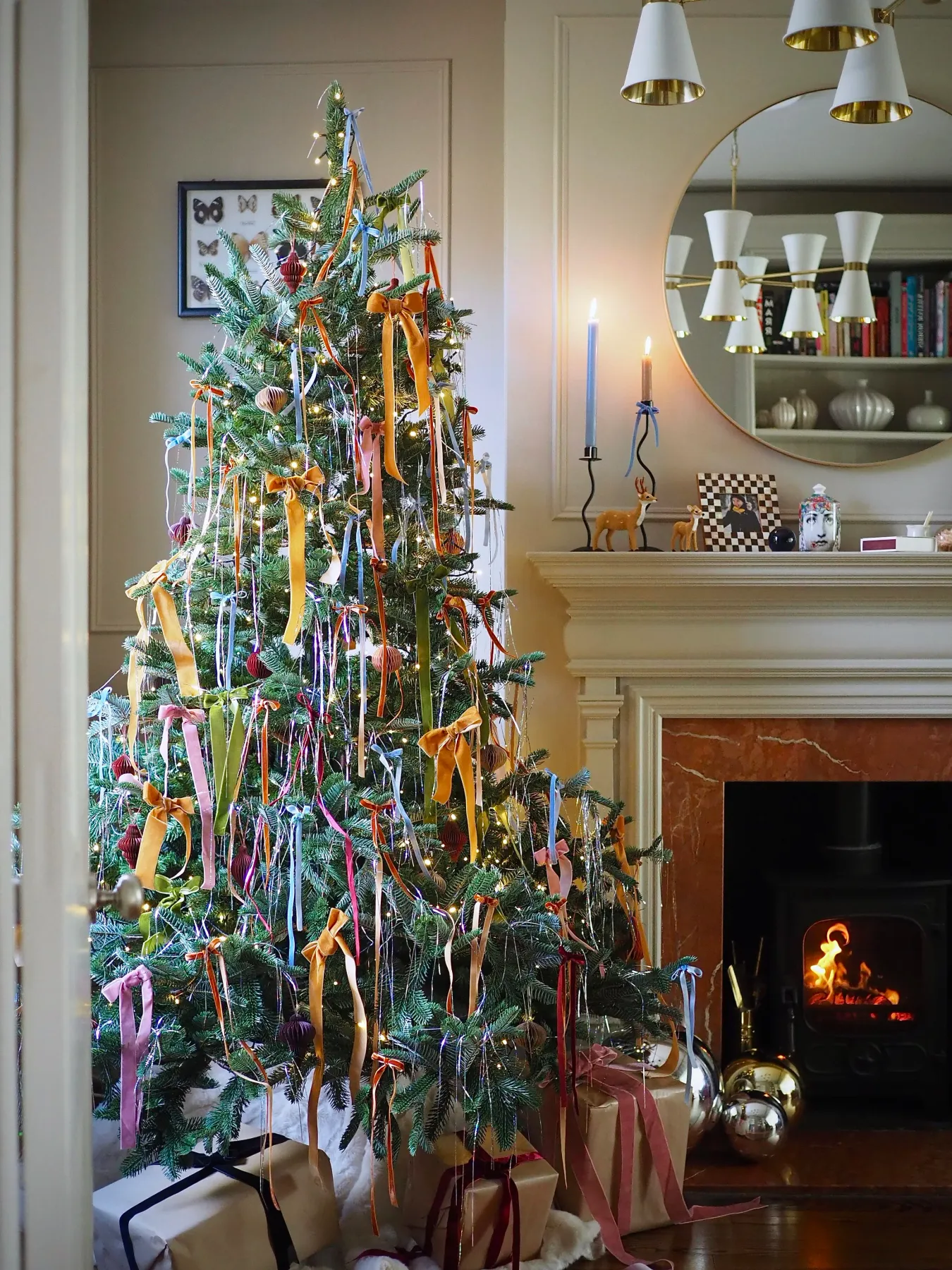
Ribbon is the cheapest way to buy luxury. A 10-yard spool of velvet runs $8–$20 depending on width; five spools in five colors costs less than one designer ornament set and does far more visual work. Raid fabric store clearance bins in January and stock up for next year — odd velvet colors often drop to $3 a yard. Pair it with craft paper gifts tied in the same ribbons and nobody will guess the budget.
12. Twin Mini Trees on a Sage Green Dresser with Brass Pulls
Two tabletop trees this size need about 36 inches of dresser width and perform best on walls 8 to 10 feet tall — the green leaf wallpaper needs room to read as a backdrop rather than a pattern. Under 8 feet, drop to one tree and let the dark abstract artwork breathe. Bedrooms, entry consoles and narrow hallways all suit this scale. If you’d rather have one small tree than a pair, the ceramic tabletop tree in Idea #20 is the same scale with a completely different personality.
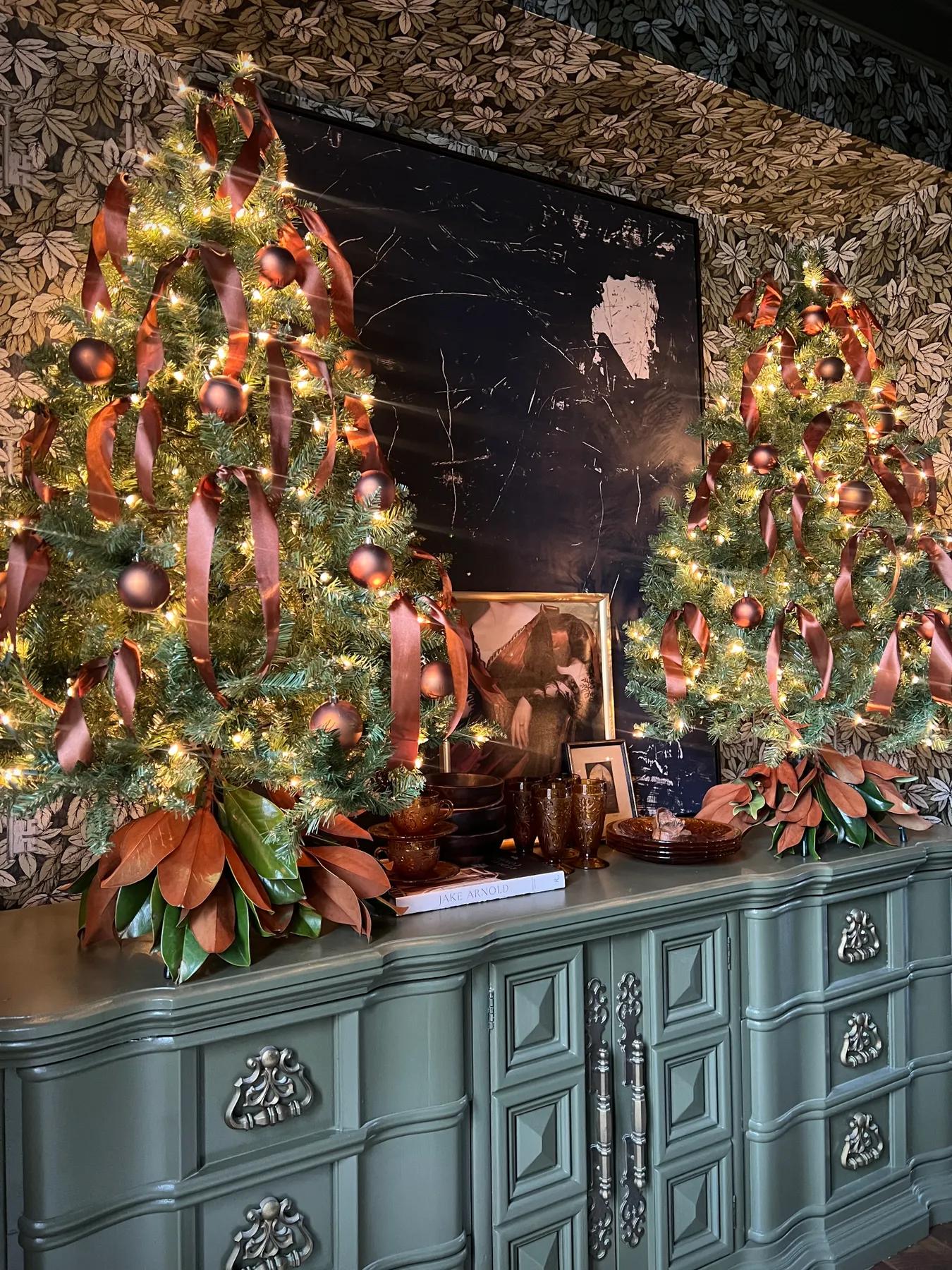
- Measure the dresser top and leave 4 inches of clearance on each side.
- Confirm outlets — two lit trees need two power sources or a discreet extension.
- Check your wallpaper’s pattern repeat so the artwork lands symmetrically between the trees.
- Pick one ornament finish before you shop; matte brown here, since mixed metallics fight the sage green.
13. Pastel Pink and Teal Baubles with Silver Tinsel Garlands
50% green — the tree and the rustic stone fireplace. 25% cream from the knit skirt, white curtains and beige sofa. 15% pastel pink and teal in the baubles. 10% silver tinsel for shine. The two pastels sit next to each other rather than opposite, which keeps them soft instead of nursery-bright. Want it sharper? Push pink to 20% and drop tinsel to 5%. Want it calmer? Go 60% cream and keep a single pastel.
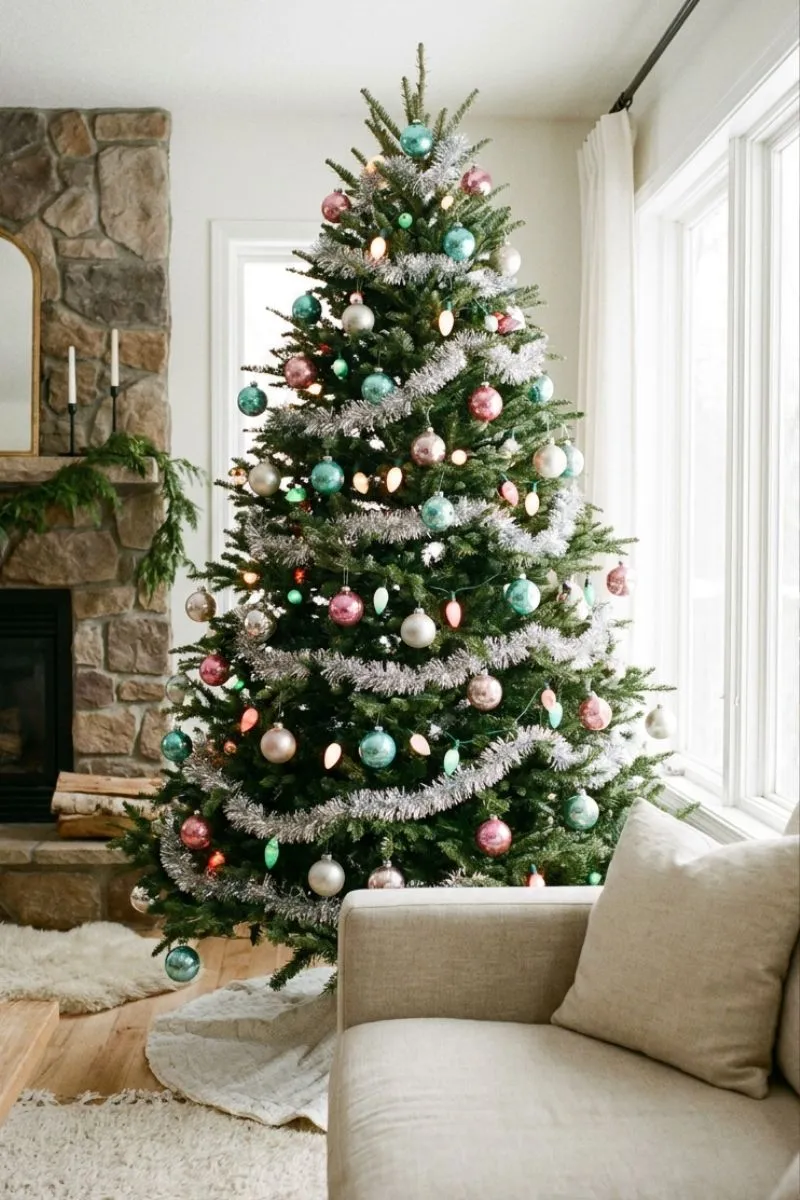
Silver tinsel is a commitment. It sheds, it tangles, and it never goes back in the box neatly — plan on replacing it every couple of years. It also reflects whatever light hits it, so under cool overhead LEDs the whole tree goes slightly icy. If your stone fireplace is the main light source you’re fine. If you rely on ceiling fixtures, swap tinsel for silver beaded garland instead.
14. Mercury Glass, Red Berries and Eucalyptus on a Snow-Dusted Tree
The red berries and eucalyptus sprigs tucked between the ornaments. Everything else on this tree — mercury glass, knitted spheres, the faux snow dusting — is soft and low contrast. The berries are the only saturated color, and they appear maybe a dozen times across the whole tree. Without them it’s pretty but a little sleepy. That’s the principle: one accent color, used sparingly, in a room where everything else is quiet.
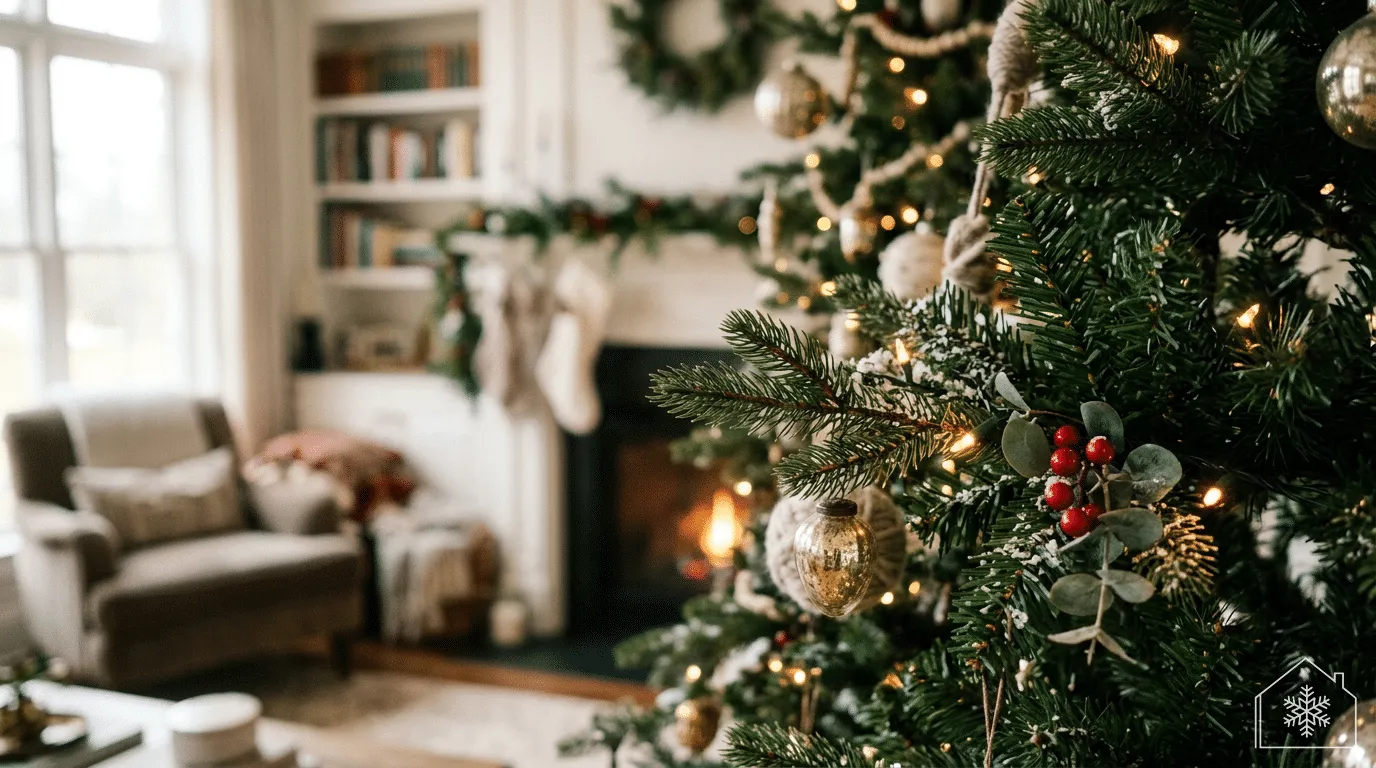
Mercury glass is reflective, so it doubles your light. Group it in loose clusters of three to five near the denser light strands rather than scattering single ornaments evenly down the branches. Aim for roughly one cluster per square foot of visible tree, then fill the gaps with matte knitted spheres. The mix of mirrored and matte is what creates depth — all-mercury reads like a discotheque.
15. Silver and White Tree Against a Dark Olive Green Wall
The dark olive wall is doing the heavy lifting. Silver and white ornaments disappear against a light wall, but against deep olive they glow, and the tree reads as part of the architecture instead of an object parked in a corner. The plaid throw and the stag mount add rusticity without adding color, which keeps the whole palette tight at three tones: cream, olive, silver.
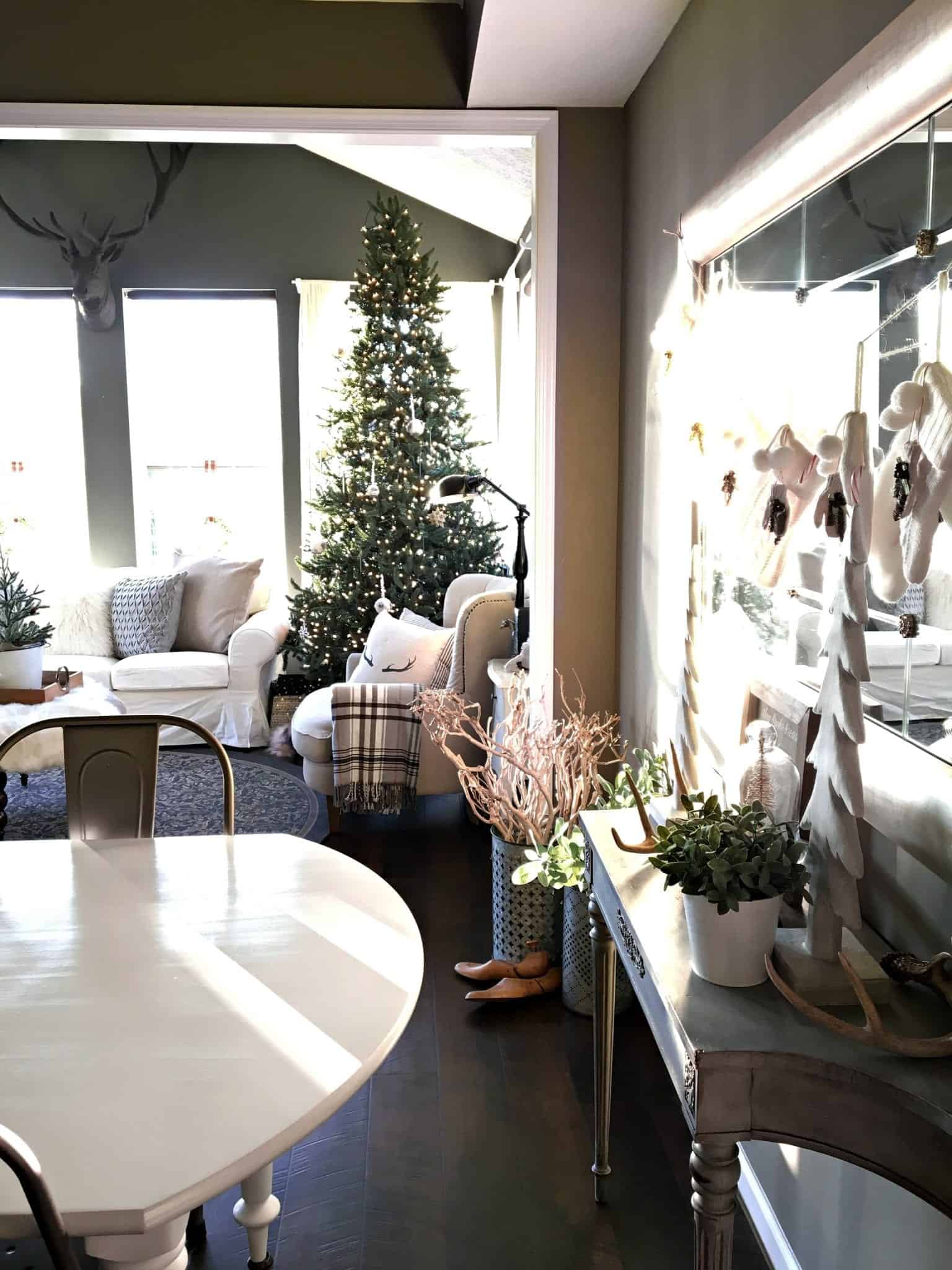
Deep, saturated wall color needs volume. This works in rooms from about 200 square feet up with 9-foot ceilings; in a smaller space the same olive feels like a cave rather than a backdrop. If your living room is tighter, paint one accent wall or move the olive into upholstery instead. The pre-lit tree itself only needs about 30 inches of corner clearance and a nearby outlet.
16. Flocked Tree with Striped Ribbon Above a Blue Faux Hide Rug
- Flocked 7.5 ft tree: $200–$500
- Black and white striped ribbon, two spools: $20–$45
- Gold ornaments and frosted branch picks: $70–$180
- Blue faux hide rug: $90–$250
- Winter garland, gold candlesticks, silver deer figures: $80–$200
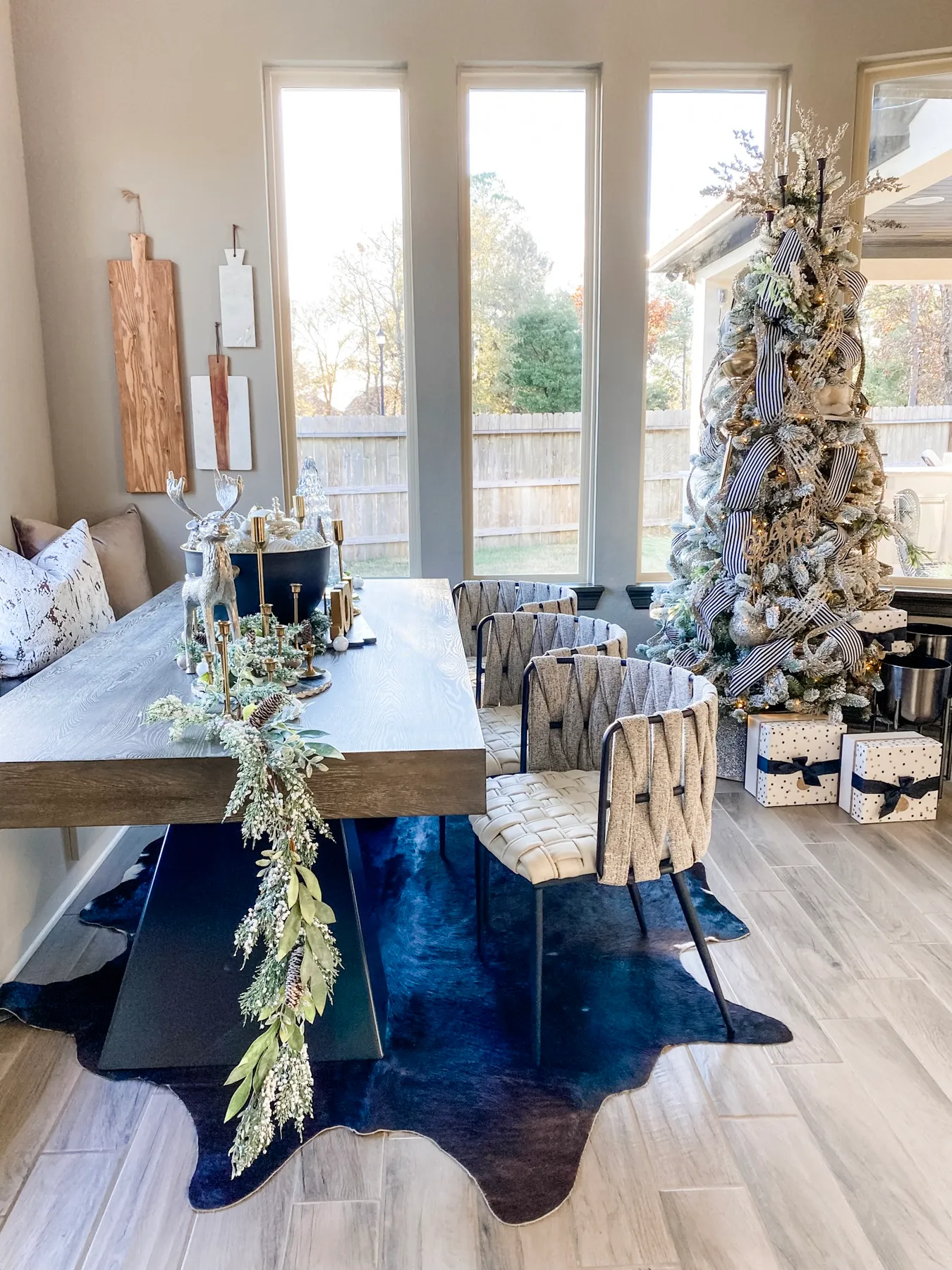
Total: roughly $460–$1,175. Budget alternative: a plain grey or navy throw rug does most of the blue work for under $50, and a yard of striped fabric cut into wide strips replaces the ribbon for about $8.
Striped ribbon only looks intentional if it’s cut cleanly. Snip at a 45-degree angle on the bias, then seal the ends with a quick pass of a lighter so they don’t fray — one unfinished end undoes the elegant effect in a glance. Cut each length at 18 to 24 inches and drape rather than tie, so the stripes stay legible instead of bunching at the knot.
17. A Cluster of Flocked Trees Along Floor-to-Ceiling Windows
Several flocked trees in one long room is a gorgeous idea with a hidden cost: flocking sheds, and more trees means more shedding. This setup also depends almost entirely on evening light. In daylight the trees read as pale shapes against pale windows. If you host at brunch, put the personality into the table garlands and runners instead — that’s what guests actually see up close.
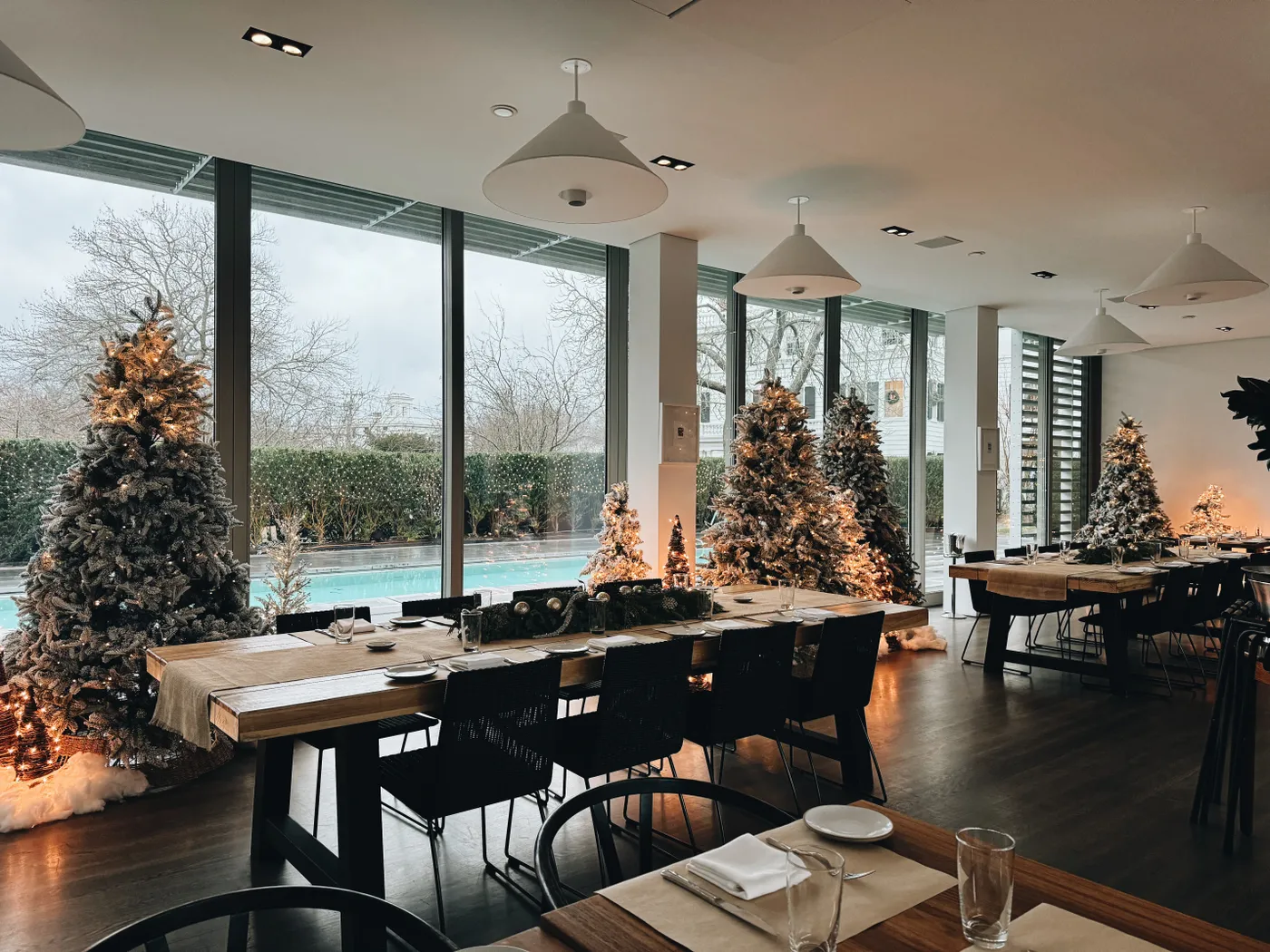
The garland-and-runner table those trees frame:
- Run a natural linen runner down the center, letting it hang 8 inches off each end.
- Lay evergreen garland on top, wired into a loose S-curve instead of a straight line.
- Tuck gold and silver ornaments into the garland at uneven intervals — three, then five, then two.
- Keep place settings simple, no charger stack; the garland is the centerpiece.
- Add low votives only, and light them 20 minutes before guests arrive.
About an hour and $50–$90 per table.
18. Glittered Gold Spheres and a Fabric Santa on a Green Tree
Gold ornaments are the most shopped-after and the most marked up. Buy last year’s open-box sets on marketplace sites, or pick up thrift-store gold baubles at $0.50–$2 each and give them a coat of matte spray if they’re too shiny. A fabric Santa figure can be swapped for any cream or beige ornament with real texture — a knit ball, a felt star, a wooden slice. The tree only needs one soft, non-glittery element to feel collected.
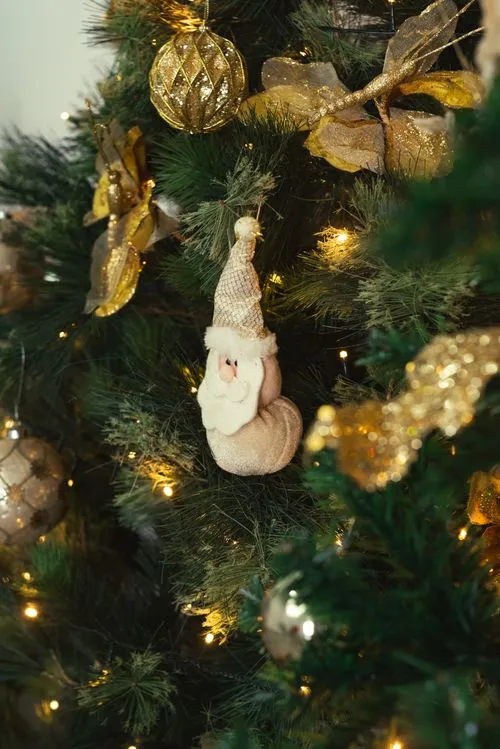
The beige fabric Santa. It’s the only ornament on the tree that isn’t metal or glitter, and it’s what keeps all that gold from reading like a store display. One soft, matte, slightly imperfect object changes the entire register of a tree. If Santa isn’t your thing, a single felt animal or a knit stocking ornament does the same job.
19. Lit Trees and an Illuminated Golden Wire Deer on a Dark Wall
Lit wire sculptures and illuminated spheres are lovely and slightly fussy. Their bulbs are usually non-replaceable, so when a strand fails the whole piece is done — expect three to five seasons. Store the deer flat, wrapped in tissue, and never coil the wire tightly. Bulb replacement on the trees themselves is straightforward, but set aside 20 minutes to swap a dead strand when it happens.
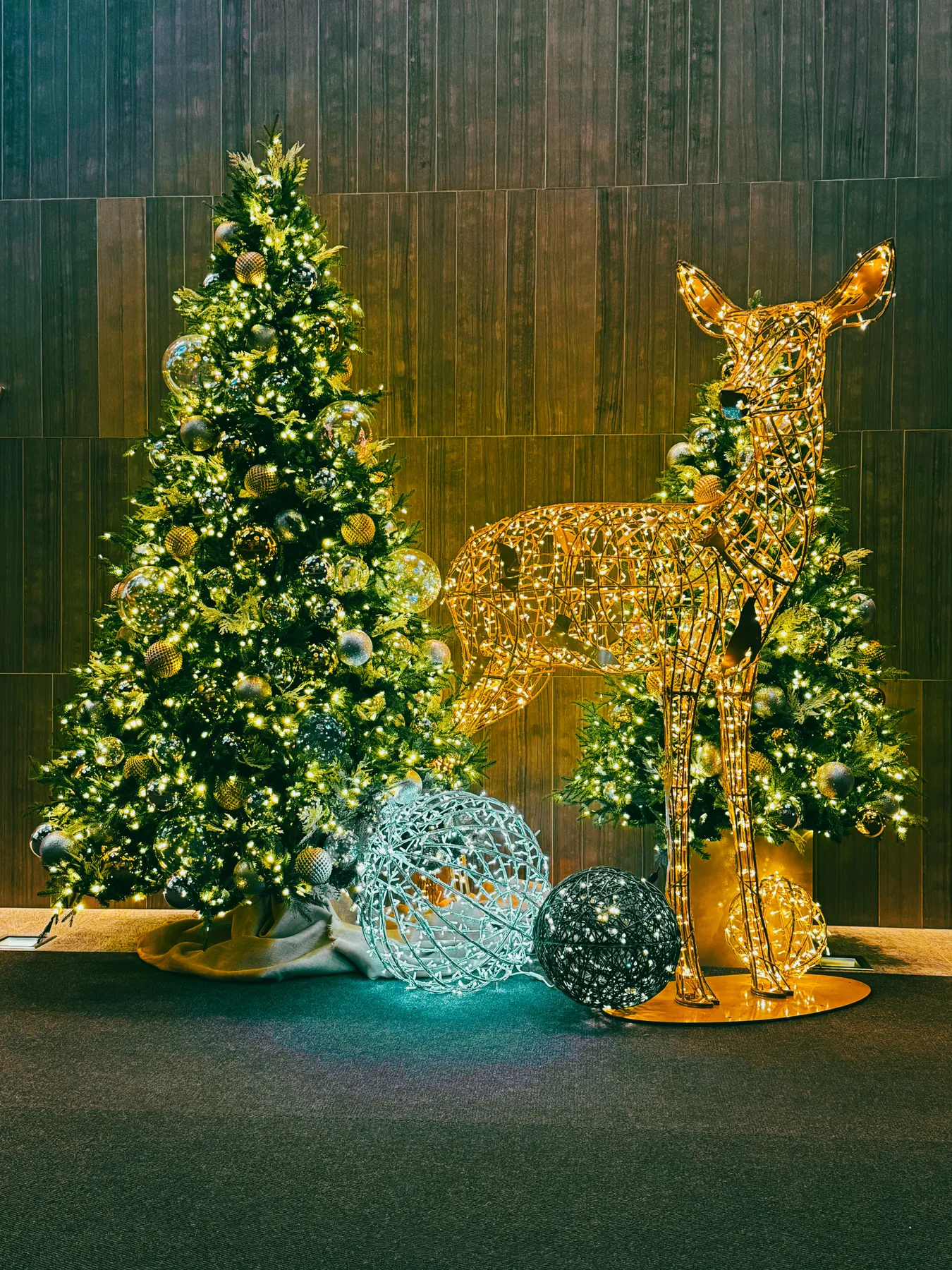
Two principles are at work. First, repetition at different scales: two trees, four glowing spheres, one deer, all in the same warm gold light. Second, a dark backdrop. Against dark wooden paneling every light source reads twice as bright as it would on a pale wall, which is why the display looks grander than the sum of its parts. Add a third lit object and it starts to look like a store window.
20. Glossy Ceramic Tabletop Tree with Multicolor Lights
Ceramic tabletop trees have been having a moment for a few years, and the vintage ones are now genuinely collectible — 1970s originals routinely sell for $80 and up at estate sales. What’s driving the revival is smaller-space living: apartment dwellers want something that reads as a tree without surrendering a corner. And the multicolor bulbs are exactly what people who grew up with one remember.
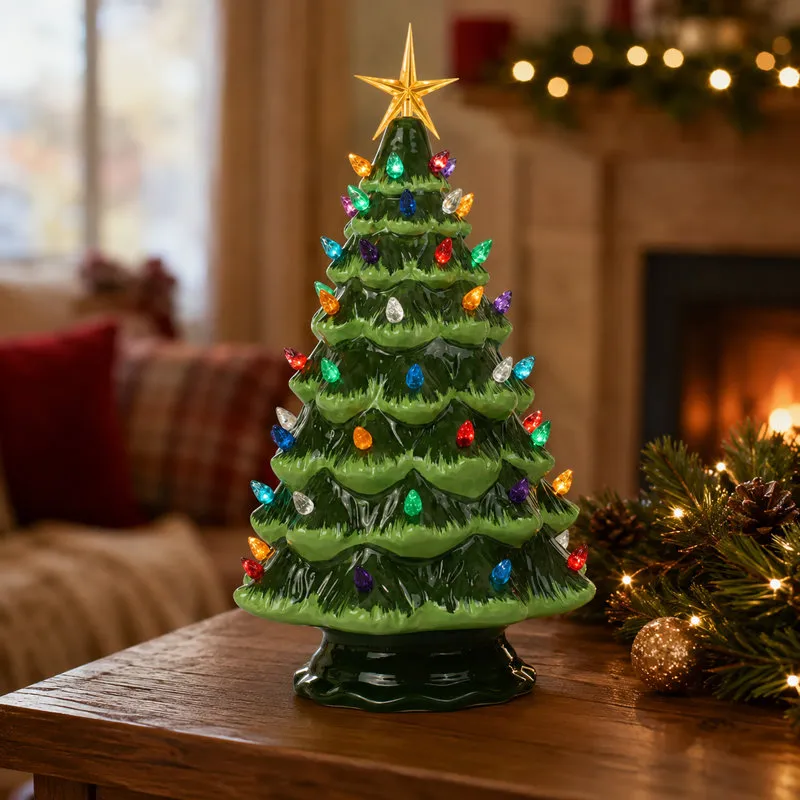
You can find a working vintage ceramic tree at thrift stores for $15–$40 if you’re patient, and plug-in reproductions run $35–$60 new. If you want the glow without the hunt, a plain dark green ceramic tree with your own warm white fairy lights tucked behind it gets close. Skip anything with missing bulbs — replacements are hard to match and it will bug you all season.
21. Gold, Cream and Brown Tree Over a Herringbone Floor
Eight upholstered chairs plus a full-size tree need a dining room of at least 14 by 16 feet, with 30 to 36 inches of walking space behind each chair. Nine-foot ceilings or higher let the tree top clear the chandelier. In a smaller dining room, drop to six chairs and use a slim 6 ft tree in the corner; the gold-and-cream palette translates fine at half the volume with a third fewer ornaments.
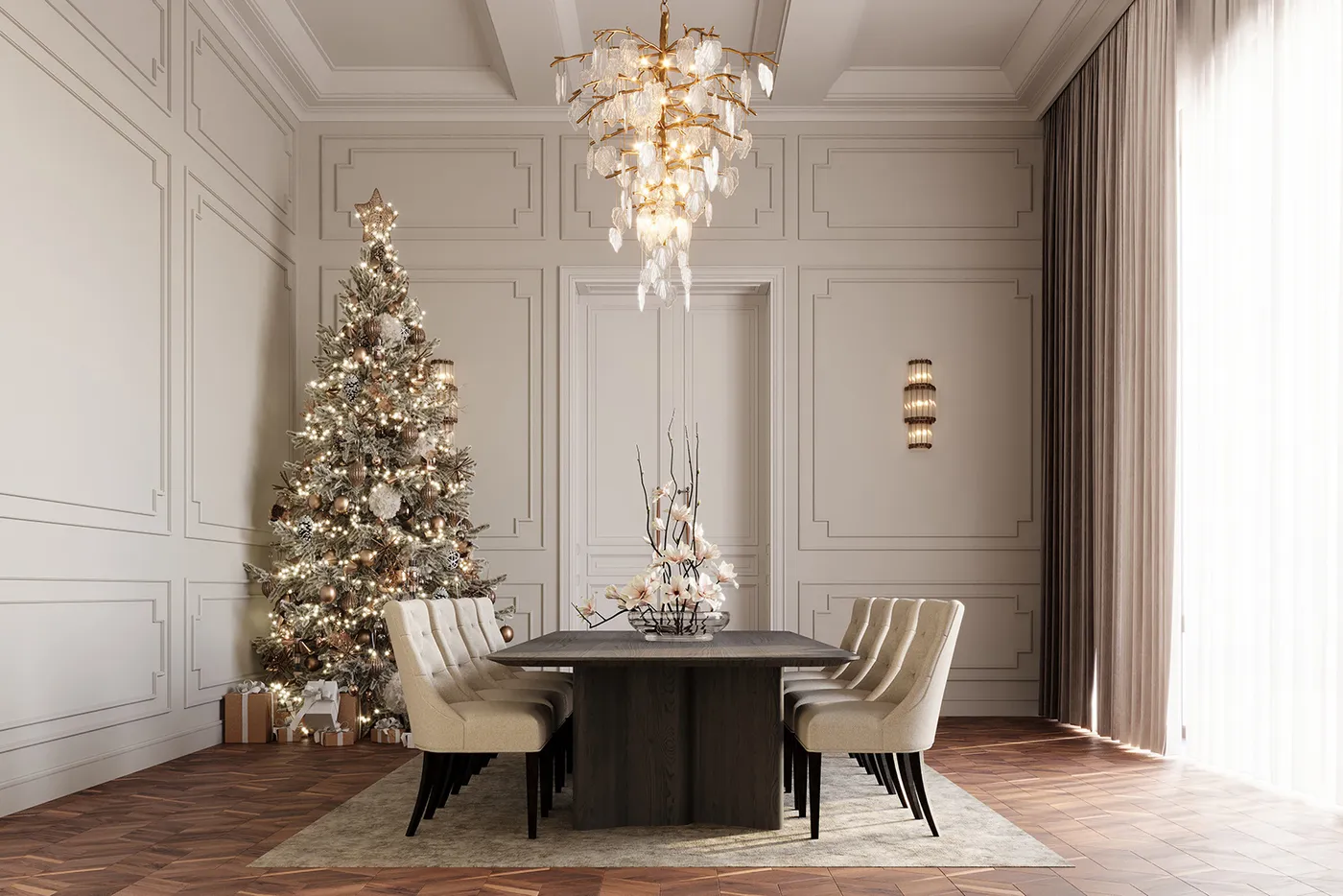
- 7.5–9 ft pre-lit tree: $250–$700
- Gold, cream and brown ornaments, 150+ pieces: $120–$300
- Star topper: $25–$75
- Tree skirt or collar: $35–$90
- Extra warm white lights: $25–$50
Total: roughly $455–$1,215 before any furniture. Budget alternative: buy one large ornament set in a single finish and a second in a contrasting texture — two coordinated sets beat five mismatched ones every time.
22. Multicolor Tinsel Tree Next to a Set Dining Table
Multicolor trees with tinsel are wonderfully nostalgic and a nightmare to photograph in a warm room — red, gold and blue all bounce off each other and the whole tree can go muddy. If the tree is going on your holiday card, shoot it in daylight near the wooden window frame, not at night. Tinsel and pets are also a bad pairing; skip it entirely if you have a cat who climbs.
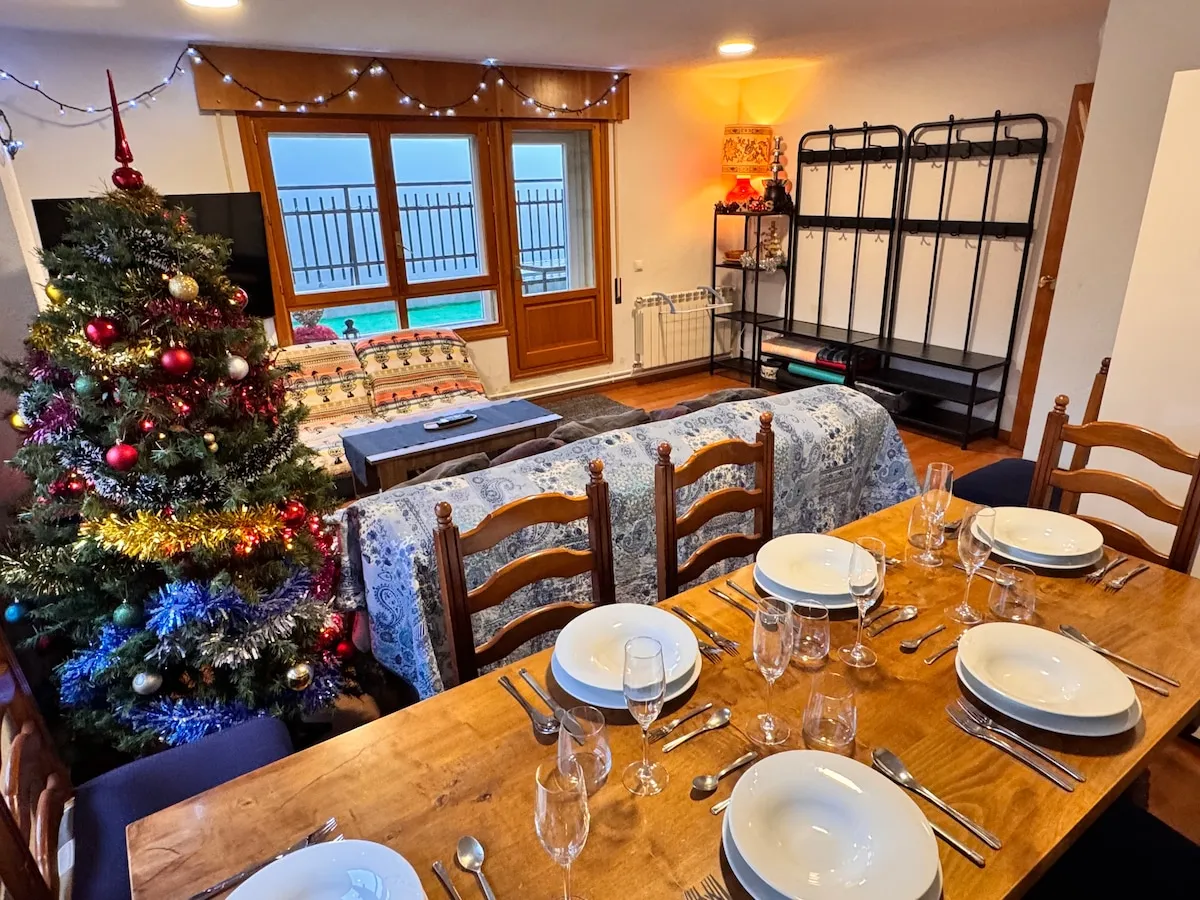
Setting that wooden table so the multicolor tree doesn’t overpower it:
- Start with a plain light wood table and a white or cream cloth — no pattern.
- Keep plates white and glassware clear so the tree’s color stays the star.
- Add one small element that echoes the tree: a red napkin, or a single blue candle.
- Resist tinsel on the table; it’s already on the tree.
- Move the black metal storage pieces out of the sightline before guests arrive.
About 30 minutes and $0 if you already own the basics.
23. A Warmly Lit Tree Framed by Glass Doors and a Forest View
Framing beats decorating. The light wood mullions divide the forest view into vertical panels, so the tree sits inside a grid rather than floating in open space. It also means the room has two light sources after dark — the tree itself and the reflections on the glass. The dark wood plank table and brown leather chairs anchor the bottom of the frame so the whole scene doesn’t drift upward.
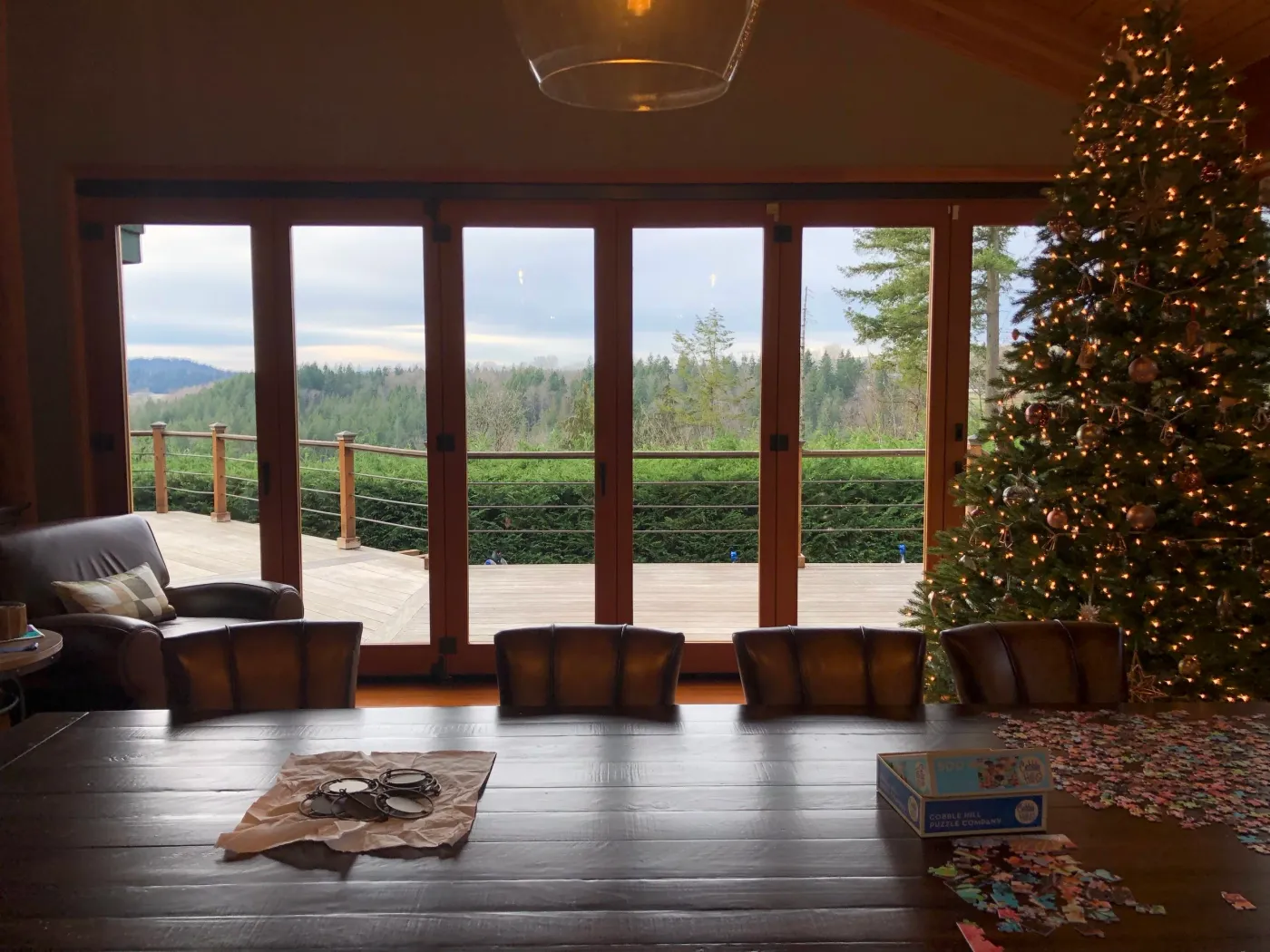
When a tree competes with a view, keep the ornaments metallic and bell-shaped. Shiny metals reflect the room and hold their own against a busy backdrop; matte or dark ornaments simply disappear into the glass. Keep the total ornament count around 100 for an 8 ft tree — going heavy here reads as clutter instead of abundance.
24. Blue and Silver Tree Seen Through an Arched Doorway
70% dark wood and beige — the floor, the woven rug, the wine rack, the dining table. 20% blue, split between the tree ornaments and the light filtering through the archway. 10% silver for shine. Because the blue is bracketed by warm neutrals on every side, it reads classic rather than nautical. Push blue past 30% and the room tilts coastal; drop it to 10% and you’re back to a plain traditional dining room.
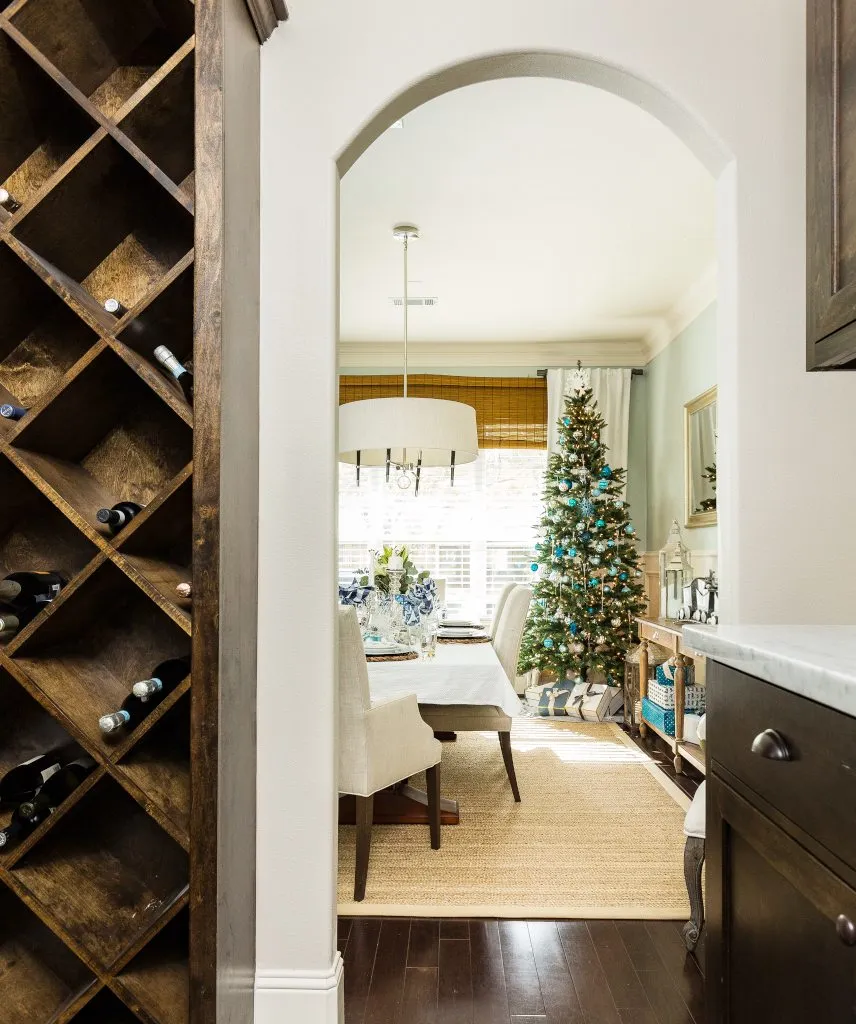
The arched doorway. It crops the tree at the edges and gives you a framed view from the hallway — which is how most people will actually see this room. A tree glimpsed through an arch reads as a discovered scene; the same tree in an open-plan space reads as furniture. If you have any arch, cased opening or wide door, put the tree where it can be glimpsed.
25. Coastal Tree with Starfish, Shells and a Draped Net
Coastal Christmas has grown from a regional Florida thing into a full seasonal category, largely because so many people now live near water or winter there. The appeal is escape: no plaid, no snow, no red. Blue and white with natural shells reads calm in a way a traditional tree can’t, and it photographs beautifully beside big windows.
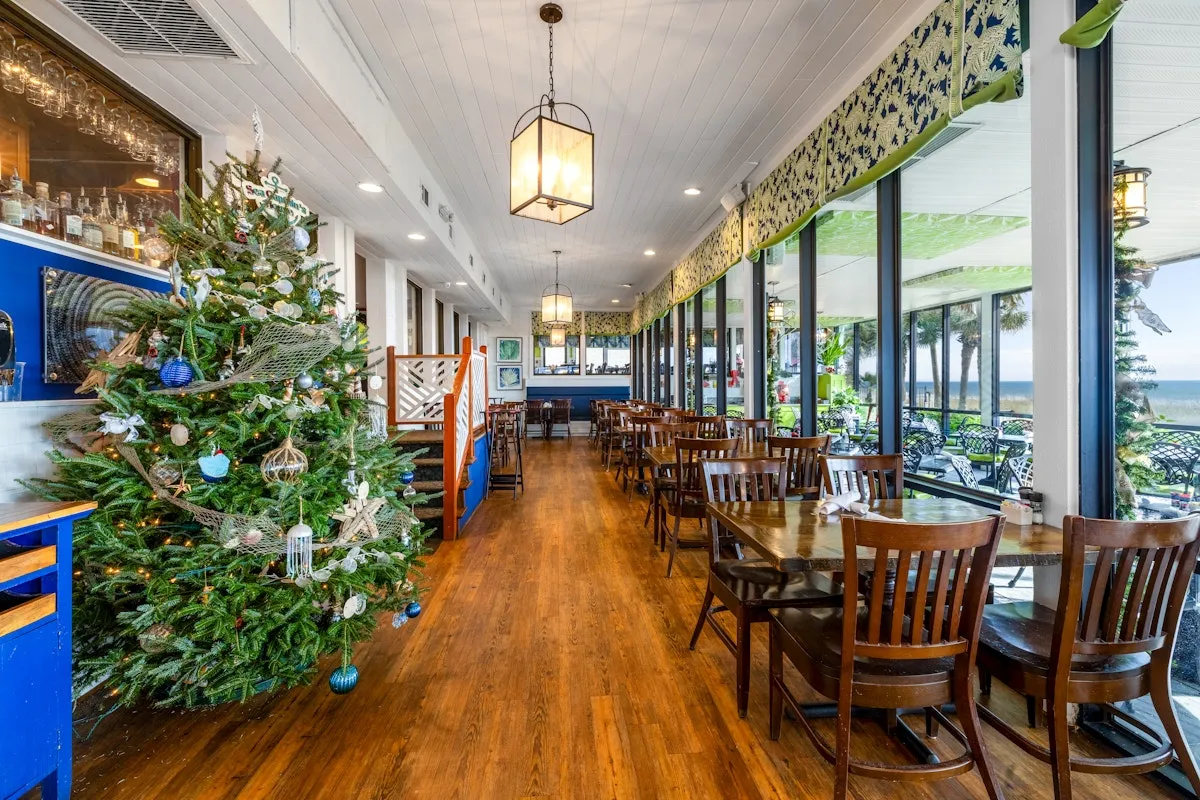
- Confirm your palette holds at three tones — blue, white, natural.
- Check that shells and nets are lightweight; heavy pieces bend branch tips.
- Decide how the tree reads at night: blue against a royal blue wall needs warm lights to separate.
- Anchor the net or ribbon at the top so it drapes rather than hangs.
26. A Slim Pink Tinsel Tree Against a Teal-Gray Wall
The wall color. A pink tree is a statement, but it only becomes a composition against a muted teal-grey. On white it’s a novelty; against teal-grey it’s a color story. That’s the thing worth stealing even if you never buy a pink tree: put your bold object against a wall that’s slightly off from neutral, and the whole corner gains a mood you didn’t have to decorate for.
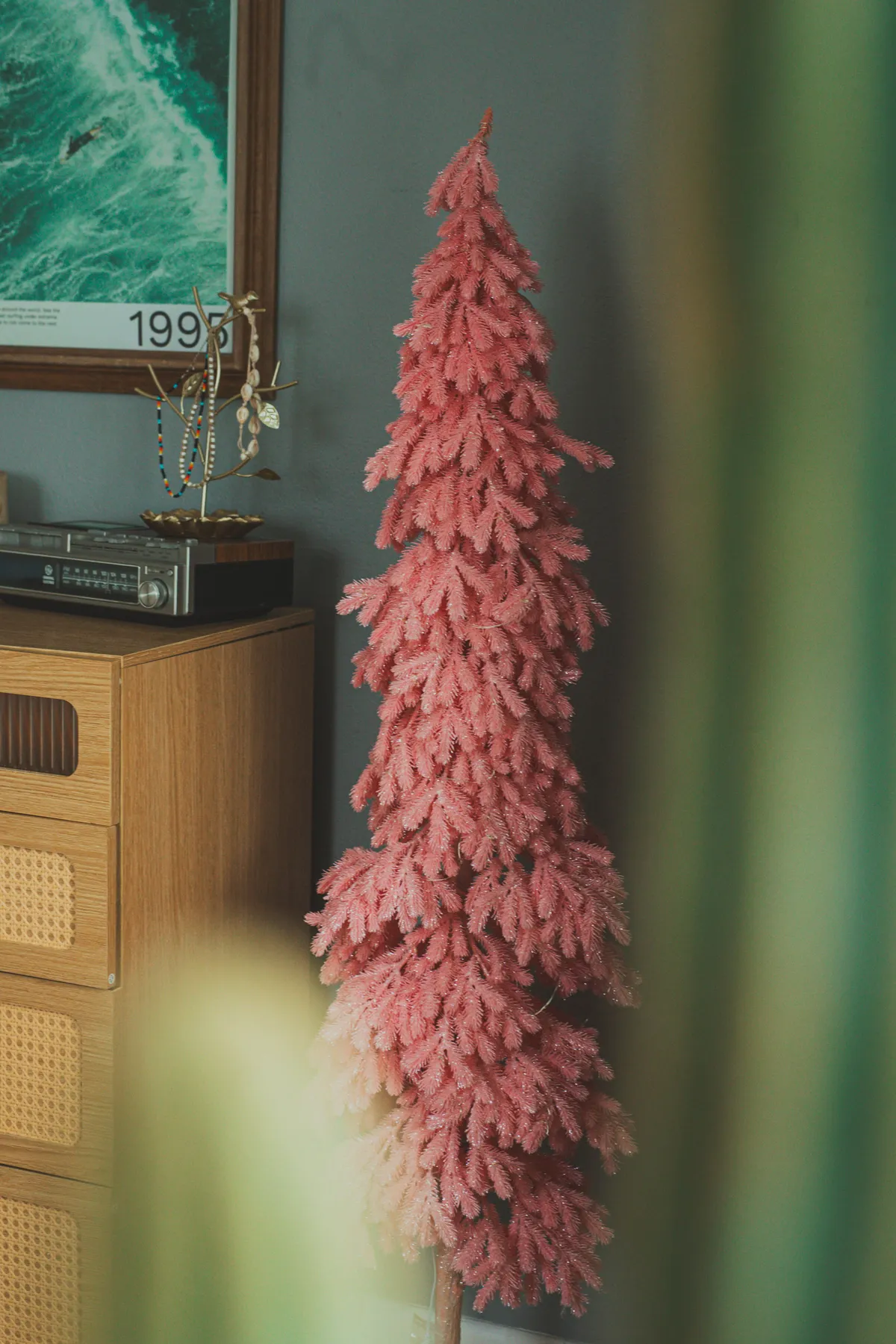
Pink tinsel trees run $40–$120 for a 6 ft slim, and a decent one looks nearly identical to an expensive one — the material does the work. Thrift stores and marketplace listings turn them up for $20–$35 after December. If pink isn’t your color, the same slim silhouette in silver or white gives you the retro feel with a softer palette. This is the moodier, more vintage-leaning cousin of the paired mini trees in Idea #12.
27. Frosted Needles and a Red-to-Gold Gradient Ornament
Flocked needles shed every time you touch them, so handle this tree once fully decorated and then leave it alone. Flocking also yellows after three or four seasons if it’s stored somewhere warm — a cool, dry basement beats a garage. Wipe ornaments with a dry cloth rather than a damp one, since flocking plus moisture equals a gummy mess. Budget two hours for setup and a careful hour for takedown.

The strongest close-up trees mix three textures inside a single color family: matte, glitter and natural. One glittered sphere, one felt or fabric piece, one pinecone per cluster. At arm’s length — which is where people actually stand — texture is what they see, not color. If a tree looks flat from two feet away, it’s missing a matte element, not another shiny one.
28. Plaid and Sheer Metallic Ribbon on a Gold-Silver Tree
55% green tree. 20% gold. 15% silver. 10% beige plaid and sheer metallic ribbon. That’s it — no third metal, no additional color. The plaid is what makes it feel traditional instead of generic; without it, gold and silver alone can read like a hotel lobby. Swap the beige plaid for red tartan and the same tree becomes a classic Christmas look with no other changes at all.
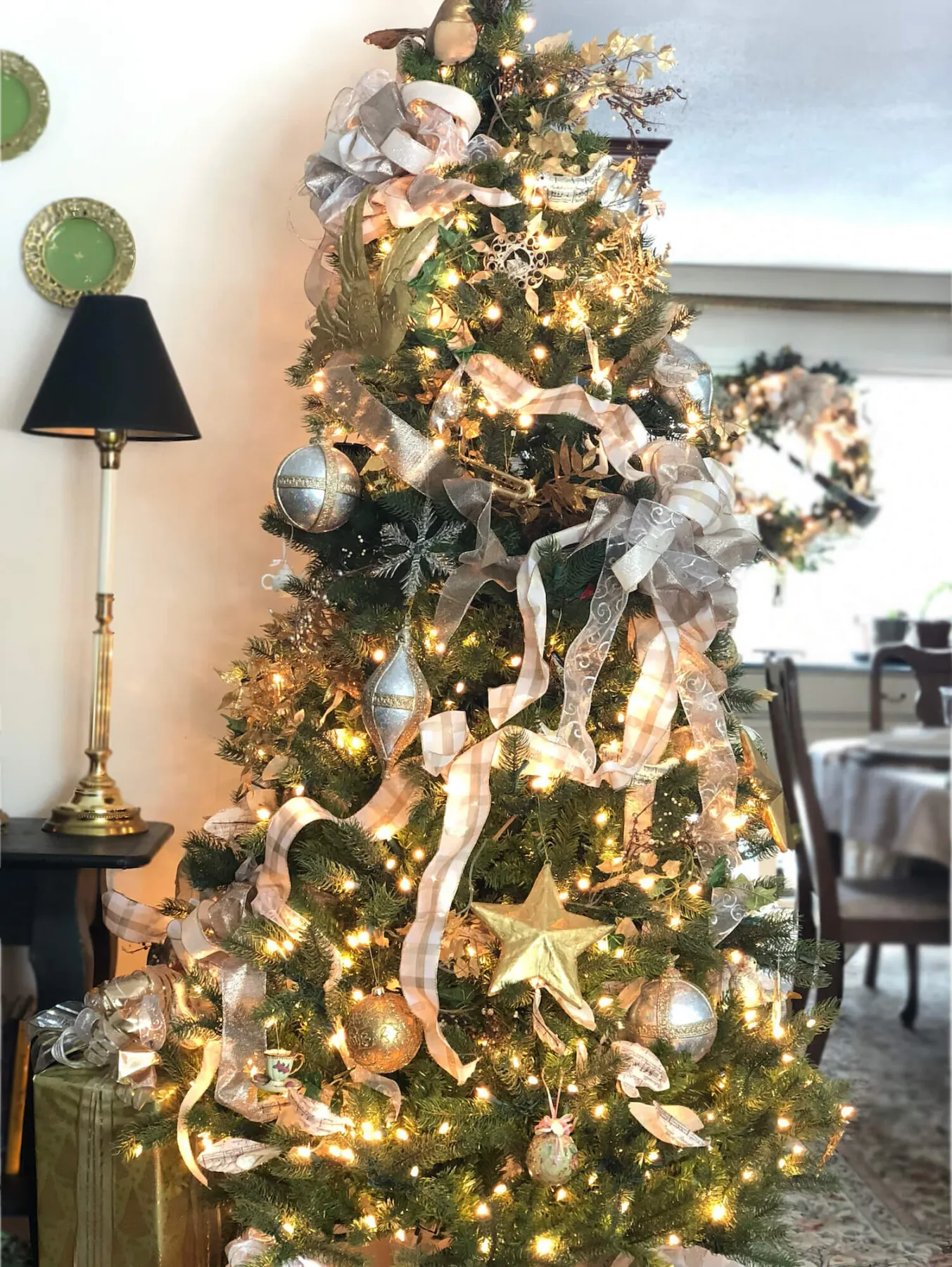
The ribbon drape that holds this tree together:
- Cut two ribbon types — one plaid, one sheer — into 20-inch lengths.
- Start at the top and weave down in a loose spiral, pinning with ornament hooks.
- Overlap the plaid and sheer so each one crosses the other every few inches.
- Tie two or three loose bows total; more than that gets fussy fast.
- Hang the largest ornaments where the ribbons cross to hide the pins.
About 40 minutes and $30–$60.
29. Flocked Tree with a Spiky Gold Starburst Topper in a Dark Room
A tall flocked tree in a dining room needs 36 inches of clearance from any chair back and at least 18 inches from the wall so the flocking doesn’t press against it. Navy tufted chairs want a table 42 inches wide or more to look balanced underneath them. Ten-foot ceilings are ideal here; anything lower and a floor-to-ceiling tree will crowd the room instead of filling it.
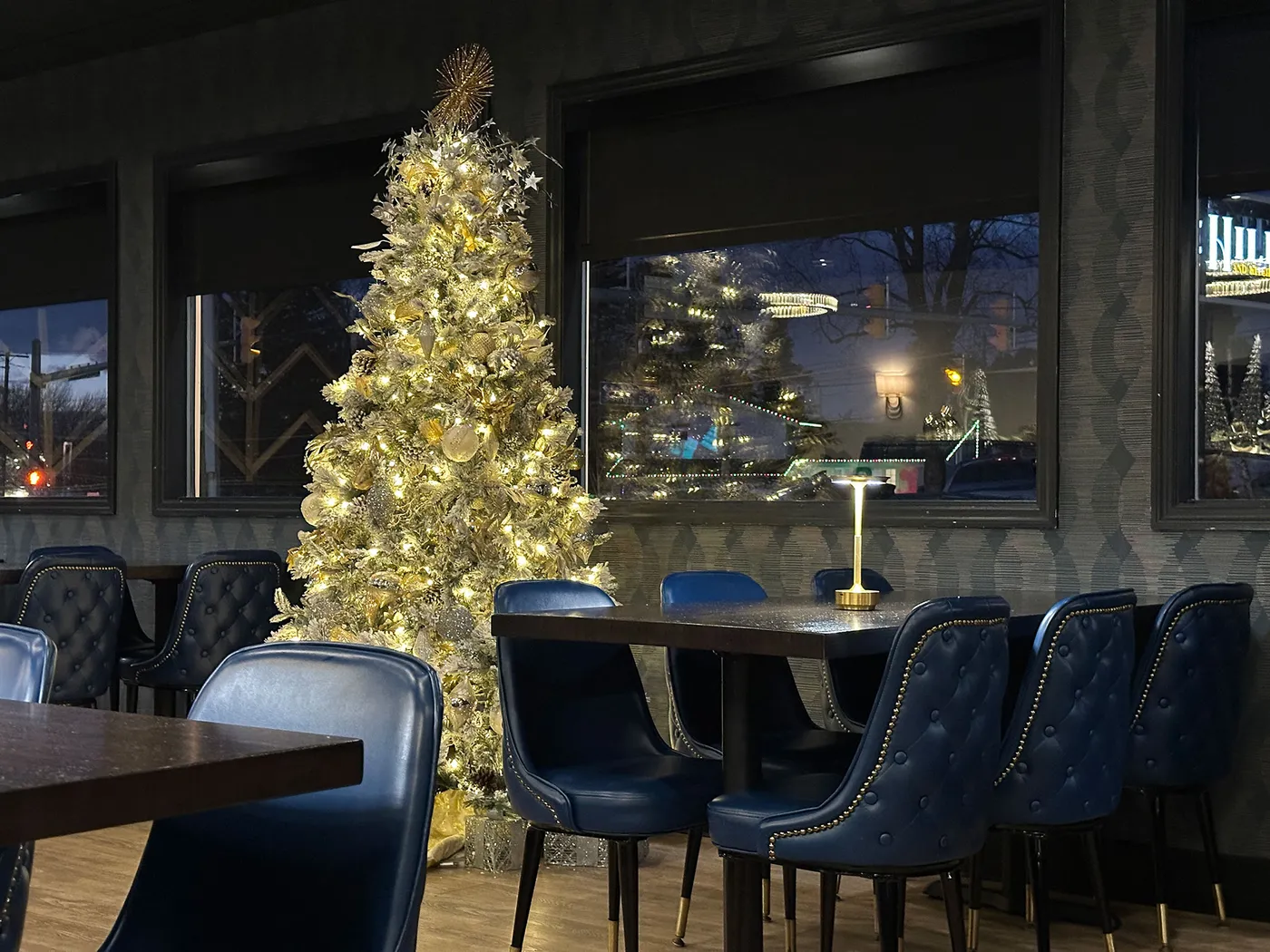
Flocked white trees in dim rooms are stunning and can tip into ghostly if the light is wrong. The gold starburst topper helps, but keep your string lights dense and warm — cool white will make the whole thing read grey. In a commercial or restaurant space, check fire code before going heavy on lit decor. At home the only real risk is dust, which flocking grabs and holds onto.
30. A Tree Dressed Entirely in White Flowers and Fairy Lights
Flowers at Christmas work because they’re unexpected. A tree with no ornaments at all forces the eye onto form — the taper, the density, the way white blooms sit against deep green. The fairy lights are small enough to read as sparkle rather than bulbs, which keeps the whole effect natural instead of electric. The metallic star topper then gives you one clean vertical line to finish the silhouette.
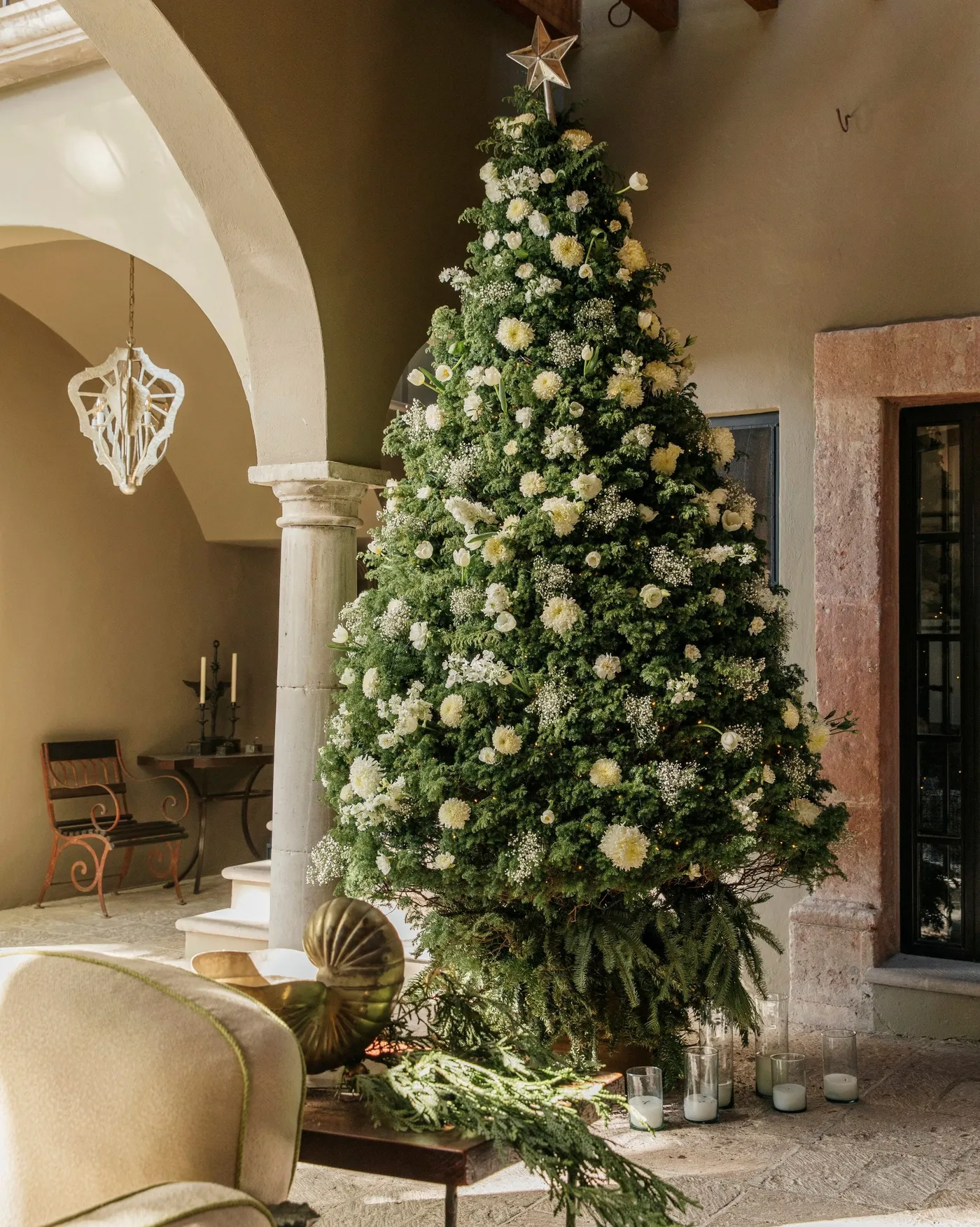
Faux chrysanthemums and baby’s breath cost a fraction of fresh and can be reused for years; a bundle of 20 stems runs about $15–$30 at craft stores, especially with a coupon. If you want the real thing, buy white blooms from a grocery florist the morning of your event — $40–$70 fills a 6 ft tree. Keep the base simple either way; pillar candles cost less than $20 total.
Your 2026 Tree Starts With One Good Idea
Save the two or three ideas that made you stop scrolling, measure your corner, and buy the tree first — everything else follows from there. Whether you land on a flocked neutral, a slim pink tinsel, or a tree dressed entirely in white flowers, the room will tell you what it wants once the lights are on. 📌 Pin your favorites now, and send us a photo when yours is up — we genuinely want to see which one you chose.