White Christmas trees used to be the safe, slightly sterile choice — and then 2026 happened. This is the year the flocked, frosty, snow-tipped tree went from “the spare one in the garage” to the piece people are pinning at midnight and driving across town to find, and the styling around it has gotten genuinely fun: cobalt velvet, sage-blue ribbon, black-and-white ticking, rose gold glitter.
We spent real time browsing HomeGoods, Target, Michaels, IKEA, and Facebook Marketplace to bring you only what’s worth your attention this season — ideas that stretch from about $45 to $1,200 depending on how far you want to take it. Inside you’ll find 30 curated ideas across minimalist flocked, monochromatic white, rustic farmhouse, and full-on glam gold-and-silver looks, and the bigger builds come with budget and luxury versions compared side by side.
The 2026 shift is texture-first. People aren’t buying more ornaments — they’re layering velvet ribbon, paper honeycomb, ceramic figurines, and woven collars so a white tree reads as designed instead of just decorated. And stay with us to the end — we break down the most common mistakes that can quietly ruin these looks.
📌 Save this to Pinterest for later — you’ll want to revisit these ideas.
1. Twin Flocked Trees Framing a Cobalt Blue Sofa
Symmetry is doing most of the heavy lifting in this living room. Two heavily flocked trees flanking a large window create a formal frame that makes an open living-and-dining space feel intentional rather than sprawling. The second principle is contrast: that cobalt blue velvet sofa is the only saturated thing in the room, so the red and white ornaments read as a deliberate echo instead of holiday clutter. And the white geometric polar bear on the light wood table ties the snow-dusted trees to the dining side without adding a single new color.
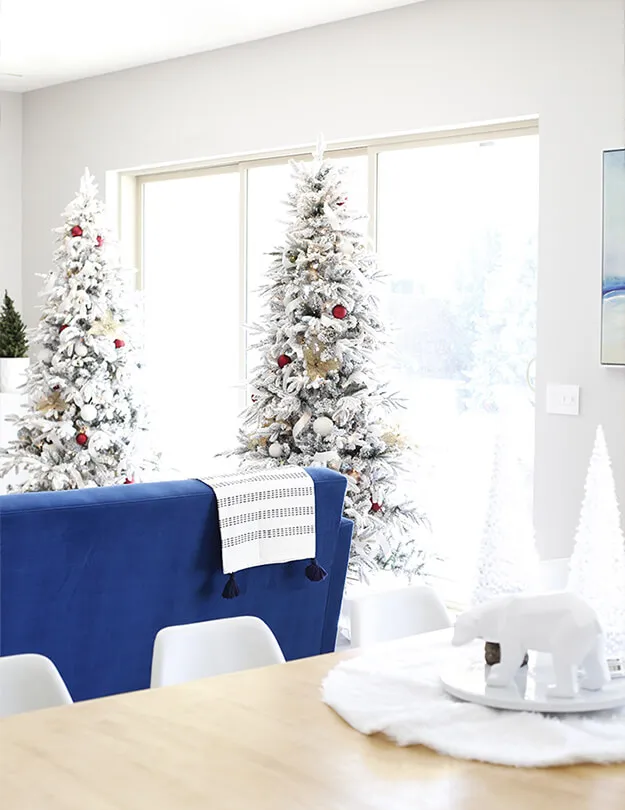
If you’re styling two flanking trees, treat them as one composition, not two projects. Measure the window’s full width, then leave at least 18 inches of wall on each outer side so the trees don’t crowd the corners. Keep ornament scale identical on both — same sizes, same count — and reserve the tallest, most sculptural piece for whichever tree sits on the room’s main sightline. Matching trees only look expensive when the styling is deliberately mirrored.
2. Tiny White Gift Boxes Against a Charcoal Wall
The miniature white gift boxes are the whole story. Without them you’d have a perfectly nice flocked tree with round ornaments — the version you’ve seen a thousand times. Those tiny wrapped packages, each tied with a thin gold ribbon, give the branches a repeating square shape no bauble can replicate, and they link the tree to the real gifts waiting underneath on that white fuzzy rug. Twenty tiny boxes cost less than one statement ornament.
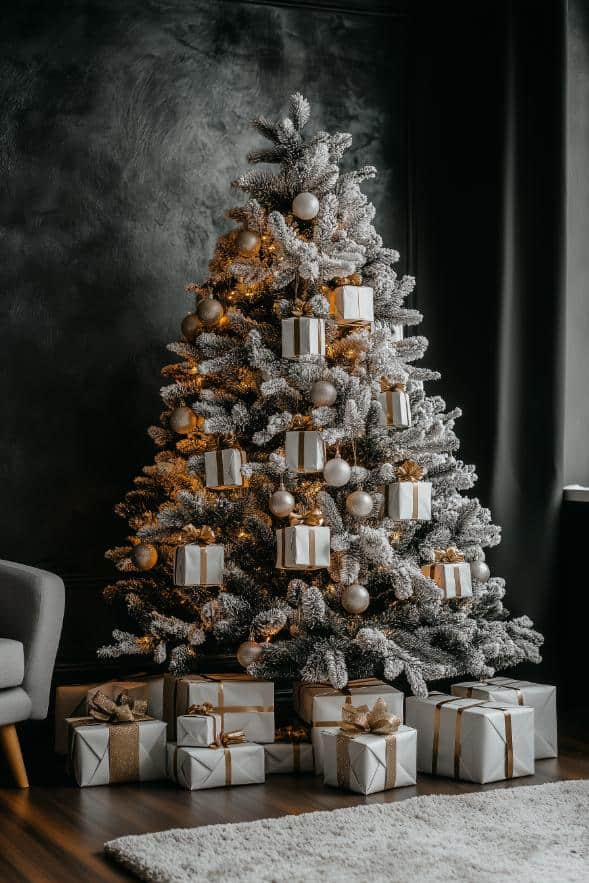
- Flocked 7.5 ft tree: $180–$450
- Warm-white string lights, 300 count: $25–$60
- Mini gift box ornaments, set of 24: $18–$40
- Thin gold ribbon spool plus round ornaments: $30–$70
- White fuzzy rug: $60–$180
- Charcoal paint for the accent wall: $40–$70
Total: $353–$870
Budget alternative: a six-foot flocked tree from Walmart ($75), a $12 strand of warm LEDs, and 24 small white boxes from a craft store with a $6 roll of gold ribbon gets you 80 percent of this look for under $120 — paint one wall charcoal and skip the new rug.
A dark textured wall is gorgeous and also unforgiving. Every fingerprint, dust halo, and stray piece of flocking shows up in raking light, and flocked trees shed constantly. If that wall sits behind a high-traffic path, you’ll be touching it up twice a season. And in a small room with one small window, charcoal plus a big white tree can tip from moody into murky.
3. A Barely-There White Tree With a Woven Collar
On a white tree, spacing beats quantity every time. Aim for roughly one ornament for every 6 to 8 inches of branch tip, and stop while it still looks slightly sparse — flocked branches bounce light, so a white tree reads about 30 percent fuller than a green one holding the same number of pieces. Cluster in odd numbers, and push a third of your ornaments two inches deep into the branches so the silhouette stays soft instead of studded.
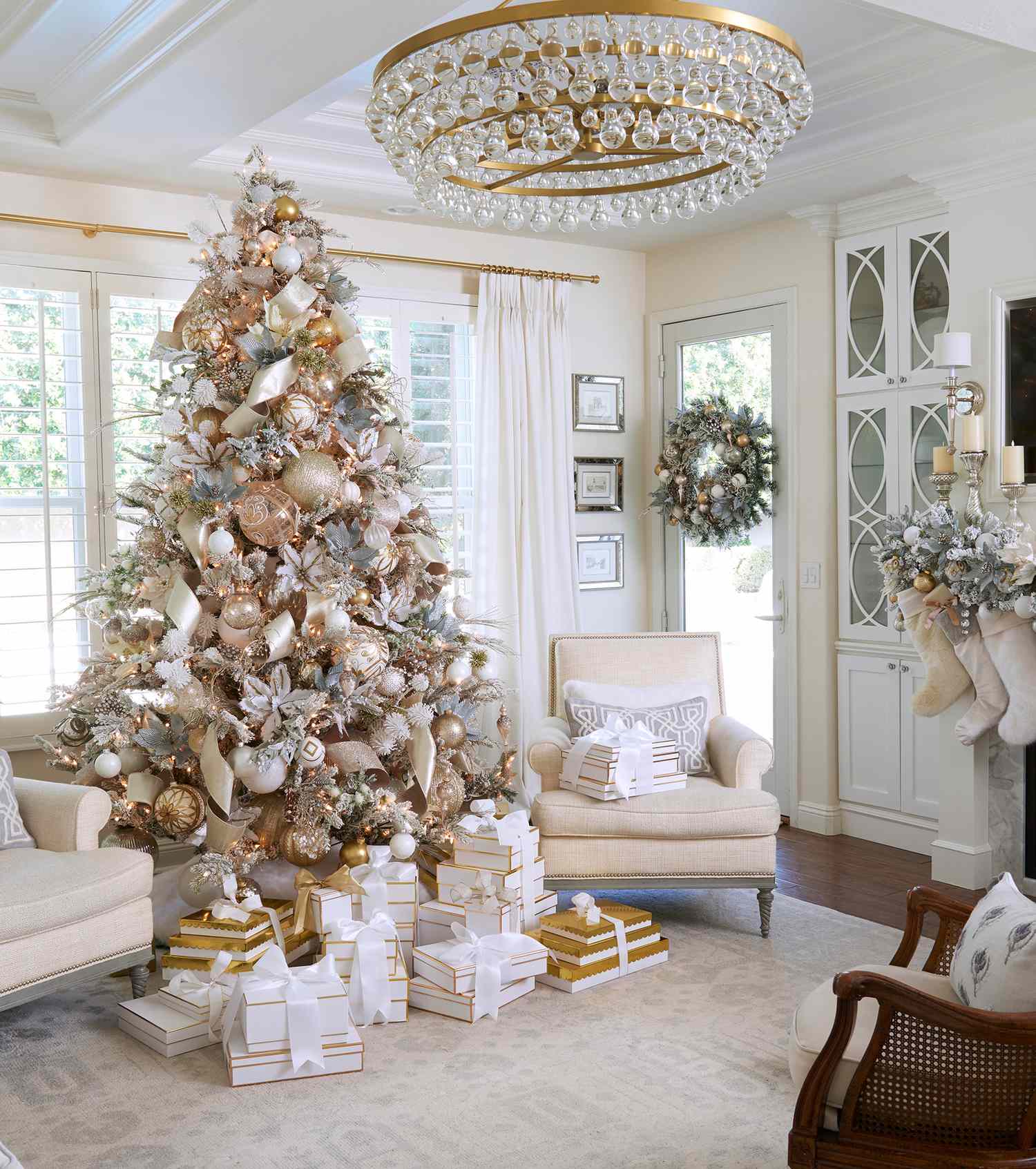
This understated look needs air around it. It works best in a room of at least 200 square feet with 9-foot ceilings and a tree between 7 and 9 feet tall. Under 8-foot ceilings, a tall flocked tree plus a chunky woven collar starts to feel like a hat that’s two sizes too big. If your space is smaller, borrow the same calm from the windowsill collection in Idea #23 instead.
4. Cream Velvet Bows on an All-White Tree
Here’s the formula: 80 percent white and cream flocking, 15 percent soft texture from velvet bows, ribbed baubles, and frosted pinecones, 5 percent warm light. Swap the cream velvet bows for blush silk and the tree goes romantic; swap them for chunky knit and it goes cabin. Keep the ratio and you can change every single object on the branches without losing the mood.
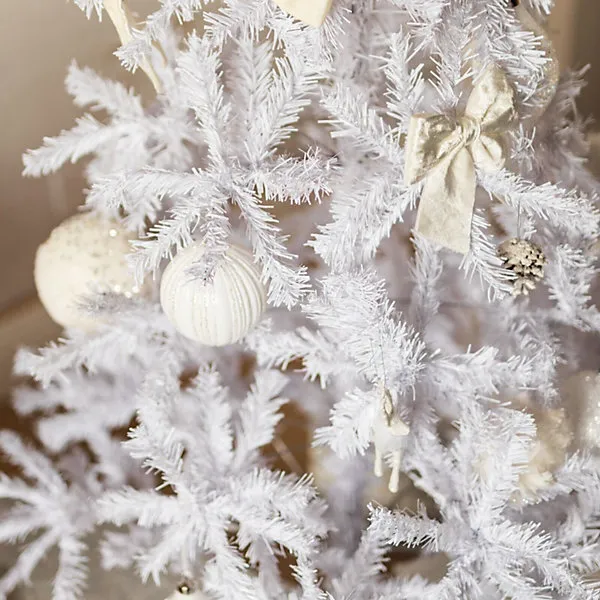
The tiny white animal figurines are what separate a display from a story. A monochromatic tree with bows and baubles is pretty; a tree with a small fox tucked near the trunk is one people walk up to and inspect. Take away everything else and keep only ribbed spheres and animals and the tree still works — the reverse isn’t true. For the same white-on-white palette with zero whimsy, see Idea #17.
5. Striped Ribbon and a Farmhouse Christmas Sign
Black-and-white ticking ribbon is quietly everywhere this season, and it works because it gives a warm, slightly rustic tree a graphic edge without adding color. Pair it with a framed vintage-style sign, an orb chandelier, and two mini tabletop trees and you get the farmhouse look that doesn’t tip into theme-park. This one has staying power — stripes are a classic textile move, not a novelty.
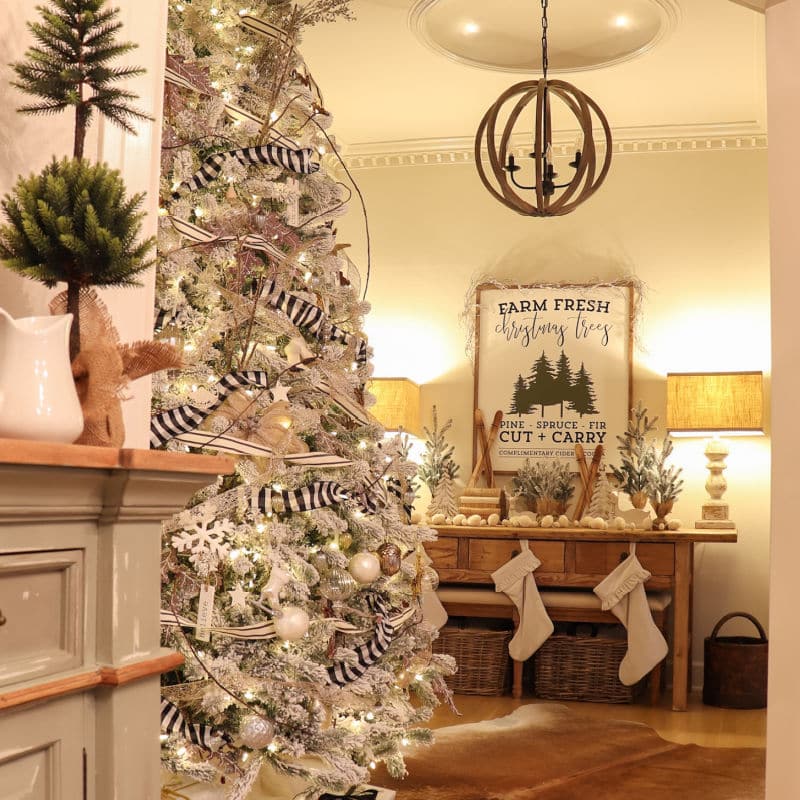
The console vignette is what sells it, so style it like a shelf, not a display table.
- Clear the console completely and place the tallest object — the framed sign — off-center, about two-thirds across.
- Add three mini tabletop trees at different heights; the tallest should be roughly two-thirds the height of the sign.
- Hang two stockings from the console edge, a hand-width apart, never centered.
- Fill the empty space underneath with one low basket or bowl so the eye doesn’t drop straight to the floor.
Time: about 20 minutes. Cost: $0 if you own the pieces, $60–$120 if you don’t.
6. Gold, Silver, and Oversized Floral Picks
Three things are making this tree glow. First, finish variety: matte flocking next to glossy metallic ornaments next to beaded ribbon edges means light hits the tree at four different angles. Second, scale contrast — oversized white floral blossoms read as architecture while standard baubles fill the gaps between them. Third, the fairy lights are woven deep rather than draped on the surface, so the tree looks lit from inside. If your tree ends up crowded rather than collected, we cover exactly that at the end.
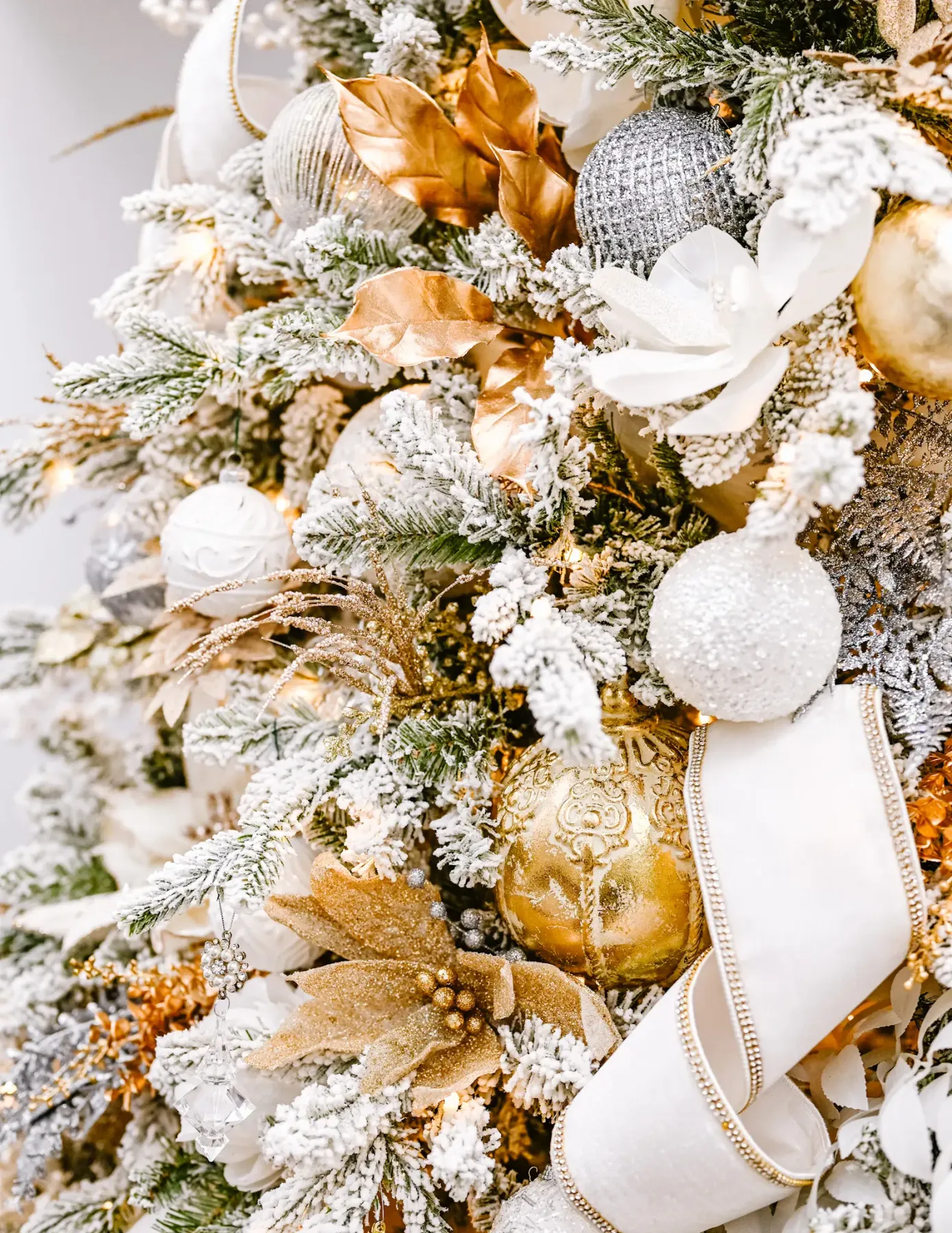
- Flocked 7.5 ft tree: $200–$500
- Mixed gold and silver ornament set, 60 pieces: $60–$140
- Wide white ribbon with beaded edges: $25–$55
- Oversized floral picks, set of six: $30–$80
- Warm-white fairy lights: $20–$50
Total: $335–$825
Budget alternative: a six-foot unlit flocked tree for $90, two strands of warm LEDs at $14, a $30 mixed metallic ornament box, and a spool of plain satin ribbon gets you most of the glow for under $150.
7. A Lit Wooden Star Topper Above White Poinsettias
The lit wooden star topper is why this tree feels handmade instead of purchased. It’s the one warm brown element in a white-and-gold palette, and it echoes the wooden crate of ornaments and the little wooden sled leaning against the wall — a material thread running through the whole corner. Replace it with a glitter star and the vignette instantly loses its rustic backbone.
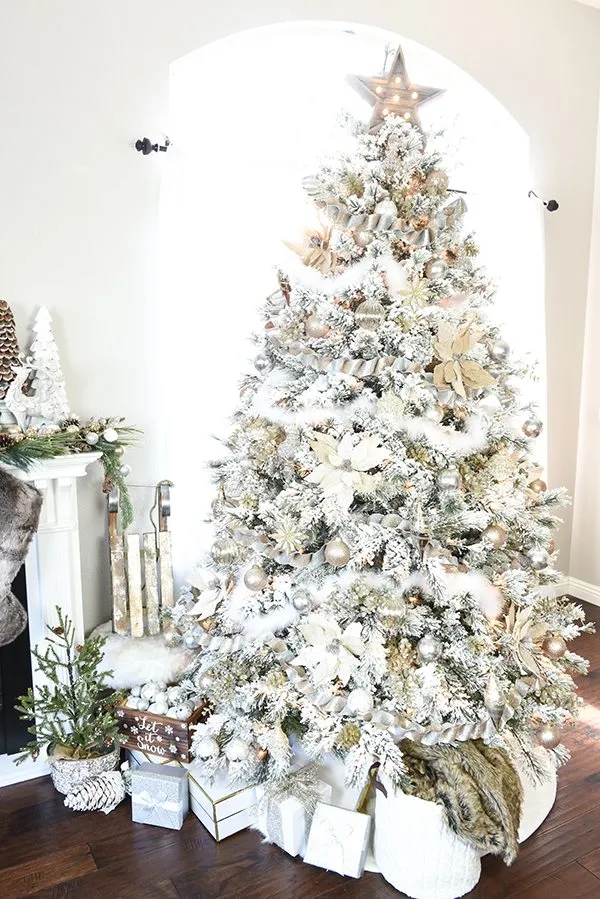
Oversized poinsettia picks and metallic leaf sprays are the highest-maintenance part of any flocked tree. Glitter sheds onto the flocking and it’s nearly impossible to pick out; the petals also crush in storage, so plan on replacing two or three picks every other year. Store them in a flat box, not a bin, and keep the tree out of direct sun — flocking yellows over about three seasons in a bright window.
8. A Tabletop Green Tree in a Grey-and-Red Corner
A small tree with pinecones and warm fairy lights is a smart choice for apartments — until a cat discovers it. If you share the house with animals or toddlers, skip the wire picks and pinecones near the bottom third, switch to shatterproof ornaments, and weight the base inside the white tree skirt. Kraft paper gifts with red bows are also a chew toy waiting to happen; keep the treats on the coffee table instead.
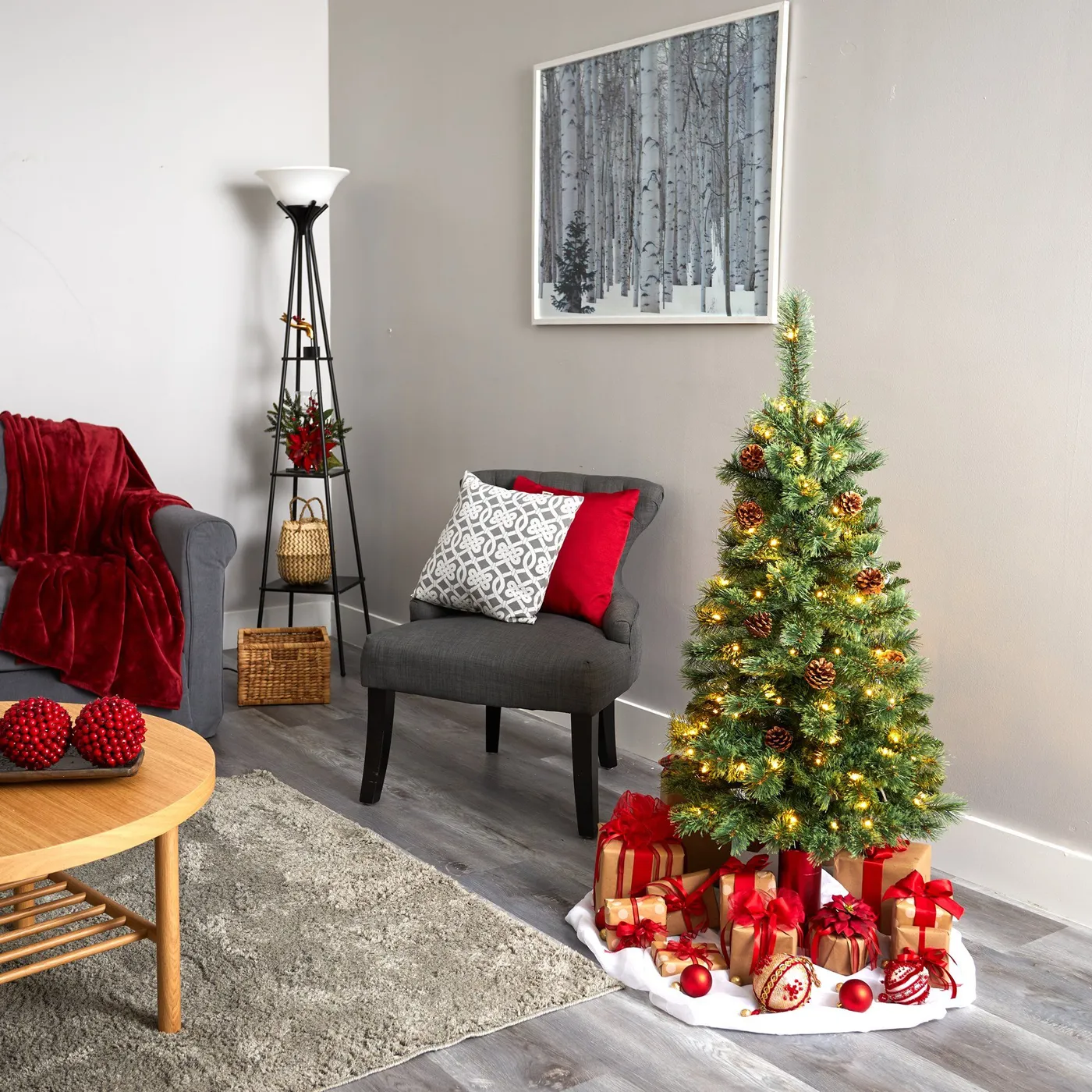
The color math holding this corner together is roughly 50 percent grey and natural wood, 25 percent kraft and white, 15 percent deep red, and 10 percent green. That’s why the red berry ornaments on the round coffee table and the red cushions on the grey armchair feel connected to the tree. Want the same red accent without the green tree? See Idea #27.
9. Sage-Blue Velvet Bows on a Frosted White Tree
Velvet ribbon needs to be cut wider than feels natural. Use 4-inch ribbon for the main bows and 2-inch for the small filler loops, and pinch the bows into shape rather than tying them tight — velvet loses its loft the moment you pull the knot hard. And check your bulbs before you commit: if a cold-white strand ends up anywhere near that sage, the blue goes grey and the whole tree looks dusty.
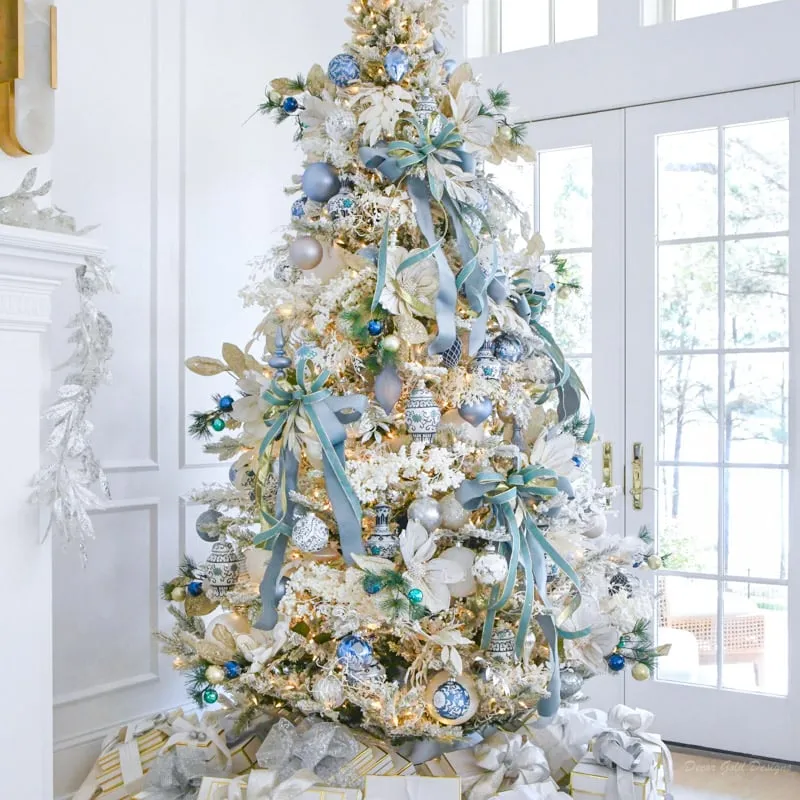
- Flocked white 8 ft tree: $280–$550
- Sage-blue velvet ribbon, three rolls: $36–$75
- Blue and silver ornament set: $50–$120
- White poinsettia picks, set of six: $28–$60
- Warm-white string lights: $25–$55
- Wrapping paper and ribbon for the base: $30–$60
Total: $449–$920
Budget alternative: dye plain white satin ribbon with a $6 fabric dye bath to hit the sage tone, and build the ornaments from a thrifted silver set plus a $20 box of blue baubles.
10. A Stacked Gift-Box Tower With Snowy Garland
This display is built from empty boxes, which is exactly why it works — nobody’s unwrapping it on Christmas morning.
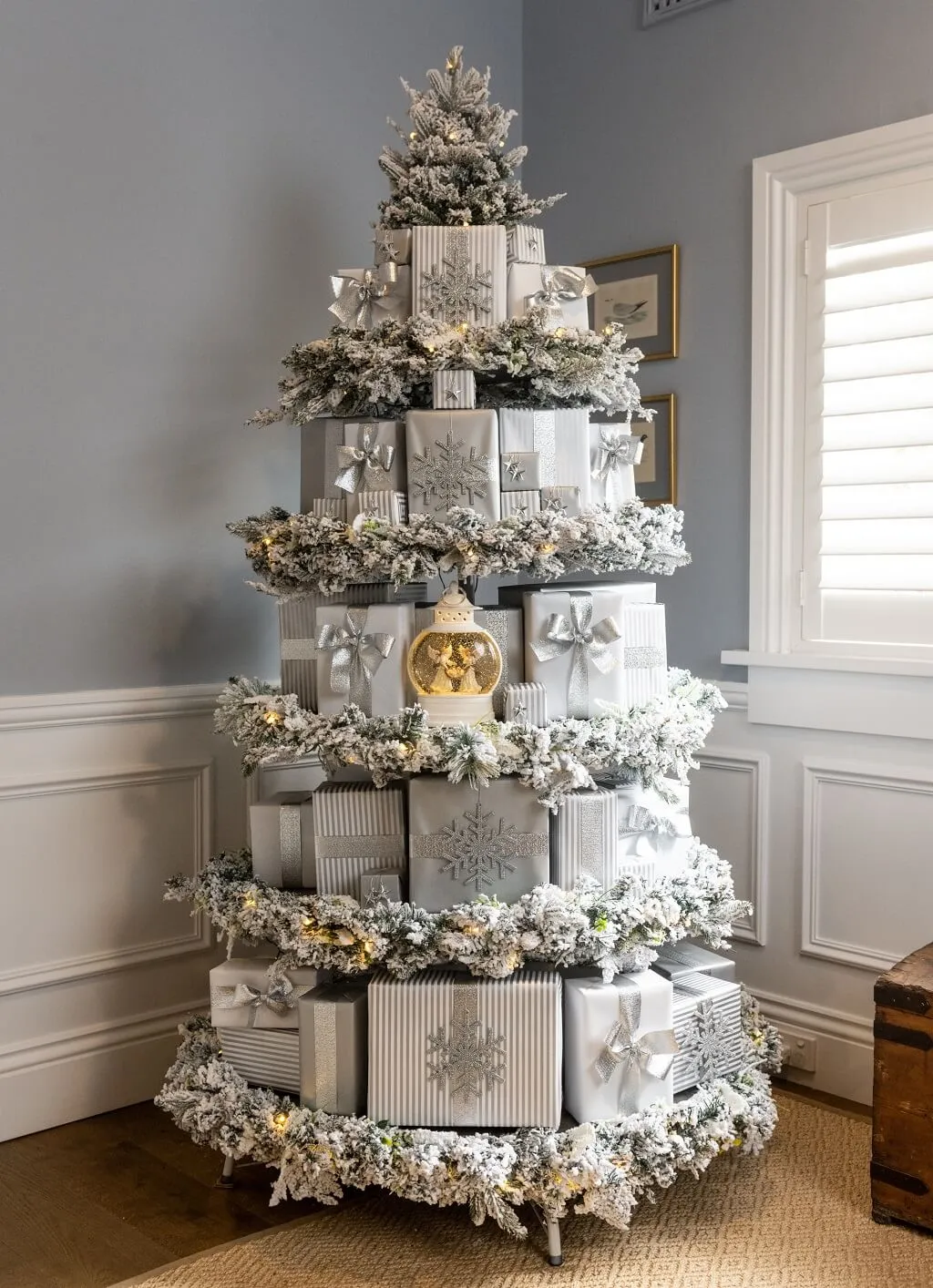
- Collect six to eight sturdy boxes in graduated sizes; gift boxes, not shipping cartons.
- Wrap each in silver or white paper, then stack the largest at the bottom and the smallest on top, offsetting every one by a few inches.
- Run frosted, snow-dusted garland between the tiers and tuck a warm light strand along the same line.
- Add a snowflake motif to the front of two or three boxes so the pattern repeats.
- Finish the peak with a small snowy tree topper and a lit snow globe lantern tucked at the base.
Time: about 90 minutes. Cost: $45–$90 in paper, ribbon, and garland.
Tiered, sculptural holiday displays are the 2026 answer to small-space decorating — they give you Christmas presence without a full tree. This one has real staying power because it’s just wrapping paper and garland. When the trend passes, you still have boxes.
11. Red Bells and a Rustic Star on a Corner Flocked Tree
You don’t need a designer’s ornament collection for this one. Shop the dollar store for gold bells in three sizes, use plain white spheres as your filler layer, and pull the red from discount stores — a bag of 40 red ball ornaments runs about $12. A textured cream tree skirt reads expensive even when it’s a $25 Amazon find. The whole tree, minus the flocked branches, lands under $75.
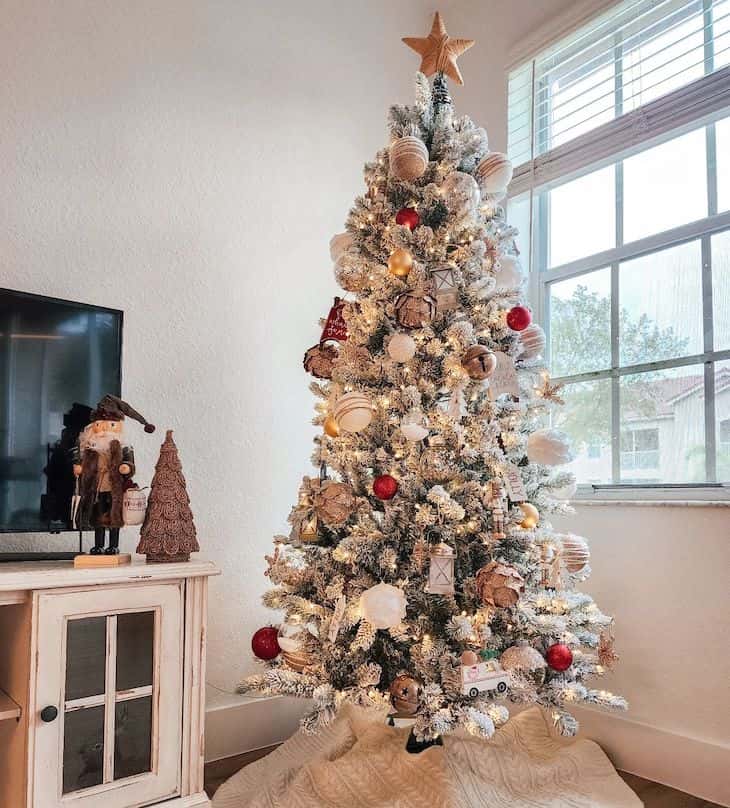
Hang your bells and heaviest pieces in the lower two-thirds and the inner branches, where they can’t weigh down the soft tips. Cluster them in threes — one large center bell with two smaller ones flanking — roughly every 18 inches around the tree. And if you love the red-and-neutral mix here, compare it with Idea #19, which runs the same idea in silver and white on a green tree.
12. A Family Tree Dressed in Ruby Red and Gold
Decorating with a kid in the room is a different sport. Put your ladder on a hard, flat surface rather than the rug, keep the breakable heirlooms in the top third, and hand off the bottom two feet as a designated kid zone — that’s where the shatterproof red and gold balls go. Tinsel and long beaded strands are the two things to skip entirely; they tangle in little hands and wrap around pets.
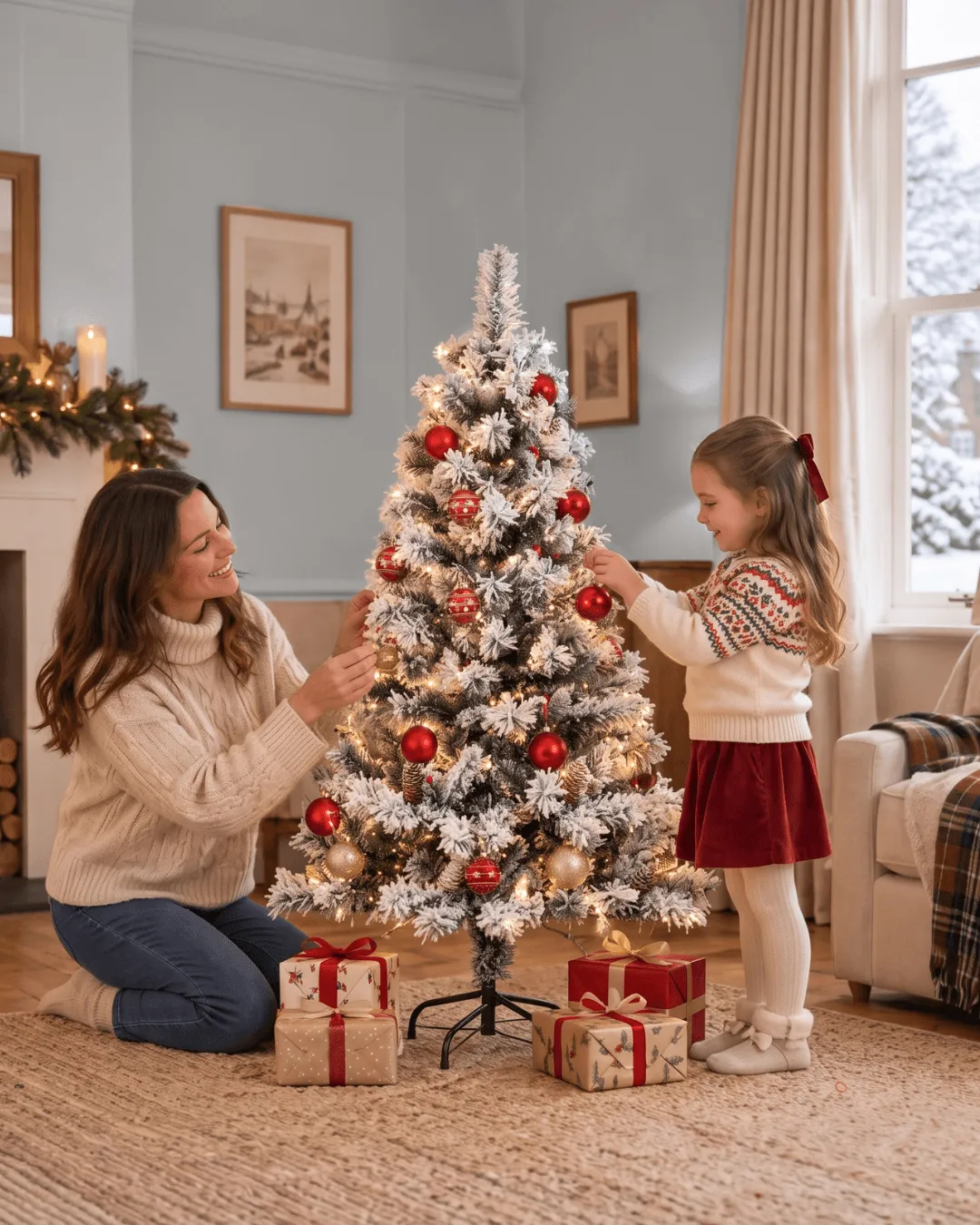
The visual logic here is simple and it’s why family photos of this tree always look good: warm fairy lights point the eye upward, identical red balls repeat at eye level for rhythm, and the wrapped gifts sit on a neutral woven rug that keeps the bottom of the frame calm. The tree is not the project. The tree is the excuse. Compare with Idea #2 — same flocked base, moodier room.
13. Gold Baubles Beside a Star-Hung Staircase Garland
The garland on the staircase railing is the real design move here — the flocked tree is beautiful, but that green swag with star ornaments hanging from it is what makes the two spaces feel like one decorated house instead of one decorated corner. It also pulls the eye up and back, so the tree doesn’t have to carry the whole room alone.
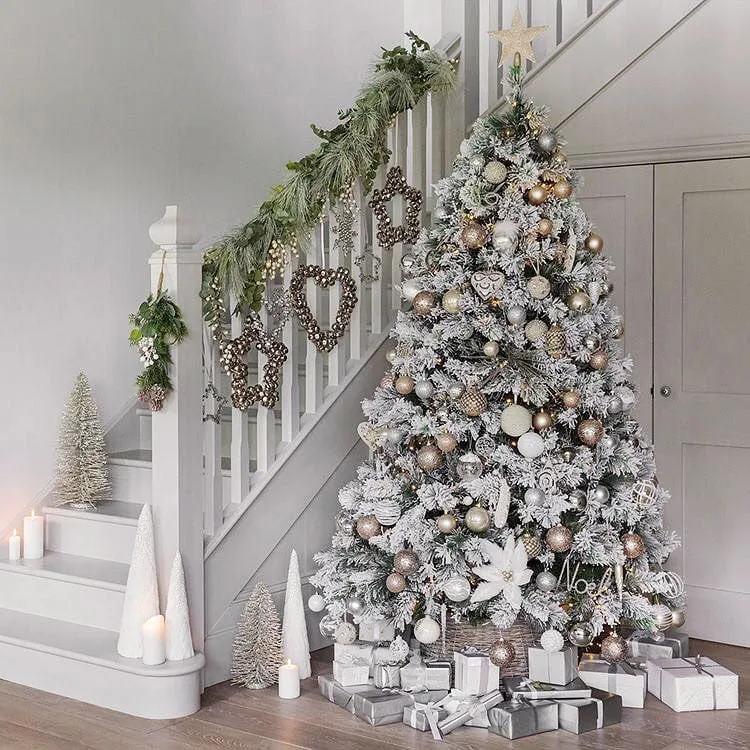
Tree-and-staircase arrangements need breathing room. Plan on at least 36 inches of clear walking width between the tree’s widest branch and the first stair tread, and keep the tree’s top at least 12 inches below any landing overhang. Ideal ceiling height is 9 feet or more with a 7.5 to 8-foot tree. Working with a tighter entry? The tabletop approach in Idea #20 gives you the same metallic palette in a third of the footprint.
14. Bold Stripes Woven Through a Flocked Spiral
The striped ribbon is the star, so get the rhythm right before you decorate anything else.
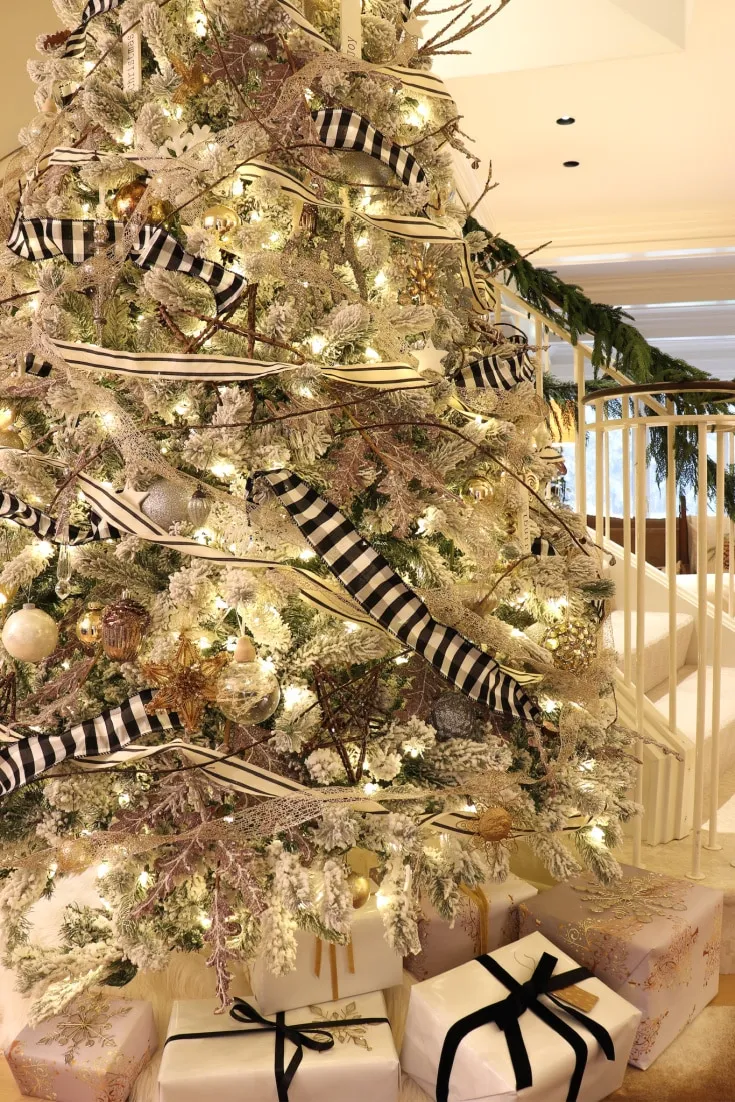
- Buy three rolls of 2.5-inch wired ribbon — wired is non-negotiable, it holds the wave.
- Tuck the end into the branches at the top and work down in a loose spiral, one full turn every 12 inches.
- Pinch a soft loop every 18 to 24 inches instead of pulling the ribbon tight against the tree.
- Step back after every third loop; you want visible branch between stripes, not a wrapped package.
- Cut the ends on a diagonal and tuck them into the bottom third where they won’t show.
Time: about 45 minutes on a 7.5-foot tree. Cost: $20–$45 in ribbon.
The pattern formula is roughly 55 percent flocked white, 30 percent black-and-white stripe, 15 percent champagne and green. Change the stripe to a thin red gingham and the whole tree reads country instead of graphic — the structure stays identical.
15. A Ribbed Ceramic Tree on a Wooden Riser
- Large ribbed white ceramic tree figurine: $45–$120
- Miniature flocked bottle brush trees, set of six: $14–$30
- Round wooden pedestal riser: $18–$40
- Natural pinecones, bag of 12: $10–$20
- Assorted ornaments for the background: $20–$45
Total: $107–$255
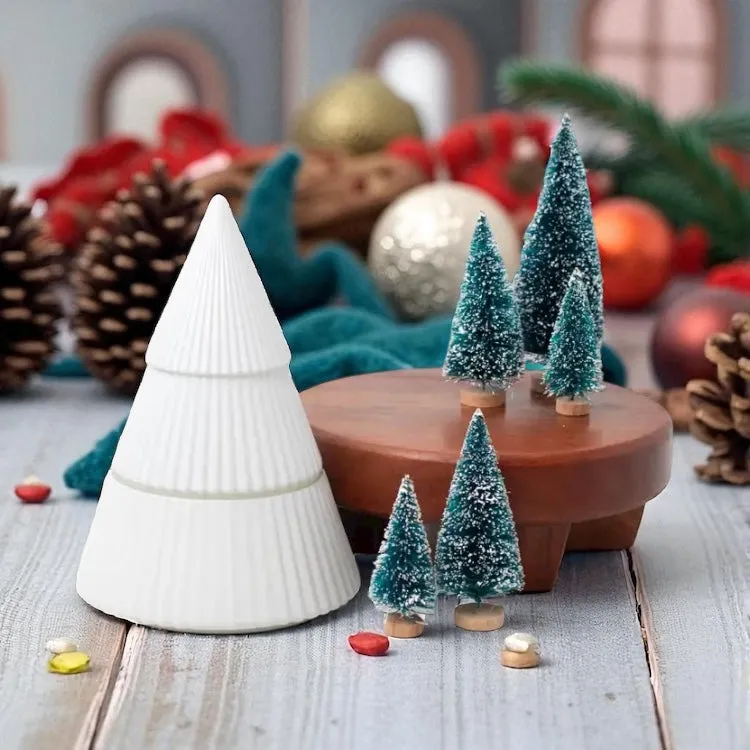
Budget alternative: thrift stores are full of ceramic trees in January for $8 to $15, and a spare cutting board or a stacked hardcover book works as a riser. Total rebuild: about $40.
Group odd numbers at three heights. On a riser, that means one tall item at the back, two mid-size pieces offset to either side, and three small bottle brush trees staggered across the front. Keep the tallest object at least a third taller than the second-tallest or the group reads as a flat row. And for a version of this idea that lives on a windowsill instead, see Idea #23.
16. Champagne Poinsettias and Quilted Ornaments
Beaded berry sprays and glittered foliage are the two biggest shedders in holiday decor. Expect a light dusting of glitter every time you move them, which means no dark velvet tablecloths under the tree unless you enjoy lint rollers. Quilted and textured ornaments, on the other hand, hold up beautifully — they hide scratches, they don’t shatter, and a quick swipe with a dry microfiber cloth in January is all the maintenance they need.
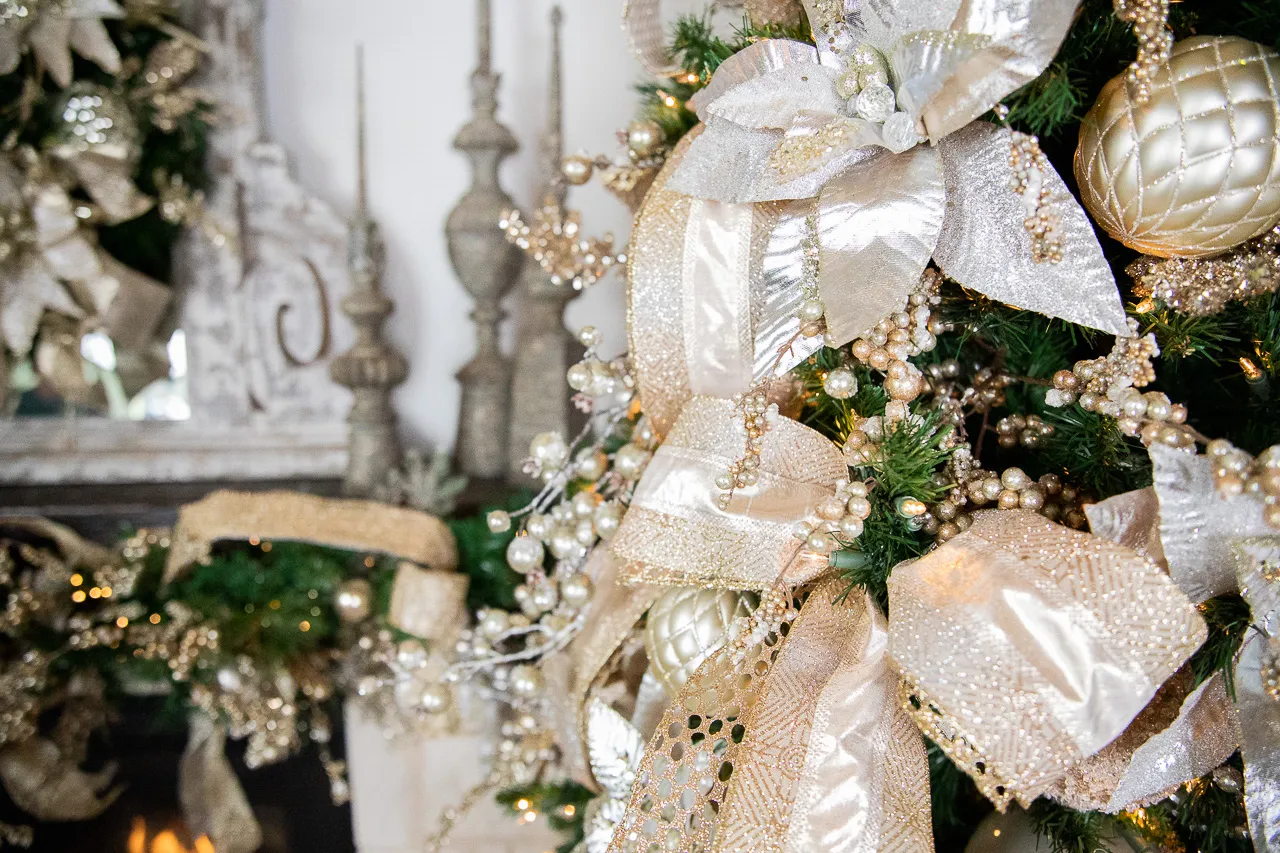
What makes this tree read as luxurious rather than simply expensive is layering: large metallic poinsettias set the scale, patterned ribbon adds movement, quilted balls add a matte counterweight to all that shine, and the warm string lights sit behind everything. Take away the matte elements and the tree turns into one bright, flat blur.
17. Sparse White Ornaments, Maximum Breathing Room
White-on-white only works when the finishes differ. Use glossy and matte in the same tree, in the same sizes, so the eye reads shape instead of color — roughly a 60/40 split of shiny to matte works well. Then count your lights: for a 7.5-foot tree, you want about 100 warm-white bulbs per vertical foot of tree, which means 700 to 800 total. Fewer than that and the flocking just looks dirty.
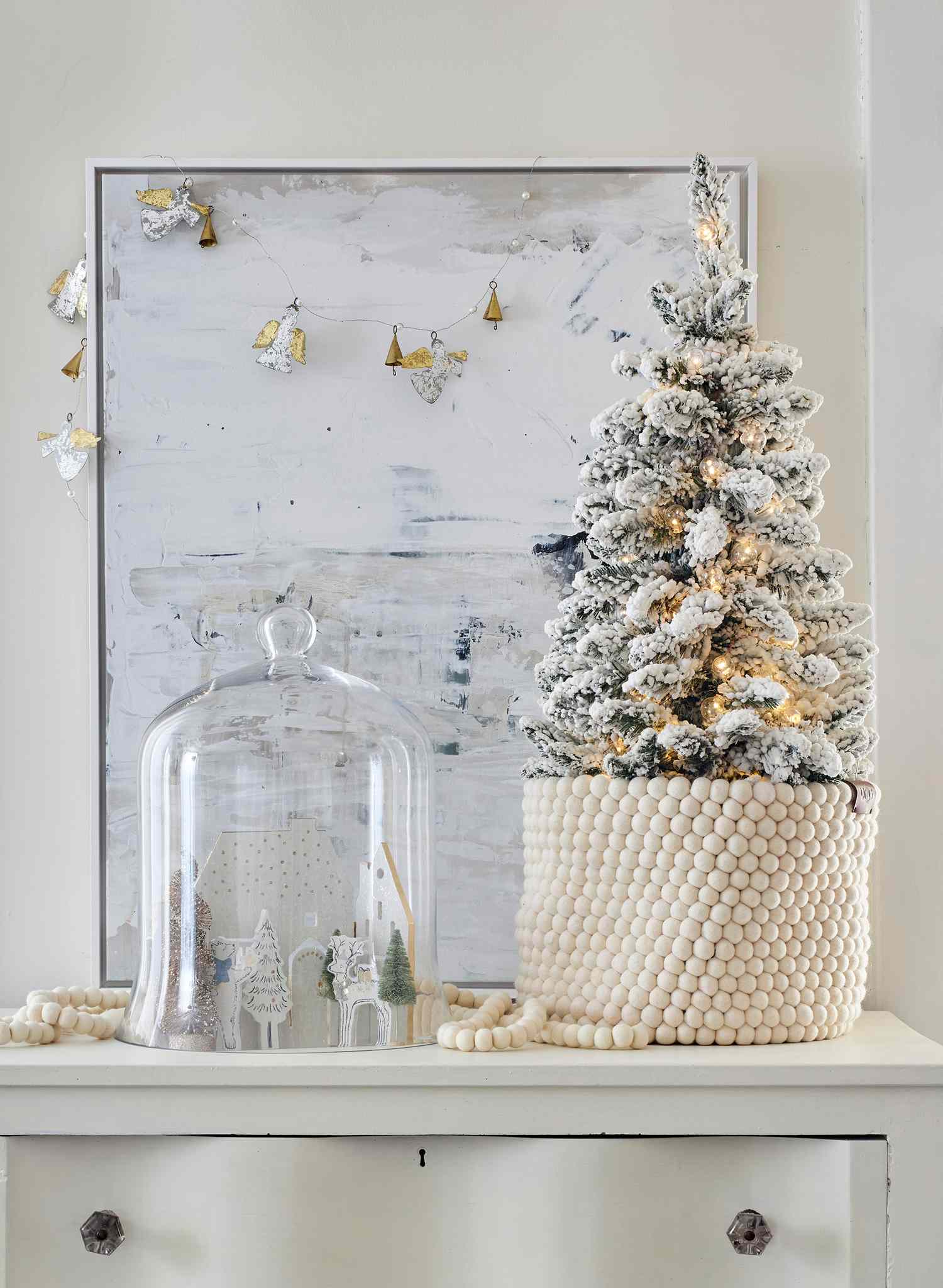
A quick pre-flight check before you commit to the minimal version:
- Measure the wall behind the tree — this look needs at least 12 inches of clear space on each side.
- Confirm your bulbs are warm white (2700K); cool white kills the whole effect.
- Check the tree base — a simple basket or woven collar, nothing shiny.
- Count your ornaments and plan to use two-thirds of them, not all of them.
- Set a budget ceiling for ornaments before you shop, because white is never cheap.
18. A White Tree That’s All Glow and No Clutter
The formula is 70 percent white flocked branches, 20 percent neutral texture from a woven base and subtle metallic ornaments, and 10 percent glow. That last 10 percent is doing more work than the other 90 combined. Swap the silver accents for warm gold and the tree warms up; swap the basket base for a galvanized bucket and it goes winter-cabin.
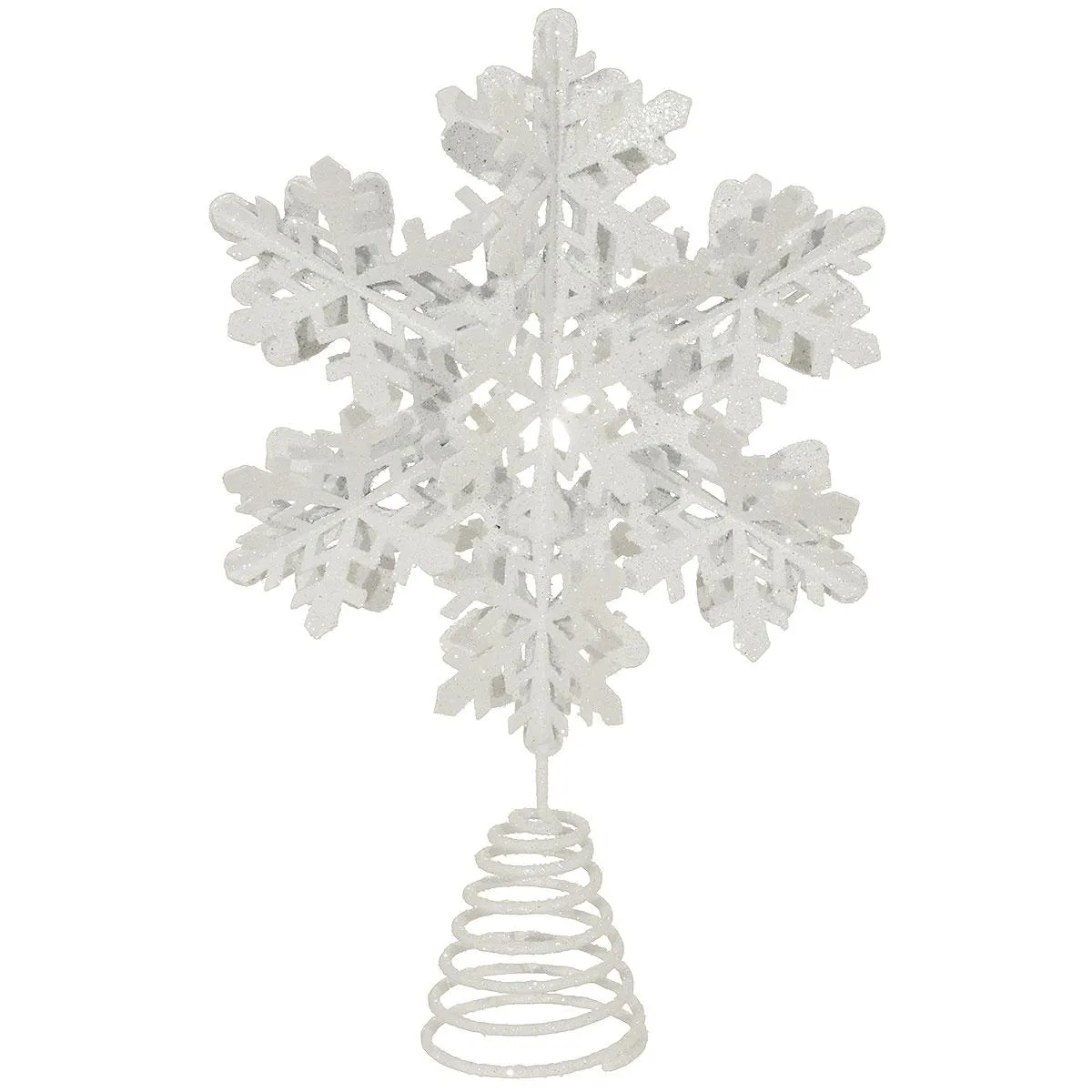
Sparse works in bright, quiet rooms and it absolutely does not work in a dark, crowded one. In a space with few windows or a lot of visual noise, an under-decorated white tree just looks like you ran out of ornaments. If your room is busy, layer in one more element — a ribbon, a garland, a dense collar — or lean into a fuller look instead. Sparse only works when the finishes are varied.
19. Silver Snowflakes on a Classic Green Tree
If you love white trees but the price tag makes you wince, do this instead: keep the green tree you already own and go all-in on white and silver decorations. Snowflake picks from a craft store run about $8 for six, glitter baubles are two dollars apiece, and white poinsettia stems are $4 each. You get the frosty feeling for roughly $95 total, versus $500-plus for a full flocked tree and flocked garland.
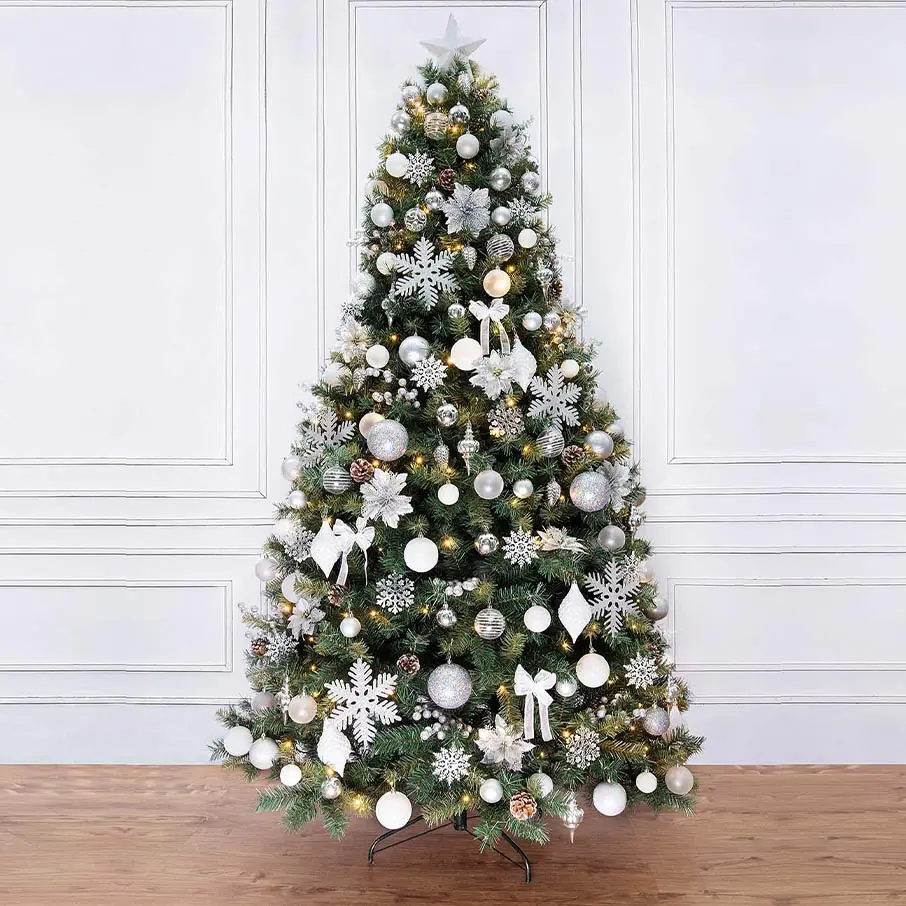
A standard green tree wants a little more height to feel balanced — an 8 to 9-foot tree in a room with 9-foot ceilings, positioned so the top clears any window trim by at least 6 inches. Against white paneled walls like this, green actually outperforms white in photographs, since the contrast does the framing for you. For a white tree in the same silver palette, jump back to Idea #9.
20. An Ornament Bowl Flanked by Silver Tapers
This centerpiece takes ten minutes and looks like you paid someone.
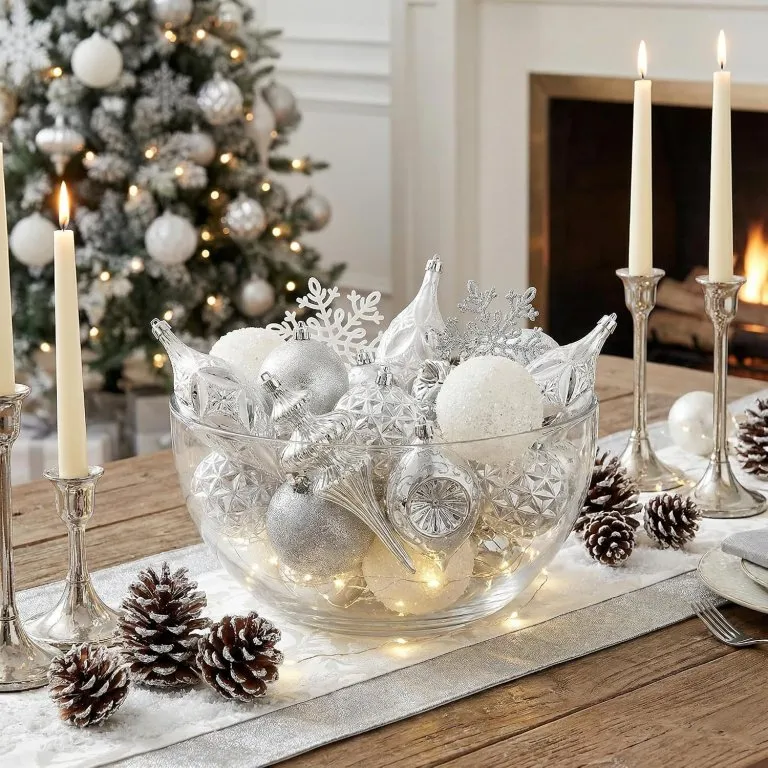
- Choose a clear glass bowl at least 10 inches wide — clear, so the ornaments do the talking.
- Fill it two-thirds with silver and frosted white baubles, mixing large spheres and small finials.
- Tuck three or four flat snowflake ornaments against the glass so they show through the side.
- Place two silver candlesticks with taper candles on either side, 4 to 6 inches from the bowl.
- Scatter four pinecones along the runner between them, keeping the spacing uneven.
Time: 10 minutes. Cost: $30–$60 if you own nothing, closer to $0 if you’re raiding the tree’s spare ornaments.
The taper candles are the piece you can’t remove. Without them, this is a bowl of ornaments; with them, it’s a table setting with height, warmth, and a little flicker that makes the silver read as mercury instead of chrome.
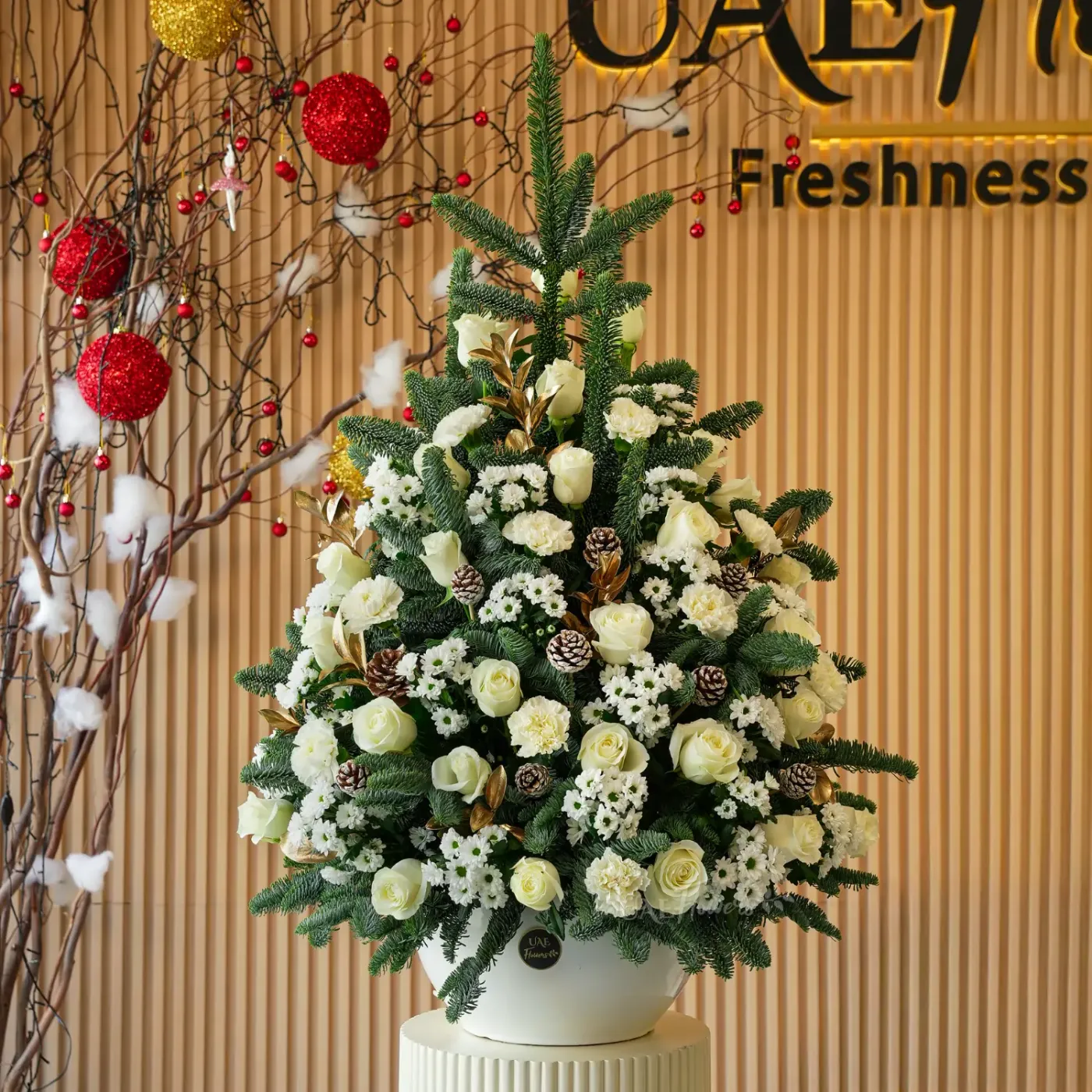
21. A Rose-and-Evergreen Tabletop Tree
Floral designers have been quietly running the holiday aisle for a few seasons now, and 2026 is the year the trend hit the tabletop. A cone of evergreen branches studded with white roses and small filler blooms, backed by pinecones and a few gold leaves, gives you the gesture of a Christmas tree at centerpiece scale. It’s the same impulse behind paper honeycomb trees and ceramic figurines: people want holiday shape without holiday square footage.
And here’s the honest part — fresh white roses in floral foam last about four to six days before the outer petals brown, and once they go, they go. Keep the arrangement away from heat vents and direct sun, top up the water every other day, and plan to swap the roses once mid-season. Want the same look without the deadline? Faux roses and frosted filler in the same pot last a decade.
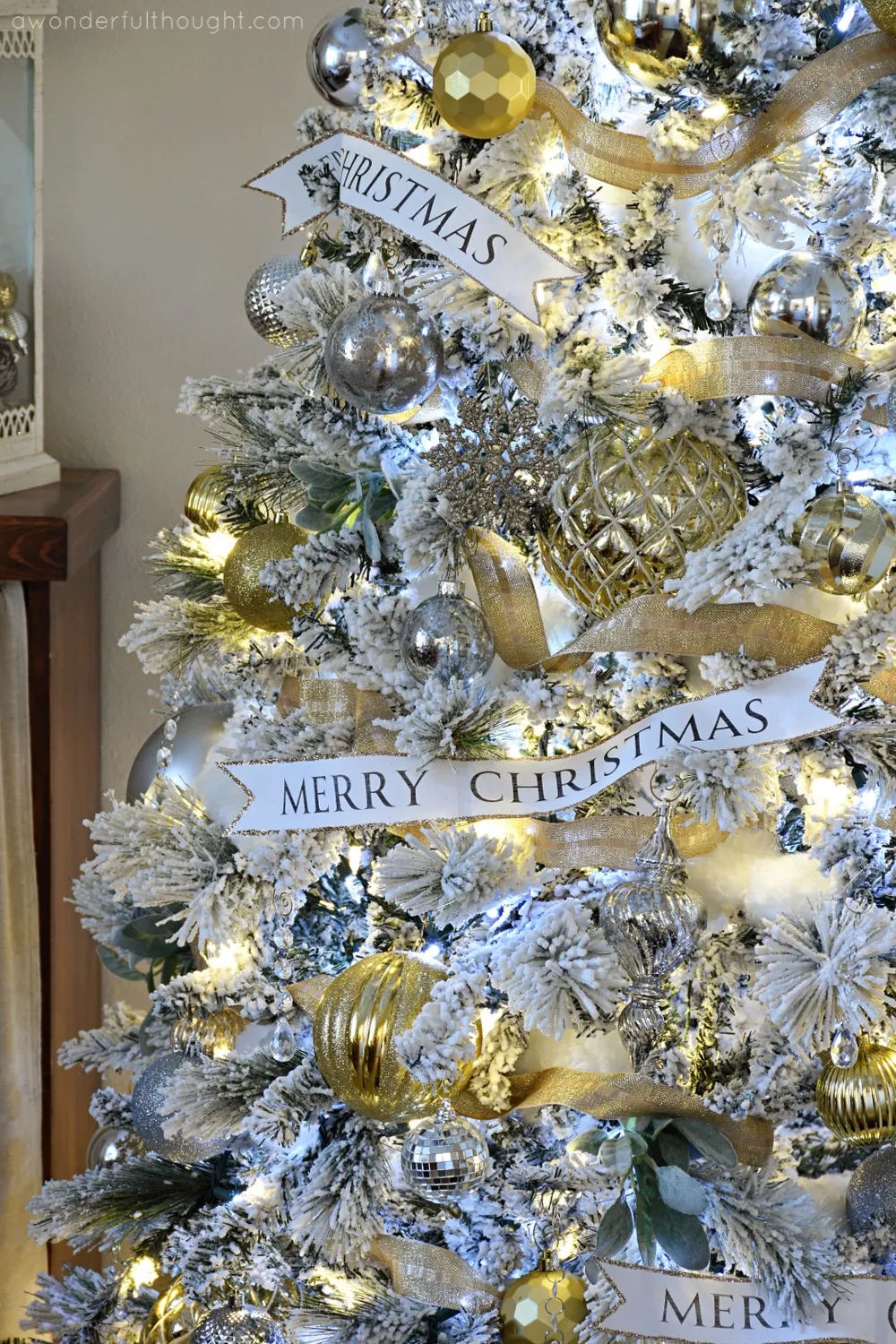
22. Sheer Gold Ribbon and Script Banners
- Flocked 7.5 ft tree: $180–$450
- Gold and silver ball ornament set, 50 pieces: $45–$110
- Sheer gold ribbon, two rolls: $18–$40
- Script “Merry Christmas” banners, set of three: $15–$35
- Metallic snowflake picks and finials: $25–$55
- Warm-white string lights: $25–$60
Total: $308–$750
Budget alternative: make the banners yourself with a $5 printable template, brown kraft cardstock, and twine. That single swap drops $30 and looks handmade in the best way.
What makes this tree read glamorous instead of busy is that nothing competes. Every single element is gold, silver, or white — no red, no green, no wood. Sheer ribbon softens all the metal so the shine has somewhere to land, and the script banners add a horizontal break in a room that’s otherwise all vertical lines. Pull one color family out and the whole thing deflates.
23. A Windowsill Collection of Miniature Trees
The sill needs to be at least 6 inches deep to hold a staggered row without everything hugging the glass, and the arrangement works best under a window that’s at least 36 inches wide. Keep the tallest piece — the carved wooden tree — around 10 to 12 inches so it doesn’t block light into the room. This is the perfect solution for a 60 to 120 square foot space that can’t fit a full tree, and it pairs nicely with the larger vignette in Idea #15.
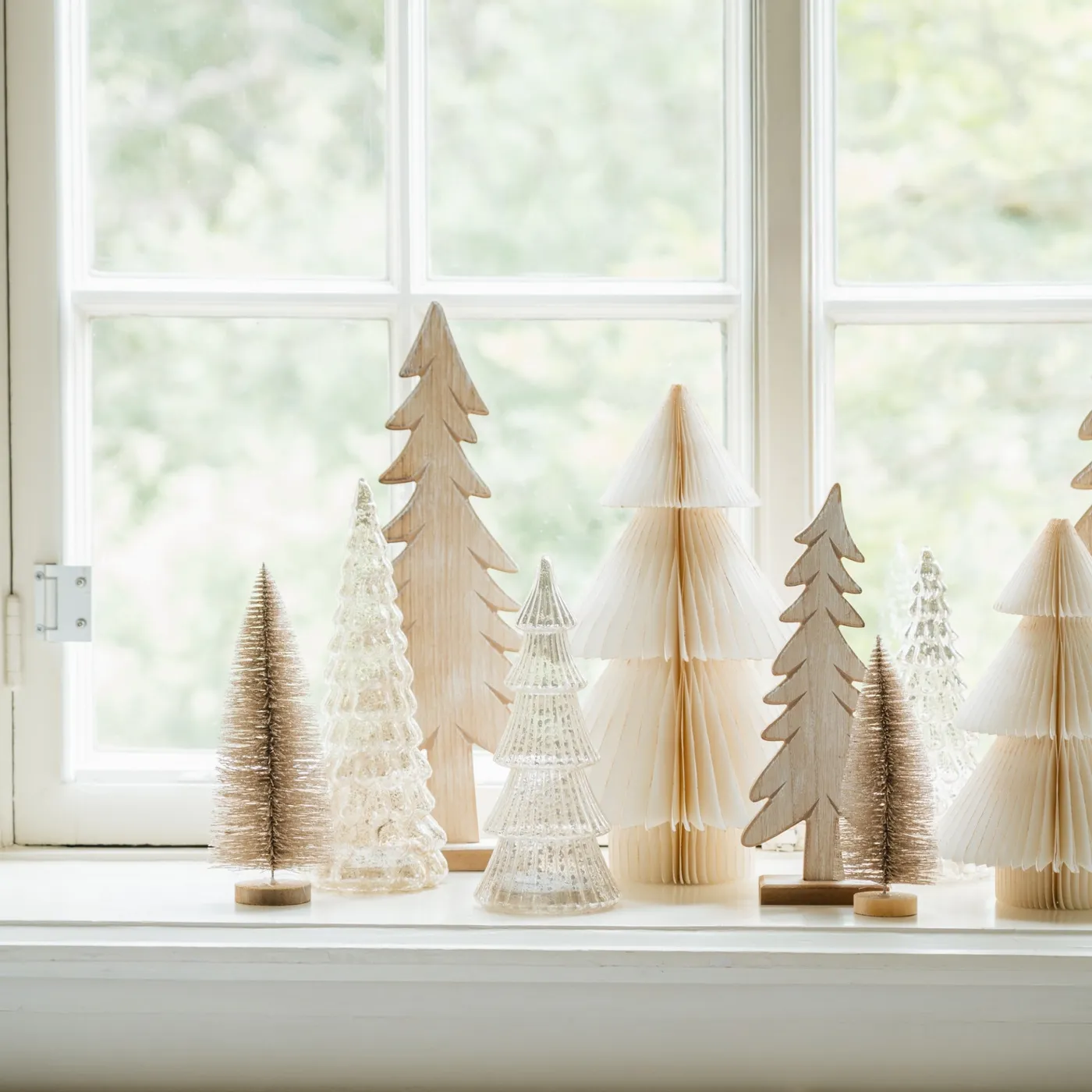
Mix materials instead of buying a matched set. A carved wood tree from IKEA costs about $8, pleated paper honeycomb trees are three for $12 at Target, and ribbed glass trees turn up at thrift stores for two dollars apiece — I’ve seen full collections built for $40. Facebook Marketplace in early December is full of people unloading last year’s tabletop decor. Aim for three materials, five heights, one shared color.
24. A Distressed Ceramic Tree on a Console Table
Before you style a console like this one, run the checklist:
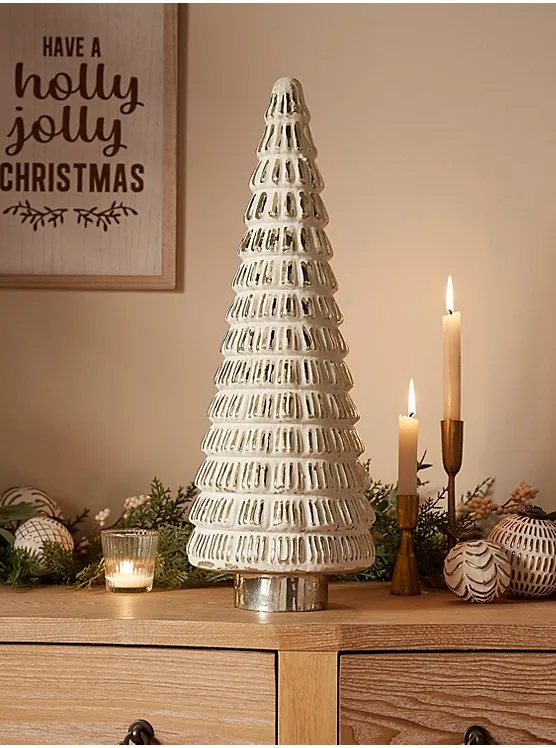
- Measure the console’s usable depth — candles need 8 inches of clearance from the wall.
- Check where the nearest outlet is for the taper candles or any lit element.
- Confirm nothing hangs above the console lower than 24 inches from the surface.
- Decide which single object anchors the arrangement before you buy anything else.
- Verify the console can hold weight — ceramic trees are heavier than they look.
Taper candles and fresh greenery garland are lovely together and also a genuine fire risk if the greenery dries out. Trim the garland ends so nothing drapes within 6 inches of a flame, never leave the room with them burning, and refresh the greens every two weeks. Battery taper candles have gotten good enough that most people can’t tell the difference from across the room.
25. White, Gold, and Rose Gold Glitter Foliage
- 7.5 ft green tree: $120–$300
- White, gold, and champagne ornament set, 80 pieces: $80–$180
- Flocked white berry sprays, set of eight: $30–$70
- Rose gold glittered foliage picks, set of six: $28–$60
- Warm-white string lights, 800 count: $30–$65
- White ceramic sideboard trees, set of three: $35–$80
Total: $323–$755
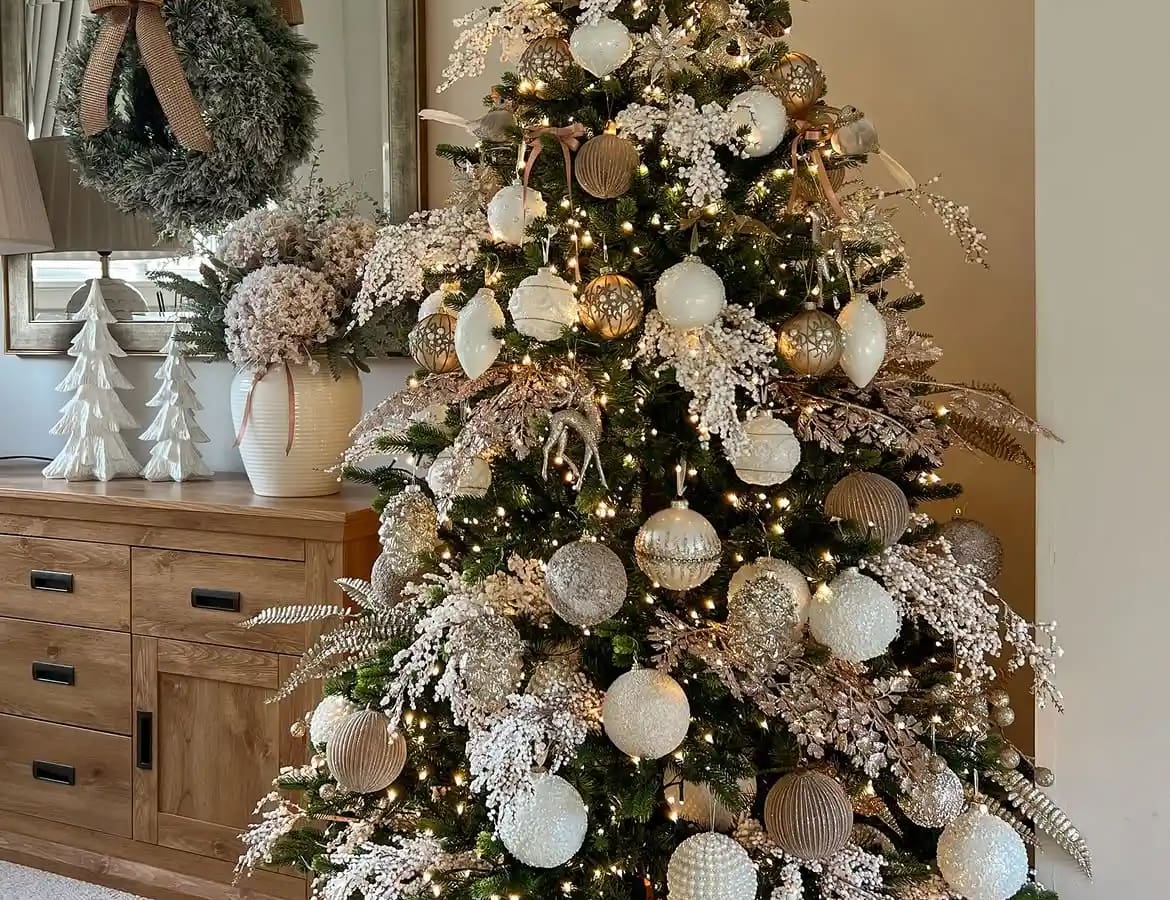
Budget alternative: spray-paint plain dollar-store picks with champagne metallic paint ($8 a can) and shop the after-Christmas sales for ornament sets at 70 percent off — the whole filler layer costs about $45.
On a full green tree, filler picks go in before ornaments and after lights. Work them in at a downward 45-degree angle, roughly every 10 inches, and always toward the outer third of the branch so they catch the glow. Rose gold picks should be your smallest cluster — about one for every four white ones — or the tree starts leaning pink.
26. Three Ceramic Trees With One Gold Trim
The gold trim is what elevates this beyond a thrift-store find. Three white ceramic trees with small perforations are charming on their own, but that thin gold line on each edge is the detail that makes them read as a set instead of three random objects. Remove it and you have a nice traditional trio; keep it and you have something people ask about.
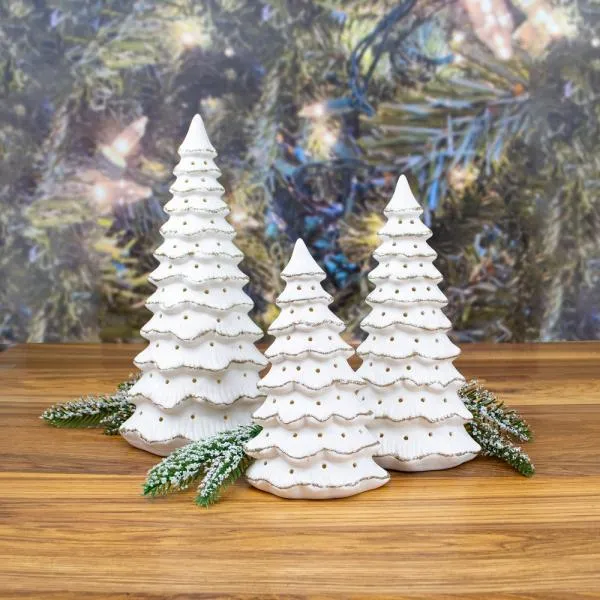
The arrangement math is simple: three graduated heights, one shared finish, one accent metal. Roughly 85 percent matte white ceramic, 10 percent gold trim, 5 percent green from the frosted pine branches tucked around the bases. If you wanted to shift the mood, swap brass for matte black and the same three trees go modern farmhouse without you buying a thing.
27. Plaid Bows in a Hammered Red Pot
Here’s how to make the bows yourself in about fifteen minutes.
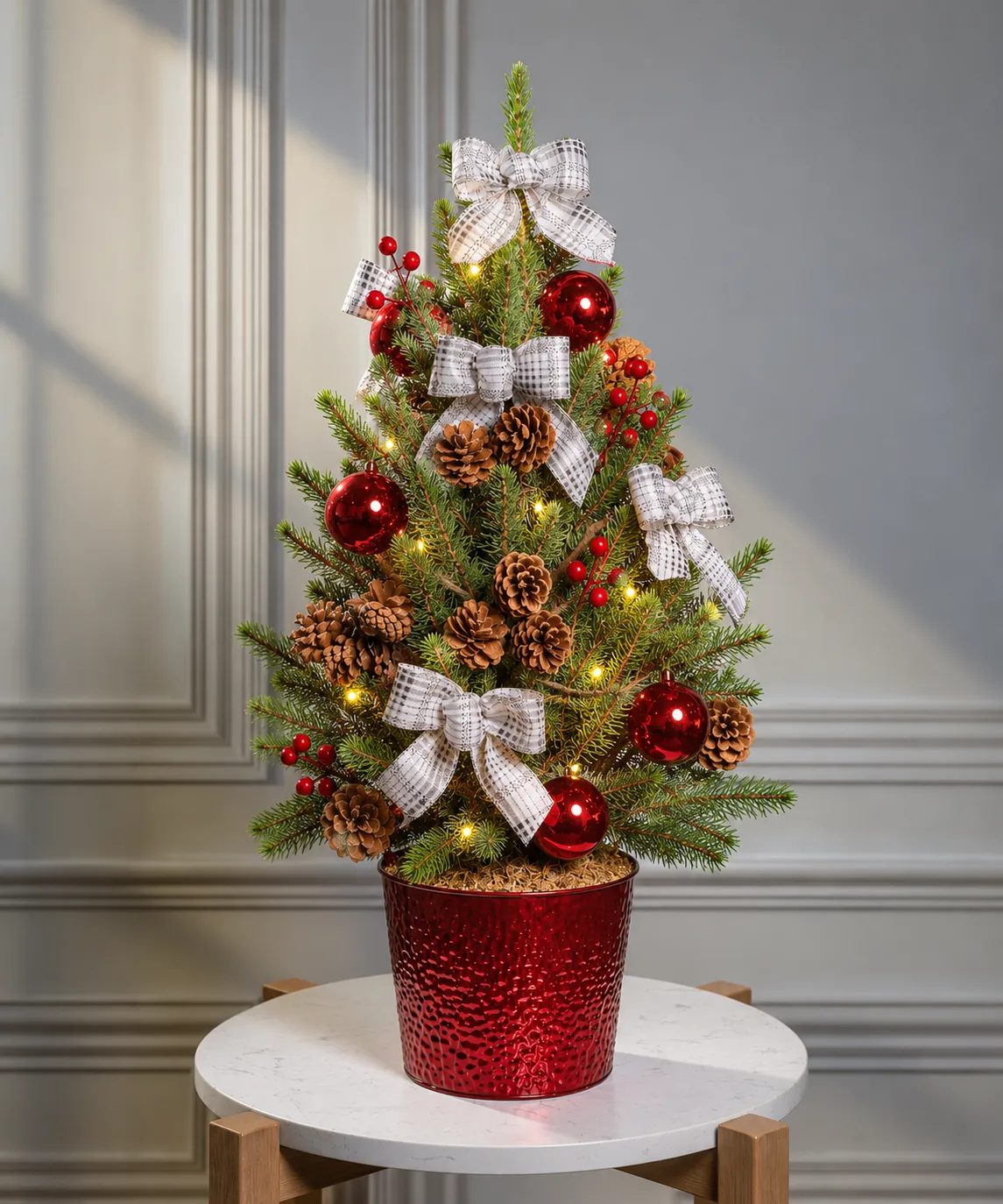
- Cut plaid ribbon into 10-inch lengths — 8 lengths is plenty for a two-foot tree.
- Fold each into a figure-eight, pinching the center between your thumb and forefinger.
- Wrap a 4-inch piece of the same ribbon around the pinch and knot it at the back.
- Trim the tails on a diagonal and pull each loop wide so it sits flat.
- Tuck the bows into the branches next to a red ball so every bow has a companion.
Time: 15 minutes. Cost: about $8 in ribbon.
The hammered red pot does most of the heavy lifting here, and it’s also the easiest thing to fake. A plain terracotta pot painted gloss red runs about $7 versus $35 for a finished planter, and thrift stores are full of hammered metal buckets in January. Add pinecones and red berry clusters from the yard and you’ve built a $25 tree with the presence of a $150 one. That’s the small-space cousin of Idea #8.
28. A Sled, a Galvanized Bucket, and Silver Baubles
This winter-wonderland corner collects a lot of stuff, and that’s the risk. A wooden sled, a galvanized bucket with a small green tree, a “Let it Snow” box of ornaments, a pinecone, and a gift box can easily turn into clutter if they all demand equal attention. Give each piece a different height and keep at least one of them low and quiet — the pinecone is usually the one that does that job. If the corner starts feeling heavy, pull the bucket.
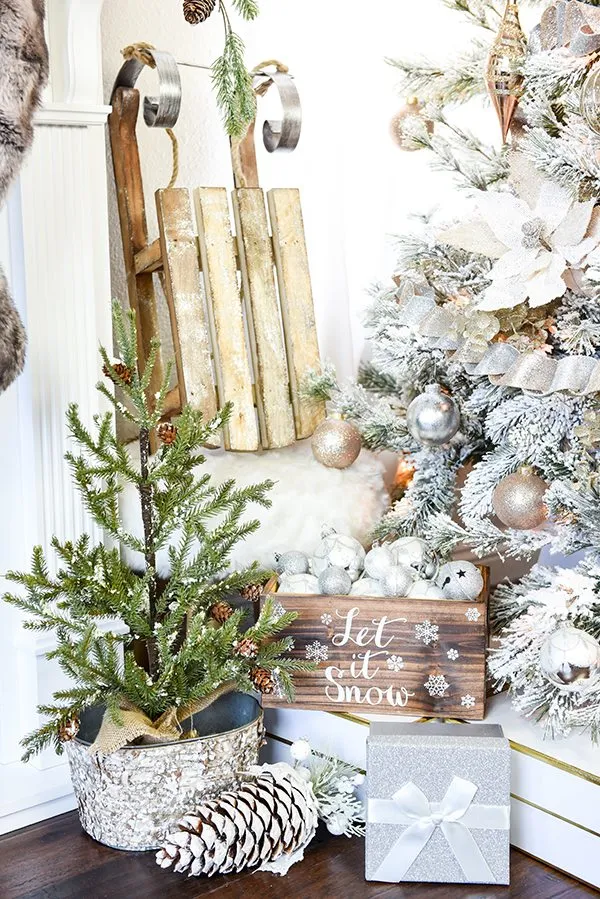
You need a corner with real width for this. Plan on 40 to 48 inches along the back wall and a ceiling at least 8 feet high so the flocked tree can top out around 6 feet without fighting the décor. In a narrow entry, the sled goes flat against the wall and the bucket gets left out entirely. The wall-mounted light display in Idea #29 is a better fit for tight spaces.
29. Illuminated Birch Branches in a Snowy Window
Fairy-lit birch branches take about an hour and cost less than most wreaths.
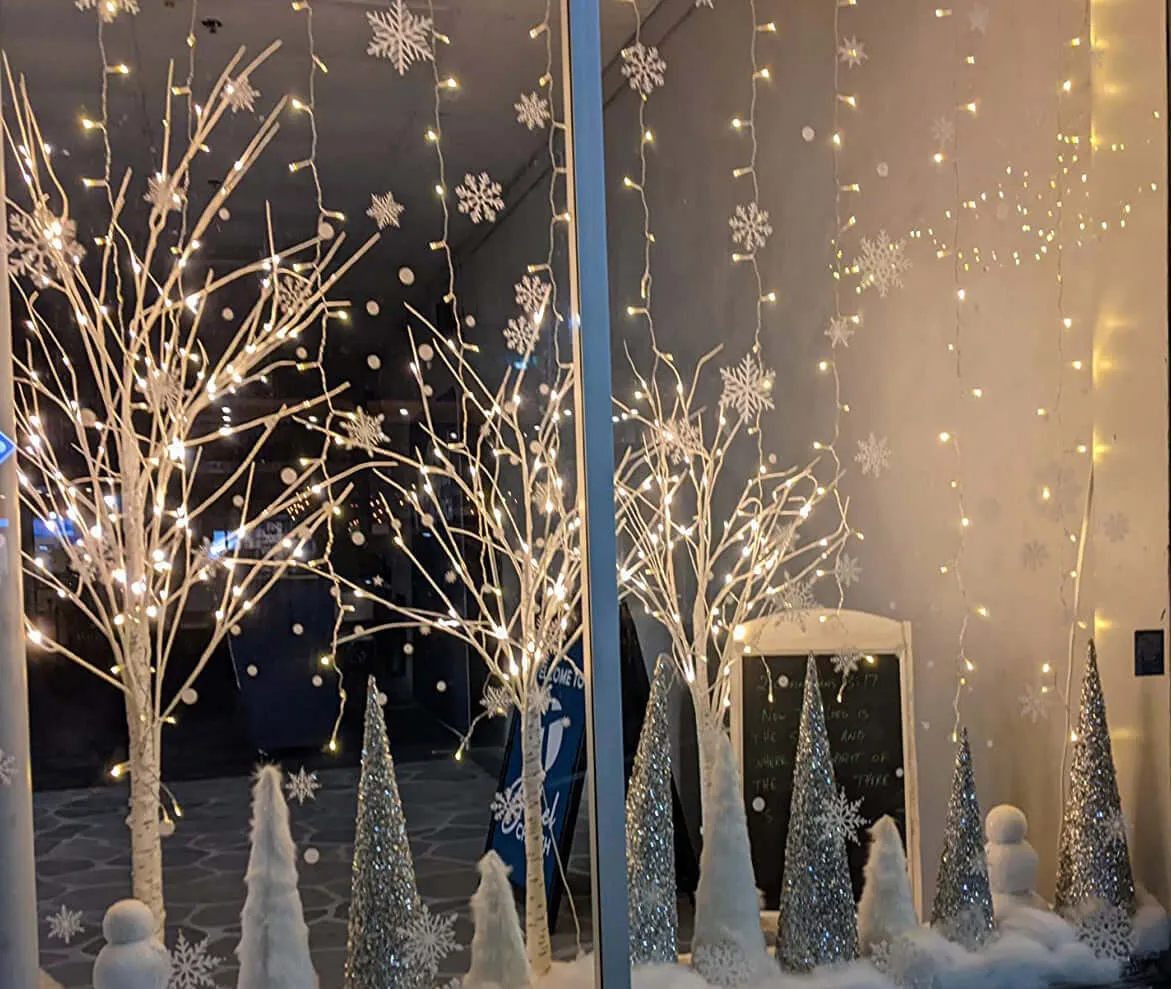
- Stand the branches in a weighted floor container and secure them with sand or florist foam.
- Wrap each trunk upward in a spiral, one light strand per branch, no more than 2 inches between turns.
- Run a second strand across the top of the arrangement so it cascades down the front.
- Lay artificial snow across the base, then nestle in the cone trees of different heights.
- Apply snowflake decals to the glass at eye level, keeping them 3 inches apart or more.
Time: 60 minutes. Cost: $60–$130 for branches, lights, snow, and cones.
This is the 2026 answer to the classic window wreath — window displays have gone full retail vignette, and people are treating their front window like a shop window. It reads as festive from the street, doubles as porch light for the room, and packs flat in January.
30. White and Silver Ornaments Against Brown Velvet
The dark brown velvet curtains are the reason this tree looks expensive. White and silver ornaments against forest green is a beautiful, fairly common pairing — but put it next to heavy chocolate velvet and suddenly the whole scene has depth and weight. The curtains absorb the extra sparkle so the tree can be as bright as it wants without looking garish, and the white star topper reads as the single brightest point in the room.
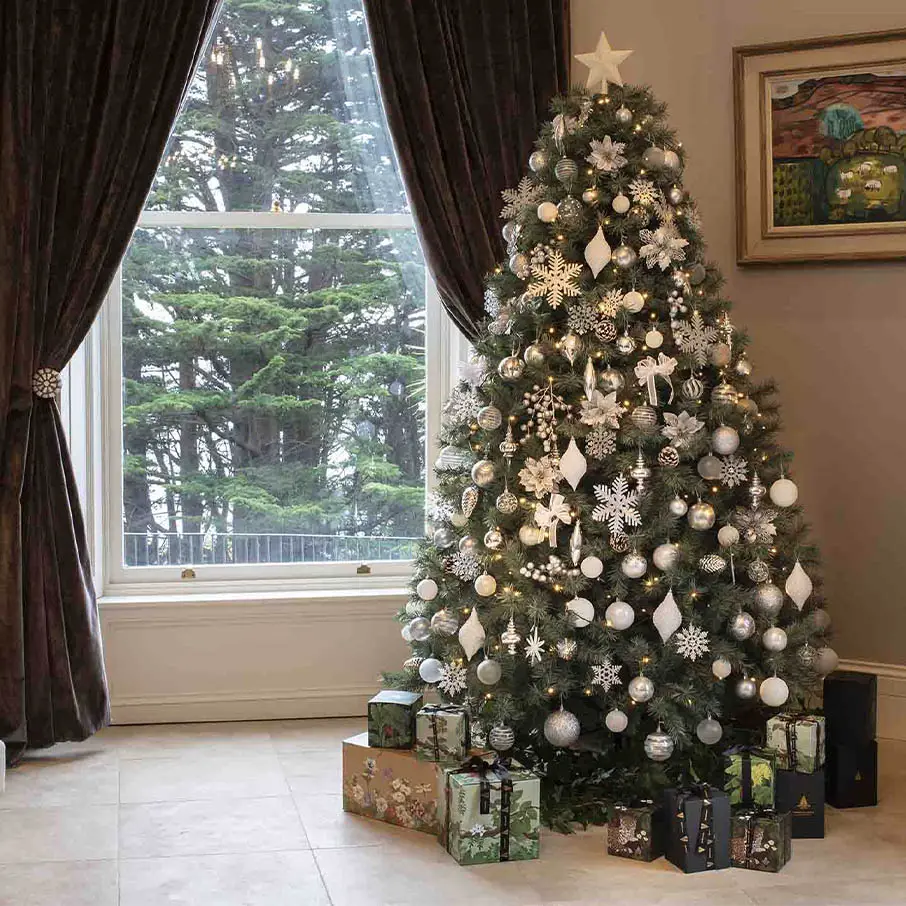
Before you copy this, check five things:
- Measure your curtain drop — velvet needs to reach the floor or it looks like a mistake.
- Confirm the wall behind the tree is light or mid-tone; dark walls plus dark curtains flatten the whole corner.
- Count the tree’s bulbs: warm white only, and at least 700 for a 7.5-foot tree.
- Check the ceiling height for the star topper with at least 6 inches of clearance.
- Set the tree at least 8 inches back from the curtain panel so the branches don’t snag the velvet.
Your White Tree Doesn’t Need a Theme — It Needs a Point of View
Thirty trees later, the pattern is pretty clear: the ones that stick with people aren’t the fullest or the most expensive — they’re the ones with one clear idea running through them, whether that’s a charcoal wall, a sage-blue ribbon, or three little ceramic trees with gold edges. Pick one, repeat it, and stop before you’re sure you’re done.
📌 Pin your favorite to your holiday board now — December-you will be very grateful when it’s time to actually haul the boxes out.