Forty minutes into a Pinterest scroll, every blue and gold Christmas tree starts blurring into the same glittery mush — which is usually the moment people give up and buy a bulk box of baubles they resent by December 26.
We spent weeks digging through Anthropologie, West Elm, Target, Etsy, and Amazon Home to filter hundreds of options down to 30 ideas that actually hold up in real rooms, with prices running from about $6 for a single glass ornament to roughly $1,300 for a fully dressed formal living room. Budget and luxury versions sit side by side the whole way, so you can steal the look at whatever number feels sane. The styles lean royal blue and gold, icy blue and silver, blue with copper and bronze, and quieter blue-and-gold touches for people who do not want to live inside a snow globe.
In 2026 the shift is texture over volume: velvet ribbon instead of plastic, real glass instead of glitter foam, one statement ornament doing the work of ten. And stay until the end — we break down the most common mistakes that can ruin these looks. A few links below are affiliate links, which means we may earn a small commission at no cost to you.
📌 Save this to Pinterest for later — you’ll want to revisit these ideas.
1. A Deep Blue Tree Standing in a Warm Neutral Living Room
What makes this room work is not the ornaments — it is the beige. The tree is the only saturated object in the entire space, and that is entirely on purpose. Strip away the neutral walls, the textured rug, and the quiet traditional furniture, and the deep blue stops reading as an event and starts reading as clutter. The mantel greenery sits in that same low-key register, so your eye travels straight to the tree and stays there.
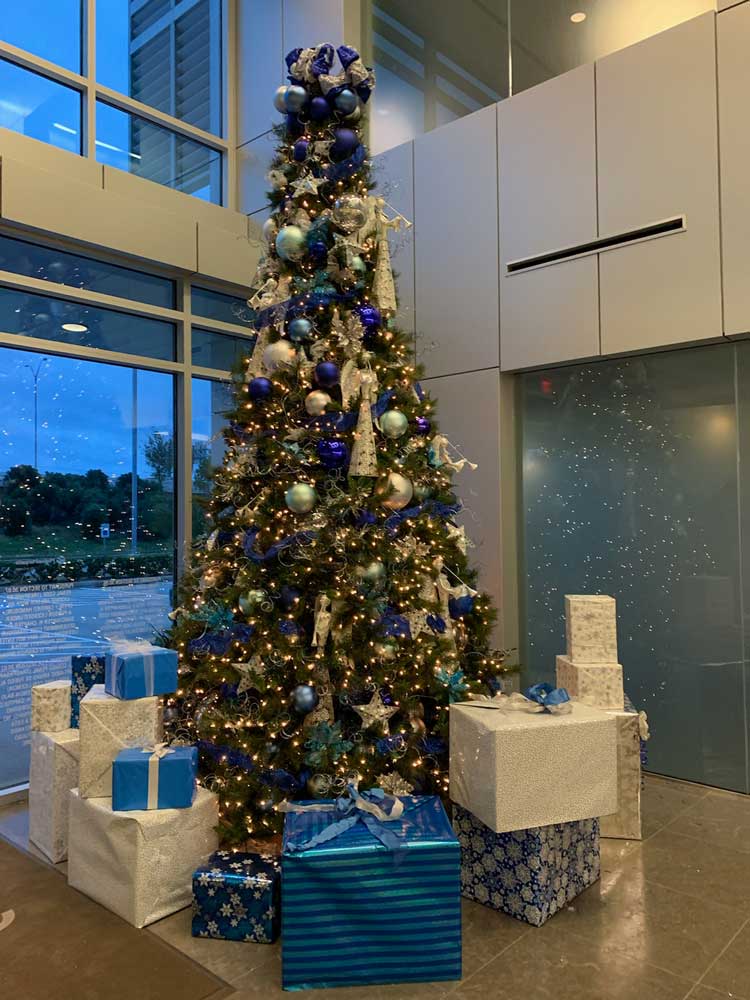
Ribbon placement is what separates a dressed tree from a decorated one. Measure your tree’s height, then cut wired ribbon into 6-foot lengths — roughly one length per 2 feet of tree. Weave each piece through the branches in a shallow S-curve rather than wrapping it around the outside, and space the loops about 14 inches apart on a slow vertical spiral. Stay with 2.5-inch width; anything wider swallows a 7-footer, and anything narrower vanishes into the needles.
2. Blue, Gold and Teal Baubles Against a Woven Wall Hanging
Three things are doing quiet work here. First, scale variation: the baubles run from tiny teal spheres to full-size gold globes, so the eye keeps moving instead of settling. Second, material contrast — glossy glass sits beside a single wide matte white ribbon, with a rustic woven wall hanging behind it, and that is what keeps the blue from feeling corporate. Third, the fluffy white animal ornament and the deer antler pick add exactly one note of humor. Restraint everywhere else is what makes those oddball pieces land.
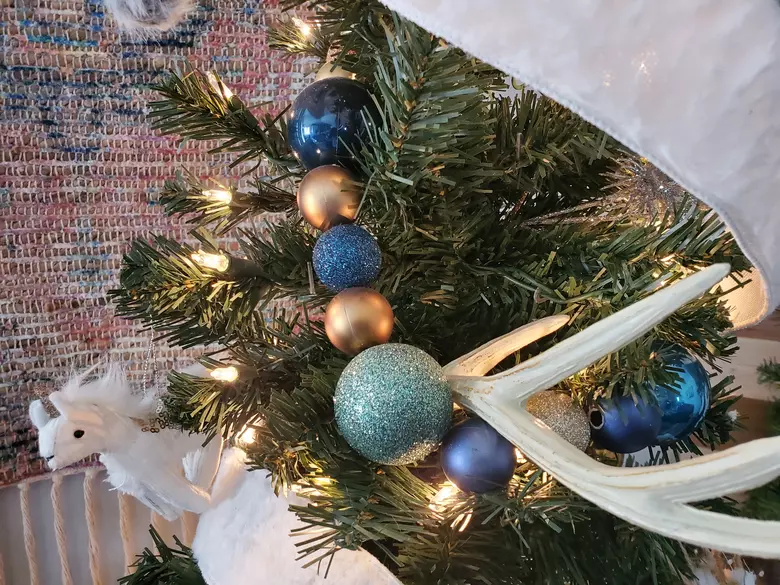
This arrangement is built for a corner, not a grand foyer. A 6 to 7.5-foot tree with a 40-inch base spread needs roughly 30 inches of clearance behind it if you want the woven wall hanging to stay visible, plus one wall running 8 feet or more. A 10×10 bedroom or the corner of a 9×12 living room handles it comfortably. Push the same tree into a room with 12-foot ceilings and everything shrinks — big rooms need volume, not more ornaments.
3. Royal Blue Baubles, Gold Crowns and a Bay Window Alcove
Rough costs to recreate this densely packed, floor-to-ceiling bay window tree:
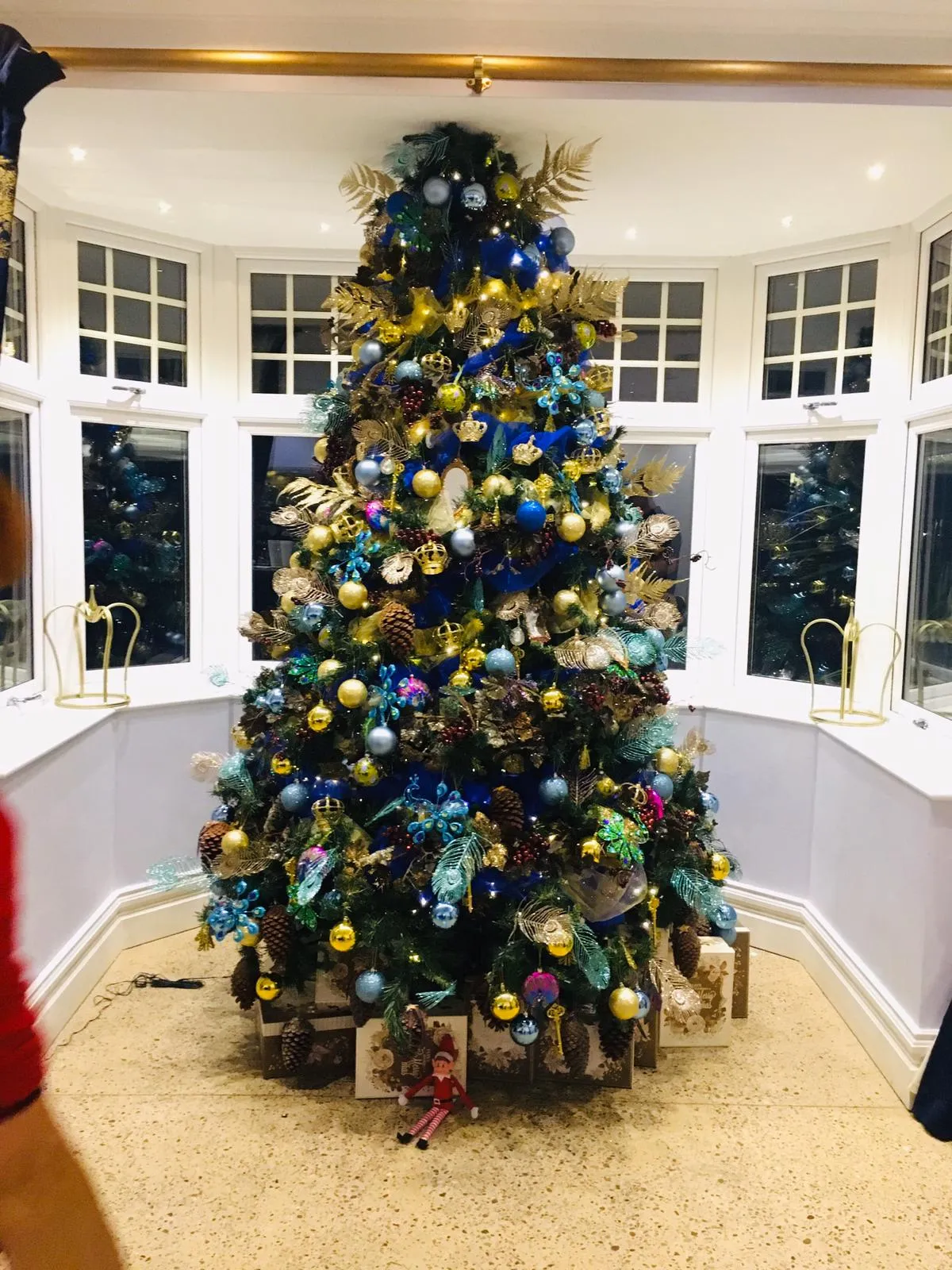
- Tree, 9 ft unlit: $180–$450
- Lights, 800 warm white LEDs: $40–$90
- Ornaments, about 150 pieces (blue, gold, crowns, pinecones): $120–$300
- Floral picks and glitter sprays: $30–$70
- Skirt, stand and storage: $60–$120
- Wrapping paper and ribbon: $25–$60
Total: roughly $455 to $1,090 — the ornament count pushes it, not the tree. Budget alternative: skip the crowns and floral picks, use 100 mixed baubles from Walmart and Dollar Tree, and the same tree lands near $260.
The formula here is almost embarrassingly simple: 55% green foliage and warm light, 30% royal blue, 15% gold, with pinecones acting as free texture. It works because blue carries the volume and gold only ever plays accent. Swap gold for silver and the whole thing turns icy without another change. Want it lighter? Push the split to 45% blue and 25% pale blue, and let gold sit at 10%.
4. Flocked Snowflakes in Blue and Silver on a Lit Evergreen
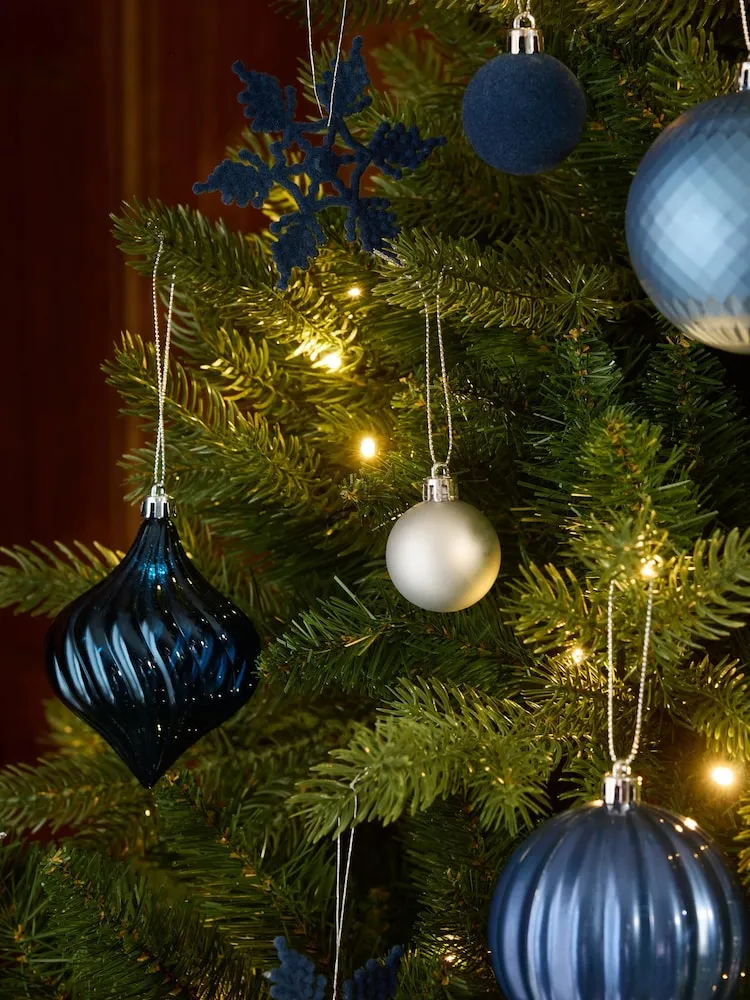
Making your own flocked snowflake ornaments takes about 40 minutes for a batch of twelve and around $18 in materials. Grab flat wooden or plastic snowflake blanks, a jar of snow texture paste, and fine iridescent glitter.
- Lay parchment over your work surface — paste goes everywhere.
- Dab texture paste across each snowflake with a foam brush, leaving edges rough.
- Dust glitter while the paste is still wet, then tap off the excess.
- Dry them flat for two hours; drying upright makes them warp.
- Thread navy or silver ribbon through the hole and hang.
Here is the part nobody mentions: warm white lights and cool silver can fight each other. Under bulbs above about 3000K, silver ornaments go gray and slightly dirty, which kills the whole effect. Stick with 2700K to 3000K strands and place silver where light hits it directly. Also expect a small drift of glitter on the floor every time you move the tree, and never store these loose in a bin with glass.
5. One Cut-Glass Teardrop That Steals the Entire Tree
You do not need a designer-bought version of this teardrop. HomeGoods and At Home regularly stock faceted glass ornaments with gold caps for $6 to $12 each, and Etsy sellers list cut-crystal teardrops in the $14 to $28 range. World Market runs gold-banded glass around $8 to $16. Buy three or four and hang them front and center at eye level, where the facets actually catch light. That is the budget version of Idea #3 — same idea, one tenth the ornament count.
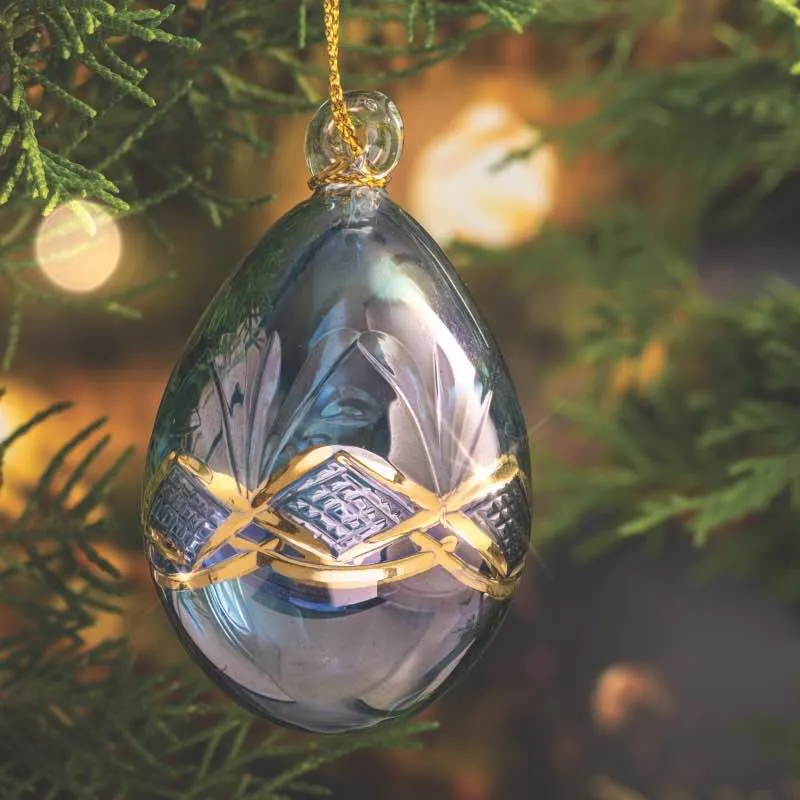
2026 is the year of the quiet ornament. After several seasons of maximalist trees carrying 200 pieces of plastic, people are buying fewer and better: real glass, real metal caps, real weight in the hand. It is a smart trend to follow because it is also the cheaper one long term. One $40 heirloom beats four $10 boxes you replace every single year.
6. Cascading Blue Mesh Ribbon Under a Light Wood Ceiling
Mesh ribbon behaves nothing like satin, and that is the point. Cut 24-inch lengths, fold each into a loop, then push the folded end through a branch gap and twist once to pin it. Work in a spiral about every 12 inches down the tree, and gather six to eight cascades per side so the ribbon reads as one continuous fall of color. A single 10-yard spool of 6-inch mesh covers a 7.5-foot tree; buy two if you want the dramatic vertical drop shown here.
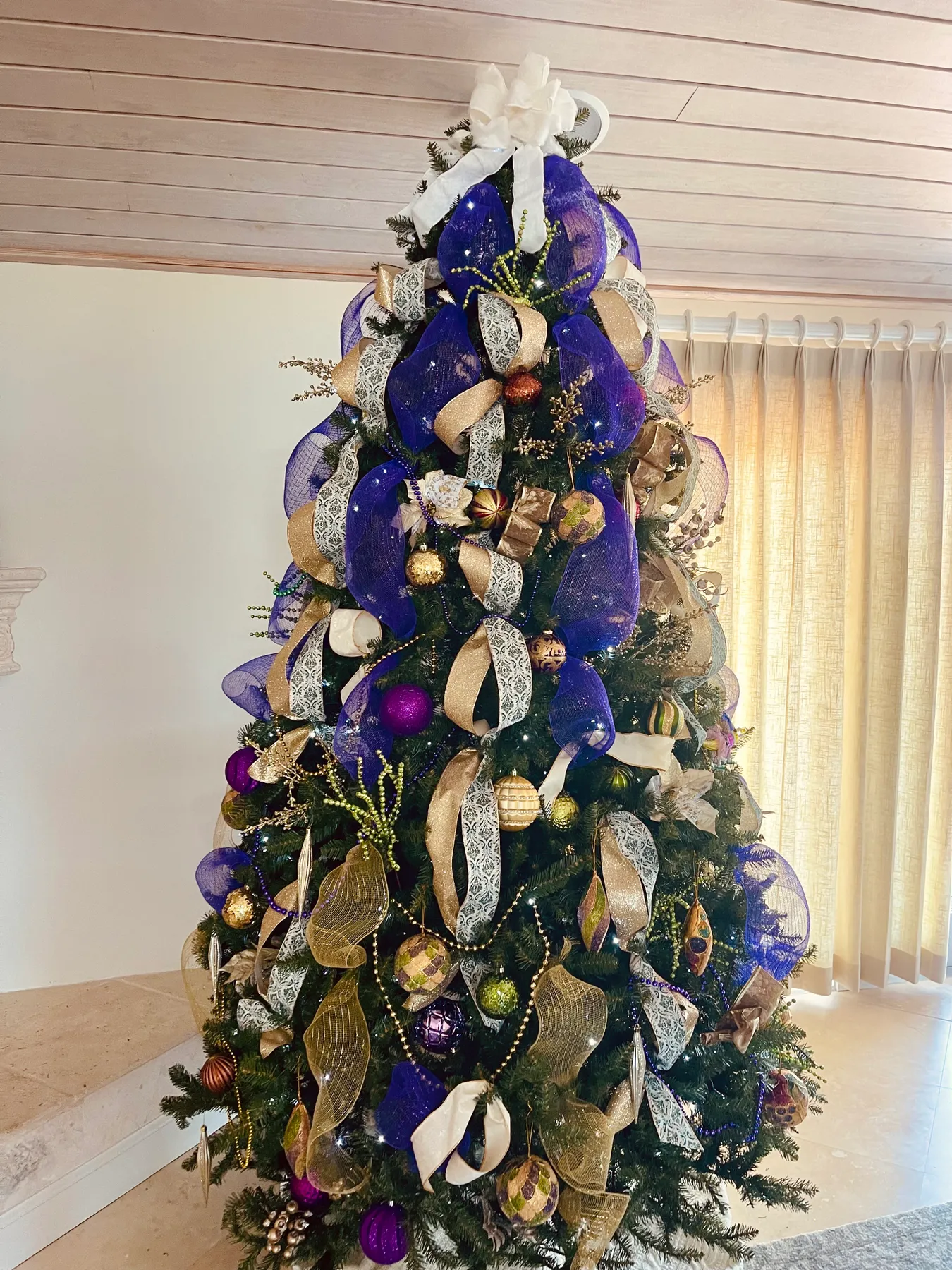
The ribbon does three jobs at once. It repeats one shape down the entire tree, which reads as deliberate rhythm rather than randomness. It adds soft matte texture against all the shine, and it fills the visual gaps ornaments never quite cover. Then the patterned silver and gold ribbon layered over the blue breaks up what would otherwise be a slab of solid color. Remove the mesh and the tree still looks decorated; it just stops looking designed.
Mesh crushes, so store lengths wound loosely around a cardboard tube instead of folded in a bin. It also collects dust faster than ornaments because of the open weave — a handheld vacuum on low, once at the start of the season, handles it. Expect to replace a spool every other year at $15 to $25. Beaded garland has the same lifespan problem; restring it every three seasons.
7. White and Gold on a Neutral Base Beside a Herringbone Fireplace
The fluffy white round ottoman is doing more than you think. Without it, the tree floats in its corner and the two gray armchairs feel like a separate seating group. With it, there is a soft white object at floor level echoing the stockings, the ornaments, and the mantel greenery, tying three zones together. That is the real trick in a neutral room: repeat your lightest color down at floor level and the whole space locks in.
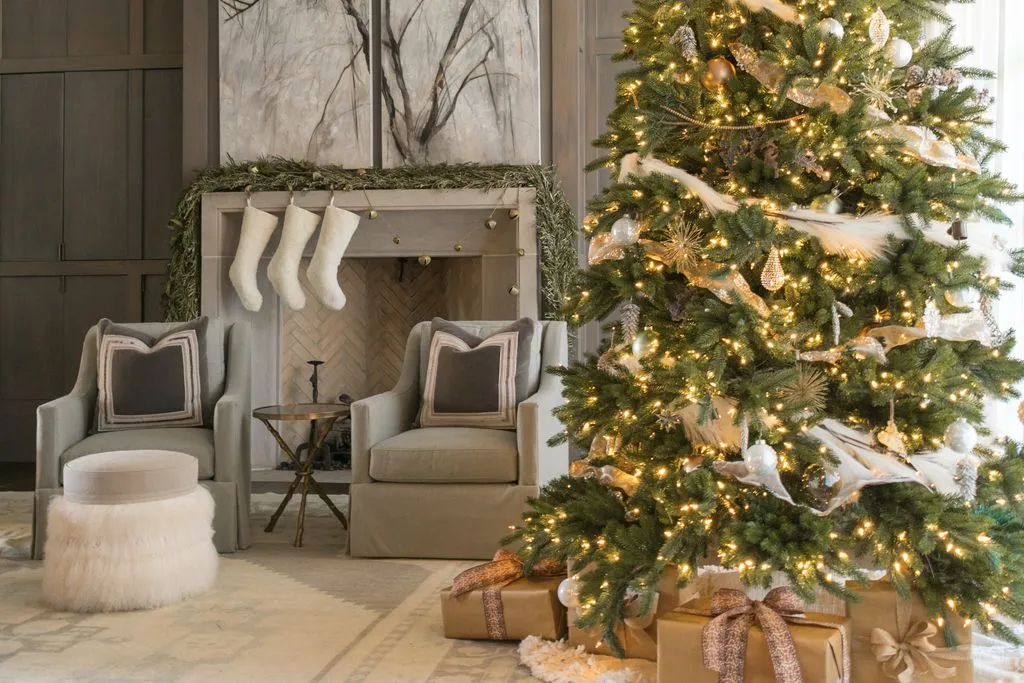
The color math here is 70% neutral, 20% warm gold, 10% green foliage — and it is the most flexible formula in this entire article.
- Base: warm gray, cream, oak and stone (70%)
- Metal accent: brushed or antique gold (20%)
- Living element: garland, tree, real branches (10%)
Swap the gold for navy and you have a blue-and-gold room. Swap it for copper and it reads warmer and slightly rustic. The proportions never change — only your accent color moves.
8. A Regal Monogram Ornament With a Crowned Finial
A statement ornament this ornate needs room to be seen. On anything smaller than a 7-foot tree with a 48-inch spread, a beaded monogram disappears into the branches. Hang it front and center at roughly your eye level, 60 to 66 inches off the floor, with a clear 8-inch radius of plain branch around it. On a tabletop tree under 4 feet, skip the monogram entirely and use one smaller crown or jeweled bauble instead. Small trees do better with one big idea than several small ones.
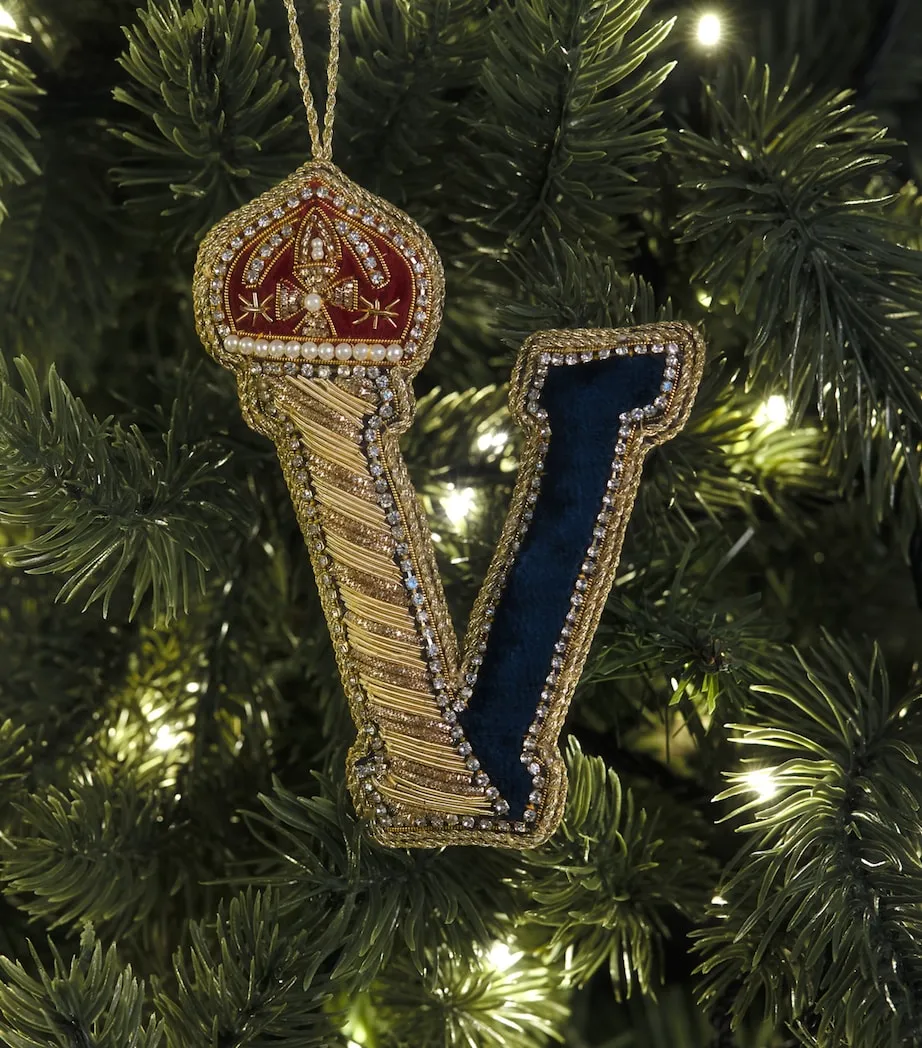
Weight is the real issue. Beaded, rhinestone-trimmed monograms can run 6 to 8 ounces, which is a lot for a thin artificial branch to hold through a season. Wire the hanger to a structural branch near the trunk, not a branch tip, and check it after the first week. Dark blue velvet inlay fades too — direct sun through a window will dull it in one season. And if you have cats, rhinestones are basically removable toys. Hang high or skip it.
9. The Mannequin Dress Tree Wearing a Pearl Necklace
Recreating this tabletop dress-form tree is more affordable than it looks:
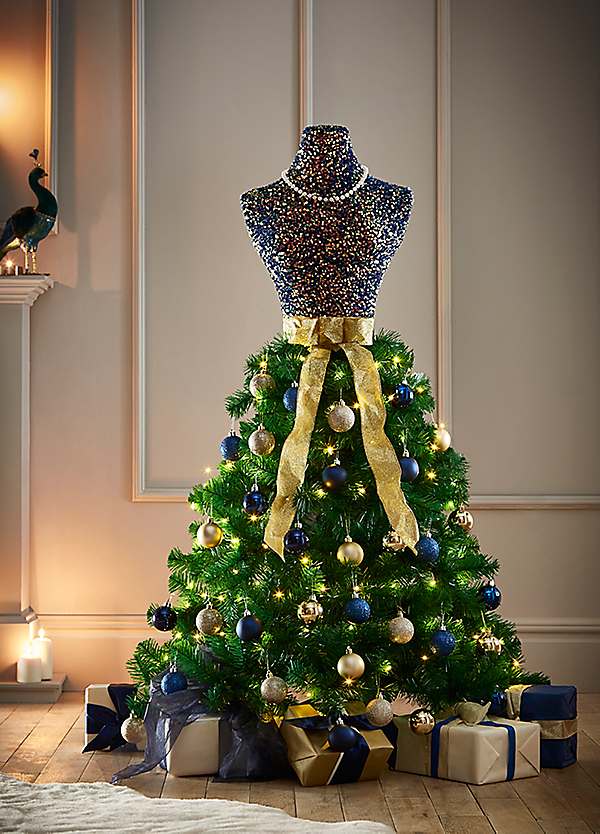
- Dress form or wire mannequin torso: $45–$120
- Green pine garland or small tree for the skirt: $40–$90
- Sparkling bodice overlay and pearl necklace: $20–$50
- Blue and gold baubles, 30 to 40 pieces: $35–$80
- Warm fairy lights: $15–$30
- Gold waist ribbon and blue and gold gift boxes: $15–$40
Total: about $170 to $410. Budget alternative: swap the dress form for a wire tomato cage wrapped in garland and you land near $95.
Facebook Marketplace and thrift stores are goldmines for dress forms — wedding shops dump them constantly for $20 to $40. Dollar Tree carries small blue and gold baubles in six-packs, and Walmart fairy lights run about $5 a strand. This cool-toned ornament approach also pairs beautifully with the palette in Idea #14, if you want a second tree that reads related without matching.
10. Ribbed Blue Glass and Frosted Plaid Globes
That frosted white plaid on clear glass is hand-painted, and you can fake it for about $12 in supplies and 40 minutes. You need clear glass ornaments with removable caps, white enamel craft paint, and a fine liner brush.
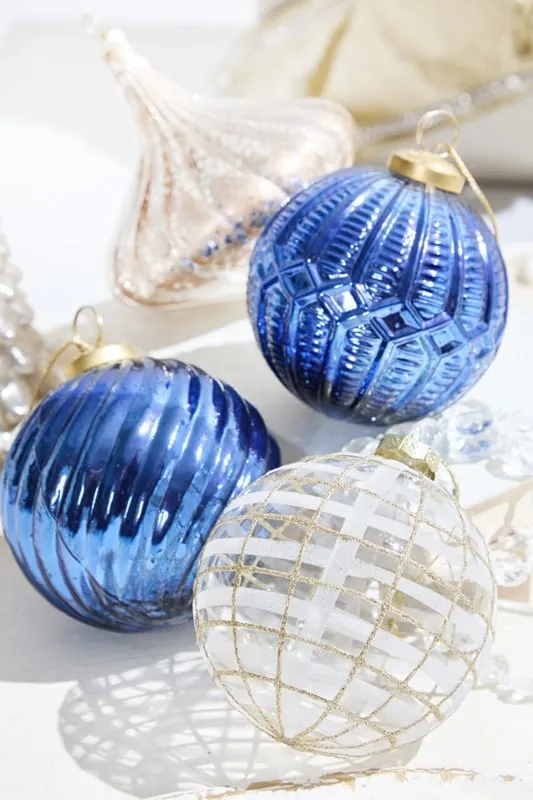
- Remove the caps and set each ornament on a paper cup so it cannot roll.
- Paint three vertical white lines, spacing them evenly around the sphere.
- Add three horizontal lines to create the grid; do not chase perfect crossings.
- Let it dry 30 minutes, then dot gold acrylic at each intersection.
- Re-cap, thread ribbon, and handle gently — enamel stays soft for a week.
buying anything, knock out this quick check:
- Measure usable branch depth — large globes need 4 inches of open branch
- Check your light temperature; anything above 3000K dulls blue glass
- Count how many ornaments you actually need before buying a set
- Confirm your storage has dividers, because ribbed glass chips against itself
- Set a hard budget ceiling, because blue-and-gold sets multiply fast
11. Pampas Grass and Deep Blue Poinsettias on Top
A topper should span 24 to 30 inches on a standard 7.5-foot tree, and it needs to be wired, not perched. Bind three to five pampas plumes together at the base with floral wire, then wire the bundle to the top three branches before you fluff anything else. Extend dark blue poinsettia stems 6 to 10 inches above the pampas so the silhouette tapers instead of ending in a blunt fan. Group elements in odd numbers — three, five, seven — every time.
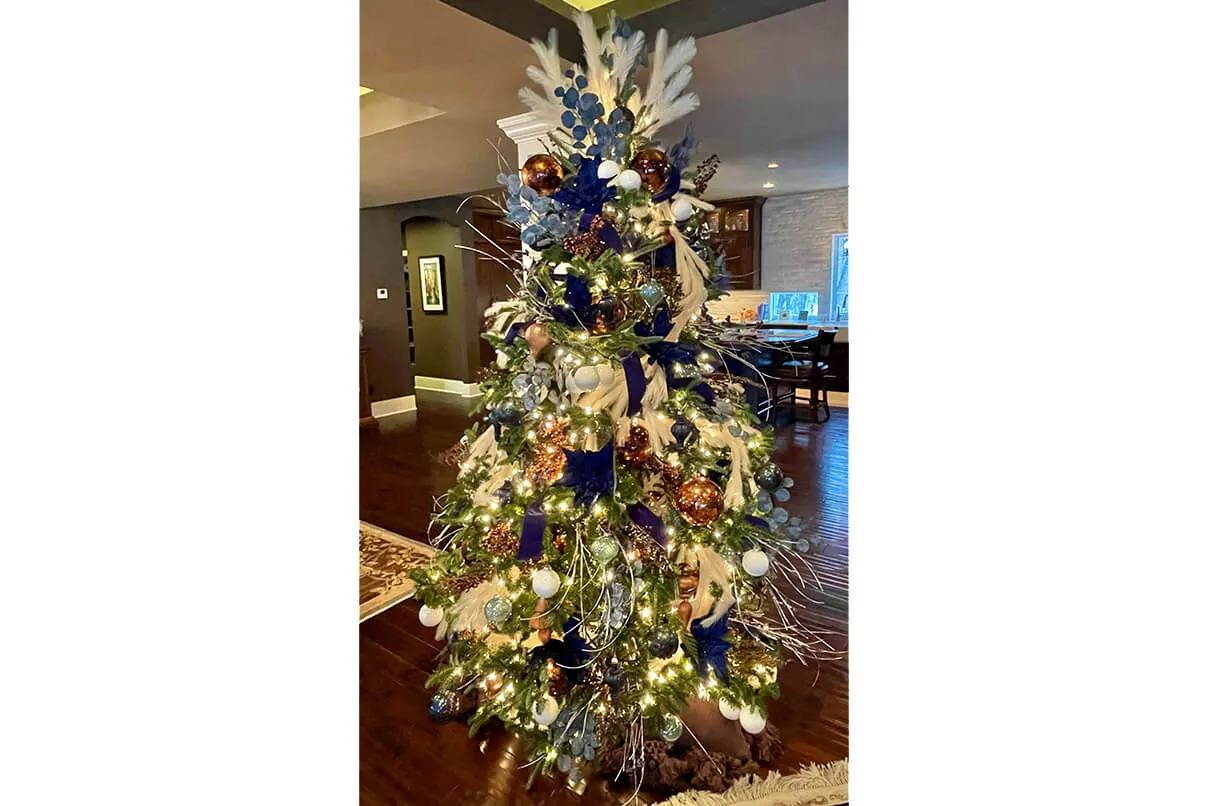
Two principles are running the show. Texture contrast: matte, feathery pampas against glossy bronze baubles and shiny blue floral picks gives the eye both soft and hard surfaces in one look. Height extension: the plumes add 12 to 18 inches of visual height without a taller tree, which is why this reads as grand under standard ceilings. It is also a smart fix for anyone whose tree never quite reaches the ceiling — decorative height reads the same as actual height.
12. Pagoda-Silhouette Tabletop Trees in Blue and Gold
Tabletop trees are having a real moment, and it is mostly practical. Smaller apartments, rented spaces, and people who travel in December all want the holiday without a nine-foot commitment. Add 2026’s appetite for Chinoiserie and Japandi detailing, and you get pieces like these tiered pagoda silhouettes — stacked blue sections, gold botanical leaves, gold piped edges, a gold pedestal base. This one has staying power because it is decor, not seasonal kitsch; it reads fine on a shelf in January.
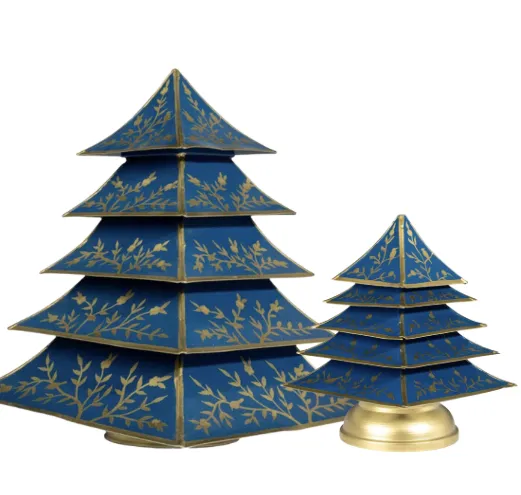
Objects follow a different rule than trees. For decorative pieces, aim for 3:1 blue to gold. Here the blue is the form — three stacked tiers — and gold is only edges, leaves, and base. Reverse it and the piece looks cheap. The test: squint. You should still see mostly blue with gold trim, not a gold object with blue details.
These work best 12 to 18 inches tall on a console 30 to 36 inches wide, offset to one side rather than centered — a middle placement kills the pagoda’s taper. Leave 6 inches between the two trees if you display them together. Ceiling height is not a factor, but surface depth is: plan on 8 inches minimum for the base plus breathing room.
13. Gold Mesh Ribbon Against Dark Wood Ceiling Beams
It is the gold mesh ribbon, and it is not close. The white floral blooms soften the tree and the glossy blue baubles carry the color, but the mesh is what makes this read as expensive in a room with dark ceiling beams and white wainscoting. Mesh reflects light the way satin cannot, so it glows against the dark wood above it. Swap it for flat ribbon and the tree still works — just quieter, more ordinary, and far less interesting once the lamps are off.
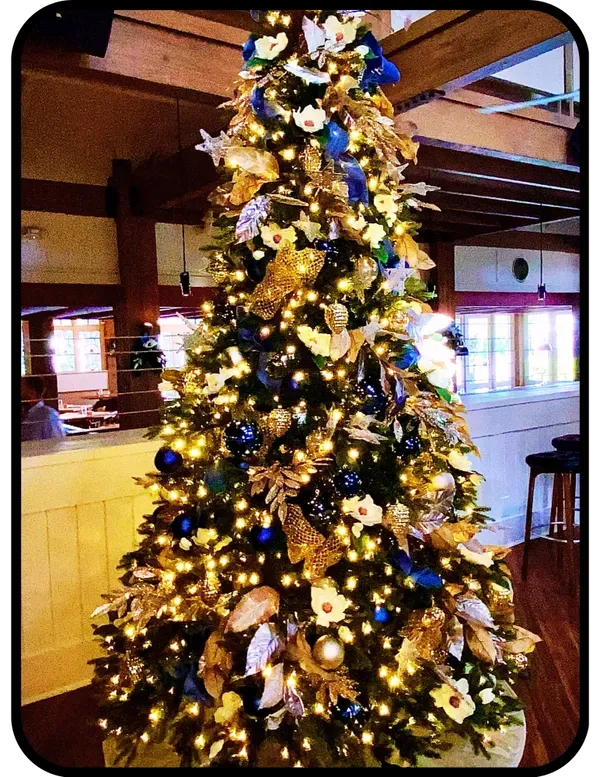
- Tree, 8 ft: $150–$380
- Warm white string lights: $35–$80
- Gold mesh ribbon, 2 spools: $30–$60
- Glossy blue ornaments, 60 pieces: $60–$140
- Metallic gold and silver leaf picks: $25–$55
- White floral stems: $20–$45
Total: roughly $320 to $760. Budget alternative: use solid satin ribbon and HomeGoods ornaments for about 45% less.
Dark wood beams are gorgeous and absolutely brutal to decorate against. Anything smaller than 3 inches vanishes up there, and blue ornaments can read almost black in a shadowed ceiling. Test your ornament colors at night with only the tree lights on before you commit, and check that your ladder clears the beams — you will be placing the top third by feel.
14. Icy Lavender and Clear Glass Icicles for a Frosted Tree
Dollar Tree sells glass icicle picks in four-packs for $1.25, and Walmart carries clear acrylic icicle ornaments around $6 for a set of twelve. Amazon has faceted crystal pendants in bulk for roughly $12 for 30. Buy two packs of each and scatter them deep in the branches, not on the tips — icicles should look caught inside the tree. Compare with Idea #4: same cool palette, but that one leans blue and silver while this leans lavender and clear glass.
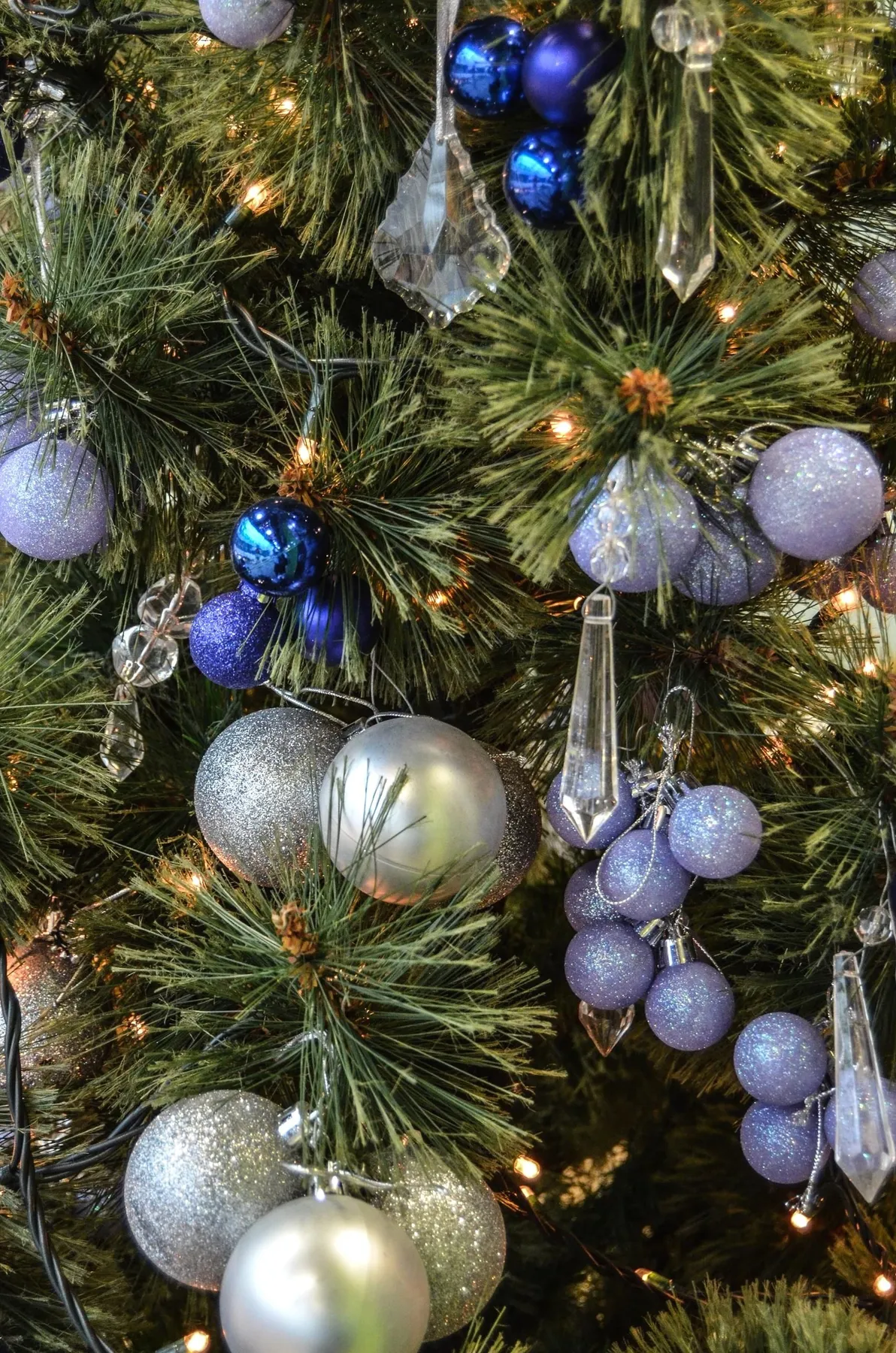
Hanging icicles evenly is harder than it sounds, and twenty minutes with a tape measure will save you.
- Start at the top and work down in horizontal bands about 8 inches apart.
- Place the largest icicles on the outer third where light hits them.
- Alternate clear glass and lavender pieces so no two neighbors match.
- Hang the smallest drops deep in the branches for depth.
- Step back every ten pieces — icicles look heavier on the tree than in your hand.
15. A Gold Wire Tabletop Tree Against Dark Blue Paneling
Contrast is doing all the heavy lifting. Thin gold wire against a deep blue paneled wall is a hard-edged, graphic combination — there is nothing soft about it, and that is exactly why it reads modern instead of cute. The scale contrast matters too: a 20-inch tree against a full wall makes the corner feel intentional rather than empty. And the rustic wooden table under all that wire and blue adds the one warm, imperfect note that stops the vignette from looking like a showroom display.
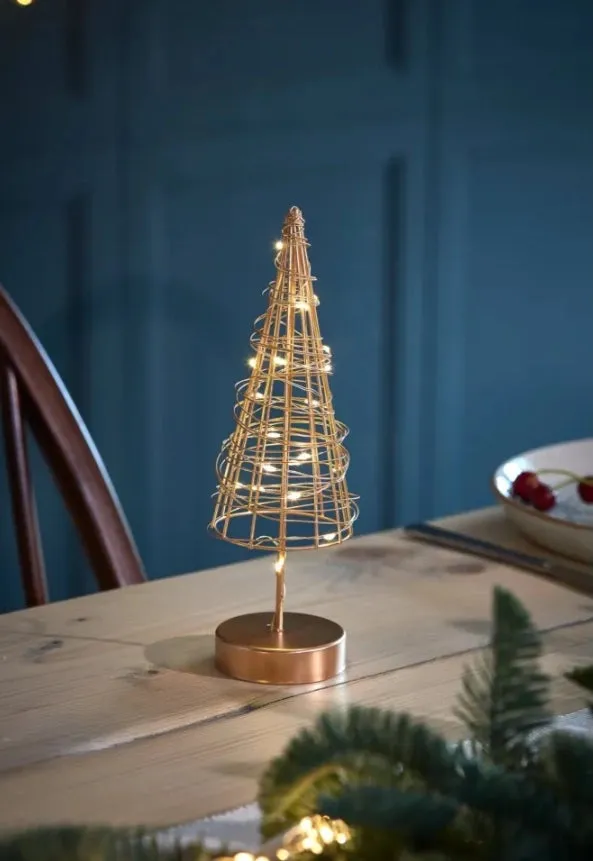
Wire trees need almost no upkeep, which is the appeal. The fairy lights are usually battery or USB powered — budget four to six AA batteries a month if you run them nightly, or about $15 a season. The wire itself bends if you are careless, so reshape gently rather than yanking. The real cost is time: restringing means rethreading every strand, roughly an hour of work.
Wire trees can also look sparse in person, especially in daylight, and product photos rarely show that. A 20-inch gold wire tree with 60 lights looks charming; the same tree with 20 lights looks like a craft project. Check the light count before buying and aim for at least three per inch of height. This reads best on a sideboard you pass mostly in the evening.
16. Ribbed Teardrops and Felt Snowflakes in Monochrome Blue
This is the most forgiving idea in the whole collection. A full 7.5-foot tree with a 45-inch spread needs a 10×10 footprint at minimum, and it works under an 8-foot ceiling without any crowding. It is equally good in a rental with low ceilings because the monochrome palette removes visual weight — a busy multicolor tree in that same spot would feel suffocating. Small rooms should scale down instead: a 5-foot tree with fewer, larger pieces carries the same story with half the ornaments.
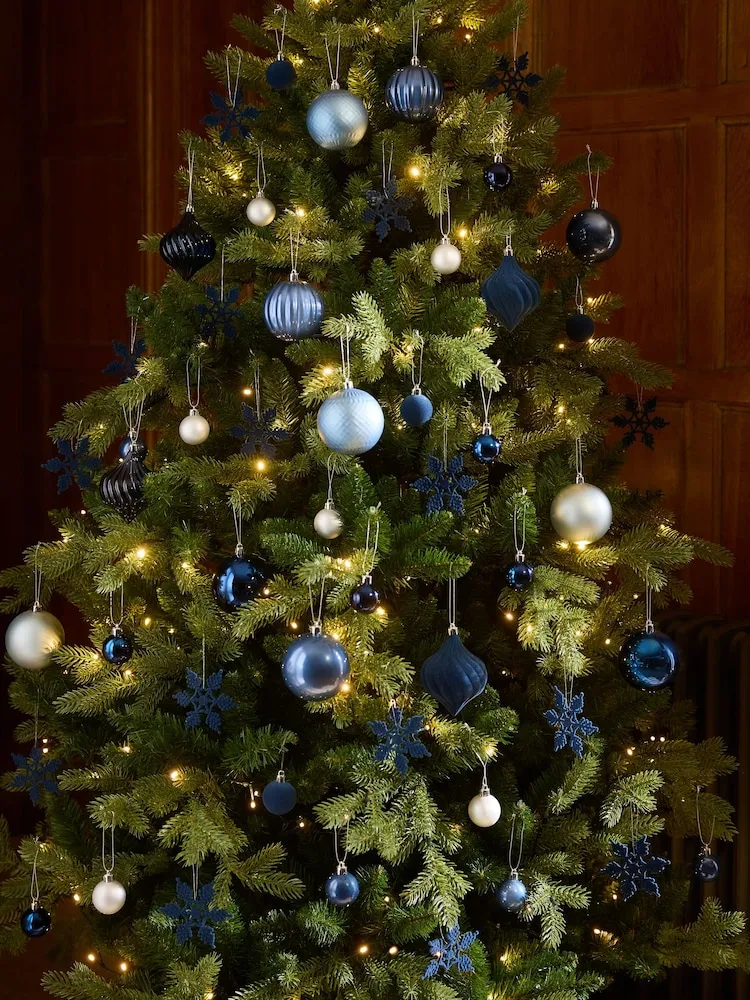
Monochrome does not mean one color — it means one hue in three finishes. This tree runs 50% royal blue, 30% light blue, 20% silver, with matte and glossy mixed throughout. The ribbed teardrops add a texture the spheres do not have, and the flat felt snowflakes break up all that shine. Rebuild it in a different hue by keeping the same 50/30/20 split: navy, teal, and copper gives you a completely different tree with identical structure.
17. A Painted Cityscape Bauble With a Gold Poinsettia
Before you fall in love with a hand-painted travel ornament, run this check:
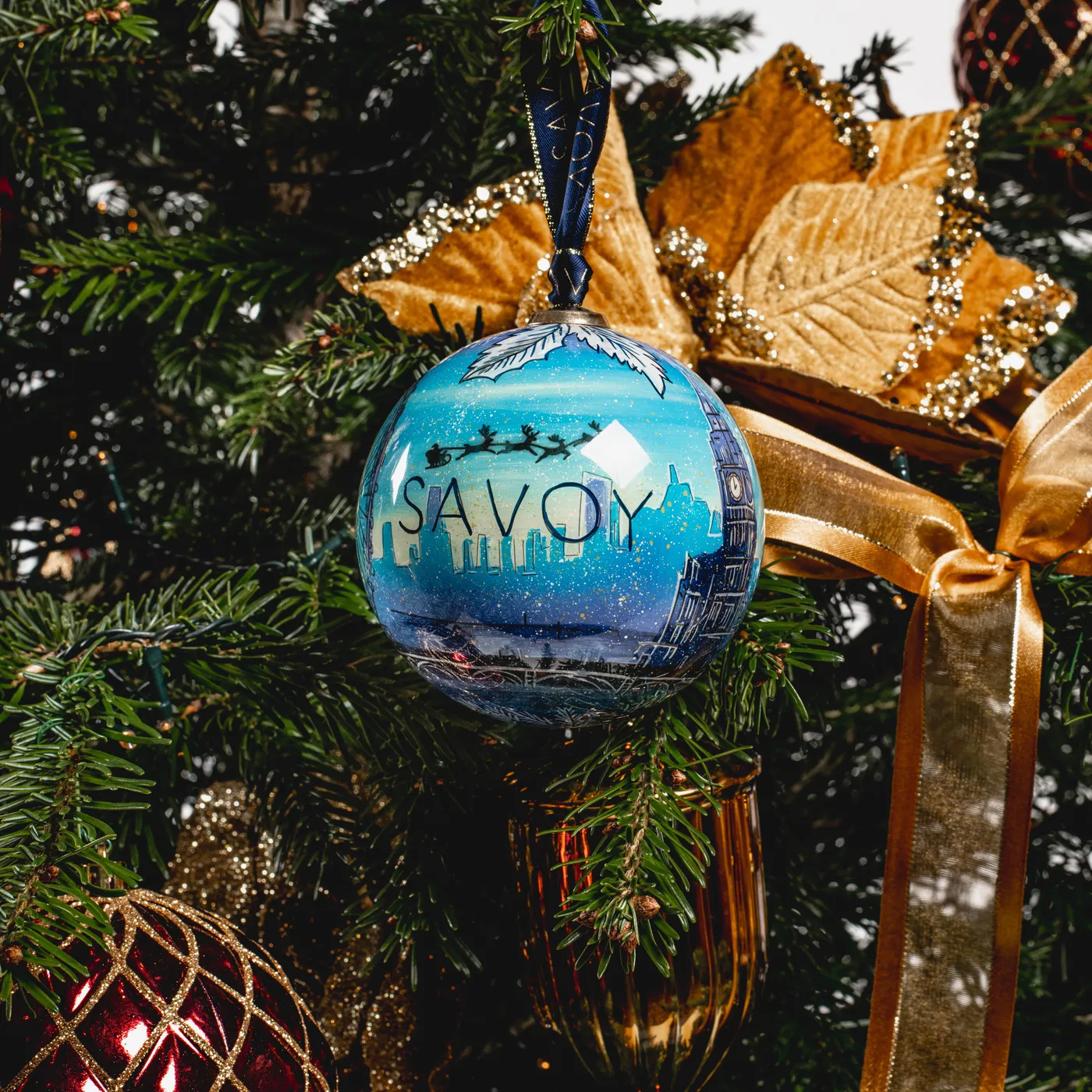
- Check branch strength — painted glass baubles can hit 3 to 4 ounces each
- Measure how wide a satin bow you want; 2 to 3 inches reads best
- Decide on a hanging zone so city ornaments cluster rather than scatter
- Confirm your hooks are metal, not plastic — glass slips off plastic
- Set a ceiling price before you commit to a $40 piece
Here is what a feature cluster actually costs:
- Hand-painted cityscape ornaments: $16–$40 each
- Gold poinsettia floral picks: $8–$18 each
- Wide gold satin ribbon, 10 yards: $12–$30
- Pine or fir garland backdrop: $20–$50
- Metal hooks and hangers: $6–$12
Total for a five-ornament cluster: about $105 to $280. Budget alternative: print a favorite skyline and decoupage plain clear ornaments for about 60% less.
18. A Glass Tree Figurine on a Metallic Blue Base
Tabletop vignettes need three heights or they read flat. Use a rough 1:2:3 ratio — something short like a candle at 5 to 6 inches, a mid piece at 10 to 12, and a tall item at 15 to 18. Here that is the candle, the framed sign, and the glass tree. Keep at least 2 inches of open space between objects so each one has its own air, and cluster everything on one side of the surface rather than centering it. Odd numbers, three or five objects, always.
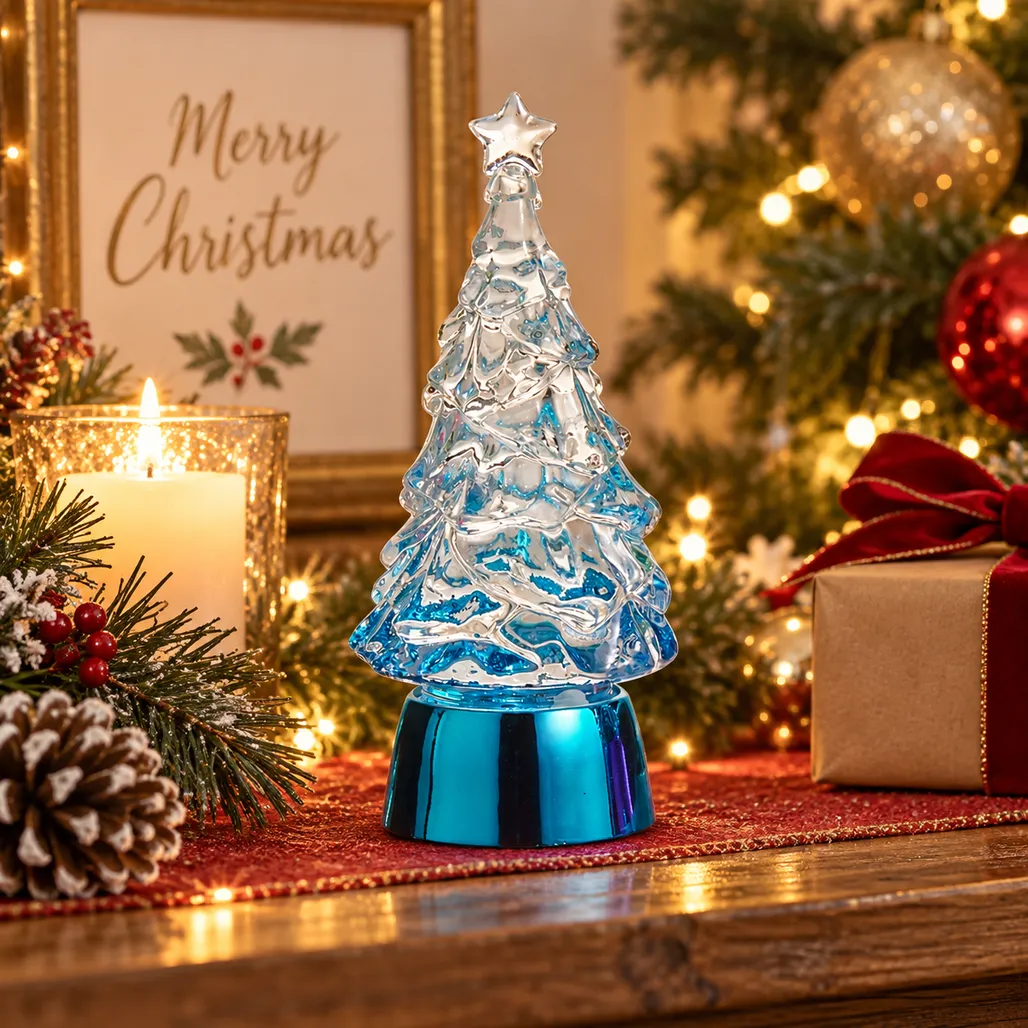
The same look lands at a fraction of the price. Target’s glass tree figurines run $15 to $25, and HomeGoods regularly has molded glass trees under $20. Thrift stores are where the real steals hide: vintage glass trees from the sixties and seventies show up for $5 to $12 and they carry better weight than new ones. Pair any of them with an inexpensive blue base or a blue ceramic coaster to anchor it.
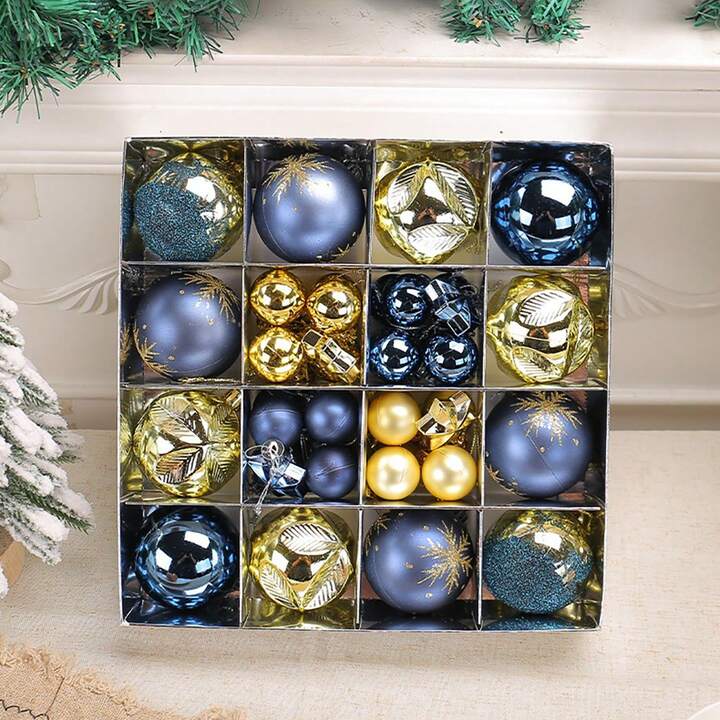
19. The Ornament Box That Shows Your Whole Color Story
Sorting an ornament collection properly takes about an hour and pays off every December.
- Empty everything onto a table and wipe each piece with a dry microfiber cloth.
- Separate into three piles: blue, gold, and anything that bridges both.
- Within blue, split by finish — matte, glossy, glitter.
- Count each pile and write the numbers on a card for the box lid.
- Return them in descending size, biggest at the bottom, with a divider between matte and glitter.
A segmented box is not just tidy, it is a design tool. Seeing the whole palette laid out makes it obvious whether it is working.
- Matte blue with gold starbursts: texture without shine
- Gold leaf-patterned globes: pattern that reads neutral at a distance
- Deep blue reflective spheres: the anchoring volume
- Smooth metallic gold spheres: the 20% accent that unifies everything
20. Blue and Copper, Packed Dense and Glittering
Copper instead of gold. That single substitution changes the entire temperature of the tree — gold reads formal and slightly cool against royal blue, while copper reads warm and a little vintage. Copper also photographs better under interior lighting, picking up lamp glow instead of reflecting white walls. Everything else here is standard: dense packing, mixed sizes, a blend of glitter and gloss. Swap the copper back out for gold and the warmth leaves the room completely.
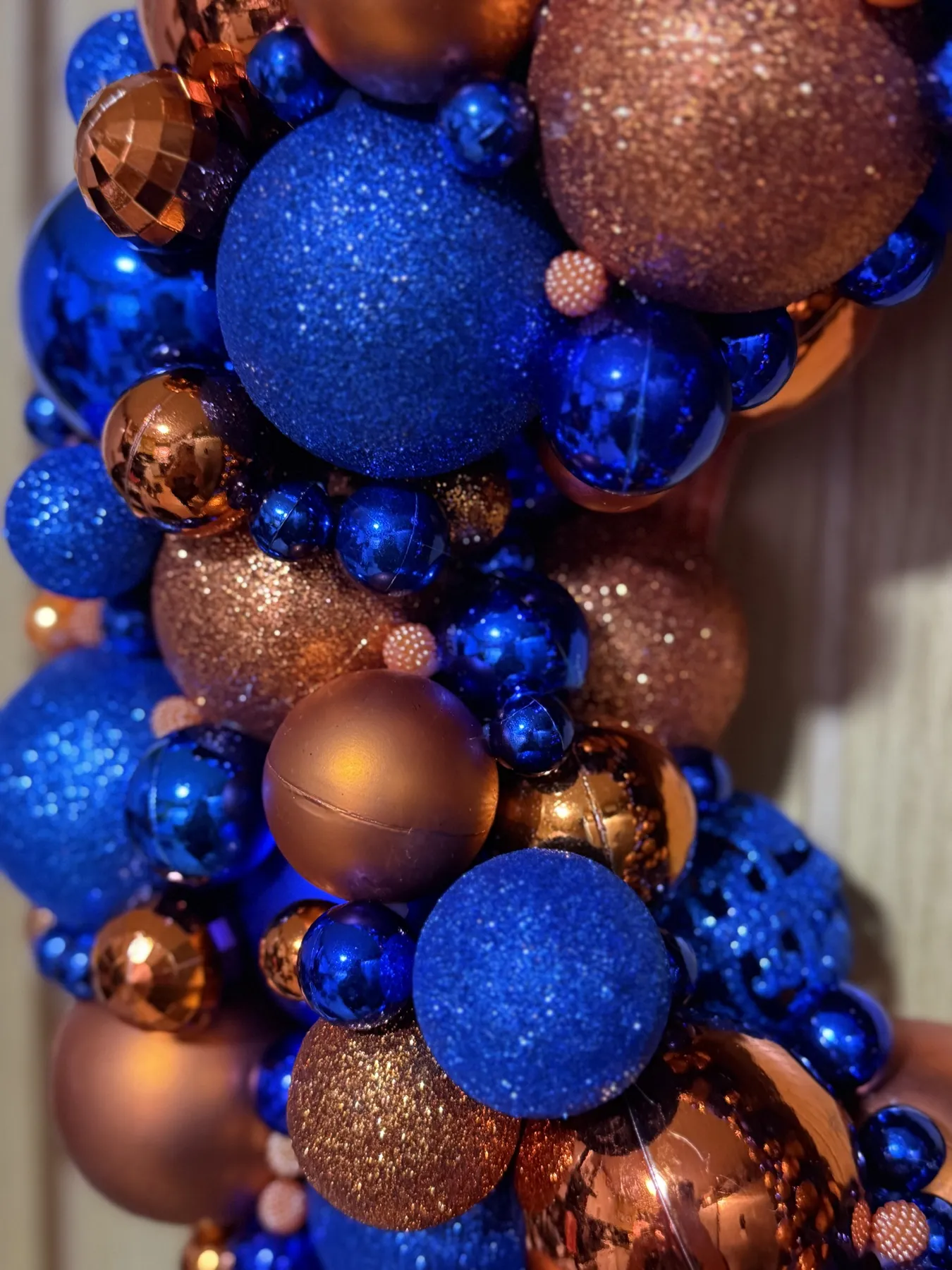
Glitter sheds, and it sheds more than you expect. Add a quick vacuum under the tree midseason. The bigger annoyance is transfer — glitter migrating from one ornament onto smooth copper surfaces, which is why glitter-coated and glossy pieces should live in separate compartments. Plan on retiring heavily glittered ornaments after four or five seasons as the coating thins out. Matte metallic finishes last far longer if you would rather replace less.
21. Jeweled-Edge Velvet Ribbon on a Patterned Wall
Pattern plus pattern works when the scales are far apart. Here you have a large blue-and-white wallpaper motif behind ribbon with a fine jeweled trim — big pattern, small pattern, no competition. Keep the ratio around 70/30: the dominant pattern should cover roughly twice the area of the secondary one. If both patterns are medium-scale, the space gets noisy fast. Then keep your third element plain — the grey surface beneath is doing exactly that job.
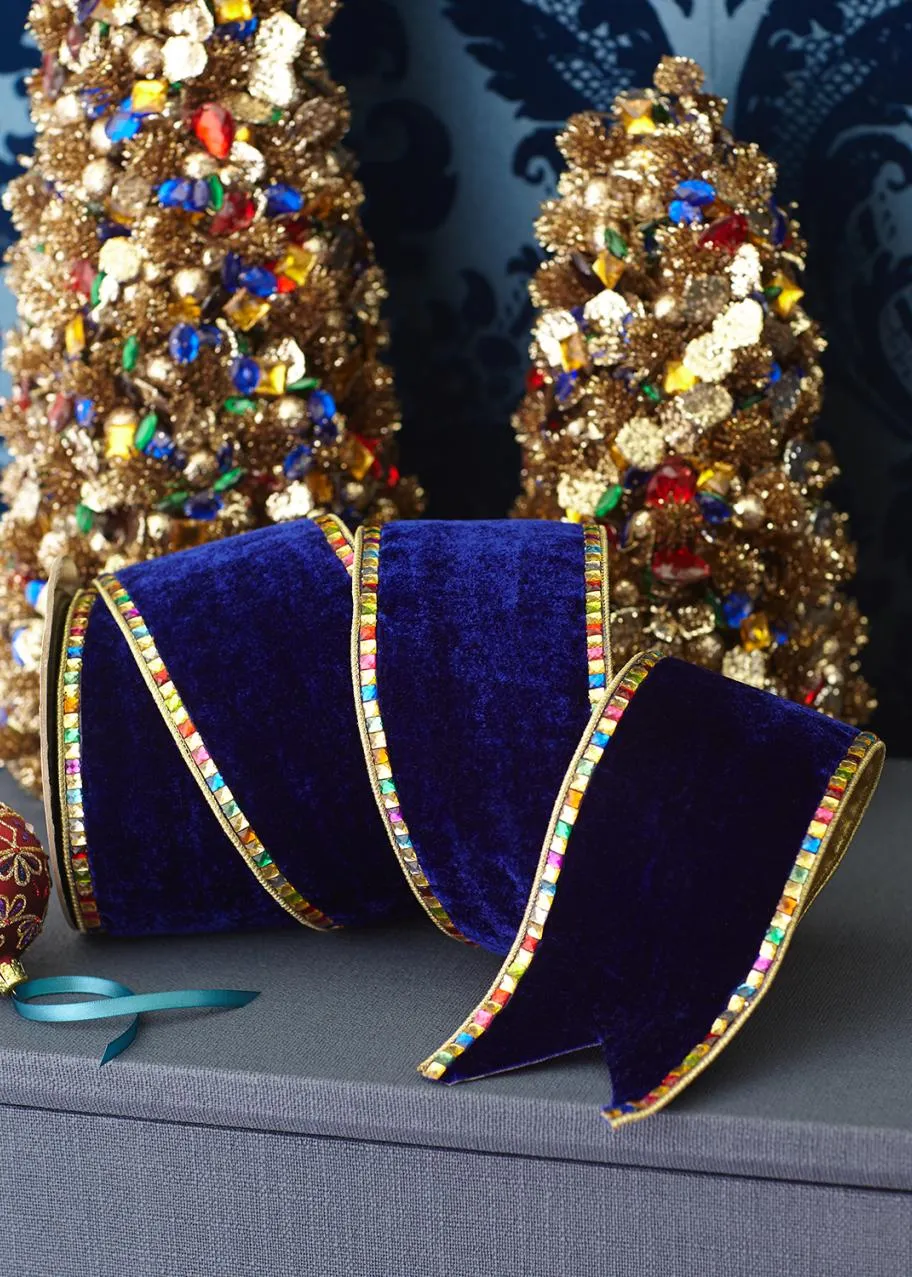
Wide velvet ribbon is a commitment because it needs surface area. At 2.5 to 4 inches it looks right on a mantel garland of 10 to 12 feet, a banister run, or a doorway garland at least 8 feet tall. On a 6-foot tabletop tree or a small wreath, drop down to 1.5 inches. Ceiling height matters less than run length — a short run of wide ribbon reads as leftover rather than intentional. The ribbon-heavy approach in Idea #6 follows the same logic on a tree.
Velvet drapes like fabric, not like ribbon, so treat it that way. Wire-edge velvet holds a curve if you shape it by hand and let it sit for a minute before pinning. For garland swags, cut lengths at 1.5 times the distance between anchors — that gives a natural sag without pulling taut. Pin from the center outward, and hide every pin in the nap of the velvet.
22. Oversized Glitter Bows and a Ruffled Navy Tree Skirt
- Tree, 7.5 ft: $130–$320
- Silver tinsel garland, 2 strands: $16–$40
- Oversized silver glitter bows, 6 to 8: $30–$80
- Large dark blue top bow: $25–$55
- Blue and silver round ornaments, 50 pieces: $45–$100
- Ruffled dark blue tree skirt: $35–$90
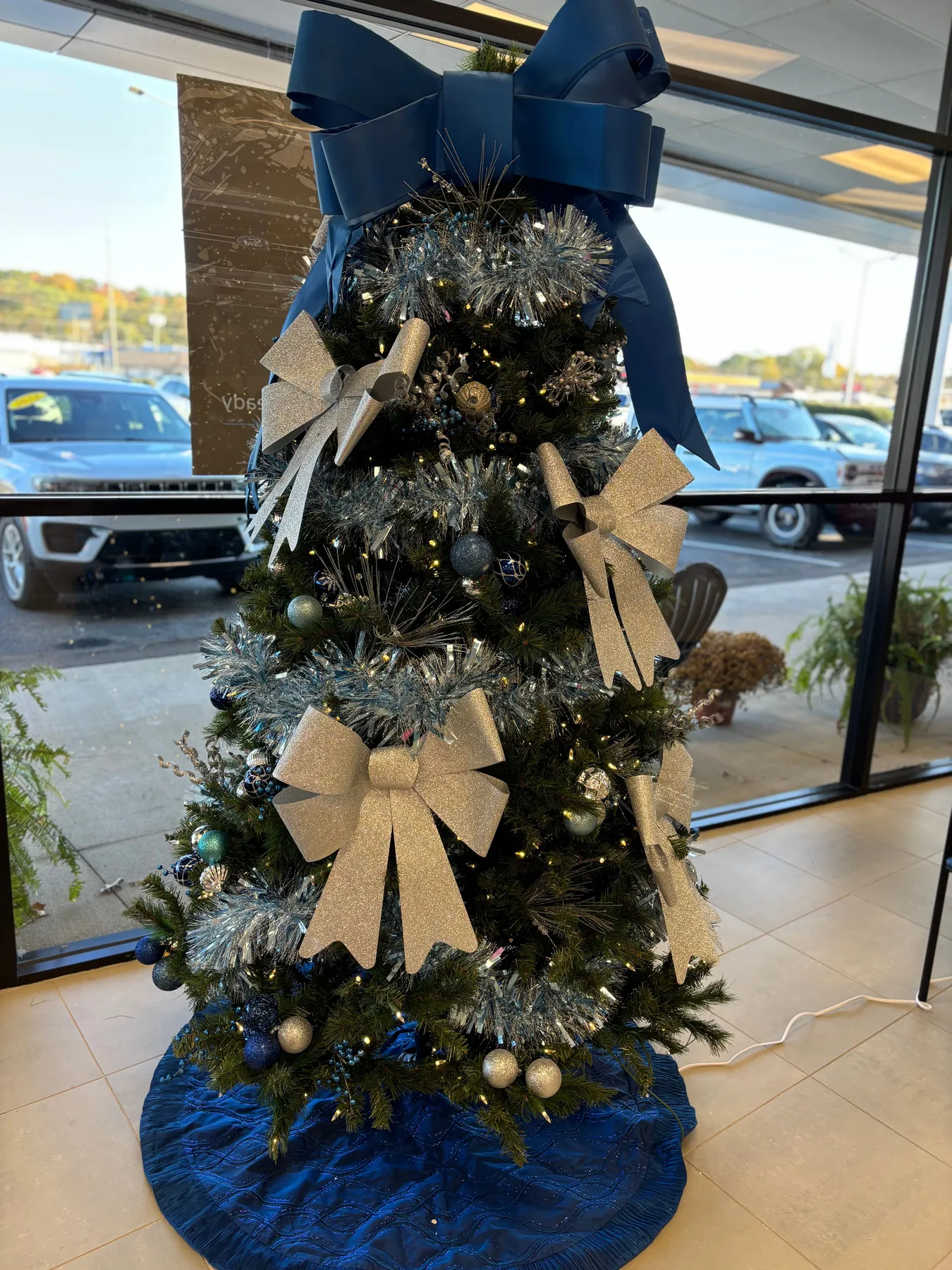
Total: roughly $280 to $685. Budget alternative: shape bows from $3 Walmart ribbon and reuse last year’s garland for about 50% less.
Two warnings. First, glitter bows shed badly — you will find silver flecks on the rug through January, so consider a matte-finish bow if you hate vacuuming. Second, this look depends entirely on contrast, and a very bright room with large unshaded windows will wash the silver out until it disappears. Cool-toned trees live or die on their lighting environment. If your room floods with daylight, shift toward deeper navy and add more matte surfaces.
23. A Blue Velvet Bow Sitting on Top Instead of a Star
Designer velvet tree toppers run $45 to $90. A quarter yard of velvet from Joann or Etsy costs $8 to $14, and you can shape a bow by hand in fifteen minutes with no sewing — just pinch, twist, and wire the center. Walmart sells pre-made blue velvet bows around $6, and Target carries oversized fabric bows seasonally for about $10. The red ornaments mixed in cost nothing extra; you almost certainly already own a handful.

Velvet absorbs light while glass reflects it, and that contrast is why this topper reads rich instead of gaudy. A glossy blue bow at the top of this tree would compete with the baubles; a velvet one quiets down and lets them shine. The red and bronze ornaments scattered through the blue also matter more than they look — they warm up what would otherwise be a very cold tree, and they visually connect the topper to the fairy lights below. Three colors, clear hierarchy, nothing fighting.
24. A Woven Star Topper Under a Wash of Blue Light
A woven star topper costs about $15 and an evening, and it beats most store-bought finials.
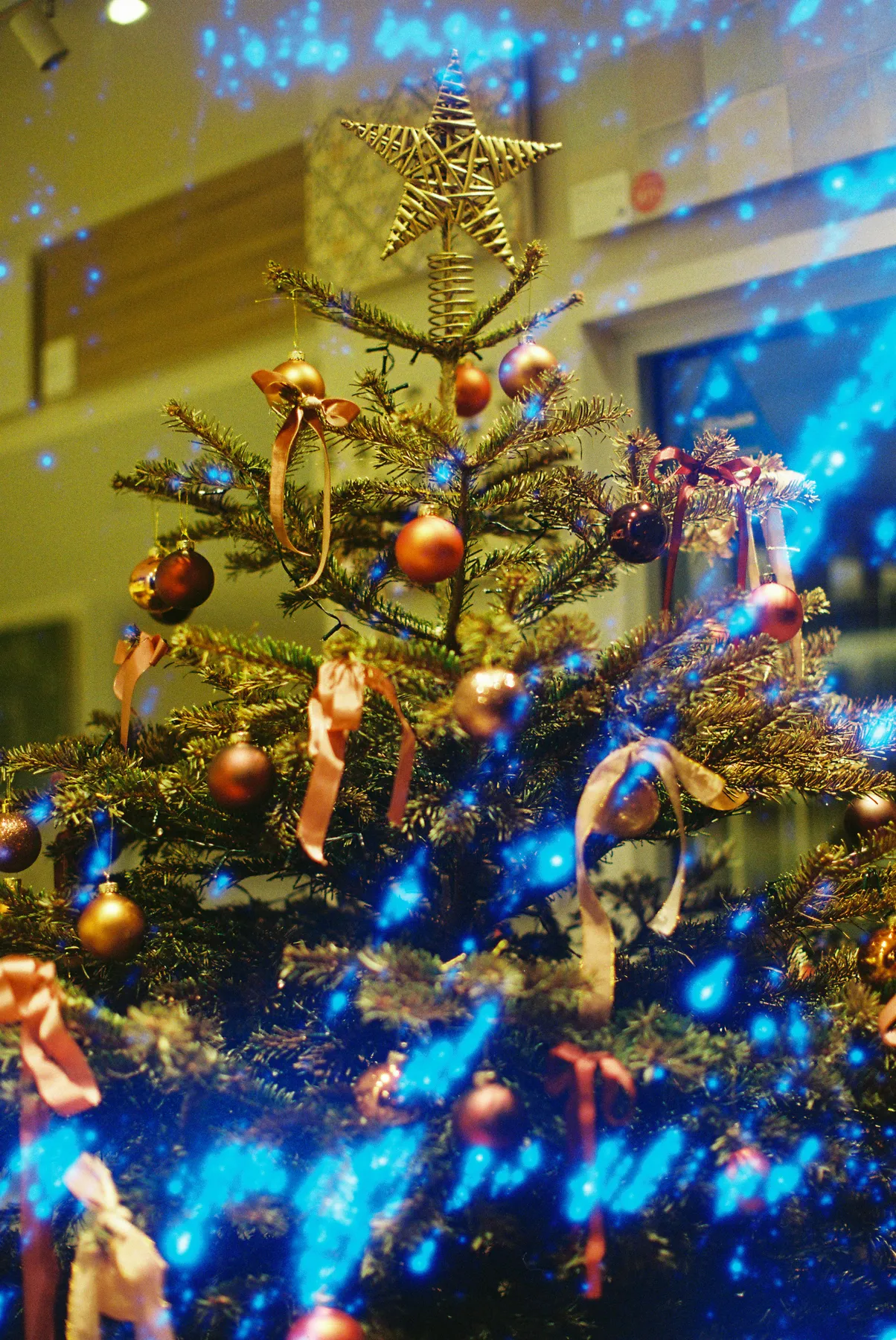
- Soak grapevine or rattan strips in warm water for 30 minutes so they bend without cracking.
- Form five equal loops and bind each joint tightly with floral wire.
- Weave a second, smaller star over the first and wire them together at the center.
- Dry overnight on a flat surface — it hardens and holds its shape.
- Attach with two wire ties to the top branch cluster, not one, or it will tilt.
A blue light wash is the cheapest way to change a room’s whole mood. One blue LED uplight aimed at the wall behind the tree, or a color-changing bulb in a nearby lamp, gives you that cool glow for $12 to $25. Keep the tree’s own lights warm white at 2700K. Mixing warm string lights with a cool ambient wash is exactly what creates the effect here; if everything goes blue, the scene flattens out.
25. Blue Glass Bells With Hand-Painted Snowflakes
- Check bulb heat — some vintage-style strands run hot enough to soften paint
- Confirm glass thickness; thin bells crack in cold garages and attics
- Test your satin ribbon for fading before using it on sun-facing branches
- Count how many you need — hand-painted sets are usually sold in threes
- Decide whether you want matching or slightly varied snowflake designs
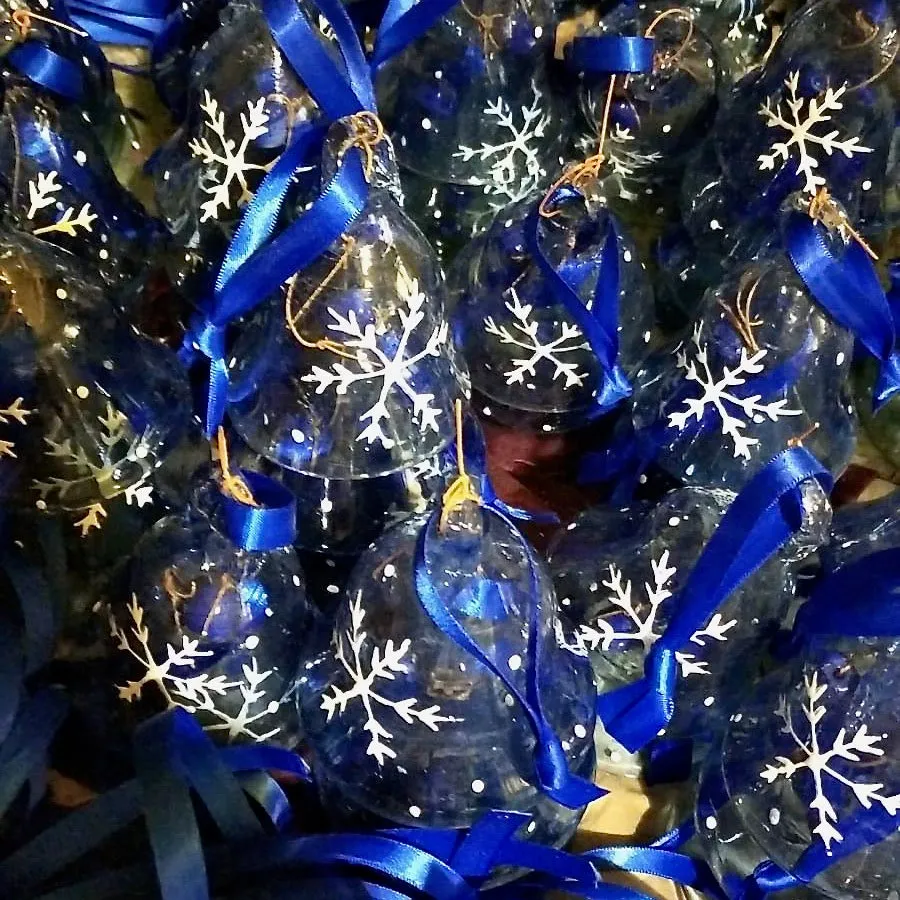
White detail on blue glass works because the white occupies under 10% of the surface. Push it to 20% and the ornaments start looking like souvenir shop merchandise. The royal blue satin ribbons match the glass hue almost exactly, which is what keeps these reading as a set — match your ribbon to your glass, not to your tree. On a navy tree, use a darker ribbon or the bells will look borrowed from a different collection.
Translucency is the real story. These bells are not just blue objects — light passes through them, so they glow from the inside when a bulb sits behind them. That is a texture you cannot get from opaque ornaments, and it is why glass always outperforms plastic on a lit tree. Hang them where a light strand sits directly behind the glass, and rotate the painted side toward the room.
26. Blue-and-White Ribbon Topped With a Silver Pinecone
- Wrapping paper, 3 rolls: $12–$30
- Patterned blue and white ribbon, 2 spools: $10–$24
- Metallic silver pinecones, set of 6: $14–$32
- Plain kraft paper for layering: $6–$12
- Gift tags and name cards: $5–$15
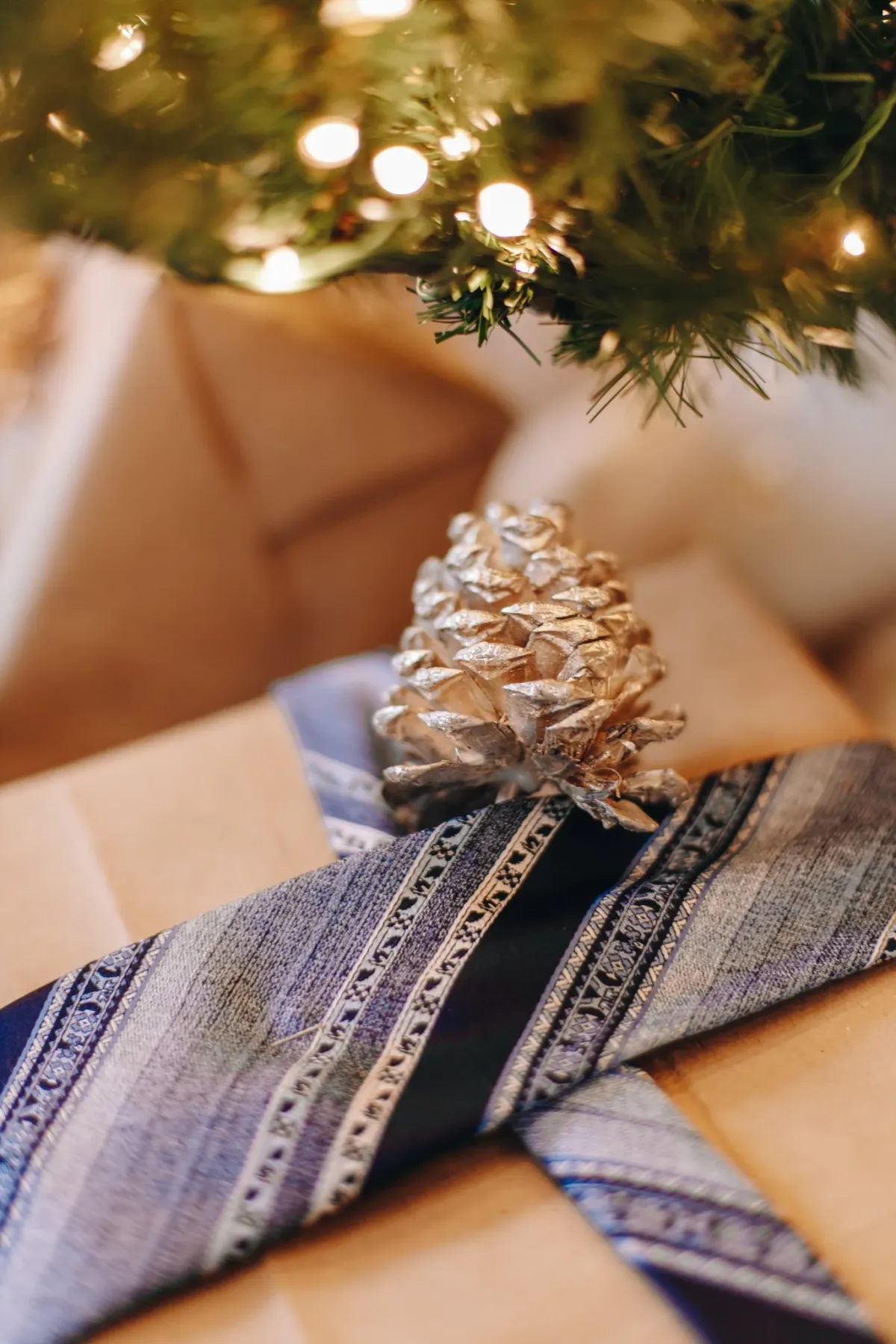
Total: about $47 to $113 for a fully coordinated pile of gifts, which is cheaper than most people assume. Budget alternative: go all kraft paper with a single ribbon color and you land around $40.
Gift wrapping has quietly become its own design category. Three things are driving it in 2026:
- Coordinated wrap that matches the tree palette instead of leftover paper
- Natural toppers — pinecones, dried citrus, cinnamon sticks — over plastic bows
- Patterned ribbon in one color family rather than mixed novelty prints
It is a cheap upgrade with an outsized payoff: the space under the tree is the first thing guests actually see.
27. A Dark Blue Scrollwork Ornament on a Gold Stand
Ornament stands are one of the most misused accessories in holiday decor. The ball should hang so its center sits just below your seated eye level — around 36 to 40 inches on a tabletop. Any higher and it competes with the tree behind it. Match the stand’s metal to your room’s dominant hardware, too; a gold stand in a chrome-and-nickel kitchen reads as a mistake. Leave the ball’s bottom 2 inches of air clear so the scrollwork looks like a floating object.
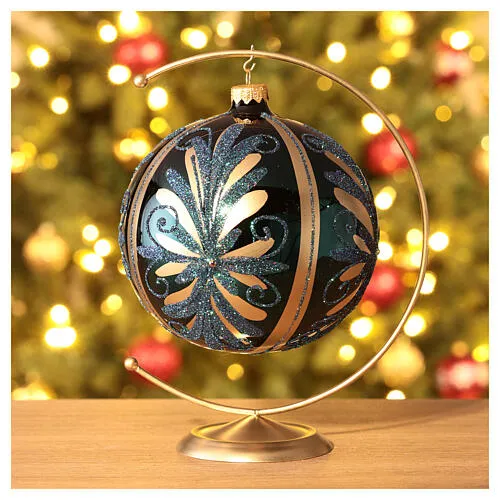
Gold metal ornament stands run $20 to $45 from designer retailers. Amazon and Etsy have nearly identical curved stands for $8 to $18, and Walmart lists simple gold versions around $6. The dark blue glass ball itself? HomeGoods stocks large patterned glass ornaments for $12 to $20. This is the same logic as Idea #5 — spend the money on the piece people will actually pick up and inspect.
Glass ornaments on open stands are a hazard in some homes. A cat batting at a hanging ball will send it straight to the floor, and a low stand on a coffee table is a target for toddlers. If either lives with you, choose ceramic or resin, or display the ball inside a glass cloche. Also skip direct sun — dark blue glass heats up and the finish can craze over a couple of seasons.
28. Flocked Tips and Blue Bead Garland With Heart Baubles
Bead garland looks best when it drapes rather than loops. Budget fifteen minutes per strand.
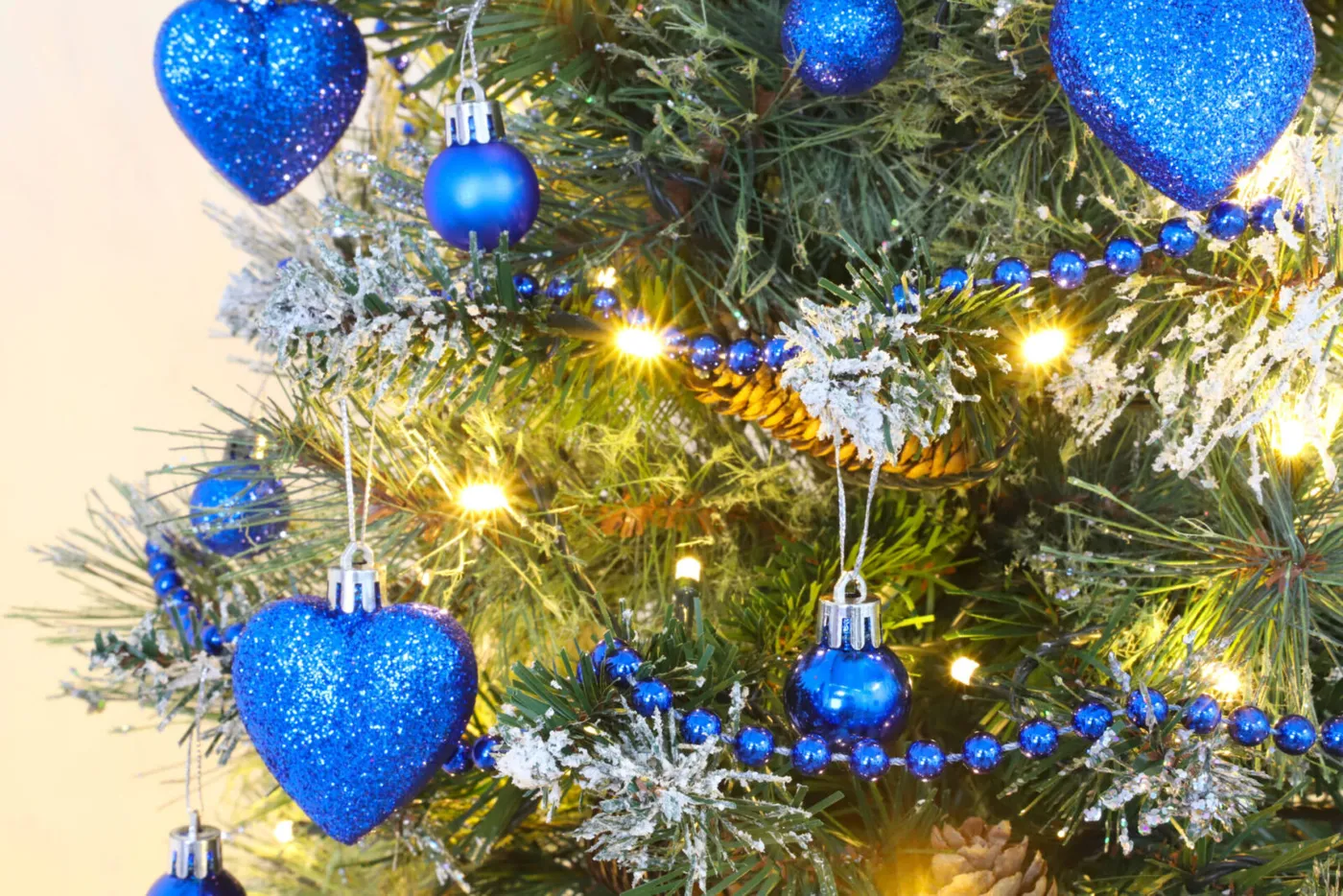
- Cut or buy strands at least 9 feet long for a 6-foot tree.
- Anchor the top end at the back of the tree, near the trunk.
- Drape in a shallow diagonal across the front, pinning every 18 inches.
- Let the garland hang below the branch line so it catches light from underneath.
- Overlap strands by about a third so no bare gaps show.
Flocked, bead-heavy trees suit compact spaces better than big ones. A 6-foot tree with a 38-inch spread needs roughly a 6×6 footprint with 18 inches of walk-around clearance, which fits comfortably in a 10×10 bedroom or an 8×10 apartment living area. The white flocked tips brighten a small dim room considerably. In a 12×14 living room this tree would look undersized — go 7.5 feet minimum and pack the ornaments densely so the branches do not read as empty.
29. Peacock Feather Ornaments With Pearl and Jewel Accents
Peacock palettes follow a tight formula: 40% royal blue, 30% emerald green, 20% gold, 10% purple glitter. Green and blue carry equal visual weight here, which is why neither ornament looks subordinate. Gold shows up only as outlines, caps, and hanger loops — outlines, never fills. Get the proportions wrong by letting green dominate and you drift straight into Mardi Gras territory. Keep the purple to a few glitter flecks and it stays jewel-toned rather than costumed.
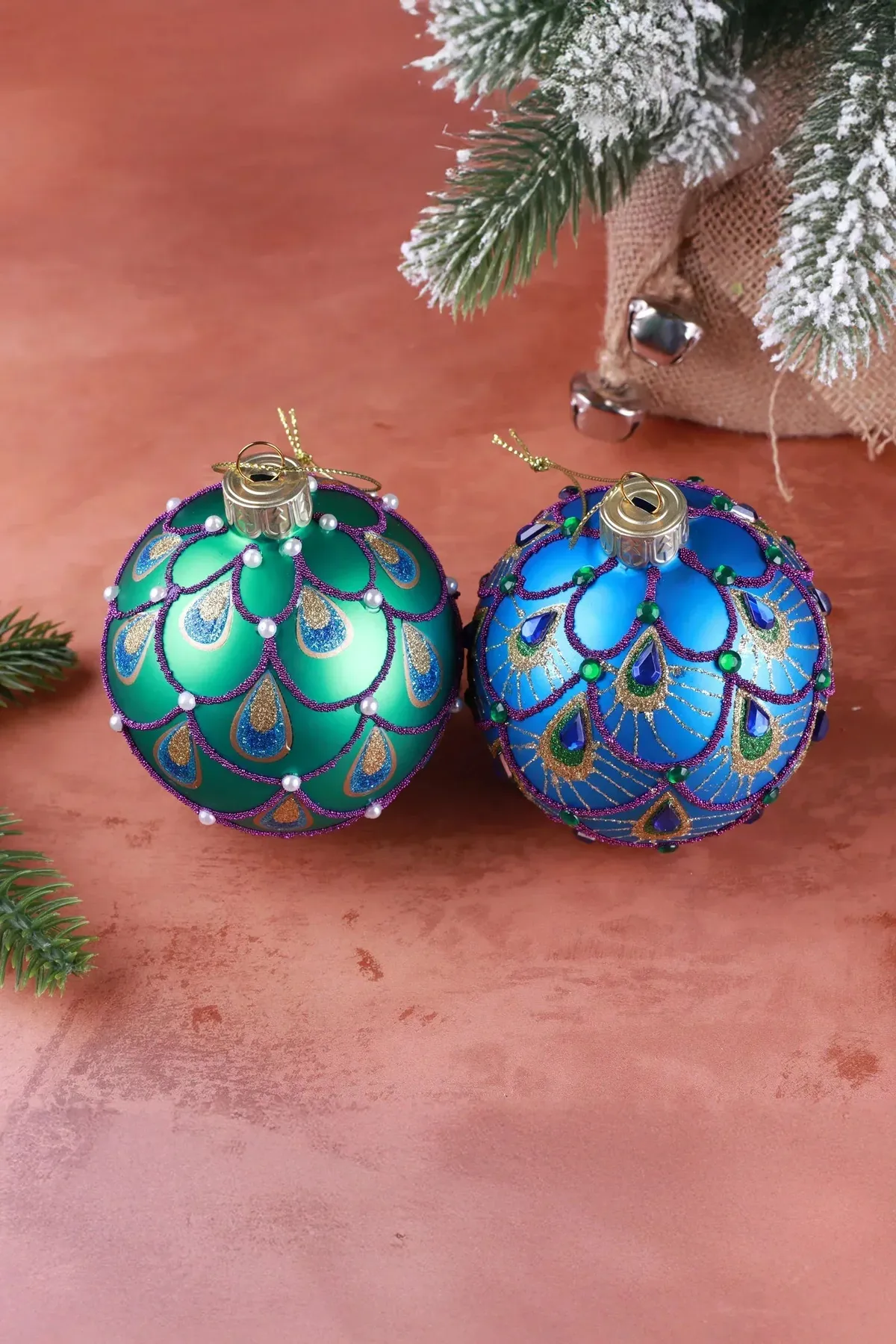
The jewel and pearl accents are the whole ballgame. Remove them and you are left with two pretty painted baubles that look like a craft fair find. With them, the ornaments gain dimension — tiny raised points that catch light and make the peacock pattern feel layered rather than printed. That is the difference between a $4 ornament and one someone keeps for twenty years. If you are DIYing it, small faux pearls and flat-backed rhinestones cost about $5 per ornament.
30. Blue Baubles and Gold Ribbon in a Formal Molded Room
- Tree, 7.5 to 8 ft: $150–$400
- Gold ribbon, 2 spools: $24–$55
- Blue ornaments, 70 pieces: $70–$160
- Warm white lights: $35–$80
- Patterned area rug: $120–$500
- Accent lamp with warm bulb: $40–$120
Total: roughly $440 to $1,315, and the rug is what swings that number hardest. Budget alternative: keep the tree and ribbon, swap in a $60 jute rug and a thrifted lamp for about 55% less.
Keep every light source in the room within 200 degrees Kelvin of each other. Tree lights at 2700K, lamp bulbs at 2700K, any picture lights at 3000K maximum — otherwise gold ribbon reads green in one corner and orange in another. Replace lamp bulbs with 2700K LEDs before you decorate, not after. It is about $4 a bulb, and it is the most common reason a beautifully styled room photographs badly.
Your Blue and Gold Tree Starts With One Good Ornament
Start with one thing — a single faceted bauble, a spool of velvet ribbon, a palette you actually love — and build outward from there. Blue and gold rewards restraint far more than it rewards volume, and the trees that get it right are almost always the ones that bought less and chose better.
When yours is up, take a photo and pin it — someone is scrolling right now looking for exactly your tree. 📌 Save this guide to Pinterest so it is waiting for you next December.