You know the feeling: it’s mid-November, you’ve saved forty shelf photos, and not one of them looks anything like the shelf in your actual house. Christmas shelf decor gets treated like a five-minute afterthought — a snowman wedged next to the paperbacks — when it’s the one spot you walk past fifty times a day.
We spent serious time browsing Etsy, HomeGoods, and Target to bring you only what’s worth your attention this year, with ideas running from about $3 for a pair of taper candles to $730 for a full mantel-and-tree scene. Inside you’ll find 31 curated Christmas shelf ideas spanning neutral minimalist, traditional red-and-green, nostalgic vintage, and blue-and-white winter wonderland looks — with budget and splurge versions compared side by side.
And 2026 is the year shelf styling got edited: backlit built-ins, layered miniature villages, and one genuinely vintage figurine are the details quietly outperforming tinsel on Pinterest right now.
And stay until the end — we break down the most common mistakes that can ruin these looks.
📌 Save this to Pinterest for later — you’ll want to revisit these ideas.
1. Backlit Built-In Shelves That Glow After Dark
LED strips are the difference between ‘designed’ and ‘dorm room,’ and it comes down to three numbers. Choose 2700K warm white — 4000K reads as a hospital hallway the second it hits wood. Mount each strip to the underside of the shelf, recessed about an inch behind the front edge, so you see the glow instead of individual diodes. Then put the whole run on a dimmer and live at 60%; save full brightness for the tree-lighting moment. Two shelves, one plug-in strip, roughly $30.
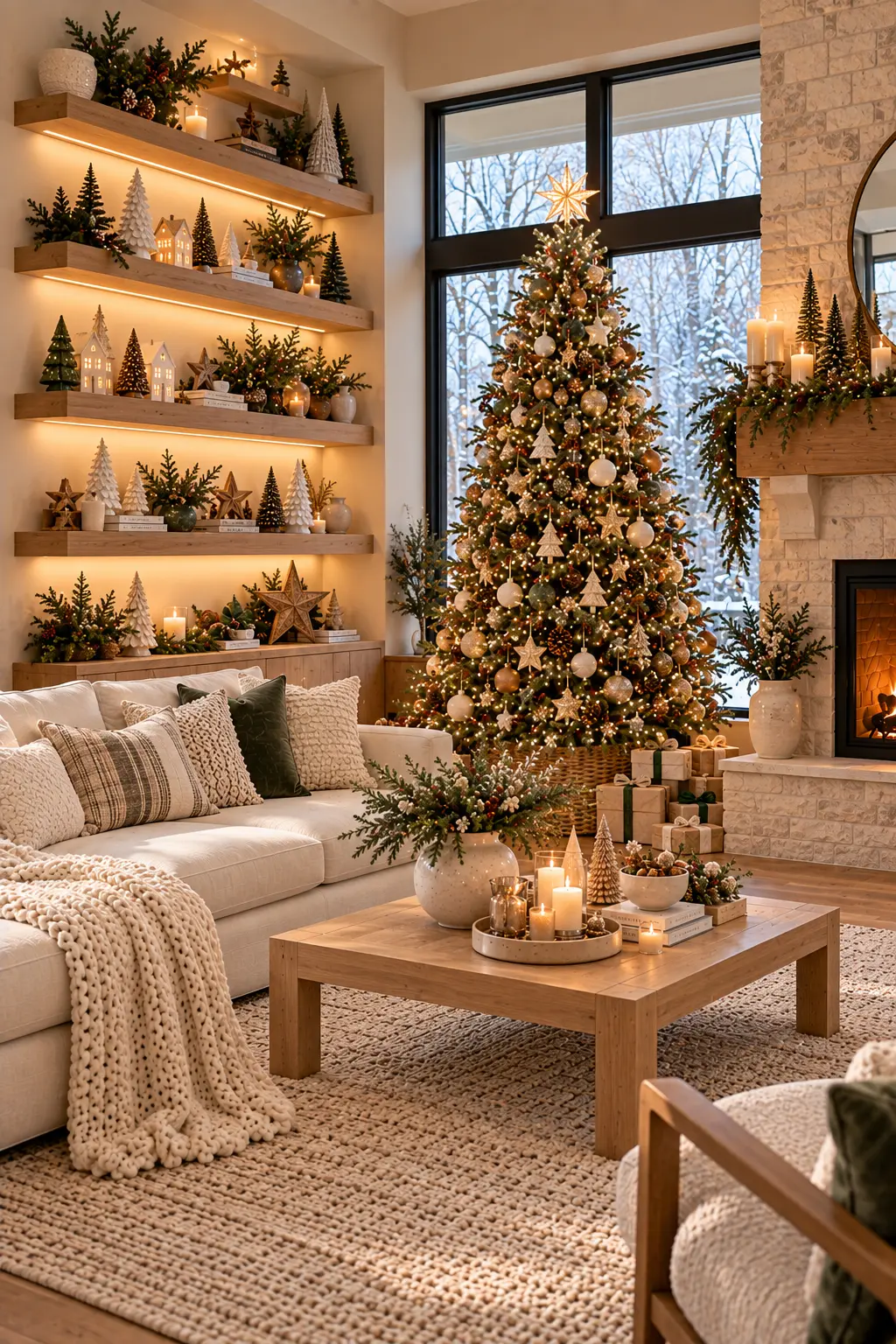
The real trick here isn’t the Christmas decor — it’s the halo. Because every shelf is lit from underneath, the miniature trees and ceramic village houses read as silhouettes first and objects second, which makes a modest collection look intentional. The stone fireplace and cream sofa stay quiet so the glow does the talking, and the densely packed tree by the window balances the sparseness up on the shelves. Contrast, not quantity, is what makes a shelf look styled.
You don’t need custom millwork. Two IKEA LACK floating shelves (about $25 each) plus a $28 plug-in LED strip get you most of this look, especially if you run the cord along the underside and paint it to match. Facebook Marketplace is where the ceramic village houses live — search ‘Christmas village’ in early November and you’ll find retired pieces for $5-15 each. Total: around $120 instead of $1,200 for fabricated built-ins.
2. Dark Grey Built-Ins With Tiny Wreaths and Wooden Snowmen
If you keep only one thing, keep the mini evergreen wreaths tied with deep red velvet ribbon. Those six-inch circles do something a garland can’t: they read as jewelry pinned to the shelf itself, so your eye travels the whole wall instead of parking at one end. The carved wooden snowmen and the gingerbread house are charming, but the wreaths are a repeatable rhythm — three or four of them turn a dark cabinet into a composition. Remove them and you’re left with a handsome grey bookcase that happens to have a cookie house on it.
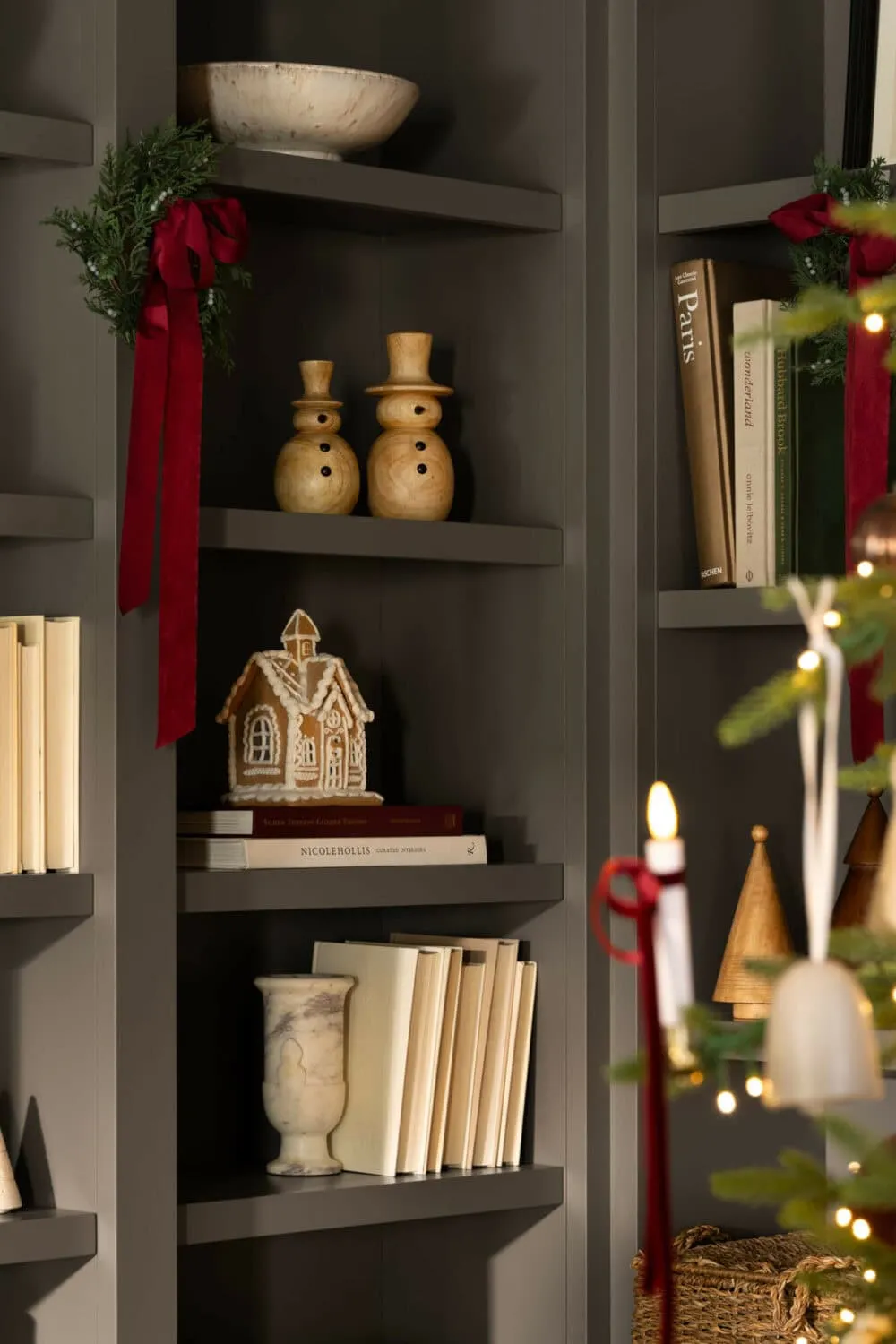
Honest warning: dark grey shelving swallows holiday color. Deep reds and forest greens sit close enough in value to the paint that they can vanish entirely by evening. Keep a marble vase or a stack of cream books between every two Christmas pieces so the eye has somewhere to rest, and light the shelves from the front rather than overhead. And if a gingerbread house is going on a low shelf, know that kids and dogs treat it as a snack.
3. Neutral Wood Shelves Where Frosted Trees Do All the Work
The formula is roughly 70% warm neutral, 20% frosted white, and 10% natural brown. That means the bulk of the shelf is speckled ceramic bowls, pillar candles, and soft beige vessels, then the frosted bottlebrush trees carry the Christmas signal, and the snow-dusted pinecones plus that wooden dough bowl supply the brown. Swap colors without changing the math: sage and ivory if you want something softer, charcoal and oatmeal if your walls run cool. Hold the proportions and the mood holds with them.
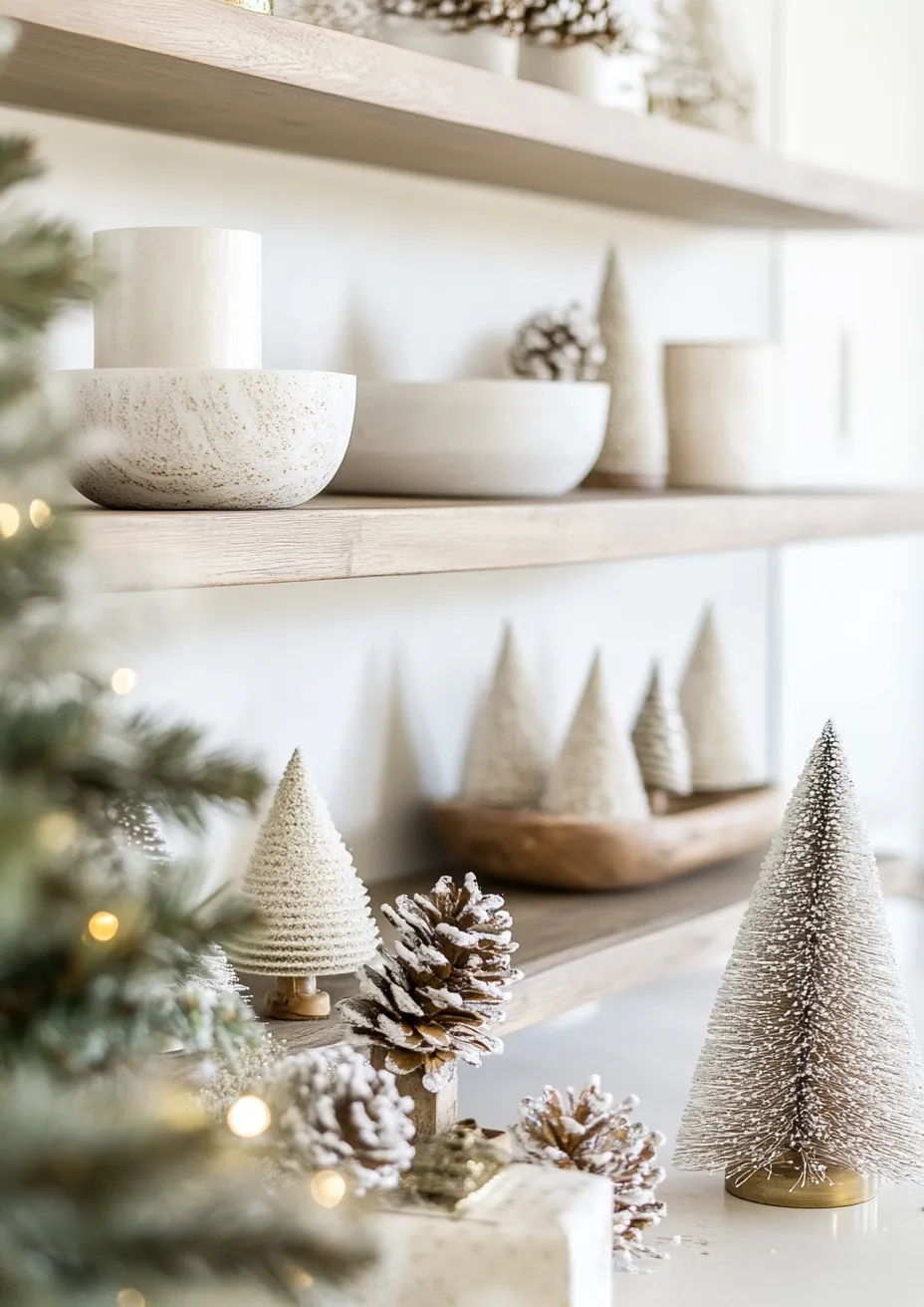
Bottlebrush trees are the cheapest luxury in holiday decorating. A bag of twelve frosted ones runs about $12 at Target or Walmart, and pinecones are free if you have a pine tree and an afternoon. The wooden dough bowl is the one piece worth actually spending on — thrift stores in the South and Midwest hand them over for $15-30, and they look better with a little wear on them. Total for the entire shelf: under $75.
4. Blue, Silver, and Gold on a White Tabletop Tree
A 30-inch tabletop tree needs about 60 ornaments. Sounds like a lot, and that’s the point — undecorated gaps are what make small trees look like a boutique display that ran out of stock. Work in three sizes: 40 small (1-2 inch), 15 medium (2-3 inch), and 5 large statement balls, keeping roughly 60% blue, 25% silver, and 15% gold. Blue stays the boss; silver and gold are just the sparkle that breaks it up so it doesn’t go flat.
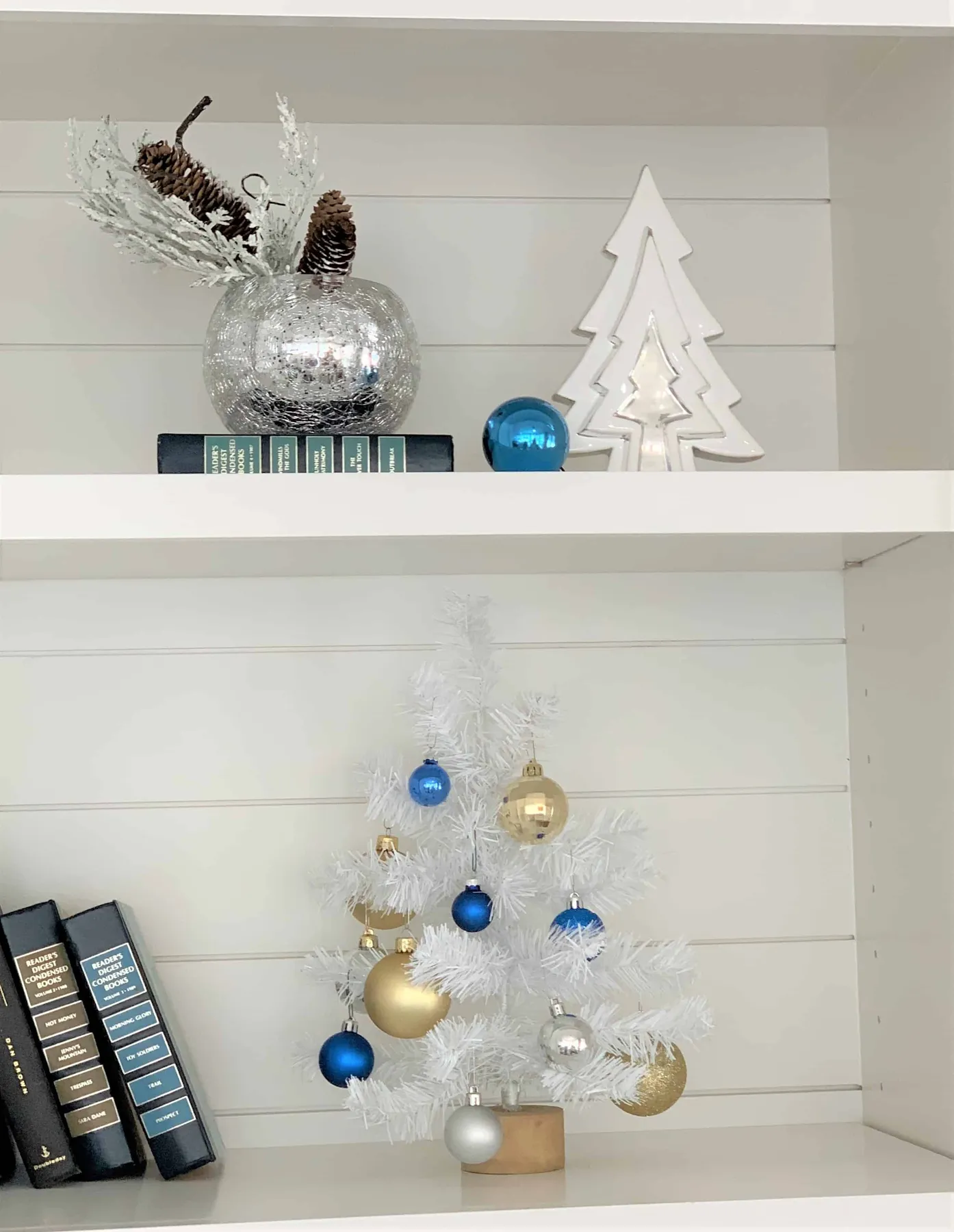
This display wants a shelf at least 30 inches wide and 10-12 inches deep, plus 6 inches of clear air above the tree so the ornaments don’t visually collide with the shelf above. Narrower than 24 inches? Skip the tree and go with the white ceramic layered tree sculpture alone, letting the mercury glass vase of frosted pinecones do the heavy lifting. Low ceilings handle this scale fine — it’s a shallow shelf that kills it, not a short room. For the room-scale version of this same palette, see Idea #18.
5. Evergreen Garland, Satin Ribbon, and Brass Picture Lights
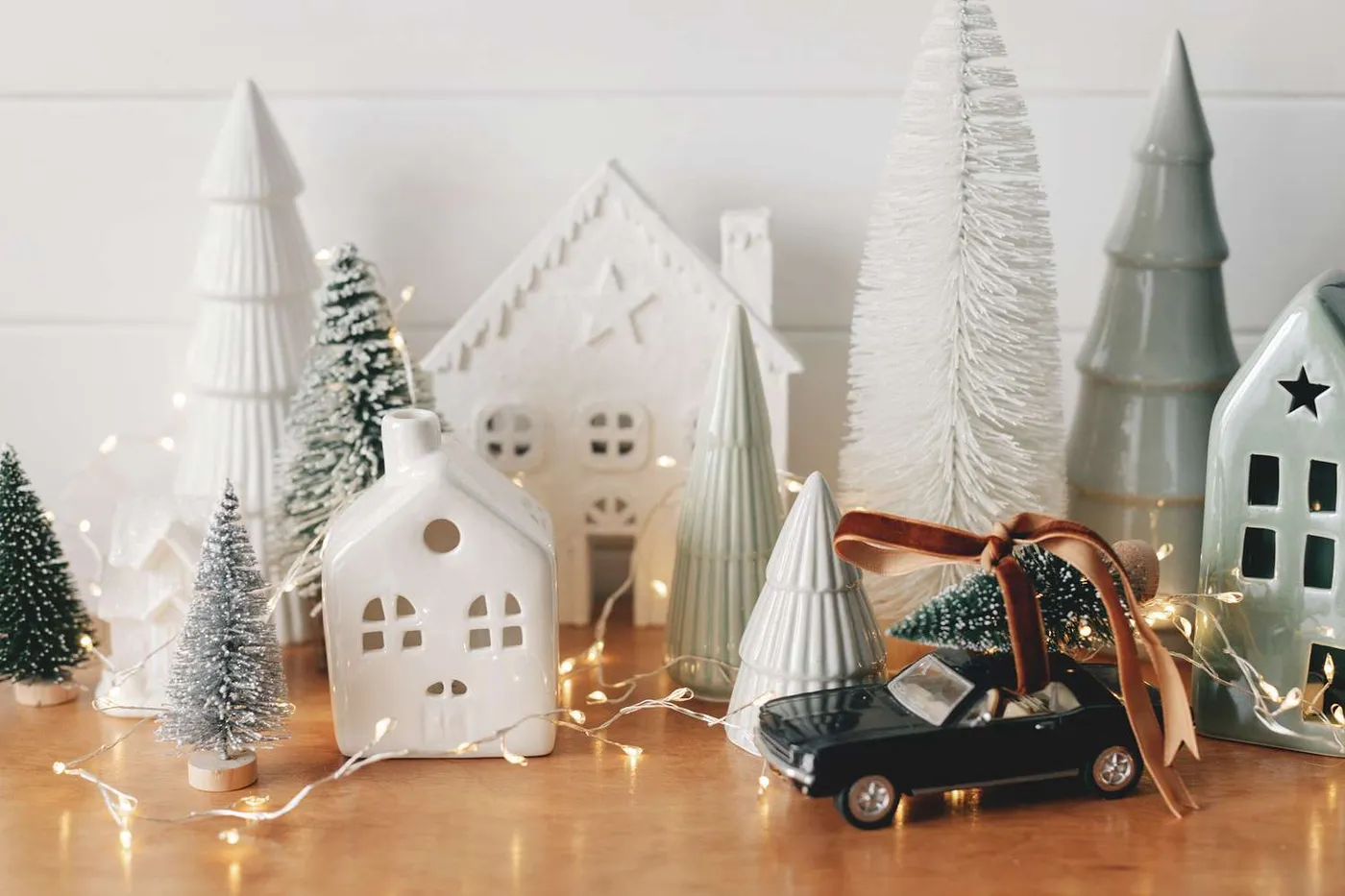
Dressing picture lights with ribbon is a 15-minute job that changes the entire wall.
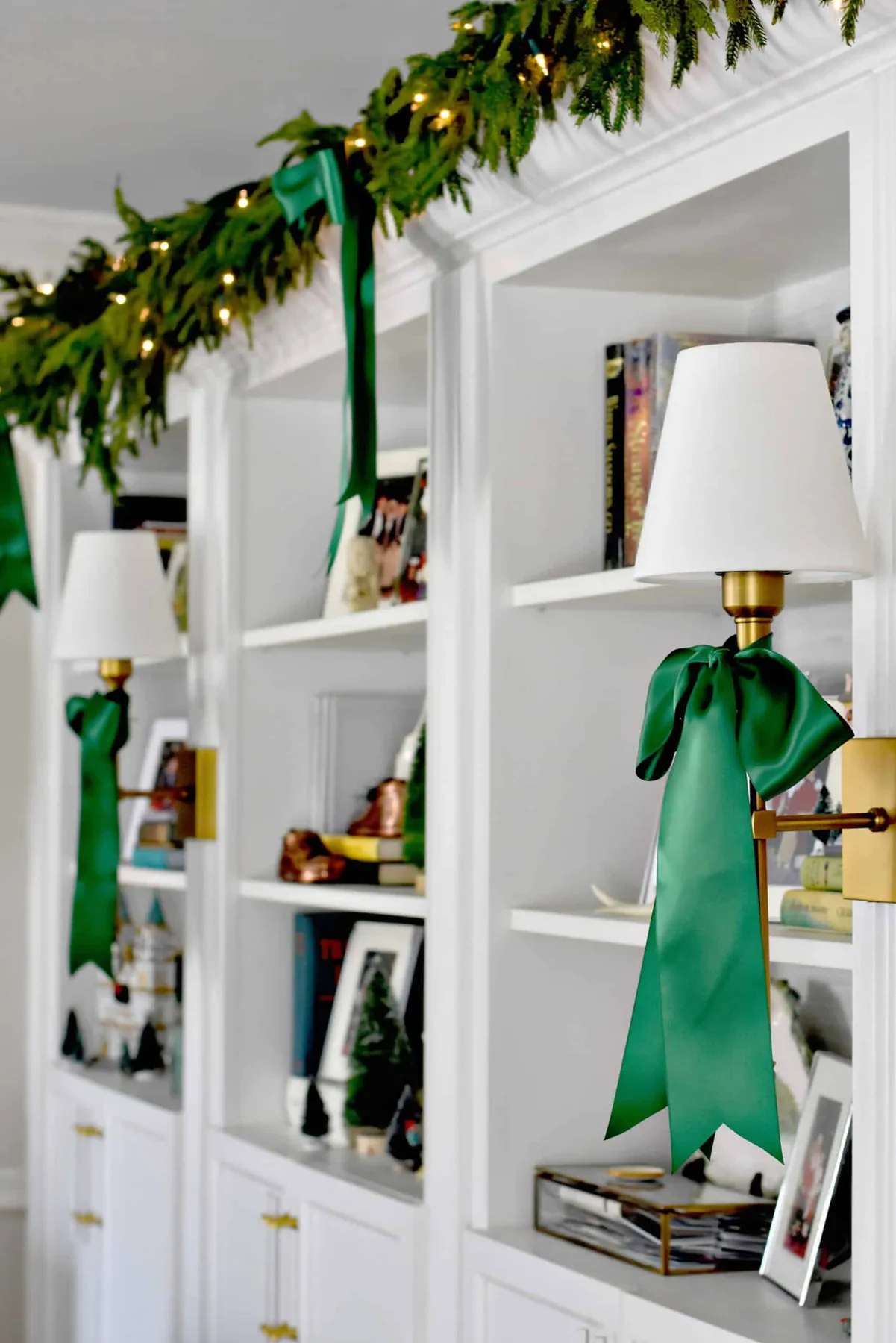
- Measure your satin ribbon against the light’s stem and cut two tails at 18 inches each, angled at the ends.
- Wrap the ribbon around the stem once, crossing in front, and pull both tails to the back so no raw edge shows.
- Tie a loose bow with loops about 3 inches across — bigger reads as gift wrap, smaller disappears from across the room.
- Trim the tails on a diagonal and pass them briefly over a candle flame to seal the fray.
- Repeat on every light along the shelf run so the rhythm stays consistent.
Time: 15 minutes. Cost: about $12 in ribbon.
White built-ins, brass sconces, lit garland, green satin bows. What makes it work is the repetition of three colors and nothing else — no red, no silver, no glitter. The brass is the only metal, which is why the whole wall feels calm despite being fully decorated.
One safety note: satin and warm bulbs don’t mix. Switch those picture lights to LED, keep the ribbon at least 4 inches clear of the shade, and never let a bow sit directly against a bulb housing. Satin scorches before it catches, and it smells like a burnt birthday cake for a week.
6. Pink, Sage, and Gingham Under Paper Stars
The formula runs about 50% soft pink, 30% sage green, 15% warm wood, and 5% brass. Pink is a base color here, not an accent — it’s on the wall, the curtains, and the ruffled pillows, which is exactly why it reads as a scheme instead of a Valentine’s leftover. Sage and deeper green handle the tree and the velvet bows, brown wood grounds everything, and the brass candlesticks supply a small warm sparkle. Trade pink for butter yellow and the equation still holds. Trade sage for royal blue and the mood turns sharp and modern.
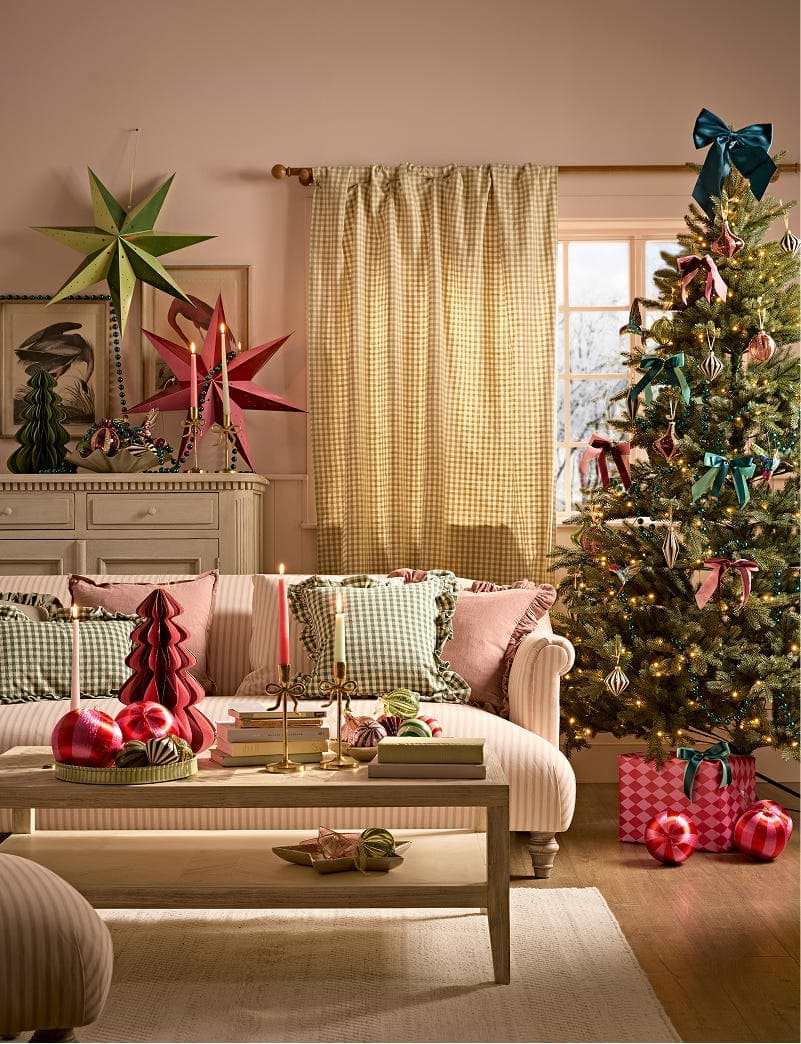
Pink Christmas stopped being niche a few seasons back, and this is the year it went fully mainstream — search interest keeps climbing while classic red-and-green holds steady. Two things are driving it: the grandmillennial crowd that never let go of gingham and ruffled pillows, and the velvet bow obsession that turned every tree into a ribbon display. The folded paper stars are the giveaway — honeycomb ornaments pack flat, cost almost nothing, and read vintage without being fragile. And if your taste runs more to figurines than frills, see Idea #22 for a different flavor of playful.
7. Muted Green Built-Ins With a Paper Star and a Bowl of Walnuts
Almost every styled shelf has ceramics, greenery, and a candle. What this one has — and yours probably doesn’t — is a small bowl of walnuts sitting between the books. That’s the element doing the heavy lifting. It’s organic, it’s warm brown against muted green, and it quietly says a person lives here instead of a store display was assembled here. The red-and-white striped paper star is the eye-catcher, but the walnuts are why the shelf feels warm. Take them away and the arrangement still reads festive. It just stops reading lived-in.
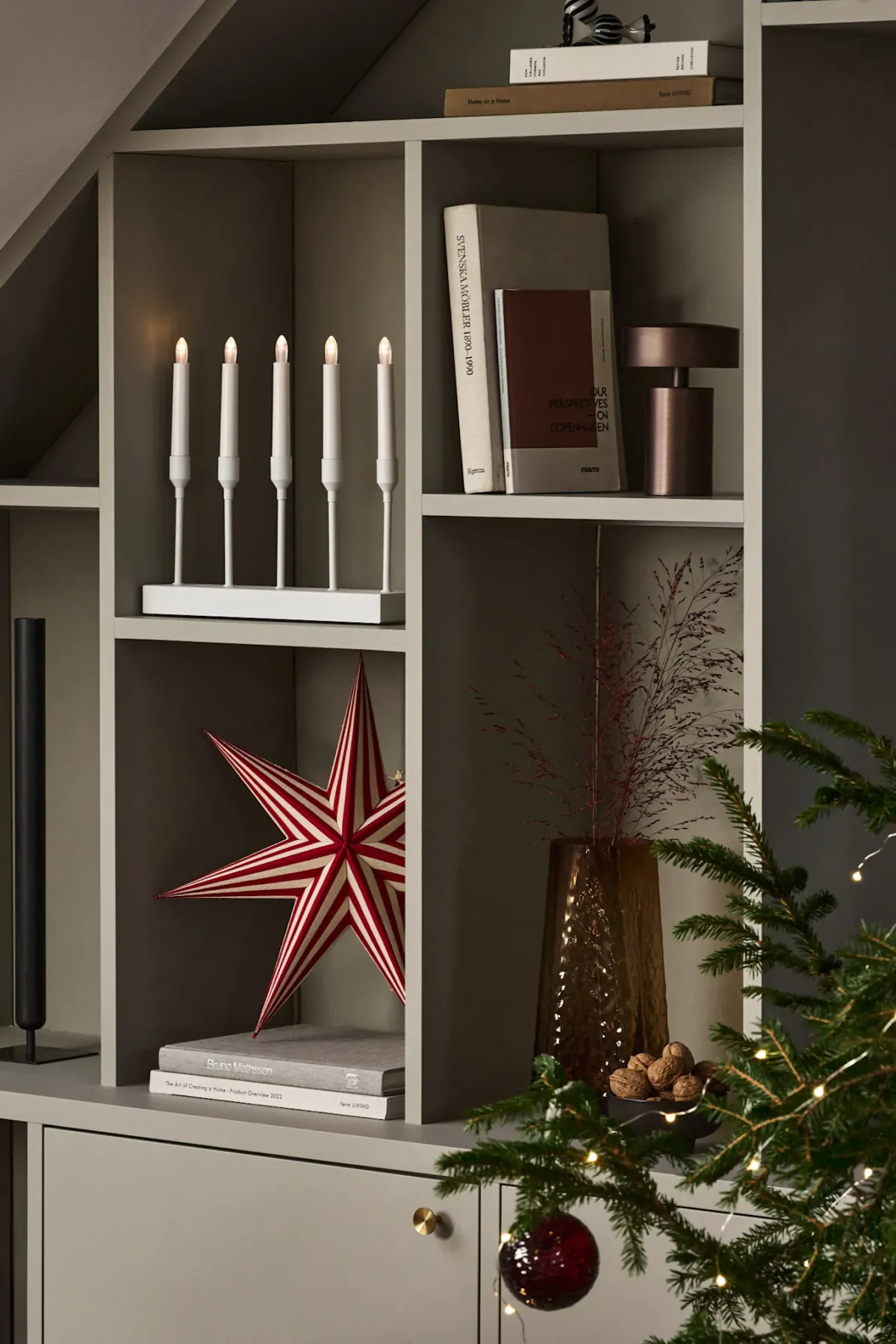
The multi-candle light fixture looks effortless and isn’t: six wicks means six trim jobs, and uneven burn lengths show from across the room. Trim every wick to a quarter inch before lighting, and never leave it burning unattended — a leaning taper is a genuine fire risk on a wooden shelf. The dried stems in the amber vase shed a fine dust every time you brush past, so plan on a quick swipe under the vase weekly. And if those walnuts are real, they’ll go stale in about three weeks and can attract pantry moths. Swap to resin after New Year’s.
8. A Mantel Village of Lighted Wooden Houses
- Lighted wooden village houses (5-7): $60-180
- Pine and eucalyptus garland (8-9 ft): $35-90
- Wrapped gift boxes and satin ribbon: $15-40
- Frosted pinecones and gold ornaments: $20-45
- Cream knit stockings (4): $40-100
- Matching wreath above the mantel: $30-70
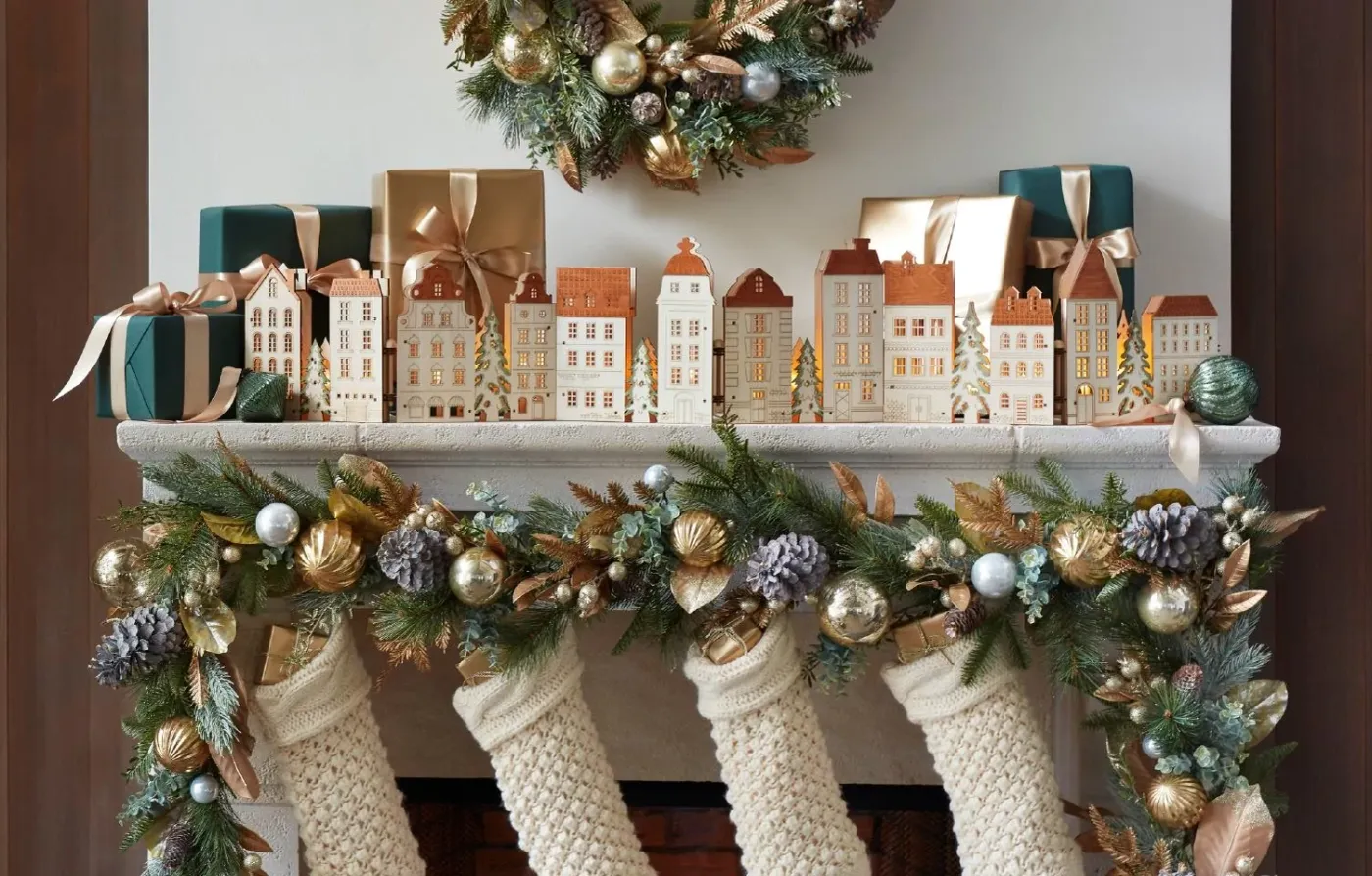
Want the same scene for less? Buy two plain wooden birdhouses and one LED tealight each, paint them cream, and cluster them with the garland on the ends only. You’ll spend about $70 and get the silhouette of a village without the price tag.
The houses only work if their rooflines climb. Set them at staggered heights in 3-4 inch increments, tallest roughly center-back, and never place two houses of the same height side by side. Small risers — a book, an upside-down bowl — hide easily behind the garland. Then drape the garland so it pools at both ends of the mantel rather than in the middle; the symmetry is what makes a row of little houses feel like a streetscape instead of a shelf.
9. Plaid Plates and Red Mugs on White Shelves
Open shelving full of holiday dishware is gorgeous for six weeks and dusty for the other forty-six. Anything above eye level collects a film you can’t see until the light hits it, and if these shelves are anywhere near a kitchen, they’ll pick up cooking grease too. Plan on washing the display pieces before you actually eat off them, and skip putting anything food-adjacent on the top shelf. Also worth admitting: red-and-green plaid plates used three times a year are eating a lot of prime shelf real estate. If storage is tight, rotate them out in January.
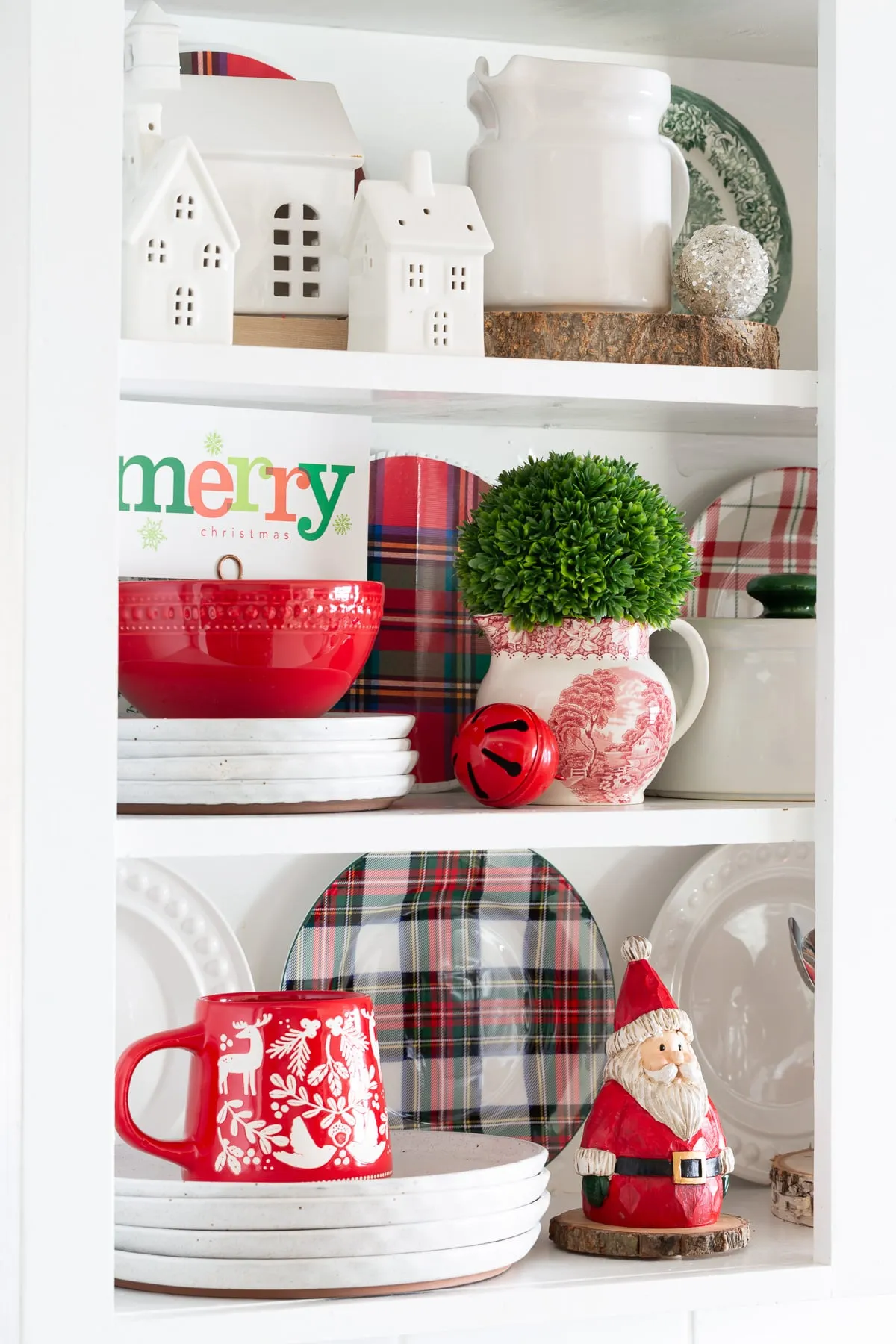
The affordable path here is genuinely affordable. Thrift stores are packed with holiday plaid dinnerware in November — $1-3 a plate, and mismatched patterns actually look better than a matched set. Dollar Tree carries red ceramic mugs for $1.25 that photograph identically to the $12 versions. The white ceramic village houses are the one category worth buying new, since dollar-store versions often arrive with chipped roofs; expect $8-15 each or $40 for a set of six.
10. A Black Glass Cabinet Keeps Christmas Quiet
Styling a glass cabinet is really an exercise in restraint. Put your best three objects at eye level — roughly 58 to 64 inches off the floor — because that’s the band people actually look at. Keep about 60% of the interior visually empty, and layer front-to-back rather than side-to-side: books at the back, ceramics in the middle, one small potted evergreen near the front. Tie brass bells to the door handle instead of adding another object inside. Same logic as jewelry — one good piece beats six average ones every time.
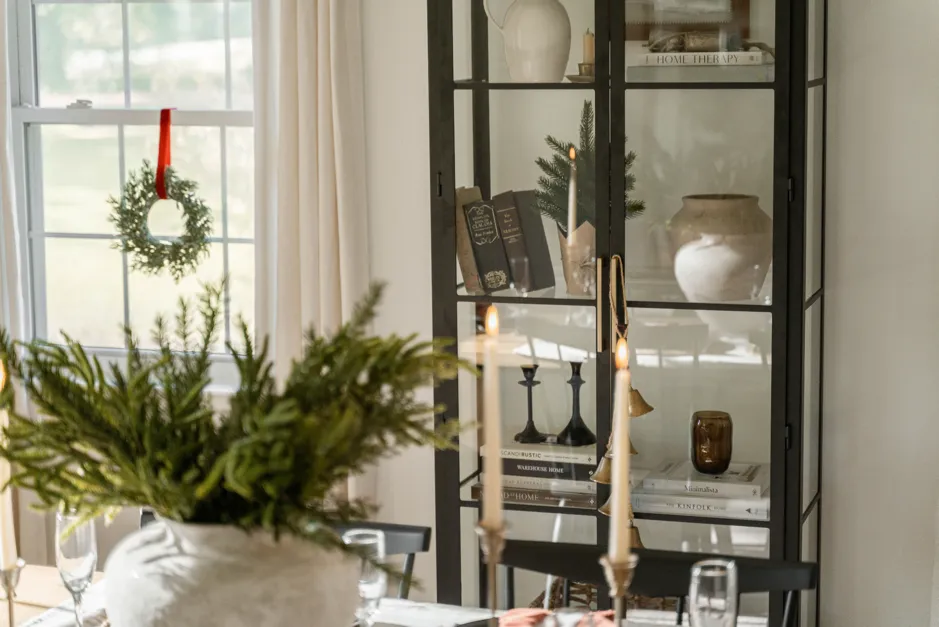
The cabinet here runs about 70 inches tall and 32 inches wide with roughly 11 inches between shelves, which is why the pitcher and stacked books fit comfortably and the evergreen stays small. If your shelves are only 9 inches apart, plan on horizontal stacks and short vessels only. The window wreath is a separate measurement entirely: 12 to 14 inches suits a standard single window, and anything larger starts covering the glass you’d rather see through. For an even quieter wall treatment, compare with Idea #12.
11. Market Stall Energy: Concrete Counters and Hot Pink Trees
- Open metal and wood shelving unit: $150-450
- Concrete-look display table or painted MDF top: $80-400
- Flocked and bottlebrush trees, mixed sizes (10-15): $40-120
- Stacked pillar candles: $25-60
- Wrapped gifts and merchandise to fill it: $60-200
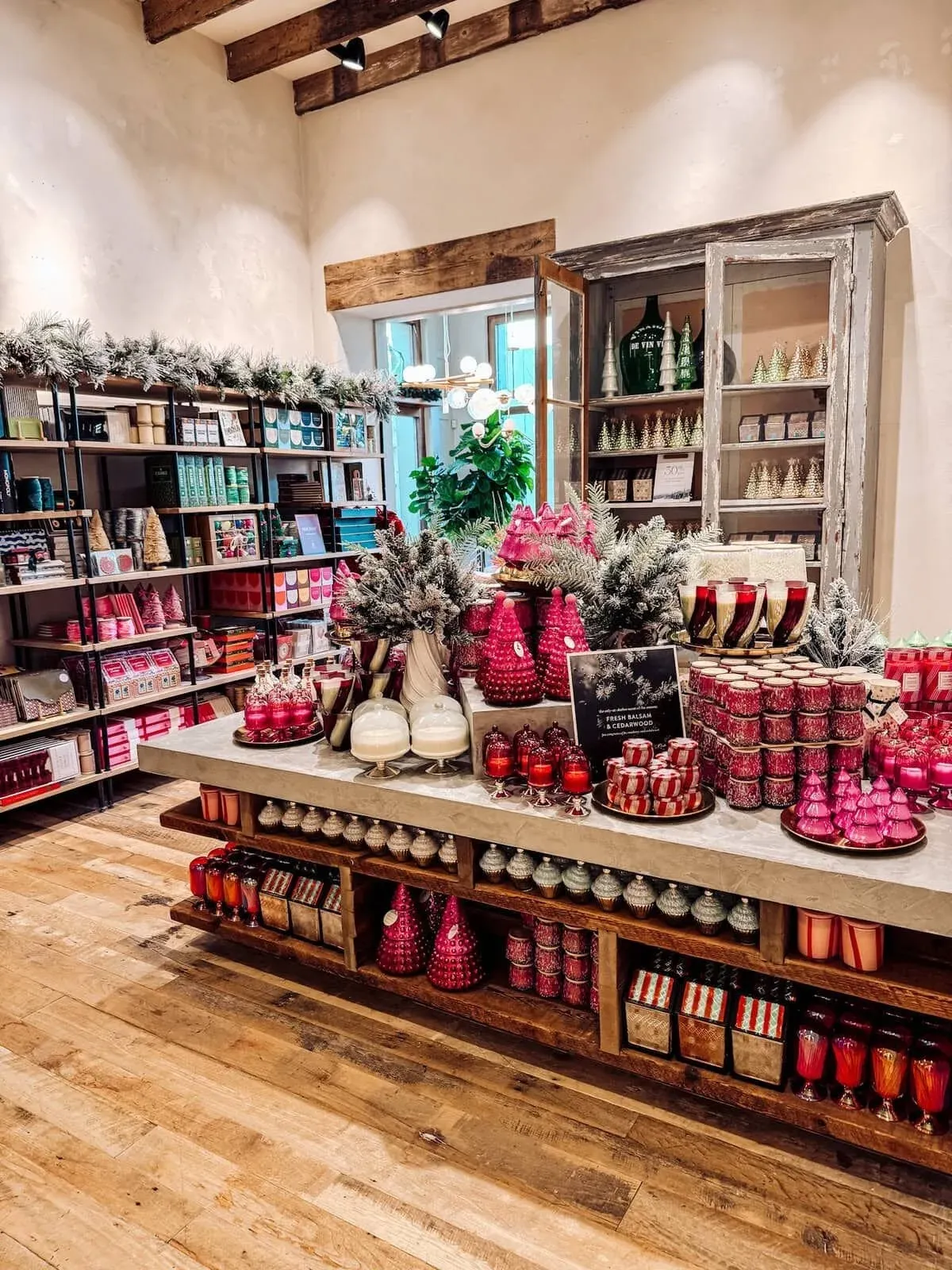
Scale the whole idea down to a single shelf and the same merchandising logic costs about $80: one metal-framed shelf, five trees in mixed heights, three pillar candles in a stack, and a few wrapped boxes you were going to wrap anyway.
This works because it’s merchandised, not decorated. Everything is massed — trees in groups, candles in stacks, pine in bundles — and repetition at volume is what makes a retail floor feel abundant. Vertical mixing matters too: tall shelving on both sides frames a lower central table, so your eye travels up, across, and down instead of stopping. Pink against concrete grey and raw wood is a deliberate clash, and the industrial roughness is what keeps bright color from reading childish. Steal the structure even if pink isn’t your thing.
12. Glass Bottles and Evergreen Sprigs on Bare Wood
Count the objects on this shelf and you’ll find five. That’s the entire formula: roughly 80% empty white wall, 12% natural wood, 5% evergreen green, and 3% brass. The blank wall isn’t wasted space — it’s the main material. When you swap elements, keep those ratios intact: trade the glass bottles for ceramic bud vases and you still have a minimalist shelf. Add a second cluster of objects and the whole thing tips into cluttered. Minimalist holiday styling isn’t about fewer decorations — it’s about protecting the emptiness.
- Cut the evergreen stems on a sharp angle and split the bottom inch so they can drink.
- Fill each glass bottle two-thirds with cool water and add a single drop of bleach to slow bacteria.
- Strip any needles that would sit below the waterline — they rot and cloud the glass fast.
- Arrange three bottles at staggered heights, tallest at the back, at least 3 inches apart.
- Refresh the water every three to four days and re-cut the stems weekly.
Time: 10 minutes. Cost: free if you’re trimming a tree, $8-12 for a grocery store bundle.
For scale, this wants a narrow shelf — 36 to 48 inches wide, 6 to 8 inches deep — with 10 to 12 inches of vertical air between rows. At 8 inches the bottles start crowding the shelf above and the negative space collapses. On walls longer than 60 inches, add a second small cluster rather than stretching this one.
13. Three Little Trees on the Kitchen Counter
Cluster in threes with a clear height ladder: roughly 8, 11, and 14 inches tall, tallest at the back-left so the group reads as one shape rather than three competing ones. Then vary texture, not just height — one frosted faux pine, one yarn or fabric tree, one bare wood or ceramic. Three frosted trees in a row look like you bought a set; three different surfaces look collected. Keep the whole trio inside an 18-inch footprint so you still have working counter, and tuck the light source behind them rather than in front.
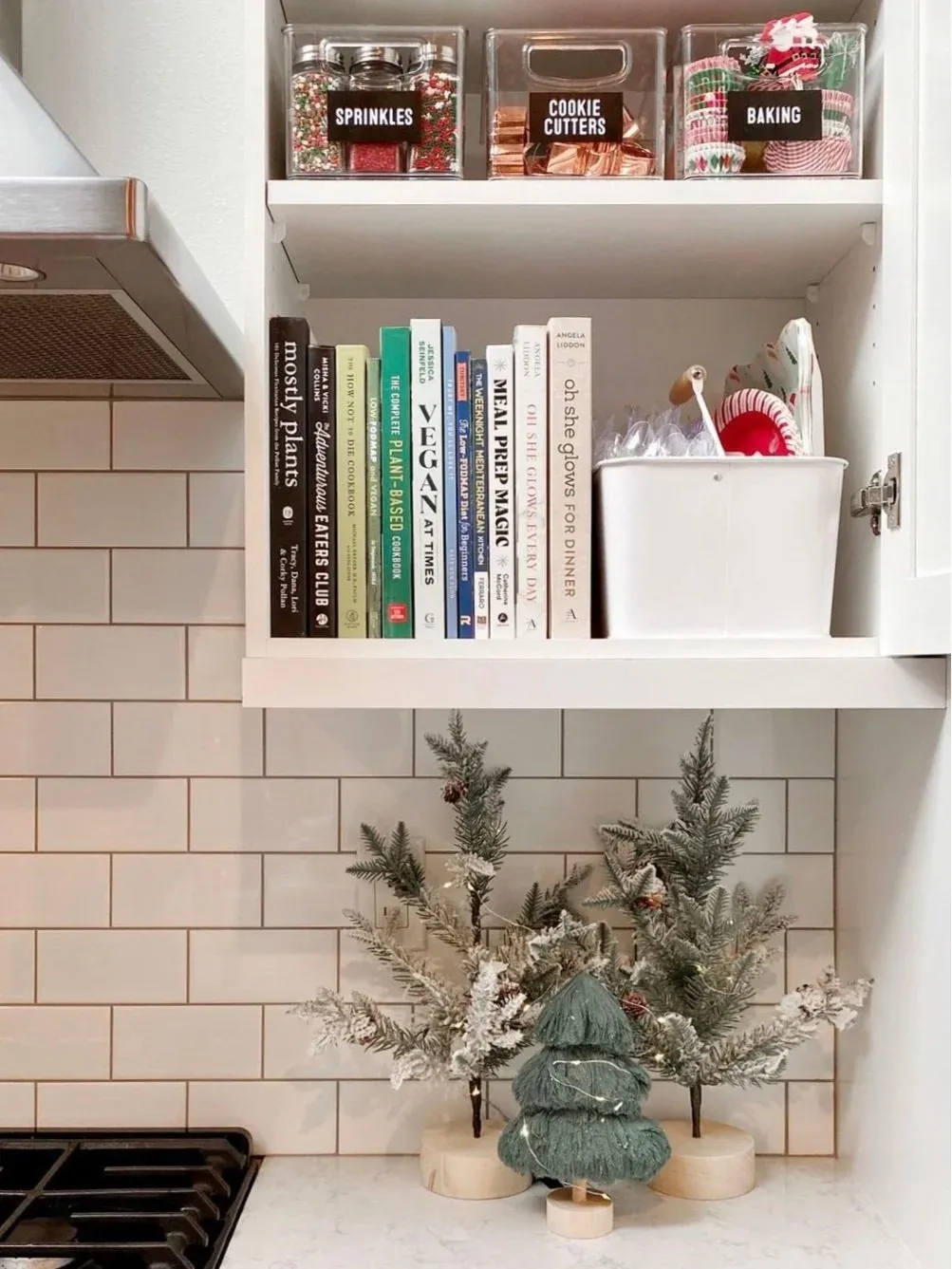
- Measure your counter depth — three trees need at least 14 inches front to back, and a 12-inch counter will feel jammed.
- Find your nearest outlet. Battery fairy lights solve the cord problem, but expect to swap AAAs every three weeks.
- Check the distance to your cooktop. Anything within 24 inches will collect grease, so glass and ceramic only.
- Look at your backsplash in daylight. Warm white tile with silver lights reads grey-blue at night.
- Decide shelf height first — open shelves above the trees need 18 inches of clearance or the display looks squeezed.
14. Red, Gold, and Pearl on a Traditional Mantel
- 7.5-foot artificial tree with warm white lights: $120-350
- Red and gold ball ornaments (about 90 pieces): $45-140
- Pearl garland (2 strands): $18-40
- Faux pine garland with poinsettia accents (9 ft): $35-85
- Two red stockings with holders: $25-70
- Wrapping paper, ribbon, and tags: $20-45
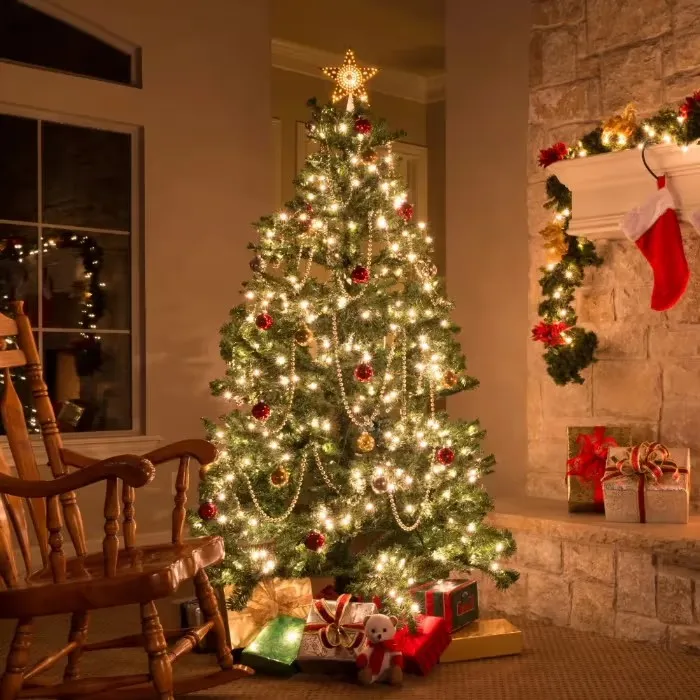
For a similar look at 45% less, a pre-lit 6-foot tree from Walmart runs $79 and Target’s 100-piece shatterproof ornament set is $30. Thrift stores turn up hand-knit red stockings for $4-8 all through November, and they’ll look better than anything new.
This needs at least a 5-foot mantel and 10 inches of shelf depth to handle garland plus ornaments, and the tree wants roughly 36 inches of clear floor width so it doesn’t crowd the hearth. Ceiling height matters less than you’d think — a 7.5-foot tree sits fine under 8-foot ceilings with a foot of air above. If your room is tighter, scroll back to Idea #8, which gets the same traditional feeling on a mantel alone with zero floor footprint.
15. A Dark Shelf Against a Deep Blue Wall
Dark shelf, deep blue wall, red tapers. The reason this reads as intentional instead of gloomy is value contrast: the candles are the brightest thing in a nearly monochrome field, so your eye goes straight to two thin verticals before it registers anything else. The nutcracker and the red fabric trees fill in behind without competing, because they sit lower in contrast. Add the firelight at the bottom of the frame and you have three separate warm pools — shelf, hearth, and the plaid throw — which is what makes a dark corner feel atmospheric rather than heavy.
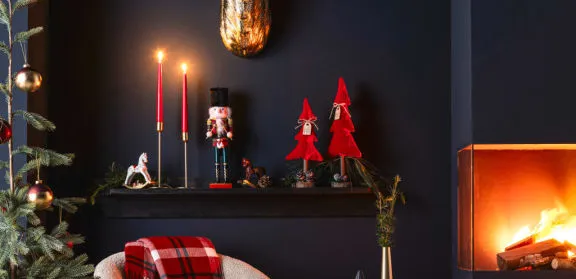
Red taper candles are the cheapest drama in this entire article: about $3 for a pair at IKEA, and they look expensive against a dark wall. Nutcrackers are a thrift-store staple — estate sales in November hand them over for $5-12, and the hand-painted older ones beat anything new. Fabric trees come back to Dollar Tree every year at about $5 a pair. The throw is the splurge; Target’s plaid version runs $25-30 and does the same job as a $120 wool one.
16. Birch Logs, Antlers, and Buffalo Check
Strip this arrangement down and the birch logs are the piece you cannot fake. Faux snow, frosted sprigs, buffalo check, a vintage truck sign — all of it is available at any craft store by September. Real birch, with its peeling white bark and visible knots, is what makes the display feel like it came from a woodshed instead of a seasonal aisle. It’s also doing structural work: the logs raise everything behind them, so the truck sign sits higher than the pine sprigs and the arrangement finally has a foreground, a middle, and a background.
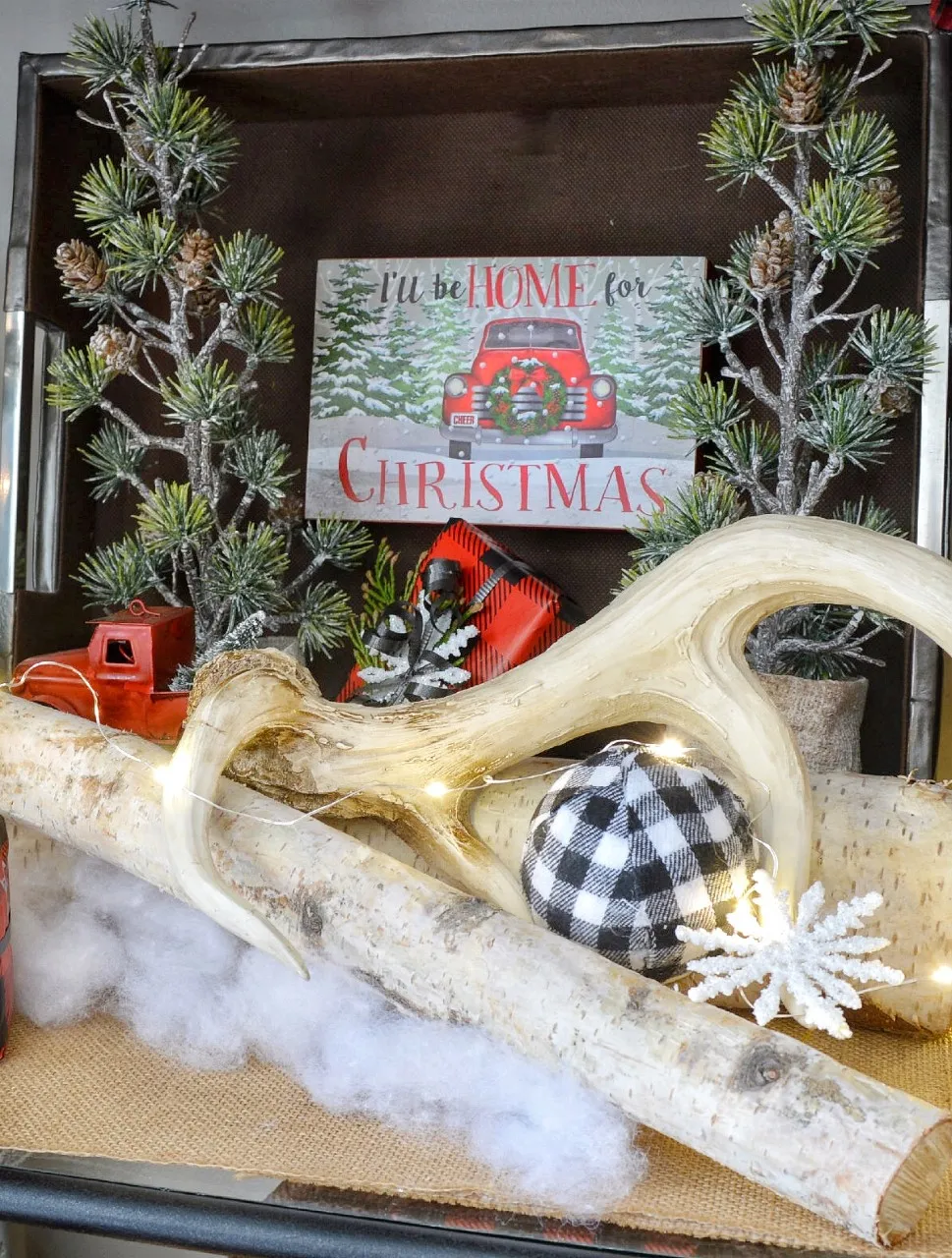
Two things to think through. Antlers plus a dog who counter-surfs equals a chewed, splintered mess — mount them high or skip them entirely. And faux snow is staticky, drifts, and finds its way into every corner; a light dusting looks intentional, a thick layer looks like an accident, and you’ll be vacuuming it off books for weeks. Buffalo check is also the fastest way to make a neutral shelf look busy, so cap it at two check items. Love the rustic feel but have kids or pets? Birch logs and pinecones only.
17. Gold Reindeer, a Mini Tree, and a Ribbed Glass Lantern
This corner arrangement works in very little space: two stacked shelves, roughly 24 to 30 inches wide and 10 inches deep each. The recessed lower shelf gives you about 12 inches of height, which is exactly why the lantern is short and wide rather than tall. If your shelf is closer to 8 inches deep, keep the textured vase under 5 inches in diameter or it will look like it’s about to tip off the edge. Low ceilings are fine here — the whole display tops out around 30 inches, so even in a basement room it never crosses your sightline.
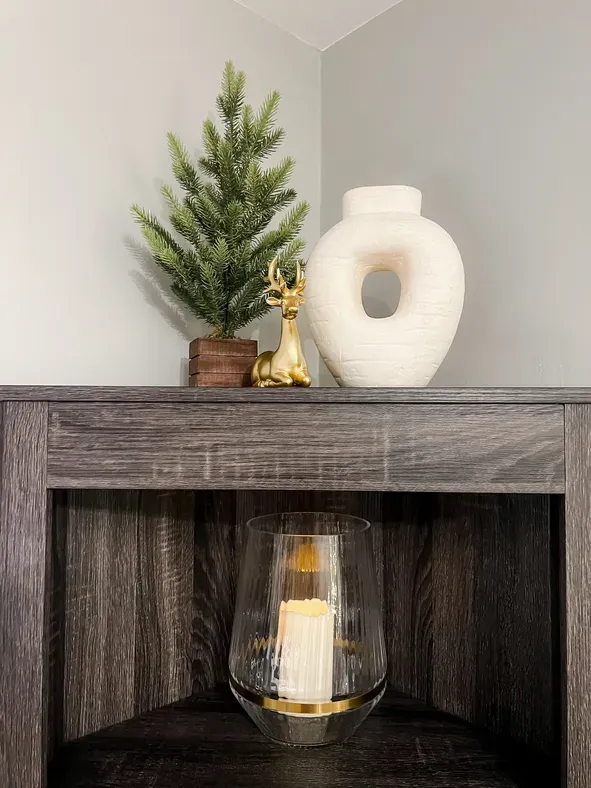
Lantern sizing is where most people go wrong. A 3-inch pillar candle wants a lantern 5 to 7 inches wide and at least 9 inches tall, and you need 12 inches of clearance above the lantern before the next shelf. Any tighter and the flame flicker bounces off the shelf above, reading as a fire hazard rather than ambience. For shelf displays, use a battery pillar with a 3D wick — the current $10 ones flicker irregularly and genuinely pass at three feet. Set it on a coaster so the wax ring never stains the wood.
18. Flocked Tree, Blue Ribbon, and Patterned Ottomans
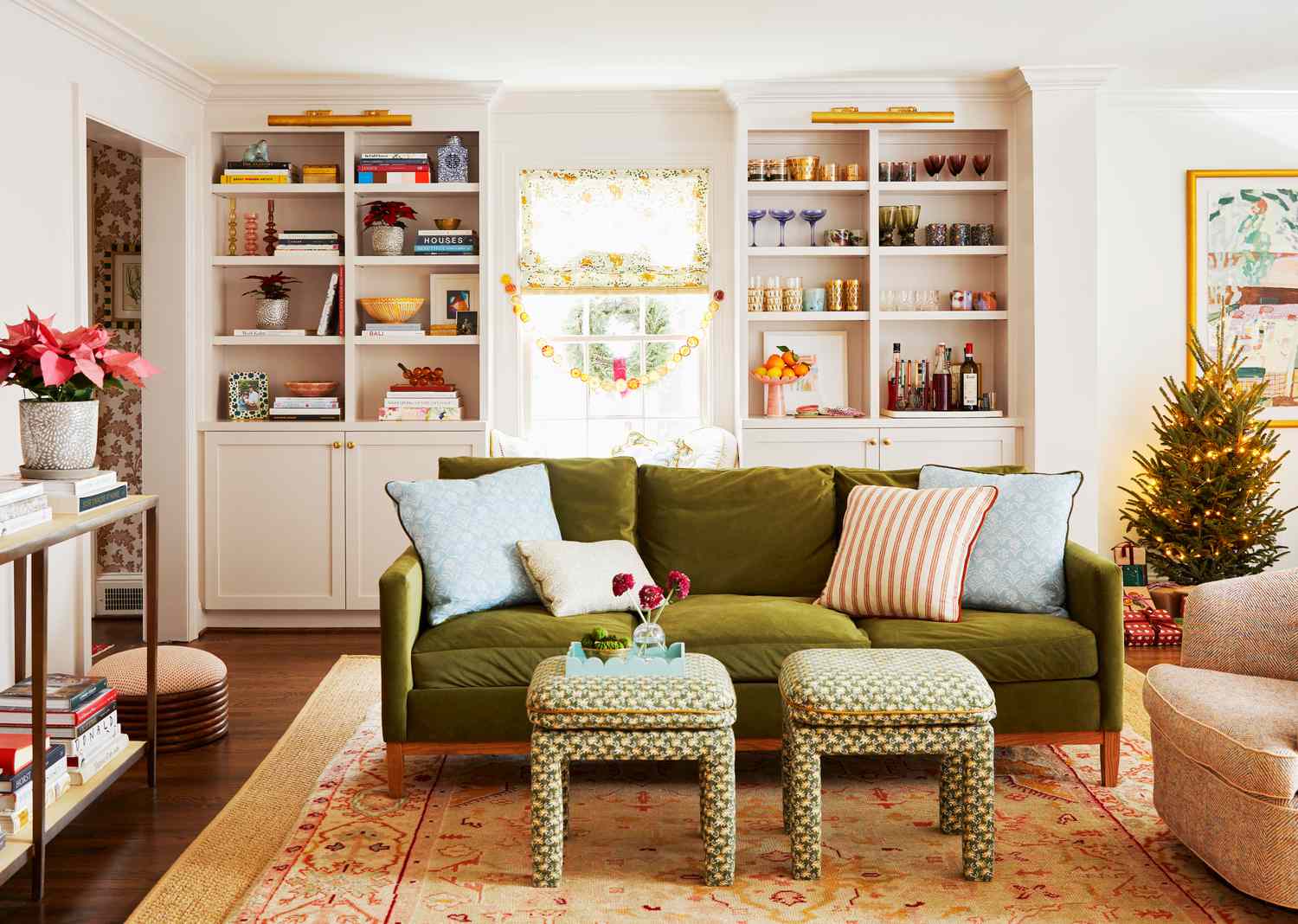
The formula is 60% off-white, 25% blue across two values, 10% gold, and 5% green. Notice that the blue is split — pale blue on the ottomans and ribbon, near-navy in the rug pattern — which keeps the palette from feeling flat while technically staying ‘blue and white.’ Swap the navy for charcoal and you get a moodier, more masculine version of the same room. Swap the pale blue for blush and the gold for rose gold and it turns soft and feminine. The 60% neutral base is the part you never touch.
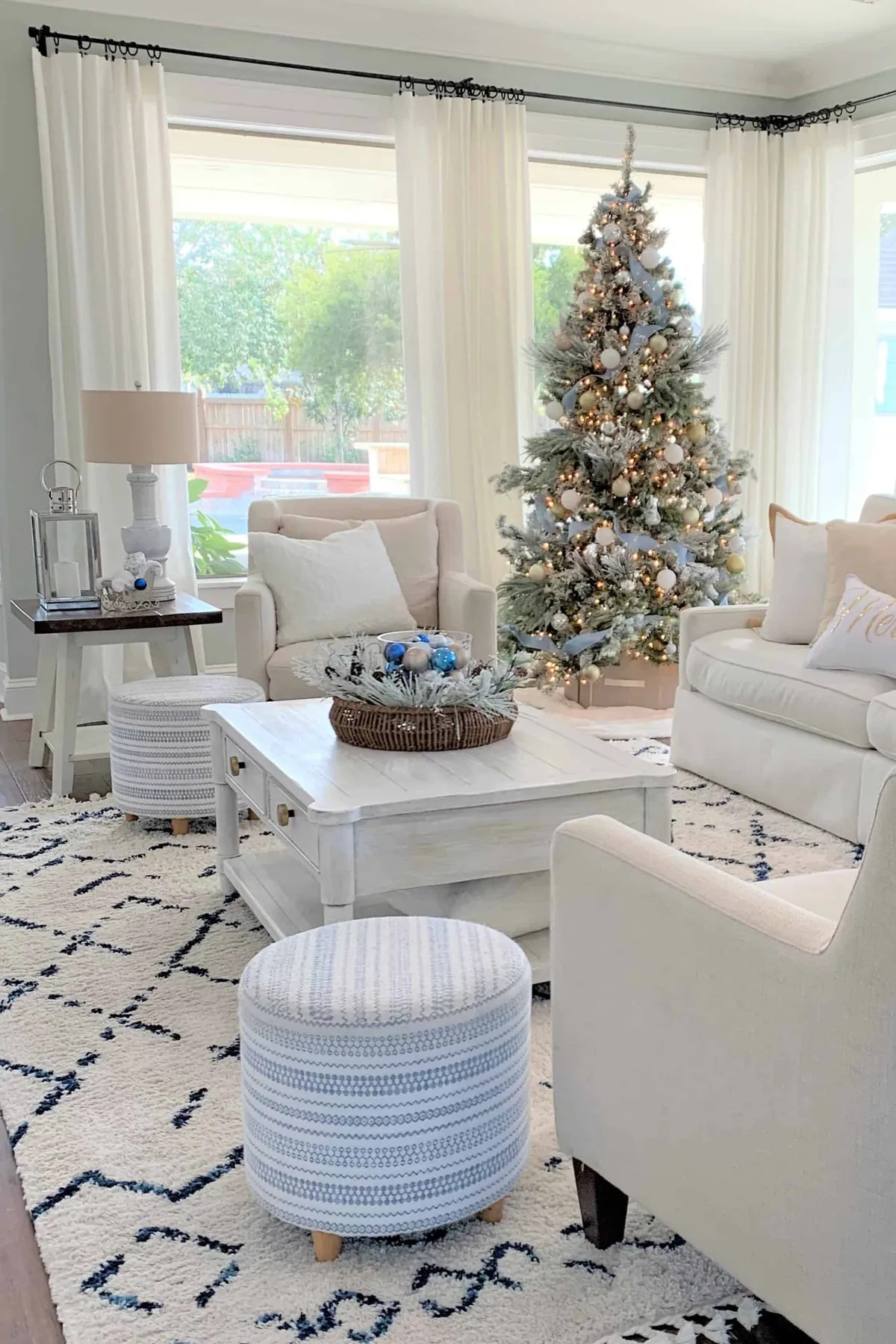
Flocked trees shed. Every time you walk past, a little snow drifts onto the rug, and by December 26th there’s a visible halo around the base. Vacuum with a brush attachment and never a beater bar, and don’t store the tree in a hot attic — heat makes flocking go tacky and yellow. Off-white upholstery with a light rug and a dark abstract pattern is actually the smart call here, because the navy breaks up any snow that lands on it. The blue-and-white patterned ottomans, though, will show every speck of dust. Budget on a lint roller from Thanksgiving to New Year’s.
19. A Miniature Village on a Single Floating Shelf
- Lay a 24-inch strip of artificial snow along the shelf, feathering the edges instead of making a straight line.
- Set the two tallest houses at the back on small risers — a couple of stacked coasters is plenty — so every roofline stays visible.
- Thread the LED string along the snow itself rather than behind the houses, so the glow comes from the ground plane.
- Tuck green bottlebrush trees between the houses at alternating left and right positions to build rhythm.
- Finish with the reindeer at one end, angled slightly inward, then step back three feet and check that no two objects share a height.
Time: about 45 minutes. Materials: $40-60.
- Light wood floating shelf (24 in): $20-45
- Bag of artificial snow: $6-14
- White miniature houses (4-6): $12-40
- Green bottlebrush trees (5-8): $8-20
- White reindeer figurine: $8-25
- Warm white LED string lights: $8-18
Cut that to about $35 by swapping the new shelf for a Marketplace find and buying the houses at the dollar store, where plain white ceramic ones come in three sizes for $1.25 each.
20. Ceramic Houses Under Glass Cloches
The glass cloches are the detail that turns a nice village into a display. Without them, ceramic houses under a string of LED lights look like a craft fair table. Under glass, each house becomes an exhibit — the cloche makes you lean in, and the reflection of the warm lights on that curve doubles the glow for free. If you buy only one thing from this idea, buy a single cloche and put your favorite house inside it with a bottlebrush tree. That’s the whole trick, and it costs under $15.
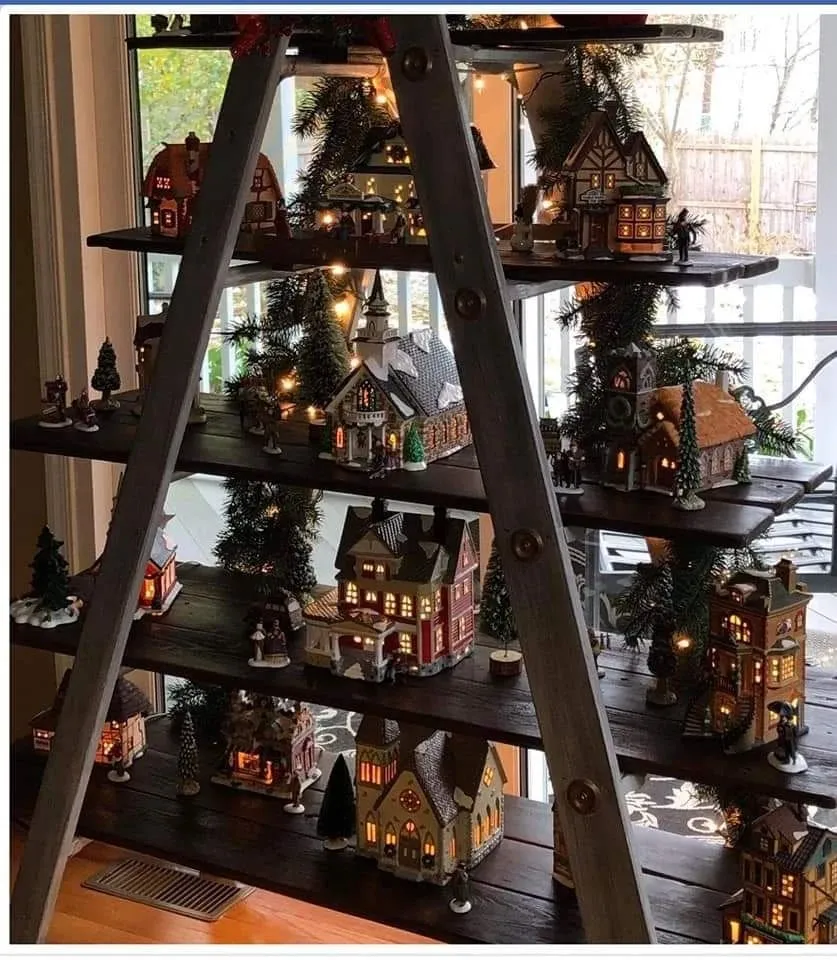
Three principles hold this together. First, scale variation — the houses run from about 3 to 8 inches tall, so the eye has a hierarchy instead of a flat row. Second, mixed light sources: a mini LED tree, a flameless pillar, and ambient room light create three different warmth levels, which is why the shelf never looks flat. Third, real color restraint — white ceramic, tan accents, dark green trees, and nothing else. The fluted shelf edge even echoes the bottlebrush trunks with its own vertical rhythm.
Break it down as 55% white ceramic, 25% light brown and tan, 15% dark green, 5% clear glass. The whites are the base — houses, shelf, cloche interiors — and the brown houses are what stop it from looking sterile. Swap the dark green trees for deep red and the identical arrangement becomes a traditional Christmas shelf. Push brown up to 35% and you’re in warm vintage Scandinavian territory. Proportions matter more than the specific colors.
21. Pussy Willow, Holly, and a Children’s Book
Every shelf grouping needs one living element, and it doesn’t have to cost much. A $6 bundle of pussy willow from the grocery store, cut on an angle and set in a glass vase, lasts three to four weeks if you change the water every third day and re-cut the stems weekly. Trim any buds that would sit below the waterline — they rot and smell. The rule of thumb: one real botanical per grouping, placed where it can actually be touched. Real holly is gorgeous but the berries are toxic to cats and dogs, so keep it at the back of the shelf or go faux.
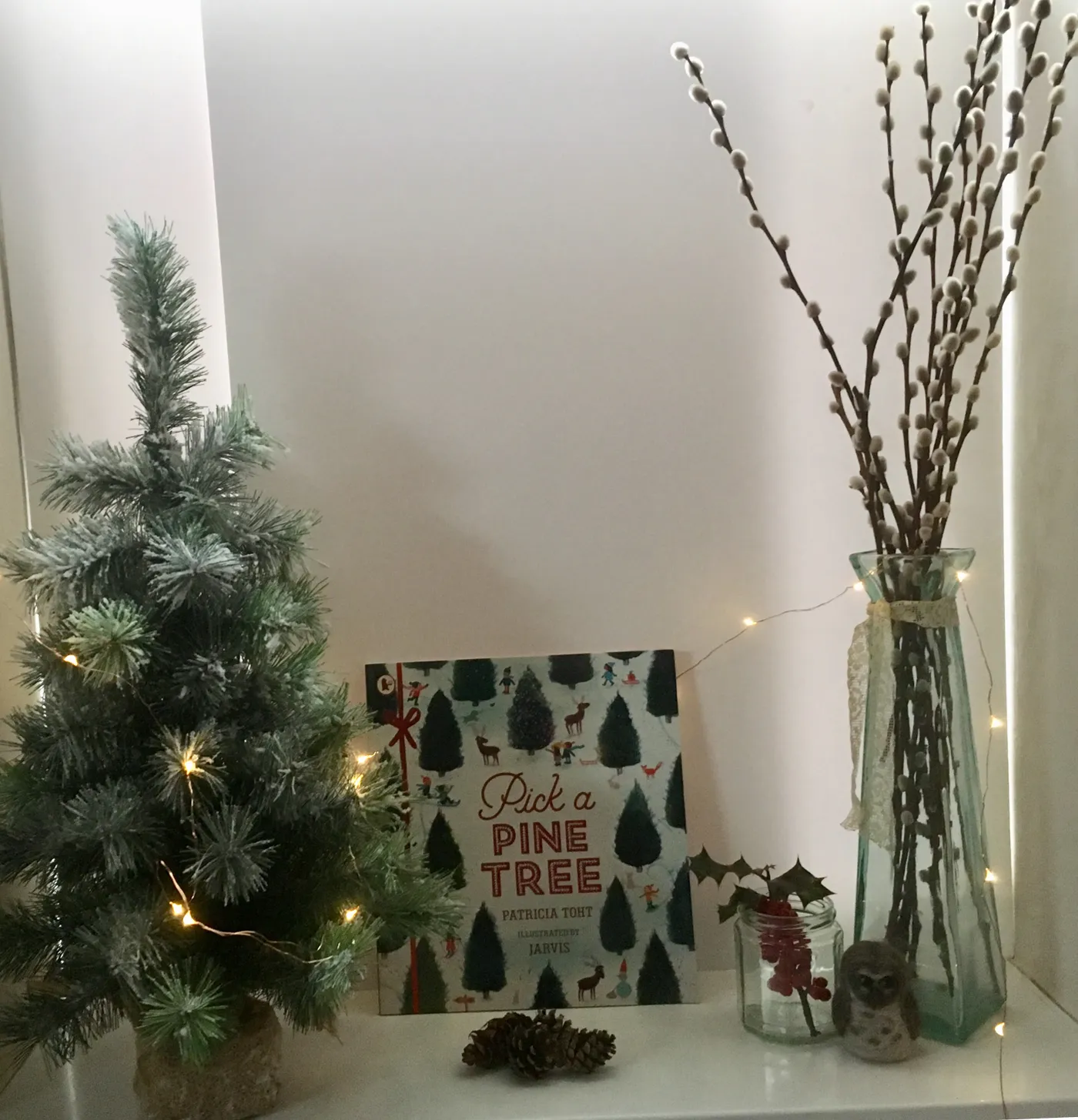
Two trends are pushing this look into 2026. ‘Bookshelf wealth’ — the styling approach where shelves look collected over years rather than merchandised — is still the dominant shelf aesthetic on Pinterest, and its holiday cousin is the foraged shelf: pinecones you found, a branch you trimmed, a book your kid actually reads. The other is the retreat from plastic maximalism, with buyers shifting toward natural materials and fewer, better objects. Which is why frosted bottles, willow, and wood tones are outpacing glitter this season. It’ll age well — these are pieces you’ll still use in 2035.
22. A Retro Elf, a Lantern, and a Snowdrift
Vintage elf figurines have gotten expensive — a good knee-hugger can run $150 online. Skip that market and hunt estate sales and church rummage sales in early November, where they turn up in boxes for $5-20 because the seller doesn’t know what they have. Dollar Tree faux snow is $1.25 a bag and indistinguishable from the craft store version once it’s spread out. The small brown lantern is the one piece worth buying new; IKEA’s runs about $15 and actually lights up. Whole scene for under $40 if you’re patient.
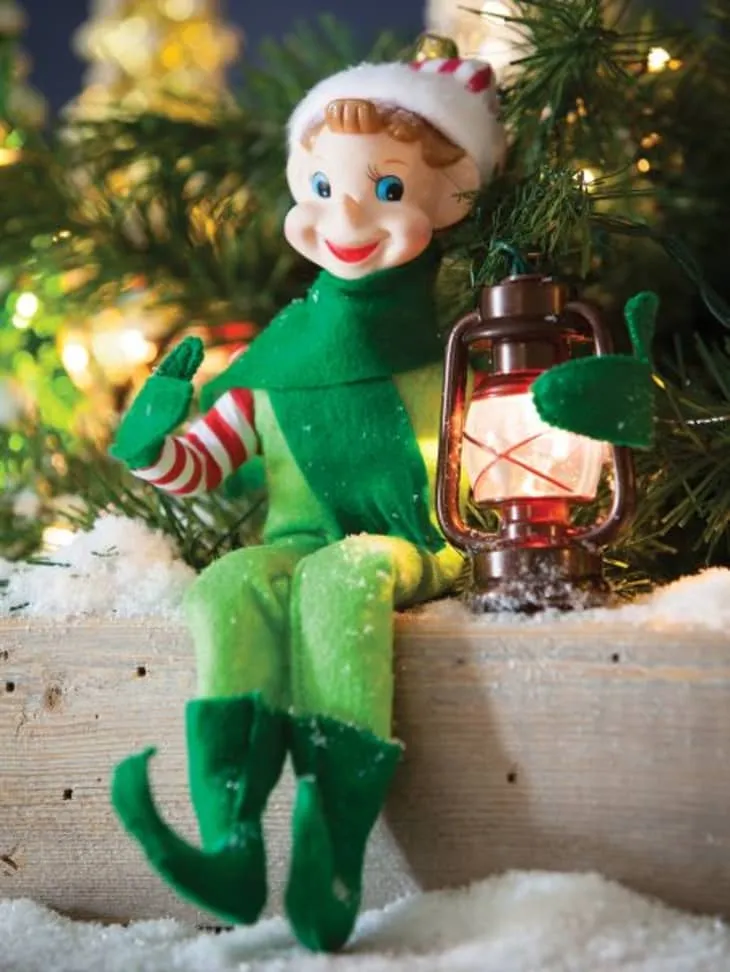
Two practical notes. Faux snow gets everywhere — it clings to fabric through static, and one bag spreads further than you expect, so use about a third and save the rest for touch-ups. And if you’re buying vintage figurines, check the paint. Pieces made before 1978 can contain lead in the finish, which matters if a toddler is going to chew on the elf. Wipe dusty vintage pieces with a barely damp cloth before they go on the shelf, and put the genuinely old ones up high where nobody’s handling them.
23. Red, Green, and Uncluttered: A Minimalist White Shelf
Sixty percent white, twenty-five percent red, fifteen percent green. That’s it — and the white is the part people underestimate. On a minimalist shelf the white isn’t background, it’s the main material, and it’s why one red candle in a clear hurricane reads as a statement instead of a shrug. Swap red for cobalt and green for silver and the exact same formula gives you a frosty, modern shelf. Swap red for burnt orange and green for mustard and you land in warm vintage territory. Keep the white at 60% and the formula holds no matter what else you swap.
- Measure usable shelf depth before buying the hurricane — a 4-inch candle plus glass needs 6 inches minimum.
- Check whether your wall reads warm or cool white in daylight; cool white walls make forest green look grey.
- Decide now if the small tree stays unlit. If you want lights, plan the cord route before you style anything.
- Wrap gift boxes empty with a folded paper insert, and stagger sizes by at least 2 inches.
- Set a total budget before you shop. Minimalist displays fail when they get over-decorated across three separate shopping trips.
24. An Elf in a Tiny Snowy Forest
- Cover the entire surface with about an inch of artificial snow, pushing it into the back corners so the depth reads real.
- Build a small mound under each tree so the trunk appears buried rather than sitting on top of the snow.
- Place the tallest bottlebrush trees in the back corners and shorter ones toward the center-front to create a clearing.
- Tuck red berry clusters into the snow at the base of two or three trees — never all of them.
- Set the elf in the clearing, angled three-quarters toward the viewer, with the tiny wooden crates just off-center beside it.
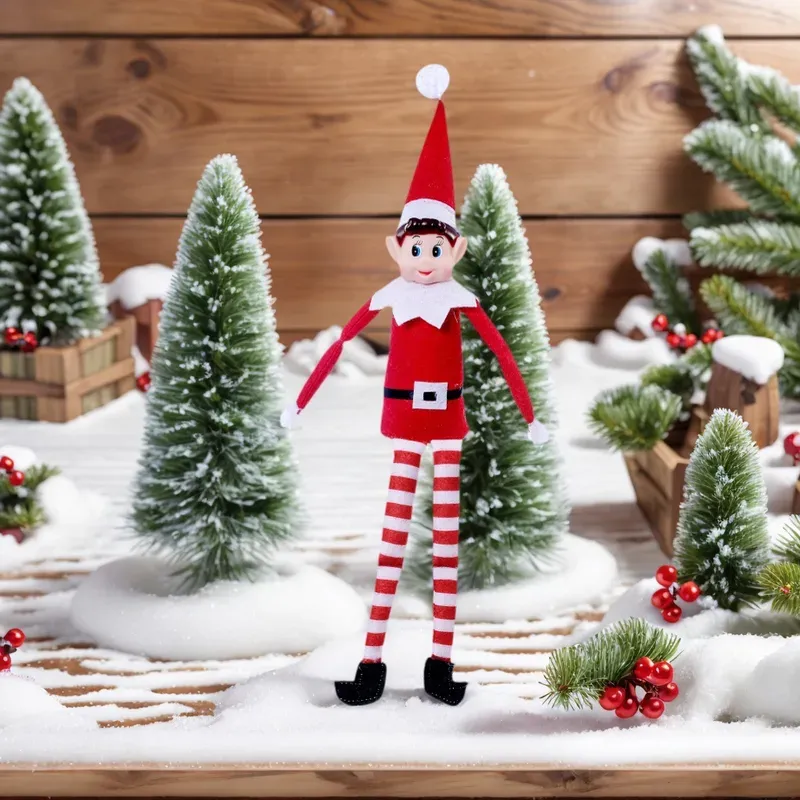
Time: 30 minutes. Materials: $25-40.
Scale consistency is the invisible element here, and it’s why this display works when similar ones flop. Every object — the elf, the bottlebrush trees, the crates, the berries — sits within roughly the same miniature scale, so the shelf reads as a tiny world instead of a collection of small things. The moment you add one full-size ornament, the illusion dies. Before you set anything down, ask whether a person living in that elf’s world could hold it. If the answer is no, it belongs on a different shelf.
25. Nativity, Eucalyptus, and Mercury Glass on Dark Wood
Style the mantel in three depths, not one row. Put the tallest pieces — the lantern, the eucalyptus — on 4-inch risers at the back, the mid-height items like the metal star a few inches forward, and the nativity scene in the front third where it’s visible from the sofa. Aim for roughly 60% of your visual volume at the back, 30% in the middle, and 10% at the front edge. If everything sits on the same plane, no amount of pretty objects will save it. Risers can be books, boxes, or stacked coasters — anything that lifts without showing.
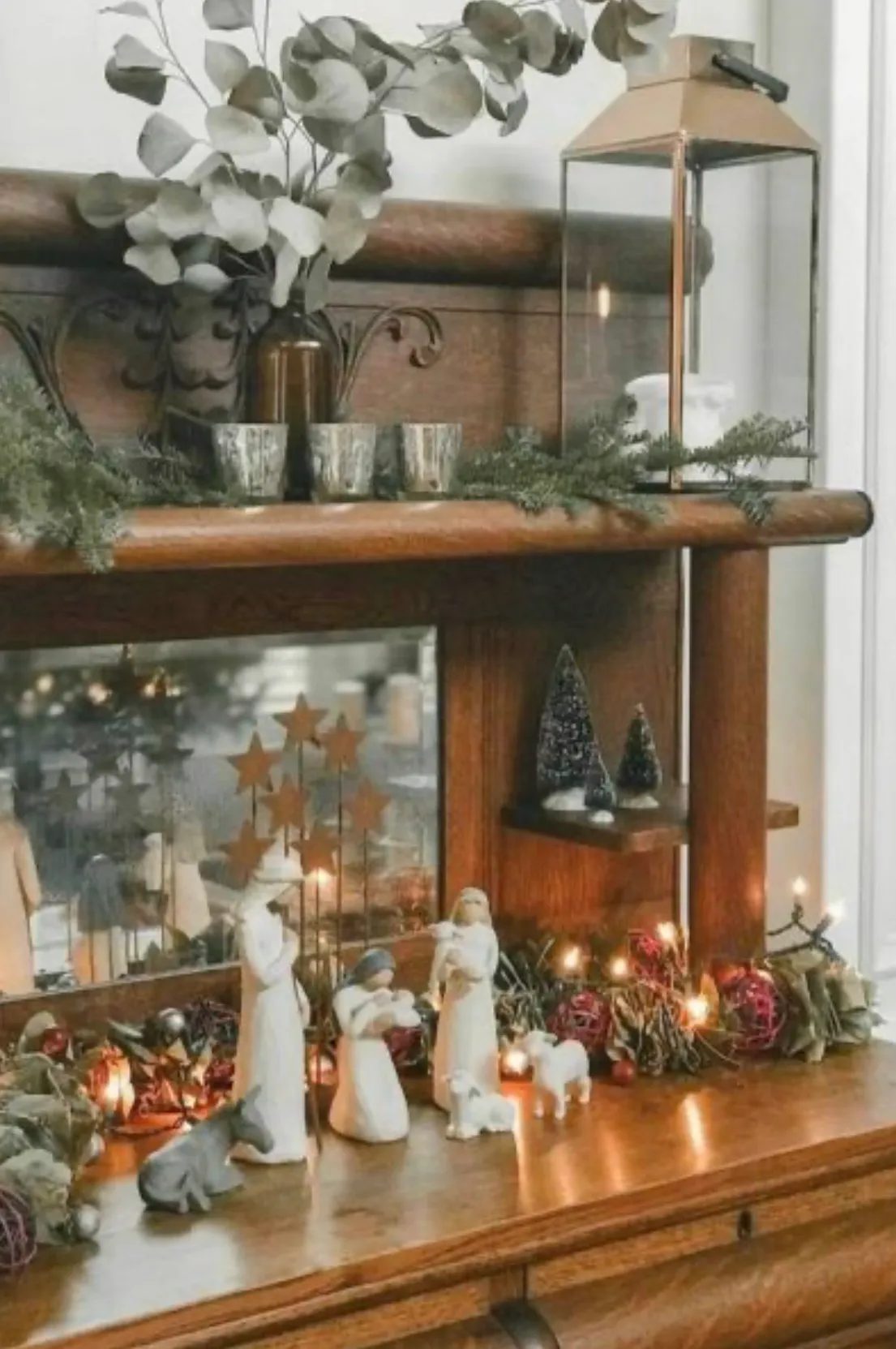
Mercury glass is the fussiest material in this entire article. It’s glass with a silvered finish inside, so it should never be submerged — wipe with a dry or barely damp cloth only, and expect fingerprints to show under warm light. Votive holders get waxy fast; freeze them for 20 minutes and old wax pops out in one piece. Eucalyptus dries brittle within two weeks and drops leaves the moment you brush it, so handle it once and leave it alone. And nativity figurines are almost always resin or plaster — chip-prone, and the small pieces vanish instantly if they’re at toddler height.
26. A Centerpiece Built From Pine, Berries, and Baubles
- White woven container with pom-pom trim: $18-45
- Faux pine branch bundle: $12-30
- Red and blue berry sprays (6-8): $15-36
- Frosted pinecones: $8-18
- Glitter star and silver baubles: $10-24
- Floral foam, moss, and wire: $8-15
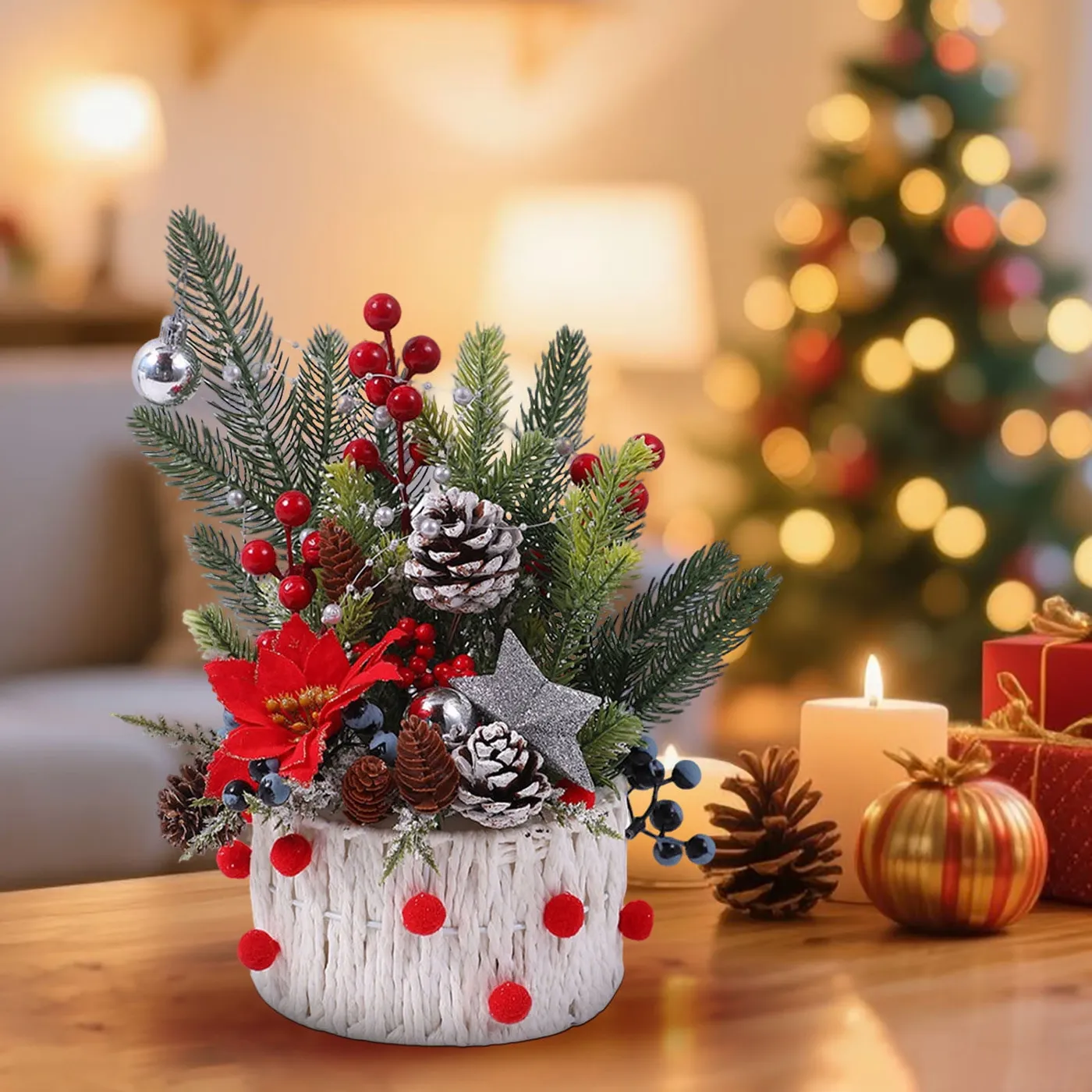
The cheapest version is also the best one: a thrifted basket for $6, greenery trimmed off your own tree for free, and berries from the dollar store at $1.25 a stem. That’s about $25, and it looks nearly identical from across the table.
Now the part that makes it read as designed. Odd numbers first — berries and pinecones cluster in threes and fives, which the eye reads as natural rather than arranged. Second, the container sets the tone: a white woven basket with red pom-pom trim says ‘casual holiday table’ before you’ve added a single stem, so glossy baubles feel playful instead of formal. Third, mixing berry colors — red and blue together — keeps the greenery from turning into a solid green mass.
- Cut floral foam to fit the container, soak it fully, and set it a half inch below the rim.
- Cover the foam with moss, pressing firmly. No foam should ever be visible.
- Insert evergreen branches around the outer edge first, angled outward and slightly down to build a skirt.
- Fill the center with berry sprays and frosted pinecones, keeping the highest point just off-center.
- Push the silver baubles and star into the gaps last. If you can still see foam, add more moss.
Time: 20 minutes. Materials: about $18 if you already own the container.
27. A Toy Truck, a Snowman, and Clear Bulb Lights
Those clear bulb string lights with a tiny tree inside are adorable and slightly impractical. The filament is delicate, the bulbs are usually not replaceable, and the whole strand is done if two go out. They also throw almost no light, so don’t count on them as your only source on a shelf. Buy two strands if you find them and store the spare. And consider heat: bulbs left on for six hours get warm against dry bottlebrush trees, so switch them off at bedtime rather than letting them run overnight.
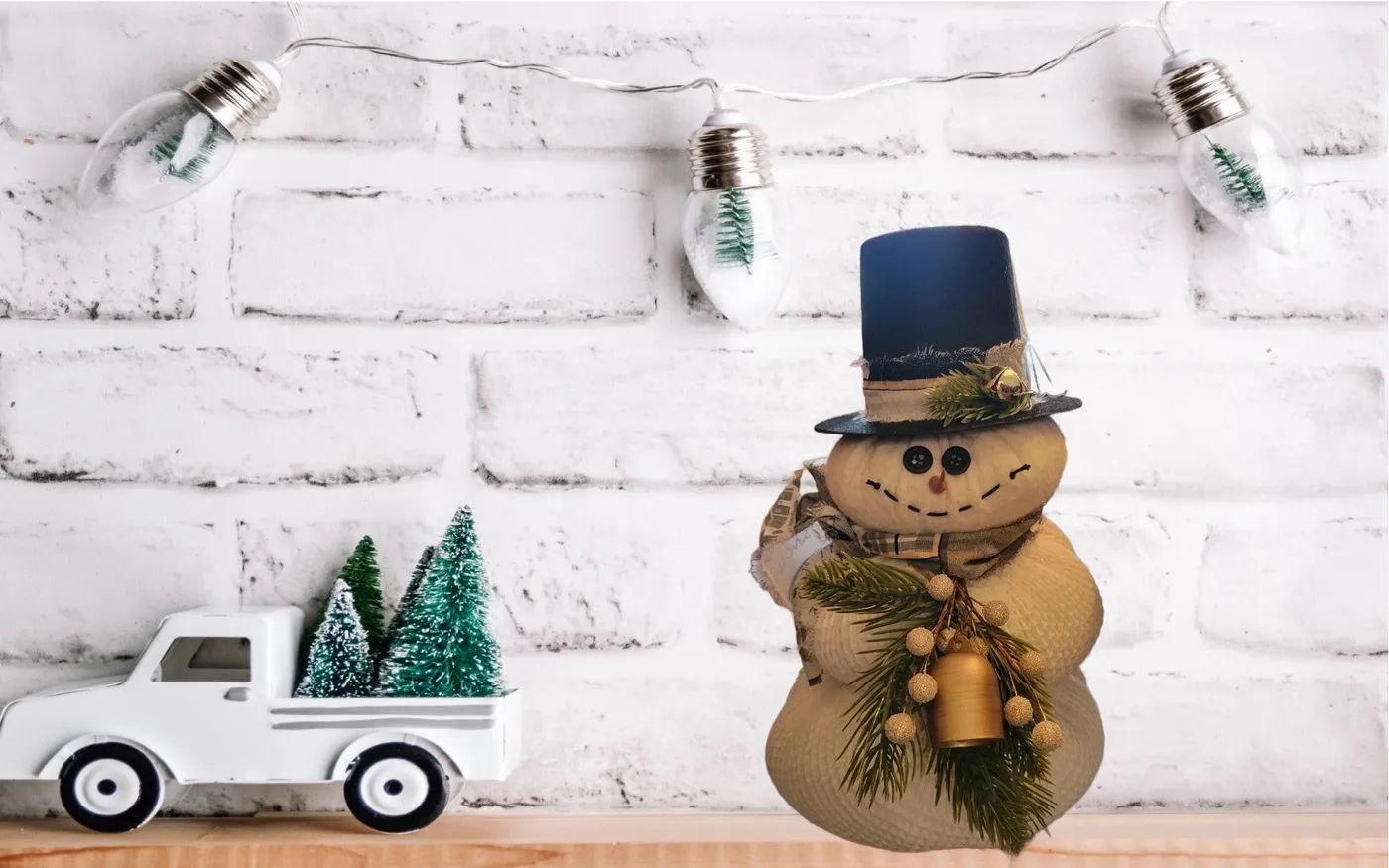
This is a two-shelf display, roughly 30 inches wide by 10 inches deep, and it needs a white or very light background to pop — against dark paint the snowman disappears entirely. The truck and snowman together want about 20 inches of run, leaving 10 inches of breathing room at the end. On a shelf under 24 inches, choose one — the truck or the snowman, not both. If your shelf sits above a radiator or an air vent, skip the snow-dusted elements. And for a living room with built-ins more than 6 feet long, see Idea #31 for a mantel-scale version of the same cozy, whimsical mood.
28. An Elf Sitting on Books With Bottlebrush Trees
Bottlebrush trees are the most markup-inflated holiday item out there. Dollar Tree sells them three for $1.25, and once they’re mixed with nicer pieces nobody can tell the difference. Thrift stores hand over elf dolls for $2-5 year-round — shop in October, not December. For the book risers, use paperbacks you already own or grab a $3 stack from a library sale; the spines matter far more than the titles. Total for this shelf: under $20, or about $30 if you splurge on a nicer elf.
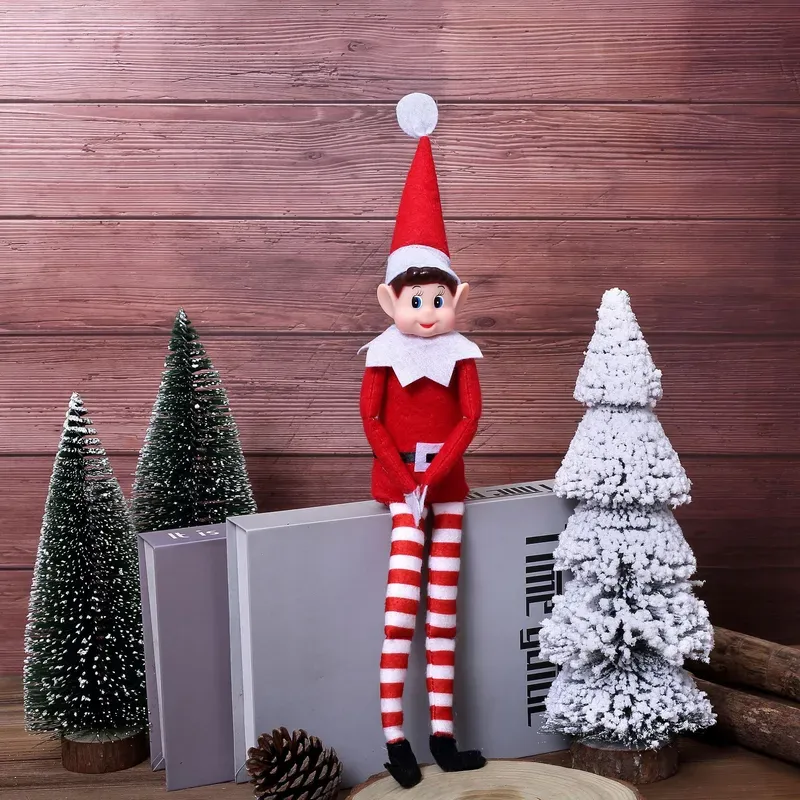
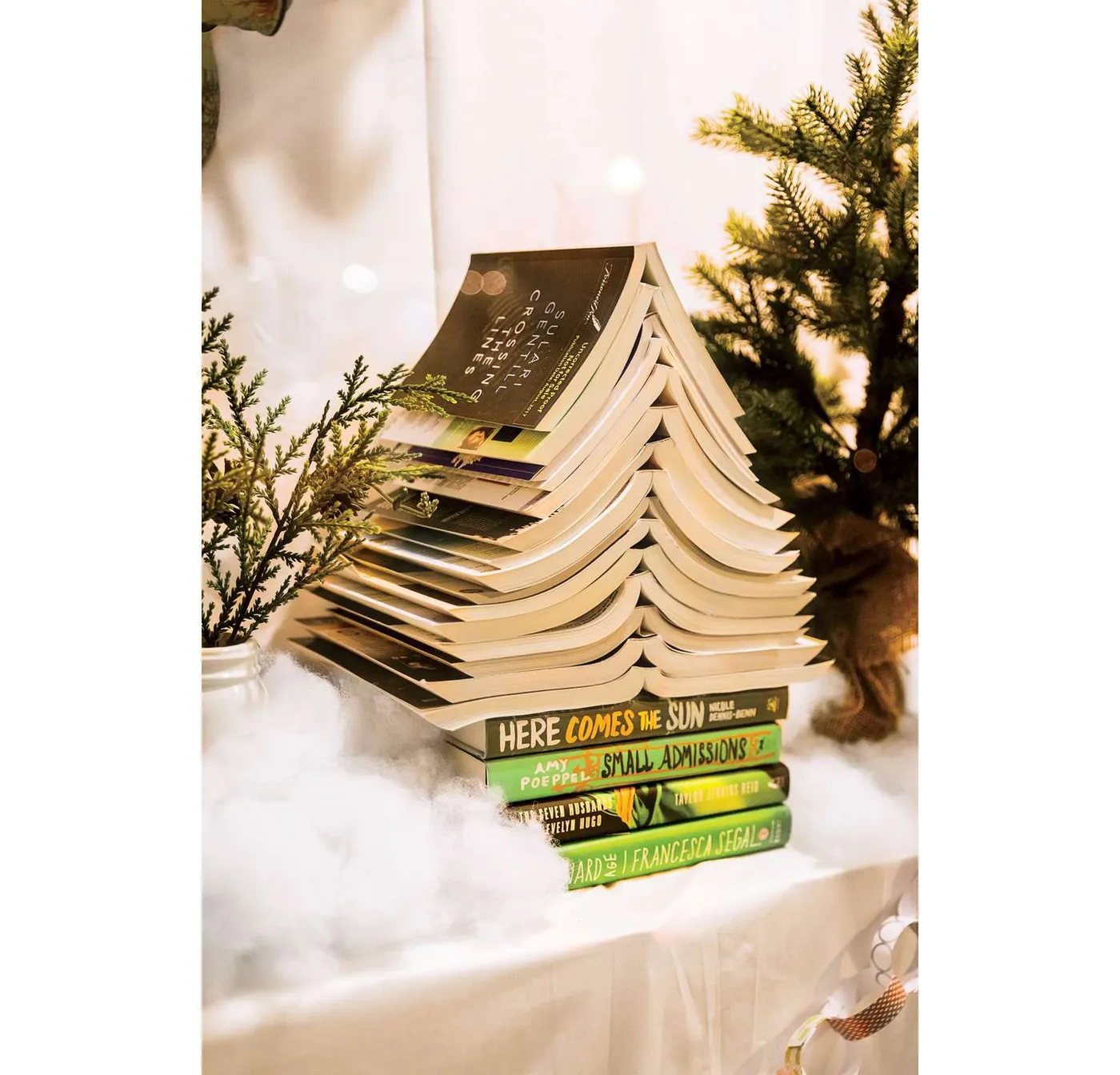
Stacked books are the cheapest riser in decorating, and there’s a right way to do it. Use three books staggered so each is offset by about an inch — a perfectly squared stack reads like a brick. Alternate spine direction: two spines out, one spine in. Match the stack to your shelf rather than the season, so greys, whites, and faded browns disappear into the background and the elf and trees stay the focal point. And keep stacks under 6 inches tall, or whatever sits on top will hit the shelf above.
29. Red Ball Garland and Green Paper Trees on White Built-Ins
White built-ins are basically a light box. They bounce tree lights around the room, which is why that red bead garland reads so vividly — deep red against bright white is close to maximum contrast without going harsh. The garland is also draped rather than strung straight, so it creates a repeating arc that pulls your eye across the entire unit instead of stopping at one shelf. The small green paper trees sit lower on the visual weight scale, so they fill space without fighting the star of the show, and the nutcracker and gnome add just enough character to keep it from feeling staged.
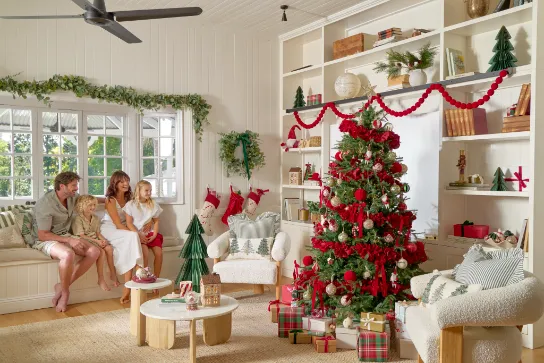
The red ball garland is the throughline. Take it away and you have a nice white bookcase with some Christmas pieces on it; the garland is what makes the shelves feel connected to the tree standing beside them. The trick is that it’s beaded, not greenery — beads hold a clean, graphic curve, where a pine garland sags and goes fuzzy at the ends. Buy two strands and drape them at different heights across different sections. It costs about $15 and it changes the entire wall.
30. White Ceramics, Potted Plants, and Fairy Lights
Live plants on a wall-mounted shelf are a slow-motion mess. Water drips down the wall, saucers ring the shelf, and one overwatering session leaves a stain you can’t sand out of painted wood. Either use small faux plants, or take the real one down to the sink every time it needs a drink. Battery fairy lights are the other recurring cost — a cheap strand eats three AAAs every three weeks, and rechargeable AAs pay for themselves in a single season. Ceramic houses chip on the corners the first time you dust them aggressively, so use a soft brush, not a cloth.
- Find the studs first. A narrow wall shelf holding ceramics should hit at least two studs, or use toggle anchors rated for 50 pounds.
- Mark the height around 60 inches from the floor — that’s eye level while standing, where small objects read best.
- Mount the bracket, then check level twice with a real level, not a phone app.
- Run the fairy lights along the back edge before anything goes on the shelf, and clip them rather than taping.
- Style from the back forward, leaving about a third of the shelf empty at one end so the display breathes.
Time: 40 minutes. Materials: $25-45.
31. Two Snowmen and Garland on a Stone Mantel
- Measure the mantel depth and make sure the garland won’t block your stockings or sit over a heat source.
- Test your garland lights before hanging — untangling once it’s on the mantel is a job you don’t want.
- Confirm the stone or brick takes adhesive clips. On rough surfaces, use small nails or clear fishing line over the mantel edge instead.
- Decide where the snowmen live before you buy the furry mat — its width determines the entire arrangement.
- Check clearance above the firebox. Anything directly over a working fire needs to sit at least 12 inches back from the opening.
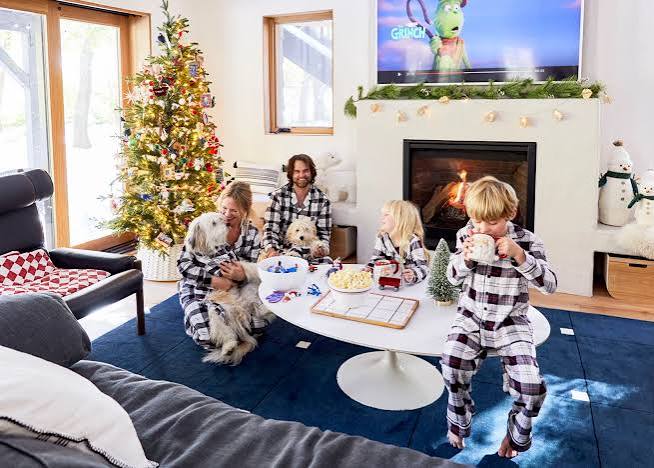
Snowmen are having a moment. After several years of austere holiday decor, the 2026 season is swinging toward whimsy — figurines, vintage characters, and displays that make people smile rather than impress them. A white snowman with a green scarf on a furry mat is exactly that: low-stakes, nostalgic, and nearly impossible to style wrong. It’s also the most kid-friendly approach in this whole collection, which matters in households where the tree gets redecorated by a four-year-old. And this trend has legs — nostalgia always comes back around.
Now Go Style the Shelf You Walk Past Fifty Times a Day
You don’t need a matching set or a big budget — you need one shelf that makes you smile every time you pass it, and you now have thirty-one blueprints for exactly that. Start with the spot you see most, borrow a single idea, and let the rest of the house catch up next year. 📌 Pin this guide to your Christmas boards so it’s waiting for you in November.