You know that feeling when you’ve pinned forty holiday buffet tables and none of them look like your actual dining room? Same. The gap between the styled photo and the real thing usually comes down to three or four decisions — what’s on the table, how high it stacks, and where the light comes from. We sorted through hundreds of images across Pinterest, home decor blogs, and real-hosted-home features to land on 31 holiday buffet table ideas that hold up when there’s a turkey, twelve guests, and a kid with a gravy spoon nearby.
You’ll find traditional red-and-green nostalgia next to navy-and-scalloped playfulness, rustic wood tables loaded with charcuterie, and a few black-tablecloth moments that feel genuinely luxurious. Plenty of these are shoppable with direct product links, and several pair a splurge version side by side with a budget version. And stay until the end — we break down the most common mistakes that can ruin these looks.
What’s driving all of this in 2026 is the shift toward tables that look collected rather than coordinated: mismatched vintage plates, real greenery over faux garlands, and candles at eye level instead of overhead. 📌 Save this to Pinterest for later — you’ll want to revisit these ideas.
1. Marble and Gold Buffet Loaded Like a Still Life
What makes this table read as opulent rather than cluttered is a simple rule: the serving pieces disappear into the palette. White and gold platters, a white marble top, a polished gold metal base — everything sits inside one narrow color story, so a roasted turkey, three salads, and a tower of desserts all register as one composition. Deep green foliage and silver mercury votives are the only interruptions, and they’re deliberate. If you swapped in colorful ceramics, the whole thing would collapse into a yard sale.
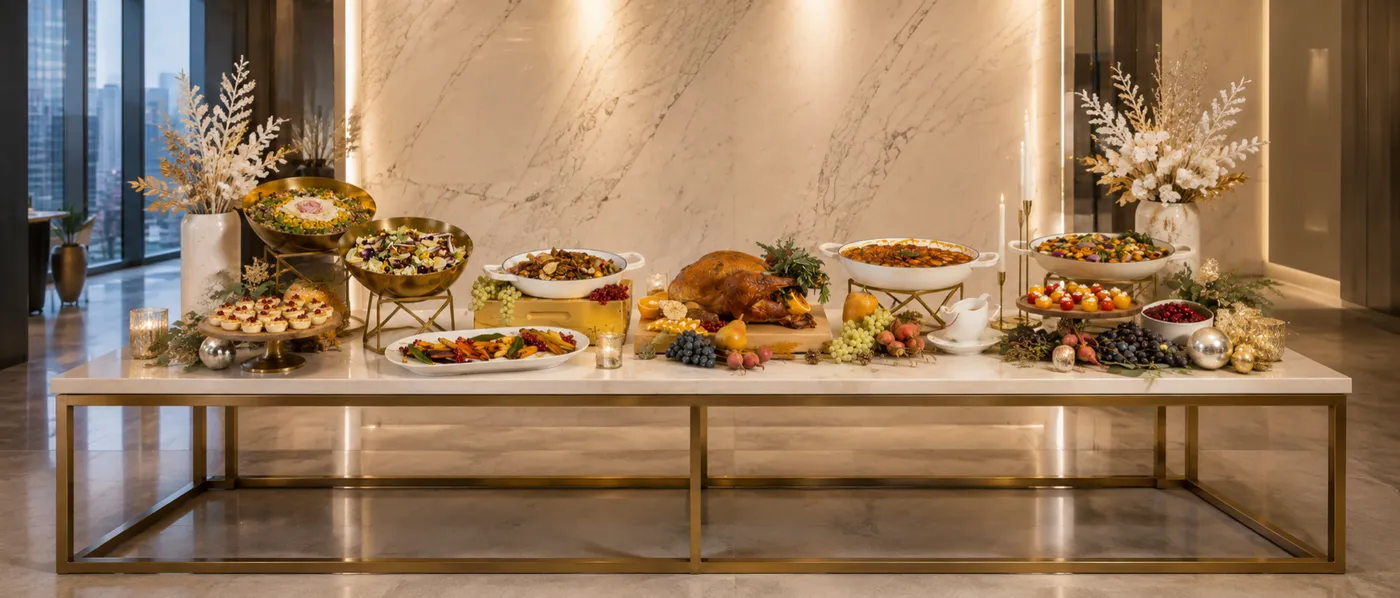
The second principle is height mixing. Nothing is arranged in a flat line — tall foliage rises behind the bird, votives sit low in front, and the platters step down in size toward the table’s end. That’s what lets guests see across without knocking anything over.
- Buffet table with marble top and metal base: $650–$1,600
- Gold and white serving platters and bowls: $180–$400
- Mercury glass votives (set of 12): $45–$90
- Faux white-and-gold foliage + fresh greenery: $70–$150
- Ornaments and small decor accents: $30–$60
- Total: roughly $975–$2,300
Budget alternative: a white laminate console with a spray-painted gold base lands the same look for 50% less.
2. White Cloth, Carved Turkey, and Cracker Crumbs Everywhere
The detail that carries this whole table is the pair of gold metal lanterns with lit candles inside. Everything else — the white tablecloth, the carved turkey, the sliced glazed ham, the dishes piled to the edge — is expected at a holiday meal. But the lanterns add warm, low, flickering light at exactly the height where food sits, and it makes a very traditional spread feel staged rather than dumped.
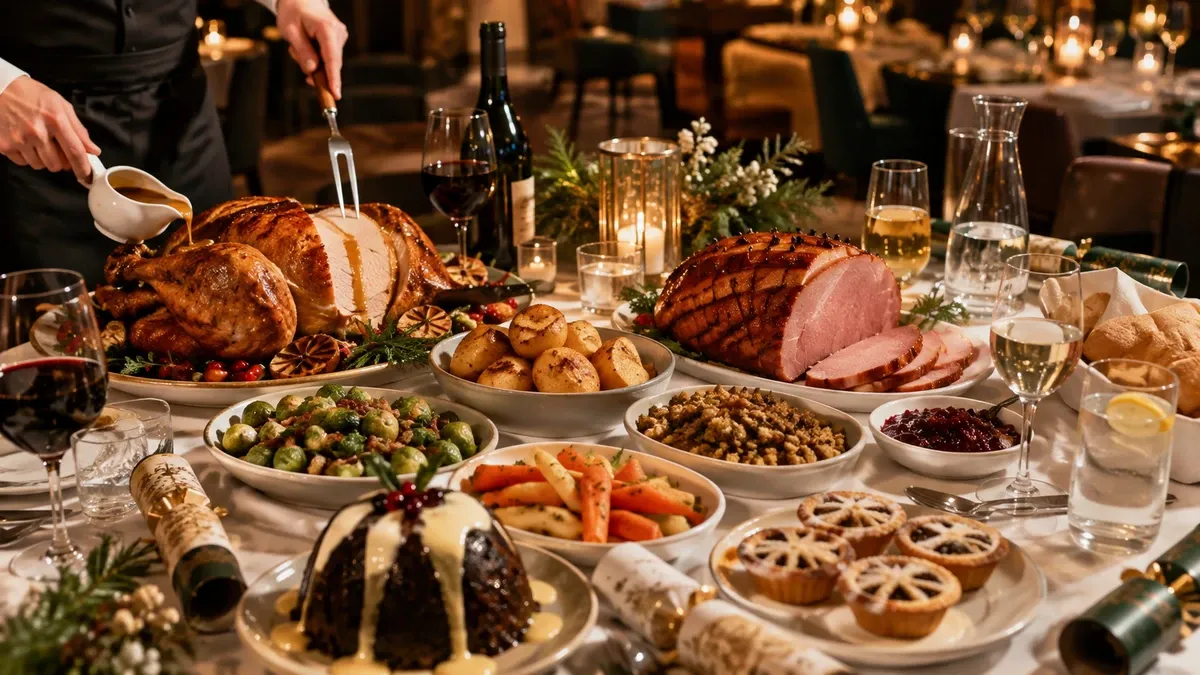
If you removed them, you’d have a nice dinner and no atmosphere. That’s how much a single lighting element matters.
Here’s the honest part: white tablecloths and carved meat do not coexist peacefully. Grease finds the cloth, cranberry sauce finds the cloth, and someone always sets a serving spoon down on the fabric instead of the spoon rest. Buy a machine-washable cloth, keep a stain pen in the drawer, and set out small saucers for spoons before guests arrive — or switch to a cream runner over a bare wood table and let the mess be part of the charm.
3. Red Underlay, White Top, and a Glowing Window Star
This buffet is a textbook color formula and it’s easy to copy: 60% warm white (the top cloth, the plates, the candles), 30% saturated red and deep green (the underlay, the tree ornaments, the pine branches), and 10% silver shine (serving dishes, glass jars, the window star). Swap the red underlay for plum or midnight blue and the formula still works — the ratio is doing the heavy lifting, not the specific colors.
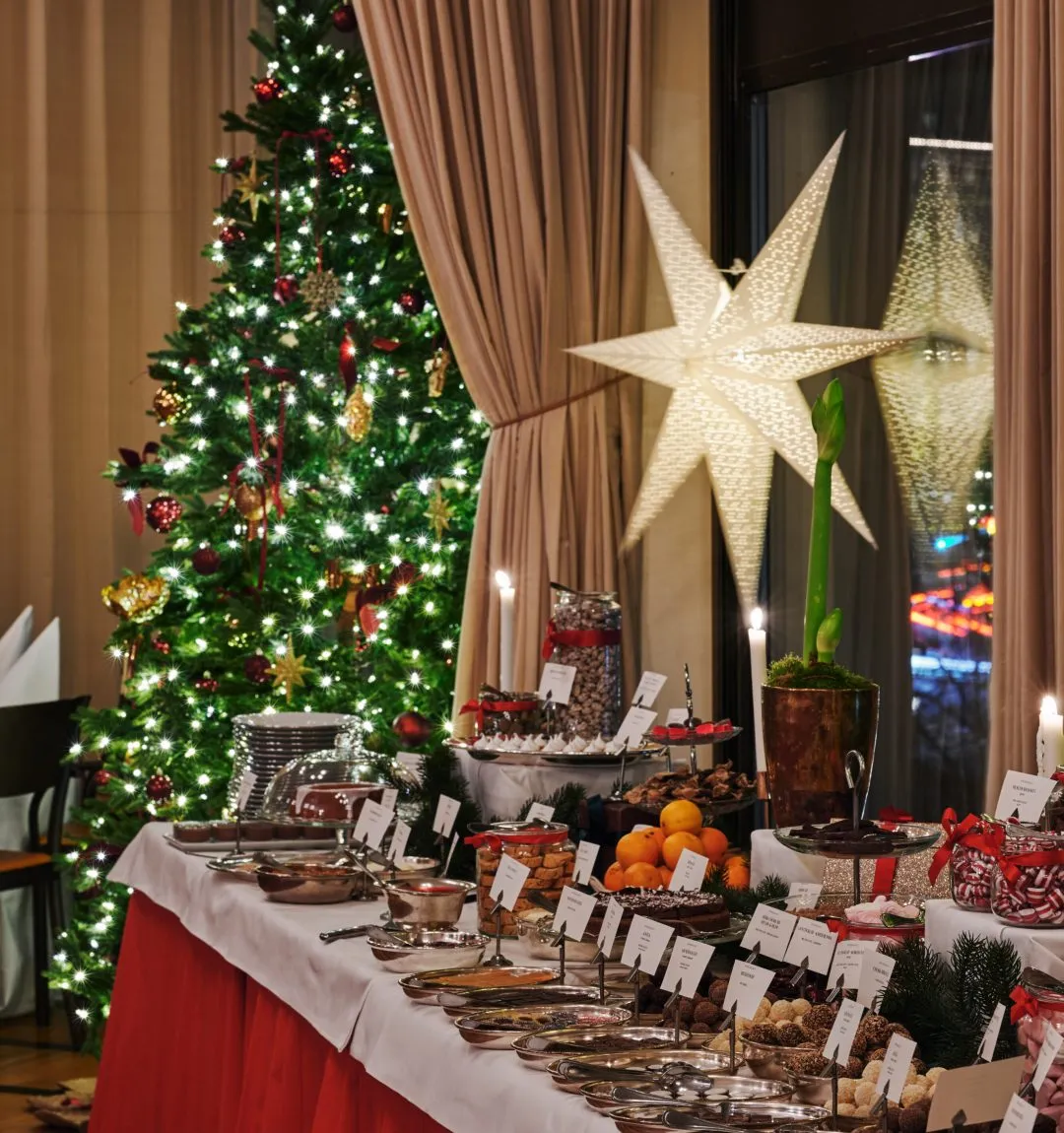
Note how the food labels are tiny and white. Small cards on a busy table need to be almost invisible or they add visual noise. Write in one weight, one size, and skip the decorative fonts.
Now the practical tip: when your buffet sits near a window, resist the urge to hang anything reflective directly behind the food. The star here works because it’s offset to the right and far enough back that it doesn’t mirror on the serving dishes. If you must hang decor behind a buffet, keep it at least 18 inches above the tallest platter so it stays in your guests’ sightline, not their plates.
4. Rose Gold Sequins Against a Black Tablecloth
Black tablecloths at the holidays were fringe five years ago; now they’re the fastest route to a table that photographs like a restaurant. The trick — and this photo nails it — is softening the black with something warm and textured. Here, a shimmering rose gold sequin runner runs the length of the table, and a continuous garland of red berries, pinecones, and silver baubles sits on top of it. Black lanterns with white candles repeat the dark note without going flat.
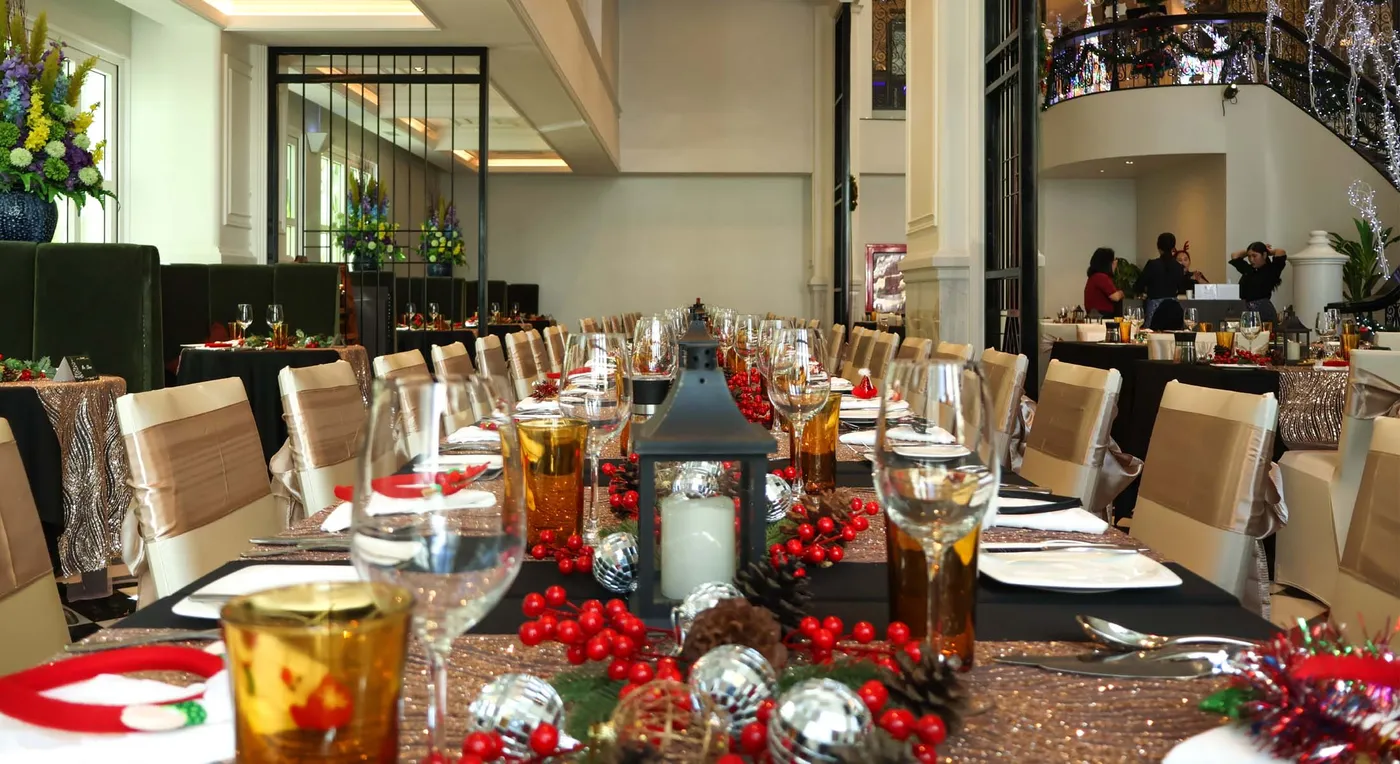
That pairing of matte black with warm metallic is exactly what’s driving holiday tabletops in 2026 — people want festive without the red-and-green default, and black reads as grown-up without reading as mournful.
You don’t need a designer budget for this. A black flat sheet from a discount store works as a tablecloth in a pinch (seriously), and a sequin runner can be had at Target or Amazon for under $30. Cream chair covers with gold sashes are the one place I’d say rent rather than buy — or skip them entirely and let your existing chairs be the contrast.
5. An Embroidered Runner Doing All the Talking
The hero here isn’t the china or the candlelight — it’s the cream runner with rich red and green embroidered florals running the full length of the table. Because it’s the busiest element in the room, everything around it had to quiet down: solid cream pillar candles in gold holders, gold flatware, and greenery garlands that repeat the runner’s colors without competing with its pattern. The red fabric napkins with ribbon are a callback, not a rival.
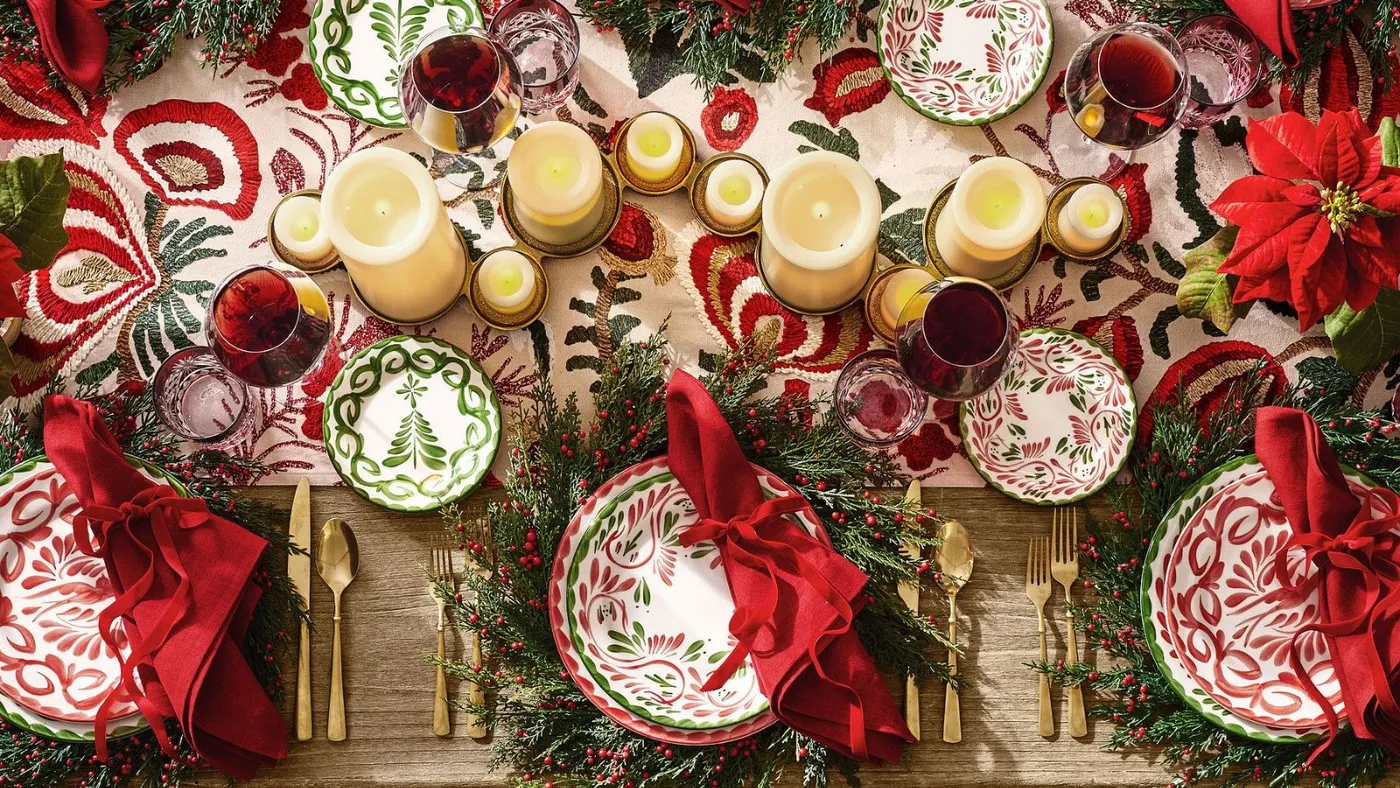
This is a good lesson for anyone drawn to pattern. Pick one piece to be loud, then make everything else a supporting actor.
Upkeep reality: embroidered runners catch candle wax and gravy in equal measure, and the embroidery loops will snag on a hot dish dragged across it. Spot clean with cool water and a drop of dish soap, never rub, and store it rolled rather than folded so the embroidery doesn’t crease permanently. If yours is vintage or hand-stitched, a cheap clear vinyl overlay during the meal is unglamorous and absolutely worth it.
6. Navy Cloth, Scalloped Plates, Beaded Candlesticks
Three things make this table feel young and cheerful instead of stuffy. First, the navy blue tablecloth — it sinks the whole composition into a rich ground so bright red and light blue can pop. Second, the scalloped-edge plates with blue patterning, which repeat the navy in a softer way and add a decorative silhouette. Third, the light blue and white beaded ceramic candlesticks holding red tapers, which are the single most charming object on the table.
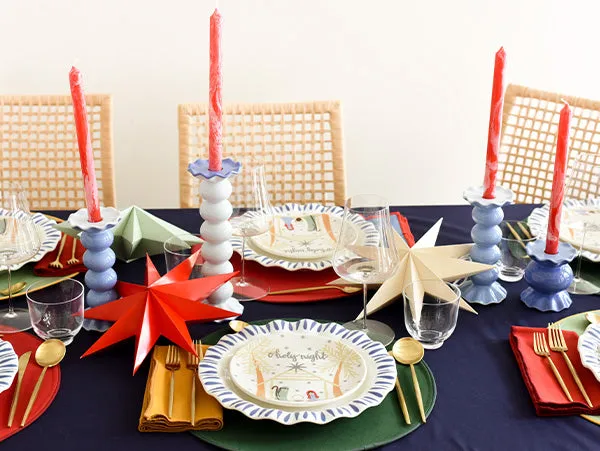
Repetition plus contrast, basically. Rounded scallops against the straight lines of gold cutlery, blue against red, playful paper stars against ceramic. Nothing here matches exactly, and that’s the point.
- Navy tablecloth: $25–$60
- Scalloped patterned plates (set of 4): $40–$90
- Beaded ceramic candlesticks (pair): $35–$75
- Red taper candles: $10–$20
- Gold-toned cutlery set: $30–$70
- Red and cream folded paper stars: $8–$20
- Total: roughly $150–$335
This is one of the most replicable tables in the whole collection — realistic to pull off in a weekend and easy to store.
7. Black Tapers, Mustard Napkins, and Dark Bloom Centerpieces
The reason this autumnal table feels sophisticated rather than Halloween-adjacent is restraint in the flower colors. The blooms stay in muted peach, dusty orange, and deep burgundy — no bright pumpkin orange anywhere — while the drama comes from tall black tapered candles and matte black sculptural vases. Mustard yellow napkins and round woven placemats with yellow trim pull warmth back in. Small gourds and ornamental corn scatter as texture, not as a theme.
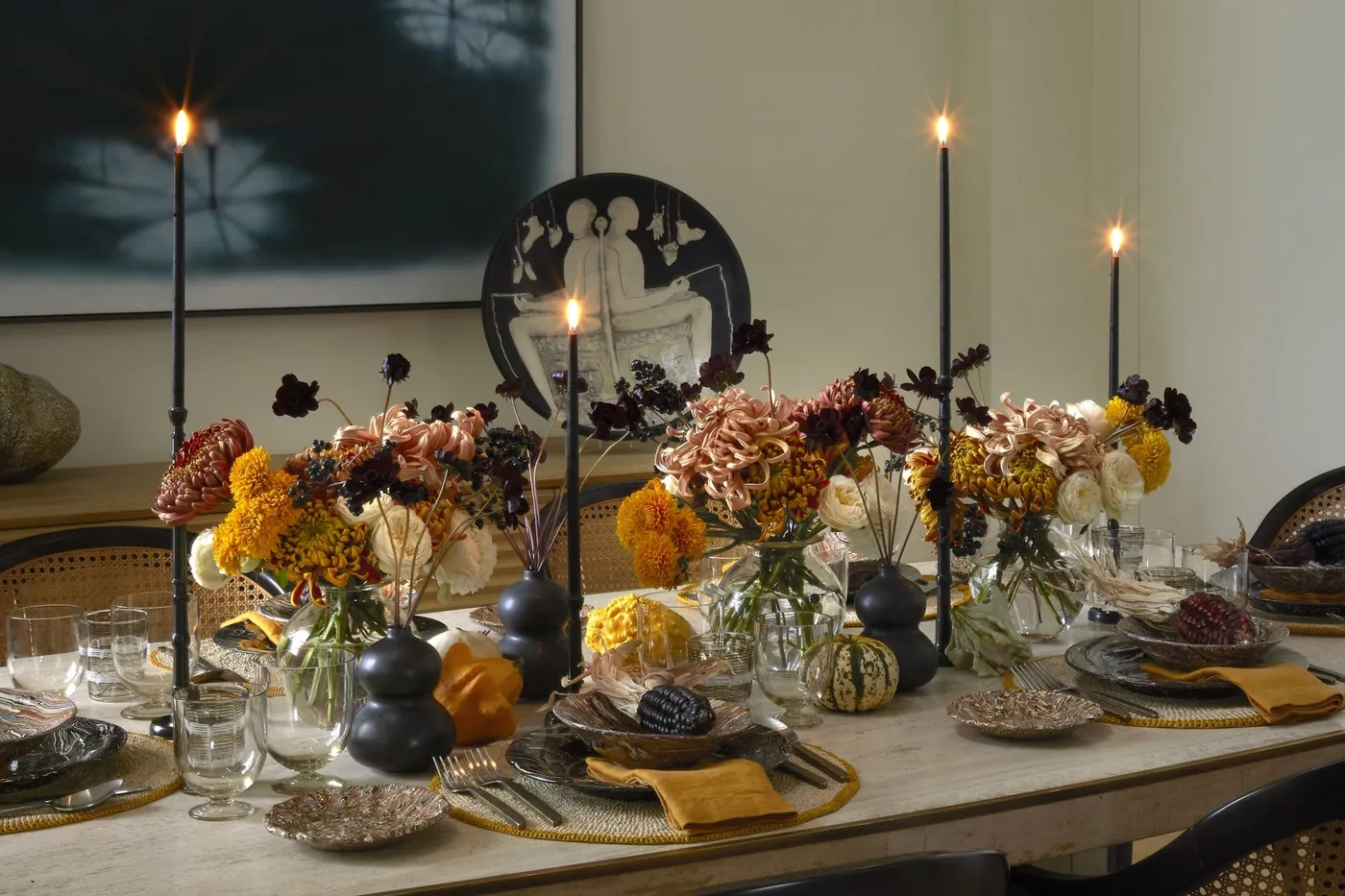
Specific tip worth stealing: cut your taper candles to two heights, roughly 10 inches and 14 inches, and stagger them — never all the same length. Uniform tapers read as a restaurant supply cabinet; staggered tapers read as styled.
One warning. Tall black candles in a group are visually heavy, and if your table is narrower than 36 inches they’ll crowd the place settings fast. Measure first. Also, black candles drip in a very visible way — use dripless tapers and trim wicks to a quarter inch before lighting or you’ll be picking wax off that mustard linen.
8. Fuchsia, Orange, and Purple Garland on Raw Wood
This is what happens when you let a florist off the leash. Eucalyptus runs down a raw wooden table, and into it go fuchsia, orange, and purple blooms — a palette that shouldn’t work at the holidays and absolutely does, because the wood and the mercury glass votives keep everything grounded. White plates topped with irregular wood boards, small gold-rimmed bowls, black napkins tied with leather, and gold flatware finish it off with a distinctly earthy kind of formality.
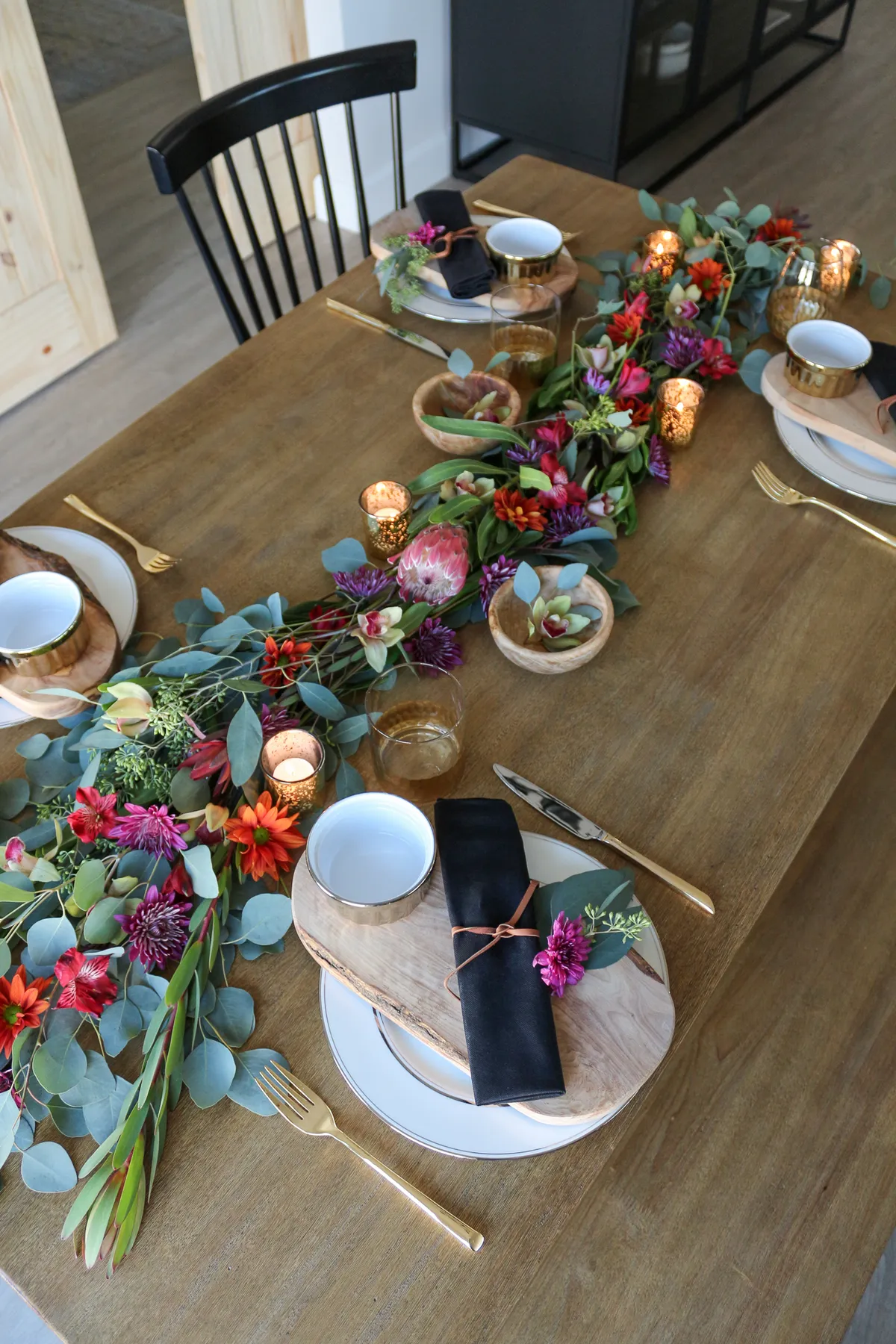
The formula: 50% neutral wood and white (table, plates, boards), 40% saturated flower color, 10% gold and glass shine. Trade the fuchsia for deep red and you have a Valentine’s table. Trade it for white anemones and it’s a wedding.
Get this for less by buying three grocery-store bouquets in similar saturated tones instead of a florist arrangement — roughly $30 versus $200 — and supplementing with a $12 eucalyptus bunch. The wood boards can be cutting boards you already own, and leather cord from a craft store replaces napkin rings at about a dollar a napkin.
9. Flocked Tree, Silver Candelabra, and Fringed Chairs
This rustic-farmhouse setup works because it’s built around a single anchoring piece: a round, distressed wood pedestal table with a substantial evergreen wreath and silver candelabra at the center. Round tables are forgiving — there’s no head of the table to fight over, and a circular centerpiece reads as intentional rather than lined-up.
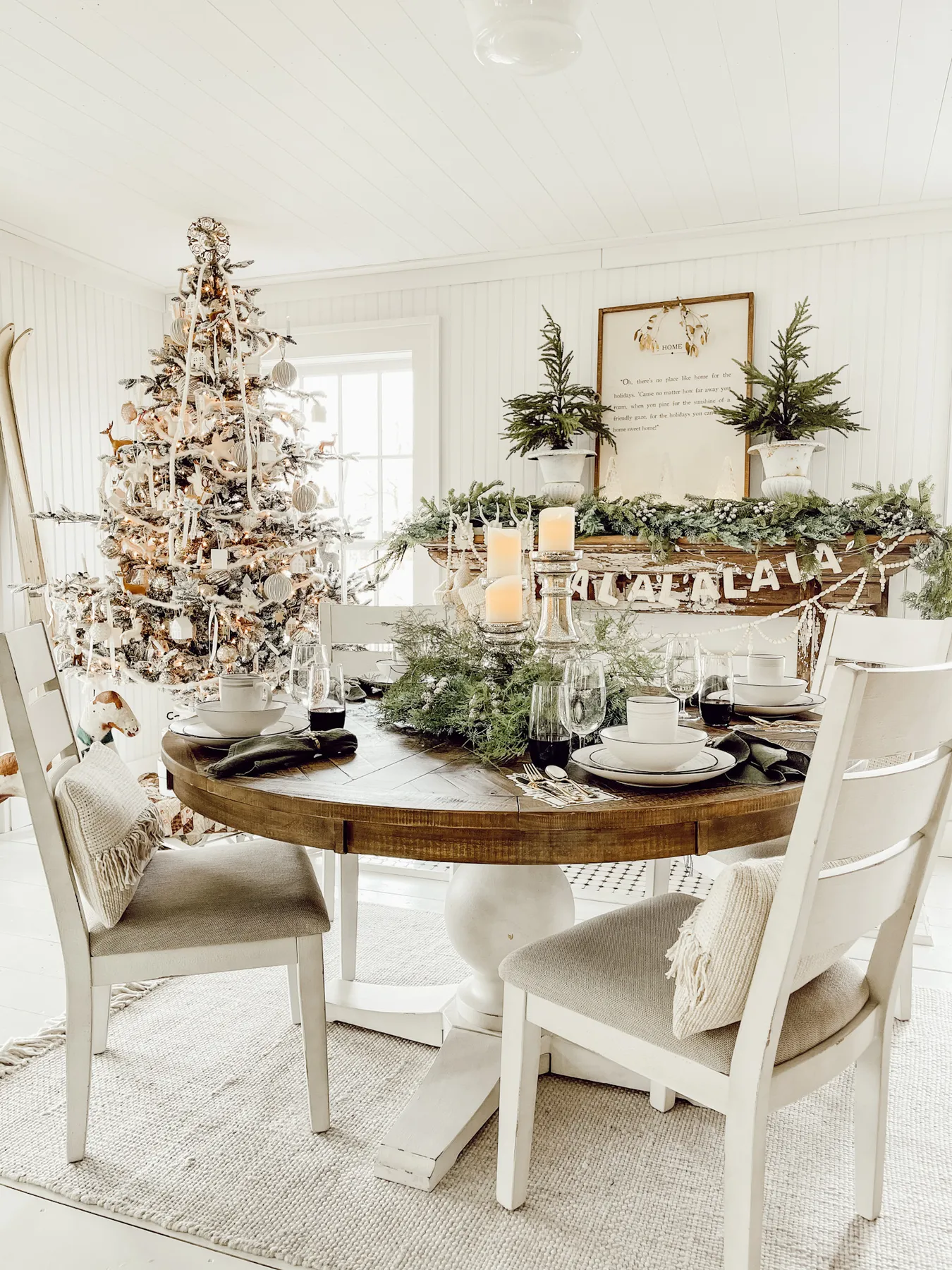
The white paneled walls and ceiling deserve credit too. In a room this bright, a heavily flocked tree doesn’t feel heavy; it reads as snow. Dark napkins and gold flatware prevent the whole scene from washing out. And the fringe pillows on the white upholstered chairs add a softness that keeps the paneling from feeling like a boardroom.
Where this idea works best: a dining room of at least 120 square feet with 9-foot ceilings, or an open-plan space where the tree can live outside the table’s footprint. If your dining room is tighter than 10 by 12 feet, skip the flocked tree in the same room and see Idea #10 for a lighter-footprint approach. Also confirm your table seats six comfortably before adding a wreath that eats 20 inches of center.
10. Twine-Tied Blue Napkins on a Wood Farm Table
The single element that holds this table together is the light blue fabric runner and matching napkins. On a plain rustic wooden table with white plates and woven brown placemats, you’d otherwise have a perfectly nice but forgettable setup. The soft blue gives it a color identity, and because it’s fabric rather than paper, it reads as considered.
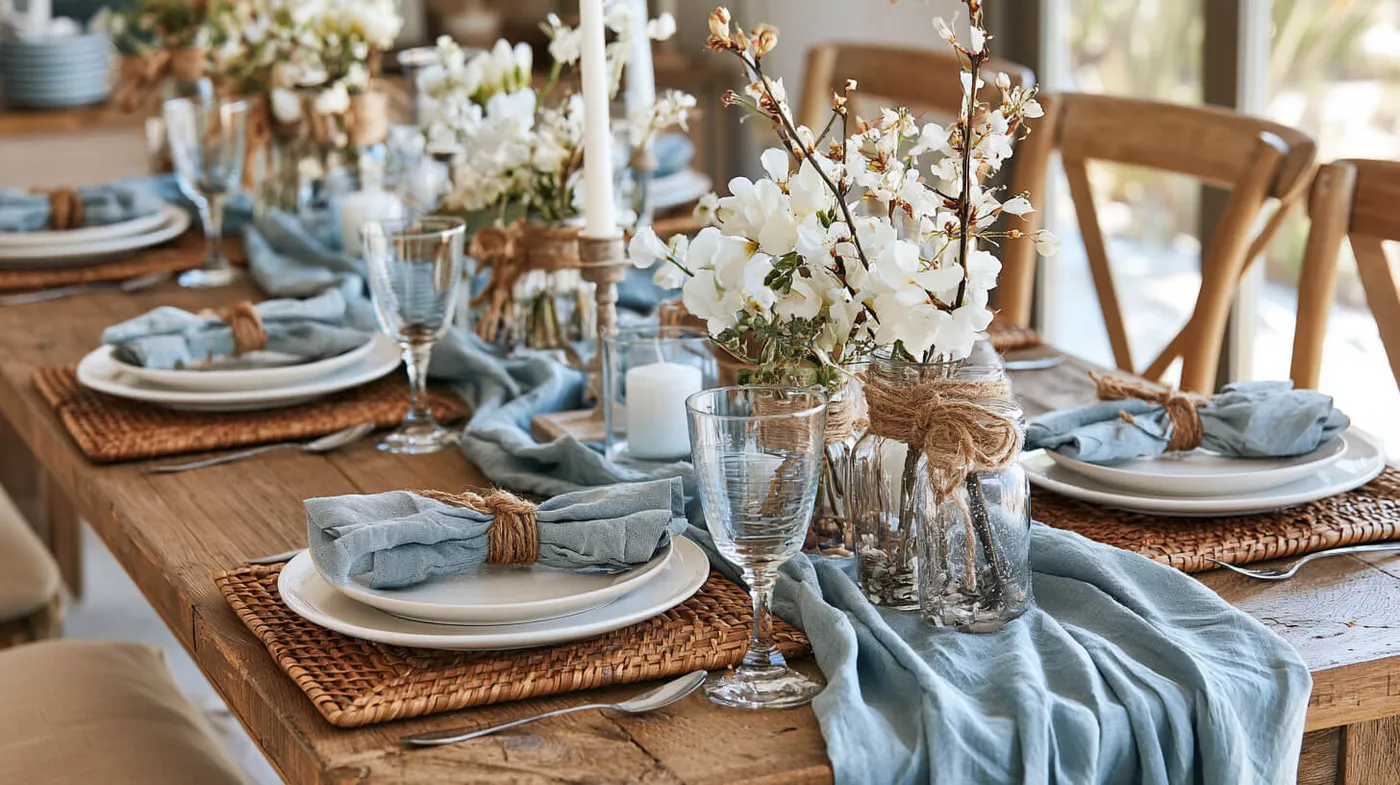
That’s the whole trick: pick one non-negotiable color and repeat it twice. Runner plus napkins. Done.
Recreating it costs almost nothing. A few yards of light blue cotton from a fabric store runs $15–$25 and makes both the runner and four napkins if you’re willing to hem a straight line. The clear glass jars holding white flowers and pillar candles are mason jars or old pasta sauce jars with the labels scrubbed off. Woven placemats at IKEA or Walmart are $3–$6 each, and twine is twine. Total for four place settings: under $60.
11. Deer-Faced Bowls and Etched Glass for a Whimsical Table
This table commits to a character theme and doesn’t apologize — light green scalloped bowls painted with little deer faces, white ceramic charger plates, clear etched glassware with deer and dot patterns, and rolled white napkins tied with twine. A flocked tree blurs in the background with warm string lights on it. It’s cozy and slightly silly in the best way.
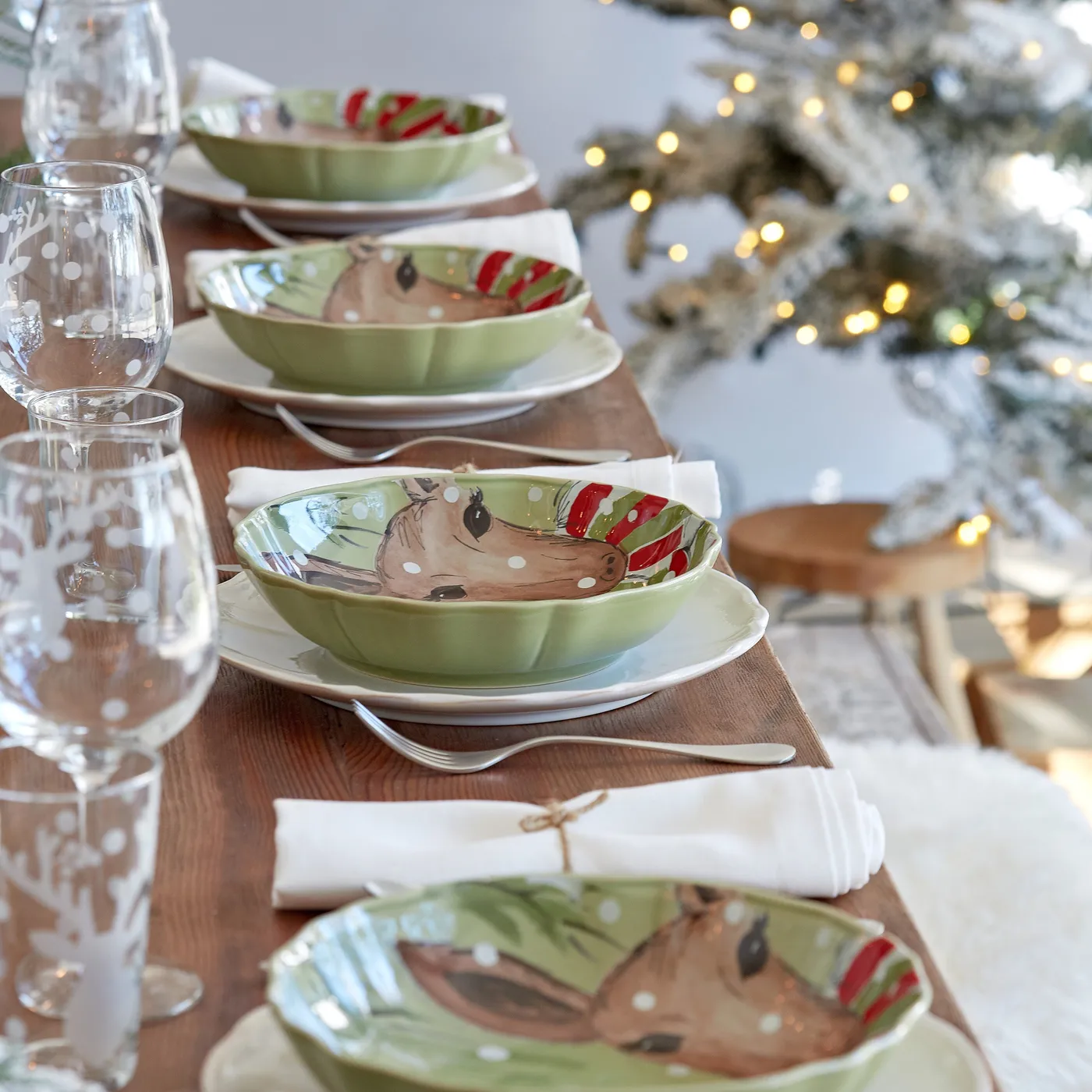
What keeps it from tipping into kitsch is the discipline of the palette: white, light green, warm brown wood, and a single note of red. Four colors, no more.
, though — themed dinnerware is a commitment. It usually comes as a set of four, it’s hard to expand later, and it will not match anything else you own. Buy it because you love it for December, not because you’re building a year-round collection. Also check whether the bowls are dishwasher safe before you commit; painted faces and scalloped rims are often hand-wash only, and hand-washing eight bowls after a holiday dinner is a very specific kind of regret.
If you want the look without the theme, a plain light green scalloped bowl lands the same charm for a third of the price.
12. Abstract Art, Black Tapers, and a Very Loud Bouquet
What makes this table sing is that it treats the wall as part of the tablescape. A big abstract painting in bold orange, pink, and blue hangs on grey brick behind the table, and the floral arrangements on the table echo those exact colors. Blue tie-dye napkins pick up the painting’s blue, green ribbed glasses pick up the green, and the black taper candles anchor it all so nothing floats away.
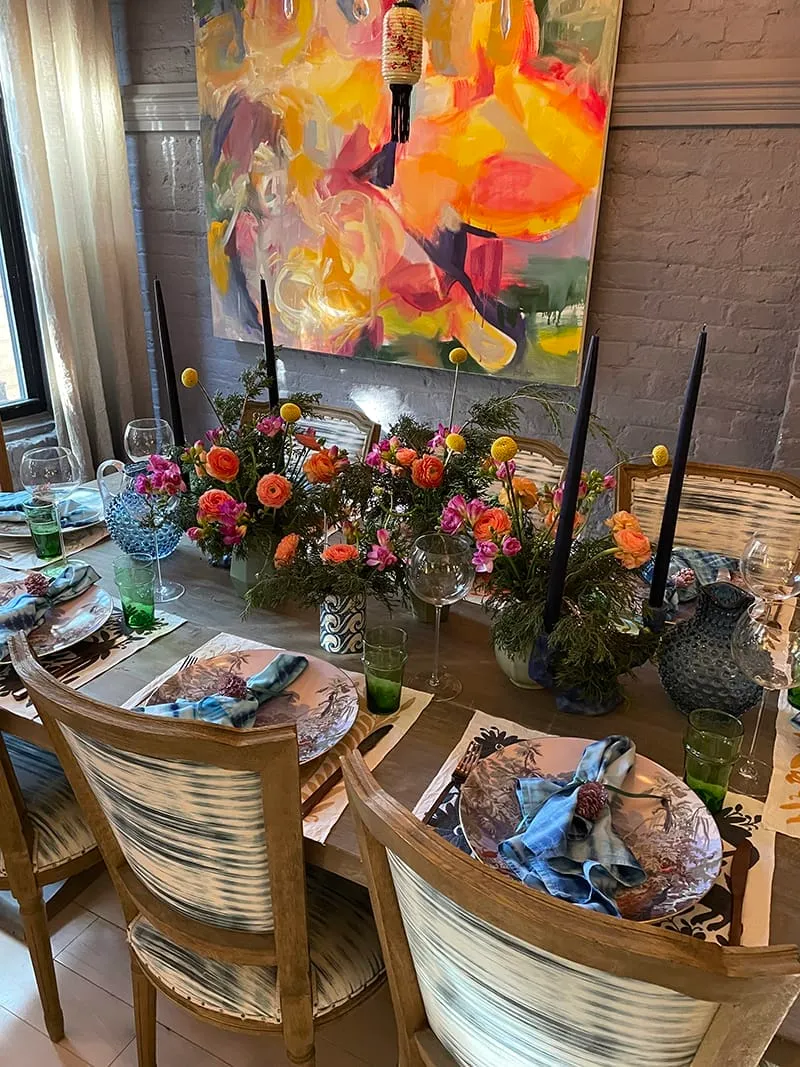
That’s the principle: when your table sits against a strong wall, sample two or three colors from the art and repeat them below. It’s the cheapest way to make a room look professionally designed.
This approach needs breathing room. It works in a dining space of at least 130 square feet because the eye needs distance to read both the painting and the table at once. In a small room, the same idea works if you scale the bouquet down by half and swap the painting for something smaller. If your wall is plain, Idea #20 gets a similar festive feel without needing art to play off.
13. Red Roses and Pine on a Black-Draped Buffet
Black table linens plus red roses plus warm bokeh string lights in the background equals a buffet that looks like it costs more than it does. The key move is the floral: large arrangements of red roses, green pine, and gold glittery accents set at two points along the table, not scattered evenly. Symmetry at the ends of a long buffet is what creates that formal, hotel-lobby feeling.
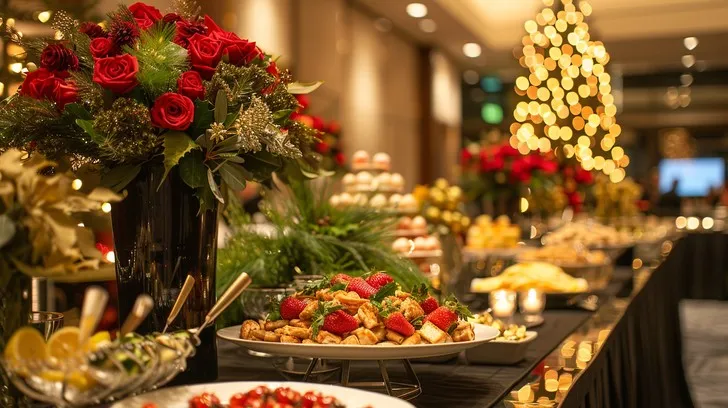
Notice that the food itself is presented plainly — white platters, tiered stands, nothing fussy. All the decoration budget went to flowers and light.
- Black floor-length tablecloth: $30–$70
- Two rose-and-pine arrangements: $120–$300
- White platters and tiered stands: $60–$150
- Gold glittered foliage accents: $20–$45
- Votive candles (set of 12): $25–$50
- Total: roughly $255–$615
Budget swap: supermarket roses in bulk plus pine cuttings from your tree’s bottom branches gets you within 50% of the look.
14. Silver Platters, Crystal, and Candles Everywhere
This buffet leans on one material family to do the heavy lifting: silver-toned platters and tiered stands, repeated at every height and size. On a dark wooden table with deep red, orange, and green florals around it, that repetition of silver is what makes an enormous amount of food look curated instead of chaotic.
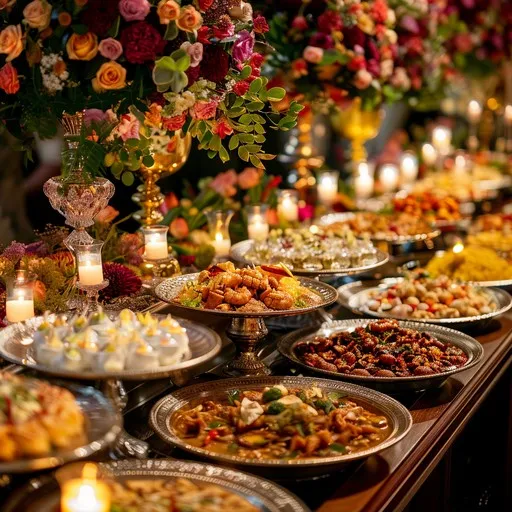
The actionable tip: group your serving pieces by finish, not by function. All the silver on one buffet, all the white ceramic on another. Mixed finishes spread across one table is the number-one reason a generous spread starts to look messy.
Practical caution — candlelight and silver plating are beautiful together and dangerous together. Keep lit votives at least six inches from any platter holding something cold, because condensation and flame travel. And silver-plated pieces tarnish fast when they sit near food with acid in it; rinse and dry them the same night, not the next morning. If you’re serving a hot dish, put it on ceramic and use the silver for breads, cold sides, and desserts.
15. Vintage Santa Plates Laid Out Like a Collection
Four scalloped-edge plates with vintage-style Christmas characters — Santa, snowmen, a reindeer — arranged flat on a dark wood surface with a red fabric runner running behind them, pine sprigs tucked in, and red and gold ornaments clustered at the edges. It’s less a set table than a display, and it’s the kind of thing you build over years from antique malls and estate sales.
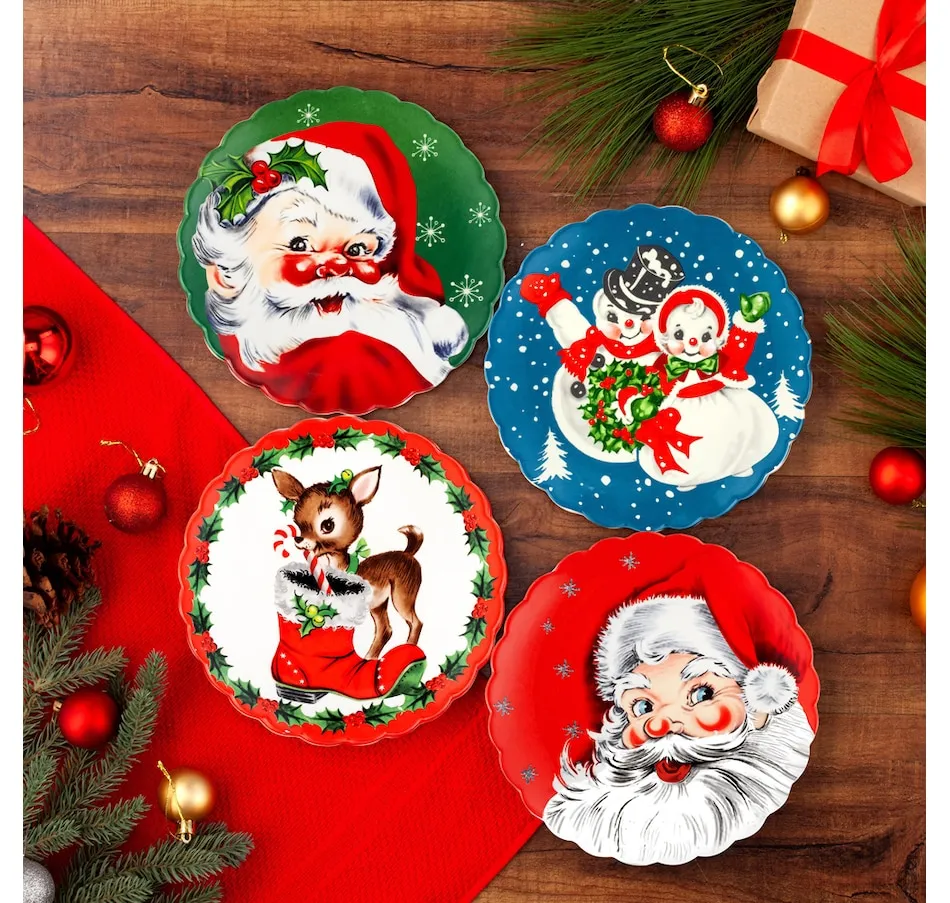
If you want to start collecting, know the maintenance first. Old decorative plates often have gold trim that is not dishwasher safe, and hand-painting can craze in heat. Wash by hand in lukewarm water, dry immediately, and never stack them without a felt pad between. Chips on the scalloped edge are common on vintage pieces — check the rim with your thumbnail before you buy.
Alternatives with zero upkeep: modern reproductions of the same vintage illustration style run $8–$15 each at big-box stores, and they’ll survive a dishwasher. A brown gift box with a red ribbon on the table is a nice inexpensive anchor, and pine sprigs are free if you have a tree.
16. Olive Wood Chargers and a Rainbow Garland
With just two place settings visible, this table proves you don’t need a crowd to make an effort. White plates with gold rims sit on round olive wood chargers, gold flatware beside them, and down the center runs a garland of eucalyptus and mixed colorful flowers — deep purple, light pink, red, orange — punctuated by lit gold mercury glass votives.
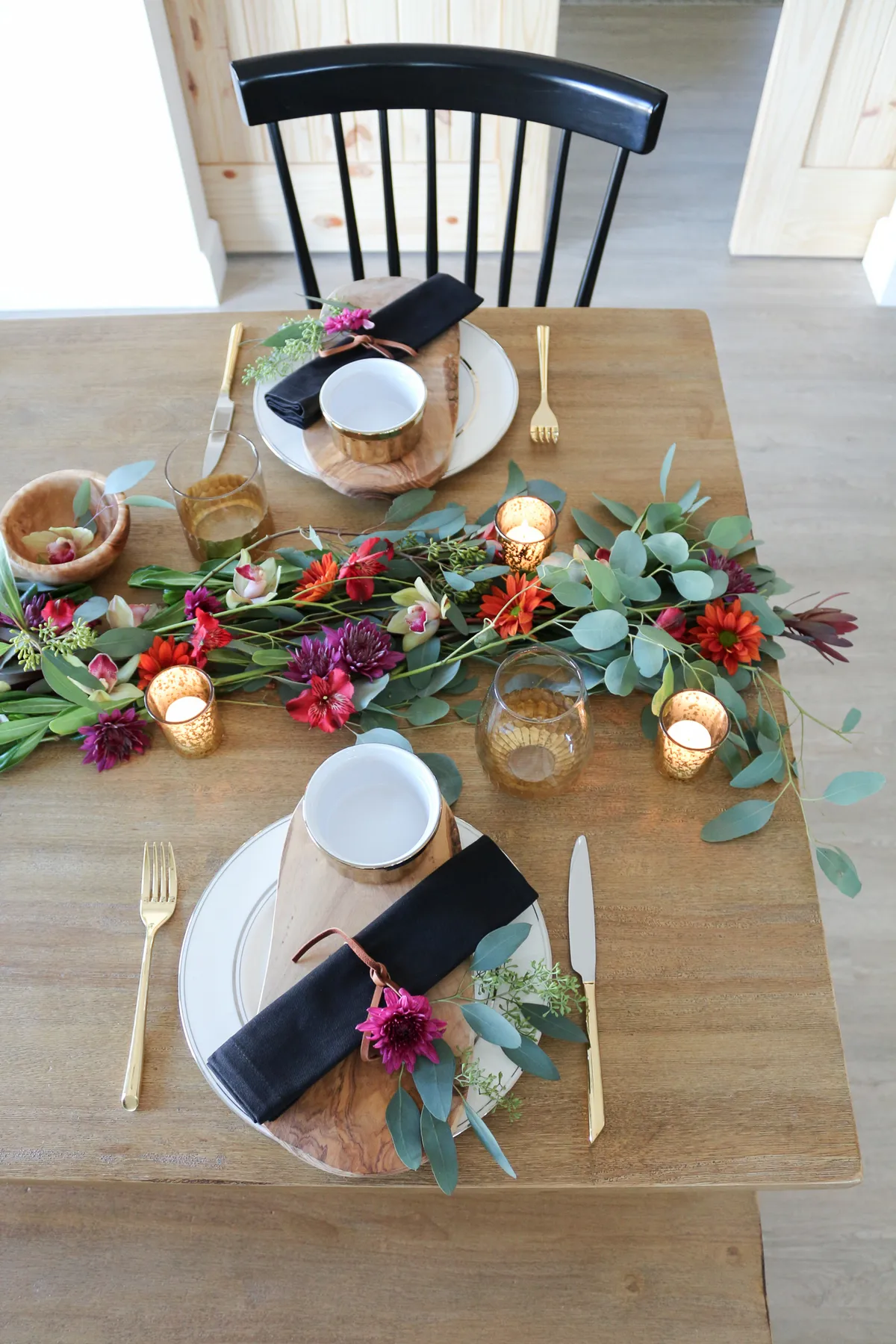
The visual math here is worth writing down: 55% natural wood and white (the table, plates, chargers), 35% mixed floral color, 10% gold shine. Swap the flowers for all-white and you have a spring table. Swap for greens and berries and it’s Christmas morning.
One specific trick with mercury glass: light the candles fifteen minutes before guests sit down so the gold reflects an actual flame instead of a cold room. And place votives at staggered intervals — roughly every eight inches — rather than evenly spaced, which reads as more natural. Even spacing is the giveaway that a table was assembled rather than styled.
17. Miniature Lit Trees Beside the Rose Bouquet
Two illuminated miniature Christmas trees with red and gold ornaments, standing right on the dinner table next to a big bouquet of red roses — that’s the element doing the most work here. A dark glossy table, golden woven placemats, and plated gourmet food would look expensive but a little cold without them. The little lit trees add warmth, height, and a bit of theater exactly at eye level.
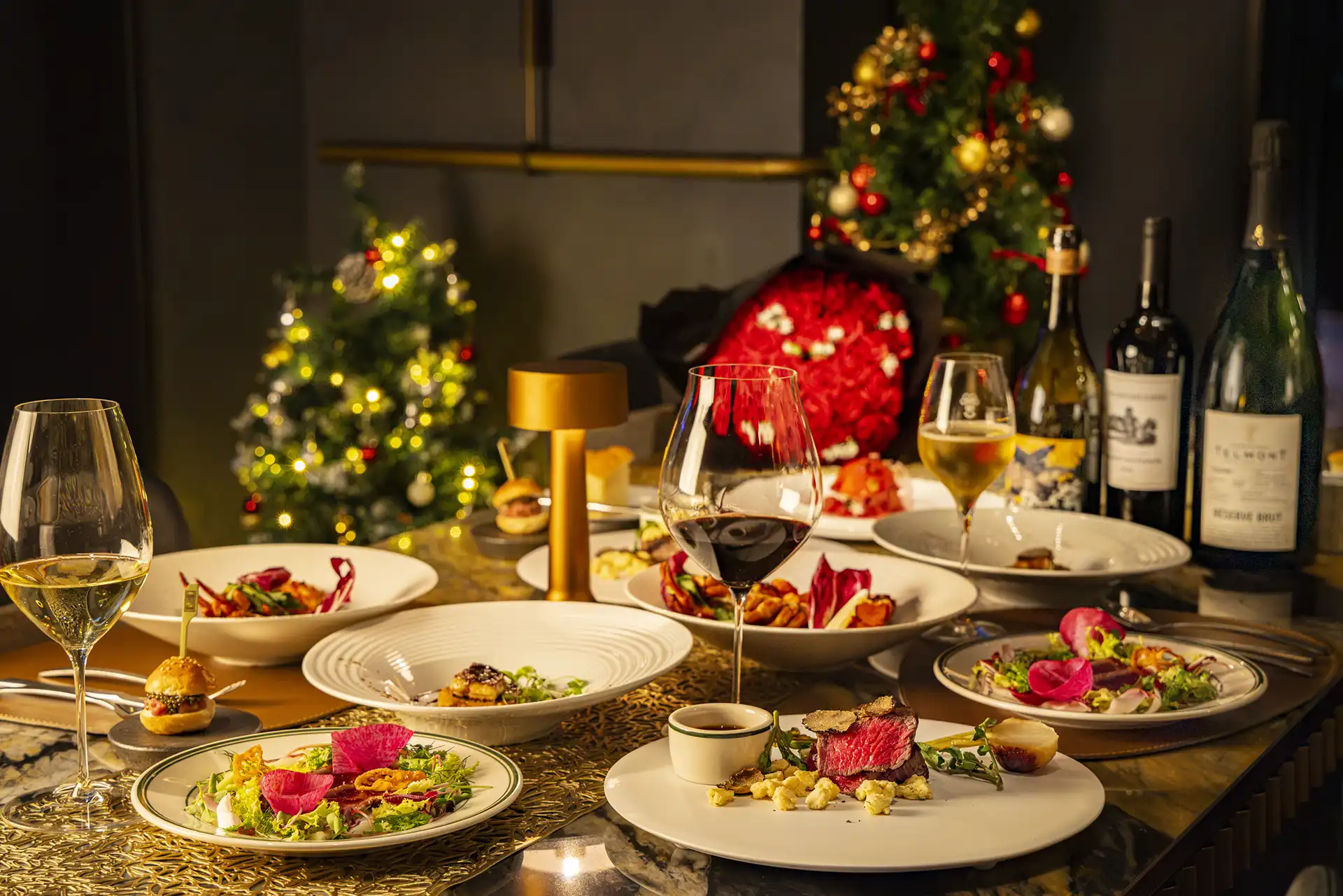
Small lit trees are having a real moment because they solve a specific 2026 problem: people want holiday atmosphere but don’t want to redesign their whole room around a seven-foot tree. A pair of battery-operated tabletop trees gives you the glow with none of the floor space.
Keep them proportionate. On a table this dressed, each tree should top out around 18 inches so guests can still see each other. Anything taller and you’re eating dinner behind a hedge. Also check that yours are LED and battery-powered rather than plug-in, or you’ll be running an extension cord across your good tablecloth.
18. Botanical Tablecloth, Berry Branches, and Hanging Ornaments
The detail that makes this buffet feel abundant before you even look at the food is the background: sheer white curtains hung with golden spherical ornaments and subtle string lights. That’s a $20 trick that turns a plain wall into a festive backdrop, and it’s exactly why people are draping ornaments in windows and doorways in 2026 rather than only on trees.
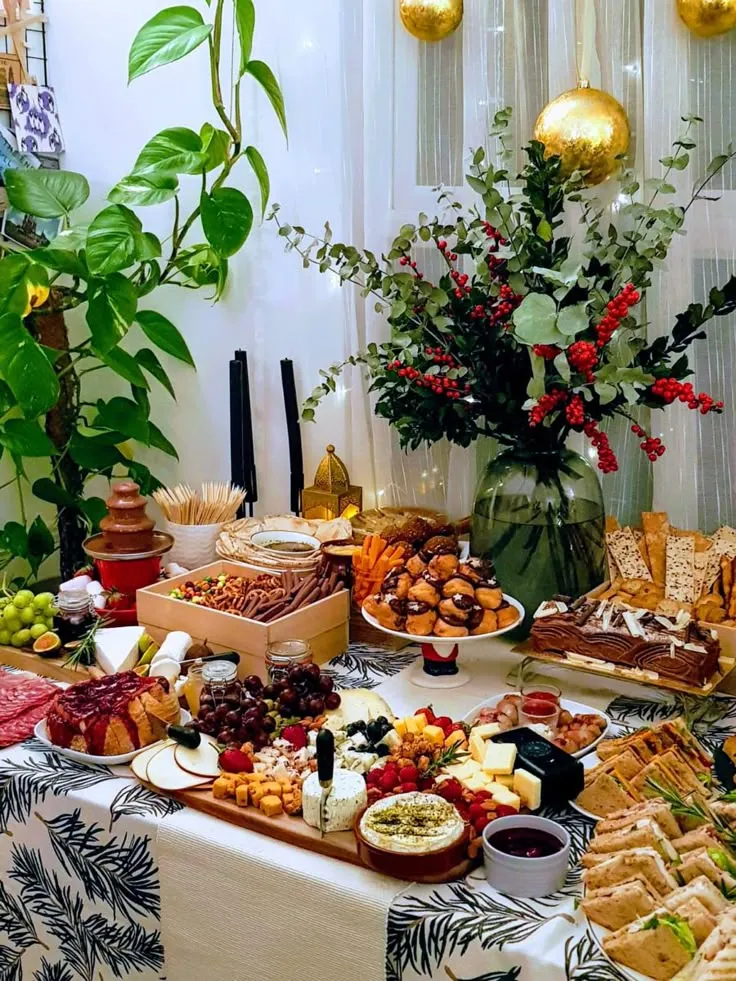
On the table itself, a white tablecloth with a dark green botanical print handles the pattern work, so the centerpiece could stay simple — one large glass vase of eucalyptus and red berries. A red chocolate fountain, charcuterie, and desserts fill out the spread.
check: a botanical-print white cloth is going to show every drop of chocolate and every smear of berry juice. Pre-treat stains with cold water before anything sets, and consider a clear plastic protective cover for the actual serving zone if you’re hosting more than eight people. Hanging ornaments near a buffet also means hanging ornaments near a buffet — tie them with fishing line and secure the hook, or you’ll find gold spheres in your charcuterie by 8pm.
19. A Big Glass Vase of Flowers Among the Shrimp and Croissants
This is a working buffet, not a styled one — shrimp cocktail, cheese and fruit platters, croissant sandwiches, a wooden charcuterie board of meats and olives — and the one decorative choice that elevates it is a single large floral arrangement in a clear glass vase, placed dead center. Because the food is casual, the flowers do all the formalizing. Blue and natural linen napkins stack neatly at the end, and a lit Christmas tree glows in the background.
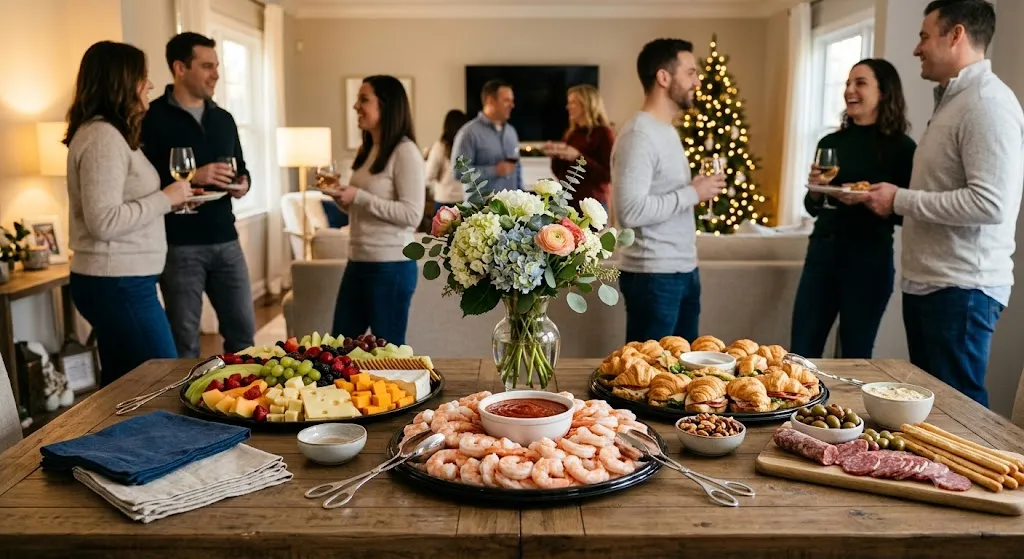
It works because the flower colors pick up the blue linens and the greenery picks up everything else. No theme, just a color echo.
- Measure your table’s usable center — you need at least 14 inches of clearance per side for plates
- Confirm your vase is weighted enough that it won’t tip when someone reaches past it
- Check that the floral arrangement stays under 16 inches tall so guests can see across
- Decide where the napkins and cutlery go before you place any food
- Set out a dedicated spot for used plates, away from the serving line
20. Pine Branches and Pillar Candles on a Working Buffet
What’s smart about this setup is that the greenery isn’t a centerpiece you have to work around — it’s woven between the food. Pine branches, red berries, and eucalyptus leaves thread along a rustic wooden table, with white pillar candles in clear glass holders rising up between the platters. Mini burgers, bruschetta, and layered appetizer shots sit on wooden boards and ceramic bowls, with light-colored plates stacked at the end.
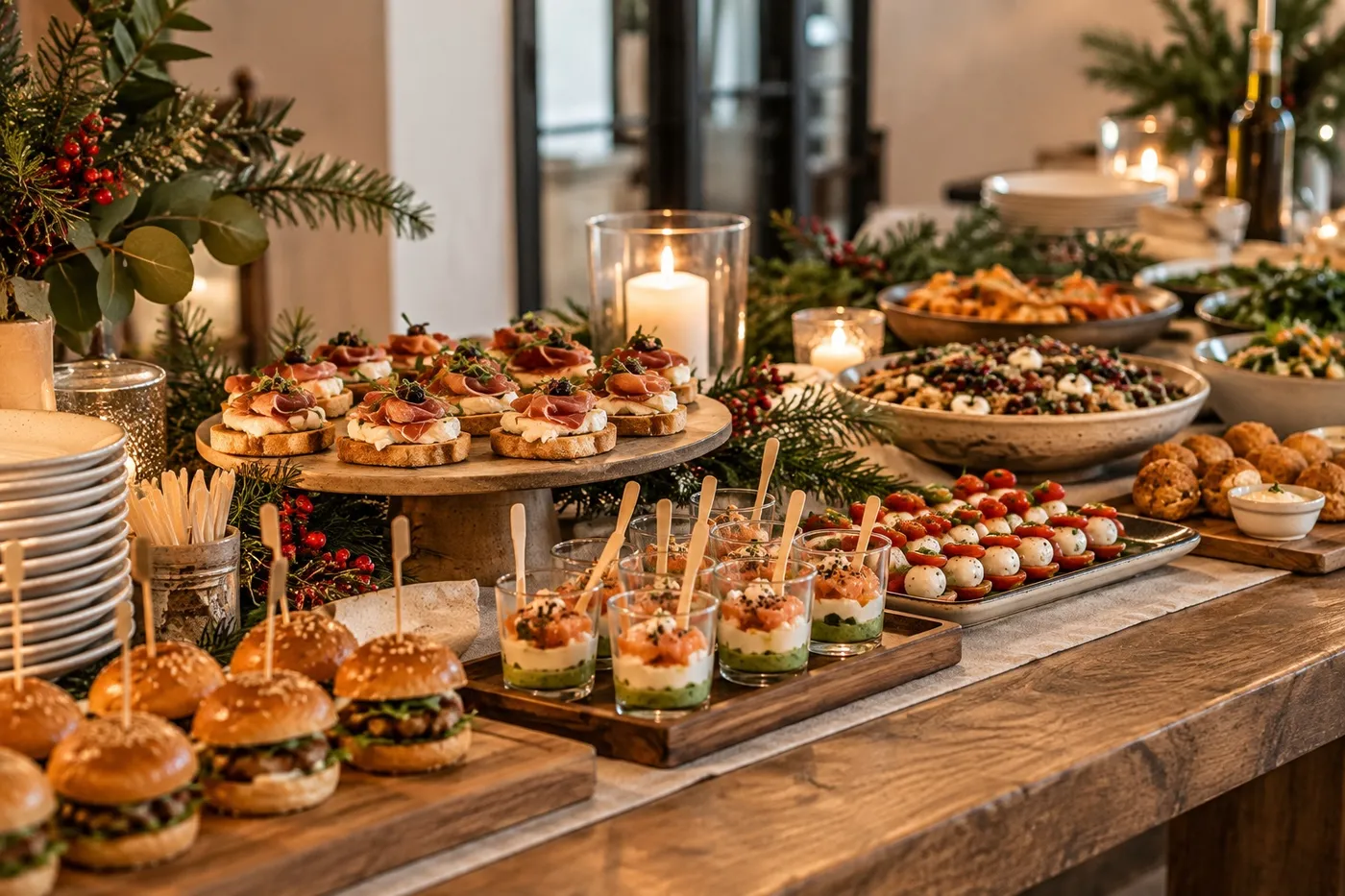
Build the greenery first, then slot the food into the gaps, and you get a table that looks genuinely abundant rather than decorated.
- Lay a base layer of pine and eucalyptus along the table’s spine, leaving deliberate gaps
- Tuck in red berry sprigs at three or four irregular points, not evenly
- Set pillar candles in glass holders in the gaps — cluster in threes, don’t line them up
- Place your largest platters next, using boards at different heights
- Fill remaining gaps with small bowls and glasses
- Stack plates and cutlery at the far end so the line moves one direction
Time: about 45 minutes. Materials: $40–$80 if you’re buying greenery, closer to $15 if you’re cutting from a tree.
21. Croquembouche, Yule Logs, and Dried Oranges
A caramelized croquembouche tower in the middle of a dessert table is not subtle, and that’s exactly why it works. Everything else — multiple Yule logs, cakes, individual pastries, small bottle brush trees, fresh mandarins, dried orange slices — arranges itself around it like planets. Remove the tower and you just have a lot of desserts on a table.
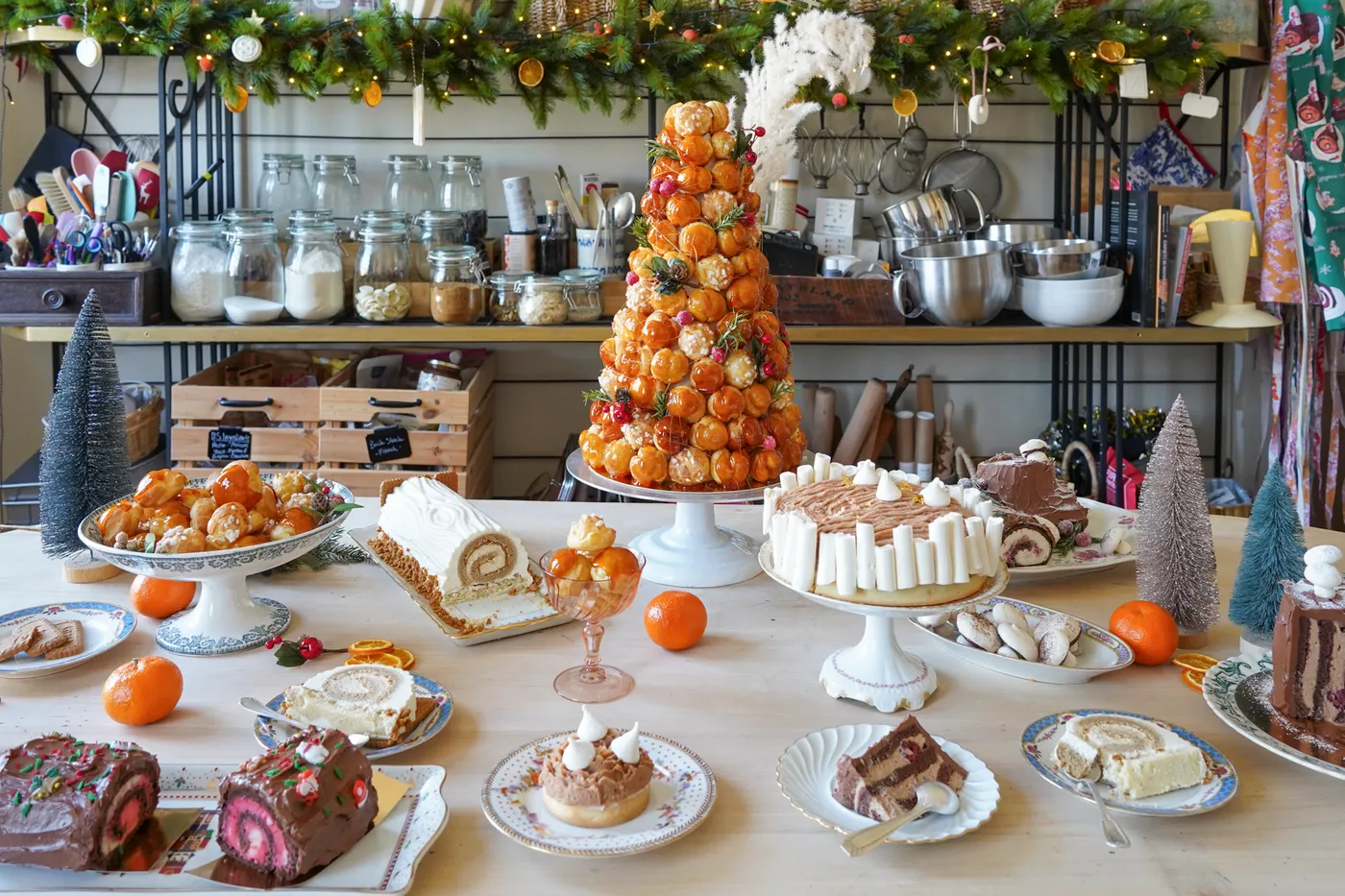
It also solves a height problem. A tall centerpiece on a dessert table is fine, because nobody needs to see across it to serve themselves a slice of cake.
For anyone not up for spun sugar: a stacked tower of cream puffs held together with melted chocolate, or even a tiered stand loaded with donuts, gives you the same silhouette for around $25 and a fraction of the stress. Bottle brush trees are $3–$8 each at craft stores, dried orange slices cost pennies if you dry your own in a low oven, and mandarins double as decor and dessert. If you want more vertical interest without the pastry drama, see Idea #28 for a frosted-tree approach.
22. A Live-Edge Riser Over a Pleated Green Skirt
Two tiers, two completely different jobs. The bottom tier hides in a dark green pleated table skirt and holds the actual food in glass jars and white dishes. The top tier is a live-edge wooden slab acting as a riser, dressed with an ornate bronze candelabra with a red ribbon and dark rectangular planters of red flowers, greenery, and small red ornaments. Purple and pink ornamental kale clusters at the base of the lower tier.
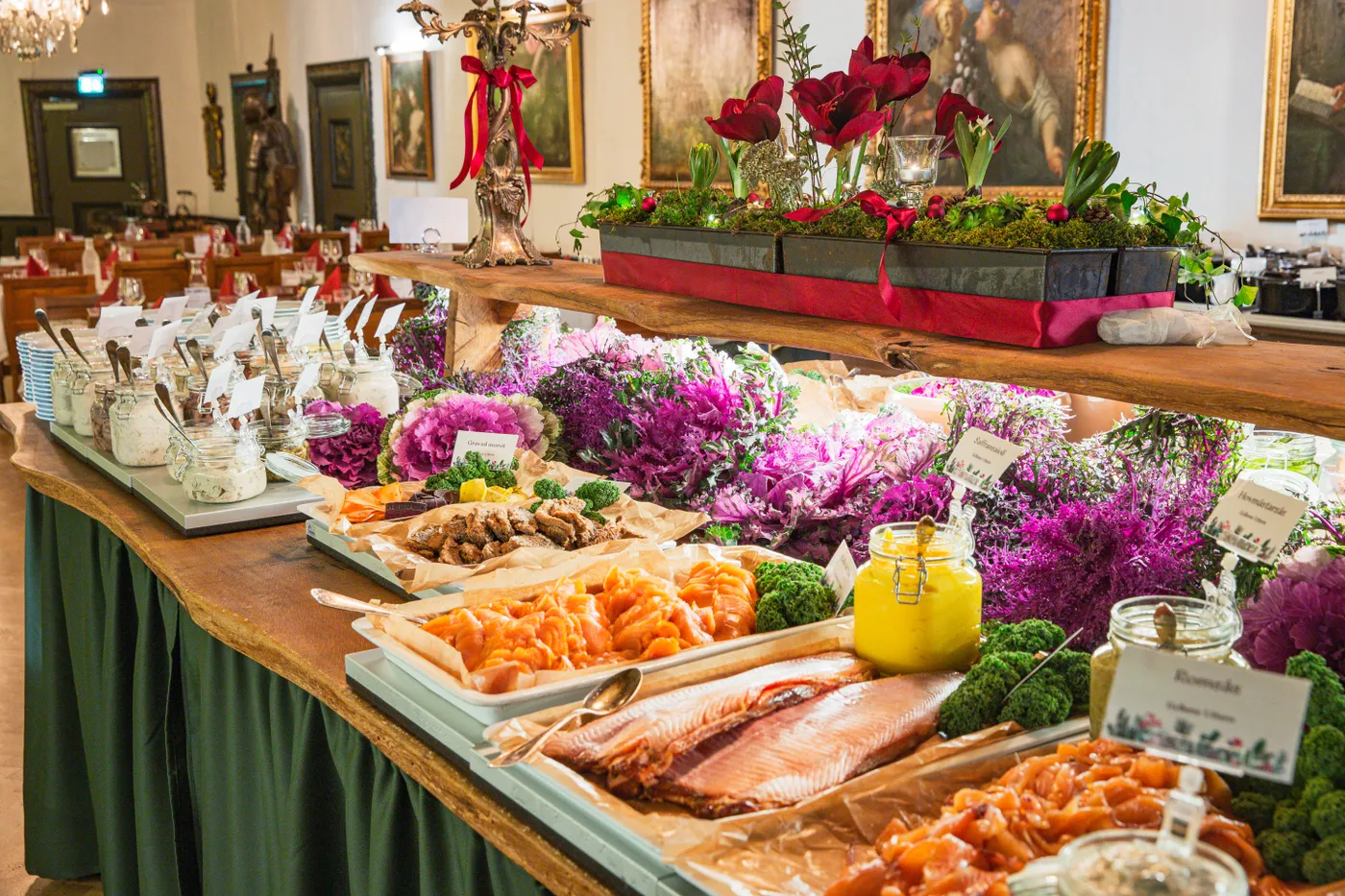
That contrast — formal skirt below, raw wood above — is why this doesn’t read as a church basement buffet.
- Measure your riser’s footprint and confirm it leaves room for plates on both sides
- Skirt the base table first, pleating evenly and pinning at the back
- Set the live-edge slab on top, centered, checking it doesn’t overhang past the skirt
- Place the candelabra slightly off-center so the arrangement isn’t symmetrical
- Fill planters with red blooms and tuck ornaments into the greenery
- Add kale and jars on the lower tier last, working around the food
Time: about an hour. Materials: $60–$150, less if the skirt is fabric you already own.
23. Pine Runner Framing a Bundt Cake and Roasted Bird
There’s no vase on this table, and that’s the whole idea. A runner of fresh pine branches and green foliage runs down the center of a white table, and the food sits directly on it — a powdered sugar bundt cake on one side, a roasted bird on a silver platter with pomegranate and clementines on the other. Dark red linen napkins, white plates, and gold cutlery at each setting.
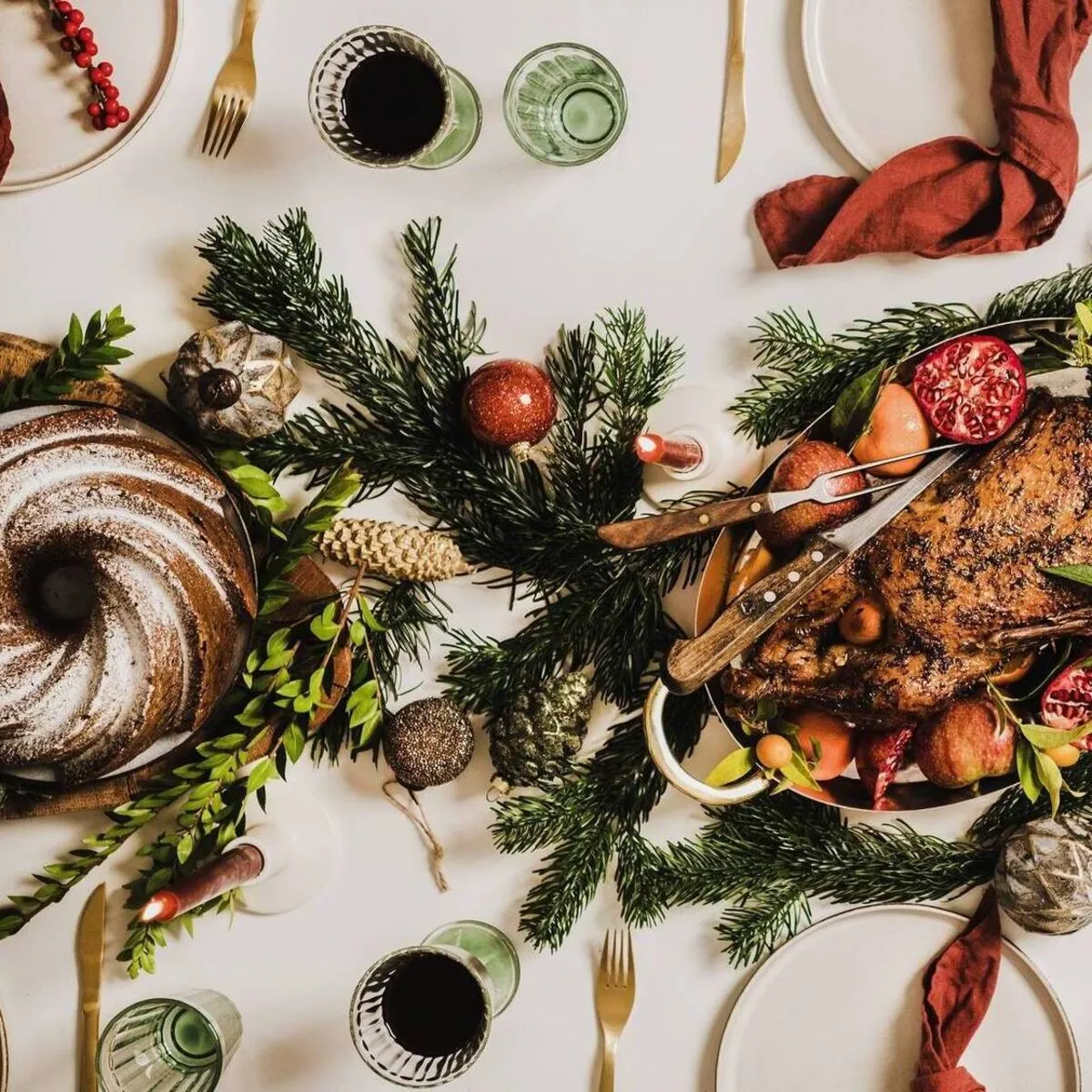
The formula is unusually clean: 45% white (cloth, plates, powdered sugar), 30% deep green foliage, 15% gold cutlery and platter, 10% red accents from pomegranate and napkins. It reads as natural and expensive simultaneously, and it costs almost nothing in decor because the food is the decoration.
One caution with fresh pine directly on cloth: sap. Put a thin layer of parchment or a narrow runner beneath the branches, and shake them outside before they come in. Baubles and pinecones tucked into the greenery are the finishing note, and they should sit low — this table doesn’t need height, it needs density.
24. Apples and Grapes Tucked Into the Garland
The move worth copying here is fruit as napkin decor. At each place setting, a folded napkin holds a small sprig of foliage and a single small fruit — a crabapple, a grape, a tiny red apple. Along the center, a lush garland of eucalyptus and dark leaves carries white roses, red flowers, and clusters of red apples and grapes. Distressed white chargers, silver cutlery, and clear wine glasses finish it.
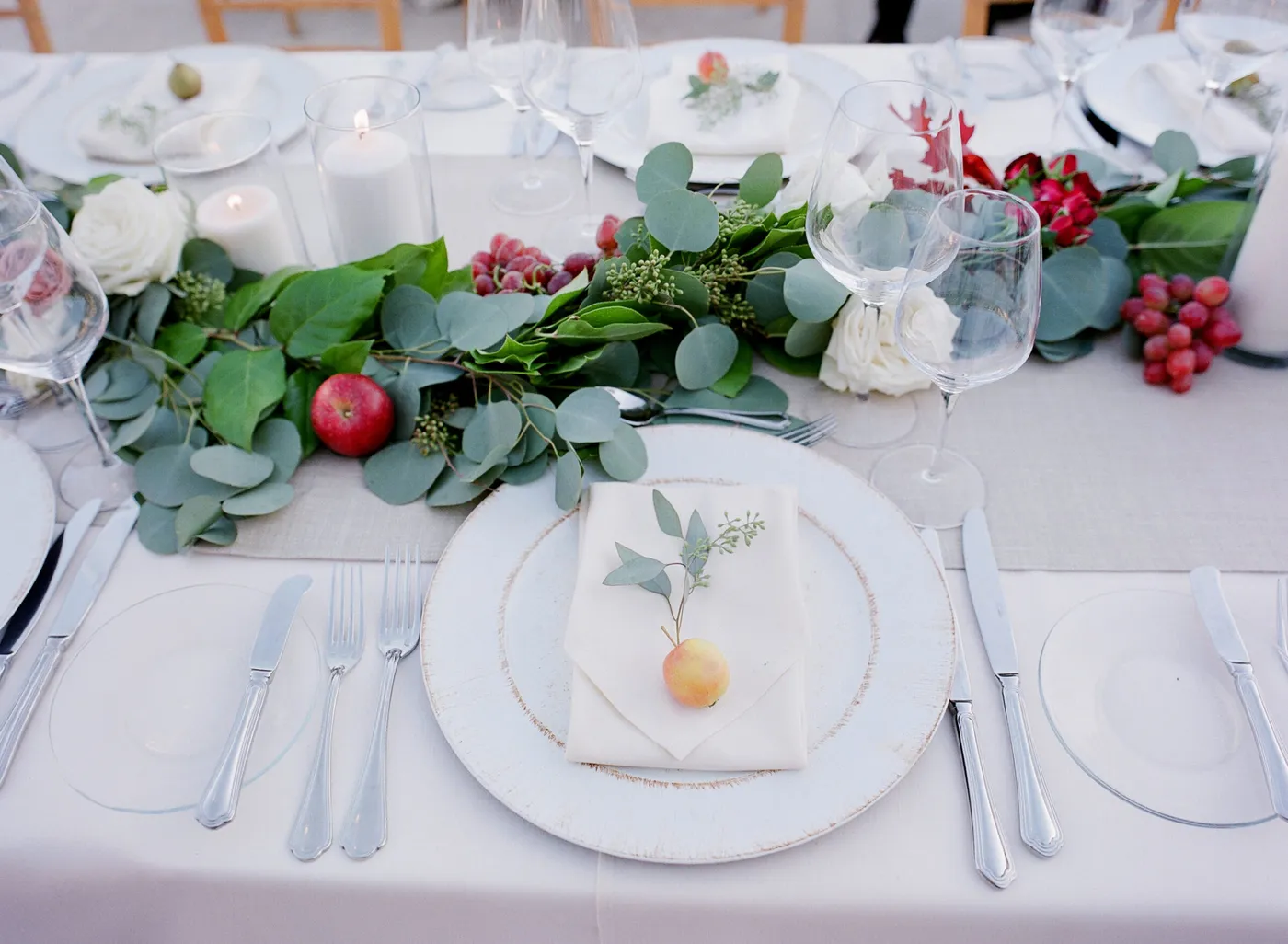
Specific tip: use fruit that’s sturdy at room temperature for four hours or more. Apples, clementines, and grapes are fine. Berries and figs will weep onto the linen. And wash and dry everything thoroughly — water spots on a cream cloth are forever.
On cost, this is one of the most affordable elegant tables in the collection. Grocery store apples and grapes run $10–$15, a eucalyptus bunch is $12, white roses from a supermarket are $15 for a dozen, and pillar candles in glass holders are $20 for a set. The whole centerpiece lands under $70. Distressed chargers can be spray-painted thrift-store plates for about $3 each if you want the exact look.
25. Navy Menorah Plates With Mercury Glass Glow
The element that makes this Hanukkah table feel special is the mercury glass — glowing candle holders clustered at the center, catching and throwing warm light across navy and cobalt blue place settings. Blue menorah-patterned placemats, white plates with blue menorah designs, cobalt drinking glasses, and navy cloth napkins held by silver menorah rings all sit in the same blue family, so the mercury glass reads as the one warm interruption.
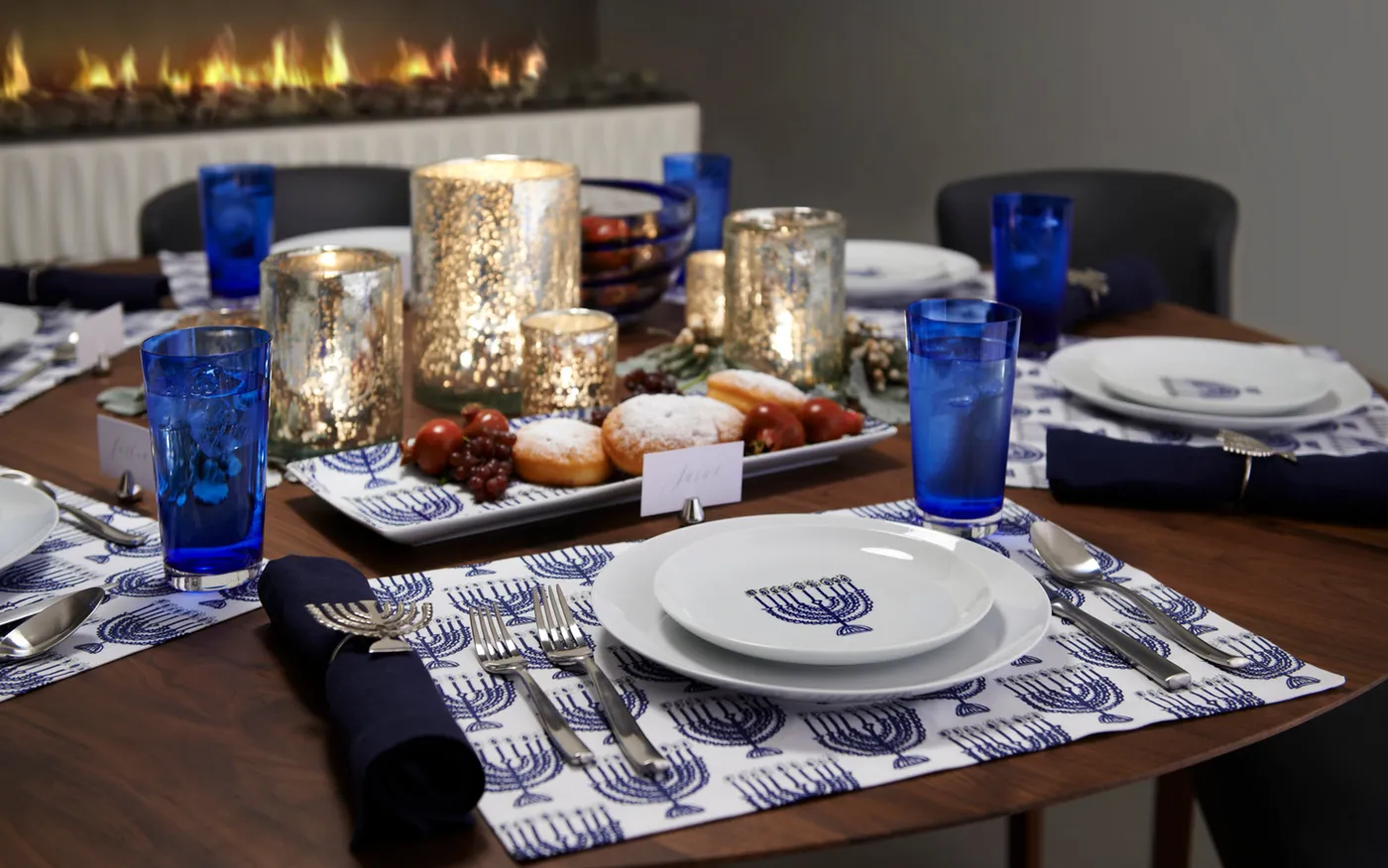
A platter of powdered sugar donuts and red fruit sits at the center, which is a nice reminder that holiday tables don’t require formal food to feel ceremonial.
Mercury glass needs gentle handling. Hand wash in lukewarm water only — hot water can crack the silvered finish between the walls, and a dishwasher will destroy it outright. Dry immediately with a soft cloth and store wrapped, not stacked. Also keep real flames away from the outer painted surface; the finish bubbles if a flame gets close. Battery-operated votives inside mercury glass give you 90% of the glow with none of the risk.
26. Crate Risers, Slate Boards, and a Charcuterie Mountain
The reason this charcuterie spread looks like a catering company did it is height. Multiple light wooden crate risers lift black slate boards to three different levels, so meats, cheeses, crackers, pickles, and olives read as a landscape instead of a flat scatter. White pillar candles and distressed white candlesticks fill the gaps, and small white ceramic vases of greenery break up the food.
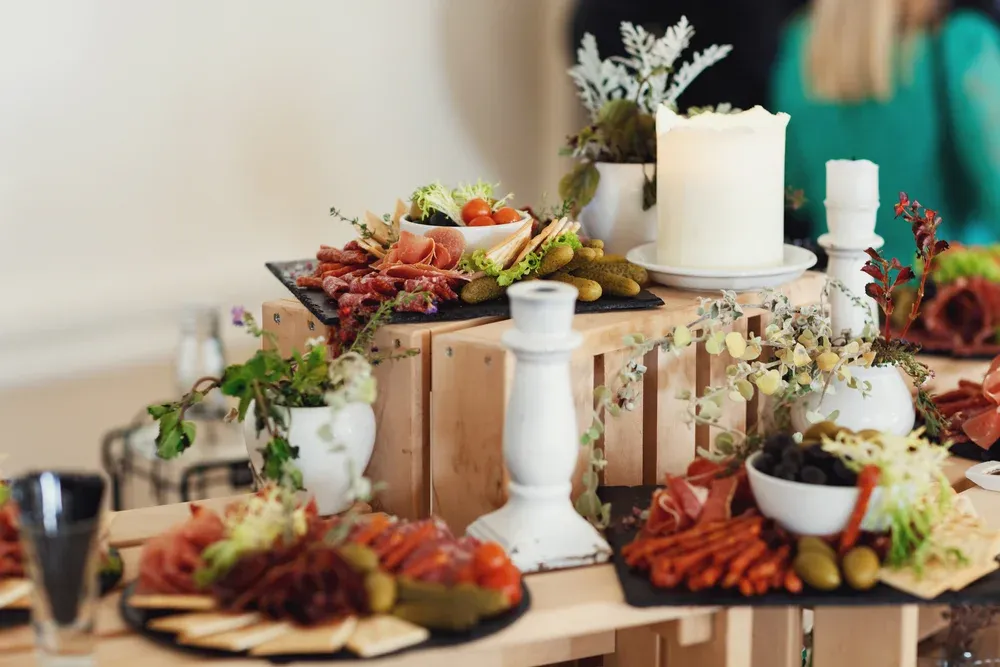
Build from the back and work forward — the tallest riser goes at the rear, and each row steps down so guests can reach everything.
- Set the tallest crate riser at the back center of the buffet
- Add two medium risers at the sides, offset rather than symmetrical
- Place empty slate boards on each level to test spacing before any food goes down
- Fill boards back to front, starting with the tallest items (salami roses, cheese wedges)
- Tuck candlesticks and greenery vases into the gaps between boards
- Add small bowls of olives and pickles at the front edge last
Time: about 40 minutes. Materials: $30–$70 for risers and candles if you don’t already own crates.
27. Pale Green Cloth, Turkey, and Mercury Glass Tealights
A glistening light green tablecloth is a braver choice than a white one and it pays off — the table reads festive without a single red tablecloth in sight. A roasted turkey with fresh herbs sits at the center, surrounded by roasted potatoes and pigs in blankets, with white plates with patterned rims, gold and brass cutlery, and mercury glass tealight holders adding warmth. Red and gold baubles scatter lightly.
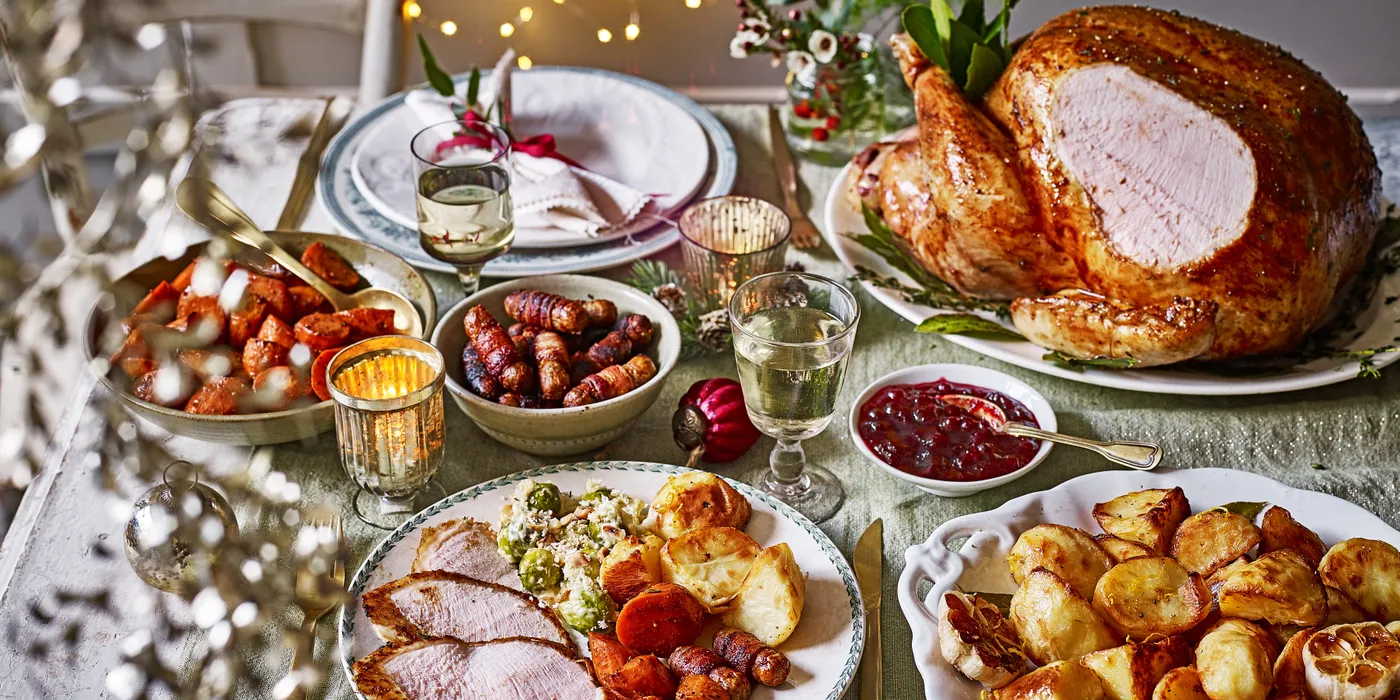
The math: 50% pale green (cloth, plus the baubles’ green tint), 25% golden brown (the bird, the potatoes), 15% white (plates, cream), 10% red and gold accents. Change the cloth to dusty blue and the same proportions give you a completely different holiday.
One honest note on shiny fabrics: a glistening cloth shows every crease and reflects every overhead light. Iron it on low with a pressing cloth, and if your dining room has a bare bulb overhead, expect a glare line right down the middle of your table. A dimmer or a lower-wattage bulb solves it.
28. A Driftwood Centerpiece of Pinecones and Mini Gourds
A long natural wood base, cut to look like driftwood, sits down the middle of a polished dark wood table holding pinecones, small orange and striped gourds, and green leafy sprigs, with a single lit tea light in a white textured holder glowing among them. It’s the least expensive idea in this entire collection and it might be the most charming.
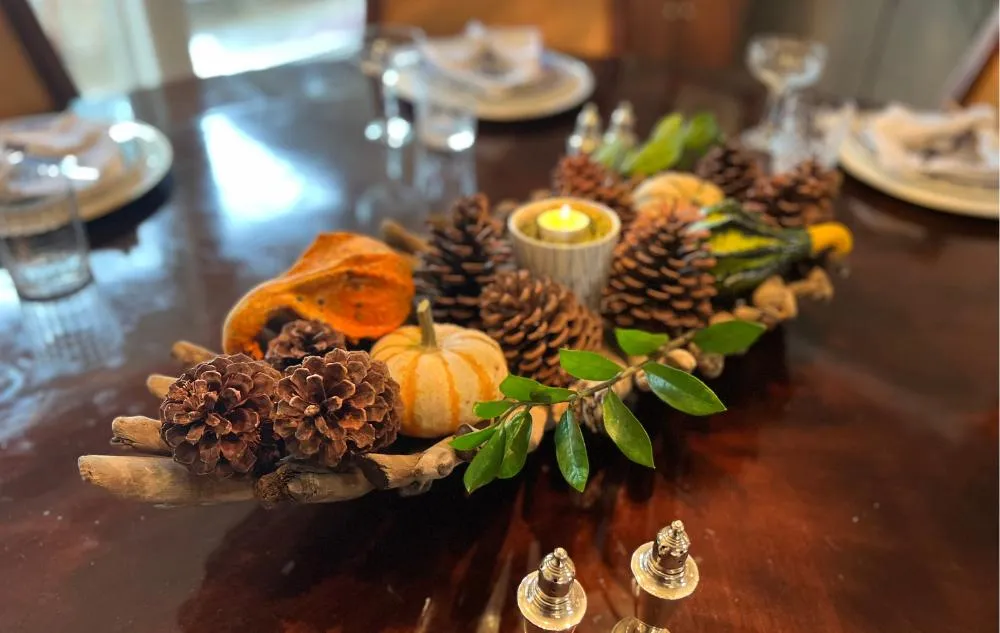
Pinecones and gourds are also the lowest-maintenance decor you can own — no water, no wilting, no candle wax on linen if you keep the tea light in its holder.
- Confirm your centerpiece base is shorter than your table by at least 12 inches on each end
- Bake foraged pinecones at 200°F for 30 minutes to kill any insects before bringing them indoors
- Check that gourds aren’t sitting directly on unfinished wood — they can leave moisture rings
- Use a battery tea light if kids or pets will be near the table
- Keep the arrangement under 8 inches tall so sightlines stay open
29. A Frosted Forest of Risers and Silver Spheres
This buffet builds an entire winter scene behind the food. Against a dark, textured wood-paneled wall lit by warm spotlights, artificial frosted evergreen trees and garlands create a dense forest backdrop, with a white glitter deer and large metallic silver spheres worked in. The appetizers themselves are in white ceramic dishes, elevated on distressed white wooden risers of different heights and shapes.
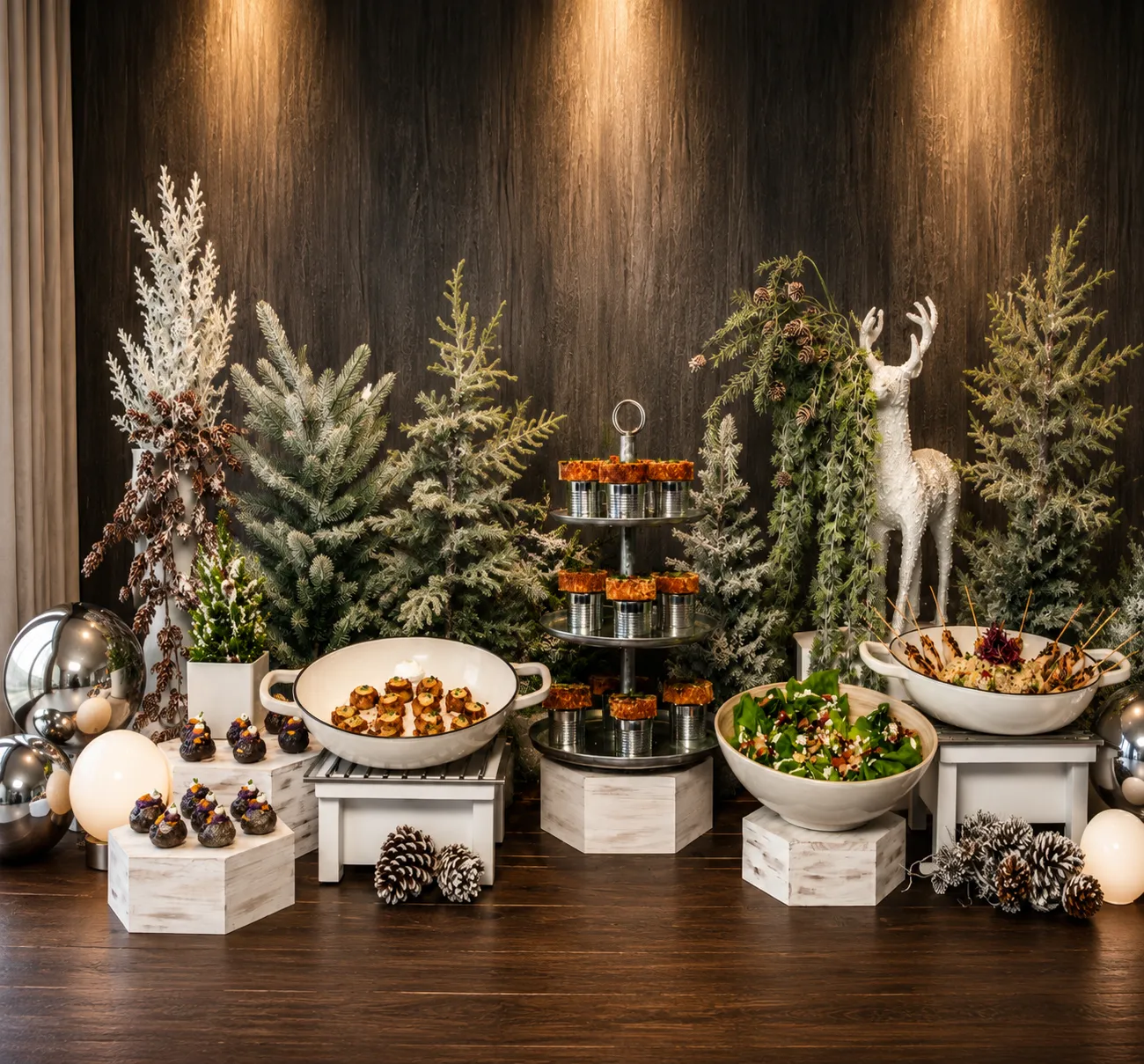
Two things make it work. First, the dark wall — frosted white decor needs a dark ground or it vanishes. Second, the risers all share one finish, so even though they’re different shapes, the display reads as a single system.
Room requirements: this needs a wall run of at least 8 feet and a room where you can direct light onto the backdrop. In a bright white room, the same arrangement will look washed out. If your space is small, see Idea #6 for a tabletop-scale alternative that keeps the festive feel without the forest. And if you’re using real flocked trees, keep them away from direct heat — the faux snow yellows over time near radiators.
30. Holiday Brunch Table With Layered Serving Pieces
A holiday brunch buffet has a different job than a dinner one: it needs to look generous at 10am, hold up for three hours of grazing, and not require re-plating. The approach that works is layering — a mix of heights and vessel types so late arrivals can still see what’s available without unstacking anything.
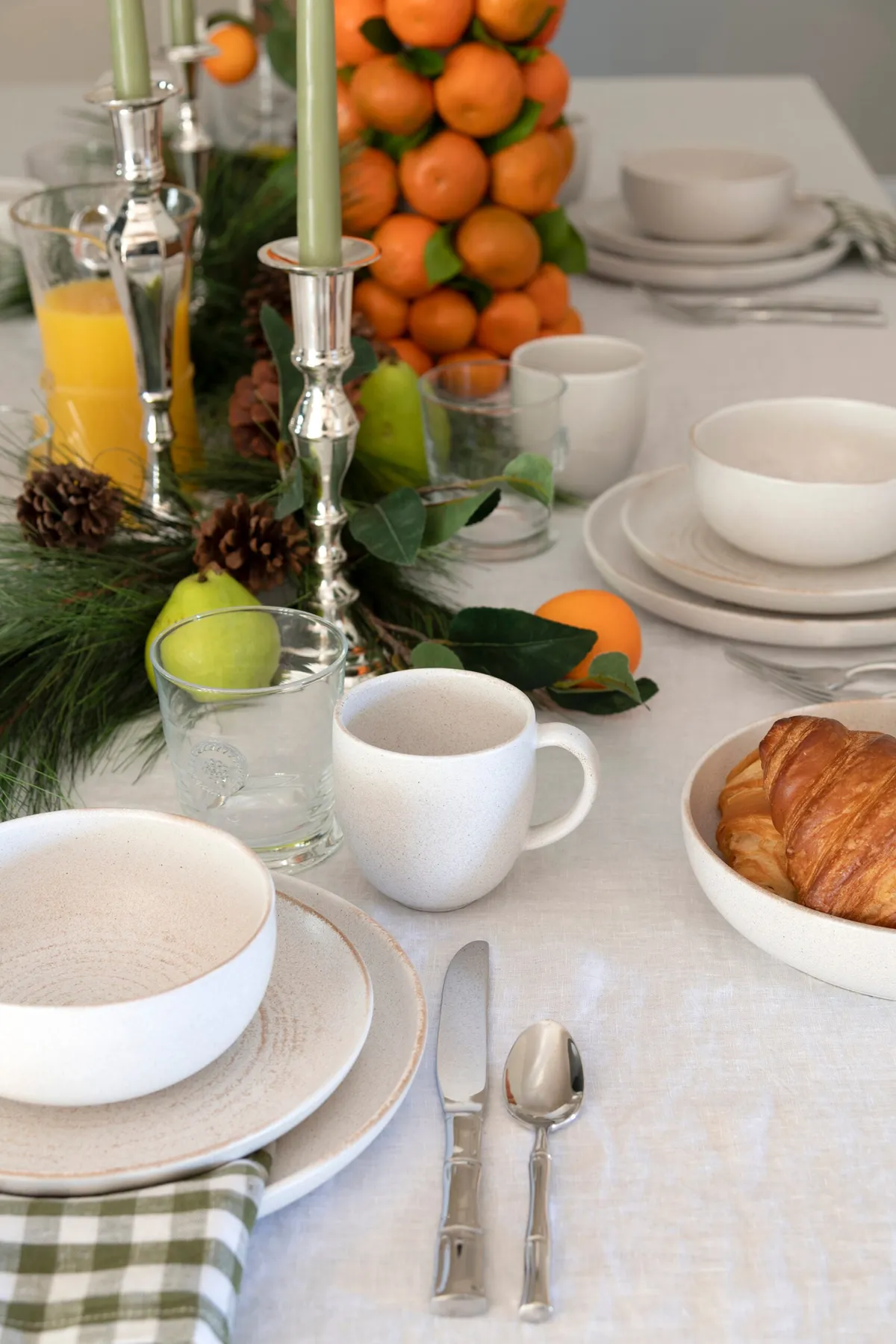
Specific tip: put anything that’s better warm at the back near the kitchen door, and anything served cold at the front. Guests naturally move from the entrance of the line toward the far end, so your hot dishes should be reachable early and your cold items last. It sounds obvious and almost nobody does it.
You can build this look almost entirely from what you own. Sheet pans lined with parchment become risers under a cloth. Cake stands elevate muffins. Mason jars hold silverware and breadsticks. A $20 trip to a thrift store for two mismatched cake stands will do more for your brunch table than $200 of new serveware. Coordinate by finish, not by set — all white, all wood, or all glass.
31. White Cloths, Gold Tiered Stand, and Charcuterie Boards
The gold-toned tiered stand is the element that turns a long white-clothed buffet into something celebratory. Without it, you’d have charcuterie boards, ceramic bowls of dips and olives, glass jars of breadsticks, and mini croissants — all good, all flat. The tiered stand adds vertical interest and gives small items like sliced meats and snacks a place to live, so the boards don’t have to carry everything.
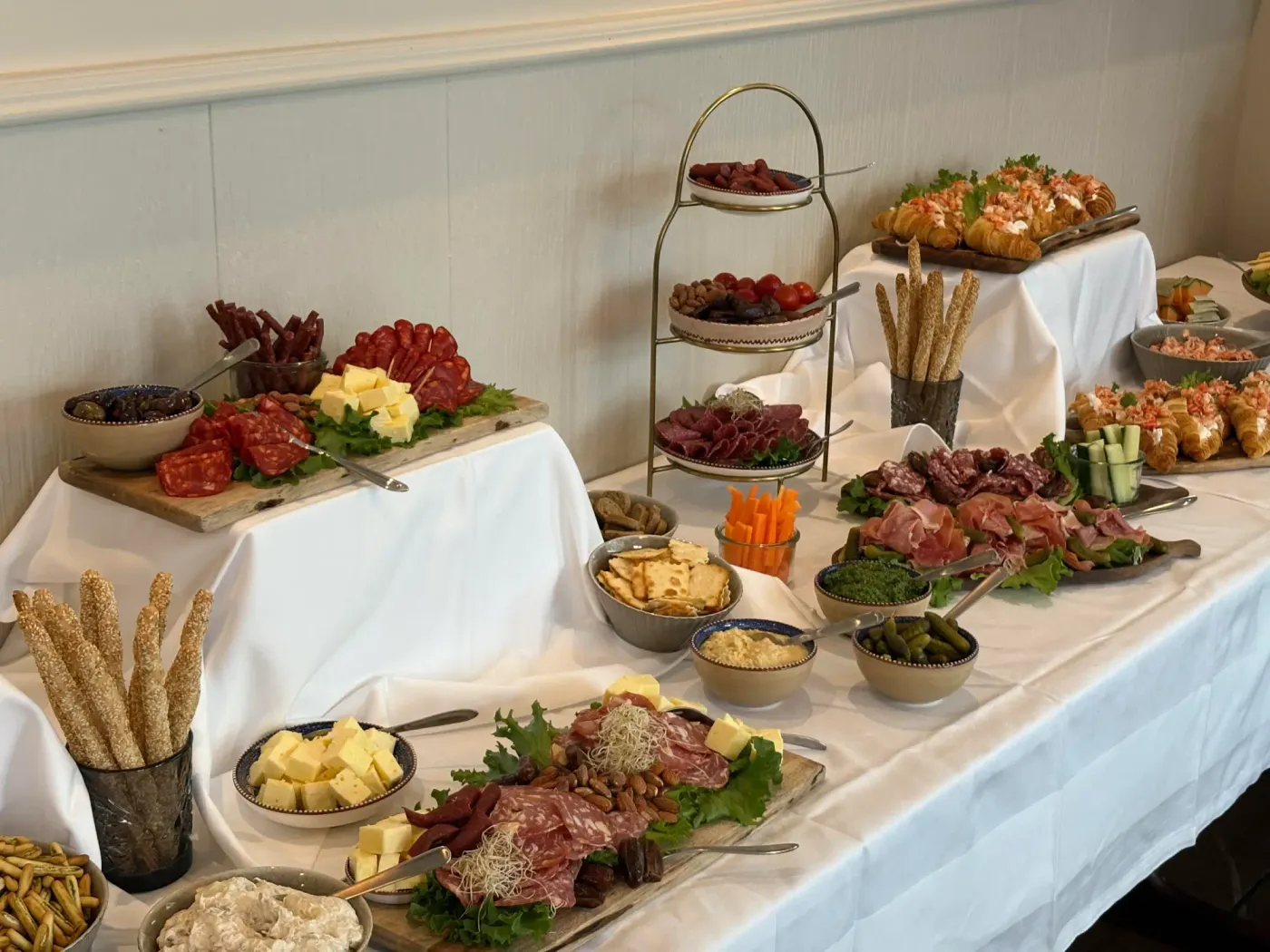
It also creates a natural focal point at the center of the table, which means you can arrange the boards symmetrically on either side and stop thinking about it.
- Two white floor-length tablecloths: $40–$90
- Gold-toned tiered serving stand: $35–$80
- Wooden charcuterie boards (set of 3): $45–$100
- Ceramic serving bowls, assorted: $50–$120
- Glass jars and small spoons: $20–$45
- Blue and white patterned plates: $30–$70
- Total: roughly $220–$505
Swap in a two-tier wire stand spray-painted gold and you’re at the low end of that range in an afternoon.
Set the Table, Then Step Back and Let It Be
The best holiday buffets aren’t the ones with the most on them — they’re the ones where someone made three or four deliberate choices and then trusted them. Pick your palette, choose one finish for your serving pieces, get the candles at the right height, and let the food be the star. Everything else is garnish.
Start with one idea from this list that fits the table you actually own, not the one you wish you had. 📌 Pin the ones you love now — December arrives faster than you think.