Most Christmas tree guides show you the same twelve photos of the same twelve trees — and none of them look like your living room. This one is different: every tree below is a real tree in a real home, photographed exactly as it was styled.
We spent serious time browsing Target, Etsy, and Pottery Barn (plus a few vintage sellers) to bring you only what’s worth your attention this year, across a price range from about $12 for a single ornament to $1,200 for a fully lit nine-footer.
Inside you’ll find 31 curated ideas spanning flocked-and-glamorous, vintage traditional plaid, playful pink, and natural driftwood. Budget and luxury versions sit side by side, and every idea includes the real cost to recreate it. And stay until the end — we break down the most common mistakes that can ruin these looks.
2026 is the year color came back to the tree. Pinterest searches for pink and non-green trees keep climbing, and flocked whites are being styled with one loud, saturated accent instead of all-neutral everything.
📌 Save this to Pinterest for later — you’ll want to revisit these ideas.
1. A Heavily Flocked Tree in White, Gold, and Silver
Don’t hang anything heavy on a flocked branch tip. Faux snow crumbles where weight presses it, and by mid-December you’ll be looking at bald patches. Keep decorations at least four inches back from the tips and save the big statement pieces for the inner branches, where the flock is naturally thinner. If a heavy ornament has to sit near the edge, wire it to the branch itself and let the flock stay undisturbed behind it.
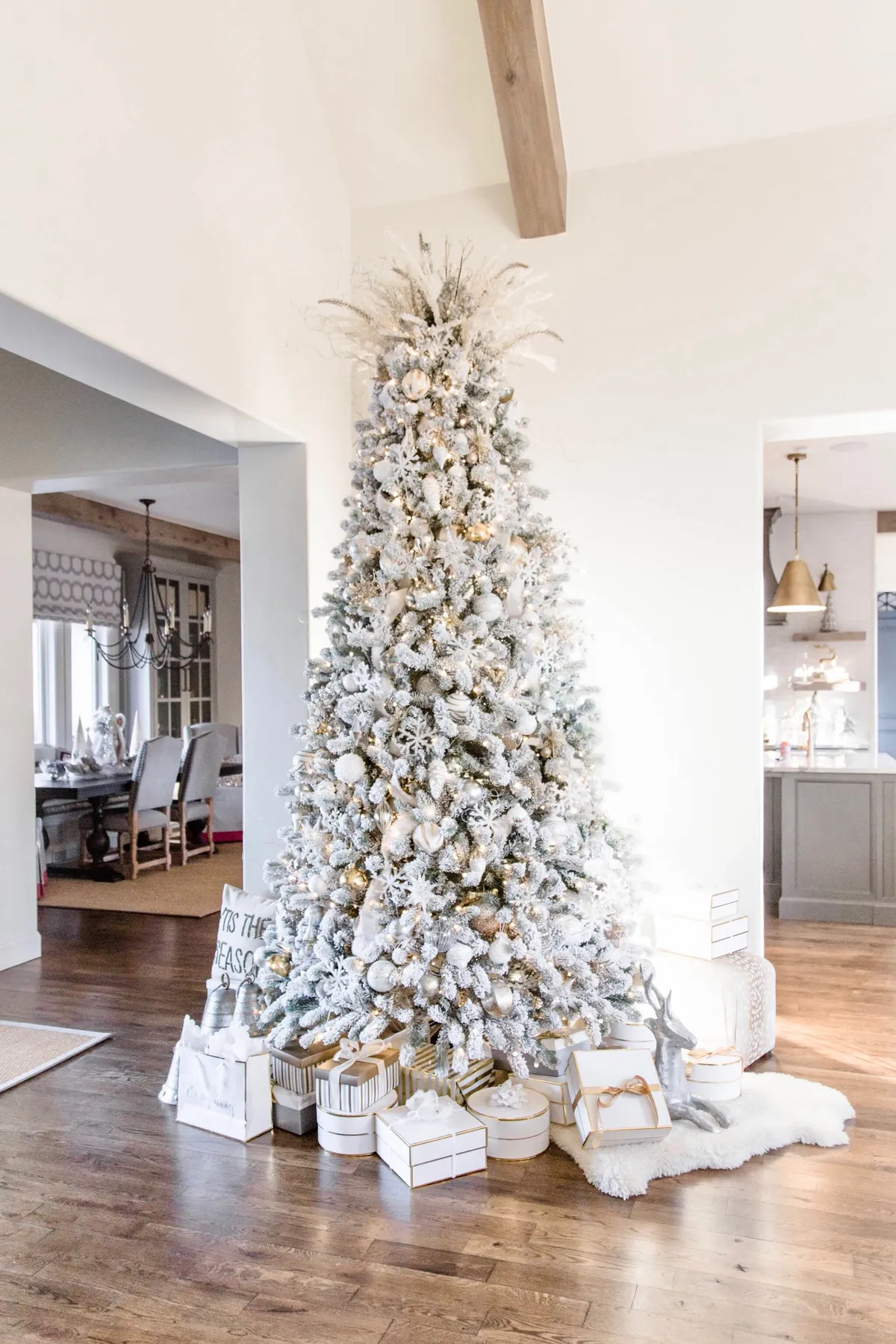
The white faux fur rug is the thing you’d miss most if it disappeared. Those gold-wrapped boxes and snowflake ornaments read expensive because they’re landing on something soft — put the same gifts straight onto dark hardwood and the whole arrangement turns formal and a little cold. About $40 buys the mood, and it hides the stand while it’s at it.
2. Three Trees, One Grand Room, All Gold and Crimson
Three trees sounds excessive until you notice the height hierarchy doing the heavy lifting: one tall centerpiece, two shorter trees stepping down on either side. Your eye reads a single composition instead of three separate objects. The flanking trees carry the red, the center carries the gold, and the arched mirror behind them bounces every bulb back into the room.
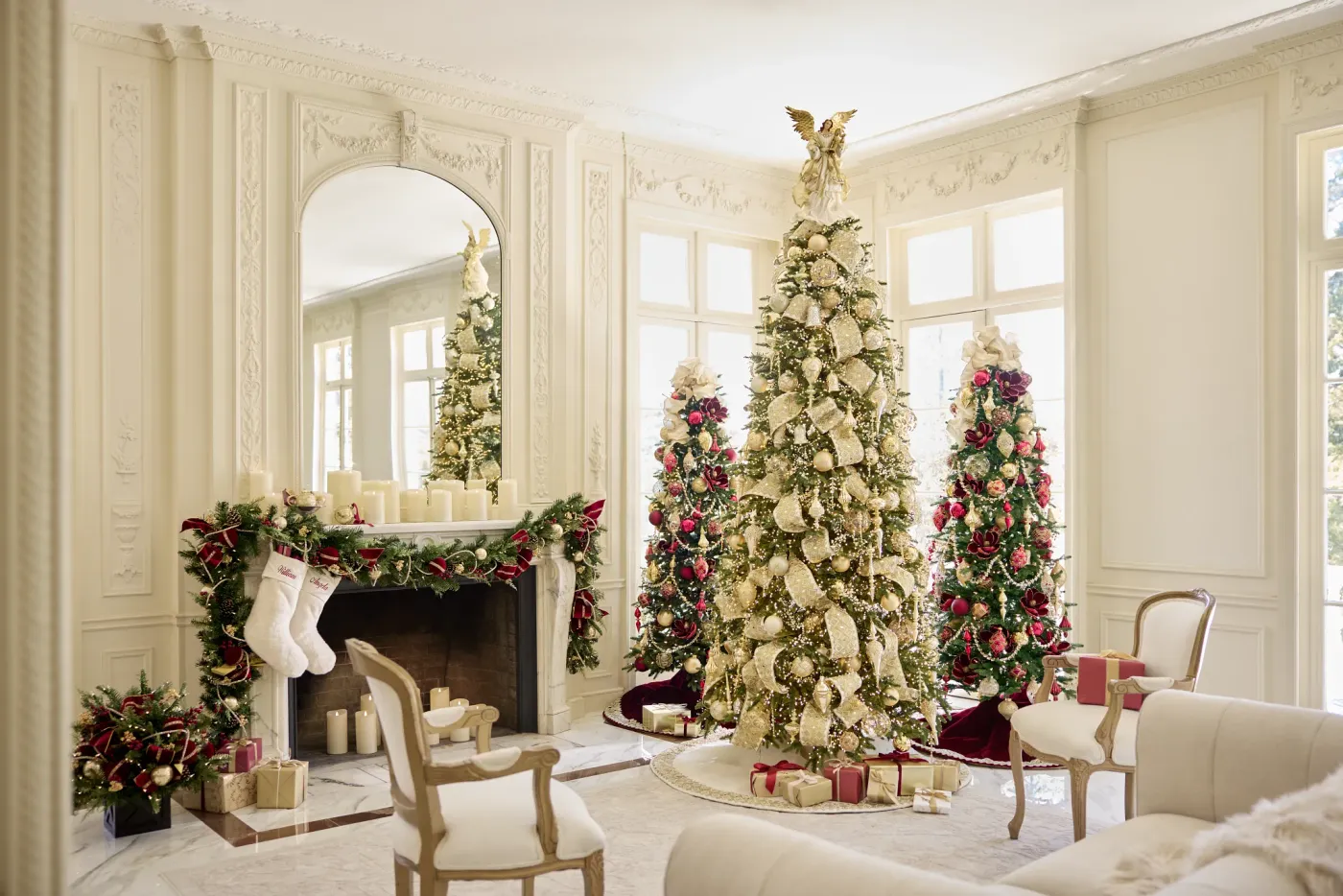
Before you commit to a trio, count your outlets. Three pre-lit trees at 7.5 feet can pull 300 to 450 watts combined, which is fine on one circuit and miserable on one power strip. Plan the cord route before anything goes up, use LED strings only, and tape down every run that crosses a walking path.
3. Frosted Gold and Silver With a Mirror Behind It
This is a 70/25/5 formula: seventy percent frosted white tree, twenty-five percent mixed gold and silver metallics, five percent warm light showing through. The frost stays the star — metallics never outnumber the snow. Swap gold for copper in a warmer room, or silver for pearl in a cooler one, and the formula holds. If you want this exact frost level with a red jolt instead, Idea #9 starts from an identical base.
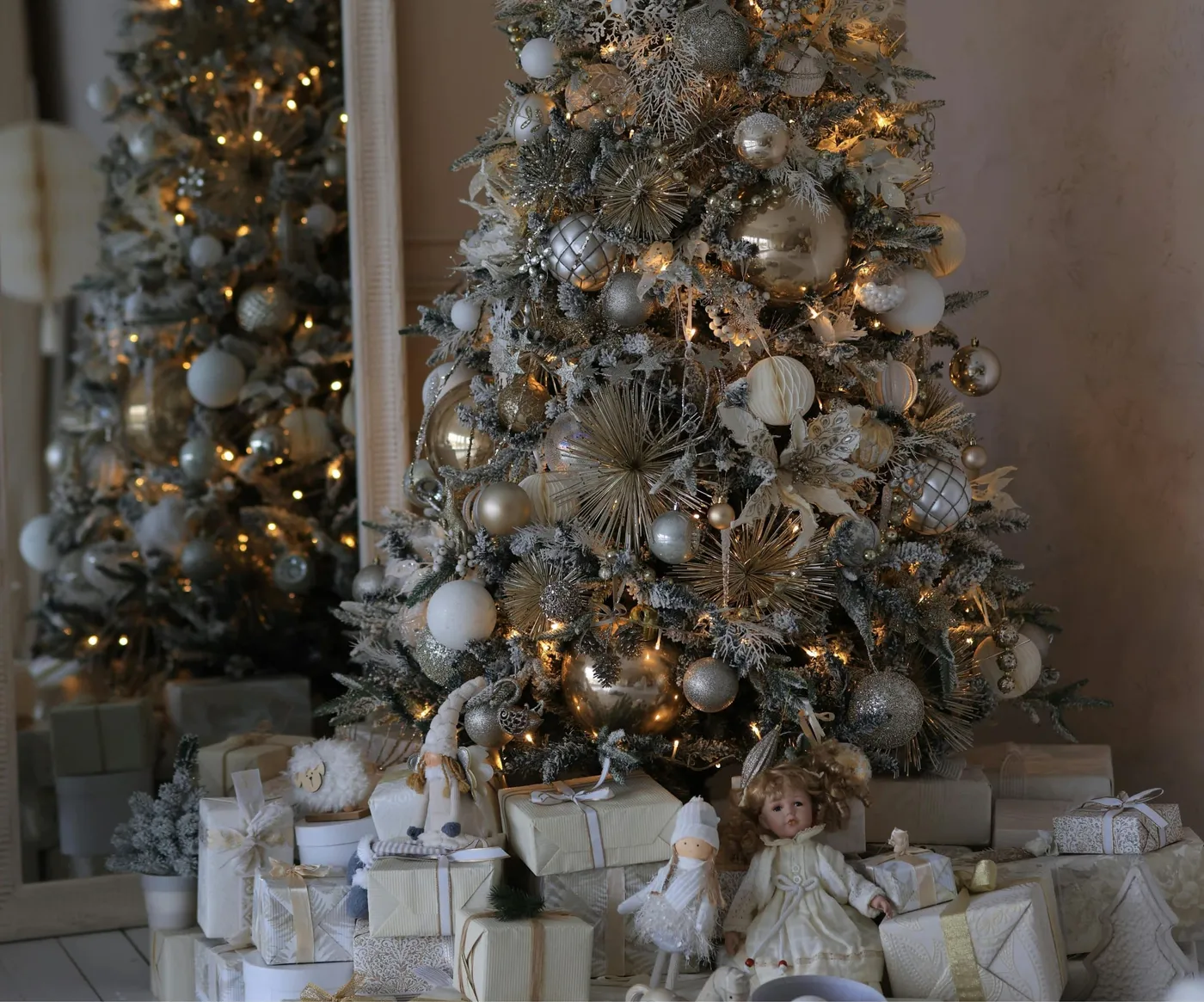
- Flocked 7.5 ft tree: $180–$450
- Gold and silver ornaments, 60–80 pieces: $60–$150
- Warm white LED string lights: $25–$45
- Wrapping paper, ribbon, and boxes: $35–$70
- Tree collar or skirt: $30–$80
Total: roughly $330–$795. Budget alternative: a $99 flocked tree from Walmart, clearance ornaments at 70% off in January, and kraft paper with wide gold ribbon gets you 80% of this for about $190.
4. A Pre-Lit Green Tree on a Metallic Gold Disc
The metallic gold disc stand is the piece doing the real work here — not an ornament, not a ribbon, the base. A skirt would have covered the same area and added bulk, but this flat gold plate lets the tree sit on the floor like a sculpture. Pull it out and you have a perfectly nice green tree. Leave it in and the corner reads intentional.
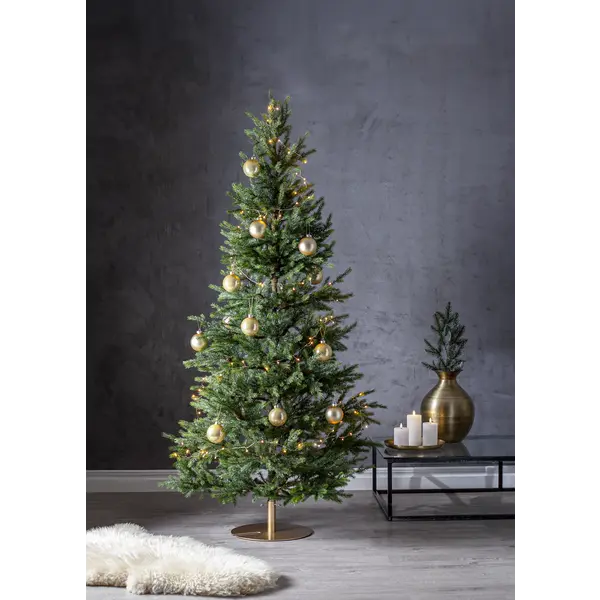
This look needs about 10 by 12 feet to breathe and an 8-foot ceiling, with a 7.5-foot tree leaving room for the topper. In anything narrower than 10 feet, drop to a 6.5-foot slim tree — the matte gold ornaments are large enough to hold their own on a smaller footprint. Keep the coffee table 30 inches away so the glass top doesn’t compete with the lights.
5. Plaid Ribbons, Nutcrackers, and Frosted Berries
Plaid, nutcrackers, and dried fruit are having a genuine revival — the “collected Christmas” look that’s been building on Pinterest for three seasons now. It’s a reaction to years of all-neutral trees: people want their grandparents’ ornaments back. The good news is this trend has real staying power, because it’s built from things you already own or can buy for under five dollars at a thrift store.
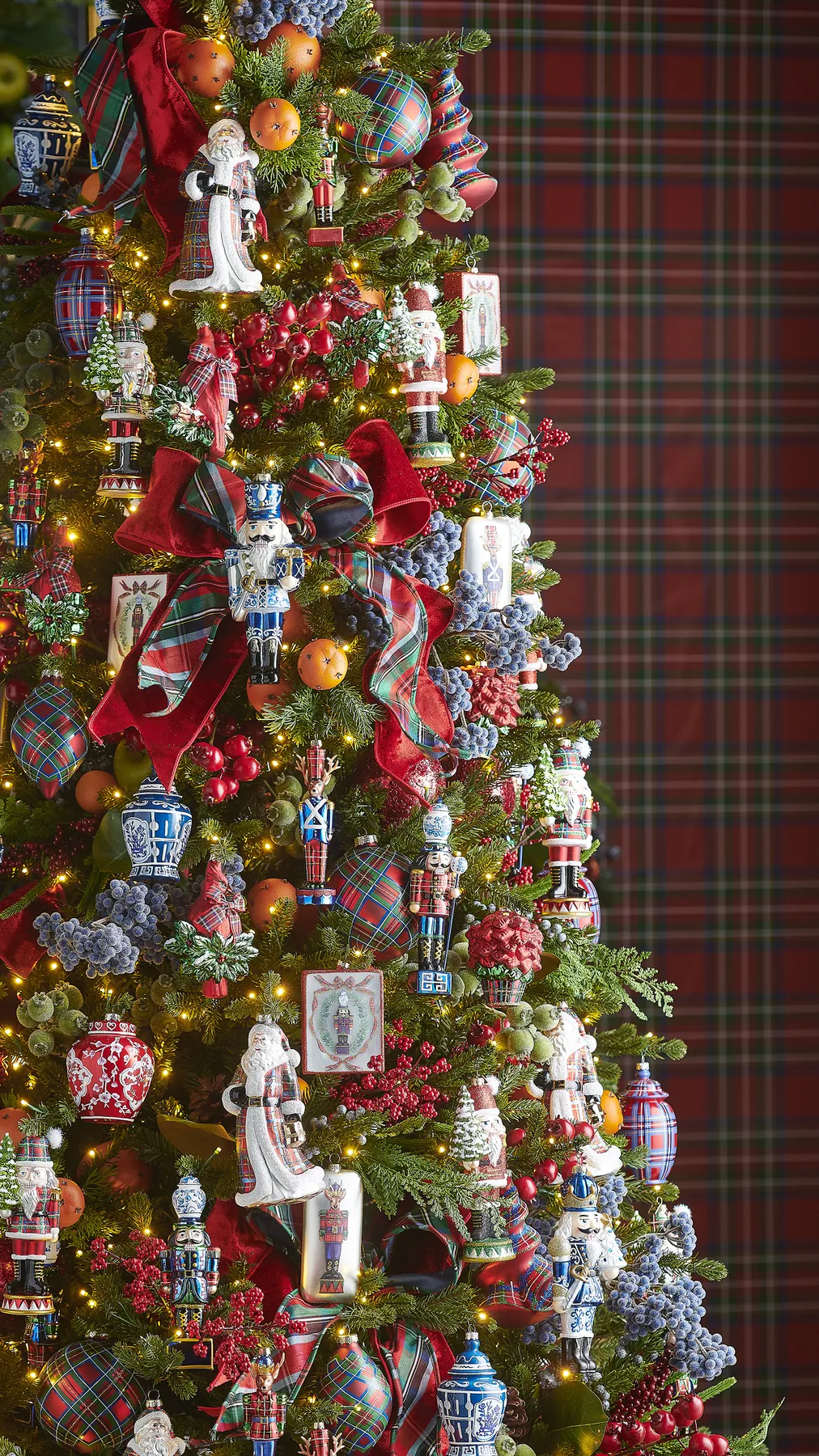
Make your own dried orange slices instead of buying them. Slice navel oranges a quarter-inch thick, blot them dry, and bake at 200°F for two and a half to three hours, flipping halfway. Poke the hanging hole with a skewer before baking, not after, or you’ll crack the rind. A dozen ornaments costs about $4 and they’ll last years in a sealed bag.
6. Pink Floral Ribbon Cascading Down a Flocked Tree
Getting that ribbon to cascade instead of look like a bow stuck to a branch:
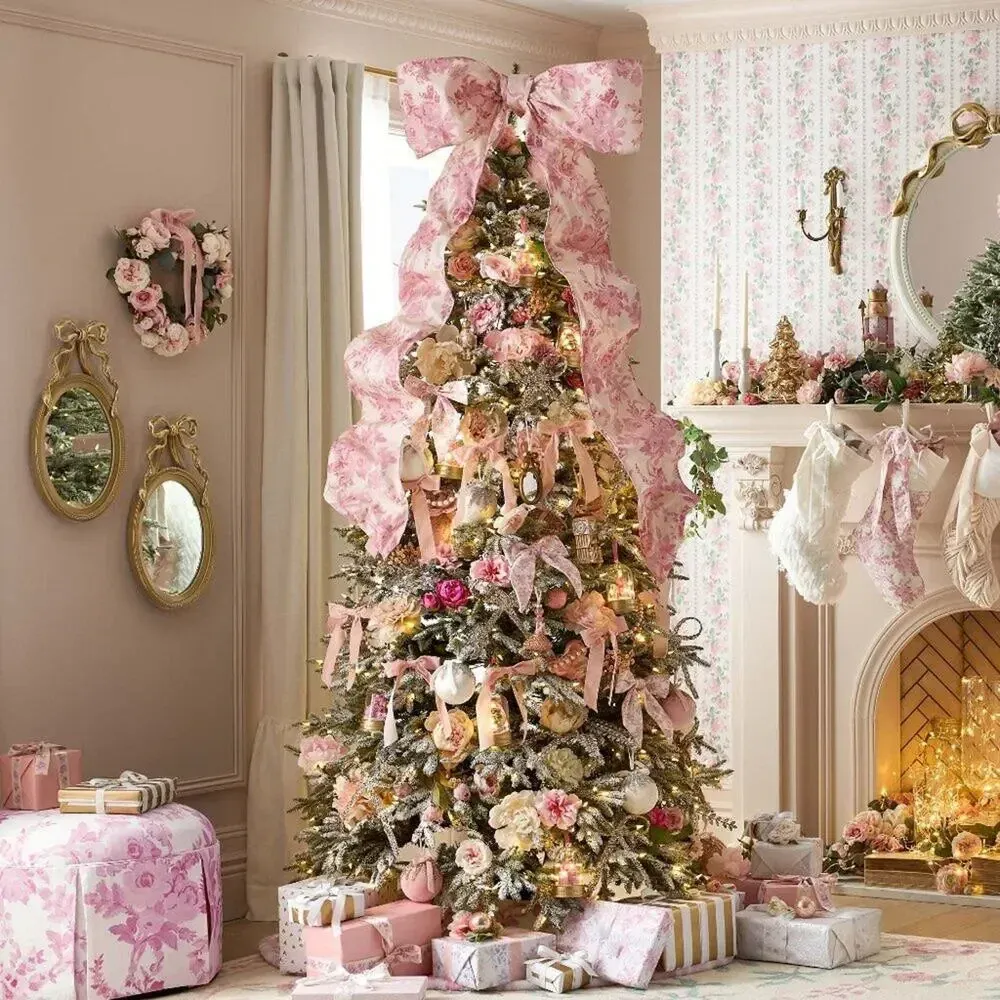
- Cut three yards of 4-inch ribbon per swoop.
- Anchor the top with a zip tie around a sturdy branch, never a twig.
- Run the ribbon down in a loose S, pressing it into the branches every 8 inches.
- Twist once at each turn so the pattern faces outward.
- Finish with a bow at the base of the last swoop.
Roughly 30 minutes of work and $18 to $30 in ribbon.
Floral ribbon looks expensive; it usually isn’t. Target and Walmart both stock wide patterned ribbon for $8 to $12 a roll in November, versus $30 to $40 for designer versions that photograph identically. Skip the matching upholstered ottoman entirely — a $25 pink velvet pillow on the sofa you already own does the same color work.
7. Red Velvet Magnolias and Draped Pearl Strands
Velvet magnolias and pearl strands are gorgeous and slightly high-maintenance. Those big fabric blooms flatten permanently if you stack them in a storage bin — store them in a single layer in a shoebox. Pearl strands tangle into knots that take an evening to undo, and they’re a genuine choking hazard for toddlers and a chew toy for cats. Cap yourself at six to eight large florals per tree and you keep the drama without the mess.
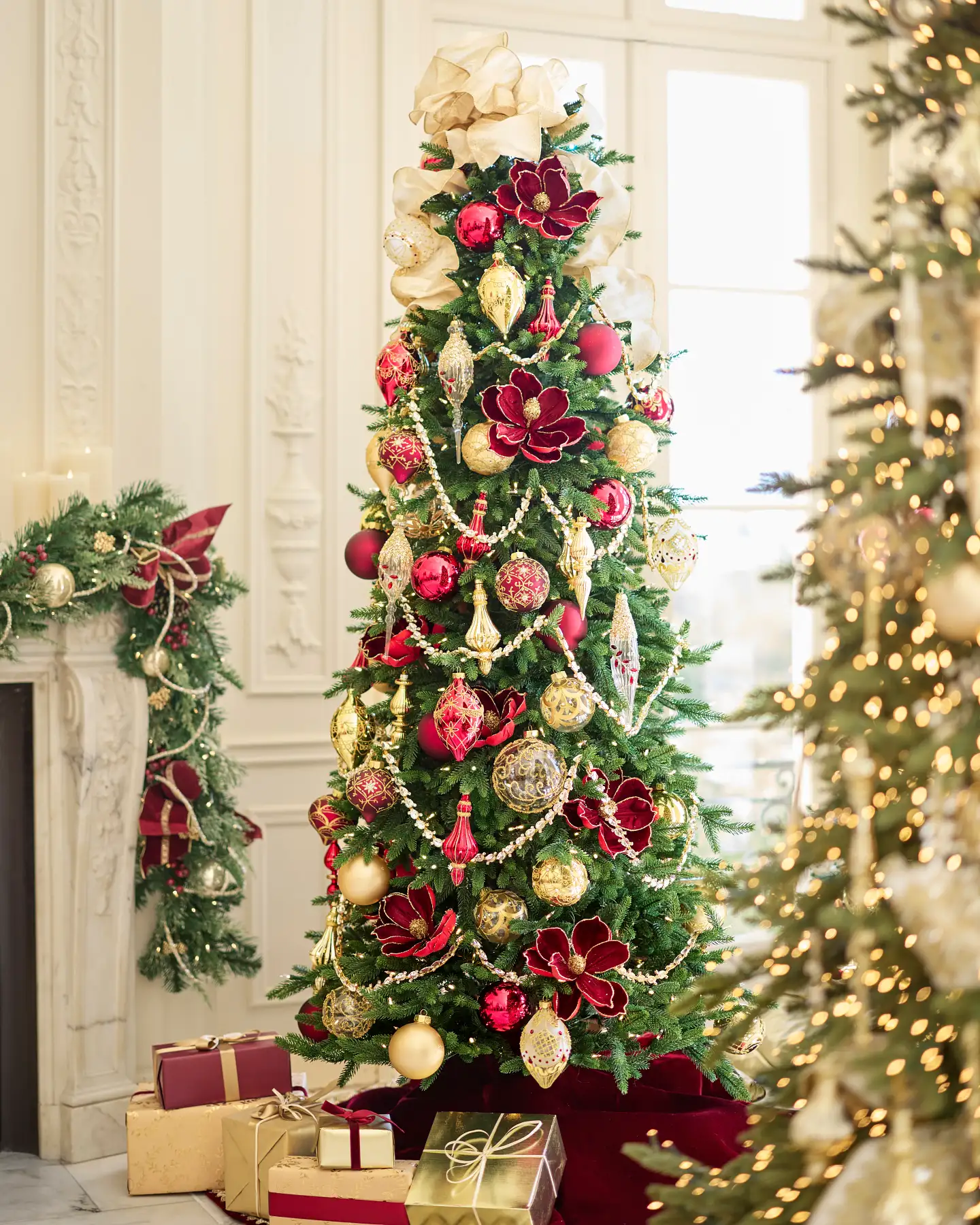
Two things are doing the work here. The oversized champagne bow at the top matches the scale of the floral clusters below, so nothing looks like an afterthought. And the pearl strands hang vertically while everything else reads round — that single directional element is what makes the tree feel like it’s dripping rather than sitting there. Same ornaments, no strands, and it’s a much flatter tree.
8. Pastel Ornaments on a White Flocked Tree
Fifty-five percent white flocked branches, thirty percent pastel pink and teal ornaments, fifteen percent lime with gold bead garland threading through all of it. The lime is the risky one — it’s what keeps this from reading like a nursery. Use it in small doses, three or four pieces max, and let pink carry the weight. Swap teal for lavender and you get a softer, more grown-up version without changing anything else.
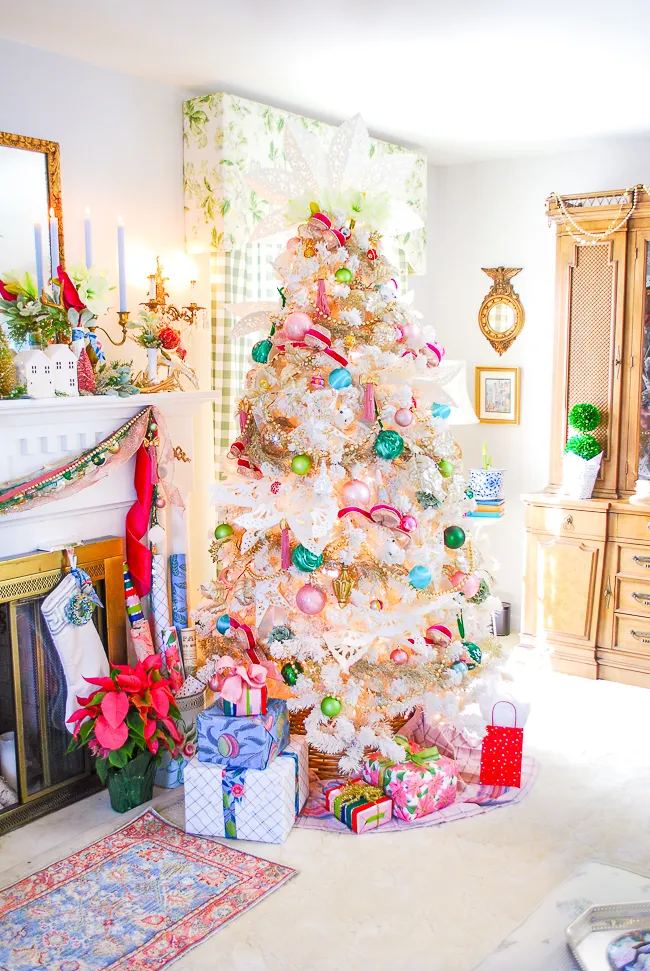
The gold bead garland is the only warm element on an otherwise cool-toned tree. Without it, the pastels start reading Easter instead of Christmas. Run it in deep loops rather than tight swags so it catches the light on the way down. If you own nothing else gold, buy one strand — about $12 — and this whole tree suddenly makes sense.
9. A Bright Pink Tree in a White Entryway
Bulb temperature matters more on a colored tree than a green one. Use 2700K warm white exclusively — cool white LEDs turn bright pink into an ashy mauve the second the room lights go off. Look for “warm white” or “soft white” on the box, not “daylight,” and if you’re buying pre-lit pink, ask for the color temperature in writing. It’s the difference between candy pink and bruised pink.
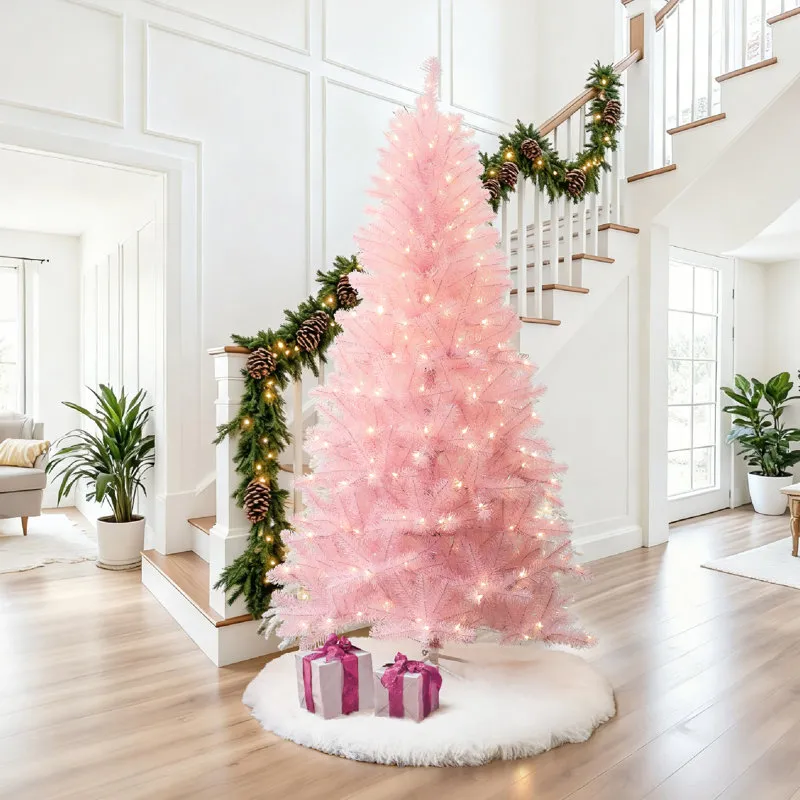
Entryways are where this most often goes wrong. A 6- or 7-foot tree in a 5-foot-wide hall needs a maximum 30-inch spread, or you’ll be turning sideways to grab your coat. Leave 36 inches of clear walking path and nothing hanging below knee height. Tighter than that? Idea #21 shrinks the whole concept to a tabletop version that fits on a console.
10. Shiny Red Ornaments on Heavy Flock Under Dark Beams
- Heavily flocked 7.5 ft tree: $200–$500
- Shiny red ornaments, 80–100 pieces: $55–$120
- Warm white LED lights: $25–$50
- White decorative branches: $15–$35
- Tree skirt: $30–$70
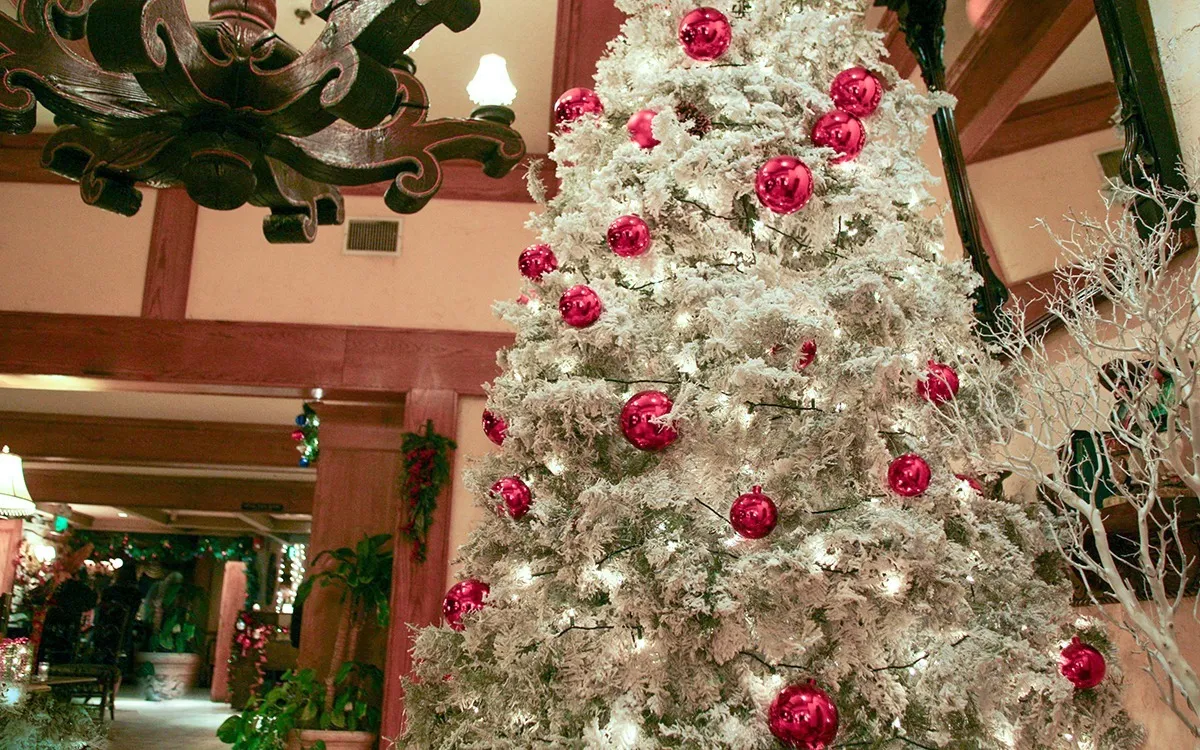
Total: roughly $325–$775. Budget alternative: flock your own green tree with a $20 can of spray snow, then buy red ornaments in bulk tubes at about 40 cents each. You’ll spend roughly $160 and get a look that photographs nearly the same.
Flock sheds. Expect to lose five to ten percent of it every season, and a fine white dust on the floor the week you set up and the week you take down. Vacuum with a brush attachment on low — a bare hose nozzle pulls the flock right off. Store it in a breathable bag in a climate-controlled closet, never a hot garage, or it yellows by next December.
11. Pink Feather Boas That Climb the Mantel
Feather boas shed, hold static like a magnet, and are absolutely fascinating to cats. They’re also the one decoration on this list I’d genuinely warn you about near a working fireplace — keep every strand at least three feet from an open flame and never let a boa drape over a mantel you actually burn in. If you have a wood-burning hearth, keep the feather work on the tree side of the room.
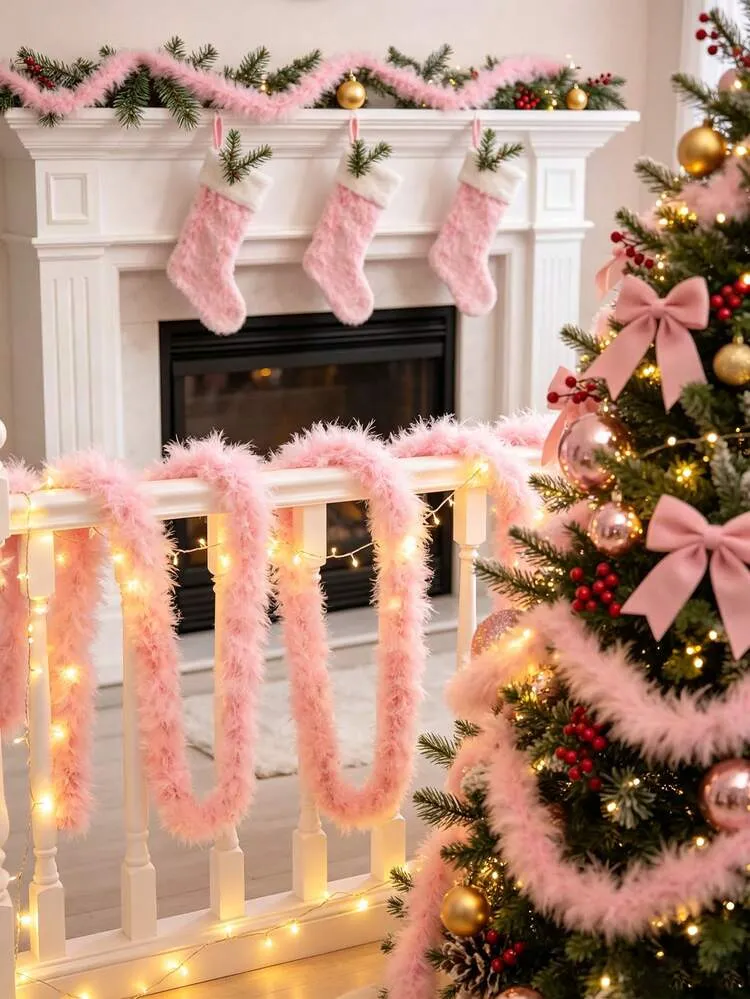
The formula is 60 percent green tree, 25 percent pink, 10 percent gold, 5 percent red berries. The red is doing more than you’d think — it’s the only thing anchoring all that pink to a Christmas palette instead of a birthday one. Swap the red berries for burgundy velvet ribbon if you want it moodier, or white berries if you want it softer.
12. A Metallic Pink Tinsel Tree in a Ceramic Vase
Value contrast, plain and simple. Metallic pink is a light, bright color, and that dark grey wall makes it look lit from within. Against a white wall the same tree would read flat and slightly cheap. The cream textured armchair and the big white window then give your eye somewhere to rest, so all that shine feels controlled instead of chaotic.
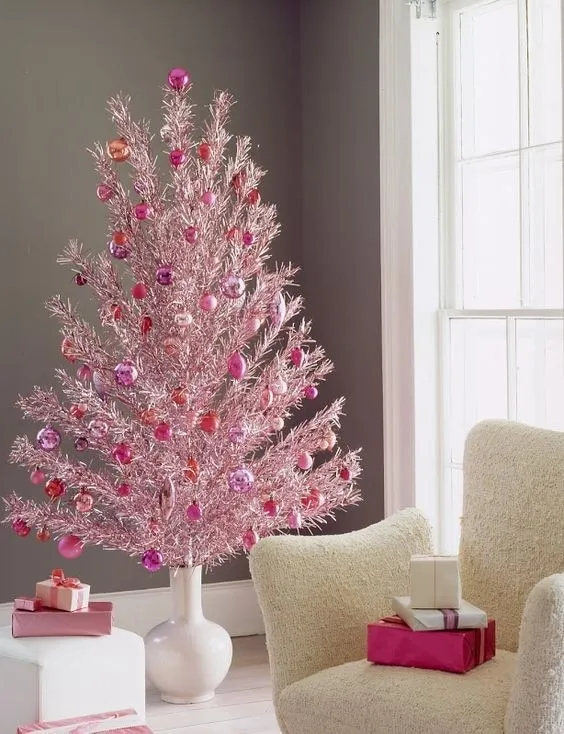
Tinsel trees are top-heavy and tip over more than people expect. Before anything else, weight the vase — a third of a bag of play sand or aquarium gravel, about $6 — and set it on a non-slip pad. Then bend the branches outward in a slow spiral rather than straight out to the sides, which fills the gaps and keeps the tinsel from looking combed.
13. A Real Tree Loaded With Everything, Topped in Pink
The collected-over-time look is the cheapest style on this entire list, if you shop it right. Thrift stores and estate sales sell glass ornaments for 50 cents to $2 each, and Facebook Marketplace lots of 100 go for $20 to $40 in early November. Skip the matching boxed sets entirely — this tree’s whole personality comes from things that don’t match.
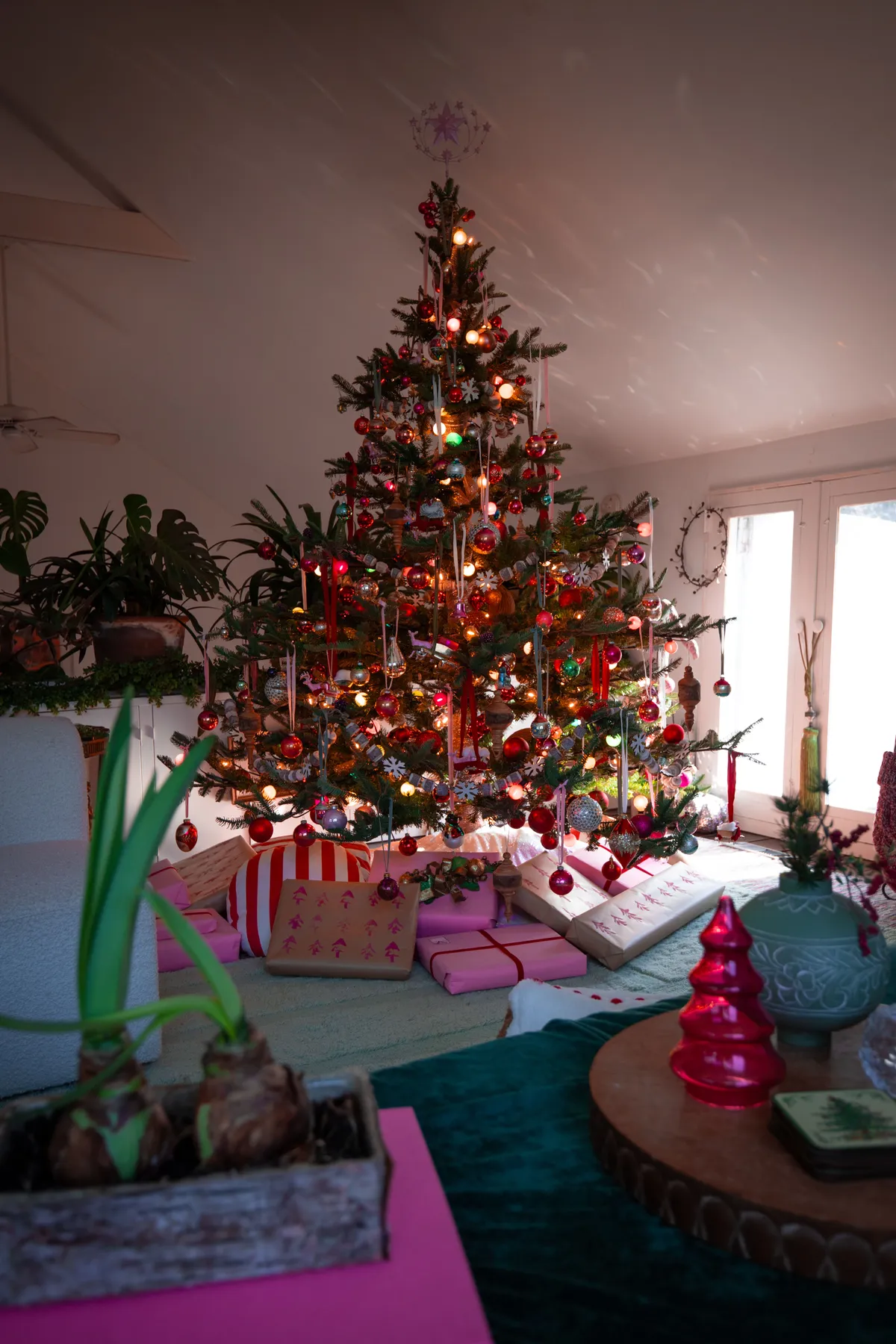
A real tree this loaded needs 9 to 10 feet of ceiling and a stand you actually measured. Budget 14 inches above the tree for the topper, and add the stand height before you buy — a 7.5-foot tree on a 12-inch stand is effectively 8.5 feet. Give it 18 inches of clearance on all sides so branches can breathe and gifts have room.
Maximalism has been creeping back for a couple of years, and Christmas is where it fits most comfortably — nobody calls a tree cluttered. The 2026 shift is away from coordinated sets and toward trees that look like thirty years of accumulated memories. It’s also why pink keeps showing up: one unexpected color separates vintage from dated.
14. A Frosted Pre-Lit Tree on a Star-Shaped Rotating Stand
The rotating stand. It’s a $60 piece of hardware that solves the single worst part of decorating: reaching around the back. Set the tree on a rotating base and you decorate and photograph it once, front to back, without ever crawling behind it. On a tree this frosted and pre-lit, that’s not a luxury — it’s the reason you’ll actually finish.
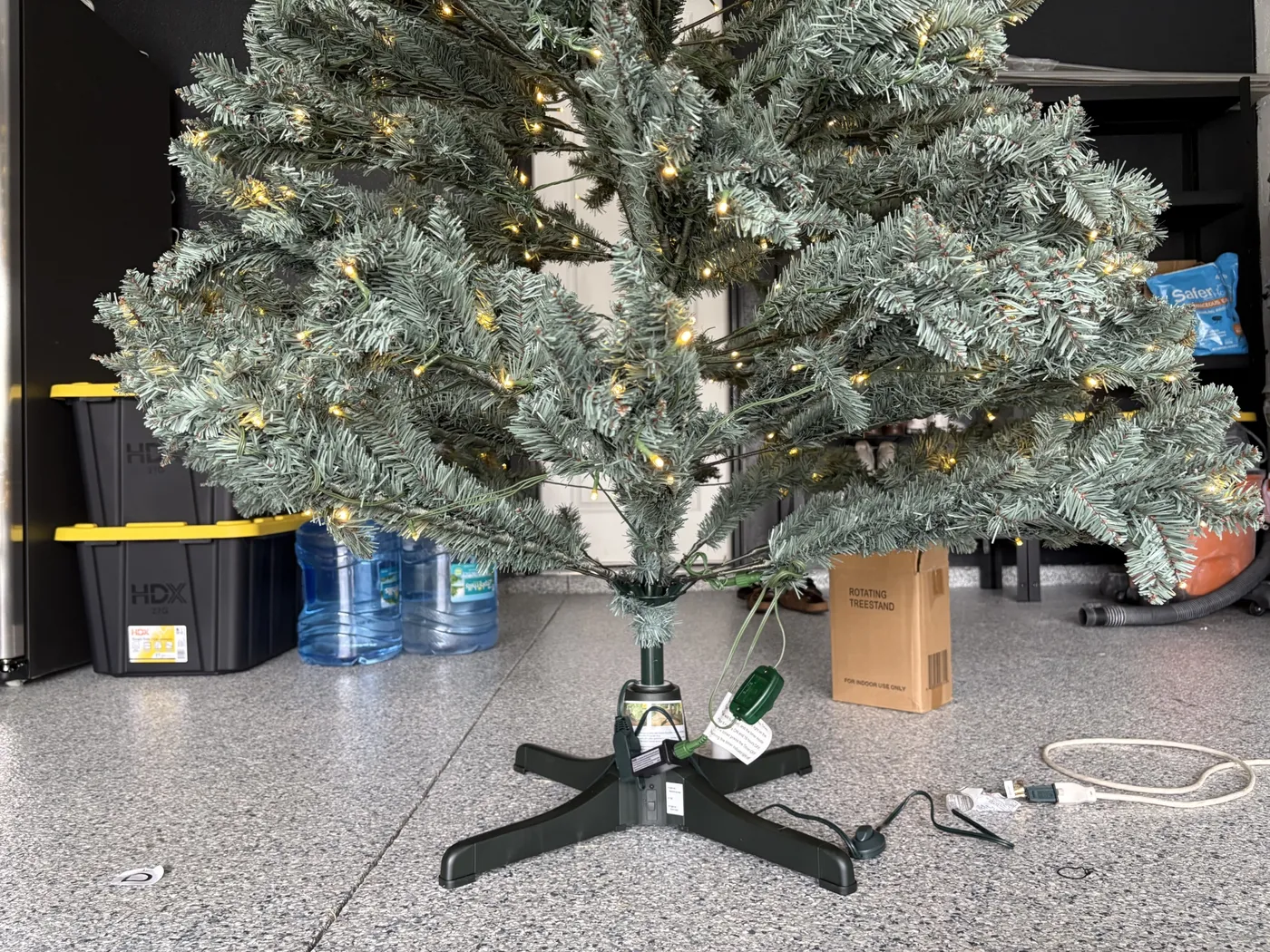
Fluffing a pre-lit frosted tree properly:
- Start at the bottom, working branch by branch.
- Separate every tip pair into a V, then bend them up slightly.
- Work outward from the trunk so inner branches fill the gaps.
- Rotate the stand a quarter-turn every few minutes.
- Step back six feet after each section.
About 45 minutes for a 7.5-footer, and zero dollars.
15. Sheer Gold Ribbon and Candle Lights in a Wicker Collar
Use two ribbon widths, not one. A 4-inch sheer gold and a 2-inch silver-taupe gives you a 1:2 ratio that reads layered without looking busy. Cut three yards per swoop and plan on eight to ten swoops for a 7.5-foot tree — that’s the difference between “ribbon detail” and “ribbon tree.” Run the wide ribbon first, then thread the narrow one alongside it.
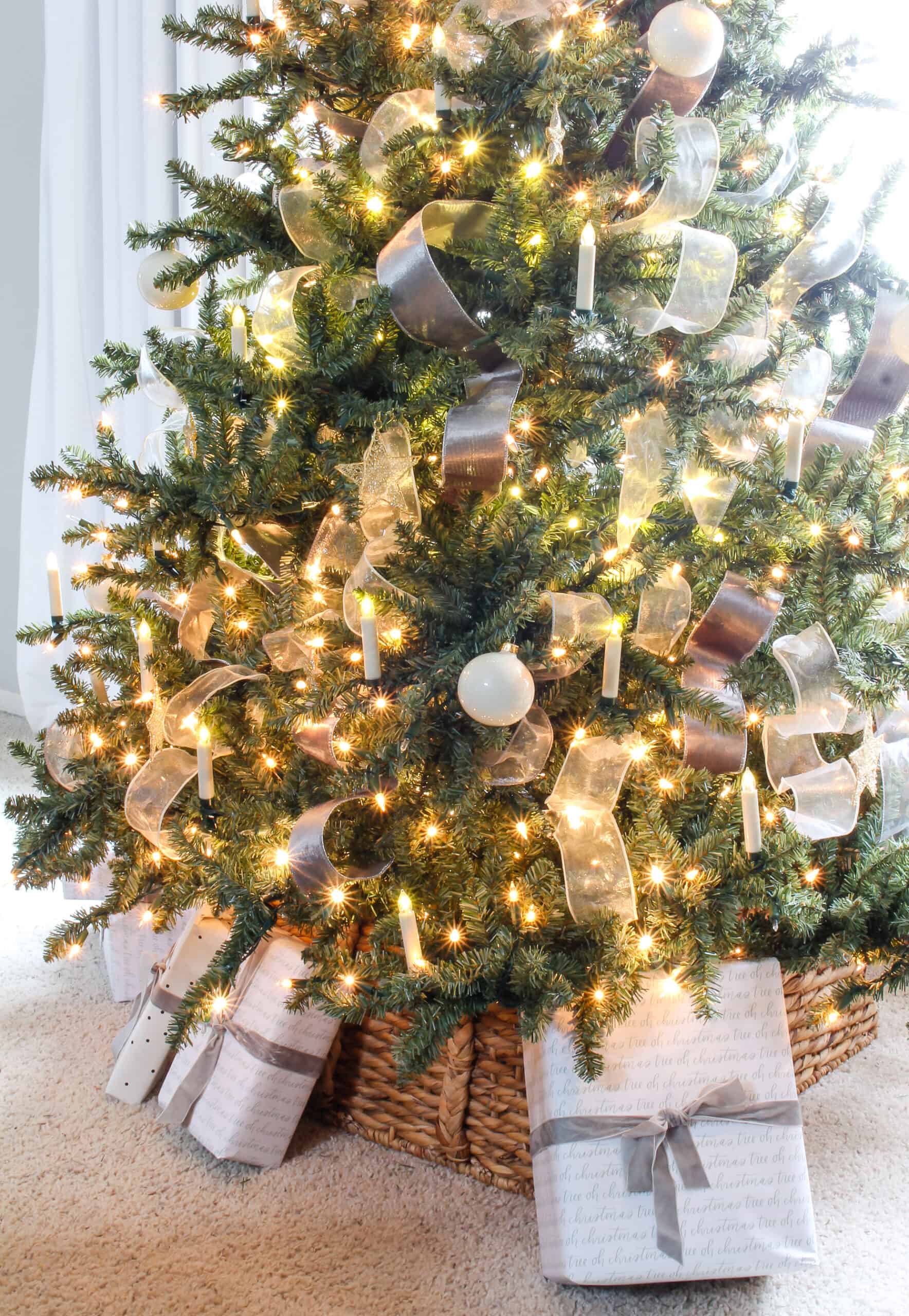
- Woven wicker basket collar: $25–$60
- Sheer gold and silver-taupe ribbon: $20–$40
- Battery candle lights, set of 10: $18–$35
- White ornaments, 40–50 pieces: $30–$60
- Neutral wrapping paper and ribbon: $25–$50
Total: roughly $120–$245 on top of the tree. Budget alternative: an $18 woven laundry basket from Target does the exact same job as the collar.
16. Multi-Color Glass Ornaments in Close-Up
Finish variety, not color variety. Mercury glass, glitter, matte ceramic, and clear glass in the same red-gold-teal palette is what separates a rich tree from a plastic one. Every ornament here reflects a different way — that’s the entire effect. Buy one texture-heavy set instead of three smooth ones and you’ll spend less and get more.
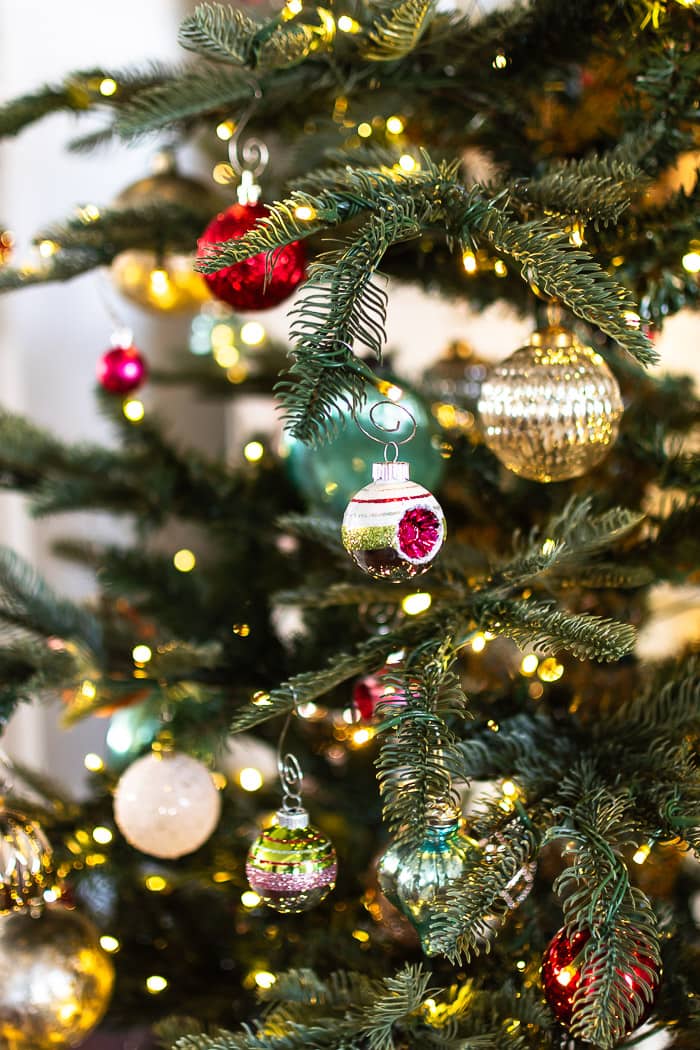
Density is the principle. A rough rule that actually works: 10 to 12 ornaments per foot of tree height, so a 7.5-foot tree wants 75 to 90 pieces. Most people stop at 40 and wonder why their tree looks sad. The second principle is size spread — small ornaments near the lights, medium through the middle, a few oversized pieces low and deep to fill gaps.
17. A Single Gold Cage Ornament, Lit From Behind
Ornament size follows a 60/25/15 split: sixty percent medium, twenty-five percent large, fifteen percent small. The small ones matter most — they fill the gaps between branches that large baubles leave behind. Open cage ornaments change the math slightly since you see branches through them, so cluster them where a warm bulb sits directly behind the metal framework.
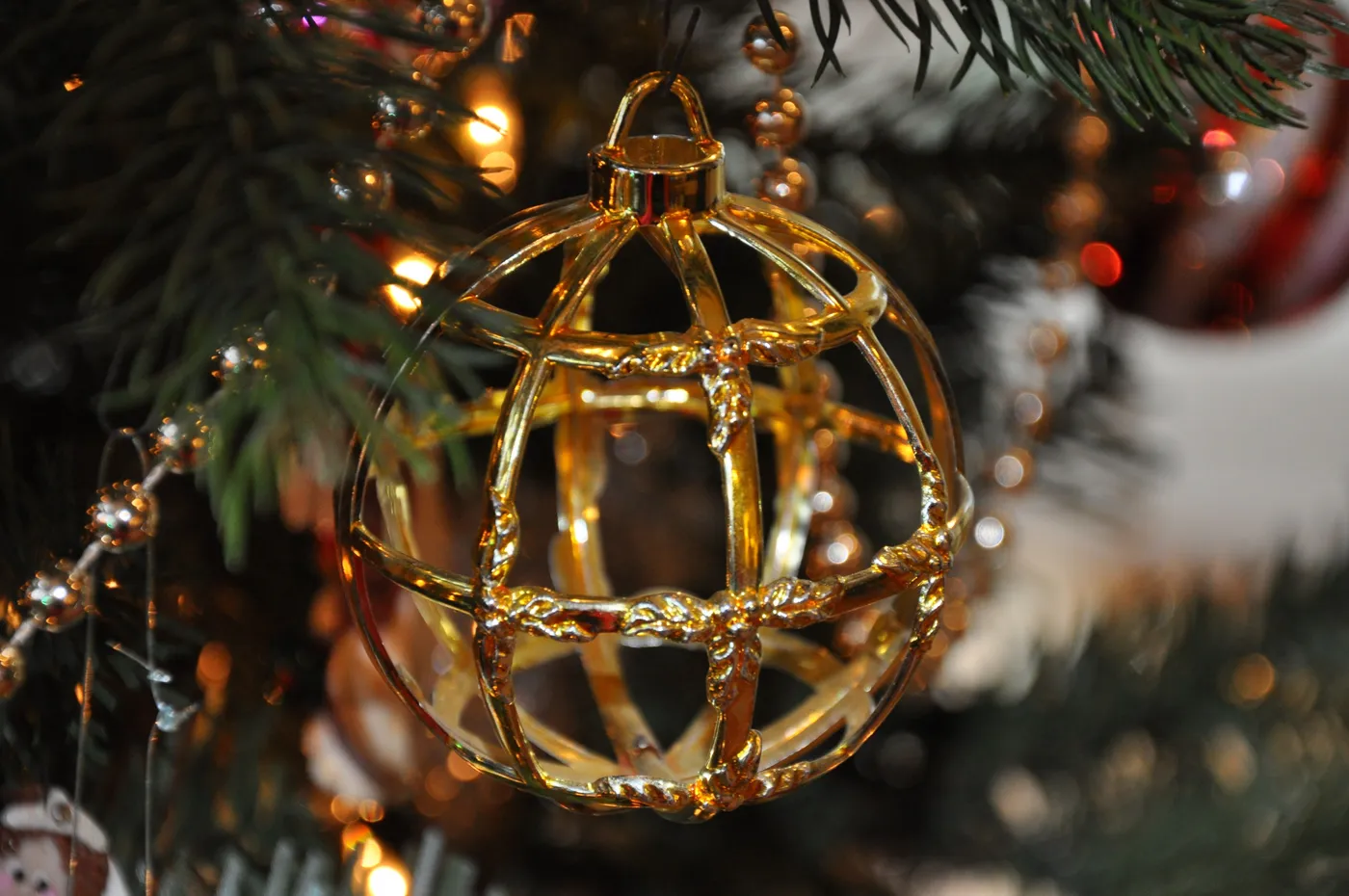
Cage and filigree ornaments look like a splurge and usually aren’t. Amazon and Target carry open-metal spheres for $6 to $14 each; boutique versions run $28 and up for the same stamped brass. If you’re patient, bend aluminum craft wire around a small bowl and hang it bare — a five-minute project, about $3 in materials, and nobody will guess.
18. Red, Gold, and White Baubles on Herringbone Floors
Mixed light temperatures are a slow-burn regret. Warm and cool LEDs on the same tree look intentional in photos and slightly muddy by New Year’s, and once a strand starts flickering you’ll be chasing it for an hour. Before you commit, plug both strings in together in a dark room and look at them side by side for a full minute. Trust what you see.
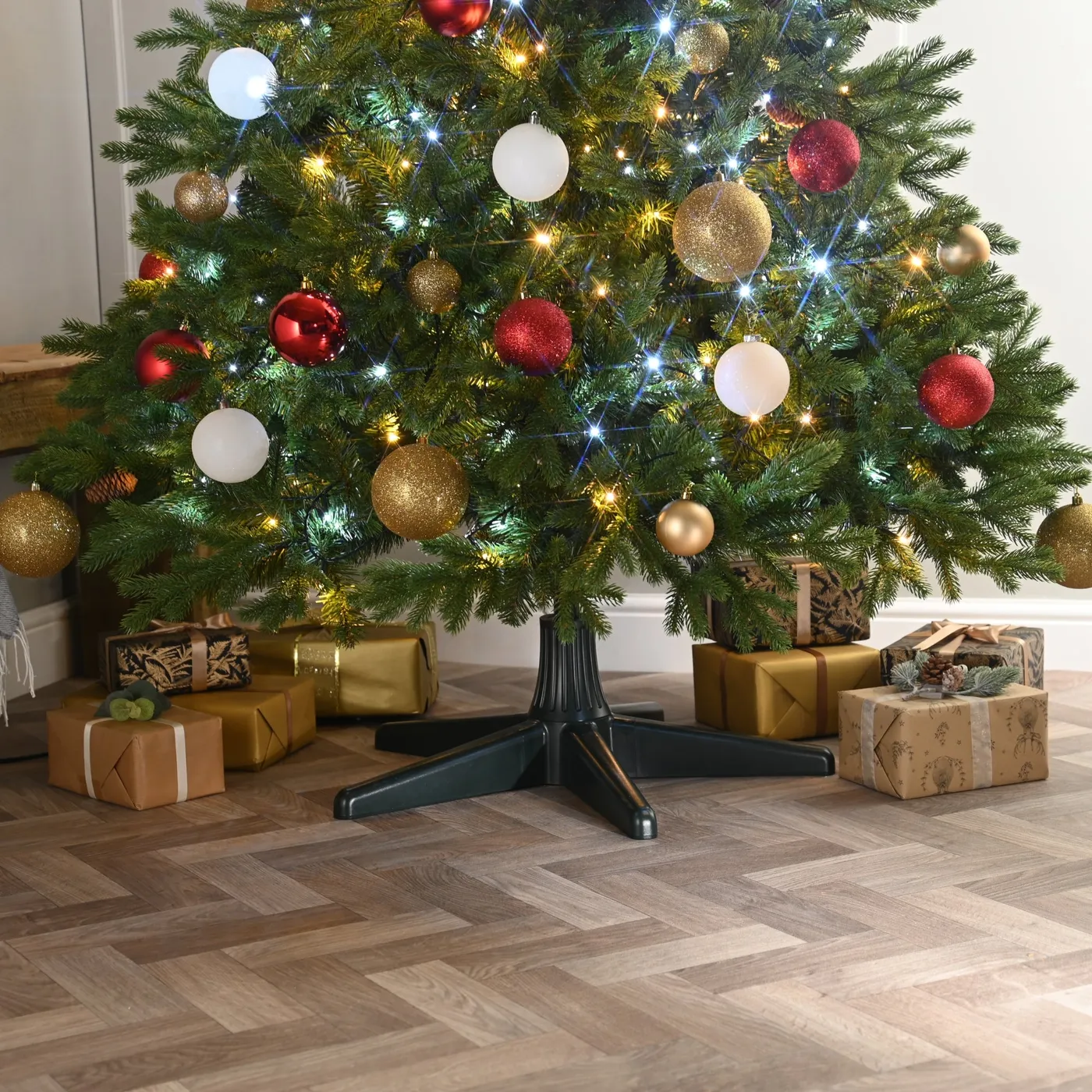
Use the mix deliberately instead of accidentally. Run cool white deep inside the branches for depth and warm white at the tips where it reads against the ornaments — that’s how display trees get that layered glow. And figure 100 bulbs per vertical foot if you want a full tree. Most pre-lit trees ship with about 60, which is why they look thin at night.
19. A White Tree Draped in Satin Against Black Wall Art
Monochrome plus one texture. Everything here is white, but satin, flock, glass, and painted wall finish all catch light differently — that’s what keeps an all-white tree from disappearing. The vertical satin drape also pulls the eye upward, which is exactly what you want in a tall, narrow space where bold wall graphics are competing for attention.
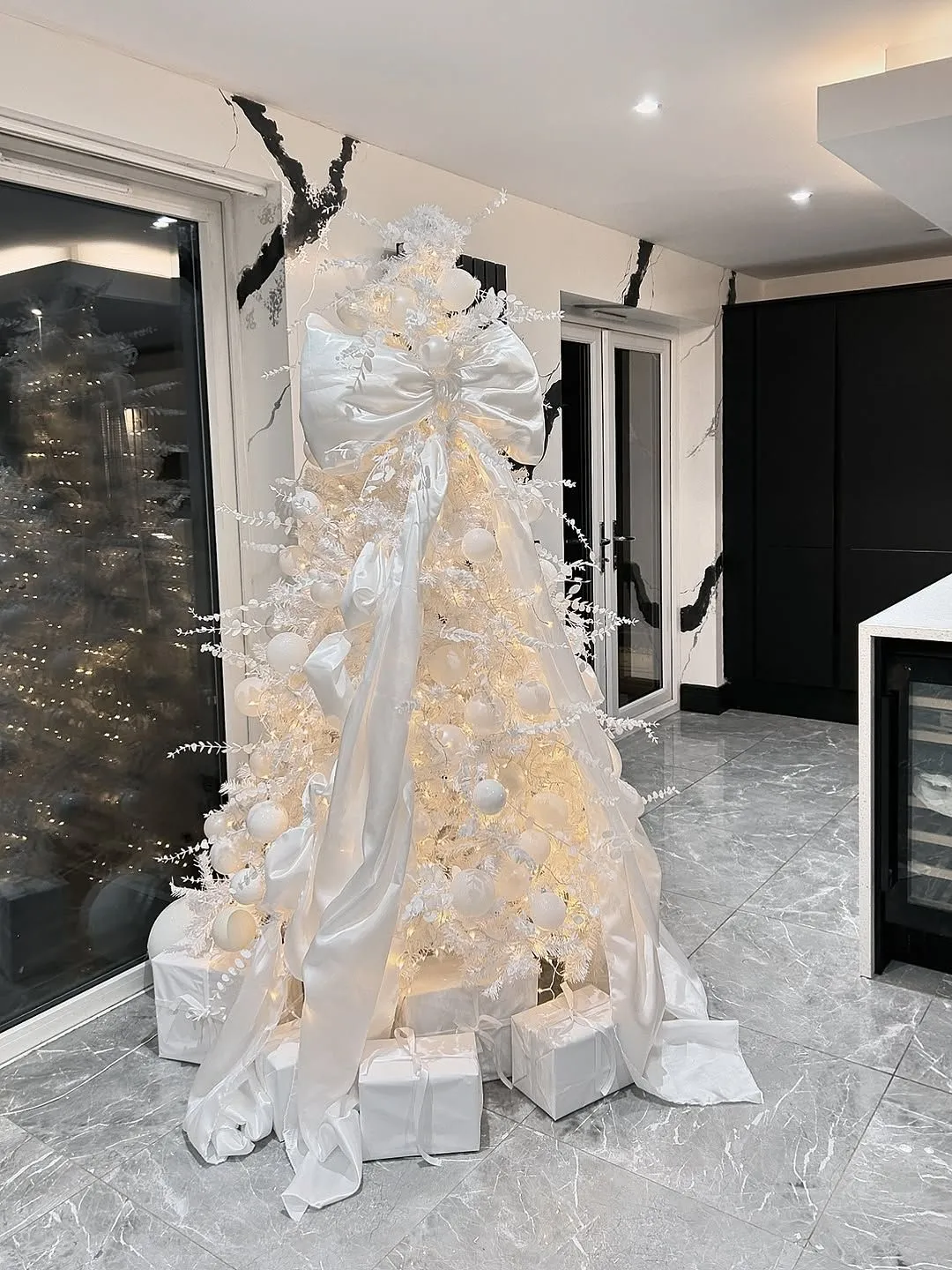
This one is ceiling-dependent. A 7.5- to 8-foot white tree plus a satin crown needs 9 feet minimum, ideally 10. The bold wall pattern needs about 24 inches of clear white on each side of the tree or the whole thing turns into visual noise. In a room under 9 feet wide, skip the wall graphic and keep the satin — the drape carries the look alone.
20. A Glass Tree Figurine on a Dark Reflective Surface
Glass and acrylic show every fingerprint, and dust settles on them like it’s being paid to. Wipe with a lint-free microfiber cloth and a drop of distilled water — paper towels will micro-scratch the surface within a season. Keep it out of a hallway where coats brush past, and put a felt pad underneath so it doesn’t grind against the shelf.
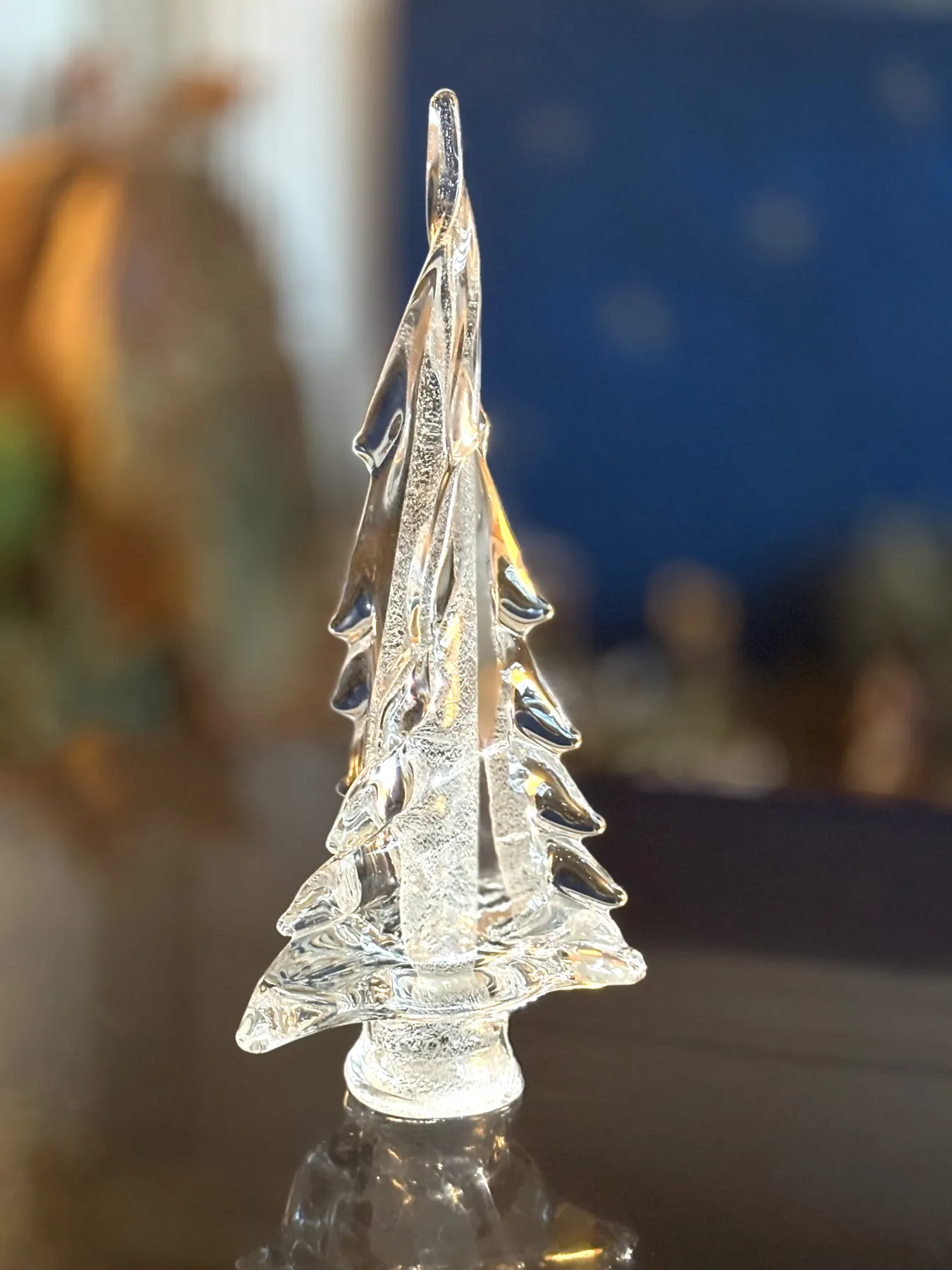
The dark reflective surface it sits on is the real subject. That second, blurrier version of the figurine below it doubles the object and turns a $20 trinket into an arrangement. Set the same piece on a matte wood shelf and it disappears in about four seconds. Think of it as the quiet counterpoint to the maximalist real tree in Idea #12.
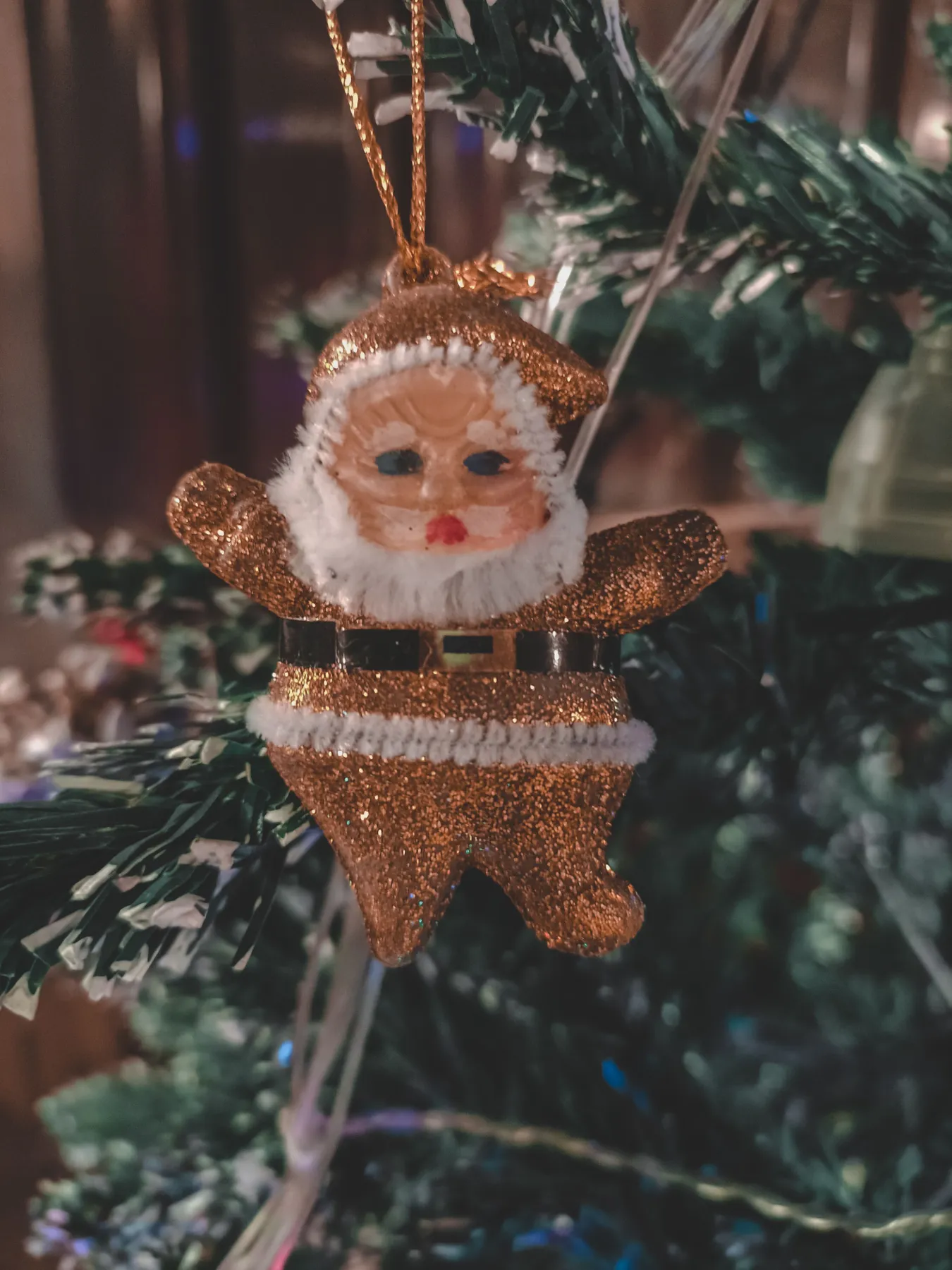
21. Gold Glitter Santa With Faux Fur Trim
Stop your glitter ornament from shedding:
- Lay the ornament on newspaper in a well-ventilated room.
- Mist lightly with matte clear acrylic sealer from 8 inches away.
- Let it dry 20 minutes, then mist a second thin coat.
- Do not touch for an hour.
Twenty minutes of actual work and about $8 for a can that treats a dozen ornaments. Skip it and you’ll be vacuuming gold flecks until Valentine’s Day.
Vintage glitter ornaments from eBay and Etsy run $8 to $20 each and have a patina you can’t fake — the glitter yellows slightly, the paint chips in all the right places. Thrift stores in older neighborhoods are the sleeper source; check the boxed ornament bins in the back, not the display shelf in front.
22. A Slender Pink Flocked Tree on a Marble Table
Tabletop trees work when the height ratio is right: keep the tree no taller than one and a half times the table’s height, or it looks like a decoration that fell over. A 30-inch table wants a 36- to 42-inch tree, which is the sweet spot anyway. Weight the container with sand and check that the base is wider than the pot, or one bumped elbow takes the whole thing down.
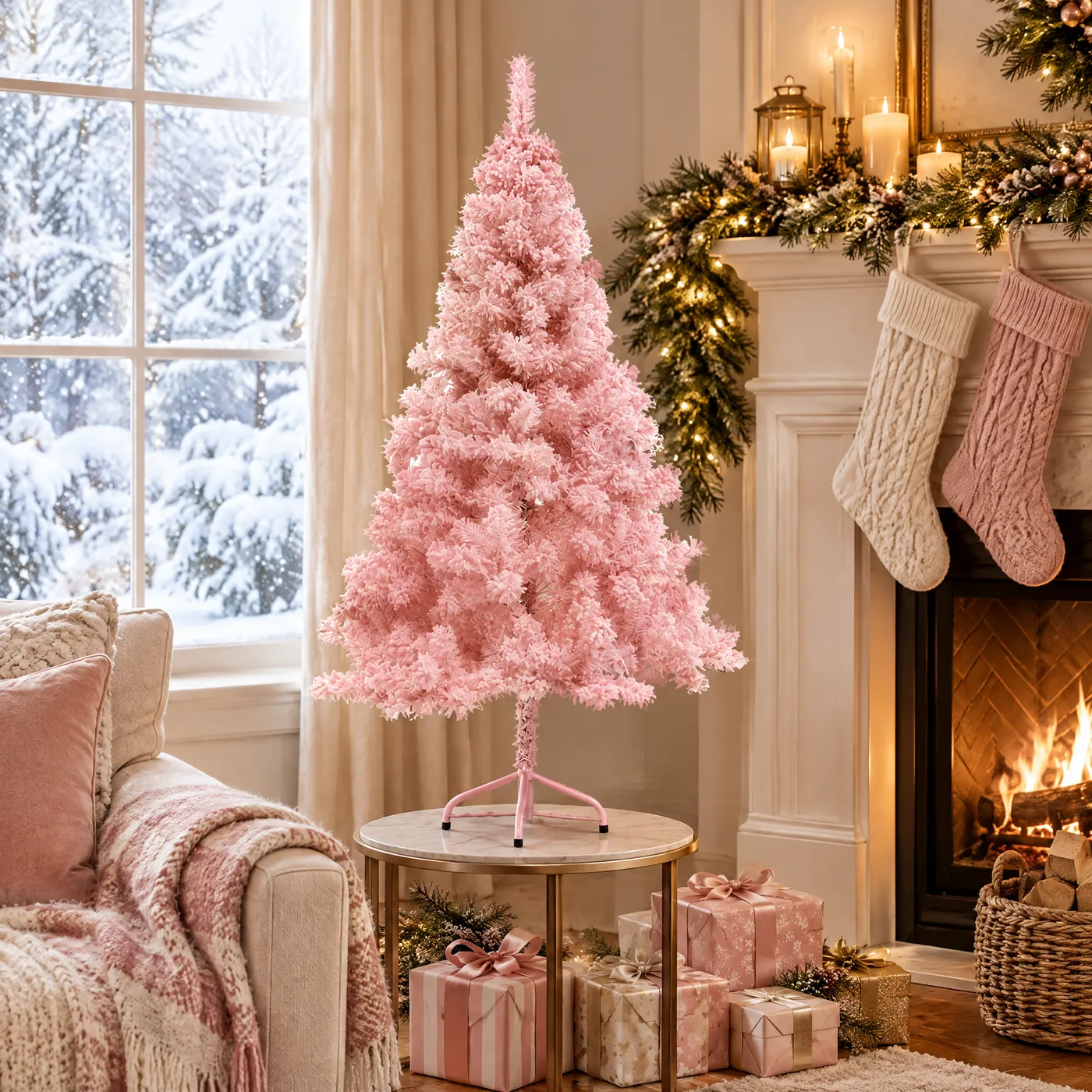
Fifty percent cream and white, thirty percent pink, twenty percent green and gold combined. The cream is doing quiet structural work — the mantel, the cable-knit stockings, the throw on the chair — so the pink never has to fight a strong wall color. Swap pink for soft sage and the same framework becomes a woodland look without changing a single piece of furniture.
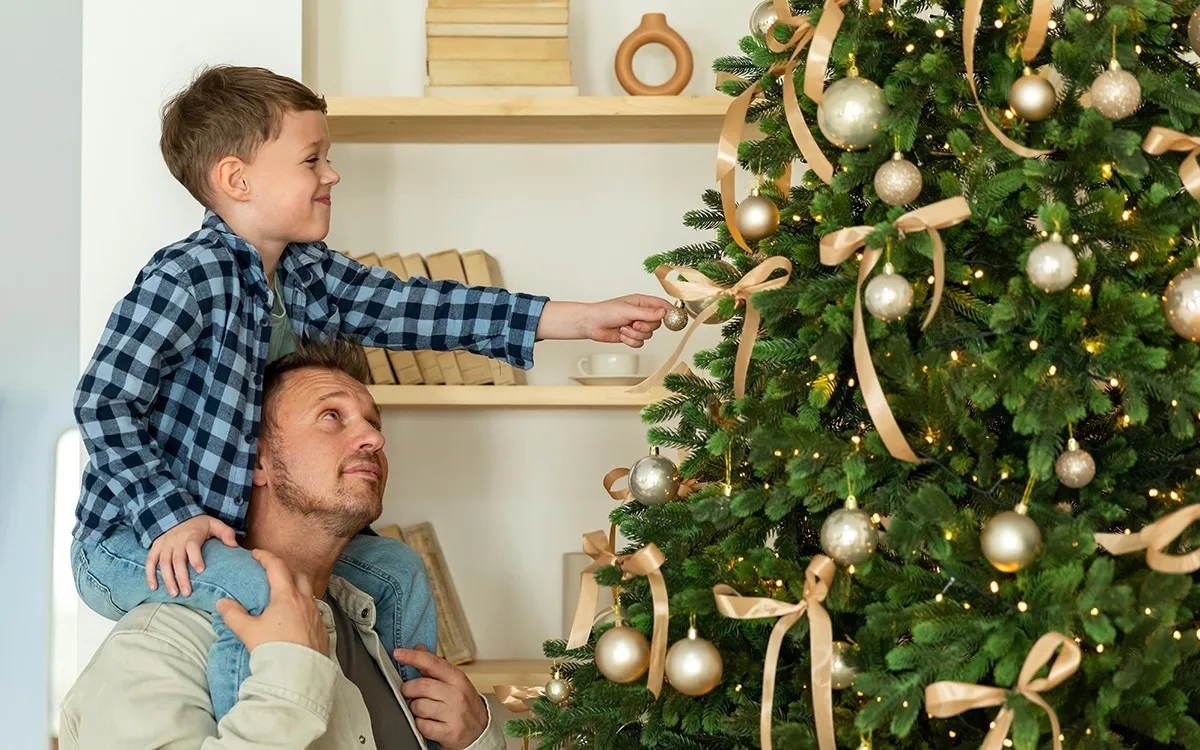
23. Gold Satin Bows on a Deep Green Tree
- 7.5 ft green tree: $90–$350
- Gold satin ribbon, 3 rolls: $18–$36
- Champagne and gold ornaments, 60 pieces: $45–$110
- Warm white fairy lights: $20–$40
- Shelf styling accents: $0–$40
Total: roughly $175–$575. Budget alternative: buy one roll of gold satin and cut it into 8-inch strips for bows instead of draping — about $6 total and it reads nearly as rich.
Rhythm and reflection. The satin bows repeat every 10 to 12 inches, giving the eye a predictable beat on a chaotic surface. Satin also reflects light differently than glass — soft and wide instead of sharp — so the gold reads warm rather than brassy. Want the same gold-on-green with a plaid accent? Idea #4 runs the identical palette in the opposite direction.
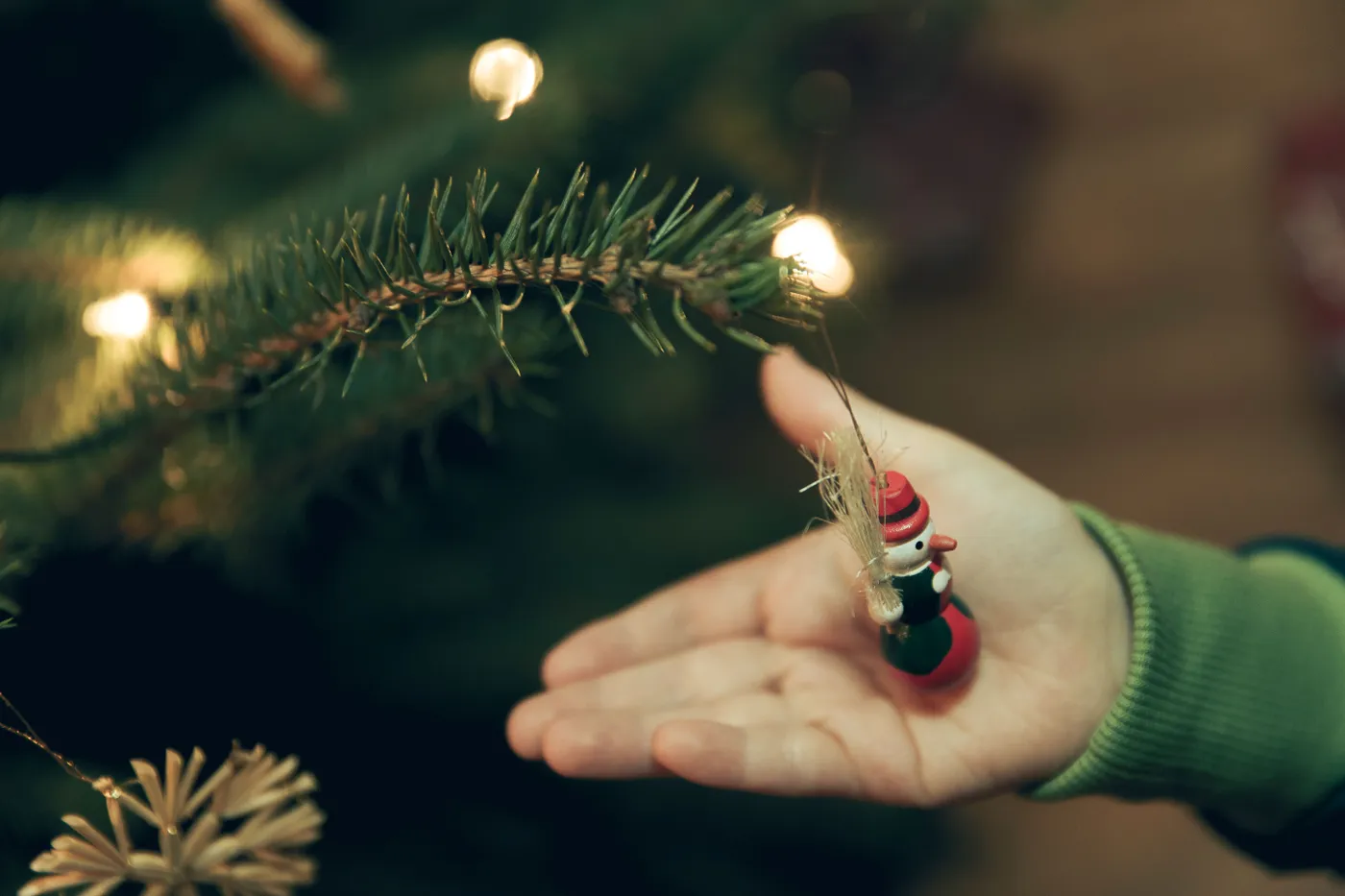
24. A Child’s Hand Placing a Wooden Ornament
Before you hand a four-year-old a box of ornaments:
- Replace every wire hook below waist height with a ribbon loop.
- Tie the tree to the wall with one anchor if it’s over 6 feet.
- Move glass and heirloom pieces above 48 inches.
- Confirm the stand holds at least a quart of water per inch of trunk.
- Put the breakable box away before the kids arrive, not after.
The bottom third of your tree belongs to the kids, and fighting it is a losing battle. Plan for it: shatterproof ornaments below 48 inches, soft felt or wood where small hands actually reach, and nothing with a cord. That wooden ornament is the right idea — light, unbreakable, satisfying to hang. Save the mercury glass for the top half.
25. Hot Pink Tinsel With Velvet Bows and Pearl Drops
The pearl drop strands are what do it, not the pink. Hot pink tinsel is loud on its own; the pearls are what make it look expensive instead of like a party store exploded. Those conical drops hang downward and pull the eye through the whole silhouette, and white against fuchsia is the highest-contrast pairing available. Without them this tree is a novelty. With them it’s a style choice.
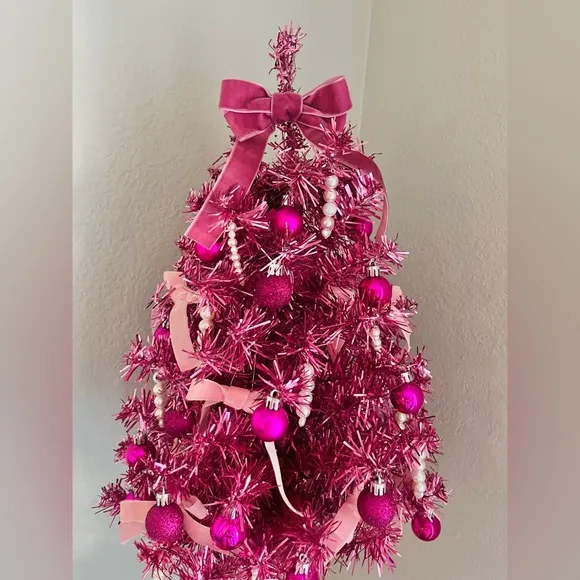
Tinsel sheds — not much, but enough that you’ll notice it on a dark floor. Don’t attack it with a bare vacuum nozzle; use a handheld on low or a lint roller. Velvet bows crush permanently if they spend the off-season under a stack of bins, so store them flat in a shoebox with tissue. Keep the whole thing away from radiators, which bake the shine out of metallic tinsel.
26. Nude Ribbons, Fabric Roses, and Plush Animals
A 7-foot tree is the sweet spot for a 12-by-14-foot living room, and that’s what’s happening here. The dusty rose armchairs need about 30 inches of walkway clearance, so the tree sits against the wall rather than floating in the middle. Smaller than 10 by 12? Drop to 6 feet and move the seating — the plush ornaments still read at that distance.
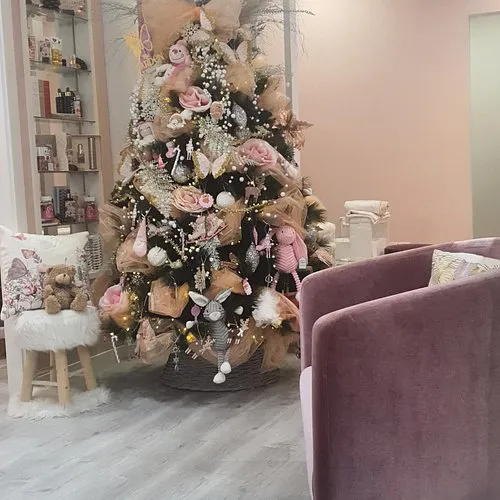
Balance cute with weight or the tree turns into a nursery display. For every plush animal, hang two or three large matte fabric roses — four to five inches across — plus a few white berry sprigs. Cute elements should never exceed about a quarter of the total ornament count. The sheer nude ribbon is the adult in the room; let it do the sophisticated work.
Soft, romantic, slightly over-the-top decorating has been building on Pinterest for a while, and it’s finally reached the tree. What makes this version outlast the average trend is the palette — blush, nude, and silver are genuinely neutral, so the ornaments work again next year even if the label doesn’t. Buy the ribbon; skip anything with a slogan on it.
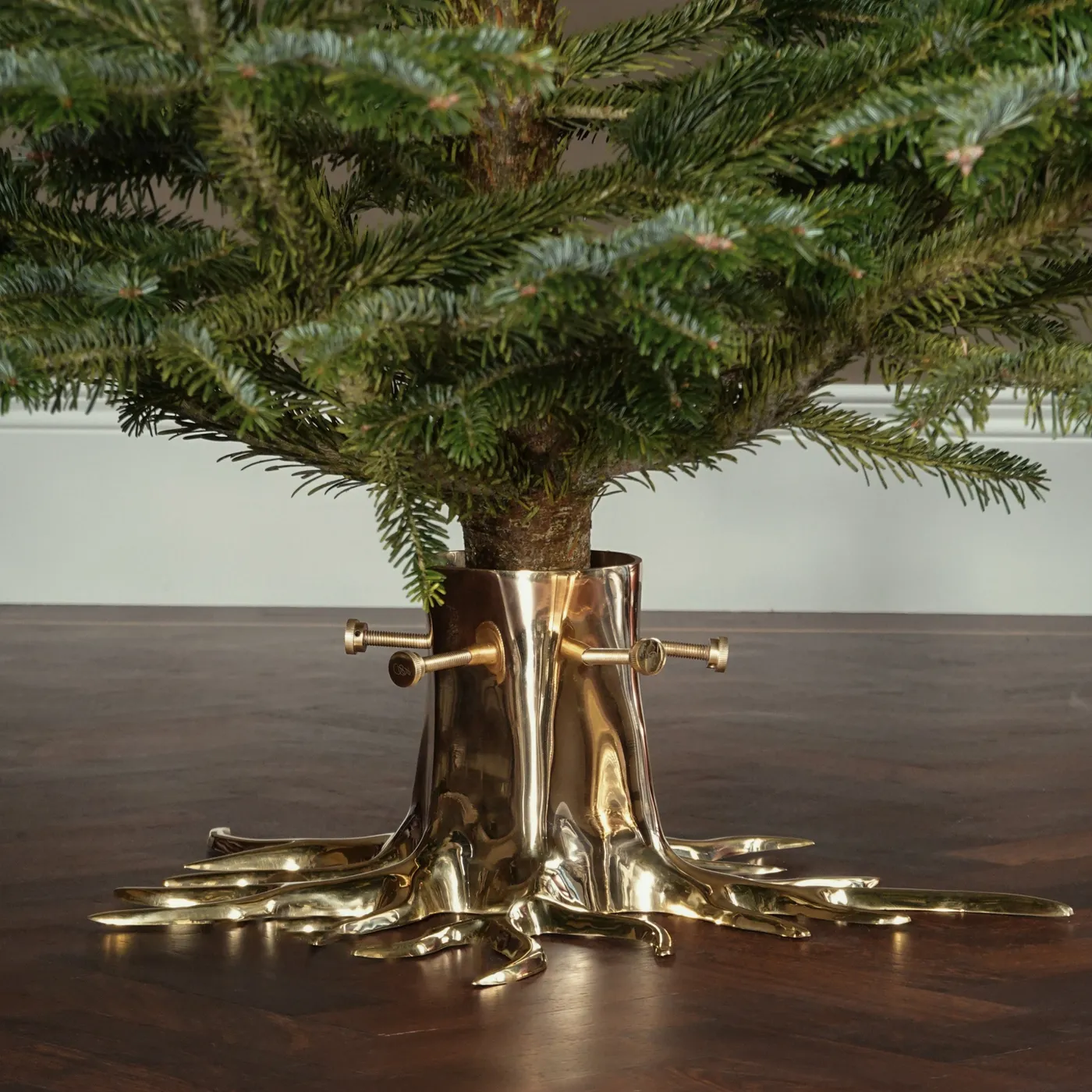
27. Polished Brass Root Stand Under a Live Tree
A brass root-style stand runs $200 to $350 from a specialty shop. The look, though, is mostly about warm metal tone and visible screws, and you can fake both. Target and Walmart sell brass-finish stands for $40 to $60, and a can of gold spray paint on an old plastic stand gets you 90% of the way for about $12. Nobody inspects your tree base at eye level.
Keeping a live tree alive past New Year’s:
- Cut a fresh inch off the trunk right before it goes in the stand.
- Get it into water within six hours of the cut.
- Refill with one quart per inch of trunk diameter, every day.
- Skip sugar, aspirin, and soda — plain tap water works best.
- Keep it three feet from heat vents and the fireplace.
Five minutes a day, and it’s the difference between three weeks and six.
28. A Watercolor Santa on Burlap String
Aim for roughly 70 percent store-bought, 30 percent handmade, and cluster the handmade pieces instead of scattering them evenly. Color-wise it’s 60 percent green tree, 30 percent red and white, 10 percent wood and burlap. The wood tone is what ties the handmade pieces into a traditional palette — without it, the homemade ornaments float and look like a separate collection.
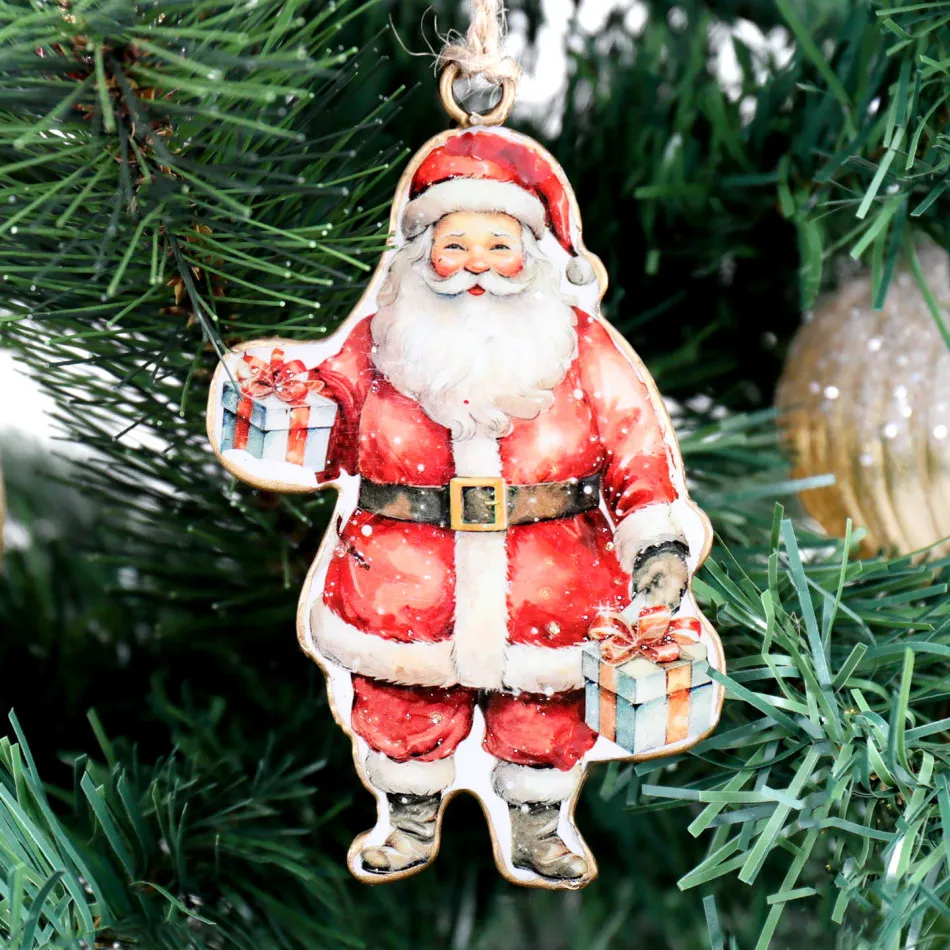
The twisted burlap string is a two-cent detail that changes everything, because burlap reads matte and handmade while satin reads store-bought and shiny. Put this same wooden Santa on a gold cord and it becomes a keepsake-shop item. On burlap, it looks like something your grandmother made. For the glittery, store-bought cousin of this ornament, Idea #20 is the same idea in sequins.
29. A Driftwood Tree Topped With a Starfish
Check these before you start assembling driftwood:
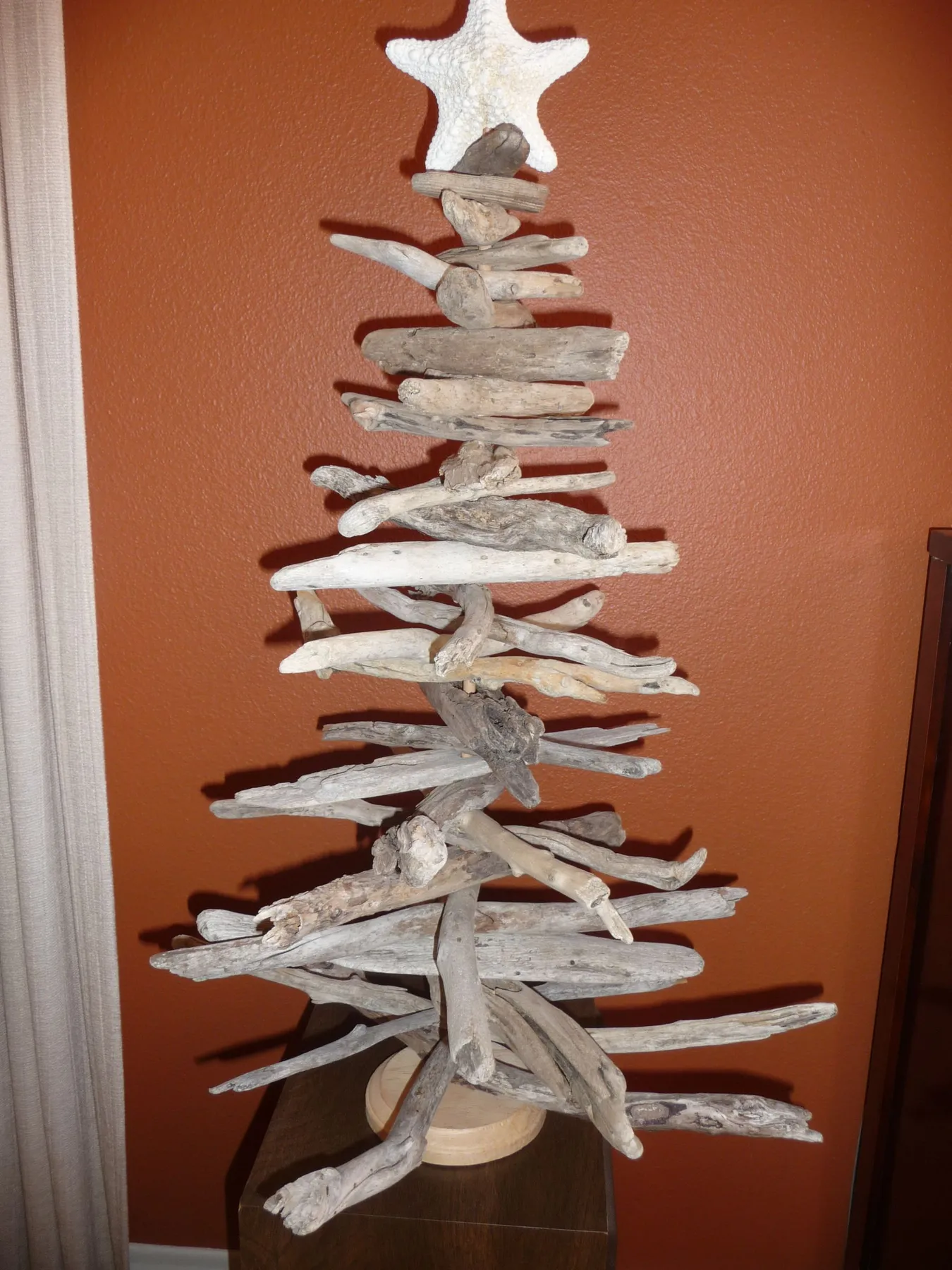
- Measure the wall — the tree wants 8 inches of clear space on each side.
- Dry the driftwood indoors for at least two weeks first.
- Seal each piece with matte polycrylic so it doesn’t shed sand.
- Confirm the base sits flat and won’t tip if someone brushes past.
- Check the wall color in daylight and at night before you commit.
Silhouette over sparkle. This tree works because the shape is instantly readable — a triangle topped with a starfish — and everything else is texture. Greyed wood against a burnt orange wall is a near-complementary pair, so the tree pops without a single bulb. It also proves a useful rule: negative space between branches is a design feature, not a gap to fill.
30. Glitter Ornaments Behind a Miniature White Picket Fence
- 4 ft artificial green tree: $60–$150
- Glitter ornaments in gold, silver, purple: $20–$40
- Miniature white picket fence: $15–$30
- Santa and reindeer figures: $15–$40
- Small potted artificial plants: $12–$25
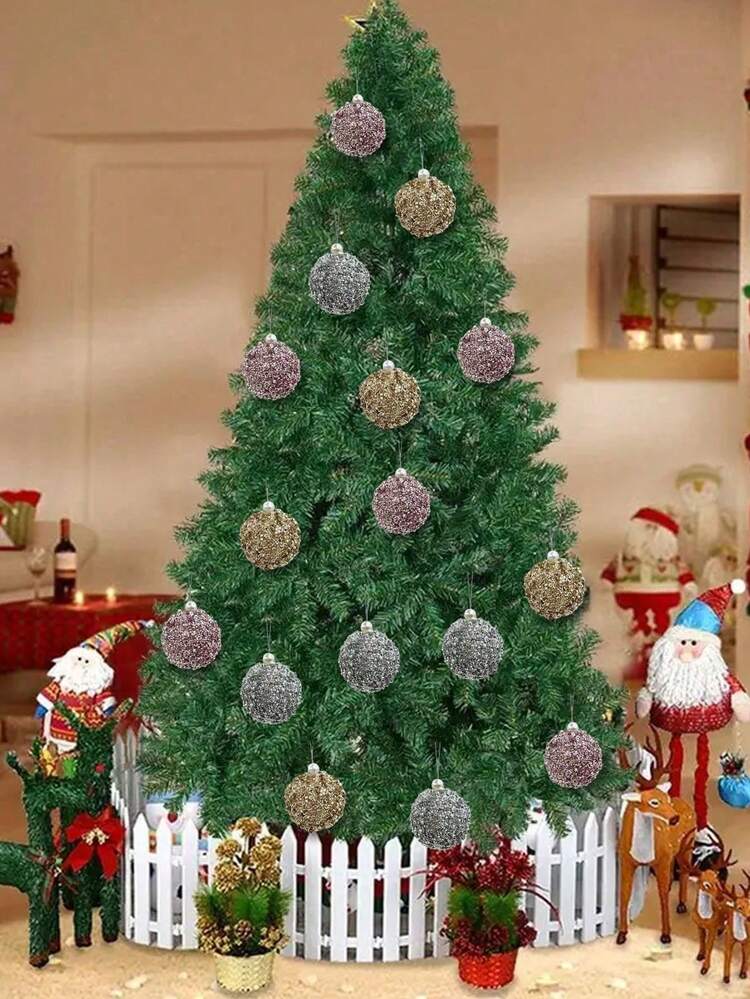
Total: roughly $120–$285. Budget alternative: dollar store ornaments in tubes and a fence made from craft sticks and white paint — about $22 total, and honestly charming.
Repeat each accent color three times or it reads as an accident. Here purple shows up in three places: the ornaments, a small ribbon, and one figure’s coat. Gold appears in the ornaments, the fence’s warm white paint, and the tree’s own lights. Three is the minimum for the eye to register a color as intentional — two looks like a mistake.
31. Candy Cane Lollipops Hiding the Tree Base
Building the candy cane gift-box base:
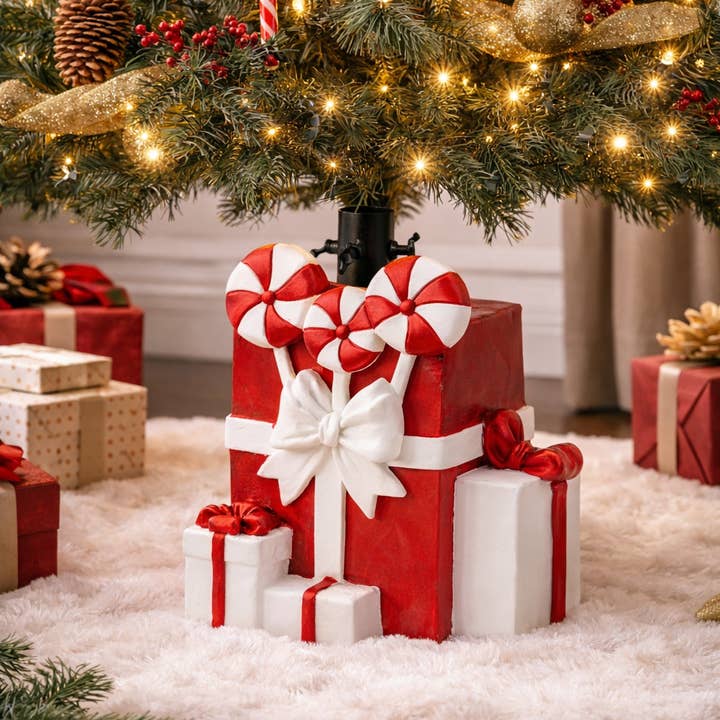
- Measure the tree stand’s width and add 6 inches all around.
- Cut foam core boxes to three heights — 8, 12, and 16 inches.
- Wrap in red and white paper, then stack in a ring around the stand.
- Attach candy cane lollipops to the front faces with double-sided tape.
- Sculpt bows from air-dry clay and let them cure overnight.
About two hours and $30 to $50 in materials.
A few things to verify first:
- The boxes clear the stand’s legs and water reservoir.
- Bottom boxes are weighted with a brick so nothing shifts.
- The assembly sits at least 3 feet from any heat source.
- Flame-resistant paper near real candles or lights.
- A toddler can’t pull the top boxes down.
Pick Your Tree, Then Break One Rule
Thirty-one trees later, the pattern is obvious: the ones that stick with you aren’t the most expensive, they’re the ones with a point of view — a gold disc instead of a skirt, a starfish instead of a star, burlap instead of satin. Choose the idea that made you stop scrolling, copy the palette exactly, and then change one thing so it belongs to your house.
📌 Save this to Pinterest so it’s waiting for you on decorating day — and tag us when your tree goes up.