You know that feeling when you finally find the tree that looks exactly right for your space — not the perfectly manicured catalog version, but the one with the slightly crooked star and the pinecones still clinging to the branches? That’s the energy running through Pinterest right now, and it’s why real Christmas trees are having a serious moment in 2026.
We spent weeks digging through Target, Walmart, IKEA, West Elm, and a whole lot of independent shops to narrow down 31 ideas that actually hold up — from rough-hewn rustic mantels to marble-floored glamour, covering everything from a $60 tree skirt to a $900 statement tree, and spanning traditional red-and-gold, neutral Scandinavian, flocked farmhouse, and modern luxe. Budget and luxury versions sit side by side, so you can see exactly what the upgrade buys you.
What’s driving it? The return of the *imperfect* tree — sparse branches, natural pinecones, dried oranges, mismatched vintage ornaments. After years of hyper-styled monochrome trees, people want the one that looks like it has a story. And stay until the end — we break down the most common mistakes that can ruin these looks.
📌 Save this to Pinterest for later — you’ll want to revisit these ideas.
1. The Densely Lit Tree Anchored by a Beige Shag Rug
What sells this room isn’t the tree — it’s the shag rug underneath it. A light beige, deep-pile rug under a dense green tree does something specific: it bounces warm light back up into the lower branches and keeps the whole arrangement from feeling like it’s floating on hard flooring. The red gift boxes with gold ribbons read as intentional color pops because the cream base gives them somewhere calm to land.

If you take away the rug, you lose the glow — the tree becomes furniture instead of a moment.
Here’s the measurement that matters: the rug should extend at least 18 inches past the widest point of your tree’s branches on every side. That’s what creates the visual “platform.” Most people buy a 5×8 for a 7-foot tree and wonder why it looks pinched. Go 6×9 minimum for a tree over 6.5 feet, or layer a round 5-foot rug just under the stand if you’re working with a tight footprint.
2. White, Silver, and Gold Ornaments Against Muted Blue-Grey Walls
The formula here is 55% cool neutral (that soft blue-grey wall and cream bouclé sofa) + 30% metallic (silver and gold stars, snowflakes, the round mirror over the mantel) + 15% deep green from the garland and the braided edge of that two-tone rug. Swap the blue-grey walls for warm greige and the same ornaments suddenly read yellow instead of icy — that’s how temperature-sensitive metallics actually behave.
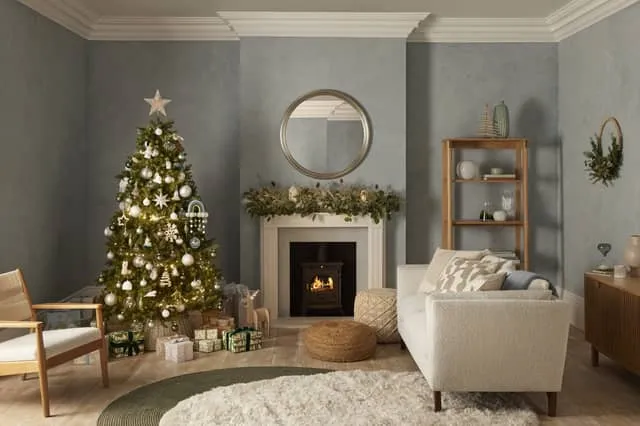
One thing nobody warns you about: silver and gold ornaments show every fingerprint, and matte finishes scuff faster than you’d think. If you have kids or a cat with tree ambitions, keep the fragile metallics in the top third and put shatterproof versions down low. Also — that cream bouclé sofa is gorgeous but it will collect pine needles like a sponge. A lint roller lives in the side table drawer from December 1st to January 6th. Worth it? Absolutely. But know what you’re signing up for.
3. Pinecone Branches and Wainscoting in a Classic Corner
Three principles are doing the heavy lifting in this corner. First, contrast: the natural pinecones against pre-lit warm bulbs create tiny dark-light rhythms that read as texture from across the room. Second, repetition: the green garland on the white mantel echoes the tree’s greenery at a smaller scale, so your eye travels. Third, restraint — the gold, red, and silver gifts are the only saturated color in an otherwise light grey and white room, which is why they pop without shouting.
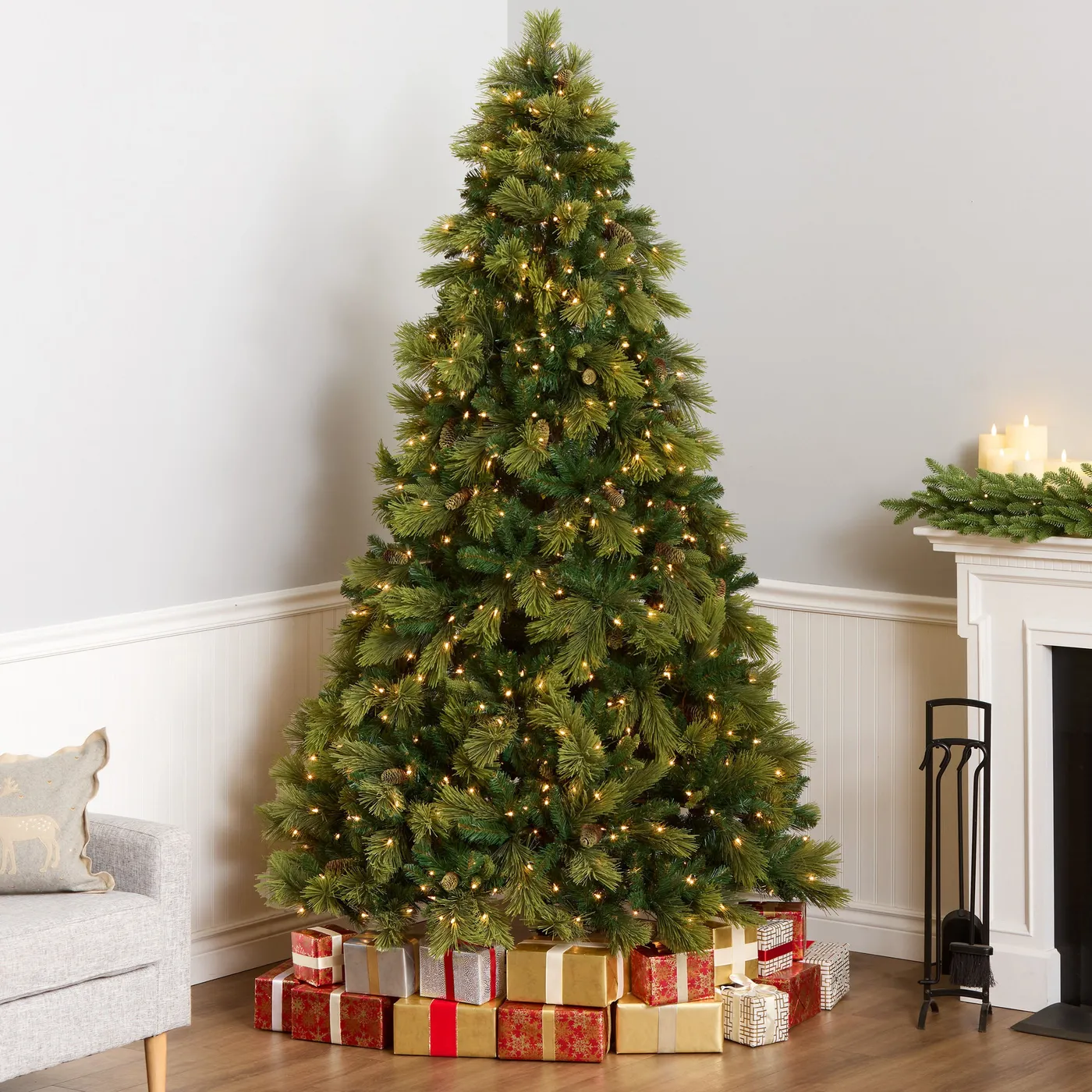
You can build this exact look for less than $150 if you’re willing to forage. Pinecones from a local park (bake them at 200°F for 30 minutes to kill anything living in them), a bag of shatterproof gold and red baubles from Target at $12 for 50, and a plain 6-foot pre-lit tree from Walmart around $79. The white wainscoting? That’s the expensive part — but a $25 roll of peel-and-stick panel molding on a painted accent wall gets you 80% of the effect, and nobody’s inspecting your trim at 11pm with a glass of wine in hand.
4. Birch Bark, Pinecones, and Muted Orange in a Hammered Gold Pot
The element that makes this tree unforgettable is the hammered gold-toned metal pot. Not a skirt, not a basket — a pot. It sits directly on that black-and-white geometric marble floor and turns the tree into sculpture. Remove it and swap in a burlap wrap and the entire arrangement collapses into “nice but expected.” The pot is what tells your brain this is a designed object, not just a decorated plant.

This is the 2026 version of glam-natural, and it’s everywhere on Pinterest right now because it solves a real problem: people are tired of choosing between “rustic” and “luxurious.” Birch bark and bare branches give you the forest; muted orange spheres and gold leafy accents give you the polish; black veined marble underneath gives you the drama. The staying power here is strong — natural materials with metallic finishes is a combination that’s been quietly gaining ground since 2023 and shows no sign of collapsing. It photographs beautifully, which is half the reason it keeps getting saved.
5. Silver and Gold Ornaments Framed by Stacked Stone
Here’s a lighting tip that will change how your tree reads at night: run your string lights in vertical spirals, not horizontal loops. Spirals put light *behind* the ornaments at multiple depths, so you get that layered glow instead of a single bright band around the middle. It takes about 20 extra minutes and roughly 15% more strand length, and it’s the difference between a tree that looks lit and a tree that looks lit from within.
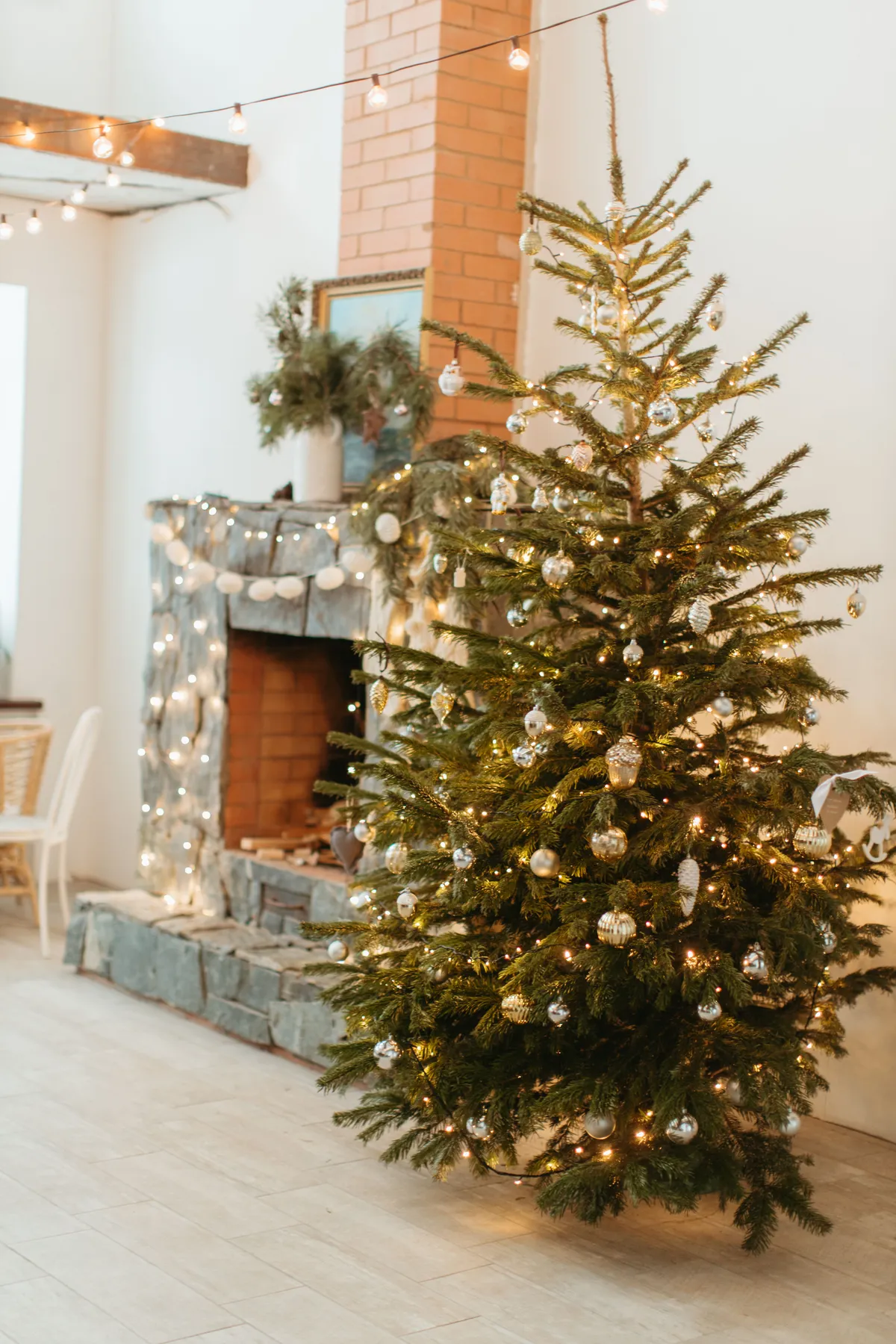
This arrangement — a full real tree beside a stacked light grey stone fireplace with a red-brown brick interior — needs breathing room to work. You’re looking at a minimum 12-foot-wide wall to keep the tree from crowding the hearth, and ceilings at least 9 feet if you want the tree’s top to feel proportionate rather than pinched. For smaller rooms, look at the corner-friendly setup in Idea #3 — same festive spirit, much tighter footprint. The white garland draped across the stone is doing double duty: it softens the hard masonry edge and catches the string light glow.
6. Rose Gold and White Baubles Beside Sheer Curtains
Recreating this bright, playful corner is more affordable than it looks. Here’s a realistic breakdown:
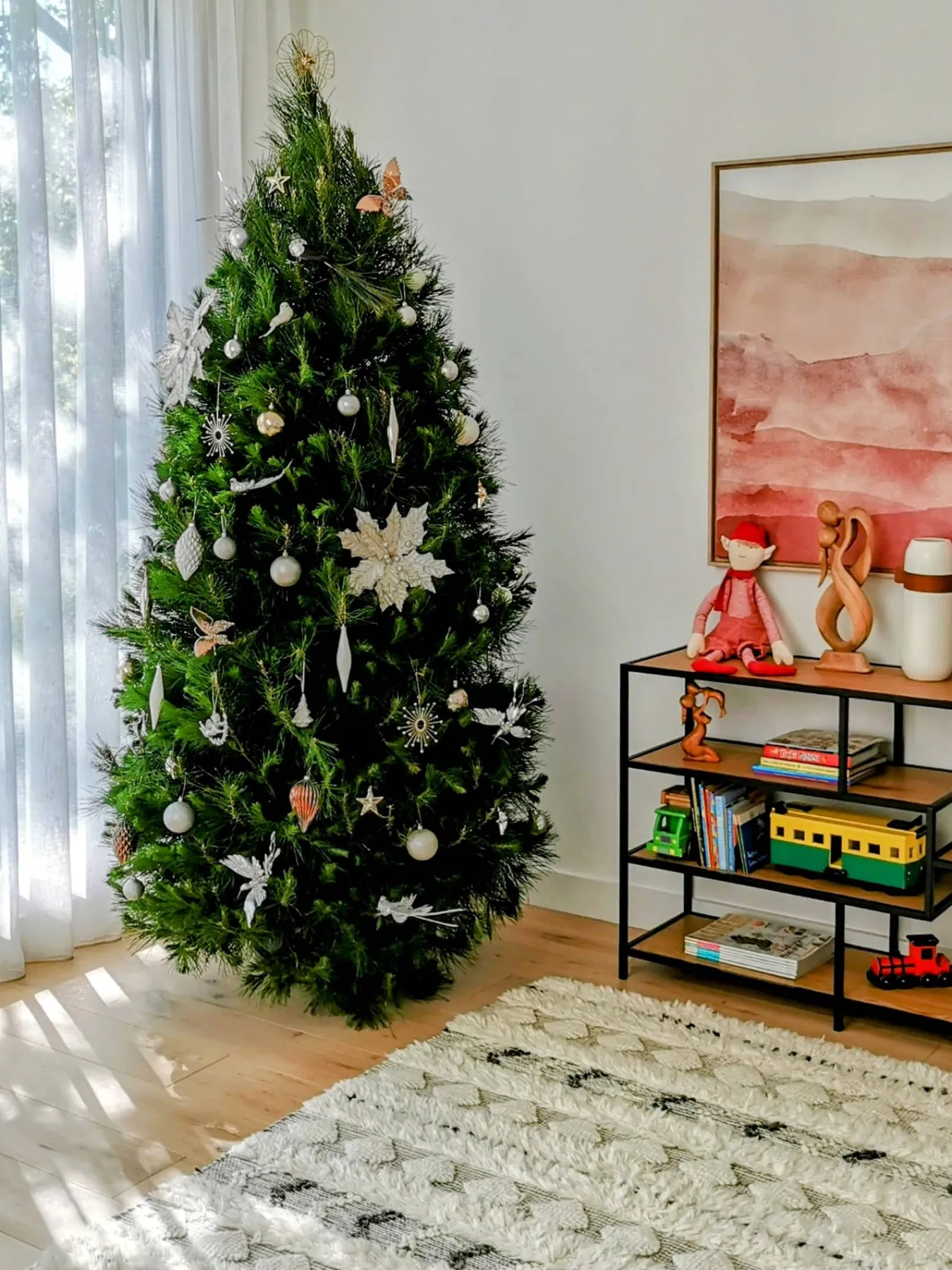
- 6.5-ft full artificial tree: $90-$220
- Ornament set (white, silver, pale gold, rose gold — roughly 80 pieces): $45-$120
- Sheer white curtain panels, 2: $30-$80
- Black metal and wood shelving unit: $80-$250
- Textured white rug: $60-$180
- Abstract terracotta wall art: $40-$150
- Total: $345-$1,000
Budget alternative: shop the shelving unit on Facebook Marketplace (these show up constantly in January when people redo their living rooms) for $40-$70, and buy ornament sets in mixed lots from thrift stores — a $15 bag of assorted metallic baubles from Goodwill often beats a $60 matched set for this layered, collected look. That gets you to roughly $210 total, about 40% of the high end.
7. Deep Red Velvet Bows in a Sunlit Cream Room
The red velvet bows are the whole story. Against clear glass baubles and warm white lights, that deep burgundy velvet adds a texture nothing else in the room has — a soft, light-absorbing matte against all that reflective glass and cream paneling. It’s contrast of *material* rather than color, which is a subtler move and a harder one to pull off. The burgundy throw on the beige sofa seals it: two velvet touches, one at eye level, one at hip level, so the color repeats without overwhelming.
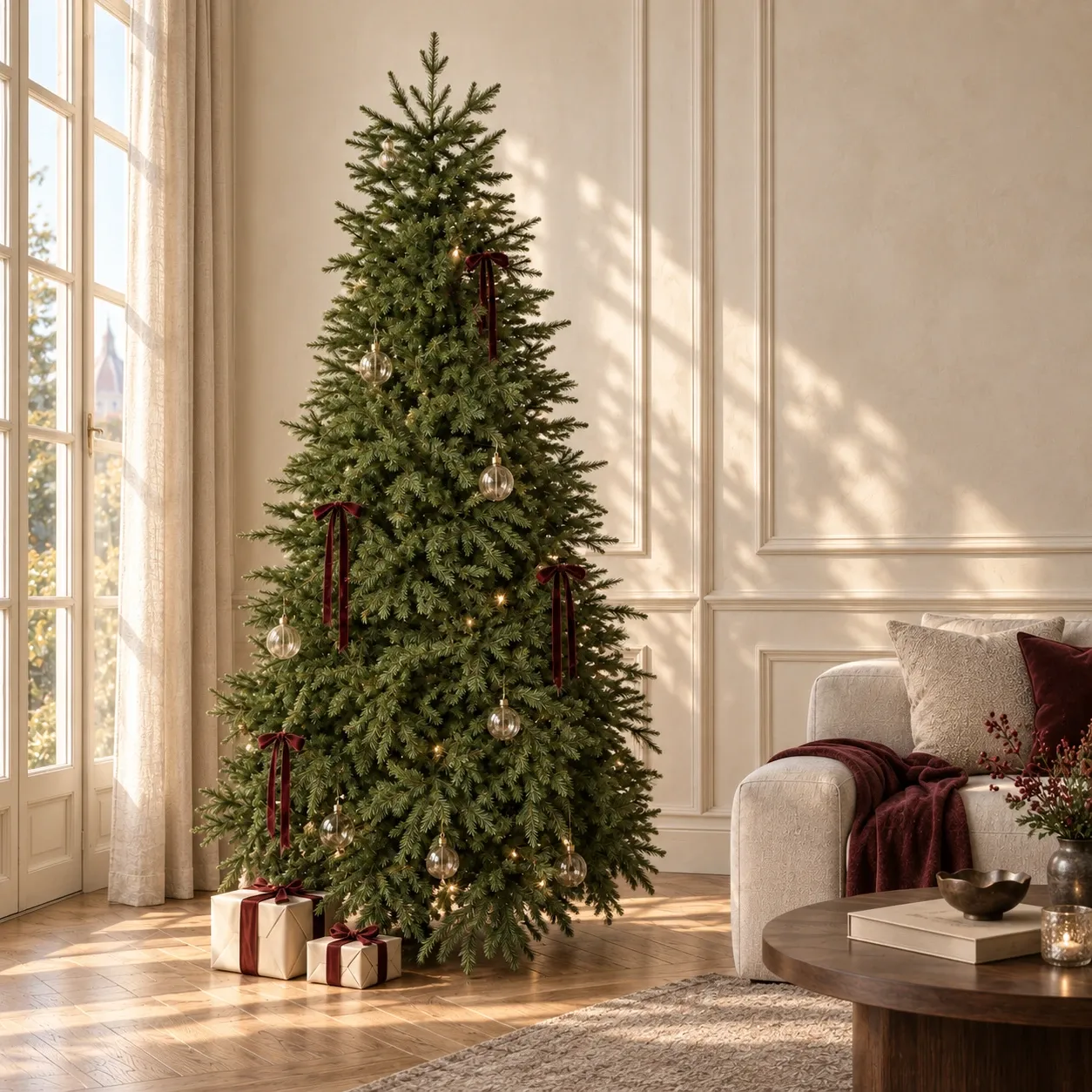
Reality check on the sunlit part: cream paneled walls plus a big window plus a tree with lights equals a room that photographs like a dream and can feel washed out by 2pm. If your space faces south, you may want one warmer element — a dark wood coffee table, an olive-green chair, a rug with some depth — to keep the whole thing from going flat. And velvet bows crush. Store them flat in a shoebox, not a bin, or you’ll spend next December ironing ribbon at 10pm.
8. A Flocked Tree on a Red and White Tree Skirt
Flocked trees are gorgeous and they are a commitment. Expect a light shed of fake snow every time you move it — put it up over a sheet you can gather and shake outside, and vacuum the surrounding floor weekly rather than monthly. Flocking yellows over time if it’s stored somewhere humid, so keep it in a dry closet with a cotton sheet over it rather than a sealed plastic bag, which traps moisture. Realistically you’re replacing a flocked tree every 4-6 years, not 15.
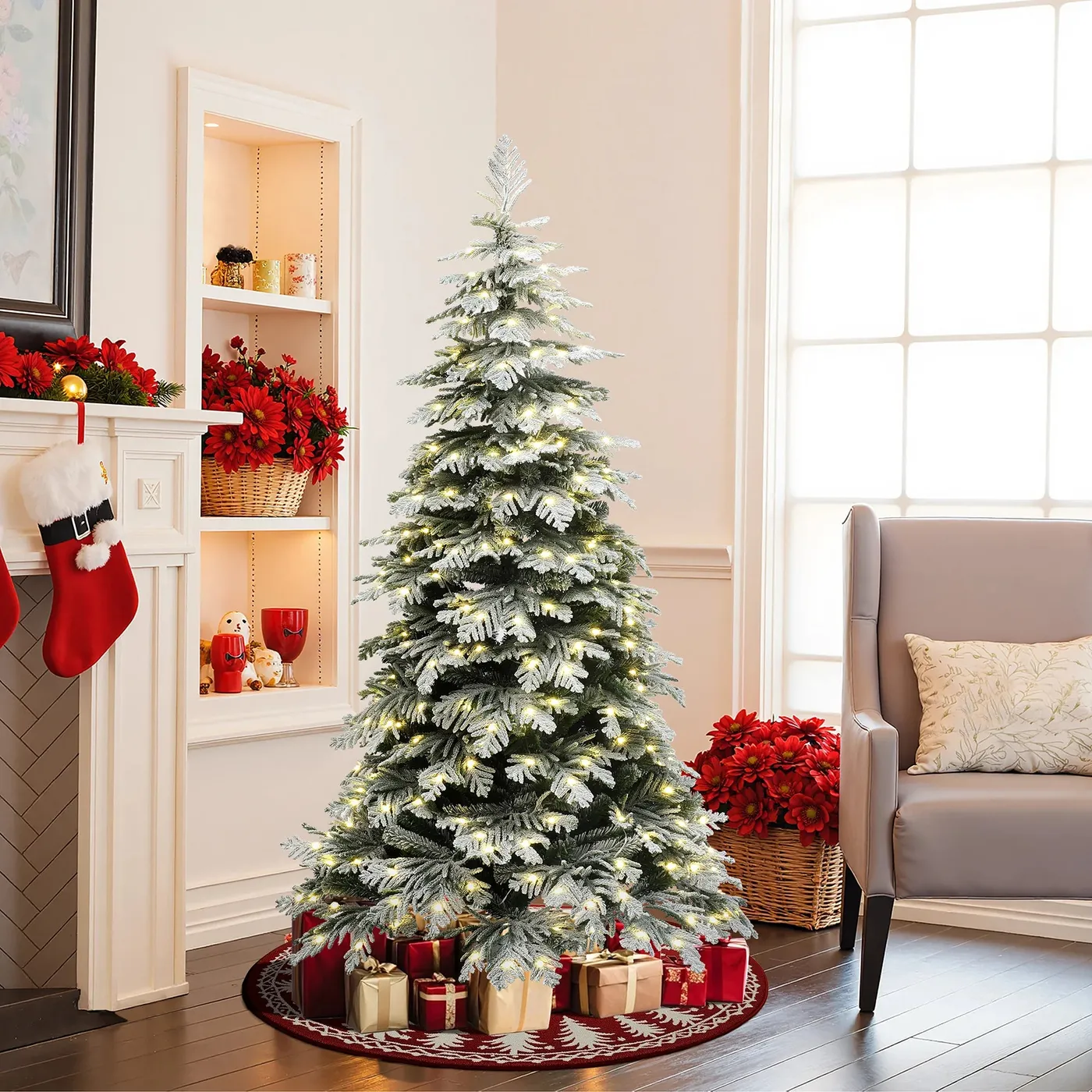
Here’s the fix that makes flocking hold up: seal it. A light spray of matte craft sealant (about $12, one can per 7-foot tree) over the flocked branches before you decorate locks the snow in place and cuts shedding by half. Do it outdoors or in a garage, let it cure 24 hours, and then decorate. This one step is the difference between a tree that still looks good in year four and one that looks like it survived a blizzard.
9. Red, Gold, and Green Against a Stone Fireplace
The lit garland on the stone fireplace is the element holding this room together. It’s not the tree, and it’s not the cream sofa with its red and green pillows — it’s the garland running the length of that mantel with a wreath centered above it. That horizontal line of green and warm light tells your eye where the room’s heart is, and it also explains why the tree sits where it does. Take it away and the stone becomes a cold, empty mass.
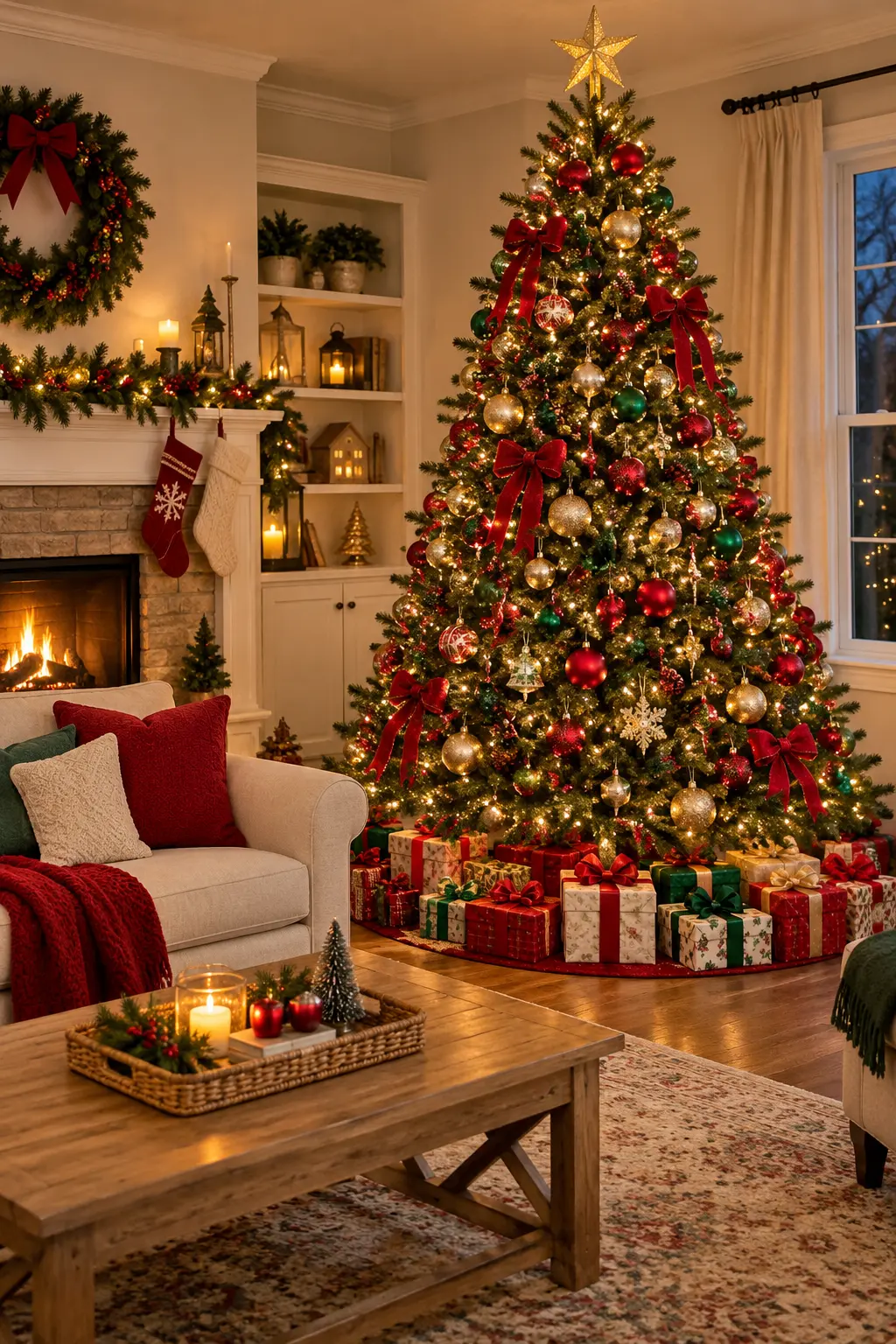
Rooms like this want space. A stone fireplace with built-in flanking shelves needs about 14 feet of wall width to breathe, and this arrangement really wants a ceiling at 9 feet or above. If your fireplace wall is closer to 10 feet wide, you’d do better to skip the flanking shelves entirely and read Idea #8 for a tighter, more vertical approach. The rustic wood coffee table with the holiday tray is deliberately low — it keeps the sightline from sofa to tree to fireplace clear.
10. The Handmade Moment: Natural Ornaments and Warm String Lights
This is the tree most people actually want and don’t quite know how to build. The trick is that the ornaments are almost all white, cream, and natural wood tones — no metallics, no brights — so the warm string lights do all the color work. When your ornaments all sit in one narrow value range, the glow of the bulbs becomes the visual interest. Crowd it with red and gold and you lose that soft, intimate quality entirely.

Practical note: if you want this look to survive a household with a toddler or an enthusiastic golden retriever, use wire ornament hooks rather than ribbon loops, and thread them through two branches rather than one. A single-branch hang is what makes ornaments drop and roll. Also, real trees dry out fast in a heated room — check the water level daily for the first week, then every other day. A dry tree is a fire hazard, and no amount of charming natural decor is worth that.
11. An Unadorned Pre-Lit Tree with Brown Paper Gifts
Nothing on the tree itself. That’s the entire idea, and it works because the room does the decorating: rough-hewn wood mantel, cream shiplap paneling, pine branches and pinecones, a woven basket of firewood. The tree is just light. This is the design principle of negative space applied to holiday decor — what you don’t add matters more than what you do.
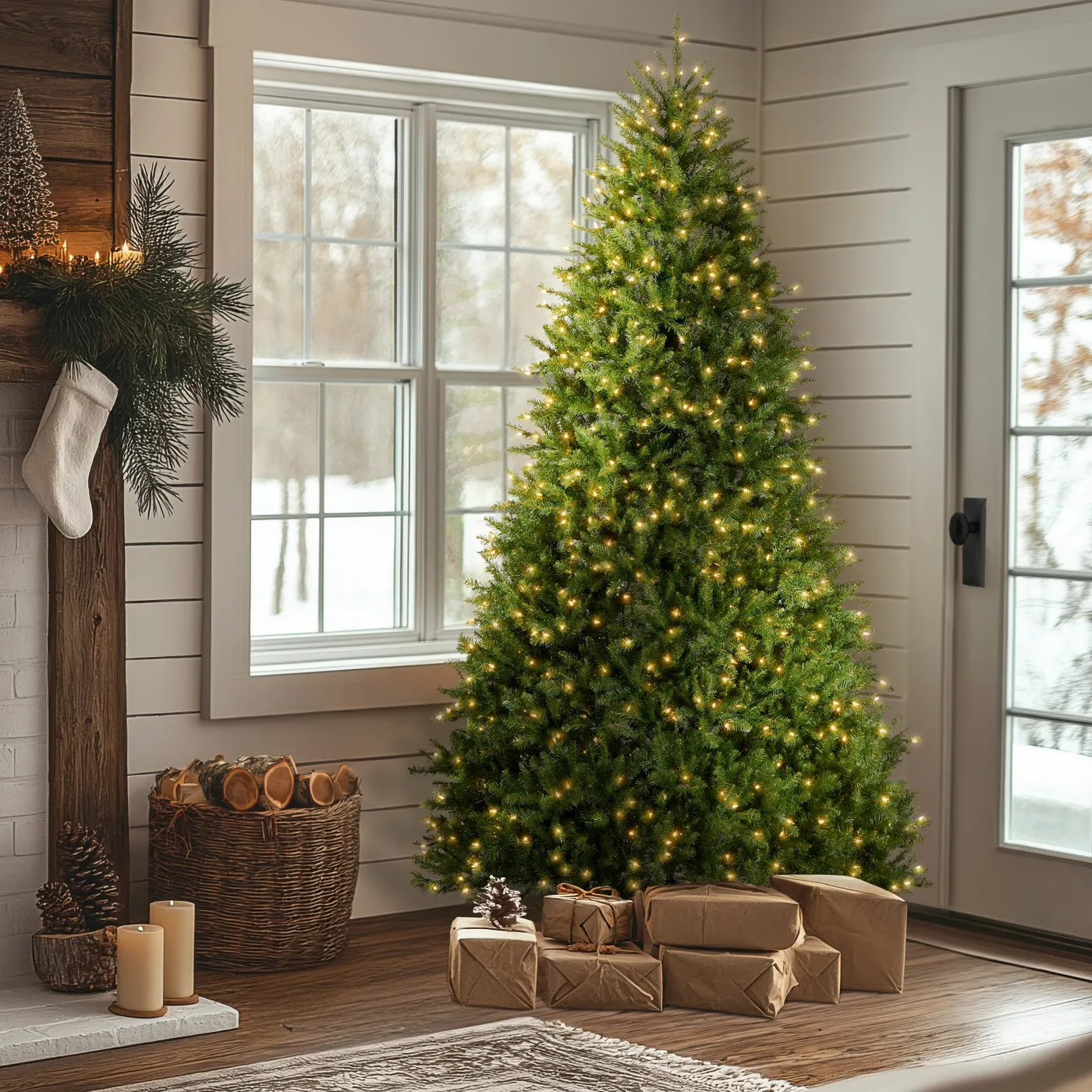
This is also the cheapest look in the entire article, by a wide margin. Brown kraft paper at $8 a roll, cotton twine at $3, a bag of pinecones you gathered yourself, a strand of warm white lights at $15 from Target, and you’re done. If your tree is already pre-lit, your total spend is under $30. Compare that to a flocked tree with a full ornament wardrobe and it’s not even the same sport. The styling is entirely about the mantel — pine branches laid flat with three pillar candles tucked in, one simple stocking. Let the fixings be humble and let the arrangement be deliberate.
12. Neutral Ornaments and Plaid Pillows by a Roaring Fire
Layer your tree lights in three passes and you’ll never go back to one strand again: a tight strand wound close to the trunk for depth, a mid strand spiraling through the middle branches, and a sparse strand just on the outer tips. About 100 lights per foot of tree height total. It’s more lights than the box tells you to buy, and it’s the reason some trees look magical and others look like they’re waiting for the room to fill up.
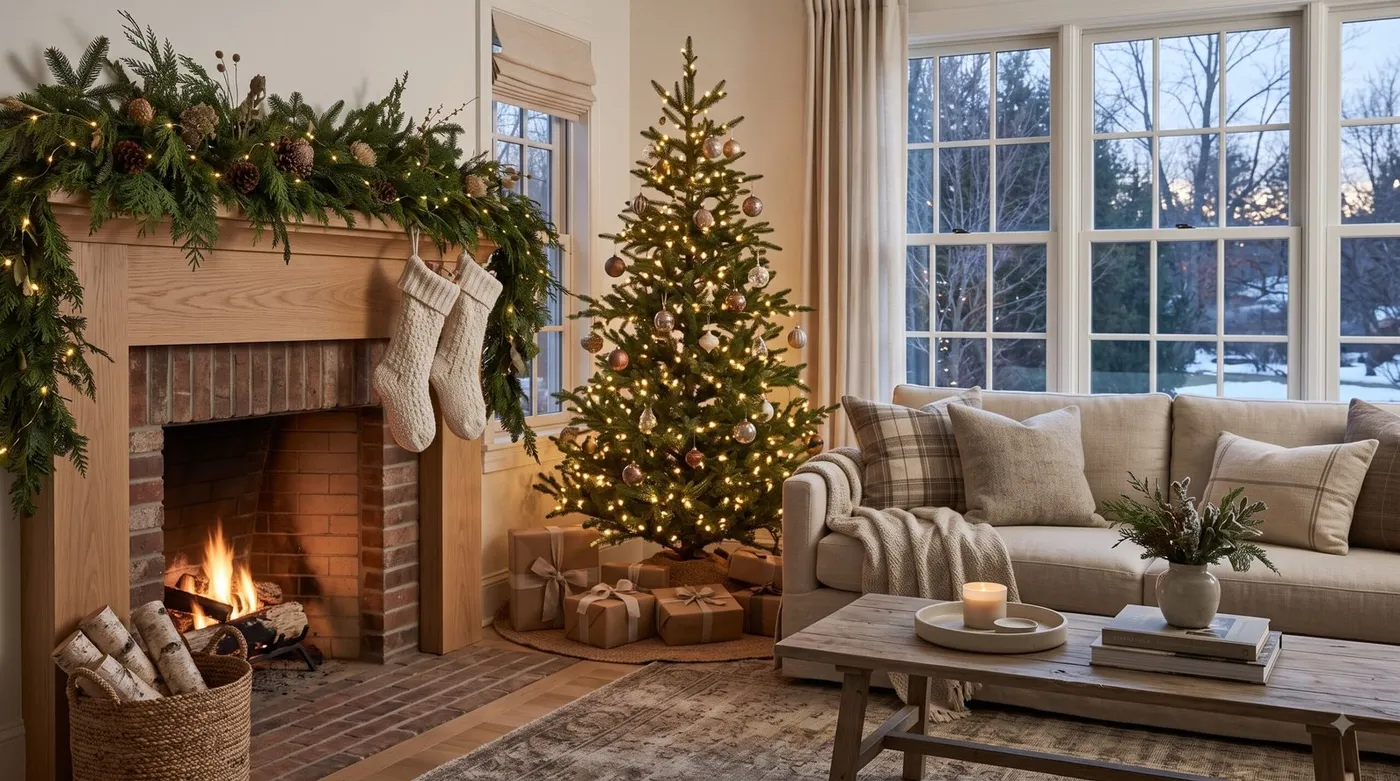
Honest talk about the roaring fire: brick fireplaces radiate a lot of dry heat right at your tree. Keep a minimum 3-foot clearance between the firebox and the nearest branch, and check the tree’s water twice as often as you think you need to. Warm dry air pulls moisture out of a cut tree fast, and a real tree next to a working fireplace is exactly the scenario where you want to be a little paranoid. The knit stockings and plaid pillows are the cozy part — the clearance is the responsible part.
13. Red Berries and Plaid Boots in Close-Up Detail
If you zoom in on only one thing, make it the plaid boot ornaments with the furry cuffs. This tree has glossy red spheres, bright red berry clusters, and rustic wood behind it, and it’s the boots that give the whole vignette a sense of humor. Take them off and you have a perfectly nice traditional tree. Leave them on and you have a tree with personality — the thing people actually comment on when they walk in.

That’s the principle worth stealing: one slightly absurd, personal ornament per tree. A boot, a tiny felt animal, a chipped vintage Santa from your grandmother’s attic. It gives the eye a place to stop among all the identical spheres, and it’s the reason a stylist’s tree never looks like a showroom tree. Everything else can be a matched set. That one piece shouldn’t be.
14. A Flocked Tree on Herringbone Floors with Marble Surround
The formula: 50% white (flocked tree, paneled walls, marble fireplace surround) + 30% green (the tree’s underlying needles, the garland, the wreath) + 15% red and gold (ornaments and wrapped brown paper parcels) + 5% warm wood from the herringbone floor. What keeps it from reading cold is the herringbone — that diagonal geometric pattern underfoot adds visual warmth even though the floor itself is light.

on light herringbone and a flocked tree: this combination is beautiful and high-effort. Flocked trees shed; light floors show every speck. Keep a soft-bristle hand vacuum near the tree from day one and do a quick pass every other day rather than waiting for a big cleanup. Also, flocking and humid rooms don’t mix — if your fireplace is gas and unvented, consider whether that moisture is going to be a problem over a six-week season. It usually is, subtly, and you notice in year two when the snow has gone slightly cream.
15. Multicolored Lights and White Gift Boxes Under a Mirrored Wreath
Multicolored lights are back, and it’s not nostalgia — it’s a reaction. After years of uniform warm-white minimalism, the saturated, slightly chaotic glow of colored bulbs reads as genuinely warm and human. It’s the same impulse that’s pushing people toward collected, mismatched ornament trees and away from monochrome. Traditional isn’t a cop-out anymore; it’s a choice.
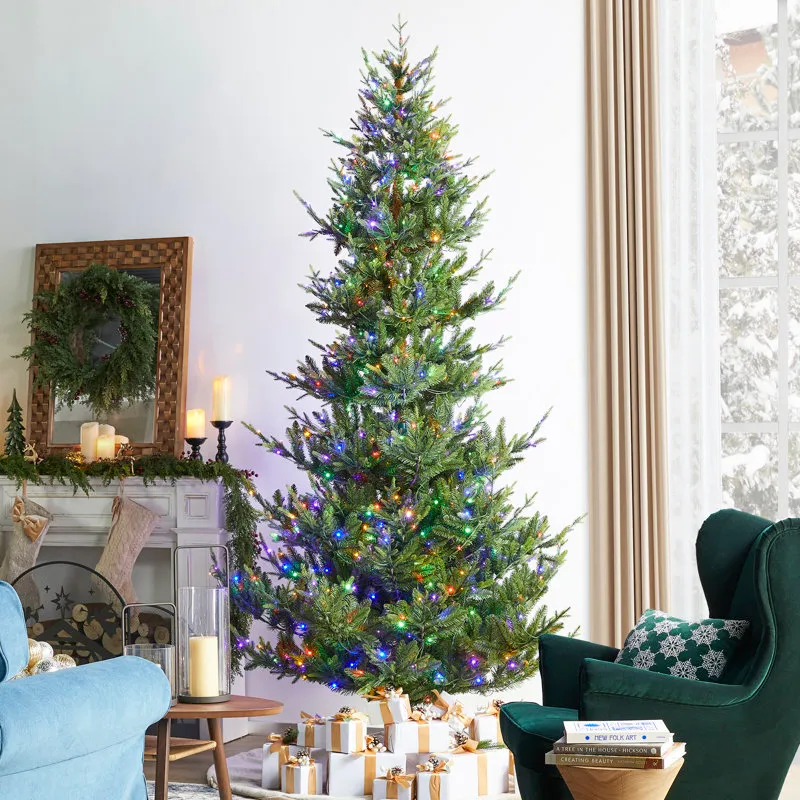
Here’s what recreating this actually costs:
- 7-ft green tree: $80-$200
- Multicolored LED strand set (300 lights): $20-$45
- White gift boxes and gold ribbon: $25-$60
- Mirrored wreath: $35-$90
- White fireplace mantel garland and candles: $30-$75
- Dark green velvet armchair (if you’re adding seating): $250-$650
- Total: $190-$470 (or $440-$1,120 with the chair)
Budget alternative: skip the velvet chair and pull in a dining chair with a green throw draped over it — nobody notices the difference in a photo or in real life. That keeps you comfortably under $300.
16. Cable-Knit Sweaters and String Lights at the Tree Farm
If you’re going to cut your own this year, do these five things before you leave the house:

- Measure your ceiling height and your tree stand’s interior width — bring both numbers on your phone
- Check the species’ needle retention (Fraser fir and Nordmann fir hold far better than spruce)
- Bring a tarp and gloves — sap is relentless and doesn’t care about your cream cable-knit sweater
- Confirm the farm’s netting and baling service hours, not just their cutting hours
- Plan the water: a fresh-cut 7-foot tree drinks about a gallon in the first 24 hours
One more: string lights draped across the farm look charming in photos, but they also mean the ground may be muddy and the paths uneven. Wear actual boots. The tan collar and green knit scarf look great and do nothing for traction.
17. Deep Blue and Rose Gold Against an Arched Window
Blue and rose gold is the most underrated pairing in holiday decorating, and this tree shows why. Blue and gold are near-complementary — cool against warm — so the ornaments vibrate slightly against each other rather than blending. Add the arched white window frame behind and you get a third element: architecture as backdrop, which gives the tree a frame it didn’t have to earn.

The gold corrugated metal base is the detail most people miss. A tree skirt would soften this arrangement into something generic. Metal keeps it architectural, echoing the window frame and the kraft paper gifts. If you’re building this look, spend your money on the base before you spend it on ornaments — it changes the read of the entire corner, and it’s the piece guests actually ask about. A corrugated metal tub from a hardware store runs $25-$40 and looks nearly identical to the specialty versions at $120.
18. Pre-Lit Warmth on a White Fluffy Skirt
The white fluffy skirt is doing more than hiding the stand. Against panel molding, a white mantel, and gold and silver gifts, that soft cloud of texture at the base is the only element in the room without a hard edge — and that’s precisely why it works. Everything else in this vignette is crisp and architectural. The skirt is the exhale.
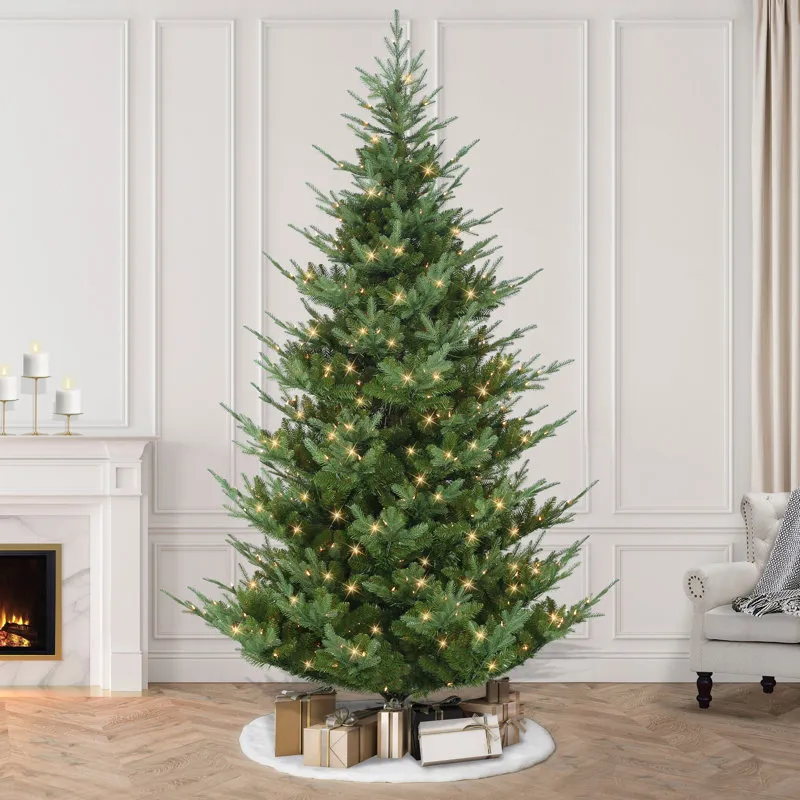
Sizing here matters more than people expect: for this composition to feel right, you want at least 8 feet of ceiling, a tree between 7 and 7.5 feet, and about 3 feet of clear floor on either side of the fireplace mantel so the tree doesn’t crowd it. Smaller rooms can absolutely borrow the idea — scale the tree to 6 feet and use a 30-inch skirt instead of 48 — but you’ll lose the drama. For a version that’s built for tighter footprints, see Idea #17.
19. Twin Flocked Trees and Plaid Stockings in a Farmhouse Vignette
Symmetry gets a bad reputation, but here’s the rule: if you go symmetrical, go *almost* symmetrical. These two flocked trees are the same height and style, but the ornaments aren’t matched and the mantel isn’t mirrored — the garland runs left-heavy, the lantern sits off-center, the sign is low. That slight asymmetry is what keeps a twin-tree setup from looking like a department store display.
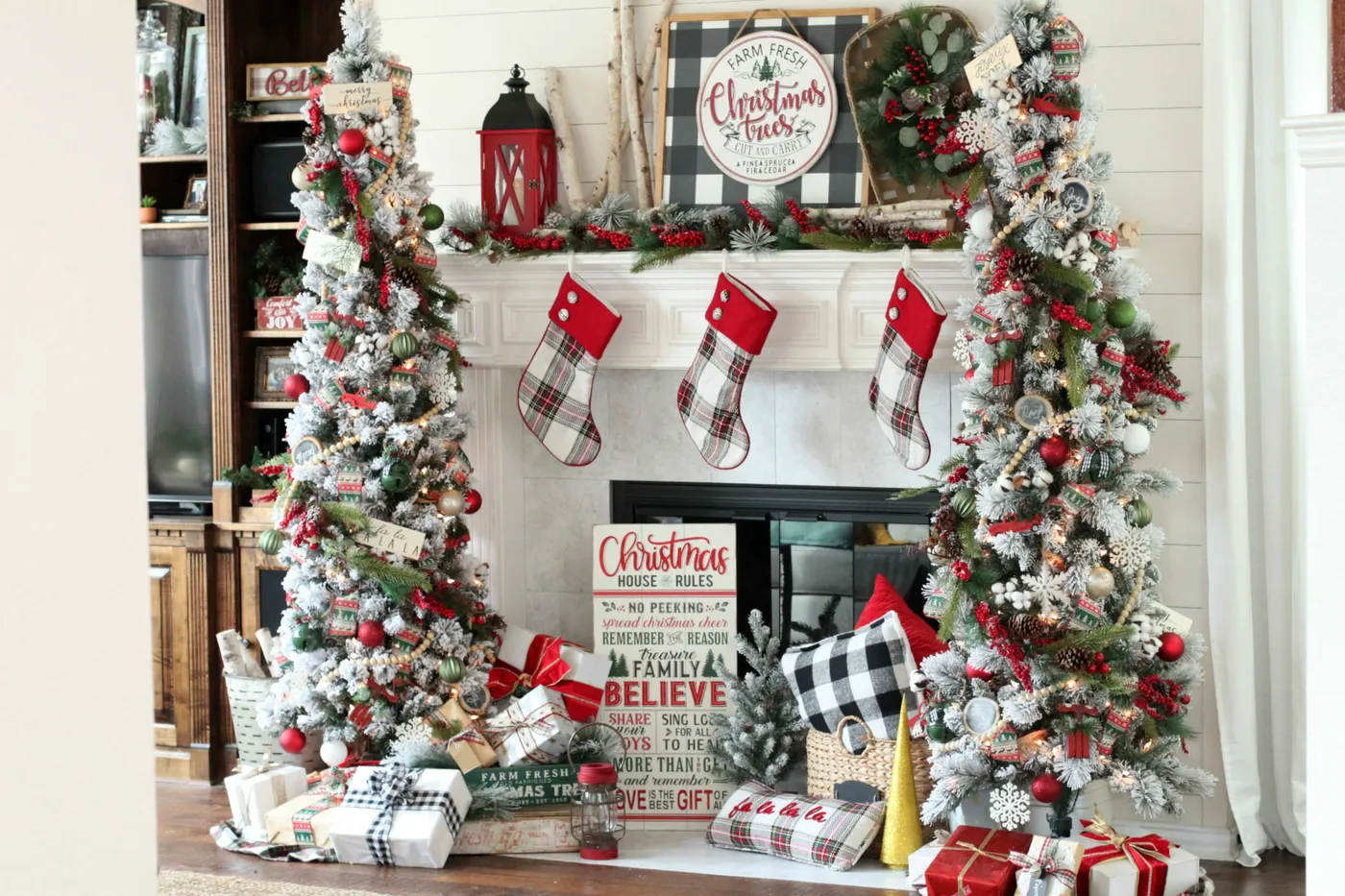
Flocked trees are expensive to buy new — $200 to $400 for decent ones. But January is your friend: flocked trees are the single most-discounted holiday item because nobody wants to store one. Set a Facebook Marketplace alert for “flocked tree” in the first two weeks of January and you’ll find them for $40-$80, often used once. Buy two, store them in cotton sheets, and you’ve built a farmhouse mantel for a fraction of retail. The plaid stockings and berry garland are the cheap part — $8-$15 each.
20. Copper Bells and a Heart Ornament at Child Height
The heart-shaped ornament on twine, hung where a kid can reach it, is the whole point of this tree. Copper bells, warm white lights, a personalized white bauble with a name on it — these are the things that turn a decorated tree into a family record. It’s the one element that no amount of money can replicate, and it costs about $6 at a craft store.

Practical warning, and I mean this kindly: anything hung low in a house with small children will get re-hung, dropped, licked, and possibly eaten. Skip glass entirely below the 3-foot mark. Copper bells and twine are perfect — they’re light, they don’t shatter, and if one disappears into a toy bin for a week, nobody’s heart breaks. Keep the heirloom pieces in the top third, and photograph the tree early in the season before the toddler curation begins.
21. White and Silver Elegance Between Arched Windows
White-on-white needs a value anchor or it disappears. Here it’s three of them: the dark wood coffee table, the nutcracker figurines clustered along the window ledge, and the dark frame of the large rectangular mirror. Strip those out and the tree, garland, and NOEL sign would all dissolve into the wall. That’s roughly 65% white and silver, 20% dark wood, 10% warm light, 5% red from the nutcrackers’ uniforms.
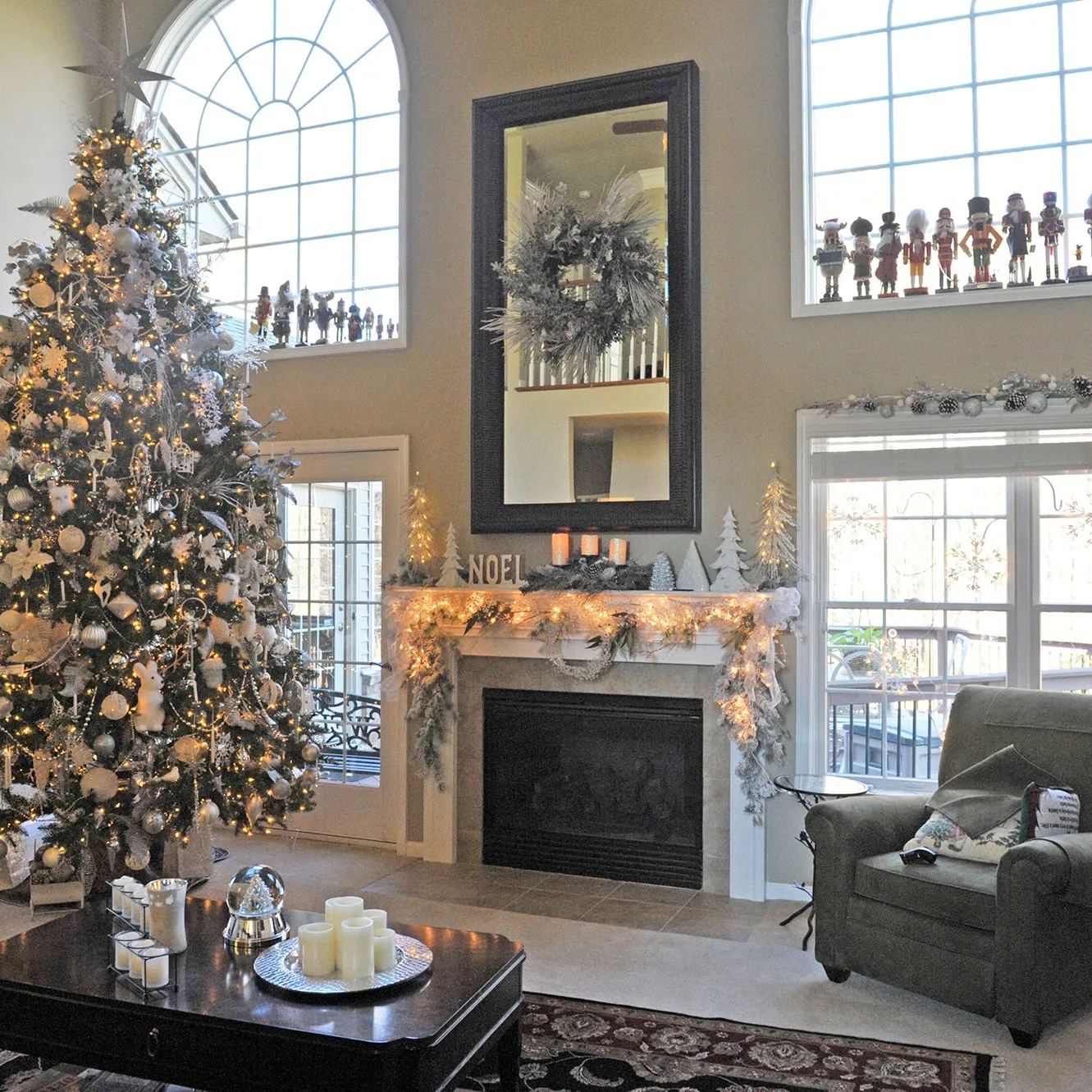
This room is genuinely large — tall arched windows, a wide fireplace wall, a full-size tree with a 48-inch spread. If you’re working with something similar, you need a minimum 16-by-20-foot footprint for the proportions to hold, and 10-foot ceilings would be ideal. The scale of the mirror above the mantel is what makes it work: it should be about two-thirds the width of the mantel, no smaller. In a standard 12-by-14 living room, that same mirror would visually crush the space. See Idea #5 for a version built around a normal-sized wall.
22. A Tiny Berry Wreath Against a Red Curtain Backdrop
Notice the depth of field. The tree is sharp, the warm lights blur into soft orbs, and the red curtain behind goes completely soft. That’s not a photography accident — it’s what happens when you back a decorated tree with a saturated textile instead of a plain wall. The red curtain absorbs the color of the ornaments and reflects it back, which makes the red baubles feel deeper and richer than they would against white.

You can use this trick cheaply: hang a single panel of deep red or forest green velvet (about $25-$50 for one 50×84 panel) behind your tree if you have a blank wall. It’s a one-hour project with a curtain rod, and it makes a $100 tree look like it belongs in a magazine. Just make sure the panel is at least 6 inches wider than the tree’s widest spread on each side, or you’ll see the wall peeking through in photos.
23. Pre-Lit Warmth Against a Dusk City Skyline
There’s a reason apartment trees photographed against windows at dusk always look better than they do in daylight. At dusk, the interior lights become the brightest thing in the frame, and the blue-grey skyline outside provides cool contrast for free. It’s a lighting principle, not a decor one — and you can use it deliberately by placing your tree near your largest window and dimming every overhead light after 4pm in December.
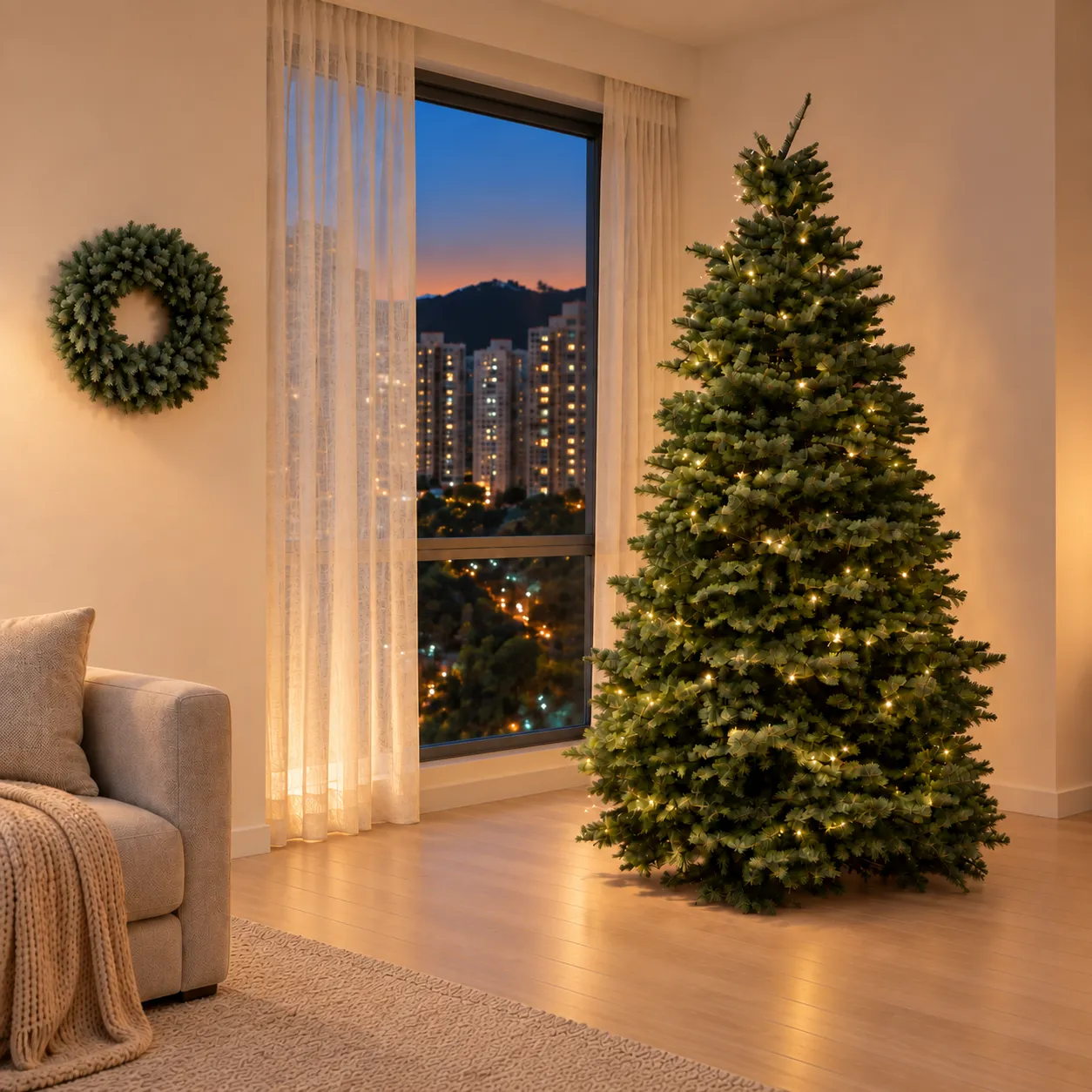
Apartment dwellers, this look is completely achievable on a small budget. A 6-foot pre-lit tree from Walmart ($69-$99), a woven throw over a plain beige sofa ($30 at Target), a simple green wreath on the wall ($18-$35), and sheer white curtains you probably already own. Under $200 total. The city view does the rest, and if you don’t have a city view, a string of warm white lights across the window frame suggests one surprisingly well.
24. Gold and White Ornaments Between Channel-Tufted Chairs
This is a seating arrangement first and a Christmas tree second — and that’s the lesson. The gold-framed arched mirror, the white sofa, the two beige channel-tufted armchairs: the tree slots into a conversation zone that already works. Here’s the cost to build the room around the tree:
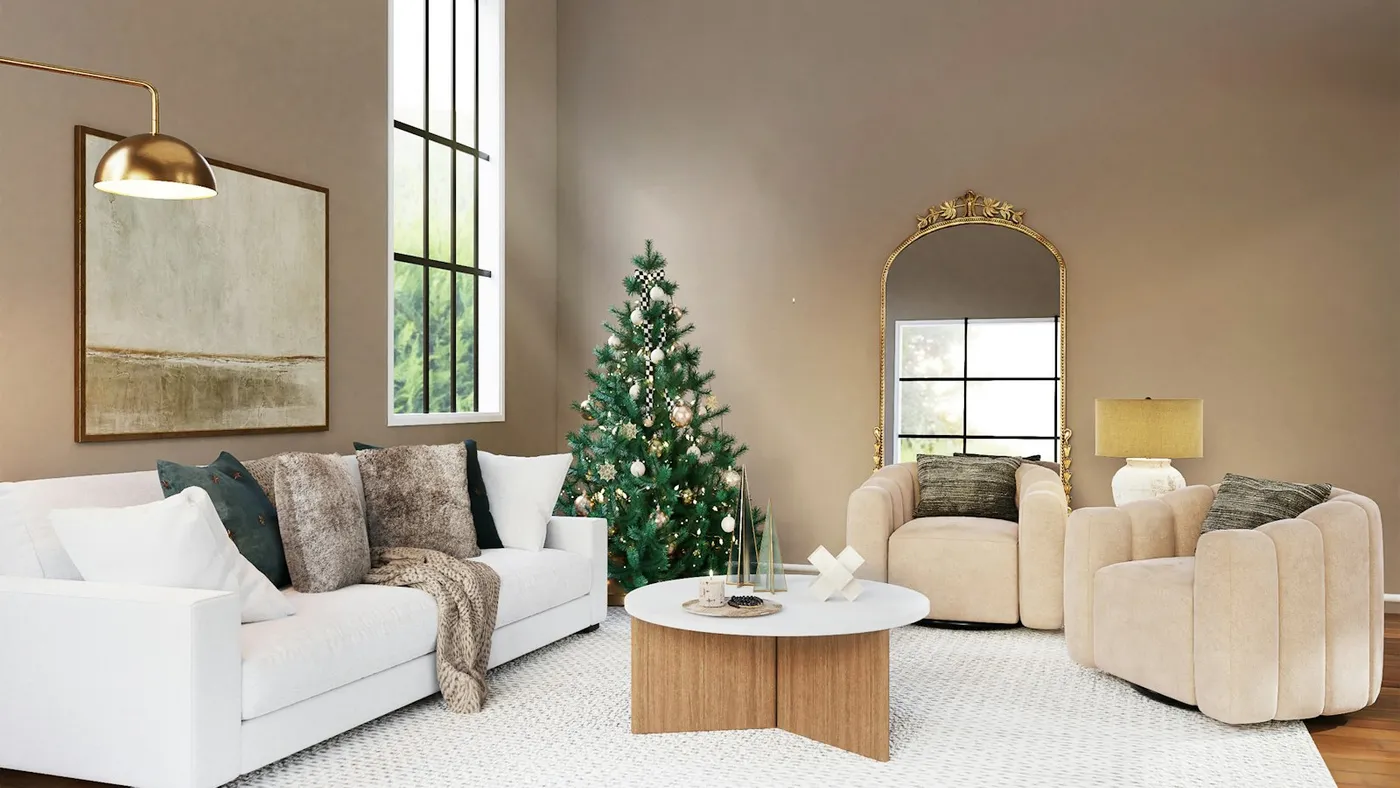
- 7-ft decorated tree with gold and white ornaments: $150-$400
- White sofa: $700-$2,000
- Two channel-tufted armchairs: $600-$1,600
- Ornate gold arched mirror: $120-$350
- Round white and wood coffee table: $180-$450
- Framed abstract art: $80-$250
- Total: $1,830-$5,050
Budget alternative: keep the tree and mirror, skip the matching chairs. Two slipcovered IKEA armchairs at $179 each and a $99 round table get you the same silhouette for under $700 — about a third of the mid-range total. The tufting is lovely, but nobody’s counting buttons when the tree is lit.
25. A Heavily Flocked Tree Beside a Roaring Stone Hearth
Heavy flocking plus a working stone fireplace is a genuinely tricky pairing, and it’s worth being honest about. The fire’s heat dries the air, which is exactly what flocking hates. Keep the tree at least 4 feet from the firebox — this one clearly is, and that’s not an accident of the room’s layout. If yours can’t clear 4 feet, use a flocked garland on the mantel instead of a full tree and put a real or lightly flocked tree across the room.
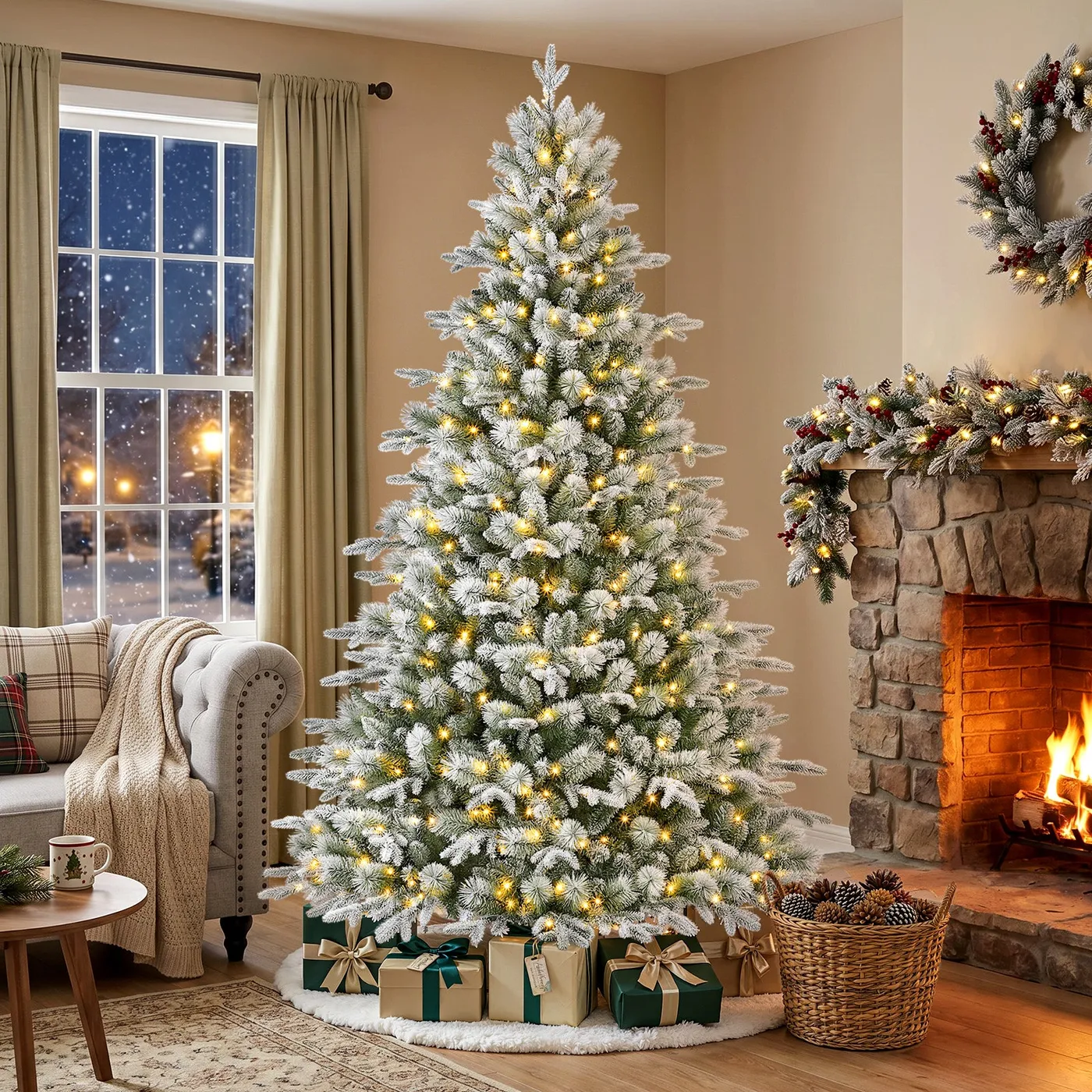
The flocked garland with red berries and the matching wreath above the hearth are the load-bearing elements here. They tie the tree to the fireplace across what is actually a fairly large distance, so the two don’t read as separate vignettes. Matching garland and wreath is the single most reliable way to make a large room feel intentional. It costs less than a second tree and does more work.
26. Pinecones and Faux Fur in a Classic White Room
The pinecones tucked into this pre-lit tree are visible from across the room, which is the whole point. Natural pinecones are dark, matte, and irregular — three qualities that make them read clearly against glossy ornaments and warm bulbs. On a herringbone floor with marble and panel molding all around, that bit of roughness is what keeps the room from feeling like a hotel lobby.
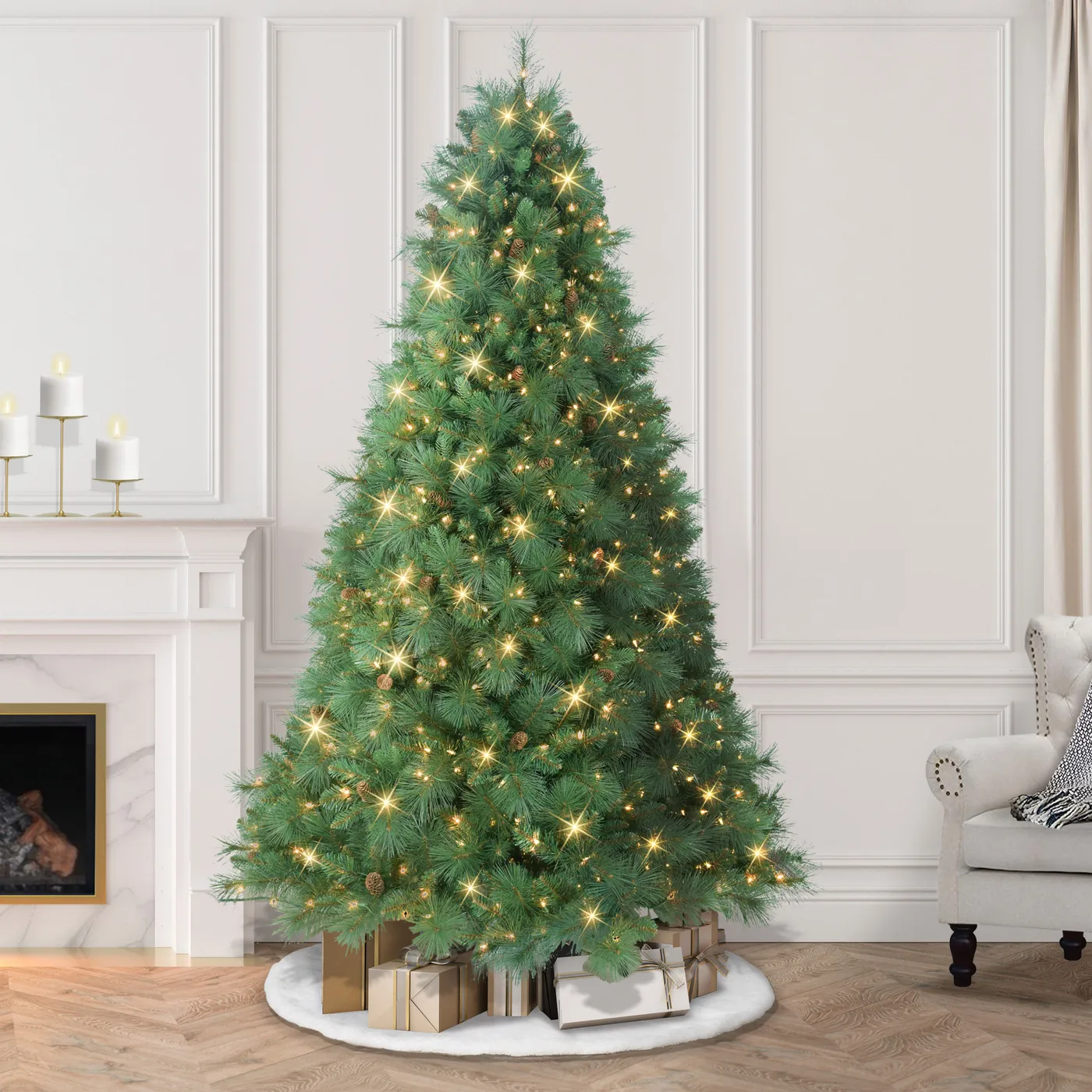
One thing that surprises people: faux fur tree skirts and white marble fireplaces are both magnets for pine needles and flocking dust, and neither is fun to clean. Shake the skirt out weekly over a trash bag rather than vacuuming it — vacuum brushes permanently mat the pile. And if your marble surround is real, don’t let sap or tree water sit on it. Both etch marble, and etching can’t be polished out by hand. A $12 clear tray under the tree stand solves it.
27. A Single Red Ornament in a Field of Pines
One ornament. That’s the styling choice, and it’s a deliberate rejection of the fully decorated tree. You’ll see a lot of this in 2026 — people hanging a single ornament on a tree they just cut, before it’s even inside. It’s the visual equivalent of a first page, and it photographs better than almost anything because it’s honest. The rest of the photo is just people in plaid and boots, standing in rows of green.

The reason this trend has staying power is that it costs nothing and requires no skill. No color theory, no ornament collection, no ladder. You hang one thing and take a picture and it looks like a memory instead of a project. If you’re someone who finds holiday decorating stressful, this is your permission slip — you don’t have to build the tree at the farm. You just have to pick it, and maybe bring one red bauble along.
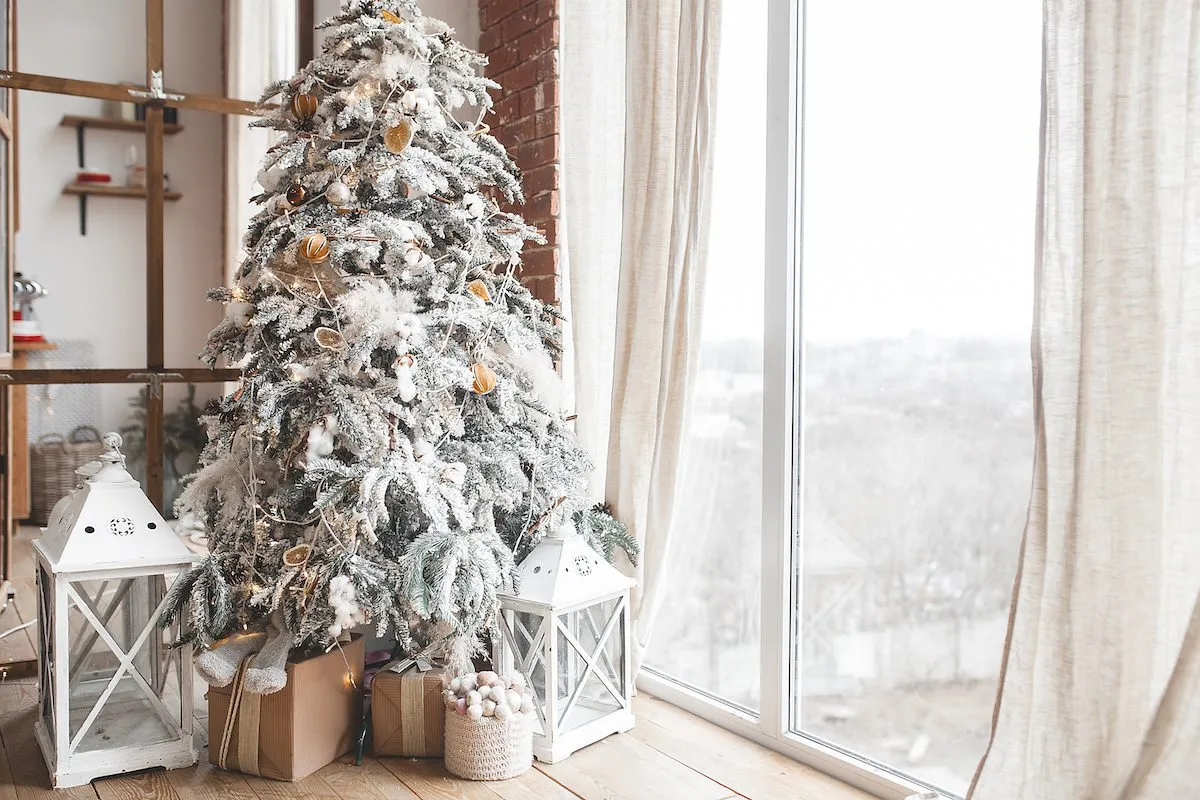
28. Dried Oranges and Cotton on a Flocked Window Tree
Dried orange slices are the easiest handmade ornament in existence, and they smell better than anything you can buy. Here’s the whole process:
- Slice oranges 1/8-inch thick with a serrated knife — thinner slices curl less
- Pat dry with paper towels and lay flat on a parchment-lined baking sheet
- Bake at 200°F for 2.5-3 hours, flipping every 45 minutes
- Cool completely on a wire rack — they crisp as they cool
- Thread with twine through a small hole poked with a skewer
- Hang near lights but not on top of them — the bulbs can scorch the fruit
Total time: about 4 hours, most of it hands-off. Materials: $4 worth of oranges plus twine. One batch of eight oranges yields roughly 30 slices, which is plenty for a 7-foot tree when mixed with cotton stems and white lanterns.
29. Red Roses and Orchids Woven Through Evergreen
Real flowers on a Christmas tree is the most opulent move in this entire article, and it’s the roses that do it — deep red, fully open, nestled into the branches rather than wired on top of them. Orchids in that deep pink-purple add a second, cooler red that keeps the arrangement from reading like a florist’s default. Small shiny red baubles pick up the light between the blooms.
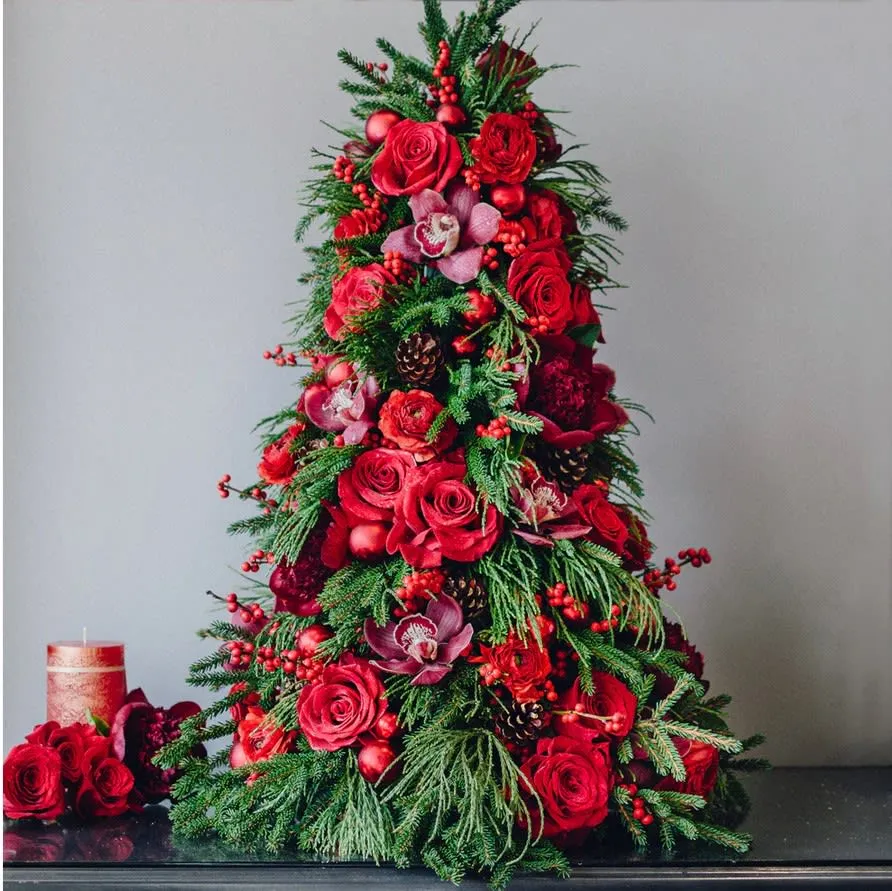
fresh flowers on a tree last 3-5 days, maybe a week in a cool room. This is a photograph-on-Christmas-Eve arrangement, not a December-long one. If you want the look to hold, use water tubes on each stem (they’re $8 for 50), or do a mixed approach — real roses in the top half where people look, preserved or silk orchids lower down where they won’t be inspected. Also, roses near a heat vent will open and drop in 48 hours flat. Keep the tree away from vents.
30. Champagne Ribbon and Rose Gold on a Deep Green Tree
The wide champagne ribbon is the structural element — it’s not decoration, it’s architecture. Woven vertically through the branches in loose S-curves, it creates a spine the eye follows from star to base, and it makes a plain green tree look full even where the branches are sparse. Formula: 60% deep green tree, 25% rose gold baubles, 10% champagne ribbon, 5% crimson from the display cabinet to the right.
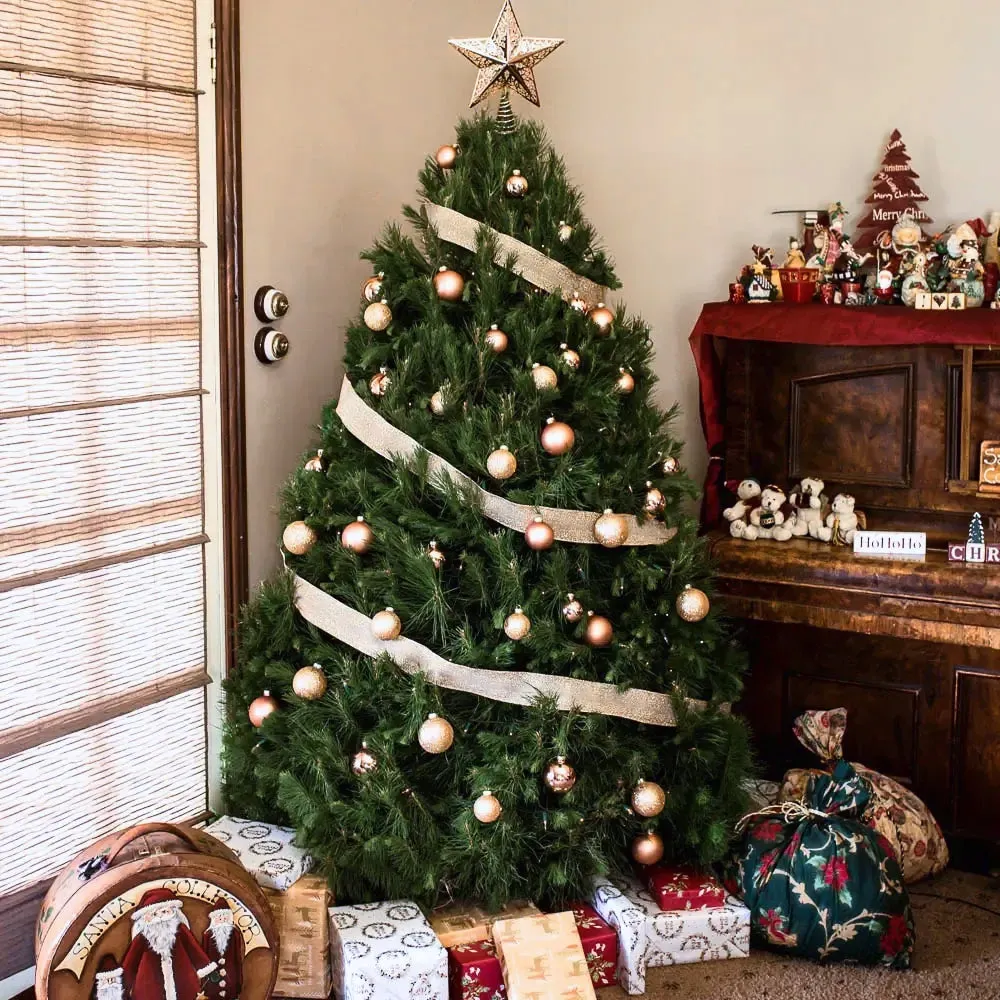
Building this on a real budget:
- 7.5-ft full tree: $120-$350
- Rose gold bauble set (60 pieces): $35-$90
- Wide champagne ribbon, 2 rolls: $18-$40
- Gold star topper: $12-$35
- Assorted wrapping paper and fabric gift bags: $30-$70
- Total: $215-$585
Budget alternative: the ribbon is where you save. A $6 roll of wide satin ribbon from Walmart in champagne reads almost identically to designer ribbon at $20 a roll — the difference is sheen, not color. Buy two cheap rolls and spend the savings on a better star topper, which is what people actually see first.
31. Warm White Lights and a Star, Nothing Else
Before you commit to a minimalist lit-only tree, check these:
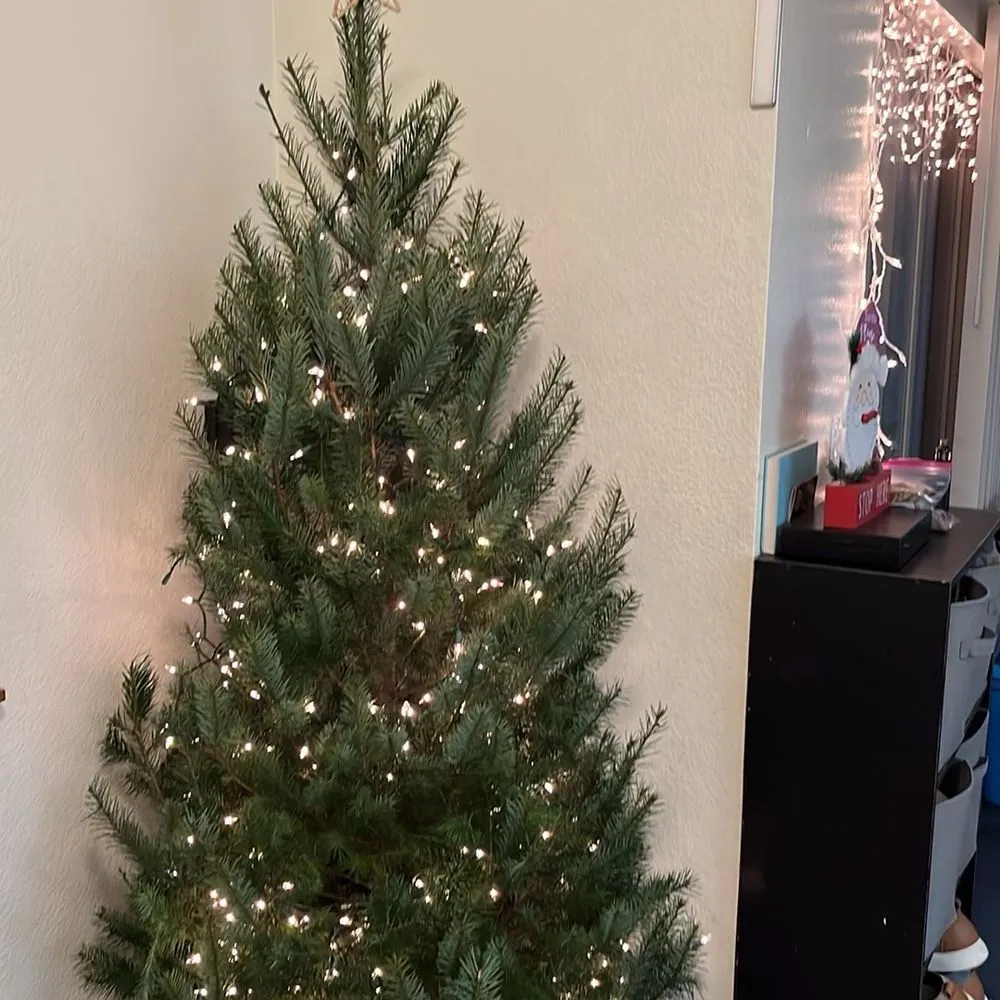
- Does your tree have enough lights? 100 per foot of height, minimum — sparse lighting looks unfinished, not minimal
- Is the star visible from the room’s main seating position, or is it lost against the ceiling?
- Is there a nearby outlet, or are you running an extension cord across a walkway?
- Have you checked the cord length against where the tree actually sits? Most pre-lit trees give you 6 feet, no more
- If you’re going bare, is the tree itself nice enough to carry the room? Sparse trees need ornaments to distract
The last one is the real test. This tree works because it’s full and evenly lit — the branches themselves are the decoration. A thin tree with nothing on it just looks like you ran out of time.
Pick the Tree, Then Let the Room Do the Rest
The best trees in this collection aren’t the most decorated ones — they’re the ones where the room and the tree were clearly thinking about each other, whether that meant a shag rug catching the glow or a single red bauble in a field of pines. Start with the space you actually have, add light generously, and let one personal thing be the star.
📌 Pin your favorite from these 31 ideas now — when December rolls around, you’ll be glad you saved it.