You know the feeling — you’ve pinned forty Christmas living rooms and not one of them looks like your actual house. We fixed that. After filtering through hundreds of options at Target, HomeGoods, and Wayfair, we narrowed it down to 31 ideas that genuinely work in real rooms, with real square footage and real budgets — from about $12 for a set of vintage-style ornaments to roughly $2,600 if you’re going all in on a two-story foyer tree.
Inside you’ll find traditional red-and-green mantels, soft neutral palettes built on cream and sage, rustic farmhouse styling, and a few moody, cinematic spaces — with budget and luxury versions compared side by side. In 2026 the shift is away from crowded, ornament-on-every-branch trees and toward quieter, layered styling people can actually live with during a frosty January. Save this post now — you’ll want it when you’re ready to shop.
1. A White Tree Anchored at the Curve of a Grand Staircase
Everything in this foyer is dark and architectural — the two-story curved staircase, the ornate iron railings, the double entry doors with their scrollwork grilles. A green tree would vanish against all that. The white tree is the one element that refuses to blend in, and that’s exactly why the pink and gold ornaments read from twenty feet away. Remove it and the entry stops feeling decorated and starts feeling merely furnished. It’s practical too: white on white tile means no gloomy silhouette when guests walk in after dark.
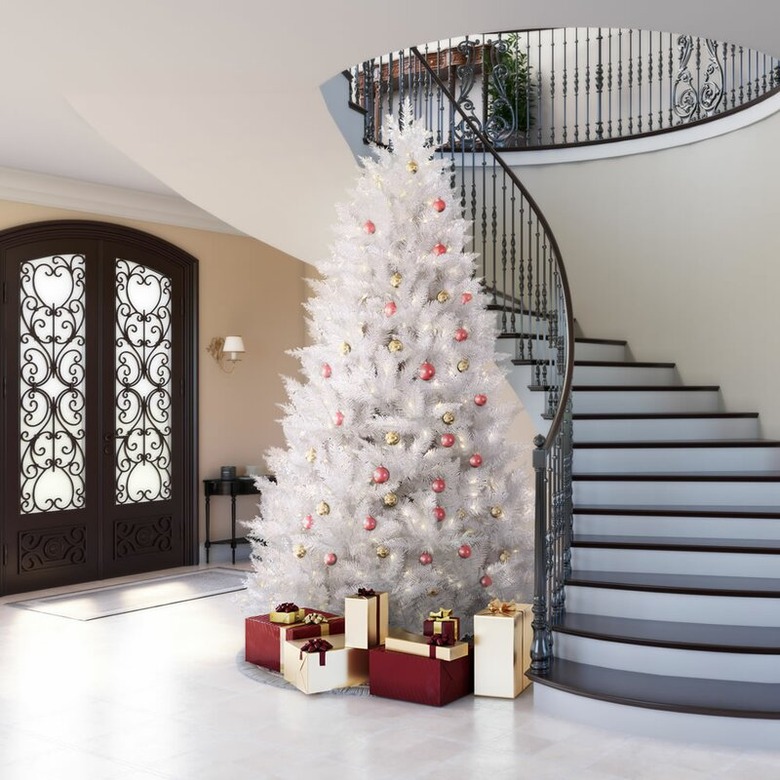
- White artificial tree (7.5–9 ft): $180–$650
- Pink and gold ornament set (60–100 pieces): $70–$220
- Wrapped gift boxes plus ribbon: $30–$90
- Stair-rail garland and ties: $45–$130
- Tree storage bag: $20–$45
Total: $345–$1,135
Budget alternative: buy a pre-lit white tree at Target or HomeGoods in early November for 40% off, wrap empty boxes you already own in kraft paper and satin ribbon, and skip the railing garland entirely — this staircase is ornate enough to hold its own.
2. Ivory and Gold With an Arched Mirror Over the Mantel
The formula here runs about 55% ivory and cream, 25% warm gold, 15% deep evergreen, and 5% warm brown wood. The flocked tree and the slipcovered sofa carry the ivory load. Gold shows up in the ornaments and the brass candlesticks along the stone mantel, evergreen arrives through the lit garland, and the round wooden coffee table brings the brown. Swap gold for brushed nickel and you get a cooler, more modern room. Swap the evergreen garland for eucalyptus and the whole thing turns coastal.
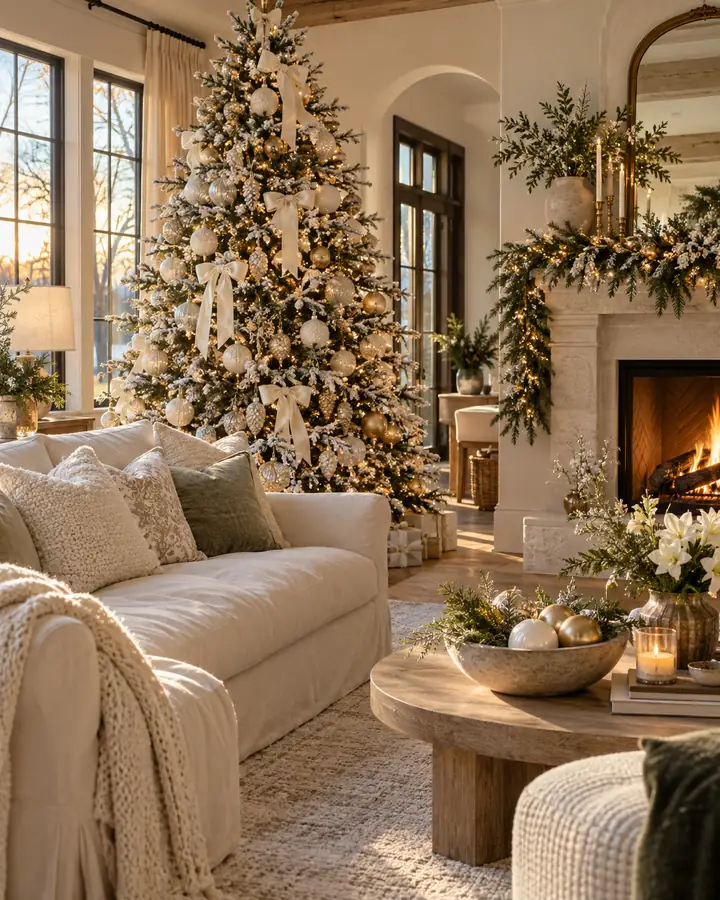
Cream bows on a flocked tree only look expensive when the ribbon is wide enough. Use 2.5- to 3-inch velvet or matte satin cut into 18-inch lengths, pinch the center, and wire it to the branch — don’t tie it. Anything narrower than 2 inches disappears into the flocking. Keep bows no more than 8 inches apart and only on the front-facing third of the tree; the back doesn’t need them, and that’s how you get a designer look on a grocery-store ribbon budget.
3. The Quiet Corner Tree in a Woven Basket
The undecorated tree has been gaining ground since 2023, and by 2026 it’s arguably the dominant look on Pinterest’s calmer boards. Call it the flip side of maximalism: after years of dense, ribbon-wrapped, ornament-loaded trees, people want something their eye can rest on. A simple evergreen in a woven basket with soft ambient light fits that mood perfectly, and it photographs beautifully without any styling effort. It also survives toddlers and curious cats far better than a tree hung with glass baubles.
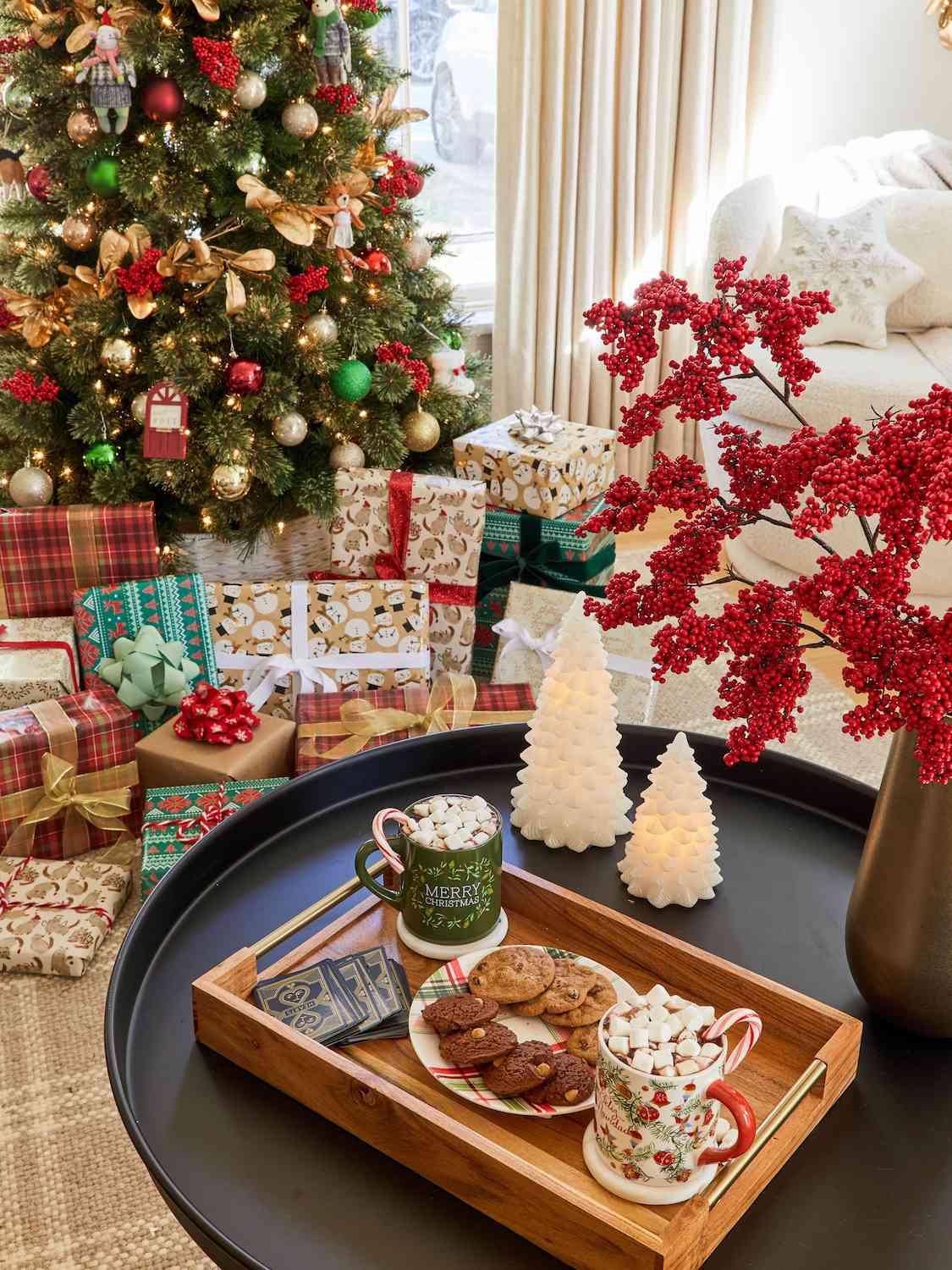
The woven basket is the real hero here — not the tree, not the knit throw. It’s what turns a plain evergreen into intentional decor instead of a plant you forgot to decorate. A metal stand or a fabric skirt would make the exact same tree read as unfinished. Look for something with genuine texture and a slightly flared shape, at least 18 inches across at the rim so the stand disappears completely.
4. Twin Trees and Burgundy Velvet Bows, Perfectly Symmetrical
Two trees flanking a sofa is a symmetry play, and symmetry reads as designed to the human eye almost instantly. What makes this pair work is the balance of weights: matching red ornaments on both trees, then a beige sofa in the middle that’s neutral enough to let the red do the talking. The mantel garland ties it together with burgundy velvet bows, a deeper, moodier red than the ornaments — that small shift in value keeps the room from looking like a matching set bought in one cart.
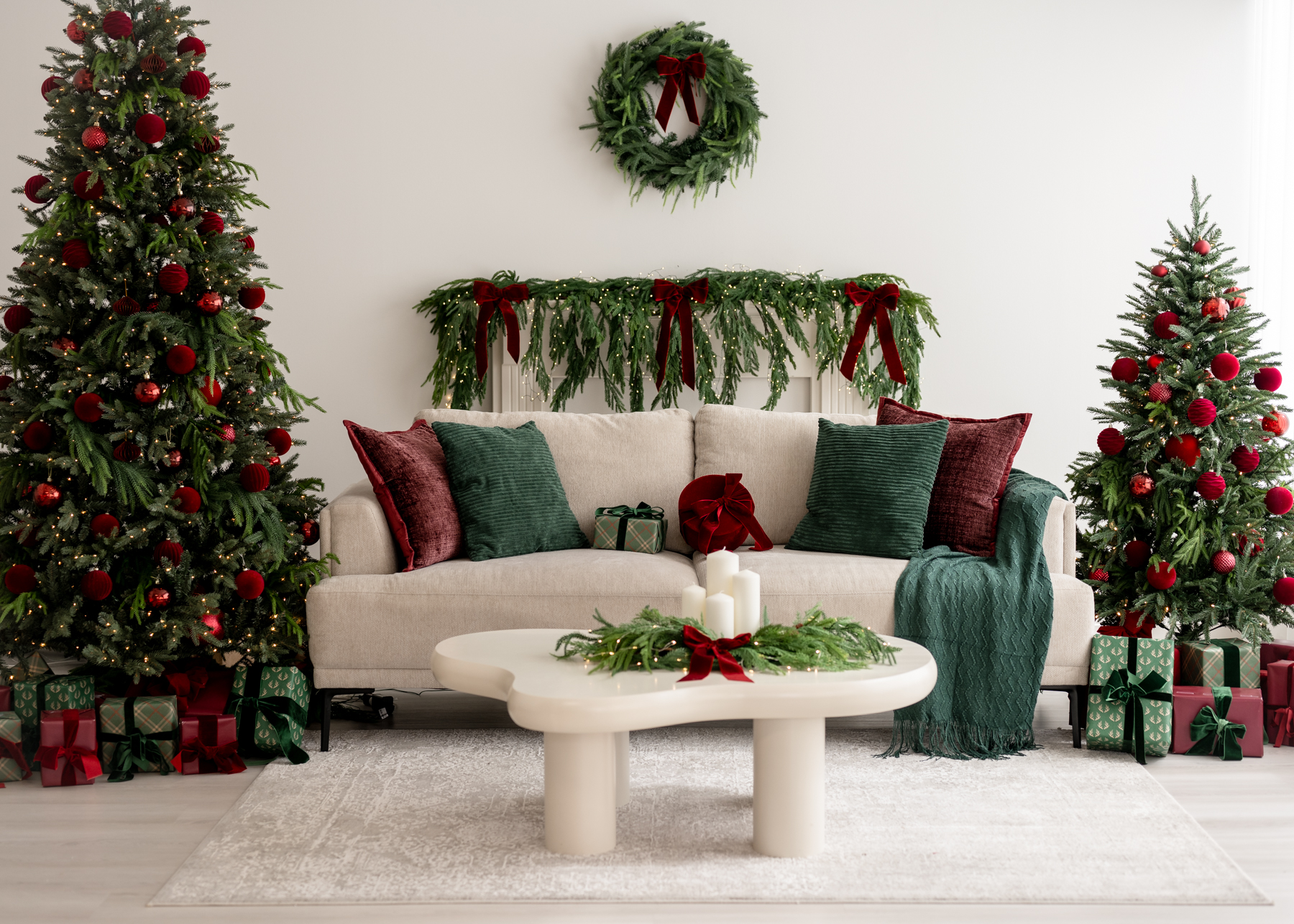
Two full-size decorated trees is a genuine commitment. Here’s what you’re signing up for:
- Decorating time, year one: 6–10 hours
- Annual set-up and take-down: 4–6 hours
- Storage: two 7-foot tree bags, plus ornament bins
- Minimum room width: 13 feet
If your living room is smaller, skip the symmetry and read Idea #6 instead, where one tree and a heavily layered mantel do the exact same job.
5. A White Sectional Lit Only by the Tree
A white sectional plus a knit throw plus any tree is basically a full-time job from December 1 to January 5. Needles, sap, and pollen land on light upholstery constantly, and knit blankets pill if you wash them more than every couple of weeks. Plan on vacuuming the sofa every other day and spot-cleaning cushion covers monthly. If that already sounds exhausting, switch to a performance-fabric slipcover in oatmeal — nearly identical look, and you can throw the whole thing in the wash.
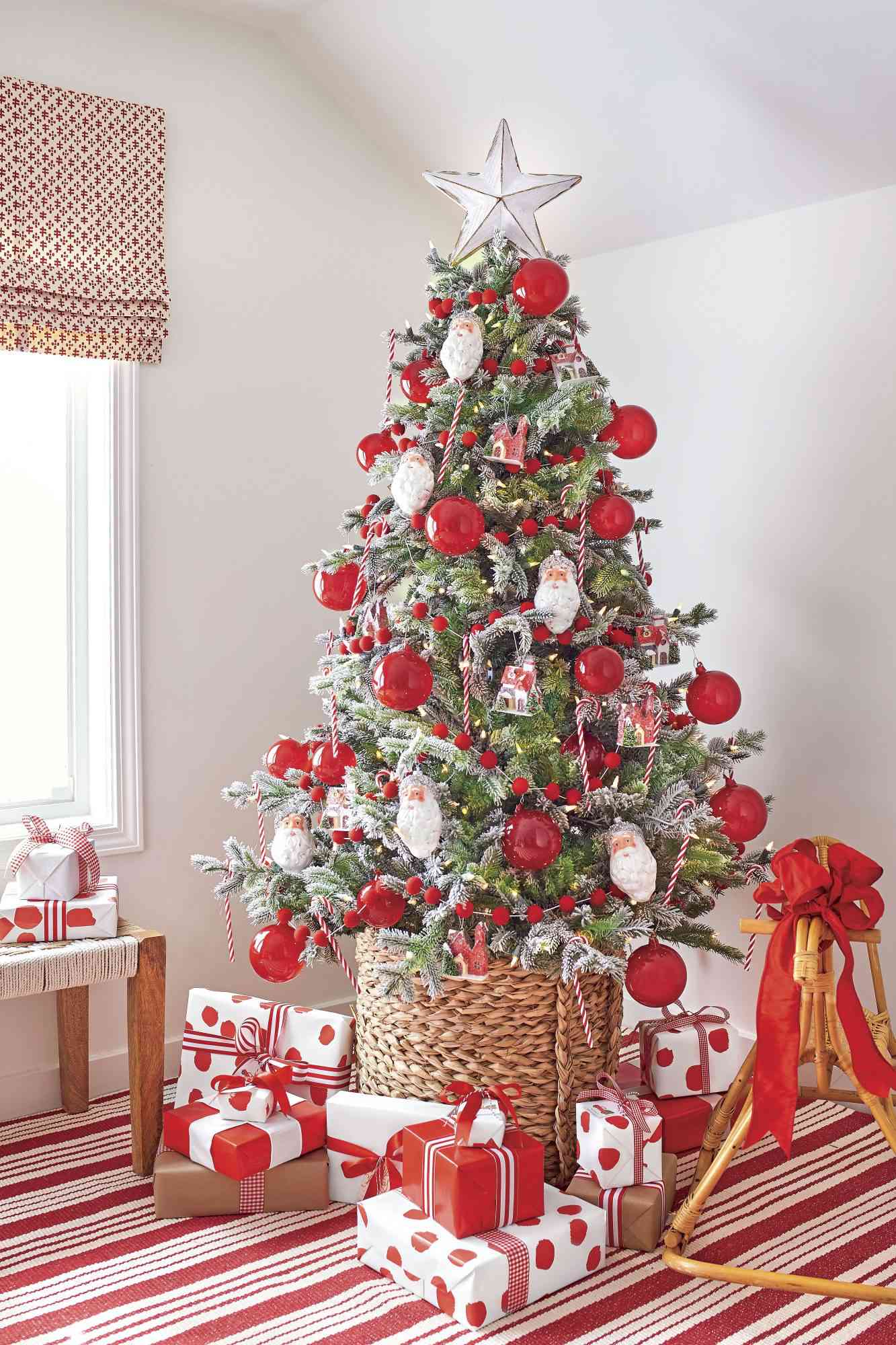
You don’t need a sectional to get this mood. A single IKEA Ektorp or Target sofa in off-white runs $400–$700, and the rest is pure styling: $40 for two chunky knit throws at Walmart, $25 for textured pillow covers at HomeGoods, $60 for a pre-lit 6-foot tree, and $30 for a woven basket collar. That’s under $600 for the entire corner. Check Facebook Marketplace in mid-November — that’s when people upgrade and offload last year’s trees for a third of retail.
6. Layered Garland, Four Stockings, and Tall Brass Candles
Building a mantel garland that doesn’t look like a rope:
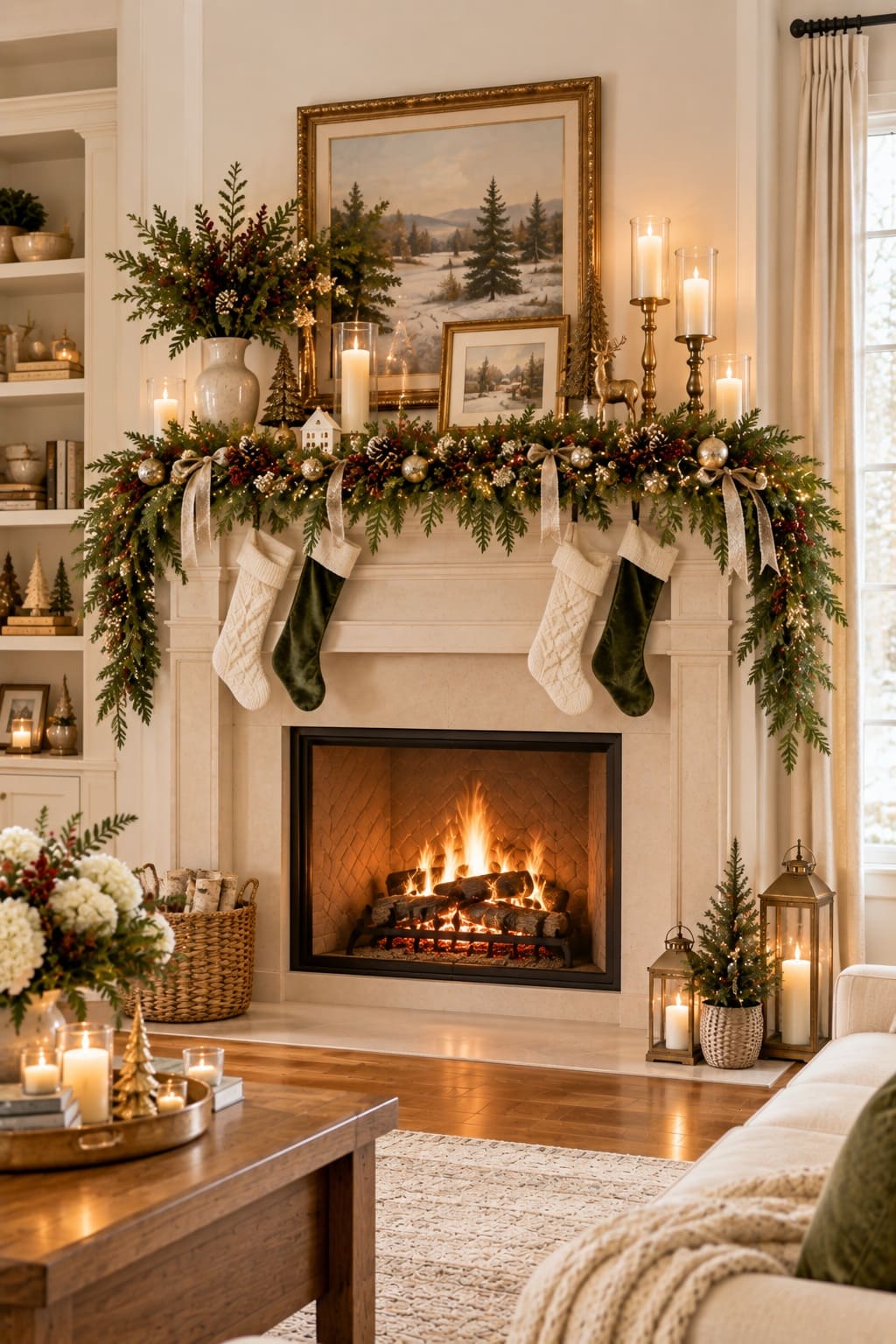
- Measure your mantel and buy garland 1.5x its length — 6 feet of mantel needs 9 feet of garland.
- Start at the center and work outward, securing with small clear zip ties instead of hooks so nothing scratches.
- Tuck in contrast every 6–8 inches: pinecones, silver and gold baubles, frosted sprigs.
- Weave the fairy lights in last, pushing them slightly into the greenery so you see glow, not wire.
- Hang stockings from separate hooks behind the garland so they don’t pull it forward.
Time: about 90 minutes. Materials: $70–$180, depending on whether you buy finished garland or build it from loose stems.
Those four stockings aren’t random — two cream knit, two green velvet, hung in an alternating pattern. Hang them so the bottom edge sits 8–10 inches above the hearth; lower than that and they dangle into the fire zone. And keep brass candle cylinders to odd numbers on a mantel. Three or five, never four.
7. Pine Green and Warm White: The Classic That Never Quits
There’s a reason this look keeps returning: it’s the version of Christmas that doesn’t require you to buy anything new. Warm white lights, a garlanded mantel, a tree with ornaments you’ve owned for a decade. As the quiet-luxury conversation matures into 2026, the pendulum has swung toward rooms that feel collected rather than purchased — and pine green with warm white light is the most collected palette there is. It’ll still look right in 2035, which is more than you can say for last year’s tinsel trend.
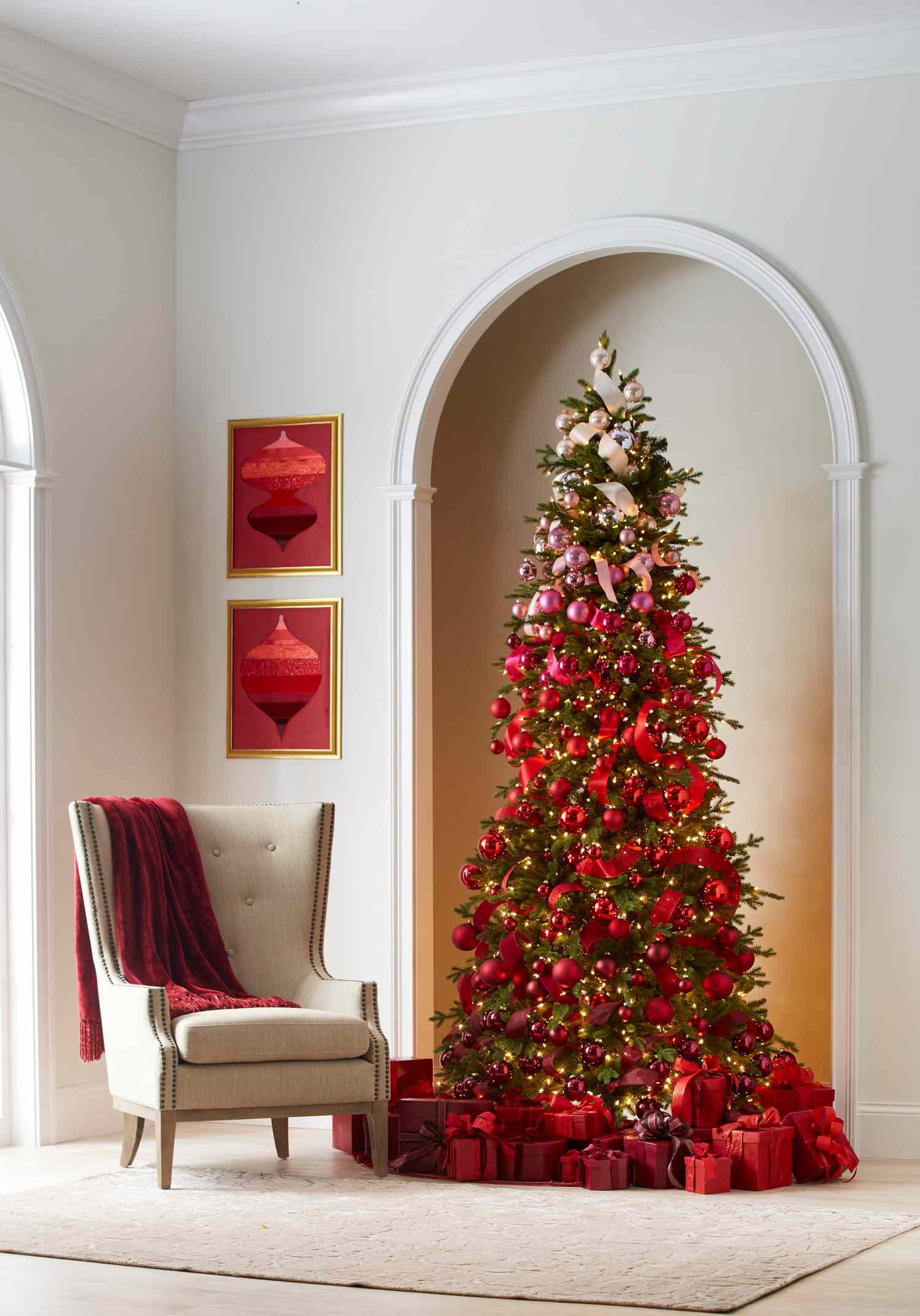
This layout wants a living room of at least 12 x 14 feet, with the tree in a corner that isn’t in the walking path between the sofa and the kitchen. Ceilings between 8 and 10 feet are ideal — a 7-foot tree fills the corner without fighting the mantel. If your room is under 150 square feet, swap the full tree for a 4-foot tabletop version, or steal the corner-built-in approach in Idea #9, which adds festive weight without eating floor space.
8. One Big Black Lantern Over a White Brick Fireplace
That single oversized black lantern pendant is why this room doesn’t read as generic farmhouse. The white brick fireplace and wooden mantel are the safe, crowd-pleasing part; the lantern is the risk. It works because of scale contrast — one big, simple shape against a lot of small busy ones in the garland, stockings, banner, and ornaments. It also pulls your eye upward, which makes a low-ceilinged room feel taller than it actually is.
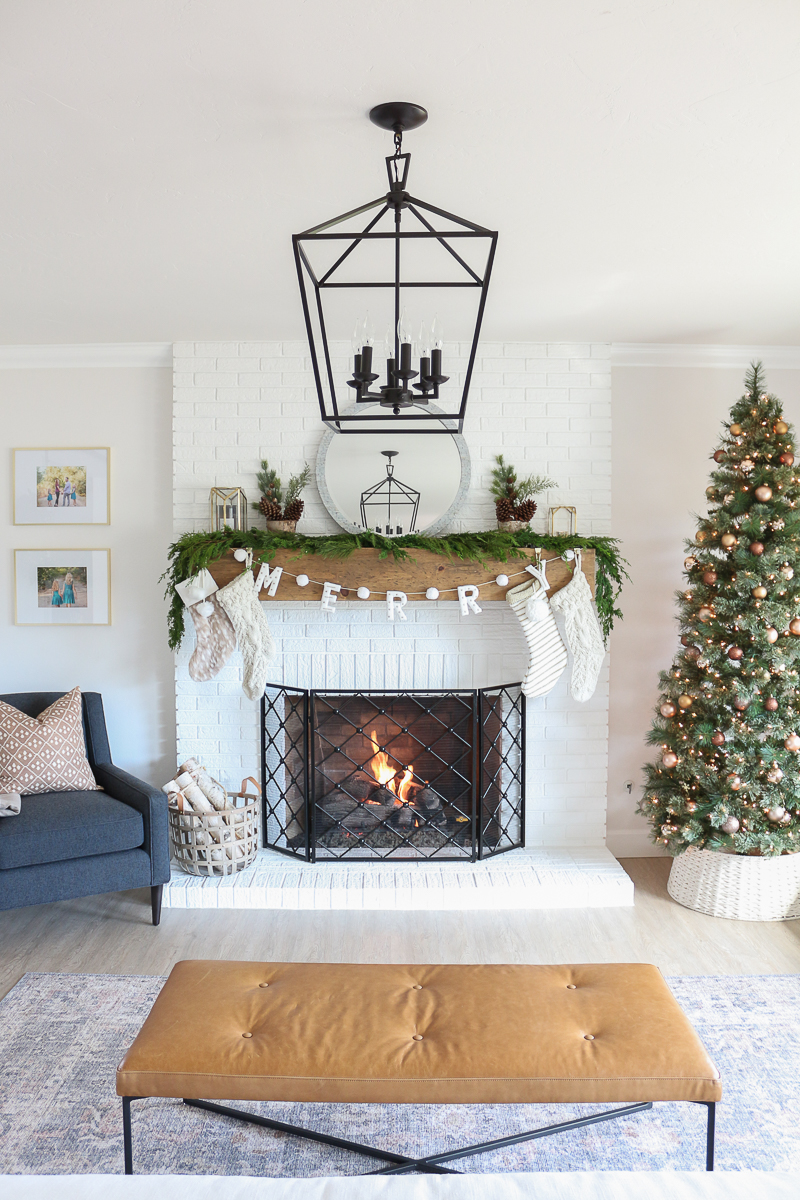
- Oversized black metal pendant: $120–$450
- Pre-lit garland for the mantel: $45–$140
- Stockings plus hanging banner: $40–$95
- Woven basket tree collar: $35–$80
- Tree and ornament set: $150–$500
Total: $390–$1,265
Budget alternative: keep your existing ceiling fixture and add a black wire plug-in pendant shade for $40–$60 — most hang from a simple hook with no wiring at all. Build the garland from two $12 greenery stems and a $15 strand of warm LED lights.
9. A Bare-Bones Tree Beside Open Wood Shelving
This may be the cheapest look in the whole roundup, because it’s mostly restraint. An undecorated 5-foot evergreen runs $50–$90 at Target or Walmart. A woven basket collar is $25. Two textured pillow covers from IKEA cost $16. The wooden shelving is the only real investment, and even that can be a Marketplace find — people sell open shelving constantly when they move, usually $60–$120 for a pair. That’s under $250 for the whole corner, and none of it looks dated by January.
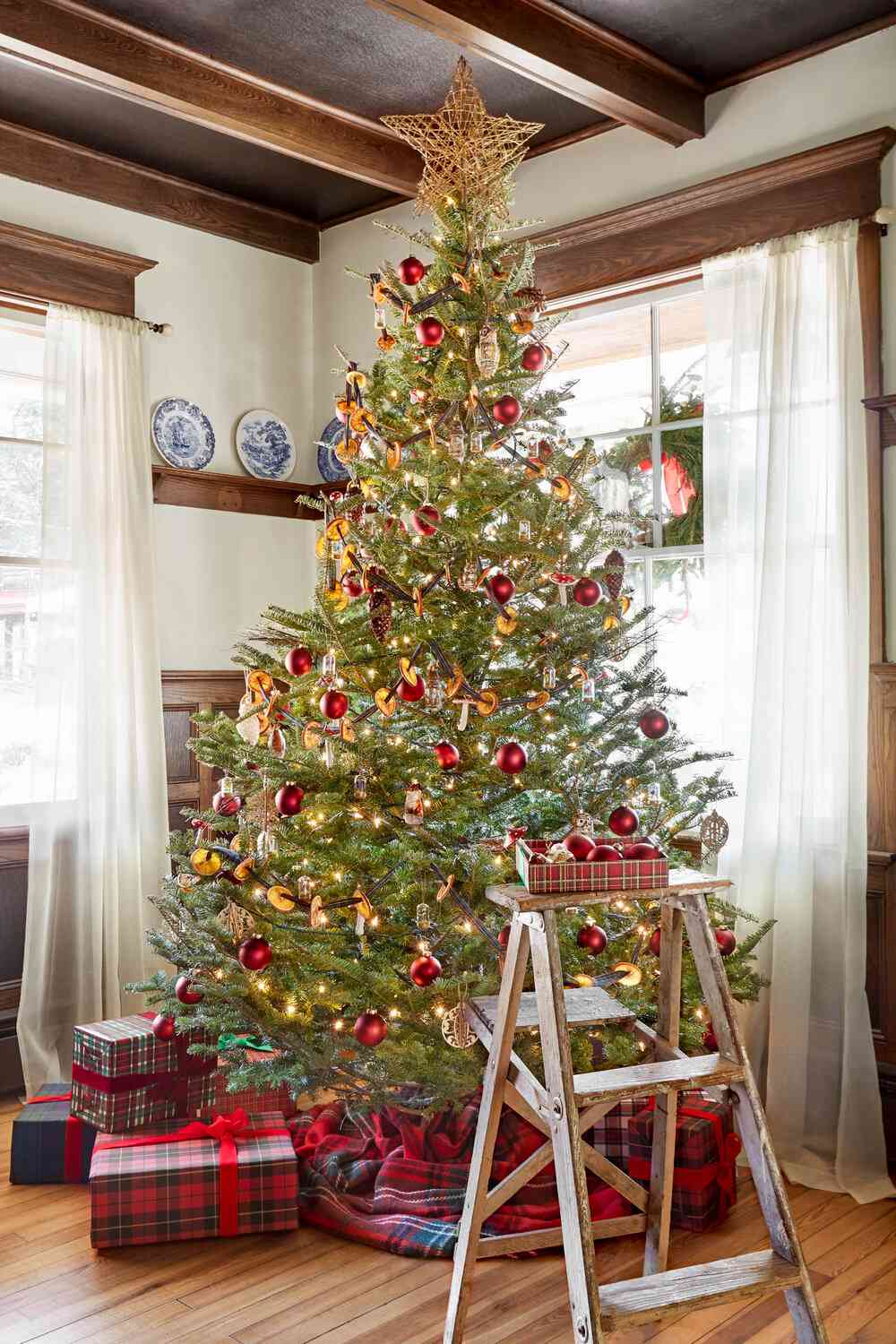
A tree this bare needs breathing room, or it reads as unfinished rather than intentional. Give it at least 3 feet of clear wall on both sides, and keep the shelving no closer than 18 inches to the branches. Rooms from 10 x 12 feet up handle it comfortably. If you’re working with a tighter footprint, the tabletop styling in Idea #23 delivers a similar calm at a fraction of the floor area.
10. Poinsettias Instead of Flowers, All Over the Tree
Oversized poinsettia picks are the fastest way to make a standard green tree look custom. Use 12 to 18 of them, and cluster three at the very top instead of using a single star — that’s what creates the full, blowsy crown. Position the largest blooms at eye level and above; anything below knee height just reads as clutter. Always twist the stem wire toward the trunk so the petals face out and slightly upward, and don’t be afraid to trim stems shorter than you think you need.

Poinsettia picks look incredible for about six weeks and then look like fabric flowers for the other forty-six. If you decorate early and leave the tree up past New Year’s, expect the crown to feel tired by mid-January. Red-and-gold is also the least forgiving palette for rooms with cool grey walls or blue-toned flooring, because the warmth fights the undertone. Warm white walls, oak floors, or beige carpet are its natural home.
11. Wooden Tree Cutouts and Bead Garlands on a Family Mantel
The charm of this mantel is that it’s clearly homemade, which means you can absolutely copy it for less. Wooden tree cutouts run $8–$15 for a set of six at Walmart or Dollar Tree, plus $4 for craft paint. A wooden bead garland is about $12 for a 6-foot strand at Target. Buy your flocked tree on clearance in late November and reuse the kids’ ornaments. Total mantel styling lands under $40, and it looks better than a $200 version because the imperfection is the entire point.
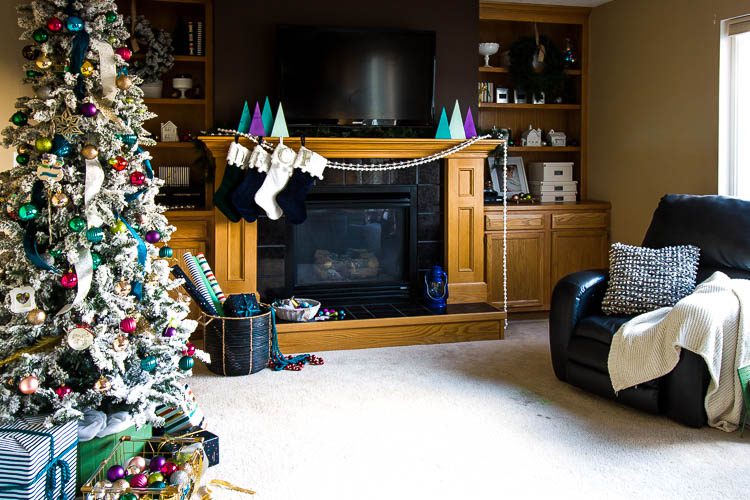
Built-in bookshelves are notoriously hard to decorate for Christmas without looking like a store display. The trick used here is restraint on the shelves and generosity on the mantel — the books stay books, and all the festive weight goes into one horizontal line. The black leather armchair does the rest by anchoring the corner in a matte, non-seasonal material, so the room still reads as a living room twelve months a year.
12. A Ceiling-High Tree Against a Wall of Windows
This tree needs the right room, and the multi-pane window wall is what makes it possible — the verticality of the glass echoes the tree instead of competing with it. Here are the numbers that matter:
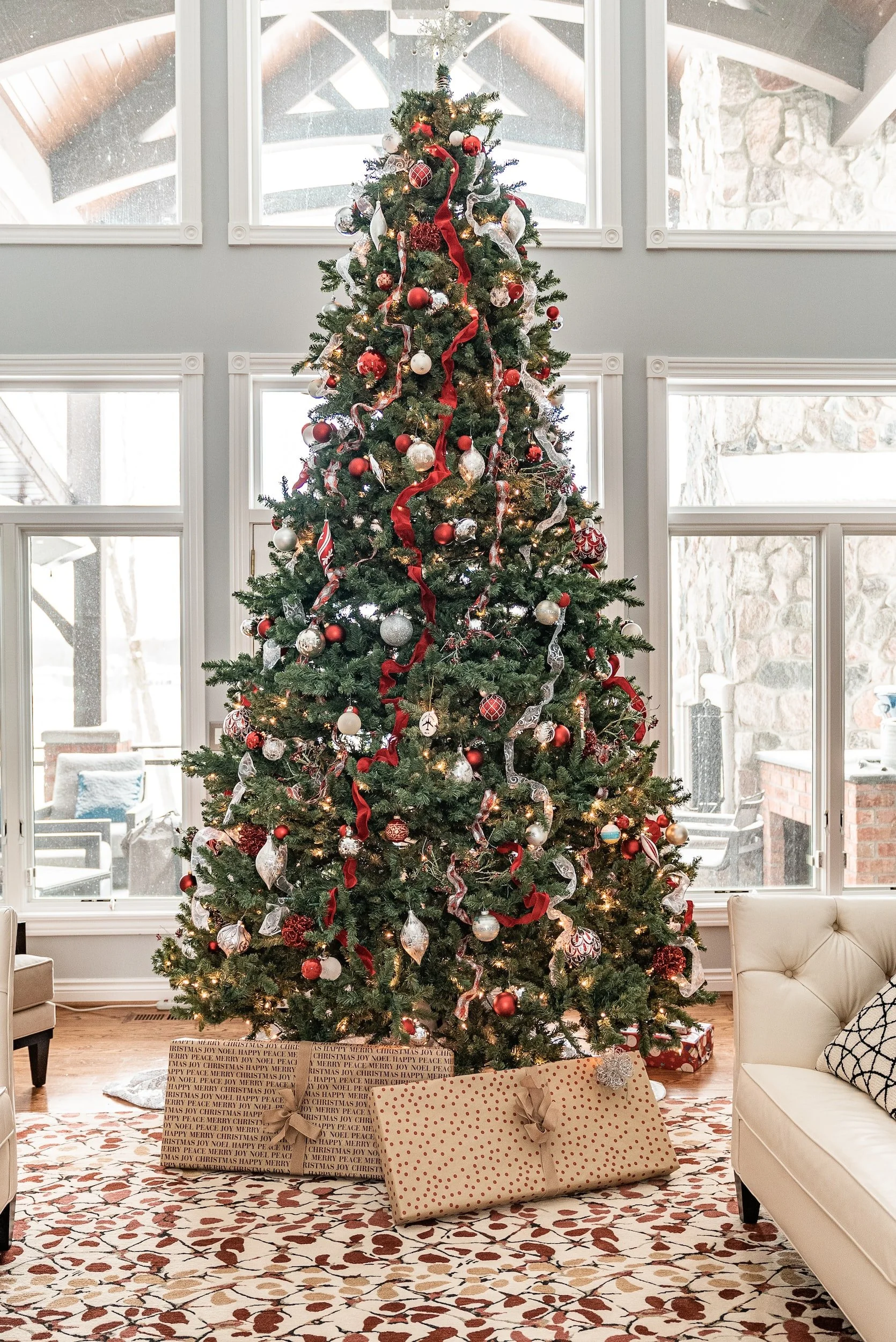
- Ceiling height: 9–10 feet minimum
- Room width: 16 feet or more
- Tree height: 9–12 feet
- Clearance from seating: 3 feet
Below 9-foot ceilings, cap the tree at 7.5 feet. Compare with Idea #20 — a flocked tree that fills a standard-height room without overwhelming it.
Ribbon on a big tree should be looped, not spiraled. Cut 30-inch lengths, fold each into a soft loop, wire both ends, then place loops every 10–12 inches on a diagonal. That gives you cascading movement instead of a barber-pole effect. Stick to one ribbon width — 2.5 inches — throughout, and match the ribbon to the rug’s accent color, not the ornaments.
13. Kraft Paper Gifts and Two Knit Cream Stockings
The palette is 50% cream and pine green, 25% kraft brown, 15% metallic silver and gold, and 10% warm white glow. Kraft paper is what makes the whole formula feel unfussy — swap it for glossy red-and-gold wrap and the mantel turns formal instantly. For a cooler version, replace gold baubles with brushed silver and switch warm lights to daylight white LEDs. Same bones, completely different temperature.
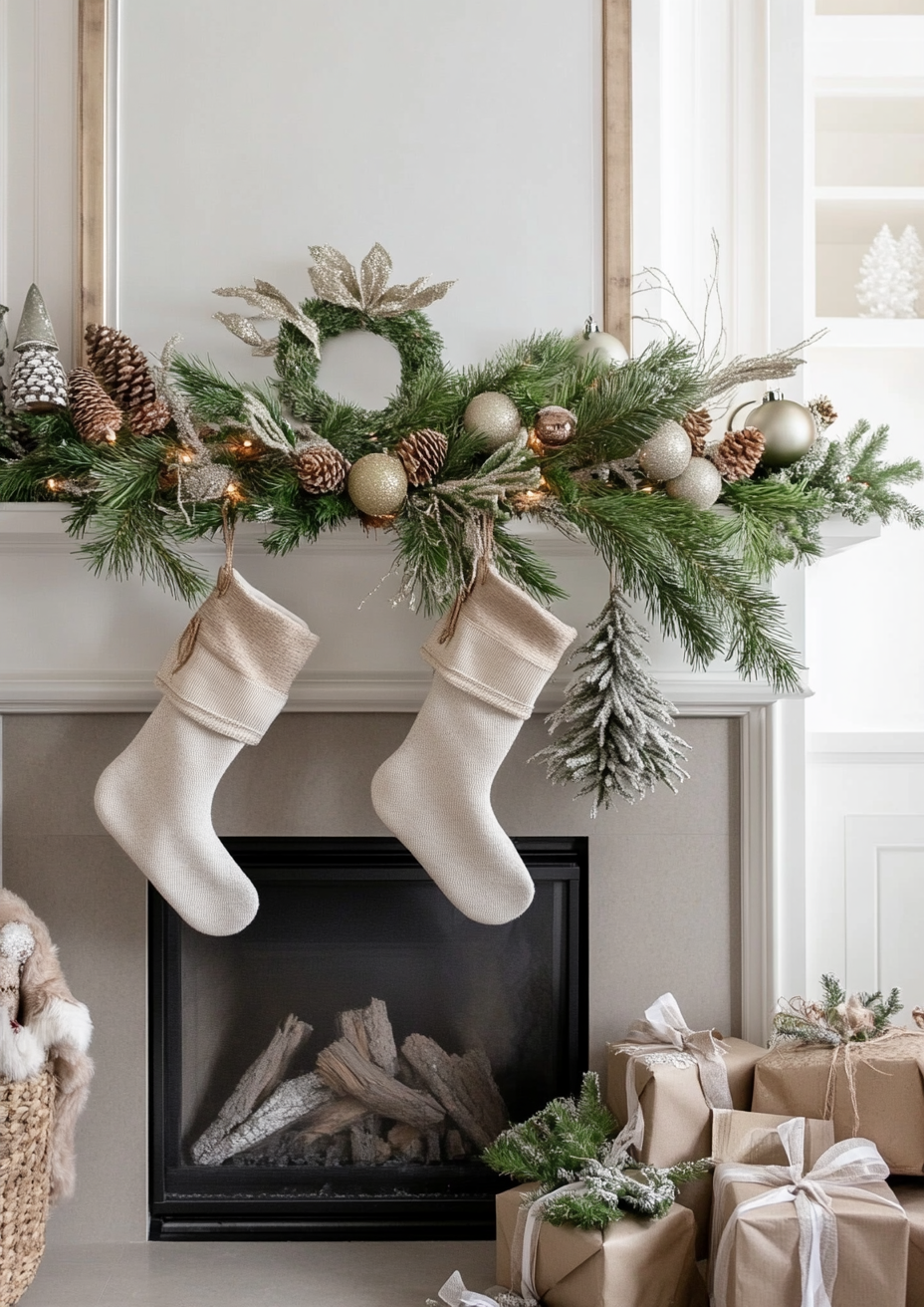
Fresh pine garland drops needles from day three onward and goes crunchy fast in a heated room. Expect to sweep daily and replace it after about three weeks. A good faux garland with a realistic needle mix eliminates all of that — the convincing ones run $45–$90 and last a decade. One more thing: kraft paper wrinkles near heat vents, so keep display gifts away from registers and tie on fresh ribbon the morning guests arrive.
14. A Lighted PEACE Sign and Pink Chairs in the Built-Ins
The pricey parts of this room are the built-ins, which you either already have or don’t need. The real styling wins are small: a lighted PEACE sign runs $18–$35 at Target, a set of four mini village houses is $20 at Walmart, and nutcrackers turn up at thrift stores for $3–$8 each all December long. Buffalo check pillow covers are $10 for two on Amazon. The pink chairs are the splurge — but a pair of pink velvet slipcovers over dining chairs you already own gets you 80% of the look for $60.
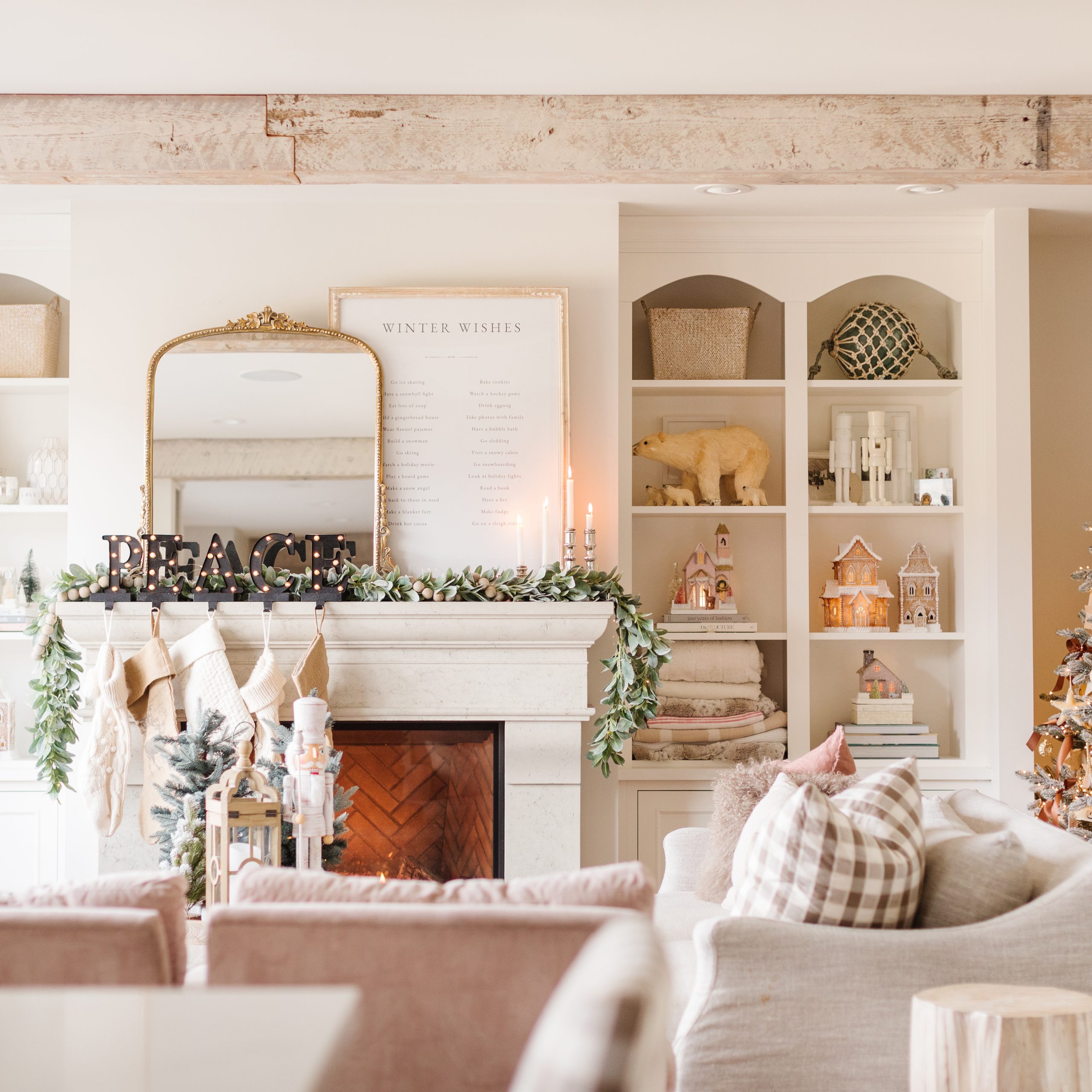
Built-ins are a styling trap. The instinct is to fill every shelf, and the second you do, the room looks like a holiday store. Follow a 60/40 rule: 60% everyday objects like books, bowls, and framed photos, 40% seasonal. Also, lighted signs are a commitment — they need an outlet and the cord is always shorter than you think. Measure before you buy, and pick one with a USB cord so you can run it off a battery bank in a pinch.
15. Dark Grey Walls, One Glowing Tree, Movie Posters
Dark grey walls plus a glowing tree is the most cinematic combination in holiday decorating, and this theater room leans all the way in. It never feels gloomy because of the ratio: roughly 80% of the surfaces are matte and dark, and the light comes from exactly three sources — recessed ceiling cans, the tree, and the screen. Framed Christmas movie posters above the sectional make it feel like a room with a point of view, not just a dark box with a tree parked in it.
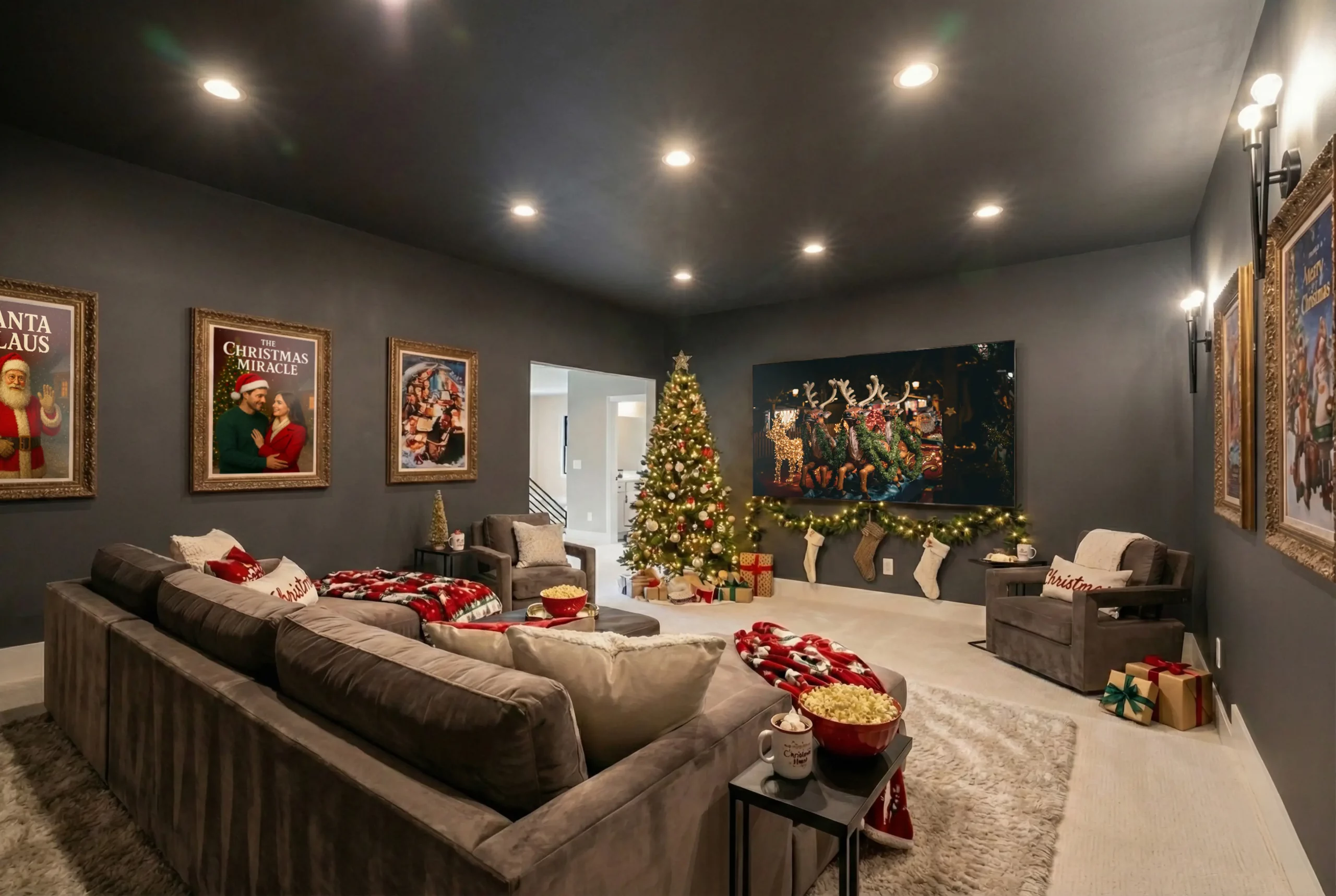
Hanging stockings under a wall-mounted screen without drilling into the wrong spot:
- Measure the screen’s bottom edge and mark a line 4 inches below it with painter’s tape.
- Install a slim floating shelf or low-profile hook rail on that line — no more than 2 inches deep.
- Space stockings 6–8 inches apart, centered under the screen.
- Keep them lightweight; that shelf is not rated for a stocking full of oranges.
Time: 45 minutes. Materials: $25–$60 for the rail, hooks, and anchors.
16. Nutcracker Ornaments Against a Deep Teal Wall
The teal wall is the hero. Not the nutcrackers, not the tree — the wall behind them. Deep teal is the reason those red baubles and gold accents pop the way they do, because teal sits almost directly opposite red on the color wheel. Paint that wall greige and the entire vignette flattens into a perfectly ordinary Christmas tree. If you can’t commit to a full teal wall, a single teal accent — a framed print, a chair, a throw — recovers a surprising amount of the same energy.

Nutcracker ornaments are heavy and top-weighted, which means they swing. Loop the hanger string through the ornament twice before hooking it, and place them no lower than the tree’s midpoint — below that they tangle in the light strand and knock into gifts. Cluster them in threes rather than spacing them evenly. Even spacing reads as retail display; odd clusters read as a collection.
17. A Floor-to-Ceiling Tree Between Twin Staircases
This is a foyer, not a living room, and the rules are different. You need a 12-foot ceiling for a true floor-to-ceiling tree and at least 6 feet of clear width at the base so guests can pass with coats and bags. Double staircases almost always mean a 16-foot-wide entry minimum. If your foyer is a standard 5 x 8 feet, drop to a 6-foot tree on a console and put garland on the stair rail instead — you’ll get the grandeur without the obstacle course.
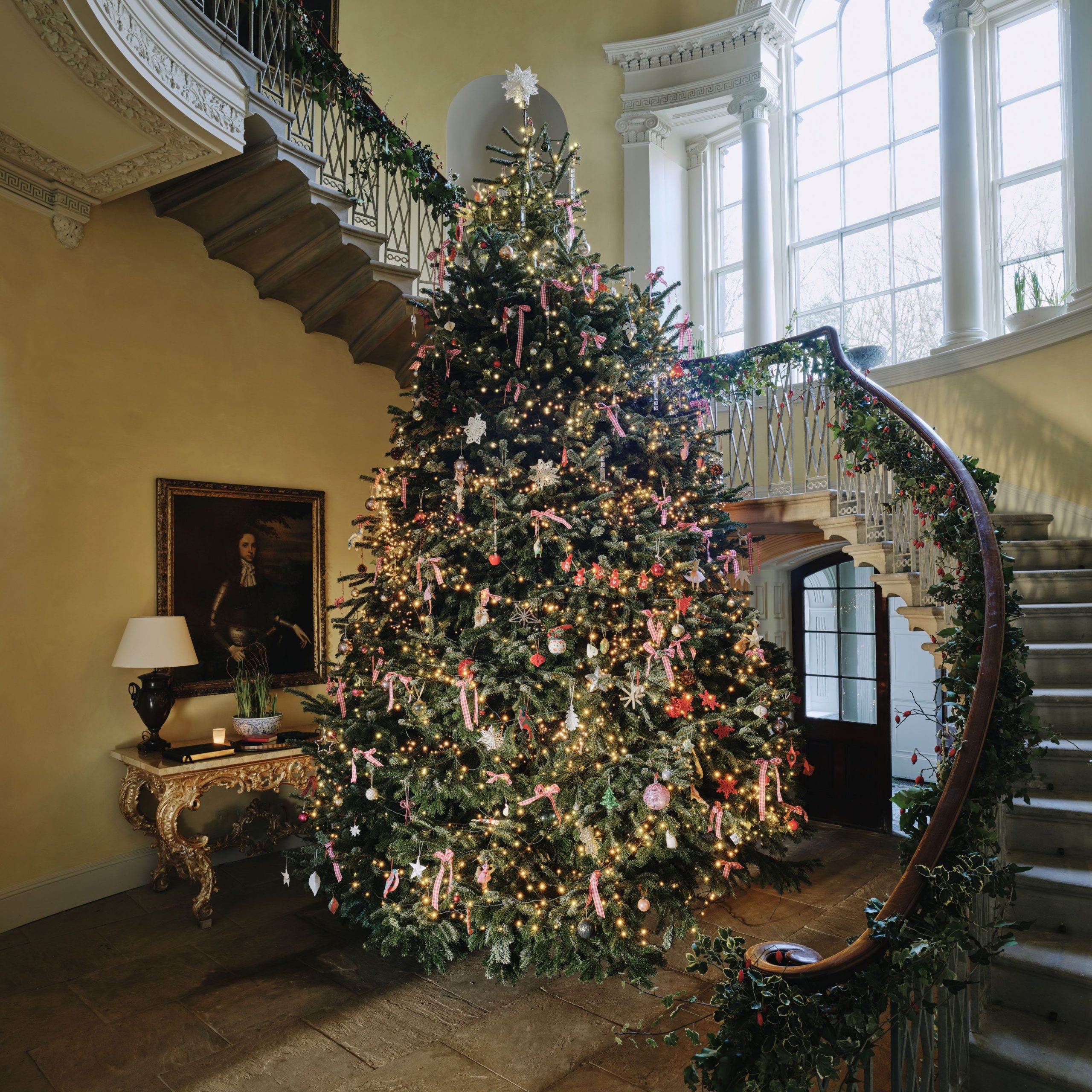
- Oversized tree (10–12 ft): $400–$1,400
- Fairy lights plus plaid ribbon: $60–$180
- Stair garland, both sides: $90–$260
- Gilt console and lamp styling: $150–$500
- Ornaments and filler picks: $80–$250
Total: $780–$2,590
Budget alternative: a 9-foot tree plus a garland-draped stair rail gets you most of the drama for under $450. Rent a ladder from a hardware store for the day instead of buying one.
18. Red, Green, and a Black-and-White Striped Rug
This room breaks the rules on purpose: roughly 40% warm white and beige, 20% black, 15% red and green, 15% blue, and 10% pure white. The black-and-white striped rug is the anchor holding all those colors back from carnival territory. To simplify, cut the blue entirely and let the stripe plus red and green carry it — that alone reads more traditional. Want it more modern? Swap the red ornaments for matte black and brass, and keep the blue armchair right where it is.
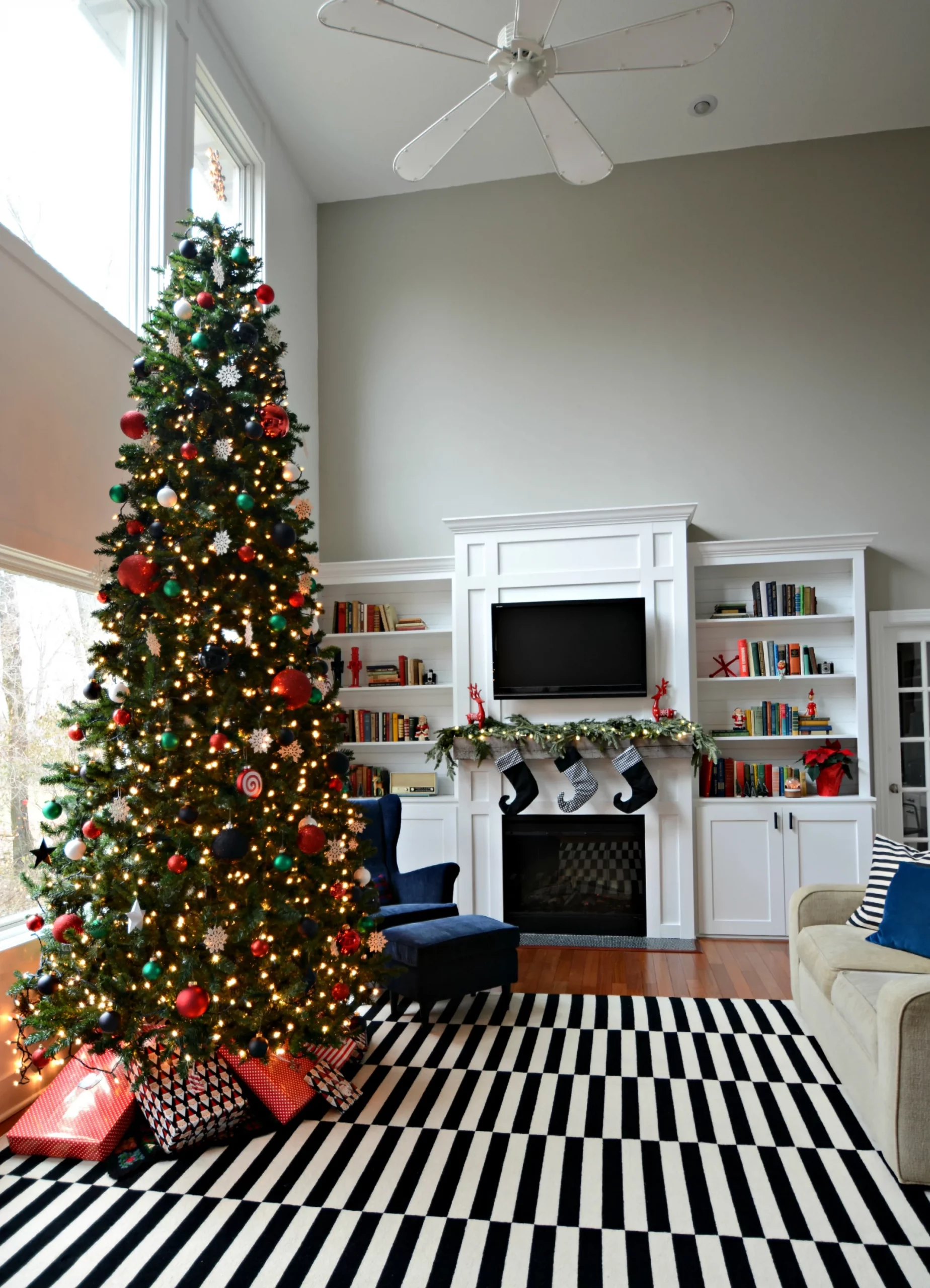
Striped rugs are everywhere right now, which means they’re cheap. IKEA flatweaves run $99–$199 for a 5 x 8, and Target has a nearly identical option for $70. The blue armchair is the wildcard — a $50 Facebook Marketplace find reupholstered with a $120 slipcover beats a $900 new chair every time. And a tall tree looks taller on a rug with a strong horizontal stripe. That’s an optical trick you get for free.
19. A Forest Green Armchair With a Stuffed Reindeer
Stuffed reindeer, tinsel garland, and a floor lamp with a warm yellow bulb add up to a very specific nostalgic charm — and a very specific amount of stuff. Everything here sits low and within reach of the floor, which means pets treat it as furniture. Tinsel gets eaten; skip it if you have a cat. The electric fireplace insert also won’t heat the room, so treat it as glow rather than warmth, and don’t stack gifts directly against the insert.
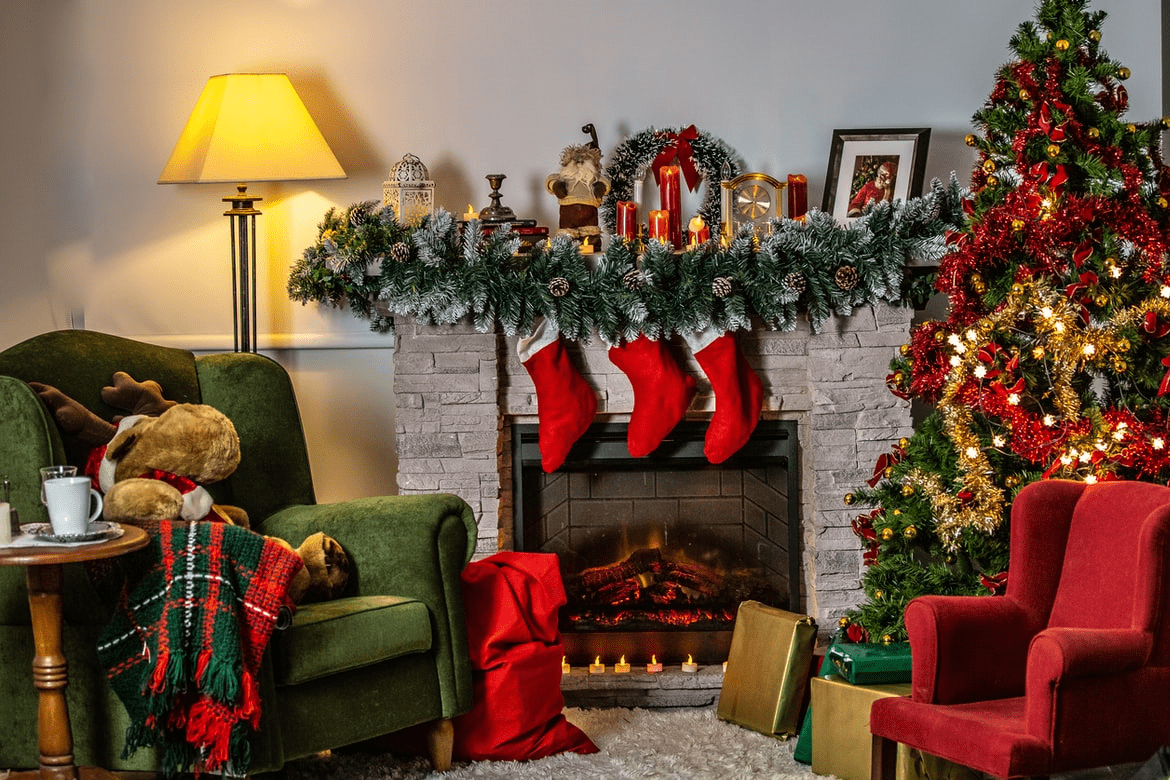
The green upholstered armchair is the thing. Strip away the garland, the tinsel, and every figurine, and this corner still works, because that deep forest green is doing all the Christmas work by itself. Add a plaid blanket and you’re finished. That’s the quiet lesson worth remembering: a green chair is a year-round Christmas decoration, which is why it’s worth spending real money on one instead of on more ornaments.
20. A Flocked Tree in Silver and Soft Blue
Check these before you commit to a flocked-and-fur look:
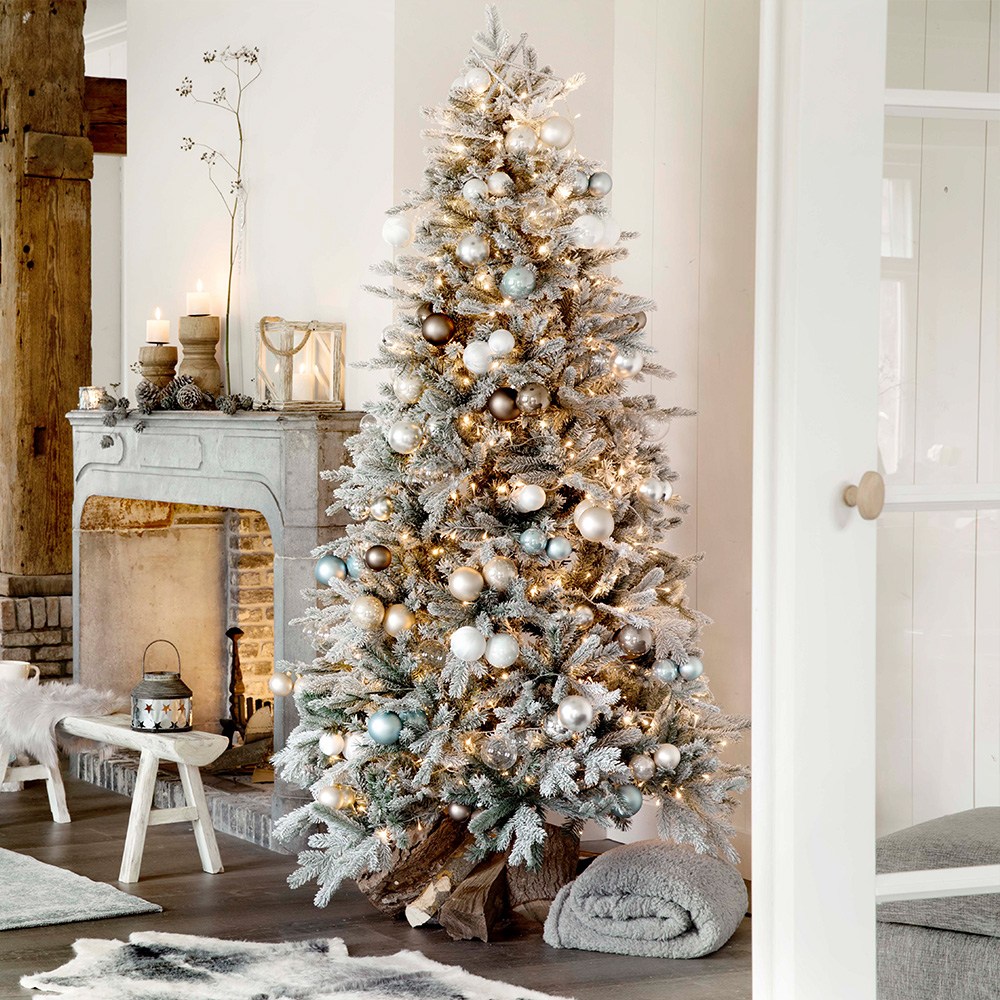
- Mantel depth of at least 8 inches for the wooden candle holders and lantern.
- Whether two stacked rugs plus a tree stand will trip anyone walking through.
- Your metal choice — this look is silver-forward, so brass and gold will fight it.
- A 12-inch clearance between the tree and any heat source.
Flocked trees shed. That white powder finds carpet fibers, sticks to socks, and reappears every time you vacuum — plan on a full vacuum and shampoo in January. Faux fur rugs are the other culprit: they mat down and need brushing weekly. If either bothers you, a pre-lit tree with white-tipped branches gives you a frosted look without the snowstorm.
21. An Olive Velvet Sofa and Vintage Sleigh Art
Velvet is having a genuinely long moment, and olive green specifically has moved from niche to safe bet in three years. It’s the color that made the jump from fashion to furniture, and it happens to be beautiful at Christmas. Three reasons this combination keeps working:
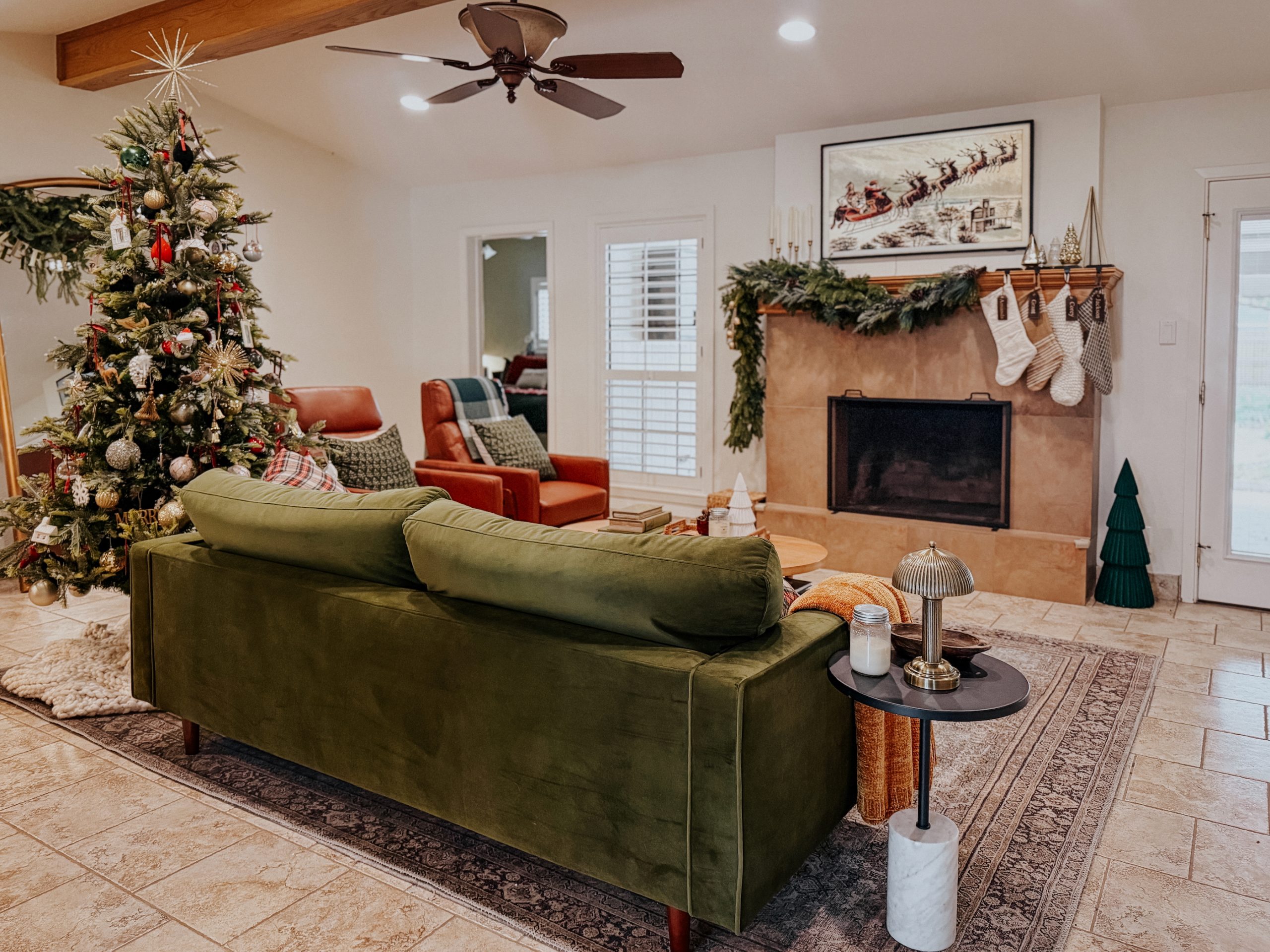
- Olive reads festive in December and neutral in March
- Velvet has a depth that flat weaves can’t match in photos
- Framed holiday art adds seasonal weight without adding clutter
Hanging framed art over a mantel, properly:
- Center the frame and hang it so the bottom edge sits 6–10 inches above your tallest mantel piece.
- Use two hangers, not one, so the frame can’t tilt.
- Keep the frame width to about two-thirds of the mantel length — wider looks heavy.
- Style the mantel in a triangle: tall item at center, descending heights outward.
Time: 30 minutes. Materials: $10–$25 in hanging hardware.
22. The Undecorated Tree in a Room With Nothing Else Going On
- Minimalist pre-lit tree (5–6 ft): $60–$180
- Neutral upholstered sofa, if new: $700–$2,000
- Low-profile coffee table: $120–$400
- Warm ambient floor or table lamps: $80–$250
- Simple ornaments, or none at all: $0–$60
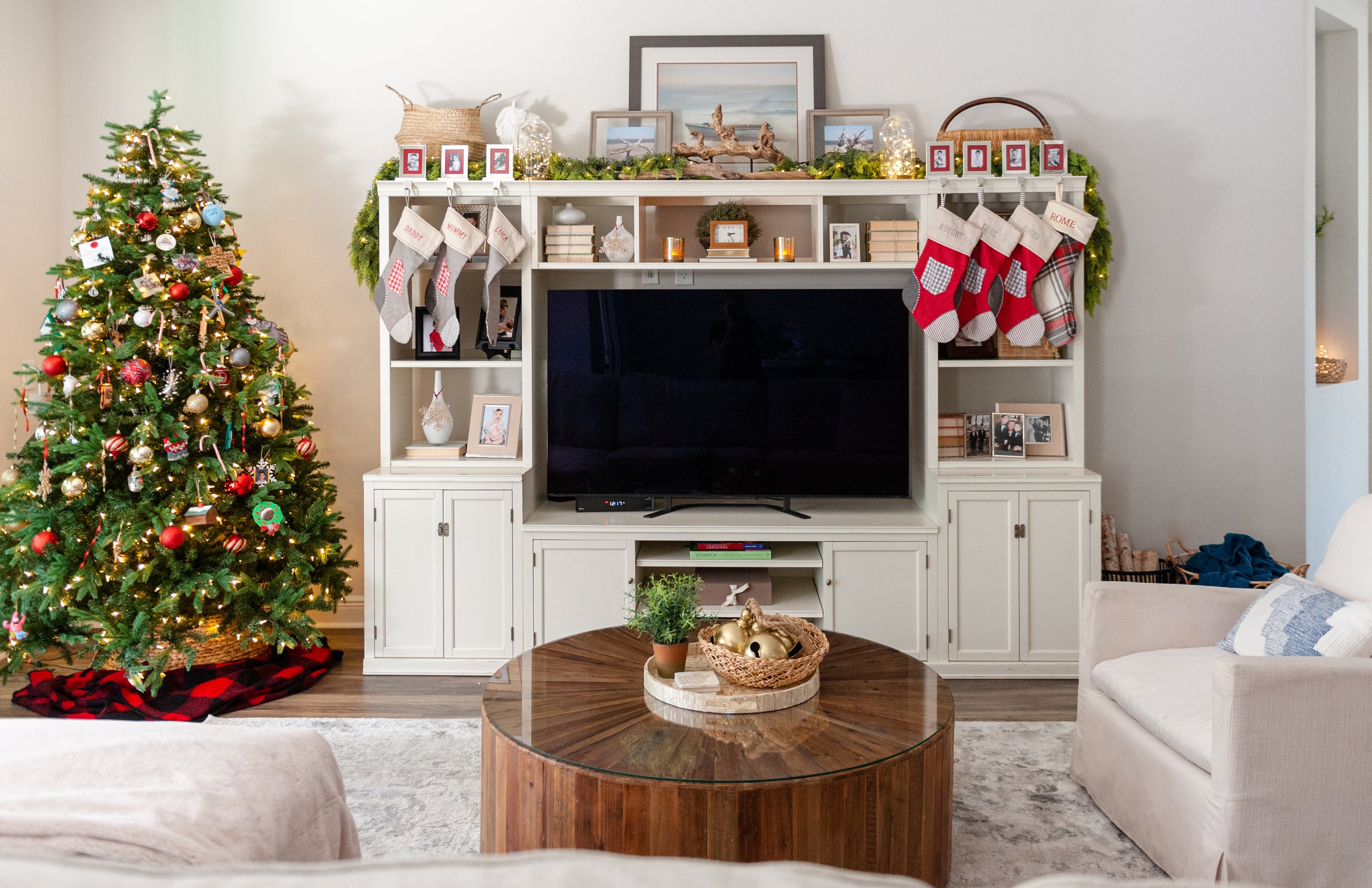
Total: $960–$2,890 — or $260–$490 if your current sofa stays
Budget alternative: keep the sofa and spend only on light. A $25 smart bulb set dialed to warm white 2700K does more for this look than any new furniture could.
Minimalist holiday styling collapses in rooms that are already busy — lots of pattern, collectibles, competing wood tones. It needs visual quiet to read as intentional. Plan on at least 140 square feet with one dominant material, usually pale wood or plaster. Rooms under 100 square feet do better with the layered approach in Idea #5.
23. Cascading Pine, Star Garlands, and Cone Topiaries
Candles on a mantel are a fire hazard dressed up as a mood. Use flameless pillars with a real wick texture for anything above 12 inches, and keep open flames below your sightline where they can’t catch garland. Cluster them at three heights — 4, 7, and 10 inches — and keep every cluster to an odd number. Strung star garlands should also sit at a slight diagonal. Horizontal reads as a banner; diagonal reads as decoration.
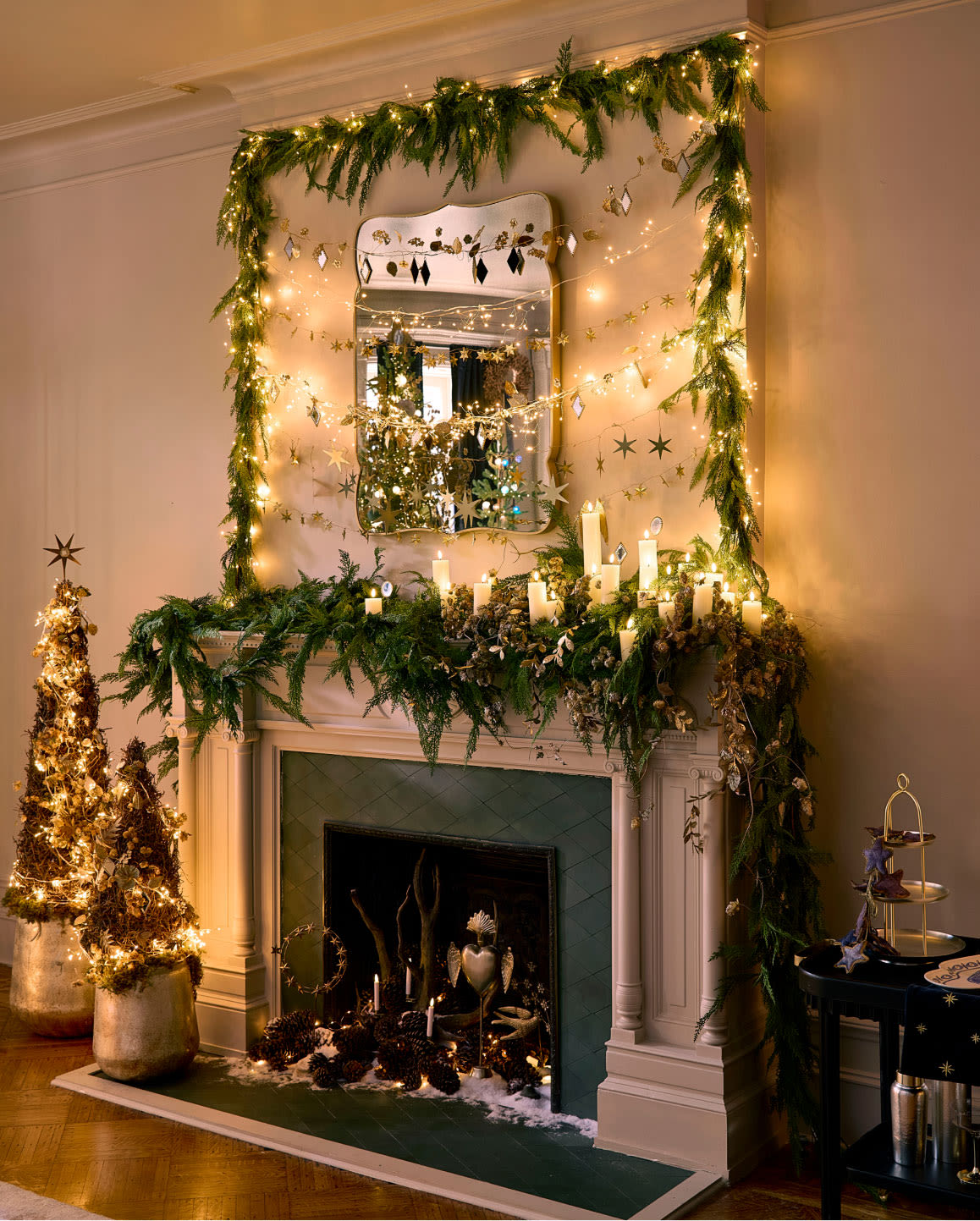
This one runs roughly 45% forest green, 30% cream white, 20% warm gold, and 5% dark wood. The green-tiled fireplace surround is the unexpected move — it grounds the palette in something that isn’t red, which stops the whole scene from feeling like a catalog page. To adapt: swap the green tile for slate for a cooler, more modern room, or keep the palette and switch all the greenery to magnolia for a softer Southern feel.
24. Symmetrical Topiaries Flanking a Carved Stone Fireplace
The symmetrical topiaries are the smallest elements in the room and the ones holding it together. Carved stone fireplaces are visually loud — all curves and scrollwork — and without something tall and simple on either side, the mantel decor competes with the architecture instead of sitting inside it. Even a pair of plain boxwood topiaries in terracotta pots would do the job. Remove them and this room looks ornate but unanchored.
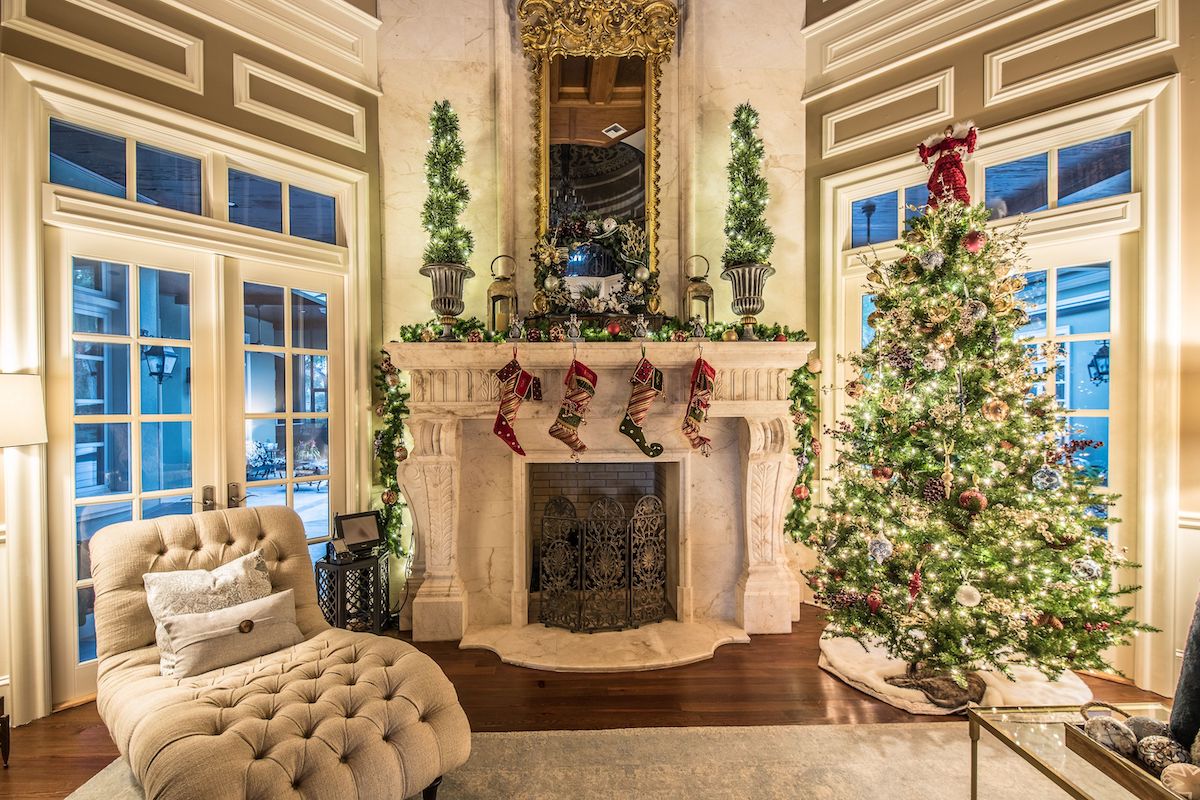
- Lit topiary pair, mantel-size: $70–$200
- Tufted chaise or accent chair: $450–$1,600
- Gilded wall mirror: $120–$600
- Red and gold ornament set: $80–$250
- Stockings and mantel greenery: $40–$120
Total: $760–$2,770
Budget alternative: skip the mirror and hang a thrifted gold frame fitted with a plain mirror insert, usually $30–$60 total. IKEA faux topiaries run about $20 each.
25. Thin Garland, Clean Stockings, and a Rough Stone Mantel
Stone fireplaces are hard to decorate because they’re already textured — a fat garland on rough stone just disappears. What saves this room is contrast of scale: a thin, loose garland draped low, stockings with clean silhouettes, and upholstery in flat, smooth textiles. The layered rug gives the floor the same treatment. Nothing competes for attention. It’s the least fussy version of a traditional Christmas living room, and the one most people can realistically pull off. Compare with Idea #8 — same stone, much more contrast.
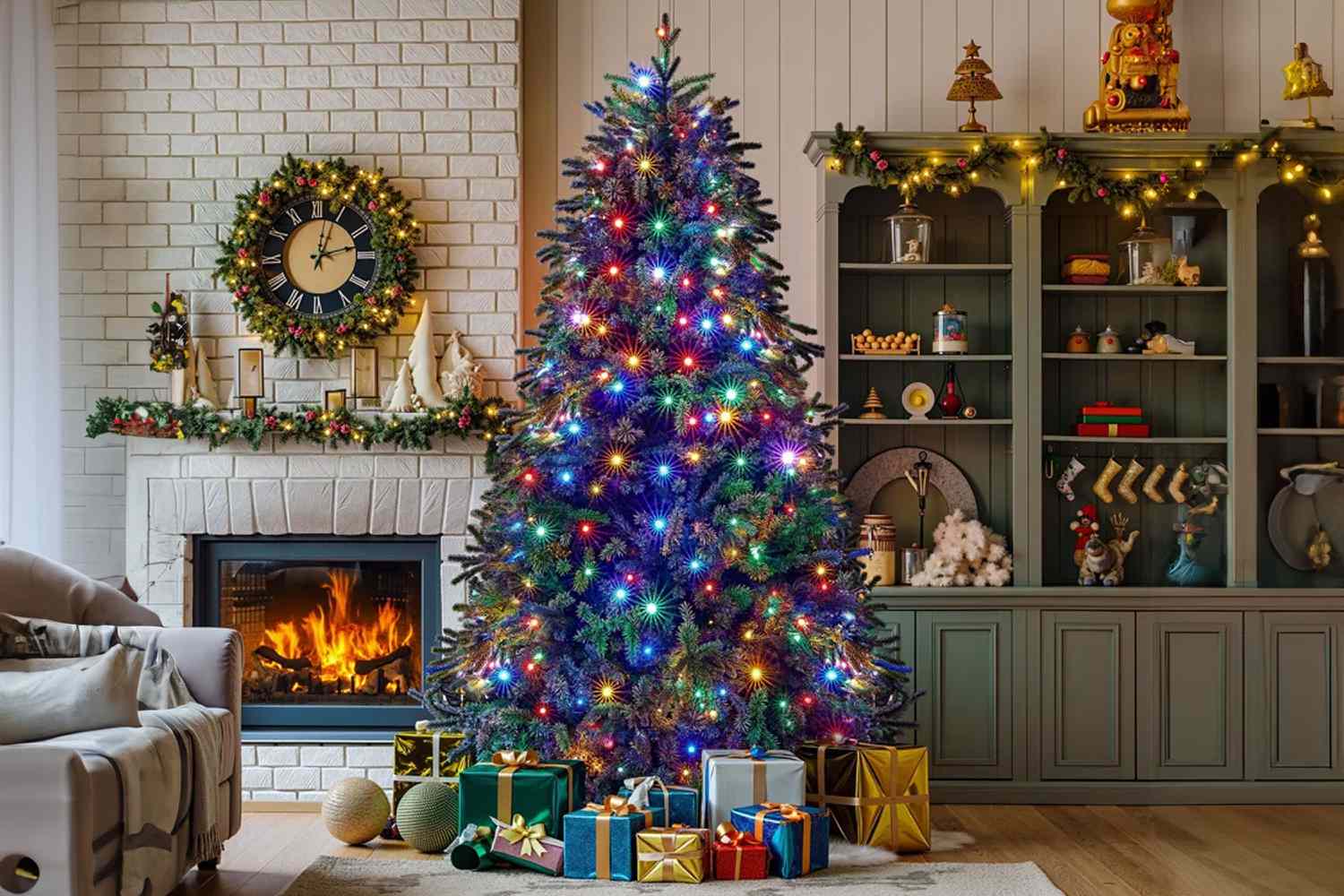
Loose garland on a stone mantel slides every time someone brushes past. Use clear adhesive hooks, never nails — you’ll regret drilling into that surface. An unlined garland against stone also sheds visibly, so vacuum the mantel ledge weekly rather than monthly. And keep stockings short on a rough surround; long ones catch on the edge and fray.
26. Five Mismatched Stockings and Black Candleholders
Layering a white mantel with five stockings and candles:
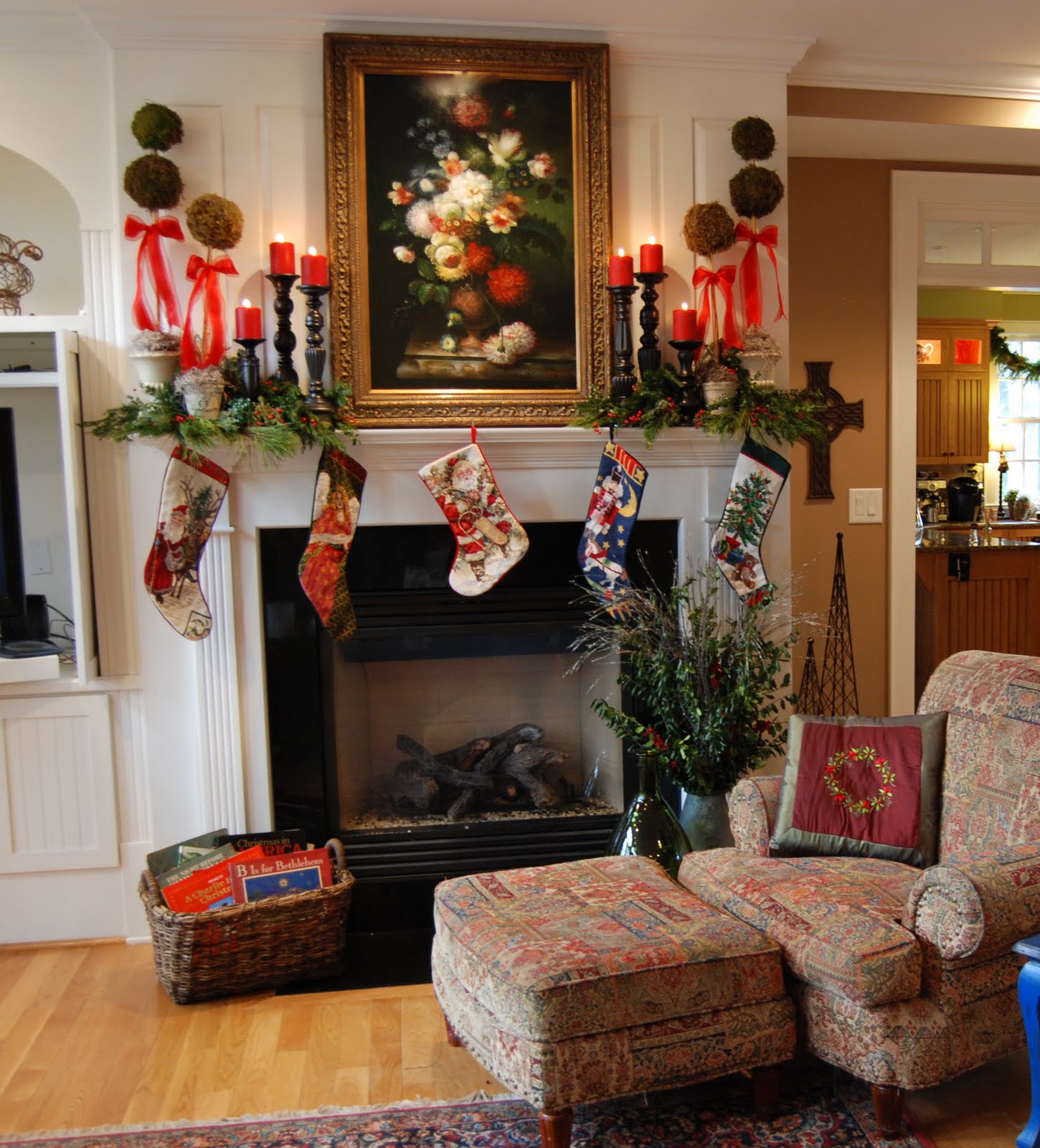
- Hang the stockings first, spacing them evenly across the mantel’s actual width, not the whole wall.
- Layer greenery behind and between the stockings, never in front — you want fullness, not blockage.
- Set candleholders into the gaps between stockings, staggering heights by 2–3 inches.
- Finish with a topiary ball at each end to frame the whole arrangement.
Time: 1 hour. Materials: $60–$140 for greenery, candles, and holders.
Five stockings sounds like a lot, and mismatched is the point — which makes it cheap. Thrift stores stock knit stockings for $2–$5 each all December, and fabric paint personalizes them for $6. Black pillar candles run $12 for a set of three at Walmart; red tapers are $4. Topiary balls are $8 each at HomeGoods.
27. Dried Orange Slices and Blue Velvet Bows on Brick
Four things to verify before you start nailing things to a brick fireplace:
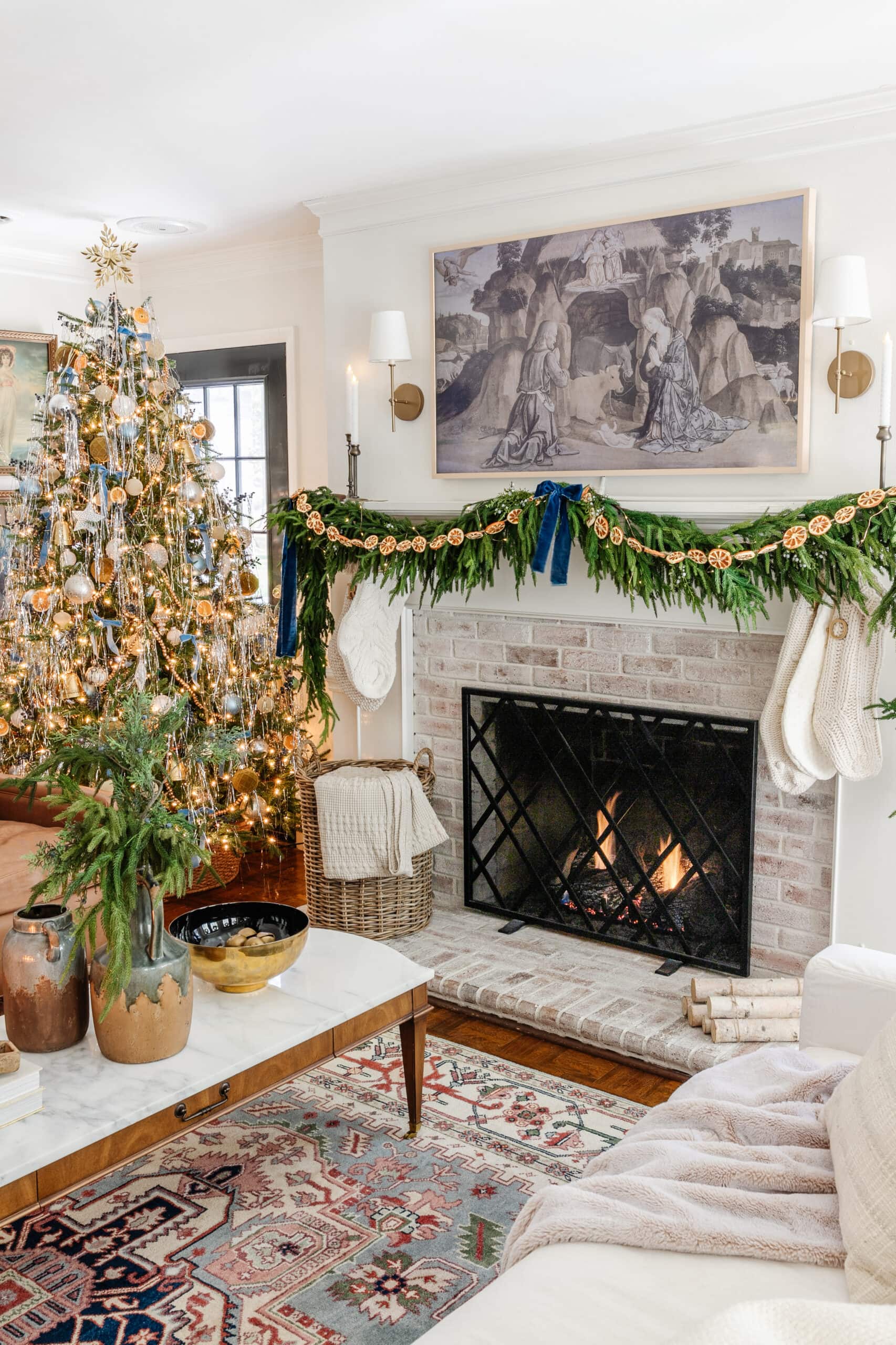
- Mantel weight capacity — dried orange garland is heavier than it looks.
- Artwork height; it should clear the garland by 3 inches minimum.
- Whether you actually want to paint the brick. That’s hard to undo.
- A heat-rated fire screen if the fireplace is functional.
Dried orange slices are the easiest homemade ornament in existence: slice thin, bake at 200°F for 3–4 hours, flip once. They hold color for years if you store them in a sealed bag with a silica packet. String them on jute twine rather than ribbon, and thread the twine through the rind instead of the flesh so the slices hang flat. Blue velvet bows every 18 inches will keep the garland from reading as a school project.
28. White Ornaments, Plush Sofa, Patterned Rug
The formula is 60% warm white and beige, 25% pine green, 10% natural wood, 5% gold. What makes it work is that the tree ornaments are white, which means the tree glows instead of sparkles and the whole room softens. Swap them for red and the mood flips hard toward traditional. Swap them for champagne and you’re standing in a hotel lobby. Same tree, three completely different rooms.
Repetition is doing all the heavy lifting. One green, one wood tone, one white — repeated across the tree, mantel, rug, and sofa. Your eye doesn’t have to make decisions, so the room reads as calm rather than empty. The patterned rug matters more than it looks like it should: it adds complexity at floor level without introducing a new color, which is exactly what a tight palette needs to avoid going flat.
29. Cream and Red Knit Stockings on a Brick Fireplace
- Knit stockings (4–6): $30–$90
- Large green foliage wreath: $25–$75
- Hanging hardware for brick: $8–$20
- Vintage books for styling: $10–$30 (thrift)
- Mantel greenery sprigs: $15–$45
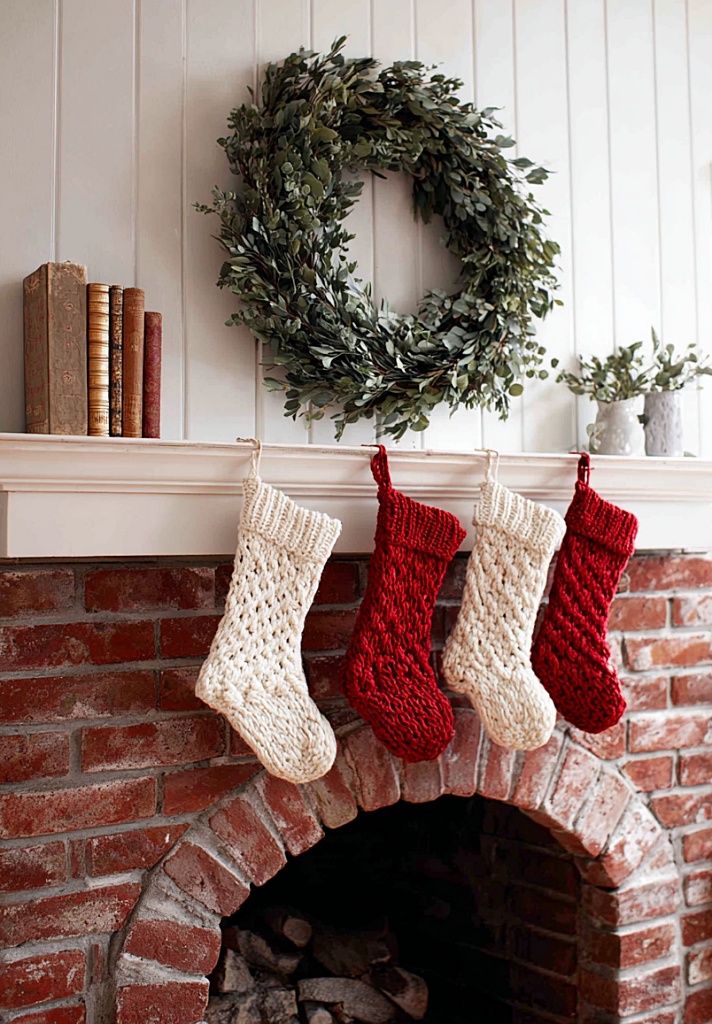
Total: $88–$260
Budget alternative: this is already the least expensive look in the roundup. Buy knit stockings after Christmas for 70% off — they don’t go out of style, and cream and red are always available the following year.
The vertical white paneling above the mantel is the unsung hero. It isn’t the wreath or the stockings — it’s that the wall behind them is panelled rather than painted flat. That vertical texture makes the wreath read as a deliberate focal point and gives a small brick fireplace height it doesn’t actually have. If your wall is plain drywall, a $40 roll of beadboard wallpaper gets you most of the way there.
30. Red on Black: A Moody Two-Color Christmas
Deep black walls with a single crimson accent is the most underrated holiday palette going, and it’s easier to control than red-and-green because you’re managing two colors instead of four. Keep the red to one hero moment — ornaments, a wide ribbon, a throw — and hold everything else in matte black, charcoal, and a small amount of warm brass. Aim for a 70/20/10 split: 70% dark neutrals, 20% red, 10% glow from warm light.
Black rooms need more light than any other color to avoid feeling like a cave in December, when daylight is already scarce. Budget for at least three light sources per room, all of them warm — 2700K or lower, no exceptions. If you rent, or if you might repaint within two years, choose charcoal or deep navy instead. They photograph nearly as dramatically and won’t punish you on the way out.
31. A Framed Chalkboard, a Pine Wreath, and a Firebox Full of Candles
Chalkboards have quietly come back, but not the word-of-the-day kind — the framed, permanent-backdrop kind. Paired with arched wood window-frame mirrors and cotton wreaths, this is the collected-farmhouse version of Christmas that took over from strictly rustic styling around 2024. It works because the board is erasable: December’s greeting becomes January’s grocery list, so the piece earns its wall space all year instead of living in a bin eleven months out of twelve.
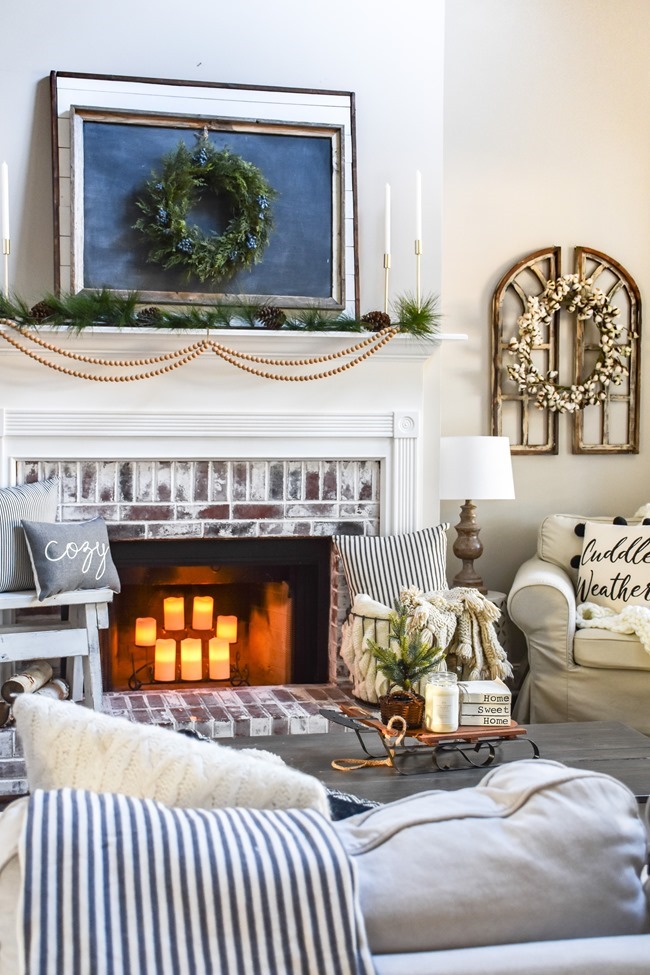
Styling it without looking like a sign shop:
- Lean or hang the chalkboard centered, bottom edge 4–6 inches above the mantel shelf.
- Drape bead garland across one top corner of the frame, never across the middle.
- Hang the pine wreath off-center on the board itself — dead center makes it read as signage.
- Fill the firebox with flameless pillars at staggered heights, 3 to 8 inches.
- Finish with slim brass candlesticks at one end only, for asymmetry.
Time: about 40 minutes. Materials: $30–$80, not counting the chalkboard itself.
The Tree Goes Up, the Room Comes Alive
Thirty-one rooms, one takeaway: the Christmas living rooms that stay with you aren’t the ones with the most ornaments — they’re the ones where one decision was made confidently and everything else got out of its way. Pick your palette, pick your hero piece, and let the garland be a little imperfect.
📌 Save this to Pinterest for later — you’ll want to revisit these ideas when the boxes come down from the attic.