Still scrolling Pinterest at 11pm, tapping through cozy Christmas bedroom photos and wondering why your version never quite looks like theirs?
We spent a few evenings digging through Target, Walmart, Kohl’s, Etsy, and Amazon to bring you only what’s actually worth your attention — 31 ideas covering everything from $18 stocking stuffers to a $340 full bedding reset. Styles run from rustic woodland and dark moody traditional to playful novelty prints and quiet neutral cozy.
Budget and luxury versions get compared side by side, so you can see exactly where the money matters and where it absolutely does not. And stay until the end — we break down the most common mistakes that can ruin these looks.
The 2026 shift is toward print-led bedding — nutcrackers, robins, winter villages — layered against dark walls and warm light, which is why it is dominating mood boards right now.
📌 Save this to Pinterest for later — you’ll want to revisit these ideas. (Heads up: this post contains affiliate links, and we may earn a small commission at no extra cost to you.)
1. Neutral Christmas Bedroom With Lit Garland and Jute Texture
The trick here is restraint. Nothing in this room is louder than the garland — cream bedding, warm white walls, natural wood, a woven jute rug, and a round rattan nightstand all sit at the same volume. That is what lets the forest green and gold read as festive instead of chaotic. Contrast does the work: soft matte textiles against the tiny hard glint of ornaments and the ceramic lamp base. Scale matters too — the tree is roughly as tall as the nightstand plus lamp, so it never fights the bed for attention. The chunky knit throw repeats the rug texture in a heavier weight, which is why the corner feels finished rather than decorated.

Run the light strand inside the garland, not wrapped around the outside — push each bulb so it sits just behind a few sprigs. The glow comes through the greenery and you stop seeing wires. For a queen headboard, a 9-foot pre-lit garland is the sweet spot; anything shorter leaves the corners bare. Secure it with two small cup hooks screwed into the back of the headboard, never over the top rail, and plug into a smart plug so you are not crawling behind the bed every night at 10pm.
2. Nutcracker Euro Shams Without Committing to a Whole Set
The realistic numbers for a nutcracker euro sham setup:
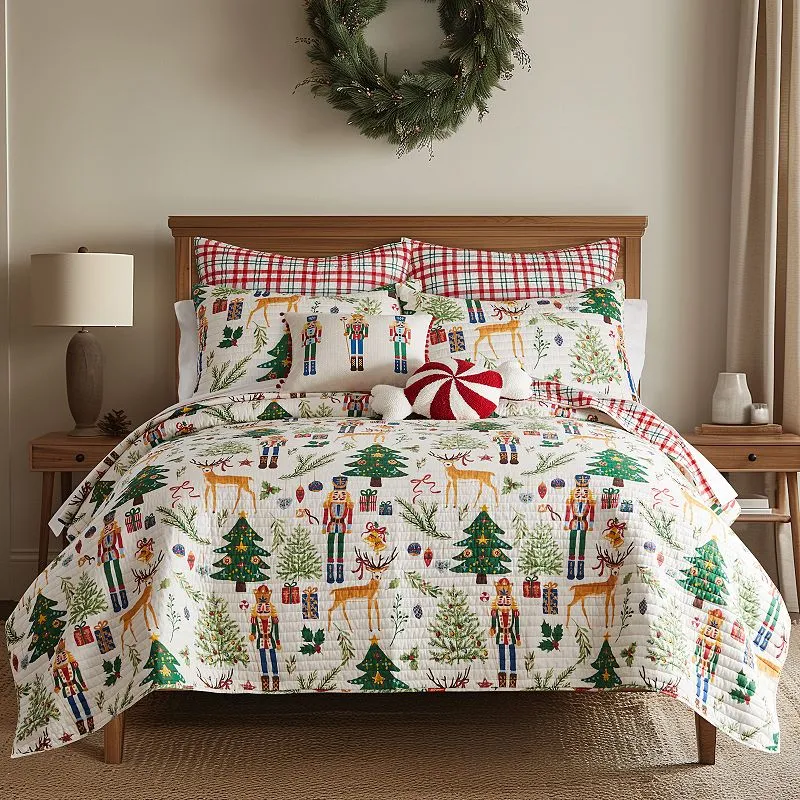
- Levtex-style euro shams, set of 2: $50–$90
- Neutral duvet cover, queen: $70–$140
- 26×26 insert pillows, 2: $30–$50
- Red or green accent throw: $30–$60
- Small tabletop tree with lights: $25–$55
Total: roughly $205 to $395. Budget alternative: plain white shams with a nutcracker-print pillowcase layered in front gets you about 80 percent of the look for $35 total.
Euro shams are 26×26 with a 2-inch flange, and they need a 26×26 insert — a 24×24 will look deflated. The bigger issue: novelty print bedding is a six-week commitment, and you will store it ten months a year. So buy the shams, not a whole second bedding set. Skip anything dry-clean-only. And if you have a shedding dog, light printed shams show every hair, so keep a lint roller in the nightstand drawer and rotate them front-facing only during December.
3. A Festive Guest Room You Can Strip Back in Ten Seconds
The single thing doing the heavy lifting in a holiday guest room is a plain white base layer underneath everything festive. Strip the printed duvet and the red pillows and it is still a nice white bed — which means the day your in-laws leave, you are ten seconds from a normal room instead of repacking a bin. Lose that base and you do not have a guest room in December; you have a display. Buy the neutral duvet first, then add holiday layers in order: fold, shams, one accent pillow, throw.
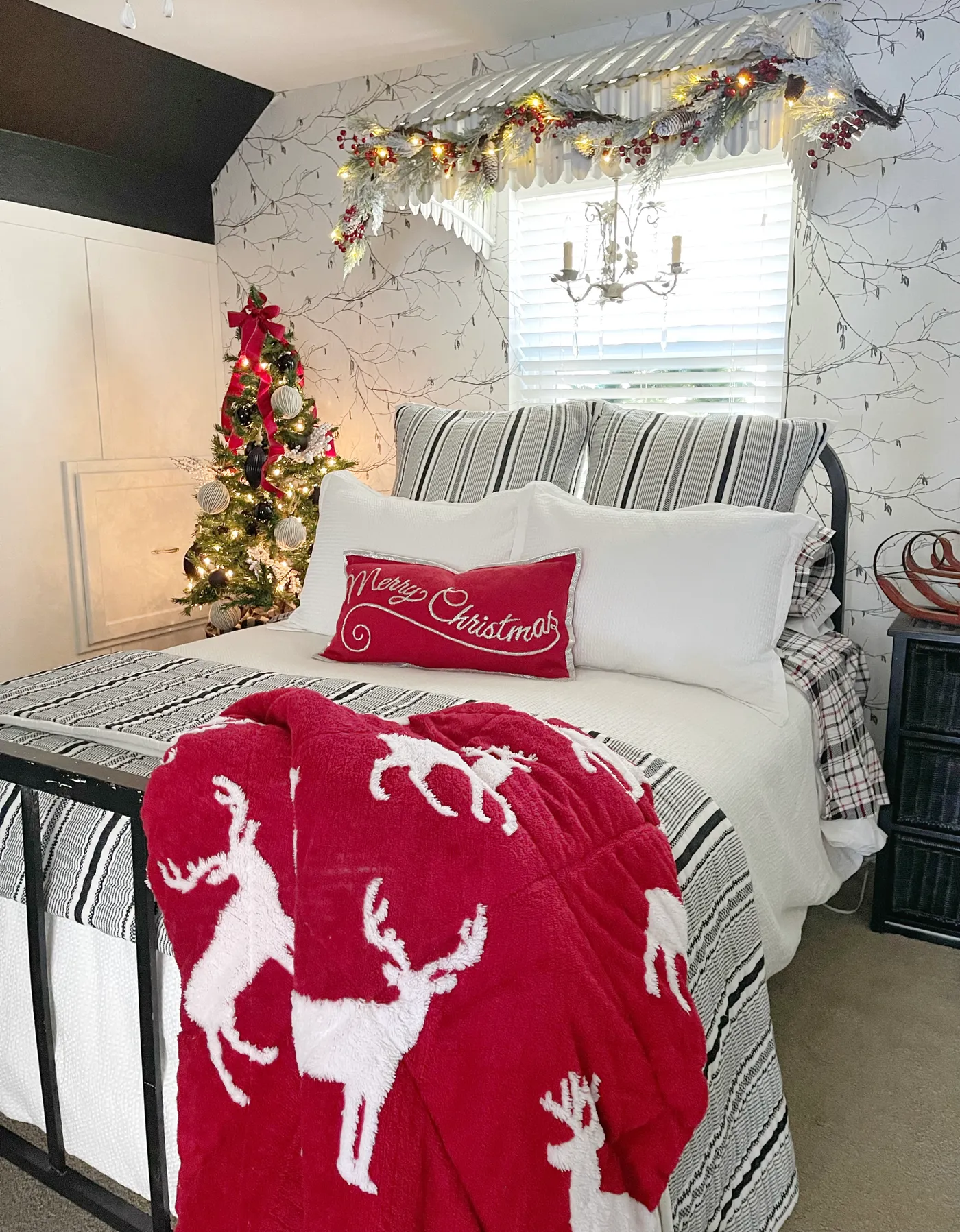
The formula is 70 percent white or oat bedding plus 20 percent holiday accent, one red or green print, plus 10 percent metallic or wood. Keep the accent to a single pattern — two prints and the room starts to feel like a store display rather than a bedroom. To swap it for spring, keep the same 70/20/10 and change the accent to soft blue and the metallic to woven rattan. The proportions never change; only the middle 20 percent does. Compare with Idea #1 — same math, greener accent.
4. Red-on-Black Christmas Accents Without the Basement Vibe
Black is seductive on a Pinterest board and unforgiving in a real bedroom. Matte black bedding shows lint, dust, and every pet hair within a ten-foot radius, and a fully black room at 7am in December feels like a cave. Keep black to about 20 percent of the visual field — a headboard, a lamp, a throw — then let the red do the shouting. If you are renting and cannot paint, get the same punch from a black metal bed frame and a dark rug instead of dark walls. Same contrast, zero landlord risk.
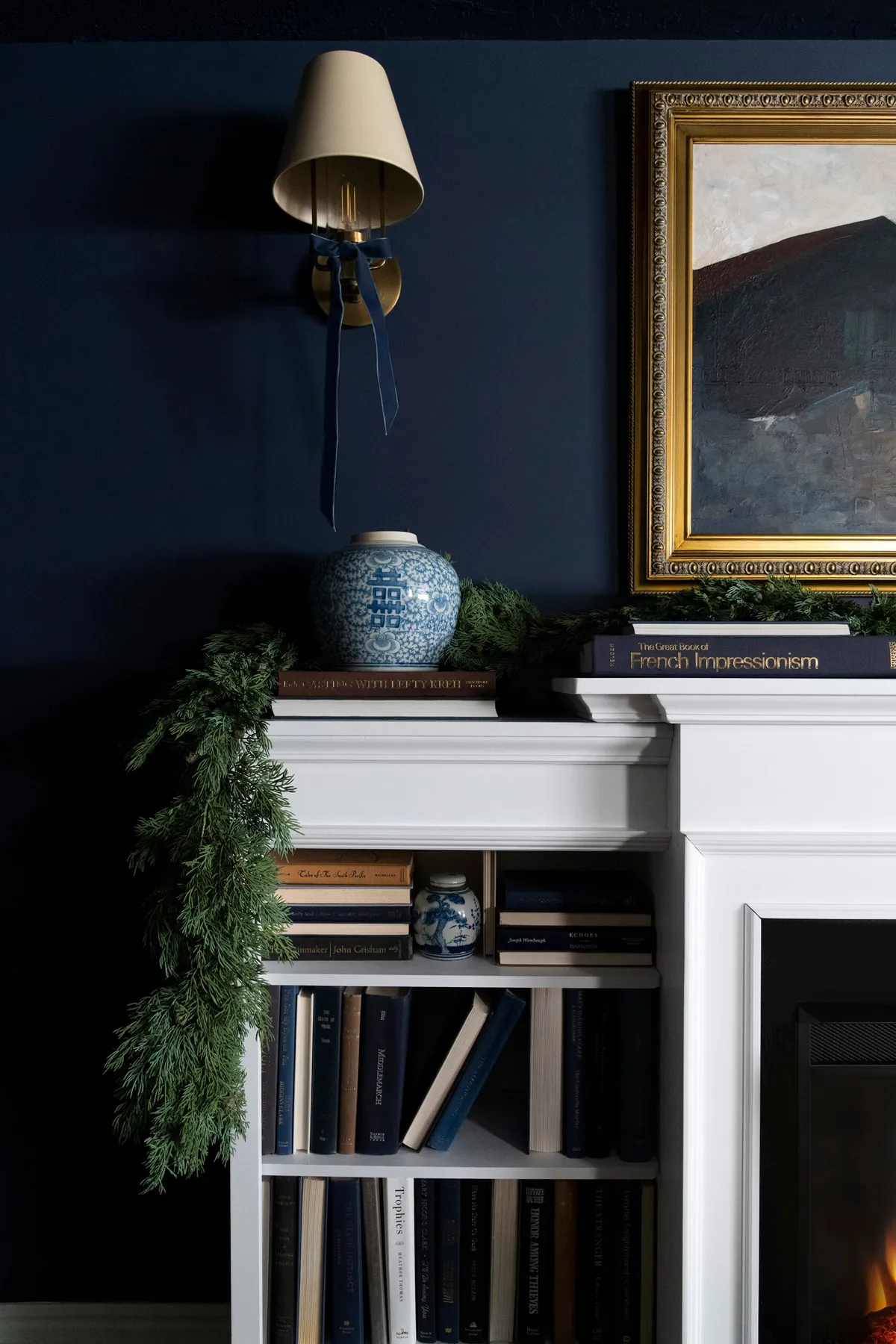
If you do go dark, spend the six dollars on a sample pot and paint a 2×2-foot patch on two different walls. Dark colors shift dramatically with light direction — the same charcoal looks green on a north wall and nearly navy on a west one. Look at the patch at 8am and again at 8pm before you commit. Then swap your bulbs to 2700K warm white. Anything cooler and dark walls turn gray and cold, which is the exact opposite of what you are going for.
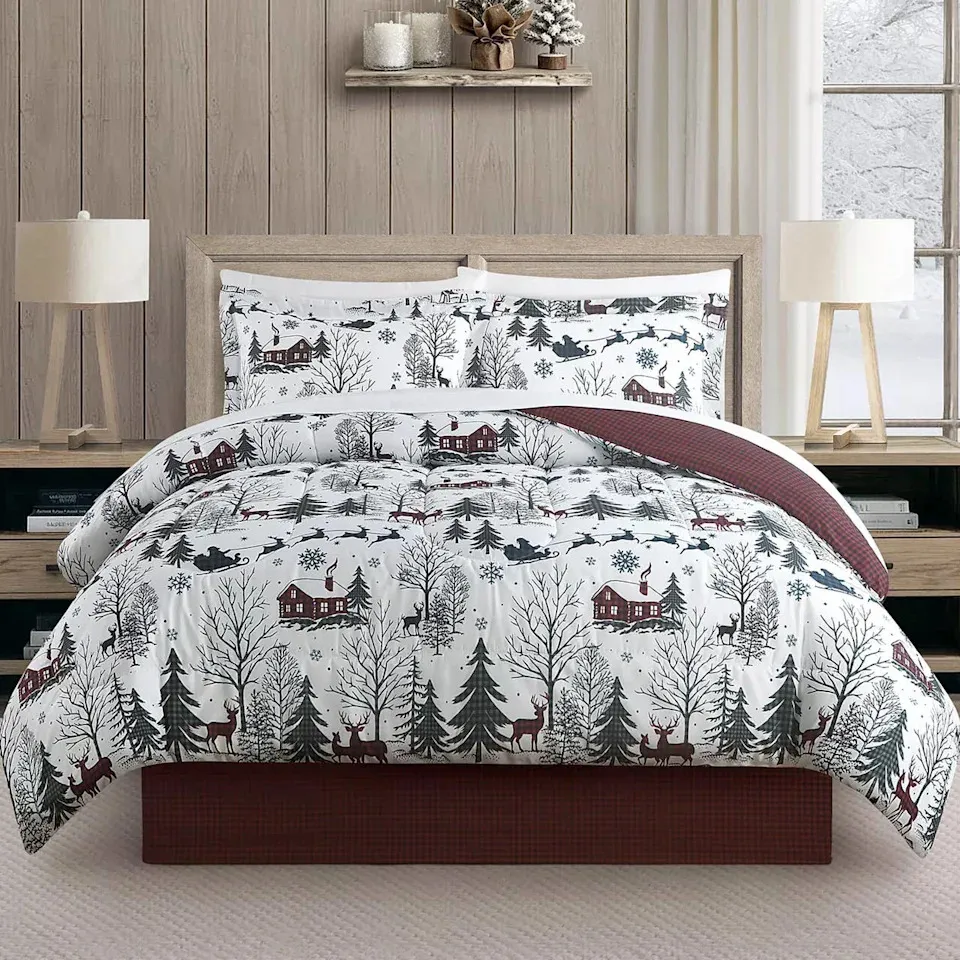
5. Winter Village Bedding With a Deep Red Plaid Bed Skirt
Getting a patterned bed skirt or folded duvet to look intentional rather than sloppy is a ten-minute job:
- Iron or steam the fold flat — wrinkles kill the effect.
- Lay it across the foot of the bed, pattern facing up, about a third of the way up the mattress.
- Pull the two front corners down tight and tuck them under the mattress edge.
- Smooth the middle, then let the sides drape straight down with no pleats.
- Add a solid throw on top if the pattern starts feeling busy.
Cost: $0. Time: 10 minutes, plus however long your iron takes to heat.
Three things make the winter village print work. The pattern is the only busy element in the room, the light wood plank wall stays quiet, and the deep red plaid repeats a color already inside the print — that is the difference between coordinated and matching. The lamps matter too: wooden tripod bases are a little rustic and a little modern, so they bridge the whimsy of the bedding and the hard lines of the paneling. The floating shelf holds candles only, no competing objects.
6. The Cozy Christmas Bedroom Ratio That Always Works
Cozy is not a style, it is a ratio. Try 60 percent warm white or oatmeal textiles, 25 percent visible wood, 10 percent deep green, and 5 percent brass or amber. That means the duvet, sheets, and rug all live in the same warm neutral family, the bed frame and nightstand carry the wood, and only the garland and a couple of ornaments bring green. The brass is one lamp base. When people say a room feels warm, they are almost always describing this ratio — not the number of decorations.
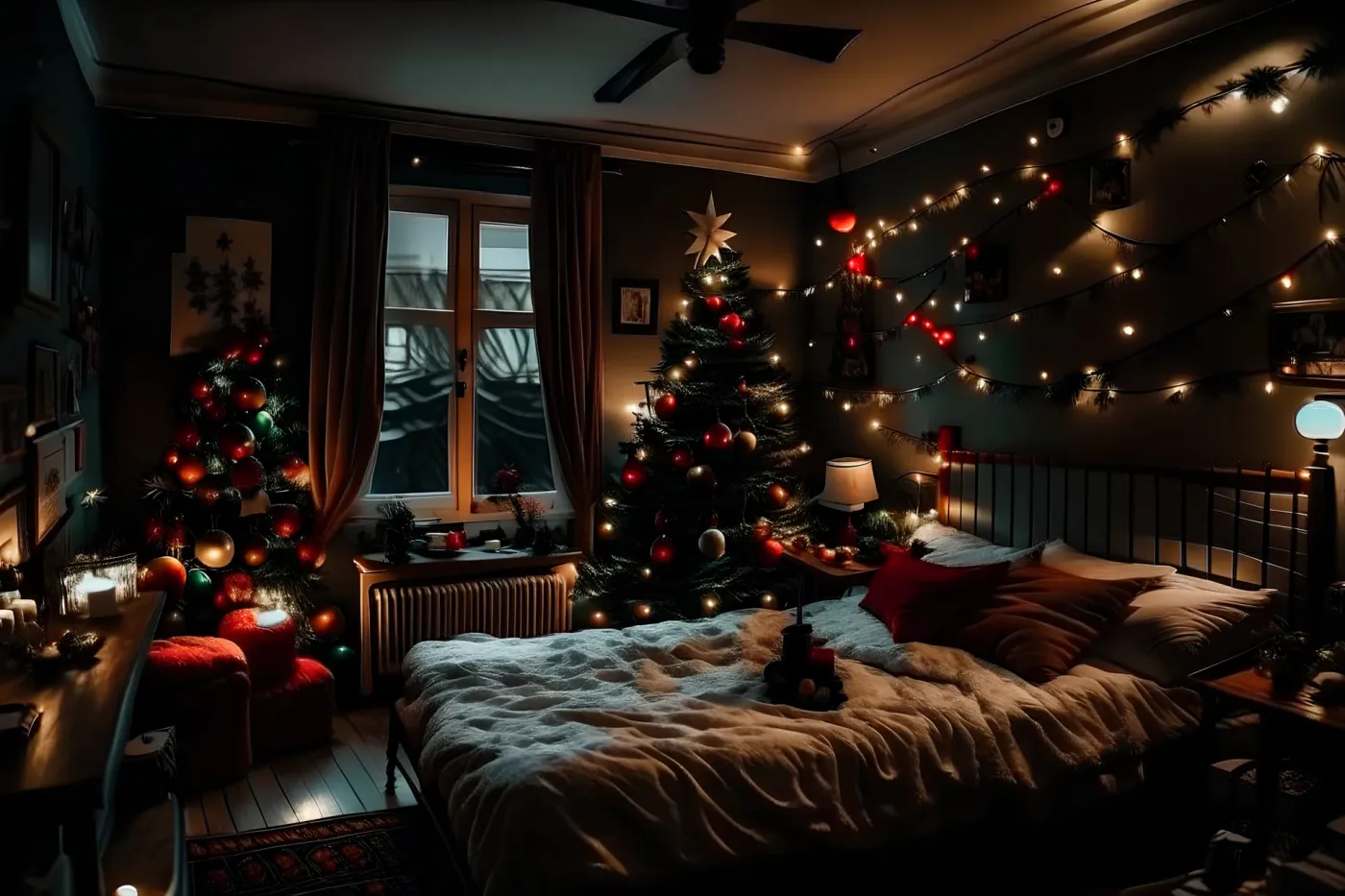
Building the whole look from scratch:
- Warm white duvet plus sheets, queen: $90–$180
- Knit or faux-fur throw: $35–$70
- Warm white fairy lights, 2 strands: $18–$32
- Wood nightstand, new or thrifted: $60–$220
- Jute or wool rug, 5×8: $80–$250
- Pre-lit deep green garland: $30–$60
Total: $315 to $815. A twelve-dollar neutral flat sheet draped as a throw gets you most of the way there.
7. Penguin Print Bedding Against Vertical White Paneling
Here is the honest price map for this look:
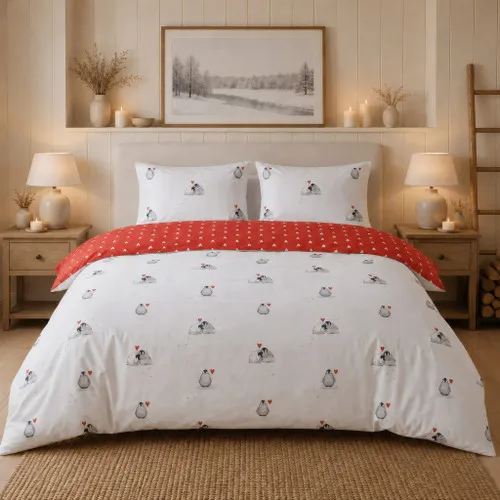
- Penguin or winter print duvet: $35–$65 at Walmart and Target
- White beadboard or panel sheet: about $40 each at IKEA or Lowe’s
- Wooden headboard: $40–$120 on Facebook Marketplace or at thrift stores
- Two matching ceramic lamps: $30–$60
You can land the whole thing under $250 if you shop in January, when holiday bedding drops about 50 percent.
The recessed ledge above the bed is doing something clever: it gives the eye somewhere to rest that is not the pillow pattern. Winter landscape art, a few candles, nothing else. The two ceramic lamps mirror each other across the paneling’s vertical lines, which reads calm instead of boring because the lamps are handmade and slightly different shapes. Jute underfoot pulls the whole thing toward rustic. Boxy, symmetrical, warm — that is the whole formula.
8. Green Bedding, Red Plaid Quilt, Dark Wood Accent Wall
It is the window seat. Take it away and you still have a nice rustic bed against a beautiful dark plank wall — but you lose the reason anyone lingers in this room. The seat lets the plaid pillows and the red banner live somewhere that is not the bed, so the bed stays believable at 11pm when you are actually tired. It also gives the small decorated tree and the holiday signs a visual partner. No bay window? A bench at the foot of the bed does the same job.
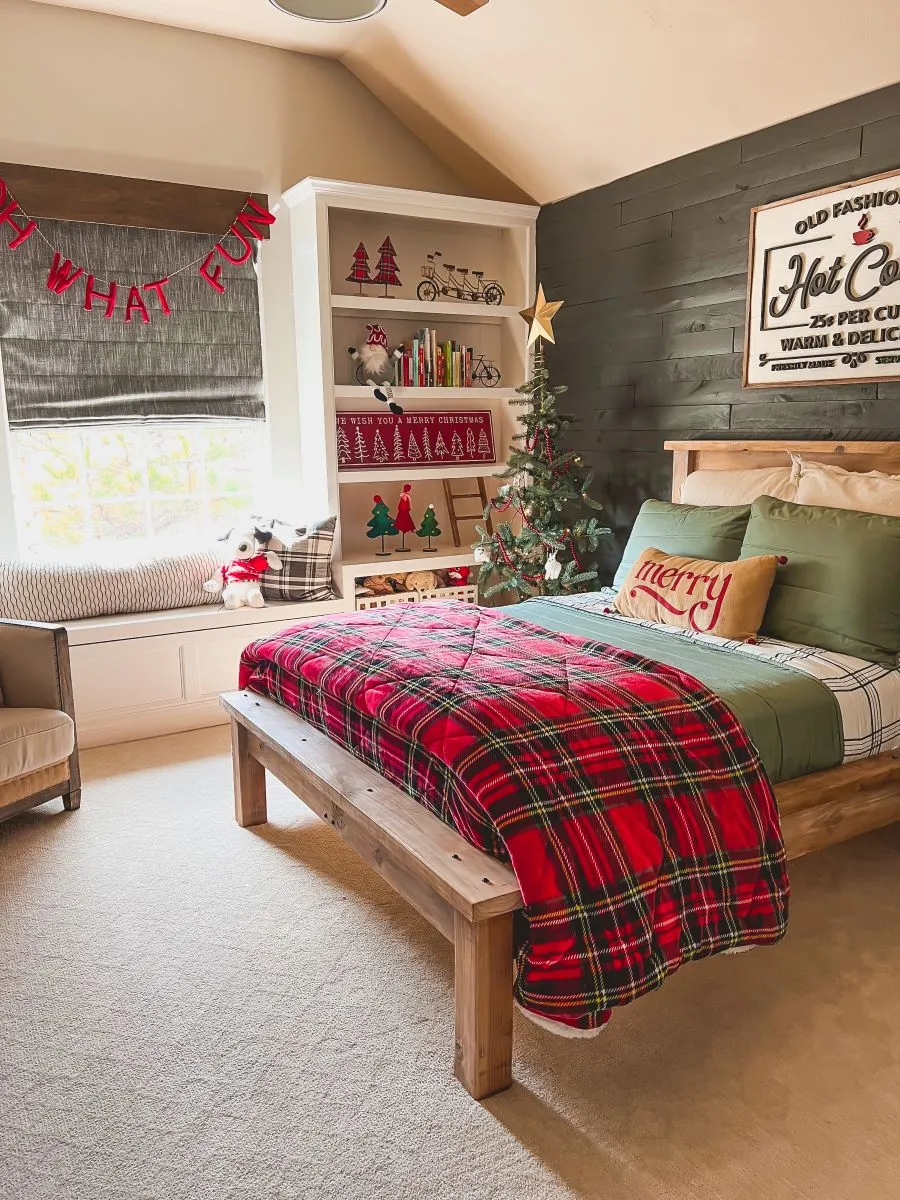
This layout wants a room at least 11×12 feet, with the bed on the long wall so the window seat is not blocked. Ceiling height matters less than floor space here — dark horizontal plank walls visually lower a ceiling, so anything under 8 feet will feel compressed unless the bottom third of the room stays light. In a smaller room, swap the window seat for a bench and keep the plank treatment to one accent wall.
9. Dark Wood Paneling, Green Plaid, Frosted Tree in a Basket
Roughly 50 percent dark wood, 30 percent forest green, 15 percent white, and 5 percent warm amber light. Dark wood absorbs light, so the white has to come from somewhere that reflects — that is the faux-fur pillow and the duvet edge, not the walls. The amber is the lamp and the twinkle. To make it less moody, swap the green plaid for a light gray and white check and keep everything else identical. The formula still reads as Christmas because the wreath and the tree carry the holiday signal.

Moody Christmas has been building for a few years now, riding the same wave as dark academia and the general rejection of all-white holiday decorating. What is different in 2026 is that people are committing to it in bedrooms, not just living rooms — dark paneling, one wreath, one small tree. It has staying power because it is not really a holiday look at all; it is a wood-and-green room that happens to have a wreath in it. Compare with Idea #4 — same dark instinct, much more risk.
10. A Flocked Tree in a Kid’s Room With a Pink Quilt
What a kid’s holiday corner actually costs:
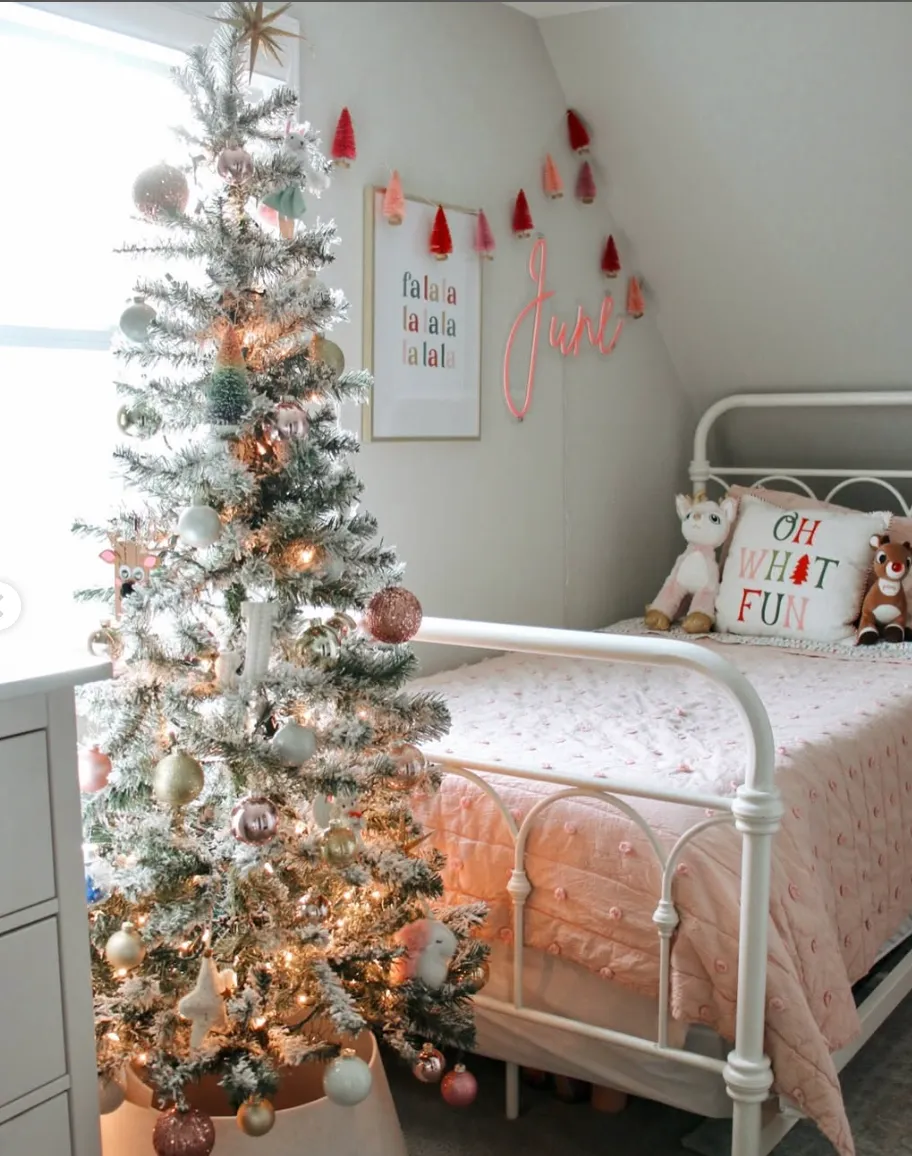
- 6-foot flocked tree: $70–$150
- LED string lights: $15–$30
- Pink quilted twin quilt: $45–$85
- Holiday accent pillows, 2: $24–$45
- Bottle brush garland and mini trees: $18–$40
- Neon name sign, optional splurge: $60–$140
Total: $232 to $490. Skip the neon sign and you are under $300, which is still plenty festive.
If you are putting a six-foot flocked tree in a kid’s room, anchor it. A single strap from the top third of the trunk to a wall stud, or a furniture anchor kit, costs under ten dollars and takes five minutes. Flocked trees shed that fake snow everywhere, so put a washable throw under the base instead of a fabric skirt. And use LED lights only — after an hour, incandescent strands get warm enough to matter in a room where a small person might grab them.
11. Red Script Pillow, Striped Throw, Twig Wallpaper
This is a pattern-scale lesson. The twig wallpaper is small and low-contrast, which is why a bold black-and-white stripe on the blanket does not fight it — the scale difference is doing the work. The red lumbar pillow with silver embroidery is the only saturated color, so it lands hard despite being tiny. The miniature lit tree echoes the wallpaper’s twig motif. Everything repeats something; nothing repeats at the same size. That is the rule, and it is why this bed looks styled rather than shopped.

Before you buy anything for a high-contrast holiday bed:
- Measure the headboard width — a 14×22 lumbar is standard, but anything over 20 inches wide crowds a twin.
- Check your wallpaper’s pattern repeat if you plan to hang a wreath or art over it; the motif should align, not bisect.
- Count your existing neutrals. You want at least two before adding red and black.
- Confirm there is a grounded outlet within reach of the tree, or budget $15 for a cord that matches the wall.
12. Dark Green Walls With a Red and White Patchwork Quilt
When you paint a bedroom dark green, pick a green with gray in it — something around an LRV of 10 to 15, like a deep forest or a spruce. Bright emerald goes fluorescent under warm bulbs and reads as a nursery. Then paint the trim and baseboards the exact same color, not white. White trim against dark green chops the wall into stripes and makes the room look smaller. Same color on everything, and the walls read as one calm envelope instead of a paint chart.
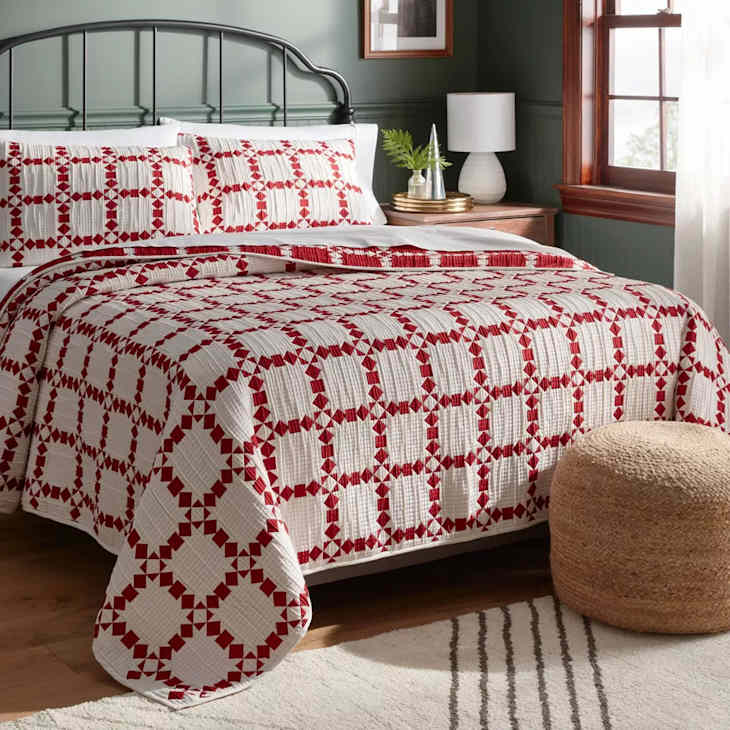
Two reality checks on this room. Dark green walls show scuff marks and handprints faster than any light color, so keep a small touch-up can and a foam roller in the closet — you will need it twice a year. And that woven jute pouf at the foot of the bed sheds fibers for the first month and is scratchy on bare feet, which matters at 6am in December. A wool or cotton pouf gives you the same organic texture with none of the itch.
13. Woodland Duvet With a Slim Tree Behind the Headboard
Placing a tree behind a headboard only works if you plan the cords:

- Measure the gap between headboard and wall — you want at least 4 inches.
- Choose a slim or pencil tree, usually 5 to 6 feet tall and under 20 inches wide.
- Run the light cord down the back of the headboard and tape it flat with gaffer tape so it never touches your neck.
- Weight the base with a bag of sand or a couple of heavy books inside the stand.
- Leave the top third undecorated so it does not look like a wall of ornaments.
About 45 minutes, and $0 if you already own the tree.
It is the tree standing behind the headboard. Remove it and this is a perfectly pleasant woodland bedding set. With it, the bed has a backdrop — a dark green cone of light behind the pillows that makes everything in front of it look intentional. It also solves the worst problem in holiday bedrooms: nowhere to put a tree in a room that is mostly bed. If your wall is solid, a tall leaning mirror gives you similar depth.
14. Avocado Print Holiday Bedding and a Red Plush Throw
Novelty print bedding is one of the few places where budget really does not show. A $35 avocado duvet from Walmart photographs almost identically to a $140 version. The solid red plush throw at the foot is the piece worth spending on — it is the thing you actually touch, and cheap plush pills after three washes. Target’s $25 throws hold up fine. For the round red accent pillow, Etsy has personalized versions from $22 to $38, and they will outlast the duvet by years.
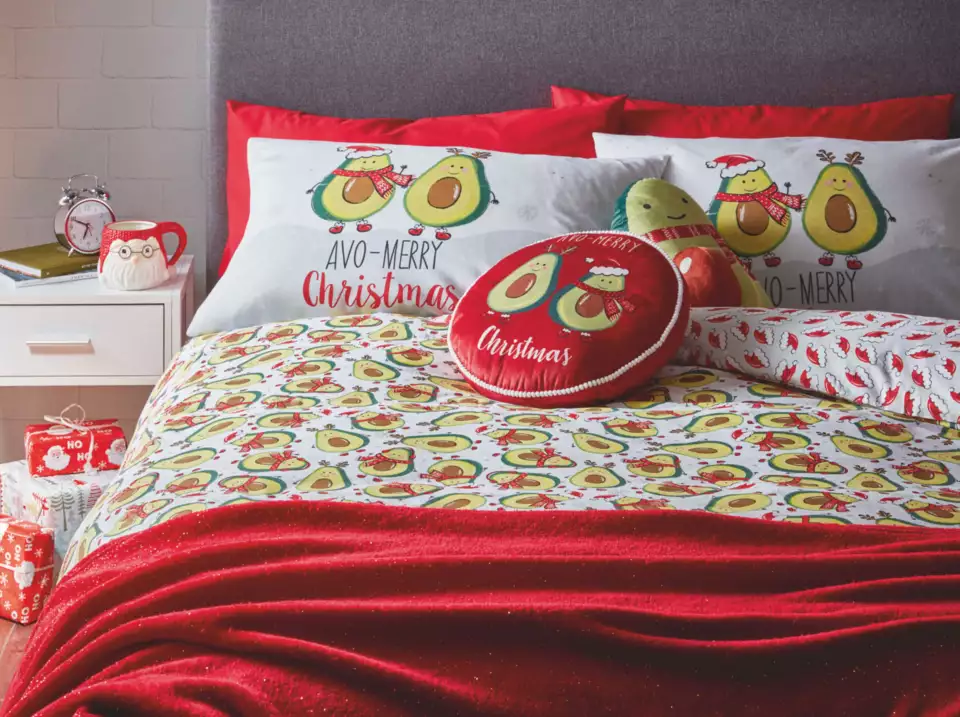
Be honest about shelf life. A novelty print like this is a five-week look, and it reads young in a primary bedroom — great for a guest room or a teen’s space, less so if you are building something you will keep for a decade. Storage matters more than you think; a queen comforter eats most of a bin. If you want a festive bed that survives January, look at Idea #19 — same playful energy, a pattern you will not outgrow.
15. Charcoal Walls, Carved White Headboard, HOHO Lumbar Pillow
About 55 percent dark charcoal, 25 percent forest green, 15 percent crisp white, and 5 percent faux fur. The charcoal is the walls, not the bedding — that is the key move. If your walls are dark, your linens have to be light, or the whole room collapses into one flat value. The white carved headboard is the bridge: light, detailed, and a place for the eye to land between the dark wall and the plaid. Swap the plaid for a cream-and-green stripe and the same room works in a completely different season.

Real upkeep on this one: a lit pine garland drops needles for about two weeks, so vacuum under the bed weekly in early December. Faux fur throws need a gentle cold wash and air dry, never a dryer, or the fibers mat. Dark charcoal walls show dust as a light film, so a dry microfiber duster once a week keeps them looking painted instead of chalky. None of it is hard — it is just more consistent than a neutral room.
16. One Red Pillow and a Trio of Tiny Wreaths
The rule here is one accent pillow for every two neutrals. On a queen bed that means four pillows: two standard shams, one 20×20 in a warm neutral, and exactly one saturated red pillow. That single red square reads as a deliberate choice; three red pillows read as a theme. Notice the plaid throw is folded narrow too — about 14 inches of visible depth at the foot of the bed — so it is an accent stripe, not a second blanket. Fold width is what makes a throw look styled rather than dumped.
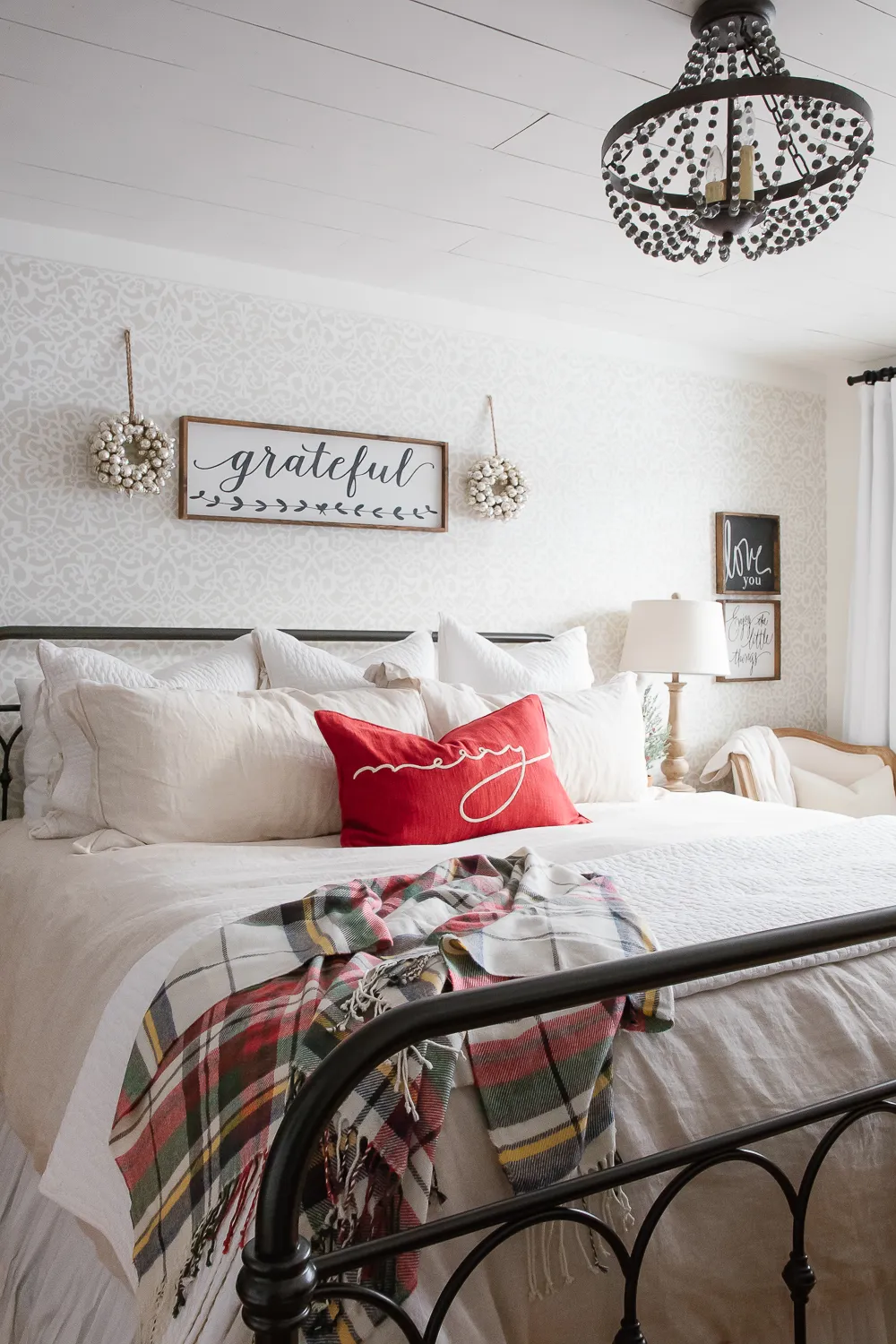
What makes this room special is not the red pillow — it is the trio of tiny wreaths hung on the patterned wallpaper, plus the beaded chandelier above the planked ceiling. Those two moves say someone thought about the whole room, not just the bed. Small wreaths on wallpaper are tricky; hang them from a single small nail or a damage-free hook and keep them at eye level so they do not vanish into the pattern. Lose them and the room goes from charming to plain.
17. Woodland Deer Embroidery With a Sage Striped Fold
The embroidery is what sets this apart from a printed duvet. Small tonal deer and pine trees in cream thread create texture you only see up close, so from across the room the bed reads as one soft cream block — which is why the sage stripe and the green bolster do not overwhelm it. A real potted evergreen in a woven basket then repeats the motif in three dimensions. The layering works because every green in the room sits at a different value, from pale sage up to deep pine.
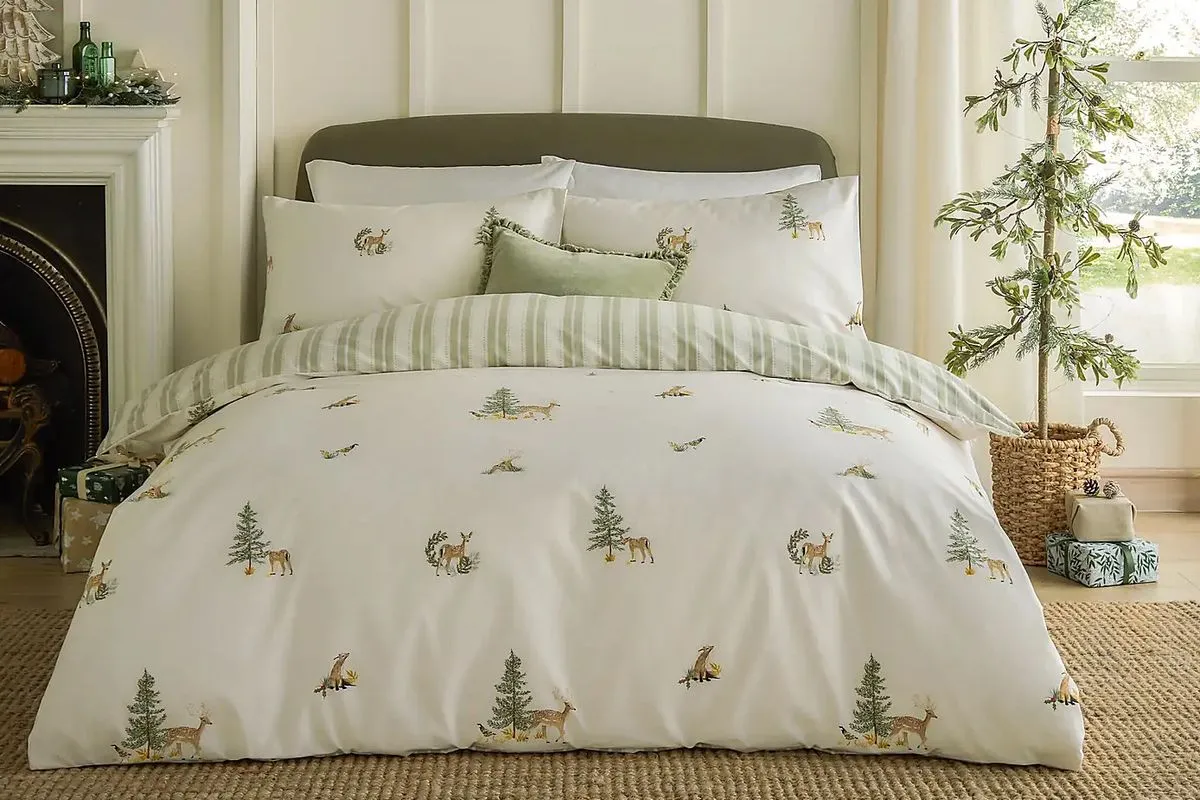
This one scales beautifully. It works in anything from a 10×10 spare room to a 14×16 primary, because the pattern is subtle enough not to overwhelm a small space and rich enough to hold a large one. Scaling it up means adding a third green element — a lumbar pillow, a wreath — not a bigger print. Flat 8-foot ceilings are fine here; the paneled headboard wall draws the eye up without needing height. The same sage palette shows up with a different energy in Idea #22.
18. Winter Forest Quilt With a Pine Wreath on Gray Paneling
The wreath above the headboard is the whole idea. Hung on a dark gray paneled wall, it frames the bed in a way artwork never quite does — a circle above a rectangle, which is more interesting than another framed print, and about twenty dollars instead of two hundred. Keep the wreath’s diameter around two-thirds the width of your headboard; smaller looks like a wall ornament, larger looks like a mistake. If you are renting, a removable hook holds most faux wreaths fine.
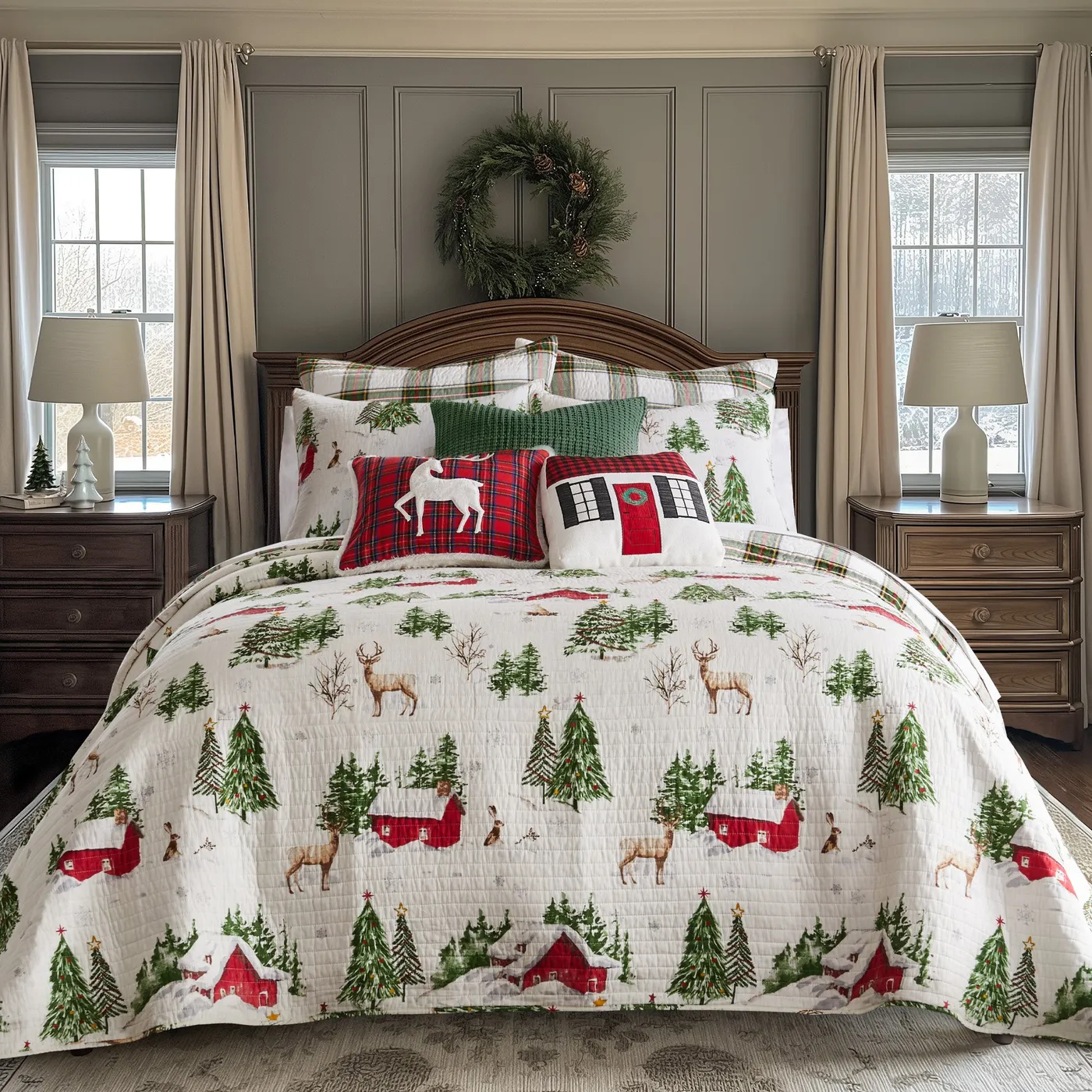
Wreaths inside the bedroom are having a moment for a practical reason: they are the cheapest way to signal holiday without rearranging anything. In 2026, people are moving away from full gallery walls toward one intentional piece — a wreath, a single poster, one large frame. The winter forest quilt sits in the same lane: nostalgic imagery treated with restraint. Expect this to outlast the novelty-print cycle, because it is built on traditional motifs rather than a punchline.
19. Nutcracker Print Bedding With Navy Plaid Pillows
Navy and red plaid is a harder pairing than it looks. Keep the navy in the smaller print — the pillow, not the duvet — and let the red quilted fold carry the volume. The trick is value: navy should be darker than your red by a noticeable step, or the two blur together. And when you mix plaid with a print, match the whites. A warm cream duvet with a cool white plaid pillow will look like a laundry accident no matter how good each piece is on its own.
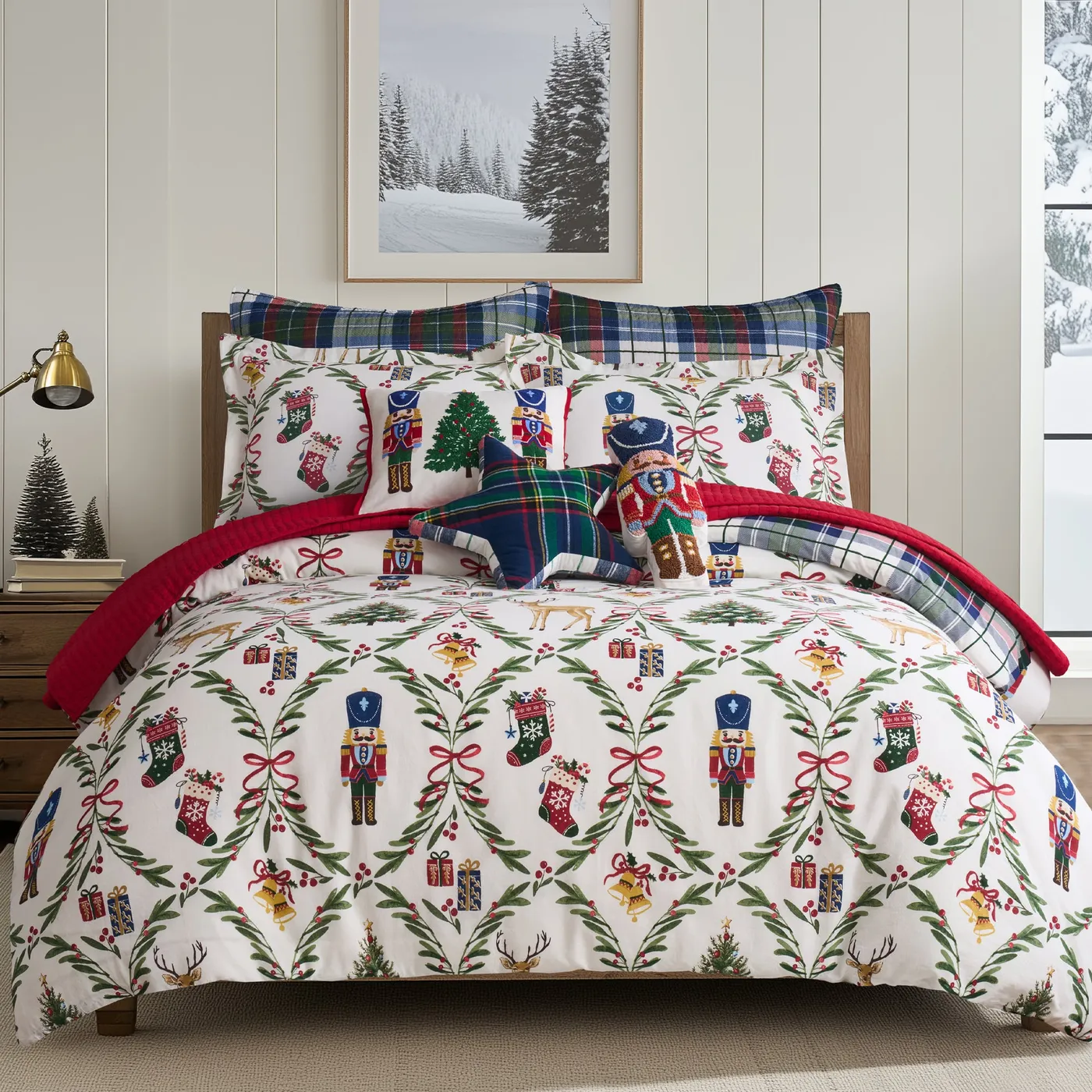
A white duvet with a busy print needs washing more often than you would think — every two weeks if it is on a bed you actually sleep in, because the pattern hides small stains until they set. Wash cold, inside out, and skip the dryer sheet; it coats the print and dulls it after a season. Bottle brush trees and tiny figurines shed and chip, so keep them on the nightstand, not on the bed, and dust the shelf monthly.
20. Pine Tree Print Bedding With Garland on Both Rails
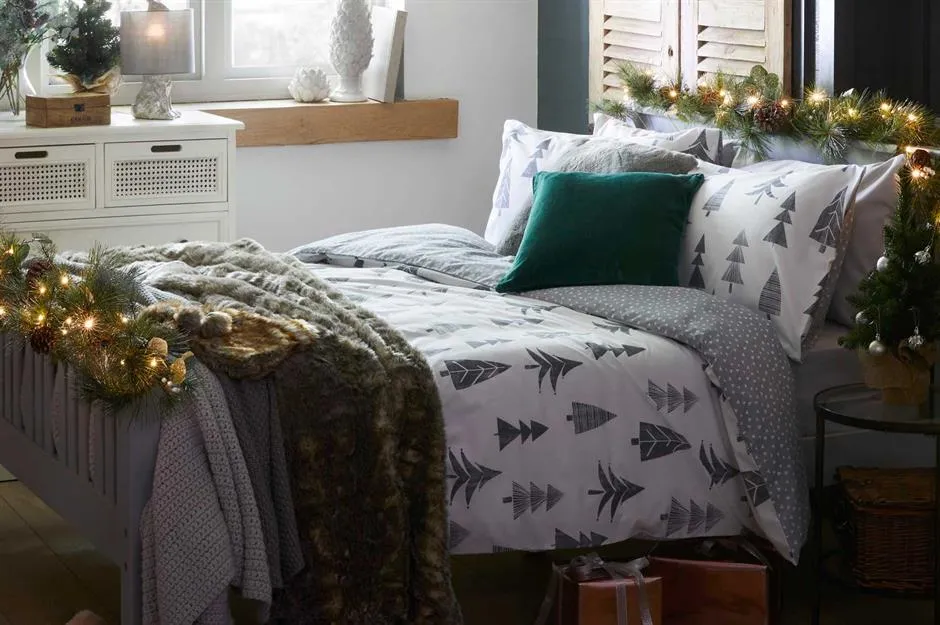
Wrapping garland around both a headboard and a footboard takes about 30 minutes and costs under $40:
- Start at the bottom corner and wrap upward in a slow spiral, not tight loops.
- Leave 6 to 8 inches of slack between wraps so the greenery reads full.
- Secure the ends with floral wire or small green zip ties — never clear tape.
- Run the light strand inside the garland, then plug the whole bed into one smart plug.
- Check that the footboard wrap will not catch on blankets when you make the bed.
Mirroring the garland on both rails is a bold call that works here because the bedding pattern is quiet. The gray pine trees on white are low contrast, so the greenery and fairy lights get to be the loudest thing in the room. The deep green velvet pillow absorbs light, which balances the twinkle above it, and the white cane-detail dresser in the background stays plain. Nothing competes with the lit frame.
21. Cars Carrying Christmas Trees on a Black Spindle Bed
Here is what this rustic setup runs:
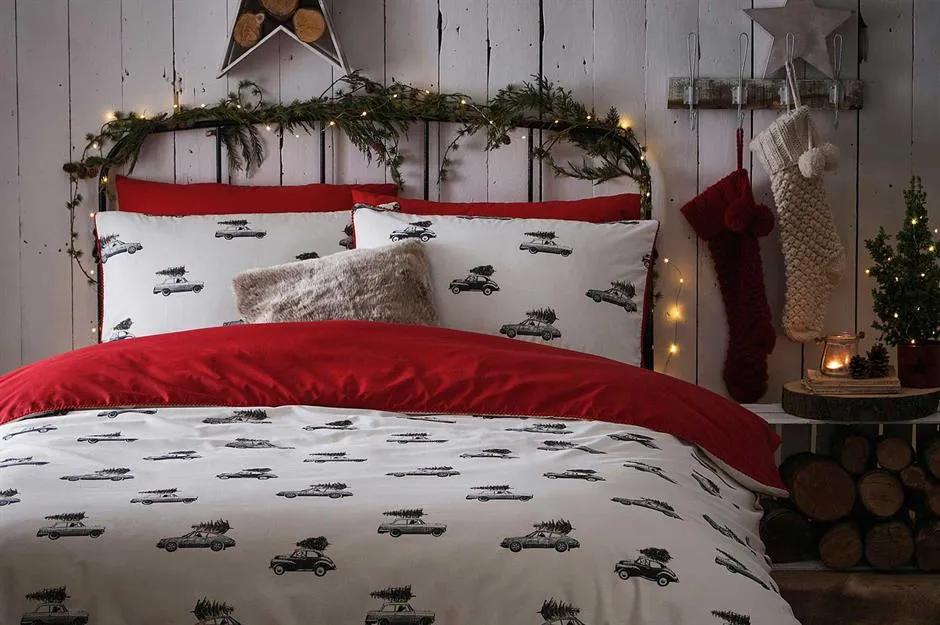
- Car-and-tree print duvet plus shams, queen: $60–$120
- Pre-lit pine garland, 9 ft: $28–$55
- Black metal spindle bed frame: $150–$400
- Knit stockings, set of 3: $30–$60
- Sheets and one solid throw: $50–$110
Total: $318 to $745. A thrifted spindle frame and one strand of lights you already own cuts that to around $180.
White plank walls make a room feel taller, so this idea punches above its square footage. It works from about 95 square feet up, because garland on a spindle headboard is visual height rather than physical bulk. Under 8-foot ceilings, keep the knit stockings below the headboard line so the eye does not stack up the wall. Larger rooms can take a full-length strand and a bigger pattern scale in the bedding without the room feeling crowded.
22. Robin Print Fluffy Bedding and Two Wire Wreaths
Wire wreaths only look intentional if you space them right. A pair of 10-inch wreaths over a queen headboard should hang 12 to 14 inches apart, centered on the headboard’s width, with the bottoms roughly 24 inches above the top of the mattress. Any closer and they merge into one shape; any further and they look like they are drifting. Add a single sprig of berries to each, not a full floral arrangement — restraint is what keeps wire from reading as craft-fair.
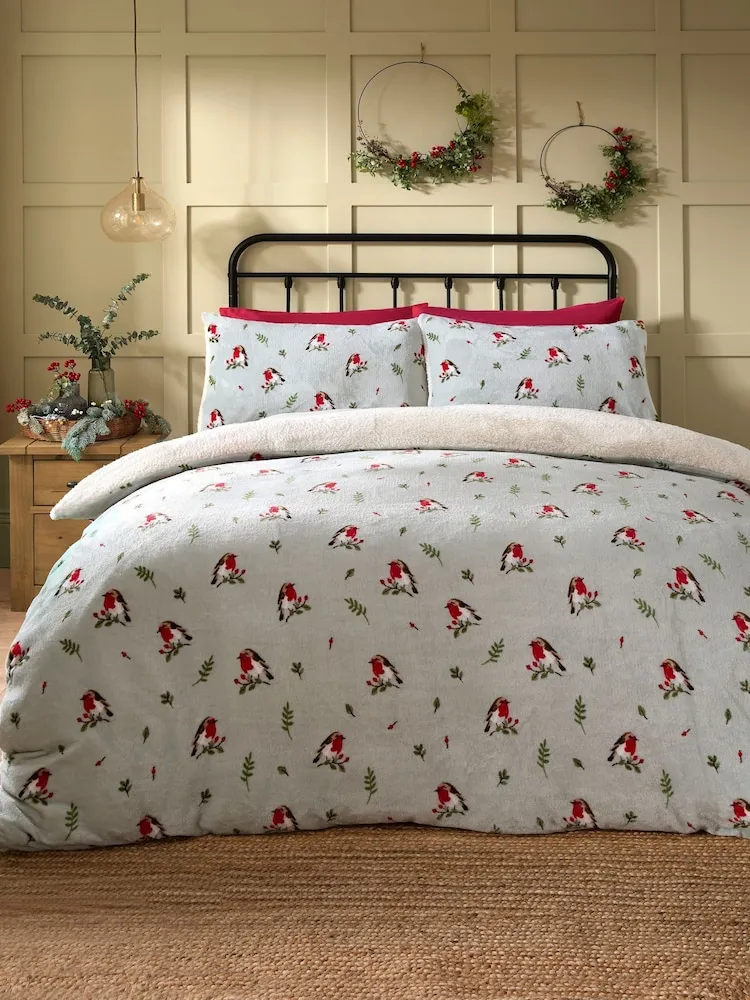
Fluffy duvet covers are the most forgiving thing you can put on a bed and the least forgiving to maintain. Once a week in the wash, always with an extra rinse — detergent residue is what makes them go flat and crunchy. Jute rugs under a bed will shed for about two months and then stop, so do not panic and return it. Pale green paneling shows scuffs; a damp eraser sponge handles most of them in under a minute.
23. Green and Red Plaid With One Tree-Shaped Cushion
This is a lot of plaid, and it works because of the ratio: roughly 45 percent plaid, 30 percent solid green quilt, 15 percent white, and 10 percent pine greenery. The solid quilt is the reset button. Without it, plaid comforter plus plaid shams plus plaid pillows becomes a wall of squares. If you want to lighten the whole thing, swap the solid green for solid cream and keep the plaid exactly where it is. The formula survives any color swap as long as one big element stays plain.

Be careful with tree-shaped cushions. One is charming; three is a craft booth, and they do not stack or store well because of the odd shapes. Cap it at one novelty shape per bed and let the plaid do the rest. Also check your four-poster height before you buy a comforter — posters plus a thick quilt plus a thick mattress often means the quilt barely reaches the rails, which looks unfinished from the doorway.
24. Light Blue Robin Fleece With a Sherpa Throw
Fleece and sherpa are some of the best value in holiday bedding:
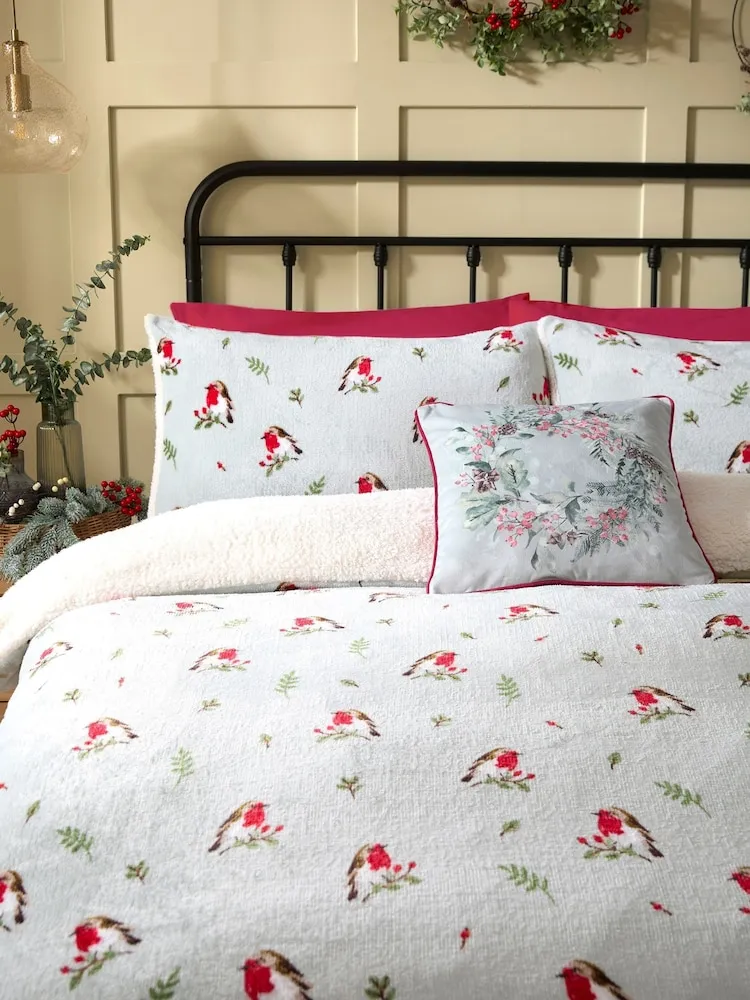
- Robin-print fleece duvet plus pillowcases: $40–$75 at Walmart and Amazon
- White sherpa throw: $22–$40 at Target
- Deep pink accent pillows, 2: $15–$28 each
Total under $120 if you already own a comforter to layer underneath. If you are repainting the pale yellow wall too, a gallon runs $35 to $70 and one coat often does it over white.
Before you commit to fleece:
- Measure your mattress depth — fleece covers run short on anything deeper than 14 inches.
- Check the duvet closure; buttons pop open on fleece, zippers do not.
- Test the pink against the wall in daylight — deep pink next to pale yellow can go peachy by evening.
- Confirm both pillowcases fit your pillows; some sets ship standard only.
25. Christmas Light Bulb Print and a Yellow Stocking
The trick with a novelty print that repeats a real object — here, actual light bulbs — is to echo it once, literally. One strand of warm white fairy lights tucked behind the headboard, unlit during the day, does more than a second patterned pillow. Then pull the yellow accent out of the print and repeat it in exactly one place, like a stocking or a small ceramic. Two echoes and the pattern feels like the room’s theme instead of its entire personality. Three and you are decorating a store window.
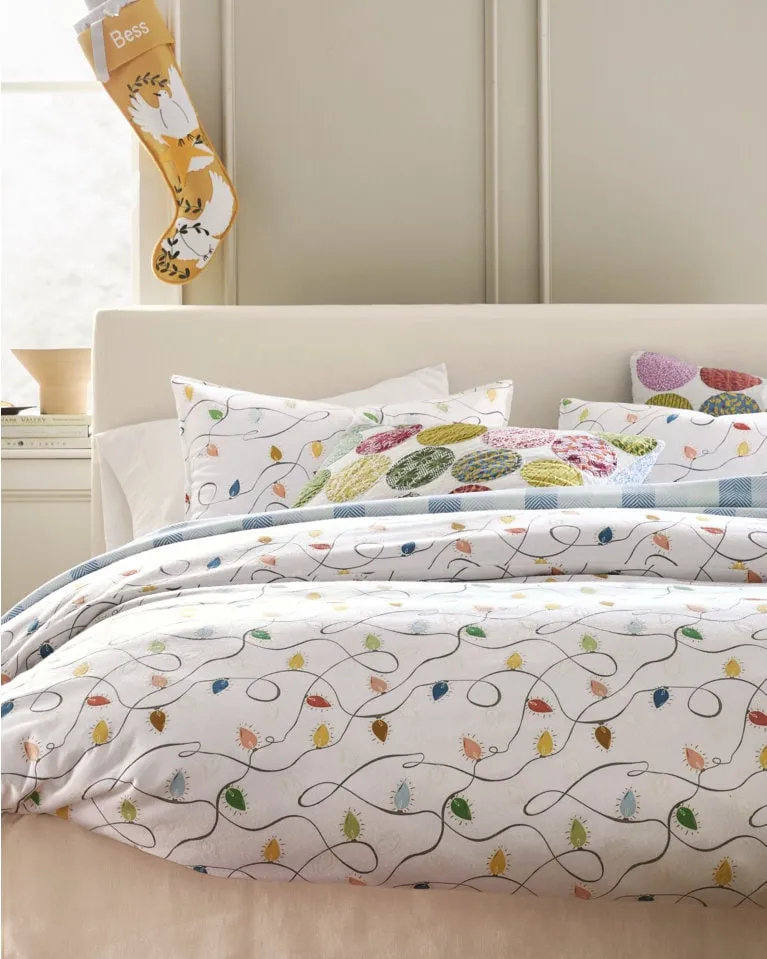
What is clever about this bedding is that the curved wires in the print are drawn at roughly the same arc as a real strand of lights, so the two read as related rather than duplicated. The white base keeps it from becoming a novelty explosion, and the multicolored quilted pillow gathers every bulb color into one object. The neutral paneled wall behind the headboard is doing quiet work too — no pattern there means the bedding gets to be the only thing talking.
26. Nutcracker Bedding With Fairy Lights on a Dark Wall
Hanging fairy lights on a textured dark wall without wrecking the finish:
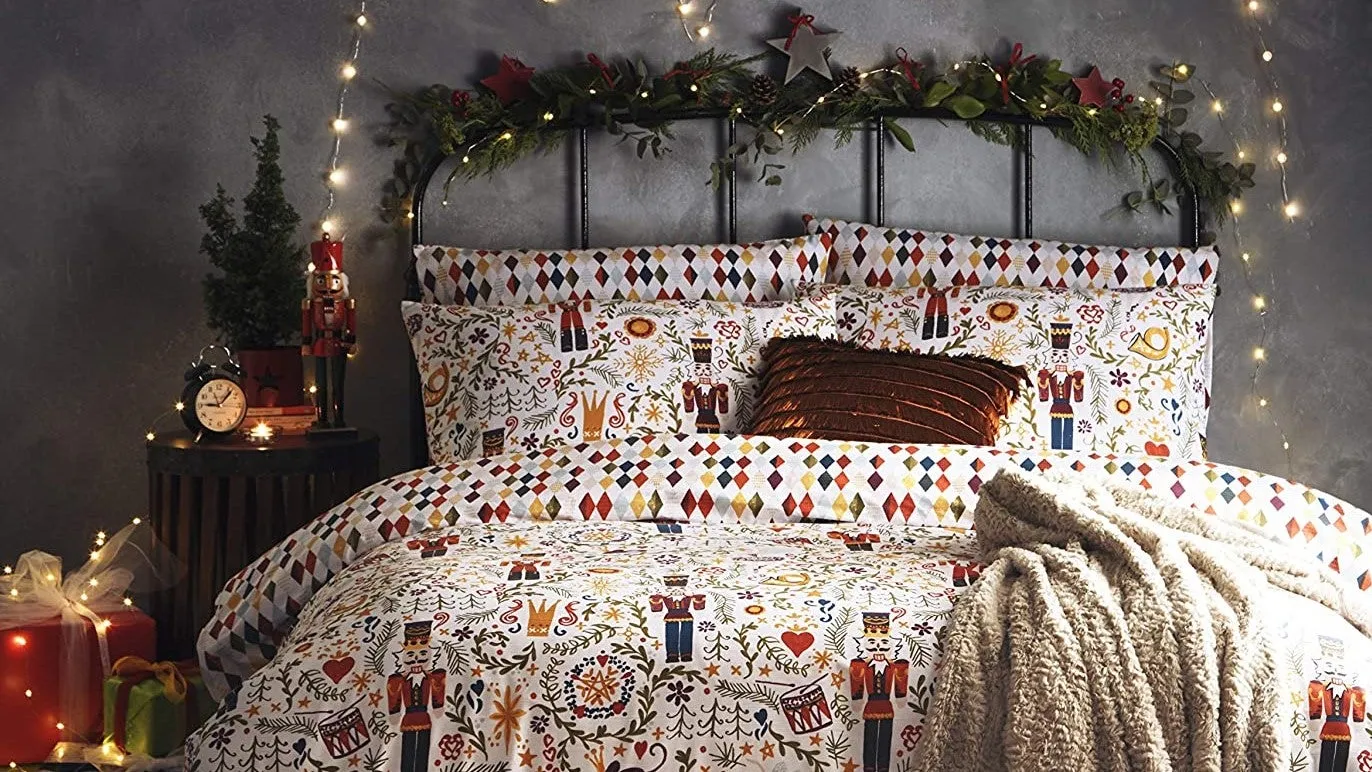
- Map the path first with painter’s tape — a gentle swoop between two anchor points.
- Use clear adhesive clips rated for the wire weight, one every 8 to 10 inches.
- Keep loops shallow; tight coils make the wire visible from across the room.
- Hide the plug end behind the nightstand and plug into a smart plug.
- Press each clip firmly for 10 seconds before you commit to the placement.
About 30 minutes and $20 to $35 in supplies.
The full setup:
- Nutcracker print duvet plus shams, queen: $55–$110
- Pre-lit green garland, 6 ft: $24–$45
- Fairy lights, 2 strands: $18–$30
- Adhesive clips plus smart plug: $15–$25
- Textured cream throw: $35–$65
- Tabletop tree and nutcracker figurine: $30–$60
Total: $177 to $335 — one of the cheapest complete looks in this entire list.
27. Christmas Tree Patchwork Quilt and a Pre-Lit Wreath
Patchwork quilts were written off as grandma decor for a decade, and they are back for good reason: they photograph beautifully, they are usually machine washable, and they are the antidote to a bedding market full of identical gray duvets. The Christmas tree motif version is new — it is a holiday quilt that does not scream, because the pattern reads almost abstract from across the room. Expect this one to hold up; patchwork always cycles back, and handmade quilts only get better with age.
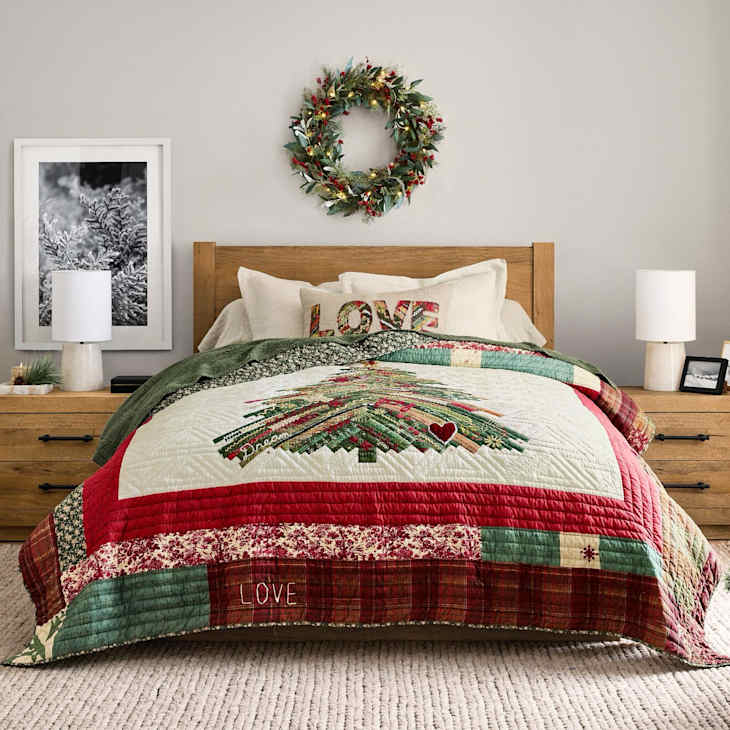
The nice thing about a quilt is that it does not need a big room to work. This setup is comfortable from 10×11 feet upward, because a quilt is thinner than a comforter and drapes without the bulk that swallows a small space. Two nightstands with lamps need about 30 inches of clearance on each side, so add 5 feet to your bed width before deciding it will not fit. Below 10 feet wide, use a single nightstand and see Idea #12 for a tighter version.
28. Pink Floral Wallpaper With an Embroidered Snowflake Pillow
Pink holiday bedrooms are cheaper to build than they look:
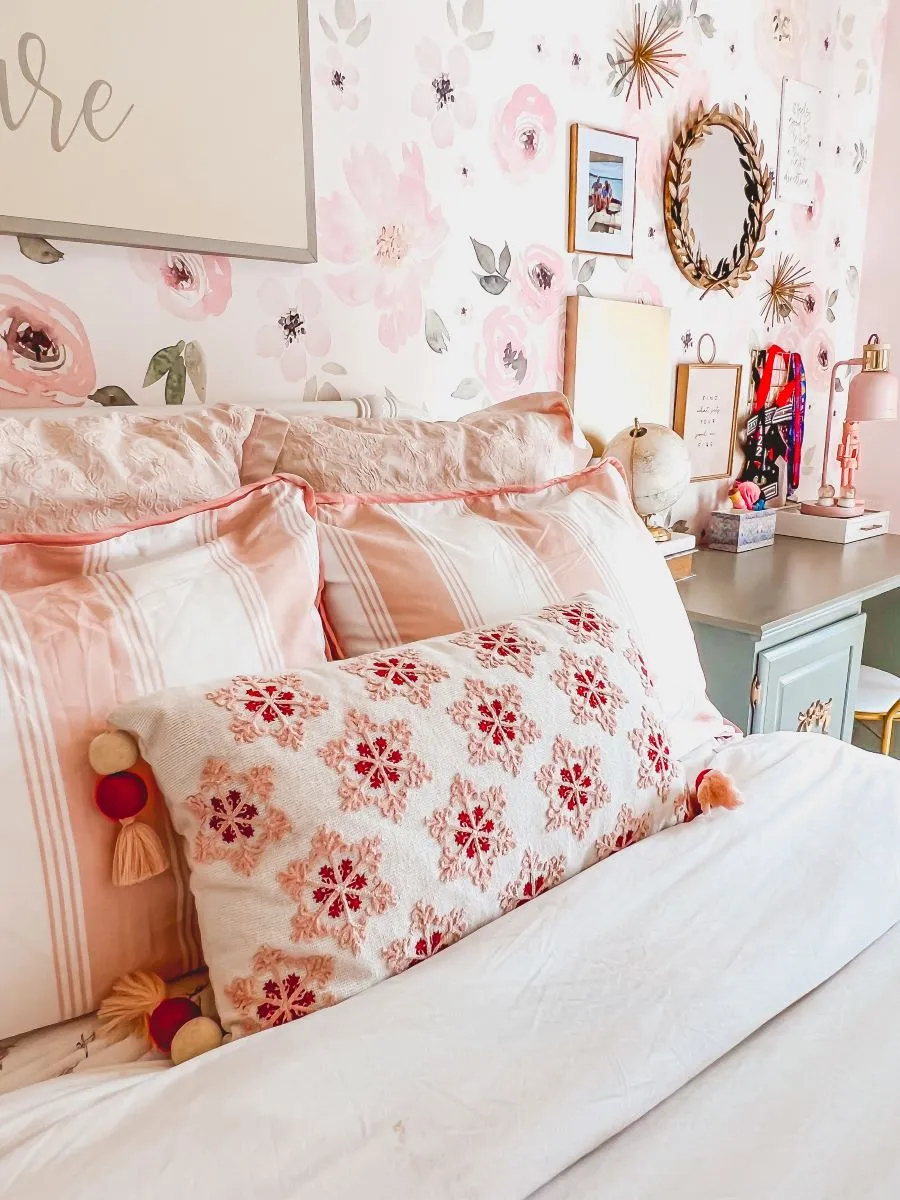
- Peel-and-stick floral wallpaper: $30–$60 per roll, roughly 2 rolls for one accent wall
- Snowflake embroidered lumbar pillow: $20–$38 at Target or Etsy
- Pink and white striped shams: $18–$30 each
- White duvet cover: $45–$80
That is about $150 for one wall. Skip the wallpaper and paint instead — a gallon of blush pink runs $35 to $55 and takes an afternoon.
Peel-and-stick wallpaper comes off cleanly for about two years, then the adhesive starts to cure and can lift paint with it. If you are renting, apply it over a wall you painted yourself or use a removable liner underneath. Floral prints hide small smudges well, which is a blessing and a curse — you will not notice a stain until it is permanent. Tassels on an embroidered pillow need hand washing, and they fray in a dryer.
29. Gnome Print Bedding With a Checkered Duvet Fold
Run through this before you buy anything:
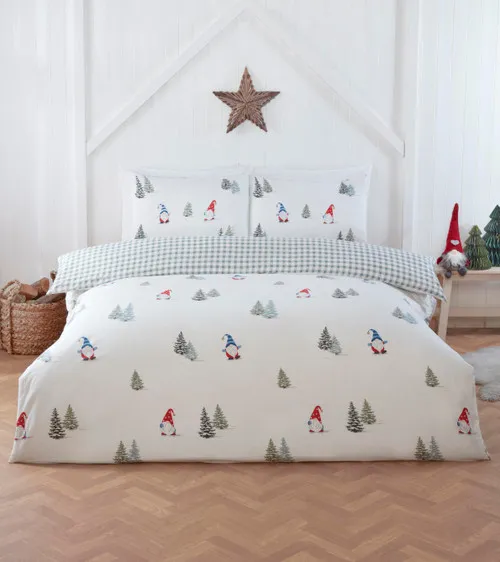
- Measure the wall from mattress top up — the triangular frame above the bed needs at least 30 inches of clear wall to look intentional.
- Decide whether your log basket is decorative or functional. If functional, line it.
- Confirm your tabletop trees have a place to plug in, or go battery-powered.
- Look at the headboard wall in morning light; white paneling goes flat gray on a north-facing wall.
The formula here is 55 percent white, 25 percent green and white check, 15 percent red, and 5 percent brown wood. The check is the bridge — white enough to keep the room bright, patterned enough to feel intentional next to a novelty print. To carry this into January without changing anything structural, drop the red to zero and let the gnome bedding become a woodland print. Same furniture, same walls, same ratio.
30. Winter Scene Bedding Against a Tall Tufted Headboard
Kid and teen bedding is where holiday decor gets genuinely affordable. A winter-scene duvet with two matching pillowcases runs $35 to $65 at Walmart or Target, and it is usually the cheapest piece in the room. Spend your money on the headboard instead — a white tufted queen frame is $120 to $300 new, but Facebook Marketplace in January is full of them at $50 to $80 when people redecorate. Light wood-look peel-and-stick flooring runs $1.50 to $3 per square foot if you need to warm up the floor.
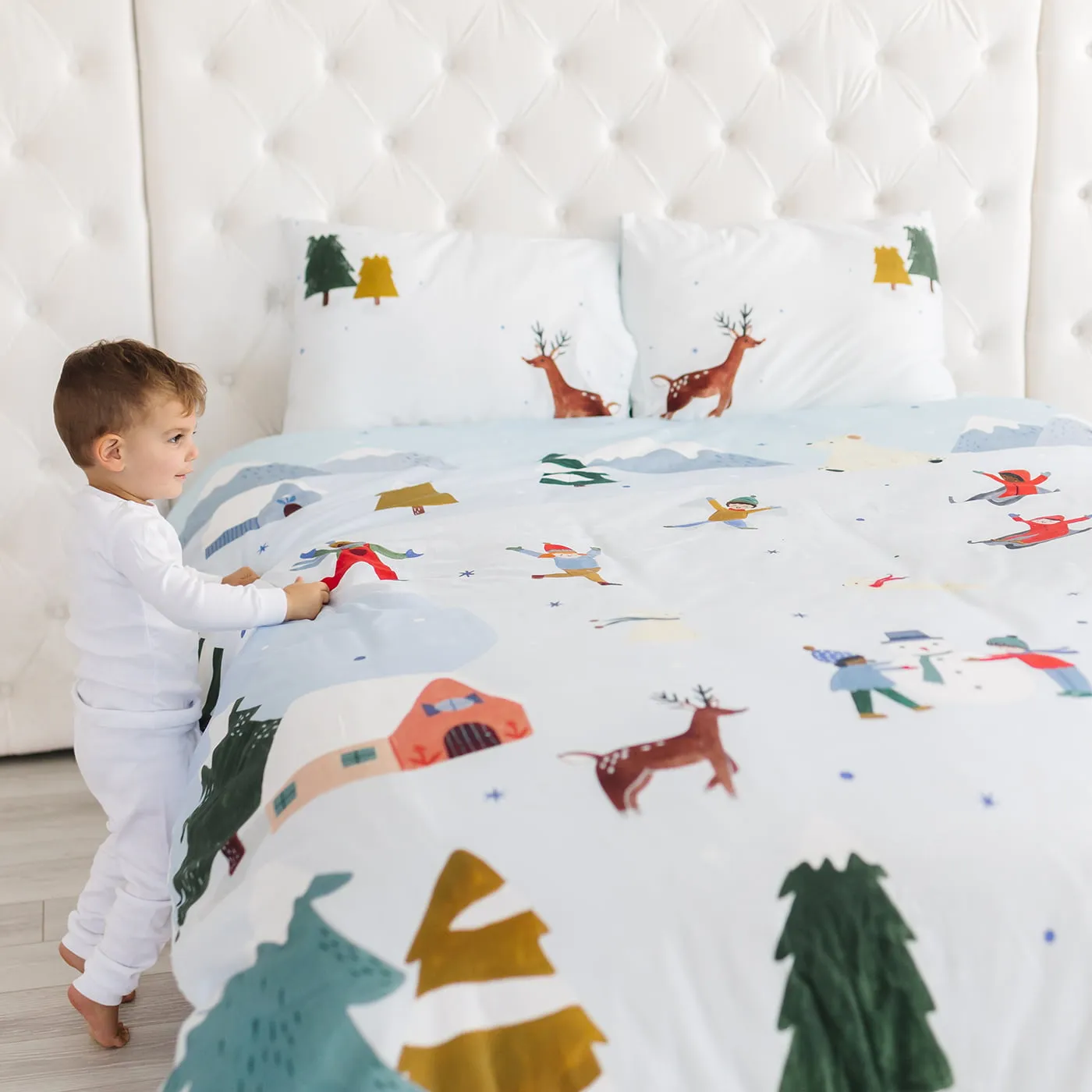
Layering a patterned duvet against a tall tufted headboard, in five minutes:
- Start with white sheets pulled tight — the pattern needs a clean edge to sit on.
- Put the duvet on inside out, then flip and button it at the foot of the bed.
- Fold the top 12 inches back over the pillows so the white shows.
- Smack the pillows against your hand to fluff, then prop them upright against the tufting.
- Skip the throw if the print is busy; the tufted headboard is already your texture.
31. Ribbon-Layered Rustic Tree With Red and White Accents
Ribbon-layered trees look expensive and are not:

- Wired ribbon, 2.5 inch, 3 rolls: $12–$20 each
- Berry sprigs and floral picks, 6: $8–$15 each
- Poinsettia stems, 4: $6–$12 each
- Fairy lights, 200 count: $18–$30
- Wooden JOY sign plus wreath: $35–$70
Total: $160 to $345 for the whole tree, versus $800-plus for a designer-decorated version at the same scale.
Ribbon layering replaced tinsel garland as the default around 2022 and it is still gaining — partly because wedding decorators brought their techniques over, partly because ribbon holds its shape and photographs better than anything loose. The 2026 version leans rustic: patterned red-and-white ribbon, natural berry stems, a wooden sign leaning at the base. It has real longevity because it is a technique, not a specific ornament, so you can rebuild it every year with what you already own.
One Last Thing Before You Plug In the Lights
Pick one idea from this list — just one — and do it properly this weekend instead of trying to rebuild the whole room in December. The beds that look best in photos are almost never the most decorated ones; they are the ones where the base layer is calm and one or two festive moves are allowed to be the loudest thing in the room.
📌 Save this to Pinterest so it is waiting for you when the tree comes out of the closet.