Still scrolling long past bedtime, saving flocked Christmas trees you’re not entirely sure you can pull off in your own living room? You’re in good company — flocked trees are among the most-saved holiday photos on Pinterest, and the 2026 versions lean hard into red-heavy traditional styling, rustic Ralph Lauren-style layering, and quiet winter-wonderland neutrals.
We spent serious time browsing Target, Wayfair, Walmart, Amazon, and Etsy to bring you only what’s worth your attention this year, with looks ranging from a $12 spool of ribbon to a $649 statement tree.
Inside you’ll find 30 curated ideas, from heavy showpiece flocking to slim pencil trees, with budget and luxury versions compared side by side and every idea shoppable through direct product links. And stay until the end — we break down the most common mistakes that can ruin these looks. This post contains affiliate links.
📌 Save this to Pinterest for later — you’ll want to revisit these ideas.
1. Heavy Flocking Paired With a Stone Fireplace Mantel
The element that carries this room isn’t the tree — it’s the flocked garland and wreath on the mantel. That’s the detail people skip. A snow-heavy tree beside a bare stone fireplace looks like a delivery nobody unpacked. Match the mantel with the same snow-dusted greenery and the tree belongs to the room instead of just standing in it, which matters a great deal against charcoal stone and warm wood.

String your lights before you hang a single ornament, and work trunk-first. Run warm white strands in a tight spiral down the trunk and out along the main limbs at about 100 lights per foot of tree height — a 7-foot tree wants roughly 700. Then push the branches back over the wire so no cord shows. The glow should come from inside the flocking, not from a visible strand, and testing every set on the floor first saves you an hour of untangling later.
2. Warm String Lights and a Garland-Wrapped Staircase
A stair rail is the cheapest way to make a flocked tree look like it was always meant to be there, and it takes an afternoon.
- Measure the rail run and add 20% — swags eat length quickly.
- Zip-tie the garland at the newel post, then work upward, tying every 12 inches.
- Weave a 100-light warm strand through the garland from the bottom up.
- Clip in three or four oversized ornaments and a pair of patterned stockings at uneven heights.
- Fluff the tips outward with your fingers so the snow reads soft, not crushed.
Budget about $60 to $120 and two hours for a standard 10-foot rail.
This setup wants a rail run of at least 6 feet and ceilings near 9 feet, which is why it shows up most in two-story foyers and open-plan living rooms with the tree visible from the stairs. In a standard 8-foot-ceiling house, keep the tree at 6 to 6.5 feet so it doesn’t crowd the garland overhead. If your entry is narrow, one swag over a doorway does the same job with half the material.
3. When the Inspiration Photo Won’t Load — Plan First
Our photo for this one arrived as a broken-image icon, which felt like an honest place to start. Flocking is messy, it sheds, and it locks you into a color story before you buy anything. If your mental palette leans red and black, note that black reads heavy against white flock — keep it to ribbon and a handful of ornaments, not the whole tree.
- Measure ceiling height and subtract stand and topper clearance.
- Check outlet placement — you want one within reach of a 9-foot extension cord.
- Decide how much white shed your flooring can handle.
- Lock your palette before you buy ornaments, not after.
- Set a hard budget ceiling, tree skirt included.
heavy flocking drops white dust every time you brush it. Put a sheet down for assembly, vacuum with a brush attachment afterward, and expect a light snowfall each time you redecorate. If that sounds unbearable, a lightly frosted tree gives you 80% of the look with 20% of the cleanup.
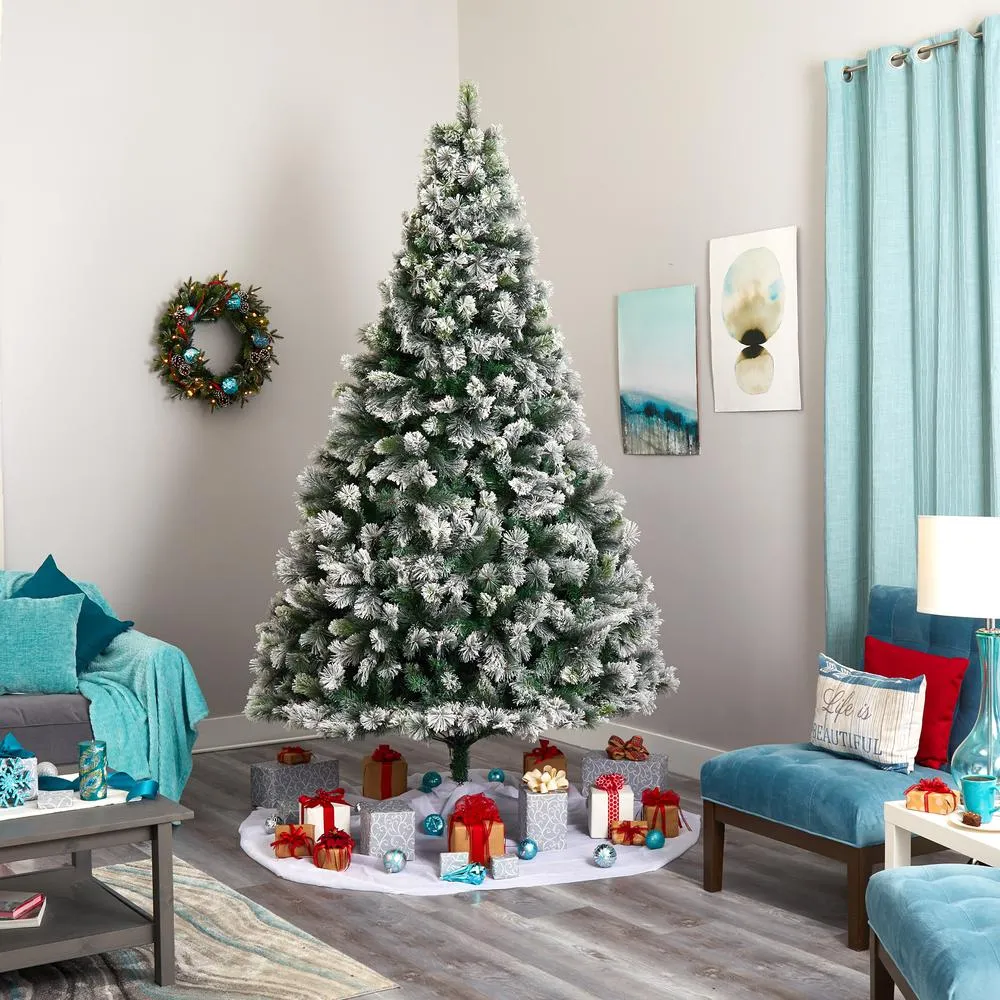
4. Flocked Tree With Teal Upholstery and Red Bows
Teal at Christmas stopped being a novelty a few seasons ago and now behaves like a neutral. The reason is simple: cool blues flatter snow-white flocking in daylight, where red sometimes turns muddy. Here the teal appears four times — grommet-top curtains, sofa, armchairs, and a small wall wreath with blue ornaments — which is what makes the red bows under the tree read as a deliberate accent instead of leftover ribbon.

Two principles do the heavy lifting. Repetition first: one accent color used four ways reads as a scheme, the same accent used once reads as a mistake. Then temperature contrast — a cool room makes warm wood-look flooring feel grounding rather than flat. The red stays small, confined to bows and a few ornaments, so the palette never tips into Christmas-movie chaos. It’s a cooler cousin to the red-and-gold story in Idea #11.
5. Looping Gold Ribbon and Translucent Glass Ornaments
What you’re paying for here is glass and restraint. Rough numbers for a 7-foot version:
- Flocked tree: $250–$650
- Upholstered accent chair: $400–$1,200
- Warm string lights: $40–$120
- Glass ornaments, gold mesh ribbon, candles: $150–$350
- Tree skirt and textiles: $40–$100
Total: roughly $880 to $2,420. Budget alternative: skip the glass spheres for matte white shatterproof balls, swap the ribbon for a $12 gold mesh roll, and use a knit blanket as the skirt. That lands you near $400 with most of the effect intact.
Flocked trees shed. Expect fine white dust for the first week and again at pack-up. Glass ornaments scratch against each other in storage, so wrap them individually, and that gold mesh ribbon never loops the same way once it’s crushed in a bin — store it rolled around a cardboard tube.
6. Pencil Flocked Tree Under Exposed Wooden Beams
Pencil trees punish big ornaments. On a slim flocked profile, cap ornaments at 2.5 to 3 inches across and hang them close to the trunk so they don’t break the silhouette. To add height without width, run a ribbon vertically from the topper down rather than spiraling it — vertical lines read taller, which is exactly what a narrow tree under low beams needs. Finish with a topper no wider than 8 inches.

. A 7-foot flocked pencil tree from Walmart runs $60–$110. Add two boxes of small ornaments at $8–$12 each, a roll of ribbon, and a warm 300-light strand, and you’re under $150. If you already own a green tree, a $15 can of spray flocking gets you partway there — work in light passes, from about 18 inches away. Facebook Marketplace in late November is full of last year’s displays at half price.
7. Silver and White Baubles Against a Dark Wall
The formula here is simple and unforgiving: 70% snow white from the flocking and lights, 20% silver, 10% warm gold. Swap the silver for champagne and it turns soft and romantic. Swap it for matte black and you get a moodier, more modern tree. Keep the ratio and you can change materials freely — ribbon, baubles, snowflake shapes — without the tree losing its cool.
that makes it sing is the dark backdrop. Against a light wall, white and silver ornaments disappear into the flocking and the whole tree flattens. Against charcoal or a deep neutral, every ornament edge shows up and the tree glows like a lit window at night. If you can’t paint, hang a dark curtain panel or a charcoal throw behind the tree for the season — it costs almost nothing and changes everything.
8. Red and White Ornaments With a Glowing Reindeer
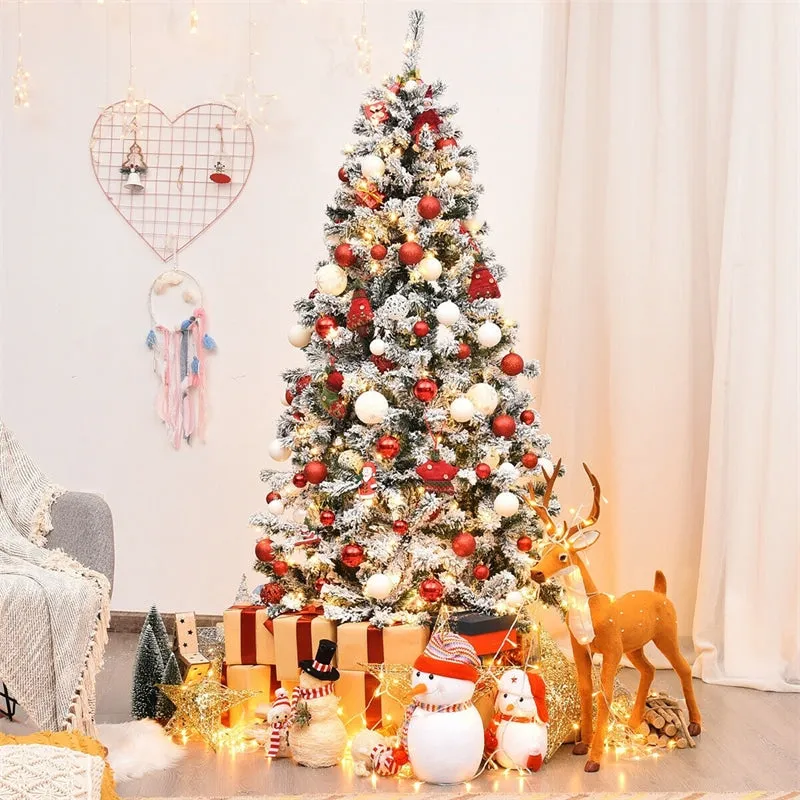
All those figurines at the base — the snowman, the glowing reindeer — need roughly a 3-foot circle of floor you can’t walk on. Worth checking before you commit. Light-up reindeer come with cords, and cords near a toddler or a teething puppy are a genuine hazard. If floor space is tight, put the reindeer on a side table and keep only wrapped gifts under the branches.
Styling the base in five moves:
- Start with a tree skirt or wide basket, fully covering the stand.
- Stack gifts largest at the back, smallest at the front corners.
- Use no more than two wrapping papers so the pile looks designed.
- Place one figurine front-left and one back-right, never centered.
- Leave a visible gap of skirt so the arrangement can breathe.
Twenty minutes, no cost.
9. Kraft Paper Gifts on a Red Pom-Pom Tree Skirt
Here’s what this traditional setup actually costs:
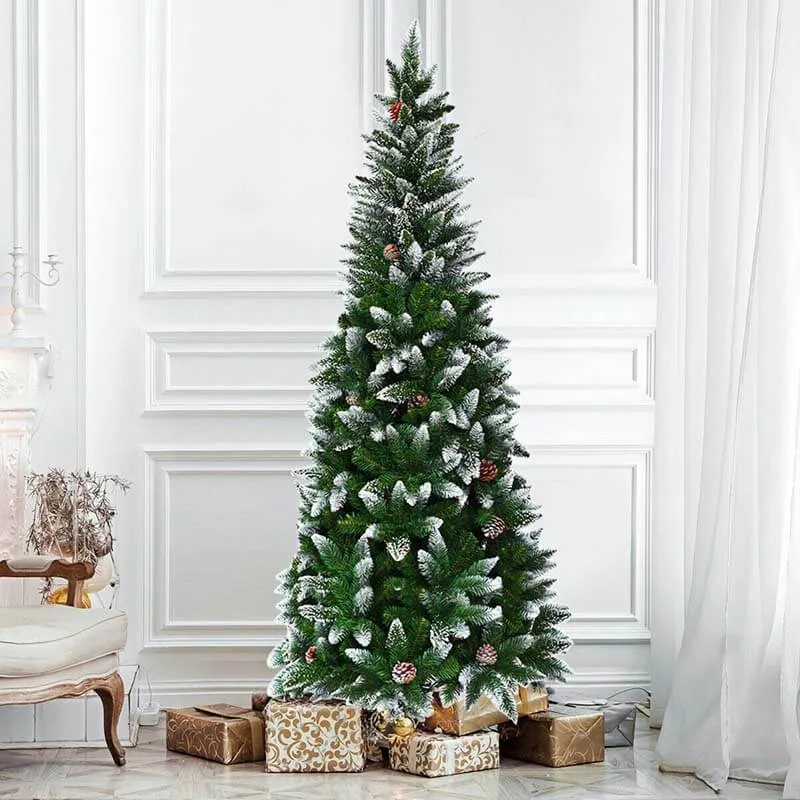
- 7.5 ft heavily flocked tree: $200–$600
- Red pom-pom tree skirt: $30–$80
- Warm white lights (700–900 count): $30–$70
- Kraft paper, ribbon, and gift boxes: $40–$90
- Mantel wreath and greenery: $40–$120
Total: $340–$960. Budget alternative: buy the tree secondhand in early January, use a red tablecloth as a skirt, and wrap empty boxes you already own. That drops you to roughly $150–$250 and nobody walking through your door will know the difference.
this look needs a wall run of at least 8 feet to fit the tree, the mantel, and the windows without crowding. Ceilings of 9 feet or higher suit a 7.5-foot tree; at 8-foot ceilings, go 6.5 feet. If your living room is under 150 square feet, the slim silhouette in Idea #10 will serve you better than a full-width tree.
10. Slim Flocked Tree Against Muted Teal Paneling
Muted teal paneling is a risky wall color, and this room proves why it works: the flocked tree is the brightest object in the frame, so the eye lands there first and the paneling becomes scenery. The light wood chevron floor keeps the teal from feeling cold, and the gold and silver boxes under the tree echo the warm candles on the white mantel without repeating a single shape.

A useful trick for narrow trees: build your ornament collection in three sizes — small, medium, and one oversized statement piece placed about two-thirds up. Odd numbers of any ornament type read better than even ones. And weigh your tree skirt down with a couple of hardback books under the fabric if you have a cat. A circular skirt that slides is a skirt that ends up across the room.
11. Glossy Red Balls Hung on Gold Cords
You don’t need a designer tree to get this. A set of 60 glossy red shatterproof ornaments runs about $20 at Walmart. Gold cord or thin gold ribbon is $4 a spool. A 300-light warm strand is $12. Total: about $36. The finish is what matters — matte red reads completely differently against white flock, so buy shiny if you want this exact effect.
The visual math is 60% flocked white, 30% glossy red, 10% gold from cords and hangers. Change the ornament color to burgundy and keep the gold, and you get a warmer, more grown-up tree. Swap gold for silver and the whole thing turns icy. Proportion is what holds it together, not the specific colors you choose.
12. Faux Fur Tree Skirt in Front of a Grid Window
Faux fur tree skirts have been climbing on Pinterest every November for several years now, and this season is their biggest yet. The appeal is contrast: heavy white flocking reads soft, and a fur skirt extends that texture all the way to the floor, so the tree looks like it grew there. It also hides a metal stand completely, which is more than most fabric skirts manage.
Upkeep, honestly: faux fur mats down where gifts press into it and needs a good shake and brush-out in January. It sheds. It also traps dust visibly because it’s white, so plan on a hand vac rather than a broom. A washable knit skirt or a simple white linen drop cloth gives you most of the softness with none of the grooming — and rotate any skirt a quarter turn each week to keep the pile even.
13. Red Berries and Pinecones on a Blue-Gray Wall
Red berries and pinecones do all the work here, and neither one is a bauble. Because there are no glass spheres competing for attention, the tree reads as something you’d find outside — which is exactly why it holds up so well against slate blue-gray paneling. Uniformity matters too: same berry cluster, same pinecone, repeated at even intervals from top to bottom, with pillar candles on the wood mantel picking up the same browns.
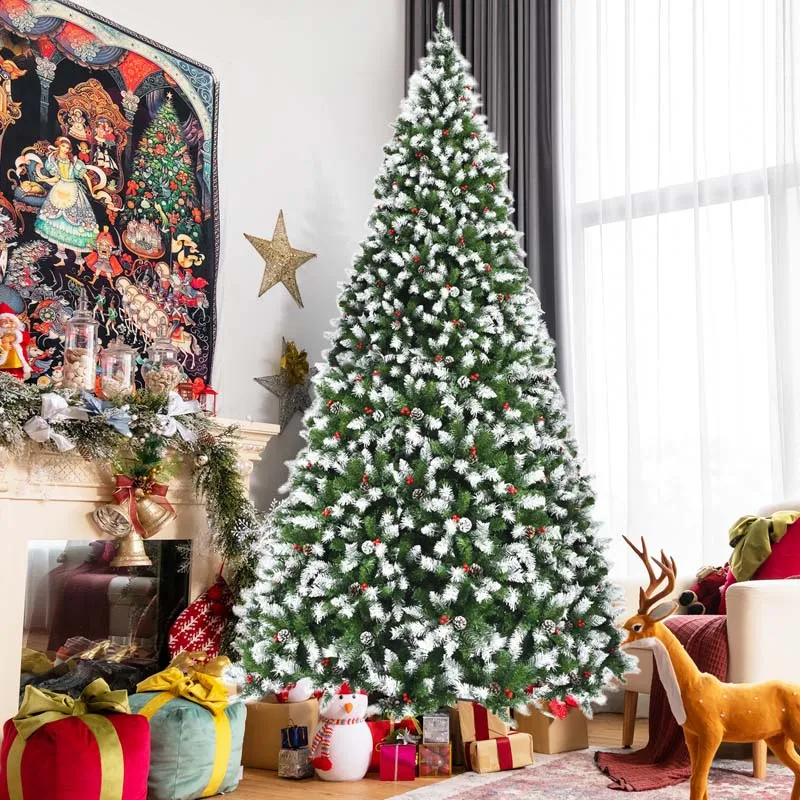
To build that look:
- Buy 40–60 pinecones and 6 berry sprays.
- Wire each pinecone to a branch tip, working top to bottom.
- Cut berry sprays into 4-inch stems and tuck them between pinecones.
- Keep spacing even — roughly one accent every 6 inches.
- Add warm lights last so they read through the pinecones.
Cost: $35–$70. Time: about 90 minutes.
14. The Undecorated Flocked Tree That Needs Nothing
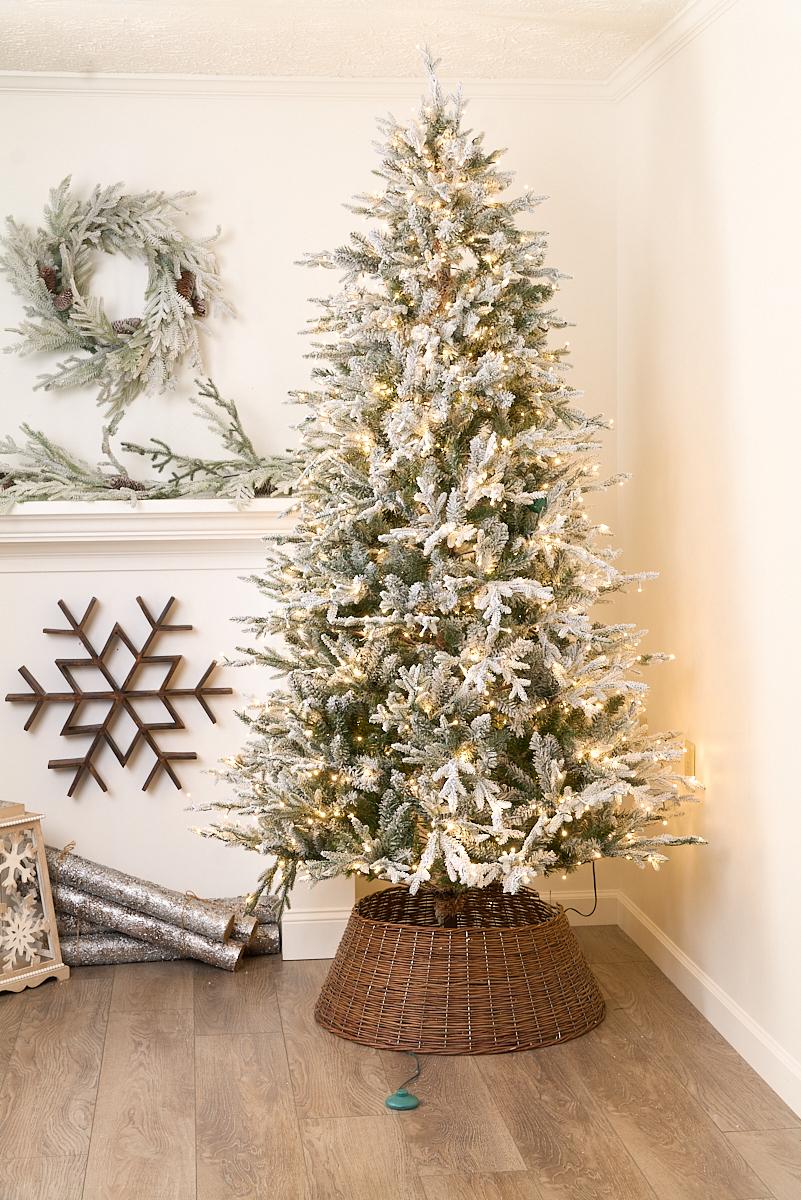
An unadorned flocked tree is the most size-forgiving thing in this entire list. It works from 4 feet to 9 feet and in rooms from 100 square feet up, because it has no width penalty from ornaments and no bad viewing angle. The only rule: leave at least 18 inches of clearance on every side, and 24 inches if people walk past it. A tall narrow version suits a hallway or dining room corner where a decorated tree would feel busy.

If you already own a plain green tree, this is the cheapest idea in the article. One can of snow spray ($12–$18) and an afternoon gets you a decent frosted effect. Work in light, repeated passes from about 18 inches away, let each layer dry, and never spray the lights. Big-box stores also sell pre-flocked trees under $100 in the 6- to 7-foot range during early November sales.
15. Brown Paper Packages Beside a Lit Fireplace
Brown paper and red ribbon is a beautiful, disciplined look and a terrible idea if your gifts are lumpy. Kraft paper shows every corner and crease, so oddly shaped boxes will look messy no matter how neat your bow. Do a dry run with one box before you commit to wrapping fifteen of them at 11 p.m. on the 23rd. Also: red ribbon bleeds in humid rooms, so keep the tree clear of heating vents.
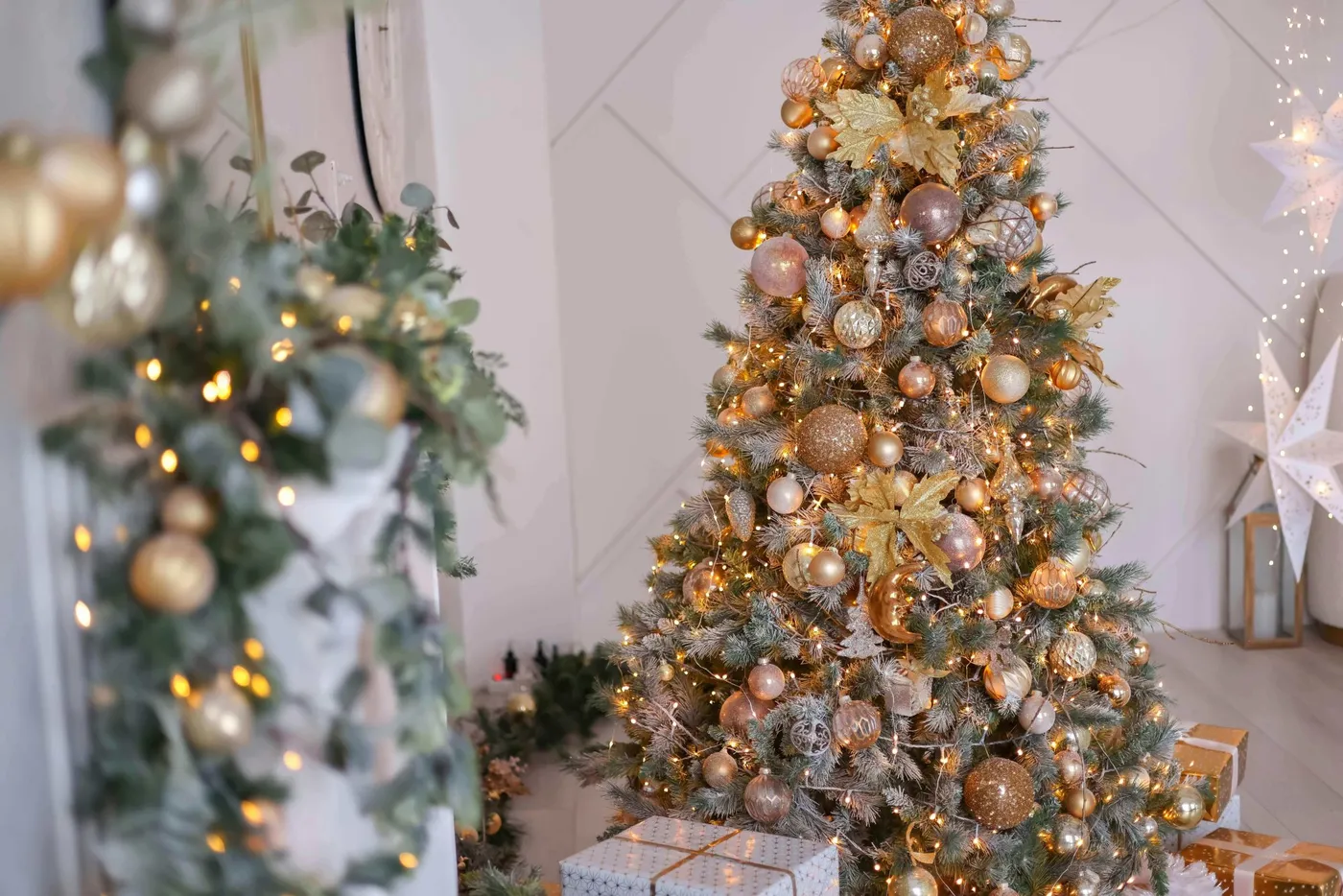
Why it works: the warm wood of the mantel and the white of the flocking create a two-tone base, and the kraft brown sits right in the middle of that range — it belongs to both. The snowy view through the paned windows multiplies the white without adding a single object. And the beige throw draped over the armchair keeps a human note in a room that could otherwise read like a catalog set.
16. Tabletop Flocked Tree With Cinnamon Stick Accents
Tabletop trees are unforgiving because everything is visible up close. Before you buy ornaments, run this check:
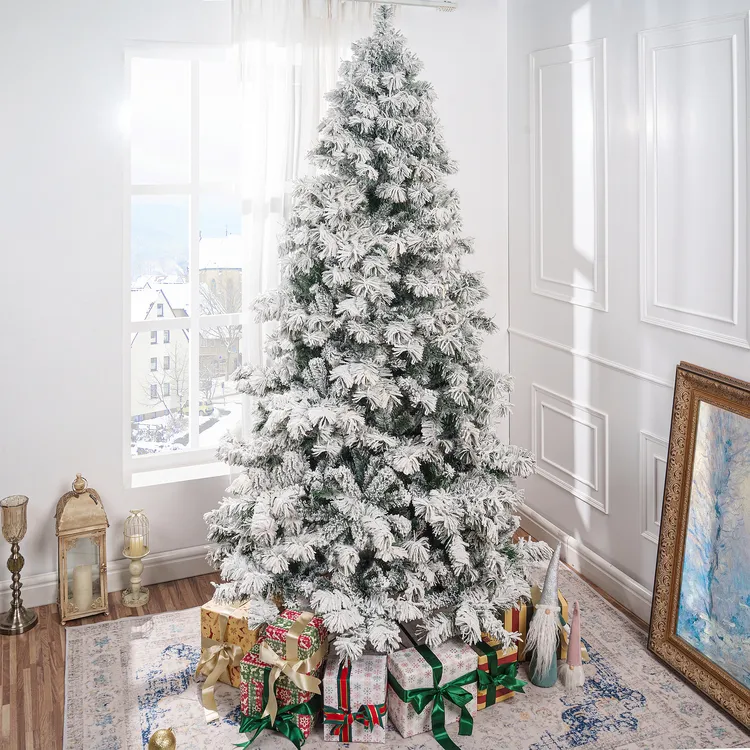
- Measure the table surface — the tree base needs a 12-inch footprint minimum.
- Confirm the table isn’t glass over a dark floor; the reflection doubles visually.
- Check that a small tree can reach an outlet, or plan on batteries.
- Pick one metal and one accent color, and nothing else.
- Leave at least 4 inches of empty table around the base.
Cinnamon sticks are the secret weapon at this scale. Bind three together with a rubber band, cover it with twine, and tuck them near a light so they warm slightly and scent the room. A 3-ounce bag runs about $6 and gives you 20 bundles. Clear icicle drops catch light like glass for a fraction of the cost, and they survive a fall to the floor.
17. Red Plaid Stockings and a Garland-Draped Mantel
The formula for a plaid-and-greenery mantel: 50% green garland, 25% red plaid, 15% white mantel, 10% gold accents. Keep the plaid in one pattern family — a red-and-black watch plaid next to a red-and-white blanket plaid looks busy, so pick one and repeat it in the stockings, the wreath bow, and a single ribbon on the tree. Everything else stays plain.

For less: a dollar-store green garland plus a $6 plaid ribbon woven through looks nearly identical to a $90 pre-decorated version. Stockings are the one place to spend, since cheap felt pills after a single season — a $12–$18 plaid stocking holds up for years. December thrift runs turn up real plaid wool scarves that drape beautifully over a mantel for $3. This is the same palette as Idea #22, just at a larger scale.
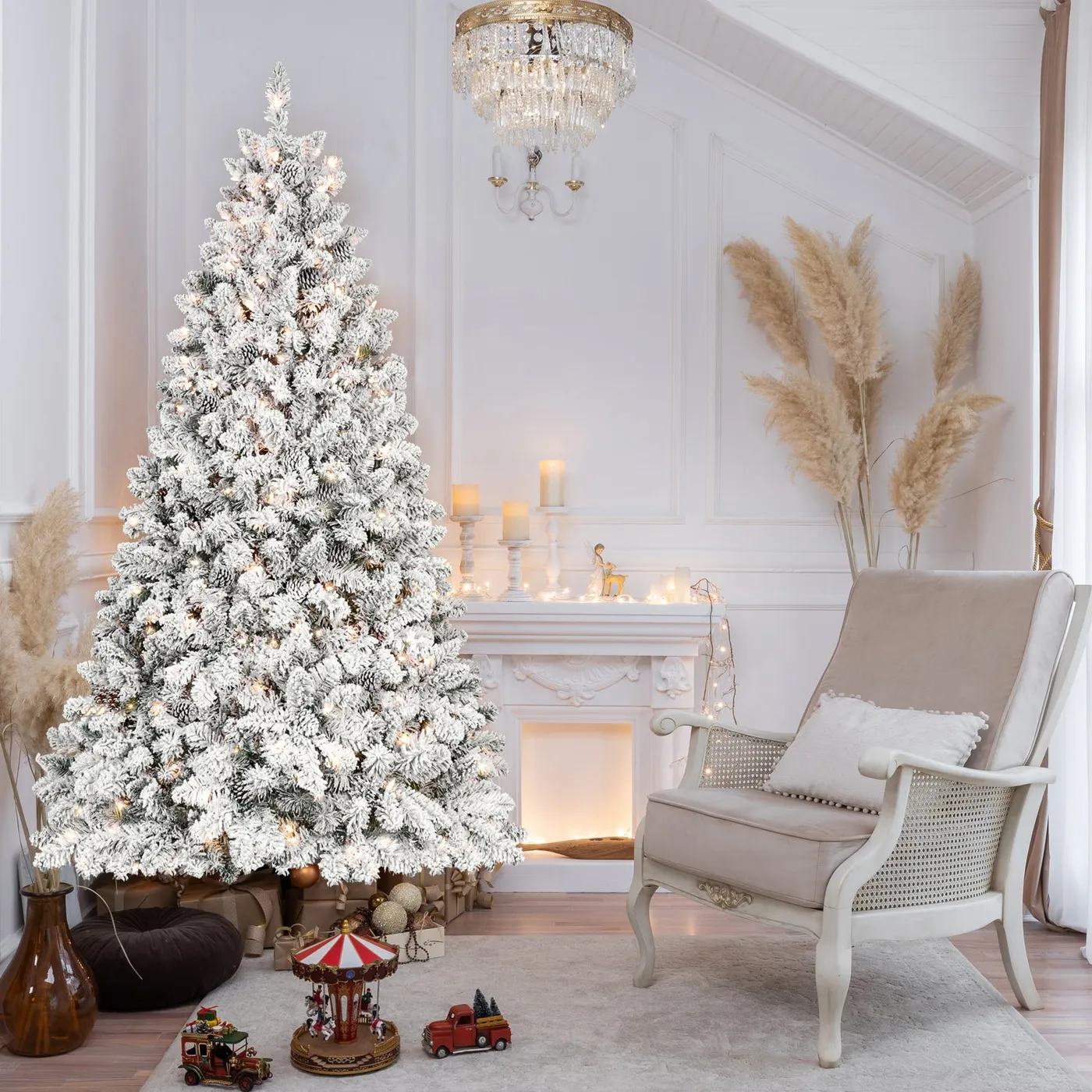
18. Cane-Back Armchair, Crystal Chandelier, and Pampas Grass
What makes this room feel expensive isn’t the tree. It’s the cream cane-back armchair pulled slightly off-axis, the crystal chandelier overhead, and the dried pampas grass in the corner. Three textures — woven cane, cut crystal, soft grass — and none of them is holiday decor. That’s the trick: a flocked tree surrounded entirely by Christmas objects reads like a store display. Mix in one or two things that live there year-round and it reads like a home.

Remove the vintage toy cars and carousel from the base and you lose the whole mood. They’re the only imperfect, human elements in an otherwise polished scene — no ribbons, no matching wrap, just small objects with a story. That single decision keeps an elegant room from tipping into cold.
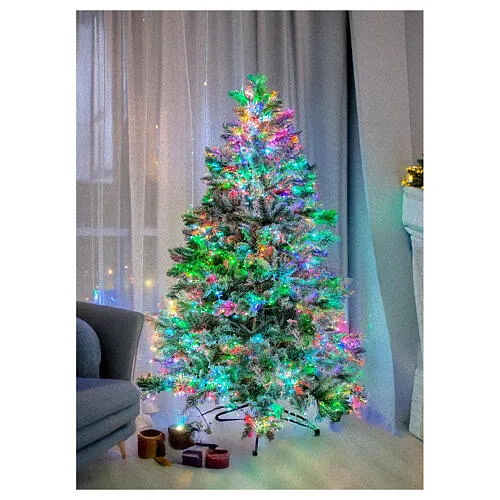
19. Multicolored Fairy Lights Behind Sheer Curtains
Multicolored lights are back, and the reason is generational: people who grew up with them want them again, and flocking makes them read brighter because white branches bounce the color back. Two tips if you go this route — buy one string brand and stick with it, and never mix incandescent and LED, or your greens and blues will visibly clash.
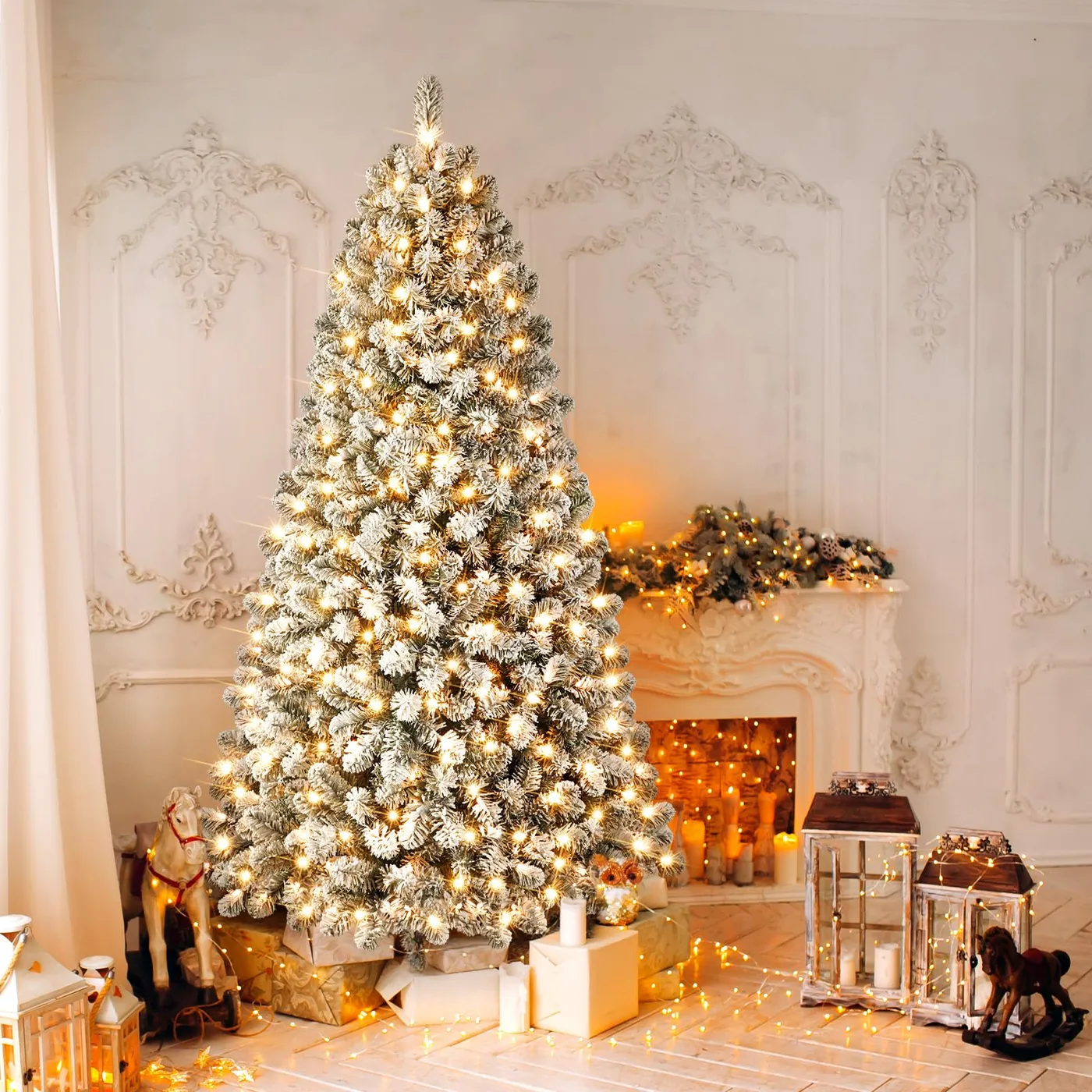
Here’s how to hang them:
- Test every strand on the floor before it goes on.
- Divide your totals by four and work in sections.
- Weave lights across the branch, not around it, for depth.
- Push each bulb slightly under a flocked tip to soften the glare.
- Step back every 20 minutes and squint — even coverage is all that matters.
Roughly 100 lights per foot of tree; about two hours for a 7-footer.
20. Multicolor Tree Lights Plus Globe Lights on the Wall
Two light sources is the whole story here, and it costs less than you’d think:
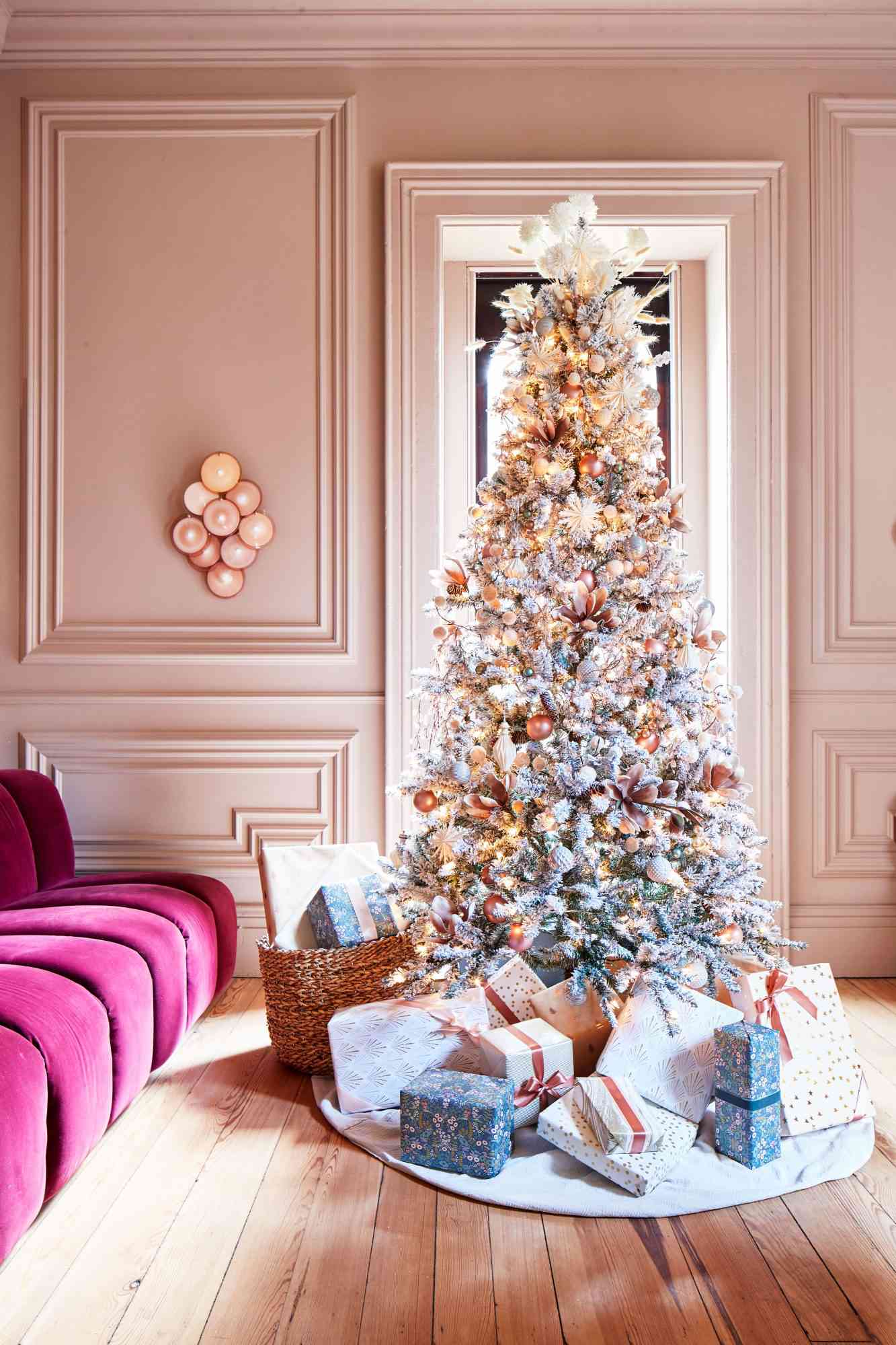
- 7 ft slim flocked tree: $120–$350
- Multicolored string lights (600 count): $25–$60
- Round globe wall lights: $30–$90
- Metallic wrapped gifts and boxes: $30–$70
- Candles and mantel greenery: $30–$80
Total: $235–$650. Budget alternative: use a single plug-in strand for the tree and battery-operated globe lights on the wall — no outlet, no visible cord, about $25 at a discount store.
on two light sources: your circuits. A 600-light strand plus wall globes plus candles can push one breaker if you’re also running a space heater. Check the room before plugging everything into one power strip, and never chain more than three strands end to end from a single outlet.
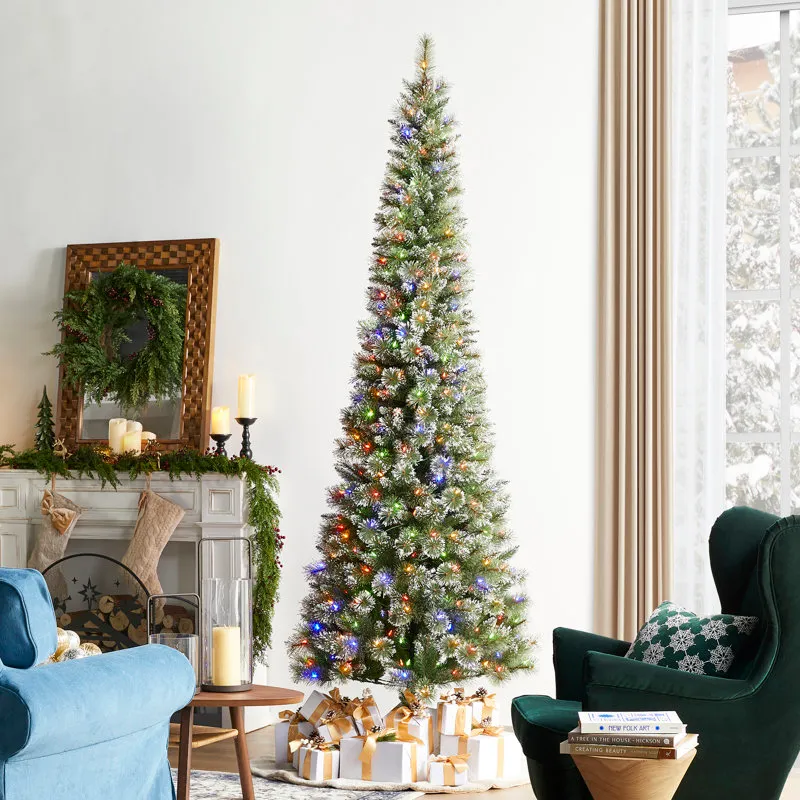
21. Dark Green Velvet Armchair and a Slim Flocked Tree
Balance a slim flocked tree with furniture weight, not more ornaments. The dark green velvet armchair here does that job — a heavy, saturated object on one side keeps the tree from floating. If your seating is light-colored, add weight with a dark throw or a deep-toned pillow instead. Rule of thumb: one dark anchor piece within 8 feet of the tree.
This layout suits rooms from 150 to 300 square feet with 8- to 9-foot ceilings. Below 150 square feet, drop to a 6-foot tree and skip the mantel garland entirely; you’ll get the same festive read without the crowding. Above 300 square feet with vaulted ceilings, a slim tree disappears, so switch to the full-width look in Idea #1 or the towering version in Idea #29.
22. Close-Up: Berries, Pinecones, and Gold Poinsettia
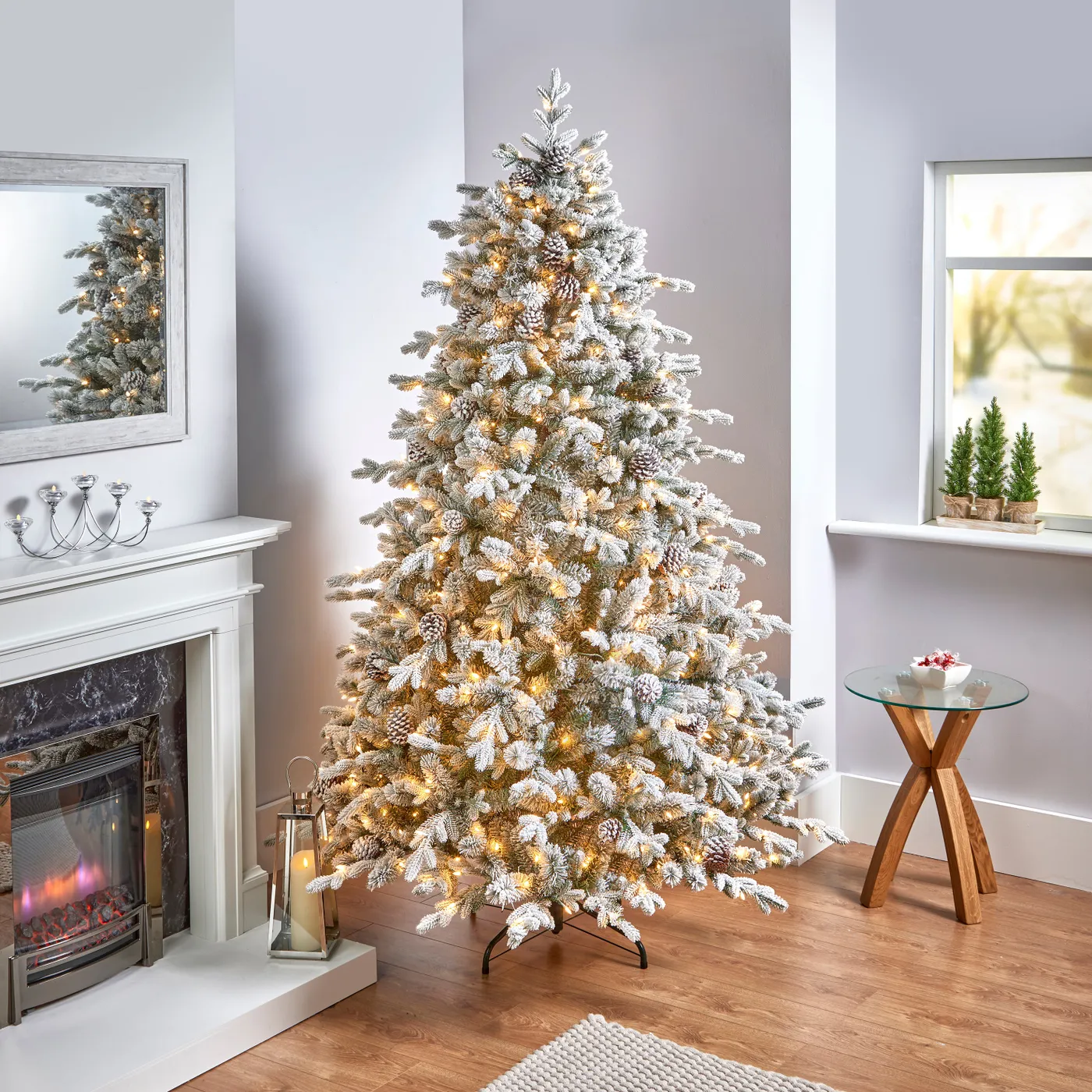
Zoomed in, this composition is about 45% green needle, 25% snow-flocked tip, 20% red berry, and 10% glittering gold poinsettia — with pinecones sitting in a category of their own, doing the job of shadow. Translate that to your own tree: roughly one accent cluster per 6 inches of branch, alternating berry, pinecone, gold, then starting over.
Three things make a close-up branch look this good. Flocked tips catch light from underneath, so the glow appears to come from within the tree. Natural brown breaks up what would otherwise be a flat two-color red-and-green pattern. And the gold is cutout rather than solid, so it reflects instead of blocking. If you add only one thing to a plain tree, add flocked tip texture — it changes the light more than any ornament can.
23. Burgundy Ribbons on Kraft Paper Gifts
Kraft paper is lovely and unforgiving. It creases permanently, it tears if you rush, and it shows grease from hands — so keep spare sheets and wrap with clean, dry hands. Deep burgundy ribbon can transfer dye to paper in damp weather, so don’t stack wrapped gifts against a wall for three weeks. And a white tree skirt under brown paper will show every bit of flocking shed, so shake the tree gently before you place gifts.
Cost to recreate: flocked tree $200–$600, warm 700-count lights $30–$70, white circular skirt $20–$50, kraft paper and ribbon $25–$45, gift boxes $20–$40. Total: $295–$805. For less, use a $5 kraft roll, turn shipping boxes inside out, and buy ribbon by the 50-yard spool instead of small rolls. This is the deeper-ribbon cousin of Idea #9 — same wrapping, different mood.
24. Fluffing Day: Gloves On, Branches Out
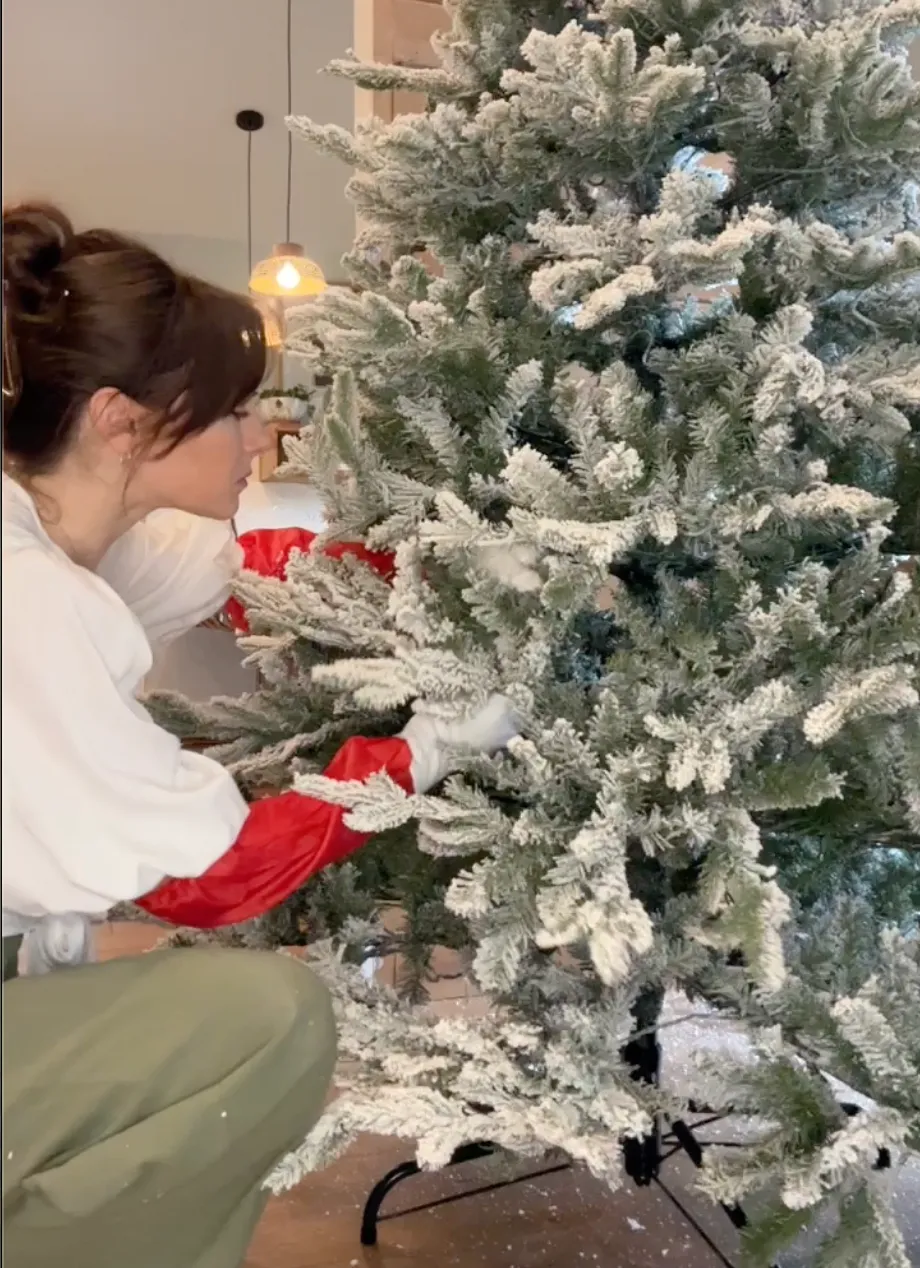
Fluffing is the difference between a $150 tree and a $600 tree, and it takes an hour. Wear long sleeves and gloves — flocking dries out hands badly.
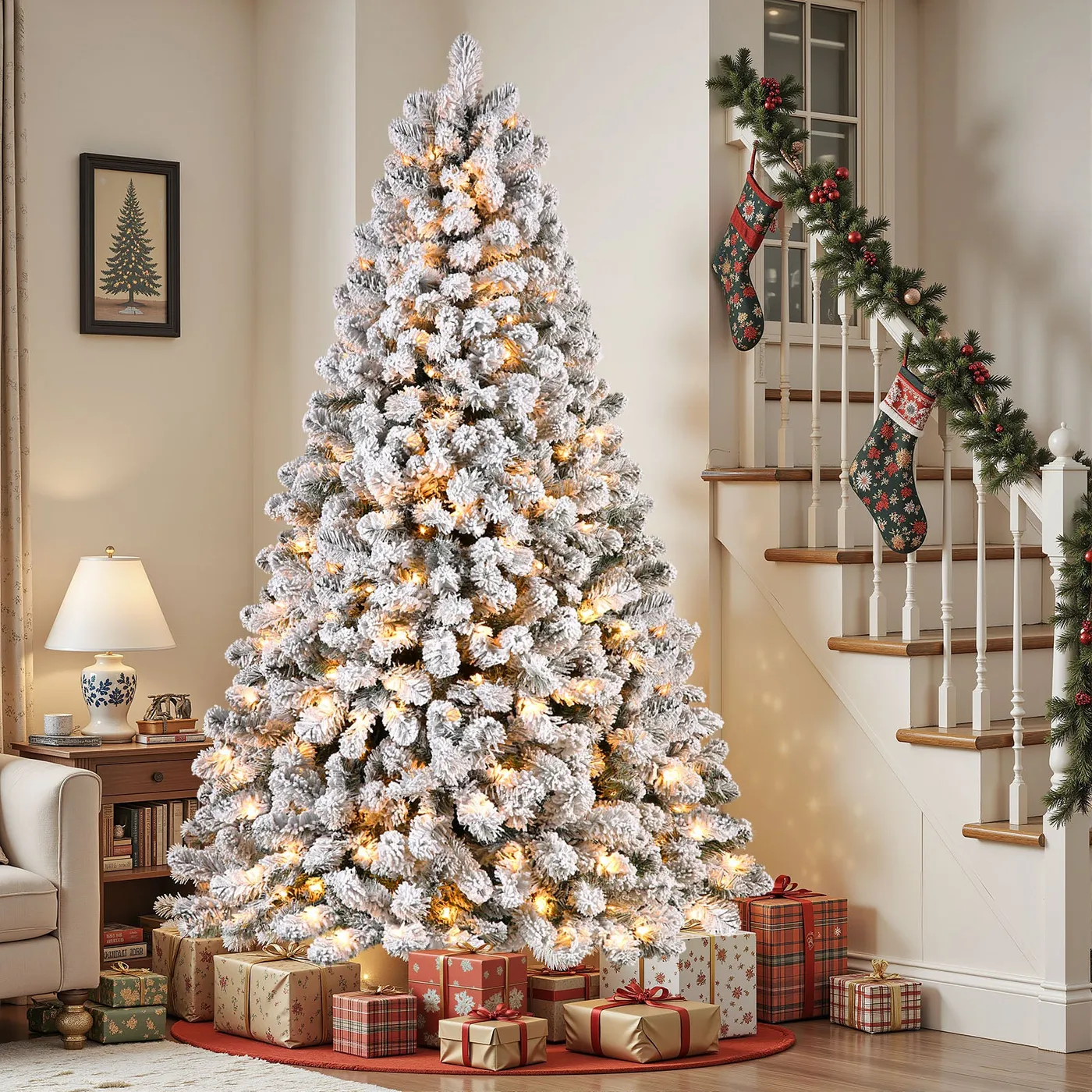
- Assemble the bottom third first and work upward, section by section.
- Separate every branch tip so no two wires sit parallel.
- Bend outer tips slightly upward; fan inner branches outward.
- Step back two full tree-lengths after each section and check the silhouette.
- Let it stand four hours so the flocking settles before you decorate.
Do a second pass the next morning — fresh eyes catch flat spots you missed.
Never decorate a tree on fluffing day. Branches still moving under ornaments will drop them, and the flocking hasn’t finished shedding. Keep the metal stand off hardwood by slipping a felt pad under each foot, which also lets you rotate the tree without scraping the floor.
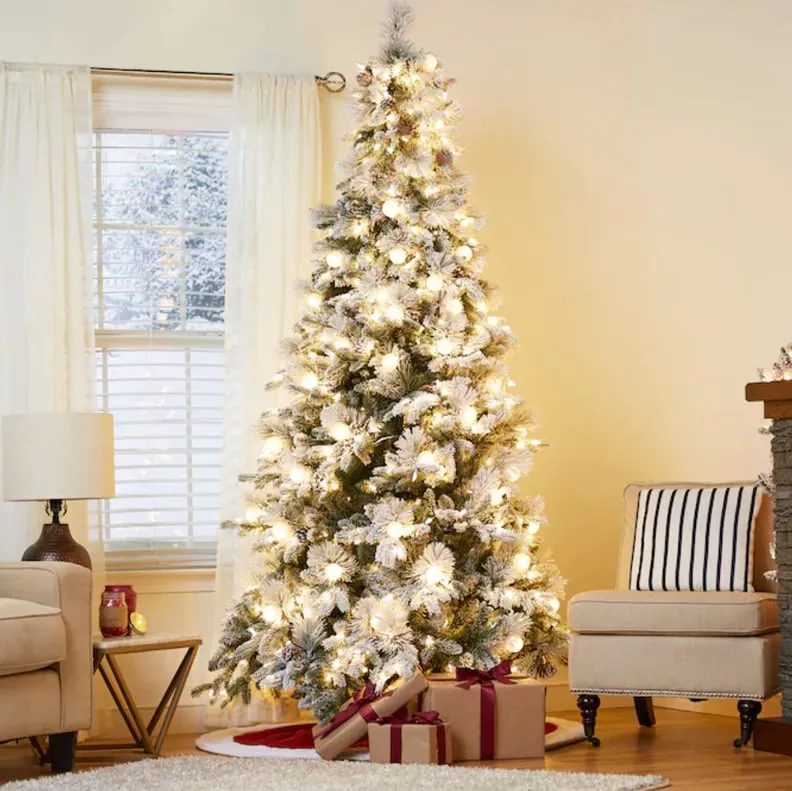
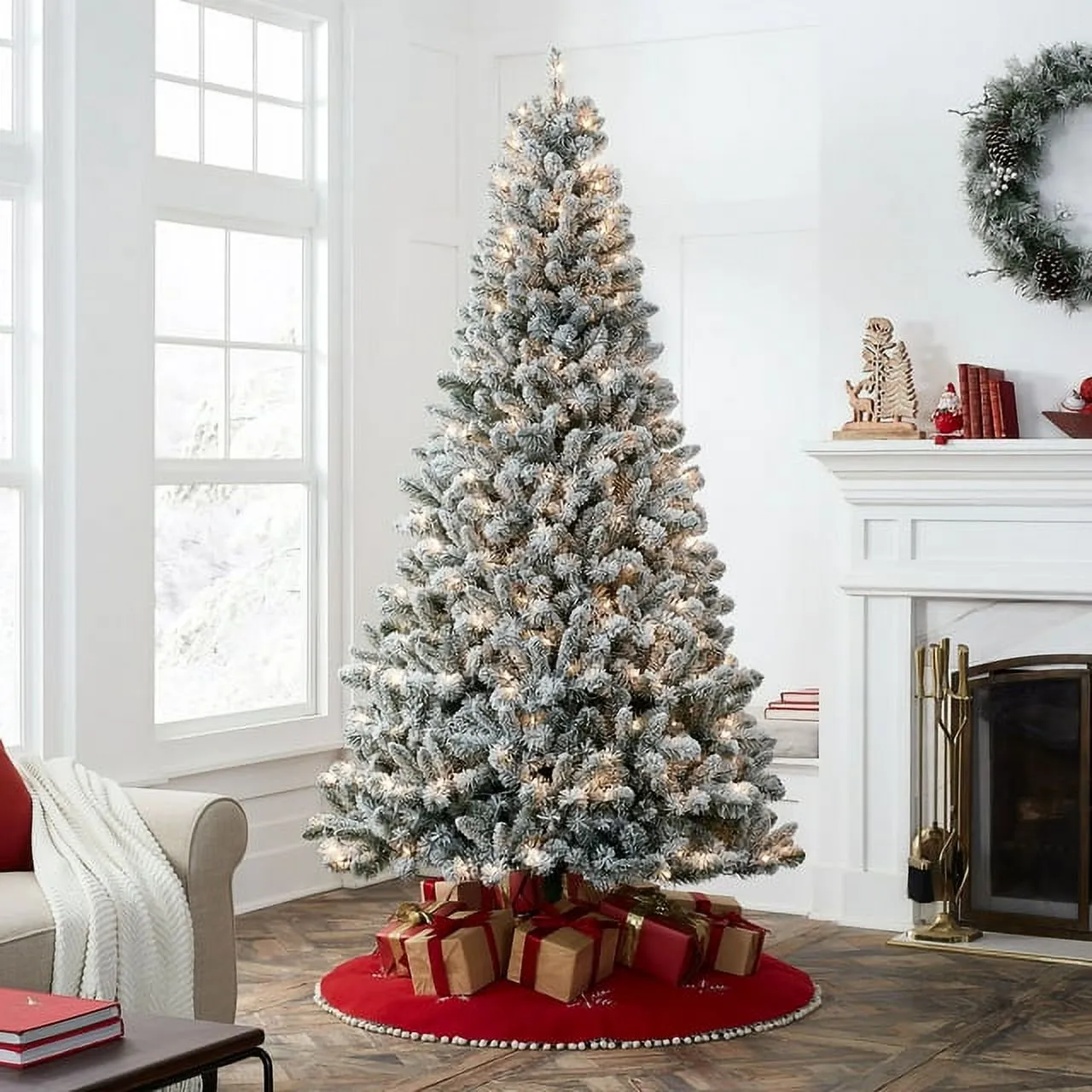
25. Light Flocking, Pinecones, and Gold Wrapping Paper
Light flocking is the budget-friendly direction, and honestly the easier one to live with. A lightly frosted 7-foot tree runs $80–$180 versus $250 or more for heavy flocking. Gold patterned wrapping paper is around $5 a roll at Target or Walmart, and a pack of 30 natural pinecones costs $10–$15 online. Total for the look: under $250 using ornaments you probably already own.
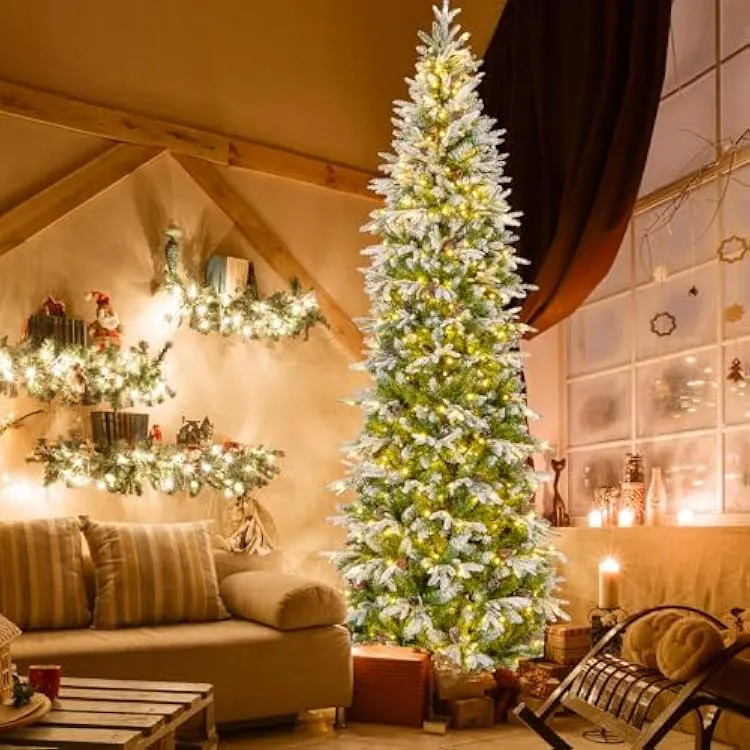
light flocking is far more forgiving than heavy snow. It doesn’t shed as much, it doesn’t hide your lights, and it photographs well in daylight rather than only at night. The tradeoff is impact — from across the room it reads as a green tree with frost, not a snow tree. If you want the full winter-wonderland effect, you need the heavy version, and you need to accept the mess.
26. Pampas Grass Plumes Tucked Into Flocked Branches
Pampas plumes add about 8 inches of width on each side, so this one needs breathing room. It works best with a 7- to 9-foot ceiling in a room of 200 square feet or more, and it wants a slim silhouette underneath the fluff — a full-width tree plus pampas looks bulky fast. Use three to five plumes total at uneven heights, and trim the stems at an angle so they slide between branches cleanly.
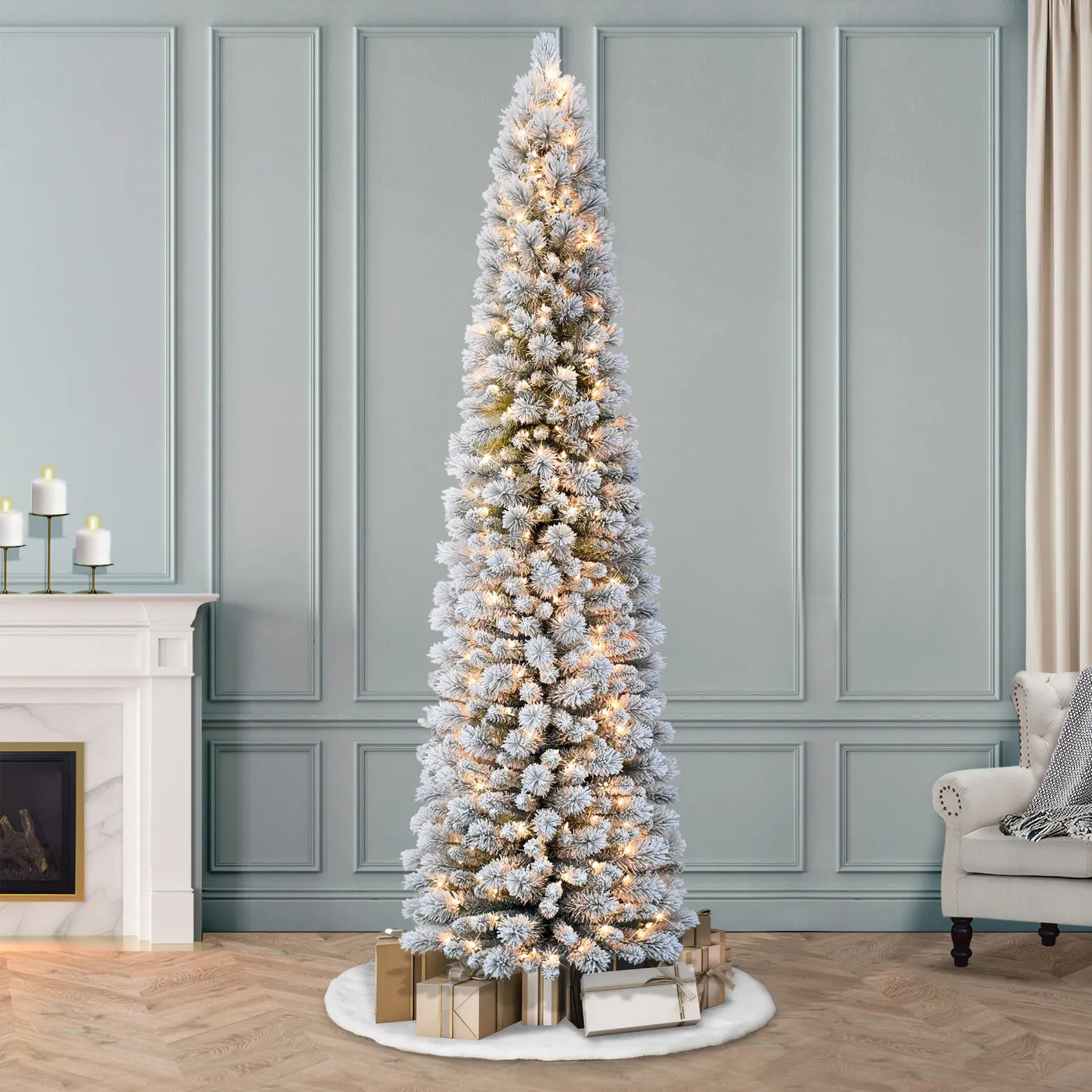
65% frosted white, 20% sage-green pampas, 10% kraft brown from the wrapping, 5% navy from the ribbon. Swap navy for black or charcoal and the scheme gets sharper and more modern. Swap the kraft paper for white and it turns bridal. The frosted white base stays fixed either way — that’s your constant.
27. Wooden Star Ornaments on a Gray Mantel
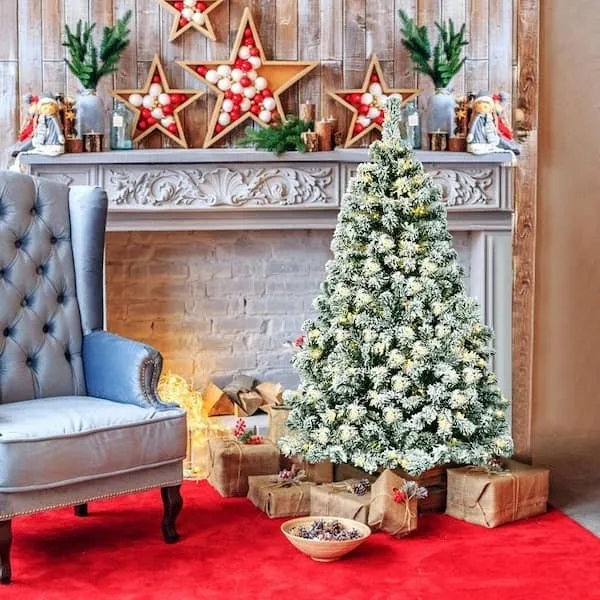
A red rug under a flocked tree is a bold move, and the tufted blue armchair beside it is bolder. Before you commit:
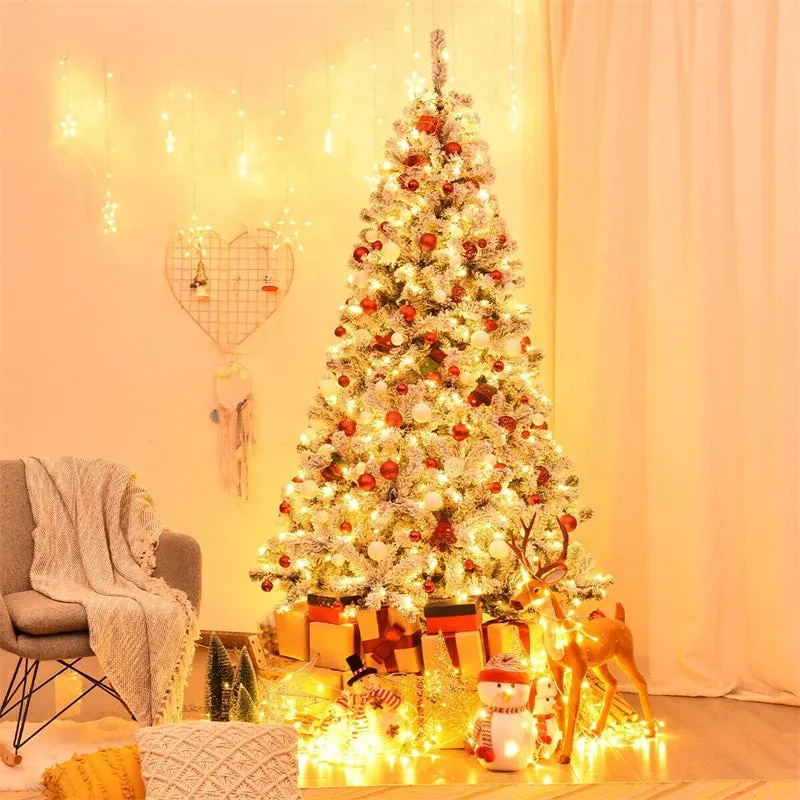
- Check whether the rug’s red clashes with your ornaments — bring a swatch shopping.
- Measure the tree footprint plus 18 inches on all sides.
- Confirm the mantel can take wooden stars without pulling out of old plaster.
- Make sure the rug is machine-washable if you have pets or kids.
- Look at the room at night with only the tree lights on.
The one element that makes this room work is the collection of wooden star ornaments on the gray mantel, filled with red and white balls. They tie the tree’s color story to the wall without a garland, and they’re the kind of thing you can’t buy as a matching set — which is exactly why the room doesn’t look like a showroom. Remove them and you have a nice tree, a nice chair, and nothing that says anybody lives there.
28. Snowmen and a Plush Reindeer at the Tree Base
Cheerful and unpretentious, and cheap to copy:
- 7 ft flocked tree: $150–$400
- Red and white round ornaments (60 count): $25–$50
- Warm white lights (500 count): $20–$40
- Plush reindeer and snowman figurines: $15–$45
- Wrapping paper and ribbon: $20–$40
Total: $230–$575. Budget alternative: hit a thrift store in the first week of January and you’ll find figurines for $2–$5 each, often the same ones still on shelves in December. Skip the light-up versions and save yourself the cord headache.
nostalgia styling is the biggest driver in holiday decor right now, and interest in vintage snowmen and ceramic reindeer keeps climbing. Flocked trees are the natural partner because white branches make bright red and white decorations pop from a distance — which is exactly what people are photographing.
29. Towering Flocked Tree With Berries and Pinecones
A tree this tall only works because the decoration stays sparse. Berries and pinecones at even intervals, no tinsel, no ribbon, no competing shapes. The mantel repeats the same two elements at a smaller scale, which is what makes the room feel composed rather than crowded. Add a third accent and the whole thing collapses into noise.
To scale this up without it getting muddy:
- Anchor the tree with a stand rated above the tree’s height.
- Light first, then add pinecones from the top down.
- Add berry sprays in the gaps, not on top of the pinecones.
- Keep gifts to two wrapping styles and place them off-center.
- Stop. Resist adding one more thing.
Plan about three hours, and get a second person for anything over 8 feet.
30. A Lit Wreath Matched to the Tree and Mantel
Match your wreath to your tree, not to your front door. If the tree is lightly frosted with pinecones, the mantel wreath should carry the same two elements and the same light count. A wreath with different flocking density or a different bulb temperature is the fastest way to make a carefully styled room look assembled from separate shopping trips.

lightly frosted trees photograph beautifully in daylight and look almost bare at night once the lights are the only illumination. If you mostly see your living room between 6 and 10 p.m., go one step heavier on flocking than the daytime photos suggest. And buy your lights in one batch from one brand — a warm strand next to a cool strand on the same tree reads gray, not warm.
From Snow-Dusted Branches to a Room That Feels Like Home
Whether you go heavy on the flocking or keep it light and pinecone-simple, the trick is the same: decide the palette first, light the tree second, and decorate last. Start with the idea that matches the room you already have — not the one that matches your Pinterest board.
📌 Save this to Pinterest for later — you’ll want to revisit these ideas when the boxes come down from the attic.