Still scrolling through front porch Christmas ideas and saving photos you’re not sure you can actually pull off? Same. Most of those pins skip the part about outlets, ladders, and the fact that hot glue gives up the first time it freezes.
We spent serious time browsing Target, Walmart, HomeGoods, and Lowe’s, filtered out the filler, and kept 31 ideas that hold up in real cold and real budgets — from about $15 for a fence line of tiny wreaths to $1,000+ for a fully lit two-story roofline. Inside you’ll find traditional red-and-green, rustic farmhouse, modern neutral, and full LED spectacle, with budget and splurge versions compared side by side on the big pieces.
2026’s shift is worth knowing: people are trading inflatables for sculptural topiary, molded LED figures, and natural materials that survive a thaw. And stay until the end — we break down the most common mistakes that can ruin these looks.
Some links here are affiliate links, which means we may earn a small commission at no cost to you.
📌 Save this to Pinterest for later — you’ll want to revisit these ideas.
1. Red and Green Roofline Lights on a Snowy Two-Story Colonial
Classic holiday color runs on a simple formula: about 60% warm white (the garland and potted tree lights), 30% saturated red and green tracing the roofline and porch eaves, and 10% white — here, the snow itself. Swap the red and green for all warm white and you get a quieter, more modern house. Swap in multicolor and the whole thing turns playful. The proportions matter more than the colors you pick.
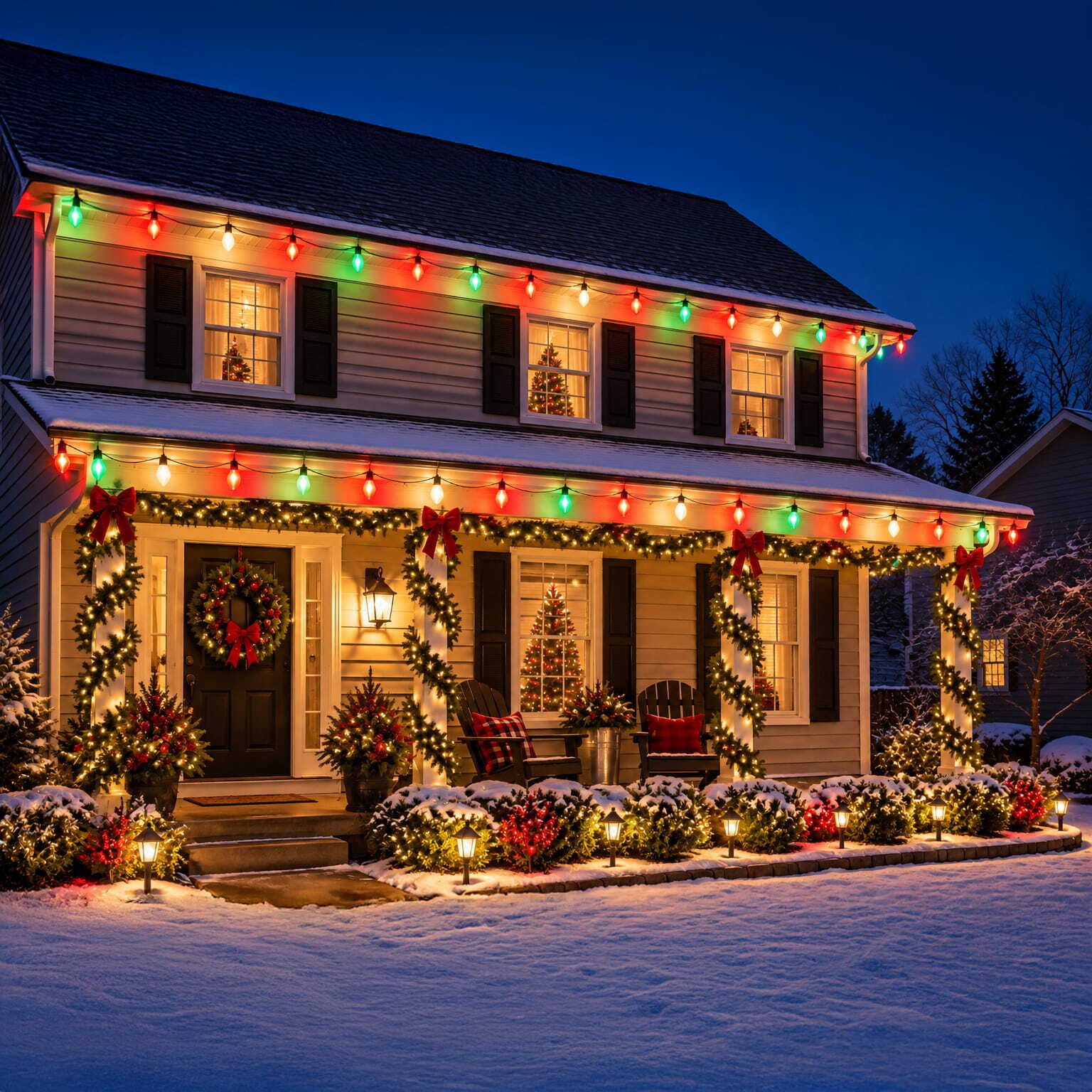
Run roofline strands in one direction from a single outlet so shadows fall the same way, and never string more than three 100-light strands end to end — that’s when the last one starts to dim. On porch eaves, clip the lights along the back edge of the fascia rather than the front. You’ll still see the glow from the street, but the bulbs won’t be silhouetted against your siding.
2. String Lights, an Egg Chair, and a Hammered Gold Coffee Table
Three things are doing the heavy lifting here. Contrast in texture: a chunky wooden sofa frame against a woven egg chair against the smooth hammered metal of the gold coffee table. Then repetition — round bulbs overhead echo the round table, and the hanging baskets echo the potted plants below. Finally, the palette stays narrow: cream, light wood, gold, greenery. Nothing shouts, which is exactly why it looks expensive.
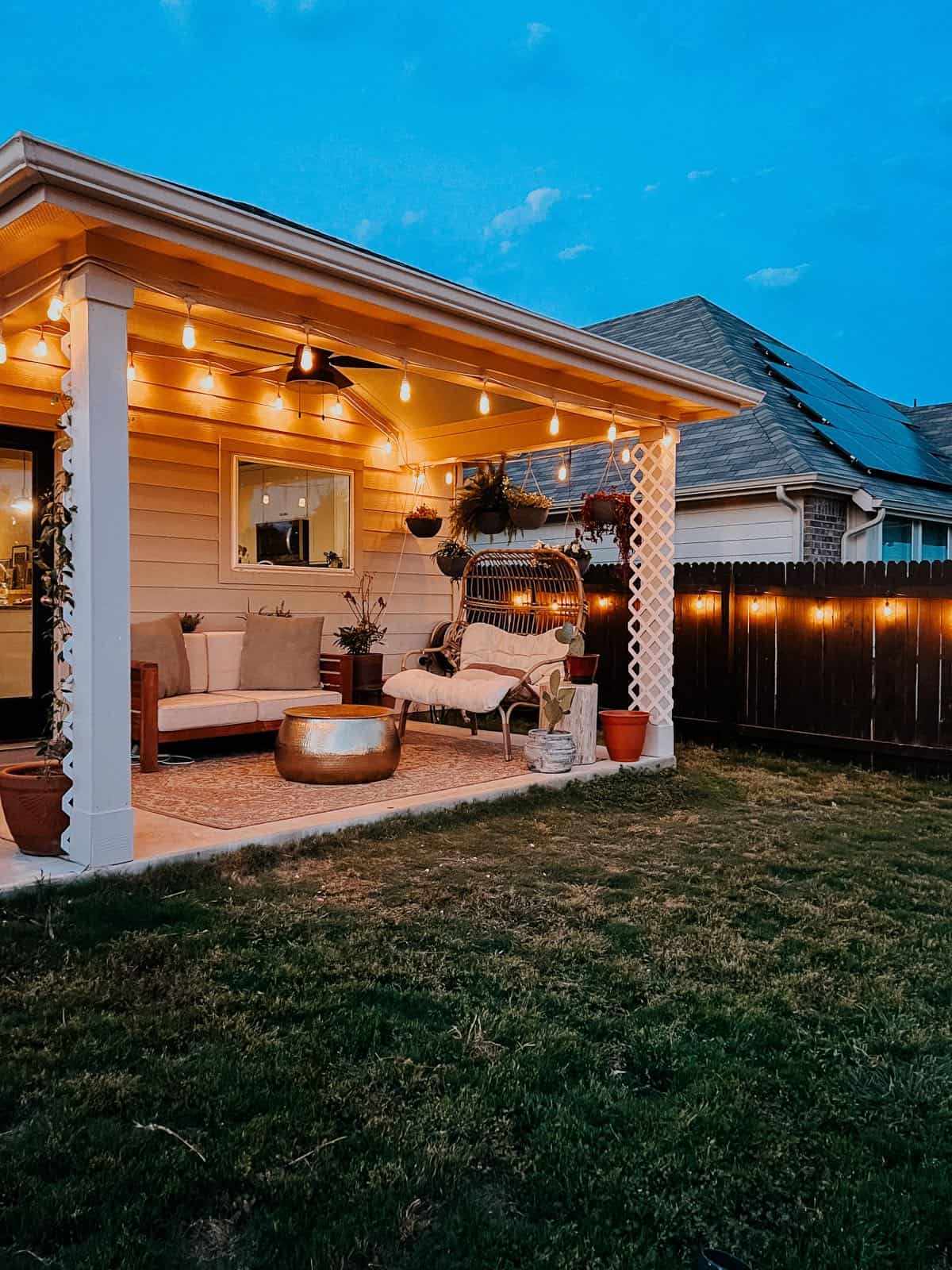
The structure matters more than the price tag. A wooden frame sofa off Facebook Marketplace ($150–$250) with IKEA or Target cushion covers ($40–$70) reads nearly identical to a set that costs four times as much. Walmart’s woven egg chair runs around $200 versus $600+ for a designer version, and hammered gold side tables turn up at HomeGoods for $60. Buy the string lights new — cheap strands start flickering by December 20th.
3. Light-Wrapped Porch Columns and a Glowing Warm White Roofline
Wrapping columns: start at the bottom, not the top, and work upward in a tight spiral with roughly 3 inches between wraps. Six inches reads sparse and you’ll see the siding through it. Use one continuous strand per column so there’s no dark gap at the splice, and tuck the plug end inside the porch where it meets the outlet. A 9-foot column usually eats two 100-light strands.
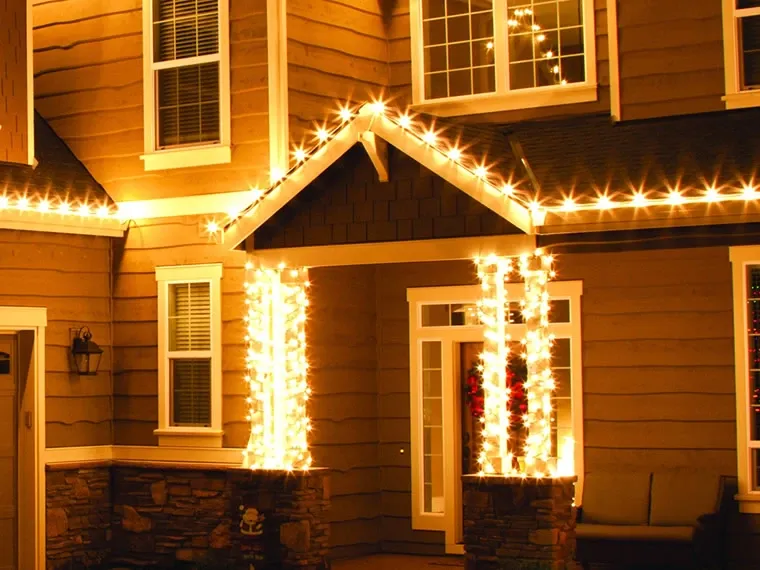
Wrapped columns look incredible and behave terribly in wind. Anything over 15 mph will loosen your spiral, and one hard gust can unspool six feet of lights. Secure with clear zip ties every 18 inches — not tape, which fails the moment it gets cold. Count your outlets now, too: most covered porches have exactly one, and between columns, roofline, and the wreath you may need a 3-outlet stake on a 12-gauge cord.
4. A Wooden Gazebo Glowing With Round-Bulb String Lights
Gazebo string lights start working at about a 10×10 footprint; smaller than that and the bulbs crowd the headroom. Keep the light line 8 feet off the deck so tall guests aren’t ducking, and leave no more than 12 feet between attachment points or the strands sag into a hazard. A 10×12 gazebo takes roughly 60–75 feet of lights including the diagonal runs across the frame. On a smaller porch, Idea #2 shows a tighter overhead layout that does the same job.
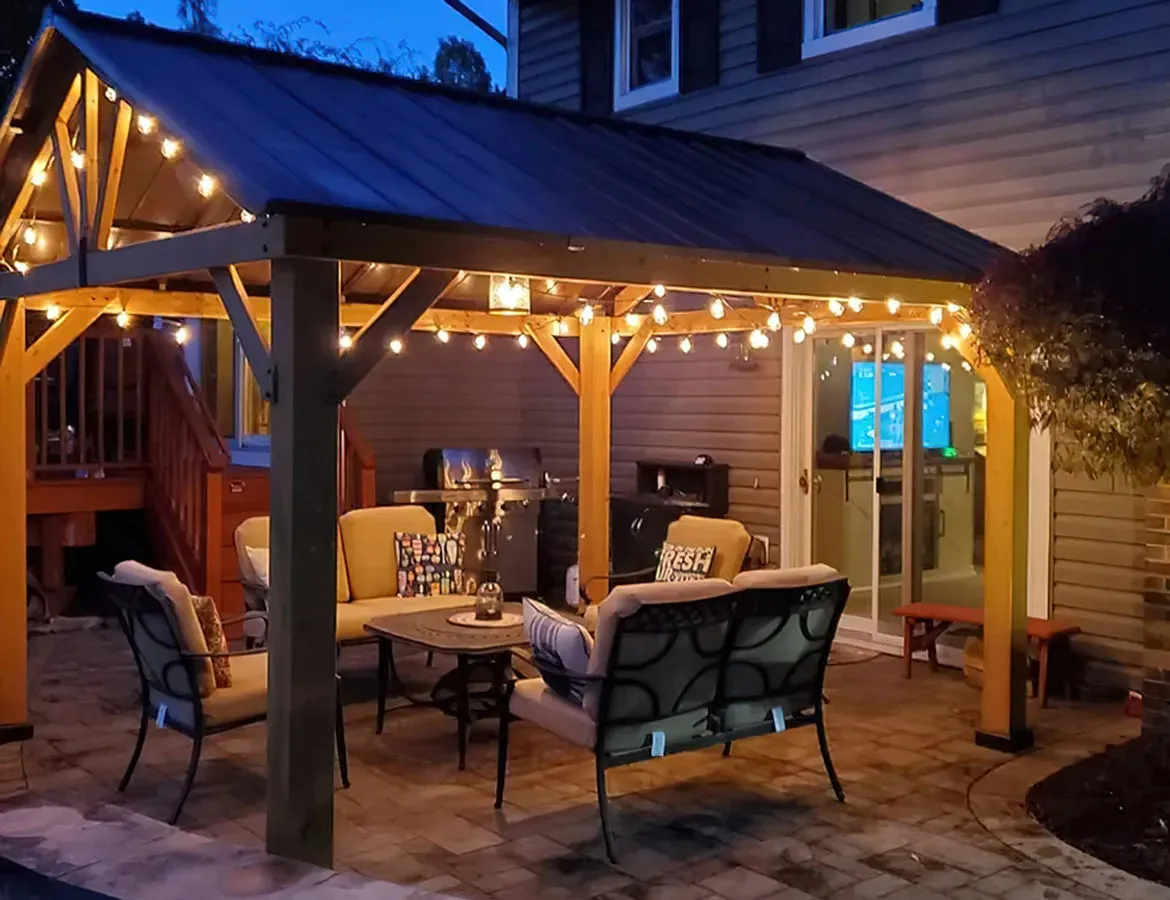
Round-bulb commercial strands are the closest thing to maintenance-free outdoor lighting, but the sockets still collect water. Every spring, unscrew each bulb, tip the socket upside down to drain it, and screw it back — five minutes per strand, once a year. Expect two to three seasons per strand under a roof, less if it’s fully exposed. Bulbs cost about $1 each, so buy a dozen spares now instead of hunting in December.
5. Two Lit Trees in Pale Wood Planter Boxes Frame a Black Door
The planter boxes. Two pre-lit trees flanking a door is the oldest trick in the book, but setting them in pale natural-wood boxes at chest height changes the geometry entirely — your eye reads a continuous frame around the black doors instead of two objects parked on the porch. Remove the boxes and the same trees look small and apologetic. Fill the boxes with sand or pea gravel so a winter gust can’t tip a six-foot tree into your glass door.
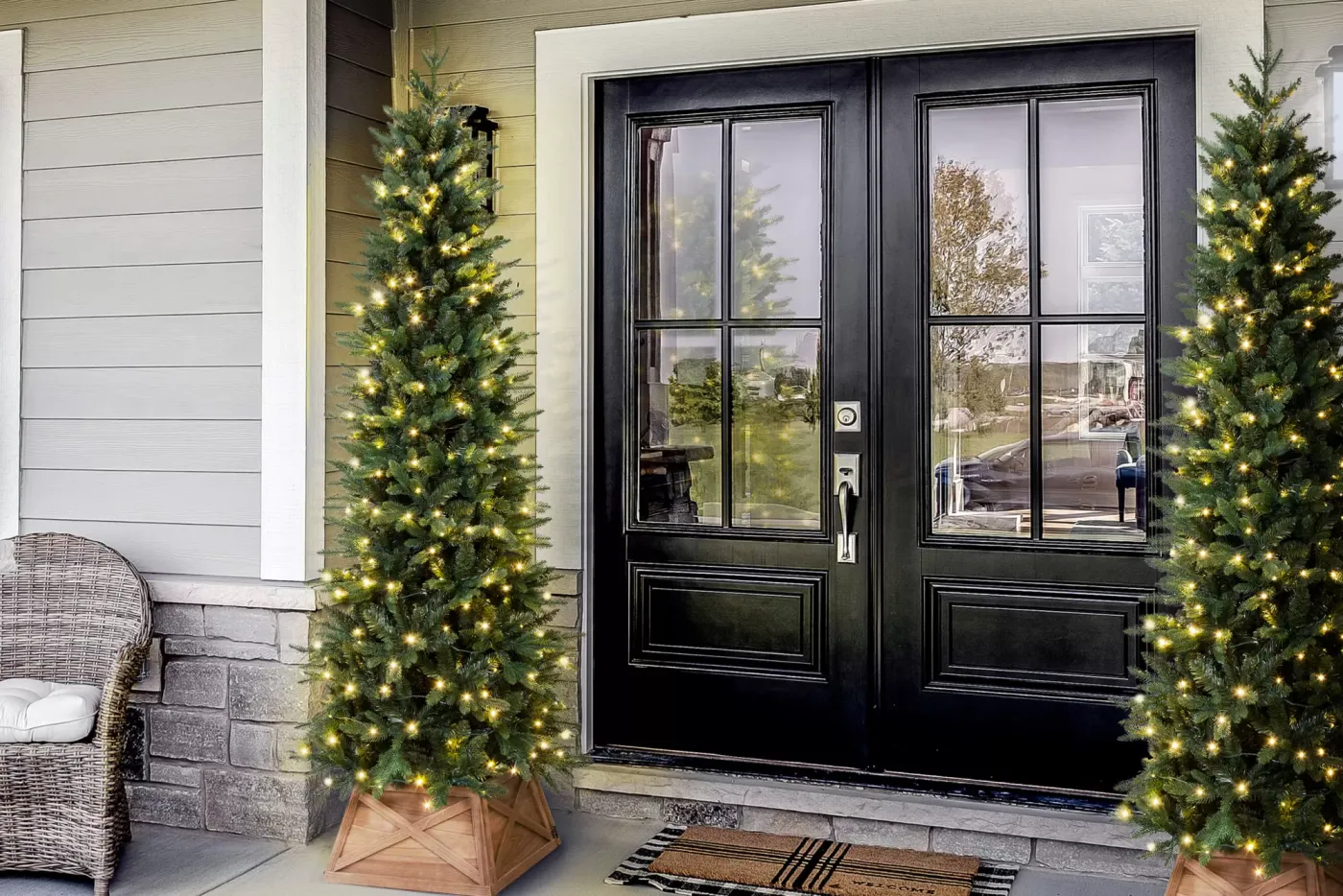
- Two 5–6 ft pre-lit trees: $120–$400
- Light wood planter boxes (pair): $80–$260
- Wicker chair with white cushion: $60–$300
- Striped doormat: $20–$60
- Sand or pea gravel fill: $15–$30
- Total: $295–$1,050
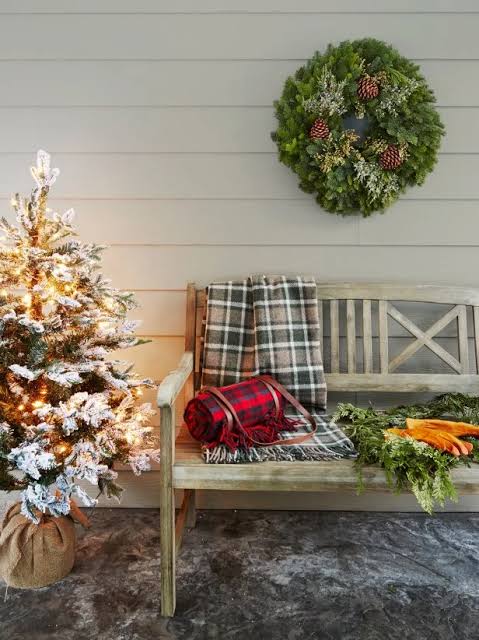
6. Pine Garland, Red Berries, and a Plaid Throw Behind White Columns
The red-and-green porch never really left, but the 2026 version is warmer and less plastic than the 2010s look — real-feeling pine with berries instead of glitter, plaid instead of sequins, and lights that read amber rather than bright white. Pinterest interest in “nostalgic Christmas porch” keeps climbing while glitter-heavy decor flattens out. It’s the safest style on this list and the least likely to look dated next December.
- Measure your header width and add 20% — garland always looks shorter once it’s installed.
- Hang the garland first on cup hooks under the soffit, then fluff every branch outward.
- Weave in berries and picks after hanging, not before, so they sit where you can see them.
- Tuck the lights in last, facing the wall, so you get glow instead of glare.
One to two hours for a single-story porch, and roughly $90–$250 depending on whether you go real or faux.
7. Whitewashed Wooden Trees, Buffalo Check, and a Galvanized Bucket
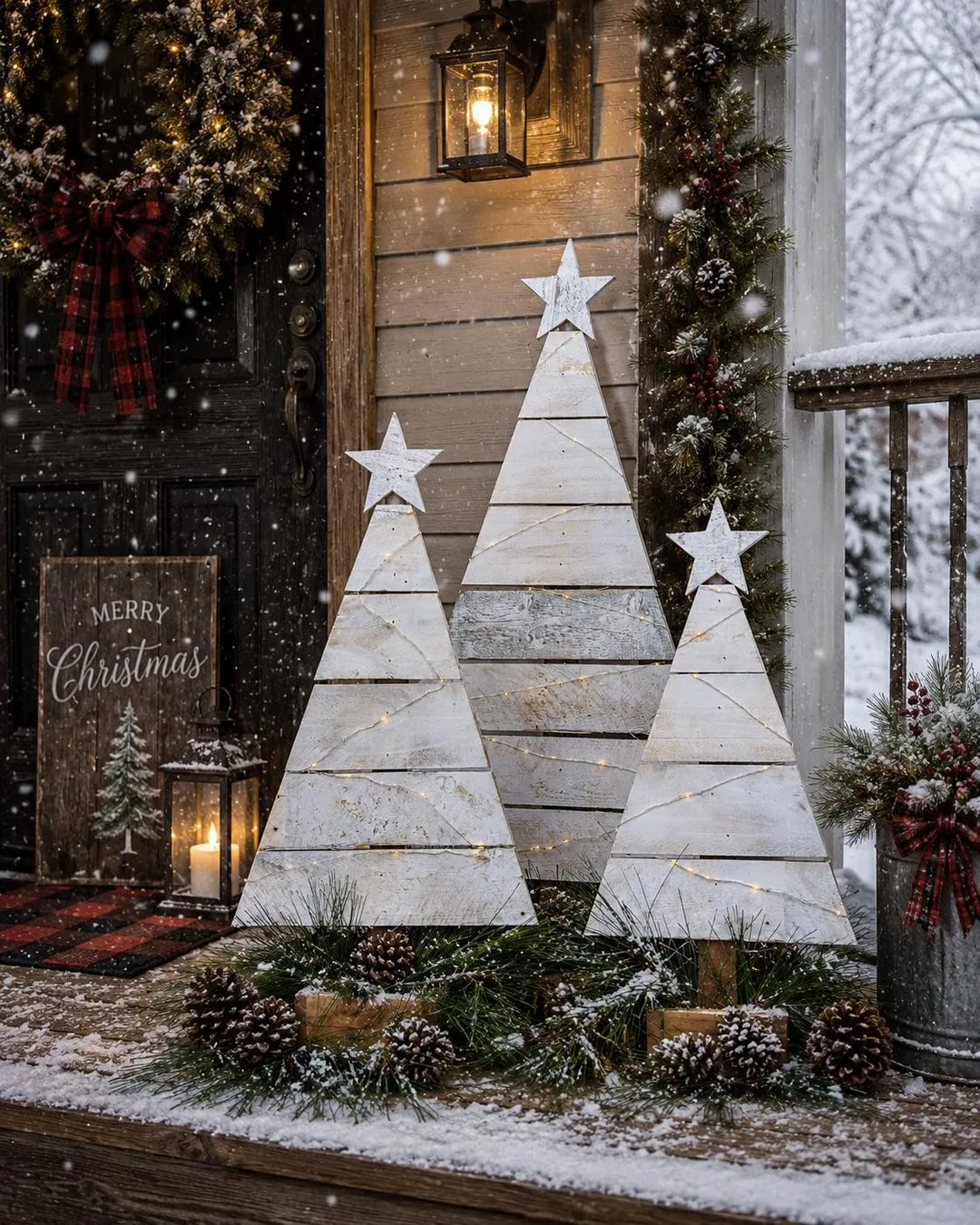
70% white and pale wood, 20% pine green, 10% red-and-black buffalo check. That’s the whole formula, and it’s why this snowy porch reads calm even though there’s a lot going on — the check is the only pattern, and it appears exactly three times: the mat, the wreath bow, and the bucket band. Repeat an accent three times in a small space and it looks intentional. Four times and it looks like a theme party.
The wooden trees are the DIY win. Three sizes cut from 1×4 and 1×6 pine, painted with diluted white craft paint, costs about $25 in lumber and an afternoon — versus $60–$120 each at a boutique. Snow-dusted pinecones: buy plain ones at the dollar store and dip the tips in white paint. The galvanized bucket is a farm store find under $15. Compare with Idea #5, which takes the same route with light instead of paint.
8. A Slender Frosted Tree in a Dark Fluted Urn
A tall urn does something a bucket never will: it gives the tree a base with weight, so a four-foot tree reads as architecture rather than decoration. The fluted shape and dark gray finish also repeat the vertical lines of the white shiplap and columns behind it, which is why the whole entry feels composed. Note the restraint — one tree, red and green berries, pinecones, nothing else. On a narrow porch, that restraint is what keeps the door usable.
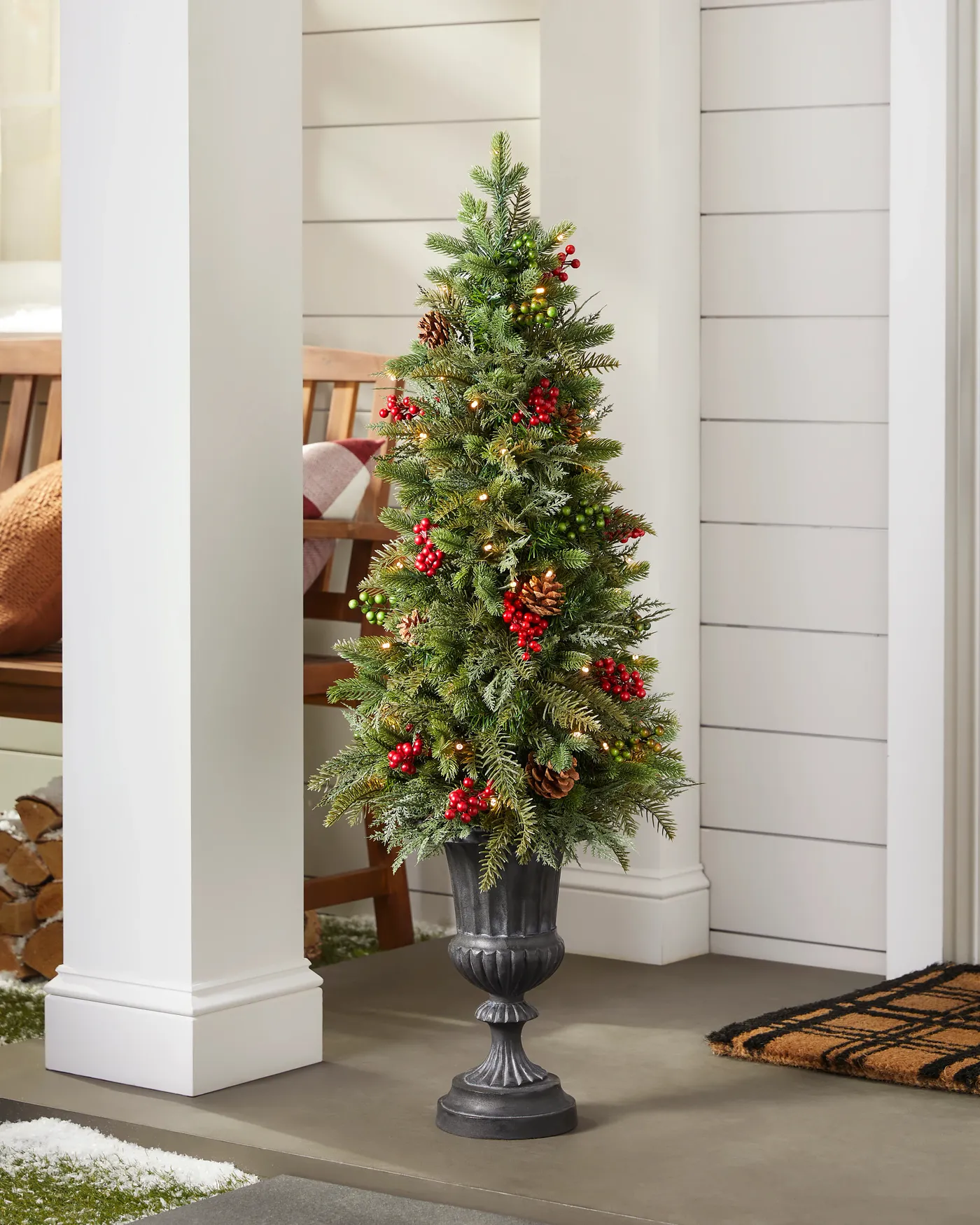
Urn plus faux tree is a two-piece problem. Fill the urn two-thirds with sand or pea gravel for ballast, set the tree in, then top with preserved moss so you never see the stem. Wrap the trunk in a scrap of burlap if it shows through the pot’s mouth, and check the height against your door hardware — a tree taller than the handle rubs shoulders with everyone who walks in.
9. One Small Fir in a Black Pot Against a Rustic Barn Door
It’s the material conversation, not the tree. Warm brown barn wood with visible knots, matte black strap hinges, and a single evergreen — three textures, three materials, zero ornaments. Take away the black hardware and the scene goes flat; those hinges are what make the wood look warm instead of muddy. If you’re copying this on a plain door, add black hardware first. The tree is the last thing you need.
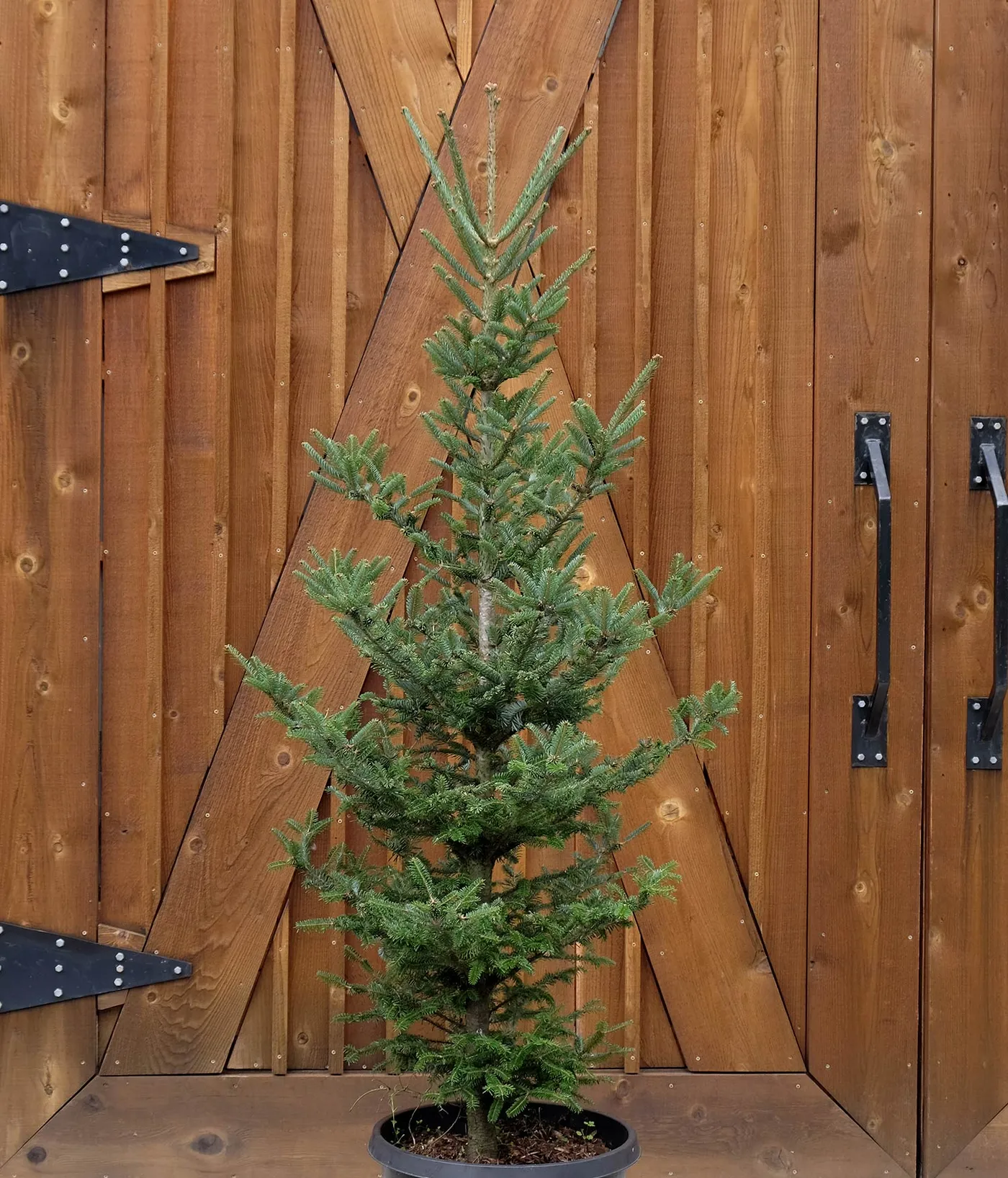
A live fir in a pot is a commitment, not a decoration. Inside a heated house it drops needles within two weeks; outdoors on a covered porch it can hold four to six weeks if you water it every other day, because that pot dries out fast in cold, dry air. If your porch is fully exposed, skip the live tree and use a faux one with real pinecones tucked in. Nobody can tell from the sidewalk.
10. A Square Wreath and Flocked Mini Tree on a Stone-Clad Entry
Square wreaths are worth the extra money on a modern door — the right angles line up with paneling and stone coursing in a way a circle just can’t. Hang it so the top edge sits level with the top rail of the door’s upper panel, not the door top. That’s usually 12 to 14 inches down from the header. Measure from the door, not the frame; frame-based hanging is why so many wreaths look like they’re sliding off.
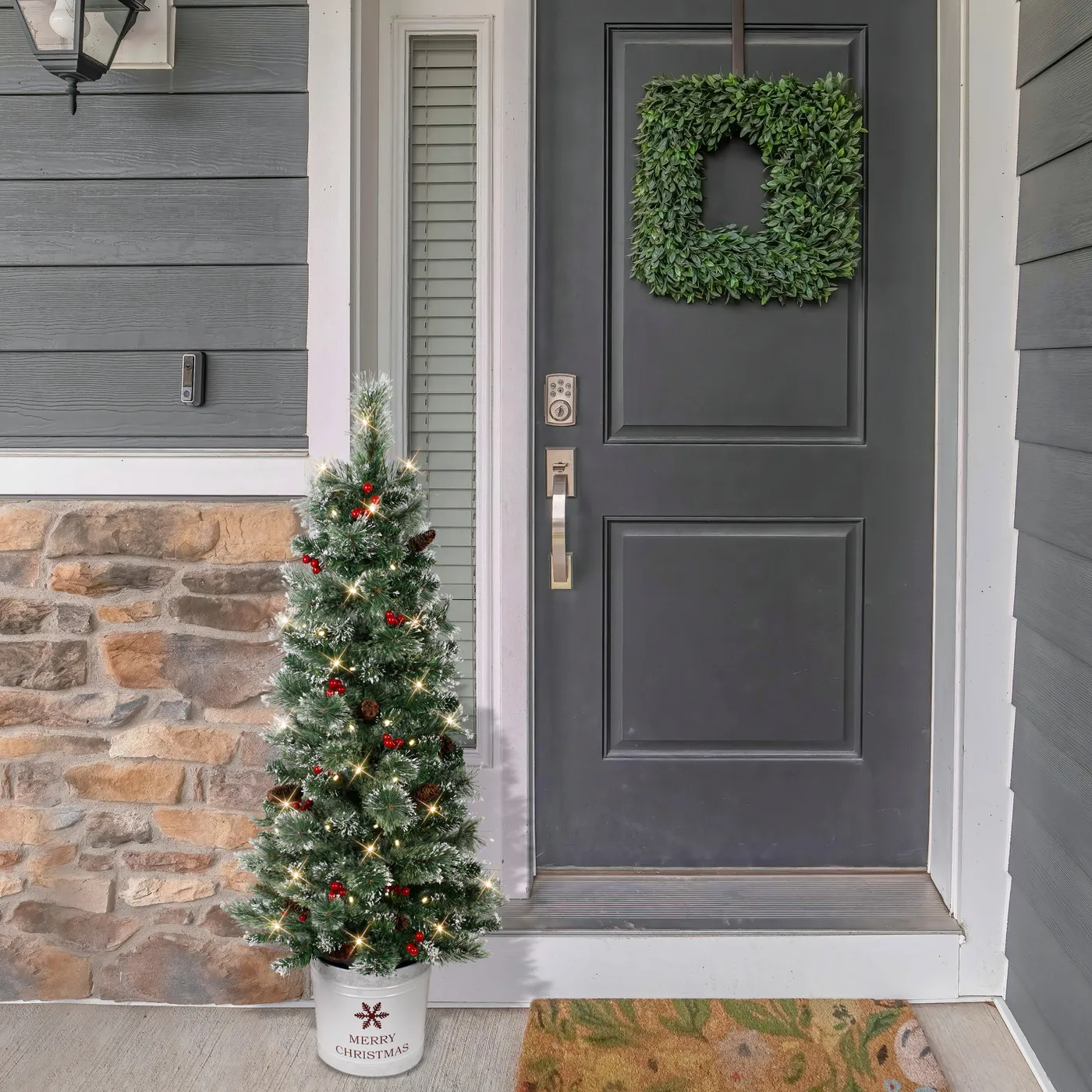
The white bucket tree works on entries from about 4 to 8 feet wide. Wider than that and one small tree gets swallowed — you’d want a matching pair, which pushes you toward Idea #5. It also wants at least 3 feet of porch depth so the bucket doesn’t crowd the door swing. On a shallow stoop, swap the bucket for a wall-mounted basket so foot traffic stays clear.
11. Evergreen Garland and a Red Lantern on a White Picket Fence
- Zip-tie a treated 1×2 rail along the back of the fence line where you want the garland to drape.
- Lay the garland on the ground first and fluff every branch outward before it goes up.
- Attach to the rail every 18 inches with green zip ties so nothing shows from the street.
- Hang the lantern last, at the low point of the swag, so the garland appears to be holding it.
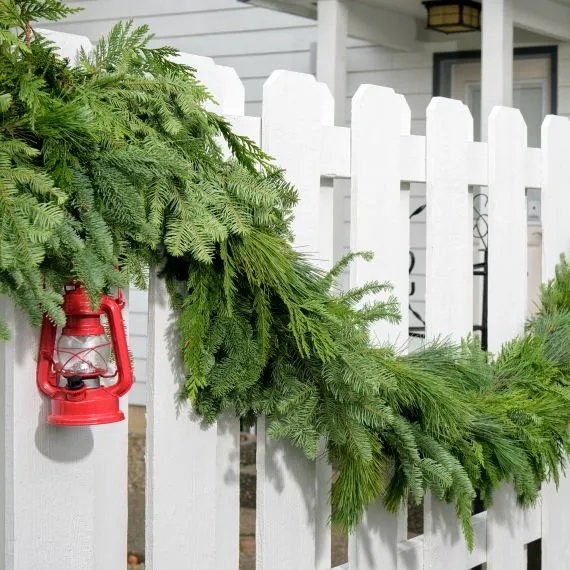
Two hours, and about $80–$180 depending on garland quality. Real garland is gorgeous for two weeks and then it’s a carpet of needles; faux mixed-pine runs $25–$60 for nine feet and lasts a decade. The lantern is the piece worth splurging on — a $30 red metal lantern with a clear glass globe looks twice its price, and the plastic version looks exactly its price. Thrift stores in January are the secret: people donate red lanterns by the box the week after New Year’s.
12. A Pinecone Wreath With a Long Gold Ribbon on Rough Stone
Rough stone is a busy surface, which is why the wreath here is one material and one shape — pinecones in a single ring — rather than a mixed-everything wreath. The long gold ribbon does two jobs: it adds shine against all that matte texture, and its vertical drop gives your eye a line to follow down to the woven basket of birch logs. Scale matters too. On a stone wall, anything under 24 inches in diameter disappears.
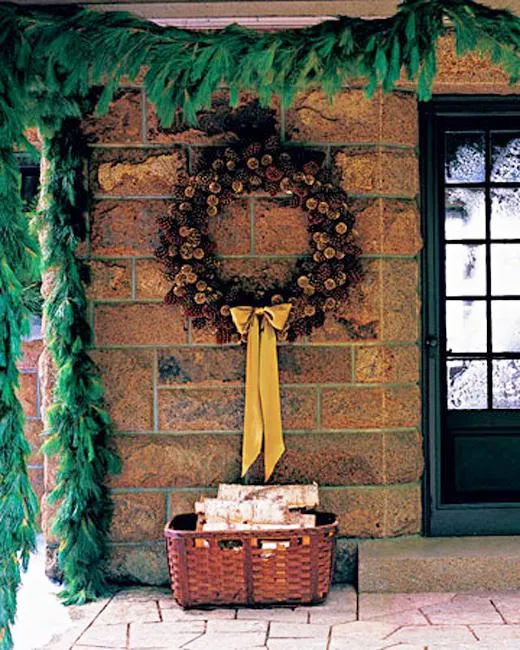
Stone plus wreath equals dust in every crevice of both. Plan on a soft brush and a leaf blower on low twice a season, and expect shedding — real pinecones drop scales, and hot glue gives up in freeze-thaw cycles. Keep clear-drying craft glue on hand and re-tack loose cones each fall. Birch logs sitting directly on stone will get damp and mold, so add a hidden plastic liner inside the basket.
13. The Lighting Habit That Turns a Good Porch Into a Warning Sign
Here’s the honest part nobody posts: a porch can have too much. The moment your display outglows the streetlight, you’ve crossed from festive to fluorescent, and neighbors start timing their dog walks around it. Blue floodlights are the usual culprit — they’re cold, they’re bright, and they fight warm white strings every time. Keep one dominant color temperature across the whole yard and you’ll stay on the charming side of that line.
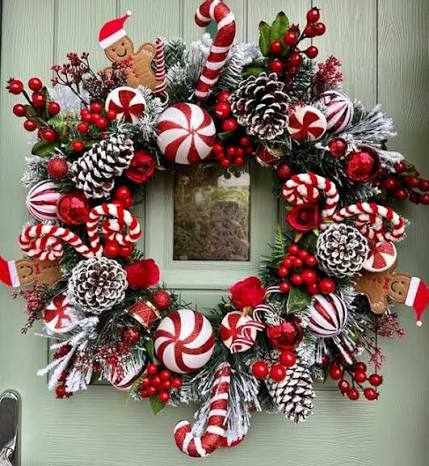
Try the sidewalk test: stand at the curb with everything lit and ask whether you can still see the shape of your house — the columns, the door, the roofline. If you can’t, you’re lighting the decorations instead of the architecture. Aim for about 60% of the light you think you want, and put the house and the yard on separate timers so you can shut half of it down at 10 p.m. without killing the mood.
14. A Gold-Loaded Evergreen Wreath With a Red and Gold Bow
The gold. Not the red bow, not the greenery — the gold ornaments and that single gold branch pick tucked through the top. Gold reflects your porch light and the warm tone of the door, so the wreath appears lit even when the bulbs are off. Strip the gold and you have a perfectly nice, completely forgettable wreath. Buy one mixed set of smooth and textured ornaments and wire them on with floral wire, never hot glue.
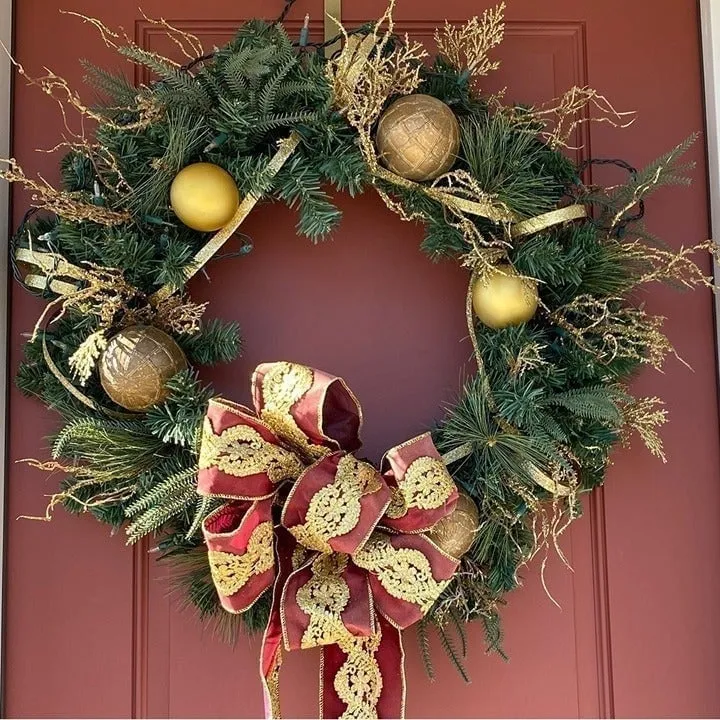
Roughly 65% green, 25% gold, 10% deep red. That ratio is why it reads rich instead of loud — gold is a metallic, not a color, so it doesn’t compete the way a second saturated hue would. Want a different mood? Swap the red bow for burgundy velvet and the formula still holds. Swap the gold for silver and the same wreath turns cool and modern on the same door.
15. Roof Santas, LED Poinsettias, and Nutcrackers Guarding the Door
Animated figures are back, and 2026’s versions are molded LED and app-controlled rather than inflatable. That’s the real shift: inflatables sag and deflate by mid-December, while LED figures hold their shape through a thaw and use a fraction of the power. Snowflake icicles along the roofline, a Santa on the chimney, a poinsettia on the garage — this is a display built to be photographed. Just know it’s a style with an audience of two: you and every car that slows down on your street.
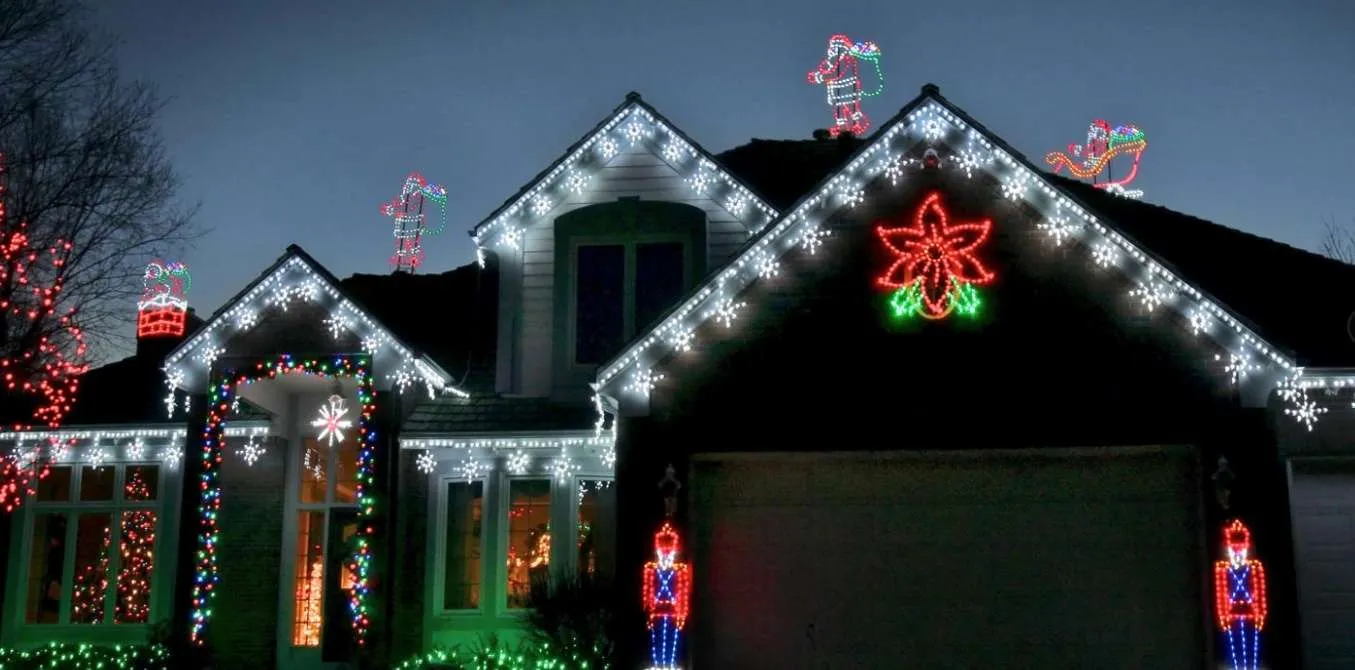
Two practical realities. Storage, first: figures this size need a shelf, not a bin, and many don’t collapse flat once assembled. Second, power. A display like this can pull 800–1,200 watts, which is fine — but only if it isn’t sharing a circuit with your garage freezer. Add up the wattage on the boxes before you plug in, and run exterior cords on separate 15-amp circuits with GFCI protection.
16. Eucalyptus, Dried Oranges, and Gold Geometry on a Modern Entry
Dried oranges and eucalyptus brown faster than they should if they hang where the porch light bakes them. Keep dried elements at least 18 inches from any bulb that’s on more than four hours a night. Wire them in rather than gluing — a 22-gauge floral wire loop through the rind holds for a full season and lets you swap pieces next year without destroying the wreath base. The same rule applies to the eucalyptus tucked into those black planters.
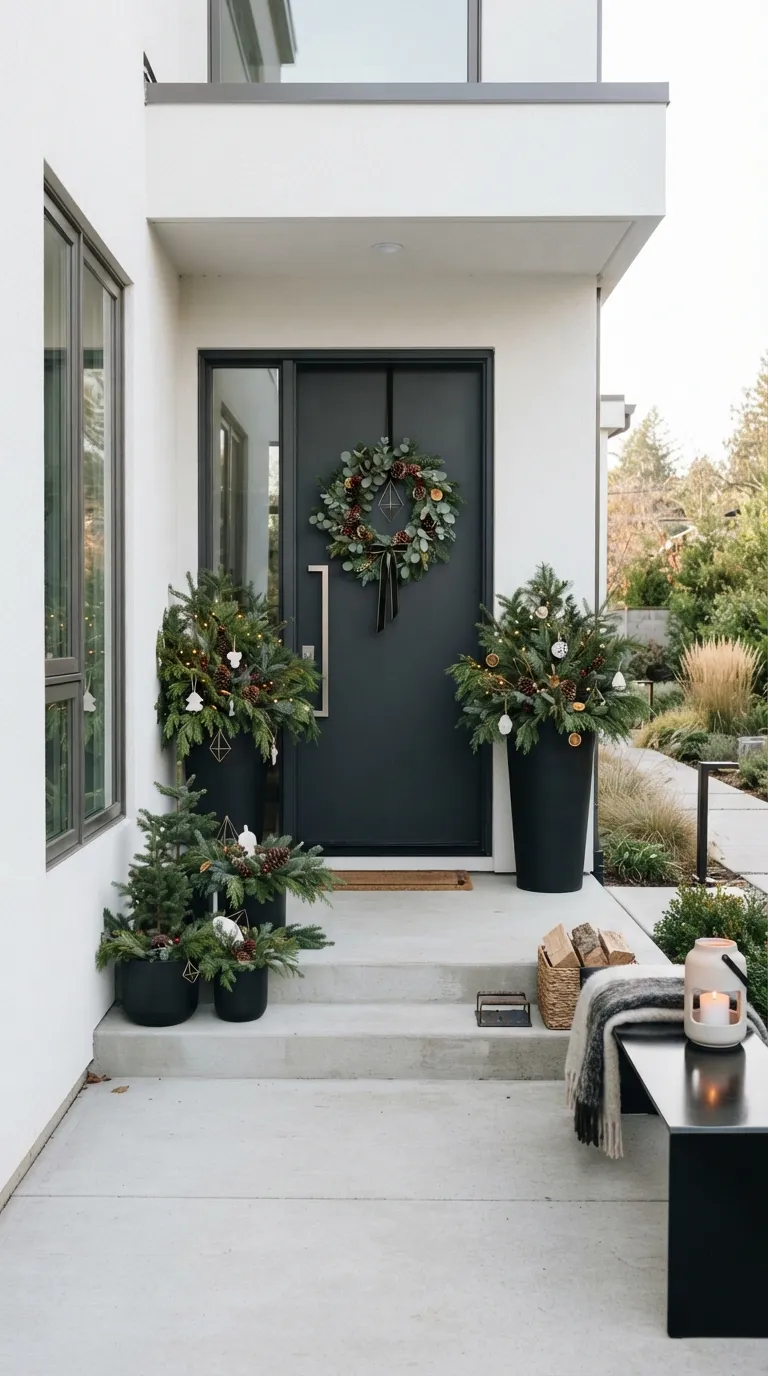
- Two black planters (large plus small): $60–$220
- Three small evergreens: $45–$180
- Mixed evergreen and eucalyptus wreath: $40–$150
- Black bench: $80–$350
- Plaid throw and white lantern: $40–$120
- Total: $265–$1,020
17. Multicolor Porch Rails and Blue Floodlights on a Snowy Night
Blue floods and multicolor strings shouldn’t work together, and somehow they do — because the blue is doing the job of moonlight, throwing the snow-covered bushes into soft relief while the strings stay low and warm-adjacent on the railings. The red door is the anchor that keeps it from going fully cold. If you try this, aim the floods up and away from the house and keep them off any surface that’s already white; snow bounces light back hard.
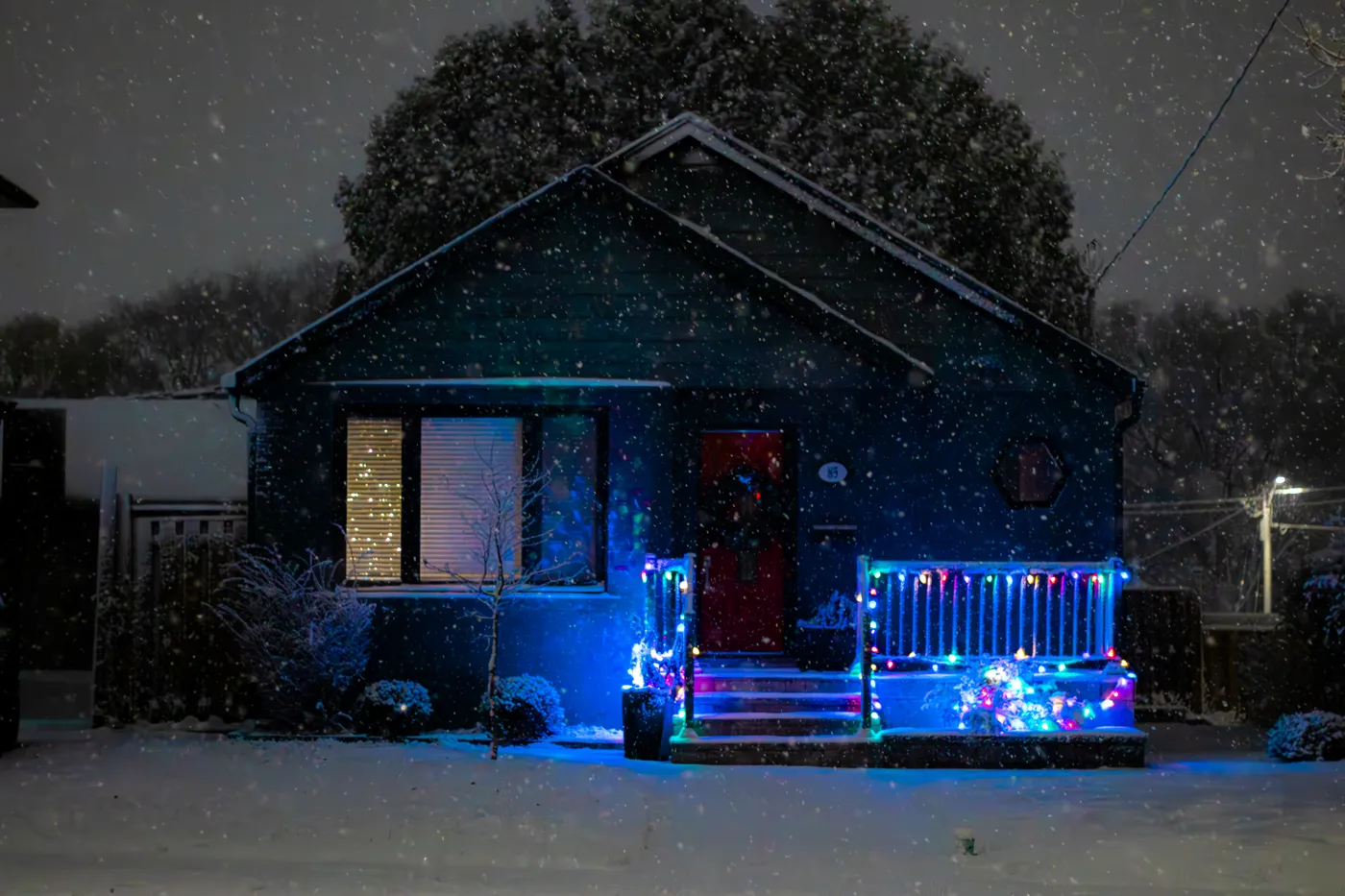
Multicolor incandescents draw about 40 watts per 100 lights, which adds up fast on a full railing run; LED versions use roughly a tenth of that and last longer in cold. Snow and ice are the real enemy — strands buried under snow hold moisture at the sockets, and that’s what kills them in January, not December. Mount the lights under the rail cap rather than on the face where snow piles up, and clear the run after every heavy storm.
18. A Cream-Ribboned Wreath, Brass Lanterns, and Dried Hydrangeas
80% evergreen, 15% cream and natural dried texture, 5% brass. That near-monochrome formula is why this porch feels calm and expensive rather than crowded. The cream ribbon on the wreath repeats in the dried hydrangeas in the garland, and the brass lanterns echo the warm wood of the door. Swap cream for tartan and this exact arrangement becomes a much more traditional, much louder porch.
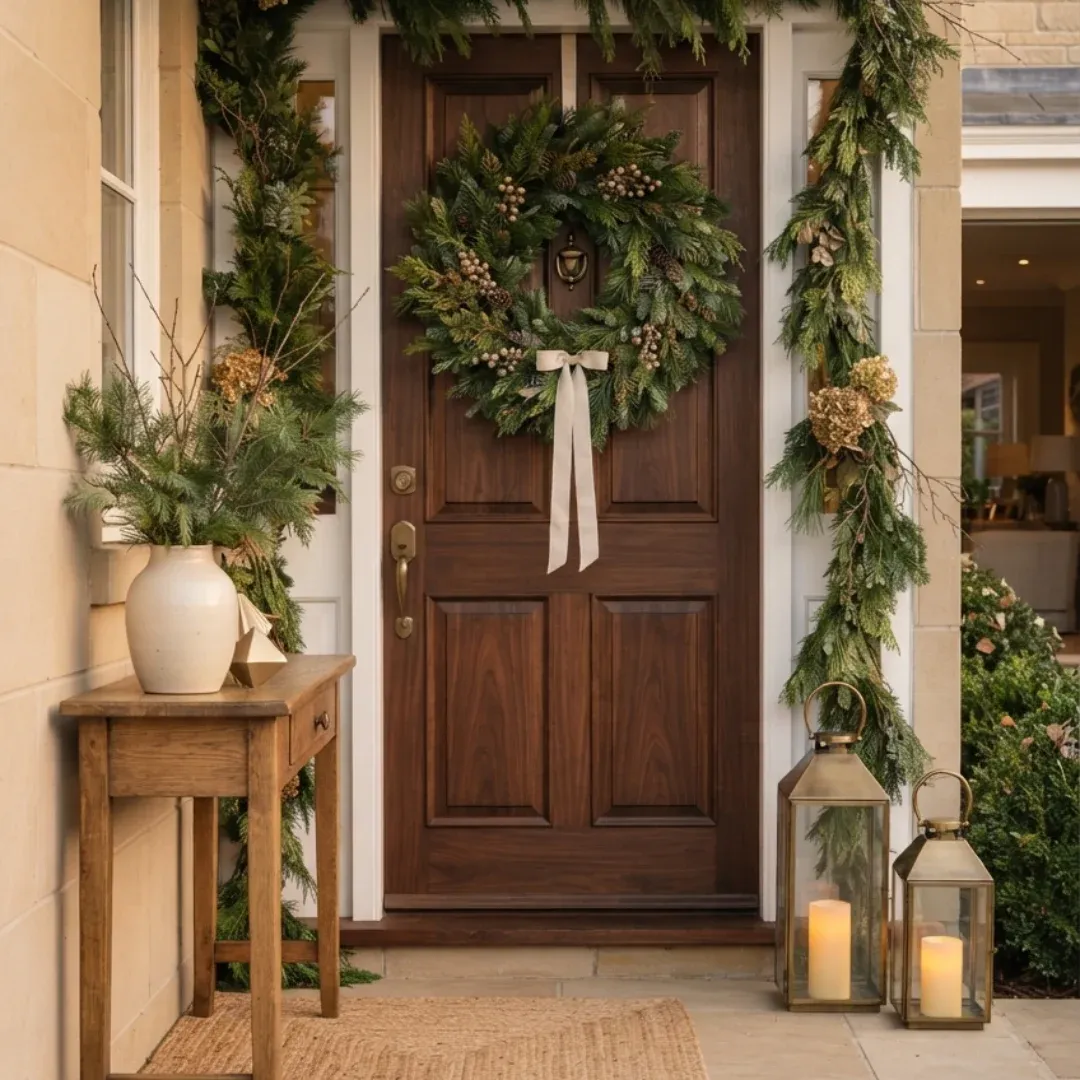
The console table is the piece most porches skip, and it’s why this entry looks like a room instead of a door. A small wooden table gives the wreath, garland, and lanterns a landing point and a shared baseline, so everything hangs at one consistent height instead of drifting. If you have 30 inches of porch depth, you have room for a table. Anchor it so a delivery driver’s shoulder can’t send it into the door.
19. A Lit Wreath on a Black Door Against Snow-Covered Brick
A lit wreath on a black door needs one thing most people get wrong: a cord you can’t see. Run a black or bronze extension cord down the hinge side of the door, zip-tie it to the hinge, then pass it through the gap above the threshold. Never over the top of the door — it pinches, and the cord fails by the second season. A 15-foot 16-gauge cord reaches most porch outlets; anything past 25 feet starts dimming warm white LEDs.
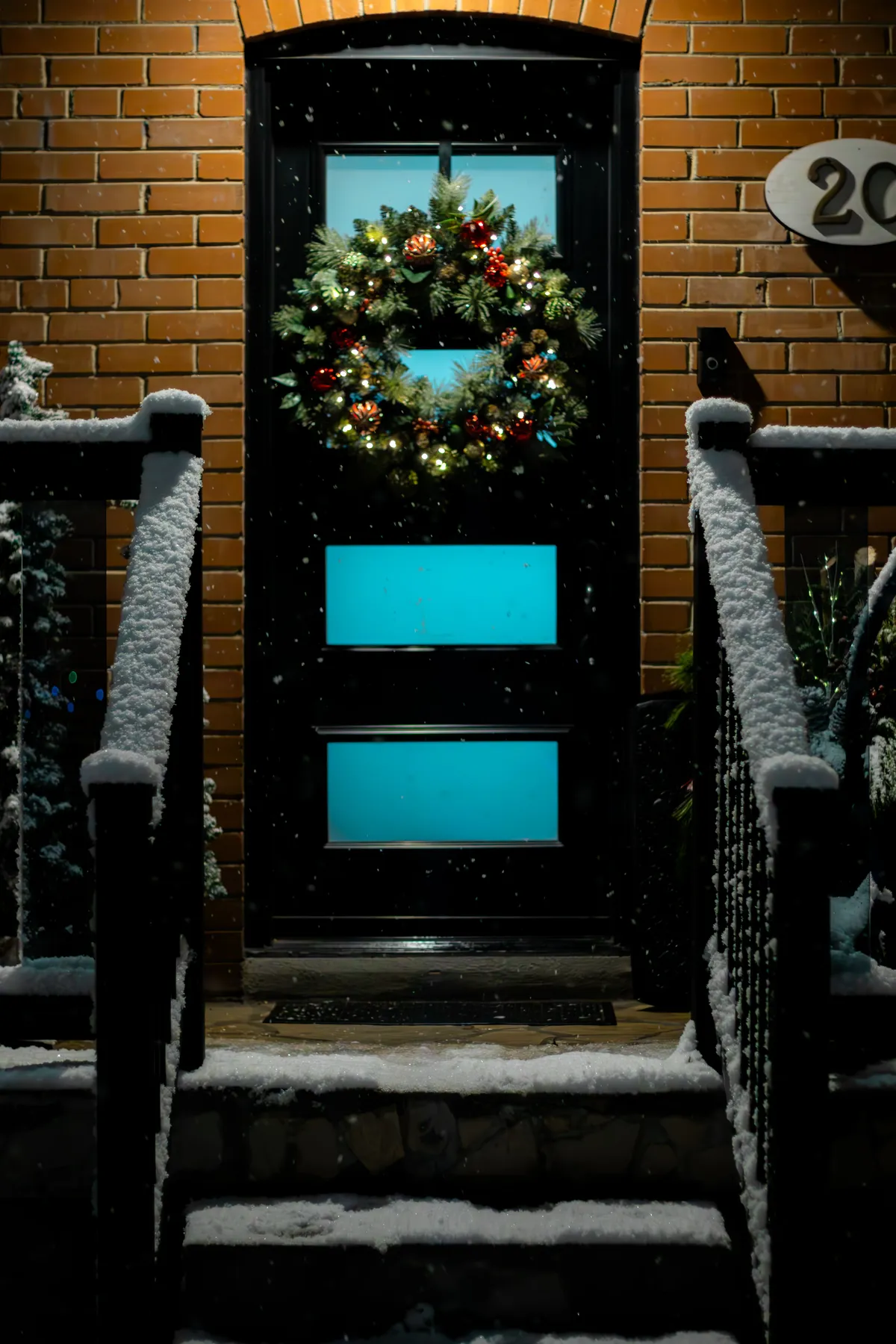
Lit wreaths are the most common cause of a dead porch outlet. If yours shares a circuit with a porch fridge, an outdoor heater, or landscape lighting on the same transformer, you’ll get flicker or a tripped GFCI on the coldest night of the year. If you’re layering a wreath over roofline lights like Idea #3, add up the wattage and test everything together for one full evening in early December.
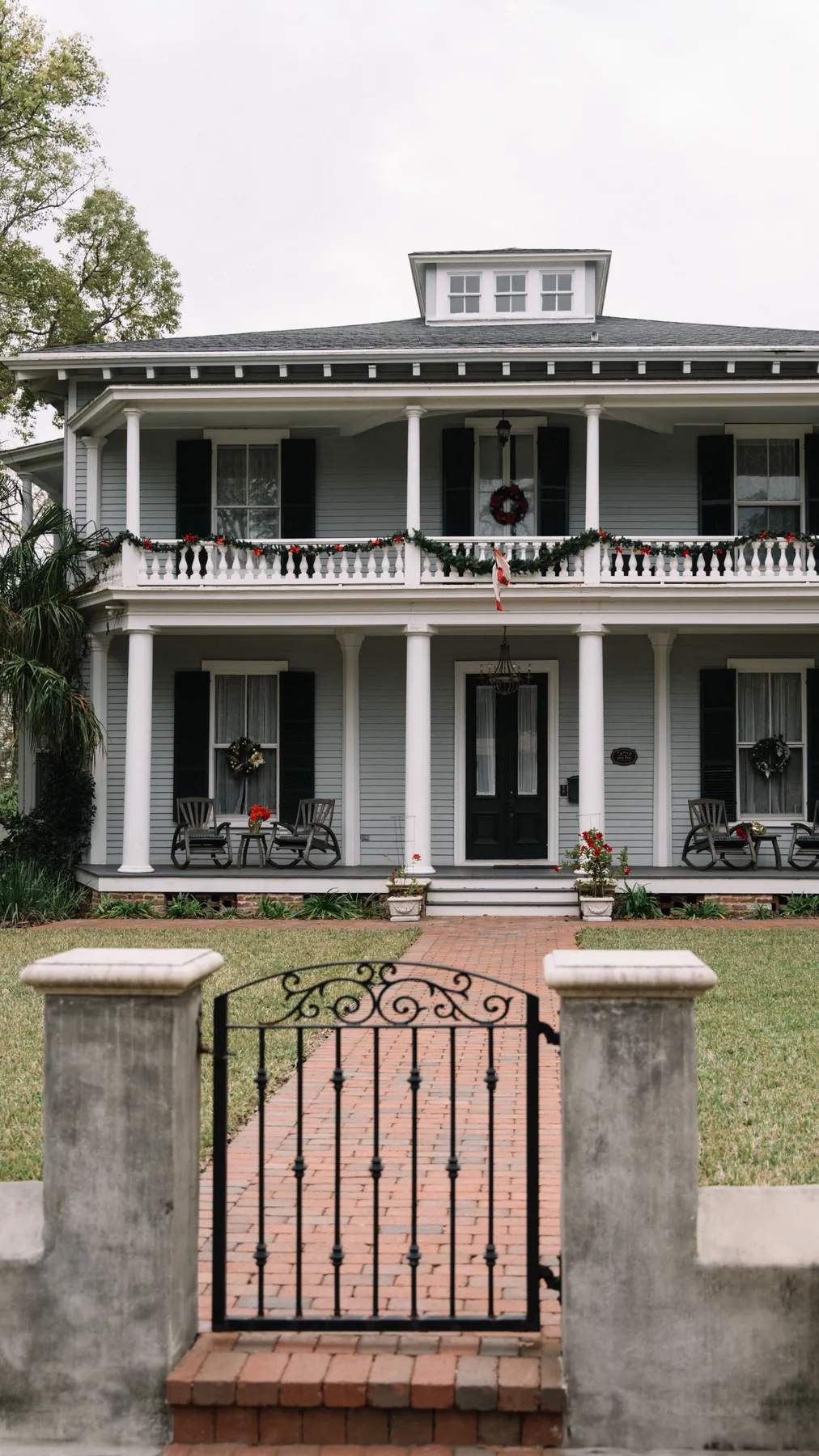
20. A Daytime Colonial Porch Built on Foliage, Not Lights
Daytime porches live or die on foliage, which happens to be the cheapest thing you can buy. A $30 bale of pine or magnolia branches from a local tree lot — often free if you ask for the trimmings — fills more visual space than $200 of ornaments. Idea #31 goes the other direction with a fully lit night display, so pick your lane: this is the porch that looks good at 2 p.m., not 9 p.m.
- Start with the entry: wreath on the door, greenery on both sides, done.
- Add one tall vertical element — a tree, a cypress, a wrapped column — to break the horizontal line of the porch rail.
- Layer in one saturated color at eye level, where daylight actually hits it.
- Check the shade. Anything sitting in a porch shadow will read dark for half the day.
21. A Pine Wreath With One Long-Tailed Red Satin Bow
95% green, 5% red — that’s the whole wreath, and it’s more sophisticated than it sounds. Because the red appears in exactly one place and in one texture (satin, which catches light), the color reads as an accent rather than a theme. Add red berries and the balance shifts to 85/15. Add a red ribbon winding through the wreath and you’ve tipped all the way to a red-and-green wreath, which is a completely different idea.
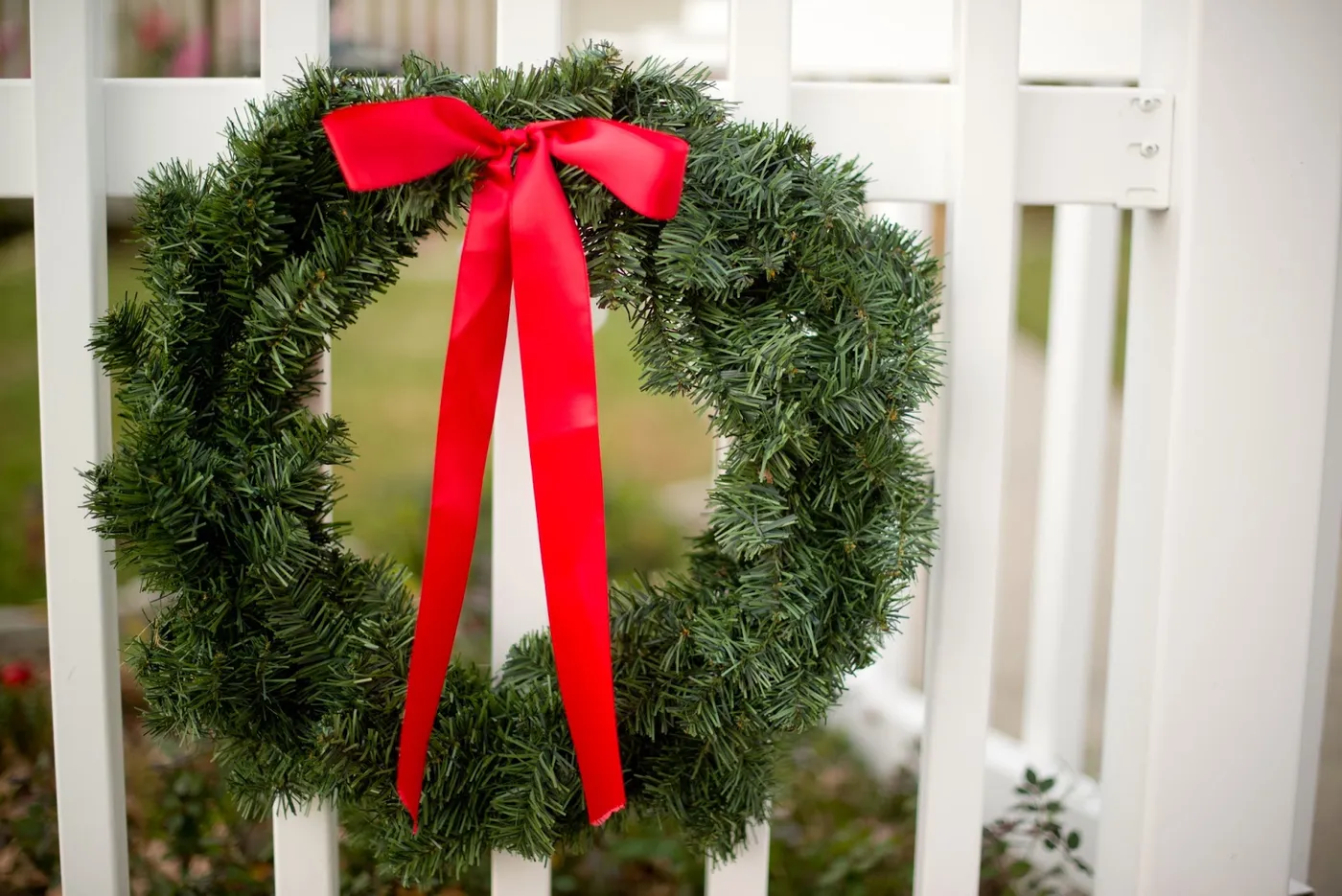
Bow tails are the tell. A short, stubby bow looks homemade in the bad way; long tails falling 1.5 to 2 times the width of the bow look custom. Wire the bow on with two separate ties at 10 and 2 o’clock so it can’t rotate, and cut the tails on a diagonal or a deep V — never straight across. If the ribbon is satin, pass the cut ends over a flame for two seconds to seal the fray.
22. A Dark-Wrapped Wreath With Bells on a Coral Front Door
The wreath is dark and the door is not. That inversion is the whole trick — a dark-wrapped base with red berries and three metallic bells reads as a shadow against the coral, so the door’s color stays the star. Put a green wreath on this door and the coral fights it; put a red ribbon on it and the door disappears entirely. Hang it centered on the glass insert, not the panel, so it looks deliberate.
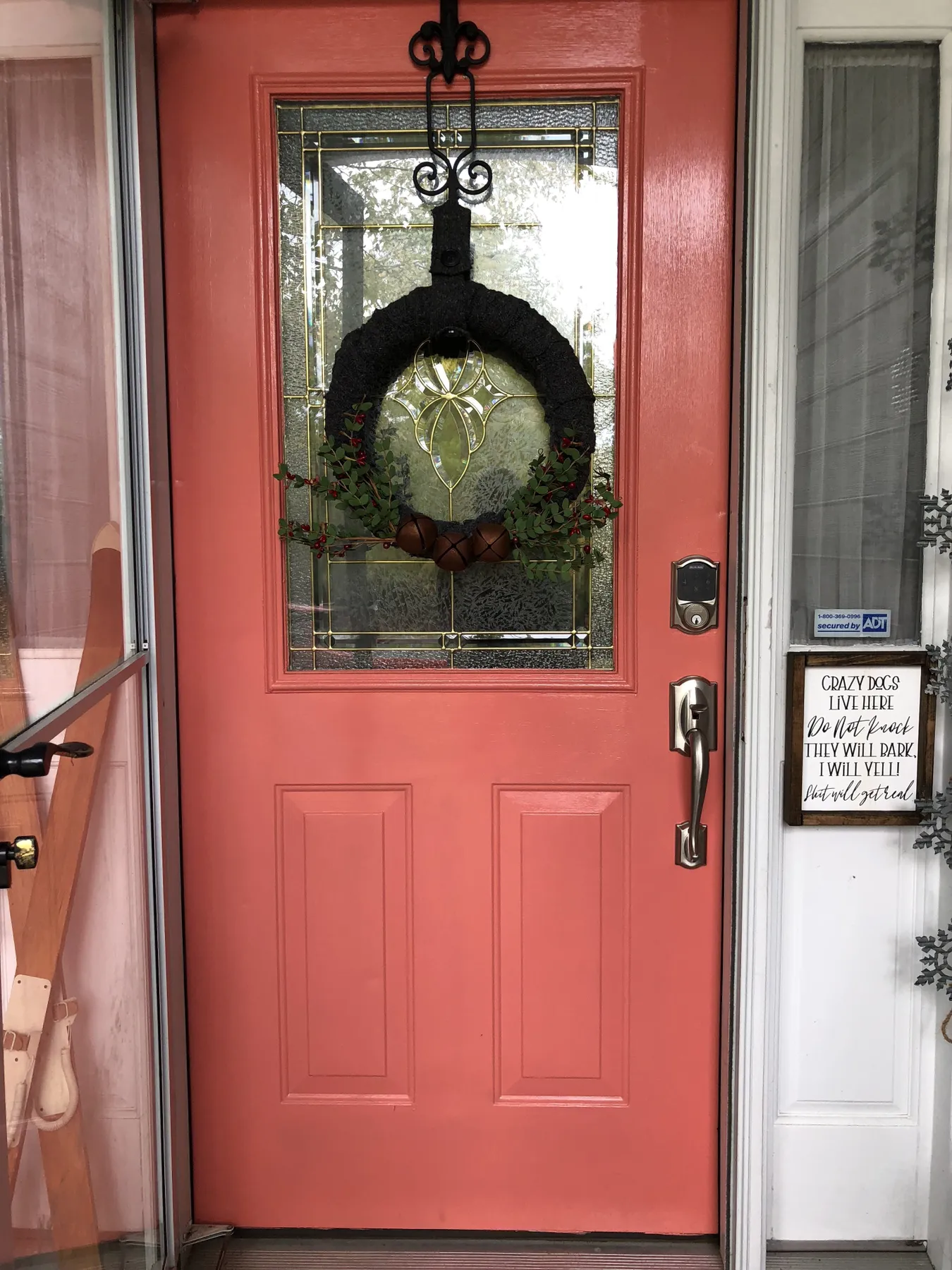
Coral doors pair beautifully with thrifted metal. Bells from a flea market run $2–$8 for three versus $25 new. The dark-wrapped base can be a cheap grapevine form (about $8 at a craft store) wrapped in dark burlap ribbon from Walmart ($6), so you’re under $30 before you add greens. Facebook Marketplace is also full of people selling entire door-wreath setups in January for a third of what they paid.
23. Garland Framing Glass Doors With Poinsettias on the Steps
Two principles are working here. Symmetry, first: matching wreaths on each door leaf with garland running across the header creates a frame, and frames read as intentional in a way one-sided decor never does. Repetition, second: the red shows up in the garland bows, the wreaths, and the poinsettias at the base — three different heights, one color. That’s enough distance between repeats that it feels layered instead of matched.
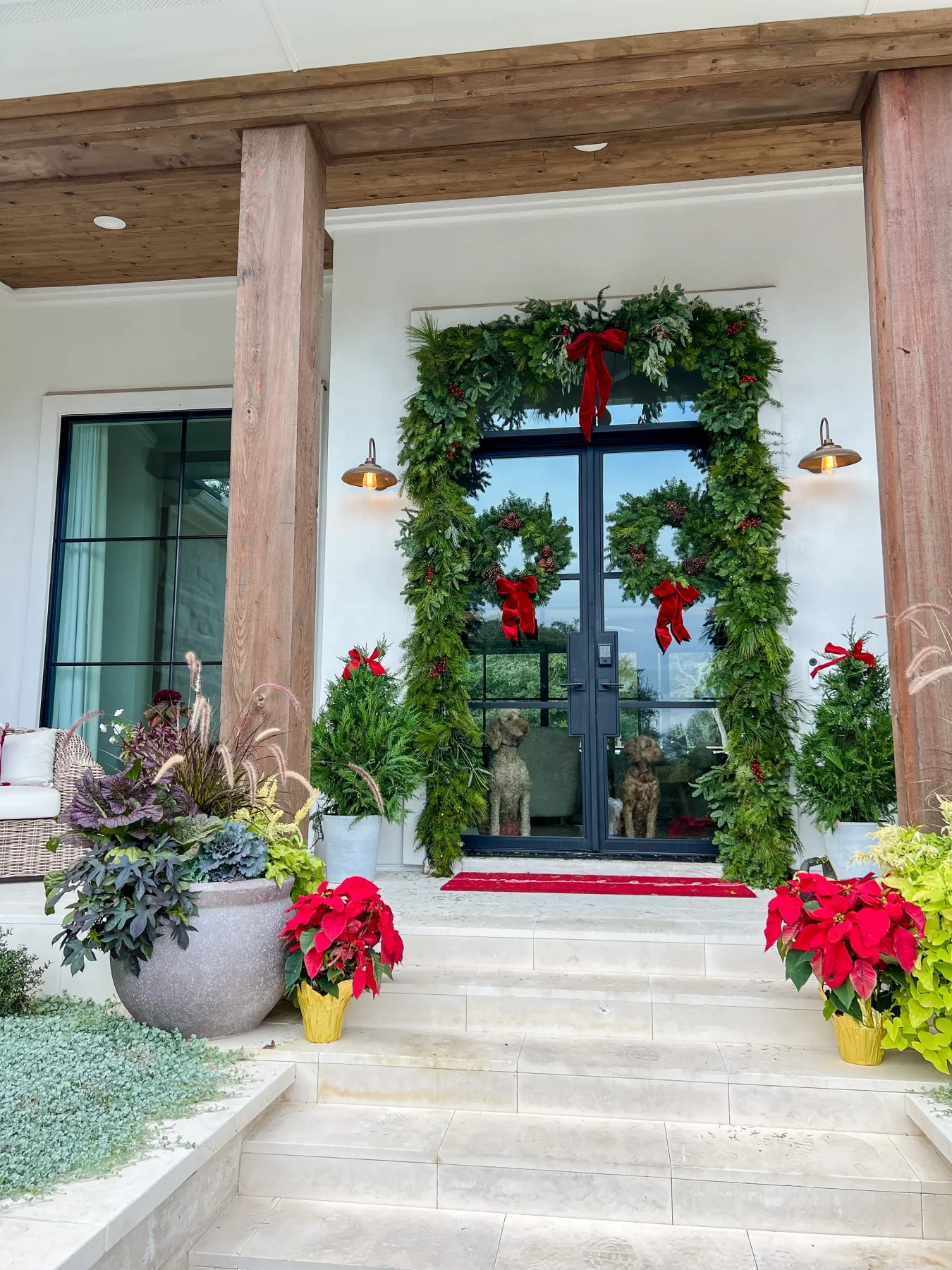
- Buy poinsettias with tight, mostly unopened centers; they’ll hold color through New Year’s.
- Sink each nursery pot into a gold cachepot one size larger — no repotting, no mess.
- Set the tallest in back, shortest up front, along the step edge rather than the middle.
- Water with ice cubes once a week so there’s no runoff staining the stone.
24. A Deep Red Velvet Bow Centered Over Dark Double Doors
The velvet. A satin bow on a dark door disappears into shadow; velvet catches light on its pile and reads as a rich, saturated red even at dusk. That’s the difference between a bow that looks like ribbon and one that looks like it cost something. One big bow, centered, with garland running around the frame — not through it. Everything else on this porch is a supporting player. Compare with Idea #23 — same framing idea, brighter palette, completely different mood.
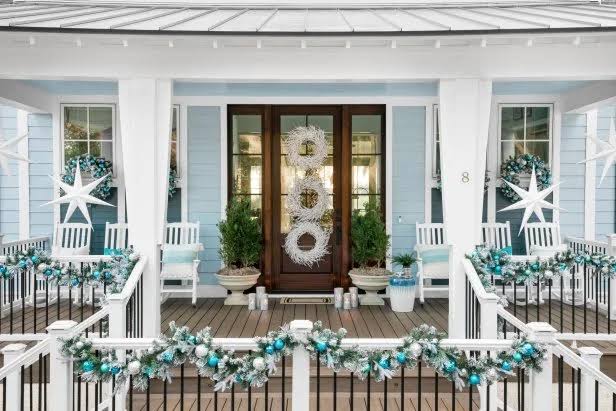
Real pine garland over a door is beautiful and messy. It drops needles on the threshold daily, and the sap leaves marks on painted trim that show up in spring when the sun hits them. Protect the frame with painter’s tape behind the garland and put a plain doormat underneath for the season. Faux cedar won’t shed, but it fades after three or four Decembers in direct sun — rotate it into a shaded spot each year.
25. Small Wreaths and Red Bows Tied Along a White Picket Gate
This is the most budget-friendly idea in the whole collection. Six 10-inch faux wreaths run about $6 each at a craft store after Thanksgiving sales, plus a roll of red ribbon ($5) and a pack of zip ties. Under $50 for an entire fence line and gate. Make the bows yourself — the loop-and-twist method takes 90 seconds each once you’ve done two. Save your money for the front door wreath, the one people actually get close to.
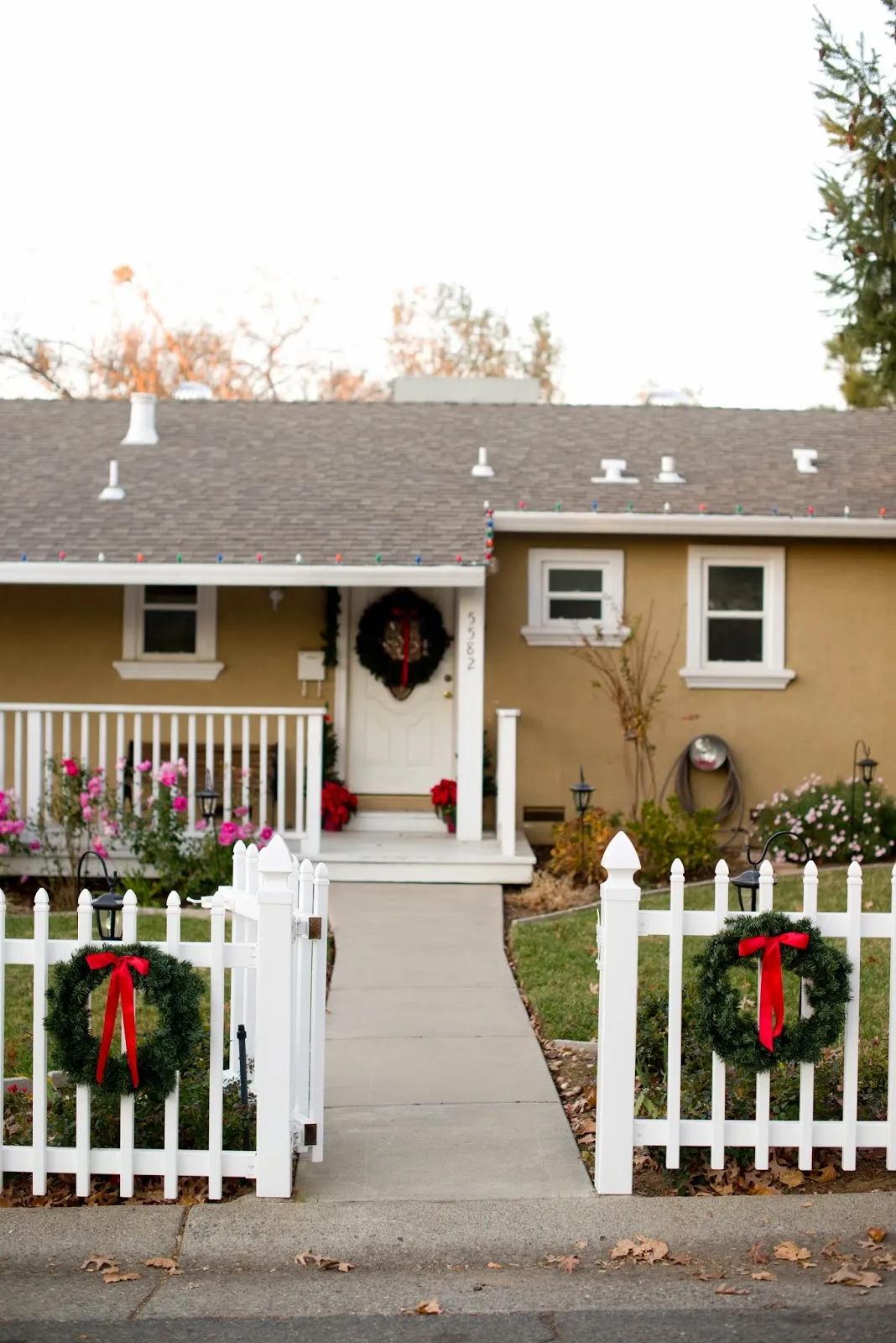
Small wreaths belong on picket runs of 12 feet or more. On a short fence they look like leftovers; repetition across a long run is what sells it. Space them 24 to 30 inches apart, center to center, and get the bow tops on one horizontal line — eyeballing always drifts. If your walkway is under 10 feet, skip the fence wreaths and put the money into a single oversized door wreath instead.
26. A Black-and-White Merry Christmas Sign and Layered Doormats
- Two potted miniature pines: $40–$140
- Vertical chalkboard sign: $25–$70
- Round “O Holy Night” door sign with bow: $20–$65
- Layered striped and coir doormats: $35–$90
- Simple door garland: $20–$80
- Total: $140–$445
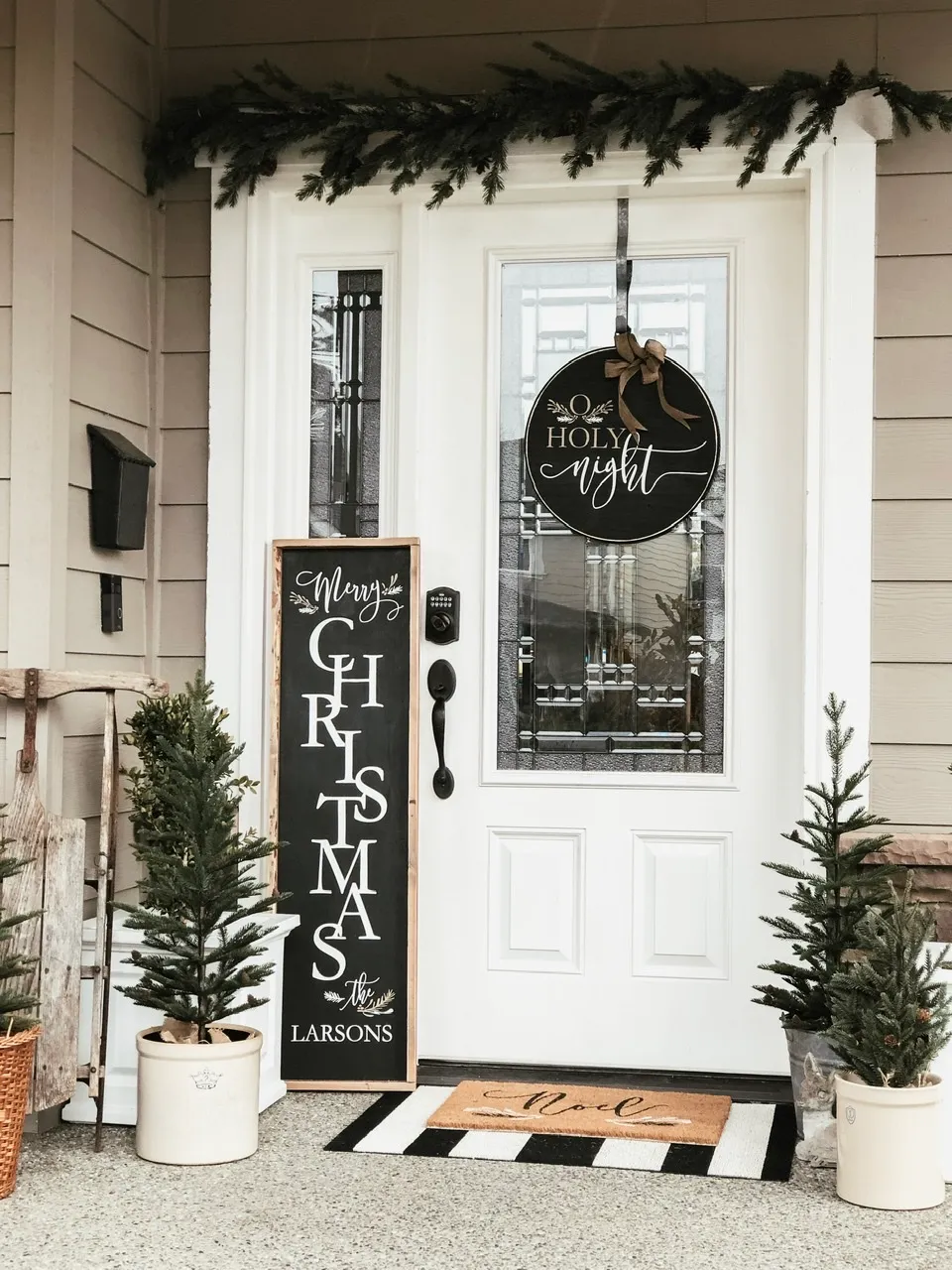
Personalization is doing more work than any ornament on this porch. A name on the sign turns a generic entry into somebody’s house, and that’s the thing guests actually notice. The rest of the composition stays deliberately plain — white door, black frame, evergreen, striped mat — so the sign has somewhere to land. When everything else is neutral, one personalized element reads as a statement instead of clutter.
A $5 thrift-store chalkboard plus a chalk marker does what the $70 sign does, and a plain coir mat under a $12 striped runner gives you the layered look for under $25. Buy the miniature pines in late November, too — by the second week of December you’re choosing between root-bound leftovers.
27. A Pre-Lit Wreath and Slim Tree Beside a Red Front Door
Red doors are the easiest to decorate on a budget because the door is already the statement. A $20 pre-lit wreath from Walmart against that red will photograph like a $120 wreath, and a four-foot slim tree runs $35–$60 versus $150 for a full one. The gift boxes? Empty boxes from your recycling, wrapped in clearance paper and glued shut so they don’t blow down the street. Under $100 for the whole vignette.
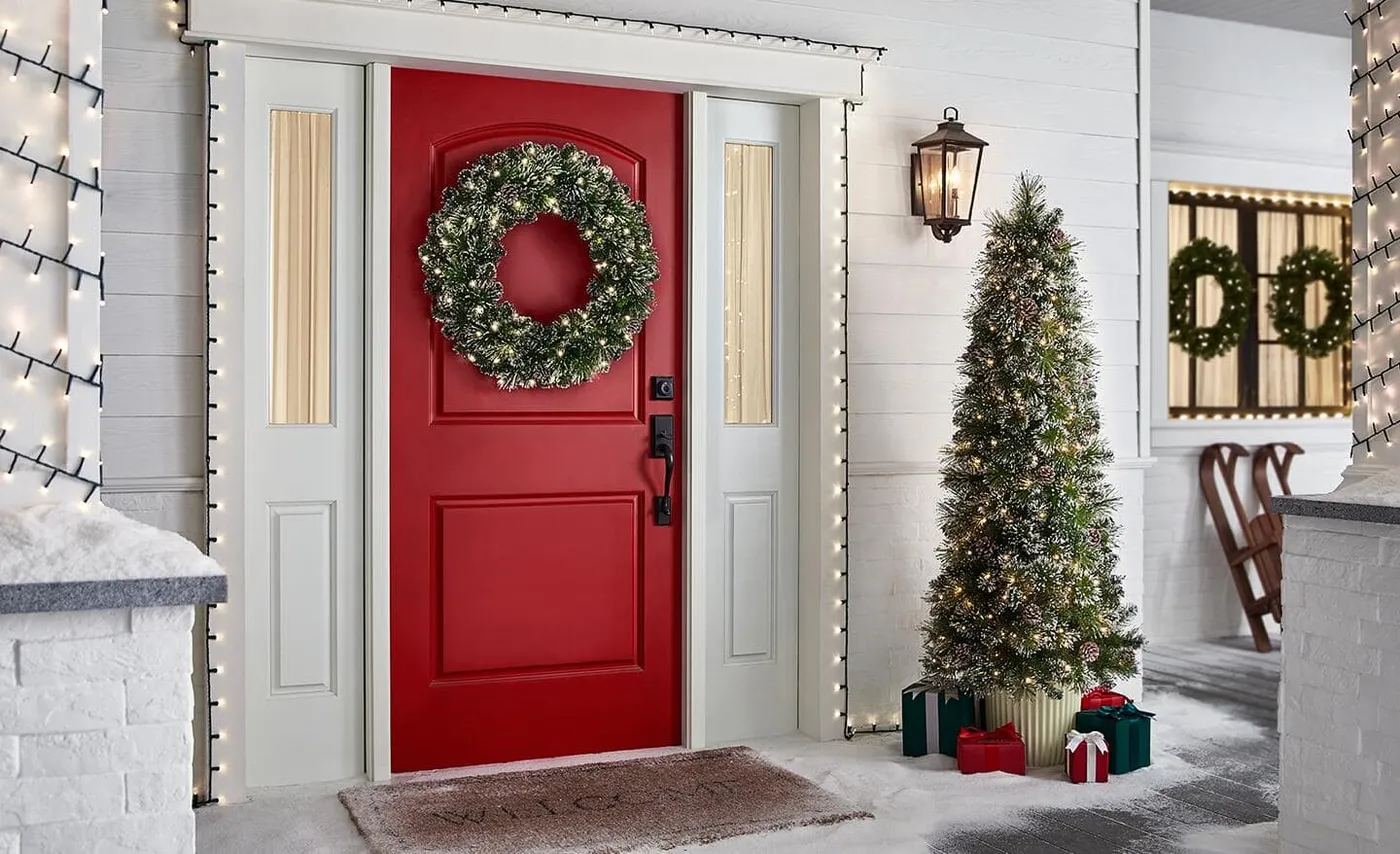
- Collect three to five empty boxes in a range of sizes — odd numbers look better.
- Tape them shut, then wrap normally. No need to be neat on the underside.
- Weight the bottom box with a brick or a bag of sand.
- Stack in a pyramid, largest to smallest, offset to one side of the door.
28. Frosted Wreaths on the Door and Sidelights, Urns on the Landing
Deep green 60%, charcoal 25%, red 10%, warm gold 5%. The charcoal comes from the door and the urns, and that’s what keeps this from being a traditional red-and-green porch — the neutral is doing as much work as the holiday colors. Swap the charcoal urns for terracotta and the whole palette softens and warms. Swap them for white and it goes crisp and coastal. Same wreaths, three entirely different porches.
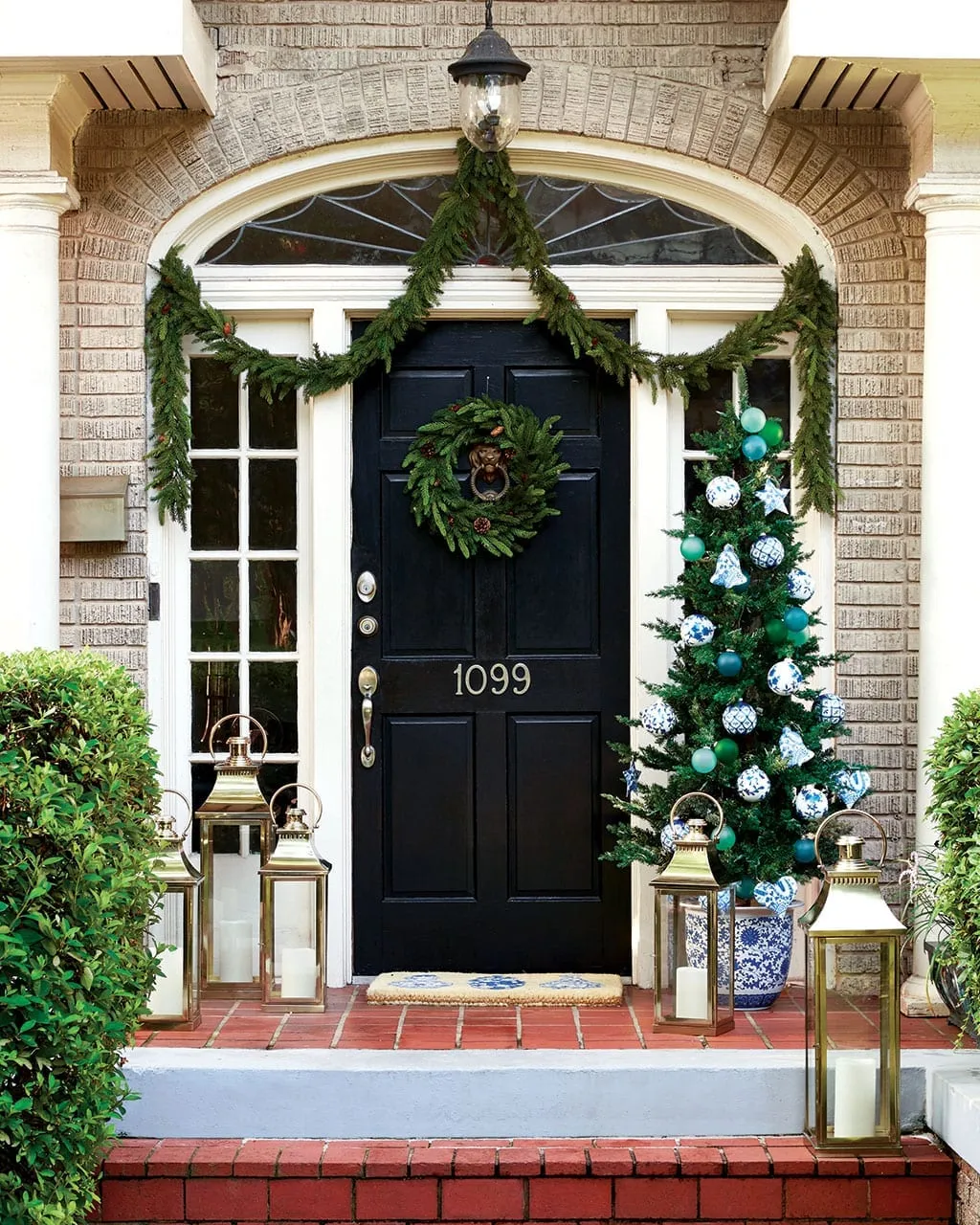
Wreaths on the sidelights, not just the door. That’s the move that makes this entry look designed — three wreaths at the same height, same size, same ribbon, spanning the full width. Most people stop at the door, which is why their entry feels unfinished. Measure all three from the same reference line; if they’re even an inch off, your eye will find it from the sidewalk.
29. Lit Lanterns, Plaid Pillows, and Wrapped Packages on a Wood Porch
Open-flame candles on a porch are a bad idea, and I’ll say it plainly: wind, dry evergreen, and a wooden floor are three things you don’t want near a flame. Every lantern look you’ve saved uses LED candles, and the good ones have a waxy shell and a flicker that reads real from three feet away. If you want actual fire, keep it inside a glass hurricane, on stone, with nothing hanging above it.
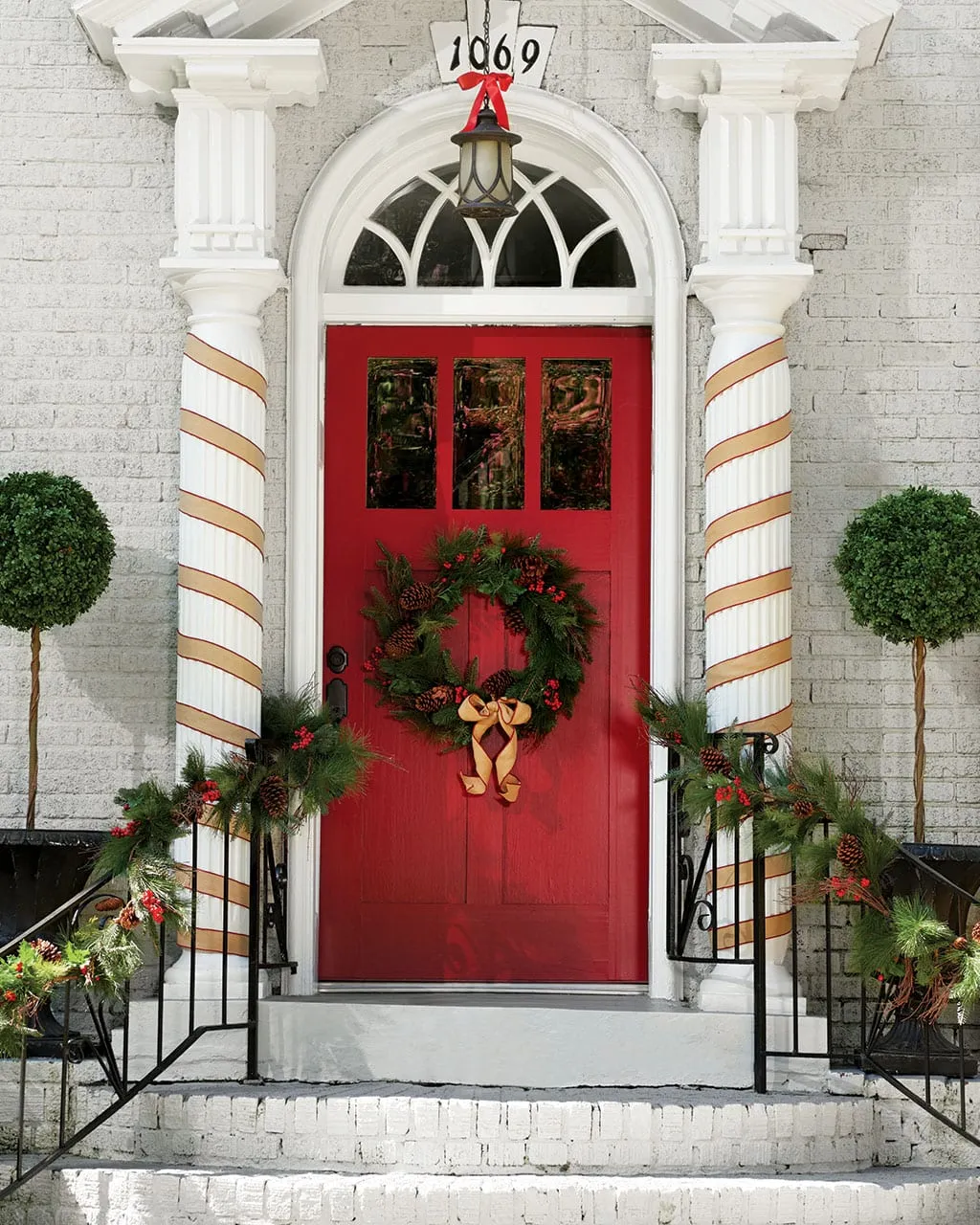
The rule for a porch you actually live on: keep 36 inches of clear walking path from the door swing to the stairs. Pillows, packages, and potted trees all migrate into that path in real life. Match your lantern heights, too — three lanterns at 8, 12, and 16 inches look collected, while three at random heights look like leftovers. Put the heaviest object closest to the wall.
30. Plaid Pillows in Two Rocking Chairs Behind Garlanded Columns
Rocking chairs. They’re the one piece of porch furniture that says “sit here” rather than “look at this,” and they change the entire read of a decorated porch — from display to invitation. Plaid pillows and a throw make them usable in December, and garland on the columns frames them like a stage. If you only have budget for one upgrade this year, buy the chairs. Everything else here can be built over two seasons.
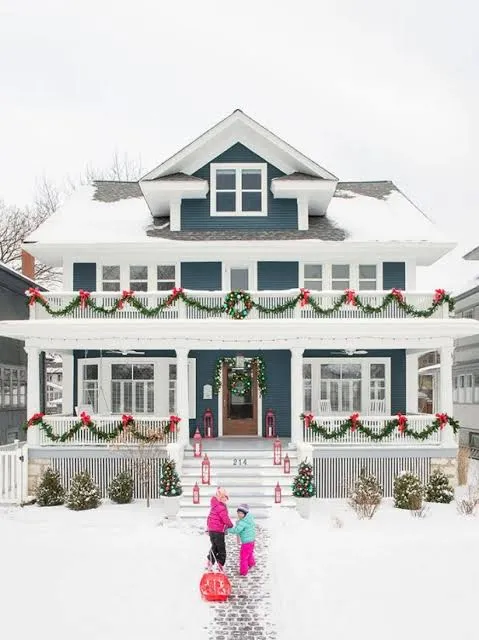
Two rocking chairs plus a side table need a porch at least 8 feet wide and 5 feet deep to rock without hitting anything. Rocker runners travel 24 to 30 inches, so measure that distance from the wall before you commit. On a narrower porch, one chair and a bench works fine; on a shallow stoop, skip seating entirely and hang the plaid over a wall-mounted basket. Small entries do better with the single-tree approach in Idea #8.
31. Boxwood Gift Boxes and Hanging Snowflakes on a Purple Door
Topiary gift boxes are the 2026 version of the light-up reindeer — same impulse, better taste. Framed boxwood shapes read as sculpture during the day and glow at night, and they photograph far better than inflatables ever did. The purple door with black-and-white striped ribbon is the bolder move; it works because purple is the only unexpected color in an otherwise classic green-and-white display. If you’re scaling up from a simpler look, this is the graduation.
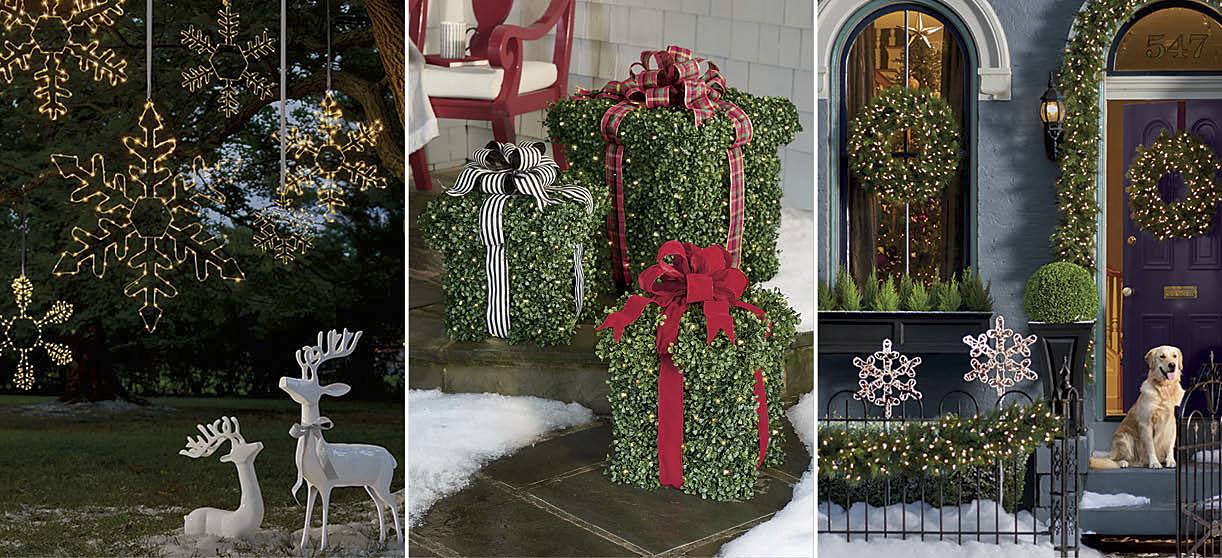
- Choose branches at least 10 feet up so the flakes hang clear of heads.
- Use a telescoping pole hook and a single stainless hook per branch.
- Hang each flake from its top loop with a 6-inch wire leader, not cord.
- Run the cords down the back of the trunk and zip-tie at three points.
Your Front Porch, One Strand at a Time
Pick one idea from this list — not five — and build it properly this season. A single well-hung wreath and one clean line of warm white lights will outshine a porch full of half-finished projects every time, and next December you can add the next layer.
When you do, snap a photo at dusk and pin it. Half the joy of a front porch is that it’s the one thing on your house the whole neighborhood gets to see.