Still scrolling through January winter decor photos without knowing where to start? We spent serious time browsing Wayfair, West Elm, and Target to bring you only what’s worth your attention this year. After filtering through hundreds of options, we narrowed it down to 32 ideas that actually deliver — spanning Scandinavian minimal, modern farmhouse, warm rustic, and cozy traditional styles. We’re comparing budget-friendly finds alongside splurge-worthy pieces so you can decide what fits your space and your wallet. In 2026, winter decor is moving away from generic holiday themes toward quieter, more personal spaces that carry you through the whole season — and these ideas capture that shift perfectly. Save this post now — you’ll want it when you’re ready to shop.
1. Bottle Brush Trees on a Brick Fireplace — Winter Whimsy Done Right
When styling a mantel with bottle brush trees, vary the heights by at least three inches between each one to create rhythm instead of a flat row. Group them in odd numbers — three or five — and tuck the bases behind garland or pom-pom trim so they feel nestled in, not just placed. Stick to four or five colors max (the blush pink and muted green here are perfect) to keep it collected, not chaotic.
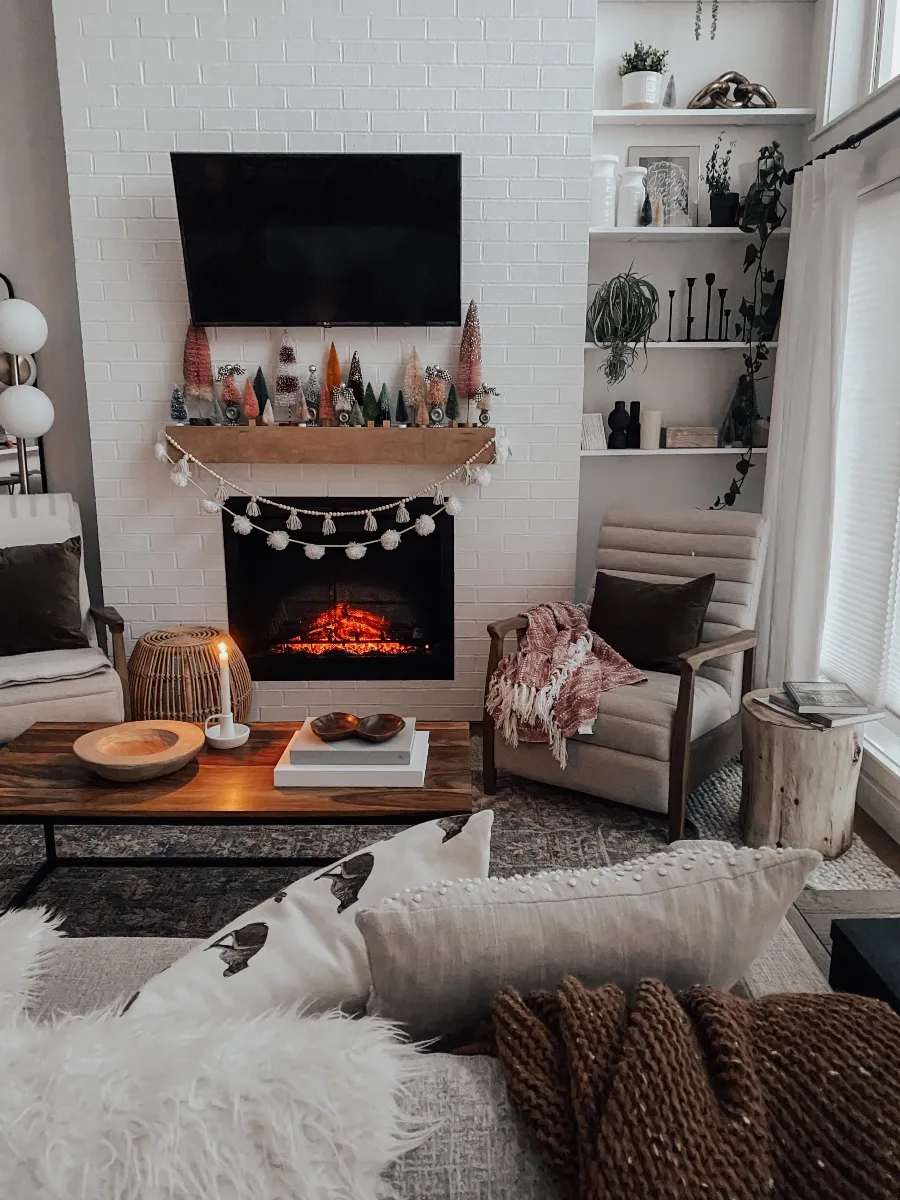
that makes this fireplace setup sing is the white pom-pom garland draped below the trees. Without that soft, textured layer breaking up the brick and wood, the bottle brush trees would float visually. That garland anchors them, adds movement, and introduces the cozy fabric texture that the rest of the room — the woven throw, the striped armchair — echoes. It’s the thread tying the whole mantel composition together.
2. Snowy Views and a Modular Sectional — Minimalist Comfort
This room follows a 70-20-10 formula: 70% neutral base (white walls, light wood floors, grey rug), 20% anchor color (the dark brown modular sofa), and 10% accent (green plants, the concrete side table’s cool grey). You could swap the dark brown for charcoal or navy and the formula still holds. The key is keeping that 70% light and airy so the 10% pops without trying hard.
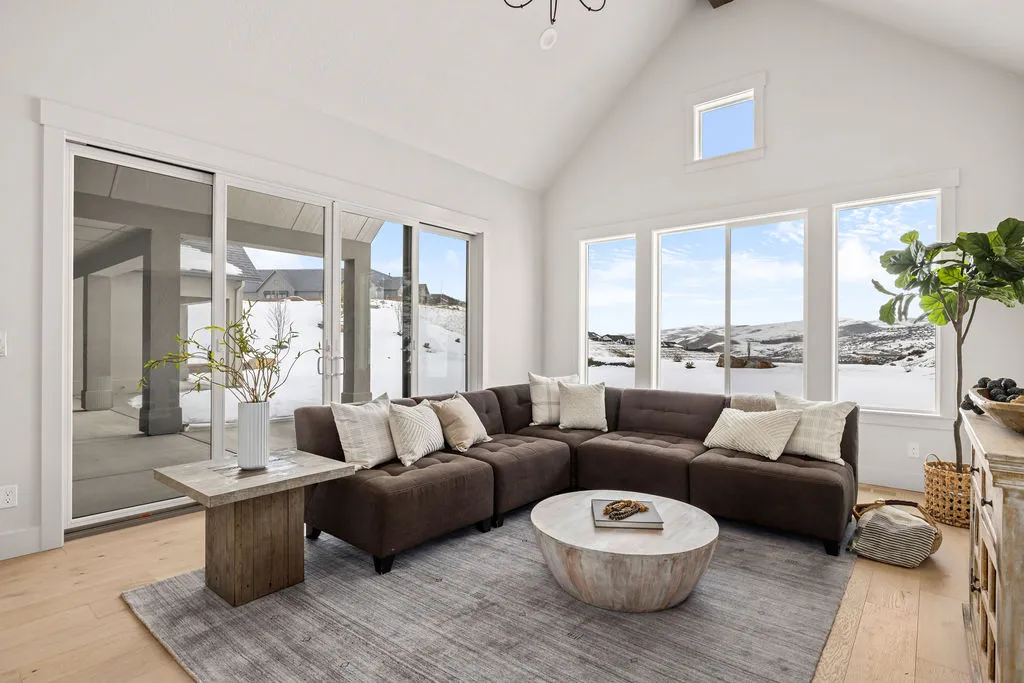
What makes this living room feel so current is how it leans into the “wintering” trend — the idea of making your home a cozy refuge rather than fighting the cold. In 2026, we’re seeing more people embrace snowy views as part of the decor, not something to block out. Those large windows aren’t just architectural; they’re a designed focal point. This look has serious staying power because it’s not about seasonal decor you pack away — it’s a year-round neutral palette with winter as the backdrop.
3. Olive Green Sofa, Warm Earth Tones — This Living Room Has It All
This room works because of color temperature mixing. The olive green sofa is a cool-leaning neutral, but the burnt orange and cream throw pillows warm it up. The dark wood coffee table adds grounding contrast, while the geometric rug ties the warm and cool zones together with its pattern. The rule of thirds is at play here too: the sofa is the main mass, the floor lamp provides vertical counterbalance, and the art shelf draws the eye upward. Each element occupies a different visual weight zone, making the whole composition feel intentional.
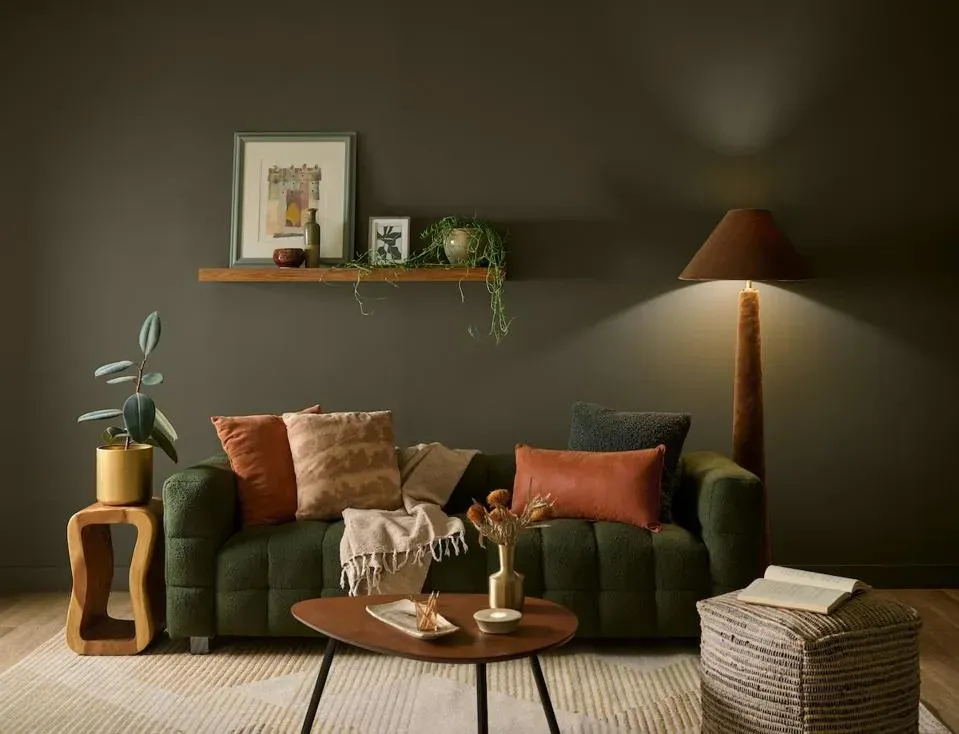
The olive green sofa is the splurge piece here, but you can get the same earthy, textured vibe for way less. Swap it with the IKEA Söderhamn in a moss green slipcover (around $699 for a three-seater) or check Facebook Marketplace for gently used sofas in olive, forest green, or even dark teal. The key is the throw pillows — Target’s Threshold line has burnt orange and cream velvet options for under $25 each. That geometric rug? Wayfair has dupes starting at $89 for a 5×7. You’re looking at under $1,200 for the whole setup, compared to $3,500+ with the designer sofa.
4. Cloud Wallpaper Dining Nook With a Marble Table That Floats
Cloud wallpaper works best in dining nooks and small breakfast areas because the pattern adds depth without overwhelming a compact space. A pro trick: extend the wallpaper two to three inches past the edges of the built-in bench so it feels like the room is wrapped, not just wallpapered behind furniture. Keep the chandelier light and airy — a branch-like design keeps the visual weight up top from competing with the busy wall pattern below. And always use a marble or light stone table to reflect that soft grey and white palette back into the room.
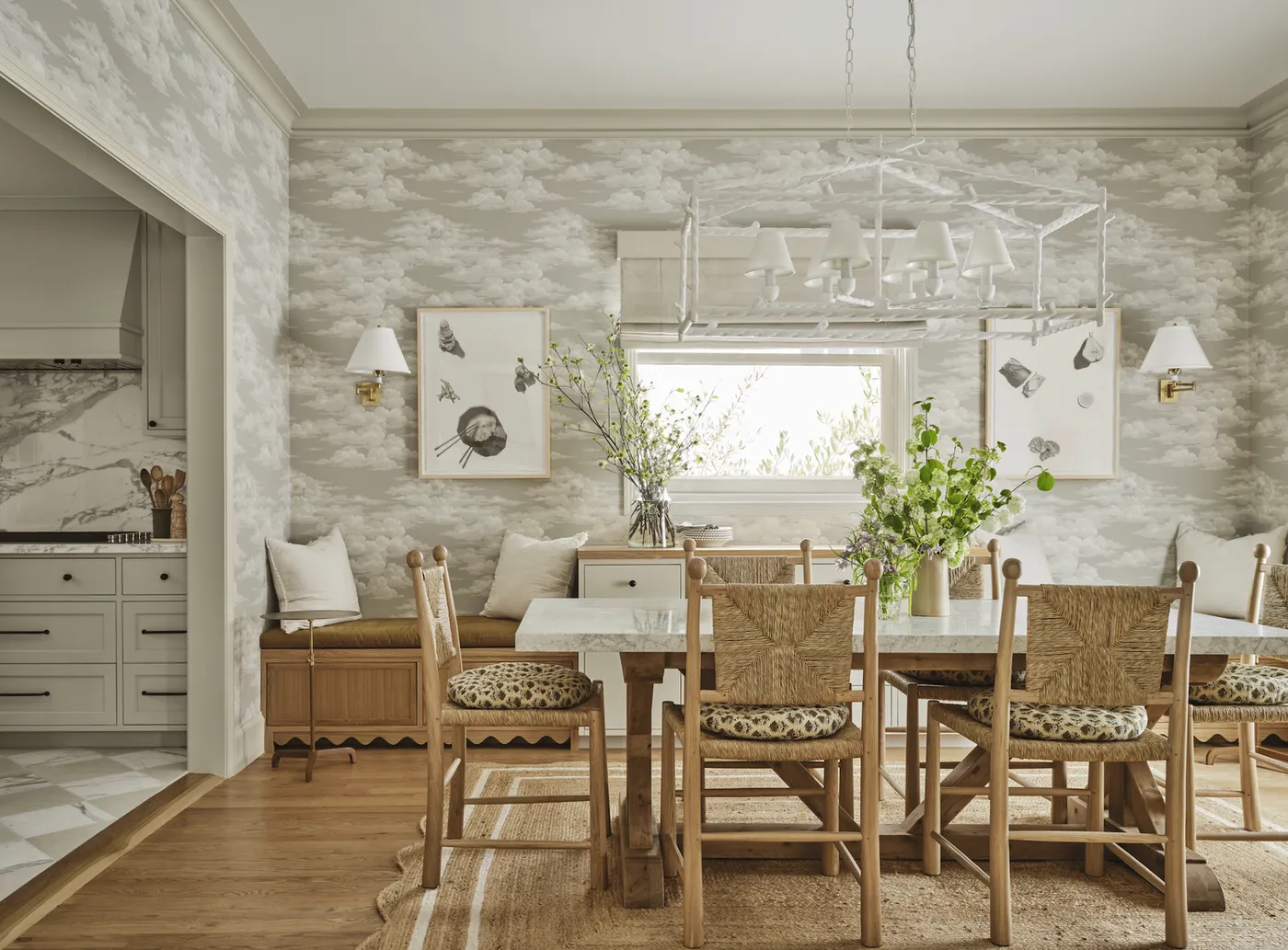
This setup works best in a room that’s at least 10 by 12 feet — enough space for the table, bench, and chairs without the wallpaper feeling overwhelming. If your dining area is smaller (say 8 by 10), skip the bench and use two chairs on each side to keep the footprint lighter. For rooms under 150 square feet, use the cloud wallpaper on just one accent wall behind the table rather than wrapping the whole space. Compare with Idea #14, which uses deep teal for a similar cocooning effect but with a darker, moodier approach.
5. January Decor That Balances Minimalism and Warmth
- Main furniture (neutral sofa + wood coffee table): $400–$900
- Lighting (floor lamp + table lamp): $80–$200
- Textiles (rug, throw blankets, pillows): $120–$250
- Decor/accessories (vases, candles, books): $50–$100
- Paint/wall treatment (if needed): $40–$80
- Total: $690–$1,530
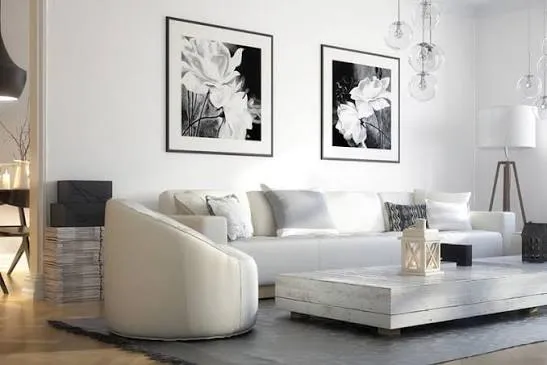
Here’s the real talk: this style looks simple but it’s actually harder to pull off than maximalism because every piece is visible and has to carry its weight. The neutral sofa shows every speck of dust, every pet hair, every wine spill. Light grey rugs? Same problem. If you have kids under six or a dog that sheds, go with a washable rug (Ruggable has great options starting at $129) and a sofa in a performance fabric like Sunbrella or a heavy-duty twill. The aesthetic works — just know what you’re signing up for maintenance-wise.
6. Concrete Fireplace Meets Snowy Windows in a Modern Retreat
The single element that defines this room is the concrete fireplace with its linear firebox. Without that long, low horizontal line, the space would lose its anchor. The firebox — with glowing logs visible — creates a warm focal point that balances the cold, bright window wall opposite it. Everything else in the room (the L-shaped sofa, the shag rug, the round poufs) orbits that fireplace. If you removed it, you’d just have a generic modern living room. With it, you have a destination.
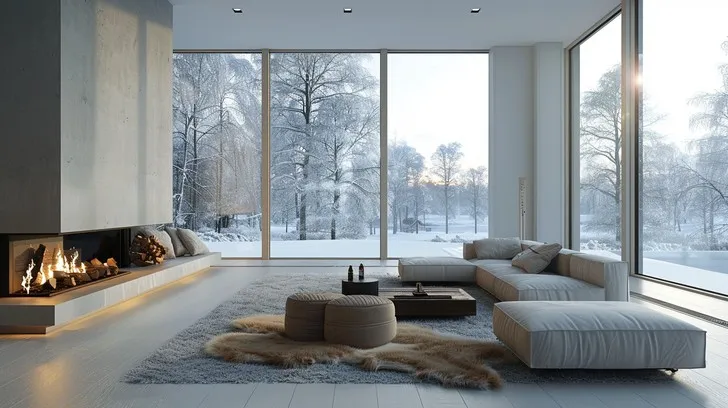
This room uses contrast pairing at its finest: the rough concrete fireplace against the smooth full-height windows, the soft shag rug against the sleek linear firebox, the round poufs against the hard-angled sofa. Each material contrast makes the other feel more intentional. The snowy landscape outside is the cold counterpart to the warm fire inside — nature is doing half the decorating work here. This is a masterclass in letting architecture and views coexist without competing.
7. Woven Chairs and a Faux Fur Throw — Texture Takes Center Stage
The texture formula here breaks down as 50% smooth (white fireplace, light walls, smooth floor) plus 30% woven (the black lounge chairs’ cane-like material) plus 20% plush (the faux fur throw, the soft pillows). That 20% plush is what keeps the space from feeling stiff or too modern. You could swap the black woven chairs for rattan or even dark wood with cane backs and the formula still works. The faux fur is the hero texture — try a sheepskin throw from IKEA for $29 as a budget swap.
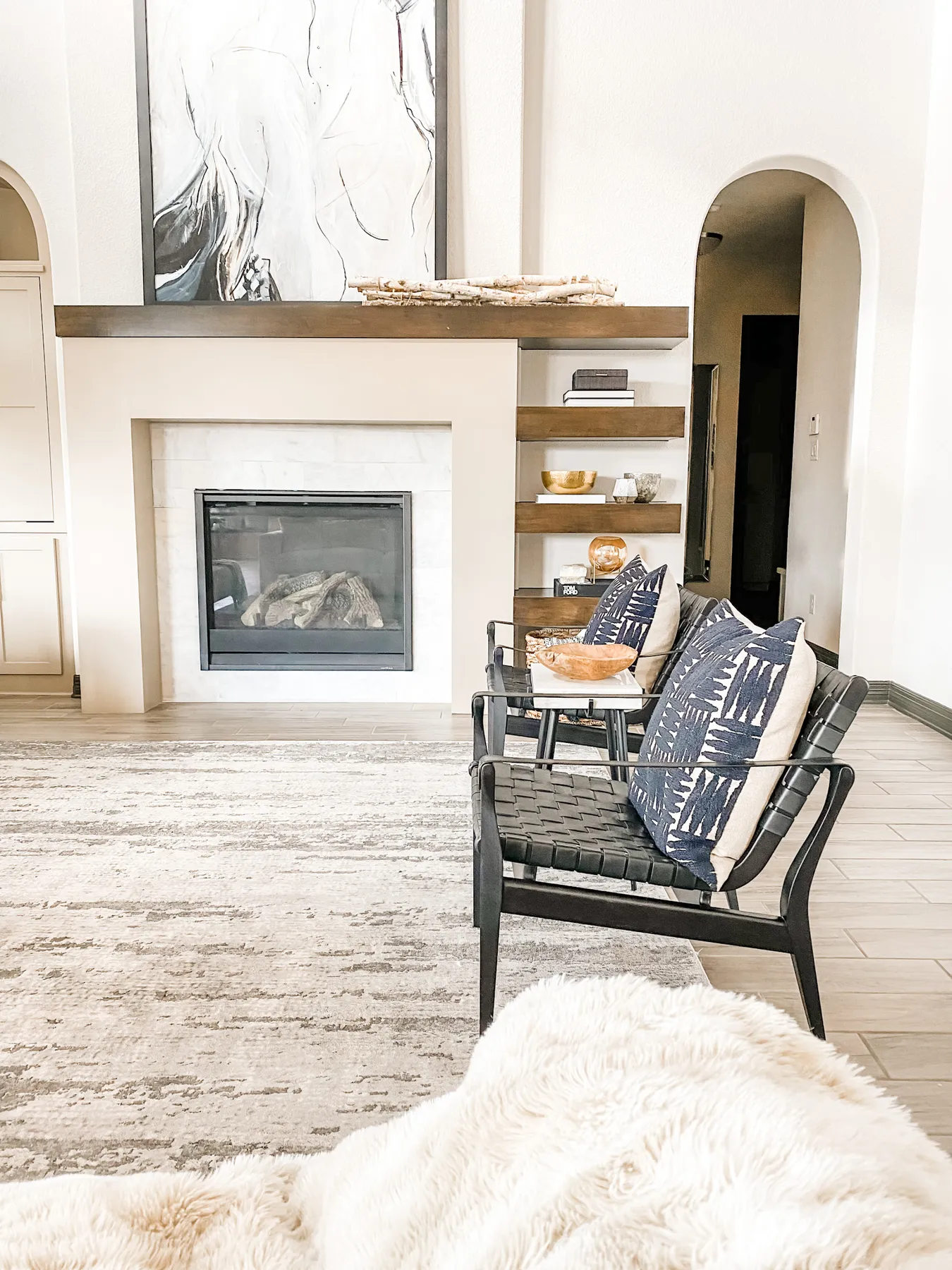
The black woven lounge chairs are doing double duty: they provide a dark visual anchor on the light rug while also introducing an open, airy silhouette that doesn’t block the fireplace. The blue and beige throw pillows tie the navy accents into the otherwise neutral room. And that faux fur throw draped in the foreground isn’t just decorative — it’s the tactile invitation that makes you want to sit down. Every texture here serves a specific compositional purpose, from the rough weave of the chairs to the soft pile of the rug.
8. Winter Bookshelf Styling With Pinecones and White Florals
- Start with a clean palette: Clear your shelves completely. Group items by height and color before placing anything back.
- Add the base layer: Place books on each shelf, alternating vertical and horizontal stacks. Stick to 2-3 colors of book spines max.
- Anchor with natural elements: Set the glass bowl of pinecones on one side and the white floral vase on the other — these create bookend visual weight.
- Add the focal point: The winter scene orb goes in the middle or slightly off-center on the main shelf. It’s the conversation piece.
- Finish with small accents: Tuck the candle, a small ceramic piece, or a tiny bottle brush tree in empty spots. Step back and adjust until no shelf feels heavier than another.
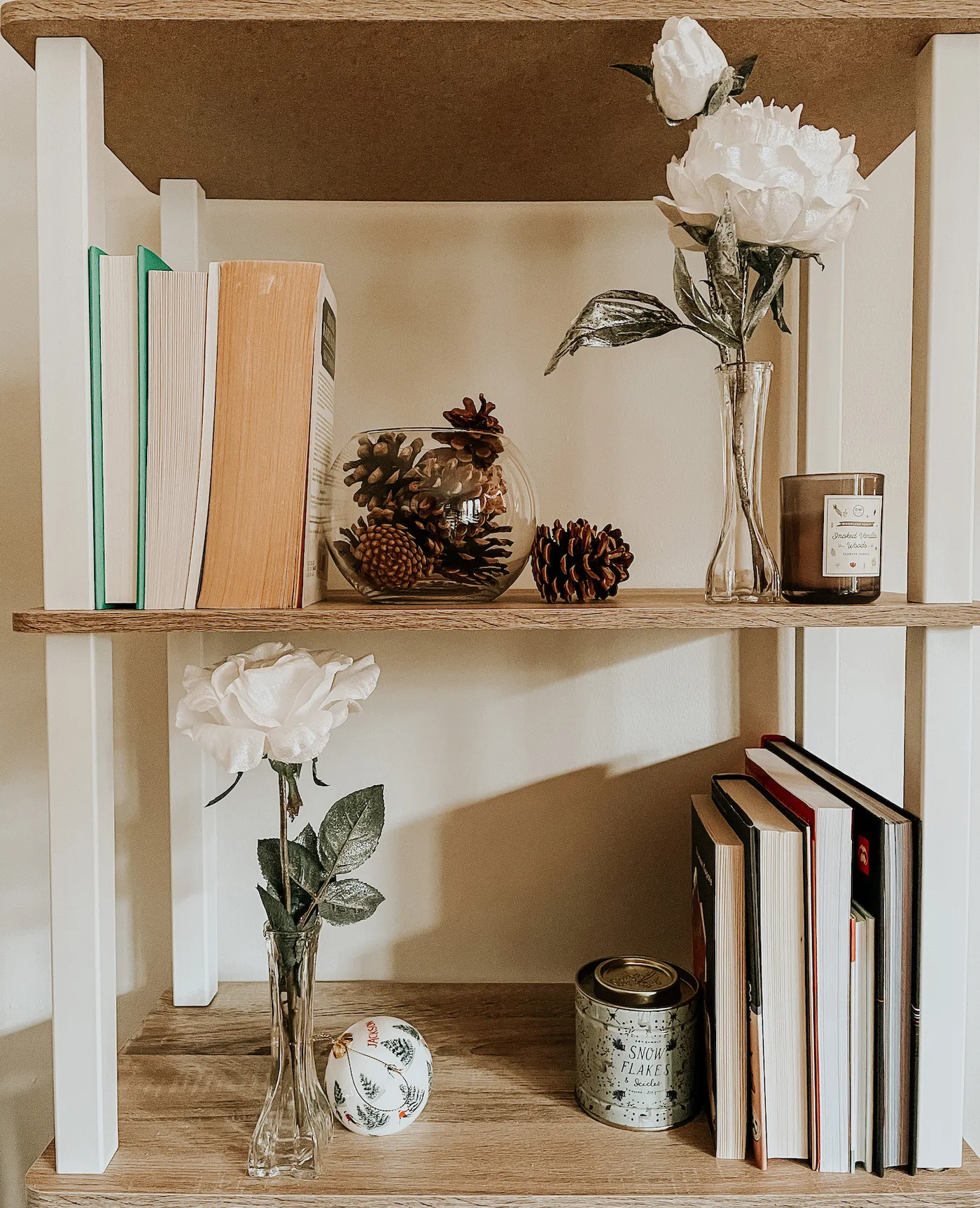
Total time: about 45 minutes. Material cost if sourcing from scratch: $40–$70.
You don’t need specialty winter decor to pull this shelf together. The pinecones? Free if you have a park nearby, or $4 for a bag at Michael’s. White faux peonies from IKEA are $6 each. The glass bowl is $4.99 at Target. Even the winter orb can be swapped for any clear glass ornament or a small terrarium from a thrift store ($2–$5). The whole shelf can be styled for under $35 if you’re willing to DIY the floral arrangement and forage for pinecones. Compare with Idea #24, which goes all-in on fairy lights and ceramic houses for a brighter, more maximal take.
9. Woven Wicker and a Warm Fireplace — Texture Layering at Its Best
The designer trick here is the wicker coffee table doubling as a storage ottoman — in a living room that already has a fireplace and a TV, you need surfaces that do double duty. The wicker adds warmth (it softens the gray sofa and cream armchair) and the open weave keeps the visual weight light. If you’re replicating this, match the wicker tone to your floor’s undertone. Here, the warm brown wicker echoes the wood trim on the windows. If your floors are grey-toned, go with a darker or black-stained wicker to maintain contrast.
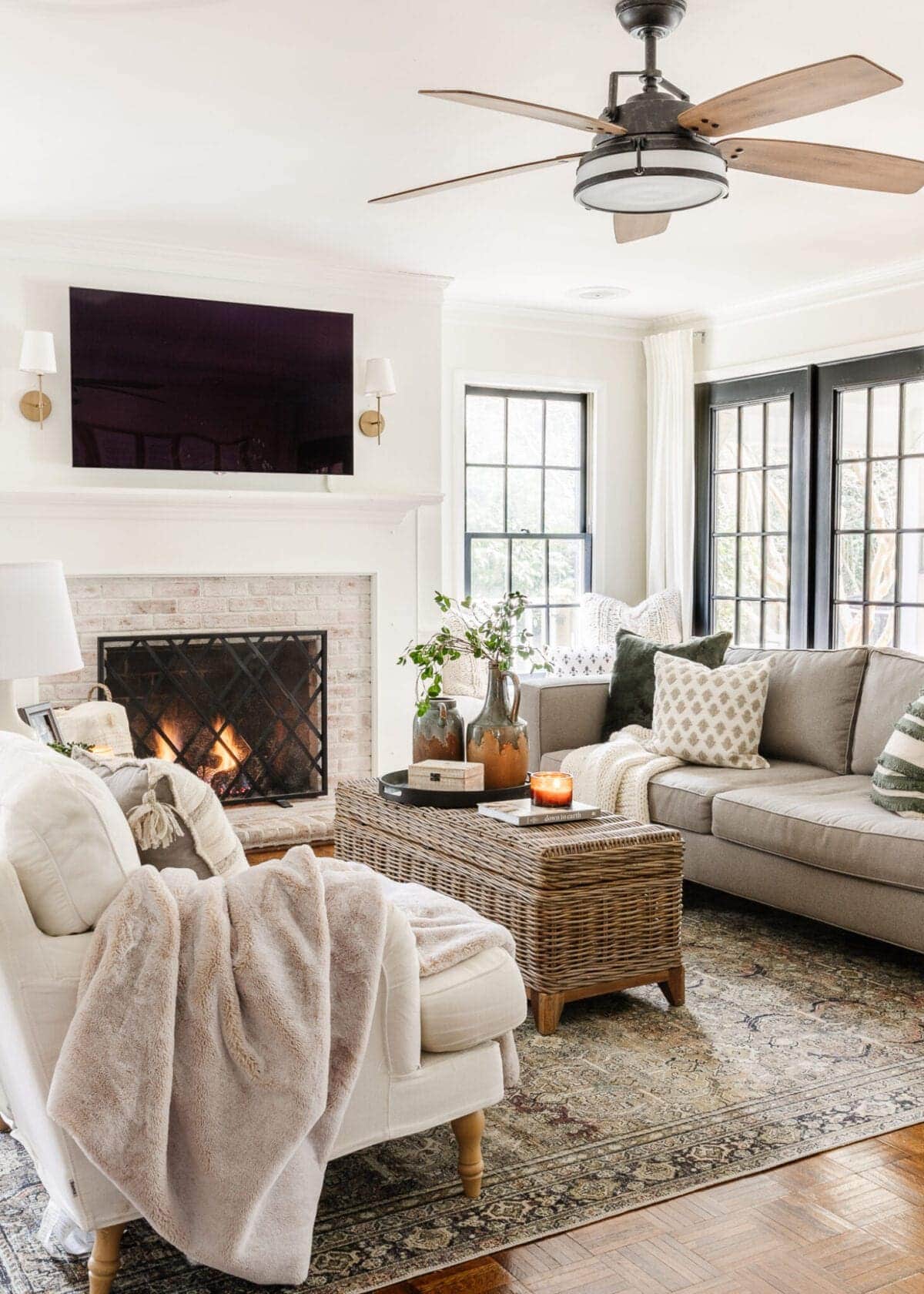
The cream armchair and gray sofa are the big-ticket items, but you can capture this exact vibe on a budget. The cream armchair can be swapped with the IKEA Strandmona ($399) in a light beige. The gray sofa? Wayfair’s 72-inch linen sofa in charcoal is around $350. The wicker coffee table/storage ottoman is the easiest find — Target has a round woven storage ottoman for $89 that looks nearly identical. The faux fur throw is $12.99 at Walmart. Total with all textiles and decor: around $950 versus $3,200+ for the designer originals.
10. Built-In Shelving and Snowy Views — This Dining Area Delivers
that elevates this dining area beyond a table + chairs + window situation is the built-in white shelving unit to the left. It transforms what could be a standard eat-in kitchen corner into a proper dining room moment. The shelves provide vertical storage that balances the horizontal weight of the table and the expansive window. Without that shelving, the eye would go straight to the snow outside and the furniture would feel disconnected from the room. With it, the whole composition feels grounded and curated — like the space was designed around how you actually live and eat.
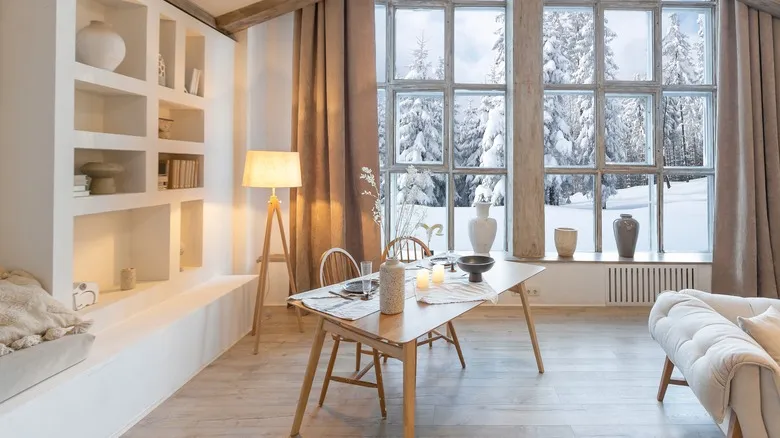
This dining setup needs a wall at least 8 feet wide for the built-in shelving plus the table to coexist without crowding. The room itself should be a minimum of 11 by 13 feet — enough for the table to have 36 inches of clearance on all sides. If your dining space is narrower (under 10 feet wide), use a wall-mounted console instead of full built-ins to get the same storage effect without eating into the room. For smaller spaces, check Idea #14 — that dining nook uses a round table and gallery wall to maximize a tighter footprint.
11. Stone Fireplace, Evergreen Branches — Rustic Winter at Its Best
The stone fireplace facade is stunning but it’s a dust collector — those crevices will trap cobwebs and soot within weeks. Plan to dust it with a soft brush attachment on your vacuum every two to three weeks during winter. The evergreen branches in the dark vase are temporary decor; they’ll dry out and drop needles within 10 to 14 days. Either budget for fresh replacements ($8–$12 a bunch at Trader Joe’s) or switch to good-quality faux evergreens that can be dusted and reused. The cream knit throw will pill and show wear — wash it on a gentle cycle once a month or budget $30 to replace it yearly.
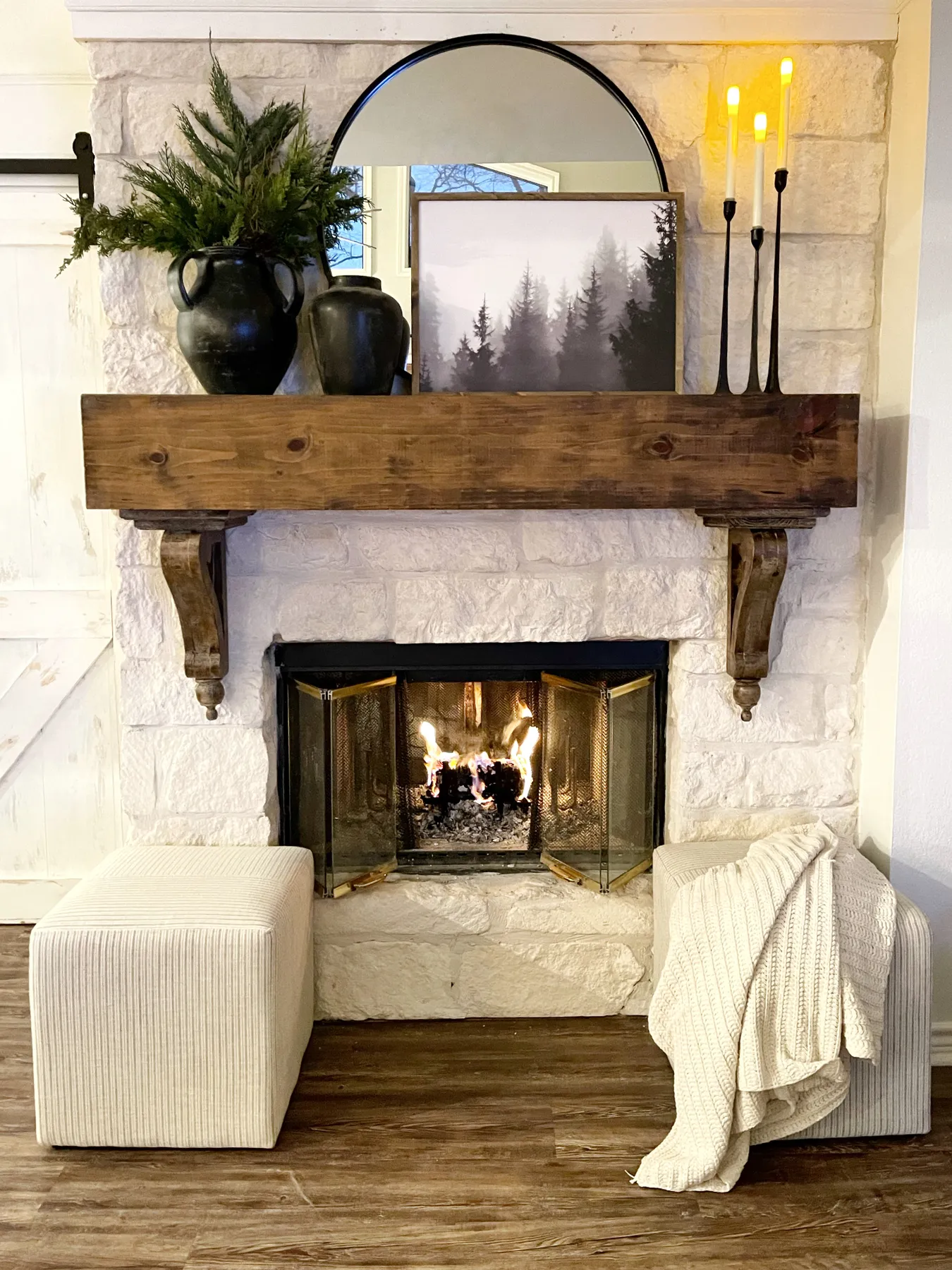
This room uses the golden ratio in its layout. The fireplace occupies about 60% of the wall’s width, leaving enough negative space on either side for the dark mirror and greenery. That asymmetry — the tall vase on the left, the framed mirror on the right — creates more visual interest than a symmetrical setup would. The black arched mirror also introduces a curved line that breaks up all the hard vertical and horizontal edges. It’s a small detail, but it’s the difference between a fireplace that feels decorated and one that feels composed.
12. A Reading Nook So Cozy You’ll Never Want to Leave
- Choose the right chair: Pick an armchair with deep enough seating to drape a throw without it falling off — at least 22 inches of seat depth.
- Layer two textures: Drape the white shaggy throw first, then fold the beige cable knit blanket over the back so both textures are visible.
- Set the side table: Position it within arm’s reach — 6 to 8 inches from the chair arm — so candles and a mug can rest without you having to lean.
- Light it warmly: Use flameless candles or real ones (with a tray) at varying heights — the pinecones add a natural element that softens the candle’s formality.
- Bring in background glow: String lights on the nearby fireplace (even if it’s not lit) create a secondary light layer that makes the nook feel like a destination.
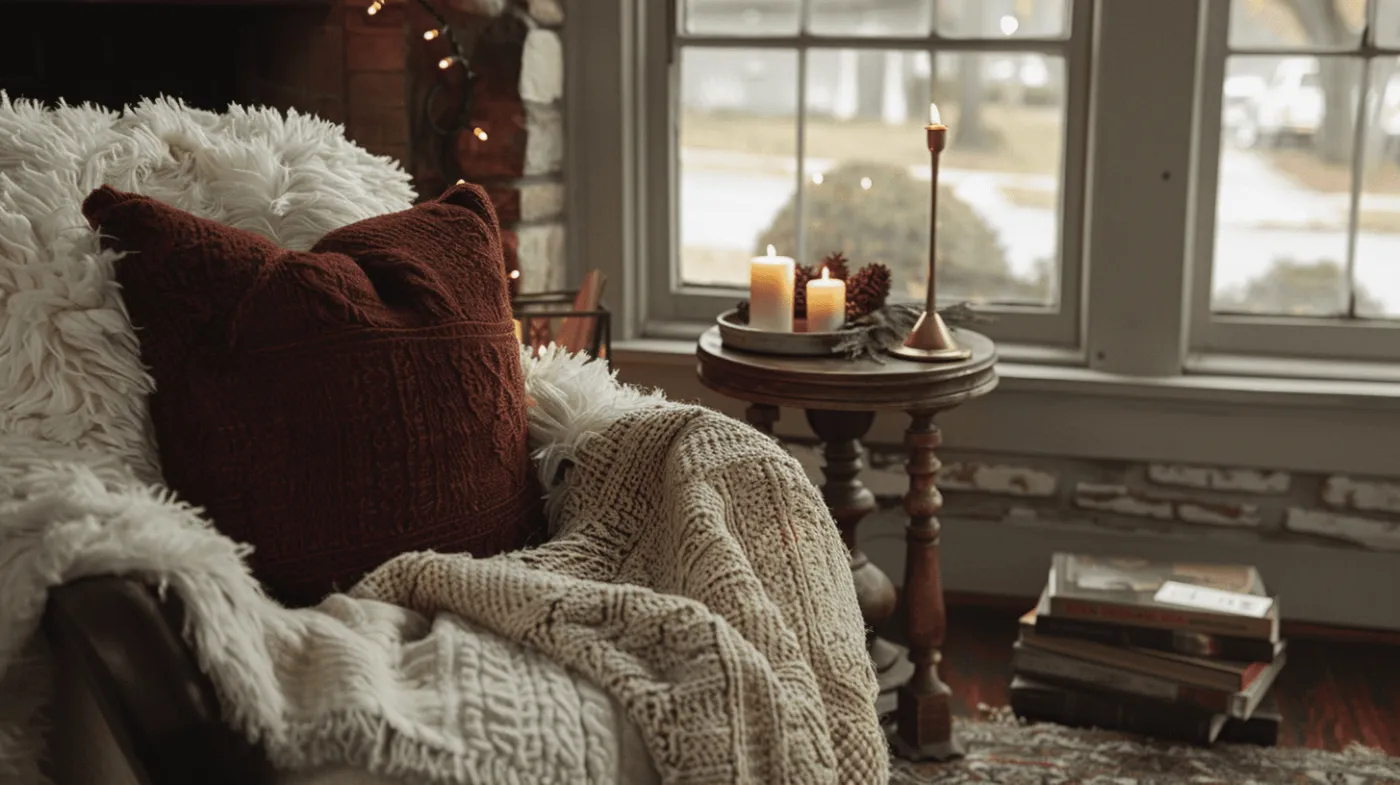
The designer tip here is about the rust-colored cable knit pillow — it’s the only warm-toned element in an otherwise neutral palette. That one pop of burnt orange keeps the nook from feeling like a waiting room. When you’re building a cozy corner like this, always add one “temperature” piece — something in rust, ochre, or even a deep burgundy. It tricks the eye into feeling warmth even before you sit down. Everything else (the shaggy white, the beige knit, the dark wood) plays backup to that single accent.
13. A Sculptural Pleated Lamp Steals the Show in This Minimal Space
The pleated table lamp with a ribbed pink base is having a moment in 2026, and it’s part of a larger shift toward “sculptural lighting” — fixtures that function as art even when they’re off. Designers are moving away from standard dome shades and toward organic silhouettes that add personality to neutral rooms. This lamp would look equally at home in a Japandi-inspired space or a maximalist setup. The trend has staying power because it taps into the desire for one-of-a-kind pieces without going fully custom. Ceramic and plaster-based lamps with tactile finishes are the next iteration of this look.
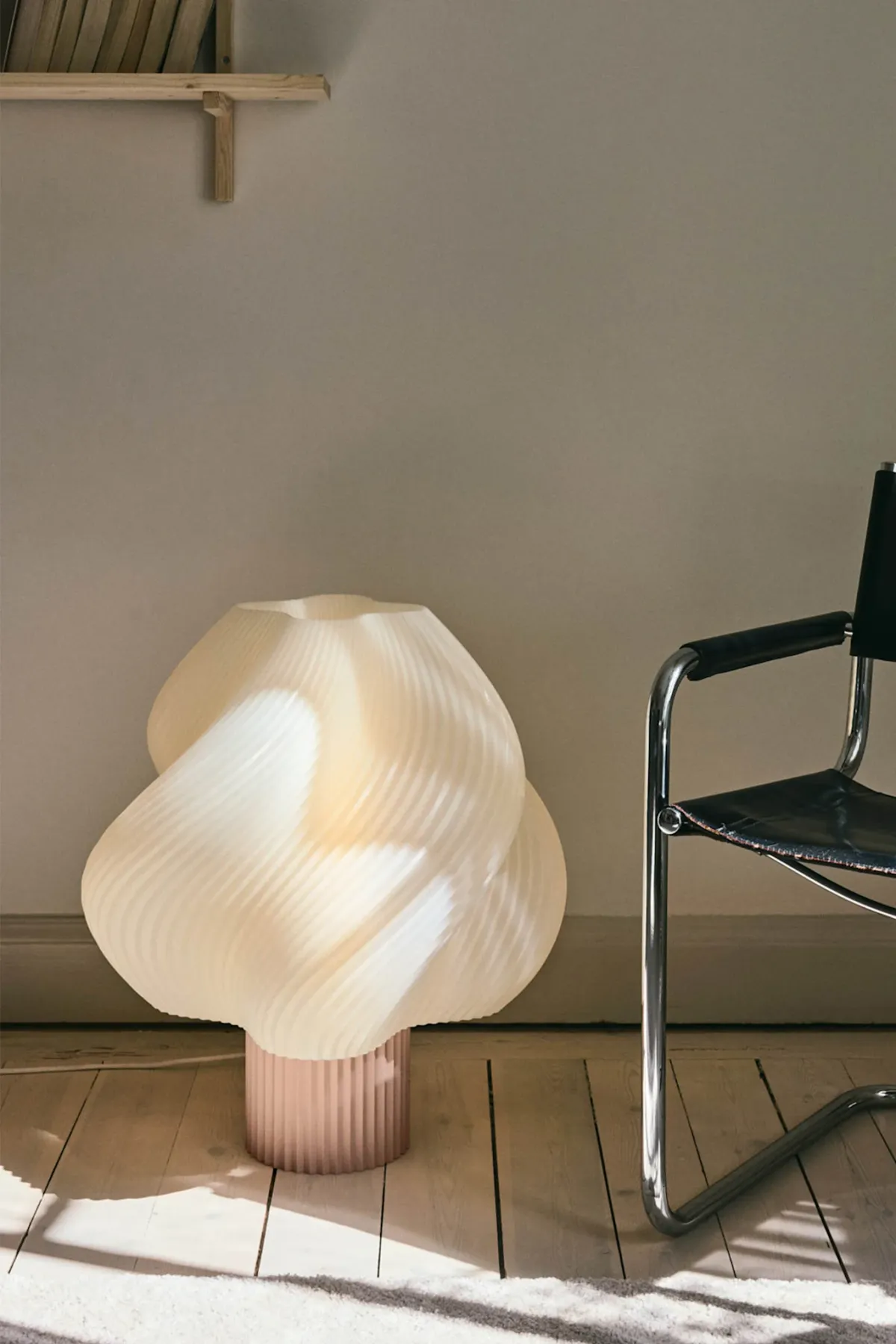
that makes this corner work is the lamp’s pleated shade paired with the ribbed pink base — you get two textures from one object. In a room that’s otherwise restrained (light wood floors, a cream rug, a chrome-and-black chair), that lamp is doing all the heavy lifting for visual interest. Without it, this would just be a chair next to a wall. With it, it’s a vignette. The pink base also introduces the only warm color in the frame, which is exactly why it catches your attention first. It’s a masterclass in letting one piece earn its keep.
14. Deep Teal Walls, Plaid Sofa, Cognac Leather — Drama Done Right
The color formula here is a masterclass in rich neutrals: 40% deep teal (walls and window frames), 30% cognac and warm brown (leather chair, wood tones), 20% mixed pattern (the plaid sofa’s grey and olive tones), and 10% metallic accent (the brass floor lamp). That 10% brass is crucial — it adds a reflective surface that catches light in a room full of matte textures. Swap the teal for a deep navy or forest green and keep the same formula. Swap the cognac for a burgundy or rust and the mood shifts from sophisticated to bohemian.
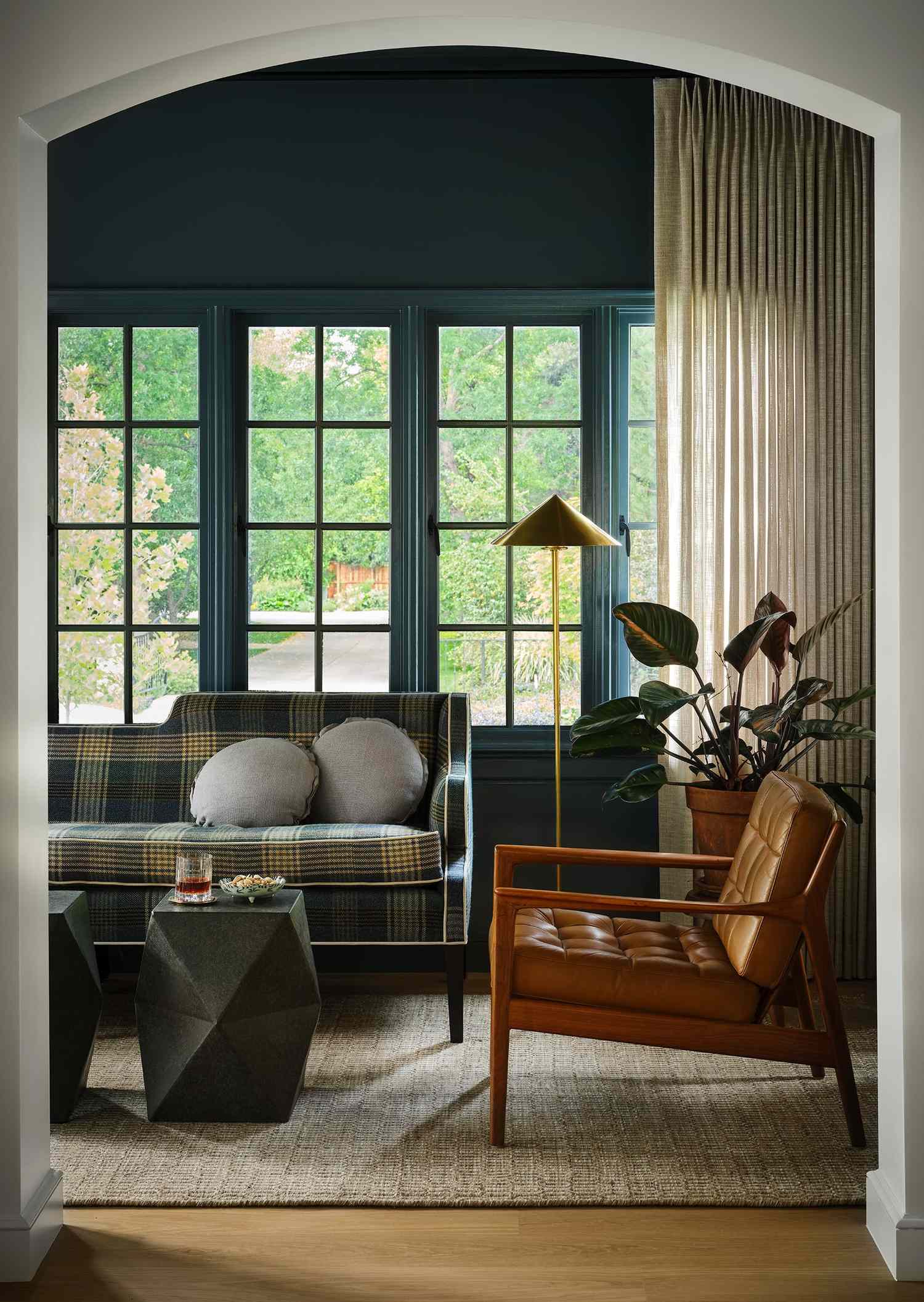
The cognac leather armchair can be found for around $350 on Amazon (check the Christopher Knight Home line) versus the $1,200+ designer original. The plaid sofa is the harder piece to duplicate, but a grey slip-covered sofa from IKEA (the Kivik, $699) with plaid throw pillows from Etsy ($25–$40 each) will get you 90% of the look. The deep teal paint is the easiest budget win — one gallon of Valspar’s “Deep Onyx” or Behr’s “Ink Well” at $35 will transform the room. The brass floor lamp? Target’s Opalhouse line has one for $49. Total budget setup: around $1,300 versus $4,500+ for the designer version.
15. A Gallery Wall Dining Nook With Pampas Grass and Cane Chairs
- Measure your wall space: You need at least 5 feet of wall width for the gallery wall to read as intentional, not sparse.
- Check your table size: A round table under 36 inches in diameter will look lost against a statement gallery wall — 40 to 44 inches is the sweet spot.
- Confirm ceiling height: The pampas grass in the bust vase reaches about 40 inches — make sure your ceiling doesn’t make it look too tall or too short.
- Test the light: This nook needs either a direct light source above the table or good natural light from a nearby window — the gallery wall needs to be lit to be appreciated.
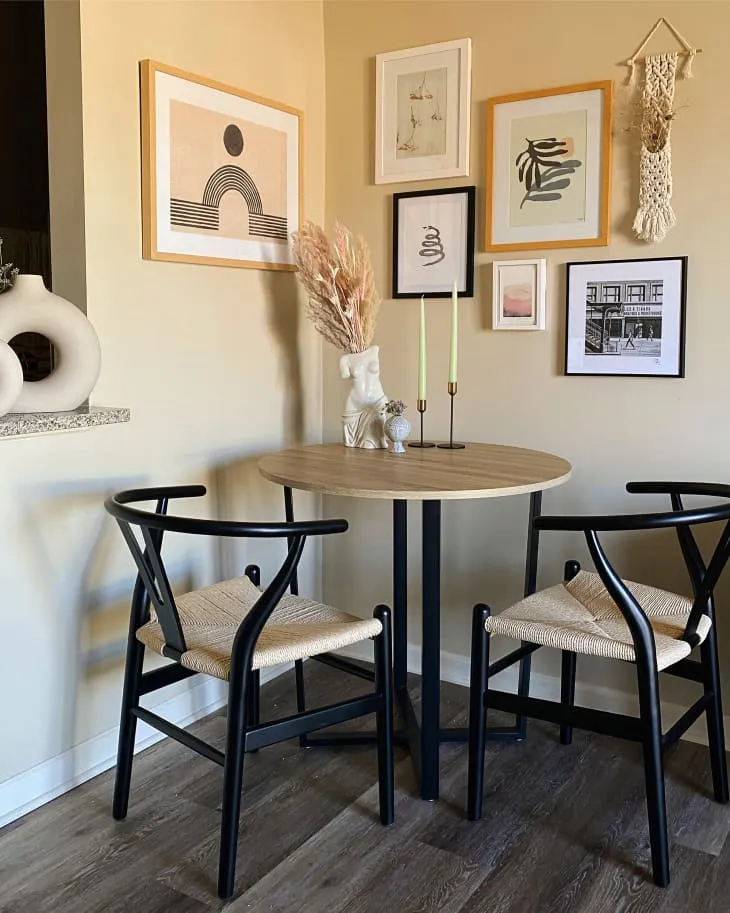
- Lay out the gallery on the floor first. Arrange frames in a loose organic cluster — avoid perfect grids. Mix a 16×20 with an 8×10 and a 5×7 to create rhythm.
- Use paper templates. Trace each frame onto kraft paper, cut them out, and tape them to the wall. Live with the layout for a day before committing to nail holes.
- Anchor with the macrame. Place the macrame hanging slightly off-center to soften the gallery wall’s hard rectangular edges.
- Add the dried florals last. The pampas grass in the bust vase should feel like it’s standing apart from the gallery, not competing with it — leave 8 to 12 inches of breathing room between the vase and the closest frame.
16. Luxurious Warmth for Your Living Room This Winter
- Main furniture (sectional, coffee table, side tables): $800–$1,800
- Lighting (floor lamps, table lamps): $150–$350
- Textiles (rug, throw blankets, pillows): $200–$400
- Decor/accessories (vases, candles, wall art): $100–$250
- Paint/wall treatment (accent wall, trim): $50–$120
- Total: $1,300–$2,920
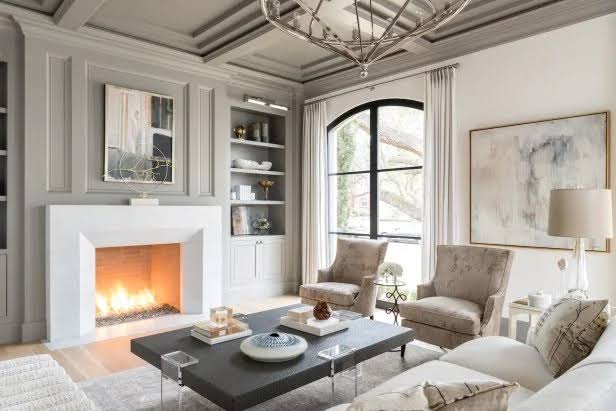
Here’s the real talk on achieving this level of cozy luxury: the velvet and chenille textures that make this room look expensive are also the most fragile. Velvet shows every pet hair and compression mark — if you have cats, skip velvet or invest in a lint roller you keep in every room. The metallic accents (brass, gold) need periodic polishing or they’ll develop a patina that some people love and others think looks tarnished. The good news? The throw blankets and pillows are easy and cheap to replace. Budget $100 a year to refresh them and the room will feel new every winter.
17. Fairy Lights and a Hot Drink — This Balcony Is Winter-Ready
The designer trick for outdoor winter spaces like this is using lighting in three layers: fairy lights on the railing (eye level), lanterns on the floor (ground level), and candles on the table (tabletop level). Most people only do one level, which makes the space feel flat. Here, the fairy lights create a glowing perimeter, the white lanterns anchor the corners, and the candles on the coffee tray give the seating area its own intimate glow. Three layers of light at different heights will make any small outdoor space feel like a cozy room.
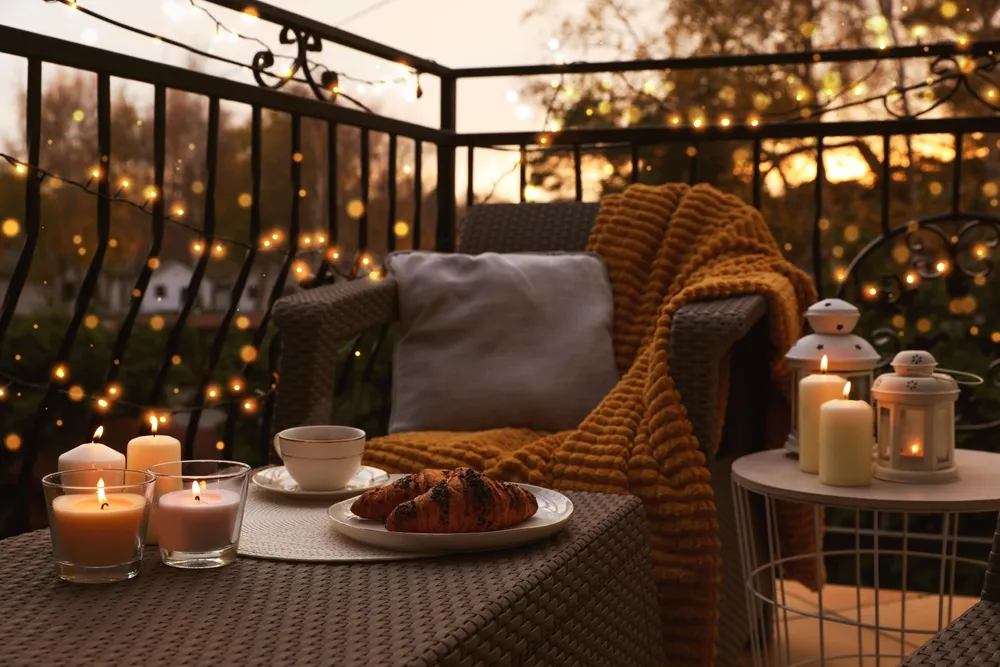
that transforms this balcony from ‘we have some lights out here’ to ‘this is a winter destination’ is the hot drink + croissant setup on the tray. It signals occupation — this space is for enjoying, not just looking at. The mustard yellow knitted throw on the rattan chair is the visual exclamation point that says someone lives here and stays warm. Without that personal, lived-in touch (the mug, the throw, the book that’s just out of frame), you’d just see furniture with lights. The human elements are what make this space magnetic.
18. Wood-Paneled Cabin Living With a Concrete Fireplace and Snow Views
This room works because of the warped perspective created by the angled wood-paneled ceiling. The sloping lines draw your eye both upward (to the peak) and outward (through the glass doors toward the snowy landscape). The concrete fireplace acts as a visual stopper — its solid horizontal mass keeps the eye from traveling straight out the windows. The tension between the angled ceiling’s dynamic energy and the fireplace’s grounding weight is what makes this space feel dramatic but not cold. The orange decorative bowl on the dining table is the only warm accent in a sea of cool tones, which is exactly why it stands out.
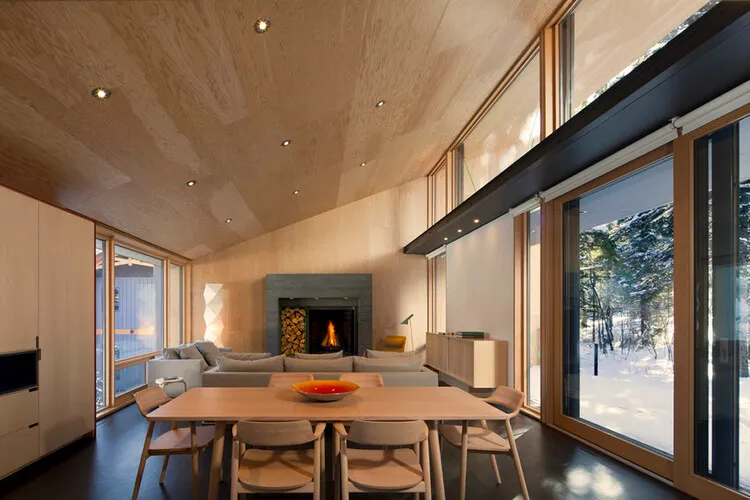
This cabin aesthetic needs at least 300 square feet of open floor plan to breathe — the angled ceiling and concrete fireplace need space around them or they’ll feel oppressive. Minimum ceiling height at the peak: 9 feet. The glass sliding doors should ideally face north or east to capture the snowy view without overheating the space with direct afternoon sun. If you’re working with a standard 8-foot ceiling, skip the full wood paneling and use it as a partial accent wall instead. This is a look for larger, open-concept spaces — for a cozier version, see Idea #10, which achieves a similar warm wood feel in a smaller dining area.
19. A Cat-Napped Neutral Living Room With Fireplace and Open Shelving
The cat sleeping on the sofa is doing a lot of the heavy lifting here — but if you want this look without the feline, the budget breakdown still works. The off-white sofa is the biggest investment, and you can score a similar look at IKEA (the Kivik in beige, $699 for a three-seat with chaise). The white open shelving above the fireplace can be replicated with the IKEA Lack shelf ($14.99 each) painted white. The large white oval ceiling light is trickier but Home Depot has a similar oval flush mount for $89. The black side table can be found at Target for $35. Total to recreate this room for under $1,000? Yes — the biggest savings come from accepting that ‘off-white’ doesn’t have to mean expensive.
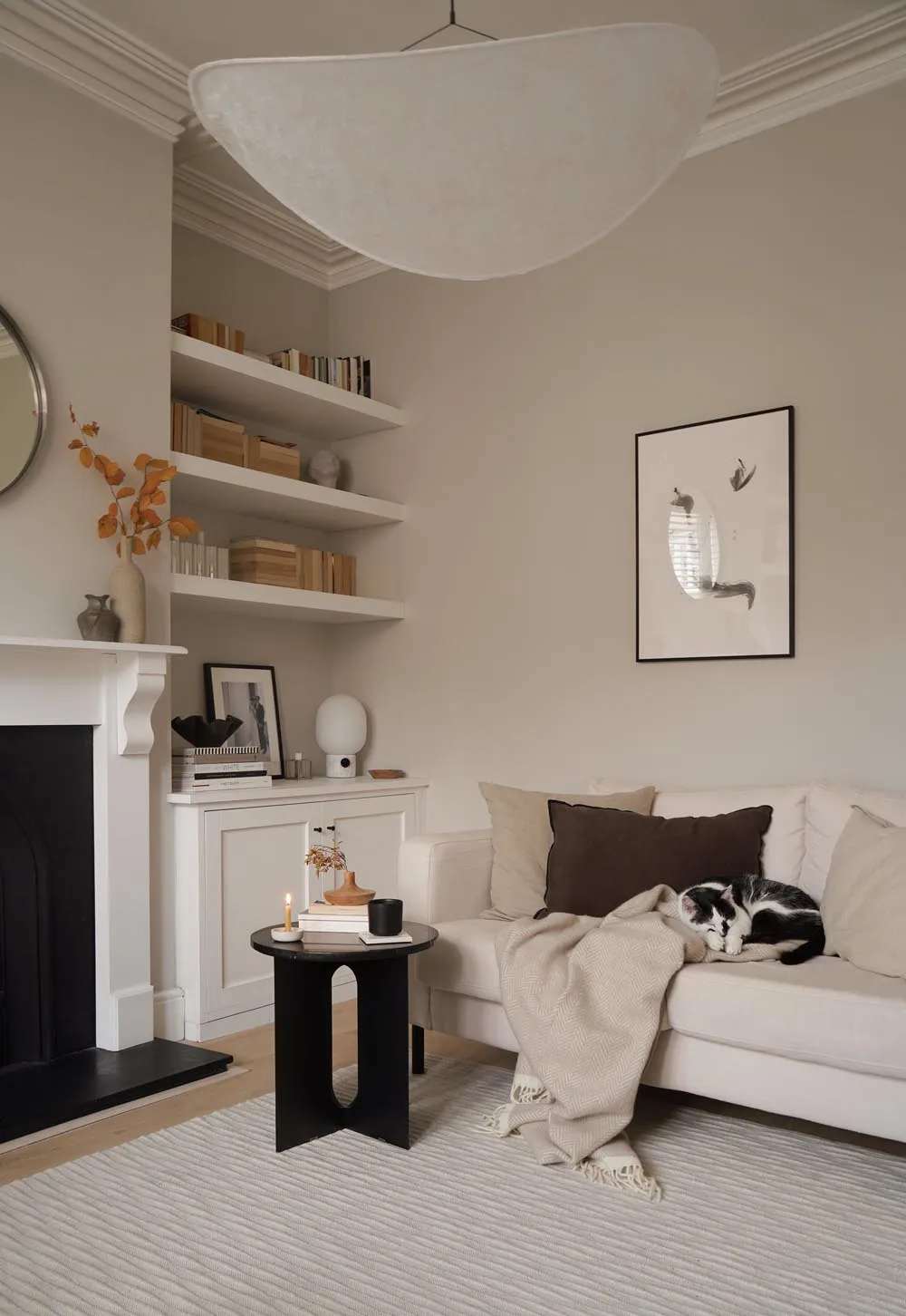
The style formula here is 80% neutral ground (white walls, white shelves, light rug, off-white sofa) plus 15% dark anchor (the black fireplace insert, black side table, dark brown cushion) plus 5% living element (the cat, or in your case, a plant or a stack of books). That 5% matters more than you think — take away the cat (or a comparable organic element) and the room goes from cozy minimalist to sterile. If you don’t have a pet, put a large snake plant in a dark ceramic pot in the corner. It’ll do the same job visually — adding life without adding clutter.
20. Terracotta Walls and a Gallery Wall — A Bedroom That Tells a Story
- Paint the accent wall first. Use a deep terracotta — think dried clay, not pumpkin. Benjamin Moore’s “Spice Cabinet” or Sherwin-Williams’s “Cavern Clay” are spot-on.
- Plan your gallery layout. Go with all gold frames (mix of brass, antique gold, and champagne) for a collected-over-time feel. Vary sizes but keep frame colors consistent.
- Layer the bed. Start with the beige duvet as your base, add the gray patterned throw at an angle, then drape the cable knit throw across the foot. The key is asymmetry — don’t fold anything perfectly.
- Drape the garland. The fairy lights and wooden bead garland go over the headboard, not around it. Let it hang unevenly — the relaxed drape keeps it from looking like a holiday decoration.
- Add the personal elements. The gold-framed family photos should include a mix of old (black and white) and current — the contrast tells the story of time passing.
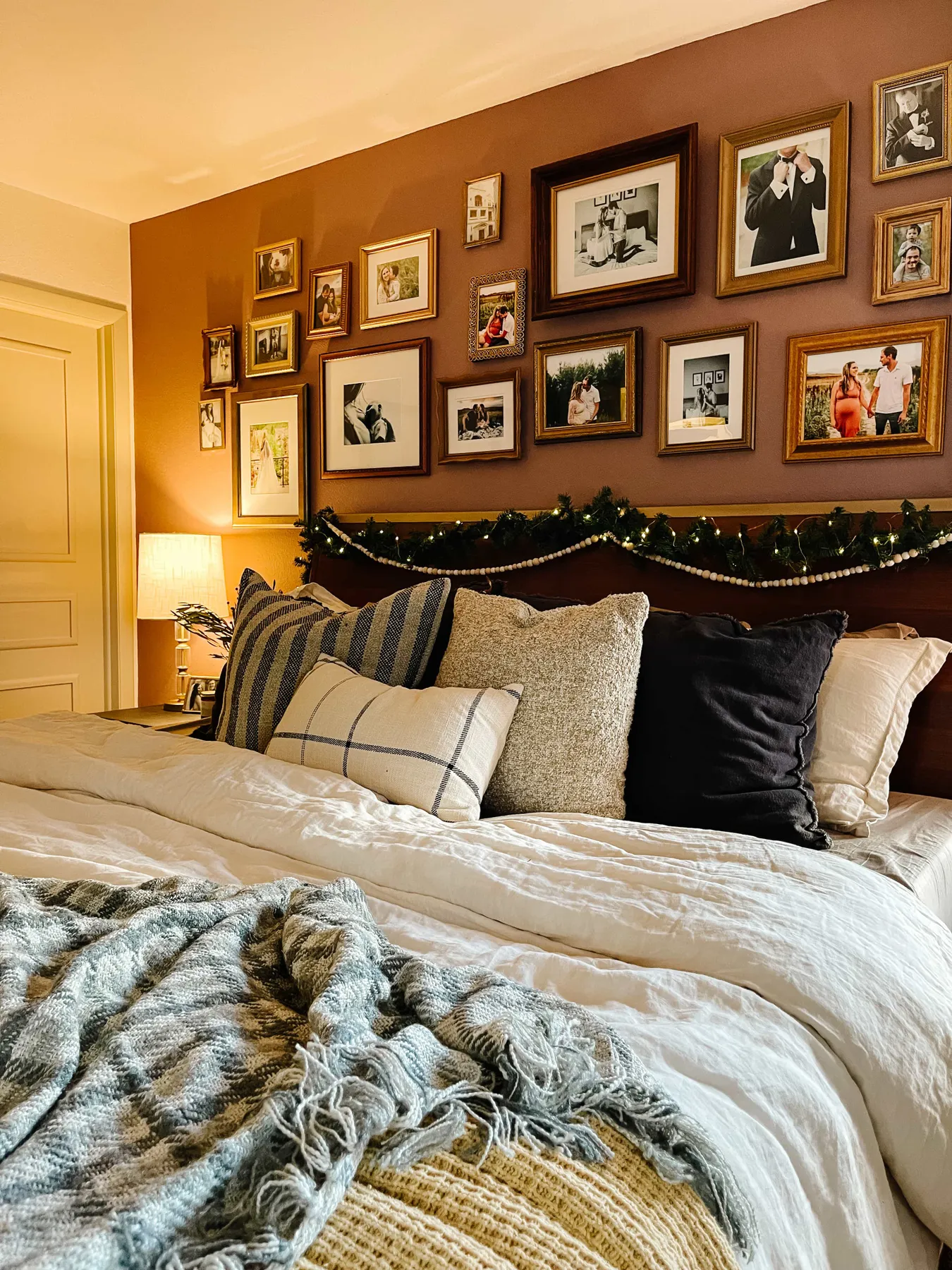
that makes this bedroom unforgettable is the fairy light and wooden bead garland draped over the headboard. It’s not a holiday garland — it’s a year-round piece that signals rest and ritual. Without it, the room would be beautiful but reserved. With it, the space becomes a sanctuary. That single, unexpected element (lights that aren’t just for December, beads that aren’t just for boho rooms) is what pushes this bedroom from ‘well-decorated’ to ‘personal.’
21. Eye-Catching Interior Decor for January — Calm and Layered
Real talk about making a calm space work for actual living: This look relies on a restrained palette, which means anything that doesn’t match (kids’ toys, mail, a bright blue water bottle) will stand out like crazy. If you’re someone who likes surfaces to stay clear, this style is your dream. If you tend to accumulate stuff, you’ll either need closed storage (baskets, cabinets) or you’ll be constantly tidying. The calm aesthetic requires about 15 minutes of daily reset to maintain — fluff the pillows, fold the throws, clear the coffee table. It’s not high-maintenance, but it’s not zero-maintenance either.
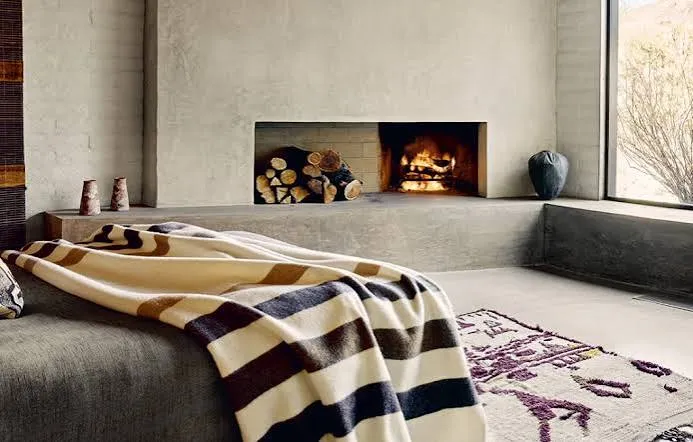
Another thing to consider: The layered neutral textiles that make this room look so inviting (the chunky throws, the plush pillows, the soft rugs) all require different care. That cream-colored chunky knit blanket? Most can’t go in the washing machine — they need hand washing or dry cleaning. The light grey rug in a high-traffic area? Plan to spot-clean every few weeks and professional clean once a year ($50–$100). The pillows with removable covers are your best bet — they can be zipped off and tossed in the wash. If you’re building this look, prioritize pieces with removable, washable covers. Your future self will thank you.
22. A Dark Green Library Living Room With Sage Chairs and Built-Ins
This room works because of the interaction between the dark olive green walls and the two sage green armchairs. They’re in the same color family but at different saturations — the walls are deep and matte, the chairs are lighter with exposed wood frames that read almost as furniture-as-architecture. The cream curtains with dark vertical stripes are the smartest element here: the stripes echo the vertical lines of the bookshelves and the window frames, creating a rhythm that organizes the whole wall. The patterned area rug in muted grey-green anchors the seating area without competing with the walls — it’s lighter, which keeps the floor from feeling heavy.
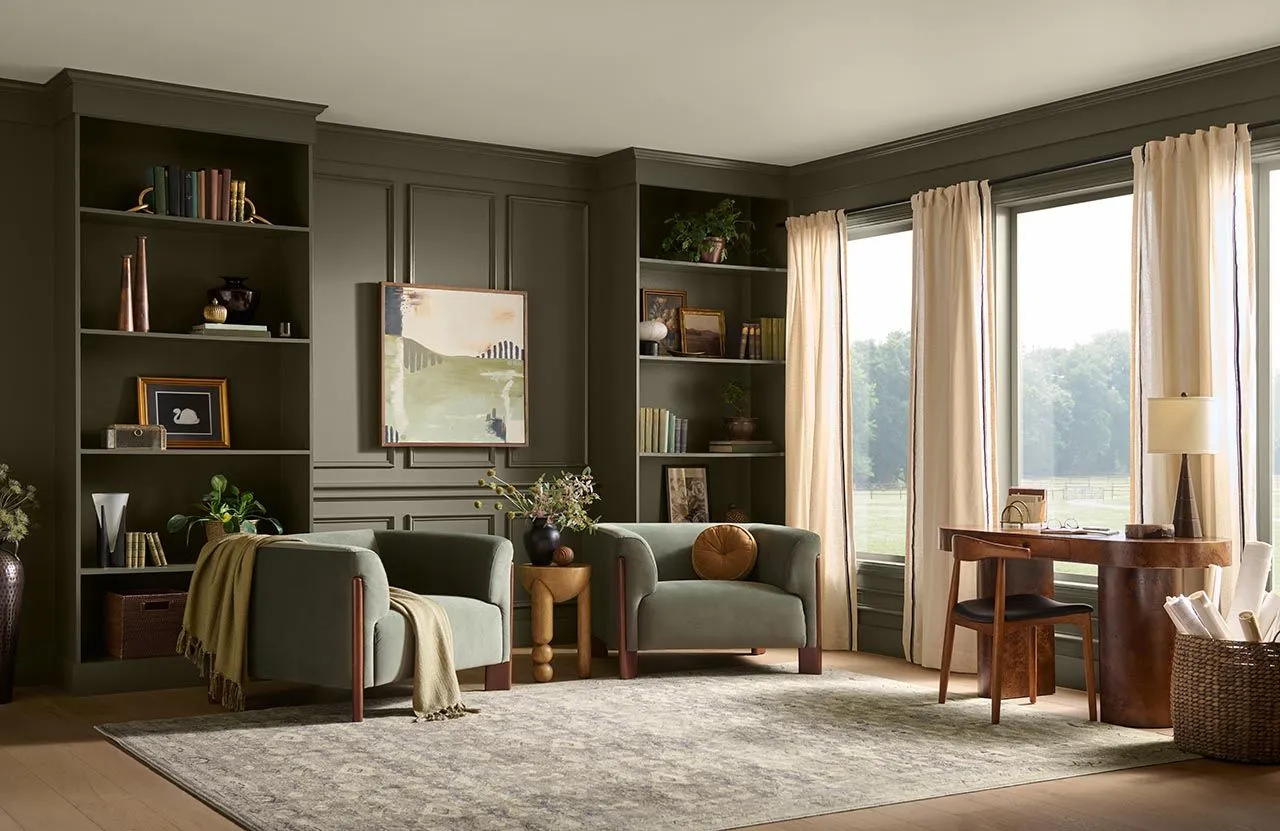
The designer trick here is the cream curtains with dark vertical stripes. In a room with dark walls, light-colored curtains can sometimes look like they’re floating disconnectedly. The vertical stripes anchor them to the wall visually by repeating the lines of the built-in shelves and window mullions. If you’re doing dark walls, always add a linear element (striped curtains, a tall bookcase, vertical paneling) that breaks up the flat expanse of color. And keep the curtain rod 6 to 8 inches above the window frame — it makes the ceiling feel higher and draws the eye up past the dark walls.
23. Silver Mercury Glass and White Pom-Poms — Winter Entryway Magic
This entry table setup screams designer styling, but every single piece can be found at affordable prices. The white console table is everywhere this season — Wayfair has a farmhouse-style table for $149, and Amazon’s similar version is $129. The silver mercury glass table lamp? At Home has one for $29.99. The wooden ‘hello’ sign is a Target dollar spot find for $3–$5. The grey woven basket with white faux fur is easy to DIY — buy a $15 basket and a $10 faux fur throw from Walmart, line the basket, and tuck the throw over the edge. Total entry table + mantel decor for under $200, including the garland.
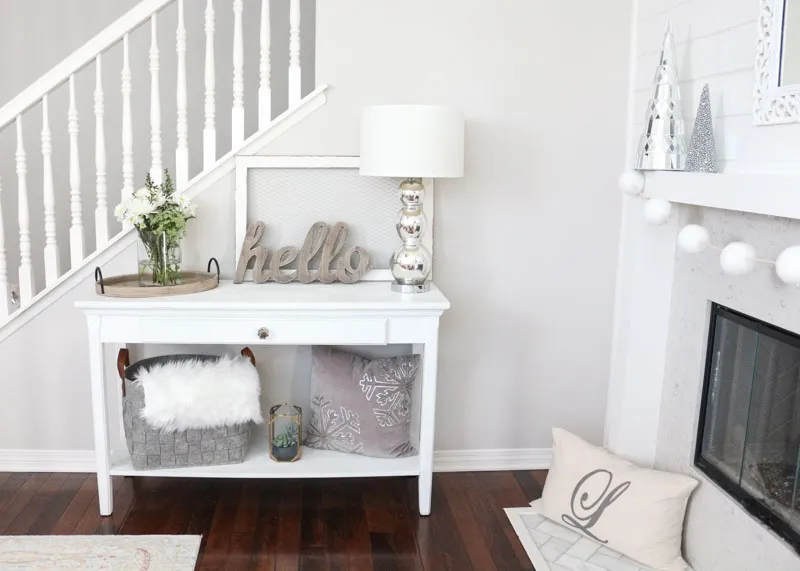
The silver mercury glass pieces on this mantel are beautiful but they show fingerprints within hours. Plan to wipe them down with a microfiber cloth weekly. The white pom-pom garland will collect dust (especially near a fireplace where air circulates) — vacuum it gently with a brush attachment every two weeks or toss it in a garment bag on a delicate wash cycle if it’s machine-washable. The faux fur in the basket will mat down in high-traffic areas — fluff it with your fingers or a pet slicker brush (yes, really) to restore its texture. If you’re near an active fireplace, keep the faux fur and pom-poms at least 3 feet from the hearth to prevent heat damage.
24. White Bookcase, Fairy Lights, and a Mini Winter Village
- Clean each shelf and lay out your items by height. Group the ceramic houses together, the bottle brush trees together, the frames together. This helps you see what you’re working with.
- String the fairy lights first. Use tiny Command hooks or clear tape to run the wire along the back edge of each shelf. Weave it through and behind items — the glow should come from behind the objects, not in front of them.
- Place the largest items on each shelf. The ceramic houses go on the bottom or middle shelf (they’re the heaviest visually). The gold frames go on the top shelf to draw the eye up.
- Add the gold glitter trees and books. Group books in twos or threes, alternating horizontal and vertical. Tuck bottle brush trees in front of or next to the houses for depth.
- Turn off the overhead light. The fairy lights should be the only light source for full effect. Step back and adjust anything that blocks the glow.
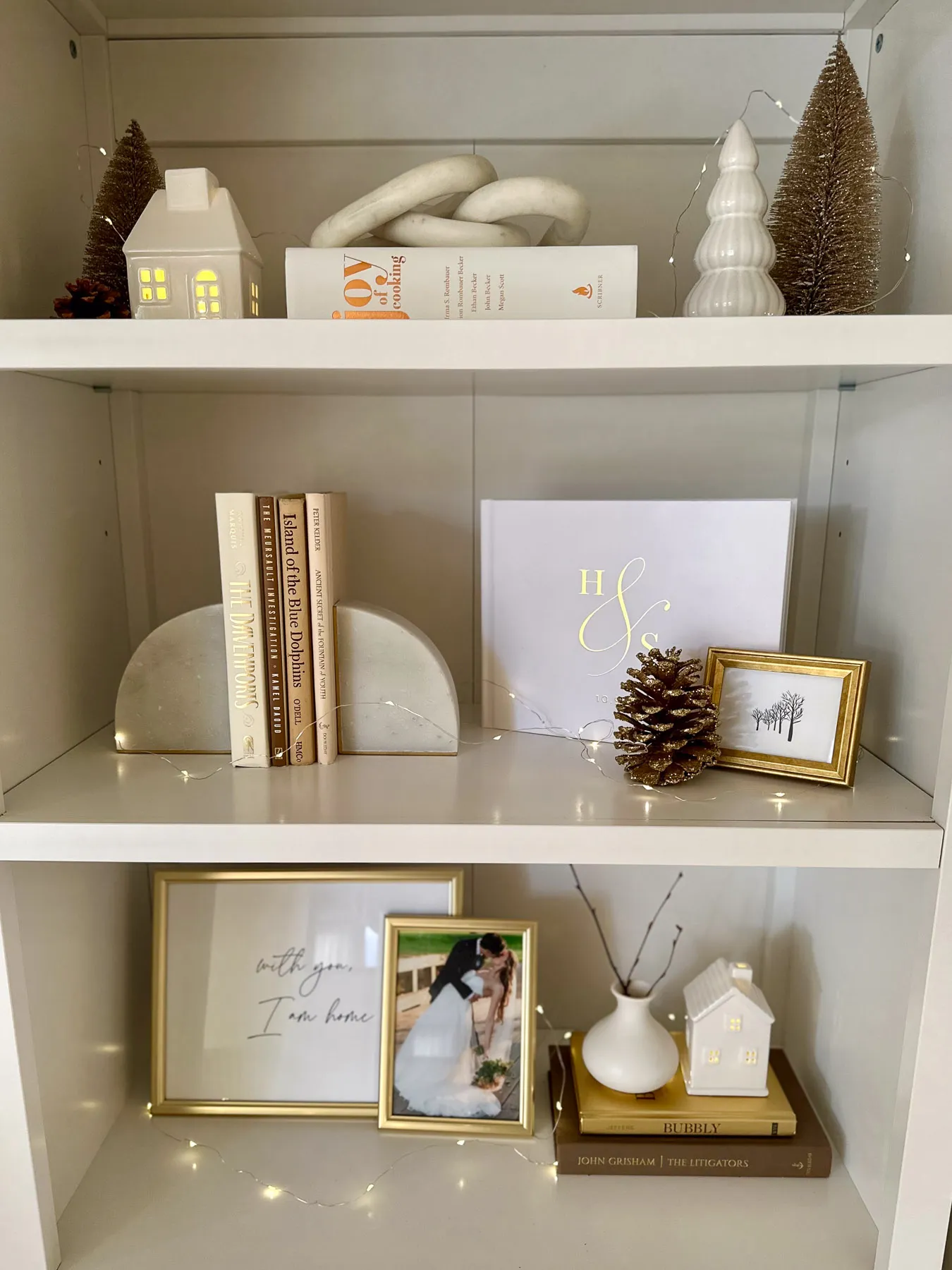
- Measure your shelf depth: Most standard bookcases are 12 inches deep. The ceramic houses need at least 6 inches of depth to sit properly without hanging off the edge.
- Check your outlet placement: The fairy lights need to plug in somewhere — make sure there’s an outlet within 3 feet of the bookcase, or use battery-operated fairy lights (easier and no cord visible).
- Assess the natural light: This display works best in a room with ambient light, not direct sunlight that will fade the gold frames and wash out the fairy lights.
- Budget for batteries: If using battery-operated lights, expect to replace batteries every 2-3 weeks with daily evening use. Budget about $20 for rechargeable batteries and a charger.
25. Neutral Shelf Styling With Snow Globes and Frosted Branches
This two-shelf arrangement follows a 60-30-10 styling ratio: 60% soft textures (the frosted branches, the white floral arrangement, the books), 30% transparent and reflective elements (the glass bowl with pinecones, the clear vases, the snow globe), and 10% dark anchor (the dark glass candle jar). That 10% dark piece is essential — without it, the entire shelf would read as one-dimensional and floaty. The dark candle jar gives the eye a place to rest and creates a sense of weight. When you’re styling shelves, always ask: where is the dark spot? If there isn’t one, add a dark book, a black ceramic piece, or a candle in a charcoal glass.
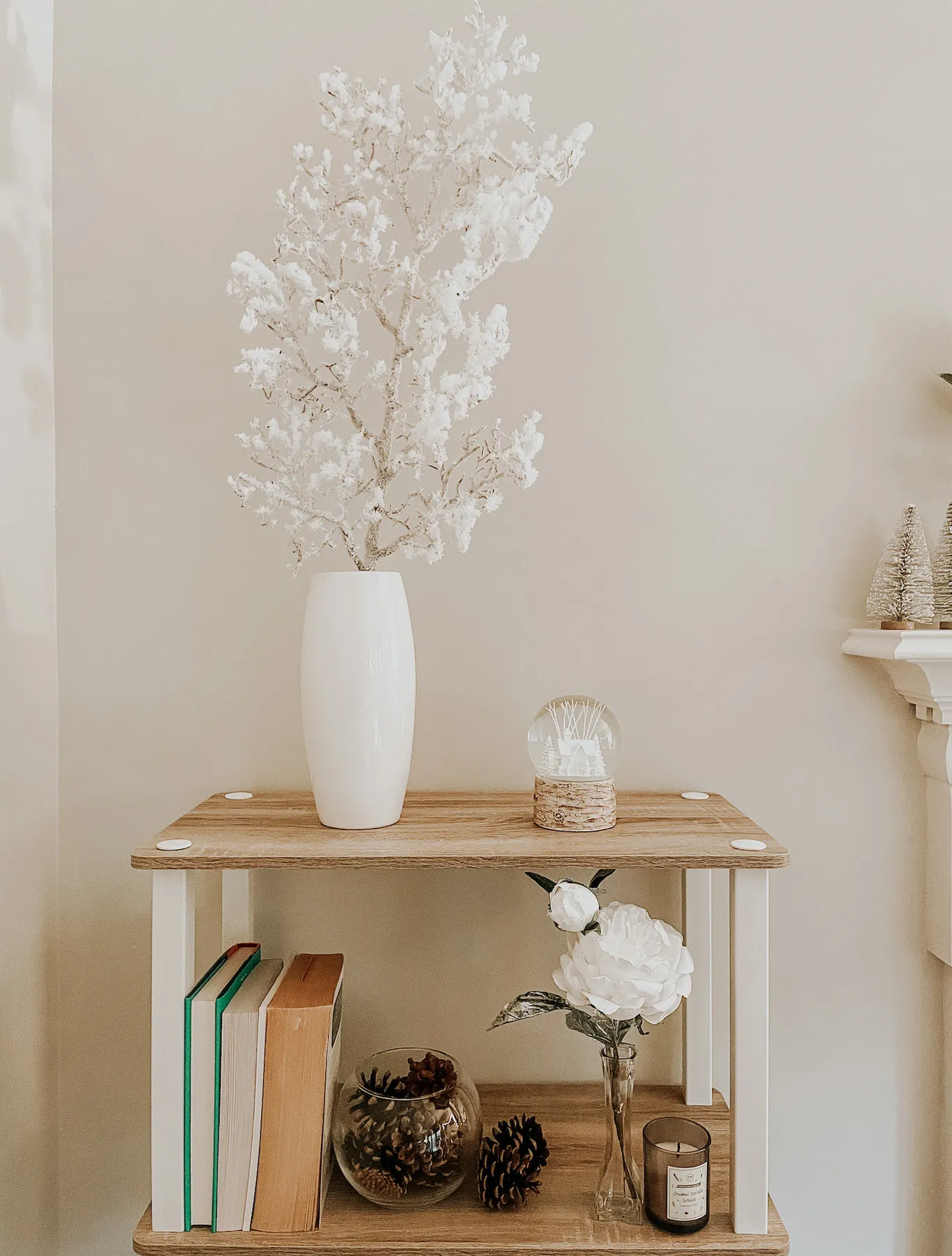
The designer tip here is the frosted branches in the white vase — they’re the reason this shelf works for winter without screaming holiday. Frosted branches (you can find them at craft stores or spray-paint foraged ones with white floral spray) read as winter-specific without being Christmas-specific. They can stay up through February (or March in colder climates) without feeling stale. The same trick works with dried baby’s breath, pussy willow, or even bare painted twigs. The key is choosing something that reads as seasonal but not specific to December 25th.
26. A Chunky Knit Blanket and Gold Sunburst — Glam Meets Cozy
- Main furniture (gray sectional): $500–$1,200
- Lighting (brass floor lamp): $80–$200
- Textiles (chunky knit blanket, gold pillows): $100–$180
- Decor (gold sunburst mirror, white side table): $70–$150
- Accessories (vases, books, tray): $40–$80
- Total: $790–$1,810
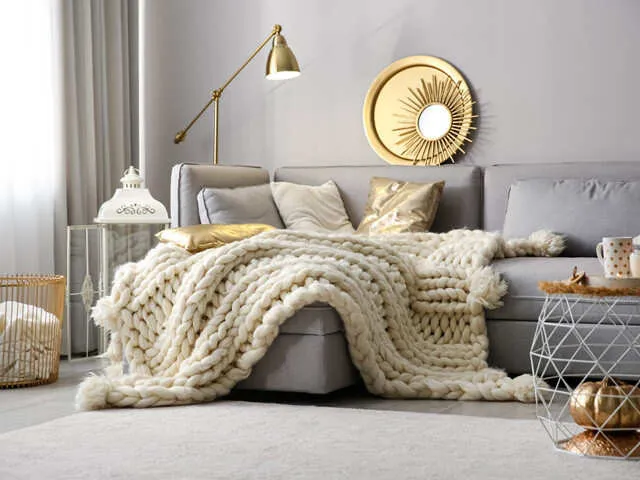
The “warm minimalism” trend is having a major moment in 2026, and this room is a perfect example. It’s the antidote to the stark all-white minimalism of the 2010s — you keep the clean lines but add texture (the chunky knit blanket) and warmth (the gold sunburst, the brass). What makes this trend different from just ‘cozy’ is the restraint: there are only three accent colors (gold, cream, light gray) and every material serves a purpose. This isn’t going anywhere — warm minimalism is evolving into a lasting design philosophy, not a seasonal trend. The chunky knit blanket alone has become a year-round staple from coast to coast.
27. Paper Stars and a Miniature Village — Winter Whimsy on Display
- Build the village base. Arrange the miniature houses and bottle brush trees on a white faux snow base (or a white tray/board). Cluster them in groups of 2-3 with space between clusters — don’t line them up like a street.
- Add the trees. The bottle brush trees should vary in height. Place the tallest ones behind the houses, shorter ones in front to create depth. Use 3-4 trees per cluster.
- Hang the paper stars. Use clear fishing line or white thread to suspend them at varying heights above the village. The key is layering — the stars should hover at different distances from the ceiling so the eye moves through them.
- Position the snow-dusted branches. Tuck them around the base of the houses to blend the scene into the surface. They also bridge the gap between the flat display surface and the hanging stars above.
- Light it from within. Use small LED candles or puck lights tucked behind the houses to create warm glowing windows. The top-down room light should be off when displaying.

that makes this winter village display exceptional is the hanging paper stars in black, gray, and white above the miniature scene. Without them, you’d have a cute decorative arrangement. With them, you have a dimensional installation that activates the vertical space between the shelf and ceiling. The monochrome palette of the stars (no colors) keeps them from competing with the warm-lit village below — they’re a counterpoint in cool tones that makes the whole composition feel designed, not just arranged.
28. Floral Chintz Sofa Meets Potted Plants — Botanical Living Room
This room works because of the contrast between the structured floral chintz of the sofa and the organic, unruly shapes of the potted plants. The floral fabric is controlled and traditional (it has a pattern repeat, a predictable palette), while the plants are wild and asymmetrical. That tension — manicured nature on the sofa, actual nature in the pots — creates a layered, collected feel that no single pattern could achieve alone. The dark wood side table with the woven tray anchors the composition with its weight, while the cream tapered lampshade above softens the vignette. The blue and white ceramic planter is the unexpected color note that keeps the palette from feeling too beige.
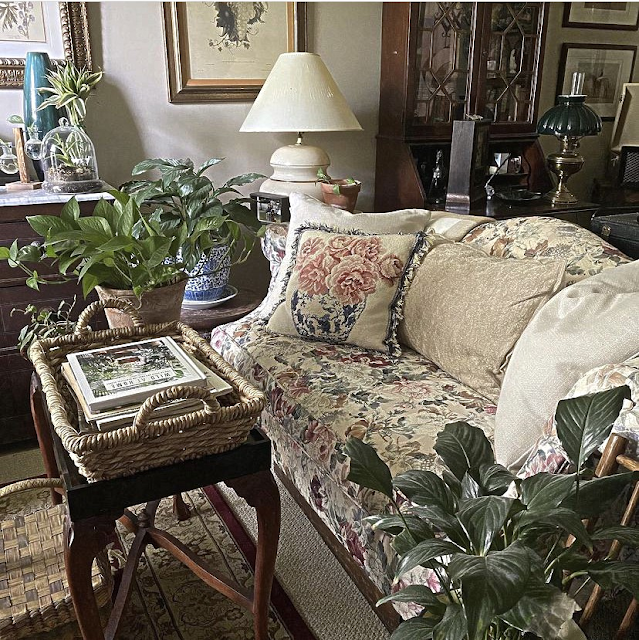
This living room setup works best in a medium to large room — at least 14 by 16 feet — because the chintz sofa is visually busy and needs breathing room. In a smaller space (under 200 square feet), the floral pattern can feel overwhelming. If you love this look but have a compact living room, try a floral accent chair instead of a full sofa, or use floral throw pillows on a neutral couch. The plants are flexible — they’ll work in any room size as long as they get enough indirect light. For a similar botanical vibe in a smaller footprint, see Idea #14, which uses a plaid sofa and potted plant for a more compact take on green-meets-pattern.
29. A Modern Entryway With Shaker Storage and Black Metal Hooks
- Built-in storage (white shaker cabinets + wood countertop): $400–$900 (if custom) or $150–$300 (IKEA Sektion hack)
- Black metal coat hooks: $15–$30 for a set of 4
- Round black-framed mirror: $40–$80
- Braided geometric rug: $50–$120
- Decor (vase, branches, framed art): $40–$100
- Total: $545–$1,230
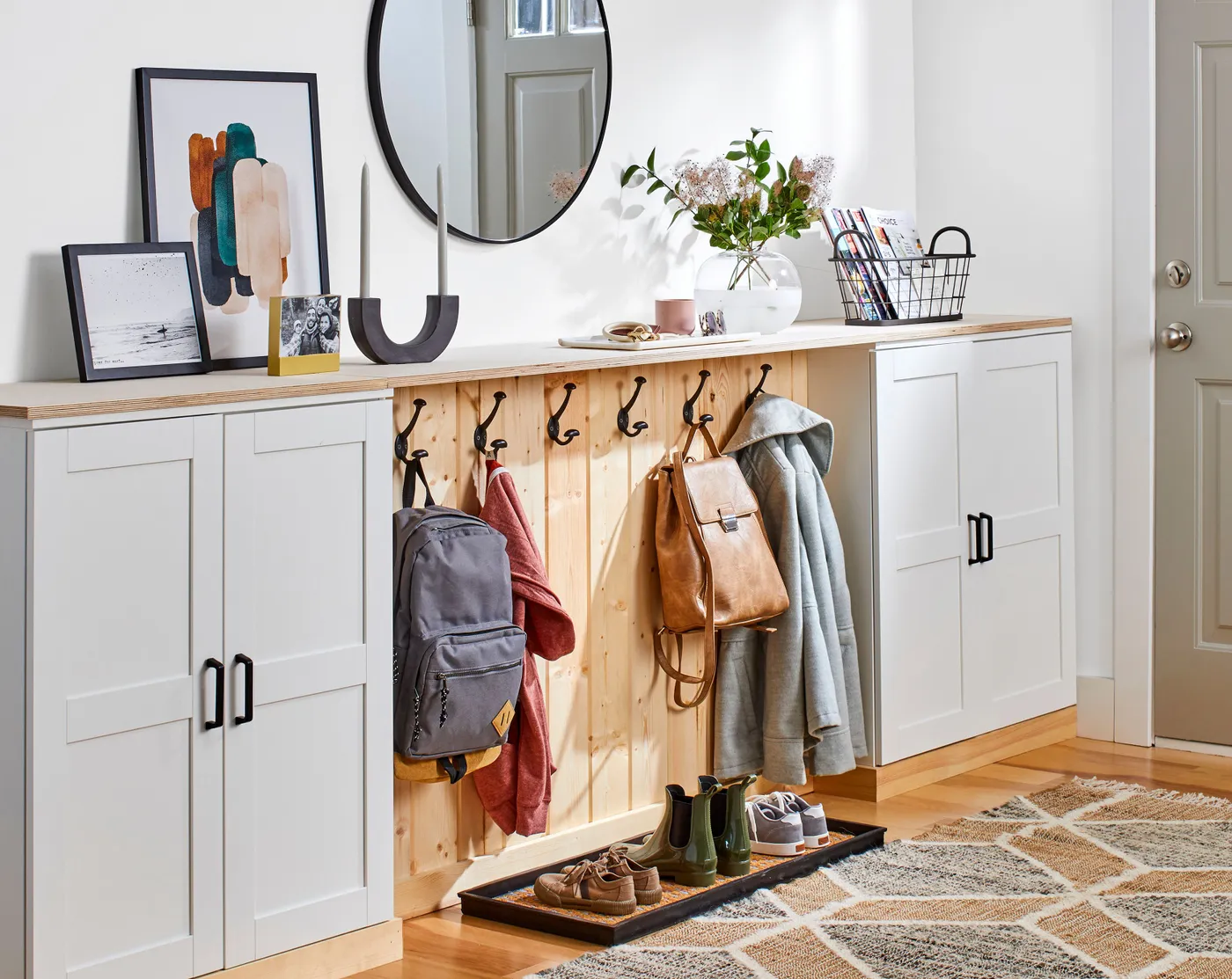
- Measure your wall depth: The standard hallway or entry needs at least 14 inches of clearance from the wall to any opposite door or furniture for the coat hooks to be functional.
- Check the traffic flow: Make sure the cabinets don’t protrude more than 12 inches into the walkway — entries need at least 36 inches of clear walking space.
- Test the hooks at your height: Hang the hooks at 48 to 52 inches from the floor — that’s eye level for most adults and accessible for kids 8 and up.
- Consider your coat volume: If you have a family of four, you’ll need 8 hooks minimum. If it’s just two of you, 4 hooks is plenty. Plan for one hook per person plus two guest hooks.
30. A Window Nook With Faux Fur, Whipped Cream, and Candles
The designer tip for this window nook is about the dark pink cushion against the white faux fur. That color combination — deep blush pink on pure white — is the visual trick that makes this corner feel warm without being overwhelming. In a nook, the window is already a strong vertical element. The pink + white combo on the sill adds a horizontal layer that breaks the window’s lines and creates a perch for the eye. If you recreate this, choose a cushion color that’s one or two shades deeper than you think you need — nook cushions read lighter against window light, so a darker tone won’t wash out.
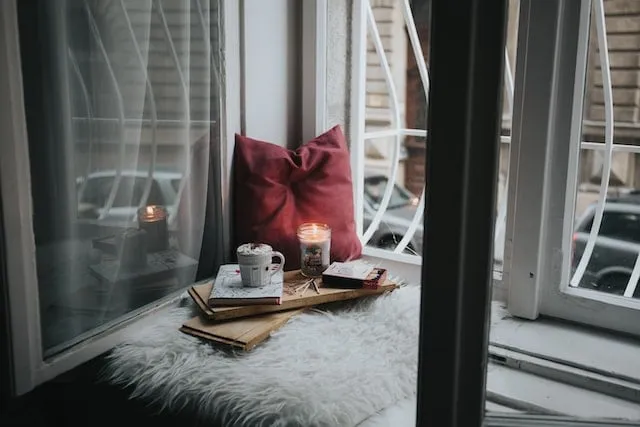
about that whipped cream-topped mug: it’s gorgeous in photos but it’s a 30-second prop. If you want this nook to look like this every day, commit to the ritual. The mug (white ceramic, any brand) and the candle (glass jar, vanilla or pine scent) are the practical, lasting pieces. The books on the light wood tray are what make the nook feel lived in — rotate them seasonally or whenever you finish one. The dark pink cushion and faux fur throw will need weekly fluffing (the fur mats, the cushion collects dust). Add a 5-minute nightly reset: put the mug in the sink, blow out the candle, fluff the throw. Future you in the morning will appreciate it.
31. Copper Floor Lamp and Cream Sectional — Modern Warmth
The formula here is 70% neutral (cream sectional, greige walls, light grey throw) plus 20% warm metal (the copper stem on the floor lamp) plus 10% texture (the framed artwork, the paneled wall). The copper is the zinger — without it, this is a perfectly nice but forgettable neutral living room. The curved copper stem adds a sculptural, almost organic line that contrasts with the straight lines of the sectional and the wall paneling. When you’re using warm metals, limit yourself to one dominant metallic finish per room. Here, the copper stands alone, which is why it reads as intentional rather than accidental.
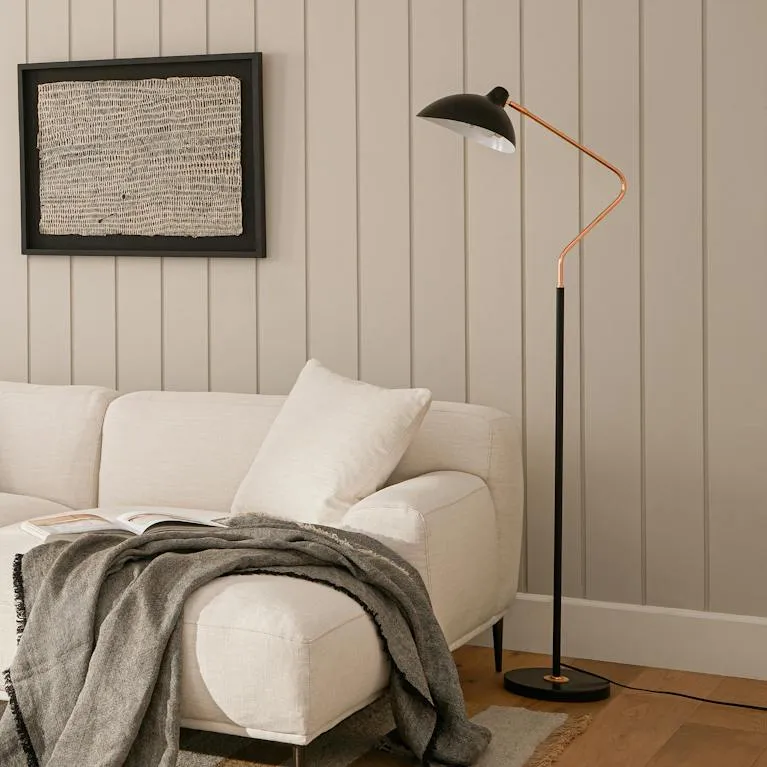
The cream sectional is the biggest potential expense, but you can absolutely find this look for less. The IKEA Kivik in light beige is $699 and has a similar silhouette. The copper floor lamp is surprisingly easy to find — Target’s Project 62 line has a copper arc lamp for $89, and Amazon has several options under $60. The light grey throw blanket is $15 at HomeGoods. The framed textured artwork can be a DIY — get a 24×36 canvas, paint it in a neutral tone with subtle texture (use a palette knife or even a fork for lines), and frame it in a simple black frame from Michaels ($30 total). The whole room: around $850 versus $3,200+ for the designer original.
32. The Best January Decor for Your Home — Warm and Inviting
Real talk about making January decor different from December decor: The biggest mistake people make is leaving their holiday decor up through January without editing it. December decor tends to be specific (Santa, reindeer, red and green). January decor should shift toward winter generics — snow, trees, neutral metallics, candles. Take down anything that says ‘Merry Christmas’ or features Santa. Keep the fairy lights, the greenery, the candles, and the neutral tones. The same space that felt festive in December can feel serene in January with a 30-minute edit session. You’re not starting over — you’re transitioning.
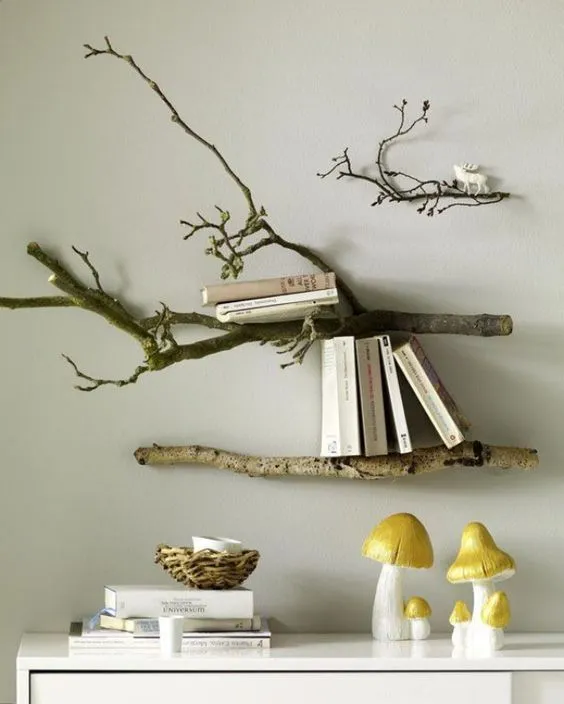
that will make your January decor feel finished and intentional is having a single consistent material thread throughout the room. In this home, it’s the mix of warm wood tones and soft metallics — the silver tables, the gold frames, the brass lamps all share the same reflective quality even though they’re different colors. Pick your thread (brass, wood, ceramic, glass) and repeat it in three different items across the room. That repetition is what makes a decorated home feel designed instead of just accumulated. Without that thread, January decor can look like a clearance aisle. With it, the room looks collected.
Your January Winter Decor Story Starts Here
Thirty-two ideas, one common thread: winter decor in 2026 is about making your home feel like a refuge, not a showroom. Whether you’re drawn to the sculptural pleated lamp, the stone fireplace with evergreen branches, or the fairy-lit balcony nook, each of these ideas is proof that the best winter spaces are the ones that feel like you. Pin your favorites now — they’ll be waiting for you when you’re ready to make your January space feel like home.