33 Jaw-Dropping Christmas Table Ideas for 2026 That Will Absolutely Enchant Your Guests This Holiday Season

Still scrolling through tablescapes at 11 p.m. and saving photos you never quite end up setting? Same. Here’s what nobody puts in the caption: the best Christmas tables this year aren’t the expensive ones — they’re built on one clear idea and a tight color story.
We spent serious time browsing Etsy, HomeGoods, Target, and Anthropologie to bring you only what’s worth your attention this year, across every price point from roughly $18 for a napkin ring to $480 for a full formal setup. After filtering through hundreds of options, we narrowed it down to 33 ideas that actually deliver.
Inside you’ll find 33 curated tables spanning traditional, modern minimalist, rustic woodland, jewel-toned, and blush-whimsical styles, with budget and luxury versions compared side by side so you can see exactly where the money goes. The 2026 mood is quieter — fewer objects, better light, linens that look inherited rather than bought that afternoon. 📌 Save this to Pinterest for later — you’ll want to revisit these ideas. A few links below are affiliate links; if you buy, we may earn a small commission at no cost to you.
1. Stacked Marble Plates with Cranberries and Rosemary
Stack no more than three pieces per setting — charger, dinner plate, small bowl — or the whole thing starts to read like a wedding display. Here the marble plates stay low and the top bowl is about four inches across, just big enough for a loose handful of cranberries. Keep votives roughly 18 inches from the nearest napkin and about 20 inches apart so guests don’t feel like they’re dining inside a lantern. And spring for real silver-plated flatware if you can; the weight sits better on marble than thin stainless, which slides.
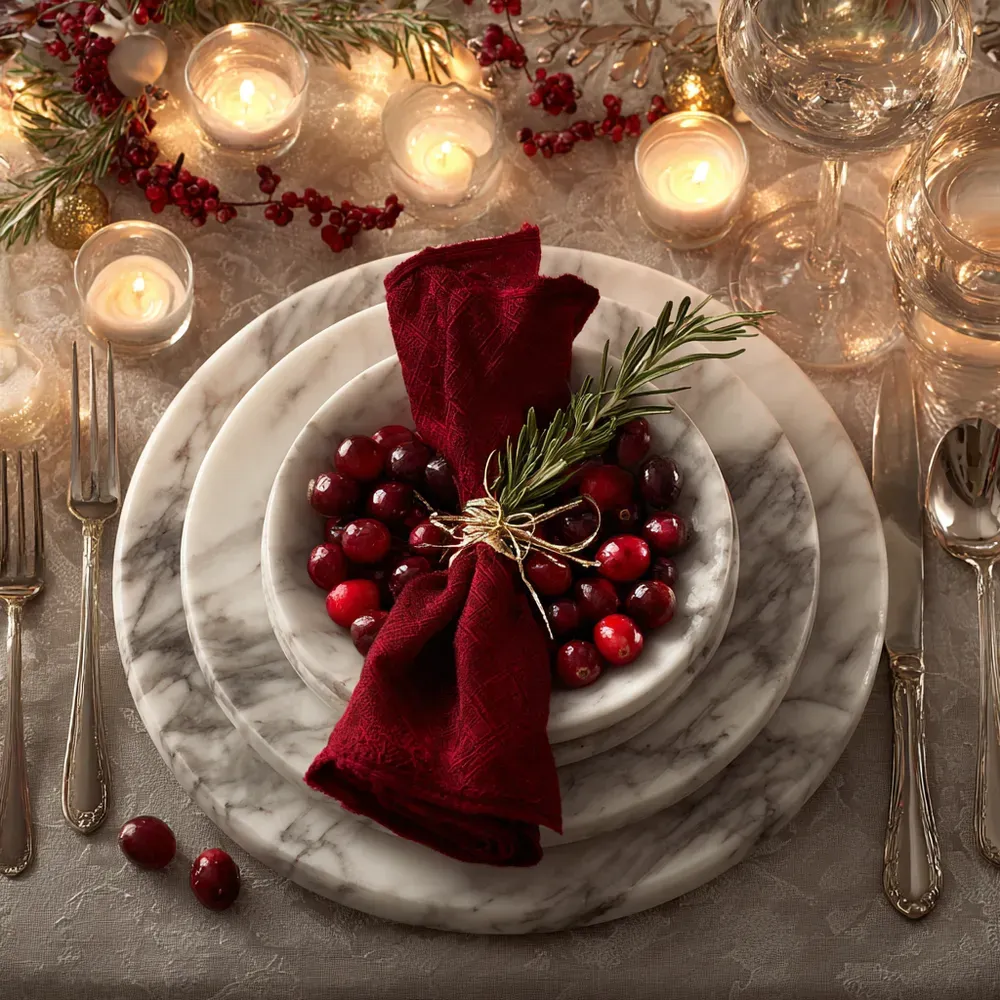
The cranberries and rosemary are the whole trick. Strip everything else away — the marble, the silver, the garland — and you have a very nice, very beige table. That tiny bowl of red fruit with a woody green sprig is the only saturated color at eye level, which is why it reads as intentional rather than decorated. It also costs about $4 and takes ninety seconds. Build your version this way: one small dose of deep red, one sprig of something evergreen, placed exactly where a guest looks first.
2. Light Blue Placemats, Brass Tapers, and a Roast Chicken
You’re mostly buying linens and candlelight here — the food does the rest.
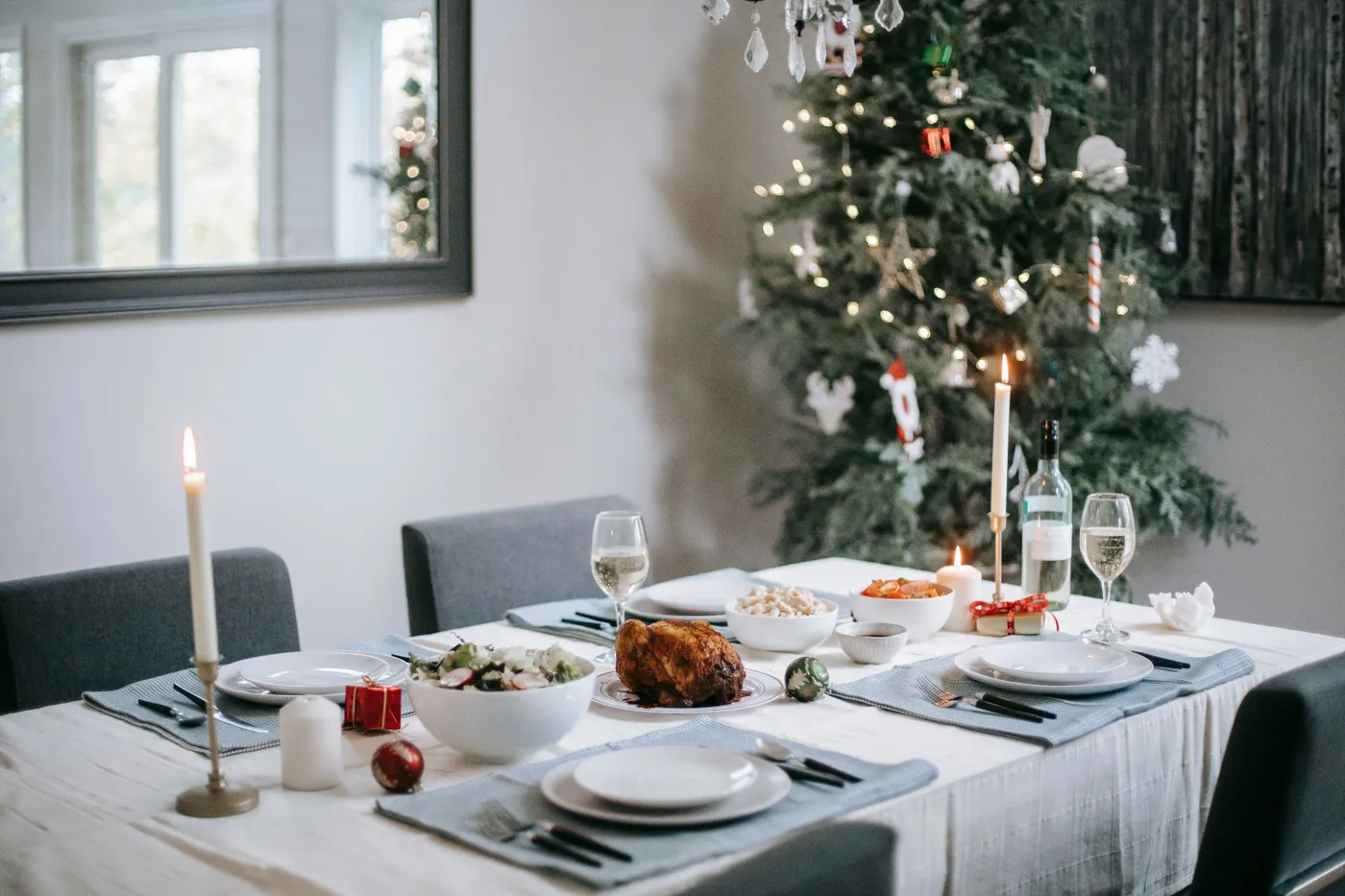
- Linens: white tablecloth $30–$70, four woven placemats $24–$48
- Dishware: white dinner plates and serving bowls $60–$140
- Lighting: brass taper holders (pair) $18–$40, pillar holder $12–$30, candles $10–$20
- Decor: small ornaments and greenery $15–$35
- Budget alternative: skip the tablecloth entirely, use a crisp white flat sheet, and pick up IKEA woven placemats at about $3 each — roughly half the spend.
Total: $169–$383
Two quiet decisions make this work. First, the light blue placemats: they’re a cool color sitting inside a warm room, and that mismatch keeps a plain white table from looking like a hotel banquet. Second, the candles are staged in three heights — tapers, a pillar, and the tree lights behind — so the eye travels up and back instead of stopping dead at the plates. It’s the same principle as Idea #30, just warmer and less styled.
3. Frosted Pine, White Ceramic Trees, and Gold-Rimmed Plates
The recipe is 60% white (cloth, plates, ceramic trees) + 25% frosted green + 10% gold + 5% dark teal borrowed from the curtains. Swap the frosted pine for fresh cedar and the mood turns rustic; swap the white ceramic trees for mercury glass and it goes glam. Keep the split either way — that’s the part doing the work, not the specific objects. Note that the dark teal only survives because it appears exactly once, in the background.
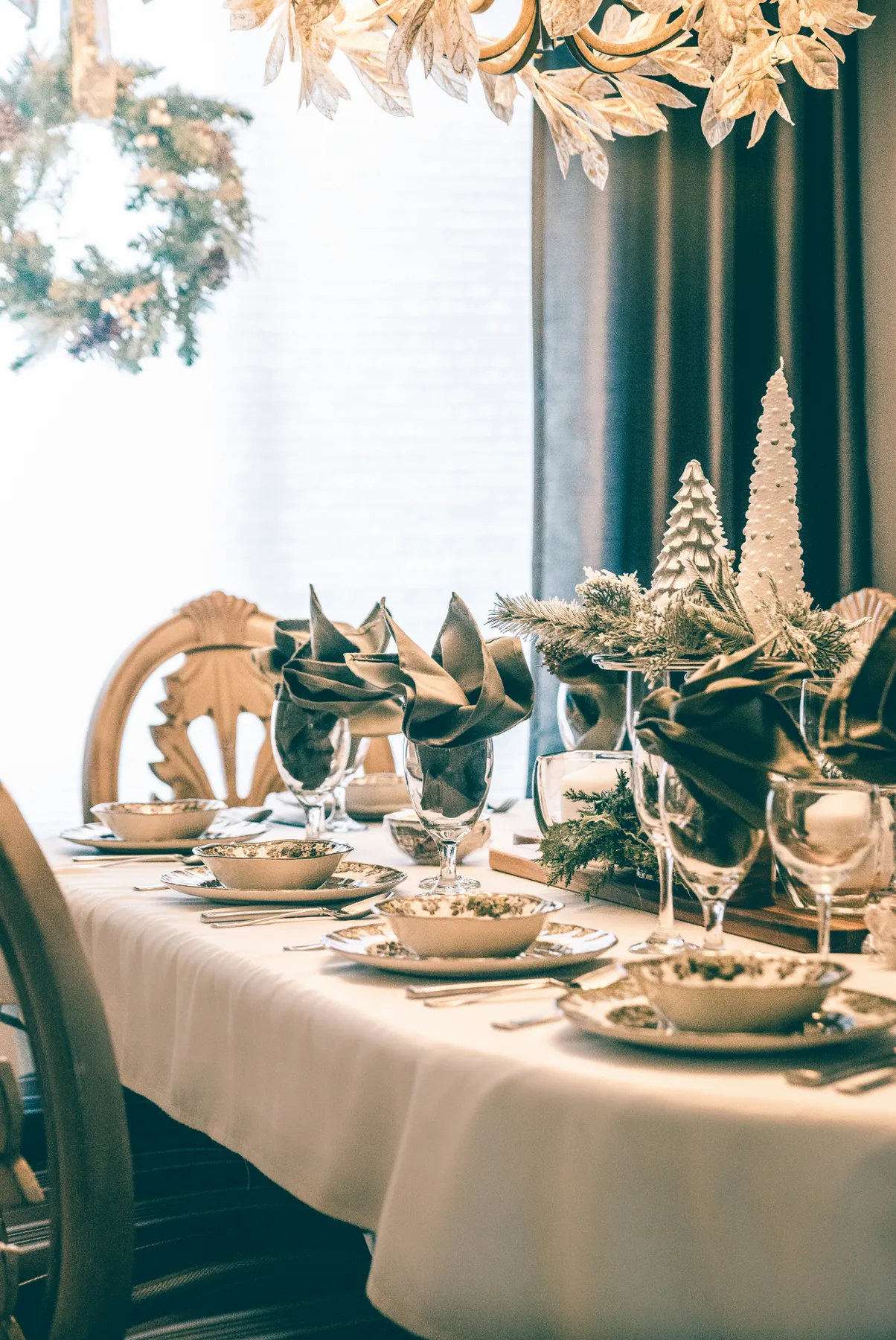
Frosted anything sheds. That fake snow will drift onto a white cloth all evening and turn into a gritty film by dessert, so shake the pine over the sink before guests arrive and keep a lint roller in a drawer. Also: white ceramic trees need to be lit or they read as gray lumps after sunset. If your chandelier runs warm at 2700K, great — if it’s cool white, the whole table will look like a dentist’s office. Fix the bulb before you fix anything else.
4. Sage-Bordered Cloth with Cream, Red, and Terracotta Plates
Build the plate stack, not the room.
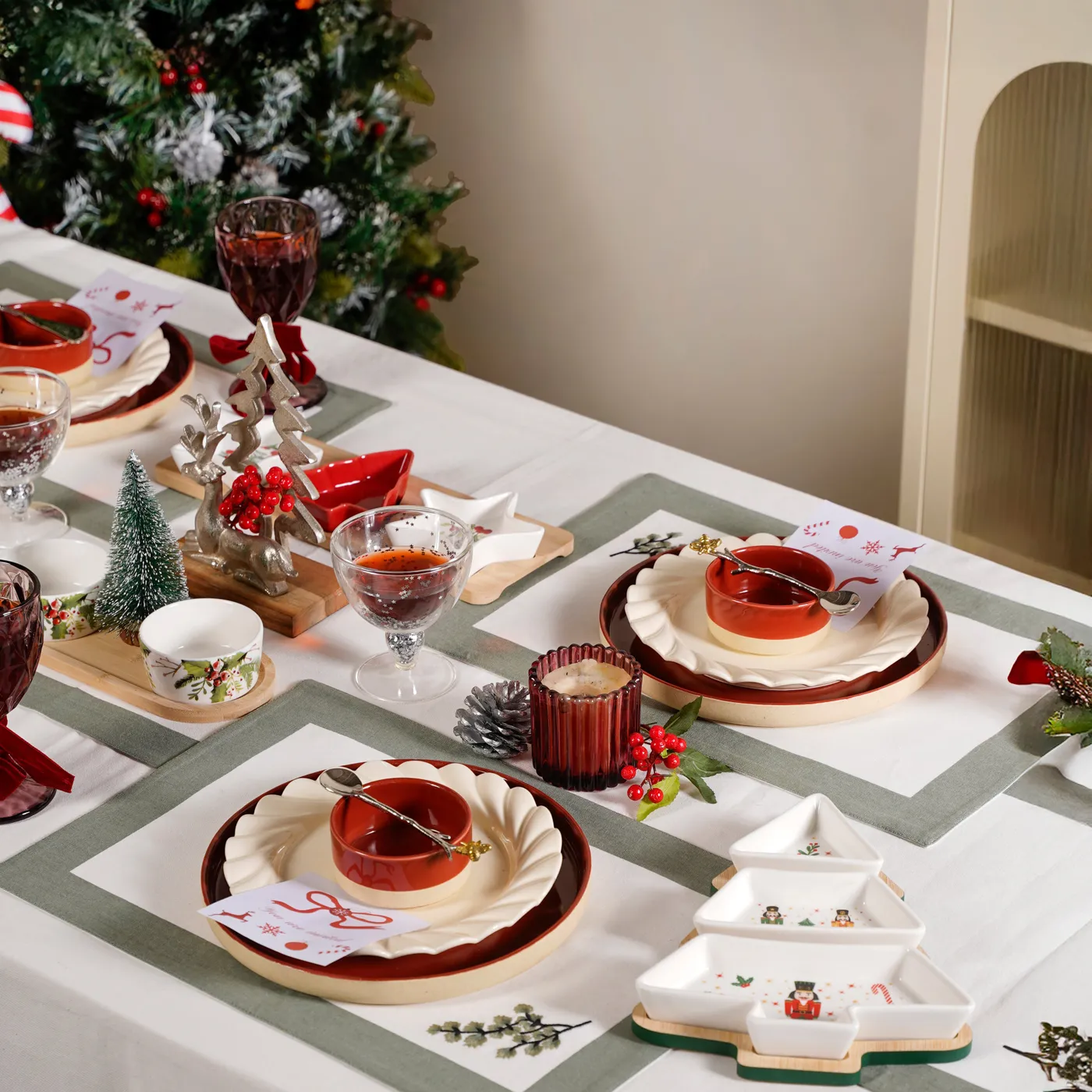
- Press the cloth — the embroidered border reads sloppy if it curls. Eight minutes with a warm iron.
- Center the cream dinner plate, then offset the smaller red plate about an inch to the left so the rim shows.
- Add the terracotta bowl on top, off-center again. Stacking in a straight line looks machine-made.
- Tuck one bottle brush tree against the bowl and one silver deer just behind the plate.
- Set the ribbed red glass holder above the knife, then step back and check the whole row.
About 12 minutes per setting once the cloth is pressed, plus $8–$14 per place in decorative extras if you already own the dishes.
Heirloom-adjacent linens are having a real moment — the kind of embroidered border your grandmother owned, now selling out at estate sales and on Etsy. Call it grandmillennial softening into something quieter: less chintz, more handwork. The sage-and-terracotta pairing is what makes it feel 2026 rather than 1996, and the bottle brush trees keep it from tipping into full nostalgia. This one has legs; it’ll still look right in five years.
5. Frosted Pinecone Garland on Polished Dark Wood
This centerpiece needs runway. Plan on a garland that runs the table’s length plus 12 inches on each end, draping slightly over the edge — so a 72-inch table wants 96 inches of greenery minimum, and honestly it looks best on 90 inches and up. Below 60 inches of table, skip the garland and do a single low arrangement instead. If your room is small, the frosted look of Idea #3 gets you the same winter feeling in half the footprint.
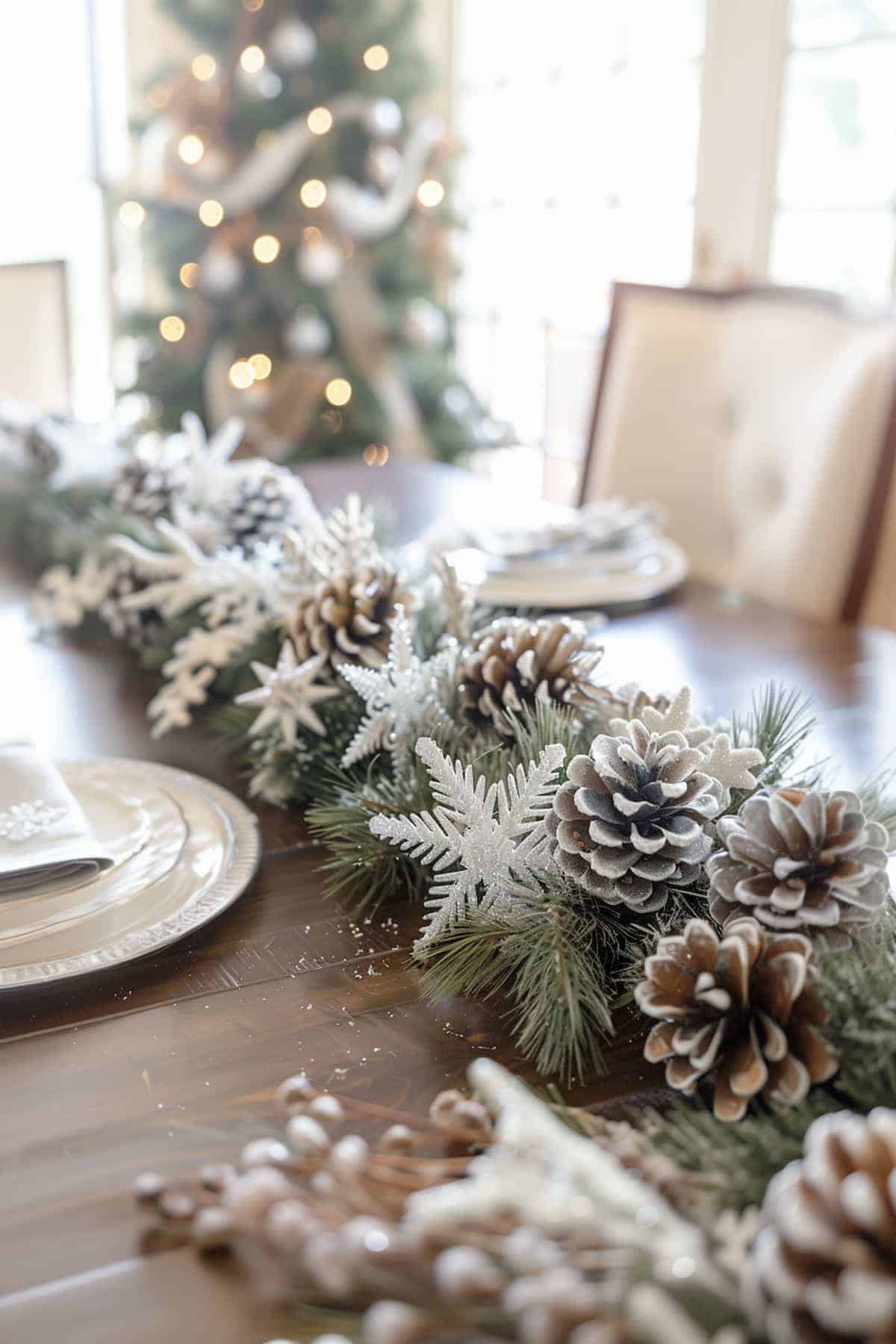
Anchor garland with clear zip ties to a slim dowel underneath, or use adhesive cable clips on the table’s underside if you don’t mind them — either way you get that heavy, deliberate swoop instead of a sad snake. Fluff it in daylight, not at 6 p.m. with a glass of wine, and bend every branch outward from the center line. Twenty minutes of fluffing is the difference between styled and bought.
6. Woven Placemats and Dried Orange Jars Against Brick
Dried citrus is the cheapest luxury in holiday decorating. Slice two navel oranges thin, bake at 200°F for about three hours, flip once, then let them sit overnight — total cost around $3. Mason jars come from thrift stores at $1–$2 apiece or free from your own cupboard, and Target’s woven placemats run $6–$10 each. The beaded white dinnerware is the one place I’d spend: HomeGoods and TJ Maxx carry lookalikes at $4–$6 a plate that survive the dishwasher.
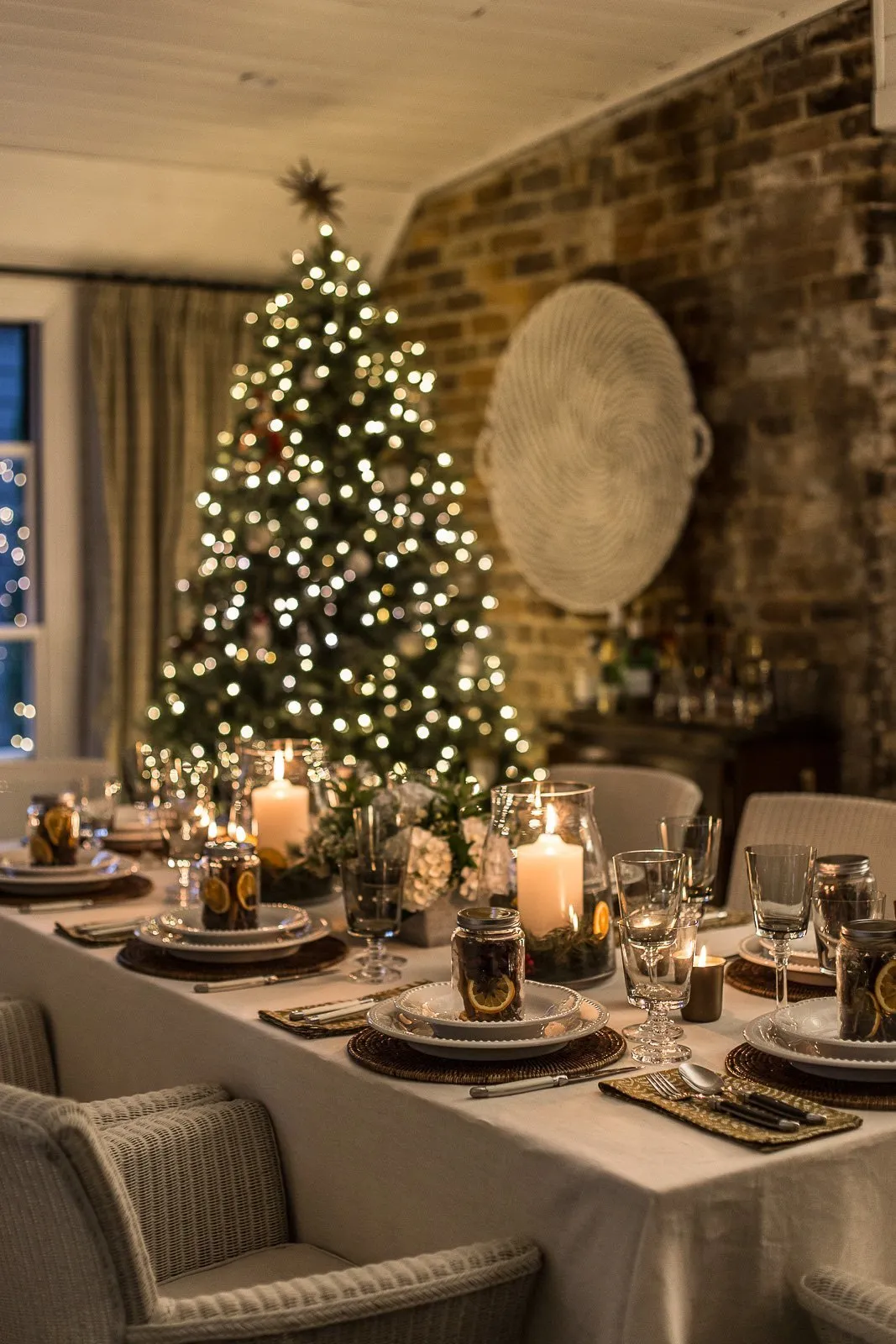
Dried oranges are only dried if they’re actually dry — a slice with any moisture left will mold inside a sealed jar within a week. Store them open for two days before sealing anything, and skip the cinnamon sticks if anyone at the table has a sensitive nose. On the candle front: white pillars in open glass will soot the rim by hour three. Trim wicks to a quarter inch and you get a clean burn instead of a gray smudge across your beaded plates.
7. Gold Flatware, a Twig Wreath, and Kraft Gift Boxes
- Linens: white cloth $30–$60, striped linen napkins (set of 4) $40–$90
- Flatware: gold-toned 20-piece set $45–$120
- Centerpiece: natural twig wreath $25–$55, geometric gold candle holder $15–$40, pillar candle $8–$16
- Candles and glass: taper pair in clear holders $20–$45
- Wrapping: kraft paper boxes and twine $12–$25
- Budget alternative: spray-paint thrifted stainless flatware in warm gold — $12 for paint plus $8 for a thrift set, about 55% less.
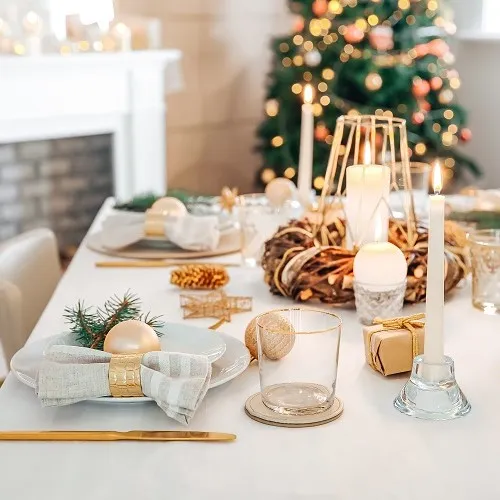
Total: $195–$451
It’s the twig wreath, laid flat with a pillar candle sitting inside it. Without that one object this is just a nice gold-and-white table — pretty, forgettable. The wreath gives the centerpiece a boundary, so the eye has somewhere to rest instead of wandering from gift box to gift box. It’s also the only thing on the table that isn’t shiny, and that single matte moment is what keeps all the gold from turning into a jewelry commercial.
8. An Embroidered Christmas Napkin on a Red Beaded Placemat
Check these before you commit to a beaded placemat table:
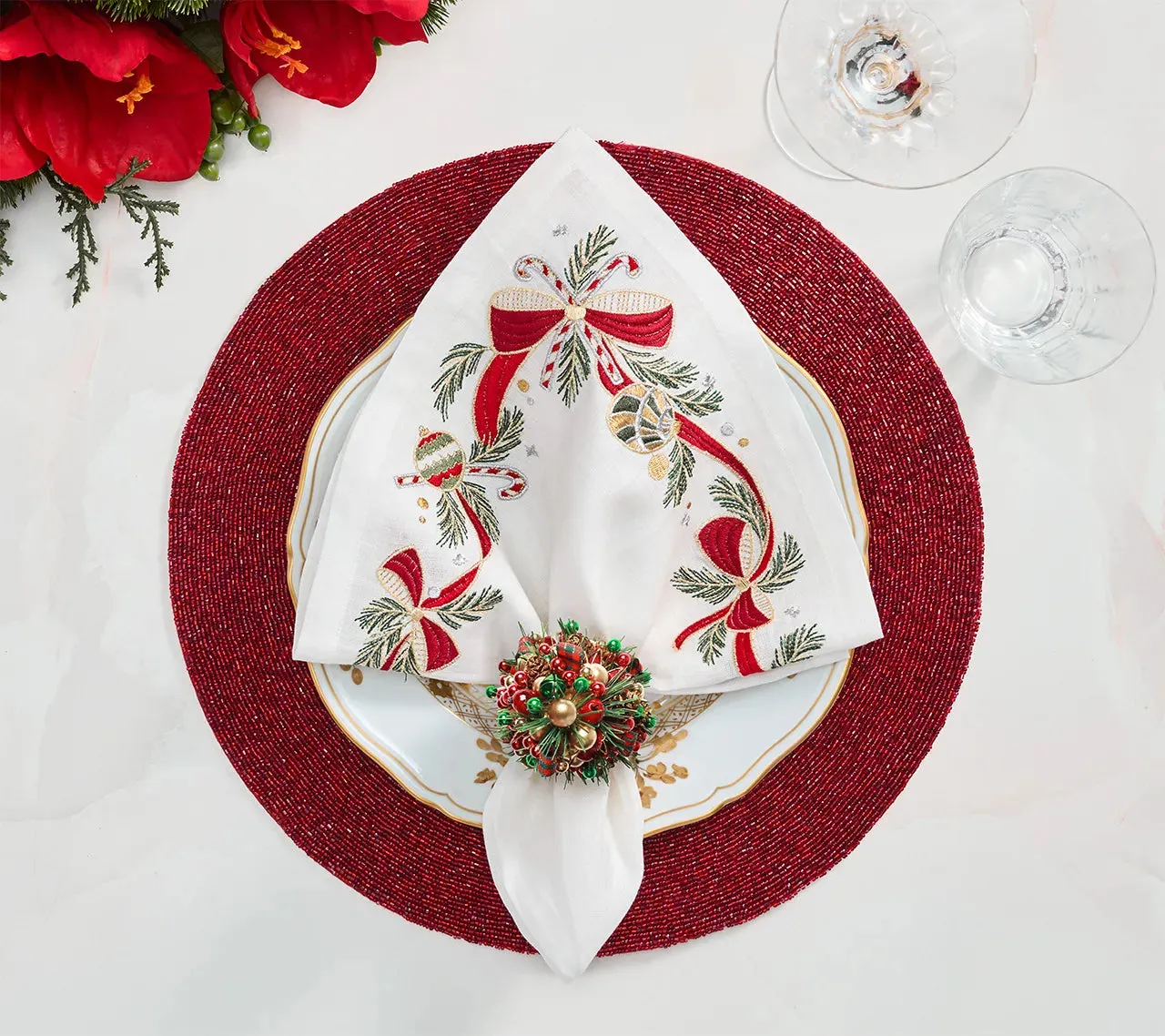
- Measure the placemat — 15 inches across is the sweet spot; 17 pushes the wine glass toward the edge.
- Count your chairs. Round placemats at a rectangular table need 24 inches per setting to clear each other.
- Check your plate’s rim width; a wide gold border will swallow a busy embroidered napkin.
- Decide the napkin fold before you iron anything, because a beaded ring creases differently than a loose fold.
- Confirm the table surface is sealed — beaded backs scratch softer finishes.
Layer the napkin so the embroidery sits above the plate rim, not behind it, which means folding it to about 5 inches wide and letting it hang two inches past the edge. Choose the napkin ring last: a multicolor beaded ring needs a napkin with almost no pattern, or the two fight for the same attention. Clear glassware is the pressure valve here — anything tinted and the setting goes from collected to costume.
9. A Miniature Snow-Dusted Tree in a Red Pot
Those golden lights in the background are lovely and also a cord waiting to be tripped over. If you’re running string lights around a centerpiece, use battery-powered micro lights and tape the pack under the table, not dangling off the edge. Fluffy chair covers plus open flame is a combination I’d skip entirely. And a miniature tree in a red pot will tip if someone bumps the table — weigh the pot with a handful of coins or a bit of florist’s clay before it goes anywhere near a wine glass.
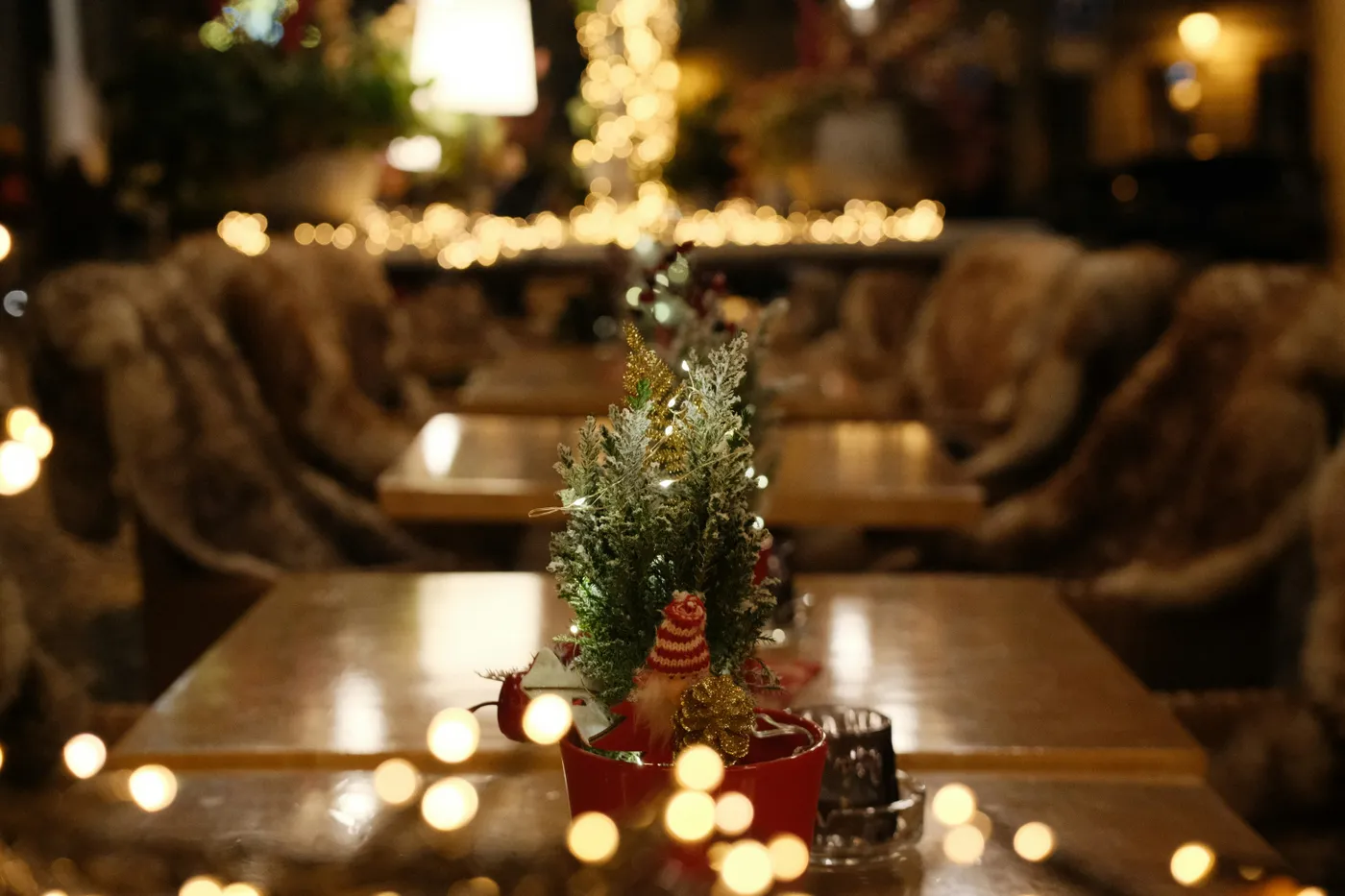
Scale is the whole story. A 10-inch tree on a full-size dining table looks confident; a 20-inch tree in the same spot looks like a decoration someone gave up on. The warm bokeh behind it does the second job — it blurs the room’s edges so the tiny centerpiece becomes the only thing in focus. Add a gnome at the base and a single glass candle holder, then stop. Three objects, one color story, and the eye has everything it needs.
10. An Evergreen Garland Dense with White Tapers in Brass
Candle-safe garland, in order:
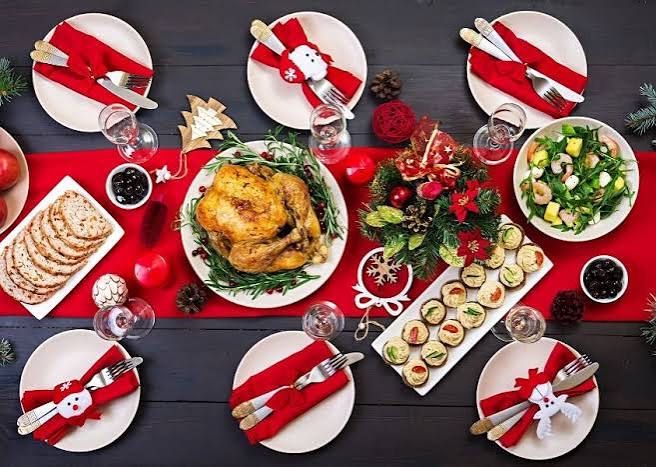
- Lay the garland on the table and pull it apart so you can actually see the stems.
- Set your brass holders into the greenery first, spacing them 10–12 inches apart — this is the bones.
- Wire in pinecones and berry sprigs afterward, filling gaps between holders.
- Trim each taper to sit at least 6 inches above the tallest pinecone; anything closer will scorch.
- Light one candle and walk the length of the table to check for leaners before you light the rest.
Roughly 45 minutes and $60–$110 in greenery and candles if you already own the brass.
70% deep green + 20% white + 10% brass, with red berries acting as an exclamation point rather than a full color. Swap the berries for cranberries and it’s juicier; swap for dried orange and it’s warmer; swap for nothing and it’s Scandinavian. The brass does more than it looks like it does — it’s the only warm metal here, and it’s what makes white candles read as glow instead of glare.
11. Blush Pink Nutcrackers on a Sheer Runner
Pink glassware is where this gets expensive, and it doesn’t have to be. Dollar Tree and Target’s Threshold line carry blush-tinted goblets at $1.50–$5 each, and a can of rose gold spray paint ($8) turns thrifted nutcrackers into the exact figures in this photo. The sheer runner is the easiest save of all: three yards of blush tulle from a fabric store runs about $6 and drapes better than most $40 runners. Re-create the whole thing for under $120 if you own white plates.
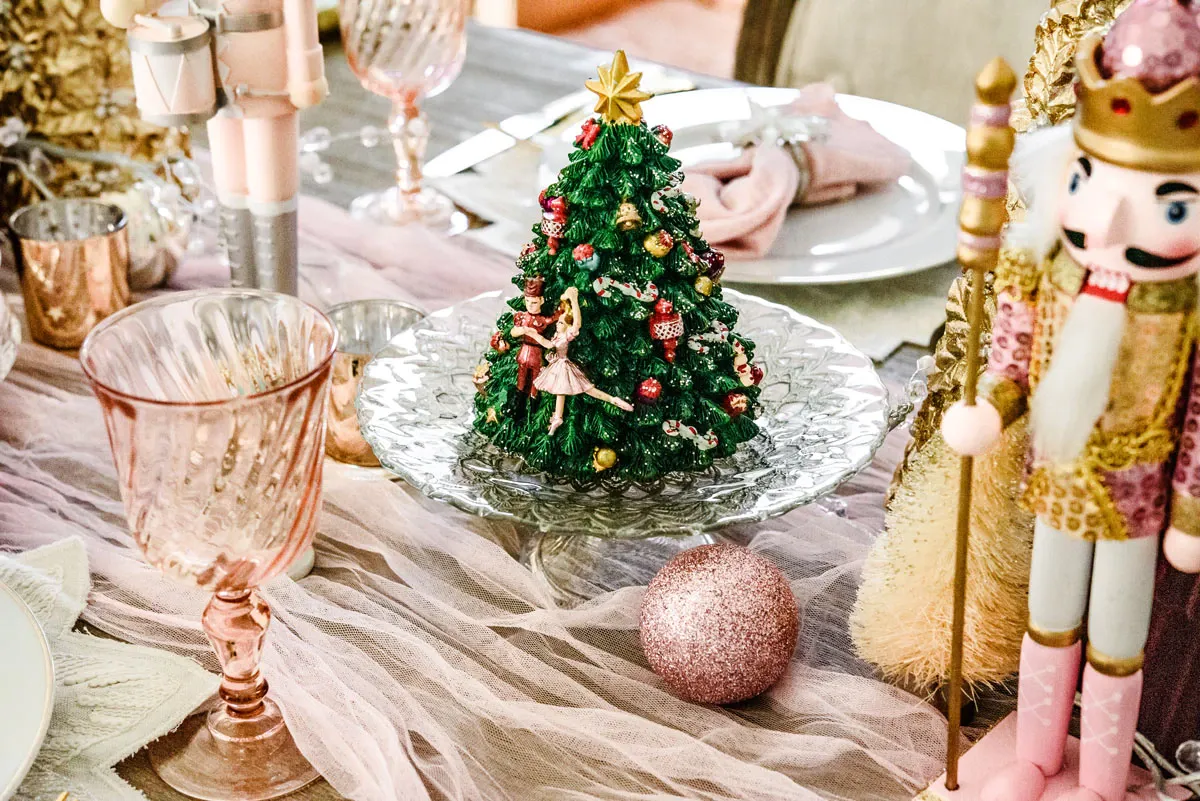
Put the miniature tree on a riser — here it’s a clear glass pedestal plate — and keep the total height under 8 inches above the tabletop. Anything taller and your guests will play peekaboo through the branches all through dinner. The centerpiece should never cross the sightline between two people sitting opposite each other. When in doubt, measure from tabletop to your seated eye level and subtract two inches.
12. A Wooden Rocking Horse Among Lace and Figurines
The rocking horse is the reason this table works. Santa, the snowman, and the nutcracker are all charming and all interchangeable — take one away and nobody notices. But the horse has a shape nothing else here has: legs, rockers, negative space. It breaks up a row of chunky, front-facing figures and gives the arrangement an actual silhouette. If you collect figurines, always give one of them a profile. That’s the difference between a display and a scene.
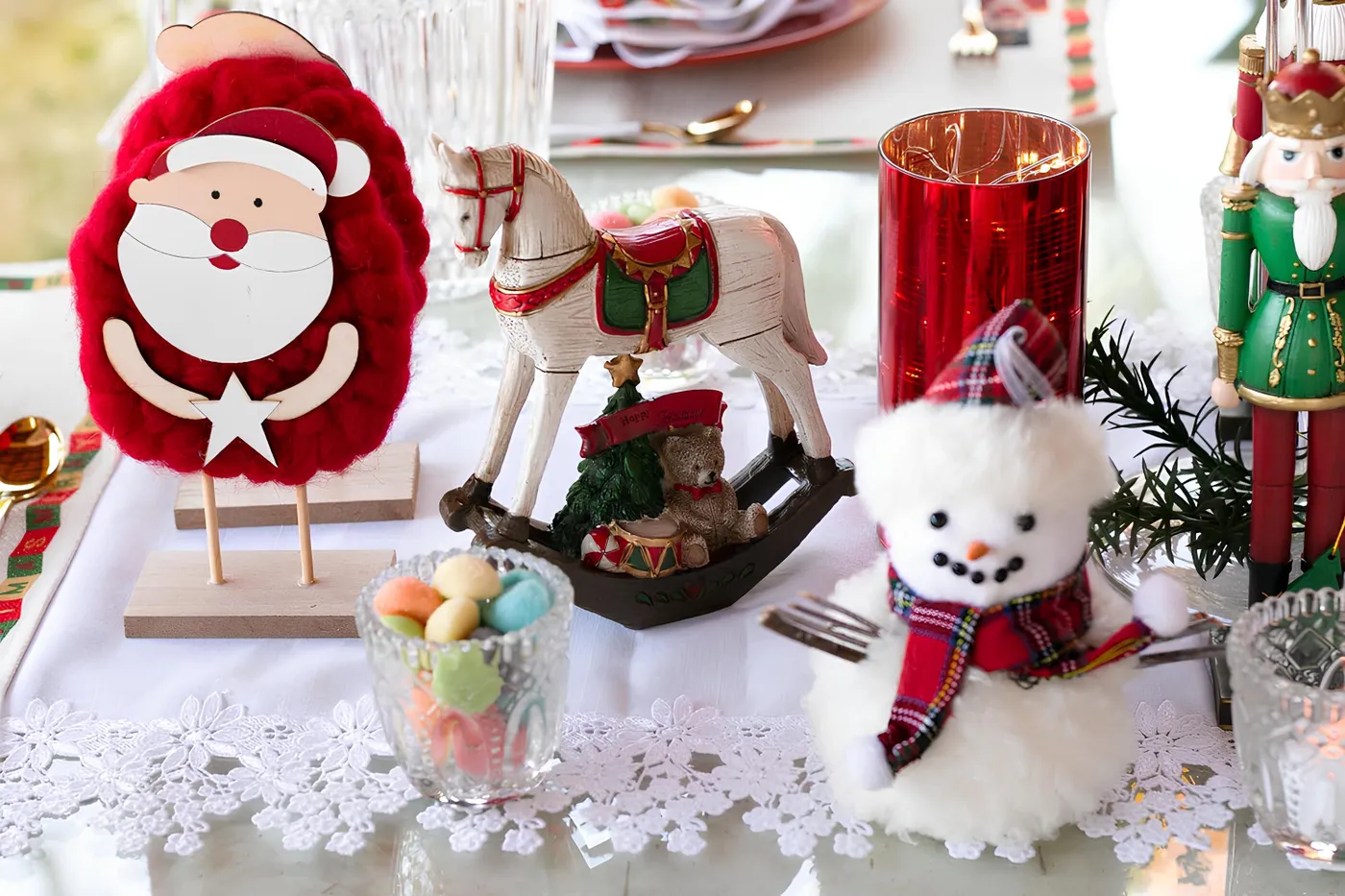
This is a wide-table idea, plain and simple — 40 inches across or more, and 84 inches long if you want all four figures to breathe. On a 36-inch table, pick two figures instead of four and move the candy bowl to a sideboard. Ceiling height matters less than chair clearance: figurines 10–14 inches tall need guests to lean back without knocking Santa’s hat. If your dining room is tight, the compact centerpiece in Idea #9 gets you the same playfulness in a fraction of the space.
13. A Gingerbread Village Down a Cream Runner
Real gingerbread and warm rooms don’t get along. Icing softens above 75°F, walls lean by dessert, and anything with royal icing is structural toast by New Year’s. Ceramic or clay gingerbread houses cost more up front ($12–$30 each) and last decades, which is worth it if you plan to do this every year. If you’re going edible, assemble with hot glue on a cardboard base rather than icing, and keep the houses well away from candle range. Also: crumbs. There will be crumbs in your runner until March.
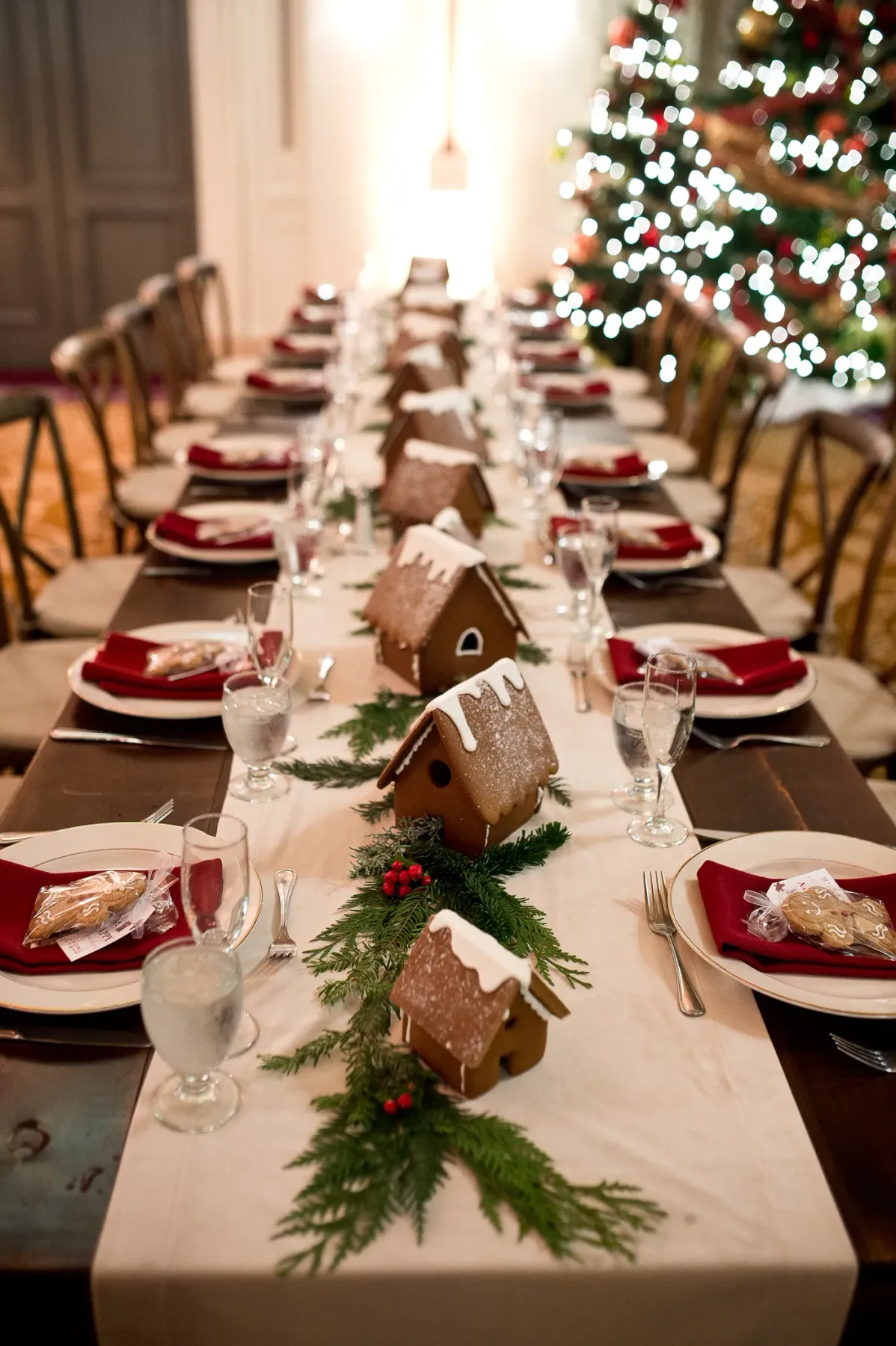
The garland doesn’t just decorate the runner — it interrupts it. All that cream fabric would read as a runway without evergreen breaking it into segments, and the gingerbread houses sit in those breaks like punctuation. Six houses at slightly different heights create rhythm without symmetry. And the dark wood underneath does quiet work: it’s the only dark value on the table, which is why the cream and red pop instead of blending into beige.
14. Emerald Napkins and Cobalt Vases on Live-Edge Wood
- Linens: emerald linen napkins (set of 4) $35–$75
- Tabletop: gold chargers $20–$48, white plates you already own
- Vessels: cobalt glass vases (3–5, thrifted) $18–$60, brass candlesticks $25–$70
- Foliage: mixed greenery and berries $25–$55
- Extras: burgundy velvet gift boxes $10–$24, gold flatware $45–$120
- Budget alternative: dye plain white napkins emerald with Rit ($8 a bottle) and hunt cobalt glass at Goodwill — $2–$5 a vase, around 60% less.
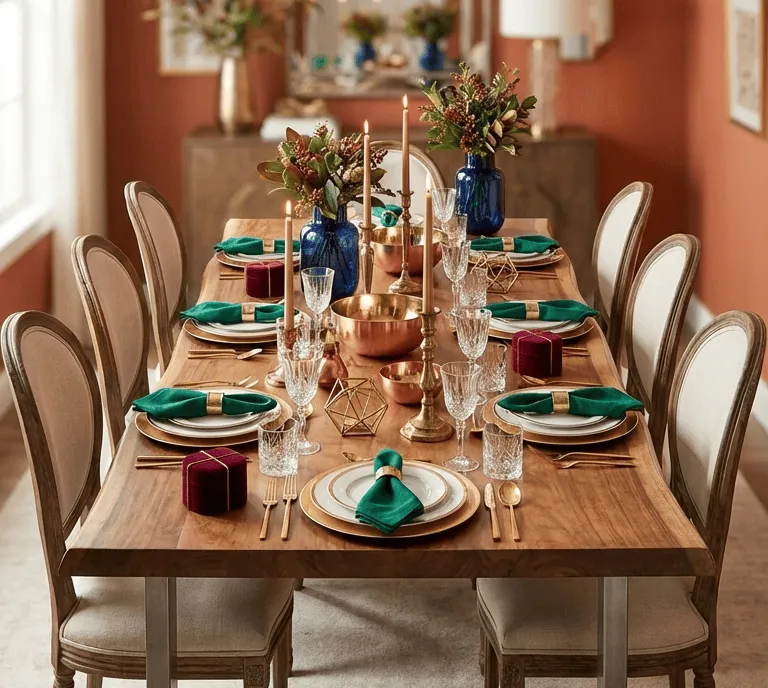
Total: $178–$452
Jewel tones have been circling back for a couple of years, and 2026 is when they finally feel current instead of heavy. The unlock is the cobalt blue — a color almost nobody puts on a Christmas table, which is exactly why it works against emerald and burgundy. This isn’t the red-and-green we grew up with; it’s the same warmth, rearranged. Expect a lot of it on Pinterest this season, and expect it to age better than the all-white minimalism of 2022.
15. Grey Herringbone, Matte Black Plates, and Fresh Rosemary
Rosemary is the cheapest styling trick in the book, and most people use too much of it. You want one sprig about 3 inches long per glass, stripped of its bottom inch of needles so it doesn’t taste like a Christmas tree, tucked behind the ice rather than into the liquid. For the napkin, a half-inch cream ribbon tied in a flat knot reads tailored; a full bow reads gift shop. And tie it before you set the plate down — retying around a glass is how things get knocked over.
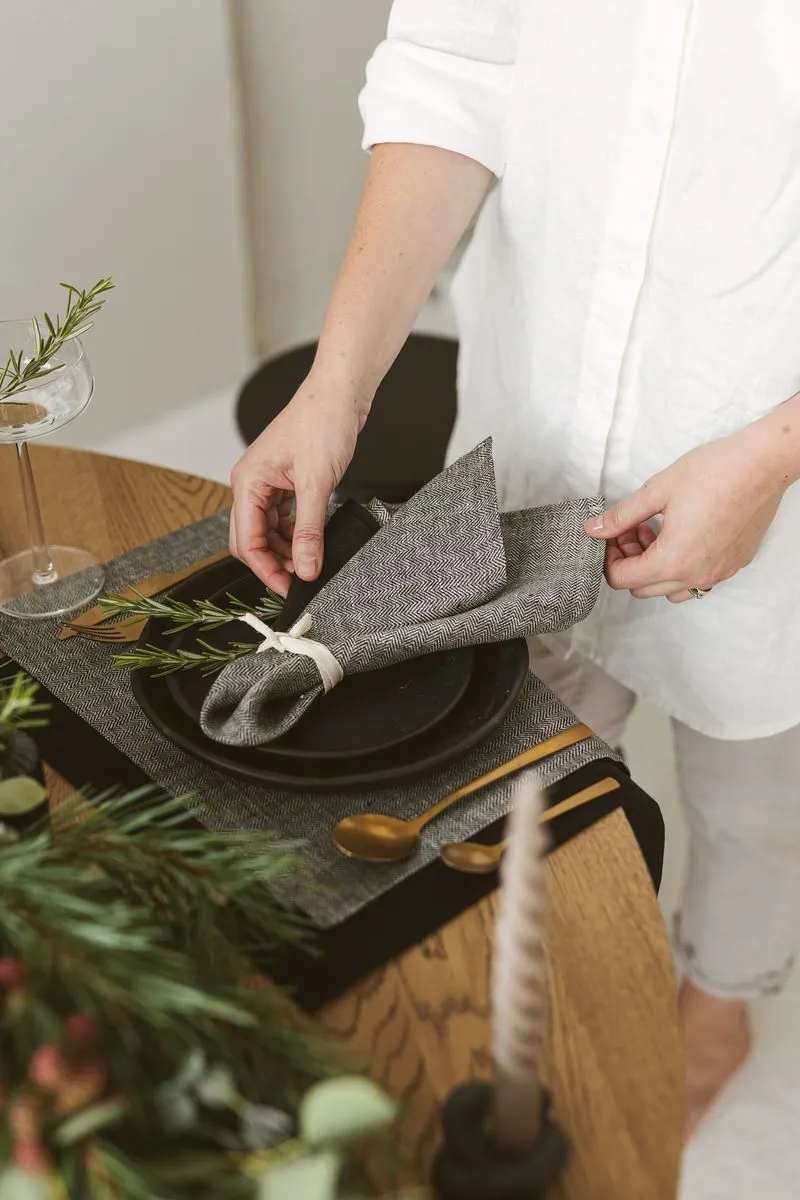
70% light wood and grey textile + 20% matte black + 10% gold, with rosemary as the green accent that’s more of a smell than a color story. Change the matte black plates to charcoal stoneware and it softens; change the gold flatware to brushed steel and it goes cold and industrial. The formula holds either way. It’s the same layering math as Idea #17 — same materials, dialed quieter — so if you like one, you’ll like both.
16. Reindeer Figurines and Personalized Place Cards
Place cards are a beautiful idea right up until you remember you have to write fourteen of them. If your handwriting isn’t there, print them — nobody has ever complained about a printed place card, and everyone has silently judged a crooked one. Also think hard about assigned seating at a family holiday: it solves the where-do-I-sit shuffle but it can also park your uncle next to the one cousin. And set those metallic-rimmed plates knowing they’re hand wash only, or you’ll be re-buying them in January.
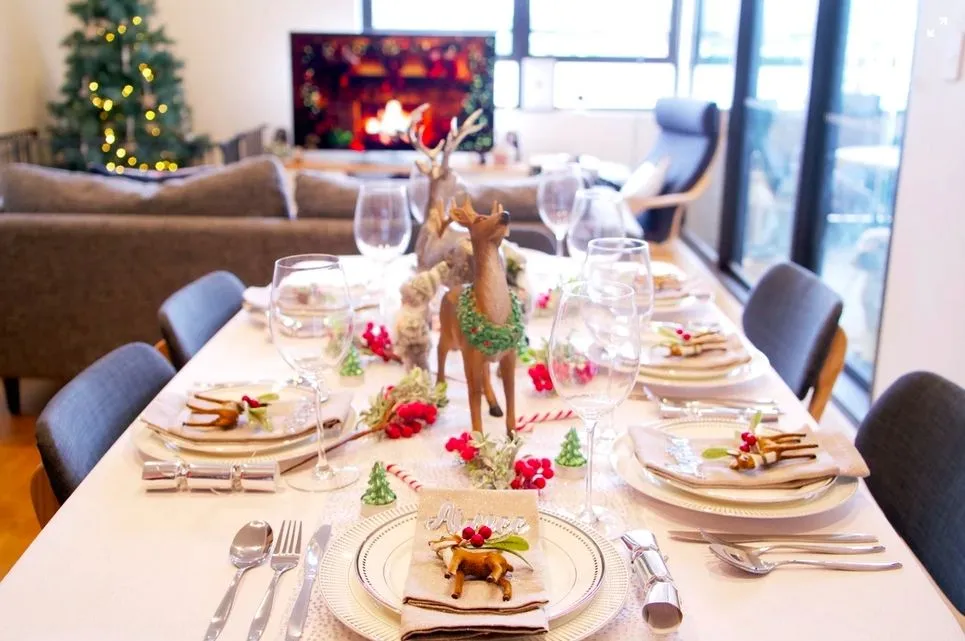
Place cards in five steps:
- Cut card stock to 3.5 by 2 inches — bigger reads like a name tag.
- Write or print names on a single line, first names only.
- Fold a 1-inch footer at the bottom so the card stands without a holder.
- Rest each card on a folded napkin, angled toward the chair.
- Do a walk-through and check the spelling twice. Twice.
About $10 in materials and 30 minutes for fourteen cards.
17. Matte Black Plates Layered with Herringbone Napkins and Pine
Texture is doing everything here, because there’s almost no color. Grey herringbone placemat, grey herringbone napkin, matte black plate, gold fork — four materials inside one narrow value range. It works because the textures read differently at arm’s length: woven cloth, matte ceramic, polished metal. If all three had been smooth this would look like a hotel. The pine and eucalyptus behind it add the only organic shape, which is what stops the geometry from going cold.
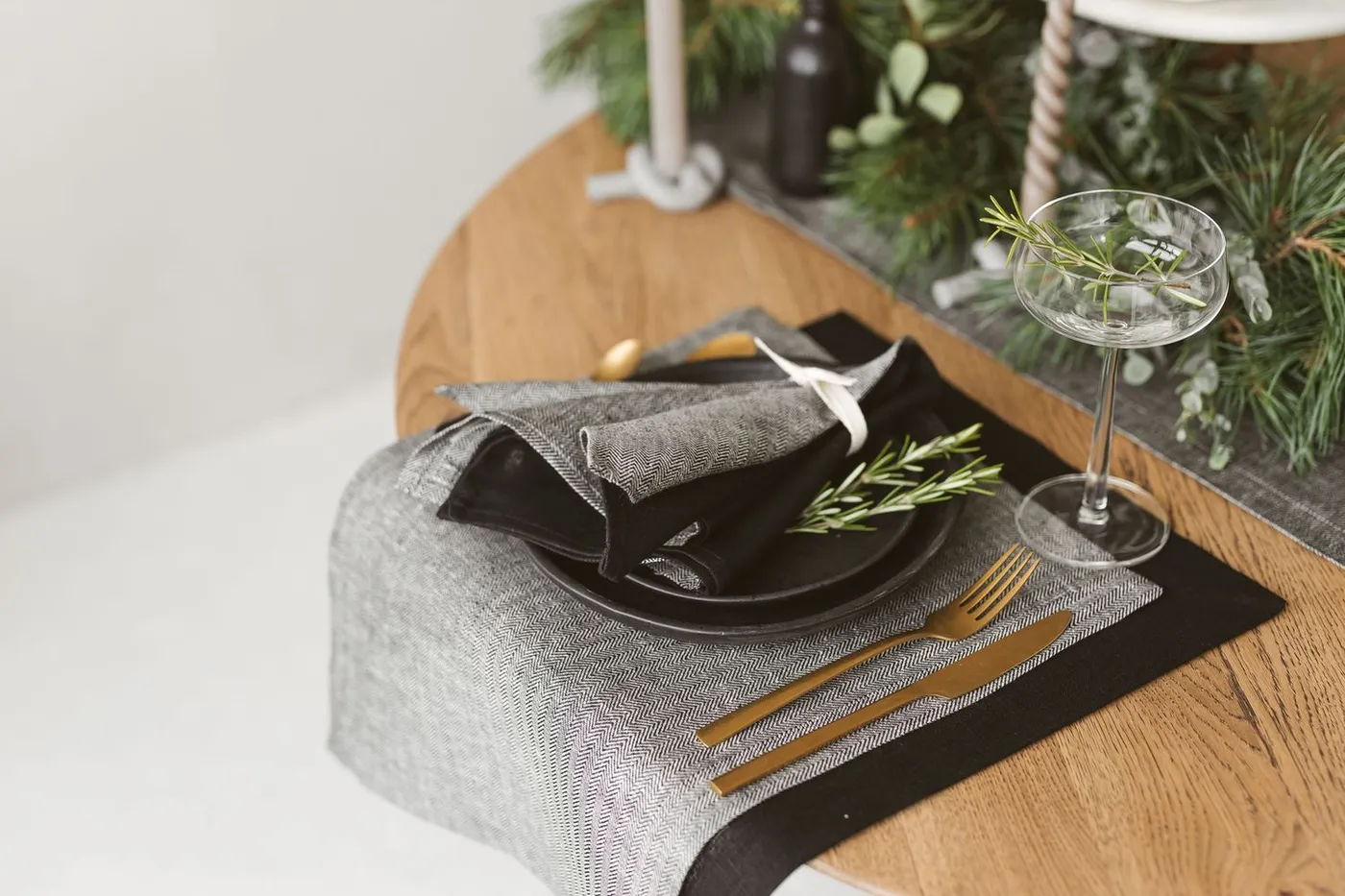
The double napkin. Two herringbone napkins tied with cream ribbon create a thick, almost upholstered bundle on the plate, and that volume is why this setting photographs so well. One napkin would have vanished against a black plate; two, tied, gives the eye something to land on at the exact center of the setting. It’s practical too — a thicker bundle catches spills before they reach the plate. Try it before you decide it’s fussy.
18. Candles, Citrus, and a Frosted Cake on Light Wood
Run through this list before you light anything:
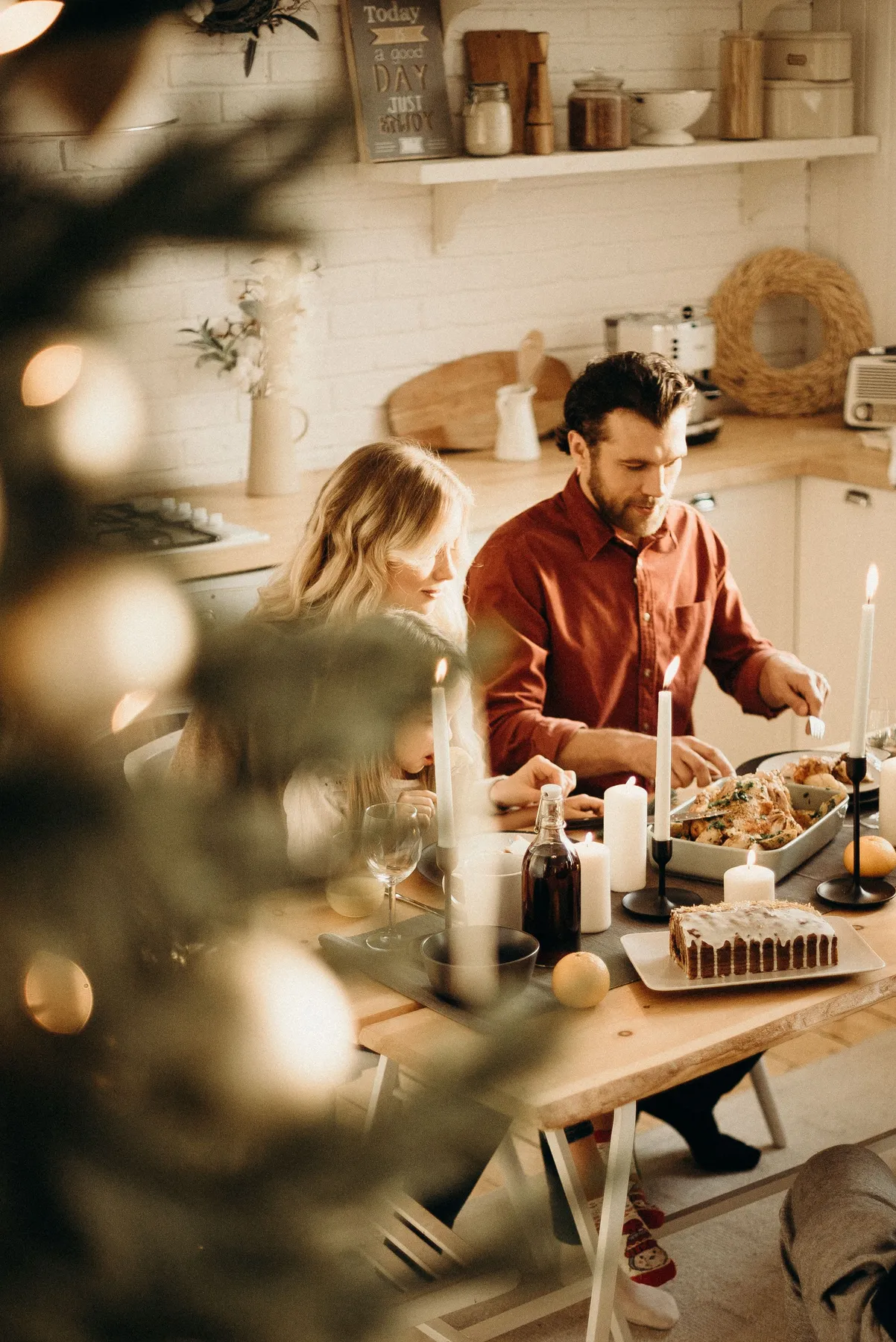
- Clear the sightline — candles sit below eye level across the table, or move them to the ends.
- Check your candle mix: pillar plus taper together needs clearly different holder heights, or it looks like a mistake.
- Pan-test your serving dish; a heavy grey ceramic roaster is unforgiving on a light wood finish.
- Slice citrus the same day — cut edges brown within hours.
- Keep the frosted cake out of candle draft, because soot lands on frosting and it shows.
This is a table built almost entirely from things you already own, which is the point. Black metal candle holders run $3–$8 at IKEA and Target; white pillar candles are $4–$9 each at the grocery store. The frosted cake is a boxed mix with buttercream and a spatula — no piping bag, and a deliberately rough finish looks better on a rustic table than a perfect one. Skip specialty bakeware: an $18 grey ceramic dish from HomeGoods does what the $70 version does.
19. Pinecone Garland with Fluted Glassware and Green Ribbon
This setting wants a table at least 30 inches deep, because the garland needs a clear 10–12 inches down the middle and the fluted glasses sit wide of the plates. On a narrow table, run the garland as a single loose line instead of a double row — same look, half the width. Tall tapers add about 14 inches of vertical, which is fine under a standard 8-foot ceiling with a pendant, and genuinely risky under a low chandelier. Measure once before you buy candles.
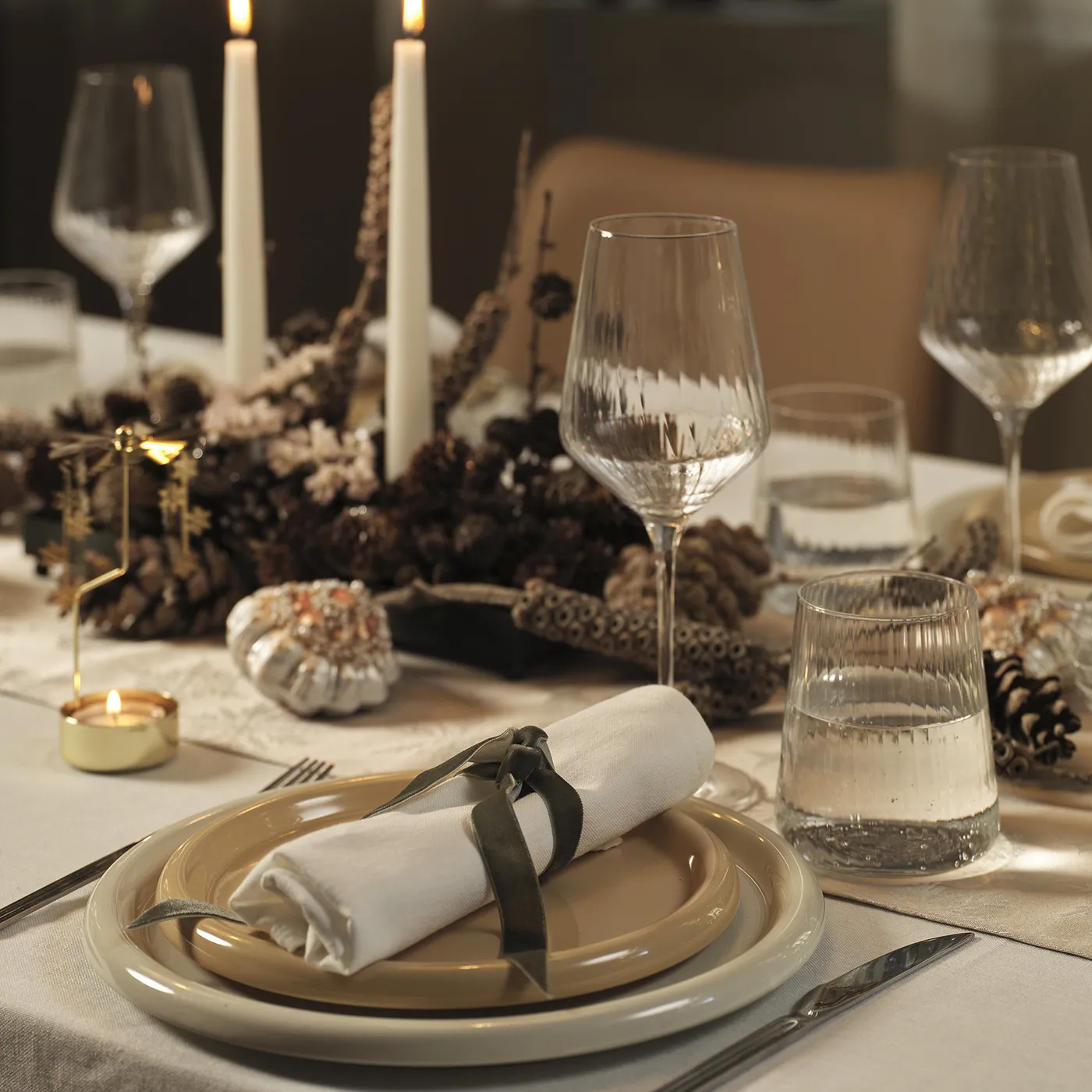
Tie the napkin ribbon so the knot sits at the top left of the plate, roughly at 10 o’clock. It’s a small thing that separates styled from wrapped, and it leaves the plate’s center clear for a place card or a small gift. Use 1-inch matte ribbon in deep green, cut to about 14 inches, ends trimmed at an angle. Satin will slide off linen before dinner starts; grosgrain or cotton tape holds.
20. A Festive Dinner Table Built Around One Focal Point
- Linens: cloth and napkins $35–$85
- Centerpiece: greenery, berries, and one statement object $30–$90
- Candlelight: holders and candles $25–$65
- Dishware: what you own, plus one accent set $40–$110
- Extras: napkin rings and small ornaments $15–$40
- Budget alternative: shop your own cabinets first, then fill gaps at thrift stores — $40–$70 gets the same effect at roughly half the cost.
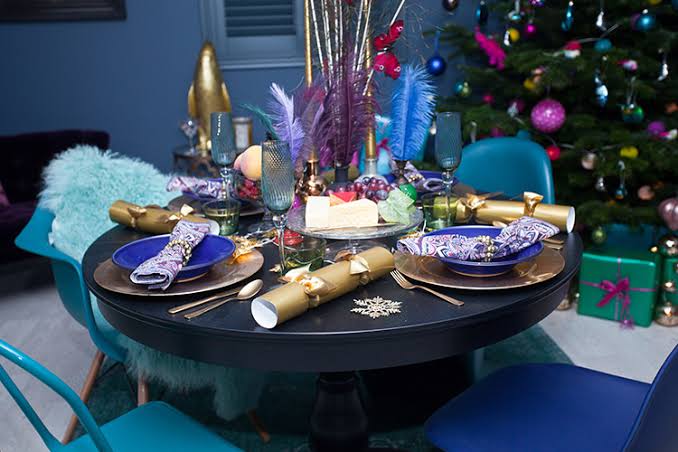
Total: $145–$390
The most common way a decorated dinner table fails isn’t taste, it’s traffic. If the centerpiece eats more than a third of the table’s length, serving dishes have nowhere to land and someone ends up holding the potatoes. Give yourself a clear 12 inches of bare surface at each end for platters and keep the decoration in the middle third. Also: candle wax on a good cloth is nearly impossible to lift, so put a mat under anything that burns.
21. Holly Plates, White Deer Figures, and Christmas Crackers
60% white cloth and plates + 25% deep green + 10% red + 5% gold. The deer figures are white, so they count toward the base rather than the accent — that’s why this table feels calmer than the holly pattern suggests. Swap the holly plates for plain white and add red napkins and the formula still holds; swap the deer for brass candlesticks and it goes formal fast. Keep the crackers. They’re the one element allowed to be loud.
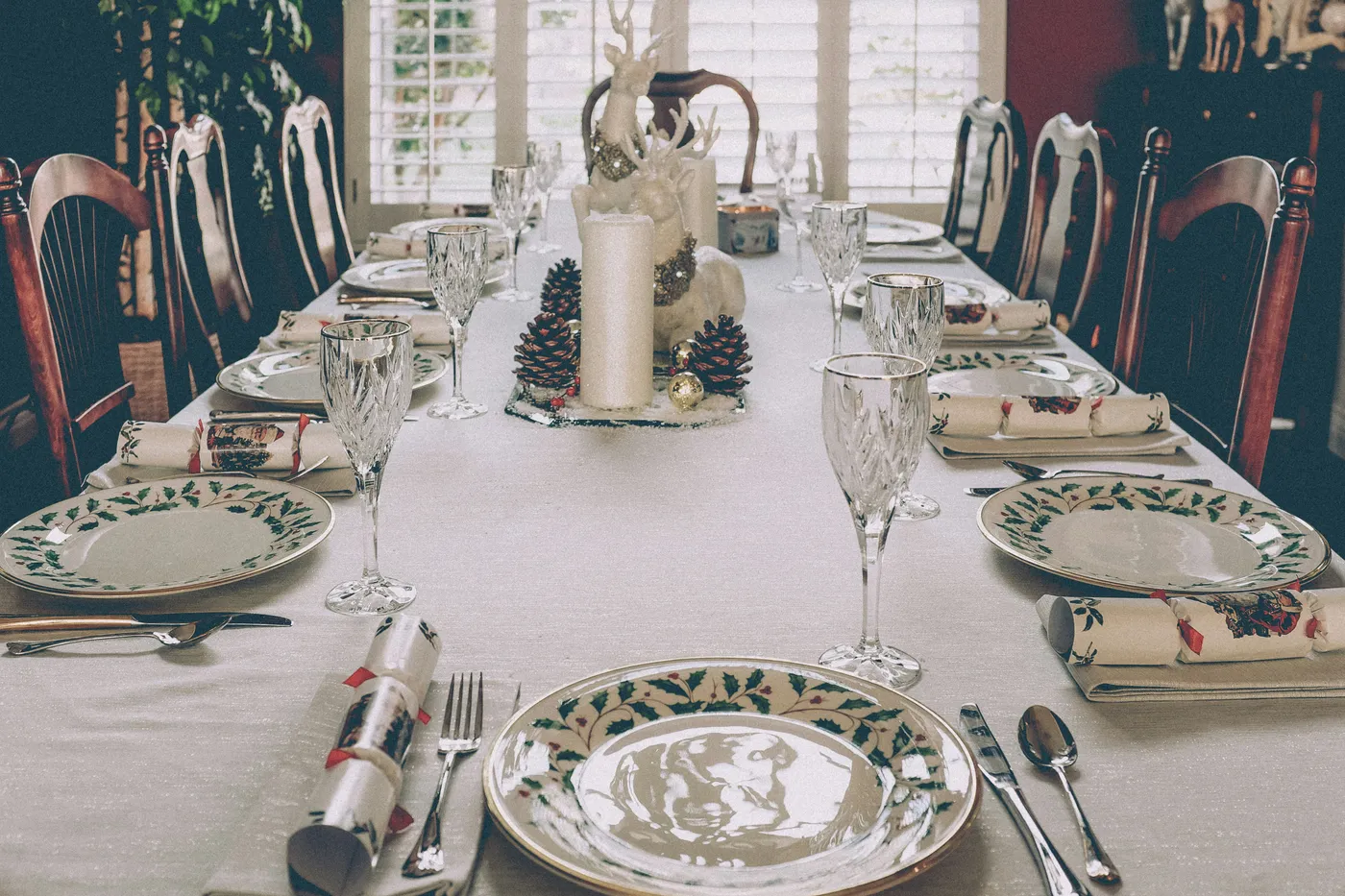
Crystal stemware with gold rims is hand wash only, full stop. The gold is a metallic film, and dishwasher heat will cloud it within a couple of runs — budget ten minutes at the end of the night with warm water and a soft cloth. Christmas crackers are single-use and leave paper everywhere, so open them over a tray. And if those holly plates are vintage, check the rims for crazing before they meet hot food.
22. Buffalo Check Cloth with Red Tapers Set in Evergreen
Two red taper candles. That’s the whole move. Buffalo check is a strong pattern and a full evergreen centerpiece is a strong shape, so a third strong element would tip the table into chaos. Red tapers are small, tall, and saturated — they punch through the green without competing with the check. And because they burn down over the evening, the table changes as you eat. That’s a rare thing in tablescaping: a decoration with a clock on it.
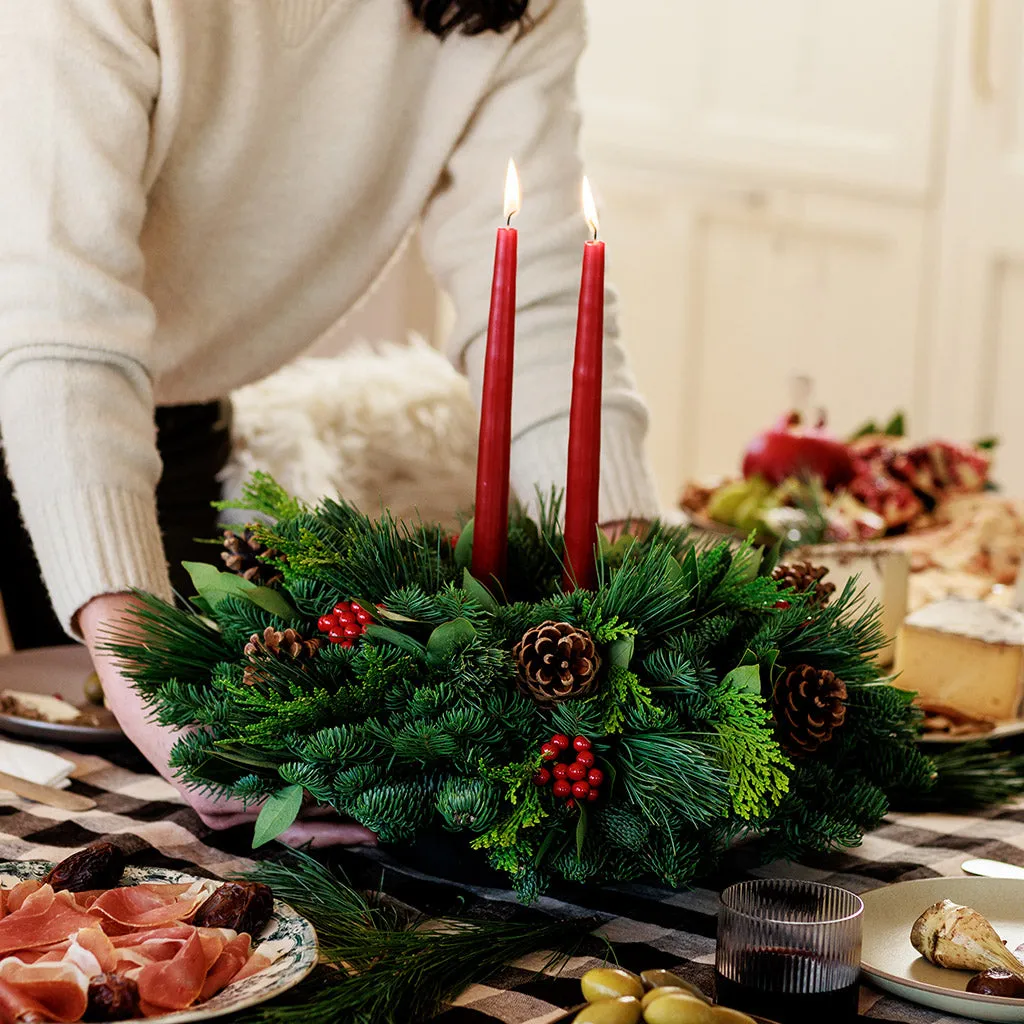
Setting tapers in greenery without a fire:
- Push each holder down until it rests on the table itself, not on the branches.
- Clear a 3-inch ring of greenery around every holder.
- Trim tapers to different heights — 8, 10, and 12 inches — for rhythm.
- Check for lean; a taper that isn’t vertical will drip onto the cloth.
- Never move a lit taper. Blow out, reposition, relight.
Fifteen minutes, and no extra cost beyond the candles.
23. A Velvet Runner with Red and White Tapers by the Tree
Velvet runners are the table textile of the moment, and it’s easy to see why — the nap of the fabric catches every bit of light from the tree, so the table glows before the candles are even lit. It’s also the most forgiving material for a holiday table: no wrinkles to speak of, and it hides wax. Expect deep red and forest green velvet everywhere in 2026. The version that will still look good in 2032 is the one that keeps everything else simple.
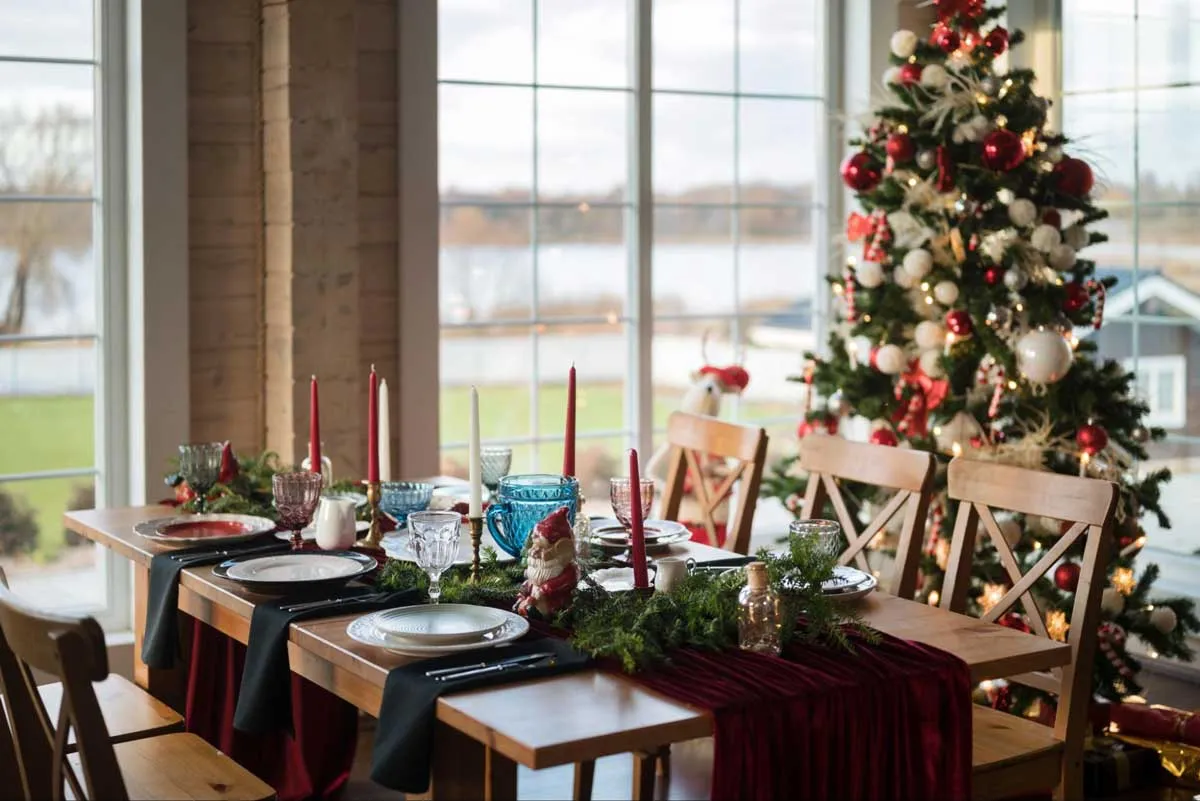
If your tree sits within four feet of the table, treat it as part of the tablescape and repeat one object between them — here, the same red and white in the candles echoes the ornaments. That repetition is what makes a room feel designed rather than decorated. Keep the runner about 14 inches wide so plates still sit on bare wood, and let it hang 6–8 inches over each end. More than that and guests will catch their silverware in it.
24. Plaid Cloth and Woodland Animal Plates with Dried Grasses
The illustrated plates work because the plaid doesn’t try to match them. A green-and-orange plaid plus a woodland-animal plate plus a dried-grass centerpiece should be a mess — except the plaid stays tonal and muted while the plates are the only place with linework. The orange chargers bridge the two. It’s the same idea as Idea #13: let one element carry the detail and keep everything around it quiet.
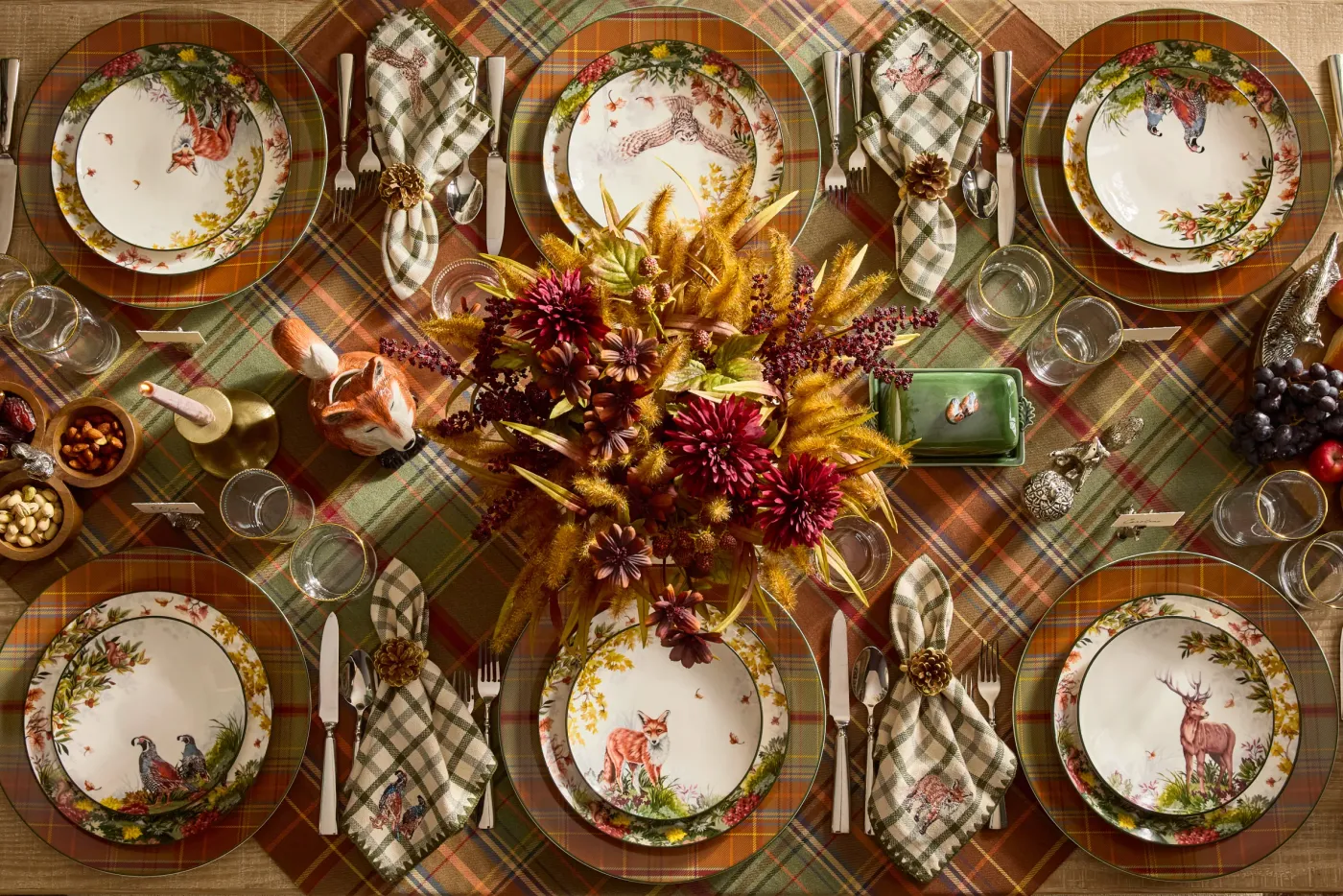
Woodland animal plates are the expensive part and the easiest to fake. Thrift stores and Etsy carry vintage holiday plates for $4–$9 each, and four mismatched animals look better than four identical ones anyway. Swap gold pinecone napkin rings for plain brass rings from a craft store at $2 each, and dried grasses are free if you know anyone with a field nearby — otherwise $12 a bunch from a florist. Plaid cloth: $15 at a fabric store, hemmed at home.
25. Damask Cloth, Gold Lattice Baskets, and Berry Foliage
This is a formal dining room table, and it knows it. Damask, candelabras, gold-trimmed porcelain — the whole setup needs a table of 96 inches or more, a ceiling above 9 feet so the candelabras can breathe, and enough room behind the chairs for people to push back. In a smaller room it goes from grand to crowded in about ten minutes. Under 200 square feet, borrow the berry-and-foliage baskets and skip the damask entirely.
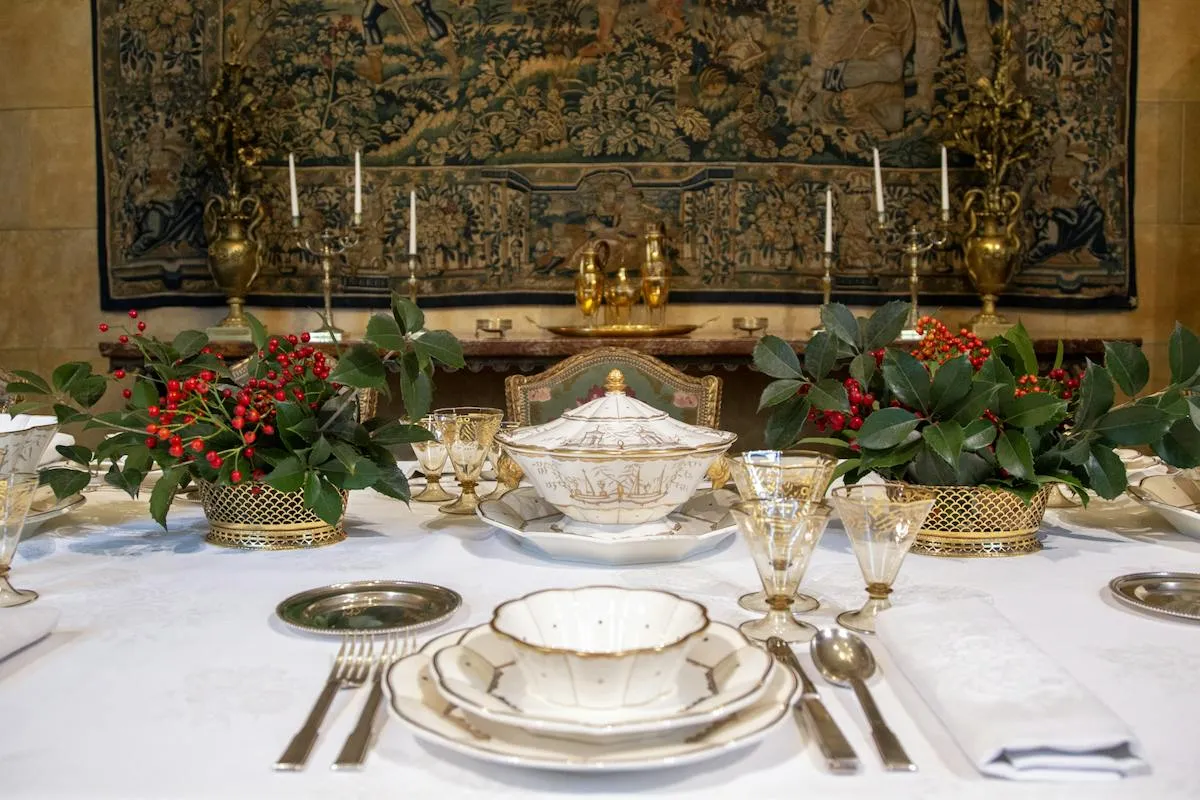
- Linens: damask cloth $60–$160
- Centerpiece: two gold lattice baskets $50–$130, fresh foliage and berries $30–$60
- Candlelight: antique-style candelabras (pair) $80–$220
- Glassware: gold goblets (set of 4) $40–$95
- Dishware: gold-trimmed porcelain, if you’re buying $120–$300
- Budget alternative: rent the candelabras for the evening at $15–$25 each and use grocery-store eucalyptus in thrifted baskets — about half the spend.
Total: $380–$965
26. Illuminated Ceramic Trees with Silver Baubles
Check these before you buy a single ceramic tree:
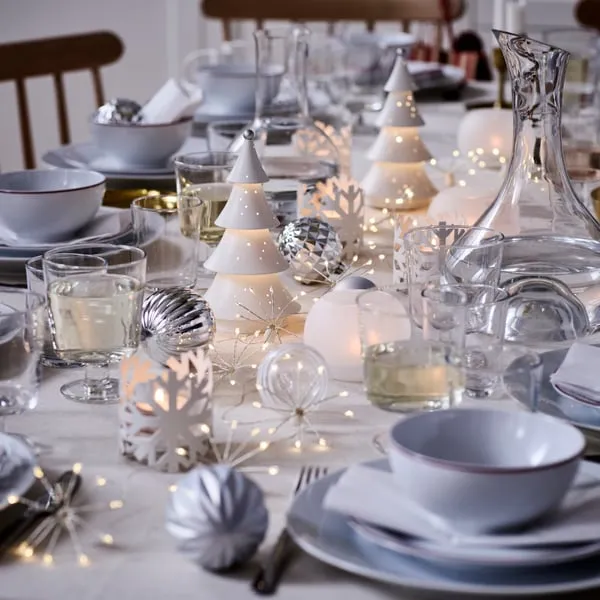
- Count your outlets — most lit trees are plug-in, and a daisy chain of extension cords under a cloth is a hazard.
- Measure table depth: three lit trees plus plates needs 38 inches or more.
- Test the color temperature; mixing warm and cool lit trees on one table looks like an accident.
- Decide where the baubles live — scattered loose on the cloth, they’ll end up on the floor.
- Confirm the plates can take the palette; a thin red rim keeps white from going flat.
The lit ceramic trees. Everything else is quiet — white cloth, white plates, clear glass, silver baubles — and the trees are the only thing with a light source inside them. That’s why the table reads as luminous instead of merely white. Take them away and you have a very pretty, very cold table. If you only own one, put it dead center and let the string lights do the rest.
27. A Silver Antler Candelabra and Light-Up Letters
Light-up letters are divisive, and they work here for one reason: they’re small and they’re the same warm white as everything else. Keep them under 8 inches tall, place them off-center, and never put them at the head of the table where they’d compete with an actual person. The antler candelabra is your anchor — center it, then build outward in decreasing heights so the eye steps down toward the plates instead of falling off the edge of the table.
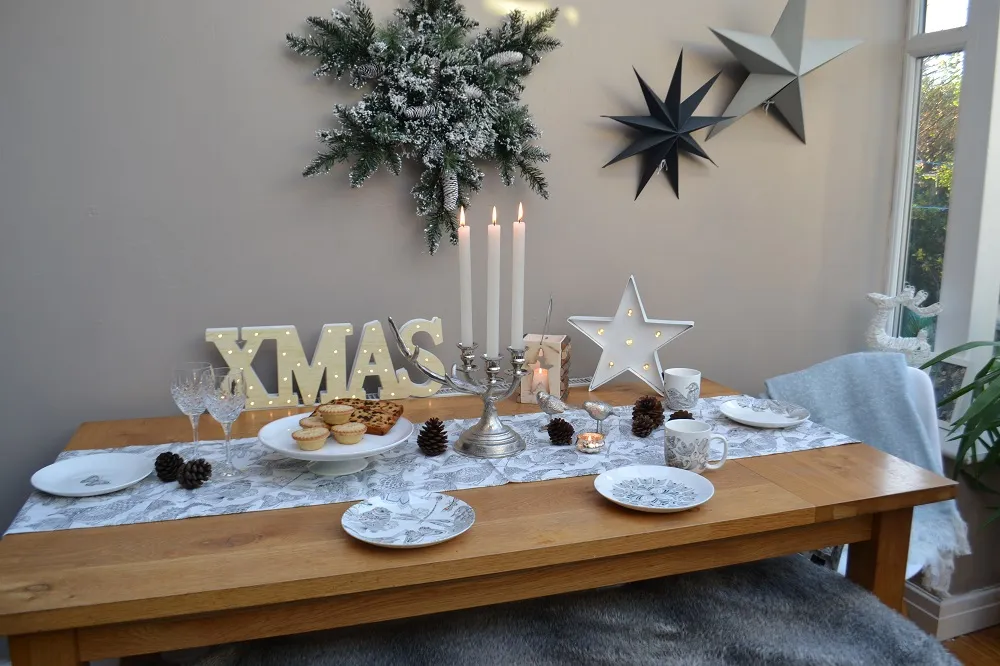
There are three light sources here — candles, the letters, the star — and they’re all the same temperature. That’s the principle. Mismatched color temperature is what makes holiday decor look cheap, and matching it is free. The frosted pine branch on the wall and the paper stars above do the same work vertically: they extend the table’s palette upward so the room feels decorated rather than just set. Grey runner, white plates, silver everywhere — one value, many surfaces.
28. A Dark Oval Table, Bouclé Chairs, and Flanking Pre-Lit Trees
Flanking trees, in five steps:
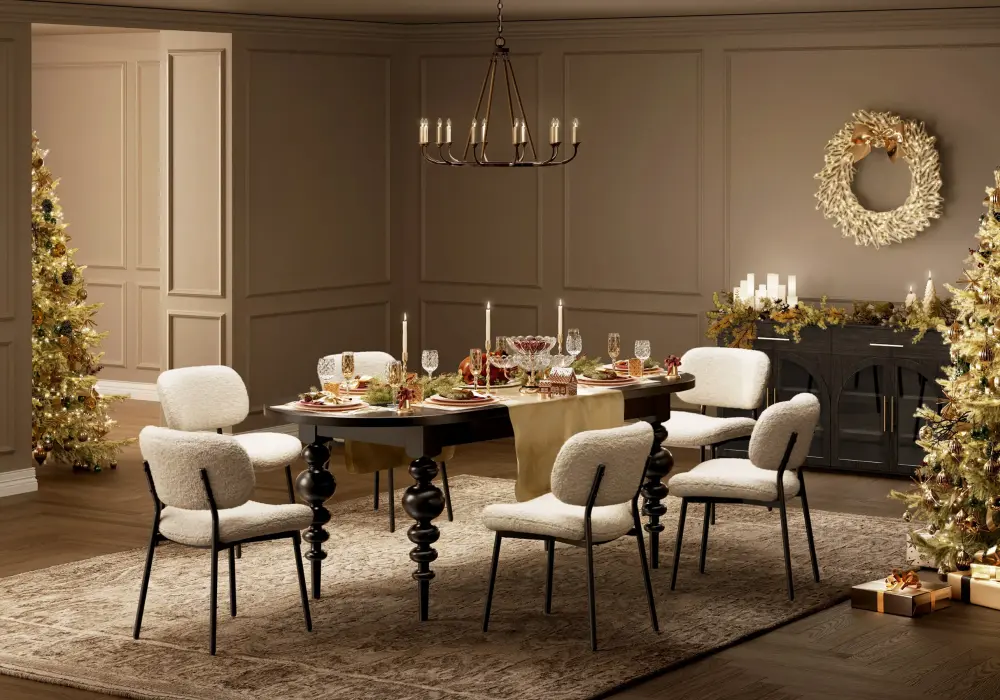
- Clear the buffet completely before anything comes in — the trees should frame it, not hide it.
- Measure the gap between table edge and wall; each tree needs 24 inches of clearance for chair pull-out.
- Set the trees first, then hang the wreath at eye level above the buffet’s center.
- Drape garland along the buffet top, letting it spill 6 inches over the front edge.
- Add candles last, and check that no flame sits under a branch.
About two hours, and no cost beyond what you own if the trees are pre-lit.
This arrangement needs a real dining room — figure 12 by 14 feet minimum, with 36 inches of walkway behind the chairs on at least two sides. An oval table at 72–84 inches seats six comfortably, and bouclé chairs add about 24 inches of depth each, which is more than most people budget for. Ceiling height matters here because of the chandelier: 8 feet works, 9 or above is where the room sings.
29. A Starred Red Cloth with a Burning Red Pillar Candle
- Linens: red star-print cloth $25–$60, red napkins (set of 4) $18–$40
- Centerpiece: red pillar candle $8–$18, faux holly and pinecones $15–$35
- Tabletop: white plates you own, gold-and-white crackers $12–$28
- Glassware: crystal stems, thrifted $20–$50
- Flatware: silver-toned set $30–$75
- Budget alternative: a plain red flat sheet as a cloth ($12) plus dollar-store crackers and pinecones from the yard — around 55% less.
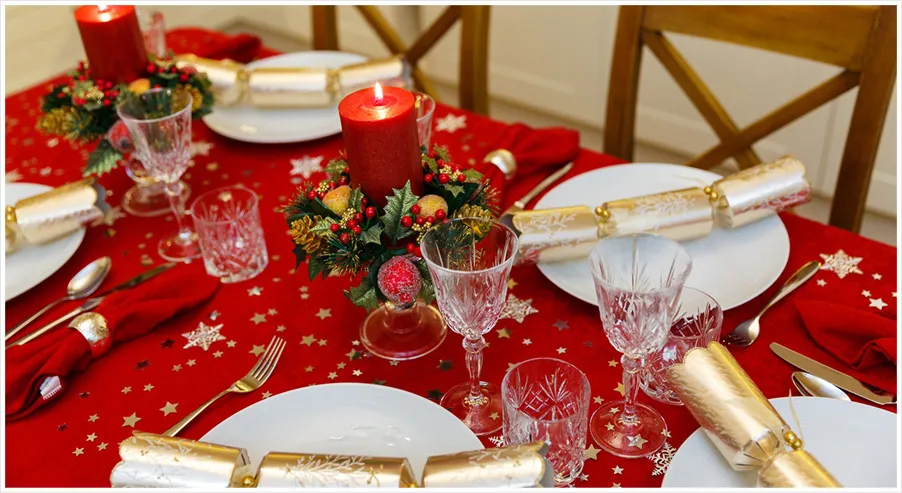
Total: $128–$306
80% red + 15% white + 5% gold and silver. It’s a bold ratio, and it only works because the red is deep and slightly muted — a bright cherry red at this percentage would be unbearable. The white arrives in small doses: plates, snowflake confetti, cracker bodies. Gold and silver are the sparkle, kept to small stuff. Change the red to burgundy and it gets moodier; change to cranberry and it gets friendlier. Don’t change the ratio.
30. A Pinecone Wreath Centerpiece with Mercury Glass Trees
Lay the wreath flat and put the two tall tapers inside it, not beside it — a wreath with candles in the center reads as one centerpiece, while a wreath next to candles reads as two objects that happen to be near each other. Keep the tapers at least 8 inches tall so they clear the wreath’s texture, and use a base of 14 inches or more so it doesn’t disappear under the visual weight of the plates.
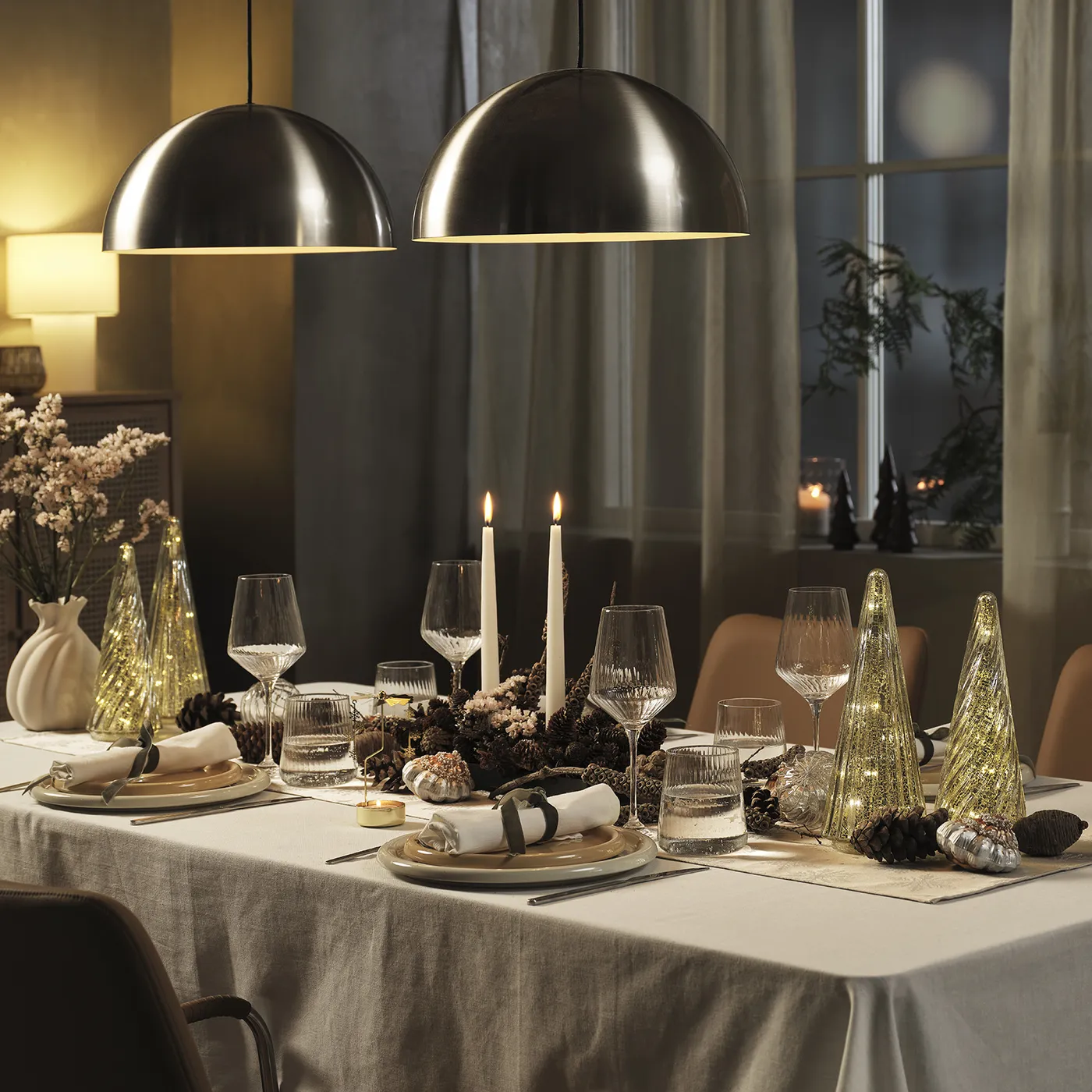
The illuminated mercury glass trees. They’re silvered on the inside, so they throw light instead of just holding it, and they pick up the fluted glassware across the table. Remove them and you still have a lovely natural centerpiece — but you lose the glow that makes the table feel lit from within. If you can only buy one thing here, make it the trees, not the wreath. The wreath you can forage.
31. Eucalyptus and Berry Garland by Candlelight
This many open flames requires actual attention. Tapers in wooden candlesticks are the riskiest combination on any holiday table — wood plus a burning wick plus a tablecloth is a three-part problem. Keep every candlestick at least 4 inches from the garland, trim wicks before lighting, and never leave the room with them burning. Eucalyptus is also mildly toxic to cats and dogs, so if you have a counter-surfing pet, swap it for olive branch or bay.
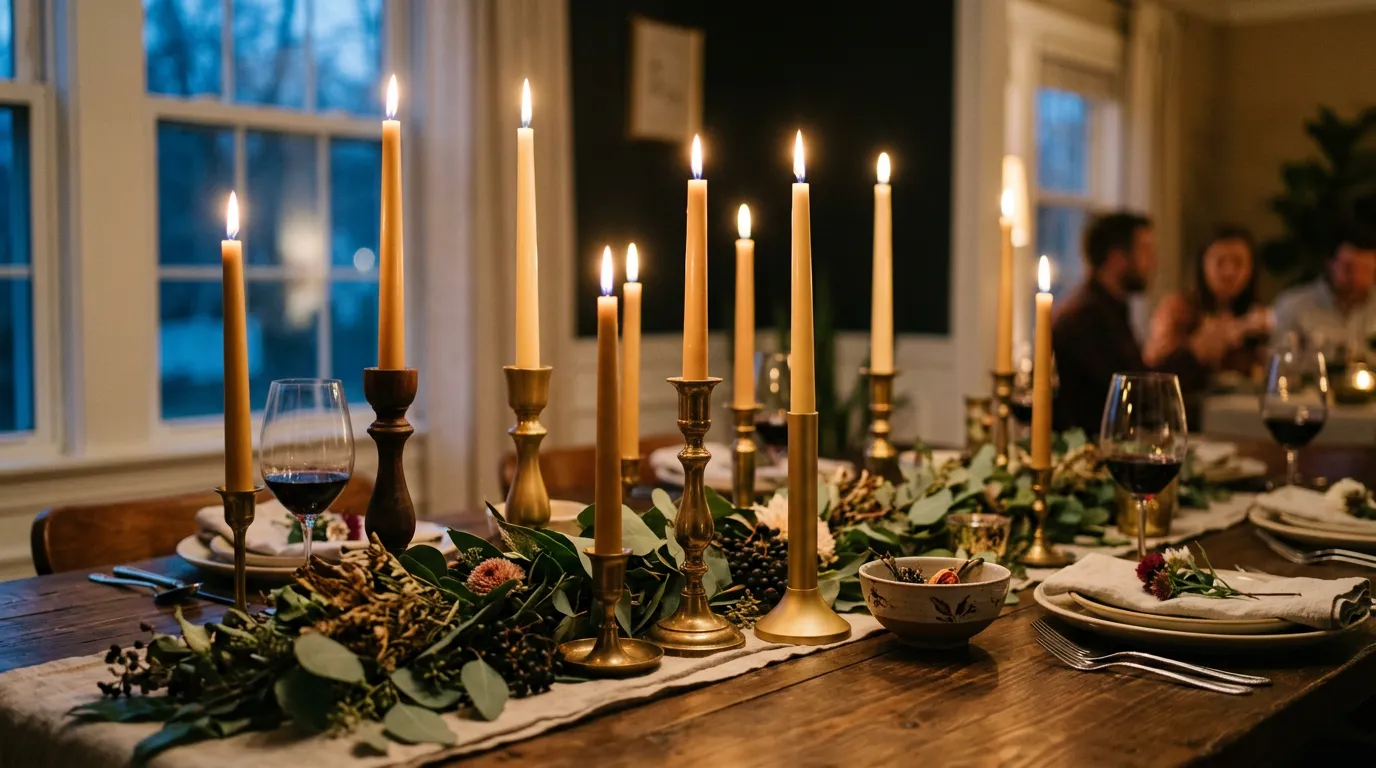
Everything here is low-contrast except the flames. Dark wood, deep green, muted linen, brass — all sitting in a narrow tonal range, which is exactly why the candlelight reads so strongly. The garland runs loose and slightly uneven rather than tightly wired, and that imperfection is doing real work: a too-perfect garland on a rustic table looks borrowed from a hotel lobby. Wine glasses with red in them finish the palette without adding a single decoration.
32. Deep Red Cloth, Silver Stars, and a Tamale Spread
The beauty of this table is that the food is the centerpiece. Skip the floral arrangement entirely and put the money into a good red cloth — $30 at HomeGoods beats $90 at a specialty store, and a flat sheet works in a pinch. Silver star ornaments come in packs of twelve for $8–$15 in January, so buy them after the season and store them with the napkins. Textured silver napkin rings: $2 each at a craft store. Total decorative spend stays under $70 if the plates are already yours.
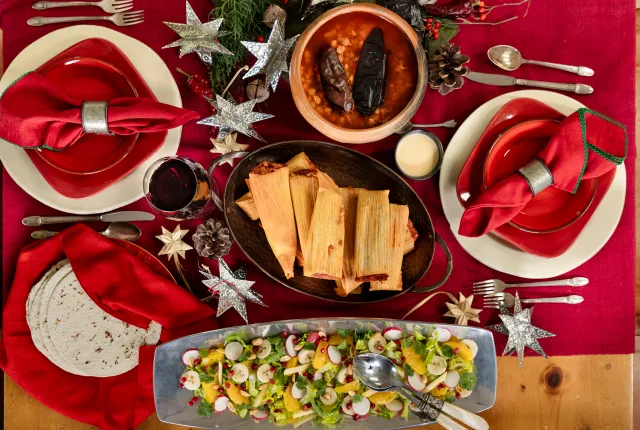
The two-tone plate stack, in five steps:
- Start with the cream dinner plate, centered on the setting.
- Set the smaller red plate on top, offset toward the guest by half an inch.
- Fold the napkin into a narrow band and lay it across the red plate’s lower third.
- Slide the ring on so the green trim shows on the right side.
- Place flatware last, an inch from the plate edge, and check the row from the doorway.
Five minutes a setting, no extra cost.
33. White Cloth, Grey Plates, and Black Paper Stars
85% white + 10% grey + 5% black, with green arriving only as pine sprigs and pinecones. That’s a nearly monochrome formula, and it stays festive because the shapes are seasonal even when the colors aren’t. Swap the grey plates for cream and it warms up; swap the black cutlery for silver and it relaxes. The white taper candles in black holders are the load-bearing detail — same math as Idea #15, just brighter.
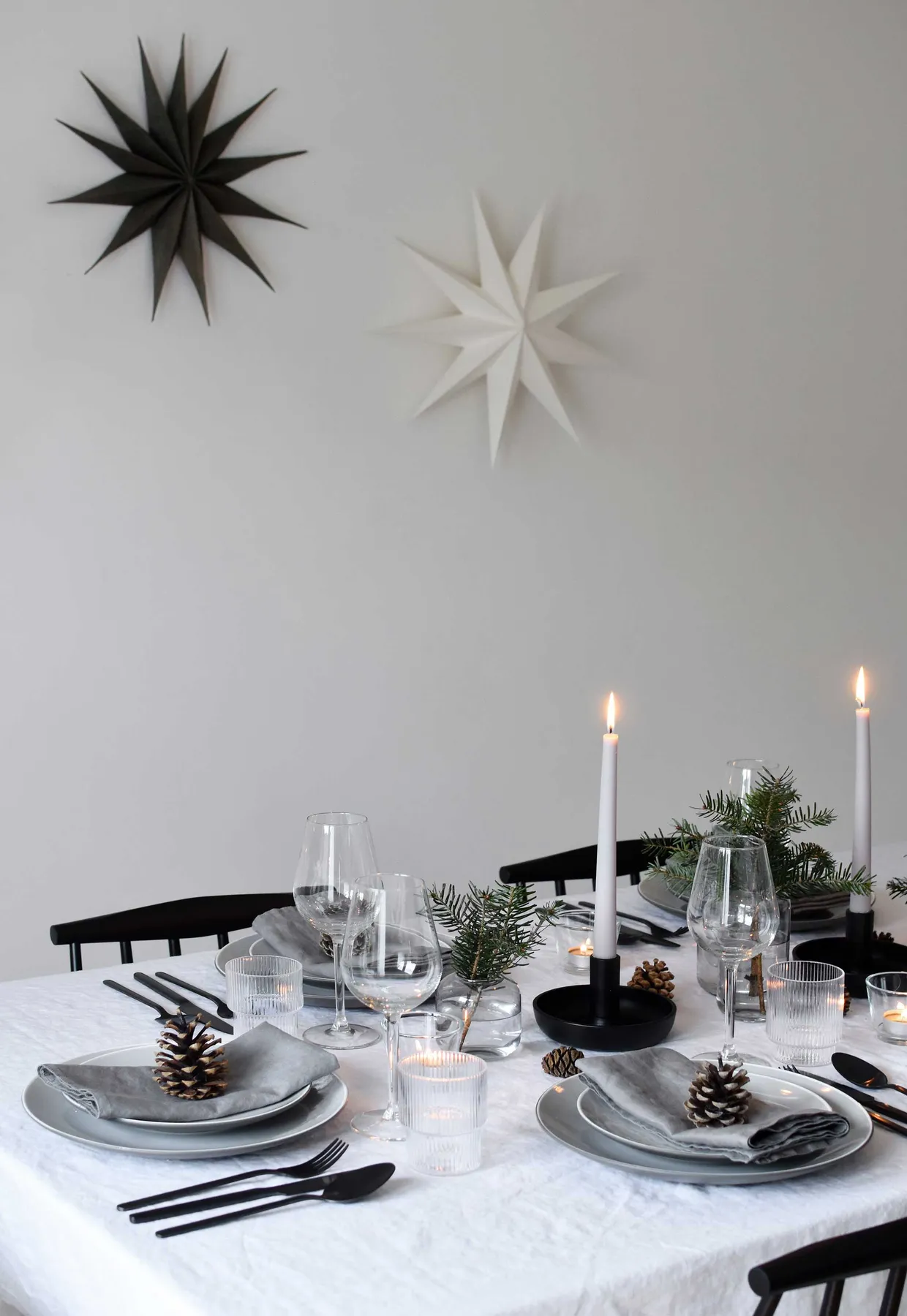
The black-and-white paper stars on the wall behind. They cost almost nothing, they’re the only decoration not sitting on the table, and they give the whole scene a frame. Without them this is a nice minimal table photographed against a blank wall; with them, the room participates. If you’re doing a pared-back holiday table, budget for one wall element — stars, a wreath, a branch — before you buy a single napkin ring.
Light the Candles and Stop Fiddling
None of these tables require a designer, a fortune, or a perfectly behaved family — they require one clear idea and about an hour of actual work. Pick the one idea that made you stop scrolling, steal the color formula, and let the food and the people do the rest.
📌 Save this to Pinterest now so it’s waiting for you the night before, when you’re standing in the kitchen wondering where to start.