Orange Christmas trees are having a major moment on Pinterest right now — and the saves tell the story better than any trend report could. We spent serious time browsing World Market, Target, and Pottery Barn (plus a few late-night Etsy rabbit holes) to bring you only what’s worth your attention this year.
After filtering through hundreds of options, we narrowed it down to 33 ideas that actually deliver, from $9 ornaments to a $1,299 statement tree. You’ll find natural rustic citrus, warm maximalist glam, mid-century tangerine, and traditional gold-and-red updates — all from real homes and real designers, with budget and luxury versions compared side by side and direct product links for every idea.
Why now? In 2026, orange has quietly replaced red as the accent neutral people actually want in their living rooms — it photographs warmer, flatters wood tones, and doesn’t fight your everyday decor. And stay until the end — we break down the most common mistakes that can ruin these looks.
📌 Save this to Pinterest for later — you’ll want to revisit these ideas.
1. The Mall-Scale Gold-Orange Tree That Owns the Atrium
What holds a tree this size together is repetition at a fixed scale. Every gold-orange element is roughly the same size and shape — leaf-like, slightly cupped — so your eye reads texture instead of clutter. The warm white string lights stay in one color temperature throughout, which is why the whole thing glows amber rather than looking patchy. Swap the leaf ornaments for feathers or paper fans and the formula still works; just keep the size consistent and the light color consistent.
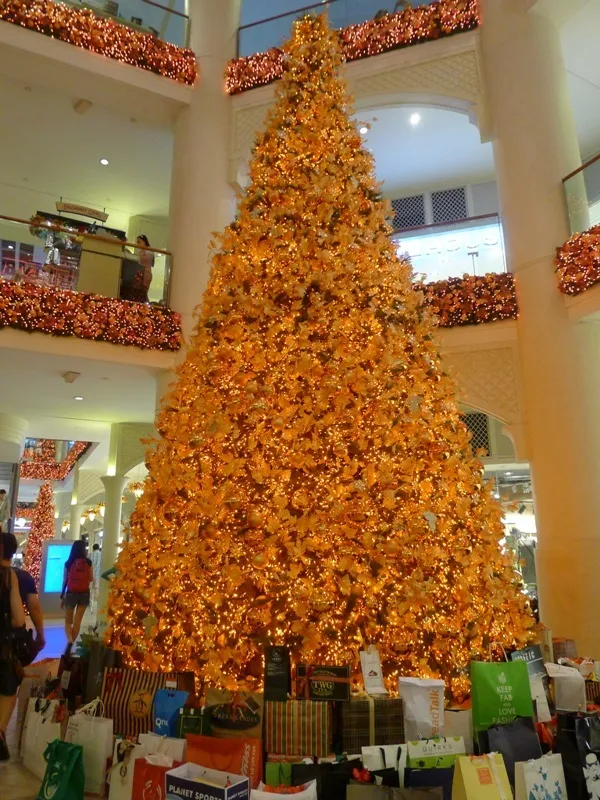
Mall trees set the palette about eighteen months before it lands in living rooms, and the amber-gold direction has been building since the last big swing away from cool silver. In 2026 the pull is toward warmth that reads well on camera — orange-gold tones flatter phone cameras and skin tones, which is exactly why this look dominates holiday boards. It has staying power, too: gold is a neutral in holiday decorating, so you can layer it onto an orange tree or a green one without rebuying a thing.
2. A Feather-Trimmed Orange Tree Against Deep Navy
The formula here is roughly 55% orange feather texture plus 30% navy wall plus 15% gold hardware and baubles. That navy is doing the heavy lifting — it’s the only cool note in the room, so it makes the orange look warmer and richer by contrast. Want to swap it? Charcoal gives you a moodier read, deep forest green goes softer and more traditional, and warm cream turns the whole thing into a bright daytime look. Keep gold in the accent slot either way; brass reads festive, chrome reads cold.
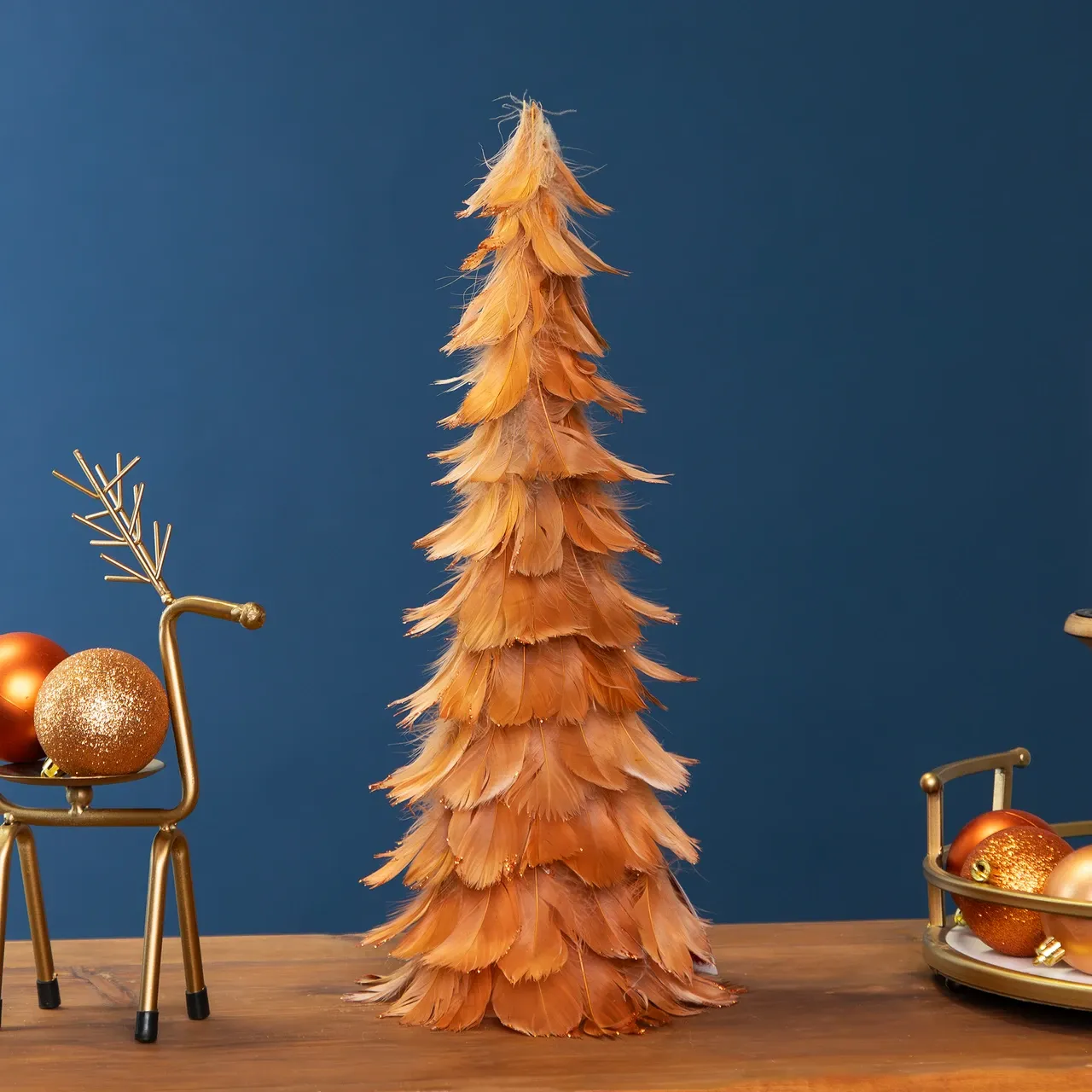
Feather trees photograph beautifully but they shed, so treat one like a textile: fluff each layer outward from the center, work top to bottom, and never push feathers back toward the trunk or you’ll flatten the silhouette for good. A 4-foot feather tree needs about 90 minutes of fluffing to look full. Keep it out of direct sun, too — dyed feathers fade noticeably in three to four weeks near a south-facing window, and there’s no fixing that.
3. Tangerine Tree in a Snow-Framed Window
A saturated orange tree against a snow-bright window is a genuinely stunning combination, and also the hardest lighting situation in the house. Backlighting turns orange into a muddy brown from inside the room, so plan on keeping the tree’s own warm white lights on whenever the view is bright. And if you have pets or toddlers, a tall slender tree on a shag rug is a tipping hazard — anchor it to the wall or skip the rug underneath entirely.
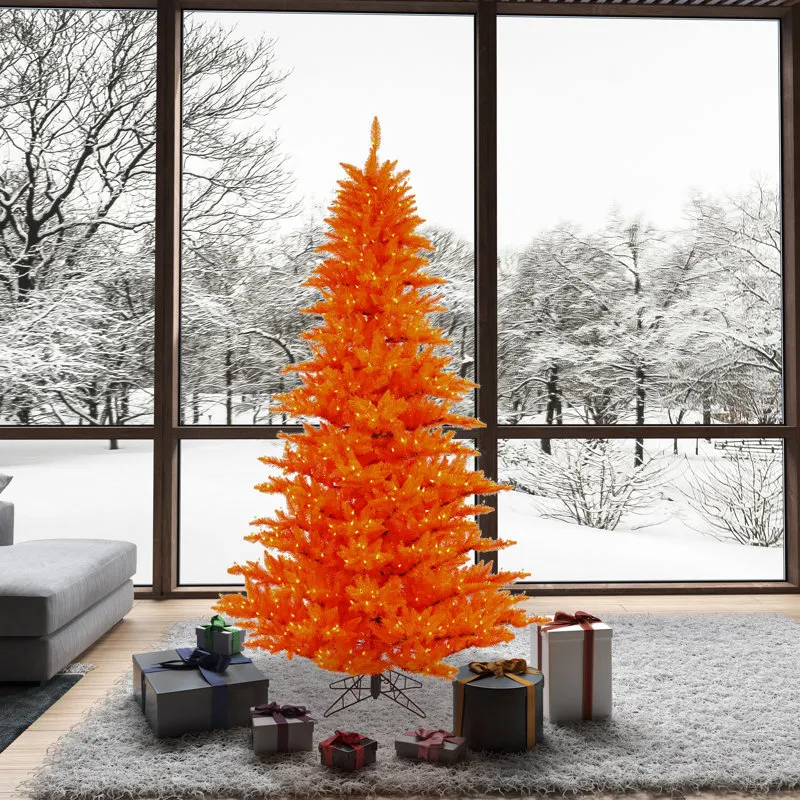
- Tree: $120–$320 for a slim 7-foot orange artificial tree
- Lighting: $25–$60 for warm white string lights, 300–500 count
- Textiles: $60–$180 for a light grey shag rug
- Gift wrap and ribbon: $40–$90 in grey, white, and charcoal
- Paint or wall touch-up: $0–$45 if the window trim needs it
Total: roughly $245–$695. Budget alternative: a thrifted green tree spray-painted gloss orange is about $35 all in — see Idea #16 for how that finish actually reads in daylight.
4. Dried Orange and Cinnamon Ornaments You Can Make Tonight
- Slice oranges about a quarter inch thick and blot them dry with a paper towel.
- Bake at 200°F for three to four hours, flipping once, until the centers are leathery rather than brittle.
- Let them cool completely — warm slices crack when you thread them.
- Thread twine through two cinnamon sticks, two wooden beads, and one orange slice, in that order.
- Knot top and bottom, trim the tails to about an inch, and hang.
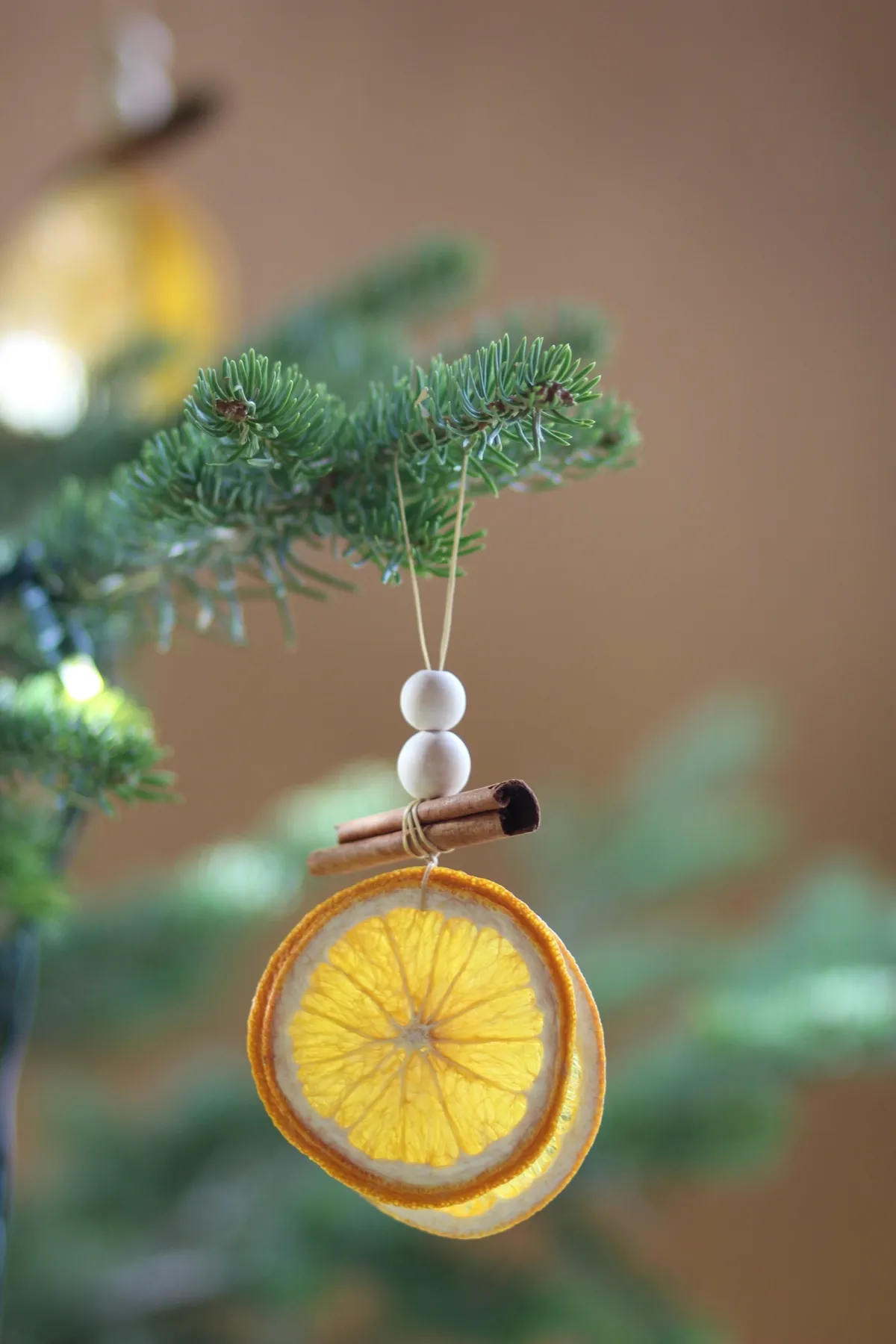
Time: about four hours, mostly oven time. Cost: roughly $0.90 per ornament.
The single element doing the real work is the wooden bead — not the orange, not the cinnamon. Those two give you the scent and the color, but the two light natural beads are what keep this from reading like a craft-fair project. They soften the cinnamon’s darkness and give the eye somewhere neutral to rest. Skip them and the ornament gets heavy and dark; add a third and it starts to look stretched. Two is the number.
5. Orange and Gold Baubles on a Classic Green Fir
- Tree: $90–$260 for a 6.5–7 ft green fir, or reuse last year’s
- Ornaments: $60–$150 for orange and gold baubles in three sizes
- Lighting: $20–$45 for warm white string lights
- Topper: $15–$40 for a large multi-point gold star
- Gift wrap: $15–$35 for silver paper and ribbon
![O [Burnt Orange] Christmas Tree, O Christmas Tree | the brinks](https://4homeideas.com/wp-content/uploads/2026/10/o-burnt-orange-christmas-tree-o-christma-5.webp)
Total: roughly $200–$530. Budget alternative: buy one big box of mixed-size orange baubles and a single can of gold spray paint, then hit half of them for a two-tone set at half the price.
Ornament size is what separates a designer tree from a decorated one. On a 7-foot tree, aim for roughly 60% small (2-inch), 30% medium (3-inch), and 10% large (4-inch and up) baubles — about 100 pieces total. Cluster two or three together, tuck them slightly inside the branches, and leave the outer branch tips bare so the tree keeps its silhouette. If your tree looks flat, you almost always have too many ornaments in the same size.
6. Copper Woven Light Spheres for the Patio
These woven spheres read best when they’re at least 12 inches across — smaller ones disappear at ten feet and just look like porch clutter. One sphere per four to six feet of paver or planter space is plenty; three in a row along a low wall is the sweet spot. On a standard 8×10 patio, two spheres at different heights is exactly right. If your space is tighter, compare with Idea #16 for an indoor-friendly alternative to the same warm glow.
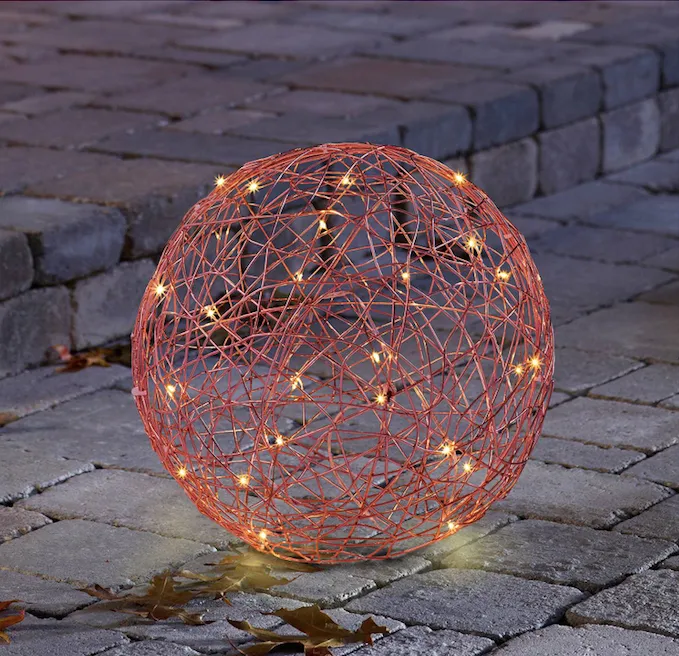
Outdoor lit spheres look magical in photos and forgettable in daylight, so place them where a planter or the edge of a low wall can hide them during the day. You’ll also need a weather-rated extension cord and an actual outdoor outlet — running an indoor cord across wet pavers is how people end up with tripped breakers and ruined decor. Check that the material is rated for freezing temps, because woven fiber and ice are not friends.
7. A White Tree Glowing Orange Against Brick
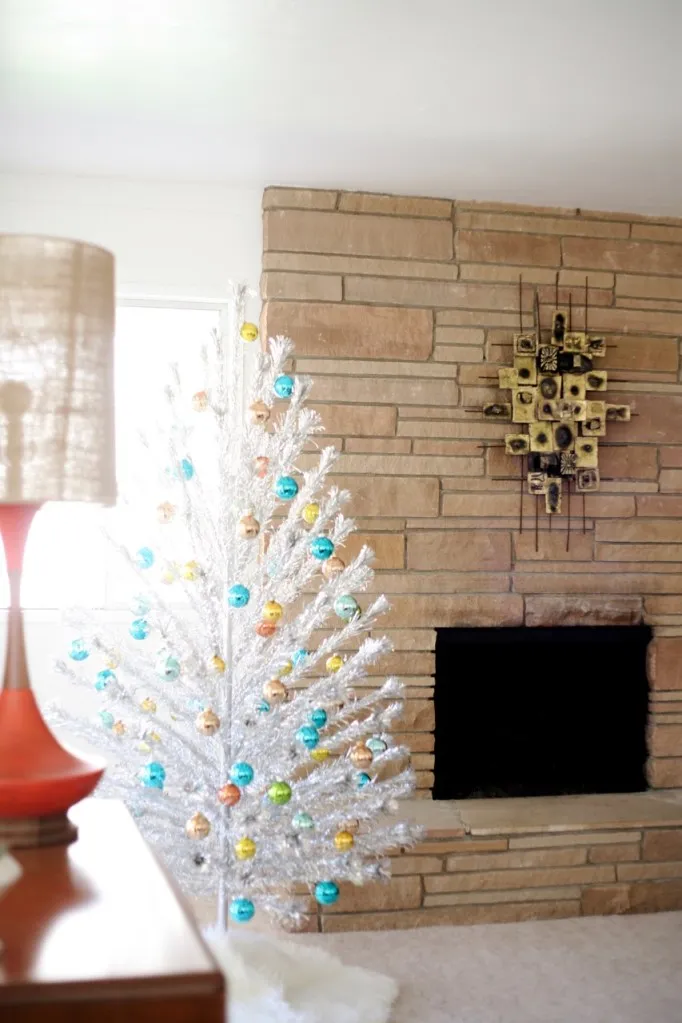
Colored light on a white tree behaves completely differently than on a green one, because white needles reflect instead of absorb. That means you need about 30% fewer strands than you think — start with 100 lights per foot of tree height, then add only if it still looks uneven. Warm orange and red light at the same color temperature will read as one color once they blend, so don’t panic if the raw bulbs look mismatched while they’re still in the box.
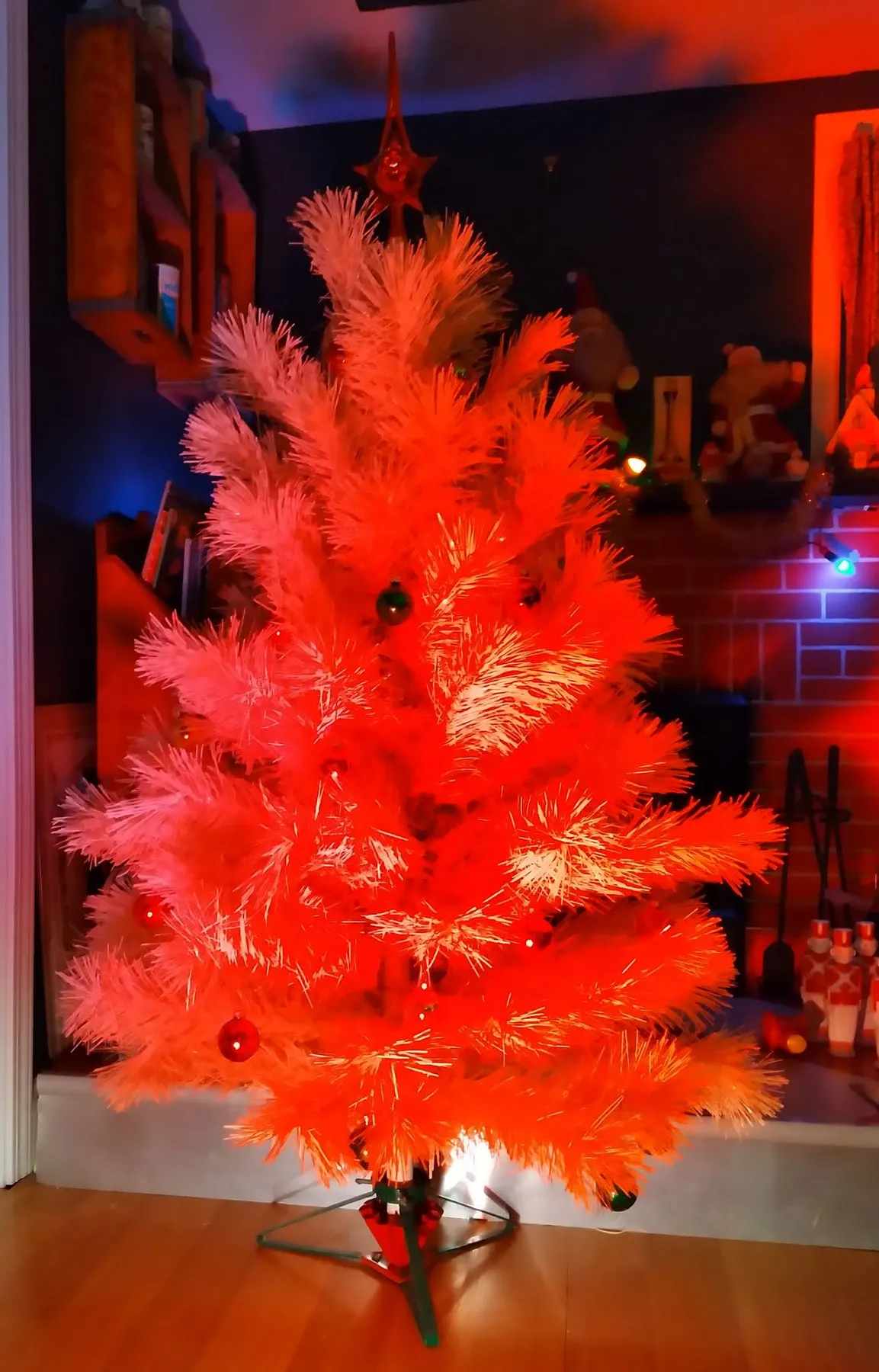
The brick is the secret here. Orange light on brick reads as firelight because brick already carries warm red undertones, so the tree and the fireplace wall feel like one continuous glow. Contrast does the rest: white branches give you a bright, high-key base that makes saturated orange look intentional rather than accidental. Move this exact setup onto a grey wall and it goes cool and a little clinical — the brick is doing more work than it gets credit for.
8. A Tabletop Tree in a Rustic Wooden Planter
- Line a square wooden planter with a plastic liner and add a false base so the tree sits high.
- Set the tree in, then tuck dried orange slices and cinnamon sticks into the inner branches where they won’t crowd the lights.
- Wire pinecones to the outer branch tips with floral wire — they’re the heaviest ornaments, so keep them low and outward.
- Wrap warm white string lights from the trunk outward, not in loops around the outside.
- Finish with a short strand draped across the top edge of the planter to hide the base.
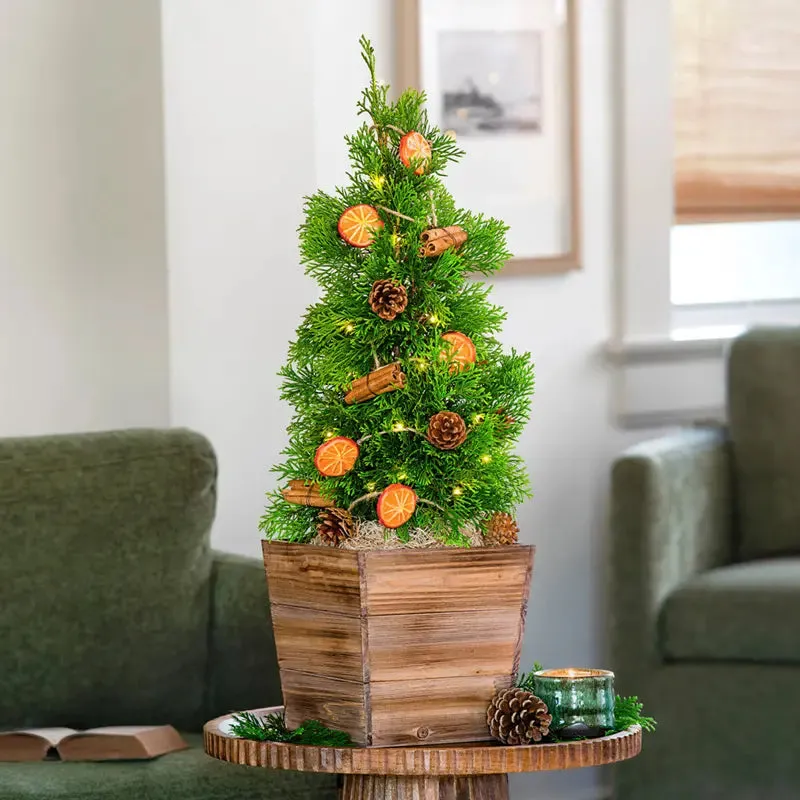
Time: about 45 minutes. Materials: $35–$60.
You can build this whole thing for under $45. Grab a $12 tabletop evergreen at Trader Joe’s or a $20 mini tree from Target, bake your own orange slices, and house it in a wooden crate from Facebook Marketplace for $8. Cinnamon sticks are cheapest in bulk at Walmart — about $4 for a bag that lasts three seasons. The planter is the one place worth spending; a $25 rustic box reads twice as expensive as it is.
9. Amber Wall Glow From a Densely Lit Tree
The wall glow is the whole point. That amber halo and the branch shadows thrown onto a textured wall are what make this tree feel like a moment instead of furniture — and they cost nothing extra. Take them away and you have a well-lit tree in a dim room. So before you buy a single ornament, point the tree at a wall with some texture, step it 12–18 inches away, and check the effect with the room lights off.
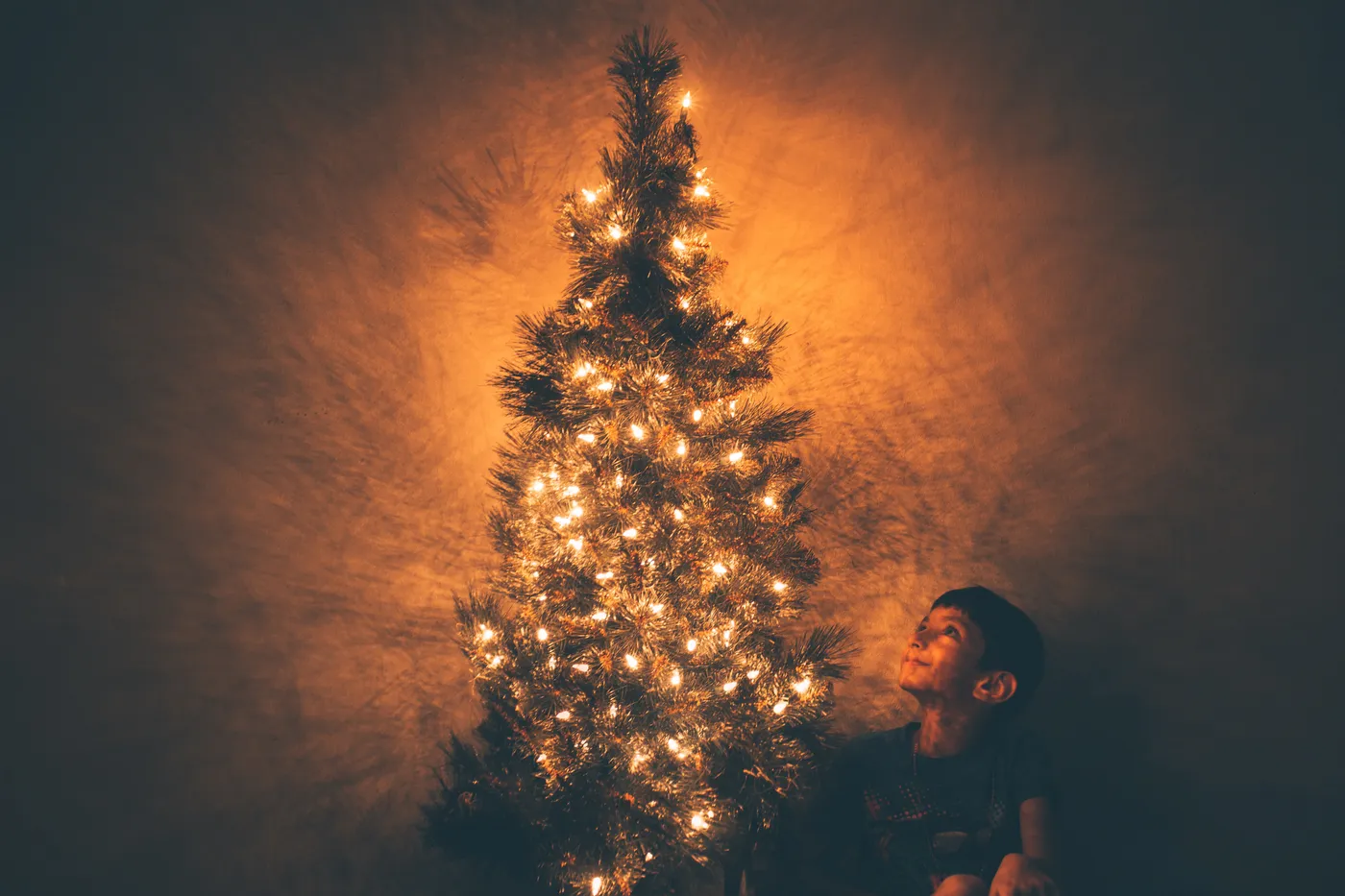
Warm string lights on a densely lit tree run hot, so budget for a fire-safe timer and check the cords monthly. Real trees in this setup need water every day for the first week and every other day after — a glowing tree dries out faster than you’d guess. If you’re using an artificial tree, fairy lights typically last two to three seasons before sections start failing. Buy replaceable strands rather than a pre-lit tree and you’ll save yourself a full replacement.
10. Flocked Branches with Citrus and Magenta Blooms
This looks complicated but the math is easy: about 60% white flocked branches, 25% pink and magenta blooms, 10% dried and fresh citrus, 5% green berries and lights. The white base is what lets hot pink and orange sit together without a fight — on a green tree, the same combination gets busy fast. Swapping magenta for soft blush makes it quieter and more romantic; swapping it for deep fuchsia pushes it into full maximalist territory. Keep the berry accents green in both cases.
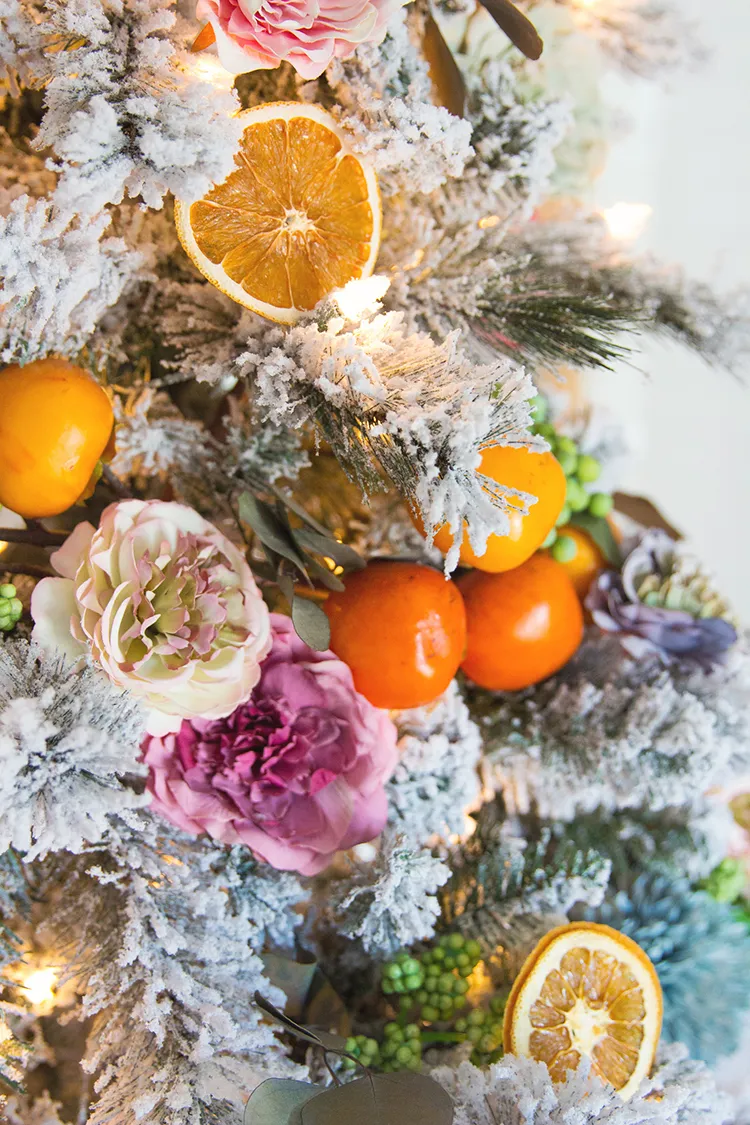
Faux flowers on a flocked tree need to be clustered, not sprinkled. Group them in threes at the branch tips, and pinch the stems so they sit about an inch off the branch rather than flat against it — that’s what gives you the just-picked look. A 6-foot tree takes roughly 18–24 small clusters. Only refresh the flocking with spray snow during the first season; flocking that’s been touched up twice starts to look crusty up close.
11. A Frosted Mini Tree on a Marble Kitchen Counter
- Mini evergreen: $18–$40
- Dried orange slices: $8 for a bag, or about $4 of fresh fruit
- Whole oranges and tangerines: $5–$9
- Faux snow spray: $6–$12
- Dark wood slice base: $12–$28
- Warm fairy lights: $8–$15
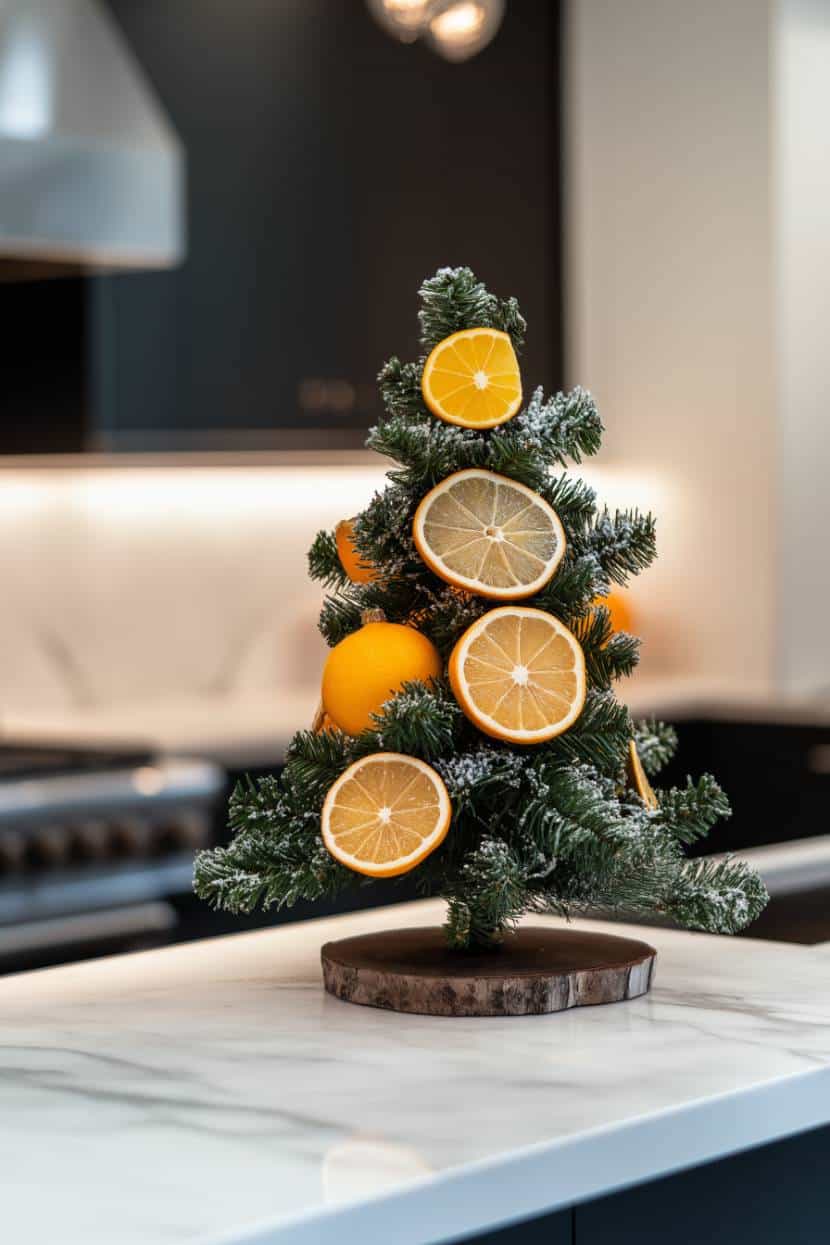
Total: roughly $57–$112. Budget alternative: skip the wood slice base and use a dark wooden bowl you already own, then put that $20 toward a nicer strand of battery fairy lights — that’s the part people actually notice.
- Measure your counter depth — a 24-inch tree needs about 14 inches of clear space, and marble scratches if you slide it.
- Keep the tree away from the sink, stovetop, and any heat source.
- Use unwaxed fruit if the oranges will sit near food prep.
- Make sure the base is waterproof, not just stain-resistant.
12. Cranberry, Popcorn, and Cereal Garlands, Old-School Style
- Thread fresh cranberries on upholstery thread with a needle, working around any soft ones.
- String plain popcorn — day-old is firmer — alternating with cranberries if you want a mixed strand.
- For a cereal garland, use a needle with a large eye and thread O-shaped cereal the same way.
- Loop the strands in soft swoops between branch layers rather than wrapping them tight around the tree.
- Keep every garland at least two inches from a bulb light; popcorn browns within days against a hot bulb.
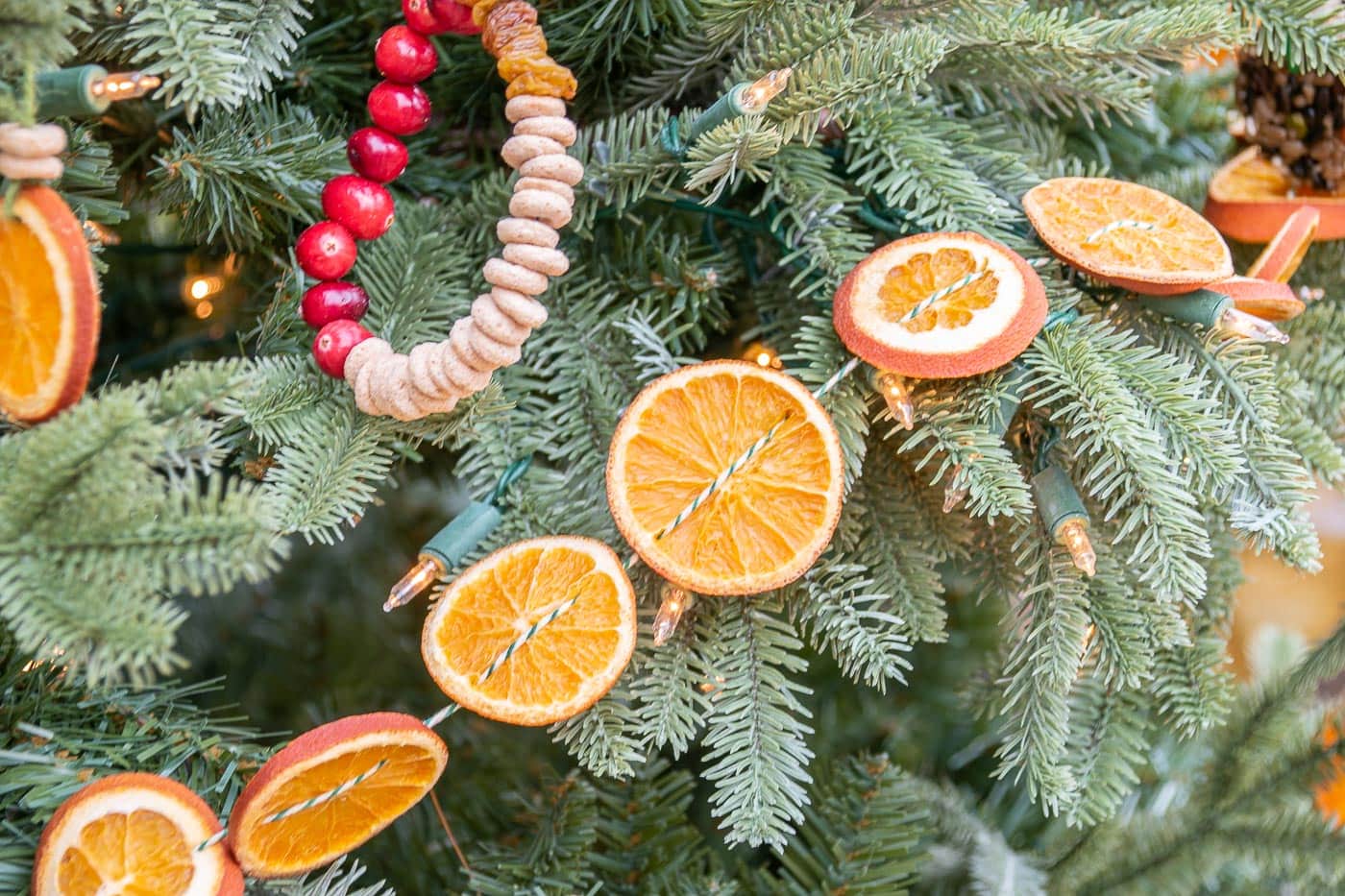
Time: 60–90 minutes per 6-foot strand. Cost: about $6 in materials.
Three separate garlands in one tree sounds like chaos, and it isn’t, because they’re all the same visual weight — small, matte, and roughly bead-sized. Repetition at that scale reads as texture instead of noise. All three materials are also matte and edible-adjacent, which keeps them looking earthy next to shiny ornaments. It’s the same reason a bowl of apples looks calmer than a bowl of glass fruit.
13. Orange Slices and White Stars in a Reading Corner
This arrangement needs floor space to breathe. The woven chair, rug, and tree together want about 8×8 feet, with the wreaths hung at least 18 inches above the tree top so the whole thing reads as one vignette.
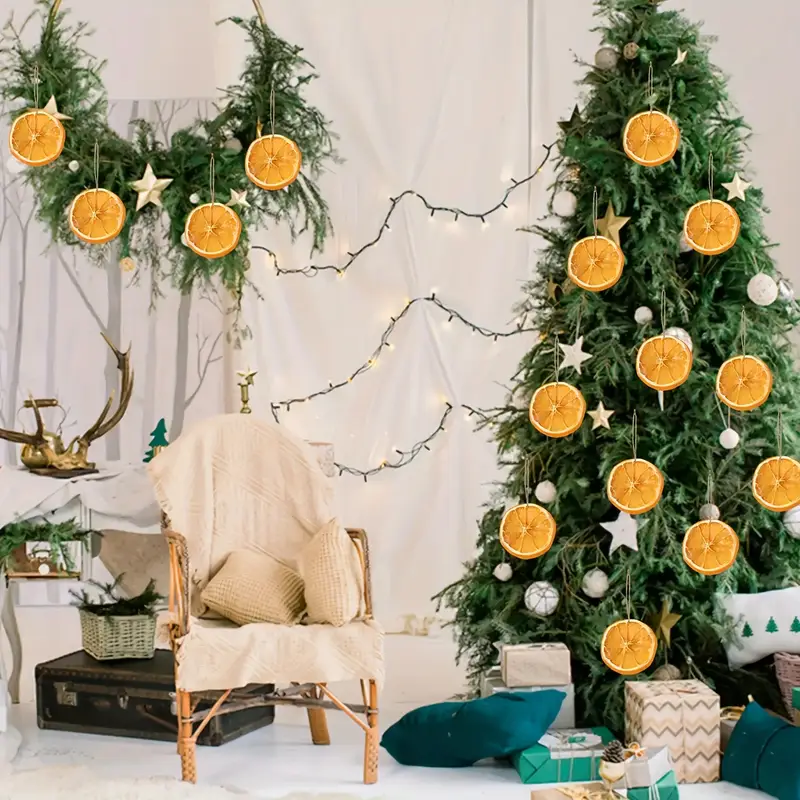
- Under 100 sq ft: a 5-foot tree and one wreath
- 100–180 sq ft: 6-foot tree, two wreaths, and a reading chair
- Over 180 sq ft: 7-foot tree plus a full seating vignette
Everything here has a thrift-store equivalent. Woven armchairs turn up on Facebook Marketplace for $40–$120, and a white fluffy rug is $30 at IKEA or $25 at Walmart. The dried orange slices cost about $4 to make; white star and ball ornaments run $12 for a 30-pack at Target. Thrifted wreaths spray-painted matte white are about $6 each. Realistic rebuild: $180–$320 versus $900-plus new.
14. A Live Evergreen Beside the Wood Stove
The gold container is the quiet hero. A live evergreen in a plastic pot looks like a nursery leftover; the same tree dropped into a low gold vessel instantly reads intentional. It also solves a practical problem — the container hides the water reservoir and saucer, which is usually the least attractive part of keeping a live tree indoors. Any warm metallic will work, but gold specifically picks up the dried orange tones and makes them glow.
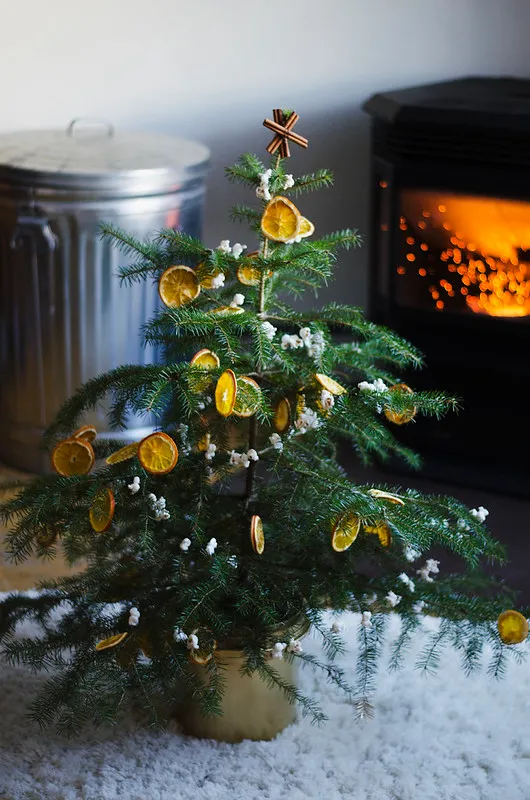
Live tabletop evergreens have been climbing on Pinterest for a few seasons, and 2026 is the year they went mainstream — partly because they cost less than a full tree, partly because people are decorating smaller spaces with more intention. Small also means you can go loud with color without committing an entire room to it. This one is a safe bet to keep trending: the materials are compostable, the palette is classic, and it needs zero storage space in January.
15. Pastel Blooms and a Golden Star on Flocked Branches
Break it down as 55% white flocking, 20% pastel florals, 15% warm lights and gold, 10% citrus and berries. The rule that makes it work is saturation matching — everything sits in the soft-to-medium range, so no single element shouts. Swap the pastels for jewel tones and you have to push the flocking to pure white and add more light, or the tree goes muddy. Drop the flowers entirely and the citrus and gold alone will look clean and Scandinavian rather than romantic.
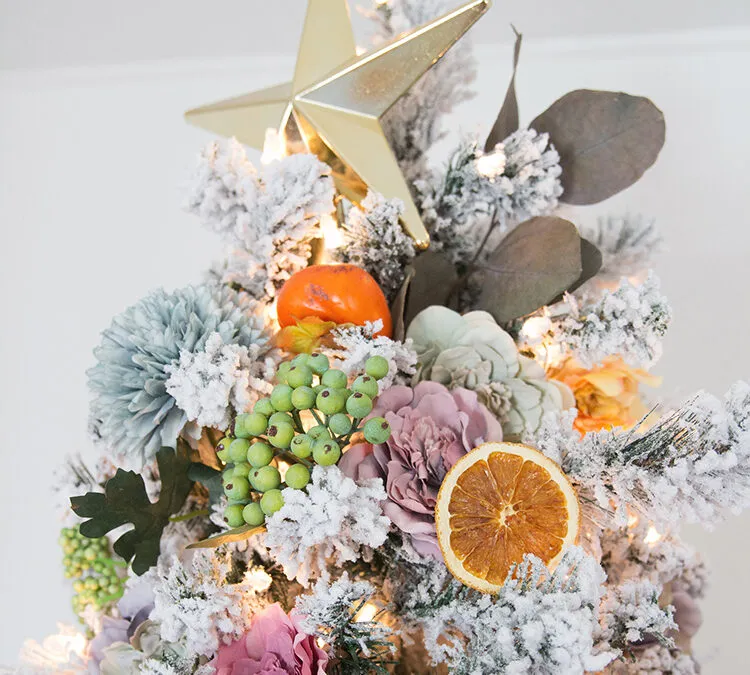
On a flocked tree, order of operations matters more than the ornaments themselves. Hang lights first, then the heaviest pieces deep in the branches, then flowers, then delicate glass at the tips — otherwise you’ll crush the flocking reaching back in later. And don’t overload it: a heavily flocked 7-foot tree looks best with about 60 ornaments, roughly 40% fewer than a green tree. The white space is the design.
16. Vivid Orange Branches, Warm White Fairy Lights
Vivid orange foliage is polarizing in person — it’s the one tree guests either love on sight or quietly ask about an hour later. It also shows dust and pet hair more than green does, and it photographs far brighter than it looks at 9pm with the room lights on. Before committing, tape an orange paint swatch to the wall where the tree will go and live with it for three days. If it still feels good at night, buy the tree.
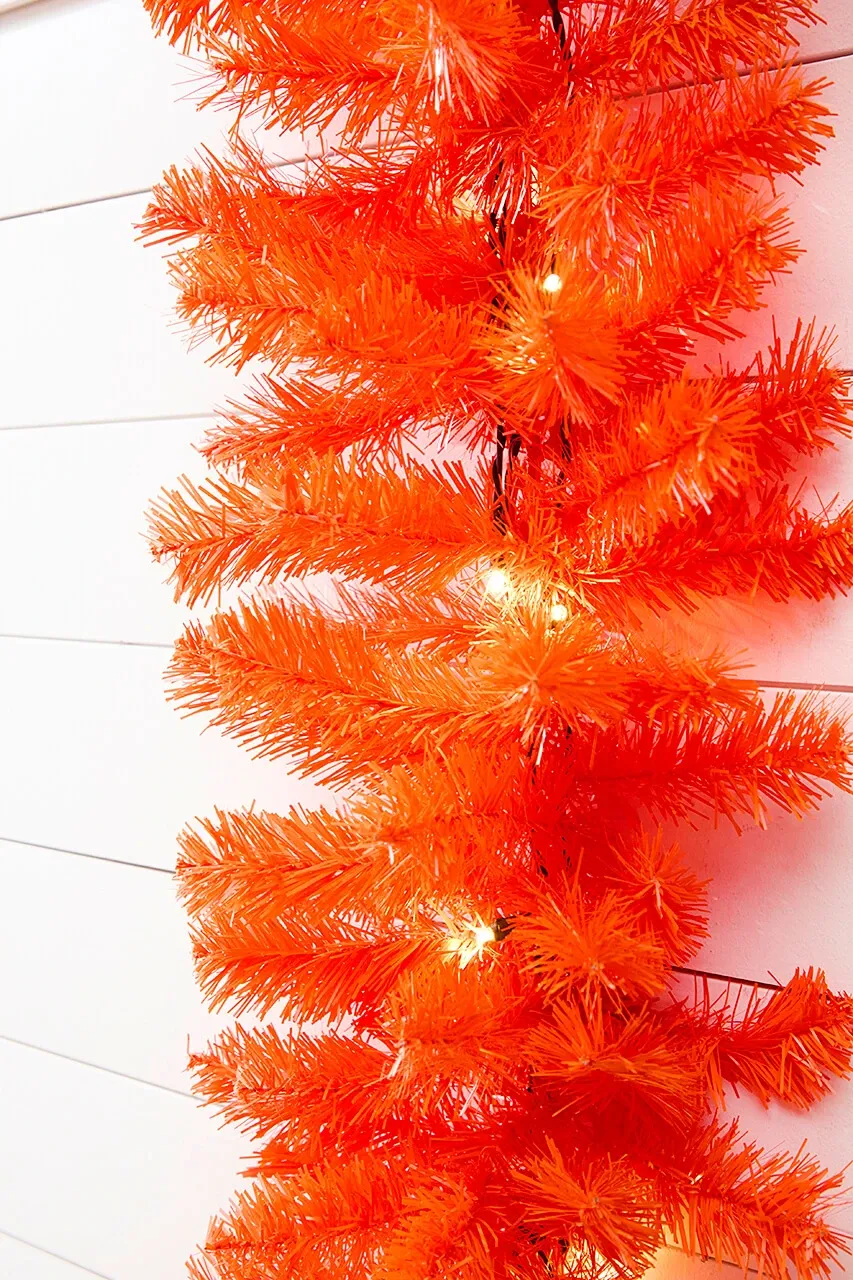
This dense, spiky orange foliage needs open space to read as a tree instead of a color block. It works best at 6–7 feet in a room with at least 10-foot ceilings and a plain, light wall behind it — the white plank backdrop here is doing exactly that job. In a low-ceilinged room, go with a 4–5 foot version on a table instead, as in Idea #25. Avoid placing it in front of busy wallpaper or a stacked gallery wall.
17. Faux Citrus and Pomegranates on a White Tree
- White tree: $80–$220
- Faux citrus and pomegranate ornaments: $45–$110
- Warm fairy lights: $18–$40
- Mantel styling, stockings and garland: $40–$95
- Framed art, if you’re adding it: $35–$150
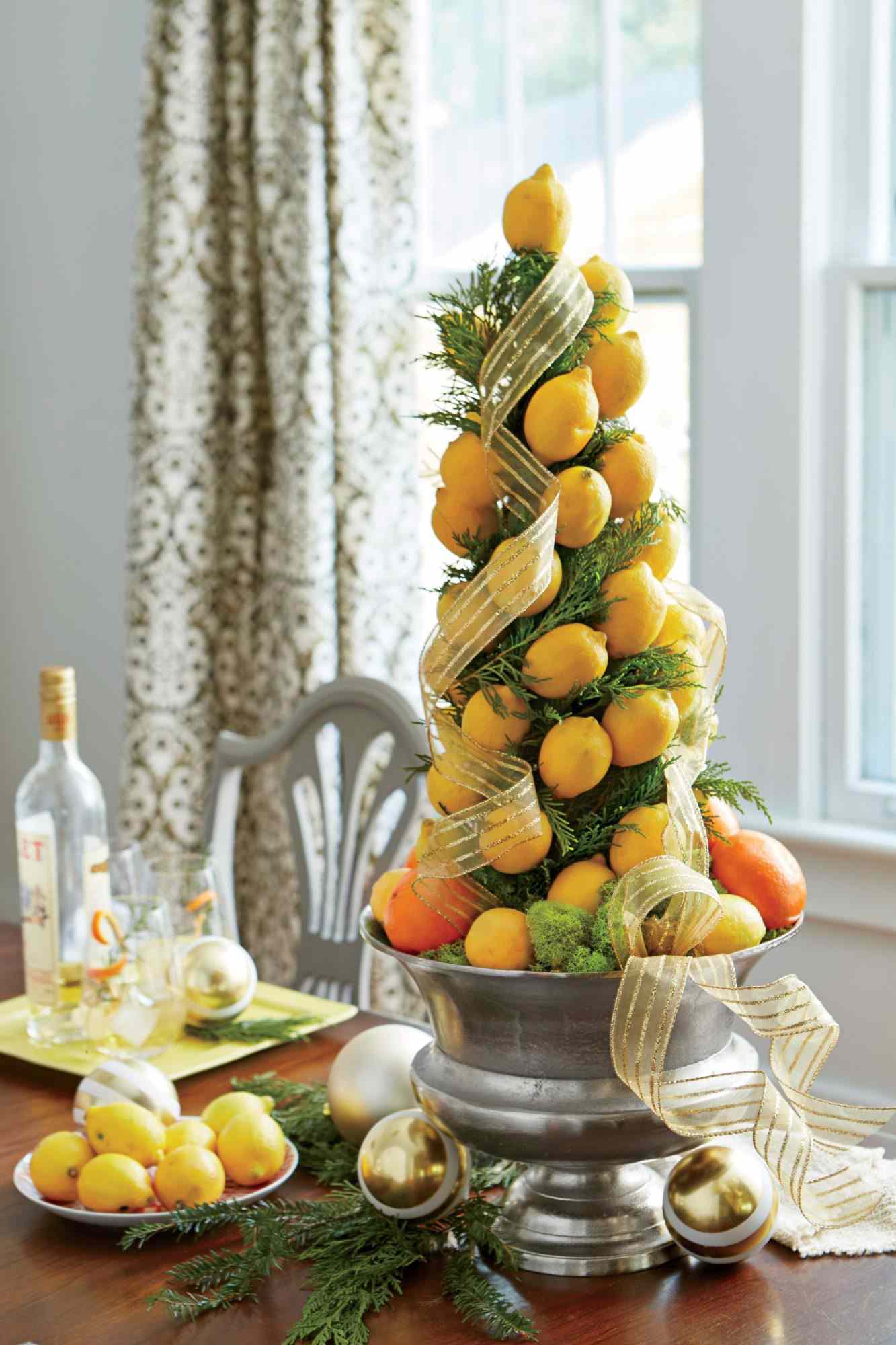
Total: roughly $218–$615. Budget alternative: real clementines and pomegranates wired onto the branches cost about $12 for a full tree and look better — just swap them out after ten days before they go soft.
The faux fruit is the entire idea. Any white tree with orange and red baubles is fine; the moment citrus and pomegranates show up, the tree tells a story about abundance and it stops being a color scheme. Repeating the same motif in three scales — full fruit, halved slices, tiny berries — is what keeps it from feeling gimmicky. This is also the one element worth doing well; cheap plastic fruit is the fastest way to make it look like a store display.
18. Red Velvet Baubles Tucked Into Mixed Evergreens
Three textures of red sitting together — shiny micro-baubles, a large matte velvet sphere, and glittery accents — read as depth rather than repetition, because your eye registers finish before it registers color. The mixed evergreens do the same thing in green: dense pine next to feathery cedar gives you two different silhouettes in one arrangement. It’s the oldest trick in decorating, contrast inside a single color, and it’s why this close-up looks expensive even though nothing in it is.
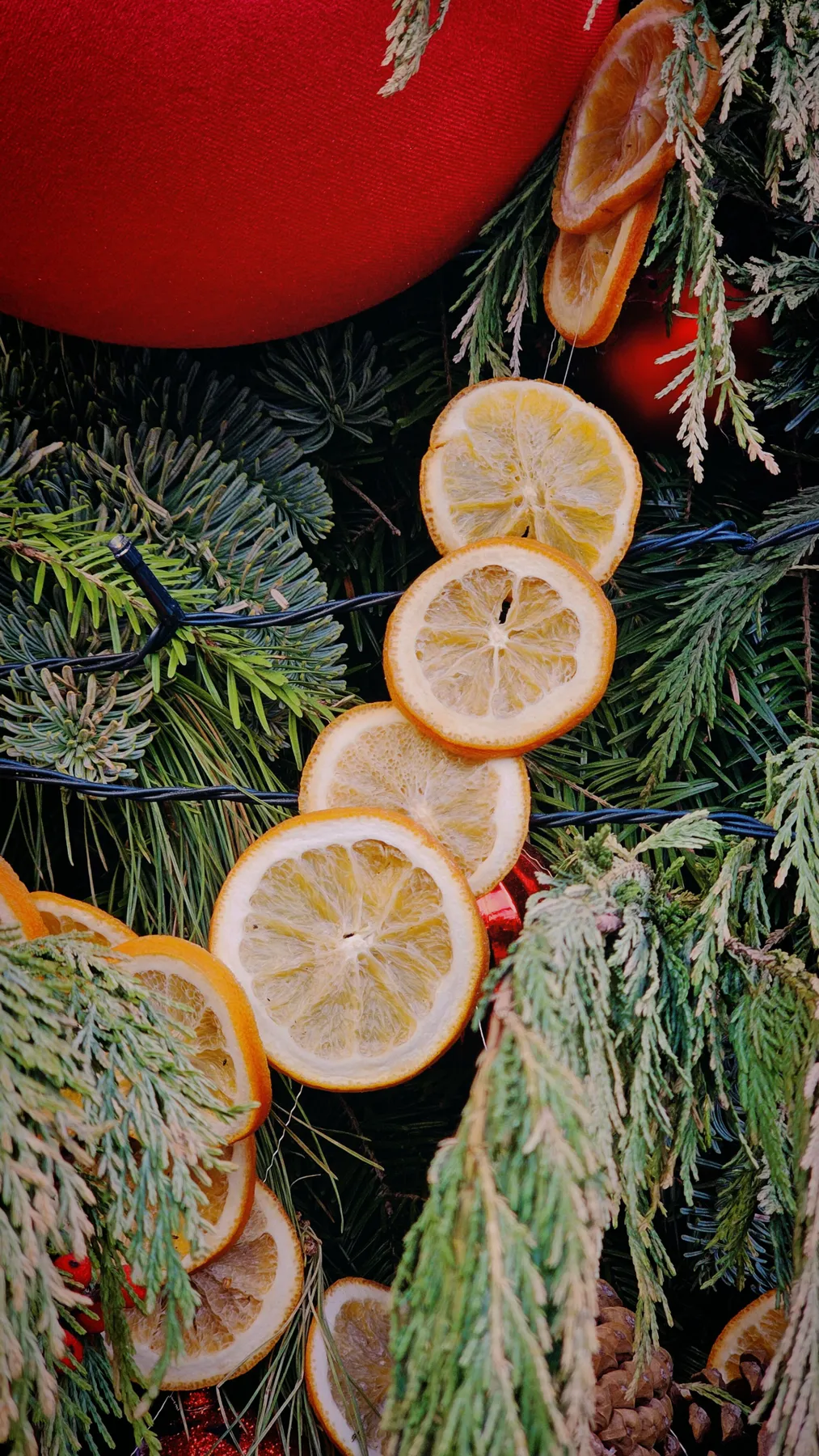
- Wire the largest velvet sphere deep into the tree, about four inches in, so it glows through the needles.
- Cluster small glossy red baubles in threes near the outer tips.
- Drape the dried citrus strand loosely through the middle layer.
- Weave black-wire fairy lights in last so they sit on top of everything.
Time: about 90 minutes for a 7-foot tree. Cost: $40–$70 if you already own the lights.
19. Gold, Bronze, and Burnt Orange Baubles Up Close
Think 45% warm gold plus 30% burnt orange plus 15% bronze plus 10% deep red. The trick is that the gold lives in the pattern, not just the finish — patterned and beaded pieces break up what would otherwise be a wall of shiny spheres. Want it cooler? Swap bronze for pewter and the whole thing goes elegant and wintery. Want it richer? Add more deep red and drop the beaded pieces; the tree gets heavier and more traditional.
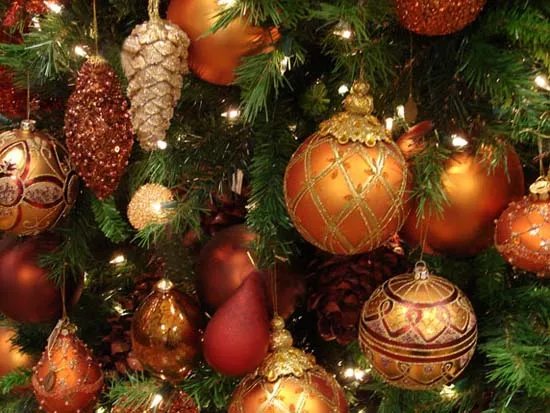
Glitter is the maintenance story here. Glittered and beaded ornaments shed for the first two seasons, which means whatever sits under the tree gets a dusting of gold — put a felt pad under anything white or upholstered. Metallic finishes also tarnish, especially in humid rooms. Store ornaments in acid-free tissue rather than newspaper, and never in a damp basement. Expect a good set to last eight to ten seasons with careful packing.
20. Glitter Gold and Matte Bronze on Frosted Needles
For that lit-from-within look, place ornaments so roughly a third of them sit inside the branches rather than on the tips. On a 7-foot tree that’s about 30 pieces recessed and 60 on the outer layer. Recessed ornaments catch light from behind and make the tree look deeper. Matte bronze pieces should go inside; glitter gold goes out front, because glitter needs direct light to sparkle while matte finishes need shadow to look rich.

Easy to scale: the same look works on a 4-foot tabletop tree with about 35 ornaments and 200 lights, or a 9-foot foyer tree with 150 ornaments and 900 lights. The ratios that matter are 100 lights per foot of tree height and about 12 ornaments per foot. Frosted needles like these read best in rooms with warm white lighting throughout; under cool white ceiling fixtures, the frost looks grey instead of snowy.
21. Peach and Orange Across a Whole Living Room
- Target: peach and orange shatterproof bauble sets, $12–$18 per 20-pack
- Walmart: warm white string lights, $9 for 300
- IKEA: beige cushion covers and a woven rug from $25
- Facebook Marketplace: a solid coffee table for $40–$70
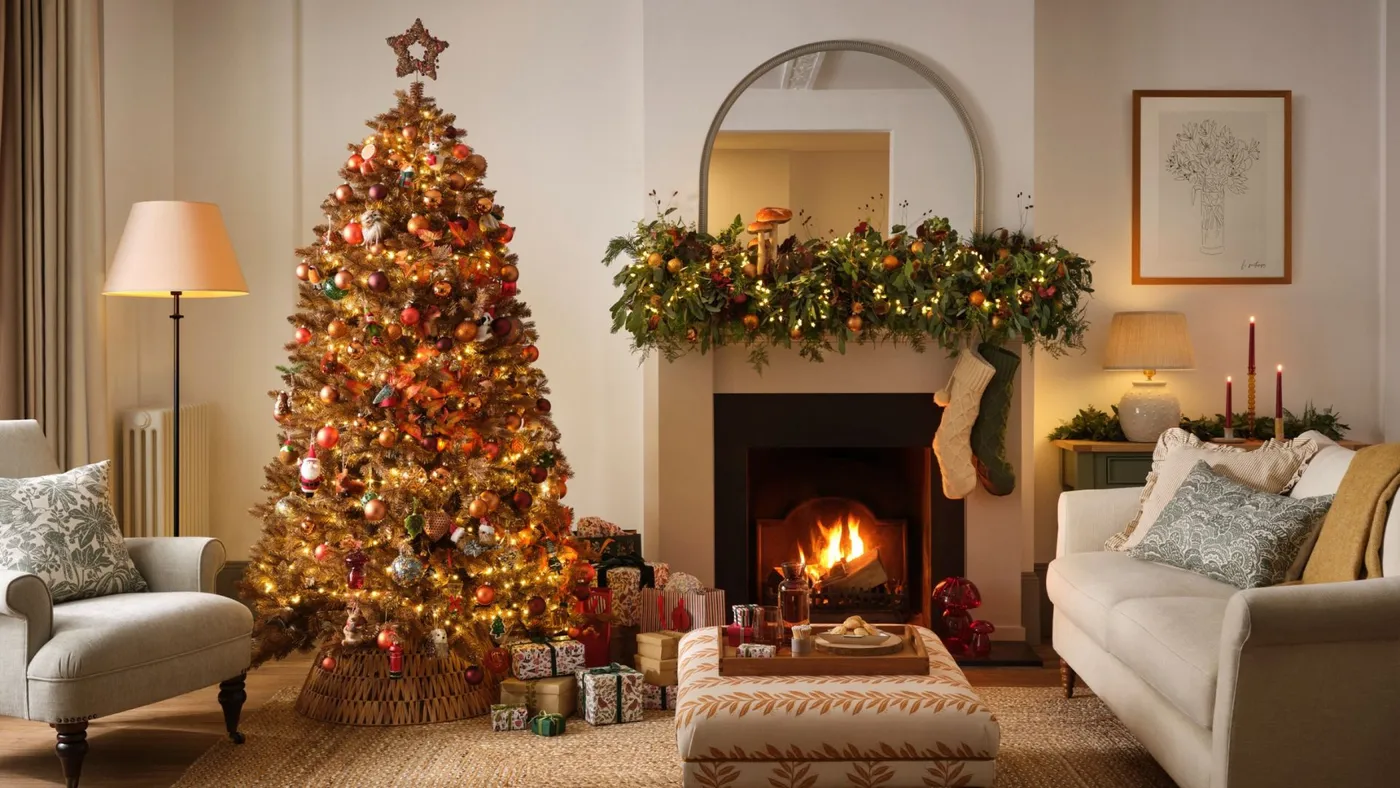
You can build this entire room’s holiday layer for around $180, and the throw pillows are the only thing worth replacing annually — they’re what makes the sofa feel like it belongs to the tree.
Peach and orange look soft and inviting in photos, and on a beige sofa under a warm lamp they can go the other way: washed out and a little flat. The fix is one dark anchor — a dark wood table, a charcoal throw, or the green garland on the mantel. Without something deep to push against, warm neutrals on warm neutrals just blur together. Also expect peach fabric pillows to show every fingerprint they meet.
22. The Two-Finish Rule for Metallic Ornaments
The single most important decision on this tree is that every ornament is either fully glittered or fully matte — there’s no in-between. That’s it. Two finishes, two sizes, one palette. Adding a third finish, pearlized say, is what makes metallic trees look cheap, because your eye can’t tell whether the variation is intentional. Pick two and commit; the restraint is what reads as expensive.

The formula is 60% gold plus 30% bronze plus 10% warm white glow from the lights. Because there are only two colors and two finishes, the balance between them matters more than the palette itself — go 80% gold and the tree tips bright and loses the coziness the bronze was giving it. Swap gold for copper and bronze for blackened steel and you keep the exact same formula at a much cooler temperature.
23. An Orange-Slice Garland Draped Over a Stone Arch
- Zip-tie or hook a plain green garland to the archway first, fluffing it to twice its packaged width.
- Thread dried orange slices on thin brown ribbon and lay the strand loosely on top of the greenery.
- Push gold leaf ornaments in at irregular intervals — odd numbers, never evenly spaced.
- Weave warm string lights underneath the foliage so the bulbs glow through rather than sit on top.
- Finish by letting a few ribbons dangle four extra inches below the garland’s bottom edge.
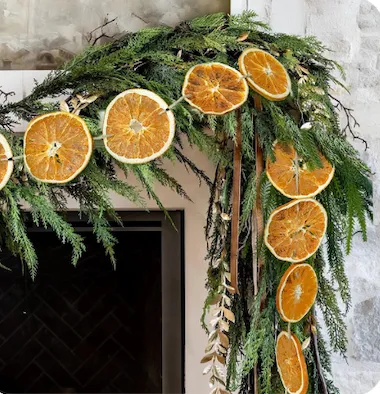
Time: about an hour for a 6-foot arch. Cost: $45–$85.
On stone or brick, never drill for a garland — use removable adhesive hooks rated for at least 5 pounds, placed on the mortar joints rather than the stone face, because mortar is more forgiving. A 6-foot garland fully loaded with orange slices and ornaments weighs roughly 4–6 pounds, so plan on four to six hooks. Undo it from the center outward when you take it down; pulling from one end snaps the wire armature.
24. Committing to an Unapologetically Orange Tree
An unapologetically orange tree is the 2026 version of the colored-tree revival — the same instinct behind pink and black trees, just warmer and easier to live with. What’s driving it is a broader shift away from strict red-and-green and toward palettes that already exist in people’s living rooms. Warm orange plays nicely with wood, leather, and cream, which means you don’t have to redecorate an entire room to make it work.
Committing to a full orange tree doesn’t require a designer budget. Walmart and Target both carry orange and citrus-toned bauble sets from about $10 a box, and a plain green tree you already own can be spray-painted at the branch tips for about $20 in materials — though coverage is uneven up close. The smartest cheap version: one orange tree, one box of gold ornaments, warm white lights. Nobody has ever walked into a room and wished for a fourth color.
25. A Small Orange Tree on Textured Snow
A small orange tree like this is the easiest way to test the palette before you commit a whole room to it. At three to four feet it works on a console, a kitchen counter, or a bookshelf, needs about 12 inches of clearance, and reads fine in a room as small as 60 square feet. If you still like it after one season, that’s your cue to go full-size.
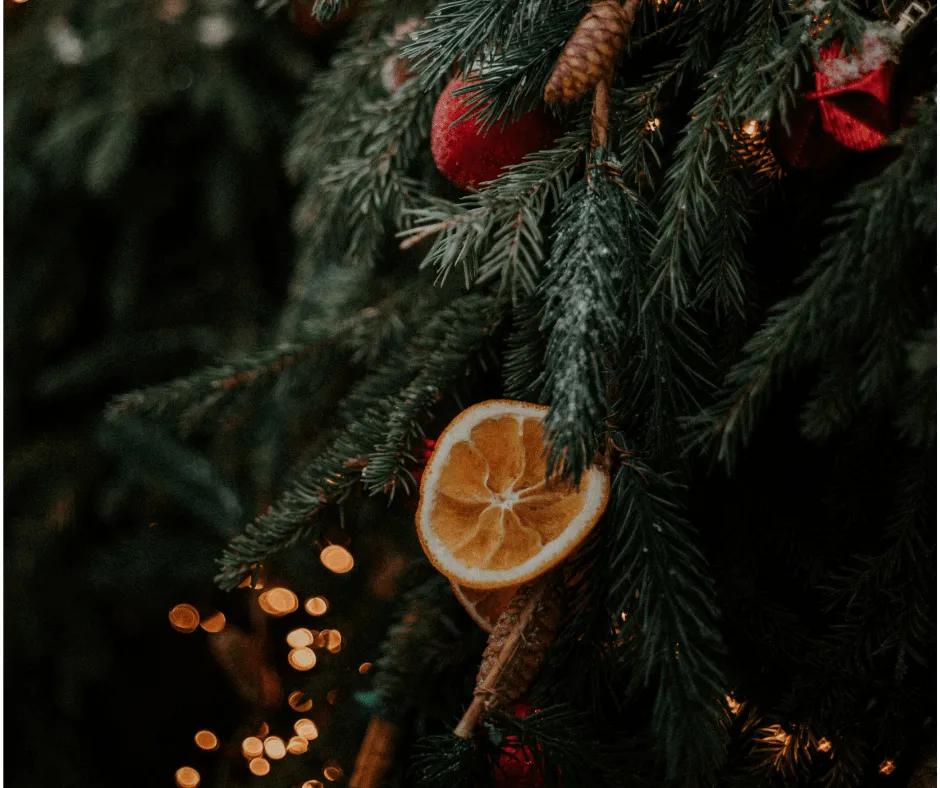
- Small orange tree: $30–$70
- Ornaments in orange, gold, and white: $25–$50
- Warm string lights: $8–$16
- White textured base or faux snow: $6–$18
Total: roughly $69–$154. Budget alternative: a thrifted 3-foot green tree plus two cans of orange spray paint lands around $22. Spray in thin coats for even coverage; one heavy coat will drip and look patchy.
26. Orange, Peach, and Gold Under a Glowing Topper
Ribbon is the cheapest way to make a tree look expensive, but only if it’s wired. Buy 2.5-inch wired ribbon, cut 24-inch lengths, then fold each into a loose S and tuck it between branches rather than tying bows around them. Roughly 20 pieces for a 7-foot tree. Unwired ribbon droops and reads as an afterthought; wired ribbon holds whatever shape you give it, and that’s the difference between a $40 tree and a $400 one.
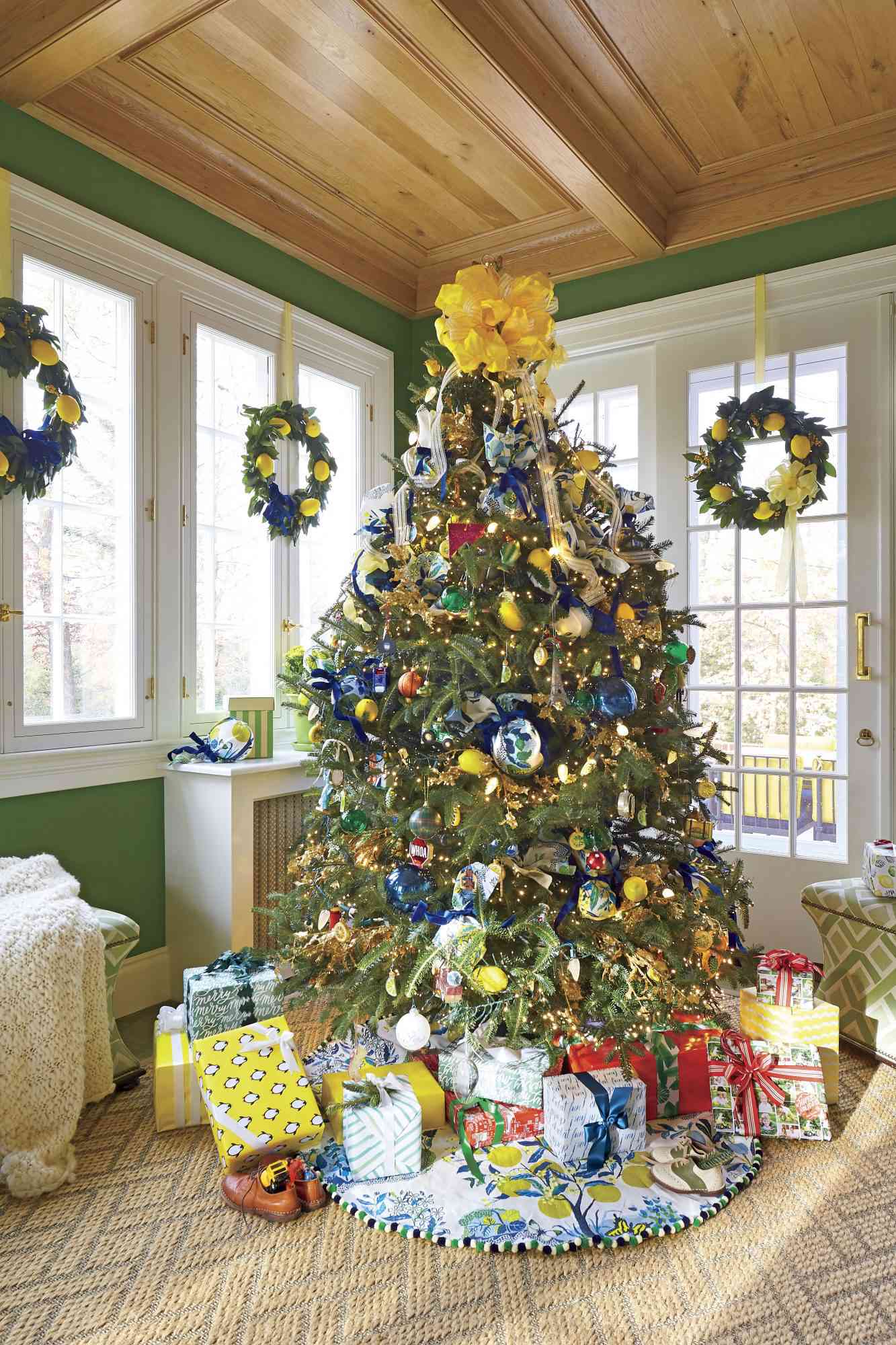
There’s no single color here — it’s a full range of orange, peach, and gold, all inside one hue family. That’s why it feels rich without feeling busy: the eye sees variety in value and finish but only one color temperature. The oversized topper is doing structural work, too, giving all that density a clear focal point. Remove it and the tree still looks full; swap in a small star instead and the whole thing goes flat at the top.
27. Red and Gold Classics in a Leather Sofa Living Room
Traditional red, gold, and green is the most forgiving palette in holiday decorating, which is also its risk: it can look identical to every tree you’ve ever seen. What saves this room is the leather and the patterned rug — the tree isn’t carrying the entire holiday, the furniture is. If your room is neutral and quiet, either add a strong rug or expect the tree to look like it wandered in from a department store window.
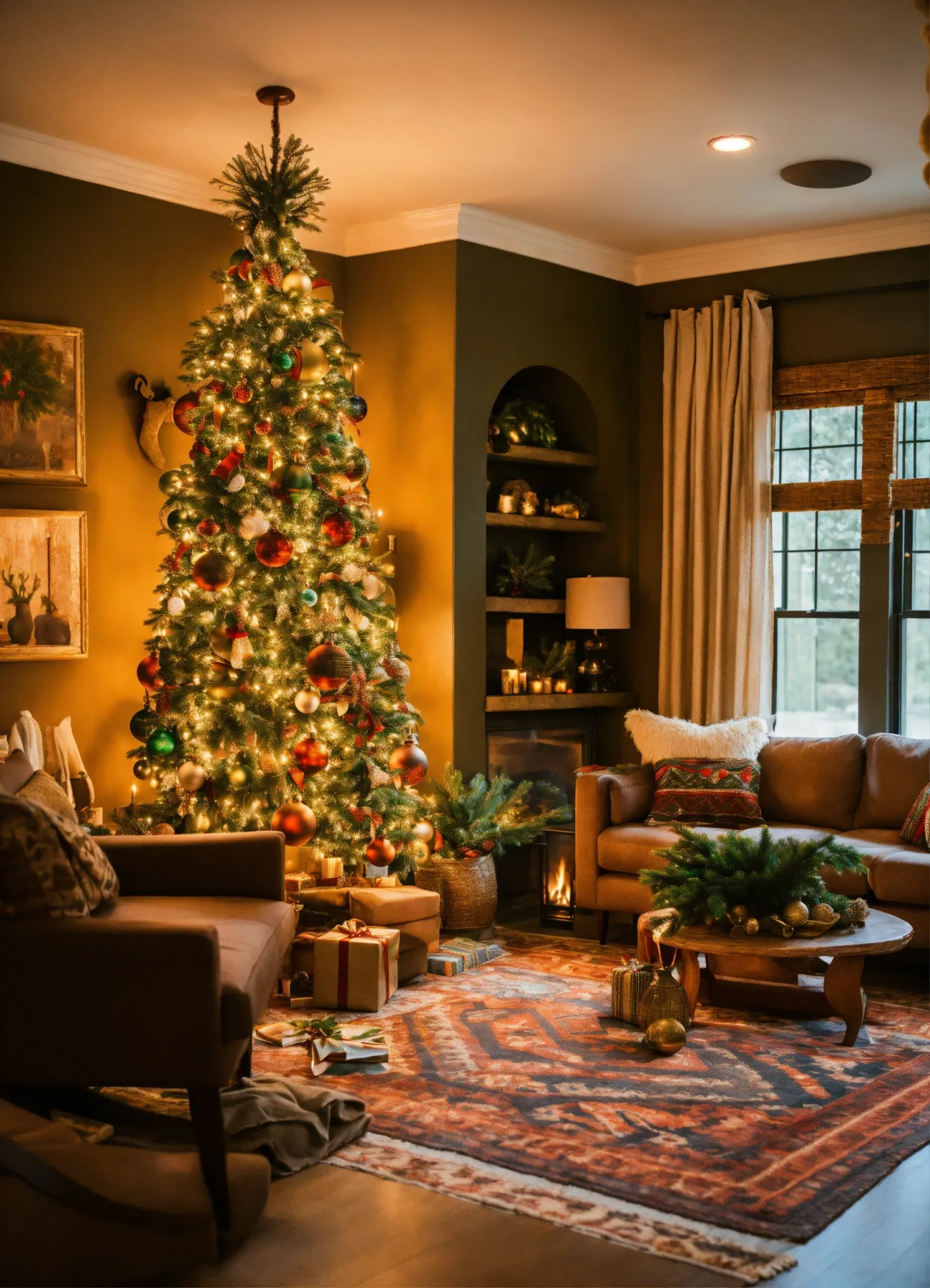
Roughly 50% warm brown across the leather and wood, 25% red, 15% gold, 10% green. That distribution is why this reads as a living room rather than a tree display — red and gold are accents here, not the base. Want to shift it toward 2026? Move about 10% of the red into burnt orange and you get a warmer, less formal room without buying anything new.
28. Citrus, Cranberry, and Popcorn on Multicolor Lights
- Cut twine to about five inches and fold it into a loop, knotting the ends together.
- Poke a needle through the dried orange slice about a half inch from the top edge.
- Pull the twine loop through and knot it snug against the slice.
- Hang from a branch at least three inches from the nearest bulb.
- Repeat, spacing them so no two slices hang at the same height.
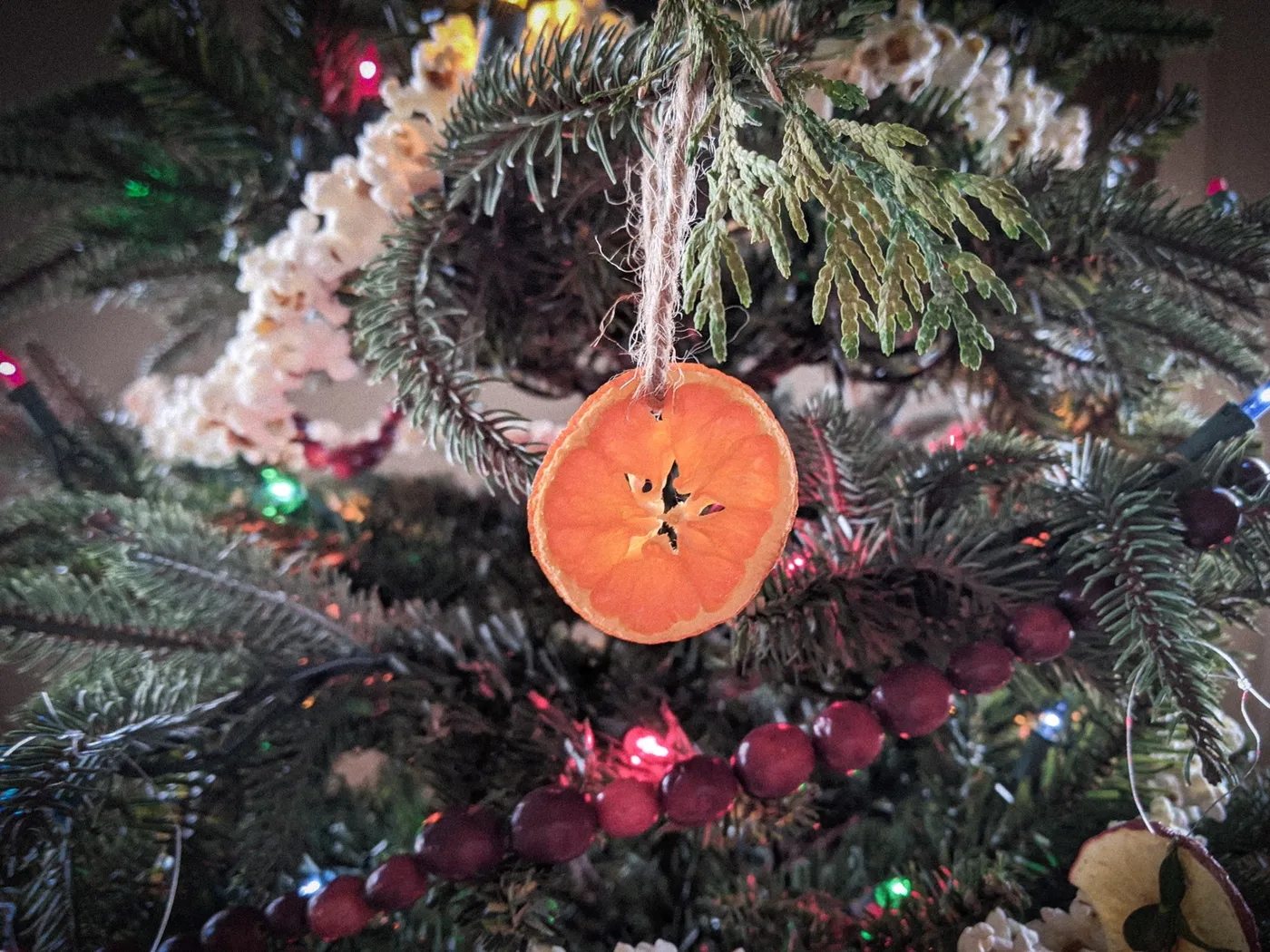
Time: under two minutes per ornament. Cost: about $0.50 each with homemade slices.
The multicolored string lights are the surprising key. Classic red-green-blue-yellow bulbs sound dated, and against dried citrus and popcorn they suddenly look intentional and nostalgic — the ornaments are all matte and natural, so the bulbs supply every bit of shine. Swap in warm white and the tree goes quiet and tasteful, which is a perfectly good choice, just a different one. Compare with Idea #12 for the understated version.
29. Backlit Orange Slices and Deep Red Ribbon
Dried orange slices look great for two seasons and then fade toward brown, especially if they’re stored somewhere warm and light. Keep them in an airtight container with a silica packet and they’ll hold color for about four years. Burlap sheds, so shake it outside before it goes back in the box, and check dark red glitter ribbon for flaking — a quick pass with hairspray sets loose glitter if you want to extend its life.
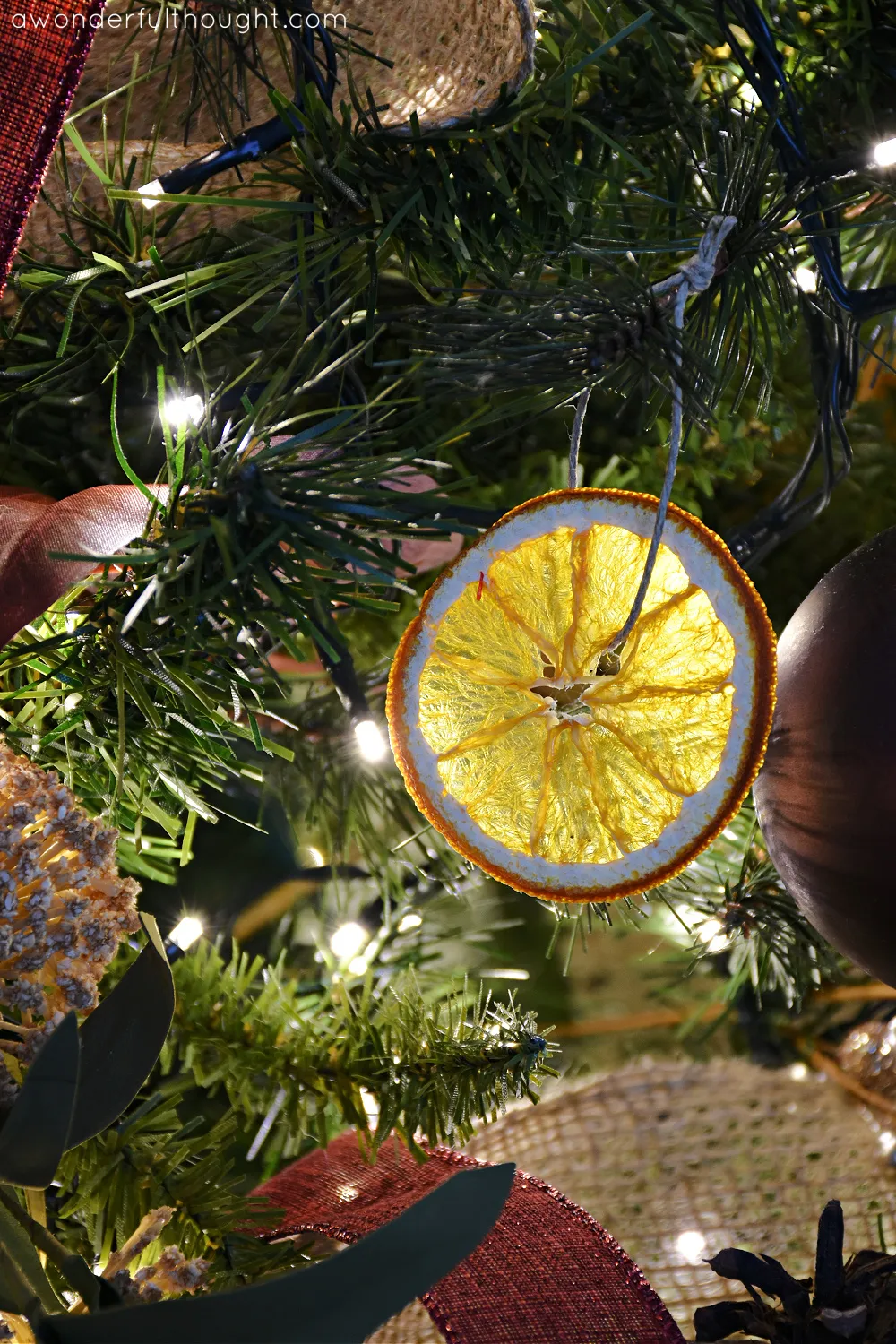
Backlighting a dried orange slice turns it into a stained-glass window, and you can do it on purpose. Hang slices so a warm white bulb sits directly behind them, about an inch and a half away — closer and you risk scorching, farther and the glow fades. The trick works best with slices that are thin, about an eighth of an inch, and fully dried, because any moisture left in the pith will cloud the light.
30. Building an Orange Ornament Collection From Scratch
If you’re buying from scratch, aim for about 50% glossy orange, 25% gold glitter, 15% matte, and 10% faceted or textured pieces. The faceted ones matter more than they seem — they catch light at angles a round bauble can’t, which is what gives a tree depth when you’re standing right next to it. If your palette leans peach, keep the glitter gold and drop the deep orange; peach plus heavy glitter goes candy-sweet fast.

- Ornament multipacks in orange and gold: $35–$80
- Statement ornaments, faceted and metallic pinecones: $25–$60
- Wired ribbon: $10–$22
- Storage box with dividers: $12–$30
Total: roughly $82–$192. Budget alternative: buy one $15 box of plain orange baubles and one $6 can of gold metallic spray, then finish every other piece yourself — a matching set for about $25 that reads as considered, not homemade.
31. Dried Oranges, Red Velvet, and Clear Beads
Dried orange slices, red velvet baubles, and gold ornaments are a genuinely cheap combination to copy. A 40-slice bag of dried oranges runs about $10 on Amazon; velvet-finish red baubles are roughly $14 for 24 at Target; clear beaded garland is $8 at Walmart. Wrapping gifts in kraft paper with a single gold ribbon costs about $0.60 a box. You can rebuild the entire decor layer of this tree for under $60 — one of the few looks where budget and designer versions are nearly identical.
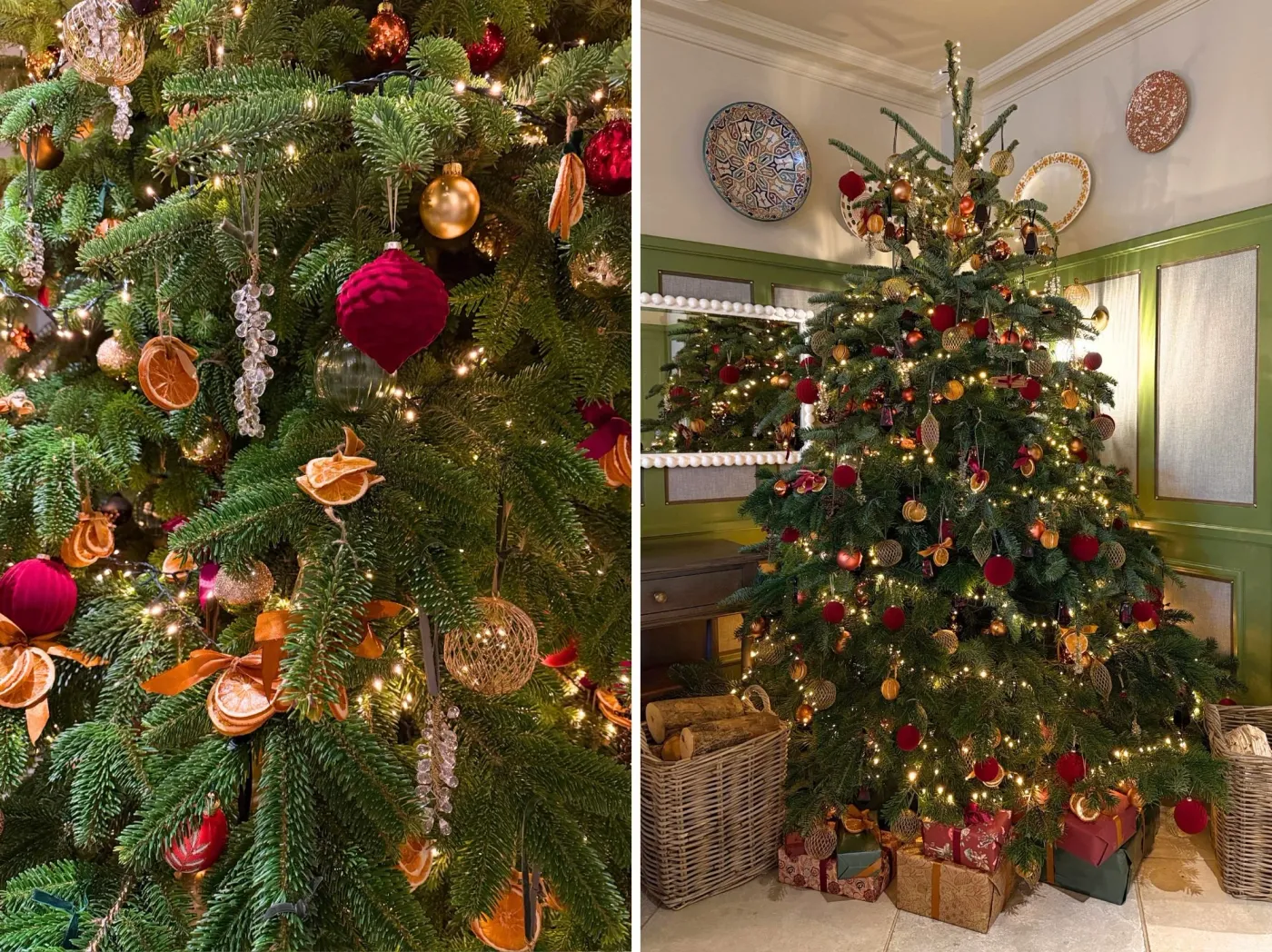
This density needs a big tree to breathe: 7.5 feet or taller, in a room with at least 9-foot ceilings. Below 6 feet, the dried oranges and velvet baubles start crowding each other and the whole thing looks lumpy. Working with an 8-foot ceiling? Choose a 6.5-foot tree and cut the ornament count by a third.
32. A Wall of String Lights Behind Two Leather Sofas
- Measure the wall you plan to light and buy strands in multiples of that length — splicing mid-wall shows.
- Confirm there’s an outlet on that wall, plus a timer; you don’t want to unplug 900 lights by hand every night.
- Check that your sofas sit at least three feet apart so the coffee table isn’t a shin hazard.
- Decide where gifts will live before December 1 — this much decor leaves very little floor.
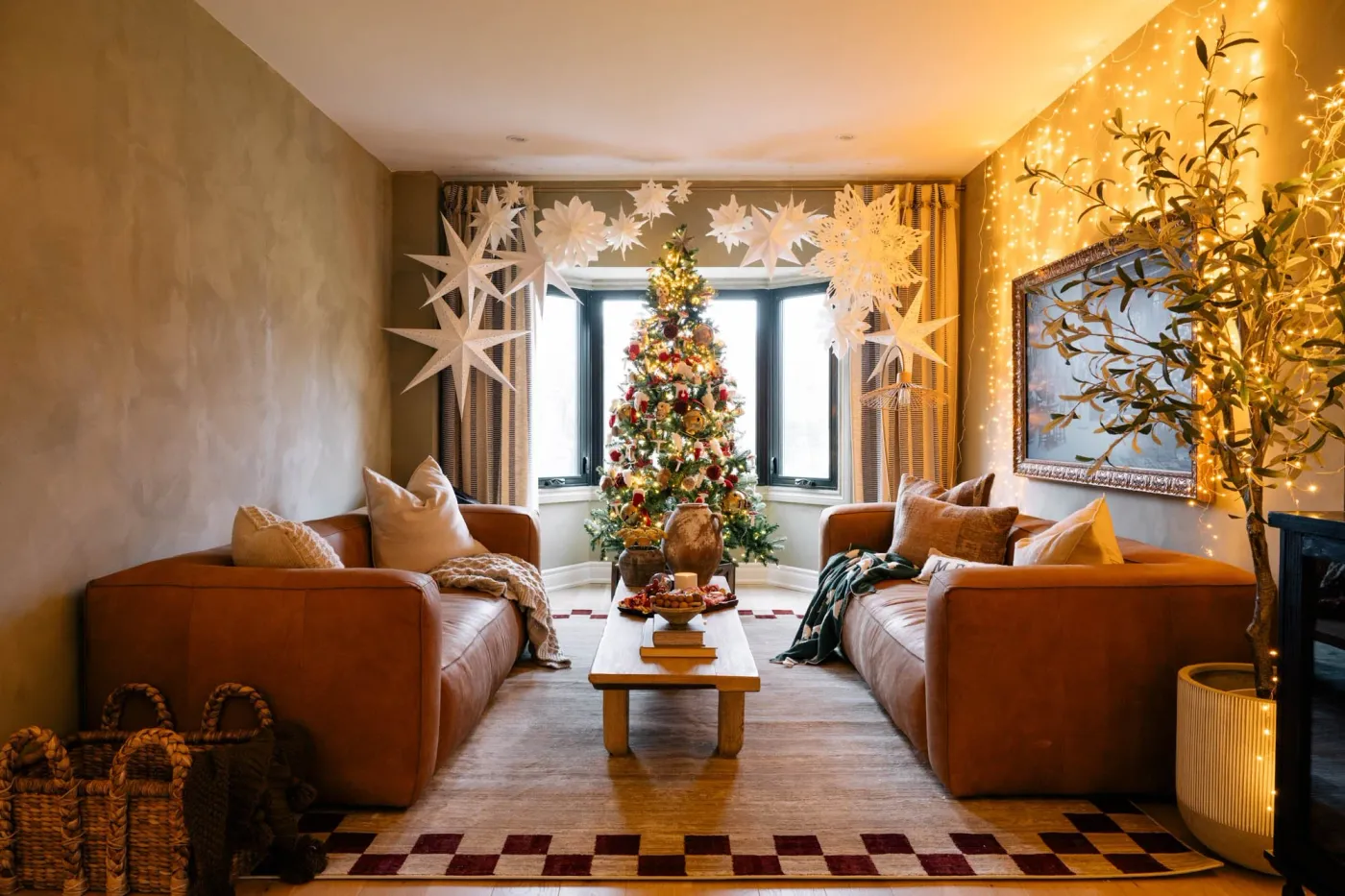
A wall of string lights is the most photographed thing in this article and the most annoying thing to live with. Expect visible cords, a slightly warmer room, and a lot of dust catching on the strands by February. Use clips rather than staples, keep everything on one timer, and plan a two-hour takedown. The payoff is real — just go in with your eyes open.
33. Why Orange Bulbs Beat Warm White on a Green Tree
Orange bulbs on green branches is a color relationship, not just a lighting choice. The branches absorb that warm light and reflect almost none of it, so the tree looks lit from inside rather than spotlit from outside. The bokeh in the background comes free, too — out-of-focus orange lights always blur warmer than white ones, which is why this reads cozy even though there’s no visible room around it.
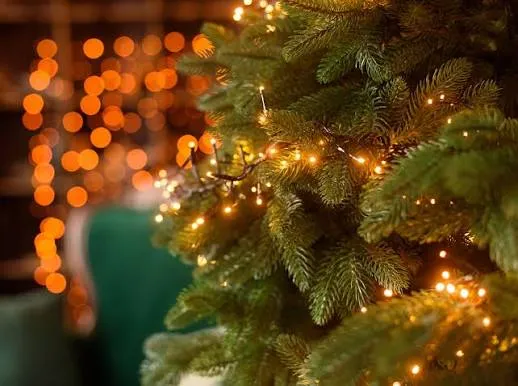
If you want this glow, count bulbs, not strands. Roughly 100 lights per foot of tree height at minimum, and 150 per foot if you want that dense, almost hazy look. More important: keep every bulb in the same color temperature. Mixing 2700K orange with 3000K amber reads as a mistake up close and as beautiful bokeh from across the room — so decide how far away people will actually stand.
Your Orange Tree Era Starts Now
Whether you go full tangerine artificial tree or just thread a few dried orange slices through the branches you already own, the warm side of the color wheel is where holiday decorating is headed — and it’s a very comfortable place to land.
Start with one idea that fits your room, live with it for a season, and let it grow from there. 📌 Pin this guide to your holiday board now — you’ll want it again in November when the good ornaments sell out.