You know that feeling when you’ve pinned forty holiday tables and none of them look like your actual dining room? Same. The gap between a styled Christmas table and a real one usually comes down to three things: layering, light, and knowing which single element to splurge on.
We spent serious time digging through tabletop finds from Crate & Barrel, Target, Anthropologie, Pottery Barn, and Etsy to bring you only what’s worth your attention this year, with ideas spanning roughly $18 to $340 per setting. After filtering through hundreds of options, we narrowed it down to 34 ideas that actually deliver — from forest green and antique gold formality to rustic wood-slice chargers and whimsical woodland glassware. Budget and luxury versions sit side by side, so you can see exactly where the money goes and where it doesn’t need to.
What’s driving 2026’s table obsession? The return of deep saturated color — emerald, plum, cranberry — layered over natural linen and raw wood instead of more glitter. It’s the “quiet maximalism” shift: abundant but grounded, festive without the plastic sheen. And stay until the end — we break down the most common mistakes that can ruin these looks.
Pin this guide for later — your future self will thank you when it’s time to actually do this. 📌
1. Forest Green Chargers and Antique Gold Formality
The formula here is restraint dressed up. A crisp white tablecloth carries a dark green charger, then white dinnerware with a gold rim, then a dark green napkin pinned with a gold ring and one small evergreen sprig. Gold cutlery and clear stemware finish it. Nothing is busy — the drama comes from the charger’s saturated green against all that white.
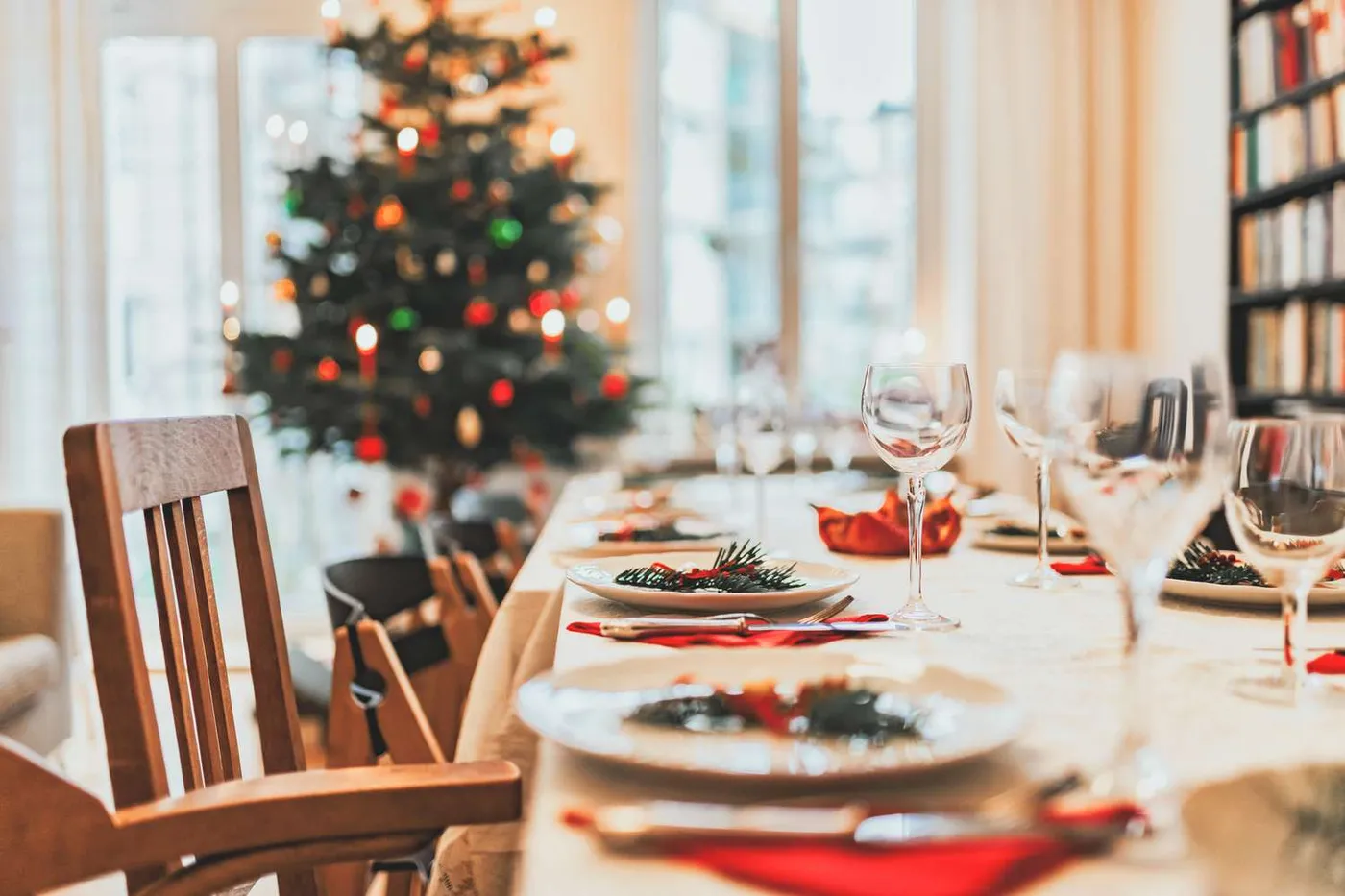
is the repetition of exactly two accent colors, green and gold, used at three different scales: the charger (large), the napkin (medium), the sprig and rim (small). Your eye reads it as coordinated before your brain even catches why. Swap the green for burgundy and the gold for pewter and the same formula holds — that’s how you know a table setting is structurally sound.
Here’s the tip worth paying for: your charger should be one to one-and-a-half inches larger in diameter than your dinner plate. Any bigger and it looks like a frame swallowing the picture; any smaller and it just looks like a mistake.
2. Cranberry and Pinecone Abundance on Dark Wood
A dense evergreen garland runs the length of a dark wood table, studded with deep red flowers, berries, pinecones, red pillar candles and gold spheres. Ornate gold chargers hold green-rimmed plates, and each top plate carries a tiny apple-and-berry wreath as a personal gift. Deep red fabric peeks out beneath the chargers.
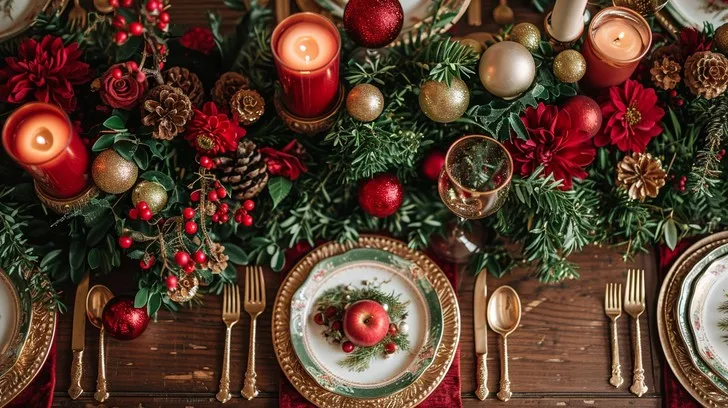
doing the heavy lifting? That individual wreath on every plate. Remove it and you still have a beautiful table — but you lose the moment where a guest sits down and realizes someone thought about them specifically. It costs a few dollars per seat and does more emotional work than the entire centerpiece.
- Main furniture (chargers, plateware for 6): $120–$260
- Lighting (pillar candles, holders): $25–$70
- Textiles (red underlay, napkins): $30–$65
- Decor (garland, ornaments, mini wreaths): $95–$220
- Paint/wall treatment: $0 — none needed here
- Total: roughly $270–$615 for six settings
Budget alternative: skip the floral garland and use a plain evergreen swag with loose berries tucked in. That alone cuts about half the decor cost with almost no visual loss.
3. Poinsettia Textiles and Lantern Glow Outdoors
A long rustic wooden table wears a white runner and placemats printed with red poinsettias and pinecone motifs. Dark metal lanterns glow at the center, ringed by evergreen branches and string lights, while wicker chairs hold cushions and a red plaid throw. Deep red stemmed glasses pick up the runner’s red.
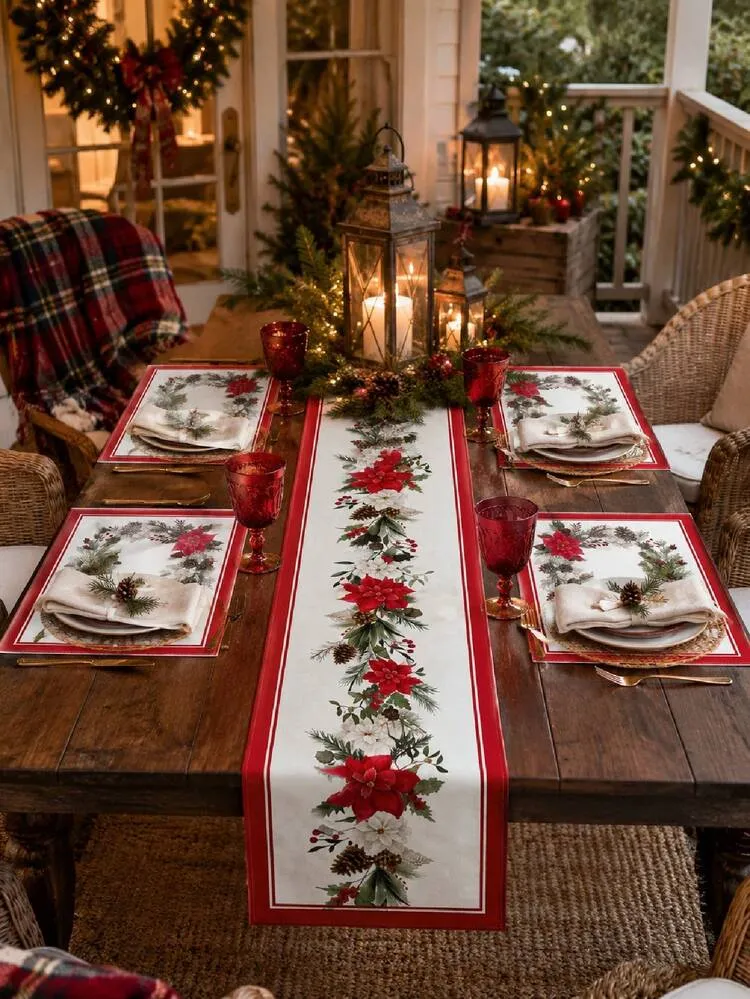
The math: 55% cream and natural wood as your quiet base, 30% crimson across textiles and glassware, 15% aged bronze and black metal for weight. Change the crimson to a deep teal and the bronze to matte black and the whole thing reads modern instead of traditional — same proportions, entirely different mood.
about open-air tables: flame and wind do not negotiate. Use enclosed lanterns with glass panels and battery pillar candles inside, and weight the runner at both ends or it will flap into someone’s soup. Wicker also holds moisture, so bring the cushions in overnight or you’ll be sitting on damp seats by dessert.
4. Gold-Rimmed Plates Under a Cinnamon Stick Garland
White plates with gold rims sit on a white cloth edged in embroidered gold, topped with dark green napkins folded around holly and berries. Gold flatware and champagne flutes carry the metallic thread upward, while the centerpiece — a fir garland threaded with pinecones, cinnamon sticks, tiny gift boxes, gold baubles and string lights — runs the full length under lit candles.
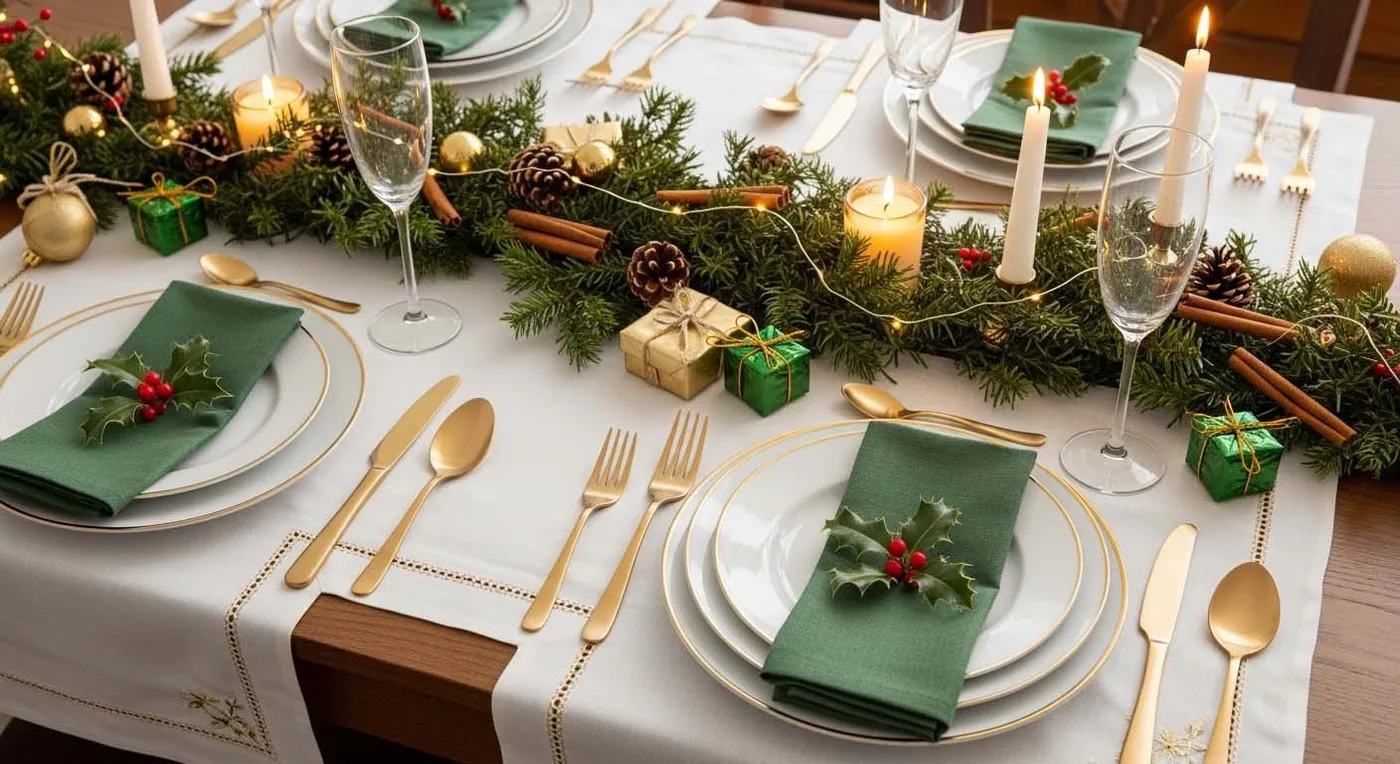
Notice the garland has three heights: flat foliage, mid-height pinecones and cinnamon, tall candles. That variation is why it doesn’t read as a green sausage down the middle of the table.
Build your own in about 45 minutes for $60–$90:
- Lay a faux fir garland down the runner and fluff every branch outward, not flat.
- Wire in three to five cinnamon bundles at uneven intervals — never evenly spaced.
- Tuck pinecones in clusters of two or three, alternating sides.
- Weave warm-white fairy lights through, hiding the battery pack under foliage.
- Add candles last, spacing them so no one has to reach across a flame.
5. Fringed Linen and Blush Ribbon Gift Toppers
A white ceramic plate holds a fringed embroidered linen napkin, and on top sits a small gift box tied with blush ribbon beside a paper honeycomb ornament with a sprig of greenery. Ornate silver cutlery flanks the plate, beeswax tapers burn in silver holders, and a mossy centerpiece rests on pale marble.
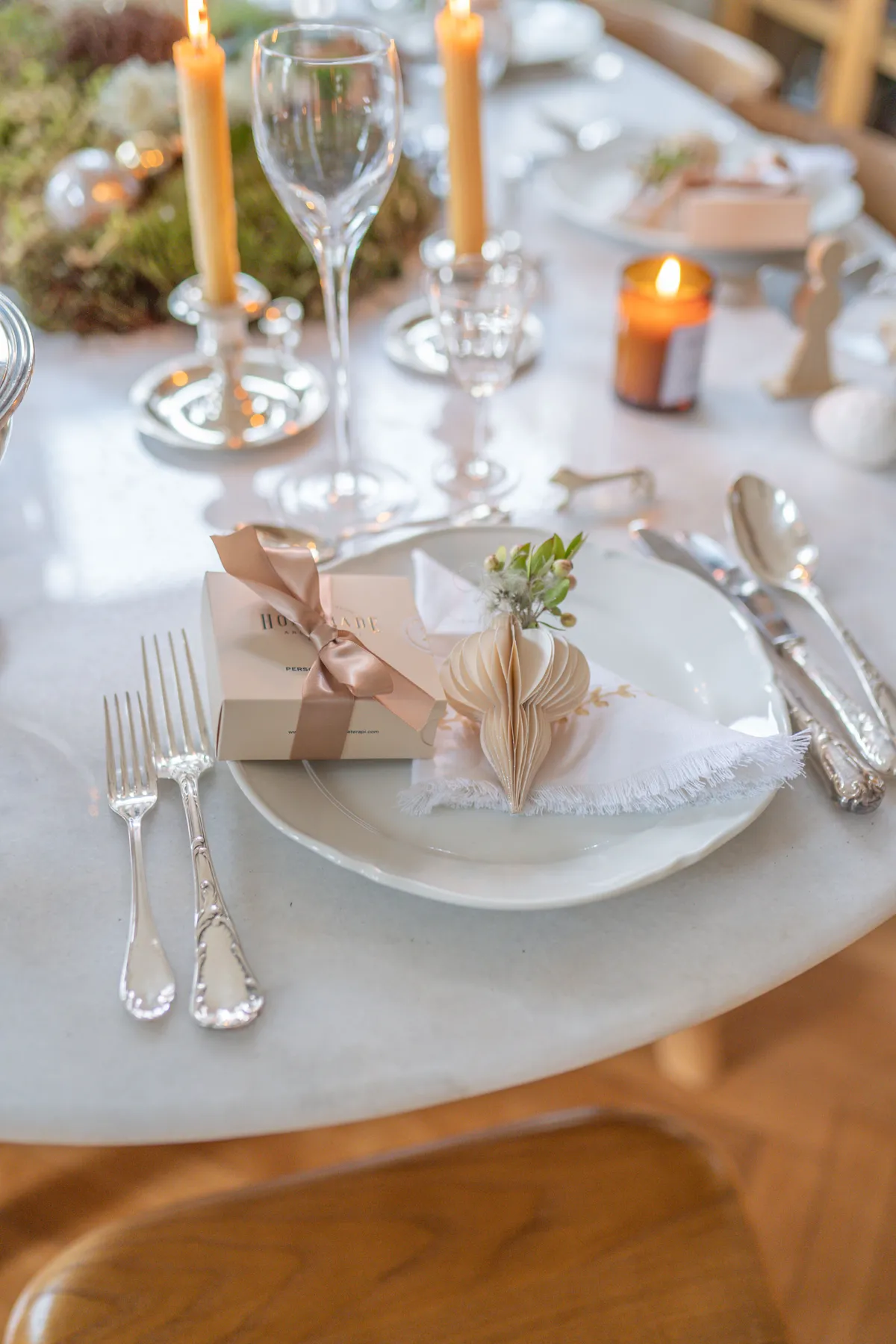
This works because of texture contrast at close range: crisp ceramic, soft fringe, matte paper honeycomb, glossy silver, velvety moss. Five surfaces, one muted palette. It’s the kind of detail that photographs beautifully and also feels lovely when your hand actually touches it — which matters more than most people admit.
Scale-wise, this is a compact look. It wants a table 60 inches or narrower so the mossy centerpiece stays within reach; on a wide banquet table the delicacy gets lost. If your room runs large, look at the fuller garland approach in Idea #4 for more visual mass.
6. Reindeer Antler Napkin Rings and a Tiny Gnome
Light wood holds stacked white plates topped with dark red fabric napkins cinched by white reindeer antler rings. At the center, an evergreen arrangement studded with red berries surrounds a cream pillar candle and a small red-hatted gnome, with a blurred Christmas tree glowing behind.
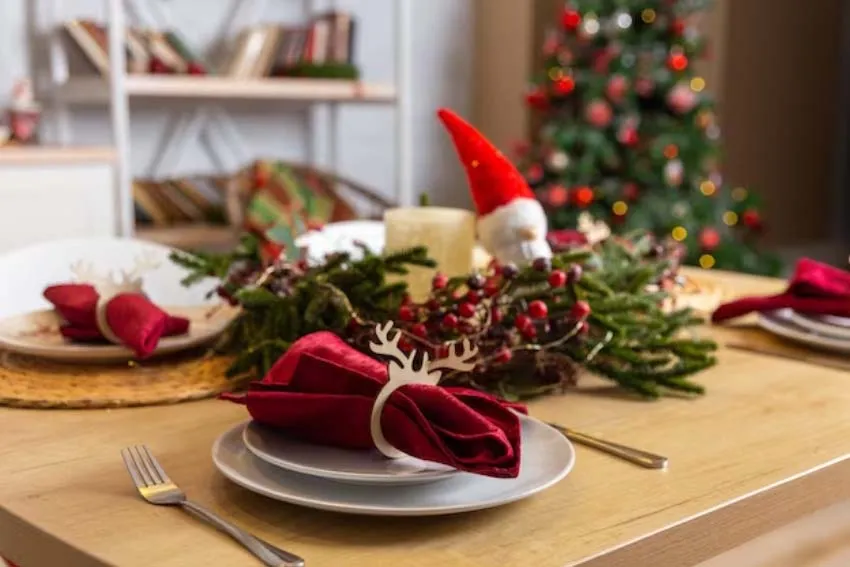
The gnome is the tell. Whimsical, slightly silly table characters have moved from novelty shops into mainstream holiday styling over the past few seasons, partly because they let a traditional table loosen up without abandoning red and green. It’s a small permission slip to have fun — and it reads as personality rather than kitsch when everything around it stays restrained.
Get the look for less: antler rings run $6–$14 each at big-box stores, but plain wood rings with a tiny faux antler glued on cost about $2 per seat. Thrifted gnomes and marketplace finds often land under $10. Honest note — if you have toddlers, skip the gnome at the table and perch it on the sideboard instead.
7. Emerald Tablecloth Anchored by Brass Candlesticks
A round table is draped in rich emerald green, set with white ceramic dinnerware and wine glasses, and centered with antique-style brass candlesticks rising out of a pine garland. A decorated tree stands to the left; a modern fireplace burns behind. It’s the rare table that looks finished from every seat in the room.
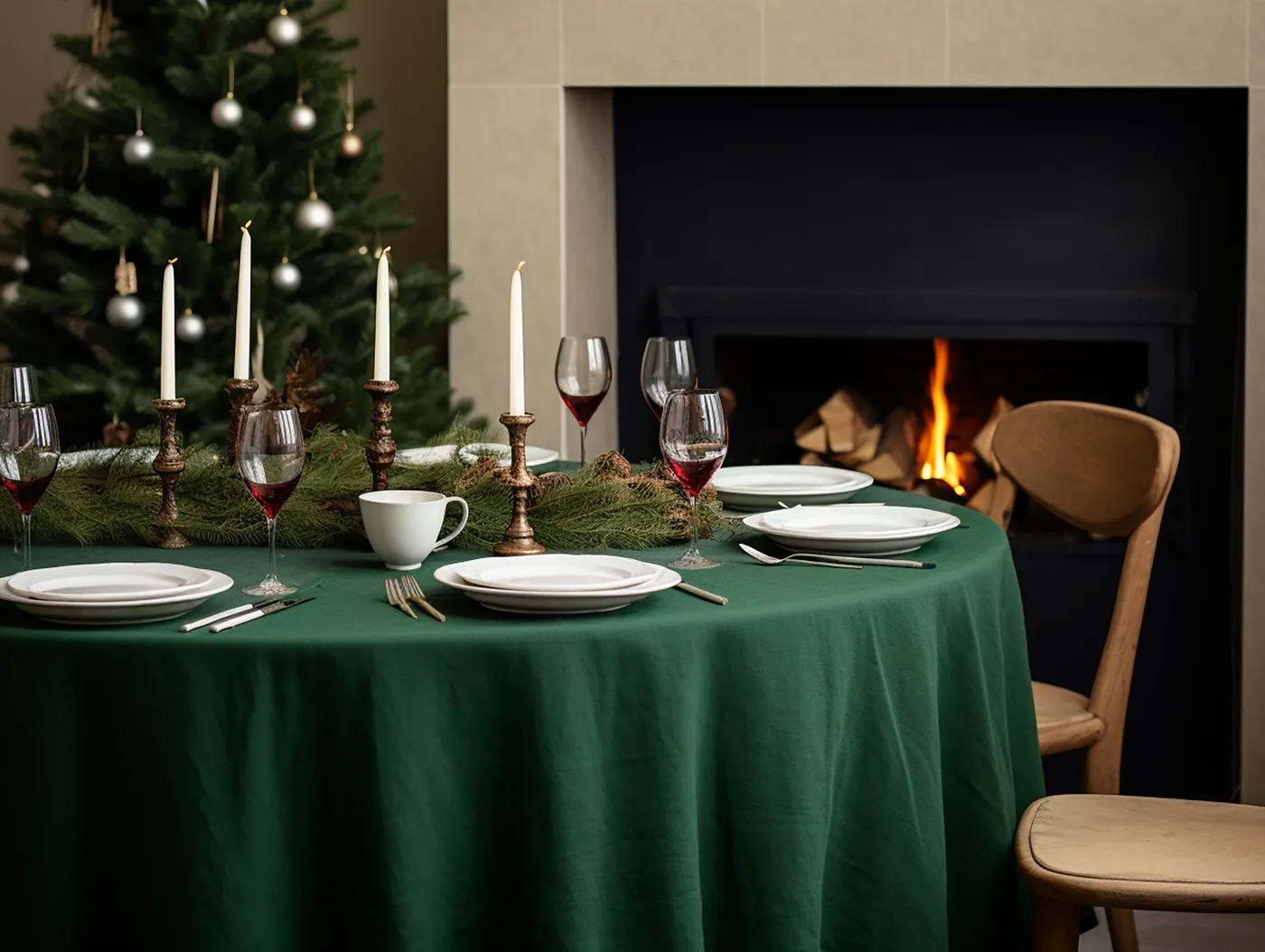
that emerald cloth. Without it, this is a nice white-and-brass table. With it, the room gains a color anchor that ties the tree, the garland, and the firelight together. A floor-length cloth in a saturated jewel tone is the single highest-impact purchase in holiday tablescaping, full stop.
, though: dark green linen shows every crumb and every drop of candle wax. Spot-clean within the hour, use a felt pad under each candlestick, and plan on a professional clean once a season if you want it to last. A polyester-linen blend in the same emerald gives you 80% of the look with a machine-washable life.
8. Wooden Tray Centerpiece with White Tapers
Gold-rimmed chargers sit beneath white dinnerware, gold flatware alongside, and white napkins tied with a green sprig and a red berry ornament. The centerpiece is the quiet hero: a long wooden tray packed with mixed greenery, white taper candles, and a scatter of small gold baubles, framed by white wooden chairs.
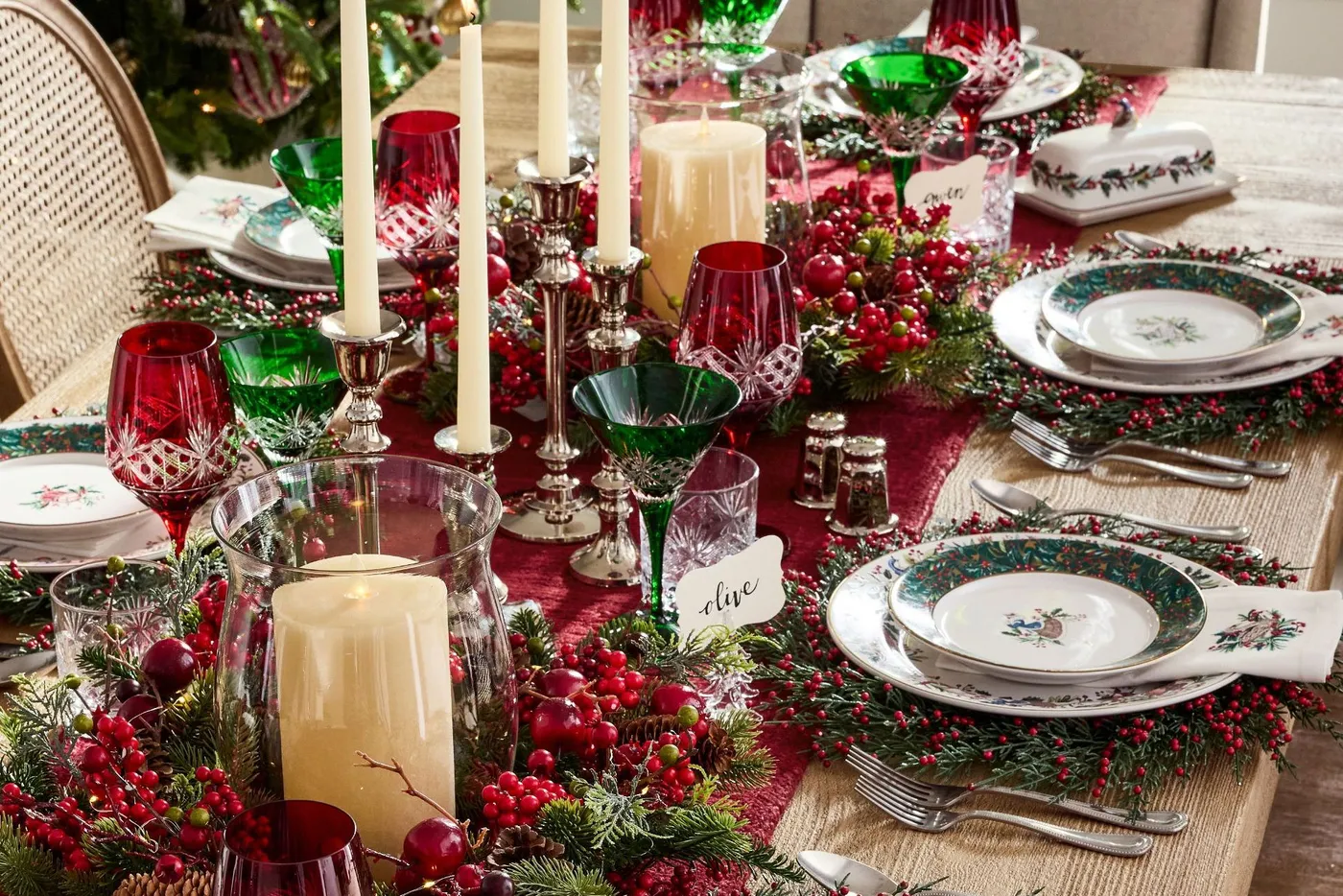
Think of it as 65% white and natural wood, 25% green, 10% gold and red. The tray is what keeps it tidy — a defined container means the greenery can’t creep toward the butter dish, and you can lift the whole centerpiece off the table in one motion when it’s time to serve.
cut your taper candles to two or three different heights and keep the tallest under 12 inches above the tabletop. Anything taller blocks sightlines across the table, and holiday dinner is mostly about looking at the people across from you.
9. Black Plates on Gold Beaded Chargers and Twine
A woven round placemat sits on a dark wood table, then a gold beaded charger, then a matte black dinner plate. Gold flatware is bundled in an off-white napkin tied with twine, and the centerpiece mixes fresh greenery, white berries, and pillar candles. A macrame runner peeks out underneath.
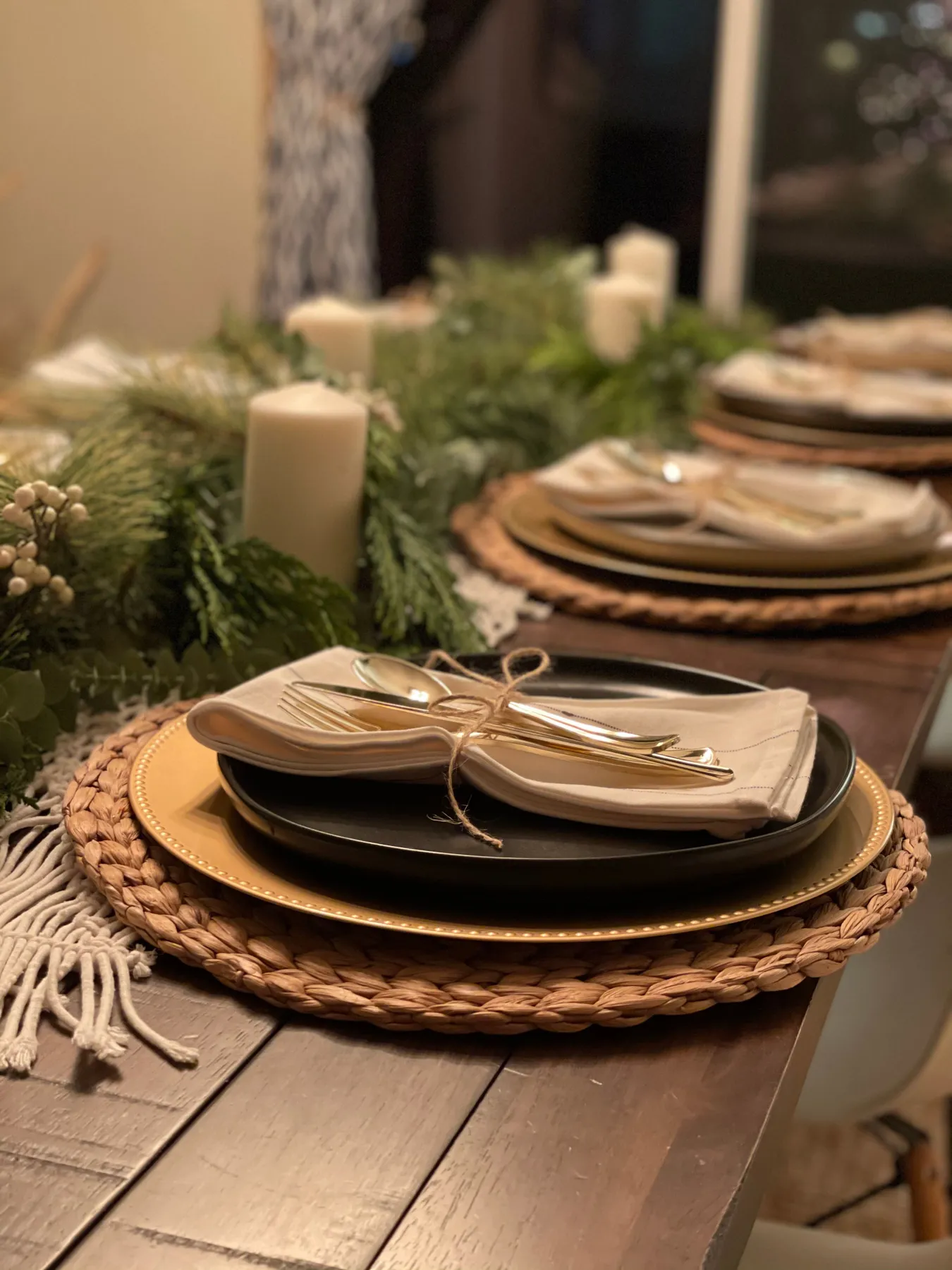
Why it works: matte black is the unexpected move. Everyone expects white plates at Christmas, and the black grounds the gold so it reads sophisticated rather than shiny. The woven placemat and macrame runner then soften what could have been a severe palette — three natural textures counterbalancing one dark ceramic.
- Measure your table: chargers plus placemats need about 15 inches of width per setting
- Confirm your plates are actually matte — glossy black reads cheap under candlelight
- Check your napkins are long enough to tie; 20-inch squares minimum
- Set a budget cap before you fall for beaded chargers at $18 a piece
10. Scalloped Holly Plates with Script Lettering
Four white scalloped ceramic plates sit on a red tablecloth, each with a single word in green script — Joy, Believe, Peace, Merry — framed by a border of red ribbons, green holly leaves, and red berries. A stack of pastel macarons rests on one plate, and a faux pine branch with red berries trails in from the corner.
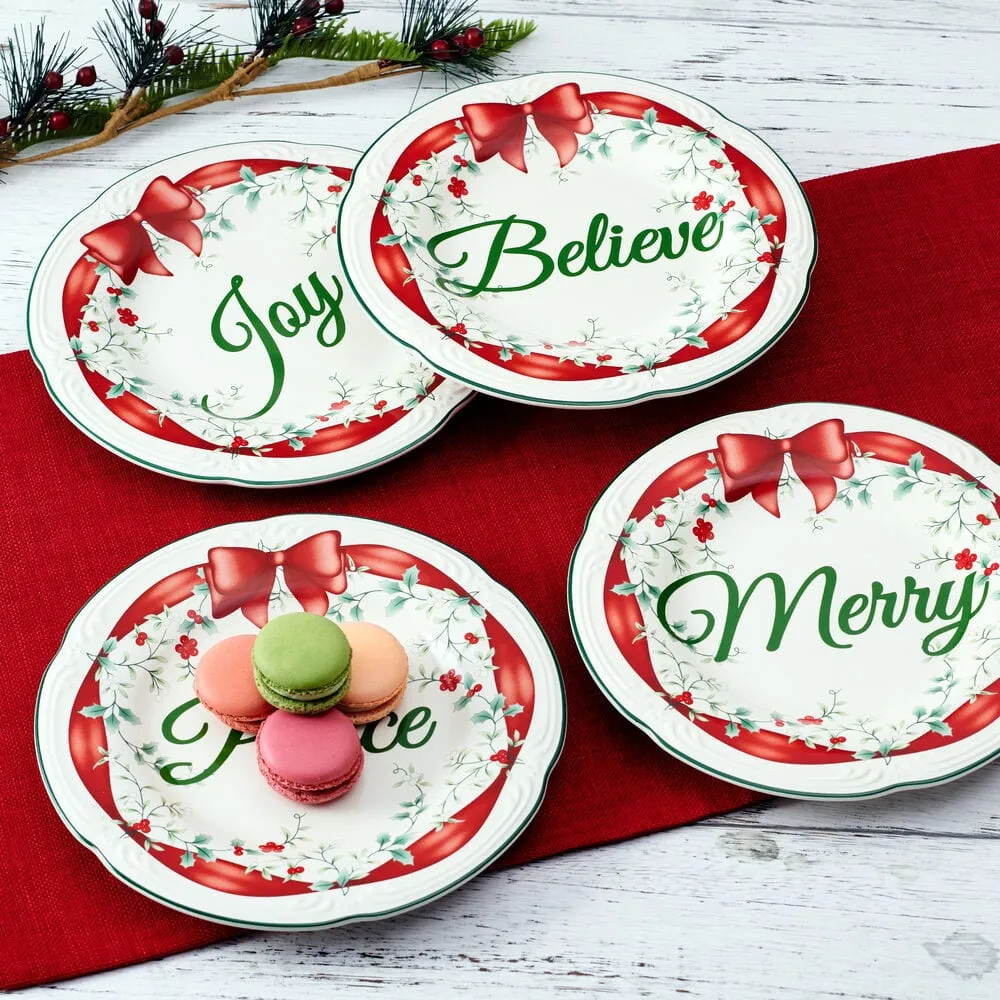
The charm is the mismatch: formal scalloped edges, casual script lettering, and a dessert that undercuts all of it. It’s a table that doesn’t take itself seriously, which is exactly why guests relax at it.
- Main furniture (four decorative plates): $40–$90
- Lighting: $0–$30 if you add votives
- Textiles (red tablecloth, napkins): $25–$60
- Decor (pine sprig, berry picks): $10–$25
- Paint/wall treatment: none
- Total: about $75–$205 for four settings
To make your own script plates in roughly two hours plus drying time: clean glazed plates with alcohol, apply letter stickers as a resist, paint the border freehand or with a stencil, let cure 24 hours, then peel. Hand-wash only, and keep them away from direct flame.
11. Red Deer Motif Plates on Red and Green Plaid
A stack of white plates with a red deer silhouette at the center and a red leaf border around the rim sits on a red and green plaid cloth, flanked by gold flatware and a red glass goblet. Pinecones and red berries trail through a garland in the blurred background.
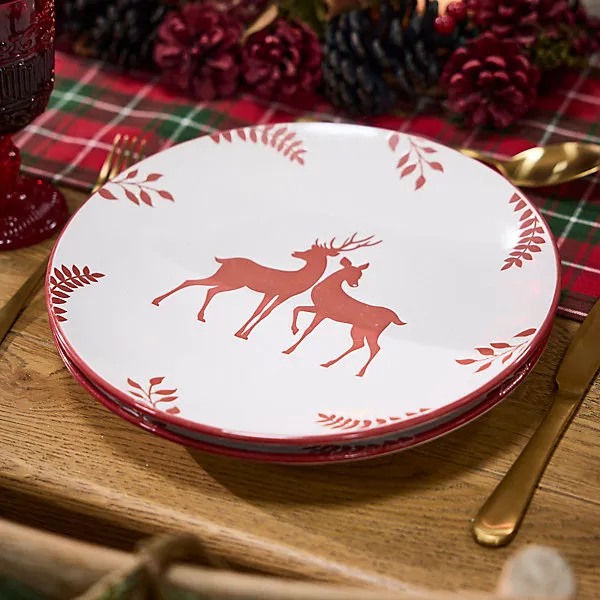
is the plaid. Those deer plates are lovely, but on a plain white cloth they’d read as cute rather than collected. The tartan gives them a heritage context — suddenly the deer looks like it belongs to a family tradition instead of a clearance aisle.
on plaid: busy patterns hide spills beautifully but they also fight with busy plates. If your dinnerware has a strong motif, keep the plaid to a runner rather than a full cloth, or the table becomes visual static. And red glass goblets are gorgeous but they show water spots instantly — hand-dry them and store them upside down on a clean towel.
12. Fluted White Ceramics on Tartan and Gold
A red tartan plaid cloth forms the base, layered with a metallic gold placemat, then a white fluted dinner plate and a matching fluted bowl. Gold flatware and a clear stemmed glass complete the setting. The fluting is the detail you notice second, and then can’t stop noticing.
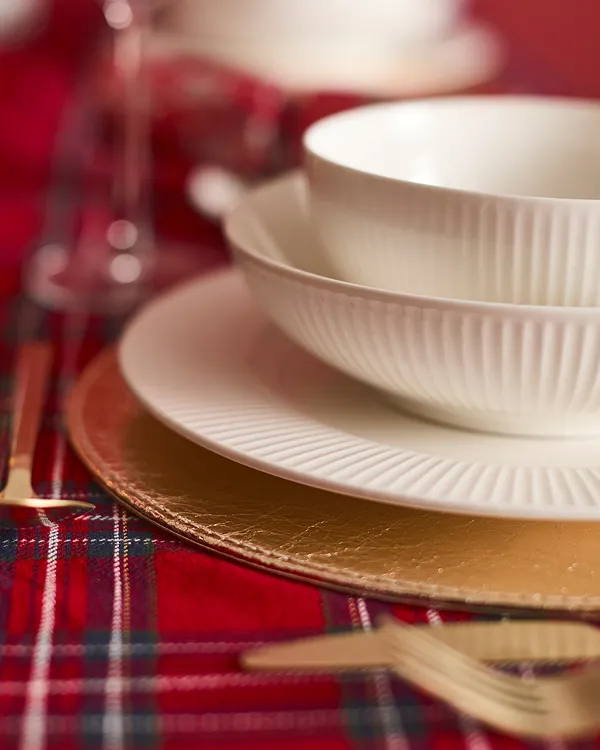
Here’s why fluted rims earn their place: vertical ridges catch candlelight and throw tiny shadows, which gives a plain white plate dimension without pattern. On a table already carrying tartan and metallic gold, that’s exactly the restraint you need — texture instead of another print.
The ratio to remember: 50% red tartan, 30% white ceramic, 20% gold. If you swap the tartan for a deep green buffalo check and keep the gold placemat, the formula still works. If you swap the gold placemat for silver, drop the tartan to a runner — silver and red plaid together can tip into tinsel territory fast.
13. Red Placemats, Berry Centerpiece, Colored Stemware
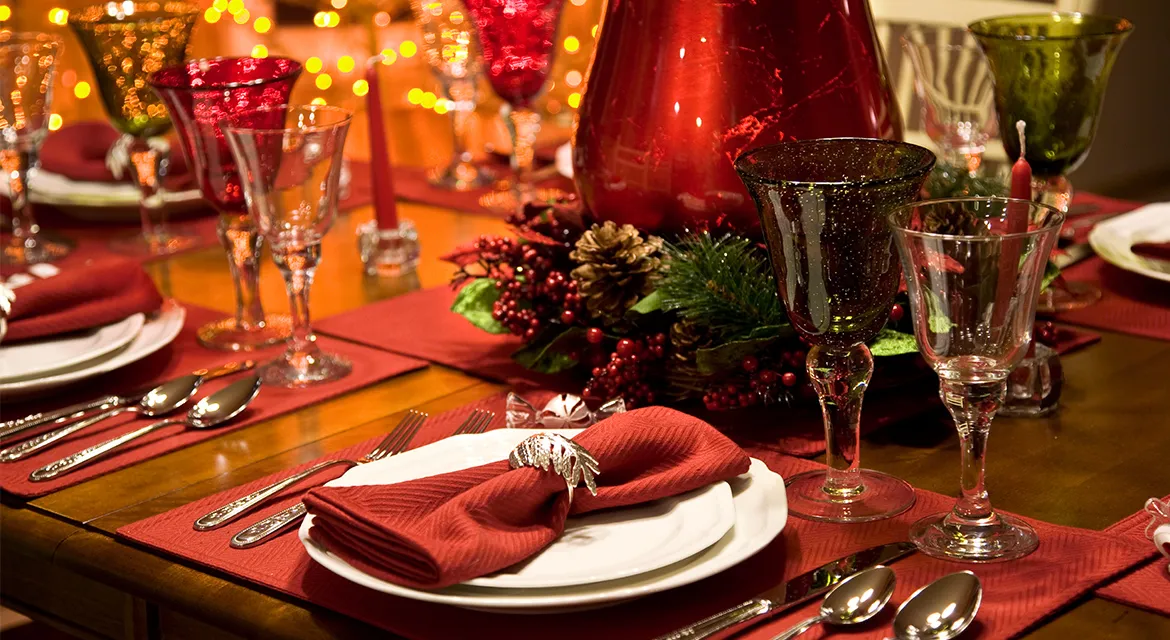
Red placemats and folded red cloth napkins in silver rings anchor white dinner plates with ornate silver-handled flatware. At the center, evergreen branches, red berries, and pinecones surround a large red glass vase, and the glassware runs a spectrum — clear, red, dark green — at each seat.
The colored stemware is the smartest thing happening here. Mismatched glass colors create rhythm across a long table without adding a single object, and they let you build a collection over years instead of buying a matched set. It’s also forgiving: one chipped goblet doesn’t ruin the family.
by sourcing glassware at thrift stores and estate sales — $2 to $5 a stem is normal, and mixing is the point. Red placemats from discount retailers run $4–$8 each. The red glass vase can be replaced with any large vessel you already own, wrapped in a length of evergreen. Total savings versus buying new matched sets: easily 50–60%.
14. Gingerbread Men on Gingham and Stacked Red
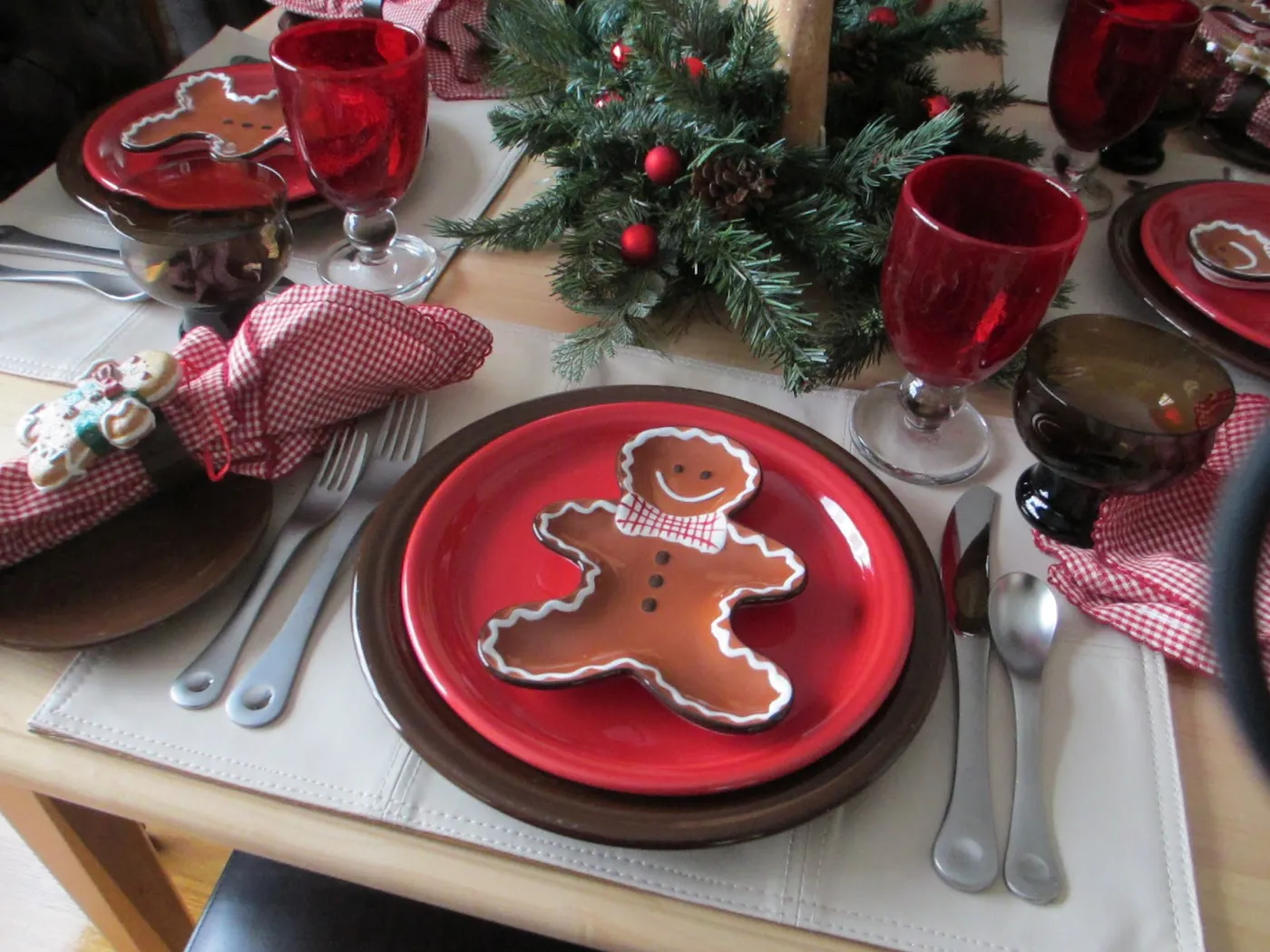
Brown and bright red plates stack at each seat, crowned with a gingerbread-man-shaped dish. Red and white gingham napkins are held by gingerbread man napkin rings, and red and amber stemmed goblets catch the light. A lush evergreen centerpiece with red berries and pinecones keeps the whimsy from tipping into chaos.
Playful thematic tables are having a real moment — the pendulum has swung away from hushed formality toward tables that make kids and adults want to sit down. Gingham in particular reads as homemade-in-the-best-way, and it’s cheap to source in any fabric store.
Make the gingerbread napkin rings in about 30 minutes for under $15 total:
- Roll air-dry clay to a quarter-inch thickness.
- Cut gingerbread shapes with a cookie cutter and poke a hole for the napkin.
- Press a pattern into the surface with a fork or toothpick for a baked look.
- Let dry 24 hours, then paint with acrylic in warm brown and add white “icing” dots.
- Seal with matte varnish so butter fingers don’t destroy them.
15. Argyle Napkins and a Molded Gingerbread Figure
A shiny gold charger holds a white dinner plate, and on it an argyle-patterned napkin in green, orange, and white folds around a large intricately molded gingerbread figure with a sprig of red berries. Two etched stemmed glasses — one clear with leaves, one amber with patterns — sit alongside silver cutlery.
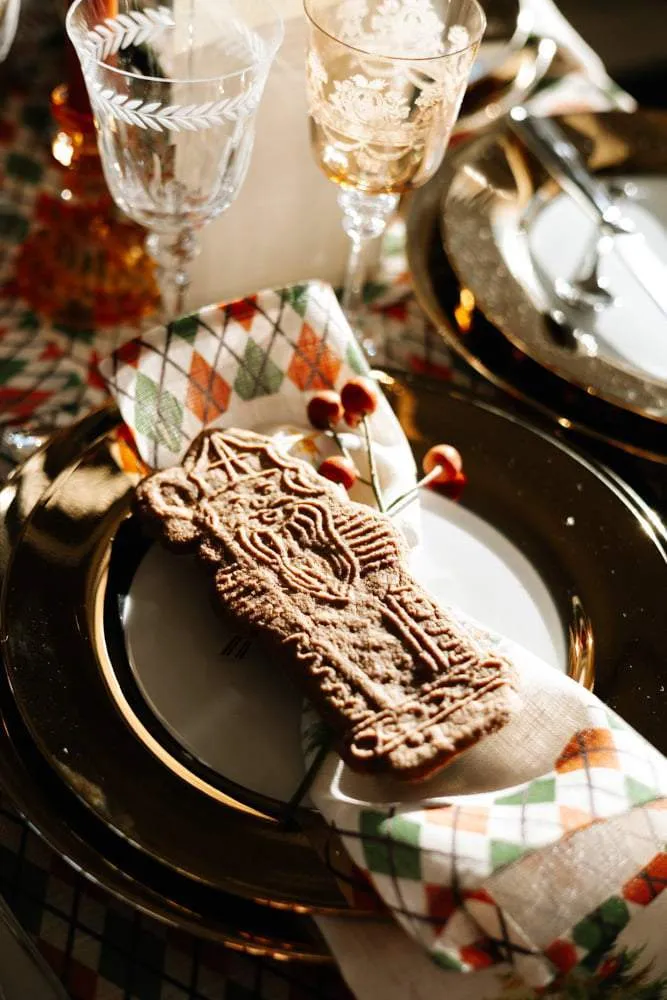
is that argyle napkin. Gingerbread on a plate is charming but common. Gingerbread on an argyle napkin in green and orange is a color story — suddenly the table has a palette beyond red and green, and it feels collected rather than purchased.
when you introduce a third accent color like orange, repeat it somewhere small and non-obvious, like a single amber glass or a ribbon on the runner. One occurrence looks like a mistake; two looks intentional. Keep the third color under 10% of the table’s total visual area.
16. Silver Crackers and a Glowing Tree Behind
A polished dark wood table is set with clear wine glasses, tumblers, and silver Christmas crackers, with silverware resting on light napkins. Behind it, out of focus, a tree glows with warm white lights and colorful ornaments. The restraint at the table lets the tree do the entertaining.
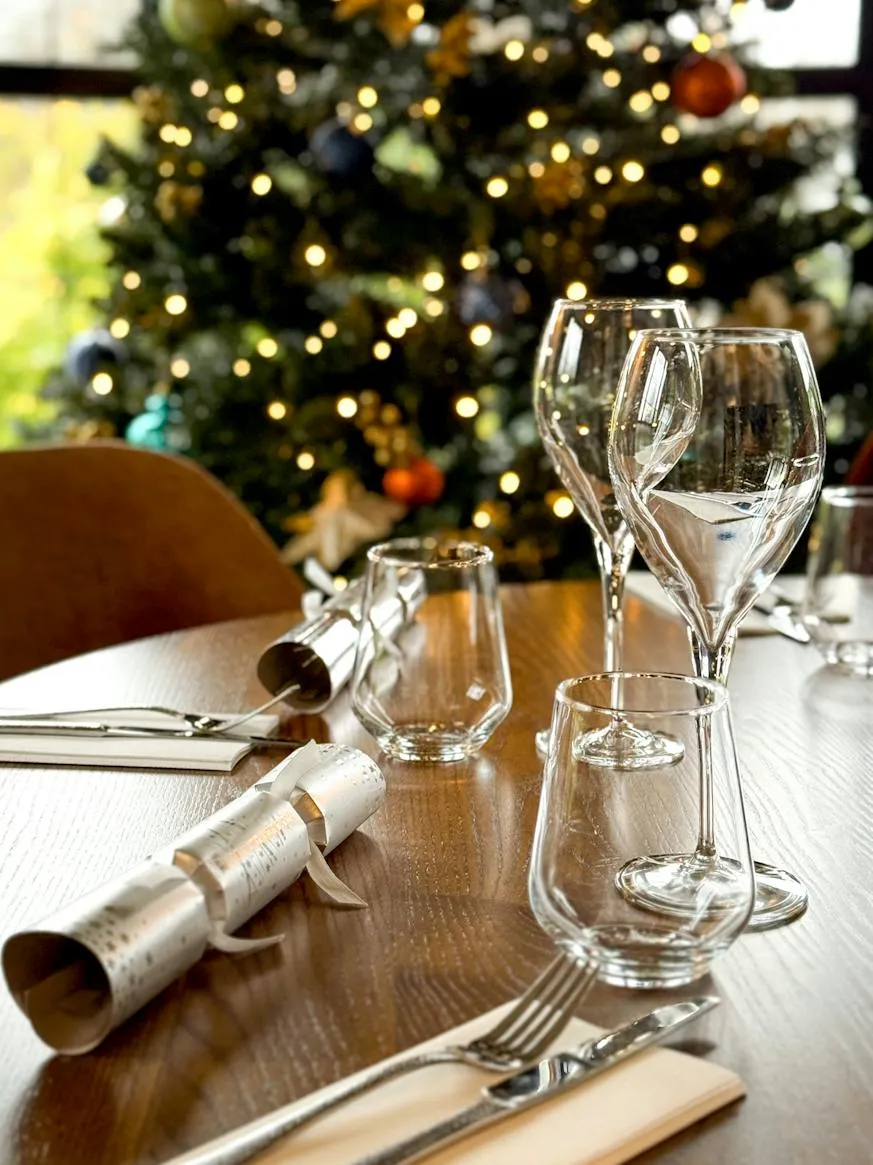
This is a table built for a room, not a photograph. It works best in a dining space of at least 120 square feet with the tree visible from the head seat — the relationship between table and tree is doing most of the decorating. In a cramped room, the same setting feels plain, so add a low centerpiece of greens to hold the middle.
about crackers: the snaps are loud, the toys are plastic, and the paper hats rarely fit. Buy them for the ritual, not the contents, and set them flat rather than upright so they don’t topple into the gravy. Silver foil also shows fingerprints — wipe them down right before guests arrive.
17. Striped Amaryllis and Red Apples Down the Middle
A striped red, white, and dark green runner runs the length of the table, topped with a striking centerpiece of red and white striped amaryllis, solid red blooms, pinecones, small red apples, and fir branches. Green glass swing-top bottles, lit votives in green glass, and place settings with white plates and yellow bowls fill out the scene.
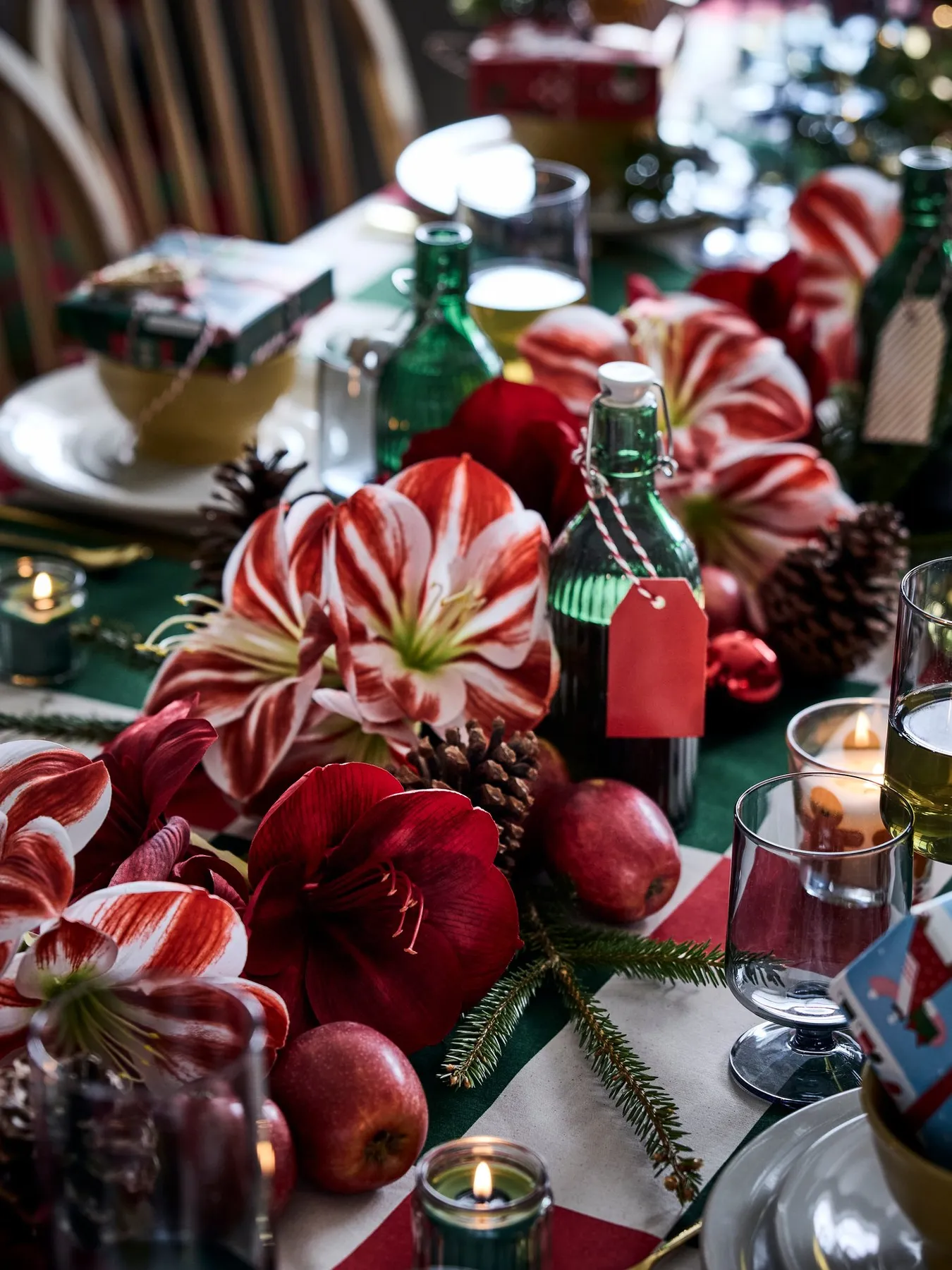
The formula: 45% white and natural runner, 35% red between flowers, apples and stripes, 20% green in foliage, glass and votives. The yellow bowls are the wildcard — a warm fourth color that keeps all that red and green from feeling like a flag.
- Main furniture (plate and bowl sets for 8): $80–$180
- Lighting (green votives, tea lights): $20–$45
- Textiles (striped runner, napkins): $25–$60
- Decor (amaryllis stems, apples, pinecones): $50–$120
- Paint/wall treatment: none
- Total: roughly $175–$405 for eight settings
Swap fresh amaryllis for good faux stems and you’ll keep this centerpiece for years instead of one season — worth it if you host every December.
18. Nailhead Chairs and Pinecone Garland Warmth
A long rustic wooden table holds a runner of pine branches, pinecones, and white berries, punctuated by glowing pillar candles on wooden holders and small votives. Woven round placemats and natural linen napkins tied with twine and a sprig sit at each seat, and cream upholstered chairs with nailhead trim surround the table.
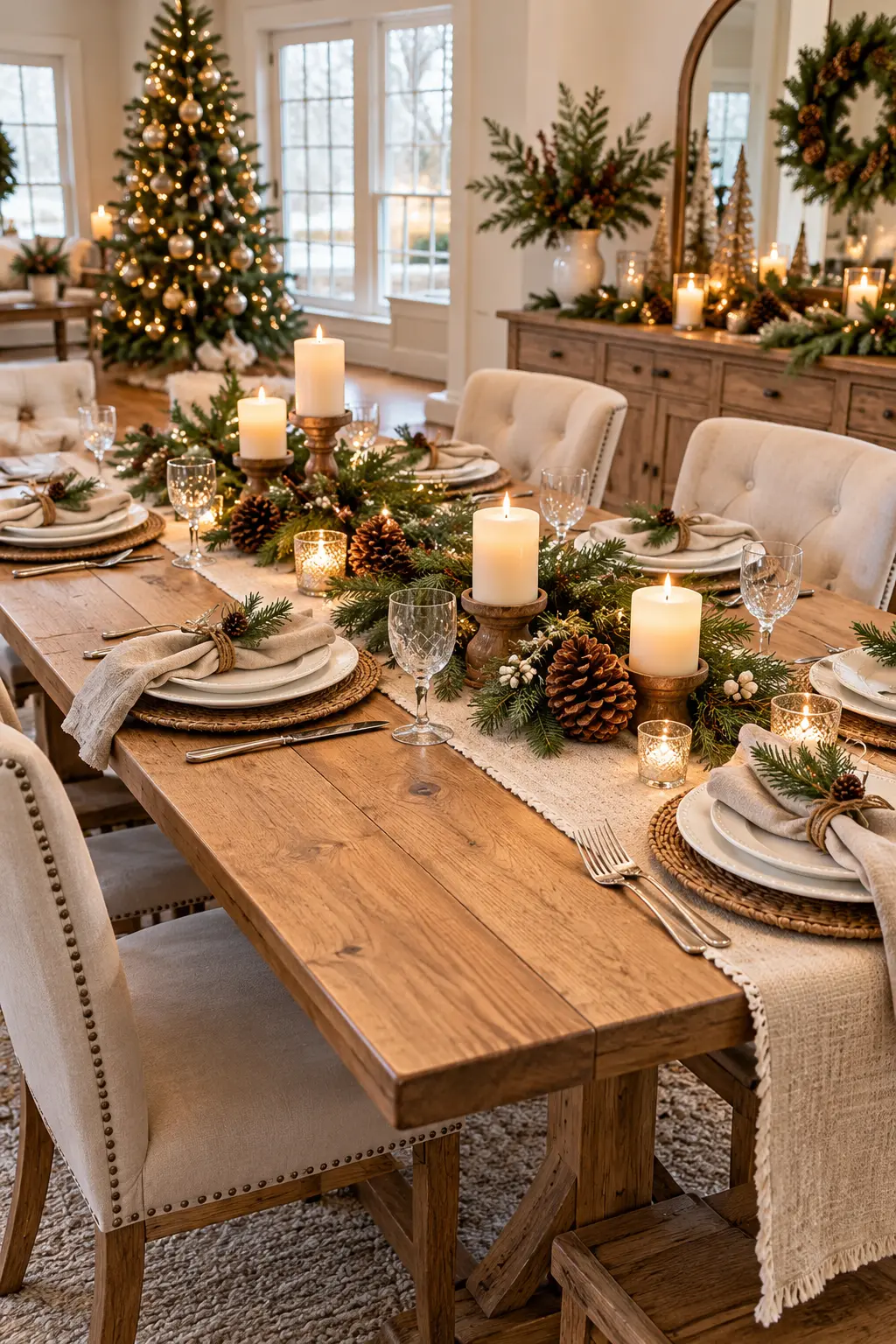
Three principles are stacking here. First, material honesty — wood, linen, twine, and wax, nothing pretending to be something else. Second, warm light at eye level, which makes everyone look better and conversation flow. Third, a repeated detail (the twine-and-sprig napkin) that gives the table a signature without shouting.
For scale, this look shines on tables 84 inches and longer, where the garland has room to breathe. On a smaller table it crowds out the plates — try the tray-based centerpiece in Idea #8 instead, which contains the greenery in a defined footprint.
19. Pomegranates and Taper Light on Cream Linen
Layered cream ceramic plates rest on a light linen cloth, while a garland of green foliage, red berries, and whole pomegranates runs down the center, lit by taper candles, tea lights, and fairy lights glowing softly behind.
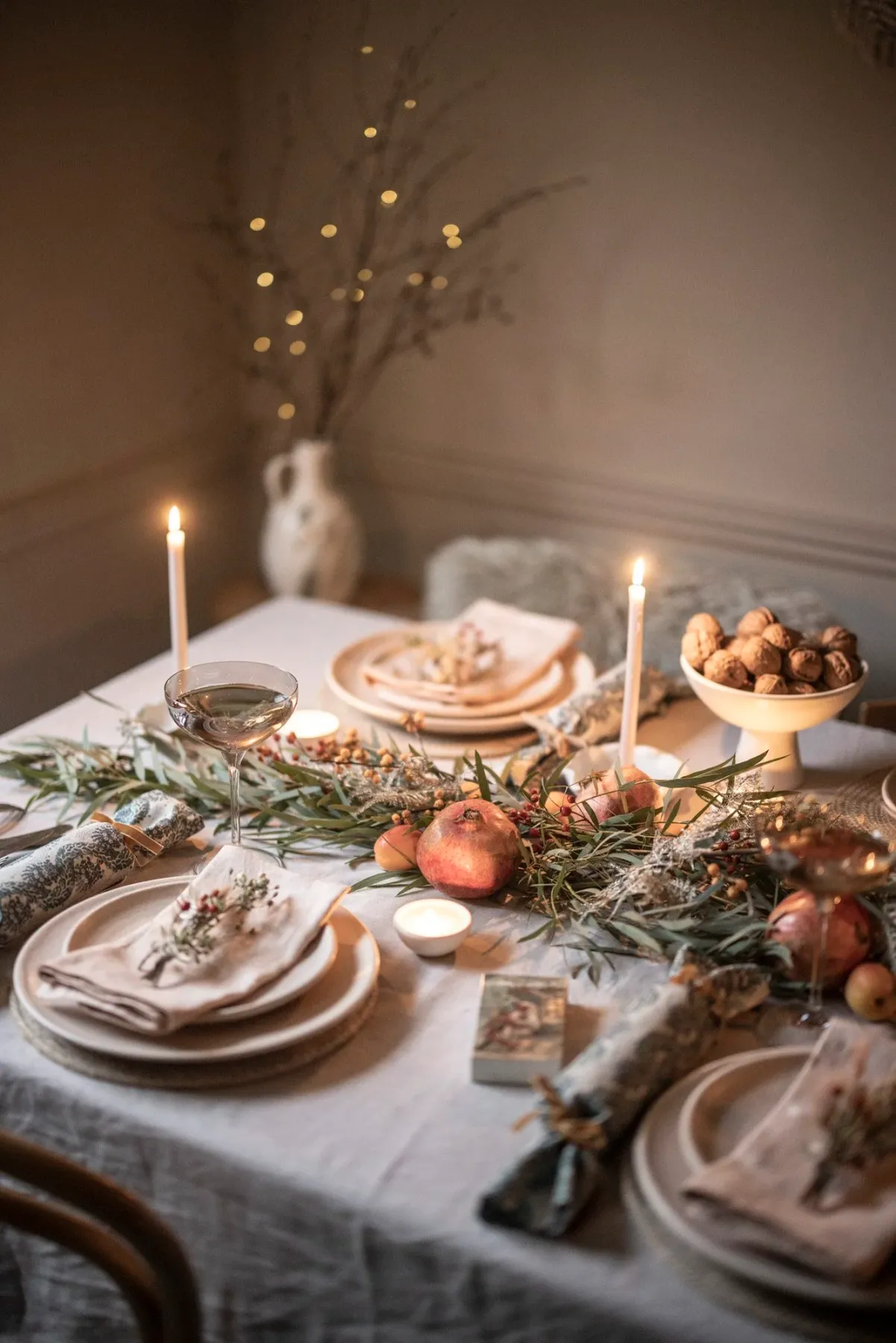
is the pomegranates. Berries are everywhere in December; pomegranates are the unexpected fruit, and their leathery crimson skin and crown-shaped tops give the table a sculptural, almost medieval richness. They also last for weeks at room temperature, which is more than you can say for most holiday decor.
pomegranate juice is a permanent dye. Once one is cut or dropped, that cloth is finished — so keep them whole, place them on a tray or a nest of greens, and warn guests before someone tries to open one at the table. Also note that taper candles in a draft will drip; trim wicks to a quarter inch and keep them away from the door.
20. Scalloped White Plates Against Warm Beige Linen
A round table wears a light beige linen cloth, set with stacked white scalloped plates, a matching linen napkin, and gold flatware. At the center, a small evergreen arrangement glows with delicate string lights, pinecones, red and gold ornaments, and taupe taper candles in copper-toned holders.
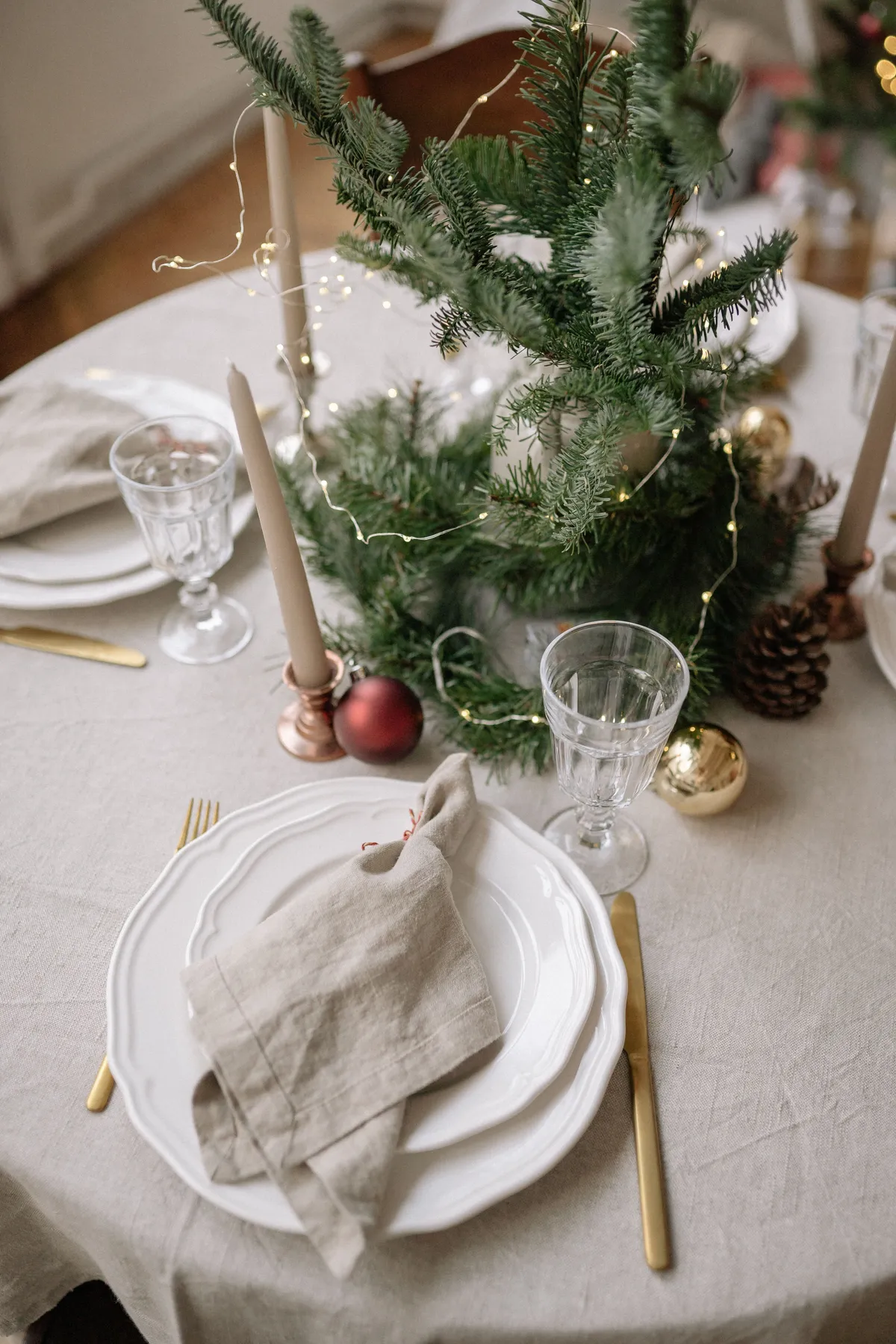
The move here is temperature: cool white ceramic and gold against warm beige, copper, and taupe. Nothing matches exactly, and that’s what keeps it from looking like a catalog page.
scalloped edge plates are a big-box staple at $5–$10 each, and beige linen can be replaced with a flat cotton sheet in oatmeal for about $20. Copper-toned holders are often on marketplace sites for $3–$6 a pair. The string-lit greenery can be a $15 faux garland from a discount store — nobody inspects the centerpiece that closely once the candles are lit.
21. Scripted Plates in a Sea of Candlelight
A long white table is set with dark rectangular placemats, white plates with calligraphic script, and dark folded napkins. The centerpiece is the showstopper: a lush green garland packed with lit candles in clear, dark, and metallic holders, threaded with fairy lights and silver spheres.
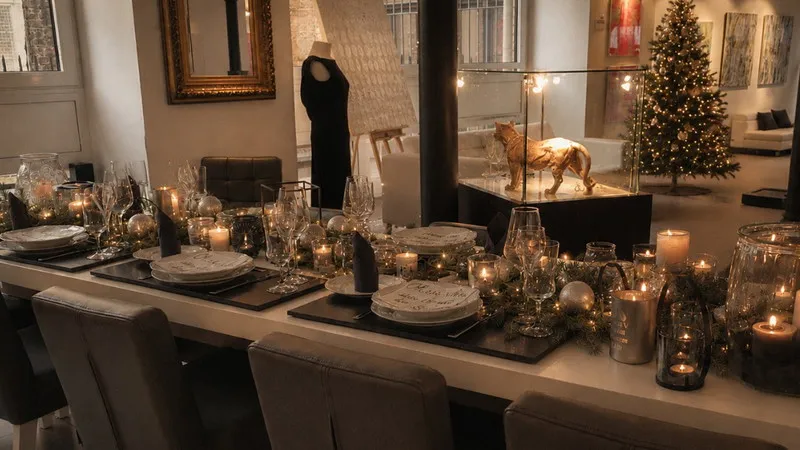
is tonal contrast. The table stays in a white, dark grey, and green range, which lets hundreds of small flames read as one continuous ribbon of light. If the plates were patterned or the linens colorful, the candlelight would get lost in the noise.
This is the candle-cluster trend at its best — the move away from one grand centerpiece toward many small light sources. It photographs like a dream and also solves the real problem of a long table: everyone has a candle within arm’s reach. Keep holders varied in height but never taller than 14 inches so sightlines survive.
22. Plum Geometry, Rattan Chargers, Amber Glass
A round table wears a plum and white geometric cloth, layered with deep plum scalloped placemats and dark brown woven rattan chargers. Cream scalloped plates sit on top with a matching patterned napkin held by a braided natural fiber ring, and the glassware mixes clear stems with textured amber tumblers. A white ceramic vase of gold dried foliage centers it, flanked by small dark fluted votives.
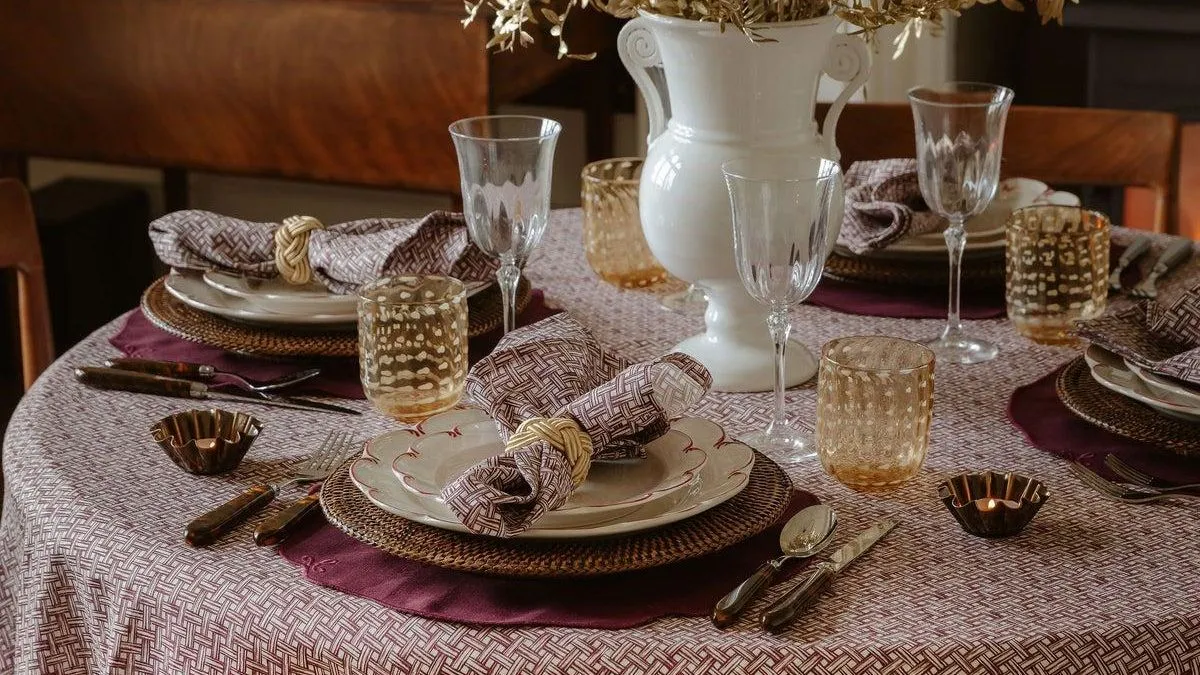
Count the color story: 50% plum and white pattern, 30% cream ceramic, 20% amber, gold, and rattan. The rattan is the secret weapon — it inserts a rough natural texture right where the eye rests, keeping all that refined pattern from feeling cold.
when your tablecloth is patterned, your placemats should be solid and about 20% more saturated than the cloth’s dominant color. That slight intensity jump makes each setting read as a distinct place rather than a blur of the same print.
23. Dried Plumes and Evergreen in Hard Sunlight
Off-white ceramic plates and clear tumblers sit at a table where the centerpiece is all texture: slender green coniferous foliage mixed with grey spherical pods, fluffy tan plumes, and spiky brown seed pods. Strong sun cuts hard shadows across the wooden surface. Nothing here is red or gold.
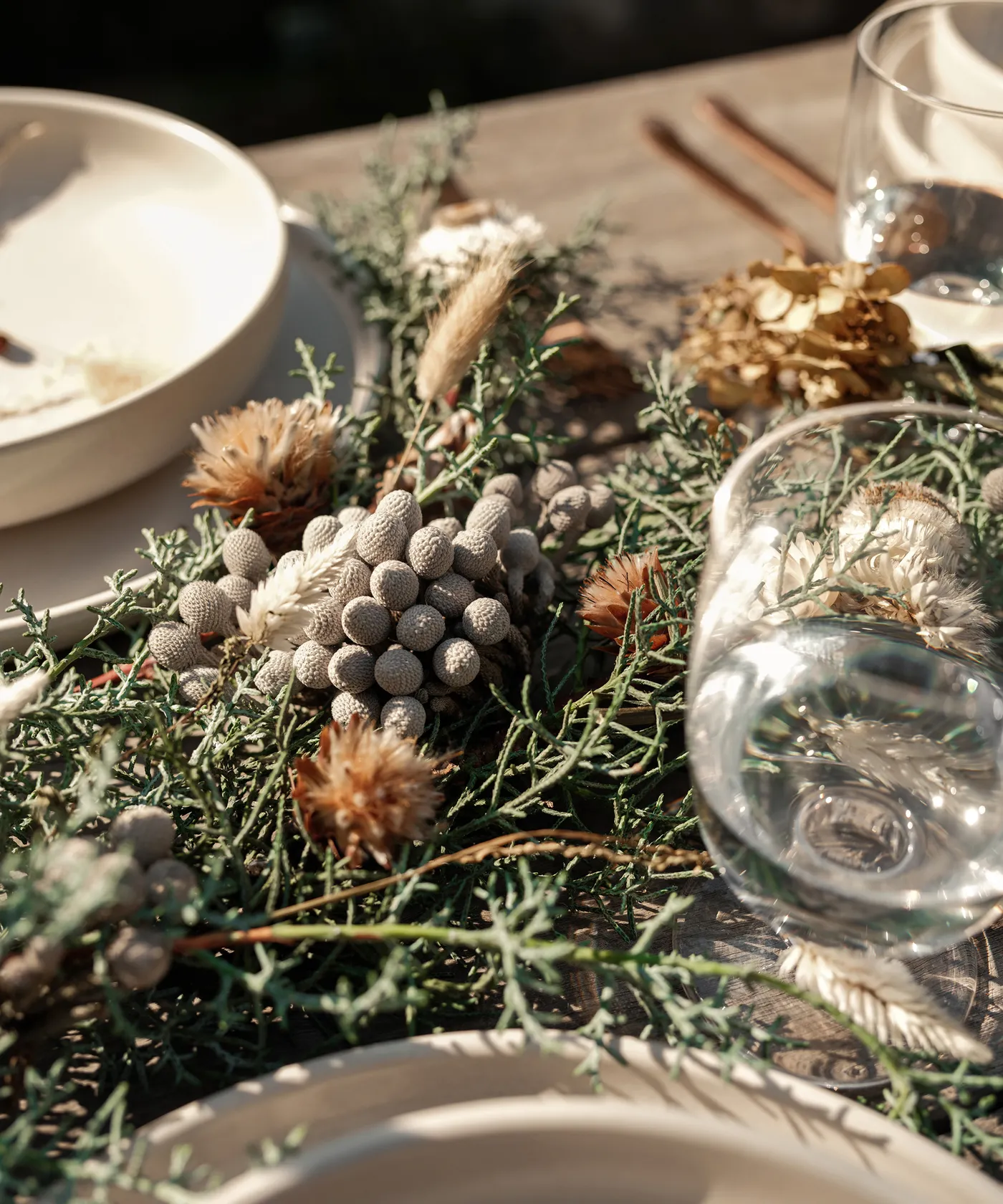
It’s a reminder that Christmas tables don’t have to be red and green to feel festive — they just have to feel abundant and intentional. Dried botanicals also cost a fraction of fresh flowers and won’t wilt mid-meal.
Build your own runner in about 25 minutes and $30–$50:
- Lay a base of coniferous branches, overlapping stems by about a third.
- Add dried grasses in irregular clumps, never evenly spaced.
- Tuck round pods in threes for rhythm and a bit of visual weight.
- Step back and check the silhouette — it should rise and fall, not run flat.
Honest caveat: dried stems shed. Give them a gentle shake outdoors first, and avoid placing them where a ceiling fan or a serving platter will brush them.
24. Deer Motif Bowl on a Plaid Runner
White and red ceramic plates with red deer and foliage motifs sit on a wooden table partly covered by a red and green plaid runner, with gold-toned cutlery resting alongside a red ceramic bowl. It’s the simplest possible interpretation of the red-and-green tradition, and it holds up.
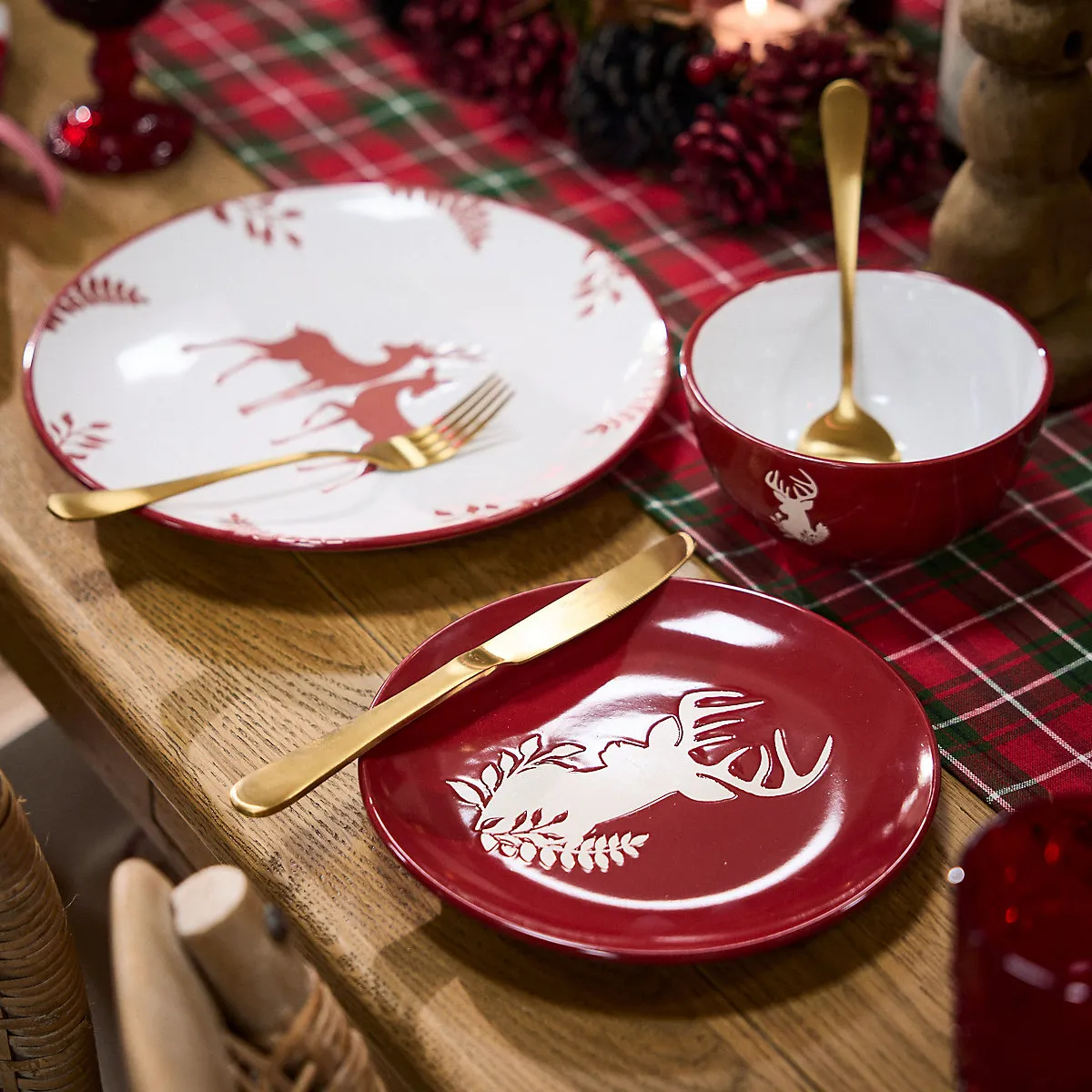
Fewer elements means each one has to be right — which is why the checklist matters more on a minimalist table than a maximalist one.
- Lay the runner first and check it’s centered within an inch at both ends
- Confirm your plate and bowl colors share the same red temperature (blue-red vs orange-red)
- Count your cutlery — gold-toned sets often skip salad forks in the box
- Decide whether the wooden table stays bare or gets placemats before you buy anything
- Main furniture (plates, bowls, cutlery for 6): $90–$200
- Lighting: $0–$25
- Textiles (plaid runner): $15–$40
- Decor: $0–$20
- Paint/wall treatment: none
- Total: about $105–$285 for six settings
25. Sage Linen with Hellebores and Whimsical Glassware
A sage green linen cloth sets the tone, with layered white and green plates at each seat. The centerpiece is genuinely rustic — pine branches, hellebores, and pinecones in a low vessel — while tall patterned drinking glasses, a brass candlestick, and a textured bowl of mixed nuts and berries finish it.
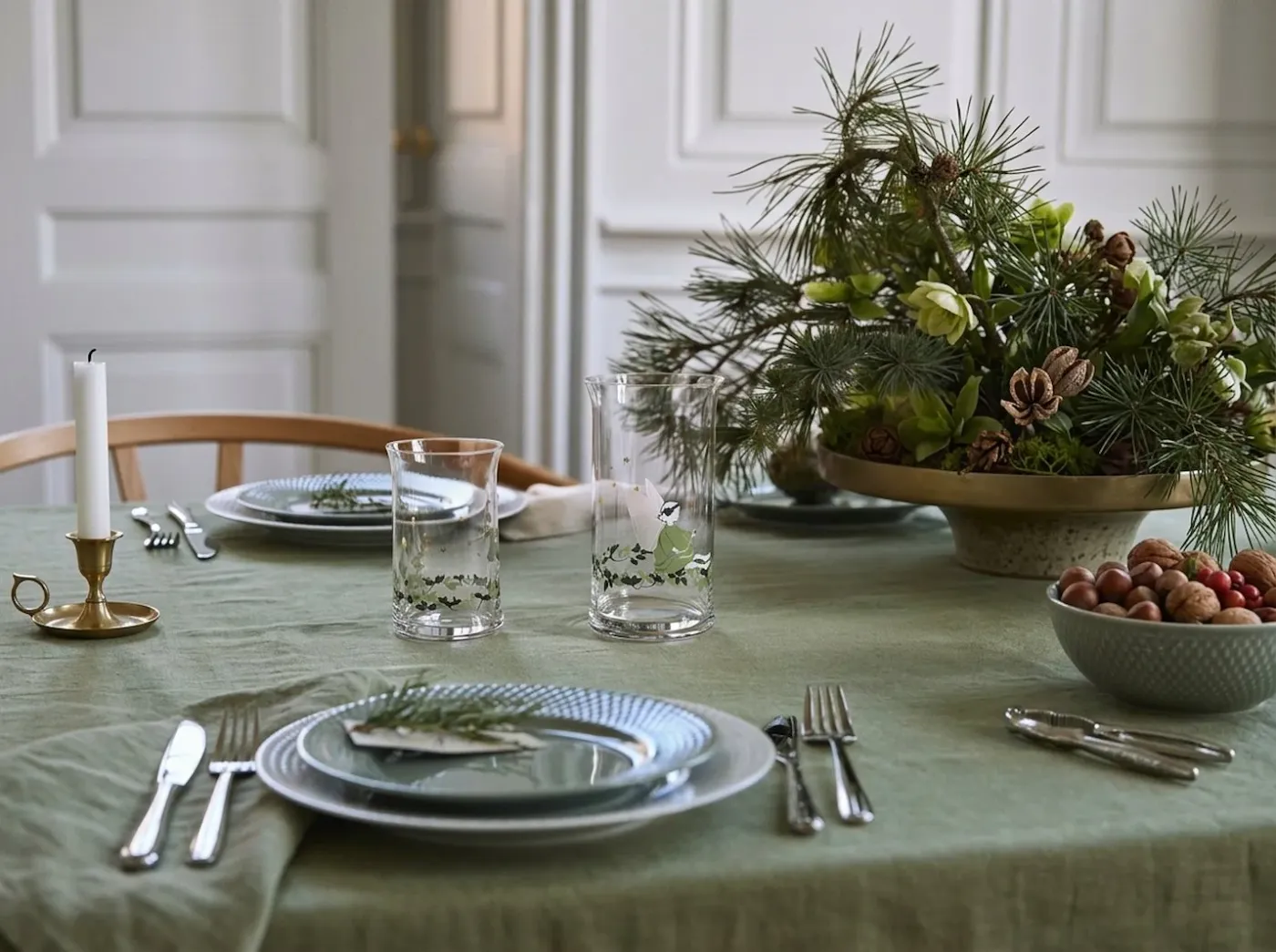
The genius is that the glasses are the only “fun” element. Everything else is muted sage, white, forest green, and brass. Restraint in the base layer buys you freedom in one accent, and here the whimsy lands because there’s nothing competing with it.
sage linen is often marked down after the season at big retailers, and patterned tall glasses are a thrift-store staple at $2–$4 each — collect mismatched ones deliberately. Hellebores are pricey; substitute white lisianthus or even good faux hellebore stems at a third of the cost.
26. Clear Glass Plates Over Dark Green and Berries
A dark green tablecloth is scattered with red berries and evergreen sprigs, with clear glass plates layered over dark grey napkins. Small white candles in glass votives flicker among tall clear glass cones interspersed down the table, and black and metallic cutlery completes each setting.
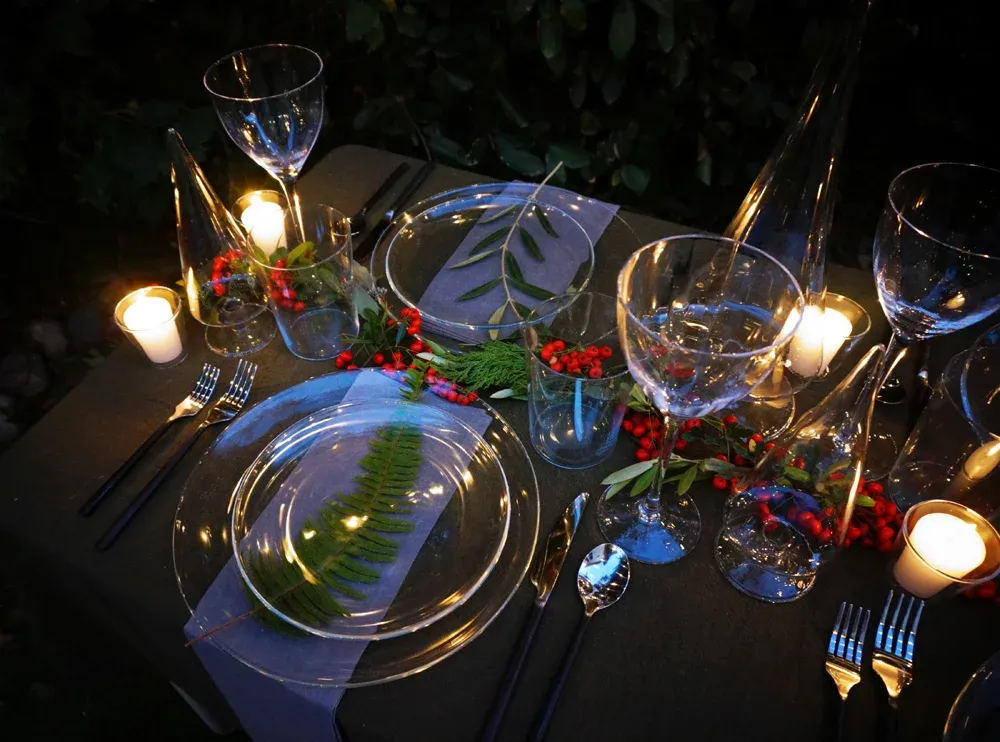
is the clear glass plates. They let the dark cloth and the scattered fruit read straight through each setting, so the table looks continuous rather than chopped into circles. It’s a trick that photographs beautifully, especially by candlelight.
clear plates show everything — every smear, every fingerprint, every reflection of a passing phone screen. Buff them with a microfiber cloth right before guests sit, and skip them entirely if you’re serving anything with a deep sauce. Dark cloth also shows candle wax instantly; use a felt or foil barrier under each votive.
27. Gold Bird Figures in a Mixed Evergreen Garland
A dark wood table carries gold chargers topped with white beaded dinner plates and small white bowls, each resting on fresh evergreen sprigs. A central garland of mixed green pine, golden dried leaves, and natural pinecones runs the length, punctuated by small gold bird figures and clear-gold acrylic flatware.
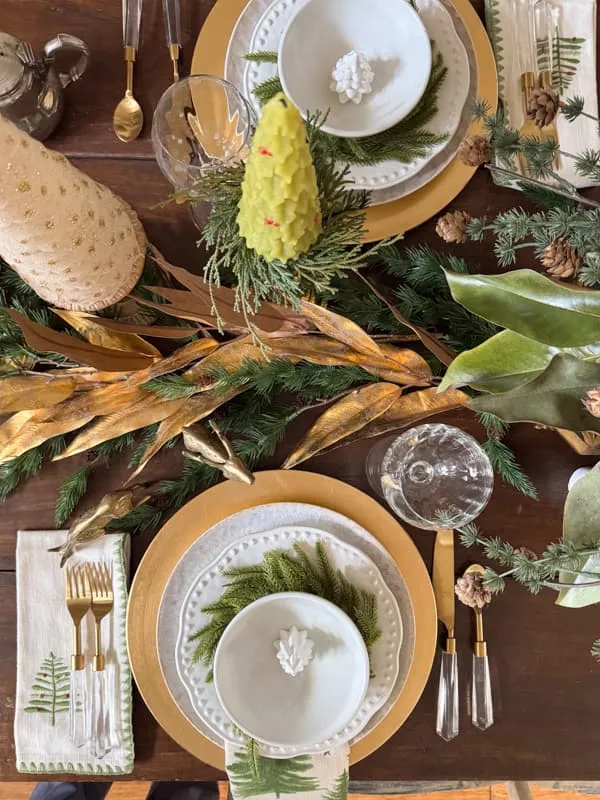
The birds are the payoff detail — small, unexpected, and repeated. One gold bird is a curiosity; five scattered down a garland is a motif, and it’s what people will mention after dinner.
place your garland so it dips between settings and rises beside them. Aim for 4 to 6 inches of foliage spread at the lowest points and 9 inches at the peaks. That undulation makes a 6-foot table feel generous and keeps plates from feeling crowded. And keep the fresh sprigs on each plate small — no more than 3 inches — or they’ll shed onto the food.
28. Vibrant Color Layered Over Timeless Structure
Bright, saturated color sits on a classic foundation — the kind of table that feels timeless in its bones but cheerful in its dressing. Rather than let one palette dominate, the look plays confident hues against traditional tabletop shapes.
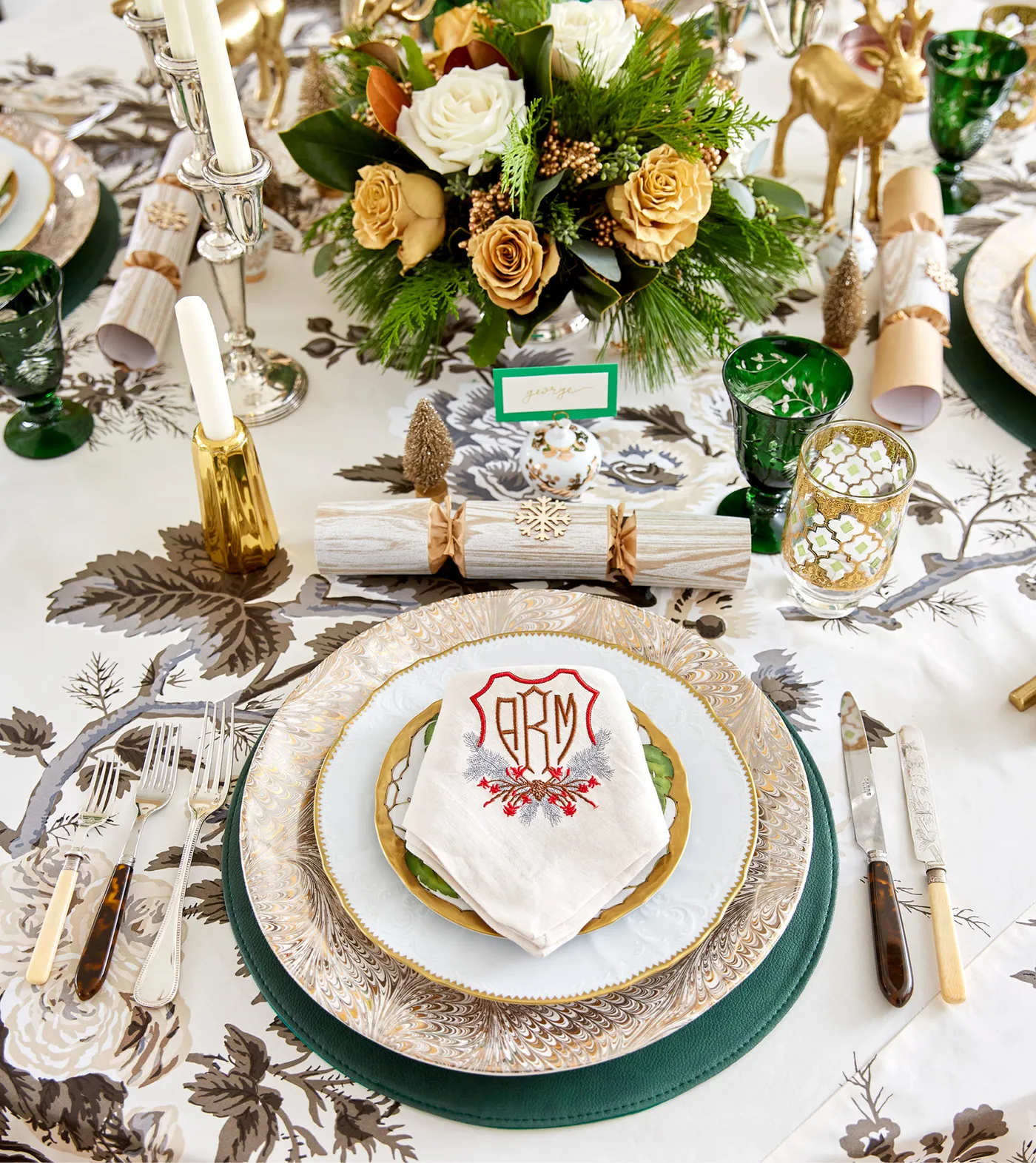
Think of it as 60% neutral and traditional base, 30% vibrant accent, 10% metallic. The base is what makes the color look intentional instead of accidental, and the metal gives it a holiday register. Swap the accent for a different saturation and the table reads completely differently without a single new purchase in the base layer.
- Photograph your existing tabletop in daylight before choosing accents
- Identify your base neutral — white, cream, or wood — and commit to it
- Pick one accent hue and one metal, no more
- Set one full place setting as a test before buying for eight
- Leave 15 minutes in your timeline for adjusting after the first pass
29. Red Ribbon Chair Ties and Hurricane Candlelight
A dark wood table is set with white dishes on lime green placemats, dressed with a lush green garland, red beaded strands, and numerous candles glowing in varied glass hurricane vases. White slipcovered chairs are tied with bright red ribbons, and a green wreath hangs on the mirror beyond.
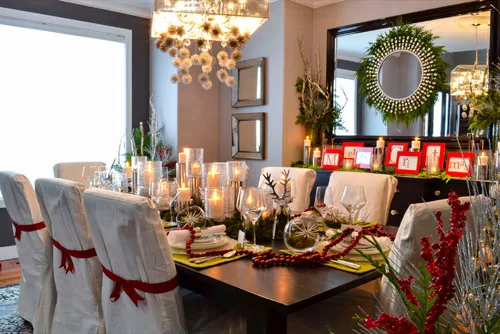
What works is that the décor escapes the tabletop. The chair ties and the wreath pull the palette into the room, so the table looks like part of a scheme rather than an island of festivity. That single decision — decorate past the edge of the table — is what separates a styled room from a styled table.
open flames plus hanging ribbons plus guests leaning back is a bad combination. Keep candles at least 12 inches from the table edge, use hurricane glass tall enough to block drafts, and never leave a lit table unattended. Battery candles in flicker mode are nearly indistinguishable behind glass.
30. Woodland Creatures in Gold on Terracotta and Teal
A dark cloth and dark napkins carry a gold reindeer and white rabbit motif, accented with red berries and green foliage. Layered terracotta and teal plates hold a fig and small sweets, and a red pillar candle glows inside a ribbed blue glass holder beside a red-tinted wine glass. Matching crackers sit on adjacent plates.
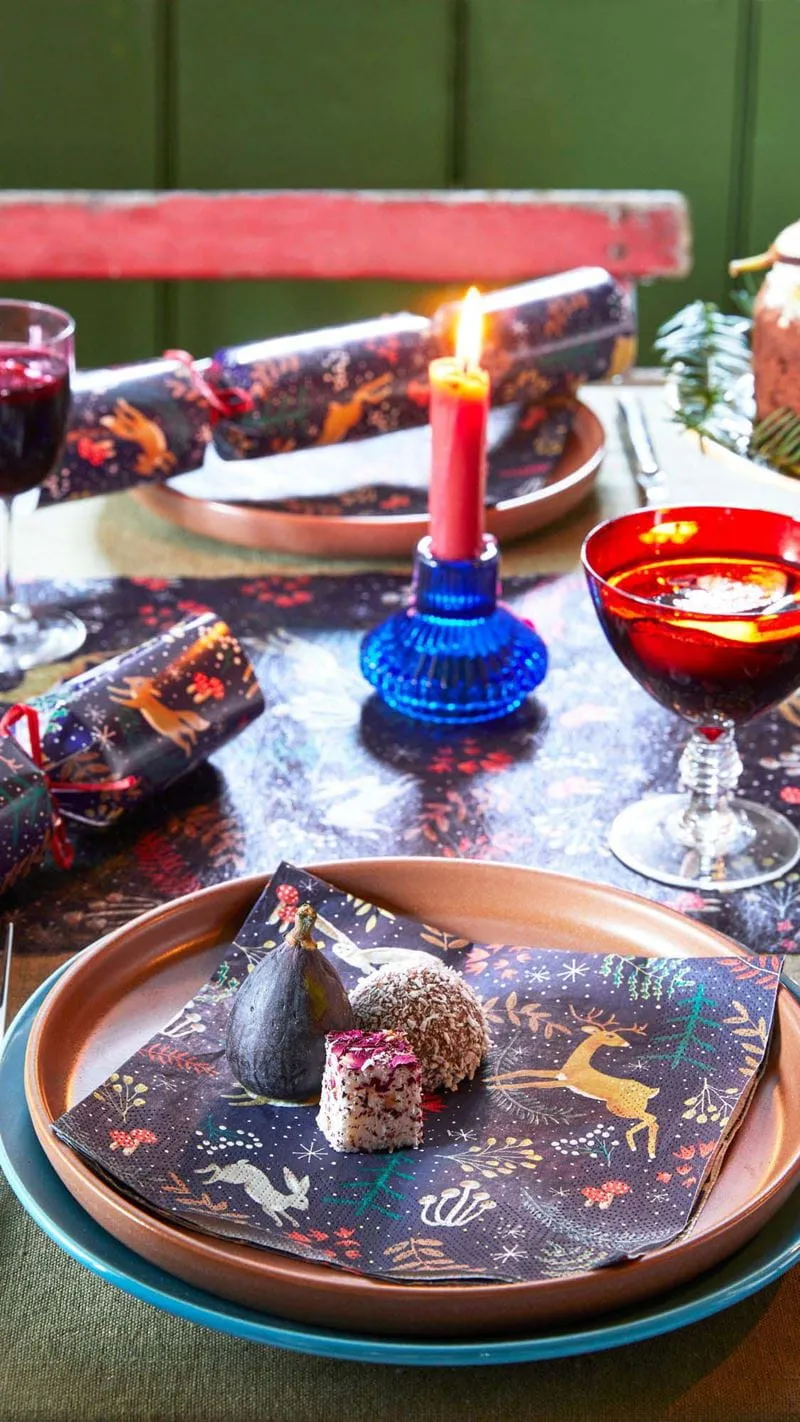
Whimsical woodland print is one of the year’s most-saved holiday directions — it lets a table be storybook without becoming childish, especially when the palette goes dark and saturated instead of pastel. The fig is a smart touch too: an edible garnish that reads as styling.
when pairing two strong colors like terracotta and teal, keep them in the same value range — both mid-to-deep — and let a single warm metal like gold be the bridge between them. Add one dark neutral (navy or charcoal) and the combination snaps into focus.
31. Striped Porcelain on a Pleated Paper Placemat
A polished wood surface holds an emerald runner and white pleated paper placemats. Each setting layers a textured gold charger, black and white striped porcelain, matte gold cutlery, and clear wine glasses, finished with red star-patterned ribbon, a pine sprig, and a white deer figurine.
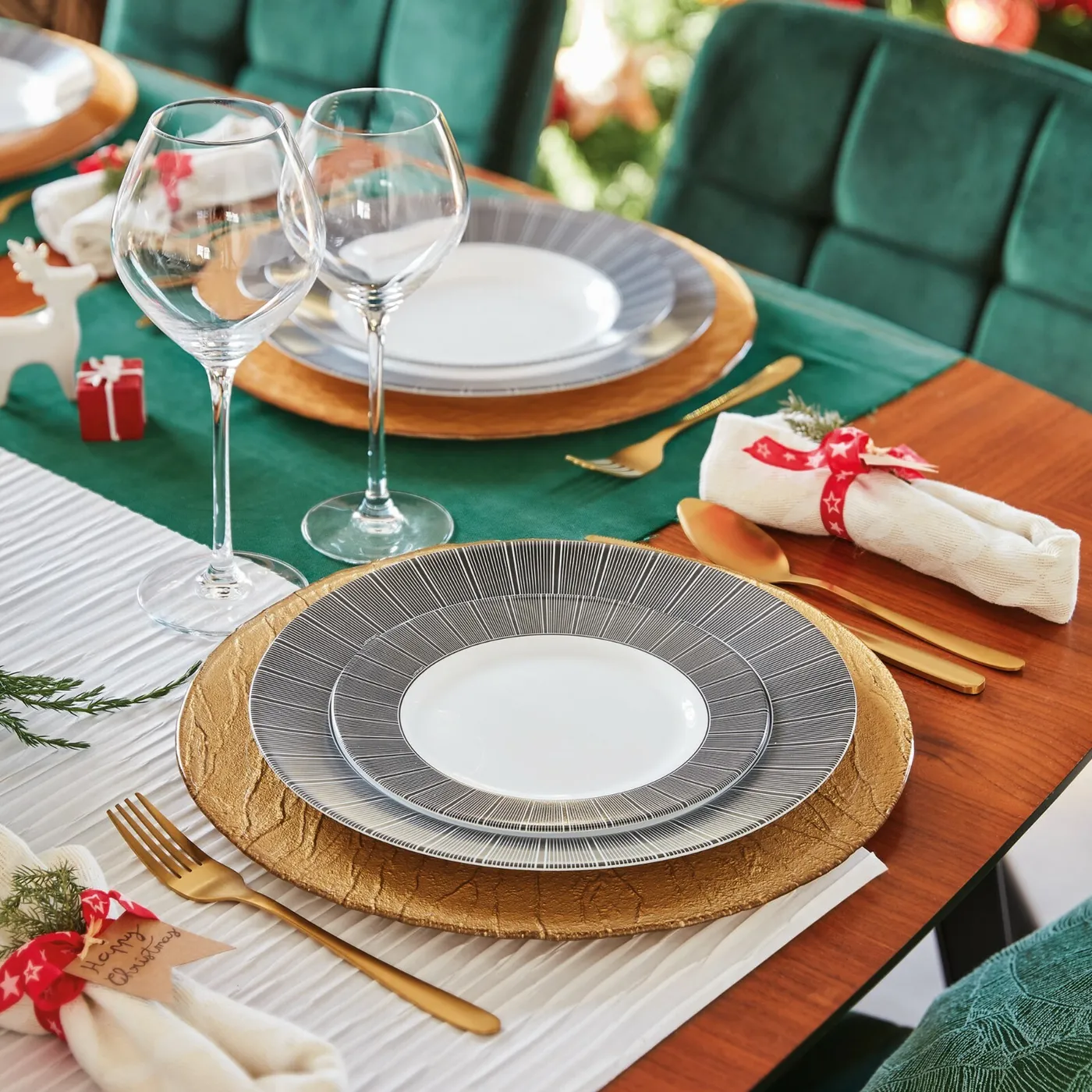
The formula is 40% emerald and white, 30% black and white stripe, 20% matte gold, 10% red accent. The pleated paper placemat is a quietly brilliant, low-cost move — it adds architectural texture and gets thrown away, so you never store it.
- Main furniture (chargers, striped plates, cutlery for 6): $110–$230
- Lighting: $0–$30
- Textiles (emerald runner, ribbon): $20–$50
- Decor (paper placemats, pine, figurine): $15–$40
- Paint/wall treatment: none
- Total: roughly $145–$350 for six settings
Budget swap: kraft paper pleated placemats cost about a third of fabric ones and read just as sharp under gold.
32. Wood Slice Chargers on Bold Black and White Stripe
A bold black and white striped cloth is overlaid with a light linen runner featuring subtle blue stripes. Each setting gets a round wood slice charger, a light blue-grey plate, and gold-toned cutlery, while a pine garland with fairy lights and white tapers in brass holders runs down the middle.
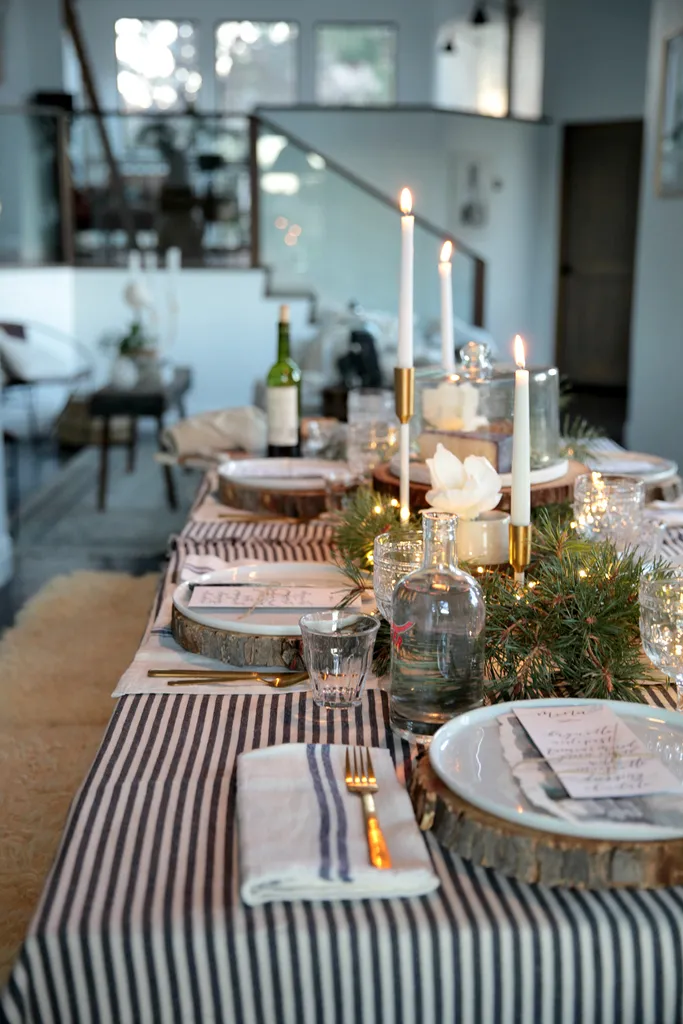
is contrast of scale. That wide stripe would swallow most tableware, but the wood slice chargers are just as bold — organic circles against graphic lines. Remove them and the plates float. Keep them and the whole composition locks together.
Why it works structurally: you have one high-contrast graphic, one soft neutral, one natural material, and one metallic. Four categories, no overlaps. The blue stripes on the runner echo the blue-grey plates without matching them, which is the difference between designed and coordinated.
33. Dark Plates Elevated on a Wooden Pedestal
Dark dinner plates stack on a wooden pedestal cake stand, topped with a crumpled brown linen napkin and ornate silver cutlery. Evergreen branches with fairy lights and light beige tapers in silver candlesticks sit nearby on a white tablecloth.
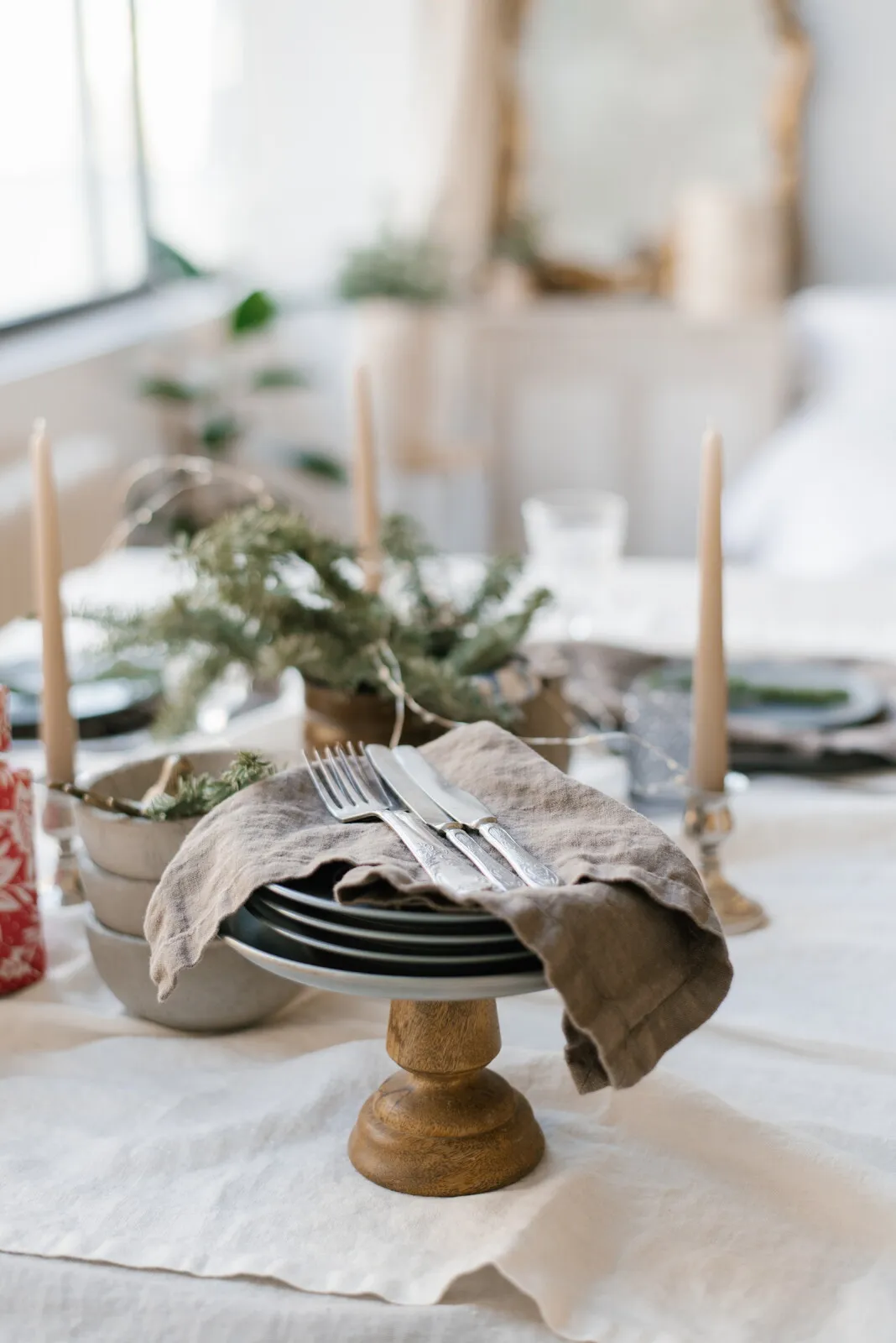
Using a cake stand as a plate riser is the quiet trick — it adds height at the center or at a single place setting and turns an ordinary stack into a display. On a small table this replaces a centerpiece entirely.
Scale note: this works best on tables under 60 inches where tall greenery would block sightlines. The pedestal gives you vertical interest without a sprawling footprint. Compare with Idea #18, which needs serious length for its garland to read properly.
a wooden pedestal needs oiling twice a season if it holds anything damp, and brown linen is a wrinkle magnet — press it flat, or lean into the crumple deliberately. Fairy light batteries will die mid-dinner if you don’t swap them the morning of.
34. Speckled Stoneware in Modern Neutral Calm
Three stacked speckled off-white plates sit on a matte grey surface with sleek silver cutlery and a dark grey textured glass. A white taper in a small ceramic holder stands beside evergreen branches and golden-tipped sprigs. Nothing is red or green except the foliage.
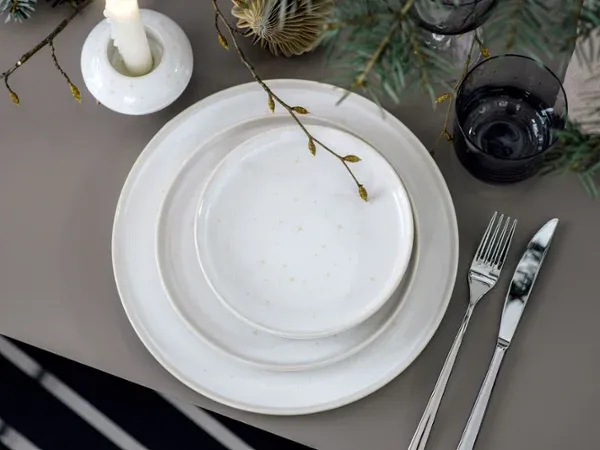
This is the modern neutral take, and it’s the one that survives past December — the palette is quiet enough to carry into January without looking like you forgot to put the decorations away.
with three stacked plates, keep diameters stepping down by about 1 to 1.5 inches each, and make sure the smallest is at least 6 inches across so it can actually hold a dessert. Stacked plates look intentional when the rings are even.
- Confirm your stack height — three plates plus a bowl can reach 2 inches, which reads as a tower on a narrow table
- Check your dinnerware is genuinely speckled, not printed; printed speckle looks flat in candlelight
- Measure your taper holder footprint before buying candlesticks
- Decide if you want the evergreen to touch the plate — it can leave sap on ceramic
Set The Table, Not The Bar Too High
Here’s the honest truth about all 34 of these: the tables you remember weren’t the most expensive ones — they were the ones where someone stacked plates a little differently, tucked one sprig on each napkin, and lit a few extra candles. Start with one idea, buy the cheapest version of it, and set a single place setting tonight to see how it feels in your actual light.
📌 Save this to Pinterest now — when December gets busy, you’ll be glad you have the whole guide in one place.