Still scrolling through tree photos without knowing where to start? Same — and here’s the thing nobody tells you: a Christmas tree isn’t a shopping problem, it’s a lighting and proportion problem. Once you see it, you can’t unsee it.
We spent serious time browsing Target, Walmart, IKEA, and Facebook Marketplace — plus an unhinged number of craft store aisles — and narrowed hundreds of options down to 34 ideas that actually deliver, from about $0 (pinecones from the yard) to $1,230 for a full staircase arrangement.
Inside you’ll find heavy flock, traditional red-and-gold, quiet neutral branches, and a few genuinely whimsical character ornaments — with budget and luxury versions compared side by side. In 2026 the pendulum has swung toward real greenery and one-of-a-kind pieces, which is why so many of these trees mix fresh pine with things you already own.
And stay until the end — we break down the most common mistakes that can ruin these looks. 📌 Save this to Pinterest for later — you’ll want to revisit these ideas.
1. Flocked Tree in Red, White, and Blush Pink
Pull out the red-and-white striped ribbon and this tree collapses into a generic pink-and-white flock. The ribbon is load-bearing. It travels in long vertical loops down the branches, which is why your eye climbs the tree instead of bouncing around it. Two-and-a-half-inch ribbon also gives all that fake snow something to sit against, so the branches read as deliberate rather than dusty.
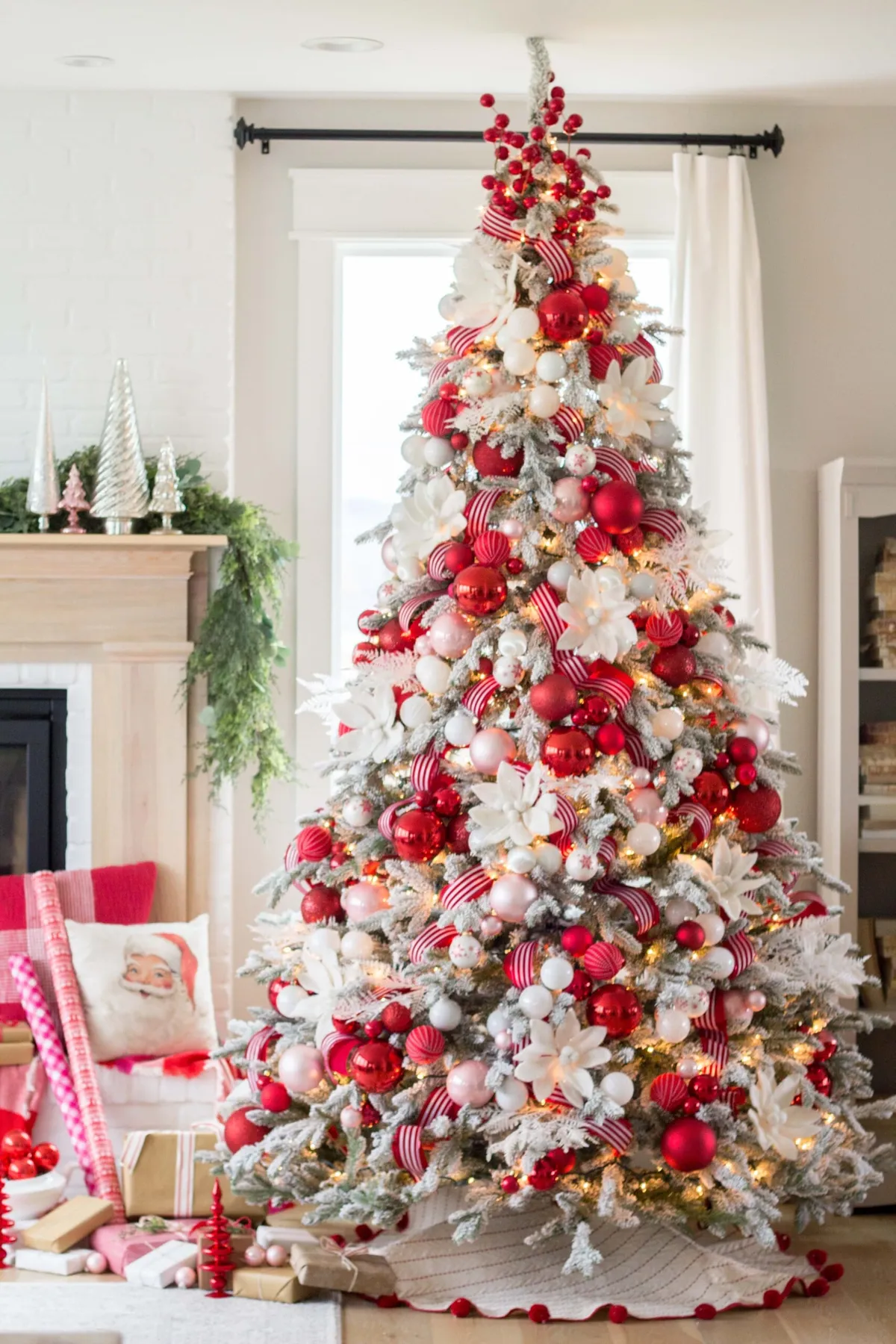
What it actually costs to build this from scratch:
- 7 ft flocked tree: $120–$380
- Warm white lights, if not pre-lit: $25–$60
- 60 red, white, and blush ornaments: $70–$180
- 2.5-inch striped ribbon, two rolls: $18–$40
- Six white floral picks: $24–$55
- Cream pom-pom skirt: $35–$80
Total: $292–$795. The budget version: skip the floral picks, wire in grocery-store carnations, and buy ribbon by the spool at a craft store.
2. One Red Bauble, All the Warm Bokeh
That soft halo around the bauble isn’t a lens trick you can’t recreate — it’s light placement. Tuck a bulb within two inches of any glass or glossy ornament and it becomes a second light source. On a 7-foot tree that means roughly 100 mini lights per foot of height, clustered into the interior depth instead of wrapped flat against the outer branches.
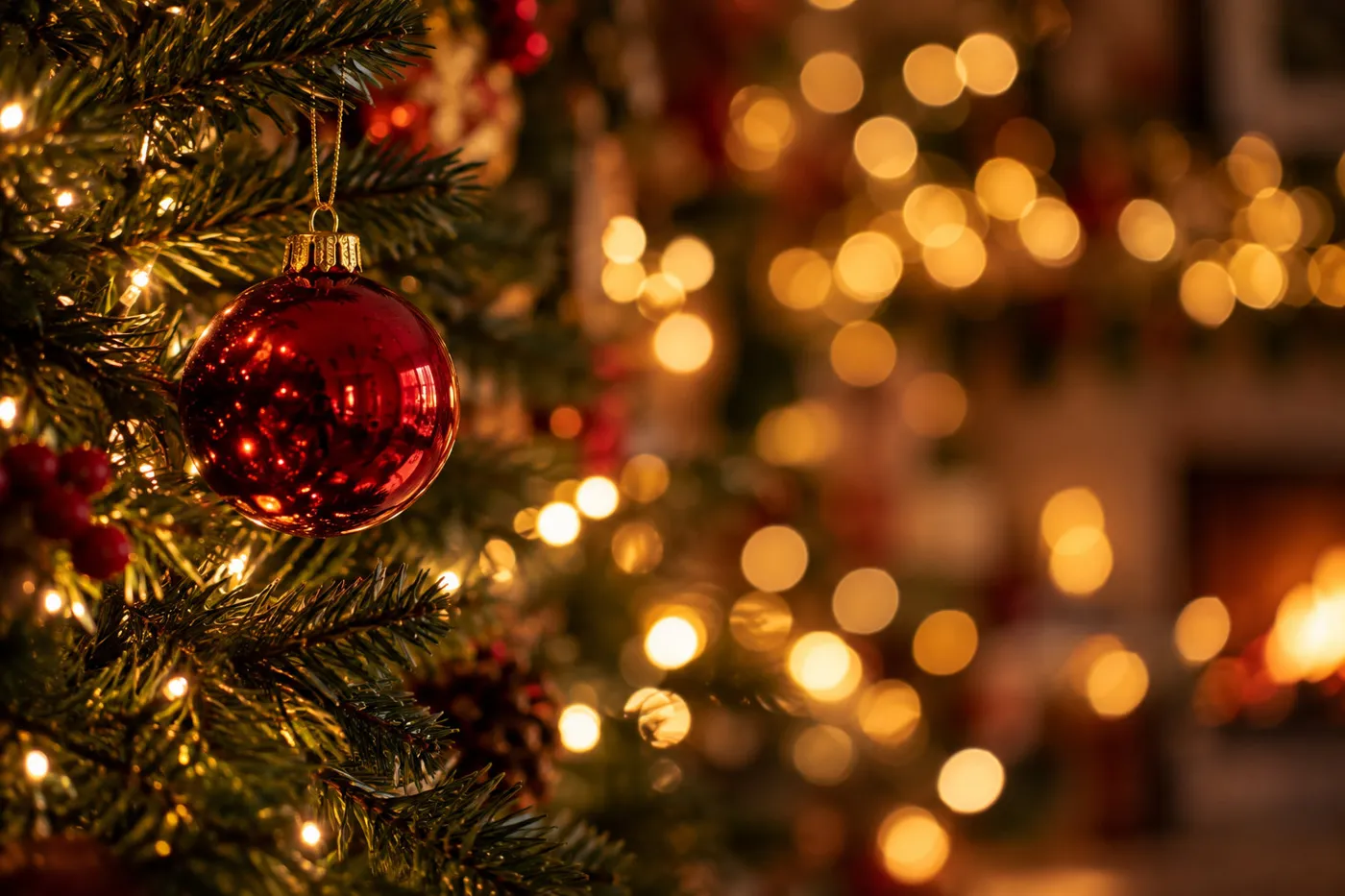
Deep green and warm amber sit almost opposite each other on the color wheel, so a red bauble lit at 2700K reads as glowing rather than simply red. The bokeh does the rest — a dozen distant lights blurred into circles create depth the tree doesn’t physically have. Same principle as a restaurant using candlelight: the imperfection is the point.
3. Laser-Cut Wood Tree Ornament on Flocked Branches
Run the numbers: 70 percent flocked white branches, 20 percent light natural wood, 10 percent near-black. That last 10 percent is the dark backing plate behind the cutout, and it’s what keeps the whole thing from dissolving into beige. Swap maple for walnut and the formula holds. Swap the black backing for white and the ornament disappears.
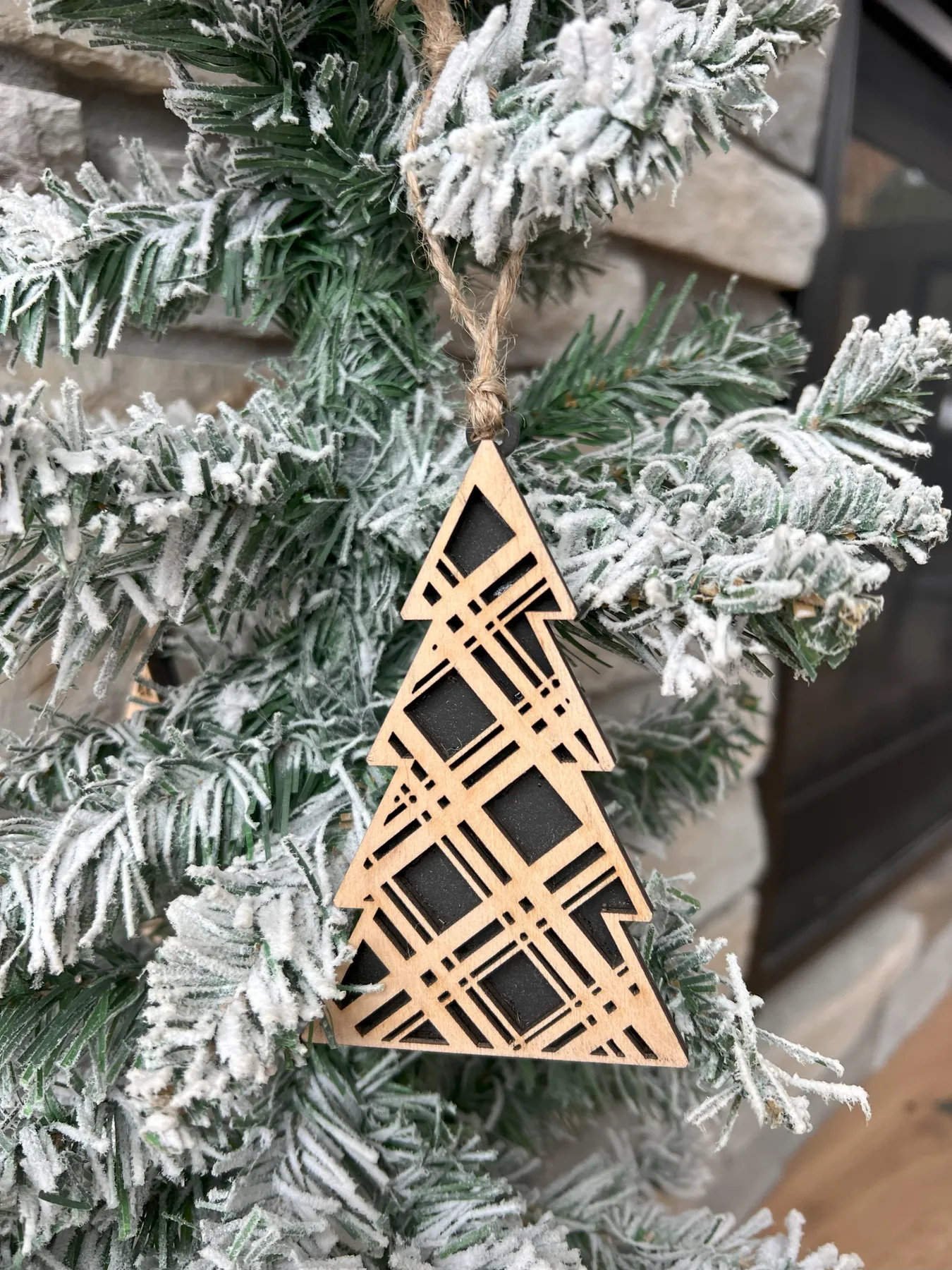
Styling a branch like this takes twenty minutes and costs nothing if the ornaments are already yours:
- Clip a 12-inch flocked branch and lay it flat.
- Hang the wood ornament front-center, an inch below the top line.
- Add two plain baubles behind it, three inches deeper.
- Thread jute string so it hangs from the branch, not bare wire.
- Leave a gap of bare flock on each side — negative space is the point.
4. Red, Gold, and a Candy Cane Handful
Before the boxes come out:
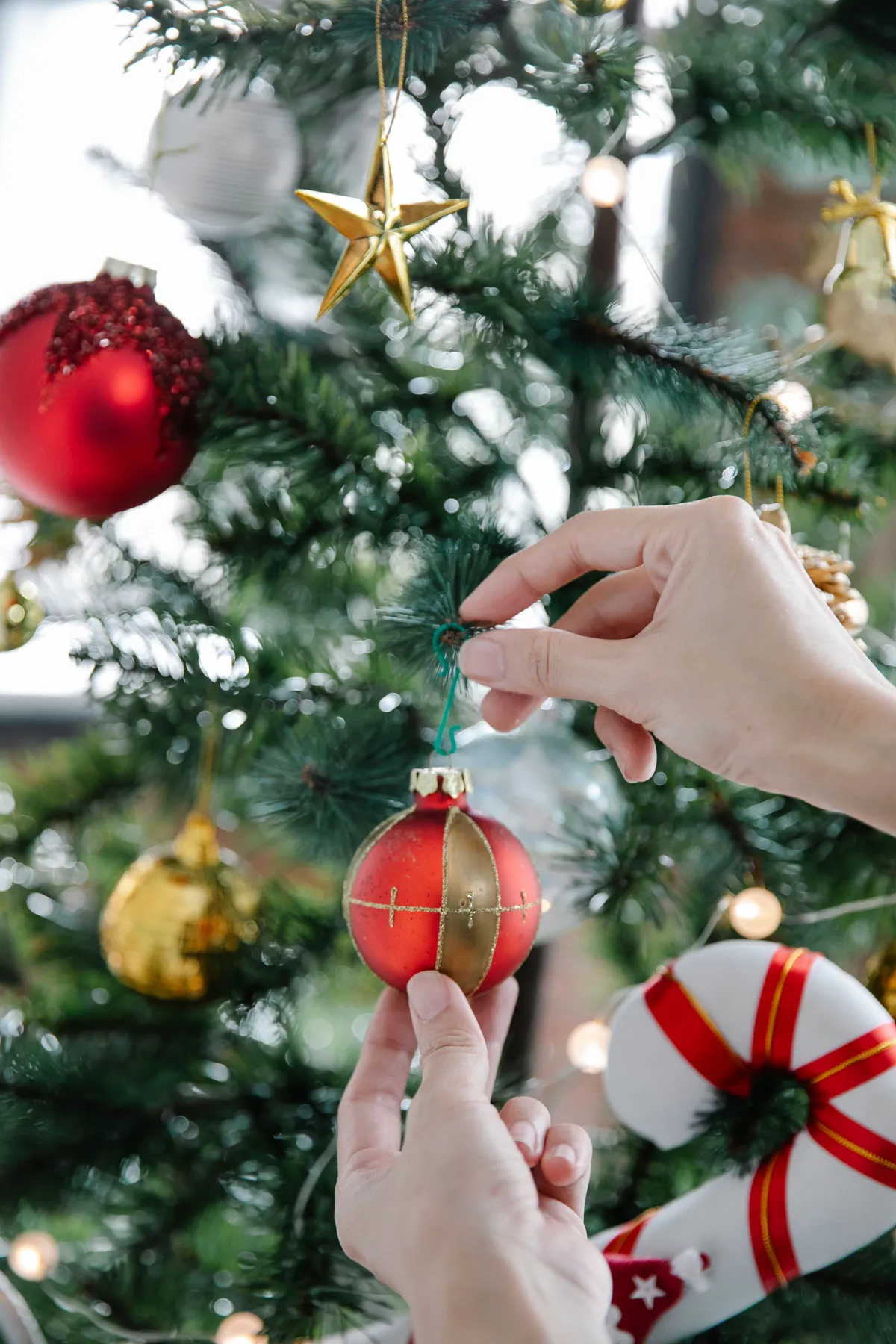
- Measure the tree’s widest branch spread, not just its height — ornaments vanish on a 54-inch base.
- Count your hooks. Forty ornaments need forty hooks and you always have thirty.
- Check whether your lights are cool white or warm white. Mixing them is the fastest way to make red ornaments look orange.
- Decide the topper before you decorate the top third.
The red-and-gold classic is also the cheapest look to fake well. Target and Walmart both sell 12-packs of shatterproof red and gold baubles under $15, and dollar stores carry candy canes by the dozen for about $3. Spend on the gold star instead — a $12 craft store star beats a $40 one that’s slightly too small for the tree.
5. Frosted Branches with Red, Gold, and a Surprise Blue
Blue is the risky one. That royal-blue bauble works here only because the tree is frosted and the bows repeat the gold — it has backup. Drop it into a plain green tree with red-and-gold and it will look like a stray from another box. Also, frosted trees shed: expect a fine white dust on your floor for the first two weeks, so put a sheet down before you decorate.
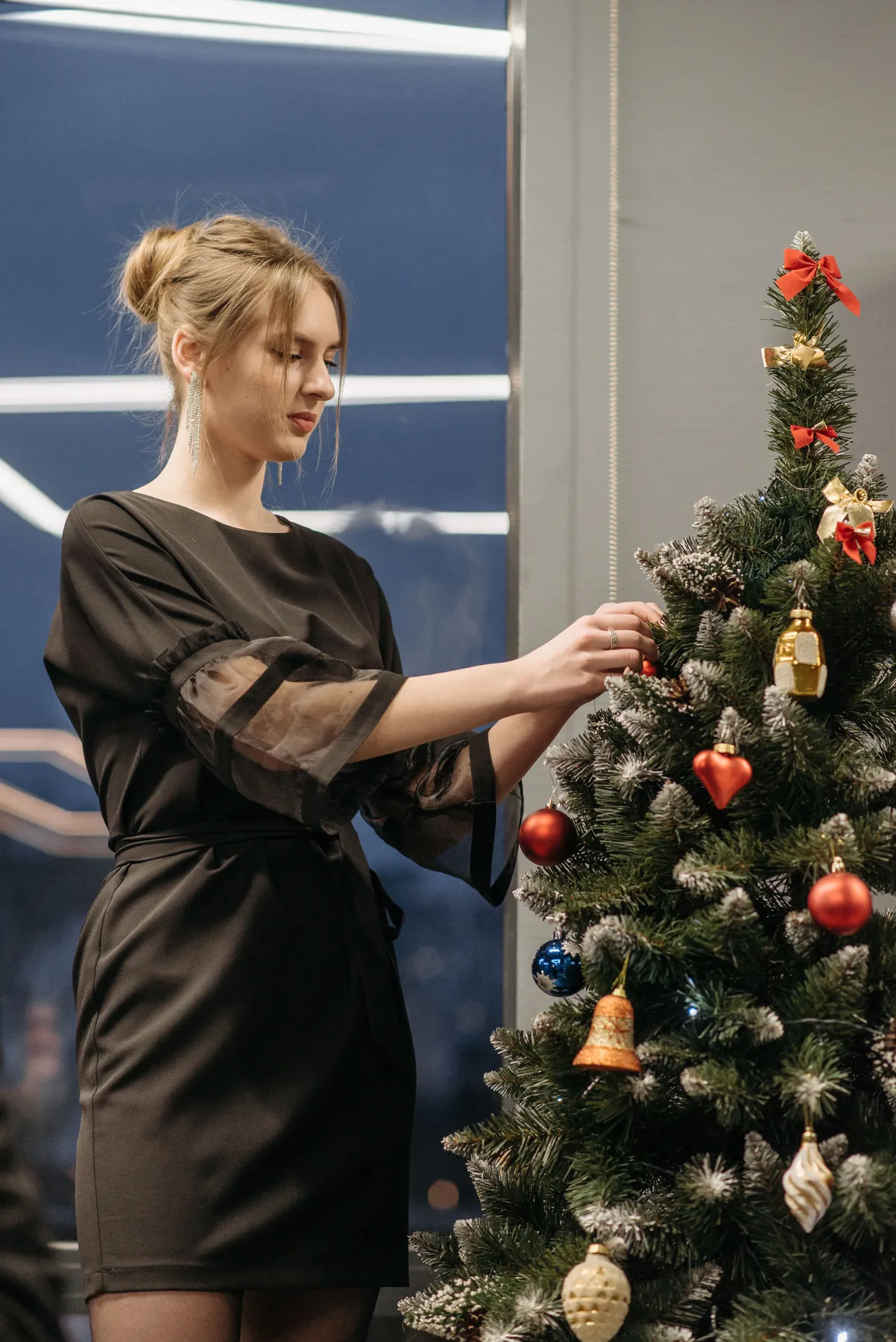
This look needs volume. A 7.5-foot tree with a 50-inch base fills a corner in a room roughly 12 by 14 feet; anything narrower and the bows crowd the doorway. Ceiling height matters more than square footage — you want 12 inches above the topper. If your ceilings are 8 feet, look at Idea #10 for a slimmer silhouette that still reads full.
6. Heavy Flock with a Diamond-Textured Gold Bauble
Put texture at eye level and shine everywhere else. The diamond-faceted bronze bauble reads from six feet away because its surface breaks light in four directions; a smooth gold sphere at the same height just reflects a blob. Rule of thumb: one textured or faceted ornament for every six smooth ones, clustered in the 4-to-5-foot band where people actually look.
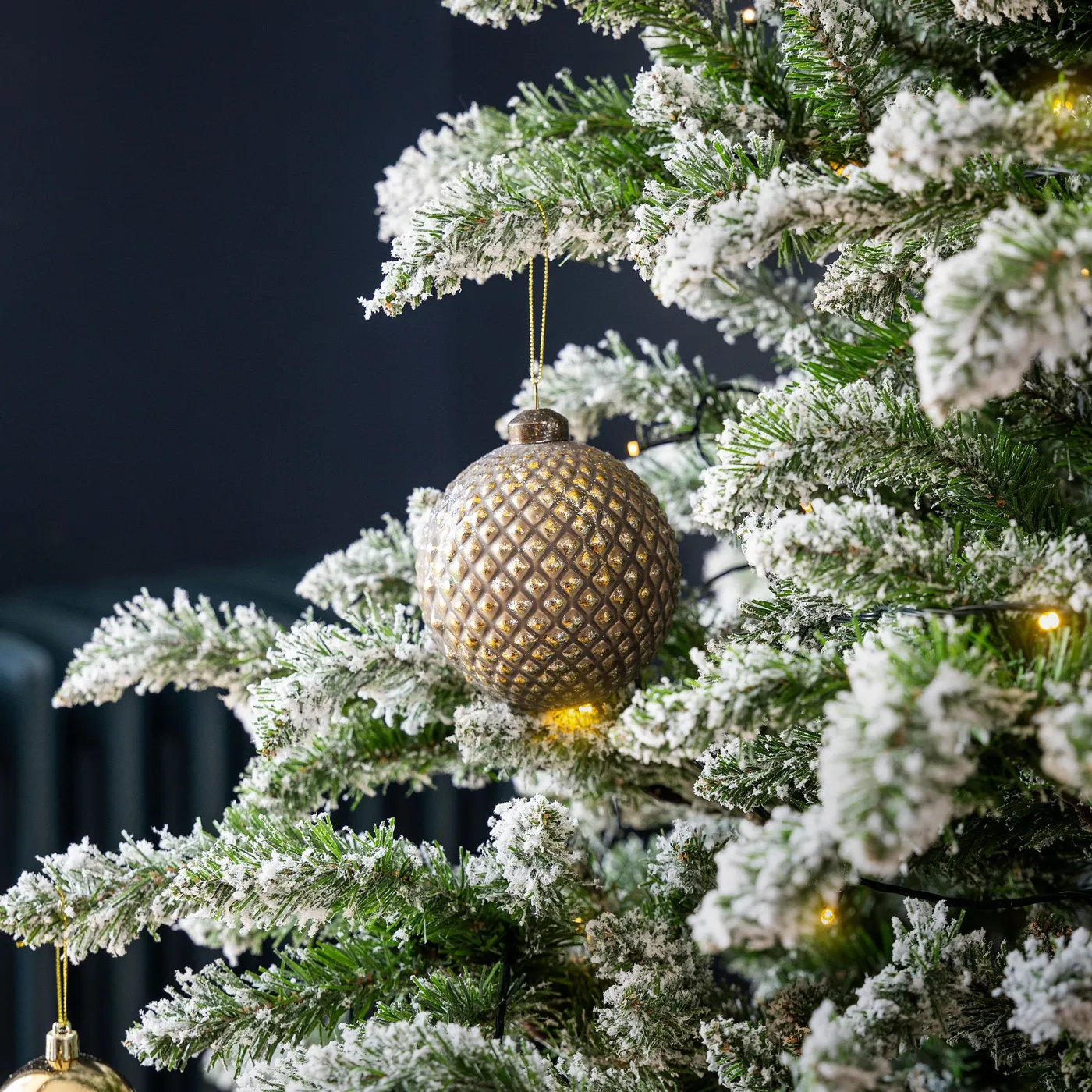
Heavy flock is essentially glued-on fiber, and it sheds every time the tree moves. Wrap sections in a sheet rather than dragging branches through a box, and store upright in a garage if you can — that’s twenty minutes saved every December. Flocked trees also yellow slightly after four or five seasons under UV, so keep yours away from a south-facing window.
7. Glittered Gold Filigree on Fresh Pine
Real greenery is having a moment precisely because artificial trees got so good they stopped being charming. In 2026 the pendulum swung: fresh pine, cedar, and fir cut short and styled in vases, on mantels, in swags. The pitch is honesty — needles drop, the scent fades, nobody minds. If you want a gold ornament to look expensive, put it against something alive.
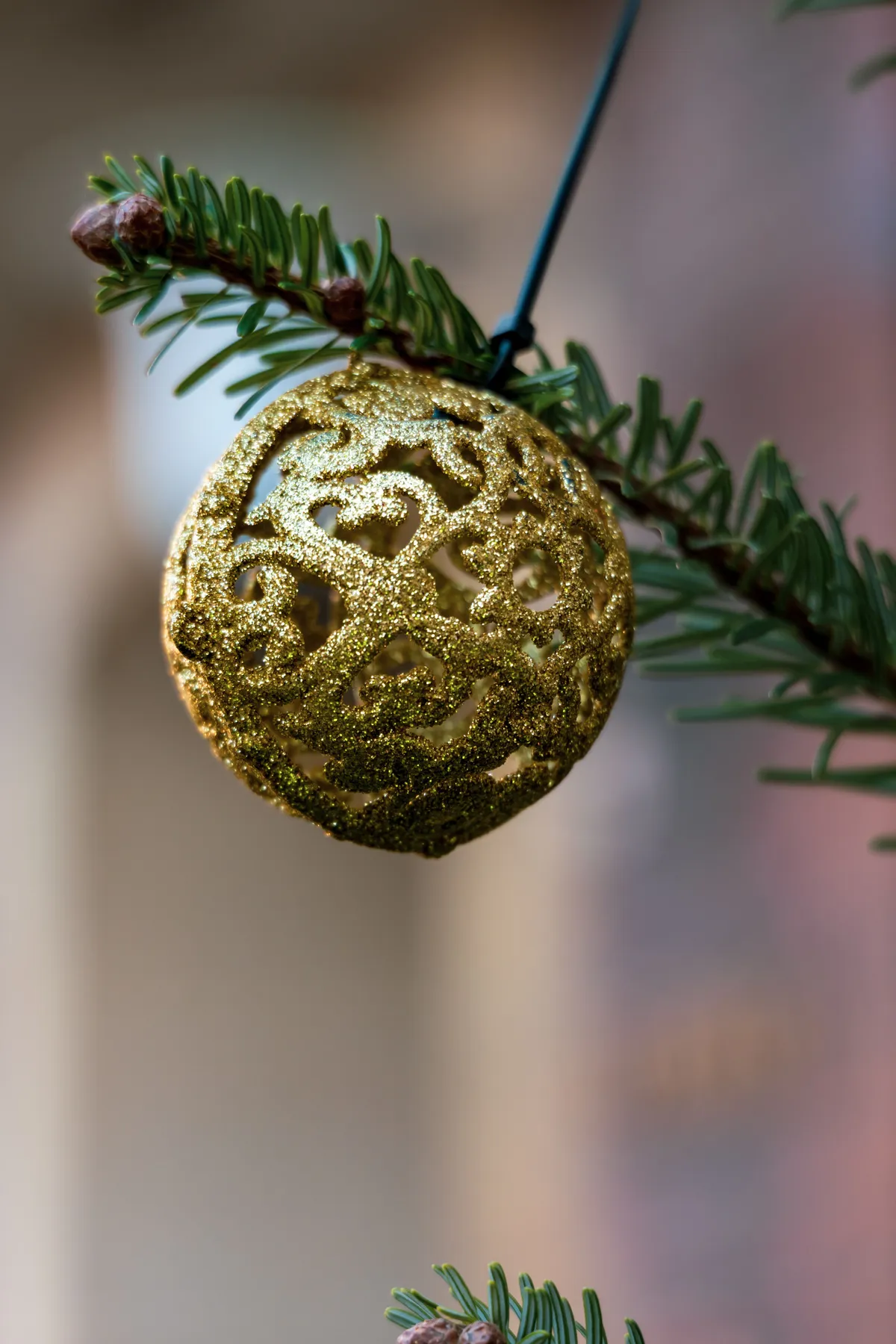
The pine branch is the whole design. Not the gold, not the glitter — the brown buds and slightly irregular needles that tell your brain this came off an actual tree. A glittered filigree bauble on a wire branch looks like a store display; the same bauble on three inches of fresh pine looks like a collected object. Keep water in the vase and you get about three weeks.
8. A Gold Star Above Gold-and-Pink Globes
This is a big-space look and the numbers are unforgiving. A tree under 10 feet vanishes in a courtyard or double-height entry; 14 to 20 feet is the working range, with ornaments at 6 to 8 inches so they still read from the sidewalk. You also want 10 feet of clear ground around the base for those projected snowflakes to land on. In a normal living room, borrow the palette instead — see Idea #9.
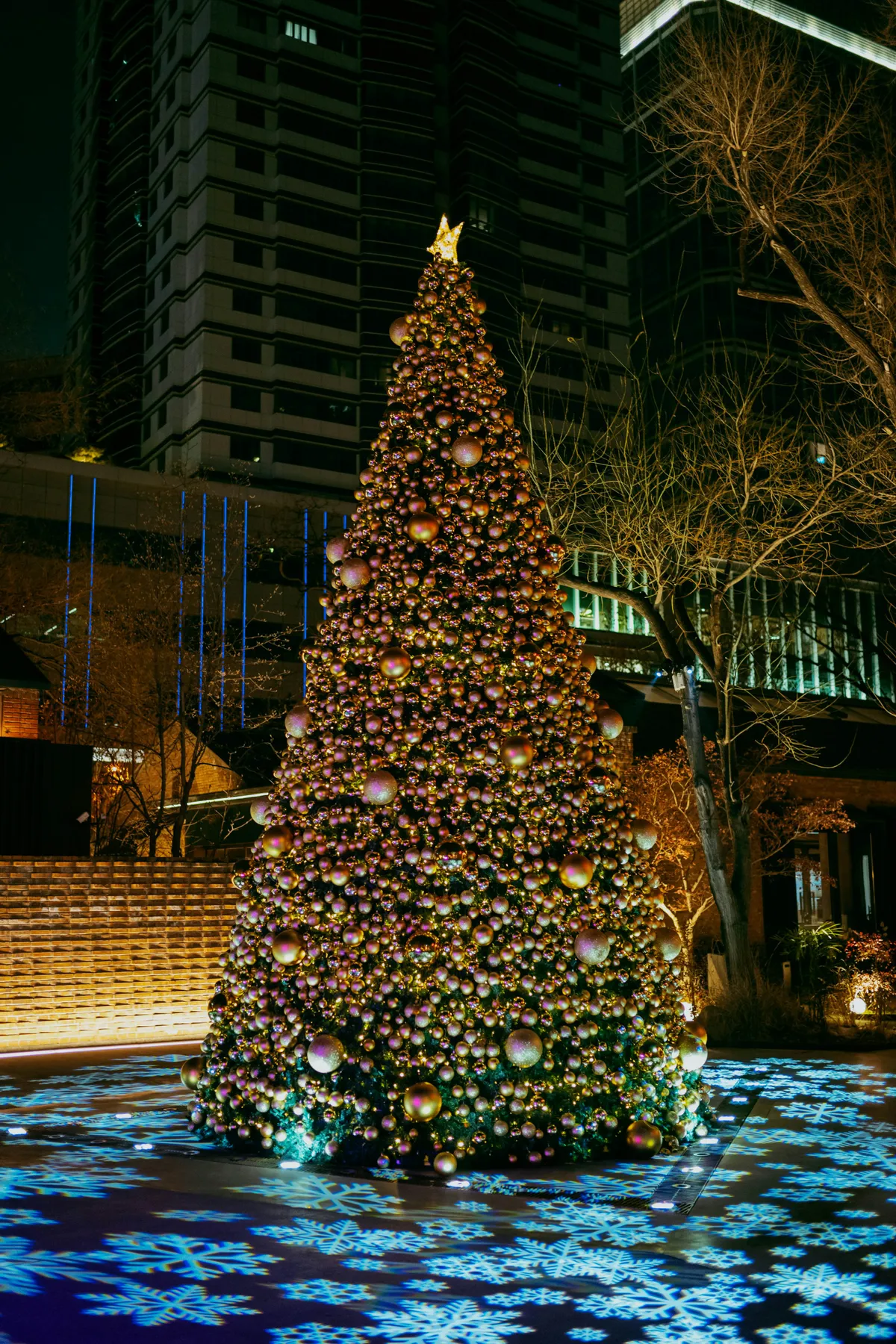
Two principles do all the work here: scale contrast and repeat. The star is huge, the ornaments are large, and nothing small is allowed near the top, which is why the silhouette reads clean from forty feet away. The same warm gold repeats in the lights, the globes, and the snowflakes on the pavement, so the eye finds one color story wherever it lands.
9. Slender Flock with Gold, Glass, and White Bows
Glass and gold need different light. Clear ornaments go where a bulb sits behind them so light passes through; gold goes to the outer edges where it can bounce back. On a slim tree that means glass in the interior third and metallics on the outer branches. Keep the bows to the top and bottom only, or the middle becomes a wall of white.
White fabric bows cost almost nothing if you make them: two yards of stiff ribbon, a spool of florist wire, forty minutes. IKEA’s plain glass baubles run about $6 for a pack of six and look indistinguishable from $40 sets once they’re lit. For the skirt, a $25 faux-fur throw folded in thirds around the base does the job — nobody sees the back.
10. Flocked Tree in a Woven Basket Collar
Basket collars are cheaper and more forgiving than skirts, and they hide the stand completely. Here’s the version that doesn’t look improvised:
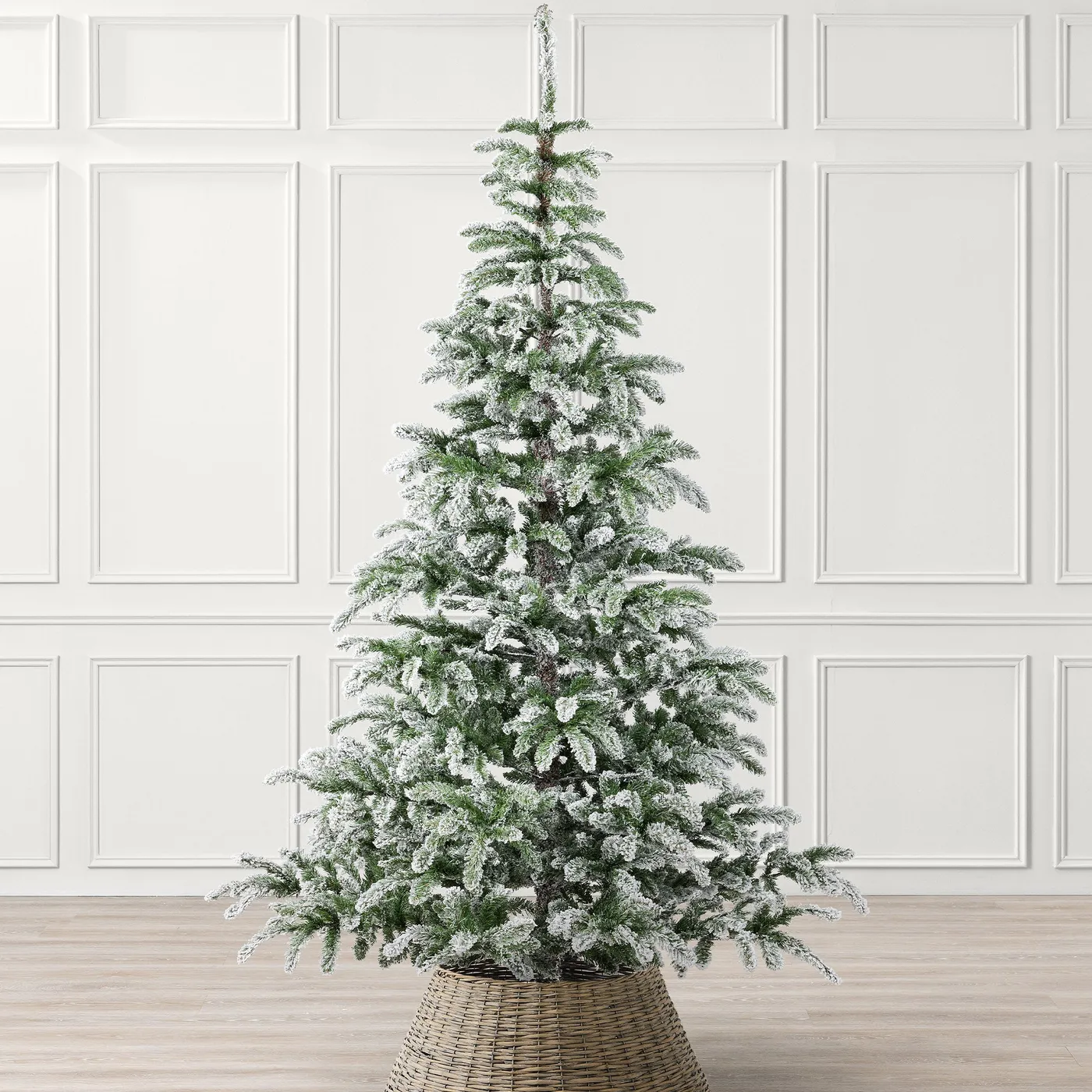
- Set the tree stand inside the basket first, then add weight or water.
- Pack the gap with newspaper so the collar sits level.
- Drape a dark cloth over the stand legs so nothing shows through the weave.
- Add one loose pinecone or sprig at the front edge for texture.
- Keep gifts outside the basket — it will tip.
The basket is what makes an otherwise ordinary flocked tree feel styled. A metal stand says temporary; a woven collar says furniture. The natural tone also warms up all that white snow, which is the difference between a tree that looks cold and one that belongs on wood floors. Twenty-five dollars, and it outworks any ornament.
11. Gold, Silver, and White with Dusty Blue Ribbon
Ribbon is the cheapest way to make a tree look designed. Go wide — three to four inches — and cut lengths long enough to weave in a loose spiral from top to bottom, roughly eight to ten feet per pass. The dusty blue here does the job most people hand to red: it cools the gold, so the tree reads elegant instead of shiny.
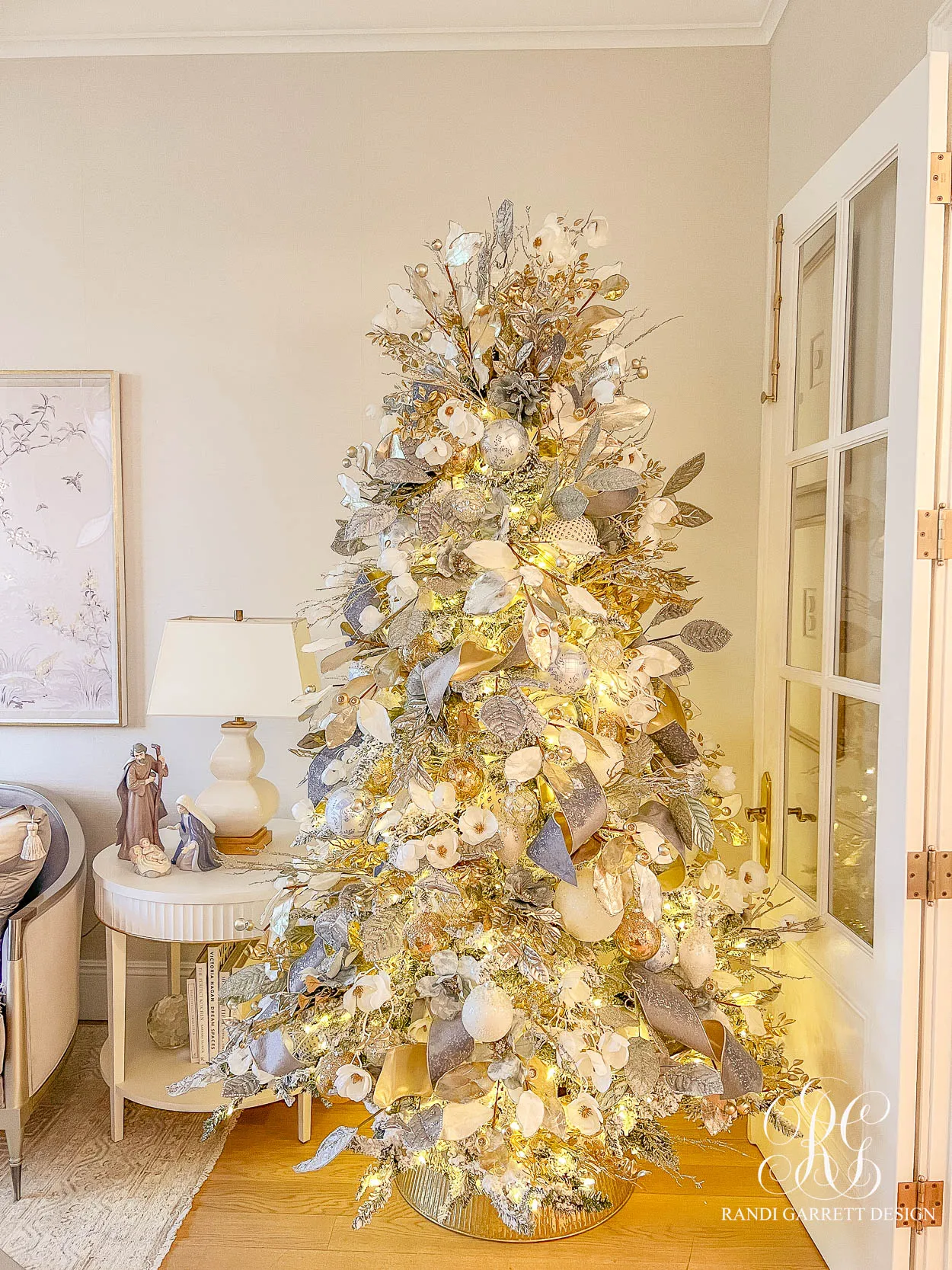
Three metallics and one muted color is a formula, not an accident. Gold gives warmth, silver gives light, white gives rest, and the dusty blue gives the eye somewhere to stop. Remove the blue and it becomes a jewelry store window. Same reason a well-built room always has one thing that doesn’t quite match.
12. Deep Green with a Wooden Sled and Beaded Garland
If you own a novelty ornament you love — a wooden sled, a satin ball from 1988 — give it a stage. Clear six inches of branch around it and hang it two inches proud of the foliage so it casts a shadow on the tree behind. Almost nobody hangs things far enough forward, which is exactly why heirloom ornaments disappear into a wall of baubles.
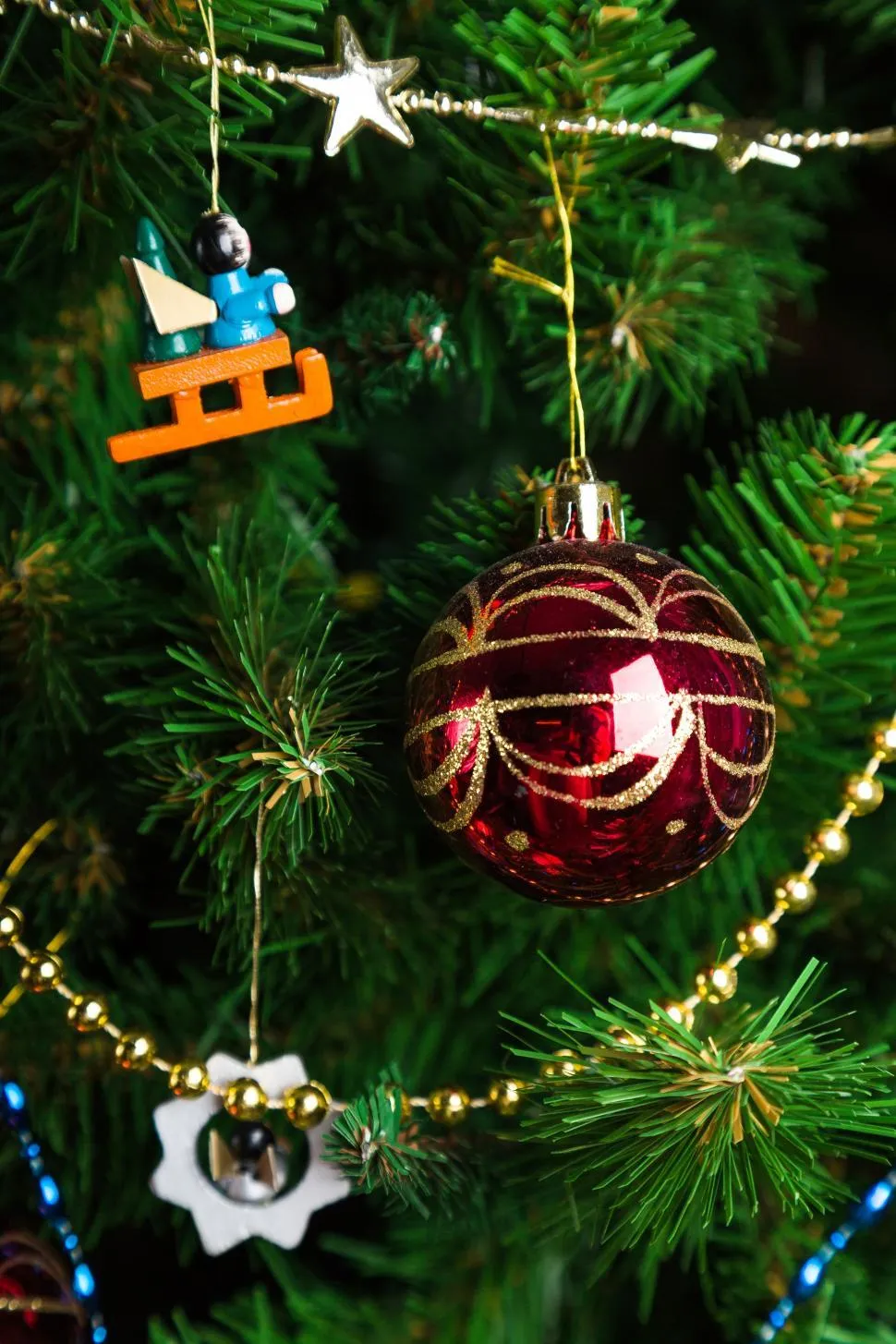
Beaded garland does something lights can’t: it draws a line. On a dark green tree, gold beads create a visual path from topper to skirt, which makes a full tree feel taller and a sparse one feel intentional. The silver stars add contrast at even intervals. Same trick works with ribbon, but beads catch light from every angle.
13. Wall-Mounted Trellis Tree in Light Wood
The flat-tree route is genuinely cheaper than a full tree, and it’s the only option in some apartments:
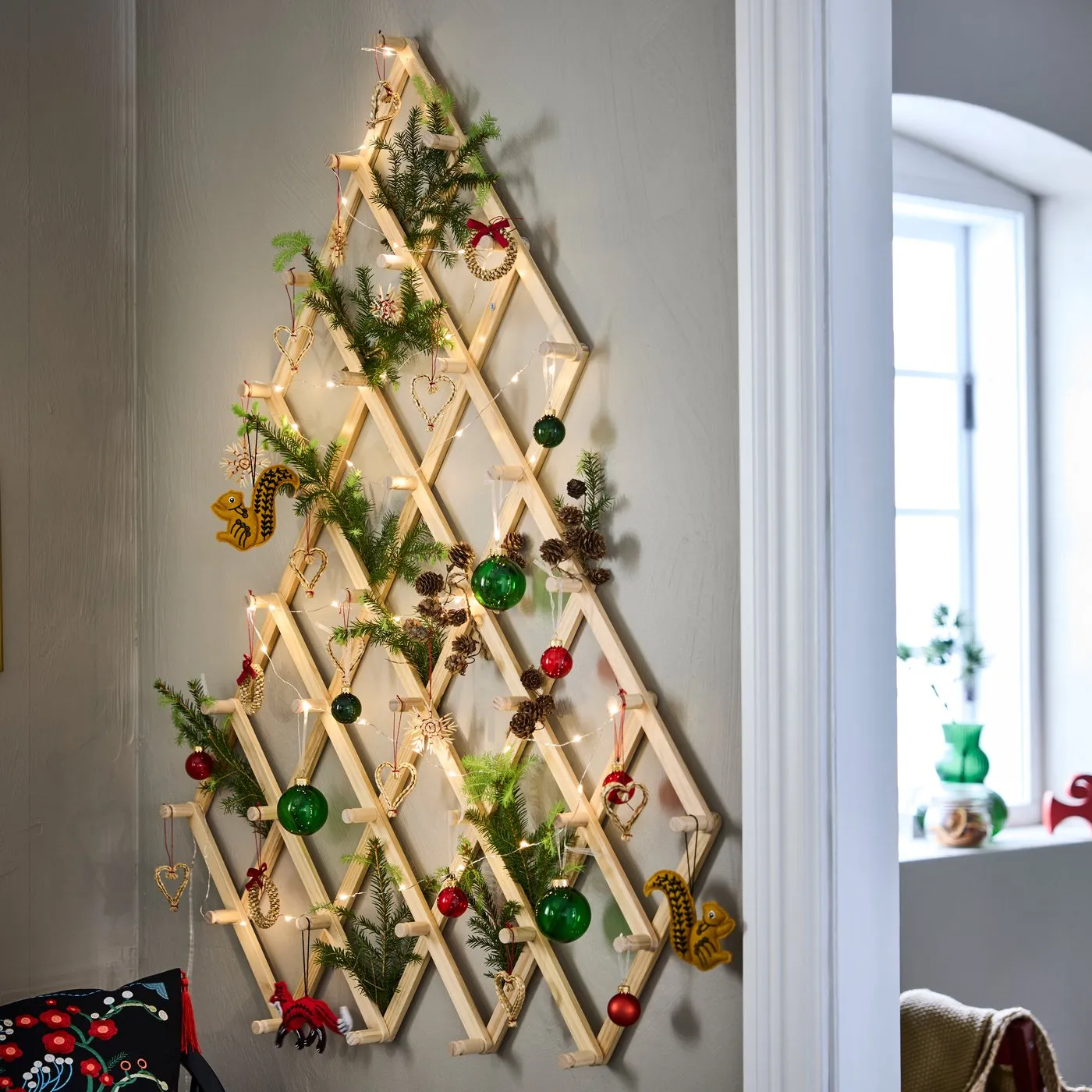
- Wood trellis panel, 6 ft: $35–$90
- Faux evergreen stems, 6–8: $40–$85
- Warm white battery lights: $15–$30
- Assorted rustic ornaments: $30–$70
- Pinecones, gathered: $0–$12
- Hooks and mounting hardware: $8–$20
Total: $128–$307. You can also skip the trellis entirely — hang branches straight on the wall in a triangle shape with removable hooks and nobody will miss the frame.
Wall trees want a blank wall at least five feet wide and eight feet tall, which describes most apartments and almost no house. Keep the widest point at 40 inches so furniture can sit beneath it. If you have a full corner instead, compare with Idea #14, which needs floor space but no wall.
14. Prelit Slender Tree in a Basket by the Window
Prelit sounds like a shortcut until a strand dies in year three. Buy a tree with lights on separate circuits so one failure doesn’t black out a whole section, and check that the manufacturer sells replacement strands. Also worth knowing: a tree in front of a window looks magical at night and slightly sad at noon, so give that corner something to look at in daylight — the basket, a rug, a few gifts.
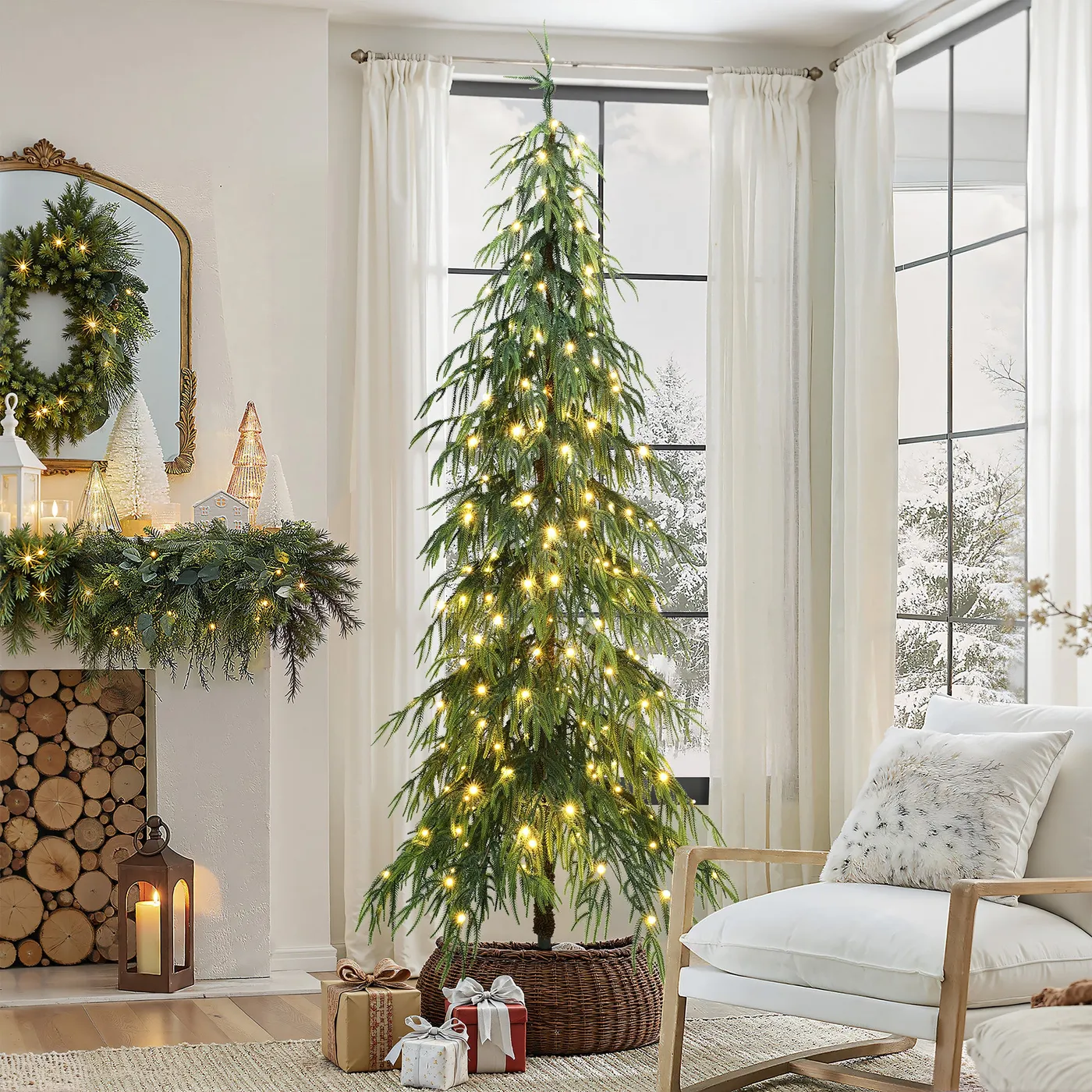
The formula here is 80 percent tree, 15 percent mantel, 5 percent gifts. That ratio is why the room feels calm — the tree isn’t competing with an over-decorated mantel, because a garland is the only thing up there. Swap green garland for eucalyptus and it goes modern; swap the woven basket for metal and it goes traditional. Proportions stay put.
15. Bare Green Tree, Black Stand, Ready
The empty tree is the point. What makes this scene work isn’t decoration — it’s light. A large grid window throws soft, even daylight across dense green needles, so the tree reads as sculpture before a single ornament goes on. That’s also your best decorating window: hang in daylight and you’ll catch the gaps you’d miss at 8 p.m. with the lamps on.
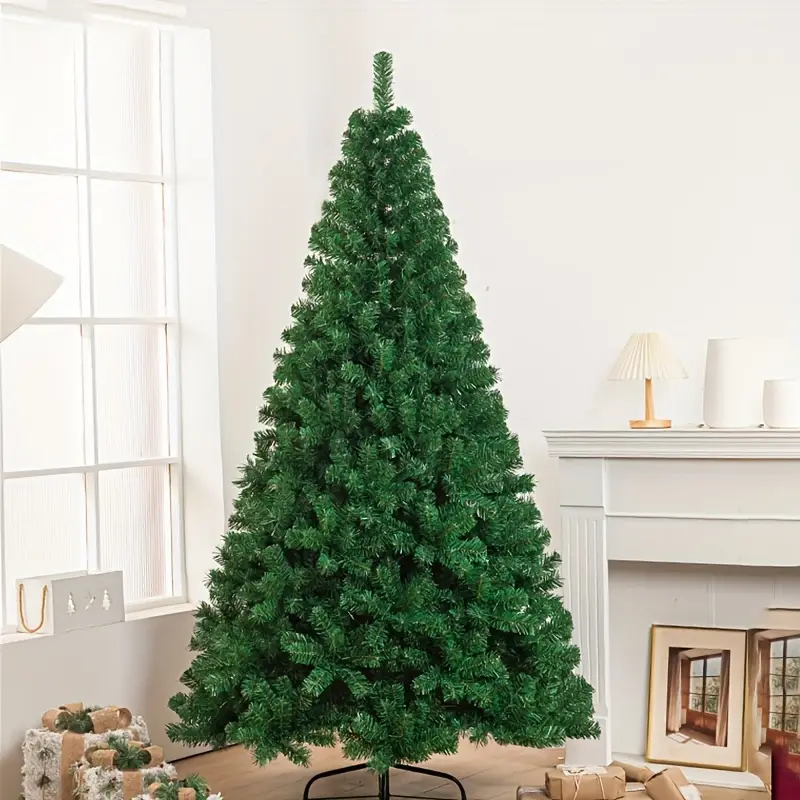
Honest news — a full, dense artificial tree is one of the few things worth buying new. Facebook Marketplace floods with them in early December at $40–$80, but check the branch count before you drive. Under 1,000 tips on a 7-footer will look thin once it’s lit. A $60 marketplace tree plus a $25 box of warm lights beats a $300 tree with none.
16. Matte Red and Glitter Gold with Dusted Pinecones
Matte and glitter are a pair, not a clash. Matte red absorbs light, which makes the gold beside it look brighter than it actually is — that’s the entire trick. Aim for roughly two matte ornaments to every one glitter, and keep the glitter near the lights. All-glitter reads cheap; all-matte reads flat.
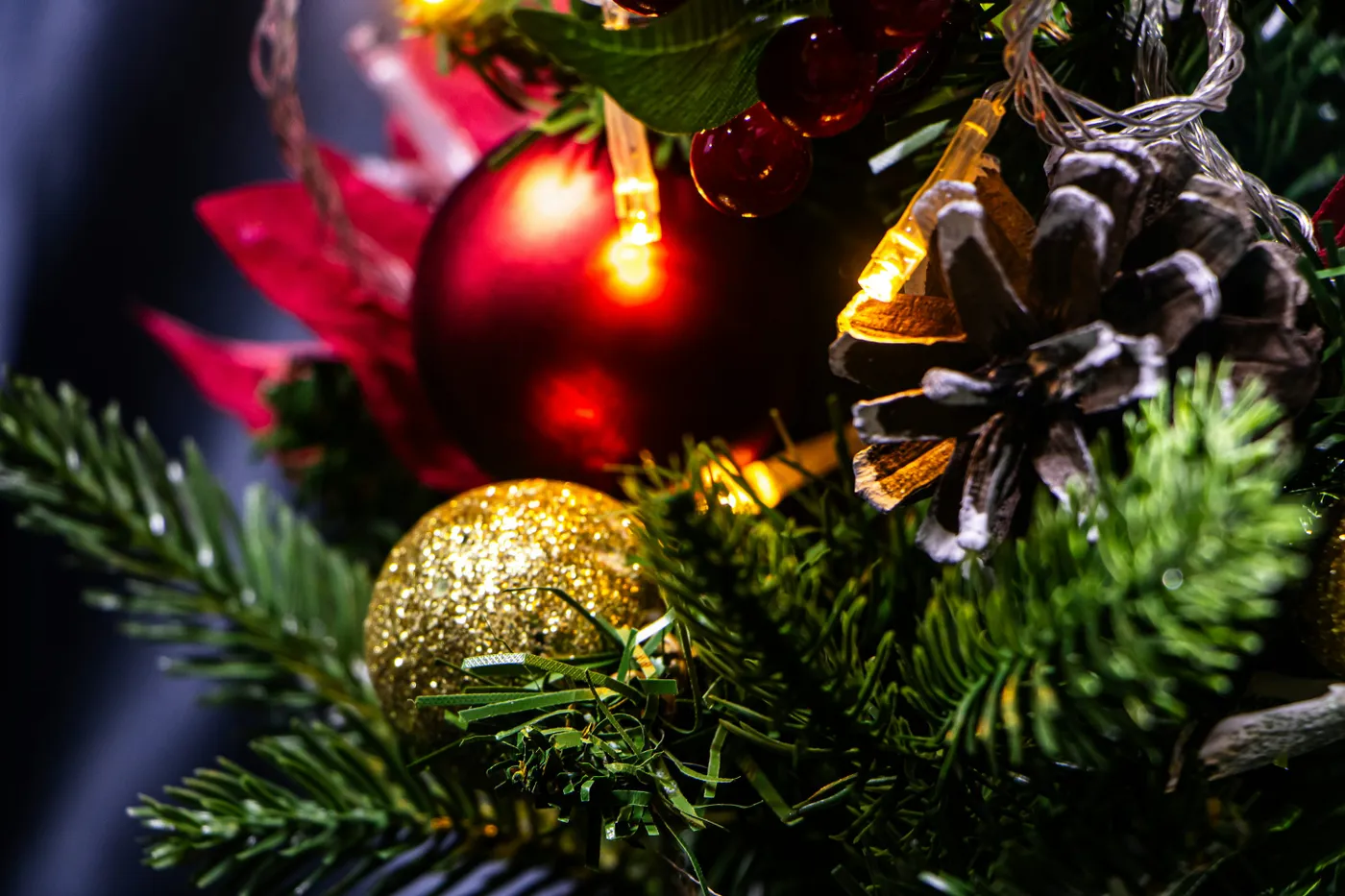
Glitter sheds, always. Assume a fine gold dust on the skirt through January and vacuum it with a hose attachment, not a brush. Snow-dusted pinecones are worse — the white tip coating flakes the moment you handle them, so place them last and leave them alone. For the look without the mess, flocked pinecones sealed with matte spray hold up for years.
17. Frosted Branches with a Saddle-Blue Horse Ornament
Character ornaments came back hard. A few years of monochrome, tasteful trees created a counter-trend: people want a horse with a saddle, a dachshund in a Santa hat, a wooden sled. Whimsical ornament searches have climbed every season since 2023, and 2026 looks like the year the maximalists win. The trick is containment — one or two characters, styled well, not thirty.
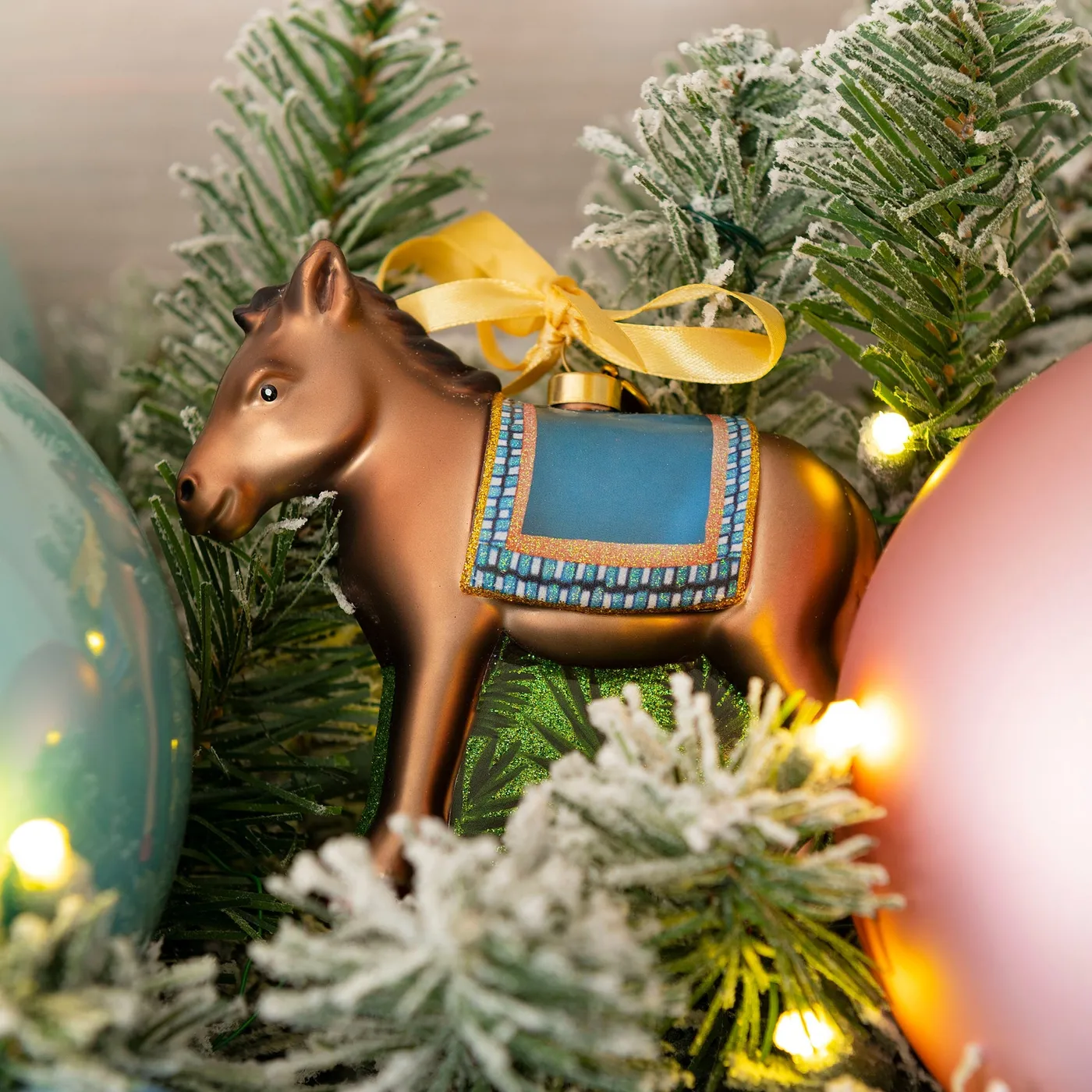
Pastels on a frosted tree only work if you control the whites. Twenty minutes, no cost:
- Group pastel baubles in clusters of three at different depths.
- Hang the character ornament at eye level, forward of the foliage.
- Cut the ribbon hanger short so it doesn’t loop over a branch.
- Add one pastel in the top third to pull the eye up.
- Leave the bottom third mostly white — frosted trees need somewhere to rest.
18. Fiber Optic Bursts and Yellow Stars
Fiber optic trees throw light outward, so they need distance to look good — six feet of standing room minimum, ten is better. In a tight corner the bursts blur into one bright smear. They also photograph badly up close and beautifully from across a room, which tells you exactly where one belongs: entryway, porch, kid’s room. Not beside the sofa.
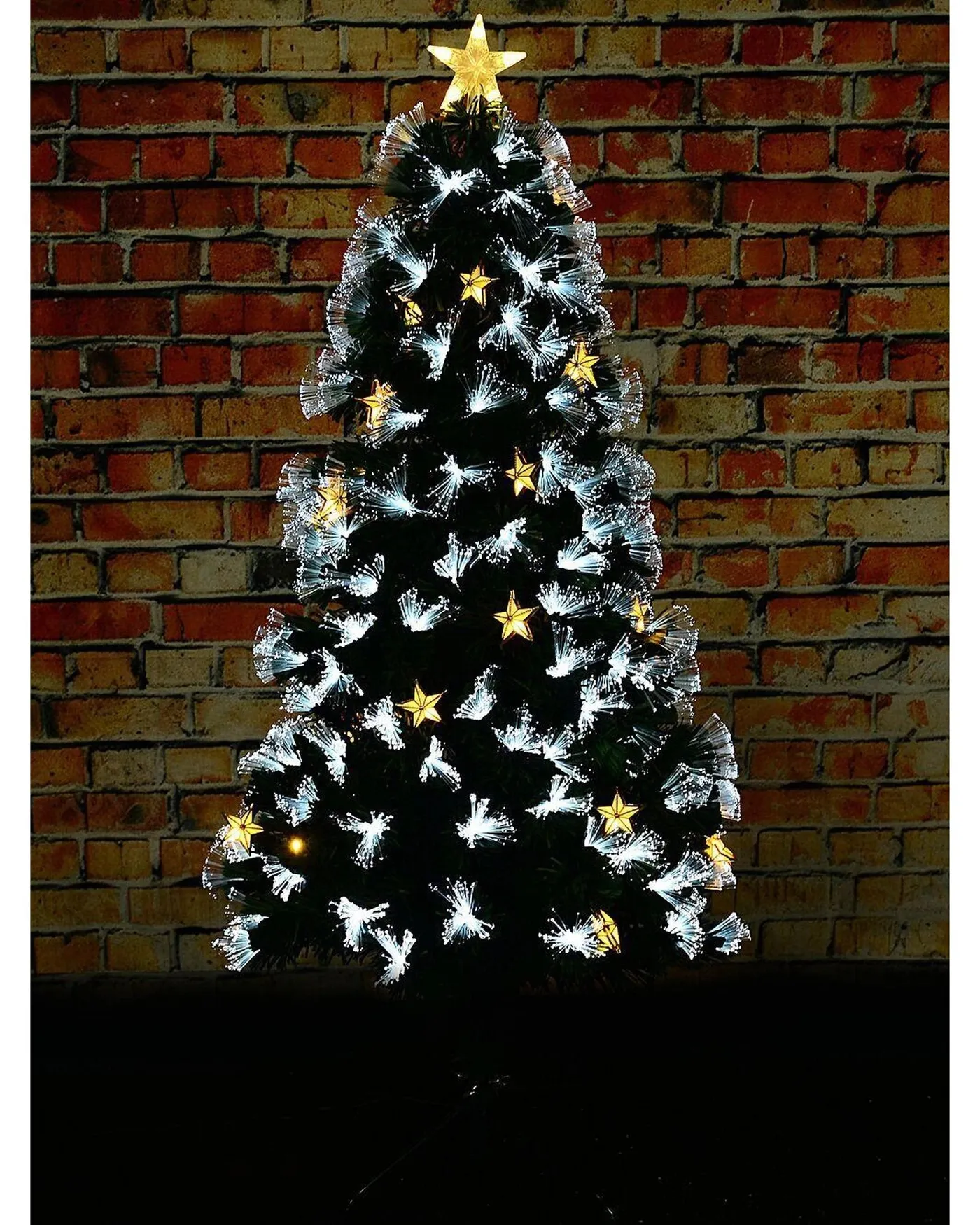
Every fiber optic strand is its own light source, meaning no shadows and no dark spots — the exact opposite of a string-lit tree. That evenness is why the yellow stars read so clearly. It’s also why this style never went out of fashion at the budget end: the technology does the decorating, and you can leave the tree completely bare.
19. Glittered Multi-Point Star on Top
Toppers are wildly overpriced. The same glittered multi-point star runs $8 at Walmart and $65 at a boutique, and the difference is mostly packaging. Look for internal battery lights ($15–$25), a sturdy coil base rather than a clip, and sealed glitter — rub it with a thumb in the store. If it comes off on your hand, it’ll come off on the tree.
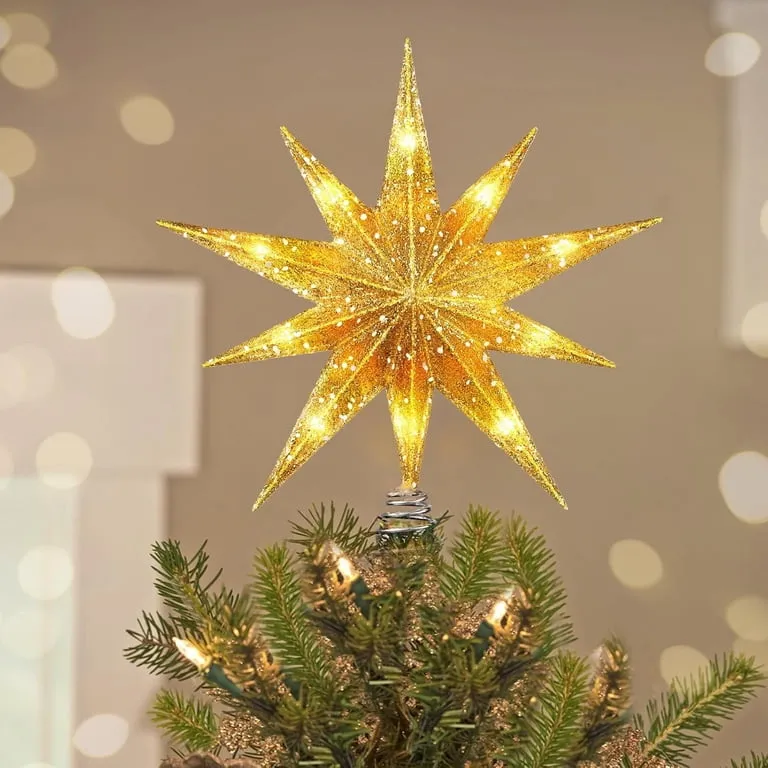
A heavy topper will lean, guaranteed. That silver coil base is doing real structural work, and a 12-inch star on a slender treetop is a physics problem, not a design one. Zip-tie the top two branches into an X before you mount anything. Then check it against the ceiling — an 8-foot ceiling and a 7.5-foot tree leaves four inches, and that isn’t enough.
20. Red, Silver, and a Glass Village Orb
Collectible glass ornaments with scenes inside belong low — around 30 to 40 inches off the floor. That’s seated eye level, which is where anyone actually looks at a tree from a sofa. Most people put the pretty ones up high where nobody sits. Move three of your best ornaments down a foot and the whole tree gets more interesting.
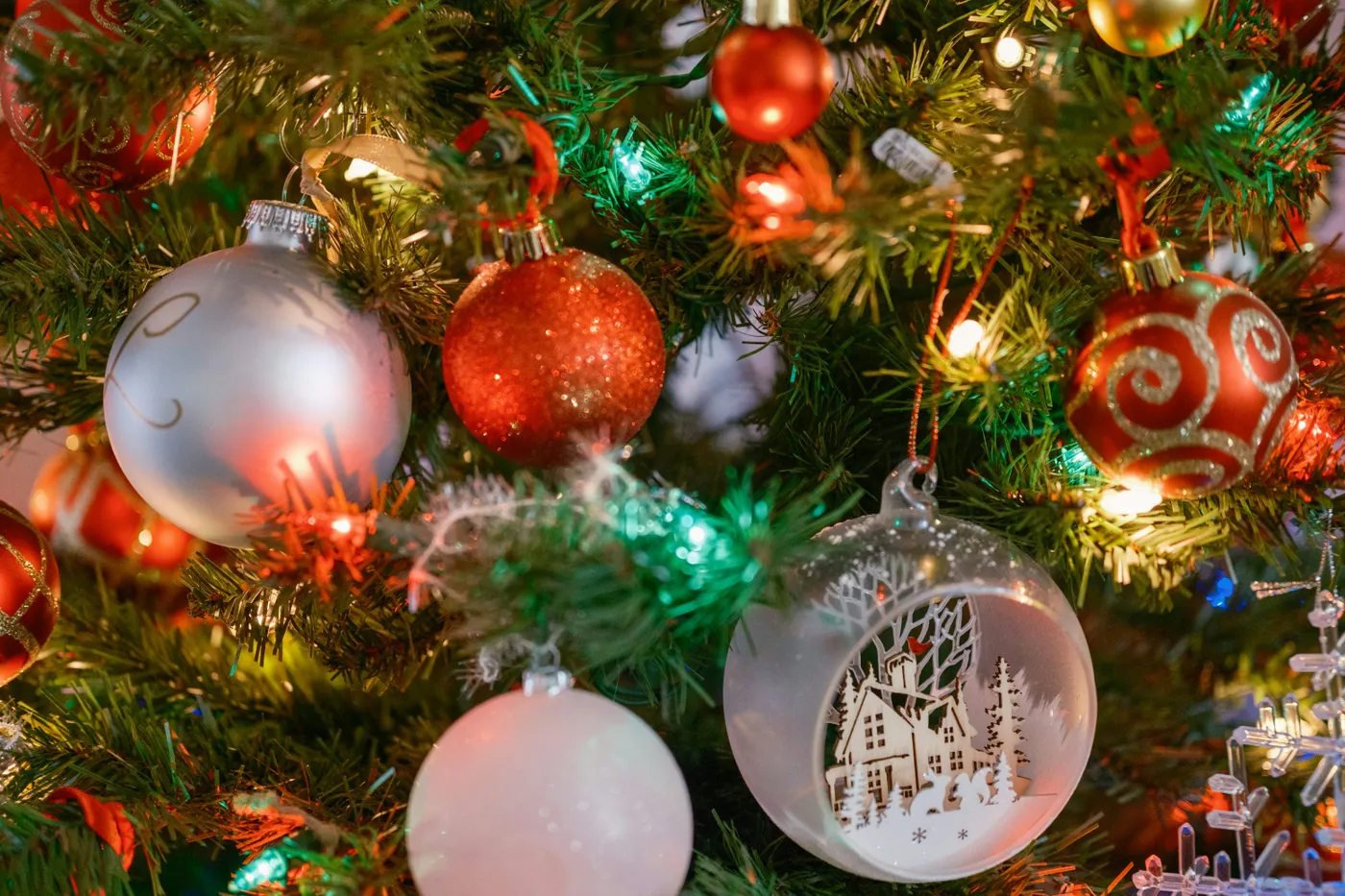
The clear orb with the little winter village inside is why this tree isn’t just red and silver. It introduces a scene, a scale shift, and something to lean in for. Everything around it is furniture; that orb is the story. If you own one sentimental piece, build the surrounding palette around it rather than burying it among forty identical baubles.
21. Prelit Tree with a Fireplace Full of Garland
The mantel is doing half the work here, and it takes an afternoon:
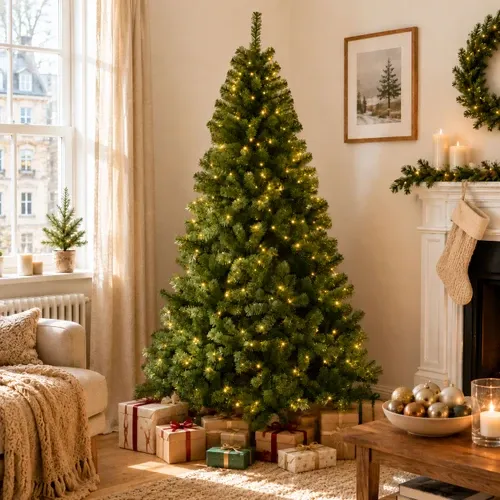
- Start the garland at one end and let it drape, never stretch.
- Weave lights through the garland rather than wrapping around it.
- Cluster candles in threes at one end — never evenly spaced.
- Hang a single stocking off-center and leave the rest of the rail bare.
- Put a bowl of ornaments on the coffee table to repeat the palette.
Budget about $60 if you already own the garland, $140 if you don’t.
Warm white lights, beige textiles, green tree, gold accents — that’s 60 percent neutral, 30 percent green, 10 percent metallic. It’s the most forgiving formula in holiday decorating and the reason this room feels cozy instead of cluttered. Swap beige for cream and it brightens; swap gold for copper and it warms up a full degree.
22. The Mannequin Tree in Faux Fur and Snow
A dress form, a tree skirt, and a strand of lights — that’s the whole build, and it costs less than a small tree. Thrift stores sell dress forms for $30–$60 and a good faux-fur shawl runs about $25. Everything else is ornaments you already own. The trick is wearing the tree skirt as a cone from the shoulders down so it reads as a tree, not a dress.
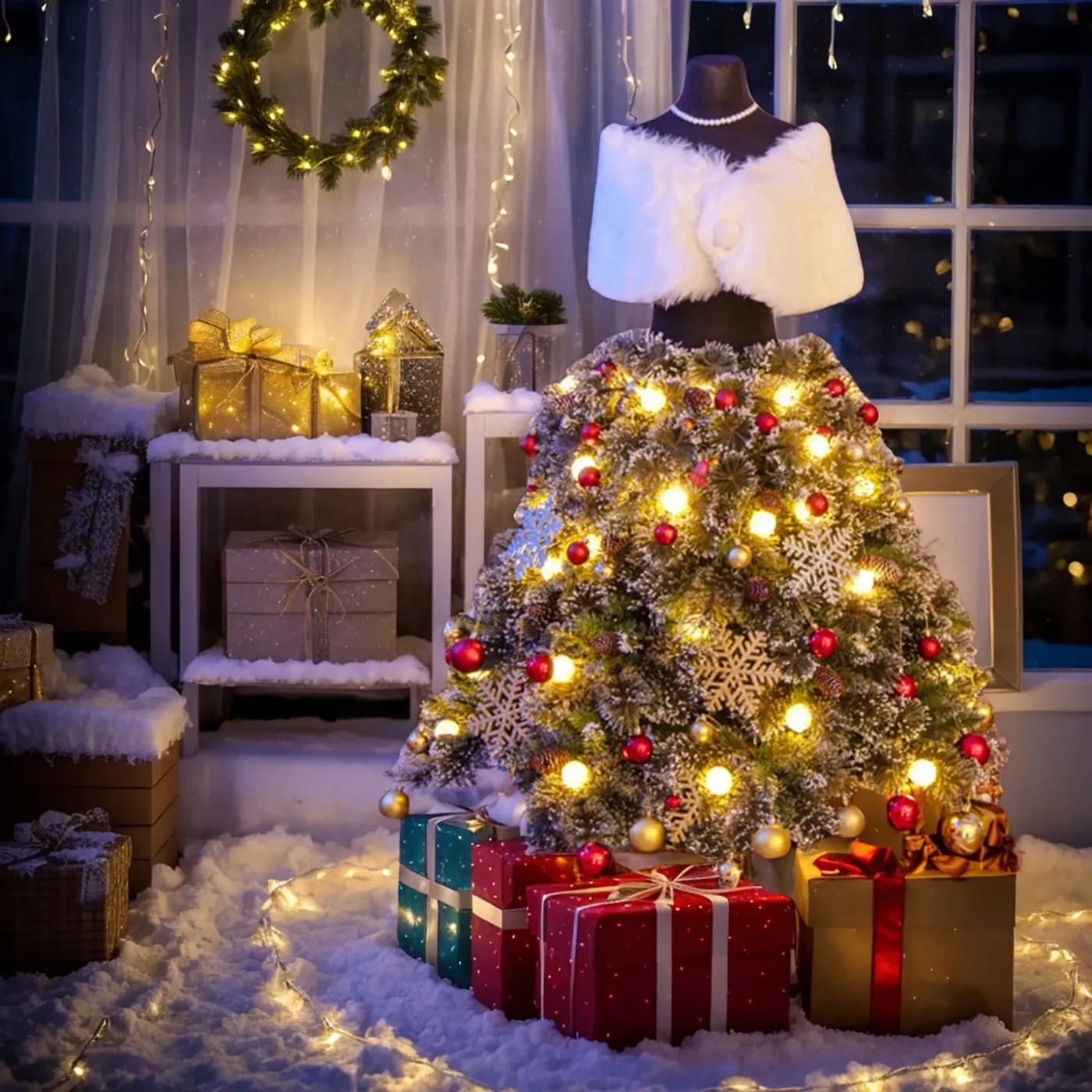
It’s a silhouette joke that also happens to be good design. Narrow shoulders and a wide skirt mimic a tree’s proportions exactly, so your brain accepts it instantly. Scale is what sells it — the skirt has to reach the floor and the base has to spread at least 30 inches, or it just becomes a person in a costume.
23. Grand Staircase Trees with Nutcracker Guards
Scale up the ornaments, not the ornament count, and the numbers stay sane:
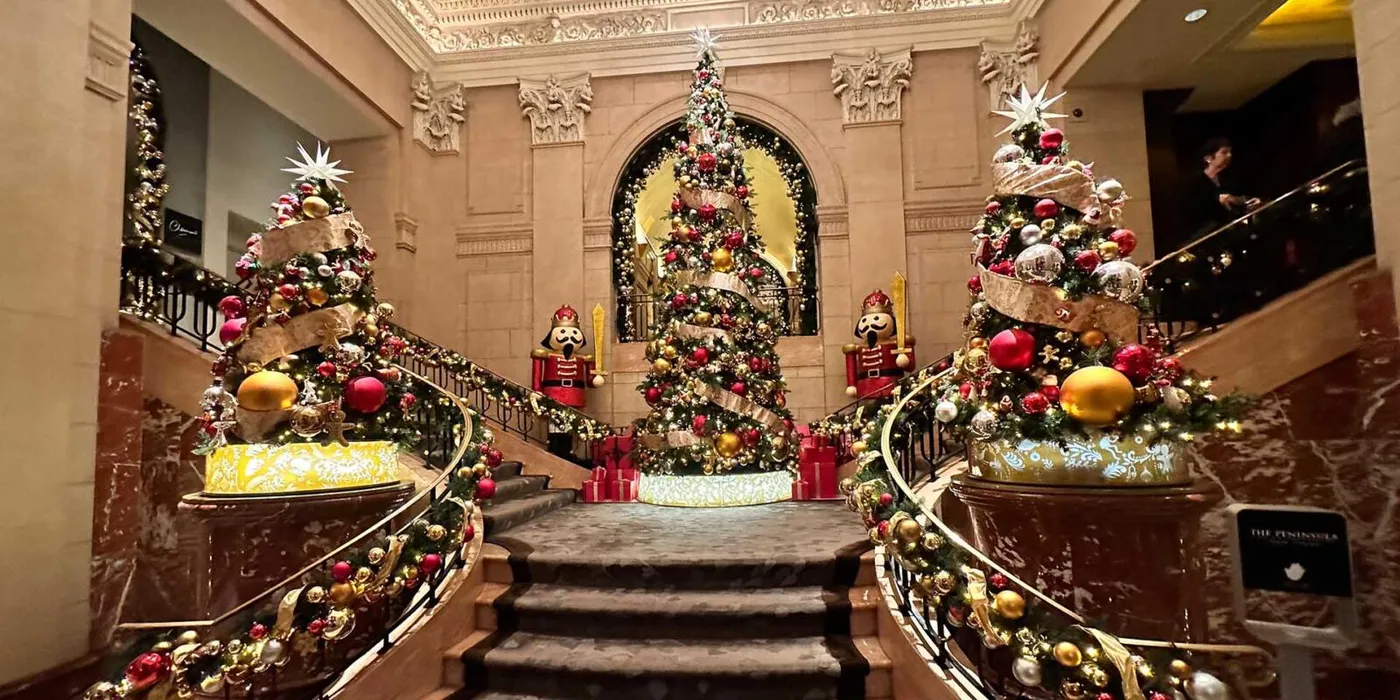
- Two 4-ft flanking trees: $80–$200
- One 7-ft center tree: $150–$400
- 40 oversized red, gold, silver baubles: $90–$220
- 4-inch gold ribbon, three rolls: $45–$90
- Two 4-ft nutcracker figures: $70–$180
- 20 ft of railing garland: $60–$140
Total: $495–$1,230. Nutcrackers are where to save — flat cardboard standees at $20 each read perfectly fine from the bottom of a staircase.
This arrangement wants a staircase at least five feet wide with a landing, or the flanking trees crowd the handrail. Ceilings in these spaces usually run 12 feet or more, which is why a 9-foot center tree still looks modest. In a standard three-foot hallway with an 8-foot ceiling, cut to one tree and skip the guards.
24. Evergreen Planter with Plaid Ribbon and Blue Berries
Fresh planters are gorgeous and temporary. Indoors, they dry out in about ten days and start dropping needles on the console; outdoors on a covered porch they’ll hold six weeks in cold weather. Water the moss base every other day, and keep it out of direct sun and away from heating vents. If you need it to last the whole season indoors, mix faux cedar into the evergreen.
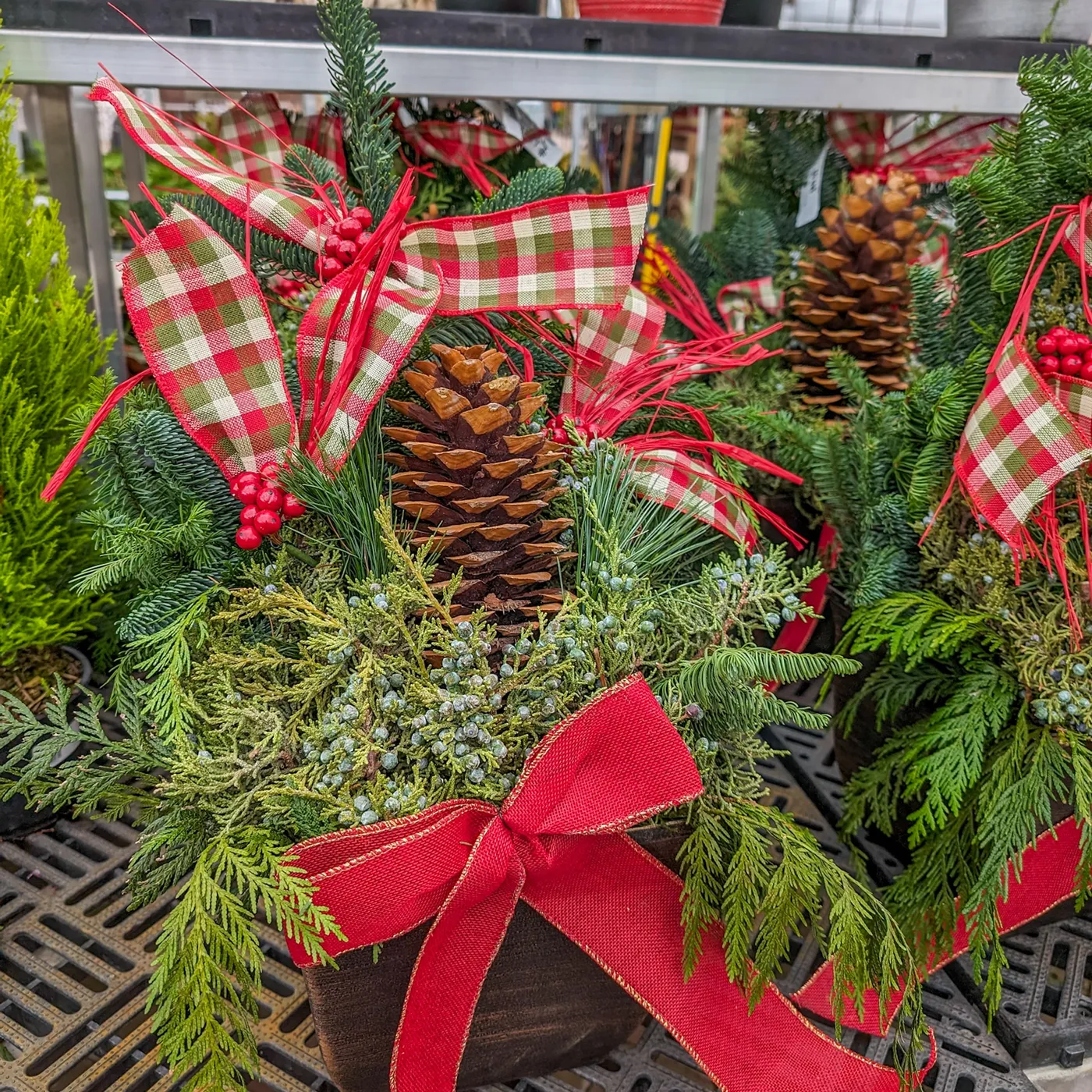
Plaid ribbon should be cut on the bias, not straight across. A diagonal cut lets the ends fan and curl instead of sitting flat and stiff — that’s the whole difference between a florist’s planter and a craft project. Cut each tail at least 14 inches and notch the end into a V. Two ribbons, one plaid and one solid, always beat one.
25. Plain Prelit Firs with Green-Cord Lights
Green cords disappear into green needles, and that single detail is why some prelit trees look expensive and others look like a tangle. Warm white incandescent bulbs at 2700K also cast a softer, slightly amber pool than LED, which photographs beautifully and flatters a room. If you’re buying new lights, look for the words warm white and a green lead wire.
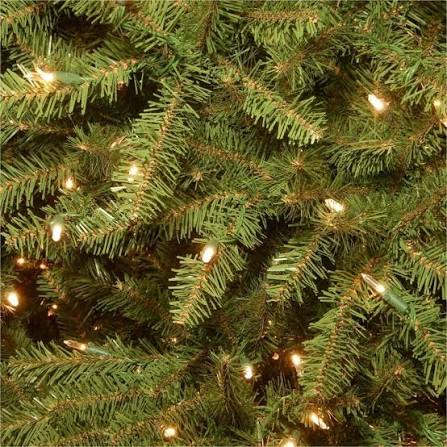
Incandescent runs warmer and uses more power — roughly 40 watts per 100-light strand, so a 600-light tree costs about $1.50 for a month of evenings. That’s fine. The real issue is heat and lifespan: bulbs fail around 3,000 hours, and one dead bulb on a series circuit takes out a section. Keep a spare fuse and a tester in the box.
26. Distressed Patina Ornaments in Beige and Oxidized Blue
Check three things before committing to a patina palette:
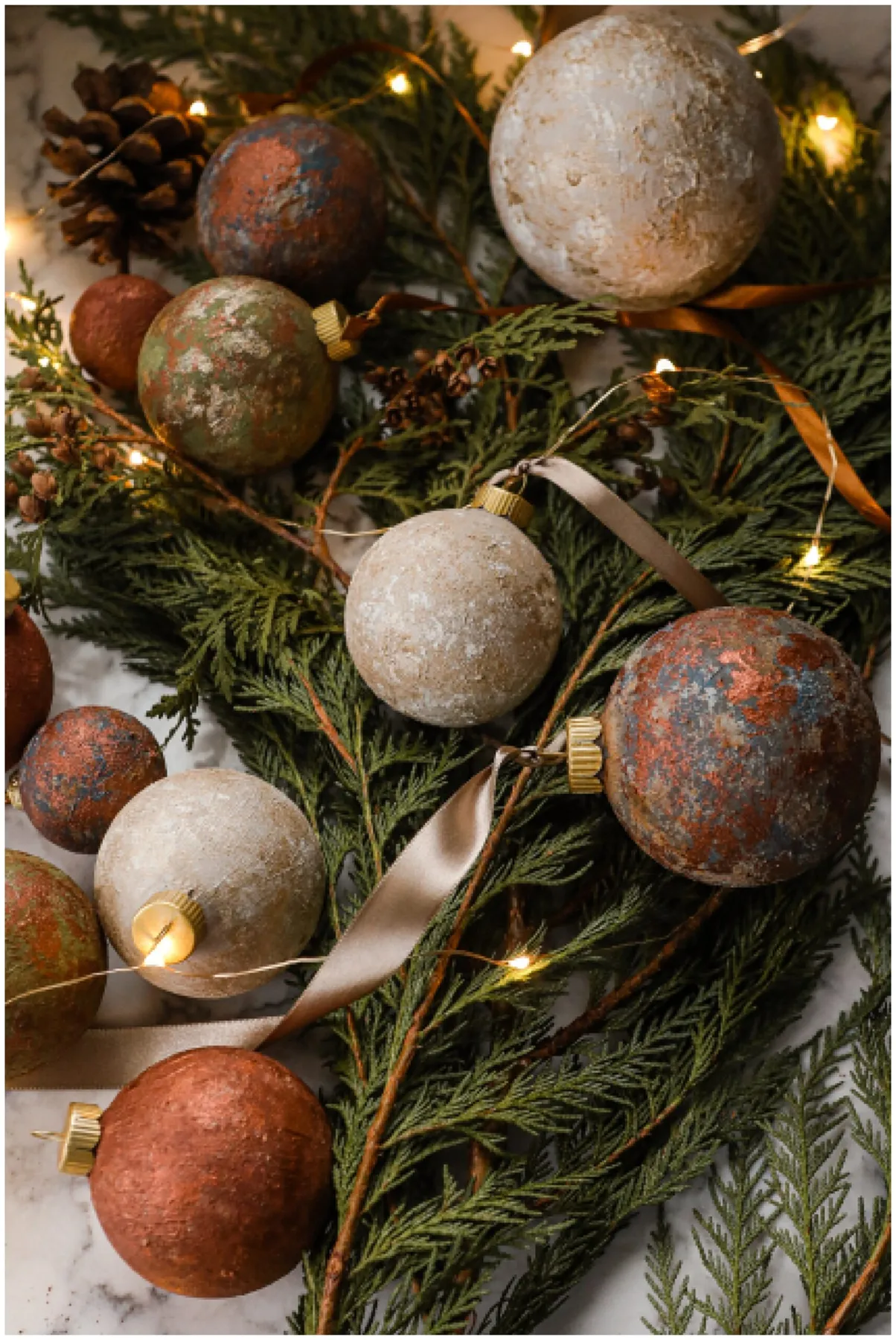
- Hold the ornaments against your tree in daylight — oxidized finishes go muddy under warm bulbs.
- Make sure at least a few pieces have real gold caps; they’re what unifies the muted colors.
- Decide whether the tree is lit warm or cool, because these finishes shift dramatically between the two.
Patina is the easiest finish to fake. Mix brown acrylic into white craft paint, dab it on thrifted baubles, wipe most of it off, seal with matte spray — a dozen ornaments for under $15. Marketplace and estate sales are full of beige and rust glass balls nobody wants in July and everybody wants in December.
27. Dachshund in a Santa Hat, Honestly
The red-and-white striped ribbon hanger is doing almost as much as the dachshund. A plain silver hook would make these read as kids’ crafts; striped ribbon makes them read as a collection. Same principle as framing a photograph — the border tells you it matters. If you’re making your own, spend the extra two dollars on ribbon that matches your tree instead of using the string it came with.
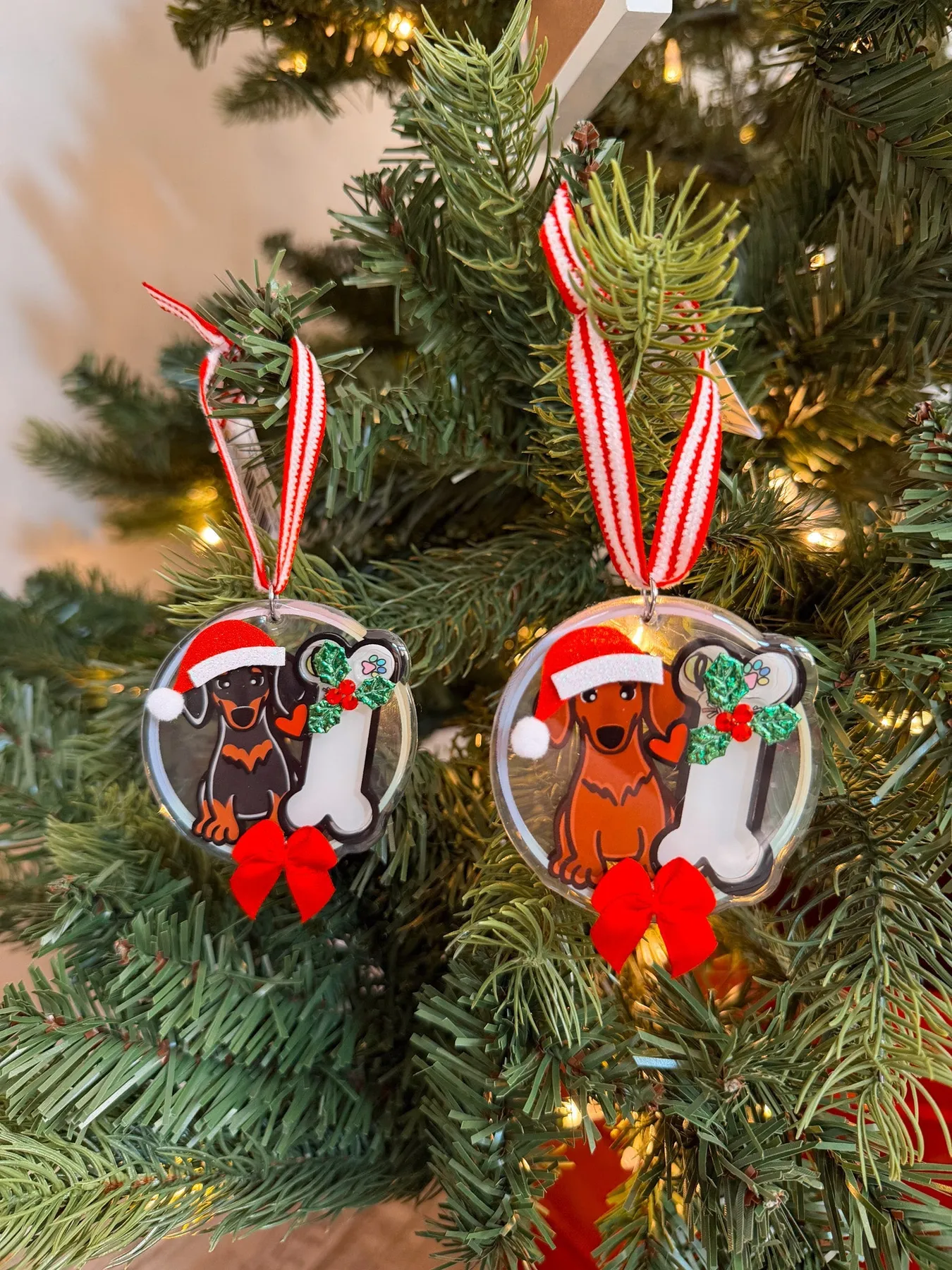
Clear plastic ornaments scratch, and once they’re scuffed there’s no fixing them. Store in a divided box, never a bag, and never stack two together. If yours have printed inserts, keep them out of direct sun — the ink fades to washed-out beige within two seasons. Photograph the front of each one so you can reorder if a favorite cracks.
28. Champagne Gold Pearl Cone Tree
This is 90 percent champagne gold, 8 percent pearl, 2 percent white — the most disciplined palette on this list, and the reason it doesn’t look gaudy. A cone tree is all texture, so the only variation allowed is finish: glitter, matte pearl, mirror metallic. Break the rule with one red bauble and the whole thing reads like a craft store display.
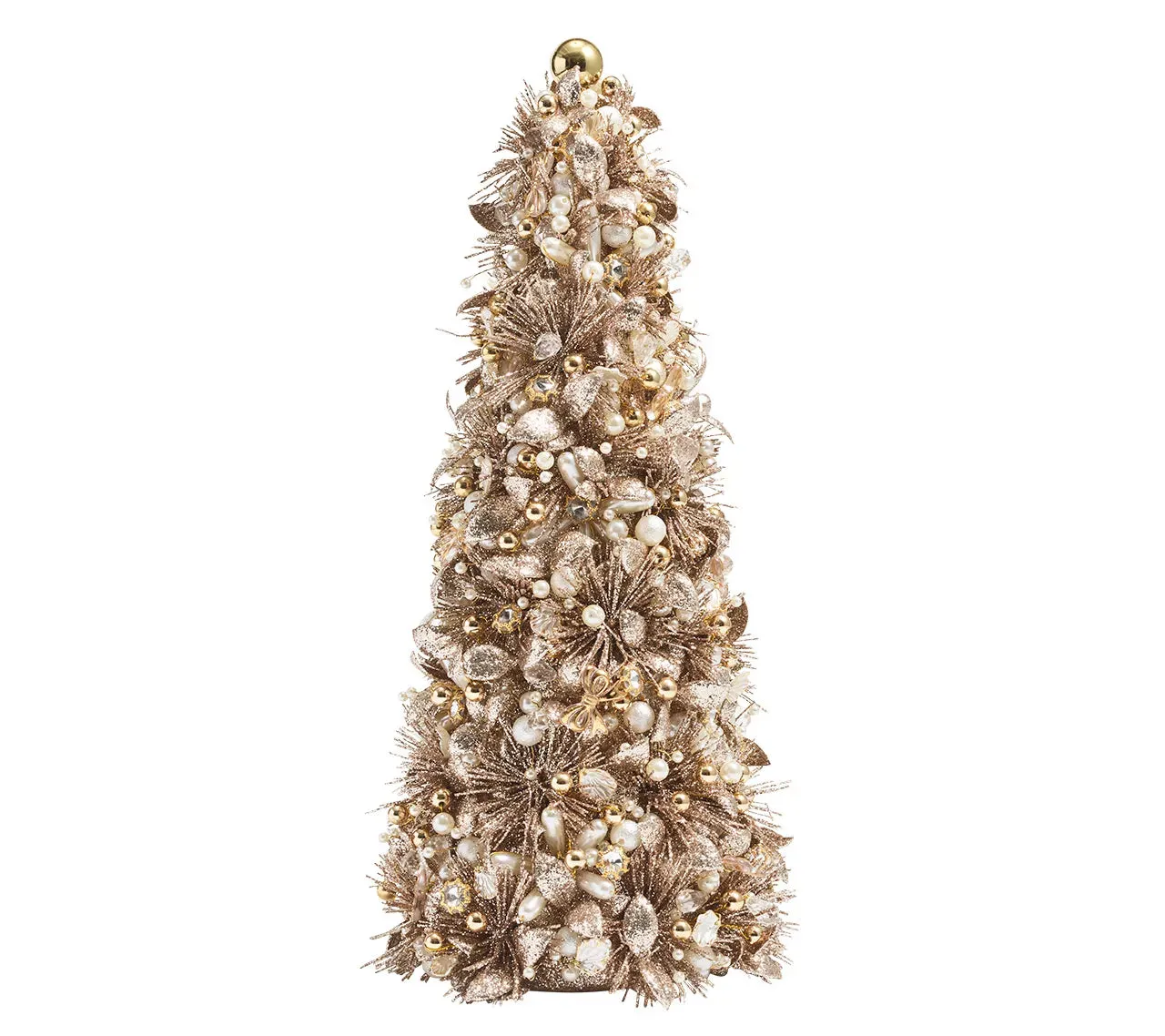
Build cone trees from the bottom up with slight overlap. Start with the largest beads at the base, work in a spiral, and tuck each row’s edge under the one below so no foam shows. Bead size should drop about a quarter inch every four rows. A 14-inch cone takes roughly 90 minutes and 200 beads — worth doing with a podcast on.
29. Frosted Pine with a Pleated Paper Tree
The paper tree is the hero because everything else is quiet. Two neutrals and three textures — ribbed matte bauble, fluffy star, frosted needles — then one pleated brown form that adds an actual shape. Remove it and you have a pleasant, forgettable branch. Designers call this the one-thing-that-isn’t-a-sphere rule, and it works on full-size trees too.
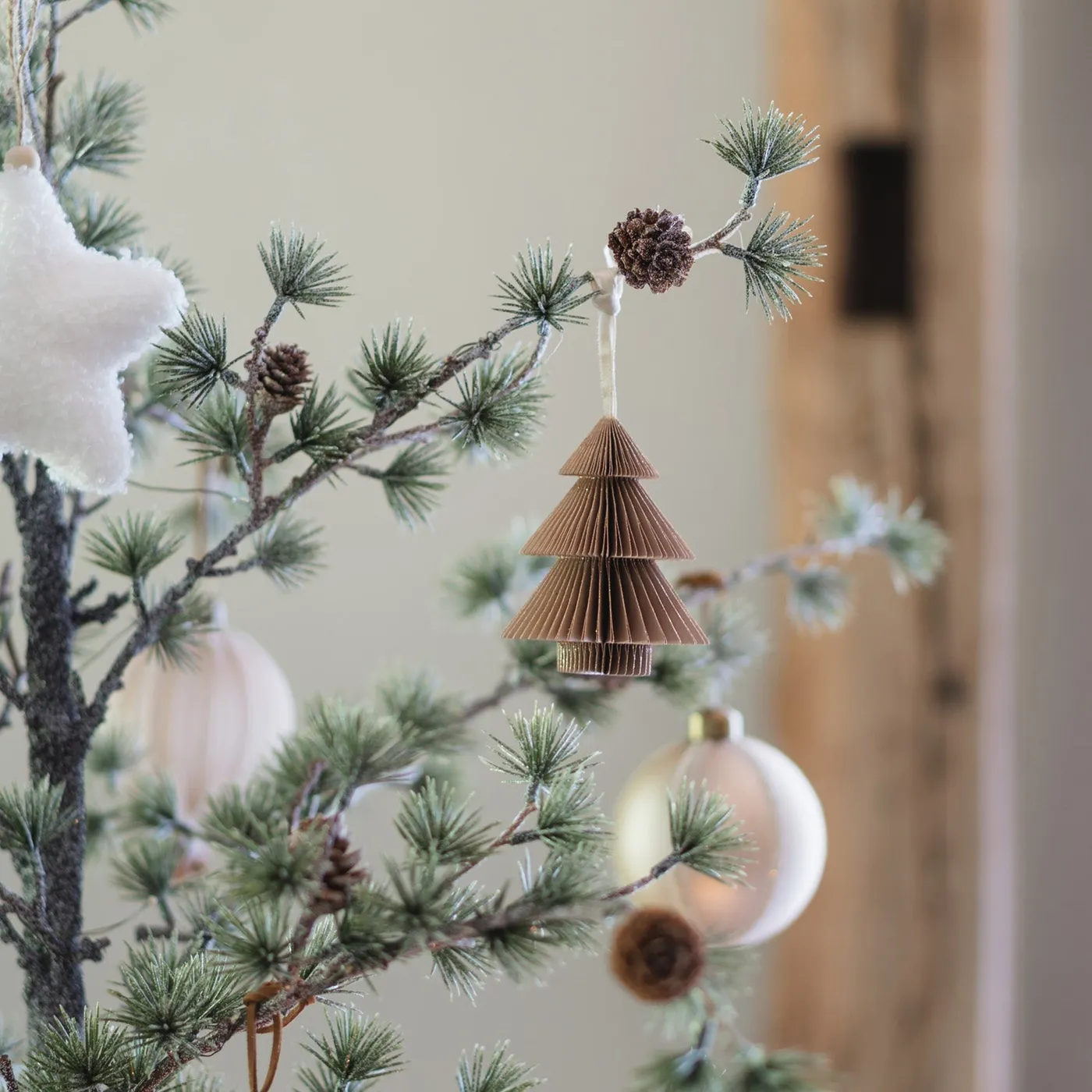
Paper ornaments indoors are a gamble. They hate humidity, so keep them away from the kitchen, the bathroom door, and anywhere a humidifier runs — pleats soften and droop by New Year. They’re also a real concern near open candles. Store them flat in a rigid box, not a bag, or you’ll open them next December to a crumpled mess.
30. Red Glitter Baubles and Tinsel Garlands
Tinsel gets a bad reputation because people wrap it in tight horizontal rings. Don’t. Try this instead:
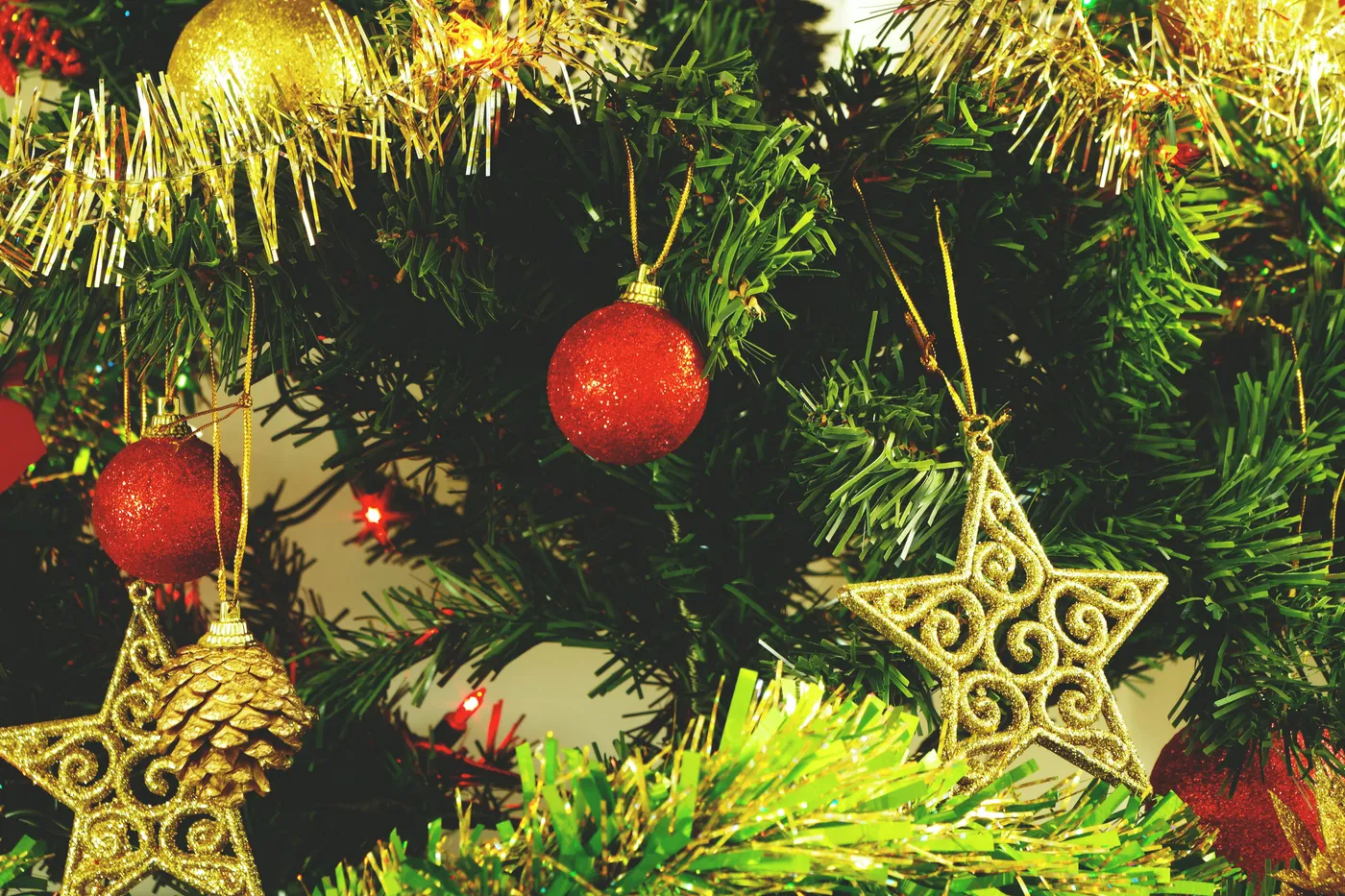
- Work in a loose diagonal from top left to bottom right.
- Let the garland sag two to three inches between attachment points.
- Pin it at every third branch so it holds the drape.
- Hang glitter baubles directly in front of the garland’s low points.
- Stop two-thirds down and leave the base plain.
Twenty minutes, and it changes the whole silhouette.
The red fairy lights, not the tinsel, are the secret here. Standard warm white would make this tree read traditional and slightly sleepy; red bulbs push it toward a department store window in 1962, which is exactly the charm. Red strands run about $12 and they’re the cheapest way to make a red-and-gold tree feel less predictable.
31. Rose Gold Candy Swirls on a White Flock
Candy-shaped ornaments are seasonal stock that goes on clearance the day after Christmas — full sets at 70 percent off in the first week of January, reliably. Buy next year’s in January. Can’t wait? Plain rose gold spheres plus a bag of candy canes from the grocery store get you within 80 percent of this look for about $20.
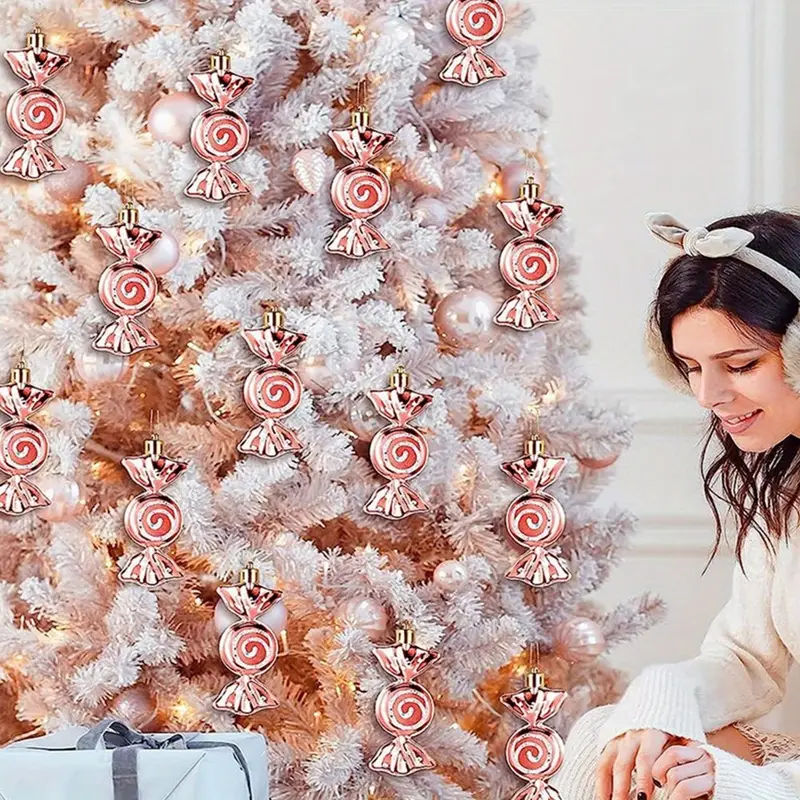
White flocked trees reflect light, so they read bigger than they are — a 6-foot flock looks like a 7-foot green tree. Great news in a small room, less great in a corner you’re trying to keep open. Keep the flock a foot off the wall minimum. For rooms under 100 square feet, a 5-foot pencil flock in this palette is the move.
32. Unboxing Red and Gold with Silver Tinsel
The unglamorous prep that saves an hour:

- Sort ornaments by color into separate boxes before you hang a thing.
- Untangle tinsel and lights on the floor, not on the tree.
- Test every strand first — one dead set breaks the rhythm.
- Put the tree up a day early so the branches relax.
- Keep a bowl nearby for hooks and caps that fall.
Red, gold, and silver at a 50/30/20 split is the most reliable holiday formula there is. Red does the emotional work, gold does the warmth, silver keeps it from getting heavy. Swap silver for white and it softens; swap gold for copper and it goes rustic. The proportions barely change — that’s what makes it a classic instead of a trend.
33. Frosted Tree with Gold and Silver Snowflakes
Snowflakes and stars should go on last and be the largest objects on the tree — a 6-inch snowflake needs 10 inches of clearance to read as a snowflake rather than a blob. Hang them at the outer tips of branches, never against the trunk. On a frosted tree, whites disappear, so let the metallics do the shape work.
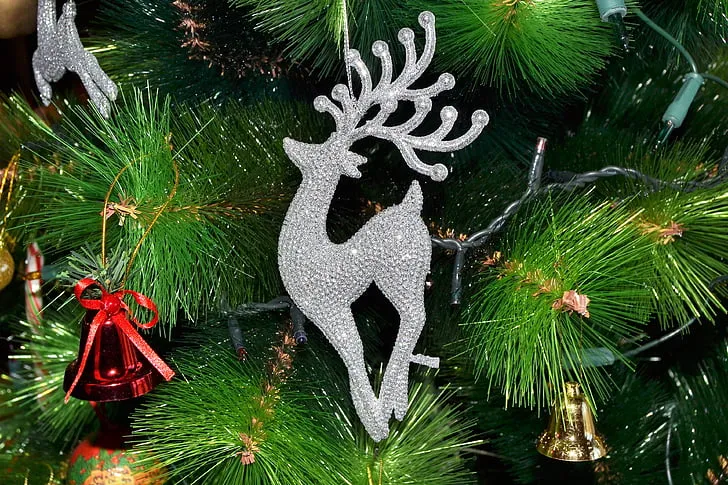
Gold and silver together was a faux pas for years — you were supposed to pick a metal. That rule is gone. Mixed metallics now dominate holiday styling because the lighting changed: LED strings at 2700K bounce between warm gold and cool silver in a way incandescent never did, so the two finishes read as one continuous shimmer instead of a clash.
34. Illuminated Angel with a Stained-Glass Body
Angel toppers need three things to look right, and none of them are about the angel:
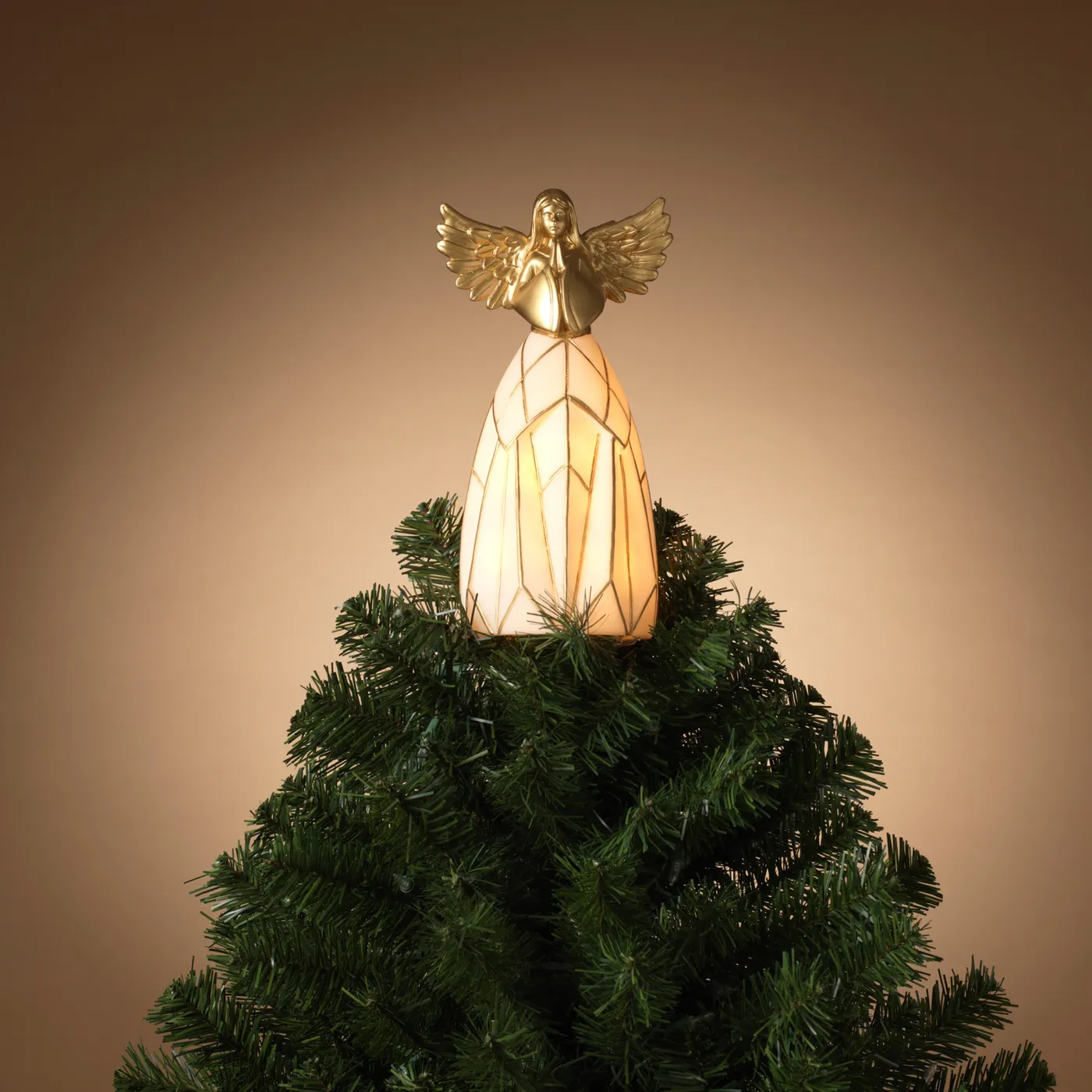
- Clear 10 inches above the highest wing so light doesn’t wash out the ceiling.
- Zip-tie the top two branches into an X — angels are heavier than stars.
- Run the topper’s cord down the back of the tree, not the front.
- Add two lights directly below the angel so it reads as lit from within.
- Turn the room lights off once before you finalize. That’s the real test.
The geometric glowing body is what makes this topper worth the money. A traditional fabric angel disappears against a lit tree; backlit cream panels outlined in gold stay visible because they emit light instead of reflecting it. If you upgrade one thing this year, upgrade the topper — it changes the whole silhouette from across the room.
Thirty-Four Trees, One December
You don’t need a bigger tree or a bigger budget — you need one decision made early, whether that’s the ribbon, the basket collar, the topper, or the one ornament with a story behind it. Pick your hero piece, let everything else support it, and stop second-guessing around December 15th.
📌 Pin your favorite from this list now so it’s waiting for you next November — and tag us when your tree goes up.