You know the feeling: it’s late, you’re three tabs deep into someone’s 1962 Christmas card collection, and you’ve saved eleven photos of other people’s mantels. Same. Vintage Christmas decor in 2026 isn’t about hunting down one perfect Santa — it’s about layering decades on purpose, from 1950s glass baubles to honeycomb paper to plain hardware-store twine.
We spent weeks digging through Etsy, Anthropologie, Target, eBay and World Market to pull 34 ideas that actually hold up, from $12 ornament swaps to $1,200 tree builds. Inside you’ll find nostalgic mid-century rooms, pastel shabby-chic flocked trees, rustic natural garlands and proper red-and-green formal dining rooms — with budget and luxury versions compared side by side, and every idea shoppable so you can track down the exact pieces.
The 2026 shift? Vintage went personal. People aren’t recreating a decade, they’re collecting it slowly, one estate-sale ornament at a time. And stay until the end — we break down the most common mistakes that can ruin these looks. 📌 Save this to Pinterest for later — you’ll want to revisit these ideas.
1. A Cranberry and Gold Mantel That Still Feels Like Home
Three things keep this mantel from turning into a pile of decorations. The garland runs the full width of the shelf and then spills over one edge only — that small asymmetry stops it from reading like a store display. The cranberry and antiqued gold baubles are clustered in odd numbers, so your eye keeps traveling instead of parking. And the warm white string lights are tucked inside the greenery rather than wound on top, which makes the glow feel like it’s coming out of the pine itself.
The knitted stockings are the piece you can’t fake. Swap them for shiny store-bought ones and the whole mantel shifts from our family’s Christmas to a display at a garden center. Knit, cable, or even a chunky crochet stocking adds a soft matte texture next to all that glass and gold — and texture is what vintage decorating is actually made of. Mismatched stockings are a feature here, not a flaw.
2. Gold, Pearl and Pinecone: A Tree With No Red At All
Want the opulent look without buying 200 ornaments? Work in clusters of three — one large gold pinecone, one clear glass teardrop with pearls, one pleated ribbon loop — and place each cluster about a hand’s width apart. Aim for eight to ten decorations per vertical foot of tree. Fold your gold ribbon into loose four-inch loops and tuck them at a 45-degree angle instead of hanging them flat; the pleats catch the fairy lights and make the tree read as far more expensive than it was.
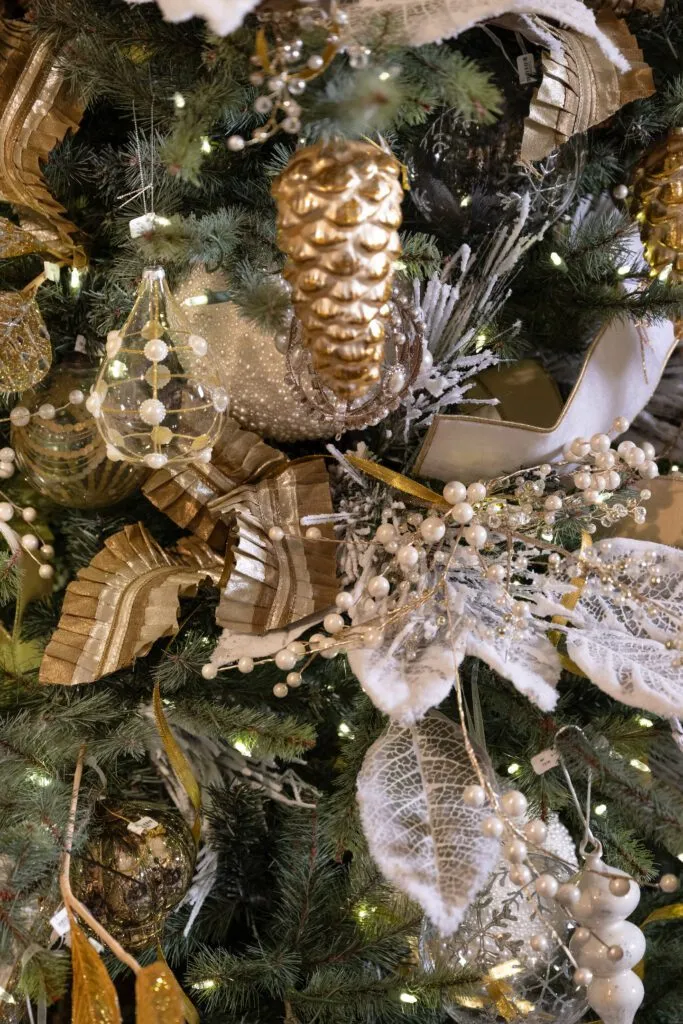
The formula here is roughly 50 percent frosted white and green base, 35 percent gold, 15 percent pearl and clear glass. That ratio is why it feels luxurious instead of gaudy — gold never gets to run the show alone. To swap the mood, keep the percentages and change the metal: 35 percent copper and 15 percent amber glass gives you something warmer, and the same numbers in silver and clear crystal turn it cool and modern.
3. Red Glass and Bottle Brush Trees on a Live-Edge Slab
A version of this costs real money if you buy it all new, mostly because of the table:
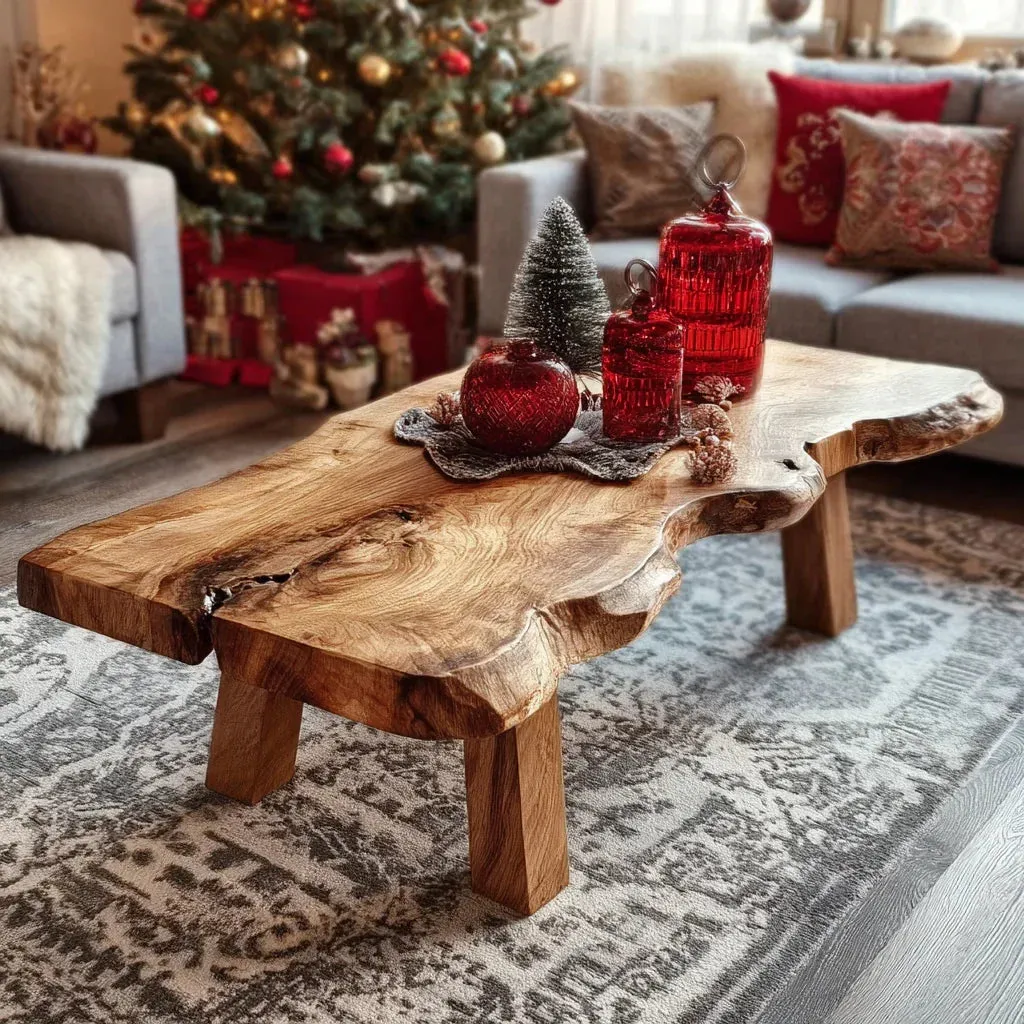
- Live-edge coffee table: $450–$1,400
- Bottle brush trees: $4–$9 each, six to twelve of them
- Red glass bottles and bowl: $25–$80
- Pinecones: free from a walk, or about $18
- Grey patterned area rug: $150–$500
- Total: roughly $650–$2,000
Budget alternative: a Marketplace table with a slab-like top ($80–$150) and thrifted red glass gets you most of the way there for a third of the price.
Two honest notes. Red glass shows every fingerprint and dust mote, especially sitting on a dark crocheted mat, so plan on a weekly wipe-down. And if you have toddlers or a cat with opinions, bottle brush trees are basically chew toys — they’re dyed and glued, so keep them high or push them to the back. Compare with Idea #15, where the same glass-and-shine energy lives safely out of reach on the tree.
4. Pink Poinsettias and Chinoiserie at the Christmas Table
It’s the pink poinsettias running down the middle instead of sitting in one vase. That single decision turns a normal holiday table into a garden, and it lets the layered Chinoiserie, grapevine and pink plates sit in a continuous band of color rather than fighting piece by piece. Remove the runner and use one centerpiece and everything else is still lovely — just ordinary. The pink also softens the cobalt blue and forest green, so nothing reads like a costume.
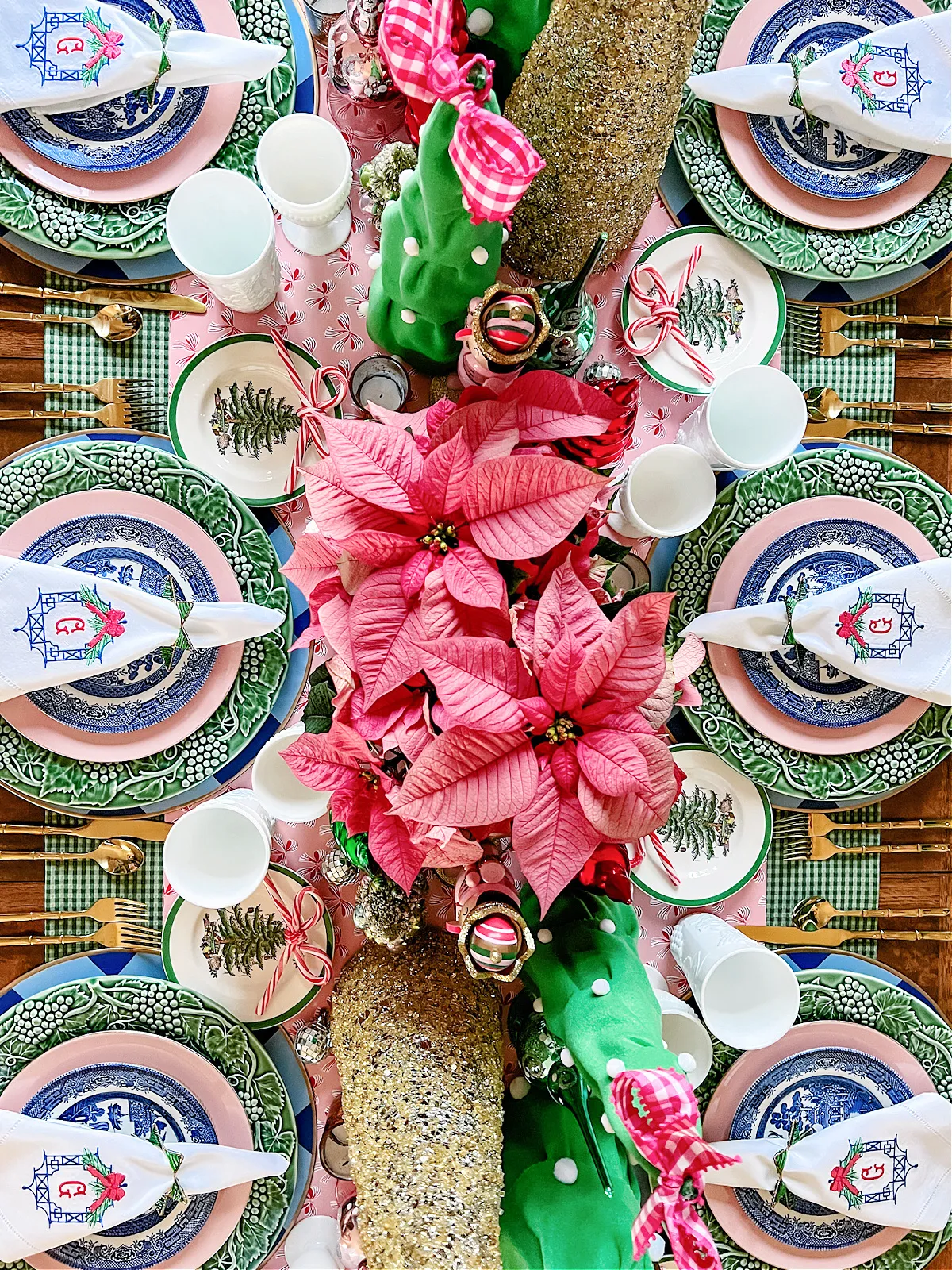
Sourcing enough pink poinsettias can be tricky, so here’s the cheat:
- Buy three to five small pink poinsettias, or dye white ones with floral spray.
- Cut them into individual stems and seal the ends over a candle for a few seconds.
- Lay them end to end down a narrow runner, overlapping by about two inches.
- Tuck in magnolia leaves or seeded eucalyptus to hide the gaps.
- Weave battery votives between the blooms for evening.
Twenty minutes, about $40 in materials, no floral foam to deal with afterward. Keep the stems short so guests can still see across the table.
5. A Multicolor Tree Against an Exposed Brick Wall
When a tree is loaded with multicolor ornaments, the room around it has to stay calm or the whole space reads as chaos. Here that job belongs to the grey sofas and the light rectangular coffee table — flat, quiet surfaces with no pattern competing. Steal the rule: if your tree is loud, your upholstery should be quiet. Notice the tall sculptural lamps flanking the seating too; they pull the eye upward so the tree isn’t the only vertical thing in the room.

Big, unapologetically colorful trees are back after a decade of white-and-silver minimalism. Blame the return of mid-century nostalgia and the thrifted-ornament haul culture that took over secondhand apps — people are buying 1960s glass by the box again. The exposed brick makes the whole thing feel collected rather than decorated. This one has staying power, because multicolor isn’t a palette you refresh every year. You just keep adding whatever you find.
6. A Red Paneled Door With Garland Down the Banister
This entryway is basically 50 percent warm wood and forest green, 30 percent cherry red, 20 percent white and brass. The neat trick: the red door does the accent work, so the garland and tree only had to echo it. Copy the math with a different anchor — a deep navy door plus blue and silver ornaments, or a black door with copper and cream. Keep the wood credenza warm in every version; cold-stained furniture kills the vintage feeling faster than anything else in the room.
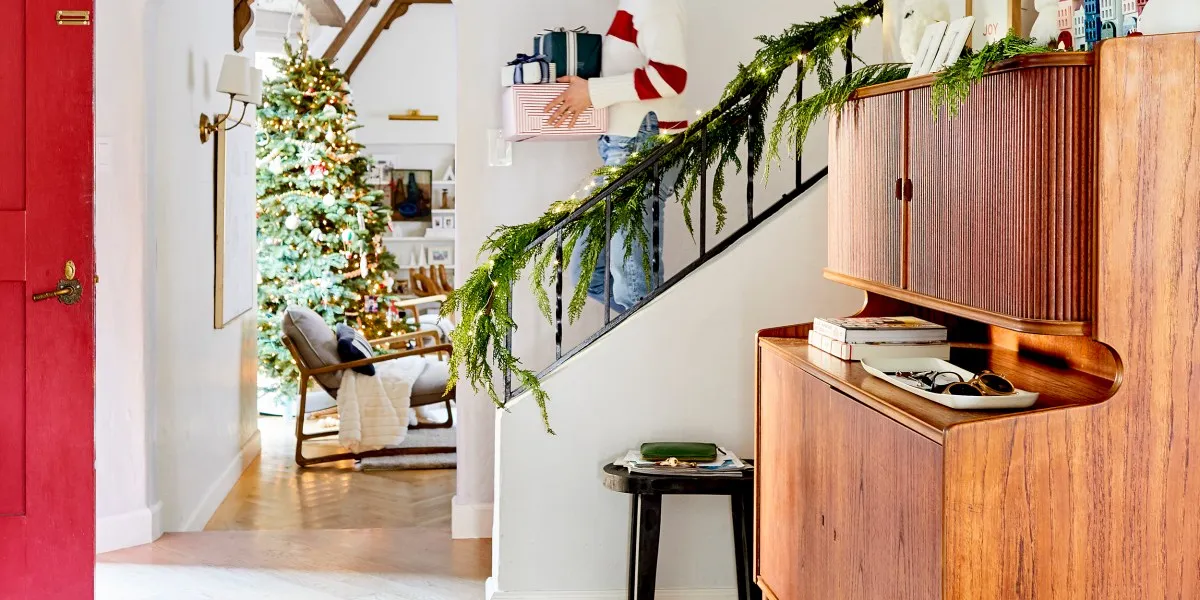
This setup wants a foyer at least 5 feet wide and a stair run with a visible banister, since the garland needs something to follow. A 3-foot-wide hall will make the credenza feel like a barricade, so skip it and use a slim table with wall-hung greenery instead. Higher ceilings are a bonus, not a requirement — the tree in the background reads fine at 6 to 7 feet. For entries with no staircase and no room for a credenza, Idea #25 handles the same vintage mood in a much smaller footprint.
7. A Tinsel-Fringed Mirror Above a Carved White Mantel
The star of this mantel is the scalloped trim along the bottom of the mirror — beaded garlands, tinsel and gold fringe — and you can build it for under $60. Start with a mirror you already own, then layer three or four beaded garlands (about $5 each at a dollar store) along the lower edge with removable hooks. Add a strip of gold tinsel fringe and a few clip-on ornaments in bright jewel tones. Total: $45–$70, versus $200 or more for a mirror built to do the same job.
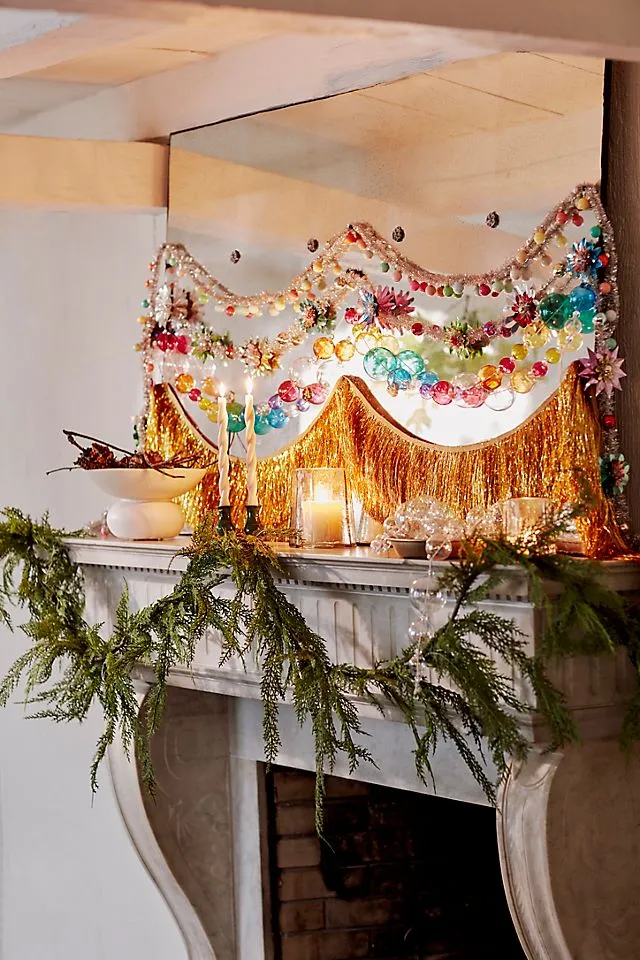
The evergreen garland on the shelf below is doing quiet structural work. It repeats the shape of the embellished mirror edge without repeating its color, which keeps the two related but not matchy. The twisted taper candles add two vertical accents and a little firelight at eye level, and the white carved mantel gives all that multicolor something neutral to land on. Take away the garland and the mirror floats; take away the mirror and the garland has nowhere to point.
8. Candles, Distressed Silver and a Tray on the Floor
Real candles on a wooden tray look extraordinary for about an hour. After that you’re dealing with smoke marks, wax pooling near the ornament, and a flame nobody wants to leave the room with. If you plan to actually enjoy this arrangement rather than photograph it, buy good LED pillars with a moving wick — the newer ones look convincing from two feet away. Keep the tray away from radiators and vents, too; the distressed finish on the ornament dulls faster in dry heat.
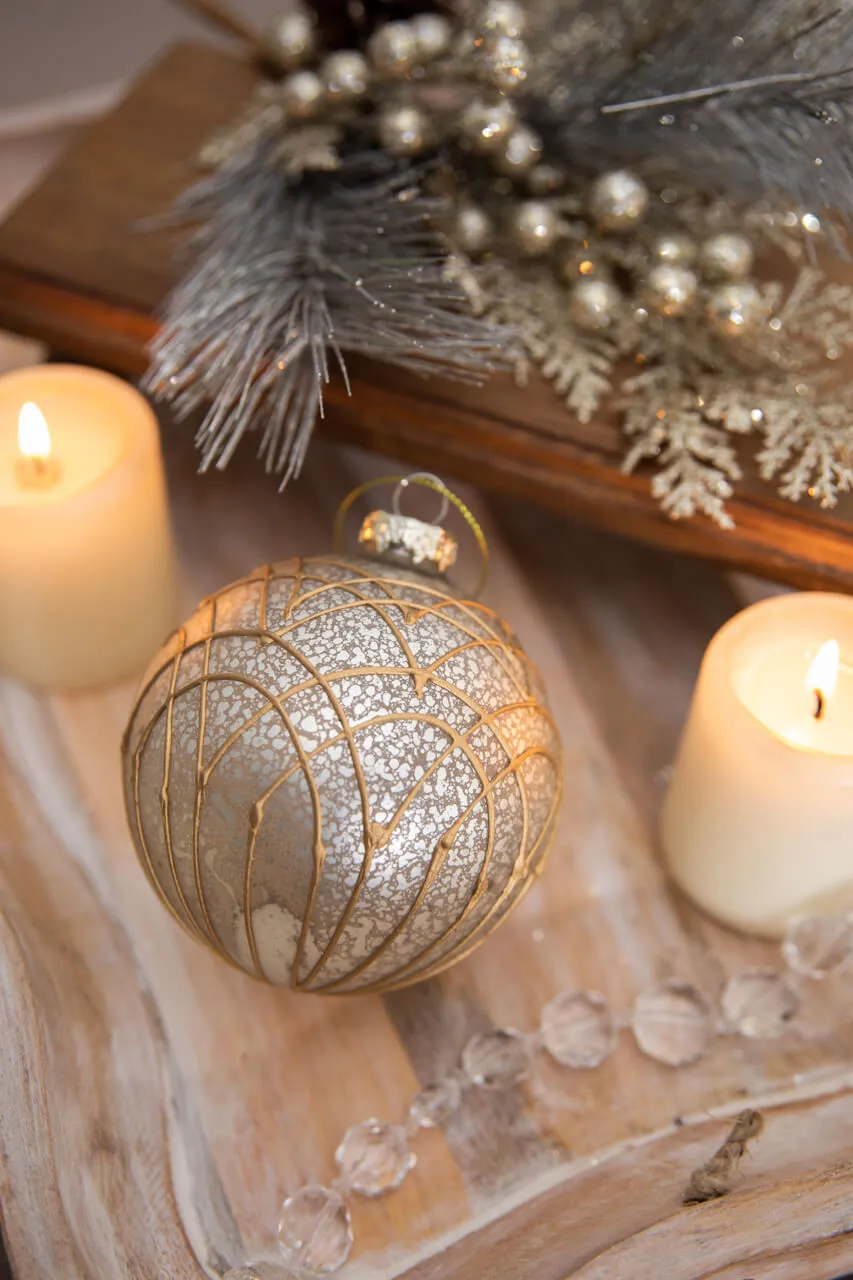
Before you build this vignette, check four things:
- Measure your tray — the ornament plus two pillars needs about 14 inches of length.
- Confirm the surface isn’t in a walk-through path; wax and glass don’t survive a hip check.
- Look at the wall behind it for glare. A very light wall plus warm candles reads flat.
- Decide real versus LED candles now, not after the first smoke smudge.
9. Gold Chargers and a Low Evergreen Runner for Dinner
For a table this formal, the garland should rest on the surface and never rise above 6 inches, or your guests will spend dinner talking around a hedge. Keep the centerpiece continuous but low, tuck red berries near the candles only, and let the gold chargers carry the shine. One thing worth paying for: a garland that runs the full length of the table, end to end. A short centerpiece in a long room makes the table look like furniture nobody uses.
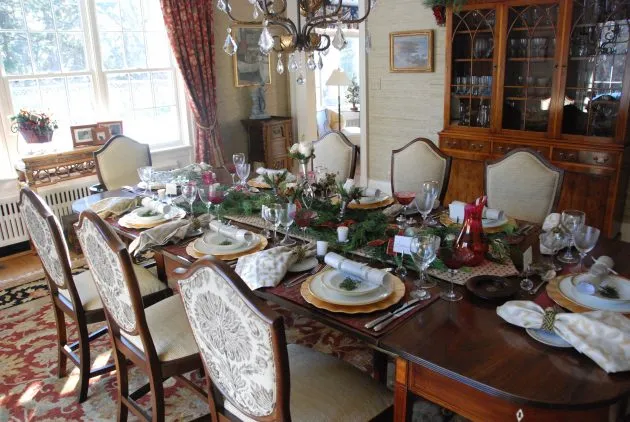
Recreating this at home:
- Evergreen garland, 9-foot: $60–$180 fresh, or about $25 faux
- Gold chargers, set of eight: $40–$120
- Upholstered chairs with patterned backs: $180–$450 each
- Crystal chandelier: $300–$1,500
- Red patterned curtains, pair: $80–$300
- Total: $1,200–$5,000+
Working with what you have? White plates on plain gold-painted chargers and a faux garland get you most of the look for under $100.
10. Honeycomb Paper Piled on the Floor With String Lights
The size mix is what makes this work. Honeycomb ornaments in three or four diameters — big, medium, small, plus one odd shape like a bell or a star — read as collected; all the same size reads as a craft-store bin. Because they’re paper, a pile on the floor is a genuinely good option for hallways, corners, or that awkward strip of wall you never figured out. The warm string lights draped loosely over the top are what make the arrangement feel deliberate instead of accidental.
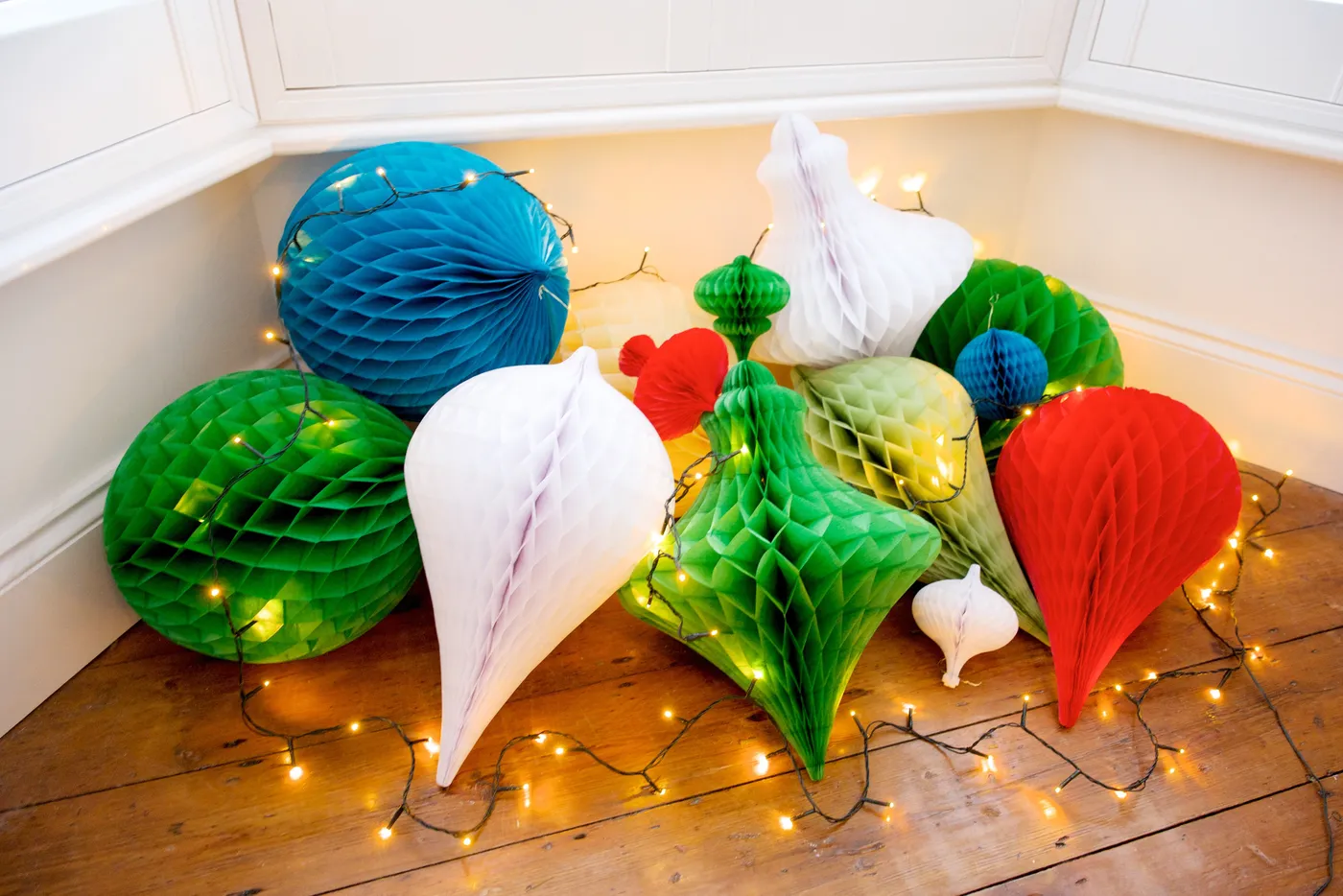
Paper honeycomb survives exactly one season of careful storage. Fold them flat, wrap them in tissue, and keep them out of a damp basement or they’ll go soft and lose their shape by next December. They also fade fast in direct sun, so keep the pile away from a south-facing window. The upside is cost: you can add a few new shapes every year for $12–$20 and never feel guilty about it.
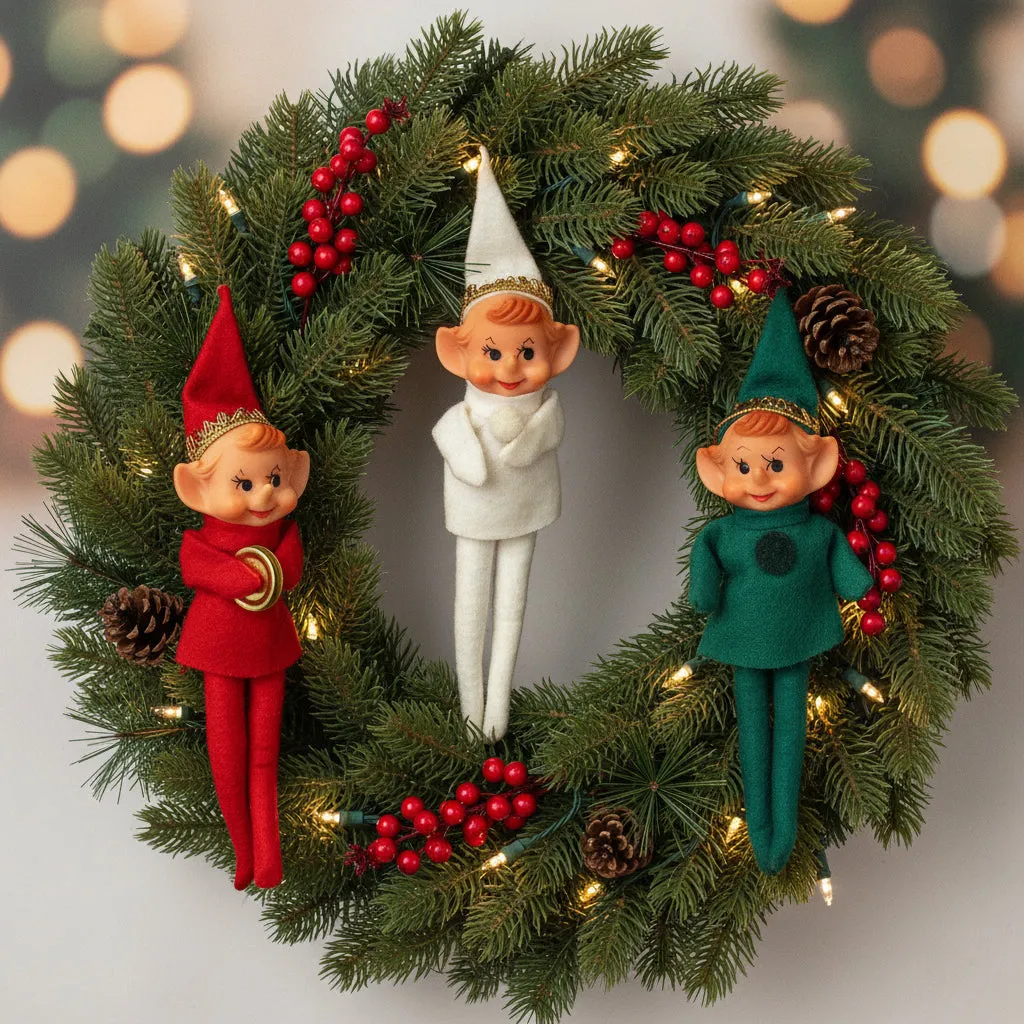
11. Three Vintage Elf Dolls Tucked Into a Pine Wreath
Building a wreath around three vintage dolls takes an afternoon:
- Start with a 24-inch faux pine wreath and fluff the branches outward.
- Wire in pinecones and red berry clusters, keeping one quadrant slightly lighter.
- Wrap warm white string lights in one continuous path so the plug lands at the bottom.
- Attach the elf dolls low and slightly off-center; they should look perched, not glued flat.
- Fill any gaps with small sprigs of the same greenery.
About 90 minutes and $50–$90 if you already own the dolls. Garage sales and estate sales are where the good ones live, usually $4–$15 each.
The color balance is roughly 55 percent forest green, 25 percent cranberry red, 20 percent cream and gold. Notice there’s no pink, no blue, no silver — this wreath lives entirely in the traditional register, which is why it reads as genuinely old rather than retro-styled. To shift it, keep the green base and swap the red for white and pale blue for something frostier and Scandinavian, or push the gold up to 30 percent and drop the red entirely.
12. White Deer, Red Pillows and a Mid-Century Coffee Table
Two things make this room feel collected instead of catalog-ordered. The red pillows on the cream sofa pick up the ornaments exactly — repetition across a room is what ties a tree to its furniture. And the white deer, berry branches and pinecones on the coffee table are all matte, natural materials, which gives your eye somewhere to rest between all that shiny glass. The warm wood tones in the table and the carved chair legs keep everything grounded so nothing floats.
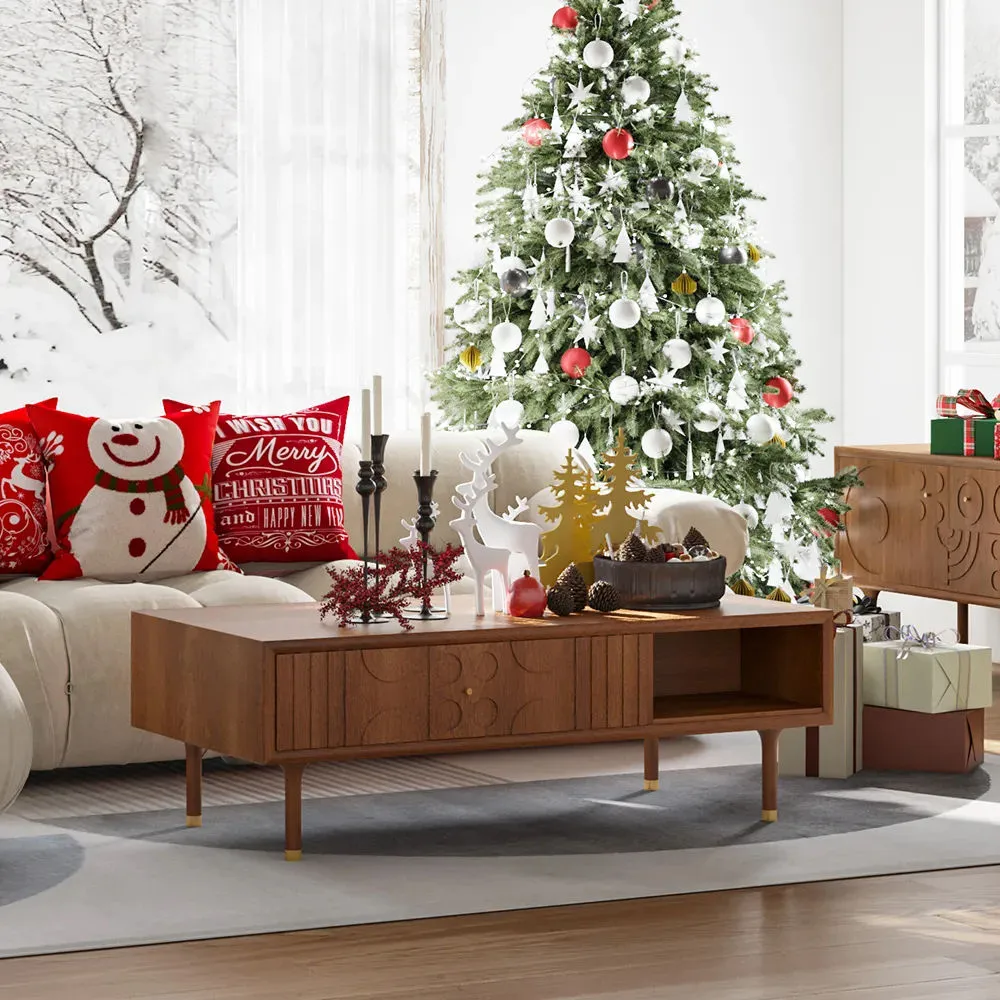
You can get this exact feel without the vintage price tags. Target and Walmart both sell cream slipcovered sofas and red lumbar pillows under $25. White deer figurines turn up constantly on Facebook Marketplace for $8–$20 a pair, and plain ceramic ones take matte white spray paint like a dream. A mid-century coffee table with tapered legs is a $60–$120 thrift find after a light sanding. Spend your money on tree lights instead — that’s the one thing people notice from the doorway. If you’re working with a smaller corner, Idea #26 gets the same mid-century warmth in a tighter footprint.
13. Braided Jute Garland Strung With Mercury Glass
Jute garland reads best at a distance, so it needs room to breathe. Use it on trees 6 feet and taller, or across mantels at least 4 feet wide. On a small tabletop tree the braid competes with the ornaments and just looks busy. Because jute is stiff, it also wants a substantial branch structure — it will slide right off spindly flocked or sparse trees, which is worth knowing before you buy ten yards of it.
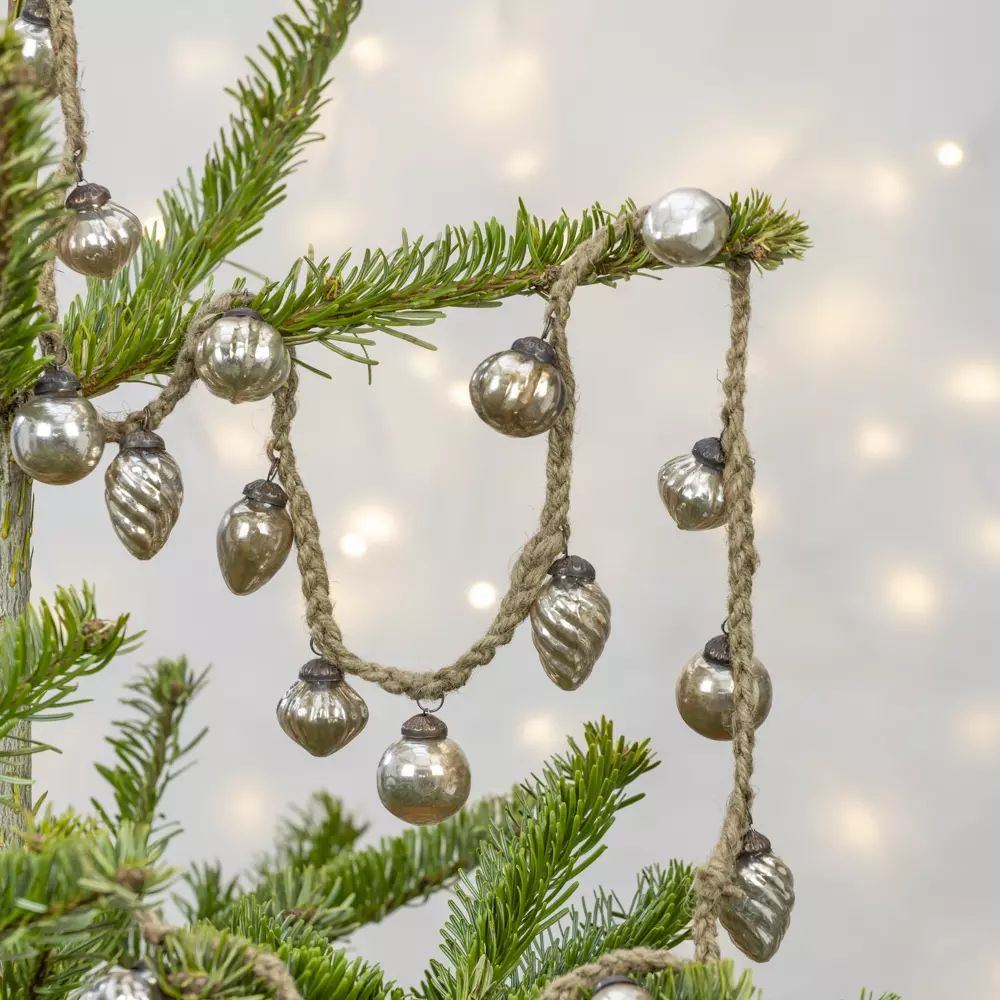
Mix ornament finishes, not colors. On this tree every ornament is silver or mercury glass — round, teardrop, ribbed — and the only other material is the jute. That’s a two-material rule. When you buy mercury glass, look for a mix of shiny, matte and tarnished finishes; three finishes in one color read as vintage, while one finish in three colors reads as new. Hang the heaviest pieces close to the trunk so the branches don’t dip.
14. Red Reflector Glass and Hand-Painted Holly on the Tree
Single-ornament close-ups are quietly driving a lot of the vintage decorating saved on Pinterest right now, and collectors’ ornaments are the reason. Indent or reflector ornaments — the ones with the deep concave glass that bounces light back at you — were everywhere from the 1940s through the 1960s, and modern reproductions have gotten good. They also photograph like nothing else on a warm-lit tree. Buying them one at a time, a few dollars each at estate sales, is a slow and affordable habit that ages well.
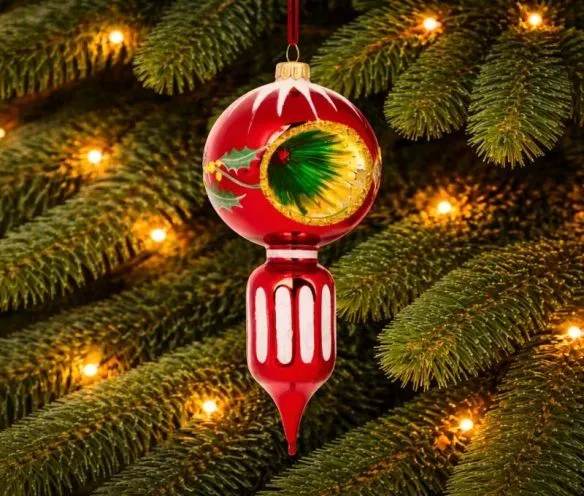
Two warnings. Vintage glass is thin and shatters on tile, so hang it high or on an inside branch if you have kids or a tail-wagging dog. And painted details like holly leaves and stripes flake off if you wash them — dust with a dry microfiber cloth and never soak them. The red hanging ribbon here is doing real work, too: it holds the ornament at the exact angle where the gold reflector catches the fairy lights.
15. Ribbed Mercury Glass Hung From Black Ribbon
This is one of the cheapest vintage effects you can buy:
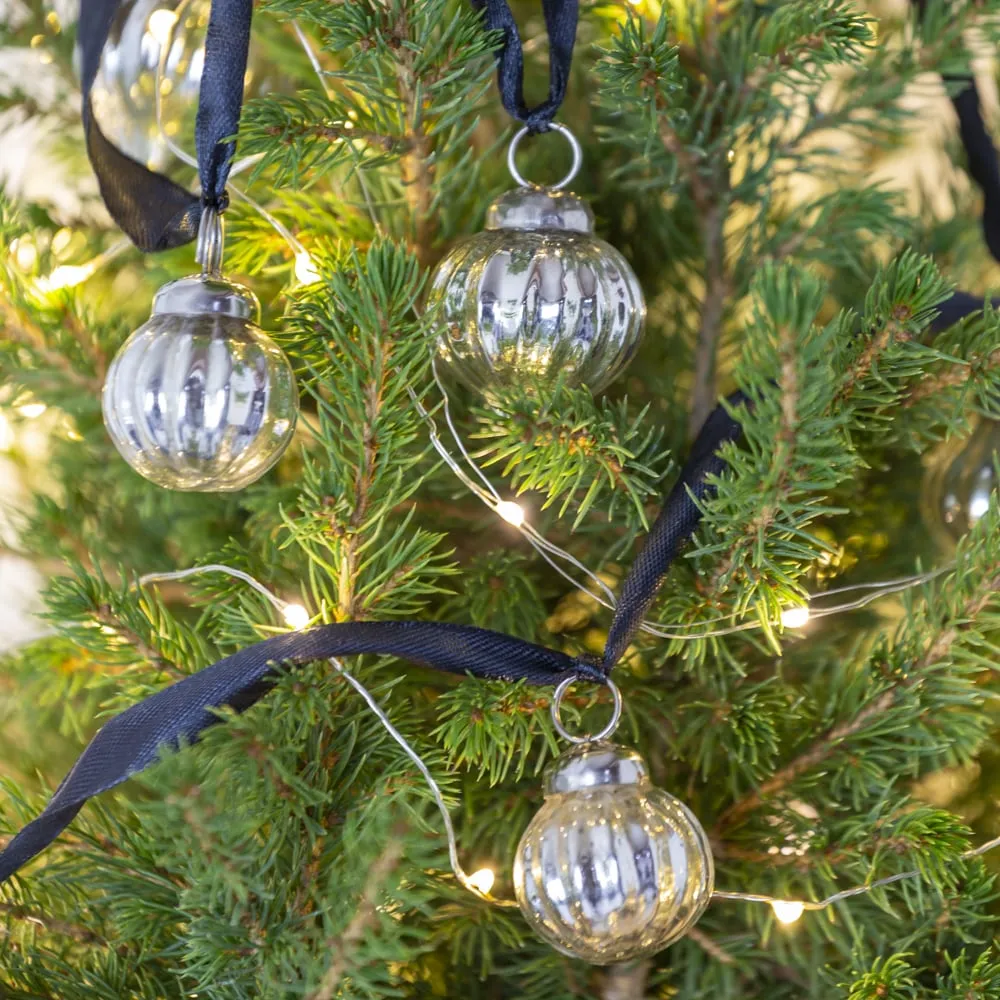
- Ribbed mercury glass ornaments, set of 12: $18–$45
- Black satin ribbon, 10 yards: $6–$12
- Warm white LED string lights, 100 count: $15–$30
- Replacement ornament caps, pack: $5–$8
- Total: $45–$95
Spend the extra on ribbon instead of more ornaments. A black ribbon does more to make inexpensive glass look old than a fancier bauble ever will, and you can reuse it for years.
The black ribbon is the whole idea. Swap it for gold cord and the same ornaments go instantly ordinary — the ribbon creates the contrast between silver glass and green branches. It also solves a practical problem: a ribbon holds an ornament at a fixed angle, so each ribbed sphere catches the lights the same way every single year. That consistency is exactly what makes a tree feel curated instead of crowded.
16. A Frosted Wreath Over a White Fireplace and Leather Chair
To get the frosted wreath look:
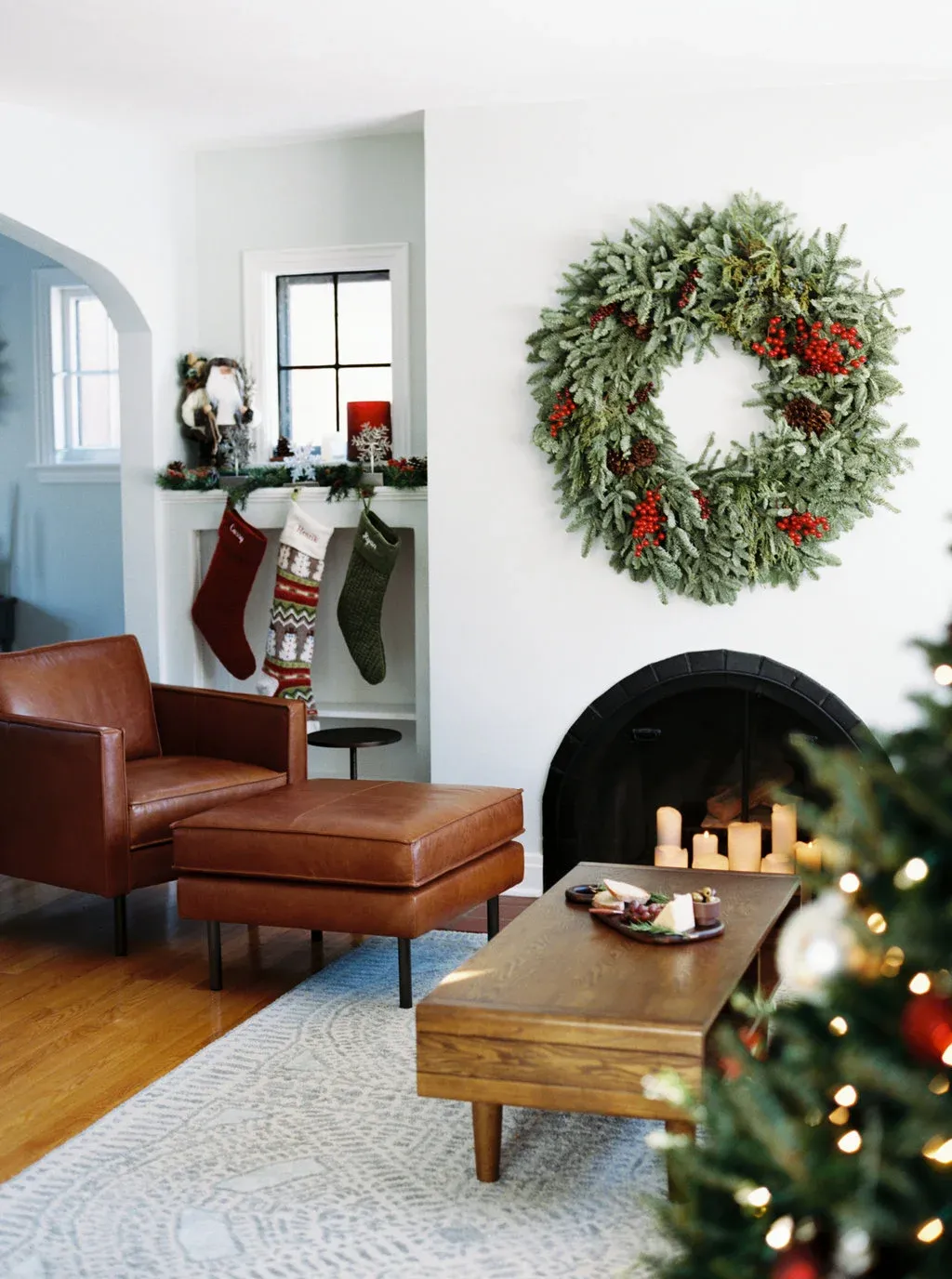
- Start with a plain 30-inch evergreen wreath and separate the branches.
- Mist lightly with spray flocking from 12 inches away — two thin passes, not one heavy one.
- Let it dry overnight, then fluff again so the frost sits inside the wreath.
- Wire in red berries and small pinecones in clusters of three.
- Hang from a removable hook rated for at least 5 pounds.
About 45 minutes and $35–$70. Flocking spray costs $10–$15 and covers one large wreath.
The white fireplace and the frosted wreath share a value rather than a color — both are light, both are textured. That keeps the eye from stopping hard anywhere. Then the brown leather armchair and dark wood coffee table add warmth underneath so the room doesn’t turn cold and clinical. It’s the classic balance: light upper half, warm lower half. Against dark brick, that frosted wreath would disappear entirely.
17. Big Multicolor C7 Bulbs on a Bare Pre-Lit Tree
Large C7 bulbs are a spacing decision, not just a color one. Space them roughly 9 to 12 inches apart on a 6-foot tree — any closer and the glow blows out into one blur. Run the strand in a continuous spiral from bottom to top, keeping the wire tucked inside the branches so only the bulbs show. And leave the tree unlit during the day for the first week of December if you can; big multicolor bulbs only work after dark.
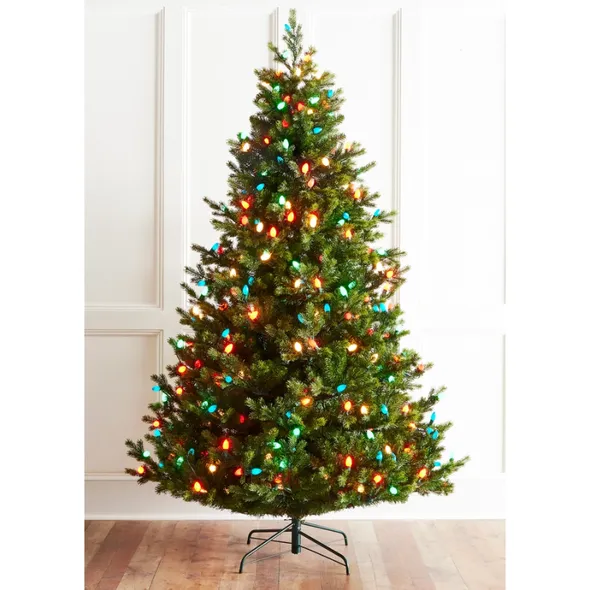
This tree needs wall behind it. Against the white paneled wall it reads as a clean, graphic statement; in a corner stuffed with furniture it just looks like clutter. Plan for at least 18 inches of clearance on all sides and a wall or corner at least 5 feet wide. A 7-foot tree suits a 9-foot ceiling, and anything taller starts feeling crowded in a room under 200 square feet. Smaller spaces get more from ornament-level detail than from tree size.
18. Candlesticks, Ceramic Houses and a Rocking Horse on Dark Wood
The charm of this mantel is that nothing matches. Candlesticks in different heights and finishes, small white ceramic houses, a framed winter print, a little wooden rocking horse — it all reads as accumulated rather than purchased. Thrift stores are gold for this: brass candlesticks run $2–$6 each, and ceramic village houses show up for $3–$8. Buy five or six mismatched holders instead of one matched set, and put your real money into the garland, since everything else sits on it.
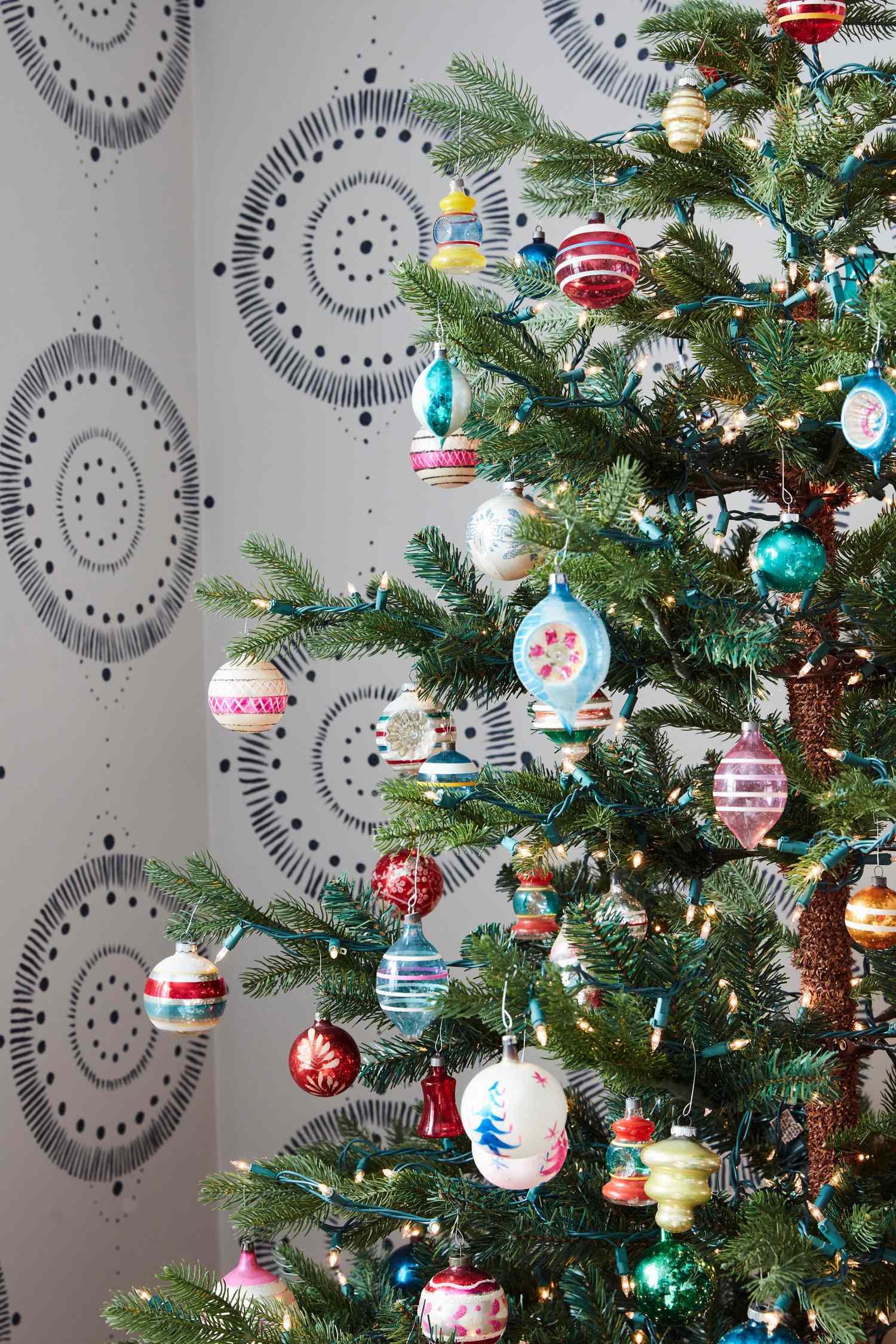
The formula is 45 percent greenery, 30 percent dark wood and cream ceramics, 15 percent gold, 10 percent red. Notice red is the smallest slice — the berries are there to point, not to shout. Because the mantel itself is dark wood, the greens and creams have to do the brightening. On a white mantel, flip it: keep the greens, drop the cream ceramics, and let gold and red carry more of the weight.
19. Tinsel and Star Lights Draped Above a Headboard
Before you drape anything above a bed, verify:
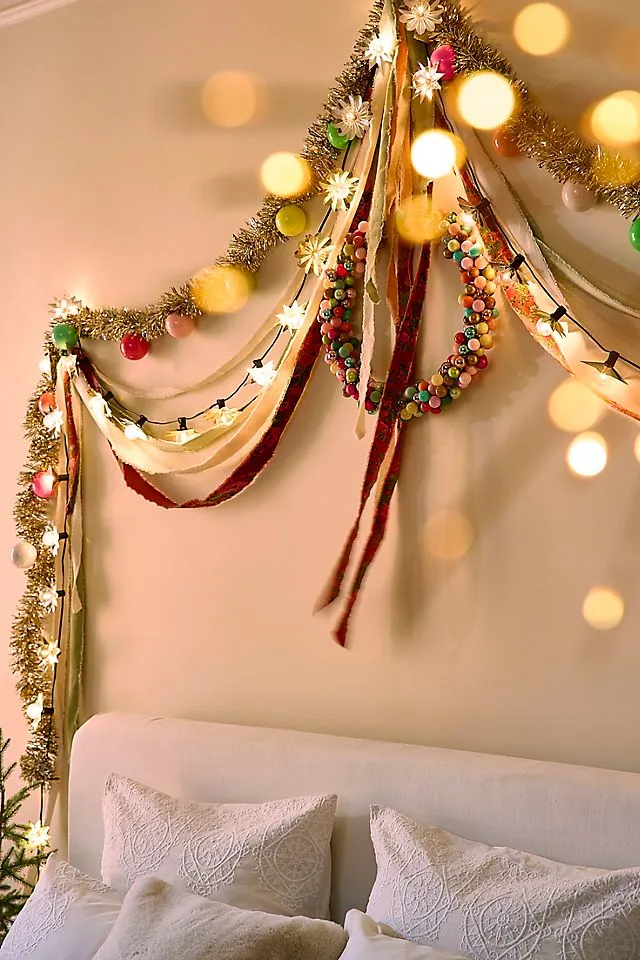
- Ceiling height — you need at least 12 inches above the headboard for a drape to look intentional.
- Anchor points: removable hooks rated for the weight, or a picture rail. Never nail into drywall over a pillow.
- Head clearance: nothing should hang lower than 18 inches above the mattress.
- Power: is there an outlet nearby, or are you going battery lights?
Anything hanging over a bed collects dust and lint from bedding, so plan on a monthly pass with a microfiber duster. Fabric ribbons absorb cooking odors and pet dander — an unlacquered plaid ribbon will smell like last week’s bacon by January. A fabric refresher helps, but honestly, ribbon is the piece to replace each year. If you share the bed, get sign-off before you commit to a full tinsel installation. And if you’d rather keep the display out of the bedroom, Idea #30 shrinks the same tinsel-and-ornament idea onto a cabinet top.
20. A Flocked Tree in Pink, Cream and Ceramic Angels
The flocking is the foundation, and it’s why the pink works. On a plain green tree, pastel ornaments look like they’re being ironic. On a heavily flocked tree, the white base makes pink, cream and sheer ribbon bows read as genuinely romantic rather than aggressively sweet. The ceramic angels and floral-patterned baubles are doing something similar — they’re soft shapes against soft color, with no hard edges to break the mood. If you buy one flocked tree, buy it durable, because a cheap one sheds white fuzz all season.
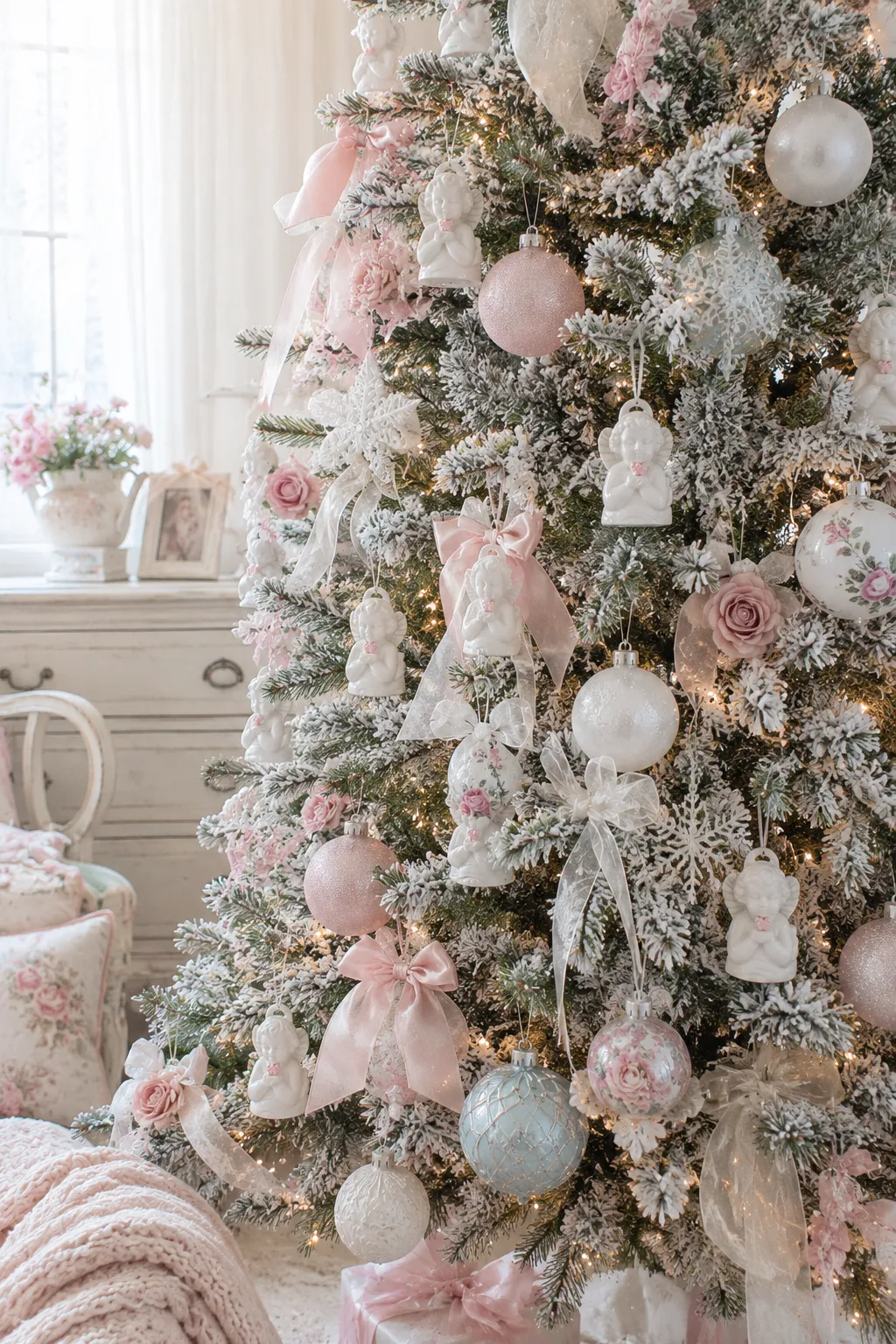
Flocked trees are messier than they look in photos. Expect a light snowfall of fake flocking on the floor when you assemble and disassemble, so put a sheet down during setup. Store it in a proper tree bag rather than the original box, or the flocking flattens against the branches. Ribbon bows crush easily, so wrap the delicate ones in tissue and store them separately. Realistically: twenty minutes of fallout every year, forever.
21. Pink Tapers and a Tiered Floral Centerpiece at the Table
This table is more affordable than it looks:
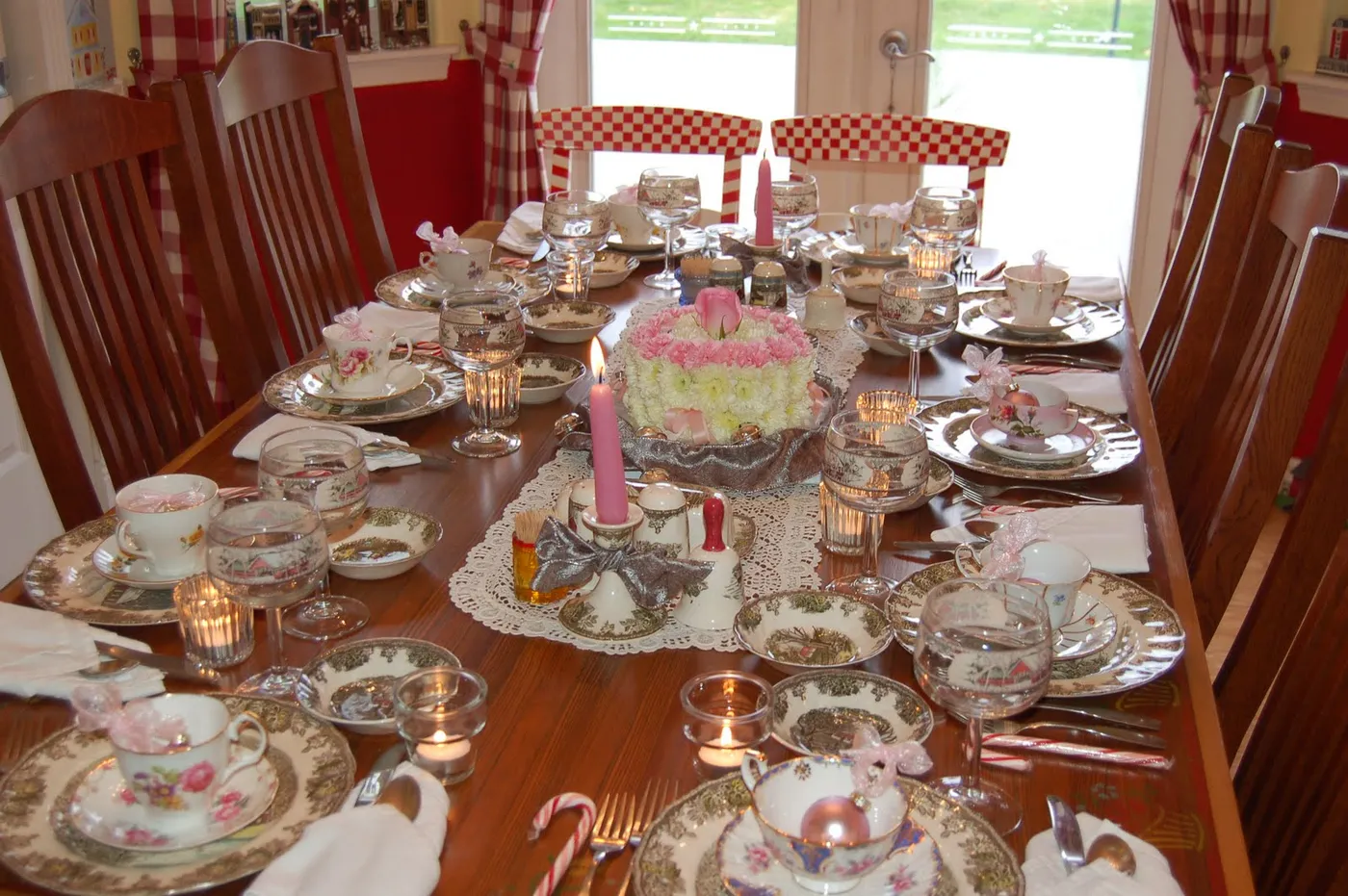
- Floral patterned china, four to six settings: $40–$120
- Crystal glassware, set of six: $30–$80
- Pink taper candles, box of 12: $12–$25
- Red and white checkered chair covers, set of four: $30–$70
- Floral centerpiece materials: $35–$75
- Total: $150–$370
Most of this is thrifted, and mismatched floral china from three different patterns beats a matched set here every time.
Set the table twice before guests arrive: once to photograph, once to actually eat. Move the candy canes and bells off the plates into a small bowl near the center, because nobody wants to negotiate a centerpiece to reach their fork. Keep tapers at least 10 inches from any guest’s elbow, and if you’re using real candles, trim the wicks to a quarter inch so they don’t smoke the china.
22. A Bronze Candlestick Wearing Blue and Amber Glass
Colorful glass looks best when it has one dark, neutral thing to sit on. Here the dark wood surface and the ornate silver-and-bronze base do the grounding, which lets the cobalt, teal and amber ornaments read as jewel-like instead of random. Mixing clear, tinted and glitter-filled pieces in the same arrangement is what creates depth — the glitter-filled ornament looks lit even when it isn’t. Three finishes, one silhouette: that’s the trick.
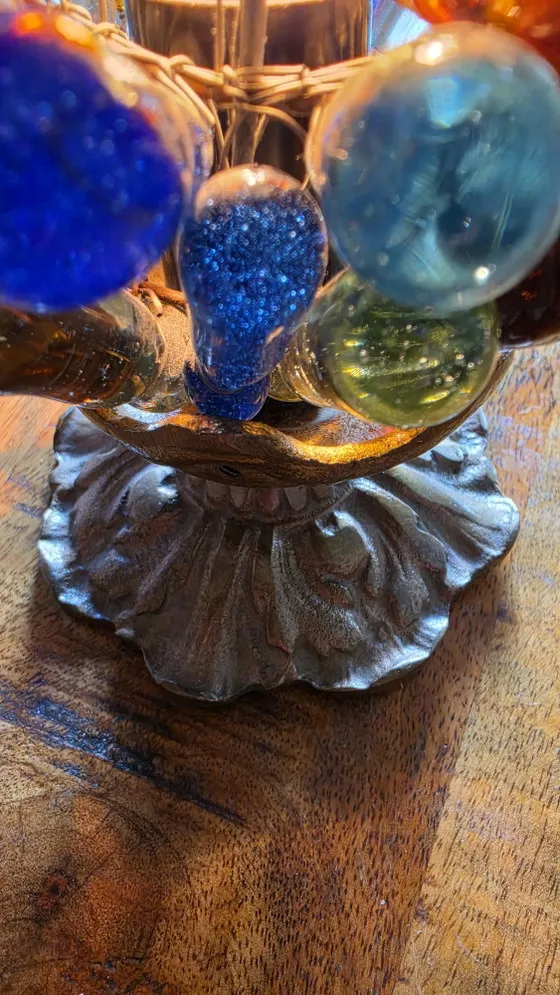
To assemble a holder like this:
- Find a heavy candlestick with a wide, textured base at a thrift store ($4–$10).
- Clean it well and spray the metal with a thin coat of clear lacquer to slow tarnish.
- Loop thin wire around the cup and twist to create hanging points.
- Attach six to eight glass ornaments at staggered lengths.
- Set it on a dark tray so dust and drips don’t show.
Roughly 30 minutes and $25–$45 including the ornaments.
23. One Oversized Red Bauble Suspended in Gold Tinsel
Maximalist vintage — tinsel, pastel mini-baubles, velvet ribbon — is having a genuine resurgence, partly because it’s cheap and partly because it’s joyful. Tinsel garland, once the punchline of 1970s decorating, now reads as campy and confident. The staying power is real: tinsel doesn’t date, it just cycles. Buy one good strand of gold rather than five flimsy ones and it’ll last a decade in a box.
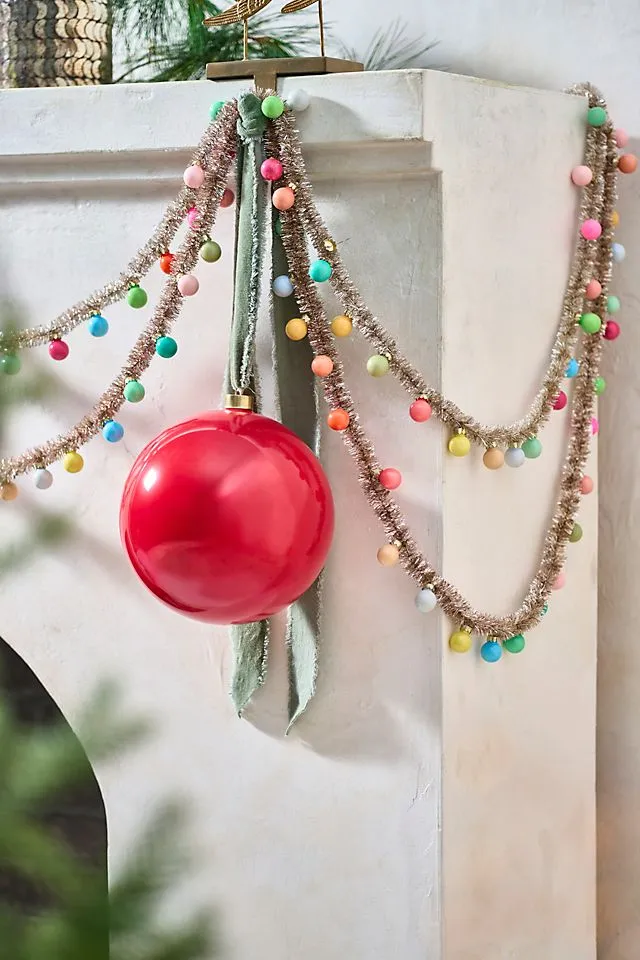
Everything in this vignette can come from a dollar store and a craft aisle. A 9-foot gold tinsel garland runs $5–$10, soft green velvet ribbon is $6–$10 a yard, and a large glossy red bauble is $3–$8. The gold mantel hook is about $4 at any hardware store. Total: under $30. If you want to upgrade one thing, make it the bauble — a heavier, well-glazed ornament looks dramatically better up close than three lightweight ones.
24. A Matte Gold Jingle Bell in Dark Fir and Red Velvet
The formula is simple and a little unforgiving: 50 percent dark fir, 25 percent deep red, 25 percent matte gold, and no fourth color allowed. Matte finishes matter more than you’d think — if that bell were polished brass it would read cheap next to the velvet. Keep everything non-reflective and the whole arrangement feels like a page from a 1950s department store catalog, in the best possible way.

A bell this size, roughly 6 to 8 inches, needs an anchor of about 12 to 18 inches of greenery to look intentional. On a narrow mantel under 4 feet wide, go with a smaller 4-inch bell or it’ll dominate the whole shelf. Door wreaths can handle the big one — just check that the hook is rated for at least 3 pounds once you add the bow, ribbon and berries. Small porch trees work too, though anything under 4 feet tall will look top-heavy.
25. Mercury Glass Ornaments Strung on Black-and-White Rope
Mercury glass garlands are lighter than they look and slide along rope if you don’t space them evenly. They also tangle hopelessly, so store yours looped over a hanger inside a garment bag rather than dumped in a box. Note the finish, too: real vintage mercury glass is silvered on the inside, so the shine is protected, while modern lookalikes are coated on the outside and dull after a few seasons of handling. Keep them out of direct sunlight either way.
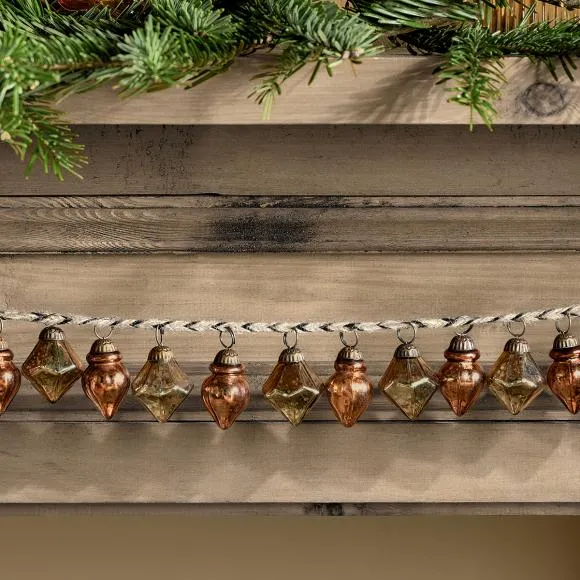
The black-and-white braided rope is what makes this feel found rather than styled. Swap in a gold cord and the same ornaments become a mall display; keep the utilitarian rope and it reads like something pulled out of a grandmother’s attic. It costs about $8 for 10 yards. That’s the entire vintage trick in one line item — plain, unglamorous materials doing the framing so the pretty things look inherited.
26. A Flocked Tree Beside a Mid-Century Chair and Shaggy Throw
Flocked trees wash out under ceiling lights, so lighting is the whole game. Use warm white LED strands only — no cool white, no multicolor — and place one small lamp or plug-in sconce in the corner behind the tree. That backlight separates the white branches from the wall and makes the flocking glow instead of flatten. Keep ornaments in muted blues, matte golds and warm browns so the tree reads soft rather than busy, and about 60 ornaments is plenty for a 7-foot flocked tree.
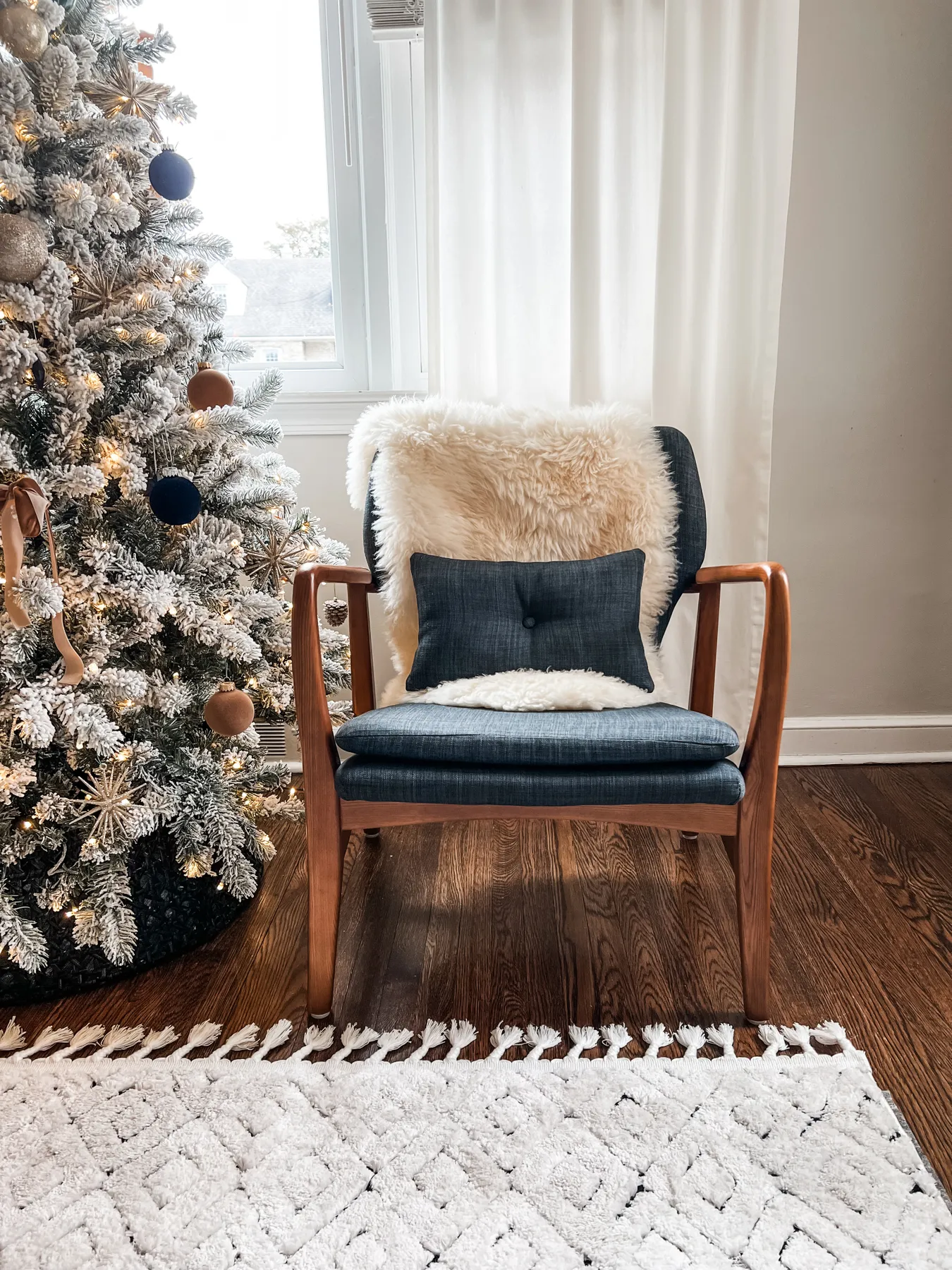
Pricing this corner out:
- Flocked 7-foot pre-lit tree: $180–$600
- Mid-century armchair: $200–$900, or $60–$150 thrifted
- Shaggy cream faux fur throw: $30–$90
- Blue and gold ornaments, 60 count: $45–$120
- White geometric shag rug: $60–$200
- Total: $515–$1,910
The chair is where you hunt secondhand. A $90 Marketplace armchair reupholstered in navy velvet gets you there for a fraction of retail. Compare with Idea #20 — same flocked base, completely different personality.
27. A Retro Sunroom With a Patchwork Rug and Granny Squares
This is the kind of room that looks effortless and takes upkeep. A stone accent wall is low-fuss but needs resealing every few years depending on the stone. A vintage CRT television weighs a ton and eats floor space — enjoy it, but lift it properly when you rearrange. Granny square blankets are machine washable on cold, air dry only, and they pill if you wash them with towels. A patchwork rug this colorful hides stains beautifully, which is exactly why it’s a smart pick for a room that gets used.
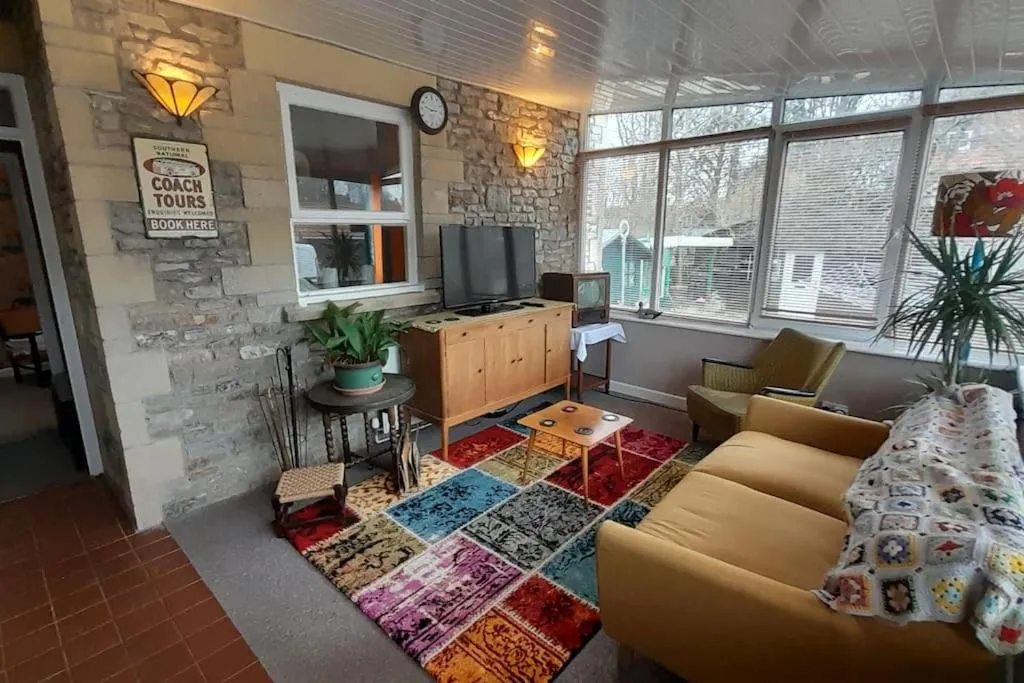
Mustard yellow and olive green sit next to each other on the color wheel, so they feel warm rather than contrasting, and the terracotta and light wood tie them together. The patchwork rug gets away with being loud because everything above it is solid and quiet. The stone wall gives the room a texture no paint can fake, which makes the vintage pieces look like they belong to the house instead of being staged inside it.
28. Hand-Painted Holly on Glass, Straight From the Craft Table
Hand-painted glass ornaments sell for $8–$25 apiece, but the technique is beginner-friendly. Buy plain glass or shatterproof spheres (about six for $10 at a craft store), pick up enamel paint pens in red and green, and copy simple holly: three leaves, three berries, done. A green fluted velvet ornament can be faked with a matte green sphere plus a thin line of gold glitter glue. Fill a bowl with a mix of DIY and thrifted pieces and nobody will know which is which.
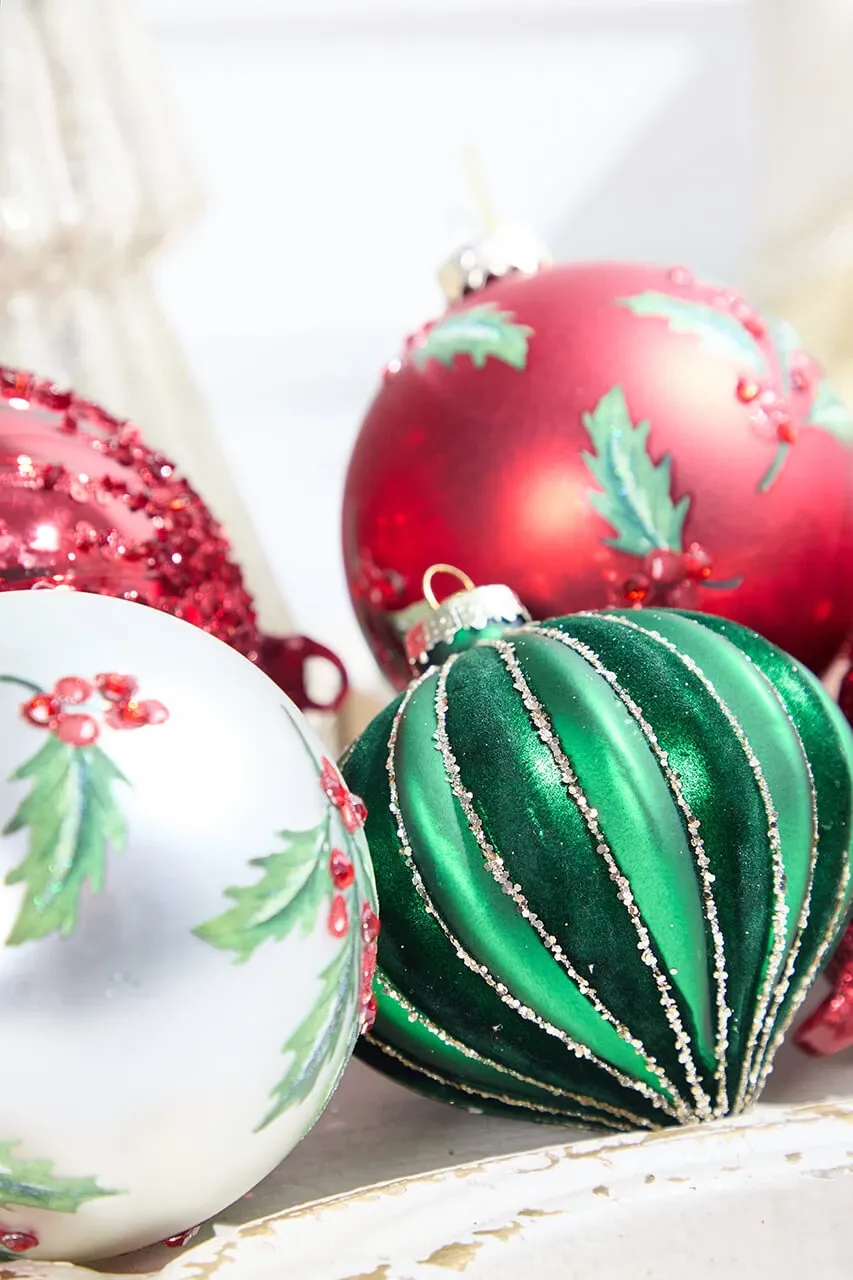
Painting ornaments that survive the season:
- Wipe each sphere with rubbing alcohol and let it dry completely.
- Sketch the holly lightly with a water-soluble marker; it disappears under paint.
- Paint leaves first, then berries, letting each layer dry 20 minutes.
- Seal with clear acrylic spray and cure for 24 hours.
- Hang by the cap so the sealant doesn’t pool at the bottom.
About two hours for six ornaments. Materials run $15–$25.
29. Gold Baubles and Pillar Candles on a Dark Reflective Tray
This arrangement is a tabletop piece, not a floor display. Plan for a surface at least 20 inches deep and 30 inches wide — a console, sideboard or dining table center works. The folded paper trees behind it want 10 to 14 inches of clearance so they don’t get crushed. If your surface is narrower than 16 inches, drop the trees and keep just the candles and baubles in a single line. Taller rooms can stack the baubles higher; low ceilings should keep everything under 10 inches tall.
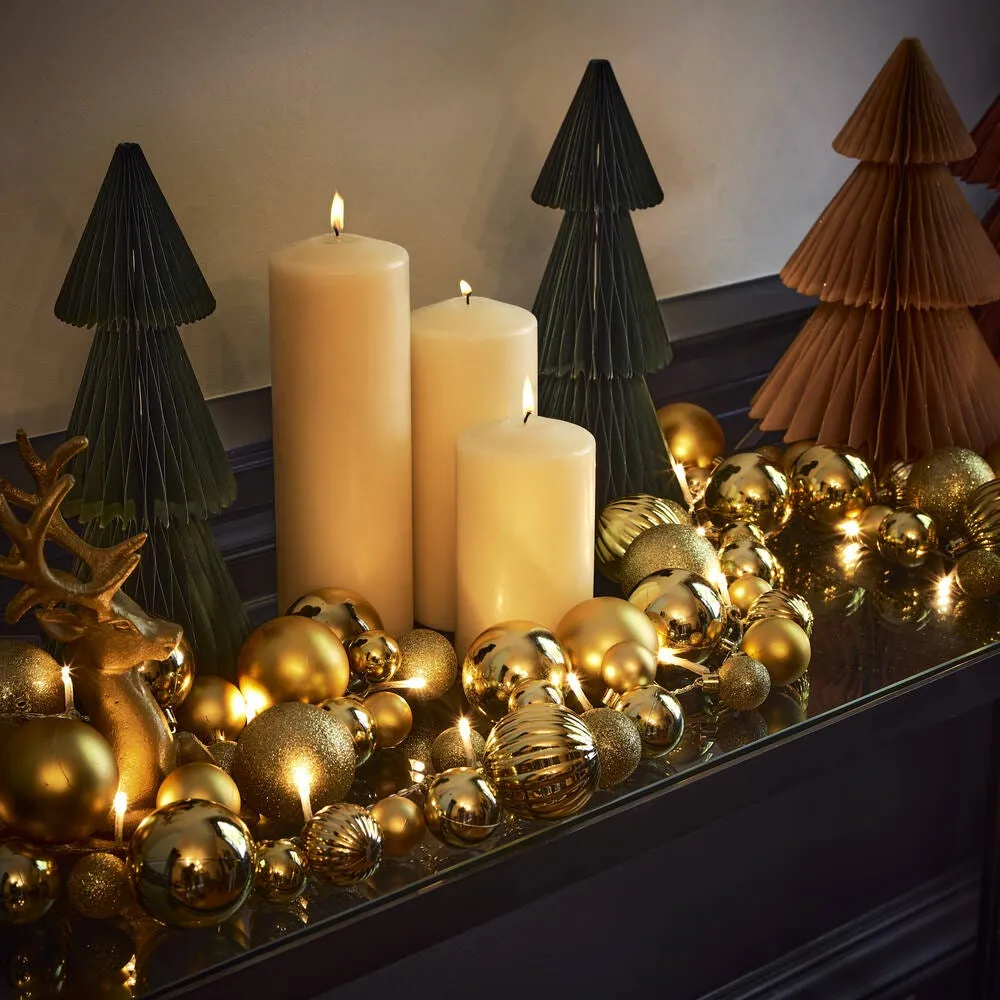
Reflective trays are unforgiving, so polish before you arrange and dust weekly. More useful: vary the finish on the baubles. A mix of shiny, matte and glittered gold in roughly equal thirds is what keeps a monochrome pile from looking like one flat blob. Scatter two or three short strings of tiny lights through it rather than one big strand, so the sparkle looks accidental. And use a fireproof coaster under real candles, even on metal.
30. Pastel Baubles, Pink Tinsel and a Very Retro Wreath
This is a pastel-heavy formula: 40 percent pastel pink and mint, 35 percent metallic tinsel in gold and silver together, which is unusual and works, 15 percent cream ribbon, 10 percent bright accents. The tension comes from pairing soft pastels with hard metallic, so the display feels nostalgic without going saccharine. Swap the pink for pale blue and the same structure reads icy and modern — same percentages, different mood entirely.
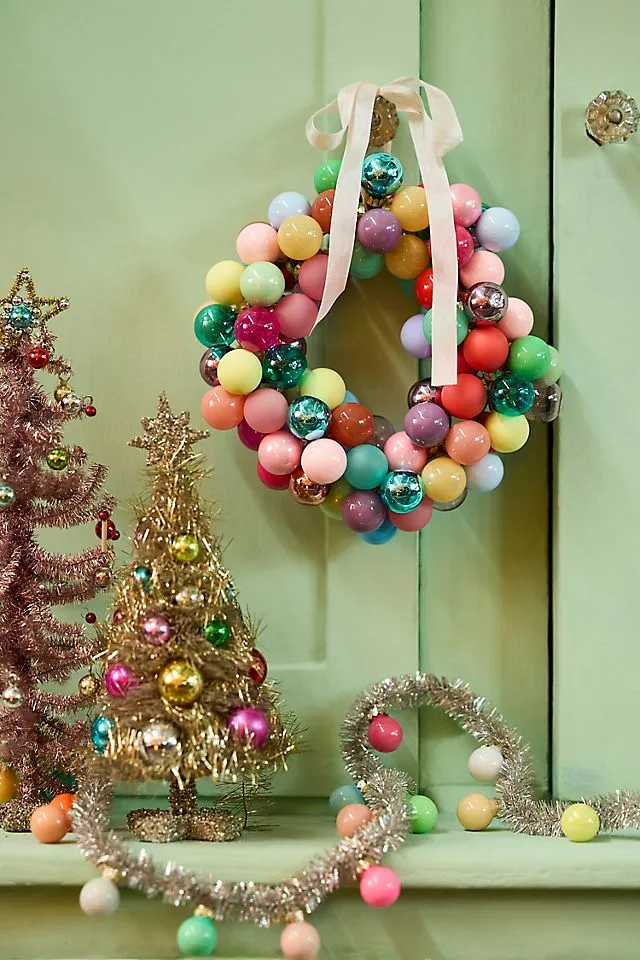
Check these before you commit to a pastel display:
- What’s the surrounding color? Pastel baubles on beige go muddy; they need green, white or strong contrast.
- Do you have a hook or a door for the wreath, and is it safe from slamming doors?
- Tinsel trees tip easily — they need a sturdy, level surface, not a narrow shelf edge.
- Set a budget ceiling. Pastel bauble sets multiply fast at $15 a bag.
31. Green Mercury Glass Strung on Plain Twine and Bare Branches
It’s the twine. Using natural jute twine instead of ribbon or wire is what turns a garland of green mercury glass into something that looks scavenged from a barn. The twine is cheap — around $6 for a large spool — and it’s the reason the ornaments don’t feel precious. Bare brown branches mixed in with the fir needles are the second half of that idea: they add a wintry, almost Scandinavian texture that green ornaments alone would never give you.
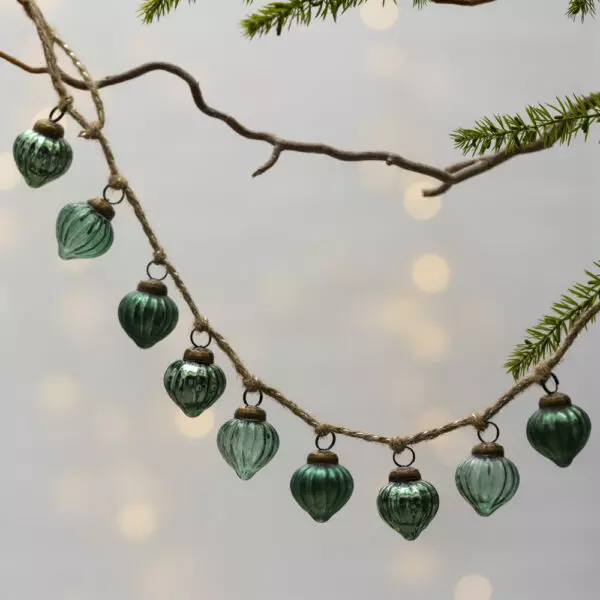
Green mercury glass ornaments are the one thing worth buying new, because tinted reproductions look convincingly old. A set of 12 in mixed aqua and emerald runs $20–$40 online. Everything else here is basically free: twine from a hardware store, bare branches from the yard after a windy day, and greenery clippings from your own tree. Compare with Idea #13, which takes the same idea in silver and jute for a slightly dressier version.
32. Fresh Pine, Pinecones and a Gold-Framed Mirror
Fresh pine garland is beautiful and high-maintenance. It drops needles from the day you bring it home, needs misting every couple of days indoors, and dries out within three weeks in a heated room. Keep it away from fireplaces, radiators and vents, and never put real candles directly under it. If that sounds like too much, a good faux pine garland with wired branches gets you 90 percent of the look with zero cleanup. Mercury glass also tarnishes faster in humid rooms, so keep this arrangement out of steamy kitchens and bathrooms.
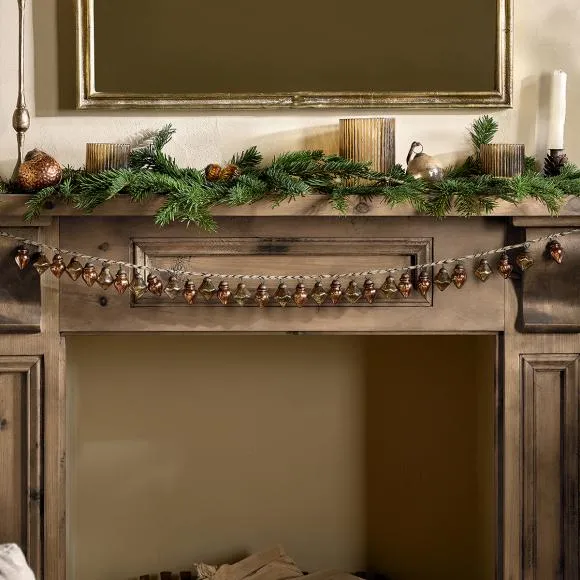
This mantel reads best on a shelf at least 5 feet wide and 10 inches deep, and the mirror above wants roughly two-thirds the width of the mantel to feel proportional. Ceiling height matters less than shelf height — below 4 feet off the floor and the drape of the garland gets hidden behind furniture. If your mantel is narrow, hang the ornament garland across a window frame instead, where the same draping works at half the width.
33. Terracotta Walls, a Mustard Sofa and a Leaded Bay Window
Terracotta walls are a commitment, and the mustard sofa is why it works. Two saturated warm tones next to each other feel rich rather than clashing when dark wood trim and a patterned rug do the boundary work between them. The bay window’s leaded upper panes add an architectural detail no decor can replicate, and the leopard print pillow throws in one unexpected pattern so the room feels lived-in instead of museum-staged. One pattern, one accent, everything else quiet.
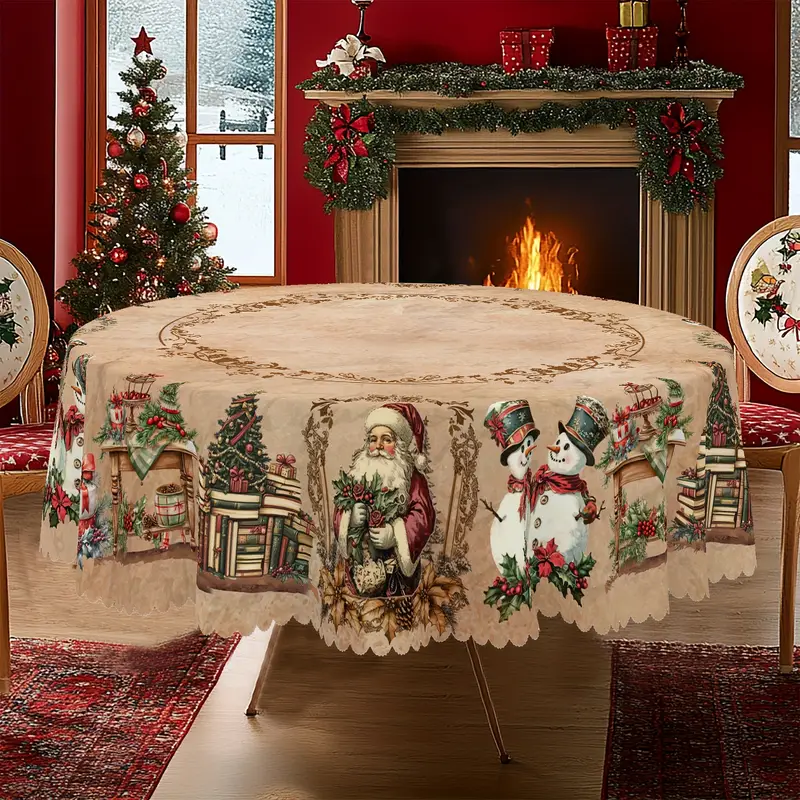
When your walls are this saturated, keep the tree simple and let the architecture speak. A tree with mainly warm white lights and wood, cream and brass ornaments will glow against terracotta; a multicolor tree will fight the walls and lose. Aim for ornaments in the same warm family — cream, amber, brass, burgundy — and skip silver entirely, which turns grey and cold next to terracotta paint.
34. Deep Red Walls and an Illustrated Christmas Tablecloth
Deep red walls, a lit fireplace, an illustrated tablecloth:
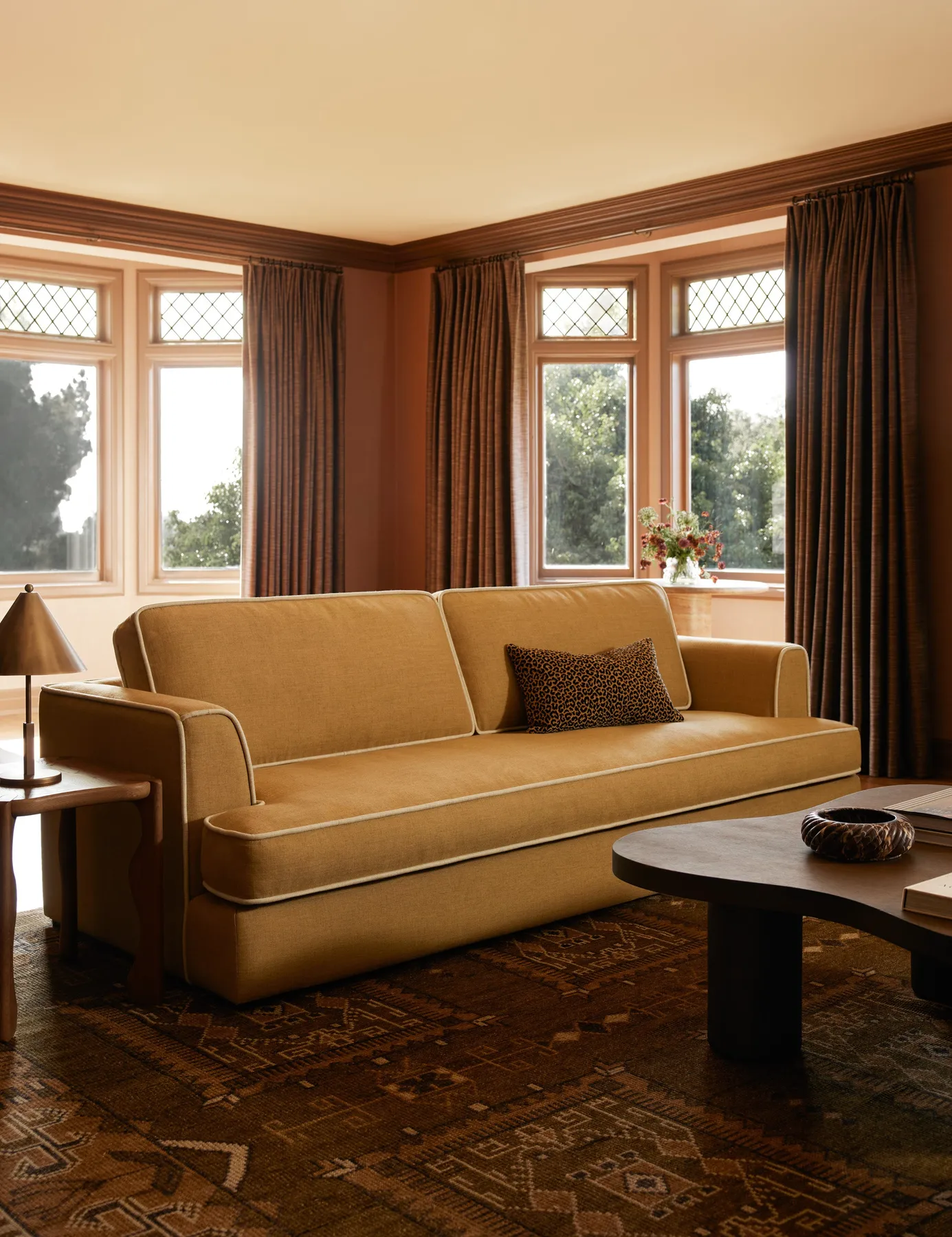
- Illustrated Christmas tablecloth: $40–$120
- Deep red wall paint, one gallon: $35–$70
- Green garland and red bows: $40–$100
- Red patterned area rug: $80–$350
- Wooden chairs with patterned seats: $90–$250 each
- Total: $375–$1,600+
Renting? Skip the paint and let the tablecloth and garland do the work — you’ll get most of the warmth for under $150.
Illustrative tablecloths are charming and completely impractical for a big dinner. Crumbs land on Santa’s hat, a red wine spill is permanent, and a hot dish straight from the oven will mark printed cotton. Use it over a plain white cloth rather than on its own, and keep a second plain cloth handy for the actual meal. Deep red walls also make a room feel smaller and darker at night — if there’s only one small window, use a lighter red or confine it to the wall behind the fireplace.
The proportions here are about 40 percent deep red, 30 percent forest green, 20 percent beige and white, 10 percent gold. Red and green can slide into cliché, and the reason this room avoids it is the beige tablecloth and wooden chairs — that neutral third keeps the two strong colors from bouncing off each other. Want it lighter? Raise the beige to 40 percent and drop the red to 20.
Box Up the New, Bring Out the Old
Vintage Christmas decorating isn’t a shopping problem — it’s a collecting habit, and you’re allowed to build it slowly. Start with one thing you already own: a mirror, a mantel, a wooden tray. Then add the jute twine, the black ribbon, the mismatched candlesticks, one estate-sale bauble at a time. Next December it’ll look like it’s been in your family for decades.
📌 Pin your favorite ideas now so you can find them again when the boxes come down from the attic.