Still scrolling past the same five outdoor holiday planters on Pinterest, trying to figure out which ones actually survive a real December?
We spent serious time browsing Home Depot, Target, IKEA, and Facebook Marketplace to bring you only what is worth your attention this year — from $35 terracotta upgrades to $450 stone urns.
Inside you will find 35 curated ideas built around four styles: rustic evergreen, glossy red traditional, ornate metallic, and natural woodland. Budget and luxury versions sit side by side so you can see exactly where the extra money shows up — and stay until the end, because we break down the three mistakes that ruin these looks most often.
In 2026, outdoor planters have moved away from one wreath and done toward layered, structural arrangements — saves for pedestal urns and birch-log planters are climbing fast, and the reason is simple: they photograph beautifully from the street.
Pin this guide for later — your future self will thank you when it is time to actually do this. (Some links in this guide are affiliate links; we may earn a small commission at no cost to you.)
1. Gold Bead Cascade in a Brown Ceramic Pot
The gold beads are what turn this from a nice evergreen arrangement into something that belongs on a magazine cover. Without them you have a brown pot of pine — perfectly pleasant, instantly forgettable. The cascading strands catch low winter light and pull the eye down the full length of the arrangement, which is exactly what a planter needs to do when it is viewed from six feet away on a sidewalk.
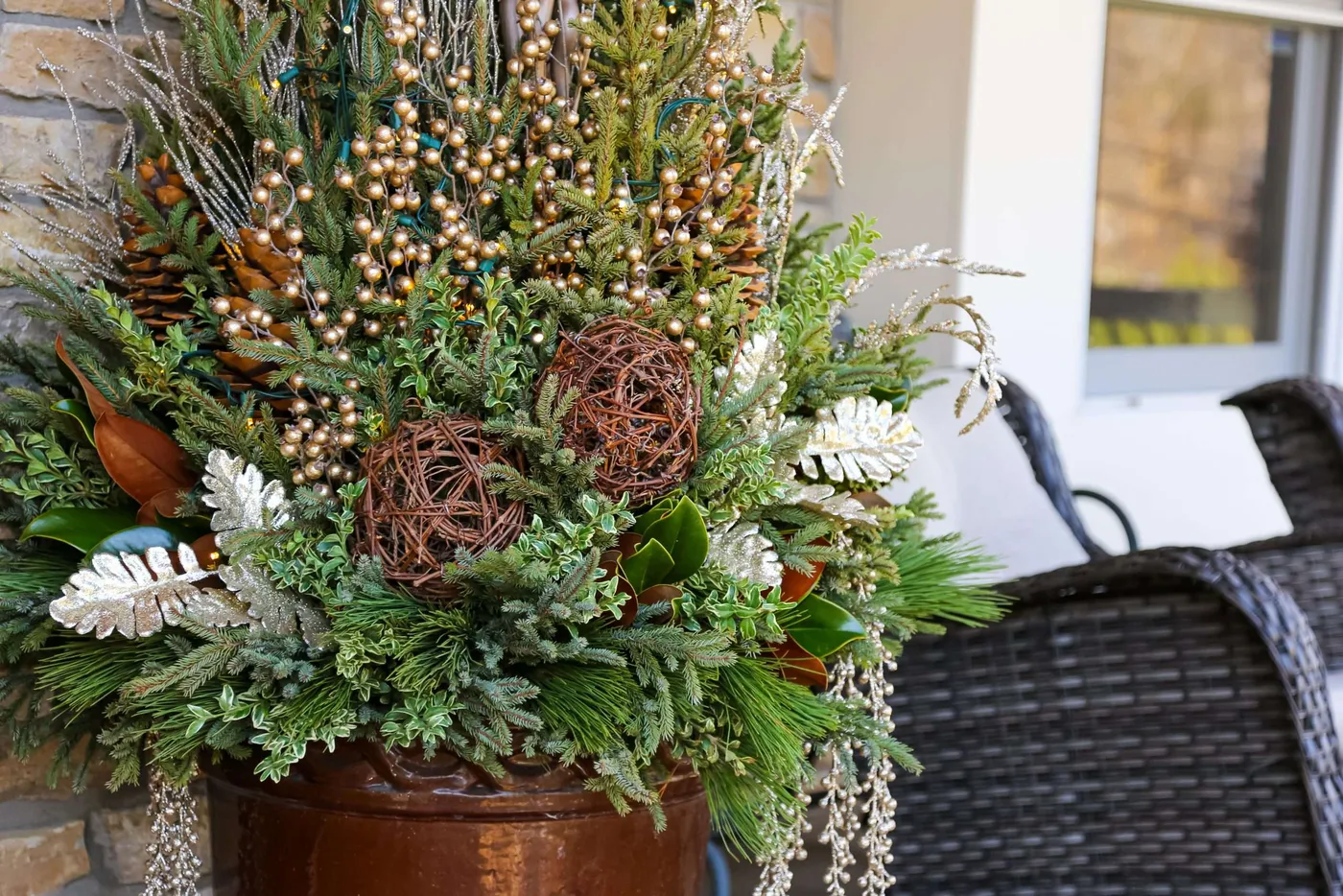
Drape beads from a single anchor rather than weaving them randomly. Push one end of a 6-foot strand of gold bead garland into the foam at the top center, then pin it with a U-shaped floral staple at three points — one-third down, two-thirds down, and just below the rim. Angle each strand slightly outward so light hits the curve. Three strands, three angles, ten minutes.
2. Weathered Terracotta With Crimson Berries
Aged terracotta is gorgeous and slightly high-maintenance. The same porous walls that give it that chalky, lived-in texture soak up water and then freeze, and freeze-thaw is what cracks pots. If yours is a sentimental piece, drop a plastic liner inside and treat the terracotta as a sleeve. Also, real berry clusters turn to mush after two hard freezes — plan on swapping in faux picks by mid-January.
The formula here is 70% deep green evergreen mass + 20% warm terracotta and wood-brown texture + 10% crimson red. To shift the mood, keep the percentages and swap the materials — replace terracotta with galvanized steel and crimson berries with white ones and you get a farmhouse version of the exact same arrangement. Proportion is what makes it read as deliberate.
3. Snow-Dusted Porch With Lanterns and a Vintage Sled
- Measure the walkway first — leave at least 36 inches of clear path, even if it means smaller pots.
- Check which direction the porch faces. North-facing means frost clings to the evergreen for days, which is beautiful but slows drying and invites rot.
- Decide where cords go before you buy lit lanterns. Battery pillar candles cost more up front and save an extension cord headache.
- Anchor the sled, crates, and galvanized bins — anything lightweight ends up in the neighbor’s yard.
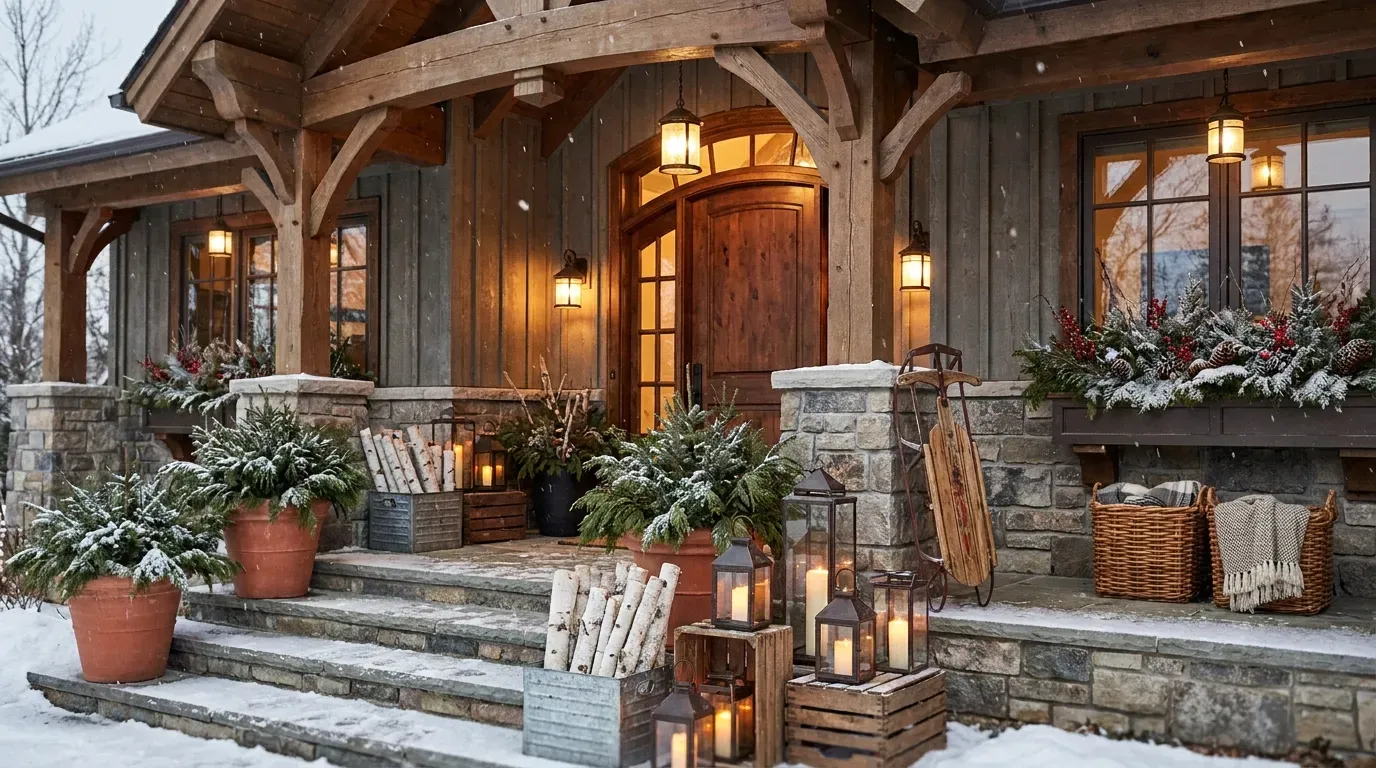
Three things are doing the heavy lifting: repetition, vertical layering, and warm-versus-cold contrast. The same terra cotta pot appears at the steps, in the window boxes, and beside the door, which makes a wide porch feel intentional rather than cluttered. Birch logs and a wooden sled create three distinct heights. And the amber candle glow against cool stone and snow is the oldest trick in the book for making an entry feel welcoming at 5pm in December.
4. Bronze Planters Framing a Wood Front Door
- Two large bronze-finish planters: $180-$420
- Fresh evergreen, magnolia, and berry bundles: $60-$140
- Pre-lit garland for the frame: $70-$200
- Wreath with silvery-blue bow: $45-$120
- Patterned coir doormat: $25-$60
Total: $380-$940
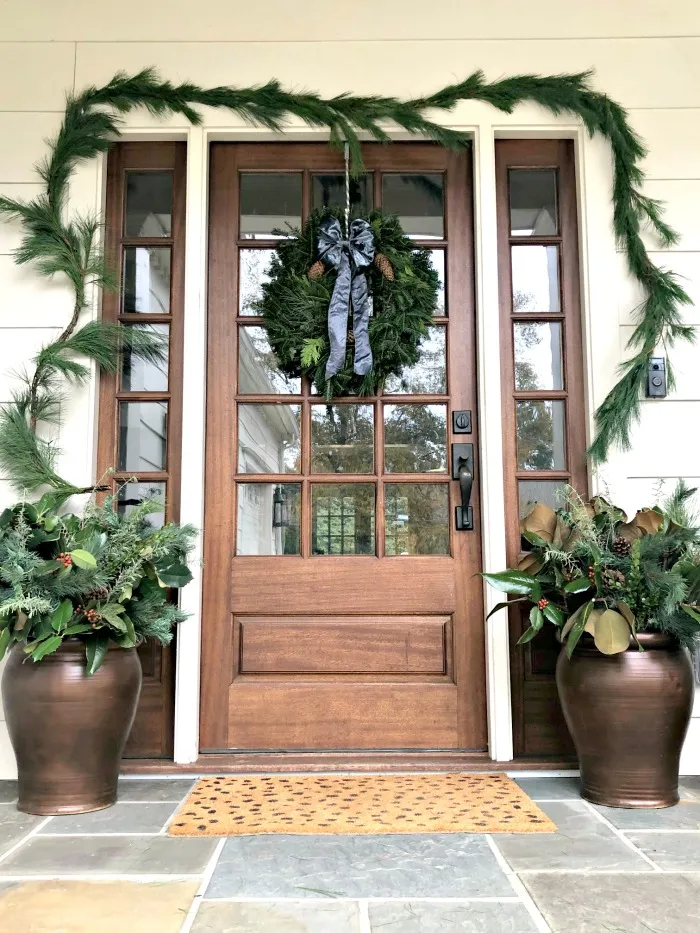
Budget alternative: spray two $30 resin urns in bronze metallic, use faux magnolia picks from a craft store, and buy garland on December 26th for next year. Total: $170-$260.
Planters flanking a door should reach roughly one-third of the door’s height — for a standard 80-inch door, that means a pot and arrangement topping out around 26 to 30 inches. Anything shorter and the entry looks unfinished from the street. Hang garland so its lowest point sits 10 to 12 inches above the door frame; lower than that and it squashes the whole entry visually.
This layout wants about 72 inches of clear width across the stoop — roughly 24 inches per planter plus a 24-inch walking gap. On a narrower 48-inch landing, drop to two 14-inch pots and skip the garland, or move one planter to the opposite side of the steps.
5. Birch Twigs and Shiny Baubles in a Dark Square Planter
You do not need to spend $300 to get this look. Facebook Marketplace and local garden centers dump birch branches for free or nearly free in late November. Buy shatterproof ornaments at a dollar store — a 40-piece set runs about $8 and reads identically to glass from the sidewalk. One $25 dark resin planter, sprayed matte, holds up fine under a covered porch.
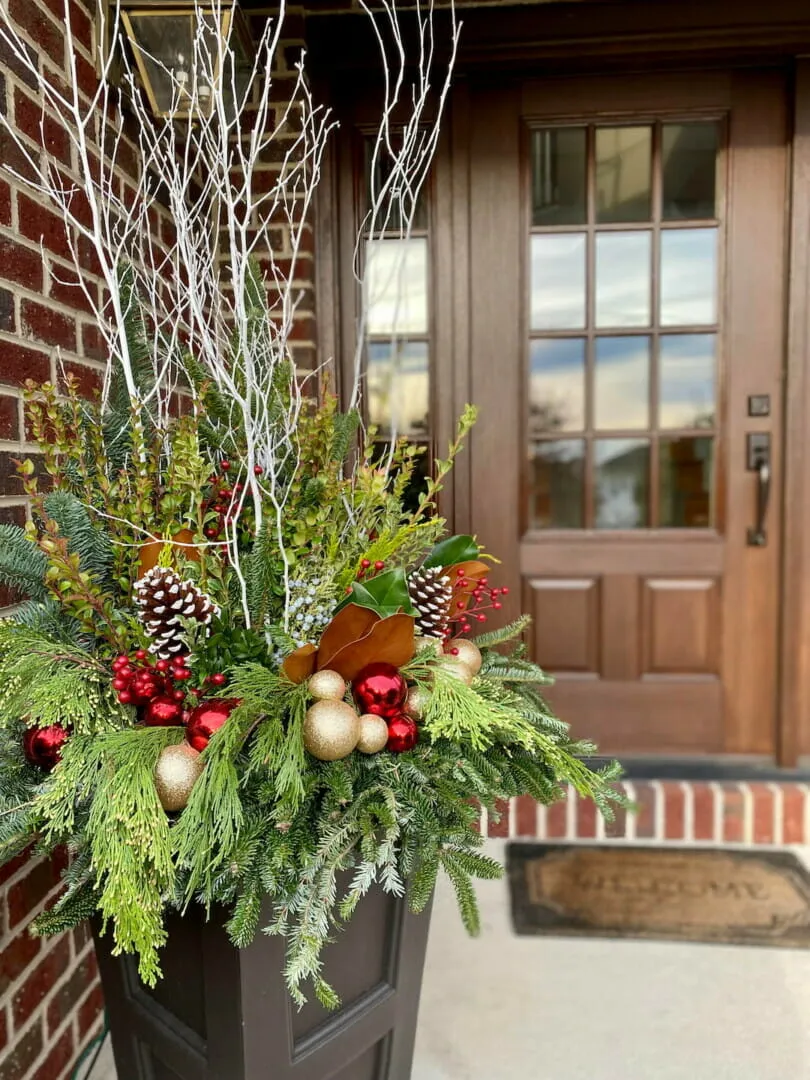
The formula is 55% evergreen green + 25% dark pot and white birch + 20% red and gold together. That last 20% is the part people get wrong — the red needs the gold to keep it from reading cheap. This is the same entry formula as Idea #10, scaled down for a narrower stoop.
6. Red Twig Dogwood and Dried Hydrangea in Bronze
- Soak floral foam and cut it to sit one inch below the pot rim. (5 min)
- Push the tallest red twig dogwood stems in first — odd numbers, 5 or 7, fanning slightly outward.
- Fill around them with evergreen boughs, working in a full circle so no bare patches show.
- Tuck dried hydrangea heads and magnolia leaves into the gaps near the rim, letting a few spill over.
- Finish with pinecones and berry clusters at the front and both sides.
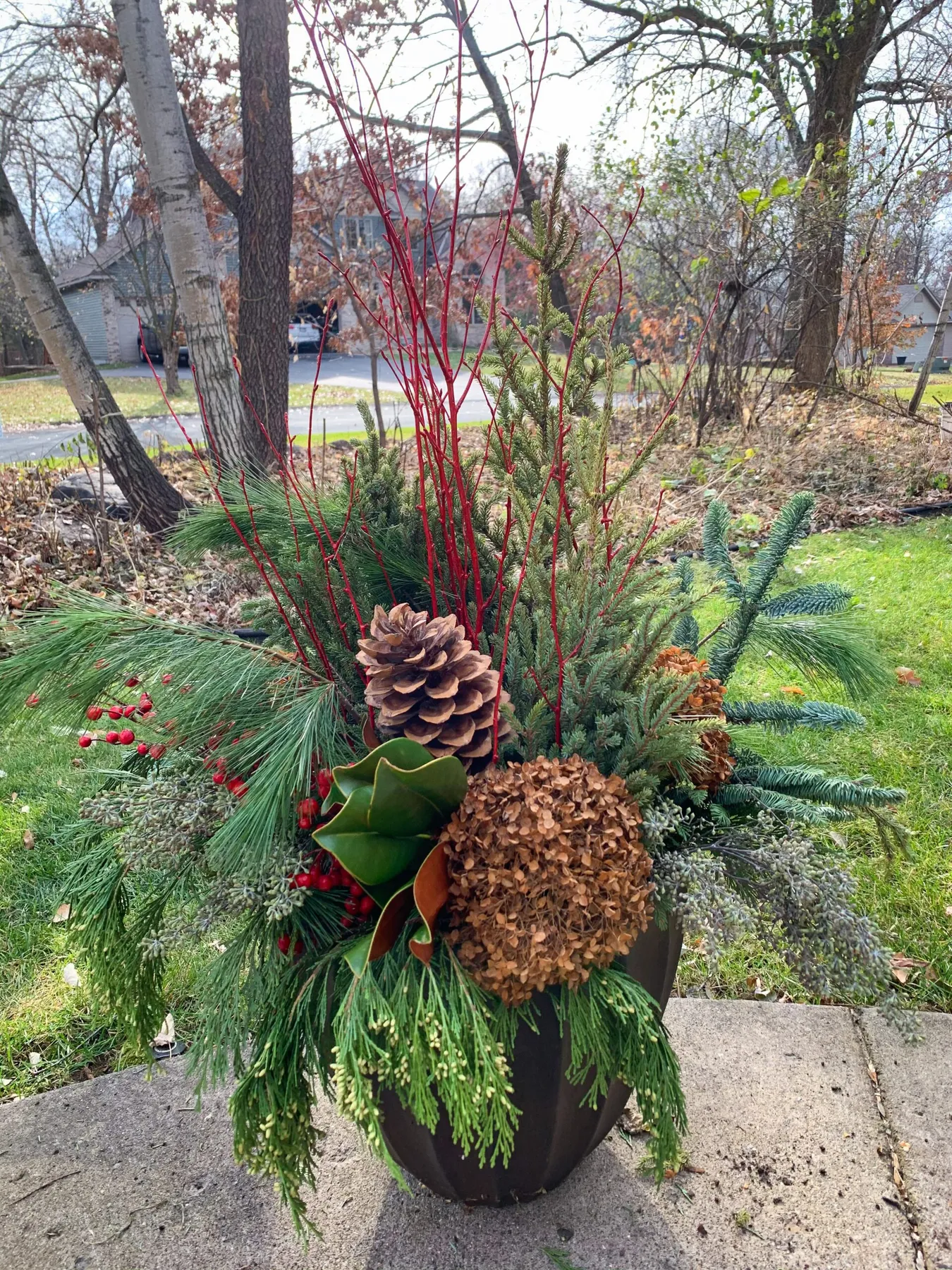
Roughly 45 minutes and about $30 in materials if you forage the hydrangeas yourself.
The texture contrast does the work. Fresh, glossy evergreen next to papery brown hydrangea, rigid red twigs shooting up through soft mass — that mix of crisp and crinkled keeps a winter planter from looking flat in photographs. Magnolia leaves add a third texture with a waxy front and matte brown back, so they reflect a little light without ever looking shiny.
7. A Boxwood Spire Rising From a Classical Urn
A pedestal urn needs room to breathe. On a landing under 48 inches wide, one urn is enough — two will crowd each other and make the door feel narrower. Aim for a floor-to-tip height of about 48 to 60 inches when the urn sits on a pedestal, and keep 12 inches of clearance on all sides so the cascading juniper does not get crushed against a wall.
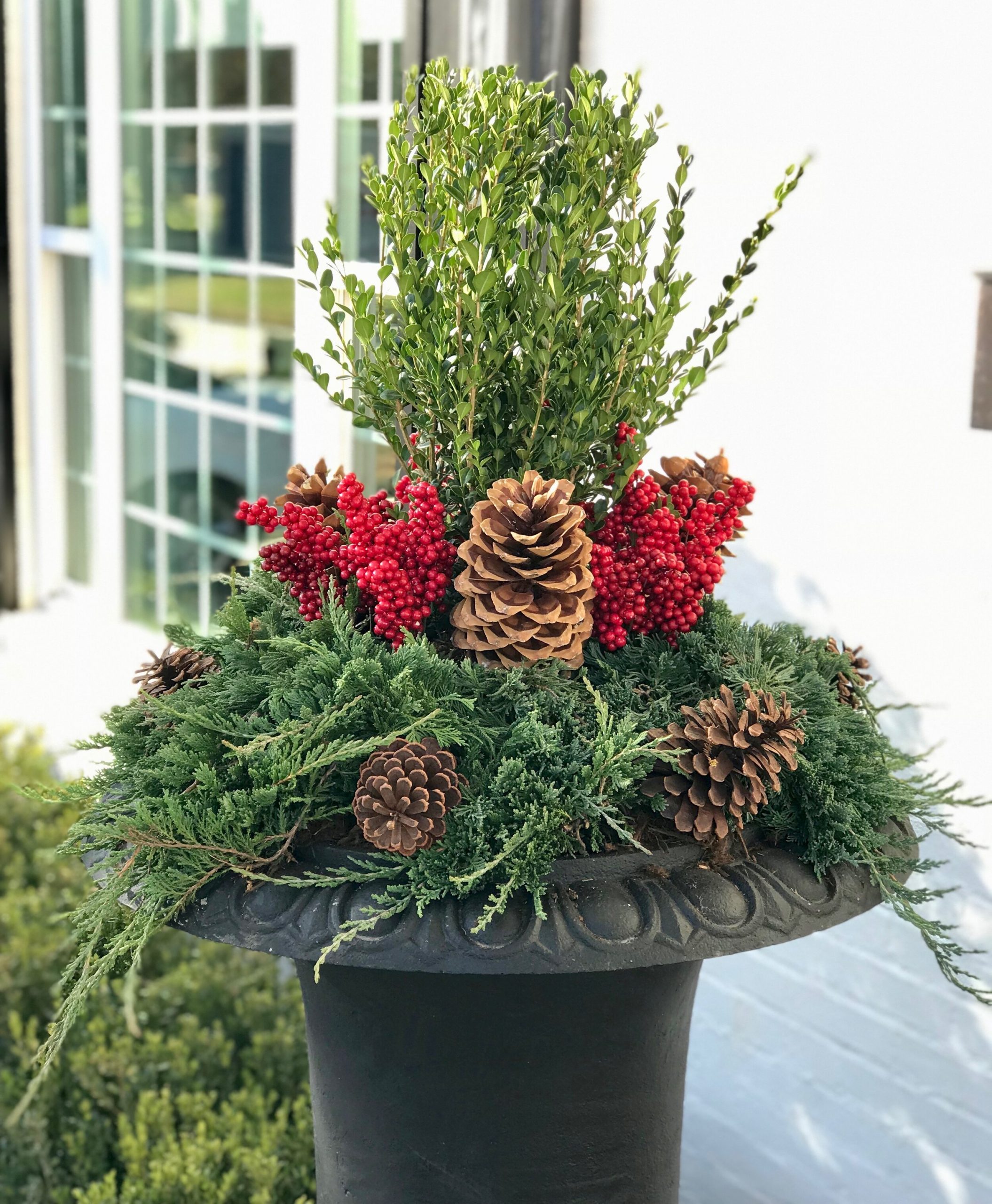
The boxwood center should be roughly two to two-and-a-half times the rim diameter of the urn. On a 16-inch urn, that means a 32- to 40-inch spire. Skinny centerpieces get swallowed by the cascade, and anything taller starts looking like a topiary accident rather than an arrangement.
8. Rose Gold Baubles on Frosted Branches
Rose gold is the 2026 story in outdoor holiday decor. For a decade the default was cool silver and icy blue; this year saves for warm metallics, champagne, and copper keep climbing, and designers lean into it because warm metals hold up better against evergreen than cool ones do. Rose gold in particular photographs beautifully at dusk, which matters if your porch is lit from 4:30pm on.
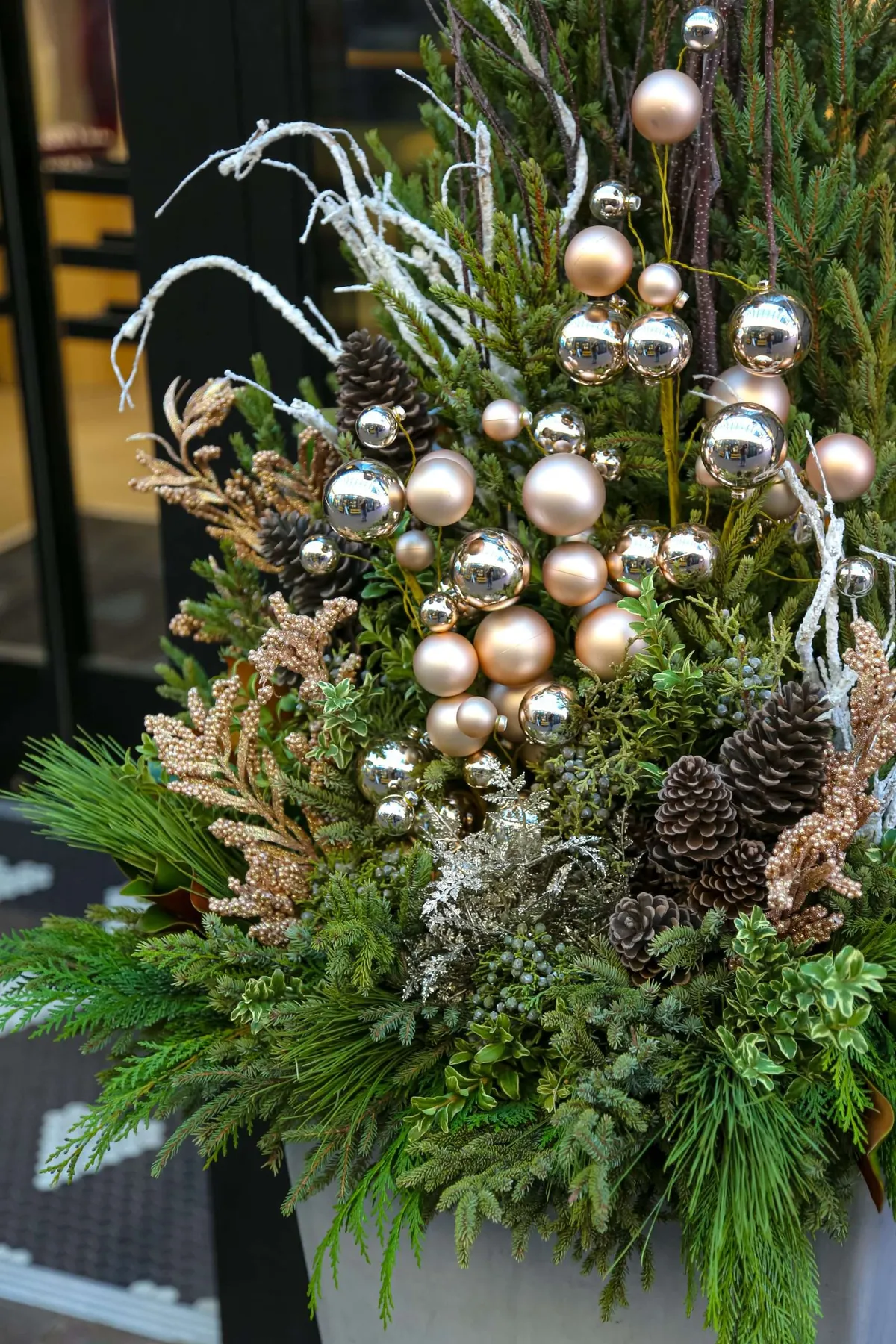
Build it as 50% evergreen green + 30% rose gold and silver combined + 20% frosted white branches and foliage. Keeping the frost to one-fifth of the volume is what stops it from looking like the spray-paint aisle exploded. Swap rose gold for antique brass, change nothing else, and you get a more traditional version for a brick colonial.
- Mixed evergreen bundle: $40-$90
- 24 large shatterproof rose gold and silver ornaments: $30-$70
- Frosted branch picks (6-8): $25-$60
- Oversized urn or basket: $60-$180
Total: $155-$400
Budget alternative: spray matte white on dollar-store branches, reuse last year’s tree ornaments, and shop the after-Christmas sales for the following season.
9. Ribbed Grey Urn With Copper Leaves and Lotus Pods
Dried lotus pods are hollow and brittle — they shatter if you look at them wrong in a hard freeze. Copper-finished leaves fade to dull bronze after one wet season, so treat them as a one-winter splurge. And pale twigs shed fine bark dust across your porch whenever the wind picks up. None of this is a dealbreaker, but budget on replacing the copper picks and the pods annually.
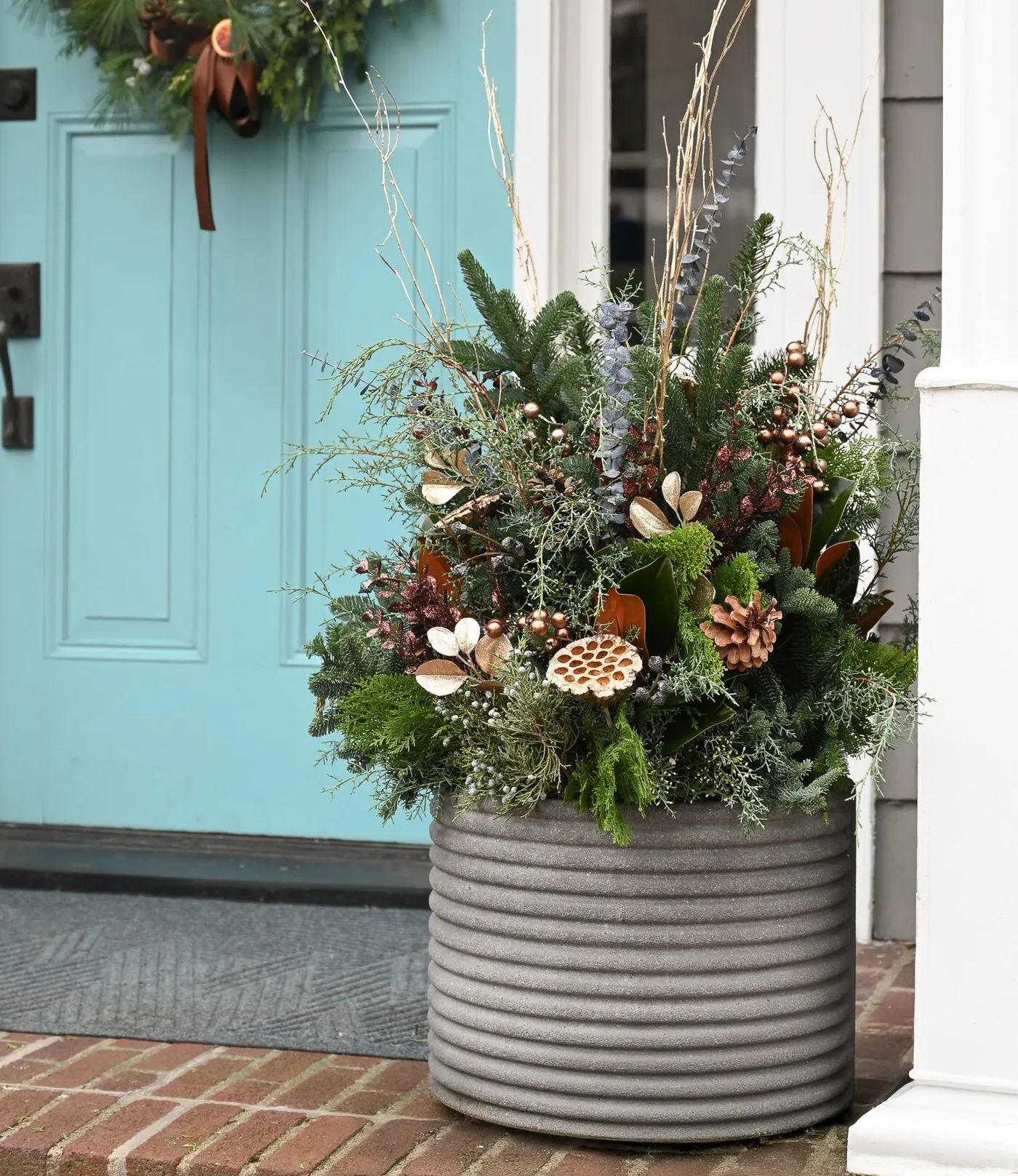
- Wrap 24-gauge floral wire around the base of each pod, twisting twice so it holds.
- Push the wire tail straight down into the foam until the pod sits flush with the foliage.
- Place pods in a loose triangle — three at the front, two behind — never in a straight row.
- Insert copper leaves at a 30-degree angle so they catch light from the street.
- Step back ten feet. If you cannot see the pods from the sidewalk, move them forward.
10. Three Glossy Red Pots Against a Blue Door
- Three glossy red ceramic planters (14-16 inch): $150-$360
- Cypress and evergreen branches: $50-$110
- Red berry clusters: $20-$45
- Trailing ivy, live or faux: $15-$40
- Pinecones: $10-$25
Total: $245-$580
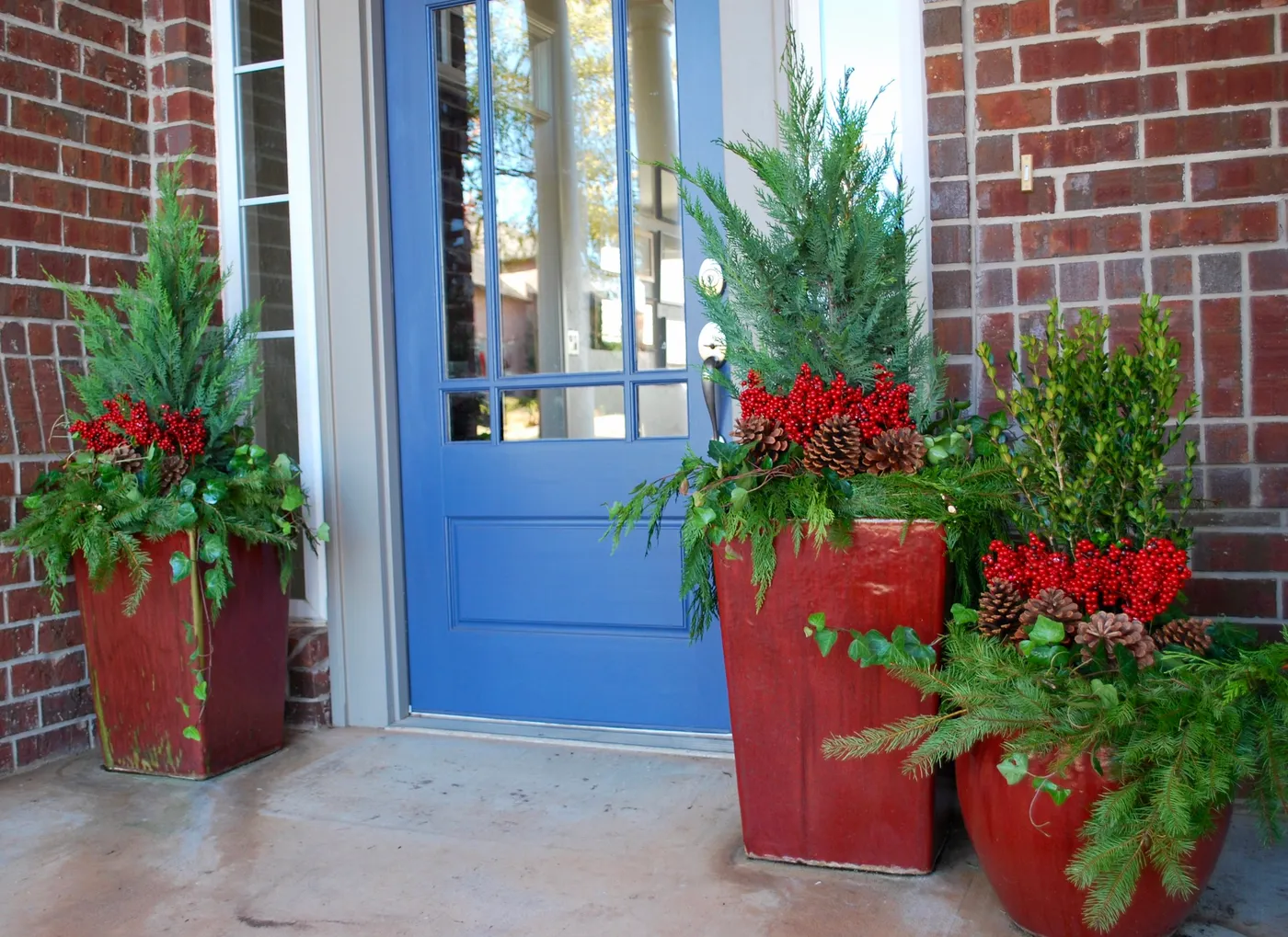
Budget alternative: terracotta pots sprayed in glossy cherry-red enamel ($12 per pot) plus faux ivy from a discount store gets you 85% of the look for under $90.
The blue door is the whole trick. Red and blue sit opposite each other on the color wheel, which is why three red pots against navy look intentional instead of busy — the eye gets a complementary hit from ten feet away. Put those same pots against a white or beige door and the arrangement is pretty but never quite alive.
11. Stone Urn Glowing With Woven Fairy Lights
Fairy lights sold as weatherproof mostly are — until the batteries die. Cold-weather battery packs lose 40 to 60% of their runtime below 32°F, so change them in November, not December 23rd. A plug-in transformer is more reliable but needs an outdoor outlet within cord reach. One more warning: lights woven through real greenery trap moisture against the branches, so set them into sealed foam rather than soil.
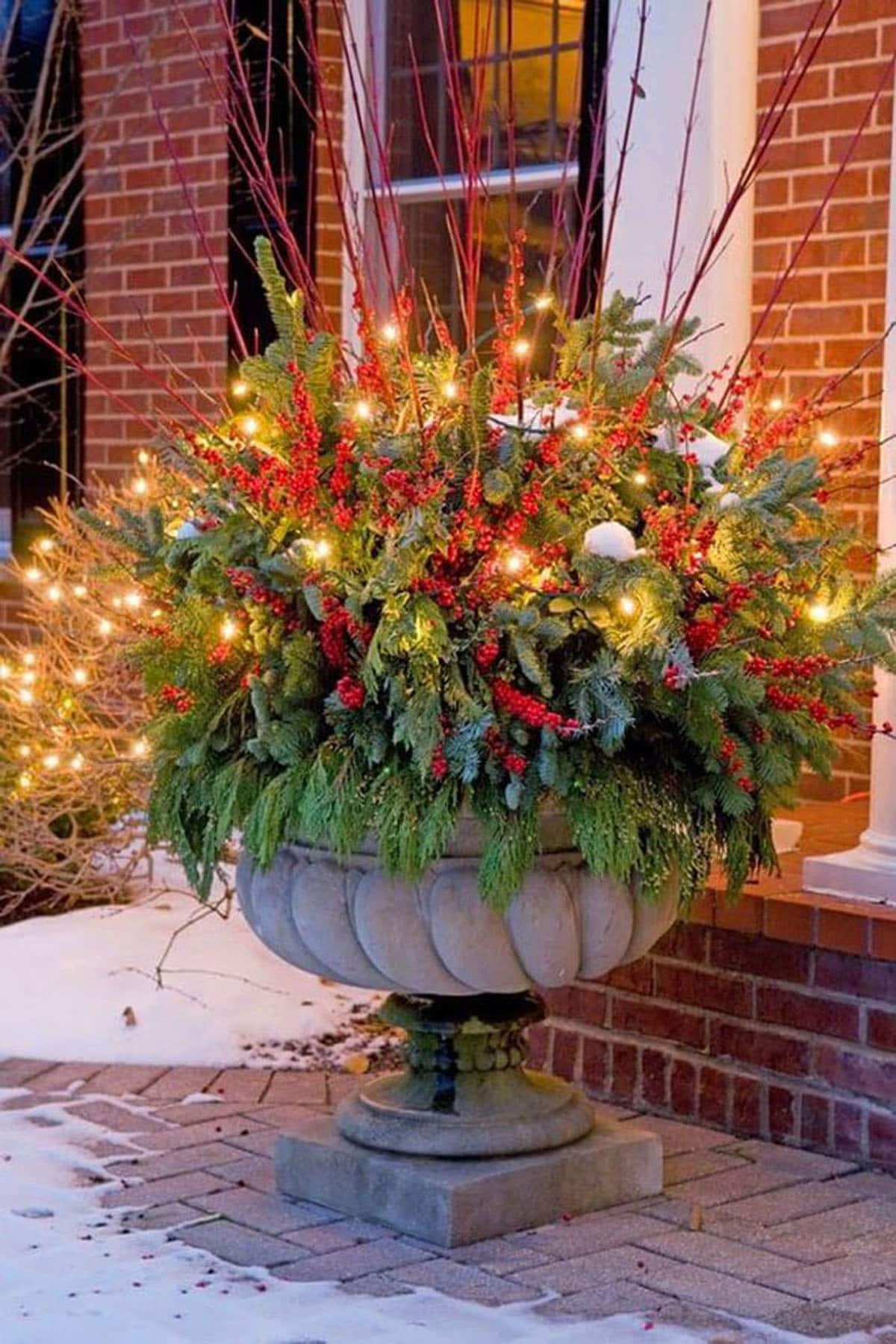
Pedestal urns need width to work. On a walkway narrower than 36 inches, a tall pedestal urn turns into an obstacle course. This arrangement fits comfortably on a landing or patio corner with at least 3 feet of clearance on two sides, and it shines on red brick, where stone gray has something warm to sit against.
12. Cedar Sprigs and Seed Pods in Tall Dark Planters
Wire red berry stems in at a 45-degree angle, not straight up. A diagonal stem reads as growth; a vertical one reads as a stick. And measure your tallest branch before you commit — it should sit about 1.5 times the height of the planter itself. On a 24-inch planter, that means branches topping out around 36 inches above the rim.
Tight packing is the entire secret. When evergreen is pushed in densely enough that no foam shows, the arrangement catches light in dozens of small facets instead of a few big ones, which is why it looks expensive. Cedar is the key player — its flat, feathery sprays fill gaps that pine needles leave open.
- Start with one tall center branch and two shorter flanking branches.
- Ring the outside edge with cedar first, angled outward over the rim.
- Fill the middle with pine and fir until the foam disappears.
- Add seed pods and pinecones last, in odd-numbered clusters.
- Push berry stems in diagonally at the end so they sit on top of the foliage.
Compare with Idea #11 — same palette, completely different energy.
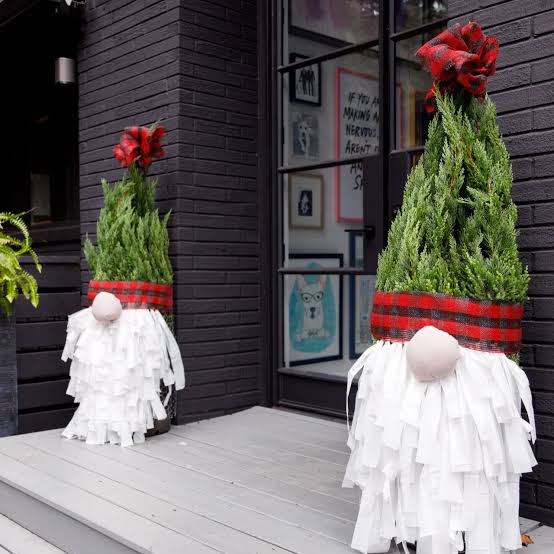
13. Plaid Ribbon and Boxwood on a Symmetrical Entry
Plaid ribbon is the cheapest upgrade in holiday decorating — $6 to $12 a roll at Target or Walmart, and three rolls cover a wreath, two planters, and a window box. Use live boxwood clipped from your own shrubs (it takes late-fall pruning well) and buy red ornaments after Thanksgiving, when big-box stores start marking them down weekly.
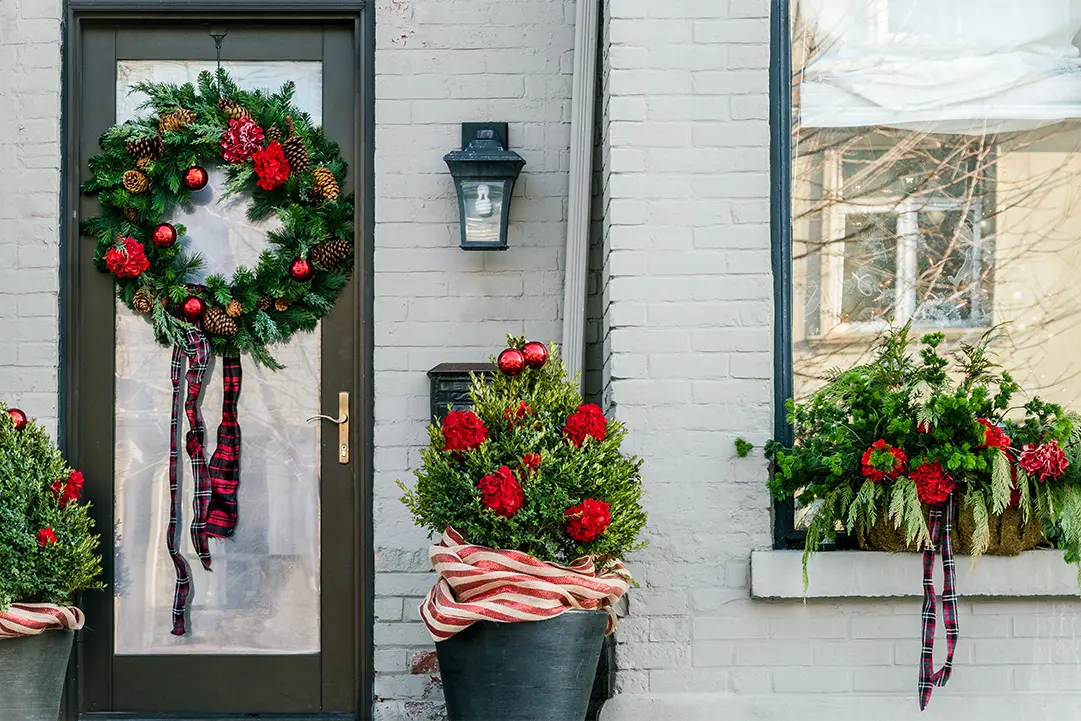
The formula is 60% dark neutral (charcoal pots, black door, deep ribbon fold) + 25% forest green boxwood + 15% bright red. That dark base is why this reads as classic rather than candy-cane. Swap charcoal for warm gray and plaid for solid red and the same arrangement drifts toward farmhouse.
Real boxwood in a winter planter needs water, even in December. Wind burn turns the leaves bronze-brown by February if the root ball dries out, and it will not green back up until spring. Check moisture every two weeks on mild days and top it off. On a north-facing entry with drying wind, faux boxwood is honestly the smarter call.
14. Tapered White Planter Against Red Brick
- Measure the pot base against your porch depth — tapered planters wobble on uneven brick.
- Confirm the white finish is exterior-grade. Matte white shows every scuff.
- Decide your silver-to-green ratio before you shop. 30/70 reads elegant; 50/50 reads frosty.
- Test the lantern with a real candle or LED before you commit to its placement.
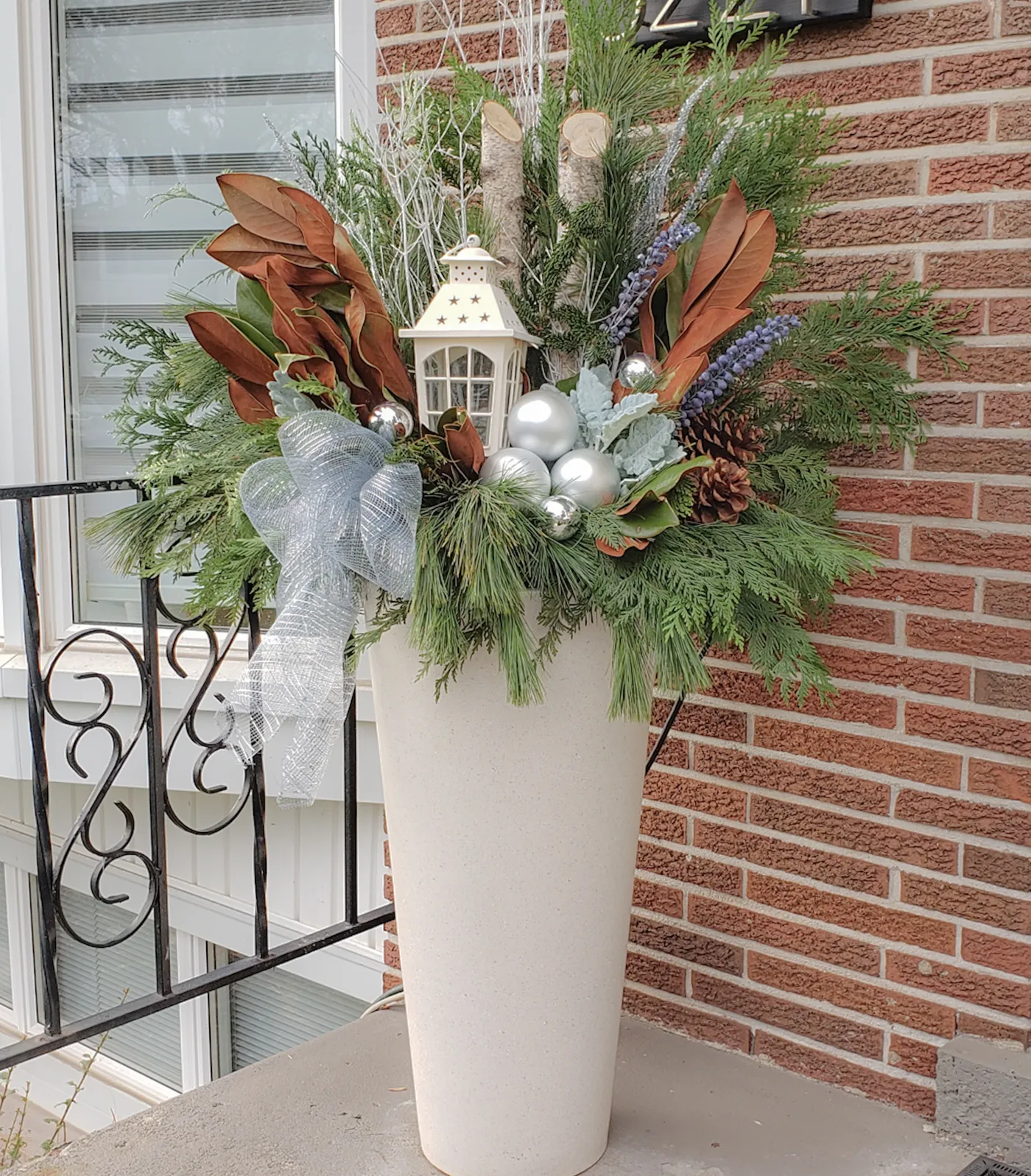
- Cut 3 yards of sheer wire-edged ribbon and fold it in half.
- Pinch the center and twist once to form the knot.
- Make two loops, one on each side, holding them with your thumb.
- Cinch with 24-gauge wire and fluff the loops outward.
- Wire the bow to a birch log at the front, slightly above center.
15. Birch Logs Standing Tall in a Dark Planter
Three birch logs standing vertically separate this from every other evergreen planter on the block. Take them out and you have a perfectly nice, perfectly anonymous arrangement. The logs give the eye a hard vertical line, and that pale, peeling bark is the only cool-toned note in a warm green composition — which is why it reads as designed rather than decorated.
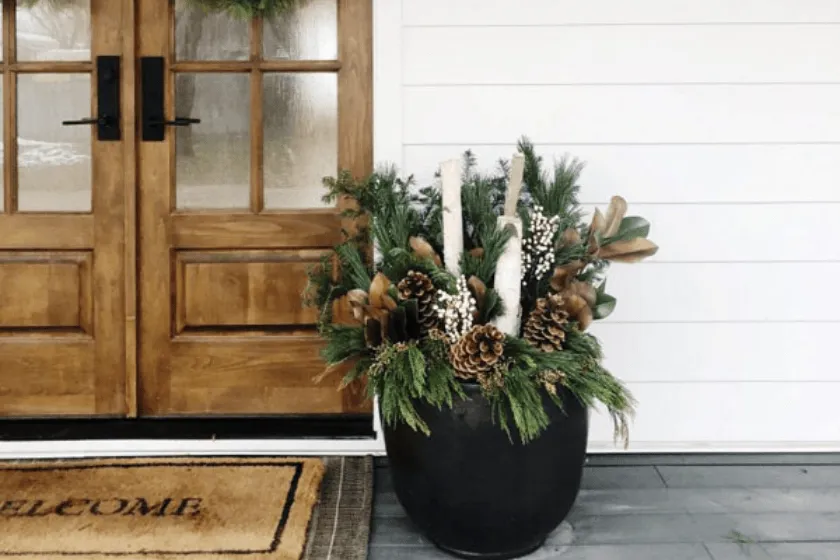
Birch bark peels and drops papery curls all winter, so do not put these planters directly in front of a door you sweep. And white siding behind a dark planter is a high-contrast pairing — gorgeous in daylight, a little stark under a single porch bulb. Add one warm light source near the base to soften it.
16. Cascading Chartreuse Juniper Over a Stone Urn
Let exactly one element cascade. Pick your longest trailing juniper branch, drape it so it hangs 6 to 10 inches below the urn rim, and keep everything else contained. Cascade from more than one direction and the arrangement turns into a shaggy mess; cascade from none and the urn looks pinched at the shoulders.
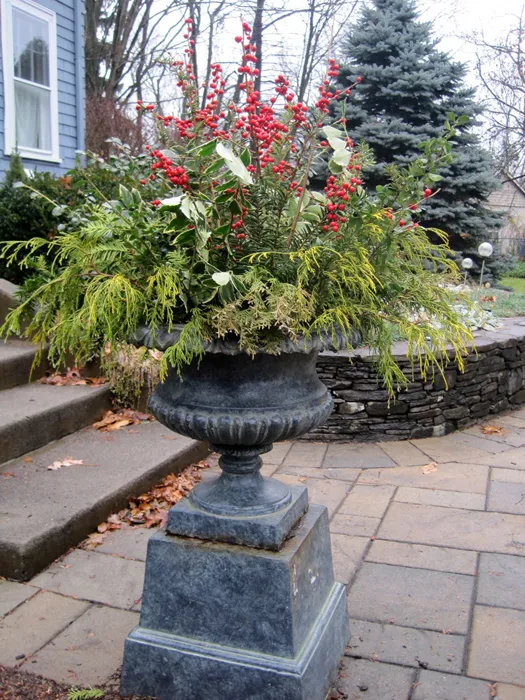
Chartreuse against deep forest green is the quiet engine here. The two greens are close enough in hue to feel calm, but far enough apart in value to create real depth without adding a second color family. Then the variegated white-and-green leaves and the red winter berries come in as accents at roughly 10% each — enough to notice, not enough to take over.
17. A Single Vertical Birch Branch in a Stone Urn
- Stone or stone-look pedestal urn: $120-$400
- Mixed evergreen and pine boughs: $45-$100
- One tall birch branch: $0-$20 (often free from a fallen tree)
- Dried hydrangeas: $15-$35
- Pinecones and woven rattan sphere: $20-$50
Total: $200-$605
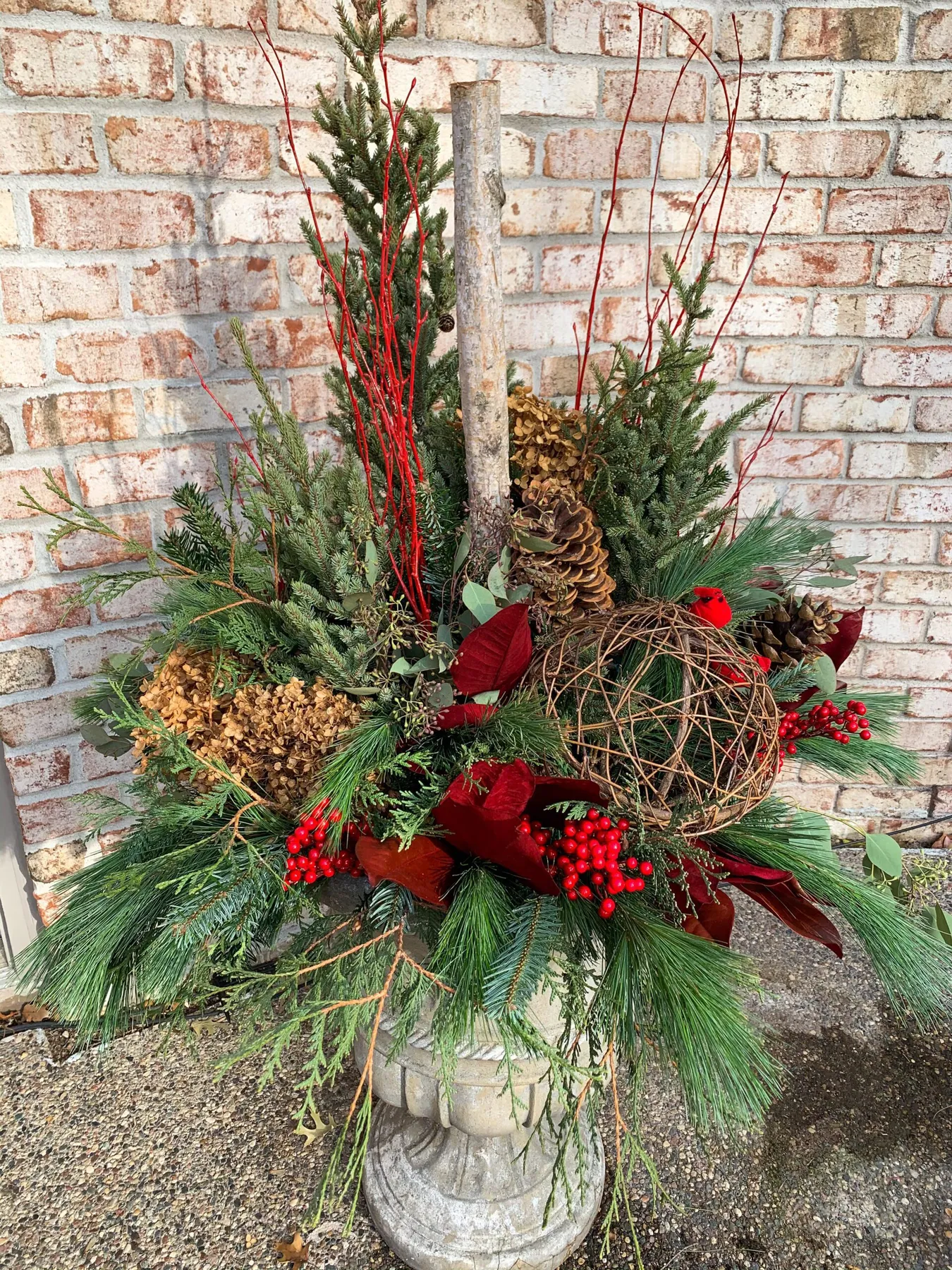
Budget alternative: a resin urn painted with stone-texture spray ($25), foraged branches, and dried hydrangeas from your own garden bring this in under $80.
This one wants a wide base. The stone urn here is roughly 18 inches across, which suits a patio corner or a landing at least 5 feet wide. Below that, go with a 12-inch urn and shorten the birch branch so the proportions do not tip. The central vertical is non-negotiable — without it the whole thing slumps.
18. Weathered Cast-Iron Urn With Bare Winter Twigs
The formula is 65% deep forest green + 20% iron gray and bare-twig brown + 15% bright red. The gray is what makes this feel weathered and old rather than new-and-shipped. Keep the twigs thin — anything thicker than a pencil starts reading as a dead shrub instead of structure.
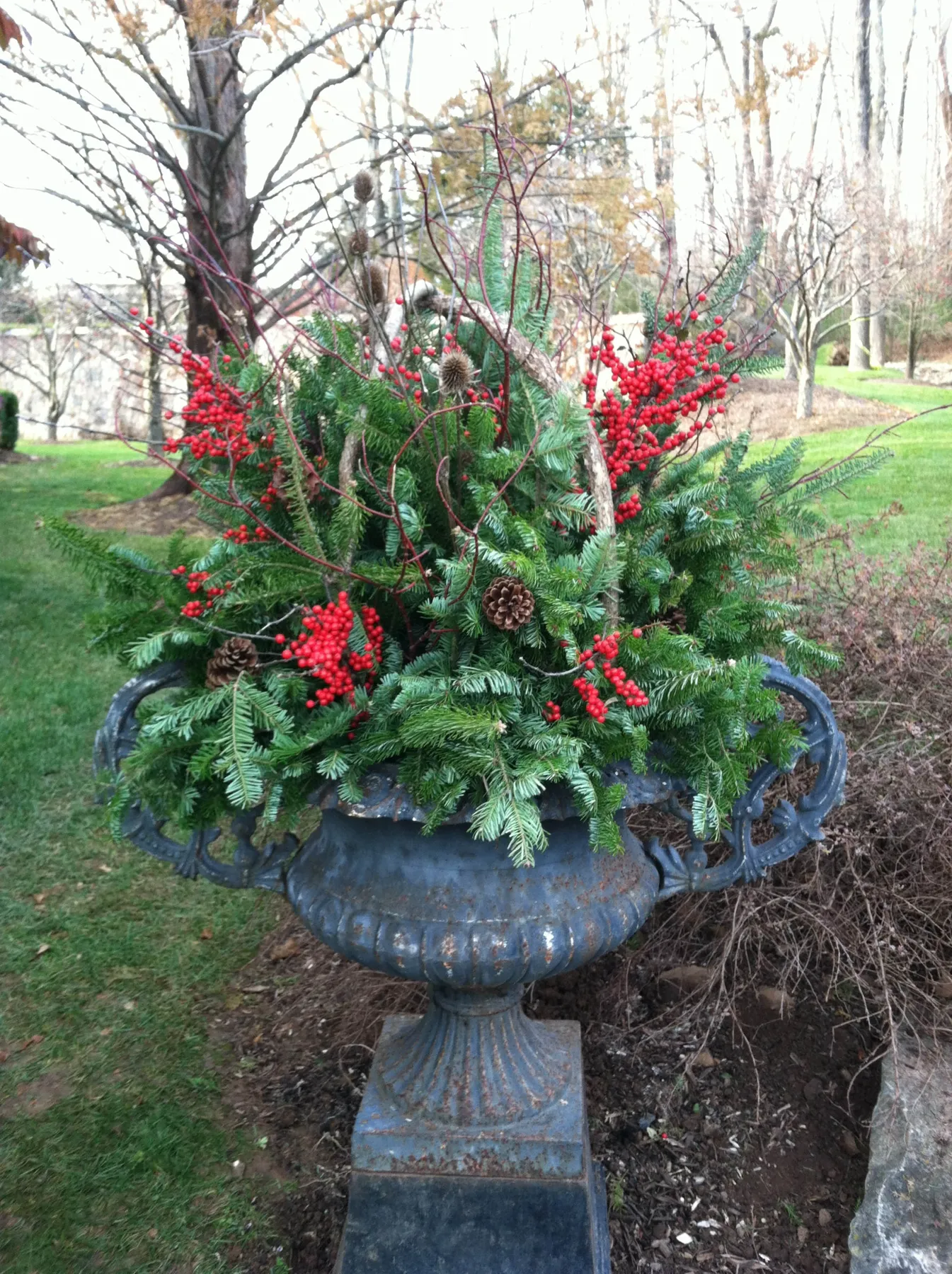
Cast iron is heavy (expect 40+ pounds empty) and it rusts from the inside where water sits. If yours is a true antique, line it and empty it after the season rather than leaving soil in it year-round. A rusted finish can be touched up with matte black exterior enamel, but honestly, that patina is half the appeal. Skip this one if you are the type to notice a drip stain on stone.
19. Twin Red Ceramic Planters on Grey Decking
Glossy red ceramic looks expensive, and it can be — $90 to $180 each. A pair of glossy red resin planters from a discount retailer runs $25 to $45 each and is lighter, frost-proof, and nearly indistinguishable at ten feet. Check Facebook Marketplace in early December; people sell last year’s red pots constantly when they redecorate.
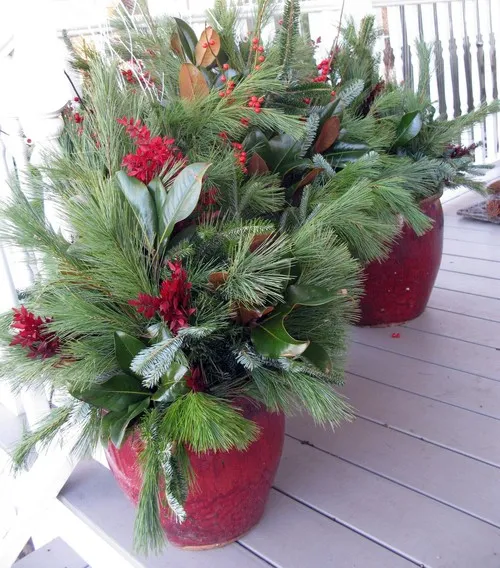
Mirror the pair, then rotate each pot about 15 degrees outward so the arrangements face the walkway rather than each other. Perfectly matched symmetry can look stiff; a slight outward fan makes the entry feel open. Keep the two arrangements at nearly identical heights — a 2-inch difference is visible and reads as a mistake. This is the paired version of Idea #10, same red-and-green logic with twice the presence.
20. A Translucent Orange Bow and Golden Pears
- Cut 4 yards of wire-edged translucent ribbon.
- Form a 6-inch loop, pinch at the center, and hold.
- Make a matching loop on the opposite side and pinch again.
- Add two smaller loops front and back for fullness.
- Cinch all layers with 24-gauge wire and trim the tails on the diagonal.
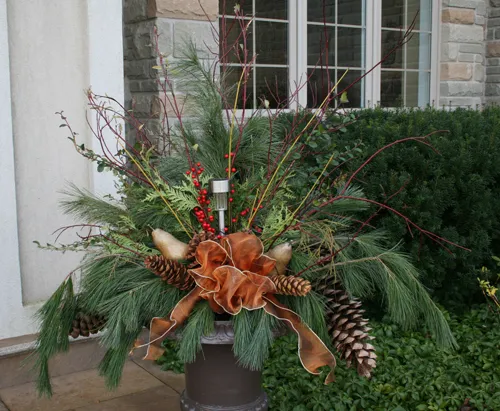
Time: about 12 minutes. Cost: roughly $9 in ribbon.
The orange bow is the one element that makes this arrangement sing, and it is also the one people are most likely to chicken out of. Filtered through translucent ribbon, orange reads as a warmer, softer cousin of red — it flatters the evergreen instead of fighting it, and it makes the golden pears look intentional rather than random.
21. An Obelisk of Red Twigs Rising From a Rectangular Planter
Sculptural planters are the 2026 move. Instead of a rounded mound of greenery, people are building vertical structures — obelisks, wrapped twig columns, tall birch bundles — and treating the planter as architecture. It makes sense: an entry is a vertical space, and tall arrangements photograph dramatically from the street and in listing photos.
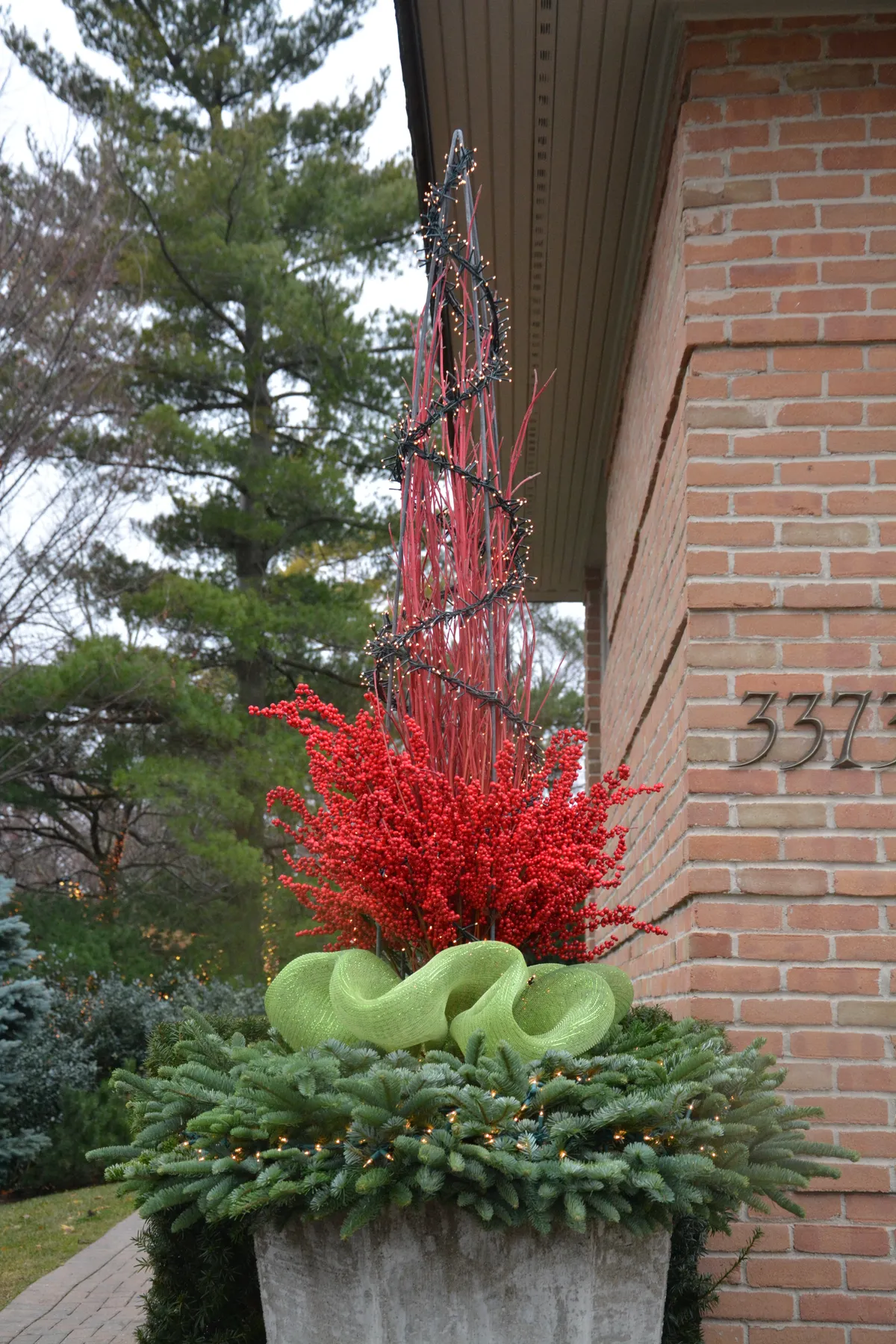
- Rectangular concrete-look planter: $80-$220
- Metal obelisk or trellis frame: $35-$90
- Red twig bundles (3-4 bunches): $25-$60
- Winterberry stems: $20-$45
- Evergreen base and warm string lights: $45-$110
Total: $205-$525
Budget alternative: a tomato cage zip-tied into an obelisk shape, wrapped in foraged red twigs and dollar-store lights, lands under $60.
22. Frosted Pinecones and White Twigs in a Pedestal Urn
Pedestal urns are where budget shoppers win hardest. Thrift stores, estate sales, and Facebook Marketplace are full of heavy concrete and resin urns for $15 to $40 because nobody wants to move them. Paint a dated one with stone-texture spray for $12 and you have a piece that looks like it came from a garden center at ten times the price.
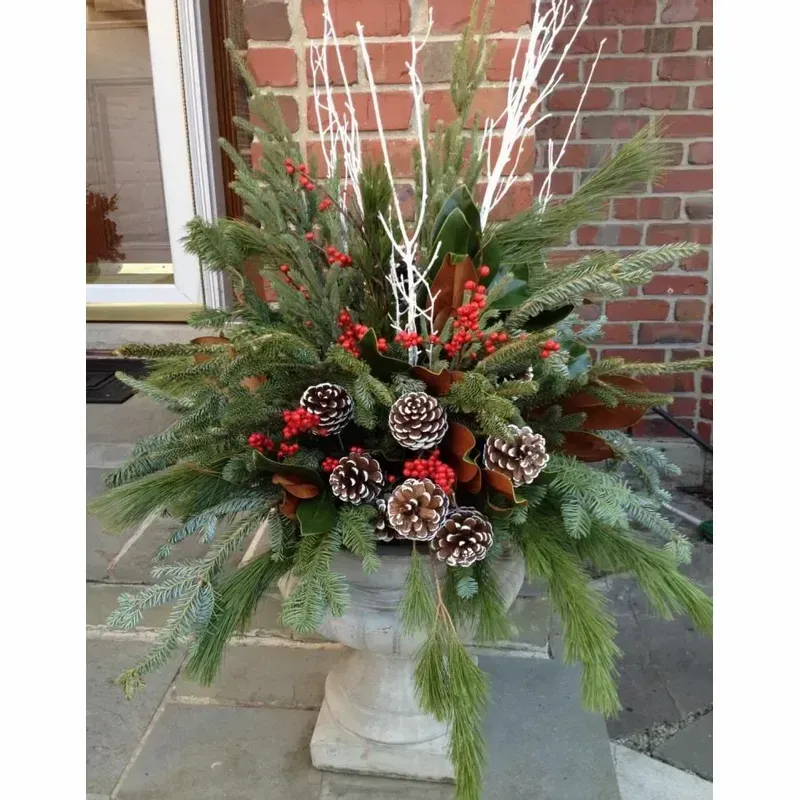
The frosted pinecones and white birch twigs give this arrangement its structure, and the magnolia leaves give it weight. Without the white twigs the tall silhouette disappears; without the broad magnolia everything up top gets airy and thin. Pairing a wide, glossy leaf against a narrow pale stick is what keeps the composition balanced.
A pedestal urn generally wants at least 4 feet of clear space — 2 feet behind and 2 feet in front for the magnolia to spread. On a narrow stoop, skip the pedestal and set the urn directly on the ground.
23. Wavy Red Mesh Ribbon in an Embossed Green Urn
Mesh ribbon will not hold a bow, so do not try. Instead, cut a 3-foot length, pinch it into a loose S-curve at the center, and wire that pinch to a hidden support stick pushed into the foam. Let the two ends fall in opposite directions through the greenery. One wavy band per arrangement; two starts looking like gift wrap.
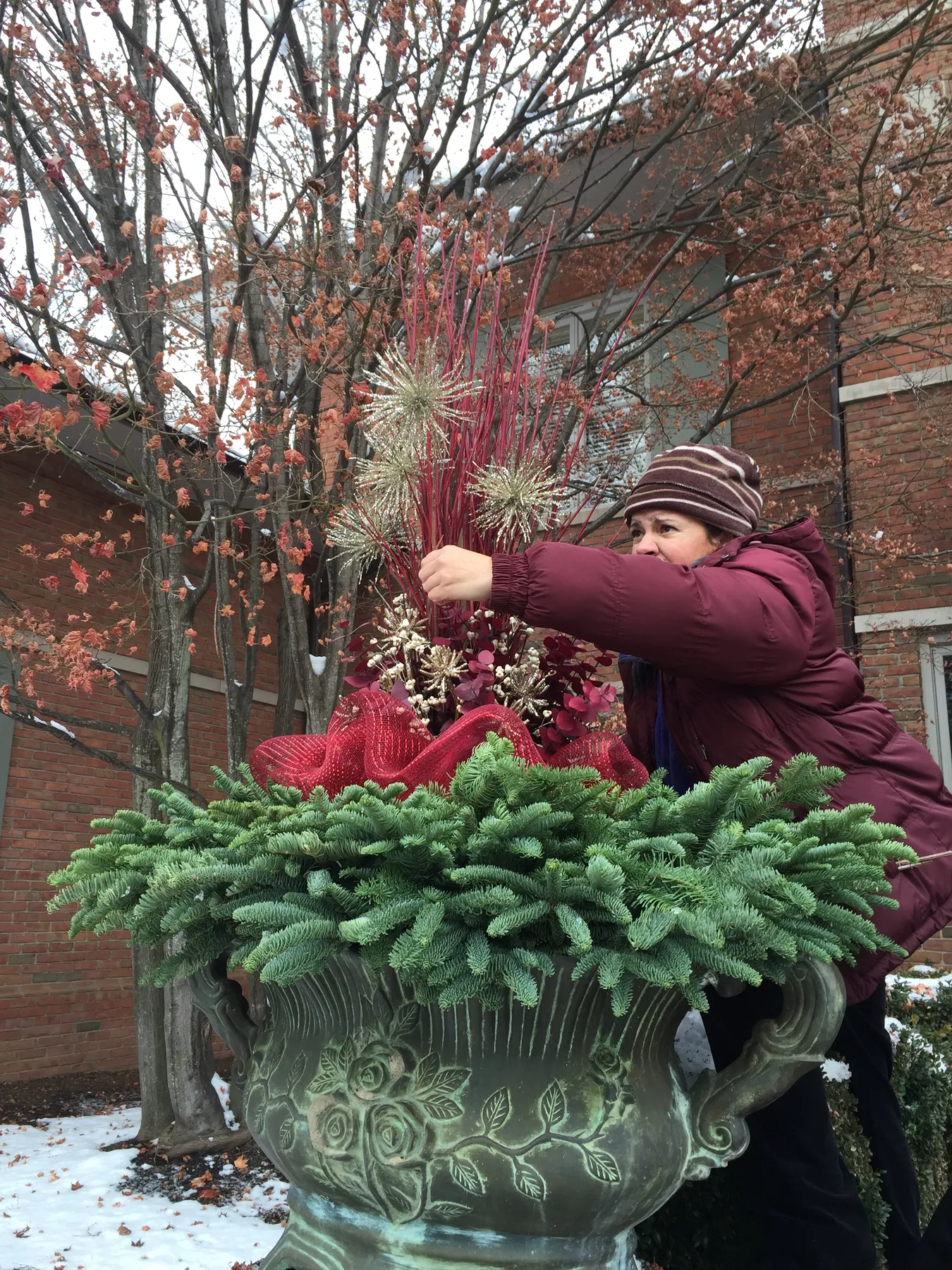
Mesh ribbon frays at the cut edge and goes limp in wet weather. Seal the ends with a quick pass of a lighter, and bring the ribbon indoors when the season ends — one winter in the elements and it will look tired. Gold starburst picks also shed glitter for weeks. Beautiful on a porch, less beautiful tracked into the front hall.
24. Moss Spheres and Gold Ornaments in a Black Urn
Moss spheres are the sleeper budget item — craft stores sell 4-inch preserved moss balls for $4 to $8 each, and dollar stores carry them seasonally. Gold ornaments are even easier: a 12-pack of shatterproof gold baubles runs $6 after Thanksgiving. The black fluted urn is the only real expense, and a matte-black resin version does the job for $30.
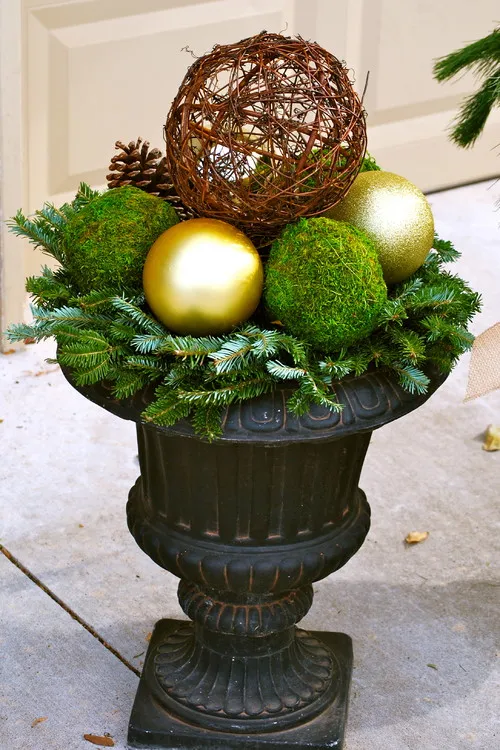
The ratio is 60% forest green evergreen + 25% black pot + 15% gold and natural brown. That heavy dark base is what makes gold look expensive instead of flashy. Swap the black urn for an aged bronze one and the same formula turns warmer and slightly more traditional — useful if your house has brick rather than painted siding.
25. Tan Grass Plumes Softening a Lattice Planter
- Trim plume stems to 12 inches with sharp snips.
- Push each stem into the foam at a slight diagonal, not straight down.
- Group three plumes together rather than spacing them evenly.
- Let two plumes droop past the rim for softness.
- Shake gently to release loose seed — do this over a bin, not your porch.
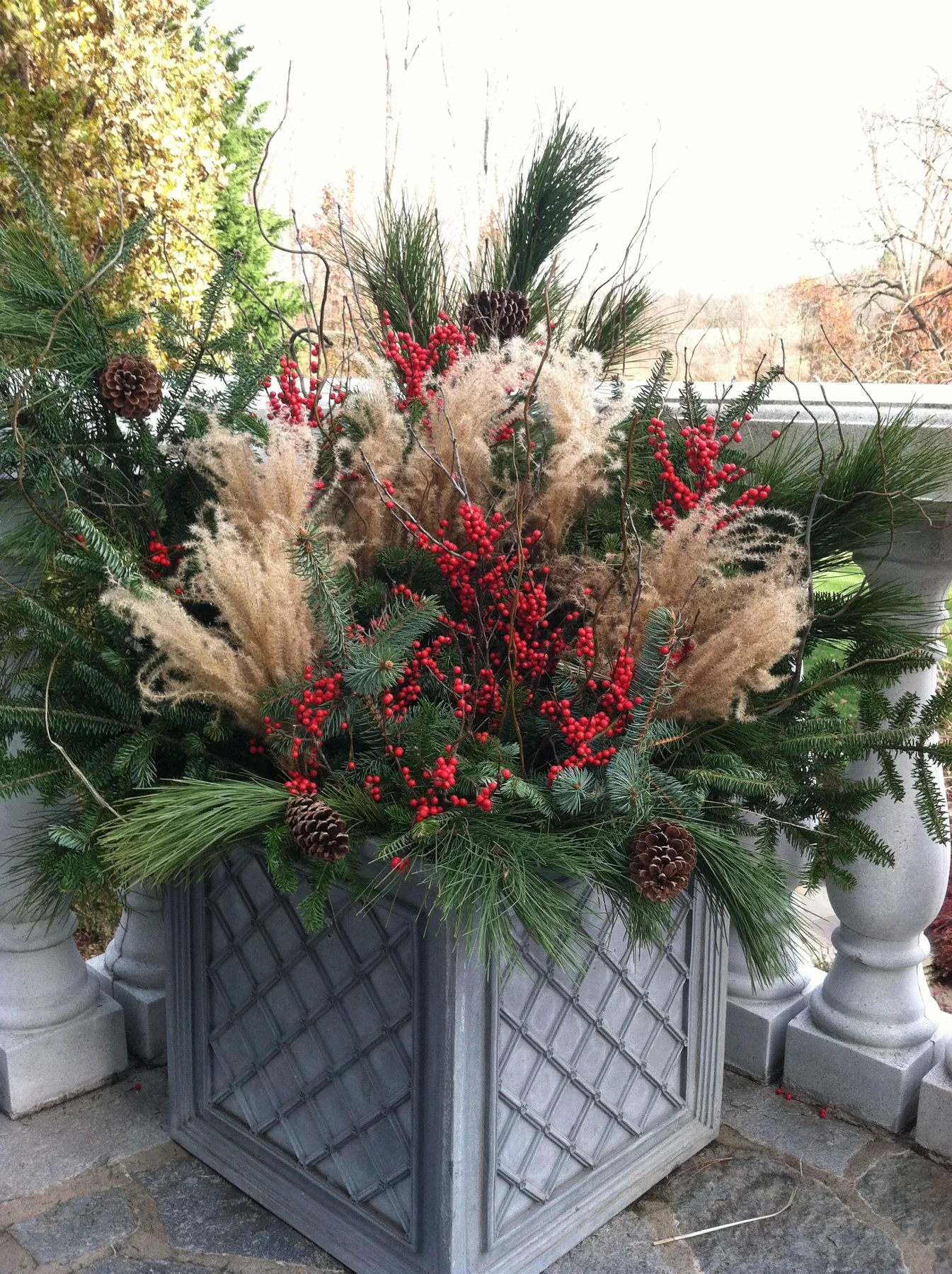
Ornamental grass plumes shed. Tiny seeds drift down for weeks and collect in porch corners and door tracks. Expect to replace them once if the season runs long, and skip them entirely on a windy balcony or an exposed corner. Evergreen and berries do the same job with zero cleanup — just with less movement.
26. A Living Evergreen Tree Centered in a Pedestal Urn
The living evergreen tree is what makes this arrangement worth doing. Everything else — the cascading cedar, the red cyclamen — is supporting cast. A real tree gives you height, scent, a natural cone shape you cannot fake, and after the holidays you can plant it in the yard. Remove it and you have a nice planter; keep it and you have something that grows with the house.
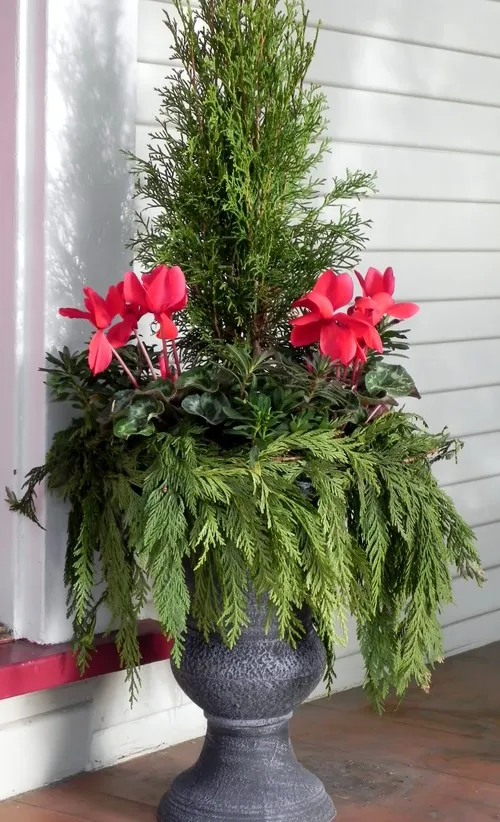
Look at how the layers stack: a tall vertical center, a mid-height ring of red blooms, and a thick cascade of cedar spilling over the rim. Three tiers, three heights, one color story. That structure keeps your eye moving upward, which is exactly what you want on a tall pedestal set against a white-sided wall.
27. Conical Conifers Lining Stone Steps
- 6-8 dwarf conifers in terracotta pots: $120-$320
- Terracotta pots (10-12 inch): $8-$20 each
- Red ribbon for bows: $12-$30
- Potting soil: $15-$30
Total: $155-$400
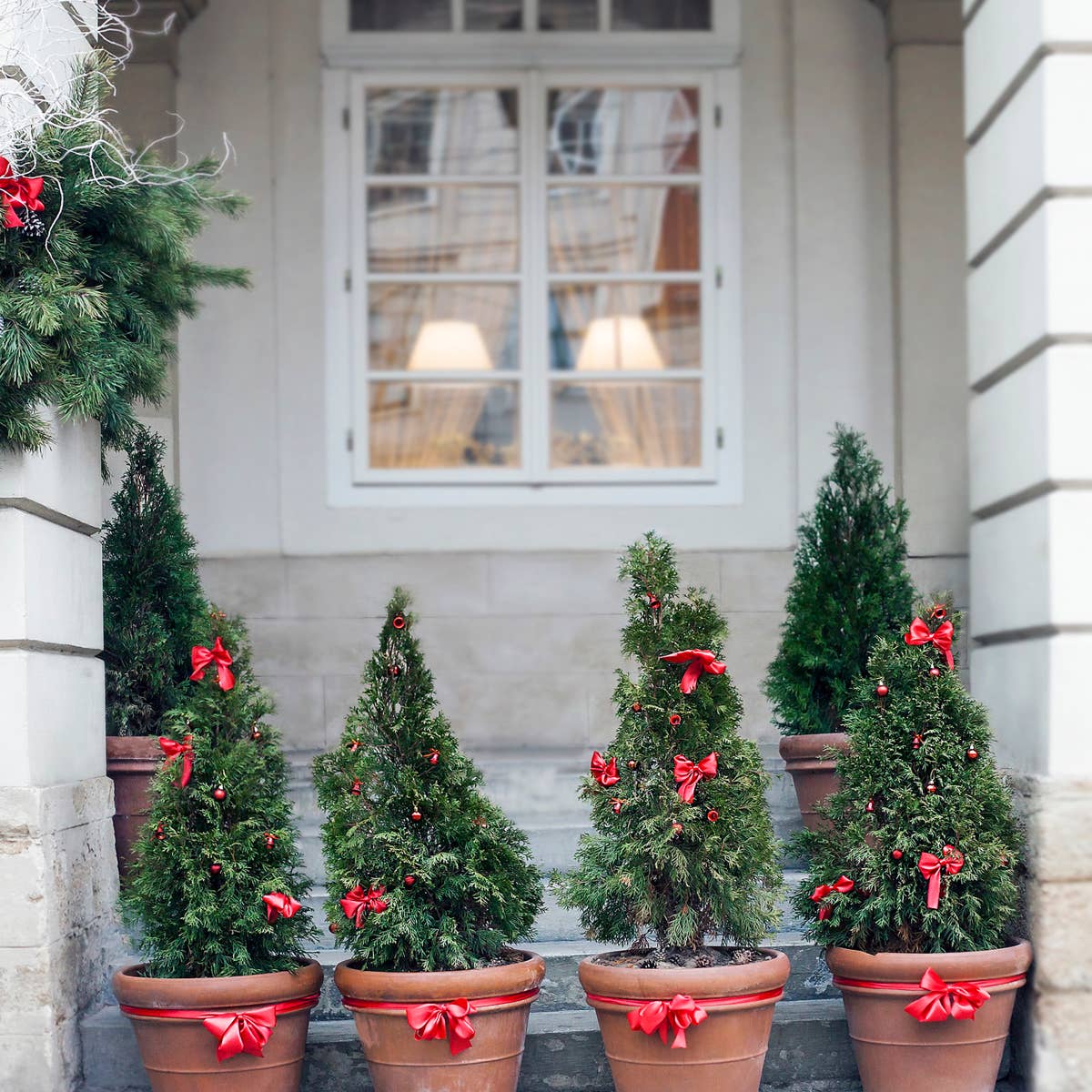
Budget alternative: buy bare-root dwarf conifers in spring for $10 to $15 each, pot them up, and grow them on all year. You will line the same steps for under $140 — you just have to plan a season ahead.
Two things to know. Live conifers in pots want water all winter — check every two to three weeks on mild days, because dry roots plus freezing wind is what kills them. And terracotta cracks in hard freezes. If your steps get below-zero nights, use frost-resistant resin pots or nestle the terracotta inside a larger cachepot.
28. Eucalyptus Rounds in a Classical White Urn
Eucalyptus brings a soft, matte gray-green that no evergreen can match, but the round leaves need to face outward to read well. Pin each stem so the leaf disc sits perpendicular to the viewer, and cluster them in threes — a single eucalyptus stem gets lost, three read as a deliberate motif. Expect the leaves to dry and curl by January, which honestly looks good.
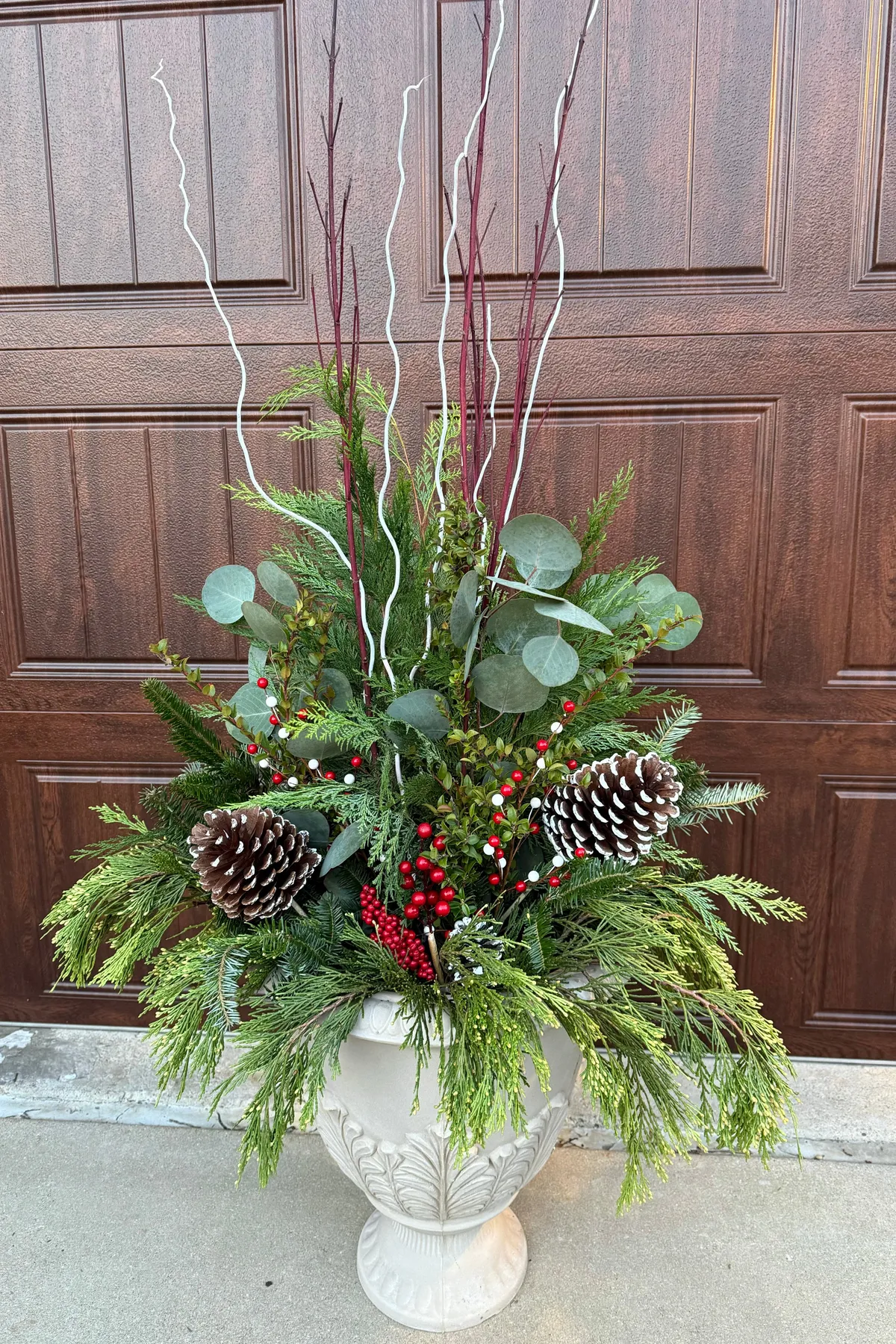
- Confirm the white urn’s finish is weather-rated. Unglazed white stains badly from soil.
- Check your entry’s light. Eucalyptus and white twigs disappear in shadow — add a spotlight or a lantern.
- Buy frosted pinecones rather than frosting your own. The DIY version sheds.
- Decide whether the berries will be real or faux. Real ones need replacing mid-season.
29. Wicker Baskets With Cyclamen and a Santa-Hat Bird
- Line the basket with a coco liner or a plastic pot two sizes smaller.
- Fill with fresh potting mix, leaving an inch of headroom.
- Set the cyclamen so the crown sits level with the basket rim.
- Tuck foliage and berry sprigs around the edges to hide the soil line.
- Add the figurine last, at the front, where it can be seen from the path.
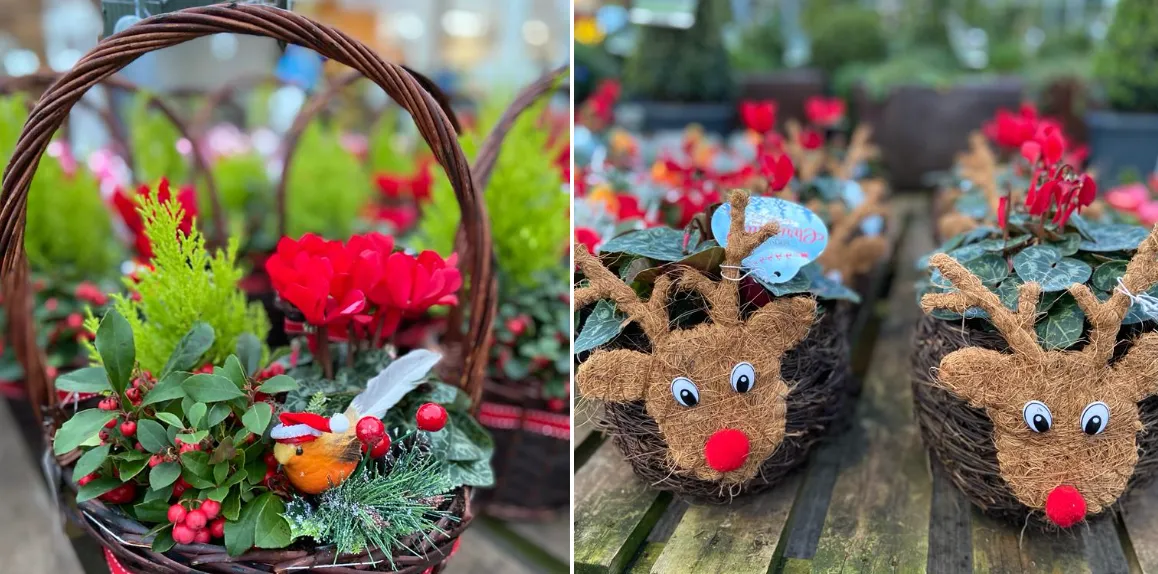
About 15 minutes per basket and roughly $18 plus the plant.
Whimsy is back. After several years of restrained, monochrome holiday decor, 2026 is swinging toward playful accents — figurines, pom-poms, coir animals with googly eyes. It reads as a reaction to how serious holiday styling got. This kind of decor ages fast, so treat it as a fun layer you can pull out next year without redoing the whole entry. If you want the calmer version, Idea #30 takes the same palette in a quieter direction.
30. Ornamental Cabbage and Burgundy in a Stone Urn
The ratio here is 45% sage green and stone gray + 30% deep burgundy + 25% pale neutral. It is an unusual mix — it leads with muted tones and lets burgundy carry the color, which is why it reads as sophisticated rather than festive. Swap burgundy for plum and the whole arrangement goes cooler; swap it for rust and it turns distinctly autumnal.
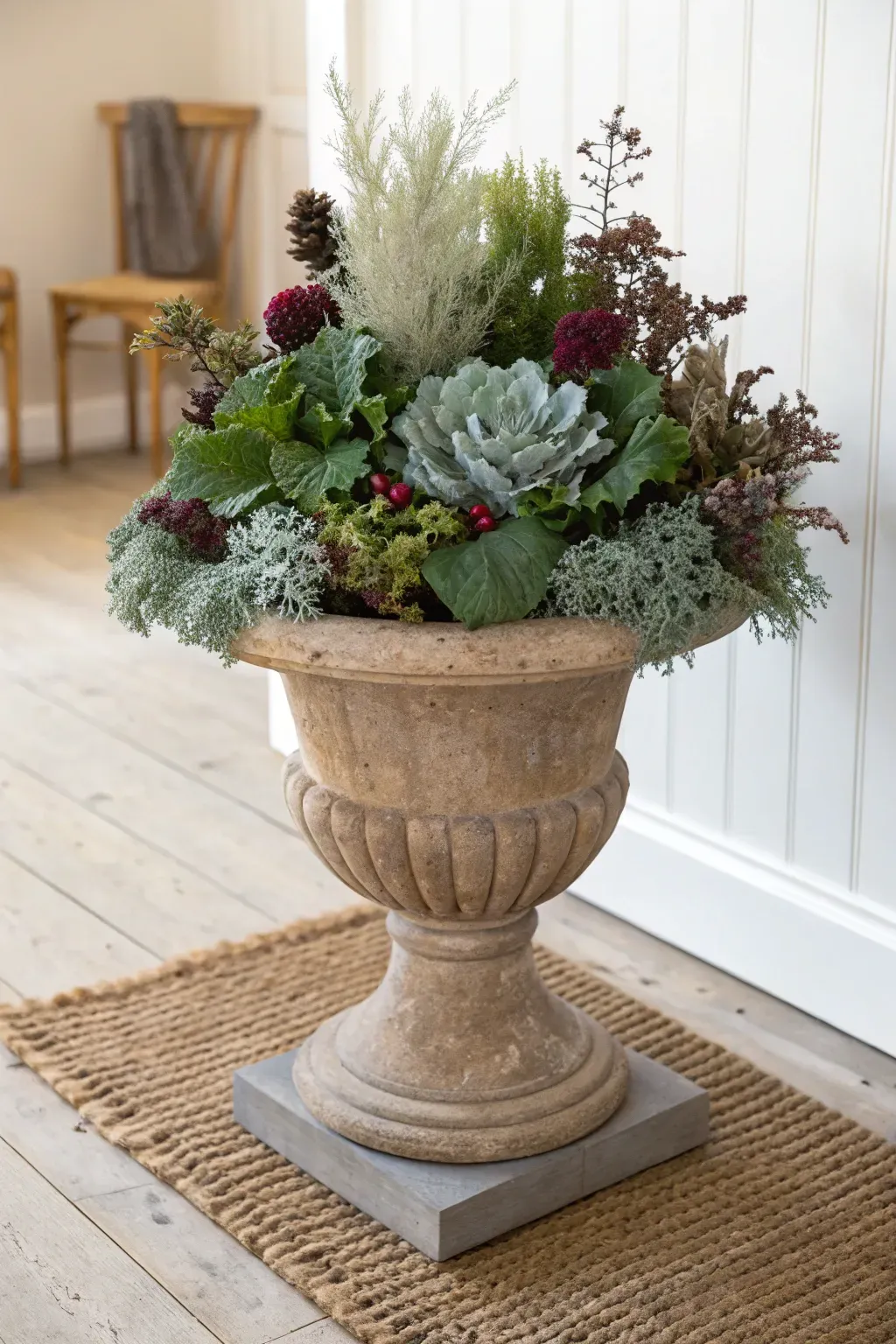
Ornamental cabbage spreads wide, so this needs a pot at least 16 inches across and about 36 inches of clear space around it. It works best on a covered porch or an entry with a wall behind it, because the composition is meant to be seen from one direction. On a narrow downtown stoop under 3 feet wide, go with Idea #33 instead.
This is a texture-over-color arrangement, and it works because nothing in it is shiny. Matte cabbage leaves, frosted silver-green foliage, dry seed heads, and a weathered stone urn all catch light the same way. Add one glossy element and the whole thing falls apart — which is why a ceramic or glazed pot would ruin this specific look.
31. A Dark Urn Against a Rustic Stone Wall
The stone wall is doing half the work. Dense evergreen against rough, dark, irregular masonry gives the arrangement a backdrop with real depth — the planter looks like it belongs to the house rather than sitting in front of it. Set the same urn against vinyl siding and you get a nice planter. Against stone, you get a scene.
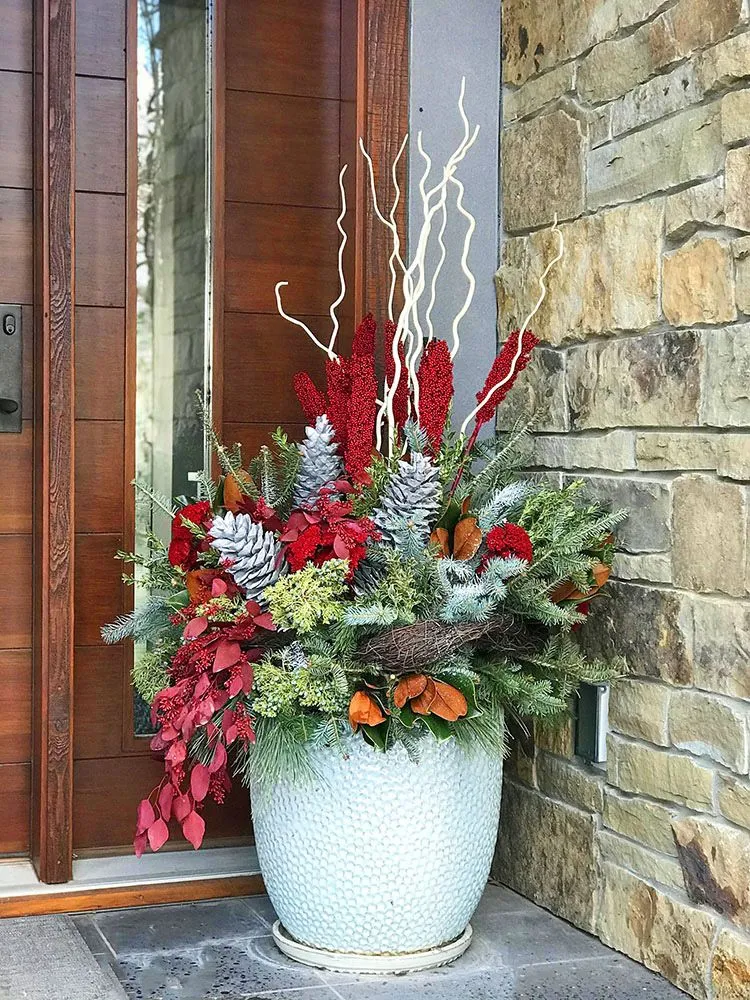
- Dark urn planter (16-20 inch): $60-$200
- Mixed evergreen boughs: $40-$90
- Red berry stems: $18-$40
- Pinecones: $10-$25
Total: $128-$355
Budget alternative: a black plastic urn from a big-box store ($18-$30) hides behind greenery almost completely, and foraged pinecones plus dollar-store berry picks land you under $70.
32. String Lights Wrapped at the Base in Terracotta Pots
Two weathered terracotta pots, two battery-operated light strands, and a bag of foraged evergreen boughs. That is the whole build, and it comes in under $70. Terracotta is the one thing worth buying used — a matching pair with a chalky patina shows up at yard sales constantly for $10 each, and new pots never look this good.
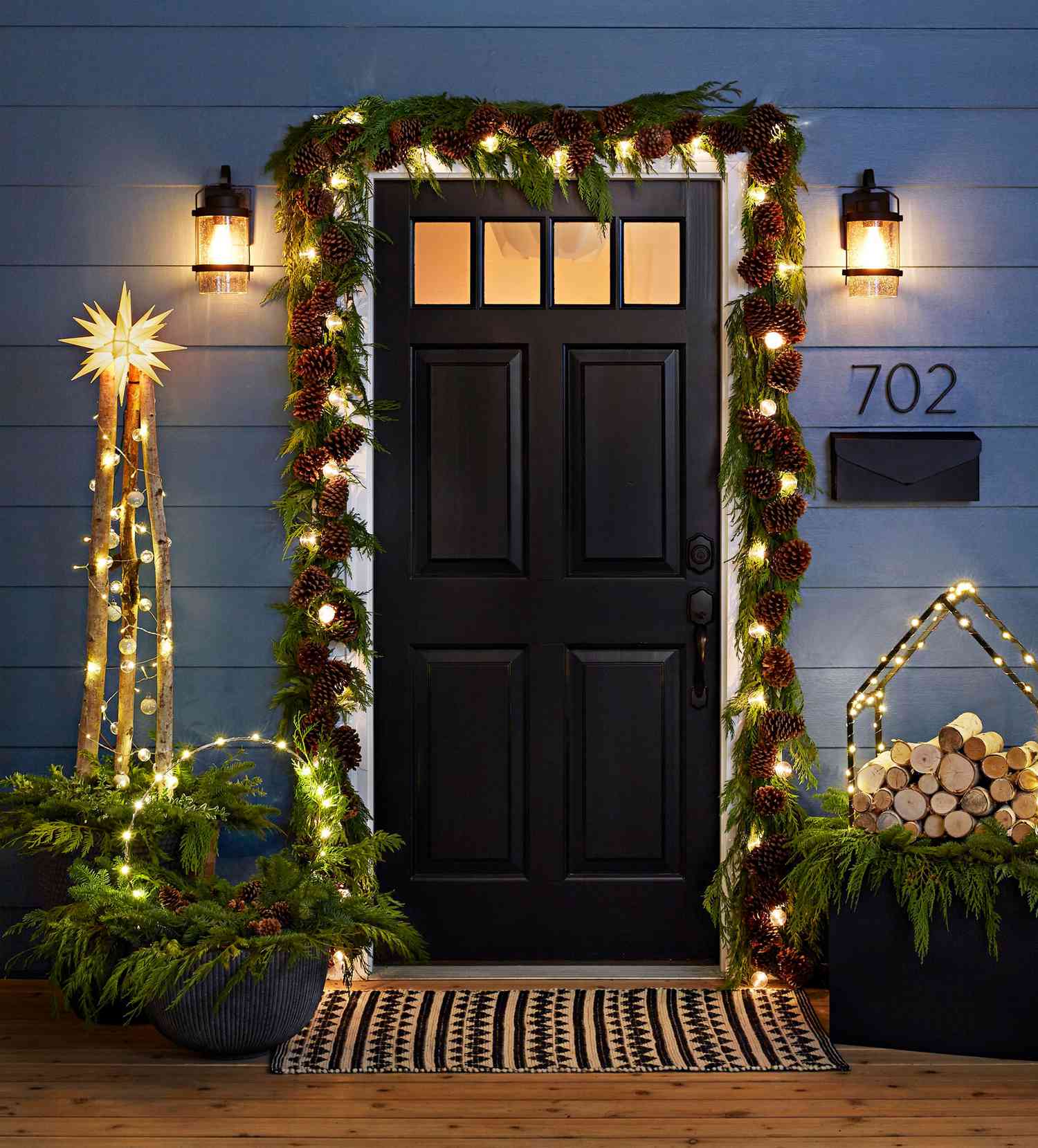
The lights are wrapped low, at the base of the foliage, and that detail matters. Uplighting from below makes the evergreen branches glow from the inside and throws soft shadows up the door — the opposite of the flat, even wash you get from an overhead porch light. It also hides the strand itself, which overhead wrapping never does.
33. Trailing Chartreuse Vines Over a Black Urn
Bury the cabbage root ball so the crown sits just above the soil line — deeper and it rots, shallower and it dries out and flops. Pack soil firmly around the base, then water it in thoroughly before you style anything else. A cabbage that shifts after you have already added the trailing vines means starting over.
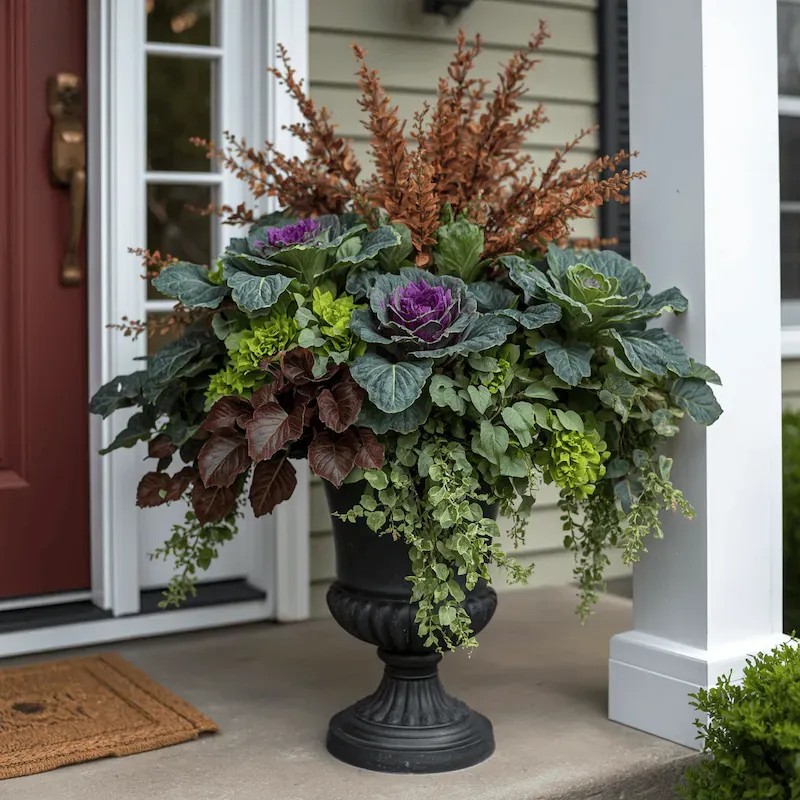
Ornamental cabbage and kale are hardy to about 25°F. Below that the leaves go limp and translucent and never recover. In a cold climate, plan on replacing them in January — they are cheap enough that this is fine, and the copper-brown twigs and vines will carry the arrangement on their own. One more thing: slugs love cabbage. Check the undersides.
Compare with Idea #24 — same black urn, completely different mood.
34. Silver Ornaments and Birch Logs in a Tall Dark Planter
- Check the ornament finish. Matte silver reads brushed and modern; gloss silver reads icy. Pick one and stay consistent.
- Confirm the planter’s height. Under 20 inches, birch logs will overpower it.
- Weigh down the base — tall planters with light resin construction tip in wind.
- Decide your ribbon length before you cut. You want tails, not stubs.
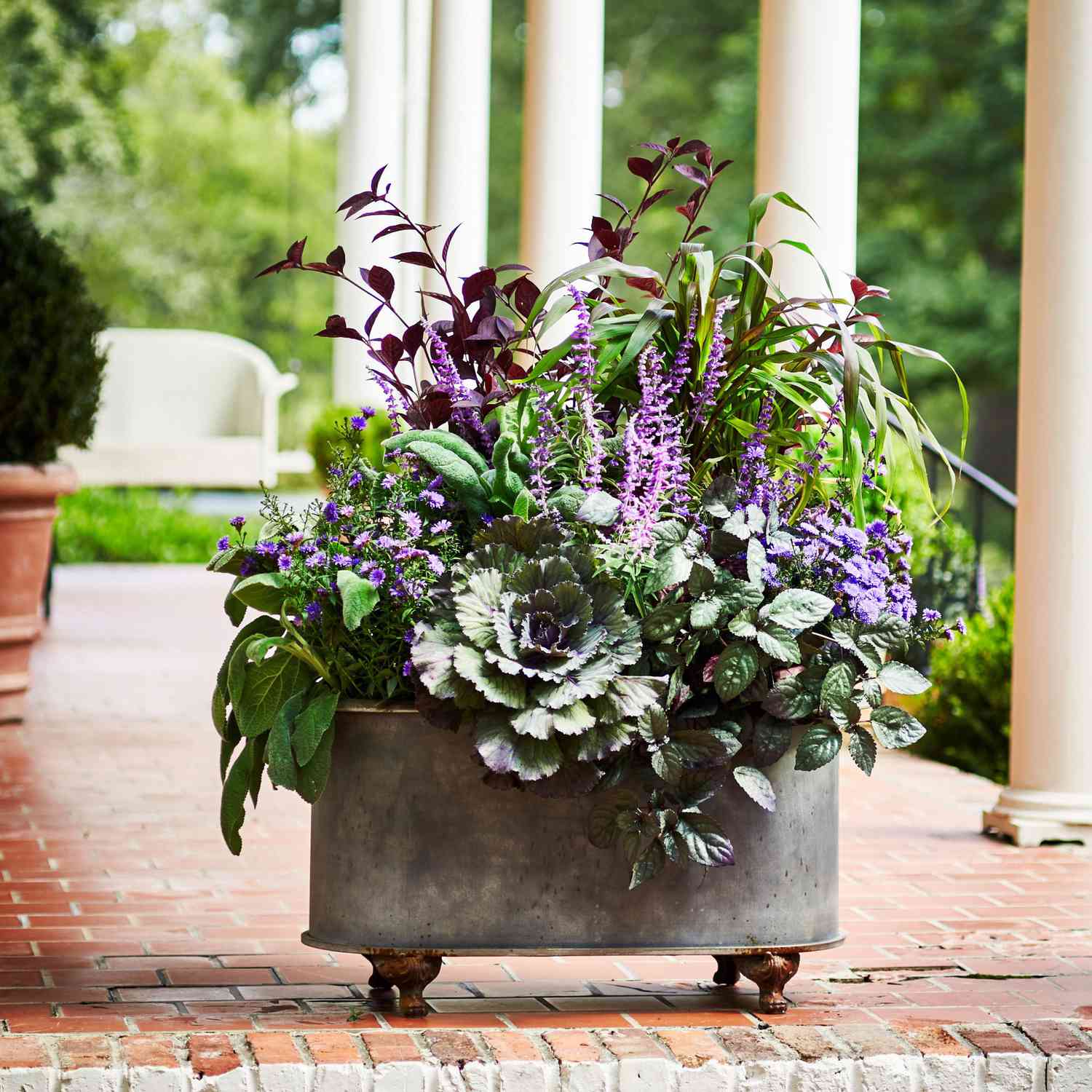
Silver is having a comeback in 2026 after several years of gold dominance. Part of it is the return of cooler, icier winter palettes, and part of it is practical — silver reads clearly in dim blue-hour porch light, where gold goes muddy. Charcoal gray planters are the natural partner, and the pairing has become a go-to for modern farmhouse entries.
35. A Glossy White Bowl Planter Built From Cedar and Fir
The glossy white bowl is the element holding this together. A dark pot would absorb all that green and read heavy; white bounces light back up into the foliage and makes cedar, fir, and magnolia look brighter and more delicate than they actually are. Swap in charcoal and the same greenery goes quiet and a little gloomy.
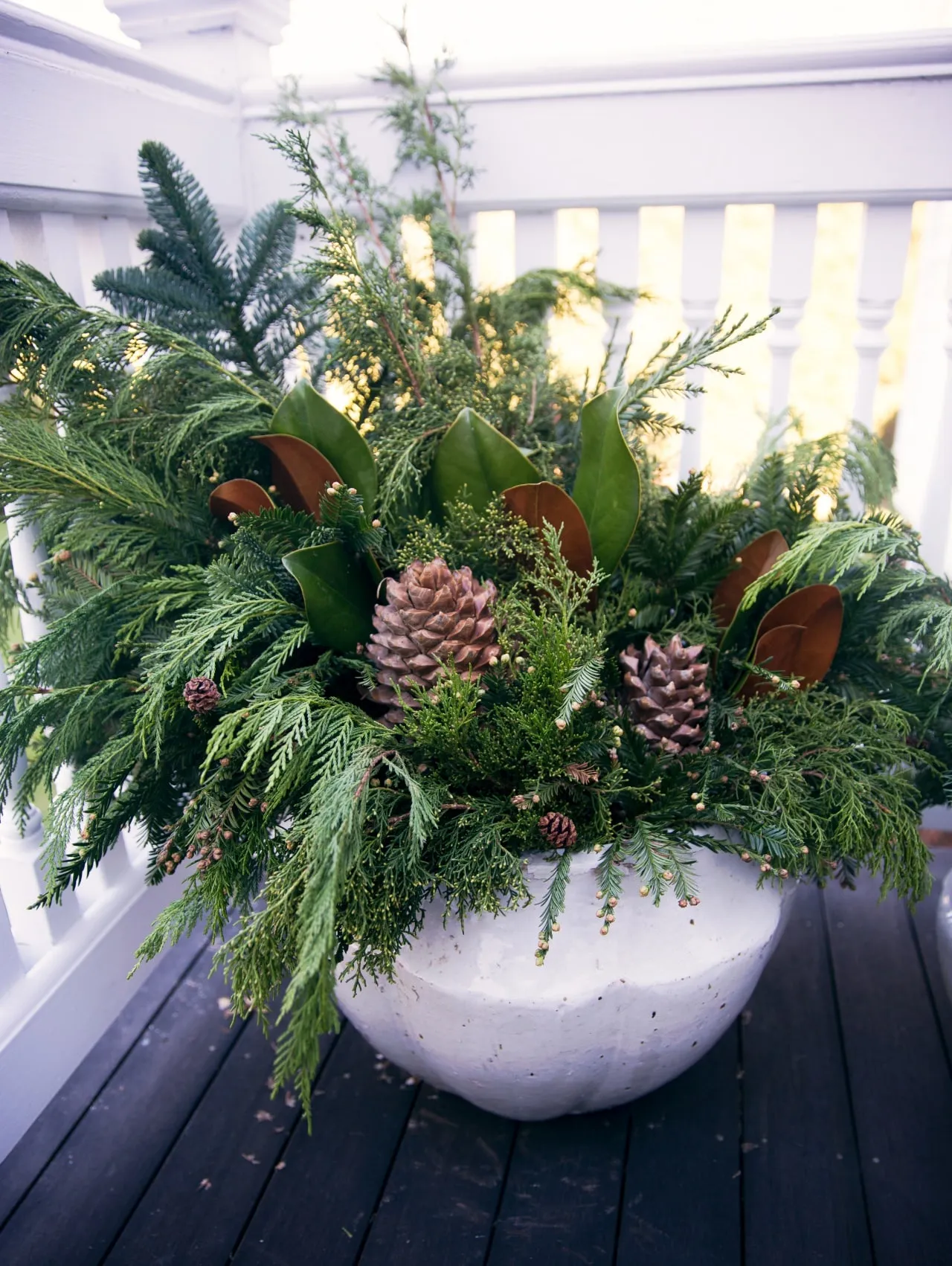
- Soak the foam and cut it to sit an inch below the rim of the bowl.
- Push in the tallest fir branch at the center back as your anchor.
- Ring the rim with cedar at a 30-degree outward angle so it overhangs slightly.
- Fill the middle with pine until no foam is visible from above or from three feet away.
- Tuck magnolia leaves and pinecones into the front third only.
About 35 minutes of work and $35 to $70 in greens.
Your Front Step, Dressed for the Cold
Start with one planter and one idea above — the entry you keep saving in your camera roll is almost always the one you can build in an afternoon. Get the proportion right, pack the greenery tight, and the rest is just berries and light. 📌 Pin this guide to your Holiday Porch board now, so it is waiting for you next November when the good greenery shows up.