There is exactly one design decision in your home that every single visitor notices, and it’s hanging on your front door. This year it doesn’t have to be the same tired wreath you’ve used since 2019 — the round door hanger has gotten genuinely good, from hand-painted wood slices to layered buffalo check bows to dried citrus that looks far more expensive than it was. We spent weeks combing Etsy, Michaels, Hobby Lobby, Amazon, and Target to pull 35 ideas actually worth hanging, spanning roughly $12 to $180, with budget and splurge versions compared side by side. You’ll find rustic farmhouse layering, classic traditional greenery, playful modern graphics, and hand-painted folk art — sometimes all in the same article. In 2026 the real shift is toward dimensional, hand-finished round signs over flat printed designs, and multi-pattern bows have replaced the single satin ribbon almost entirely. And stay until the end — we break down the most common mistakes that can ruin these looks. 📌 Save this to Pinterest for later — you’ll want to revisit these ideas.
1. Pine, White Berry, and Snowflake Symmetry on a Wood Door
A round wreath on its own reads as decoration. The same wreath inside a garland frame reads as architecture. Here the pine-and-white-berry wreath sits dead center on the vertical-paneled door while the lit garland runs the full height of the opening, and that repetition of forest green at three different scales — wreath, garland, flocked miniature trees — is what makes the entry feel finished instead of just decorated. The white cutout snowflakes on the pale greenish-gray wall give the eye somewhere cool to rest between all that warmth.
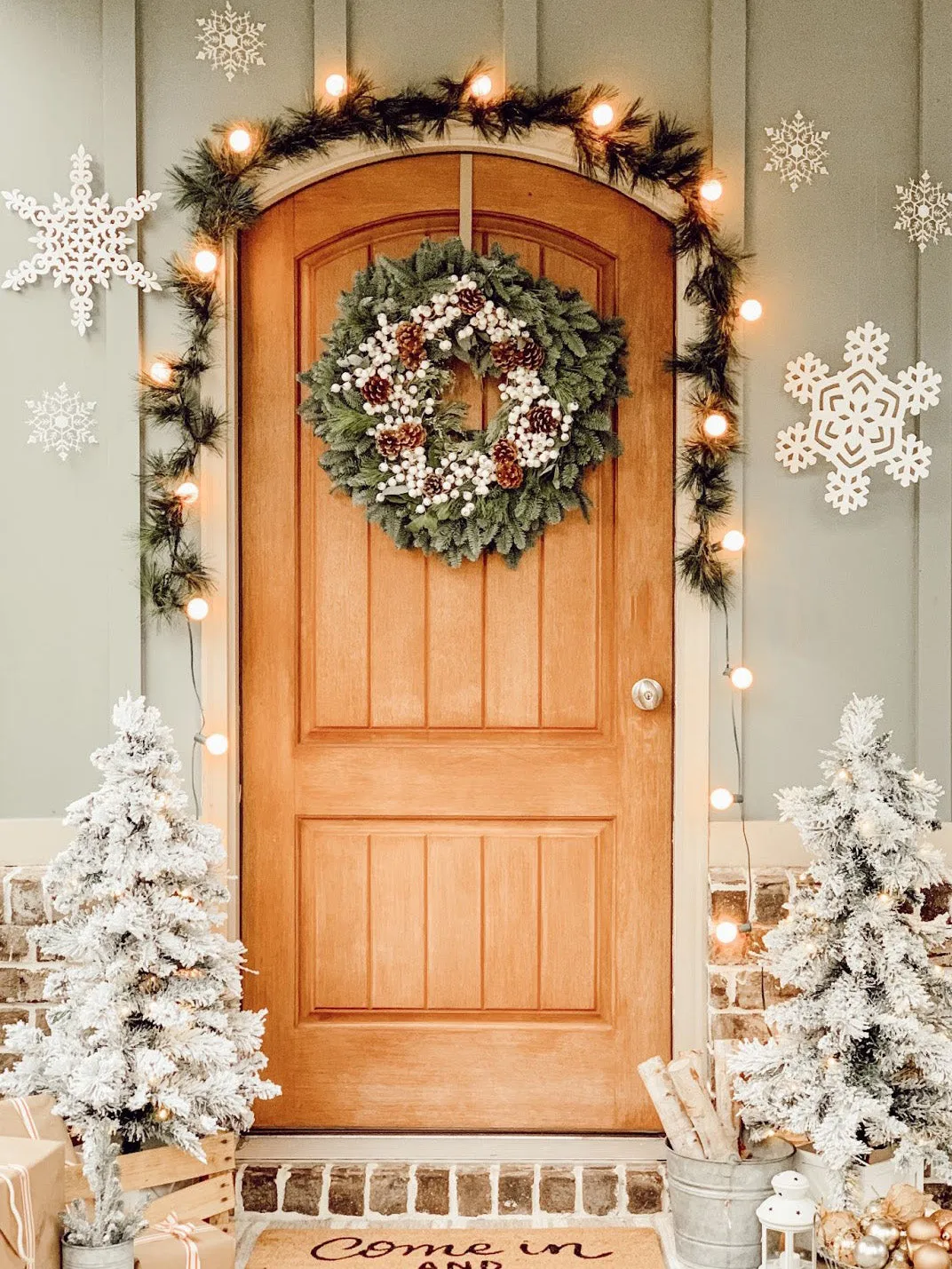
Measure before you buy. On a standard 36-inch door, a 22- to 24-inch wreath is the sweet spot — large enough to read from the sidewalk, small enough to leave the hardware visible. Center it 60 inches off the floor so it lands on the same sightline as the peephole, then hang the hook so it sits inside a vertical panel rather than across a stile. The groove hides the hardware and stops the wreath from sliding sideways every time the door swings.
2. A Red Door, Gold-Accented Wreath, and Buffalo Plaid Landing
Here’s the math: roughly 50 percent red door, 25 percent evergreen, 10 percent black from the mat and the metal lanterns, 8 percent gold and silver from the wreath ornaments, and 7 percent pink from those potted flowers in woven baskets. That last slice is the wild card, and it’s why this door doesn’t look like every other red door on the block. Want to keep the formula but change the mood? Swap the pink for deep burgundy, the gold for matte black, and the buffalo plaid mat for a solid charcoal coir.
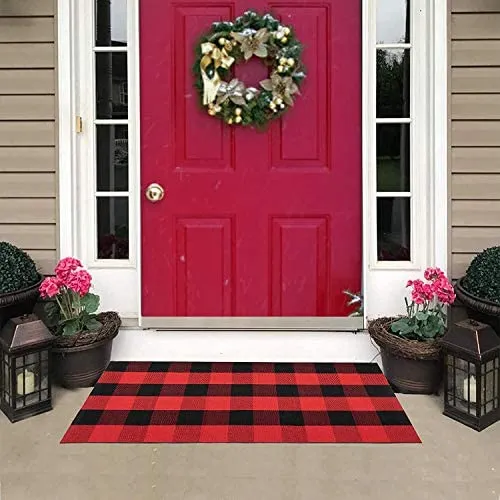
Two realities about a red door in winter. First, saturated exterior red fades fastest on south- and west-facing exposures — buy a UV-stable exterior paint and expect a touch-up every couple of years. Second, the flowers. Real blooms in December are a gamble in most of the country, so either plan on swapping them weekly or go faux and tuck the pots behind the wreath where nobody gets close enough to check.
3. Square Boxwood Wreath and an Oversized Blue Plaid Bow
here is that bow. It’s roughly a third of the wreath’s width, it’s tied from actual plaid fabric rather than printed ribbon, and it’s the reason a fairly ordinary boxwood square suddenly looks custom against that textured stone surround. Take it away and you’ve got a nice, forgettable green square. Leave it and the wreath becomes the loudest, best-dressed thing on the block. If you’re making your own, buy fabric by the half-yard instead of ribbon — you’ll get softer, fuller loops for less money.
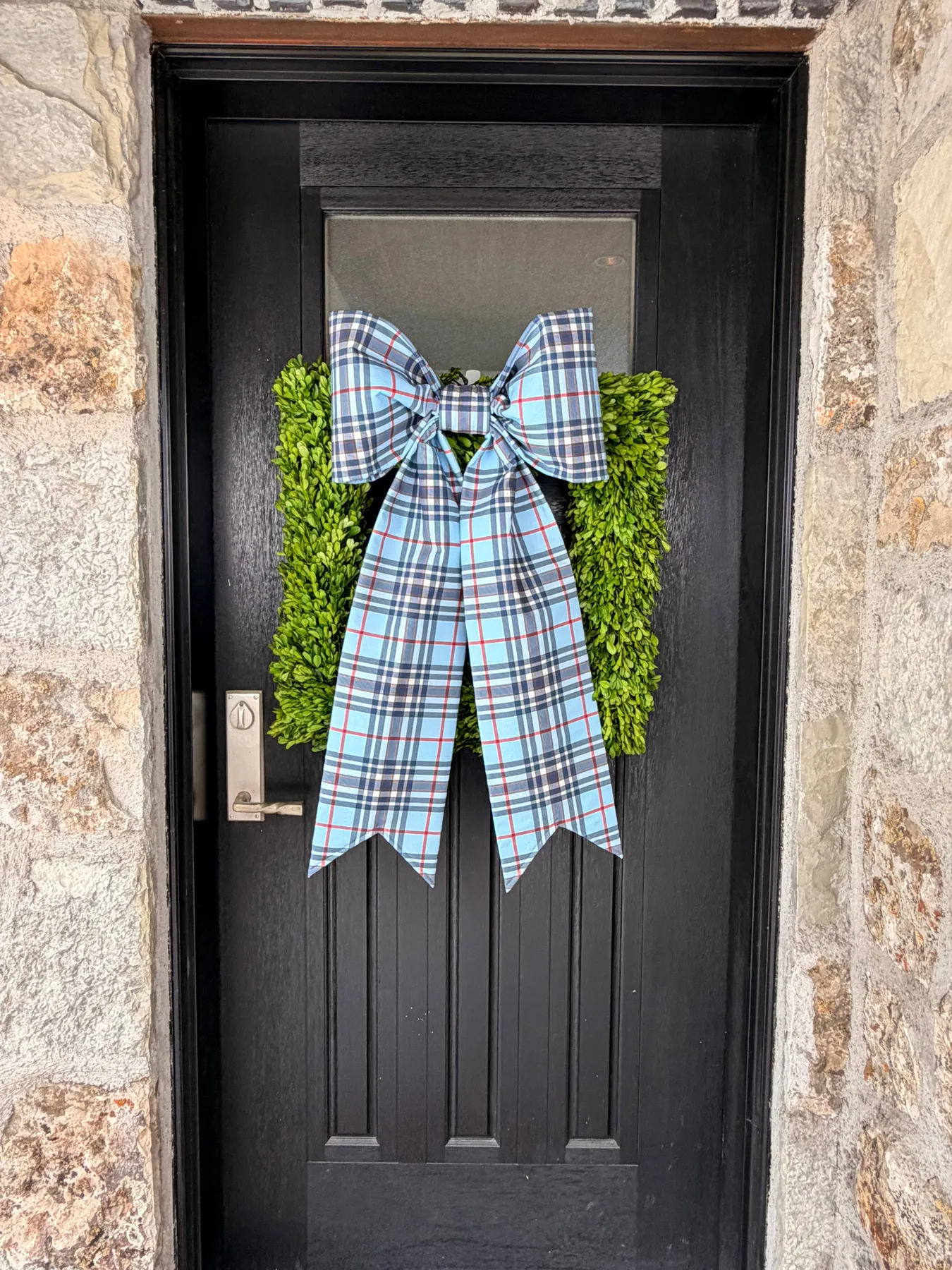
Square wreaths are a wide-door move. They need at least a 36-inch door, and they look their best framed in stone or brick, where the straight lines have something geometric to answer to. If your entry is narrower than 36 inches or has a storm door that swings out, look at Idea #30, where a round boxwood wreath with a bright bow does the same job in less space. Round also plays nicer with arched openings — compare with Idea #19.
4. Teal Scrollwork, Gray Banner, and Snowflake Cutouts in One Round
A three-zone round sign lives or dies on its typography. Keep the lettering in the middle band, let graphics own the top and bottom, and make sure your smallest letter is at least 1.5 inches tall — anything less disappears from the street. Eighteen inches of diameter is the ceiling for a single door before the sign starts feeling like a billboard, and 14 inches is the floor if you want it readable from the driveway. The white ribbon hanger is doing quiet work too: it lifts the piece off the dark textured door so the cutout pattern reads.
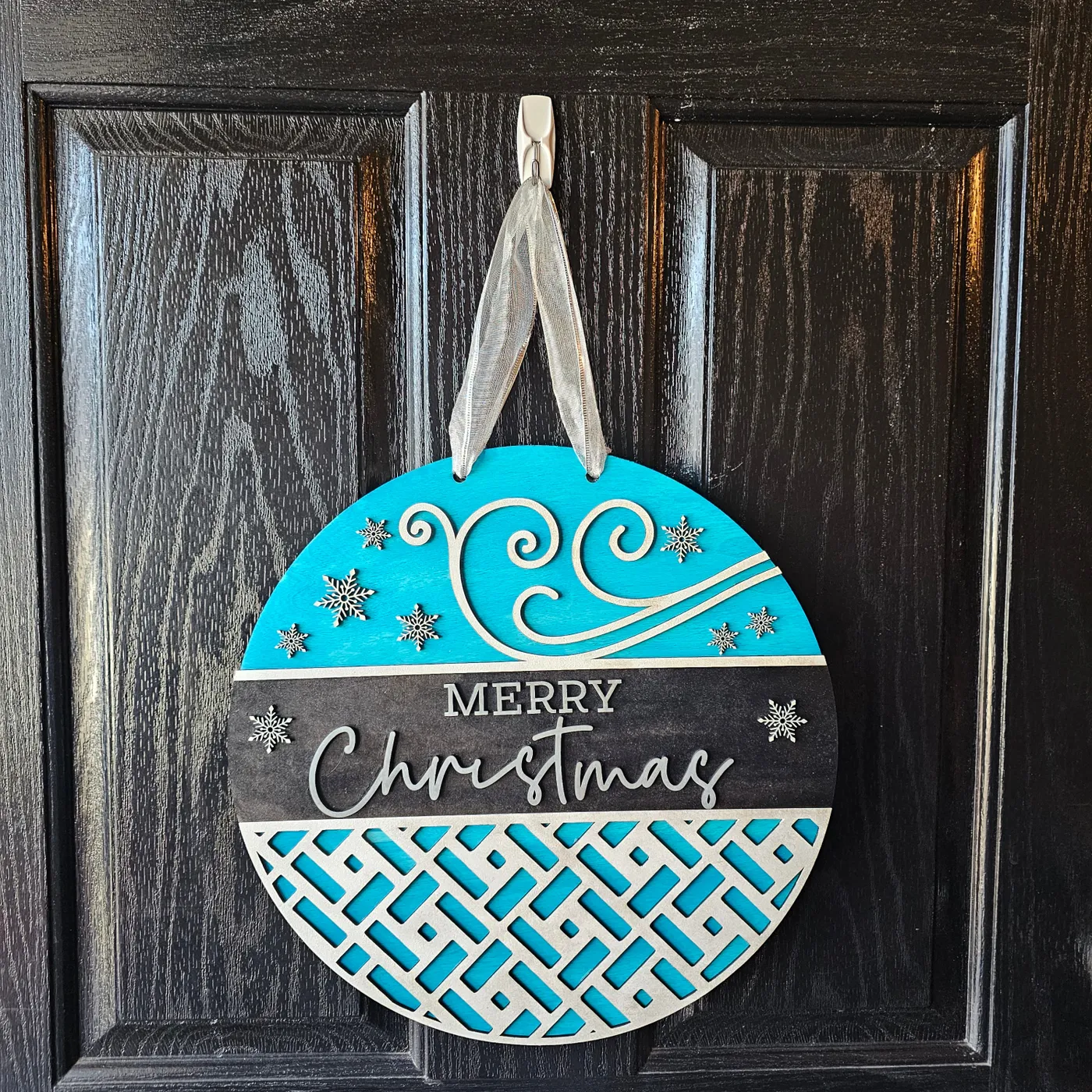
You don’t need a $75 custom sign for this. Grab an 18-inch birch round from a craft store for about $7, a small bottle of teal and a small bottle of charcoal acrylic for $4, and a roll of white adhesive vinyl for $10. Cut the snowflakes with a craft knife or a cutting machine, seal with two coats of matte exterior poly, and hang it from a $2 spool of white satin ribbon. Total: about $25, which leaves room for a second one in a different color.
5. Mixed Evergreen Wreath With a Sage Plaid Bow Tied Low
Most wreaths put the bow at twelve o’clock. This one ties it low and to the right, which turns a perfectly symmetrical circle into something that feels hand-assembled. That single move changes the whole read. Add the texture mix — spiky pinecones, smooth shiny green ornaments, soft white berry sprays — and you’ve got contrast on two axes at once: placement and surface. It’s the difference between a wreath that looks bought and one that looks made.
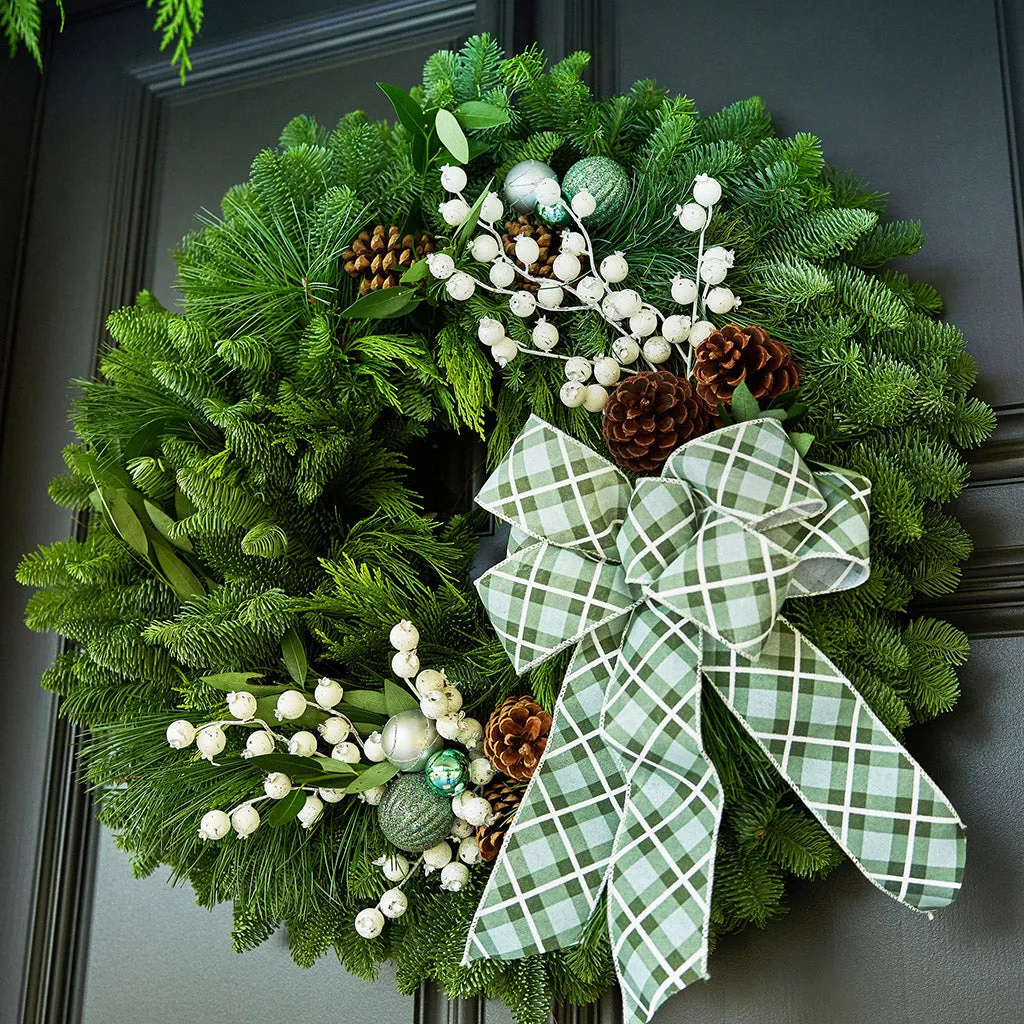
Rough numbers to recreate this one:
- 24-inch mixed evergreen wreath base: $45–$95
- Pinecones, white berry sprays, and textured ornaments: $20–$40
- Two yards of sage-and-white plaid fabric for the bow: $12–$22
- Floral wire, zip ties, and a metal door hanger: $8–$15
- Wreath storage bag (worth it): $10–$18
Total: $95–$190, versus $250-plus for a comparable designer wreath.
6. Buffalo Check Meets Burlap on a Black-and-Red Welcome Round
Building the layered bow is the whole project here.
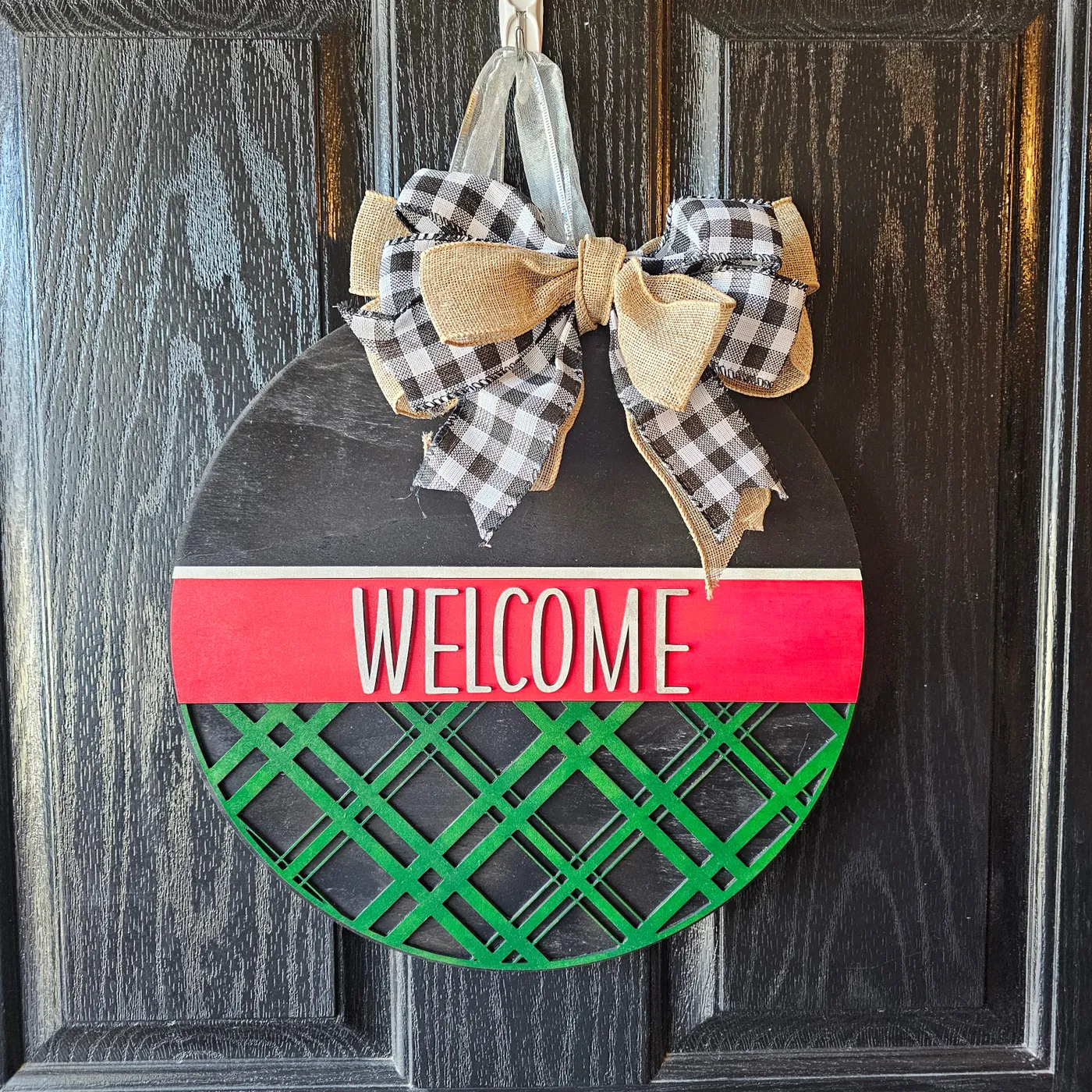
- Cut three ribbons: one wide buffalo check, one burlap, one narrow solid.
- Layer the burlap under the buffalo check and pinch both at the center.
- Wrap the narrow ribbon around the pinch and pull tight to form a waist.
- Fluff the loops outward rather than up, so the bow reads wide instead of tall.
- Trim the burlap tails into a notch to stop them fraying.
Time: about 20 minutes. Materials: $15–$25.
burlap and mesh are outdoor fabric in name only. Under a covered porch they’ll last a season or two. In direct rain and sun, buffalo check ribbon fades to pinkish grey and burlap starts shedding fibers onto your doormat within weeks. If your door faces the weather, hang this one inside and build the outdoor version from UV-treated ribbon and sealed wood instead.
7. Pine Wreath, Velvet Red Bow, and Warm String Lights
What this classic actually costs to assemble:
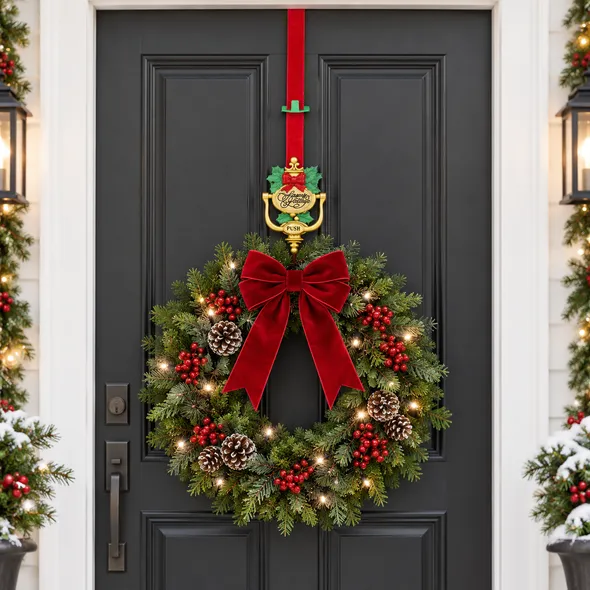
- 24-inch pine wreath, natural or faux: $40–$85
- Large velvet bow, or 1.5 yards of velvet ribbon: $15–$35
- Pinecones, red berries, and a warm-white LED strand: $20–$40
- Red ribbon to wrap the door knocker: $6–$12
Total: $81–$172.
The velvet bow is the whole personality of this door. Velvet has weight, so the loops hold their shape in cold air instead of going limp the way satin does, and it photographs beautifully against dark paneling. Remove it and you’re left with a lovely but anonymous pine wreath. Notice too how the red ribbon wraps that gold door knocker — that tiny continuity detail is what tells your eye the whole entry was styled by one person instead of assembled from three different shopping trips.
8. Chunky Pinecones and a Wide Burlap Bow With Trailing Tails
Wide burlap needs wire. Buy 2.5- to 3-inch burlap ribbon with a wired edge, because unwired burlap collapses into a sad pancake the moment the humidity rises. Pinch each loop and give it a quarter turn so the ribbon shows its face, and cut the trailing tails on a diagonal — a straight cut sheds fibers and looks unfinished. Hit the finished bow with a shot of unscented hairspray to tame the fuzz, and thread the long tails through the wreath’s back ring so they hang straight instead of flaring.
![OFFICIAL] Glitzhome 15'D Wooden Christmas Round Word Sign Door Hanger](https://4homeideas.com/wp-content/uploads/2026/10/official-glitzhome-15d-wooden-christmas-8.webp)
Expect this one to shed. Natural pinecones drop scales, frosted juniper dusts everything below it, and burlap fibers work their way into your welcome mat. A monthly shake-out and a light pass with a soft brush keeps it presentable. Store it in a breathable bag, not plastic — trapped moisture turns pinecones moldy by January. Realistically, plan on rebuilding or replacing the natural elements every second season.
9. Stained Wood Round With a Red Band and Mistletoe Ribbon
The formula here is about 55 percent stained wood, 20 percent Christmas red in that lower band, 20 percent white raised lettering, and 5 percent sage and mistletoe pattern in the ribbon. Keeping the red to a single horizontal stripe is what stops a rustic sign from looking like a craft-fair sandwich board. Swap the red band for forest green and the mistletoe ribbon for plain ticking, and the same proportions read as a completely different — much calmer — sign.
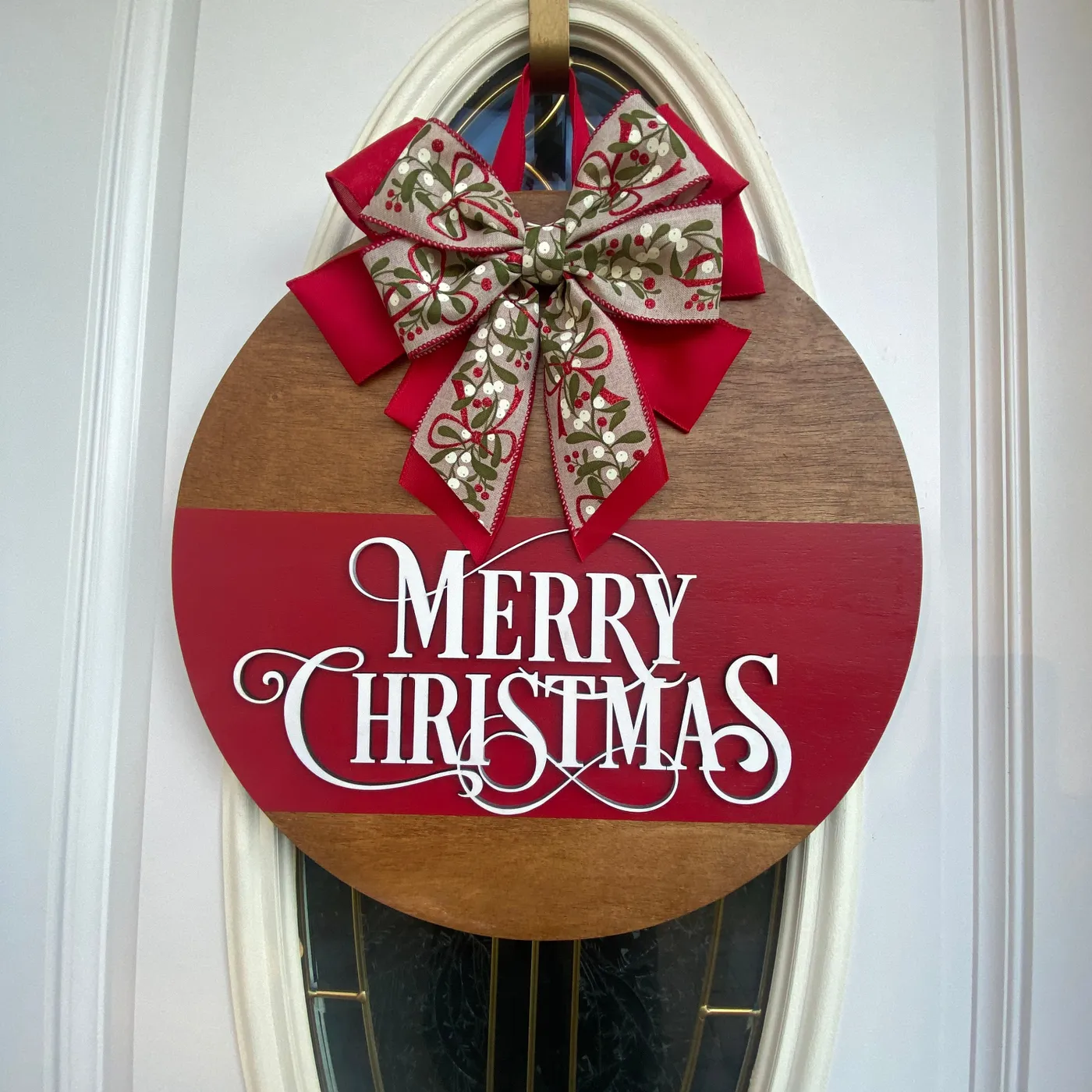
Skip the custom shop. A 15-inch wood round runs about $6 at Walmart, a sample jar of wood stain about $8, and a stencil set with a cursive alphabet about $10. Add a spool of patterned ribbon for $5 and you’re at $30 for a sign that sells for $65 to $90 online. The catch is time: staining, drying, and two rounds of stenciling will eat an afternoon. If your handwriting is decent, paint the text freehand and put the stencil money toward better ribbon.
10. Magnolia, Copper Baubles, and Orange Berries on Weathered White
Notice the temperature mix. The weathered white paneling behind the wreath is cool and slightly grey; the copper baubles, dried brown magnolia leaves, and orange berries are warm. That push-pull is why the wreath has depth instead of reading flat against the wall. Layering dried material — magnolia, nuts, assorted pinecones — under shiny elements also gives you matte-versus-gloss variation, so the eye keeps moving around the circle instead of stopping at one spot.
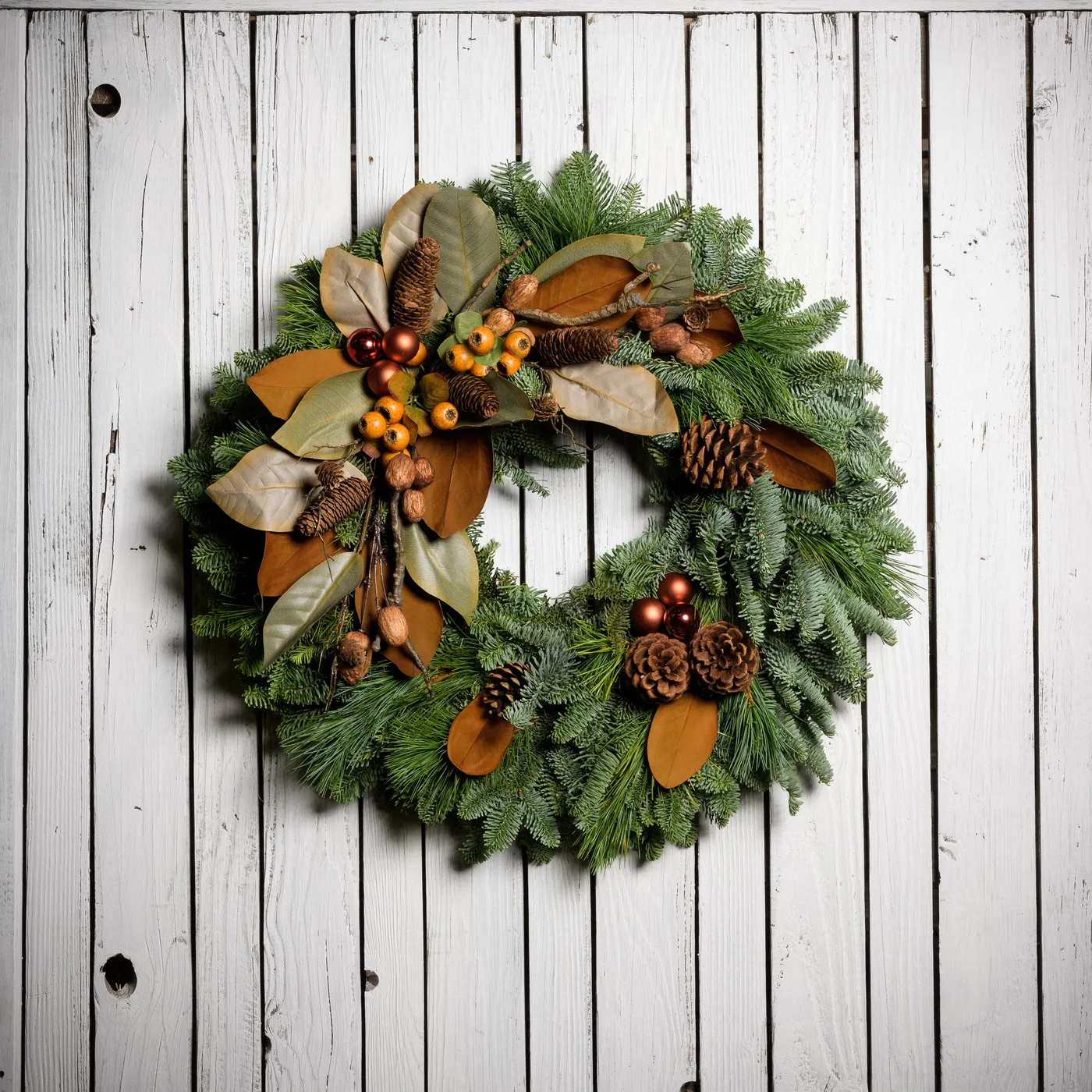
It’s the copper. Small clustered baubles in a warm metallic are the one element holding this wreath together — they tie the dried magnolia and the orange berries into a single palette and they catch whatever light hits the door. Lose them and you’re left with a nice natural wreath that reads brownish and a little flat in photos. If you can’t find copper, brushed antique gold gets you 80 percent of the effect for less.
11. Burlap Strap, Buffalo Plaid Bow, and a Bold Red Center Stripe
Here’s what a sign like this runs:

- 15-inch wood round with a burlap hanging strap: $12–$25
- Red exterior paint for the center stripe: $8–$14
- Adhesive stencil or vinyl lettering kit: $10–$20
- Buffalo plaid ribbon, 2.5 inches wide: $8–$16
- Faux eucalyptus sprig: $4–$9
Total: $42–$84 for a piece that sells for $70–$120 ready-made.
Skip the ribbon loop and hang it by the burlap strap instead. A wide, flat strap spreads the weight of a solid wood round across more of the hanger and keeps the sign from spinning into the door every time a delivery arrives. If you’re using an over-the-door hook, check the clearance first — most need about 1.75 inches between the top of the door and the frame, and a storm door eats that space fast.
12. Vintage Santa on a Tractor, Glazed Round, Red Ribbon
Retro farm imagery is having a real moment. The Santa-on-a-tractor illustration sits right at the intersection of two things that keep gaining speed: nostalgic Americana at Christmas, and the general Etsy-ification of holiday decor, where shoppers want something that looks like it came out of grandma’s attic rather than a big-box aisle. Pieces like this tend to hold their value — the aesthetic doesn’t date the way novelty graphics do, and the snowy evergreen backdrop keeps it from tipping into kitsch.
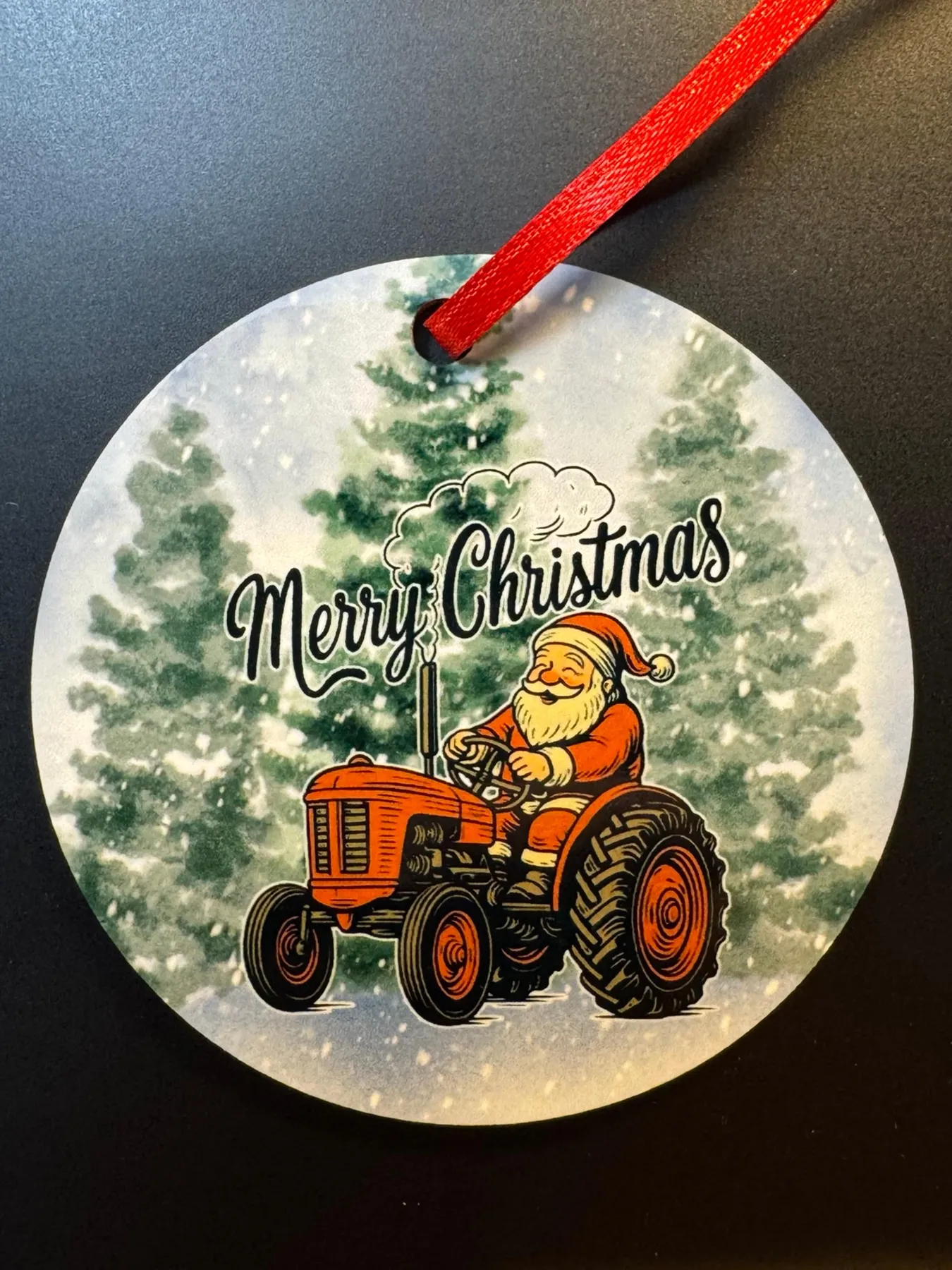
Keep the scale in mind. A ceramic round like this runs 4 to 6 inches across, which makes it an ornament or a small interior-door piece rather than a front-door hanger. It looks right on a pantry door, a mudroom hook, or tucked into a wreath, and it disappears entirely on a 36-inch entry door. If you want that farm illustration at front-door scale, look at Idea #21, where a barn-and-truck scene gets the same nostalgic treatment at 15 inches.
13. Hello Winter Wood Round With a Multi-Patterned Bow
Fair warning about the bow: three patterns in one knot is a lot. Red snowflake print, cream buffalo check, and a solid — that works only because the scales are wildly different. Swap in a third busy print at the same scale and the whole thing turns to visual static. If you’re nervous, drop to two patterns plus a solid grosgrain, and let the frosted evergreen sprigs carry the rest of the texture.

The split: 50 percent natural wood, 25 percent black panel, 15 percent red, 10 percent cream and pattern. Notice that the black panel does the heavy lifting by creating a dark field for the white lettering — swap the black for natural wood and your greeting loses all its punch against that dark gray door. To warm the whole thing up, change the panel to deep navy and the cocoa mug to rust.
14. A Bark-Edged Wood Slice Painted Red for ‘Believe’
A wood slice sign is a weekend project, and most of it is drying time.

- Cut or buy a 10- to 12-inch slice and let it air-dry at least two weeks — green wood cracks.
- Sand the face smooth, leaving the bark edge intact.
- Seal both sides with matte poly so the slice doesn’t split in a heated entryway.
- Paint the face red in two thin coats, not one thick one.
- Letter the word in white with a fine brush or vinyl stencil.
- Attach a striped grosgrain bow and a jute hanging loop.
Cost: $18–$30. Time: about 45 minutes of actual work.
Bought versions of this sign sell for $55 to $85. Doing it yourself lands around $20 if you source smart: a wood slice from a craft store for $8, red spray paint for $6, jute twine for $3, and a yard of red-and-white striped grosgrain for $4. Yard sales and Facebook Marketplace are goldmines for pre-cut rounds — people buy them in bulk for craft nights and never use them.
15. Plush Santa and Peppermint Candy on a White Fern Wreath
Attaching a heavy figurine to a wreath takes more than hot glue. Cut a 5-inch wood disc, wire it to the wreath form at four points with 22-gauge floral wire, then screw or glue the Santa to the disc. That spreads the weight across the whole ring instead of one spot, which stops the wreath from sagging into an oval by mid-December. Total hardware cost: about $6, and it’s the difference between a wreath that survives the season and one that droops.
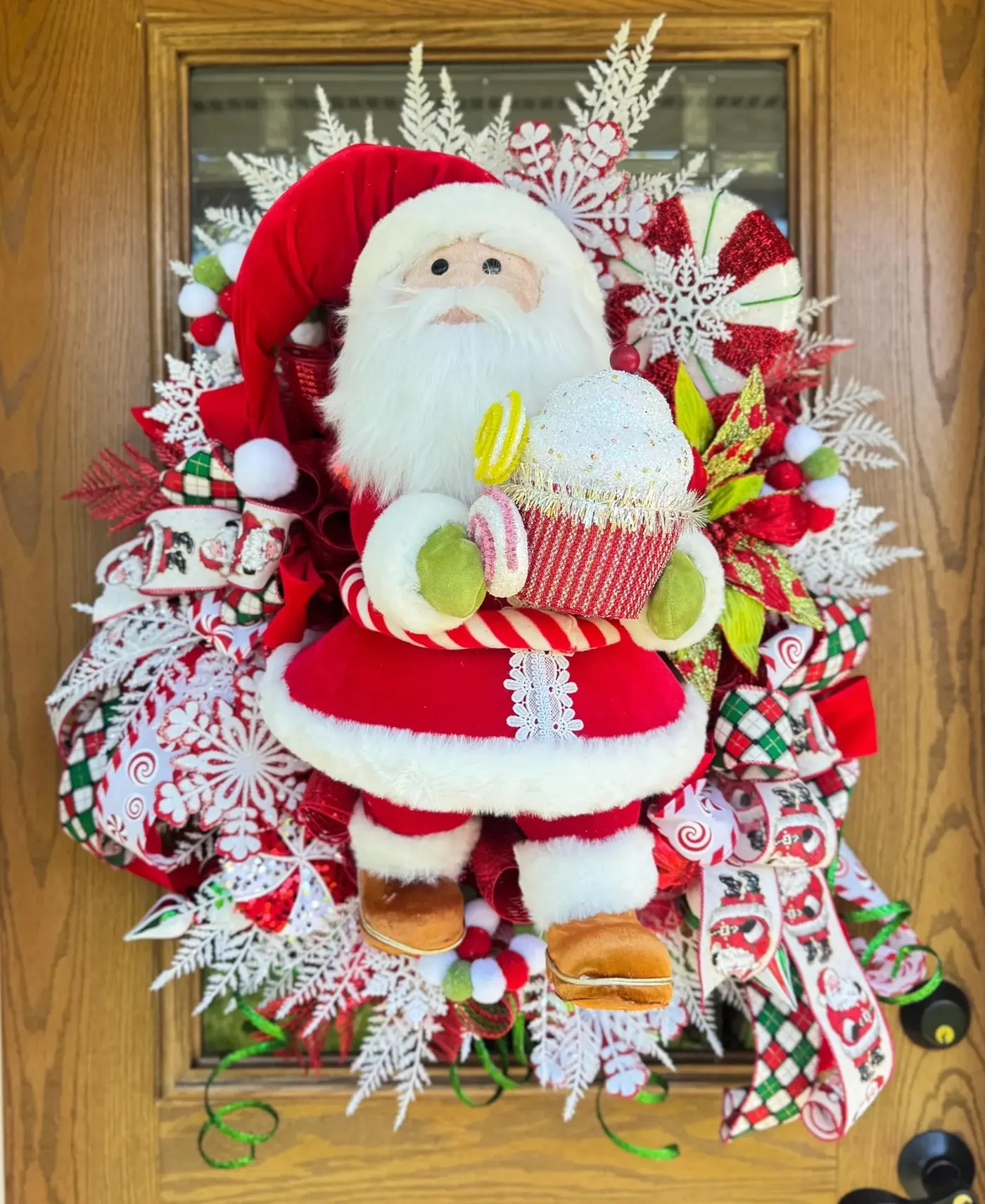
The candy is doing quiet structural work here. Those red-and-white peppermint cutouts repeat around the ring at roughly even intervals, which pulls your eye in a circle and keeps the plush Santa — a big, soft, visually heavy object — from dominating. The tartan ribbon bows pick up the red again and the white fern branches keep the whole thing from turning into a red blob. Contrast, repetition, and one focal point.
16. A Teal Spirit Round With an Eagle and a Twine Hanger
A 16-inch round is the practical sweet spot for a single front door — big enough to read from the sidewalk, small enough to leave the handle usable. On a double door, size up to 20 or 22 inches so the sign doesn’t look stranded between the panels. Over-the-door metal hangers are the easiest hardware-free option, but measure your gap: most need about 1.75 inches of clearance, and once you stack a storm door on top of that, some hangers simply won’t fit.
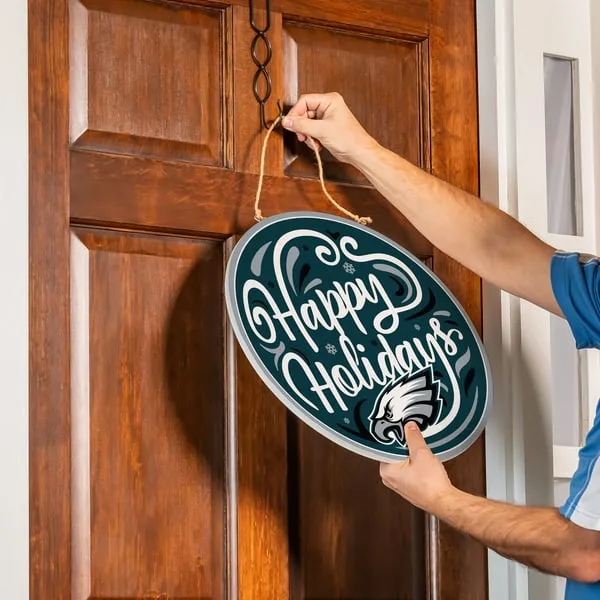
Before you commit to a custom sign, run this checklist:
- Measure the door width and the gap above it for hanger clearance.
- Check which way the door faces — full afternoon sun fades painted graphics.
- Confirm your text length fits the round; long phrases shrink the letters.
- Decide on hanger type: ribbon, twine, burlap strap, or metal hook.
- Budget for shipping if it’s custom; personalized rounds often take 2–3 weeks.
17. Dried Orange Slices and Brass Bells on Cedar and Conifer
The brass bells. Hanging them from the center on a loop of twine rather than tucking them into the branches does two things: it gives the wreath a vertical drop that breaks the perfect circle, and it adds a soft chime every time the door opens. Any wreath can hold dried orange and berries. The bell cluster is what makes guests stop and touch it, and it’s the detail people remember when they describe your entry to someone else.
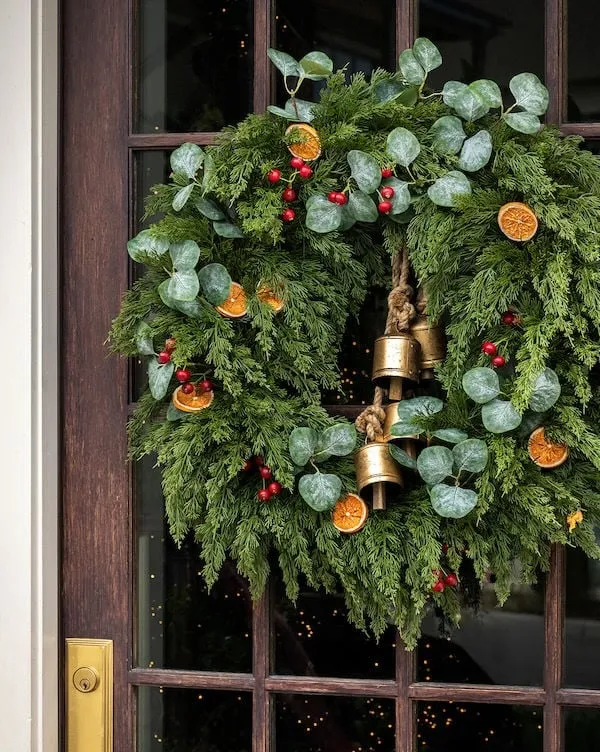
Dried citrus is unforgiving. Slices must be dried until they’re rigid — any softness and they’ll mold inside a warm house within weeks. Frosted eucalyptus looks lovely but sheds a fine white dust onto your threshold, so give it a gentle shake outside before bringing it in. Plan to replace the citrus every season, and store the wreath somewhere cool and dry, never in a hot garage.
18. White Twigs, Frosted Pinecones, and a Soft Fake-Snow Dusting
Bare white twigs against a dark door is high-contrast magic. The white reads almost graphic — you notice the shape of the wreath before you notice the color — and it makes the green foliage and small red berries look twice as saturated by comparison. It’s also a smart option if you love a snowy look but don’t want to deal with heavy flocking, which sheds everywhere and yellows after a couple of seasons.
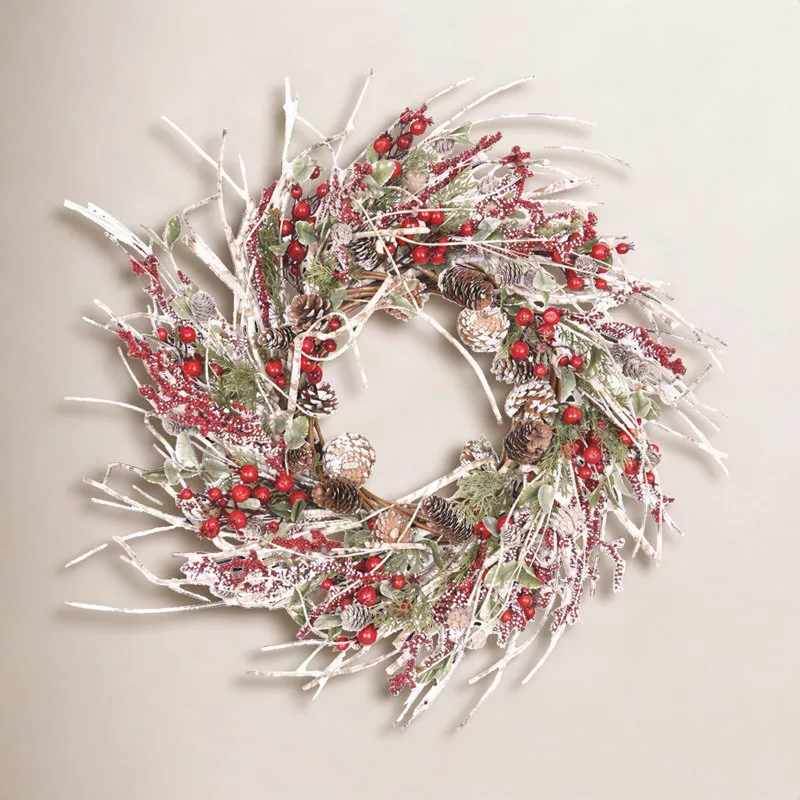
Faux-snow wreaths in this style sell for $70 to $120 at home decor stores. For about $30 you can get there: a plain twig wreath base for $12, frosted pinecones and red berry picks for $10, and a can of spray snow for $6. Aim for a light dusting rather than full coverage — over-sprayed wreaths look like they fell in a flour bin, and artificial snow never quite dries tack-free.
19. Arched Black Door Framed in Red Berry Garland
This look scales up fast, so here’s real math:
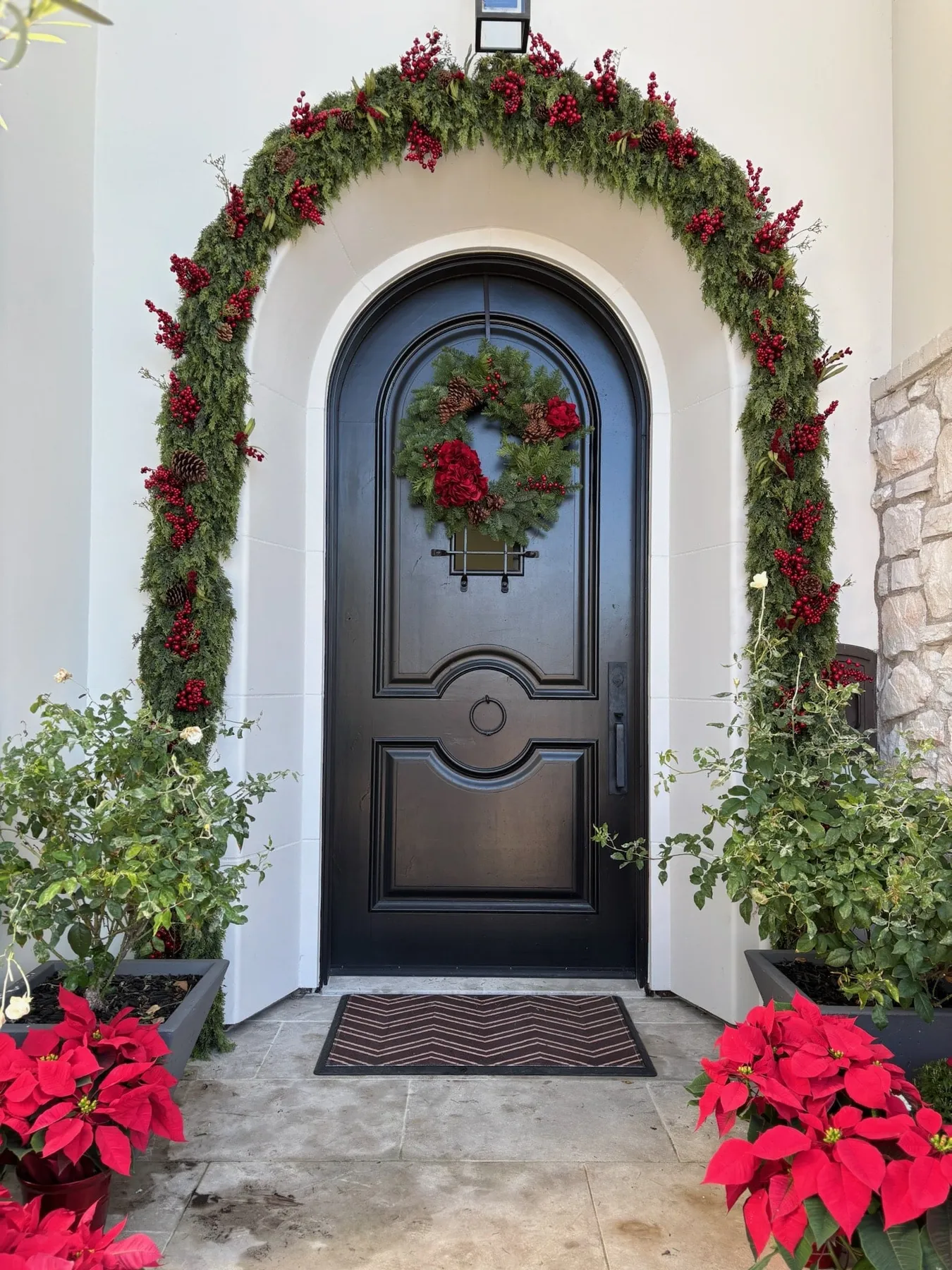
- Two 9-foot garland strands, mixed evergreen: $50–$120
- 24-inch matching wreath: $40–$90
- Red berry and pinecone picks, 12-pack: $18–$35
- Six potted poinsettias: $60–$110
- Chevron doormat: $20–$45
Total: $188–$400 — and yes, you can cut the poinsettias and almost nobody will notice.
An arched doorway is a different animal. Garland has to follow the curve without kinking, which means shorter, more flexible strands zip-tied every 6 inches rather than two long runs. You need at least a 9-foot ceiling to carry the vertical weight, and the wreath wants to sit about a third of the way down the arch — not dead center, which fights the curve. For a standard rectangular opening, go back to Idea #1, where straight framing does the same job.
20. A Vertical Teardrop Swag With Black, Gold, and Plaid Layers
Teardrops solve an awkward problem: doors with glass panes. A round wreath covers the window; a vertical swag hangs beside or in front of it without blocking light. Mount the top loop about two-thirds up the door height and let the tail end above the kick plate — that keeps it from swinging into your shins. Use a clear adhesive hook rated for 5 pounds, or better, hang from a ribbon-wrapped over-door hook that clears the frame.
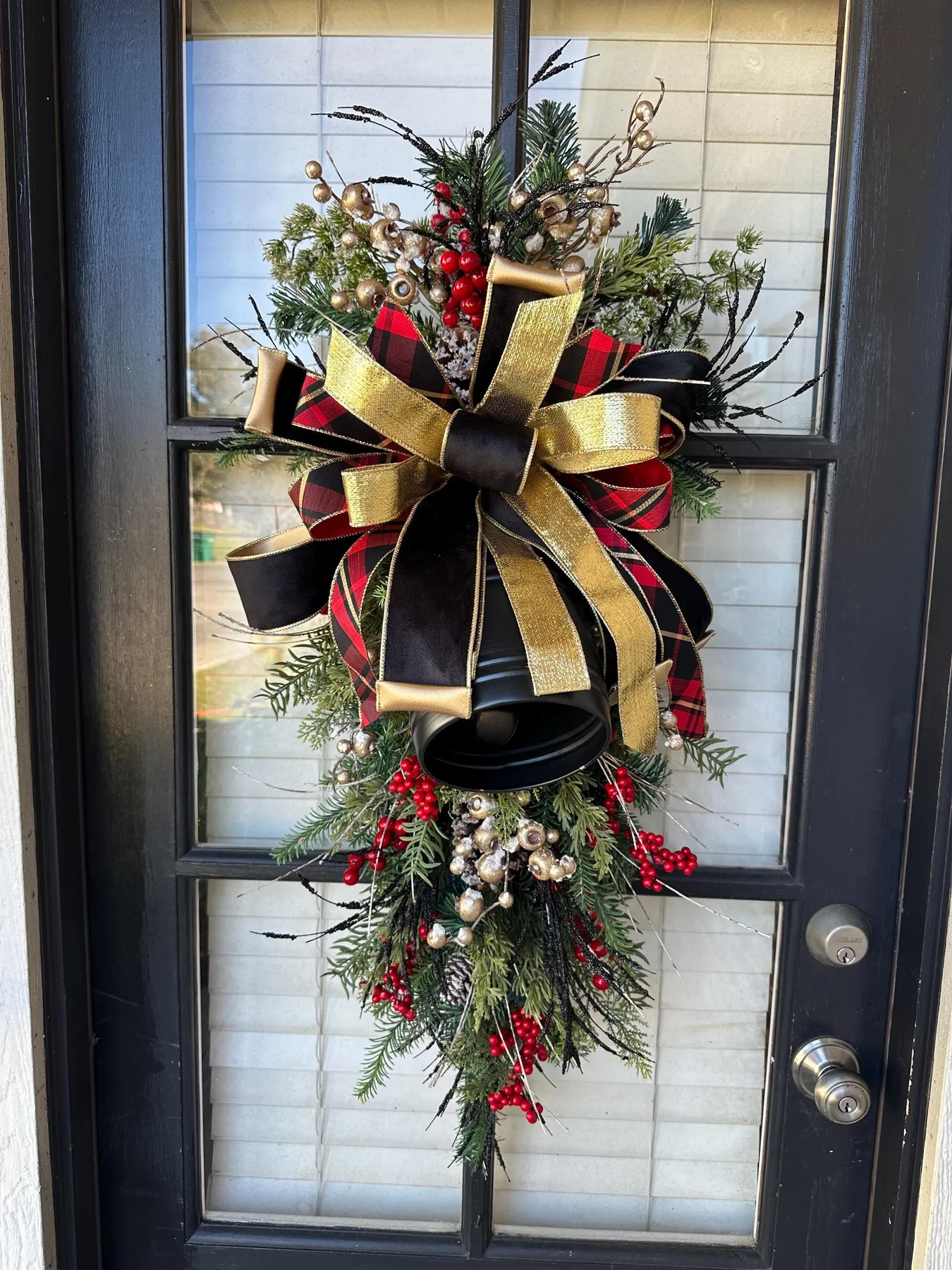
The shift away from perfect circles is one of the more interesting things happening in holiday door decor. Vertical swags, teardrops, and asymmetric clusters photograph better in a tall phone crop, which matters more than it used to now that so much decorating happens for the camera. It’s also a practical response to glass-paneled doors, which have become standard in new builds. Circles aren’t going anywhere, but this format is here to stay.
21. Barn and Truck Sign Anchored by Buffalo Check Bows
Assembling a vertical hanger like this one is a balance act.
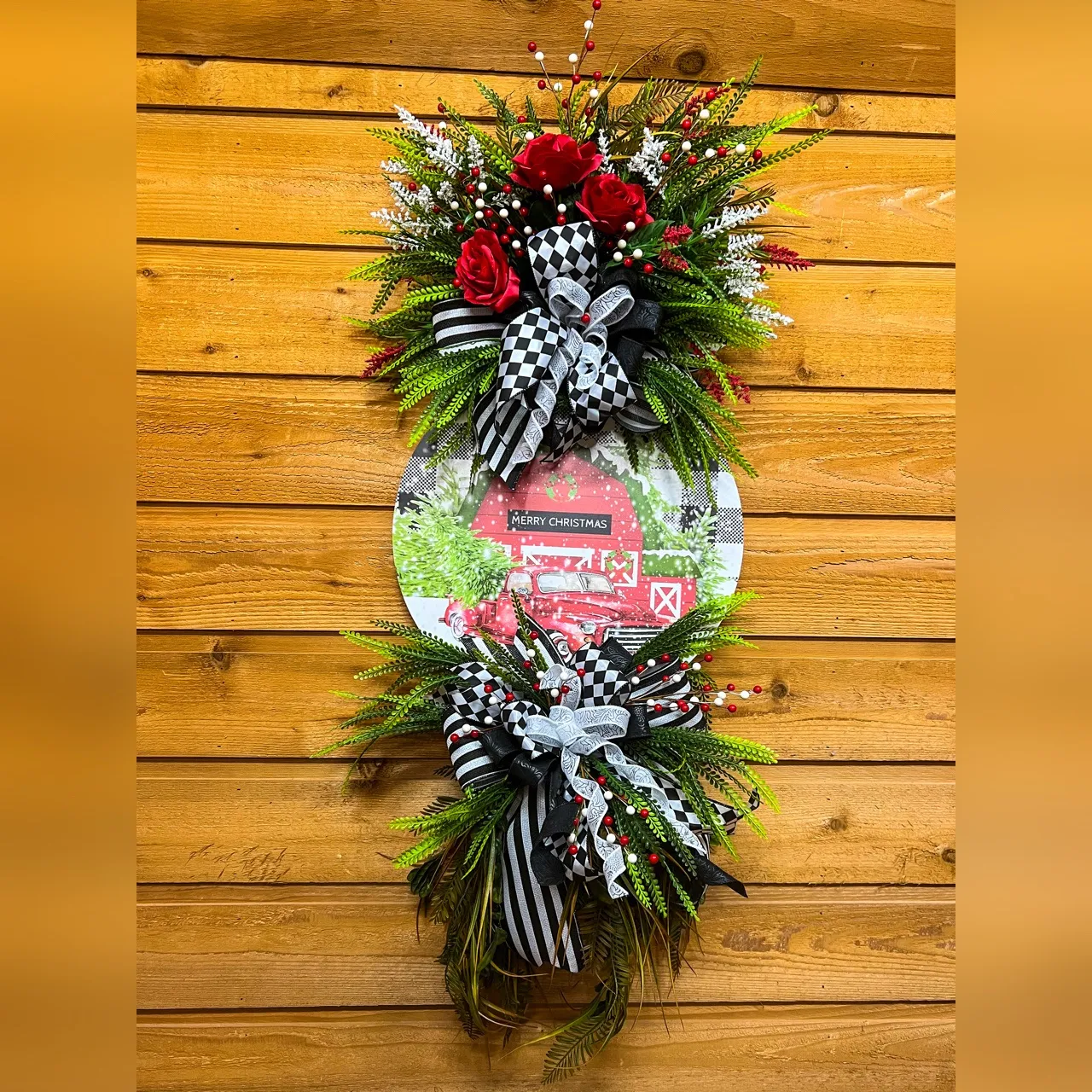
- Start with the round sign and zip-tie it to the backing form at two points.
- Build the top cluster first — greenery, then berries, then red roses — wiring each element individually.
- Add the buffalo check bows at the top and bottom, but make the bottom bows slightly smaller.
- Hang it, step back, and trim until the bottom cluster doesn’t outweigh the top.
Time: 35–45 minutes. Supplies: $40–$70.
A vertical hanger is heavier than it looks and it swings. On a door that gets slammed by kids or a dog, you’ll want a hook with a rubber grip, not a smooth metal one, or you’ll find the whole thing on the floor by New Year’s. Also check the top gap — thick swags need a hanger that clears the frame. In a narrow entry, this format can crowd the doorway; a plain round keeps traffic moving.
22. A Wooden Horse Head Dressed in Evergreen and Lace
The horse head silhouette is the entire idea. Everything else — evergreen boughs, pinecones, white berries, a lace bow — is standard holiday inventory. Without the wooden form, this is a nice wreath you’d walk right past. With it, it’s the piece people ask about at the party. If you have a hobby that has a shape — a sailboat, a guitar, a dog breed — the concept transfers, and the greens simply become the frame.
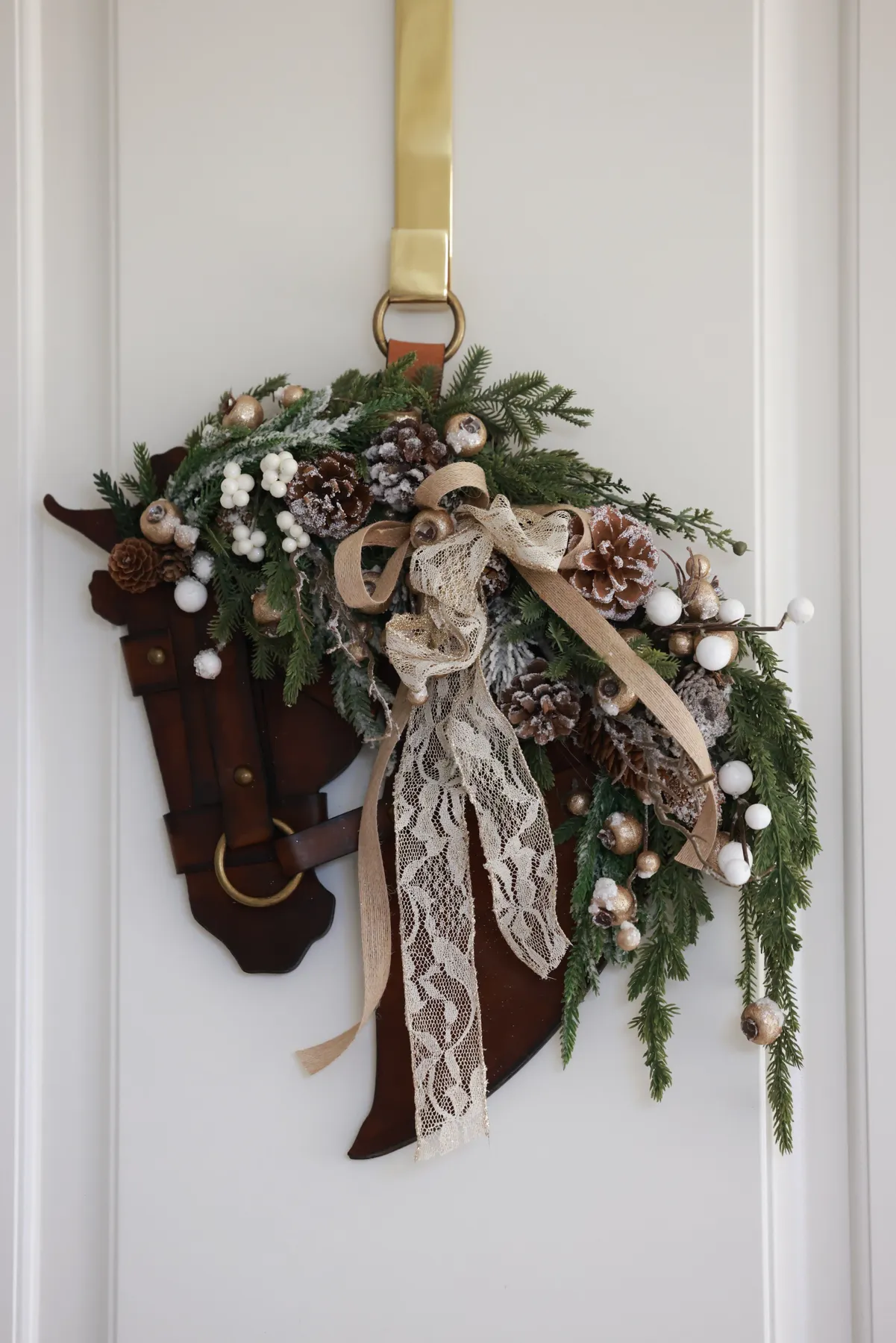
Roughly 55 percent dark wood, 25 percent evergreen, 10 percent cream and lace, 10 percent gold and white berries. The dark silhouette is the anchor, so everything else needs to stay lighter and looser than it is. Change the wood to a whitewashed finish and the same arrangement reads coastal instead of traditional; switch the lace bow to black velvet and it swings formal. Same greens, three completely different moods.
23. Burlap Mesh and Buffalo Check Loops Around a Welcome Sign
Deco mesh looks expensive and isn’t. A 10-inch roll runs about $8, a roll of buffalo check ribbon $7, and a wooden circle sign about $6 at a craft store or $8 on Etsy. Layer the mesh in loops and pin each one — that’s the whole technique, and it’s how you get that puffy, full look without a single stem of real greenery. Budget around $35 total versus $95 to $150 for a comparable finished wreath.
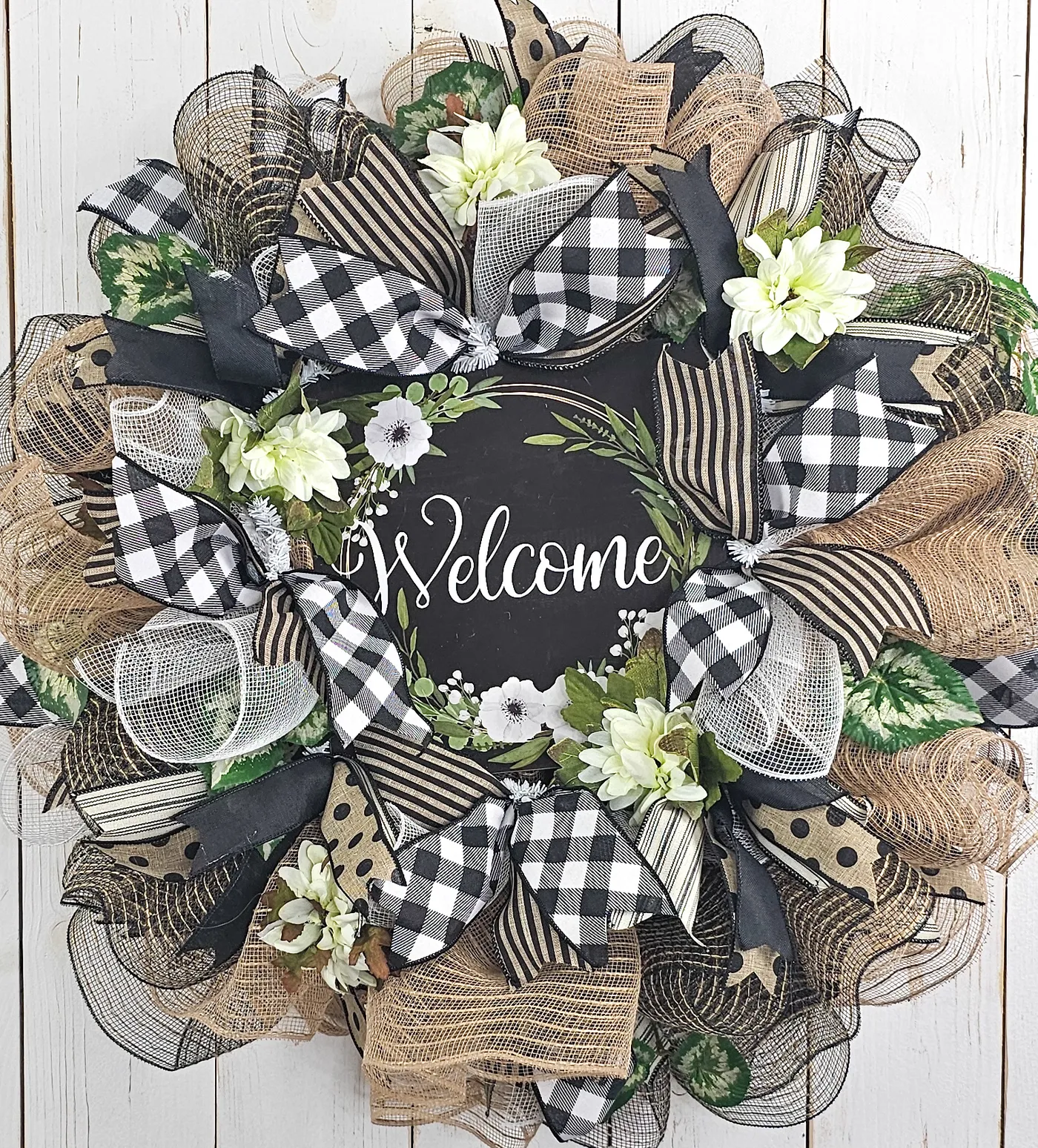
Mesh gives you volume no foliage can match for the price. It fills a 24-inch ring using loops and pins rather than pricey stems, which is why the wreath reads as a big, generous circle from 20 feet away. The black center sign also gives all that ruffled texture something solid to sit against — without it, the mesh would look like a wreath-shaped cloud. If mesh feels too puffy for your entry, Idea #26 delivers the same buffalo check story on a flatter twig base.
24. A ‘Jingle’ Sign Nestled Into a Buffalo Check Bow Wreath
Two small choices make this wreath look intentional. First, use a gold-toned over-door hanger instead of a ribbon — it reads as jewelry rather than a repair, which matters when the wreath hangs on a glass door. Second, nestle the wooden sign into the bow at an angle so it overlaps the ribbon with a slight tilt. Signs mounted dead-straight and centered always look like a price tag; signs tilted and tucked look collected. Keep the sign under 8 inches wide on a 24-inch wreath.
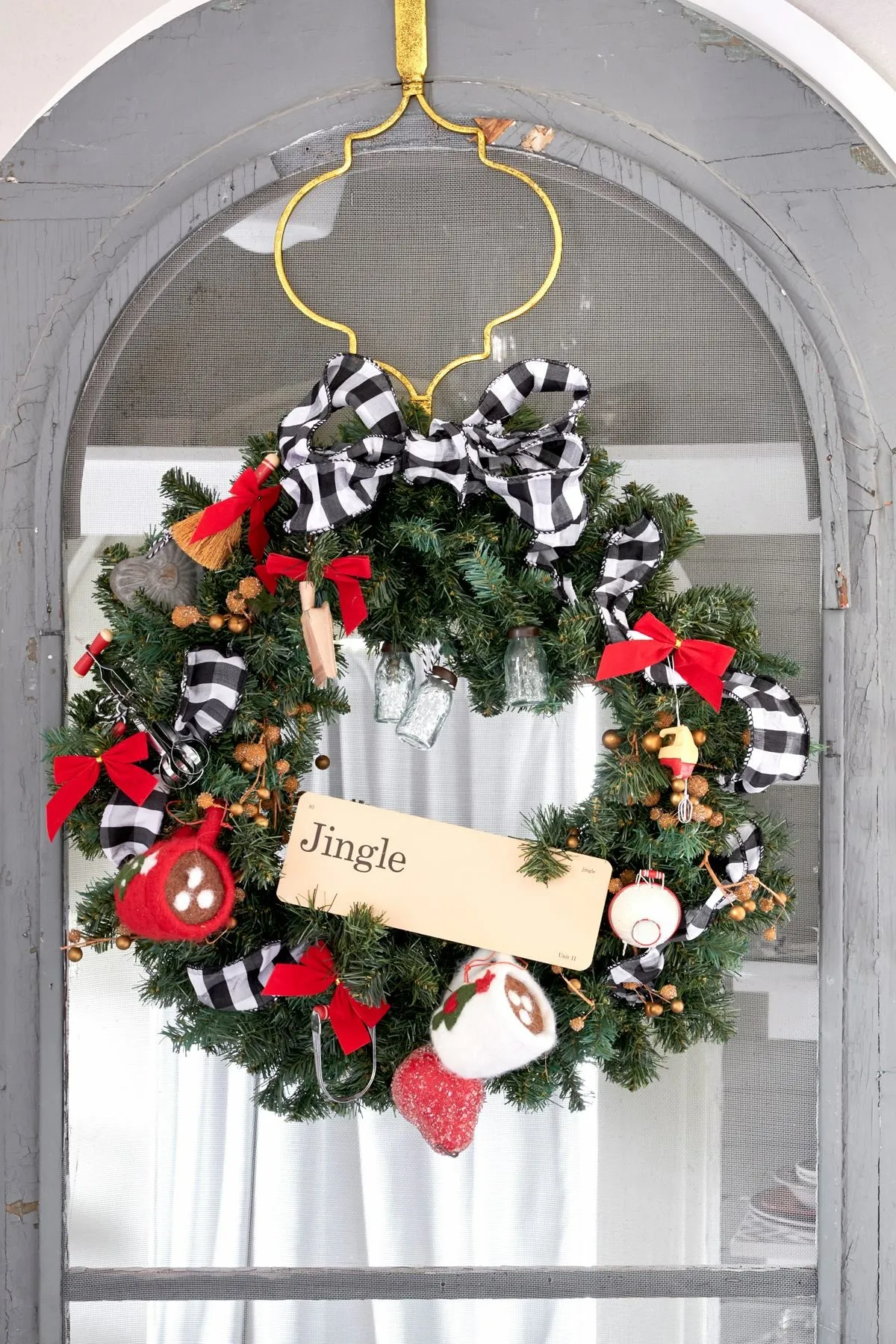
What the full look costs:
- 24-inch artificial pine wreath: $25–$60
- 2.5-inch buffalo check ribbon: $8–$15
- Miniature ornaments, red bows, gold berry clusters: $18–$35
- Small wooden sign: $6–$14
- Gold-toned metal door hanger: $8–$18
Total: $65–$142. Buying it finished usually starts around $130.
25. Red Feathery Sprigs and a Satin Bow Tied at Lower Left
This is close to 70 percent green, 20 percent red, 10 percent white door. Very little else — and that’s the point. The red arrives as soft, feathery sprigs rather than chunky ornaments, so the palette stays quiet even though red and green are both at full strength. Swap the feathery sprigs for glossy ball ornaments and the whole wreath gets louder instantly. Trade the deep red satin streamers for dusty rose and it turns romantic.
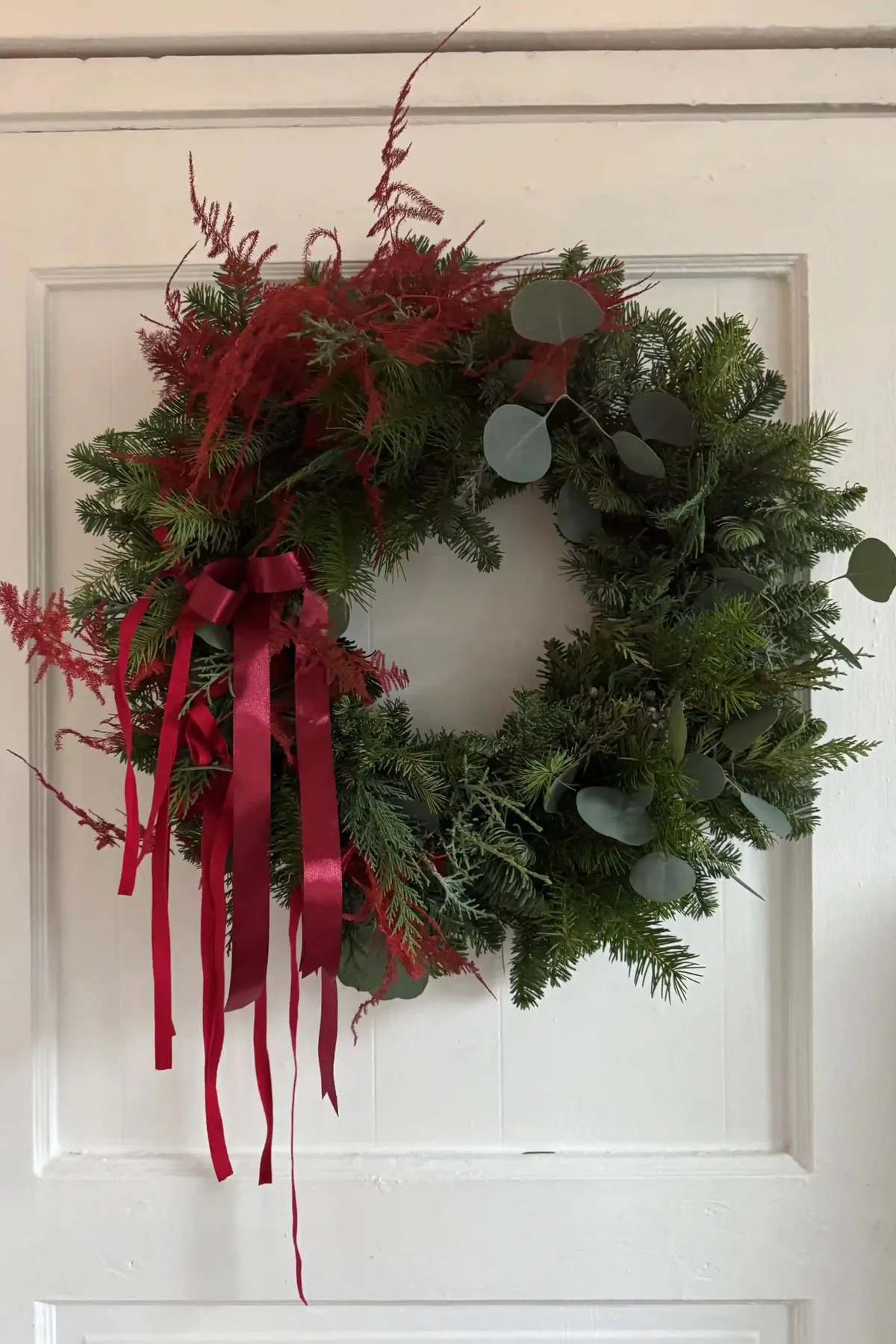
Here’s the catch with dyed foliage: it fades and it sheds. Those red sprigs will drop tiny bits on your threshold for the first week, and by week three, any sprig catching direct sun will start going soft pink. Satin is the other weak point — it holds its shine beautifully until it gets rained on, at which point it water-spots. Under a covered porch, this wreath will look good for a full season.
26. Twig Base, Lamb’s Ear, Cotton Bolls, and a ‘Hello’ Sign
Lamb’s ear and cotton bolls are beautiful and they are dust sponges. Both have fuzzy surfaces that grab everything, and neither one likes humidity — cotton bolls in particular can hold moisture and mildew if they get rained on. Keep this one indoors or under deep cover, and give it a light vacuum with a brush attachment every few weeks. In a wet climate, expect to replace the cotton by next season.

Building the asymmetric cluster is easier than it looks.
- Start with the twig base and lay the sage greenery along the left third only.
- Poke lamb’s ear stems in at three different depths so they don’t line up.
- Cluster the cotton bolls in odd numbers — three or five, never four.
- Tie the buffalo plaid bow low on the left and let the tails run long.
- Mount the hello sign on the lower right to counterbalance the bow.
Time: 30 minutes. Materials: $35–$60.
27. Warm String Lights Woven Through Pine, Berries, and Cones
The lights are the entire mood here, and the color temperature is not an accident. Warm-white strands around 2700K make pine needles look golden and berries look richer; cool-white 4000K bulbs turn the same wreath slightly blue and sterile. Weave the strand in a loose spiral rather than a tight coil — you want pools of light between clusters of berries and cones, not an evenly lit doughnut. Battery packs hide nicely tucked behind the top loop.
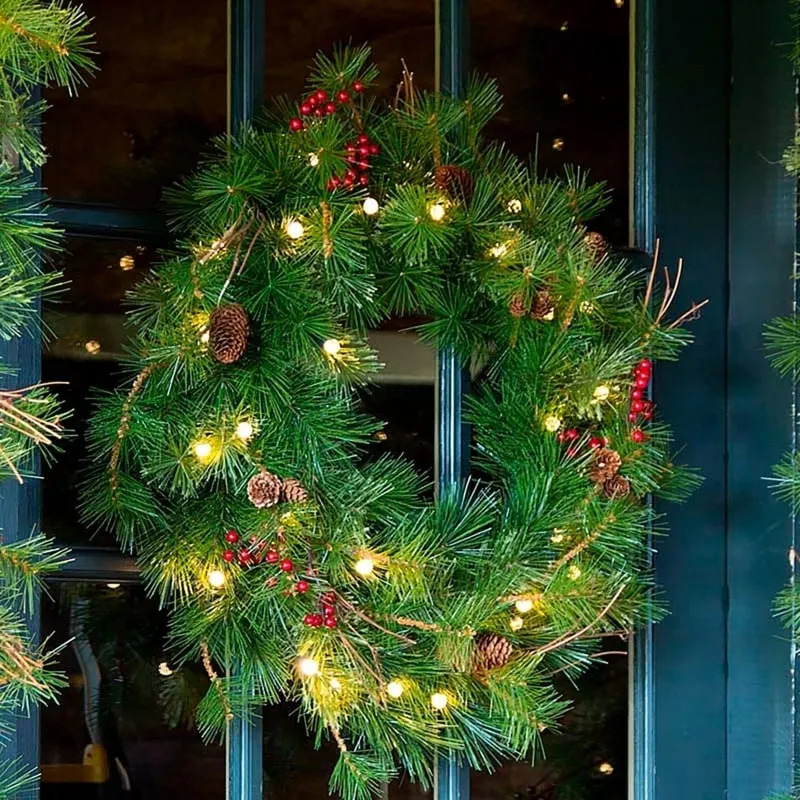
Realistic expectations: battery-powered strands on a busy door last about three to four weeks on a set of AAs, and less in cold weather, because batteries hate the cold. Buy rechargeable AAs and keep a spare set charged. Bulbs at the cheap end of the market fail in clusters, so test the strand before you weave it in. Store it coiled around a cardboard tube — yanking it off in January is how half the strand dies.
28. Layered Buffalo Check and Coir Mats With Mums and Pumpkins
Layering mats is a scale game. A 22-by-36-inch base mat with a smaller coir mat on top gives you about 4 inches of visible border on each side — any less and the layering just looks like a mistake. You need at least a 36-inch-wide landing area, and it works best with a 6-foot ceiling minimum so the mums, lantern, and pumpkin cluster have room to breathe. Narrow stoops should use a single mat and let the wreath carry the styling. Come December, this same layout swaps mums for poinsettias and the dried wreath for a round evergreen — see Idea #1.
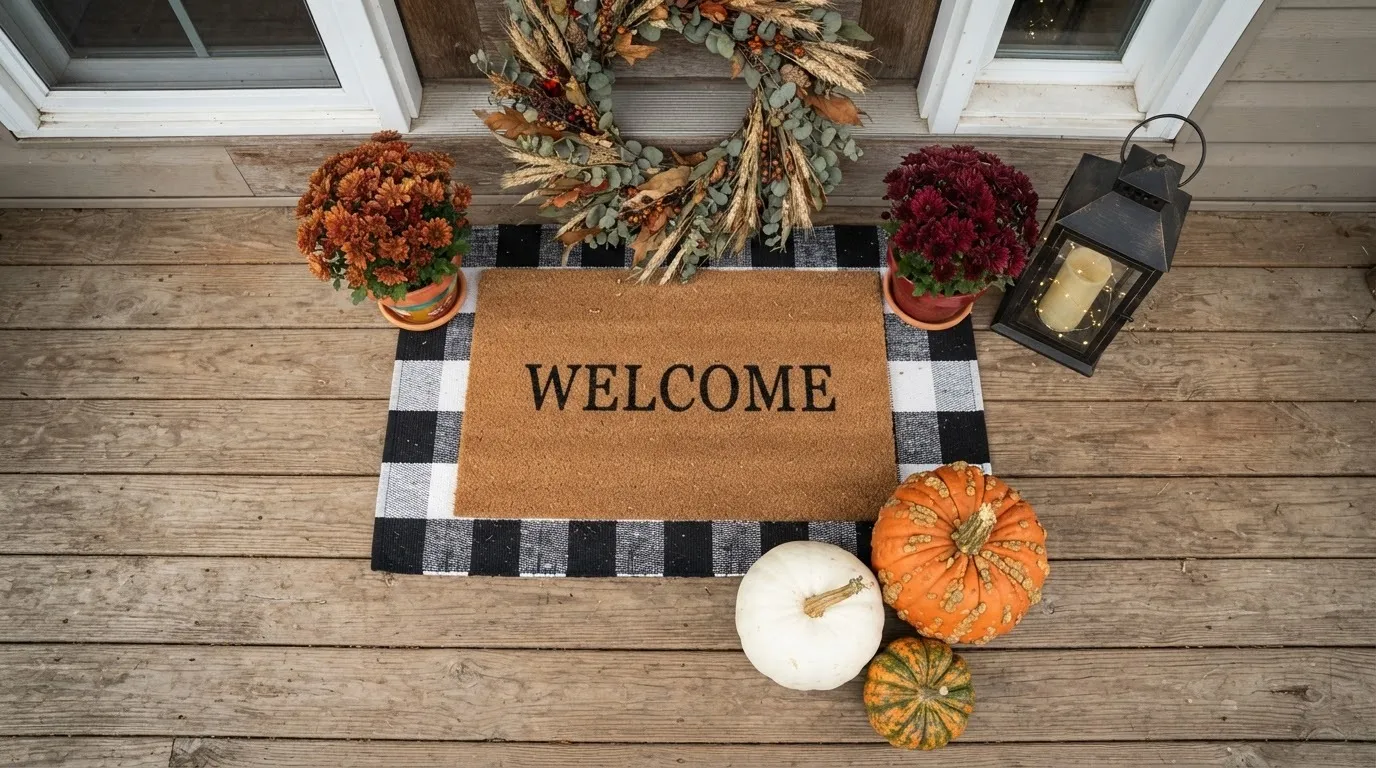
Quick pre-flight check before you style the entry:
- Measure the landing depth — mats plus a swing-out storm door need about 36 inches.
- Note which side the door hinges on so nothing blocks the swing.
- Check drainage; coir mats sitting in puddles rot from underneath.
- Confirm sun direction — mums against a west wall will need water daily.
- Anchor the top mat with a non-slip pad so nobody trips.
29. Mesh Ruffles, Blue Glitter Leaves, and a Nutcracker Round
What it takes to build the mesh version:
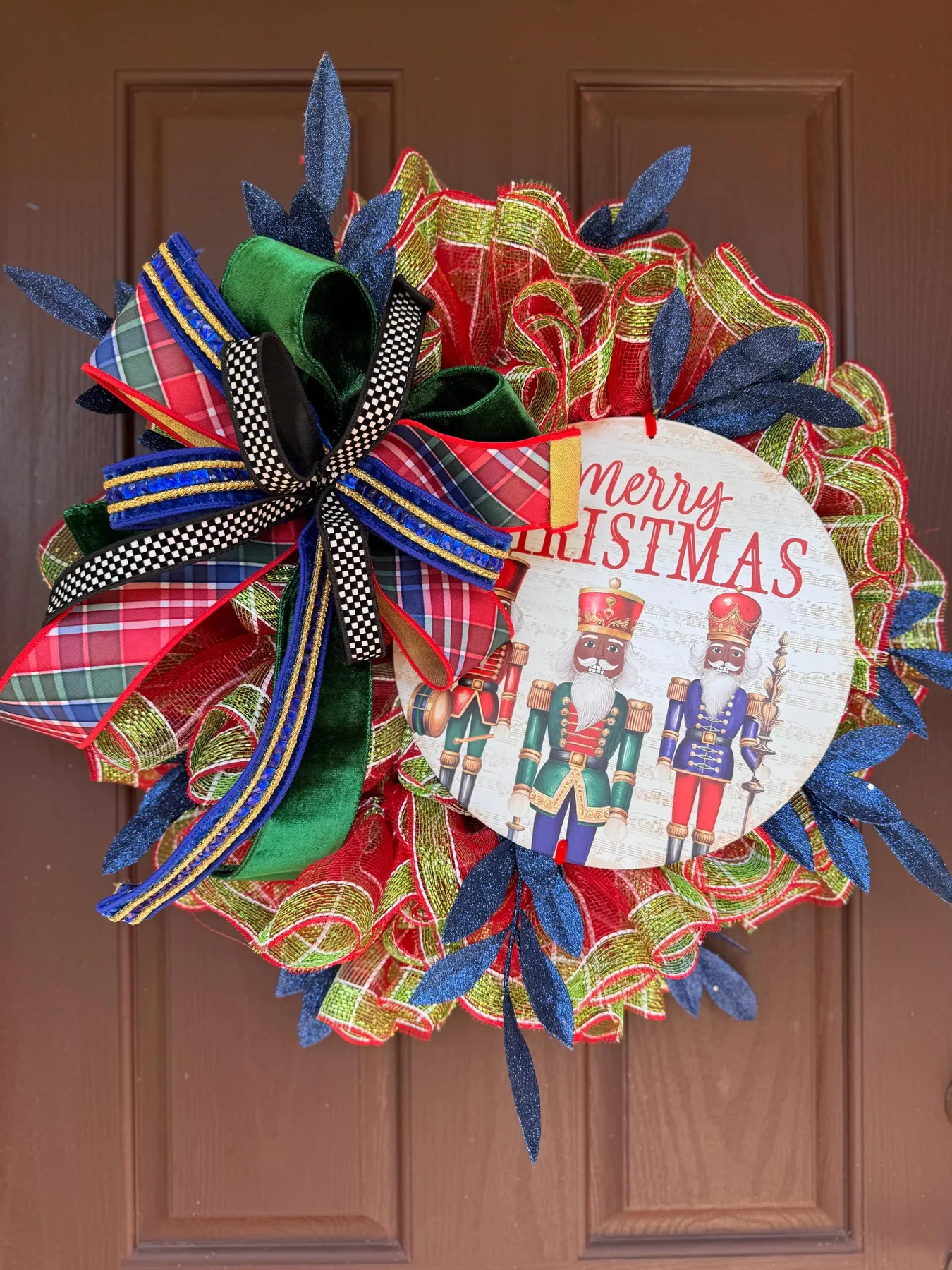
- 12-inch nutcracker round sign: $14–$28
- Two rolls of deco mesh (red, green): $16–$24
- Gold mesh roll: $8–$12
- Blue glitter leaf picks: $8–$16
- Plaid and buffalo check ribbon, three styles: $18–$30
- 18-inch wire wreath form: $5–$10
Total: $69–$120 for a piece that would sell at $180 and up.
Red and green with a shot of blue is a bigger move than it sounds. The blue glitter leaves pull this out of the standard Christmas palette and into the jewel-tones-with-a-twist space that’s been climbing on Pinterest for a couple of seasons. It reads modern without abandoning tradition, which is exactly what people who are tired of the usual red-and-green are hunting for. Keep the blue under 10 percent of the wreath and it stays elegant instead of patriotic.
30. Boxwood Wreath With a Yellow Buffalo Check Bow Tied Low
The formula is simple: 60 percent green boxwood, 25 percent dark brown paneled door, 10 percent yellow-and-white plaid, 5 percent bronze hardware. Boxwood gives you a tight, almost architectural texture, which is why a single bright bow is enough here — the greenery is already visually interesting. Swap the yellow check for red and it goes classic; swap for blush and it goes spring; swap for black and white and it turns modern farmhouse.
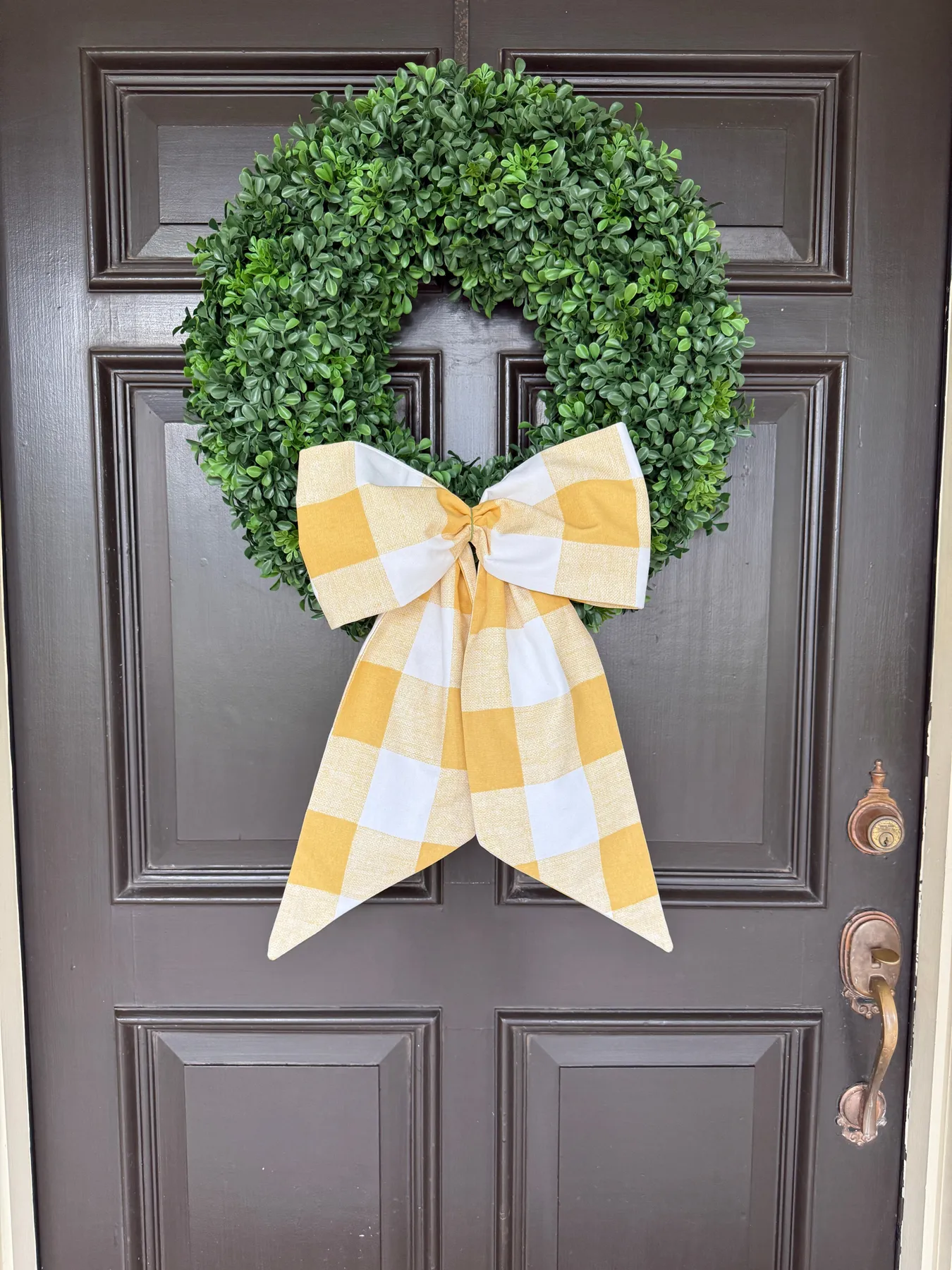
It’s the yellow. In a season of red and green, a yellow buffalo check bow tied low on green boxwood is the surprise that makes people look twice — and the tie-in with the bronze handle below is what keeps it from feeling random. Without that bow, this is a plain boxwood wreath on a brown door. With it, the whole entry becomes a color story. If yellow is too bold for you, keep the bow and paint the door deep charcoal.
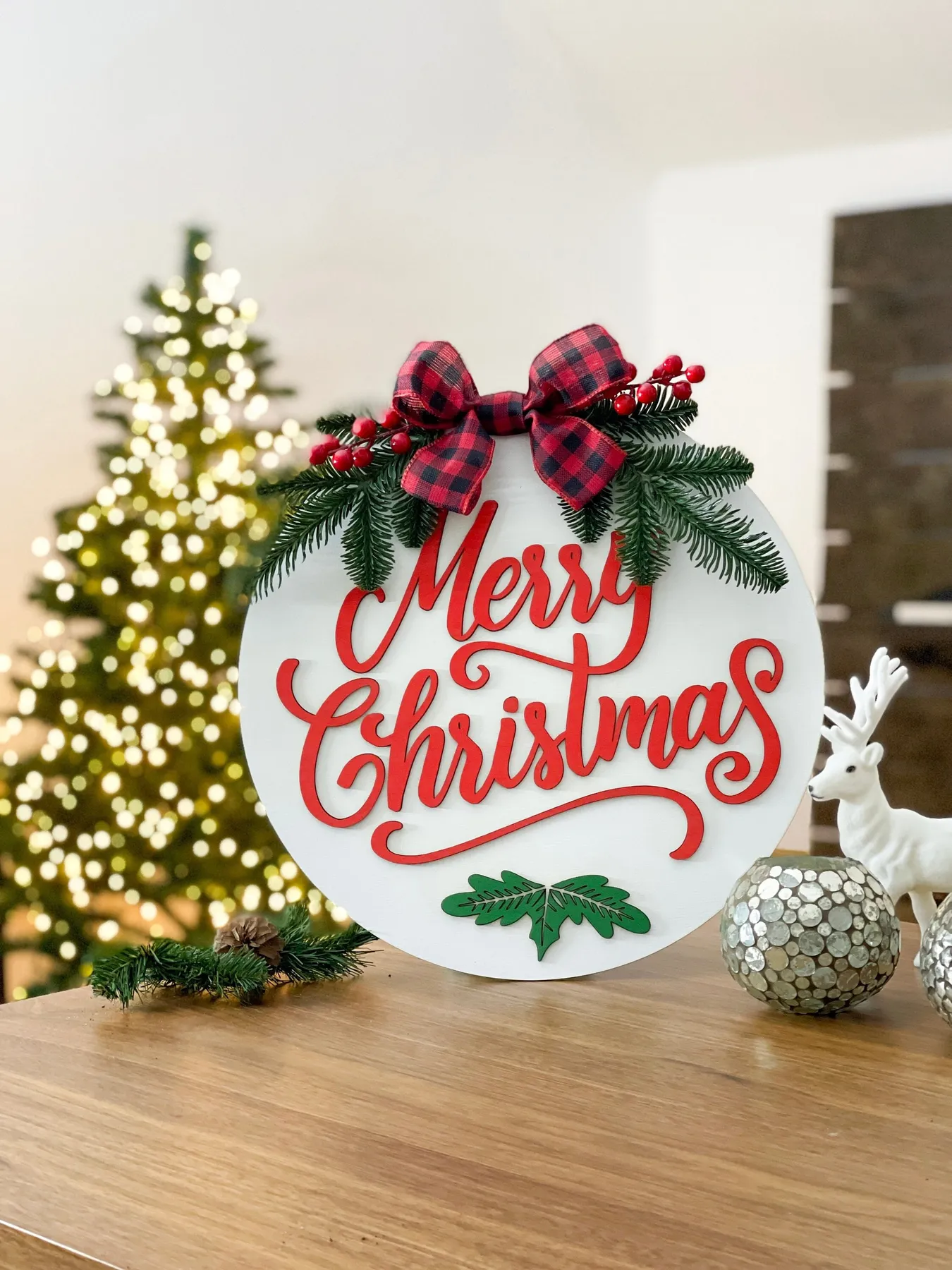
31. White Round, Red Cursive, Holly Motif, Buffalo Check Bow
Crisp raised lettering is a technique, not a talent.
- Paint the round white and let it cure for 24 hours.
- Cut your lettering in adhesive vinyl and press it onto the face.
- Paint over the whole surface with another coat of white for a blended look, or skip this step for graphic contrast.
- Remove the vinyl while the paint is still slightly tacky — pulling it fully dry cracks the edges.
- Glue a small faux-holly sprig at the bottom to anchor the composition.
Time: about 90 minutes plus drying.
White signs are the worst offenders for showing dirt. Rain splashes, road dust, and pollen all land on that bright surface, and wiping with a wet cloth can lift the paint if it isn’t fully cured. Give the finished sign two coats of matte exterior polyurethane and clean it with a barely damp microfiber, not a spray bottle. For a darker option that hides wear better, see Idea #34.
32. Frosted Pinecones, Red Berries, and a Textured Burlap Bow
This is one of the cheapest wreaths to fake convincingly. A plain 20-inch pine wreath base runs $12 to $18 at a big-box store, a bag of frosted pinecones $8, a red berry bunch $5, and 2 yards of burlap ribbon $6. That’s roughly $35 for a rustic look people pay $85 for. Facebook Marketplace in late November is full of wreaths people bought and never used — check there first.
Frosted pinecones are easy to DIY and usually better than store versions. Dip the cone tips in a 50/50 mix of white craft paint and water, then roll the wet tips in fine glitter while they’re still damp. Set them on wax paper to dry overnight. Real pinecones from the yard work fine — bake them at 200°F for 30 minutes first, and let them cool completely before you paint.
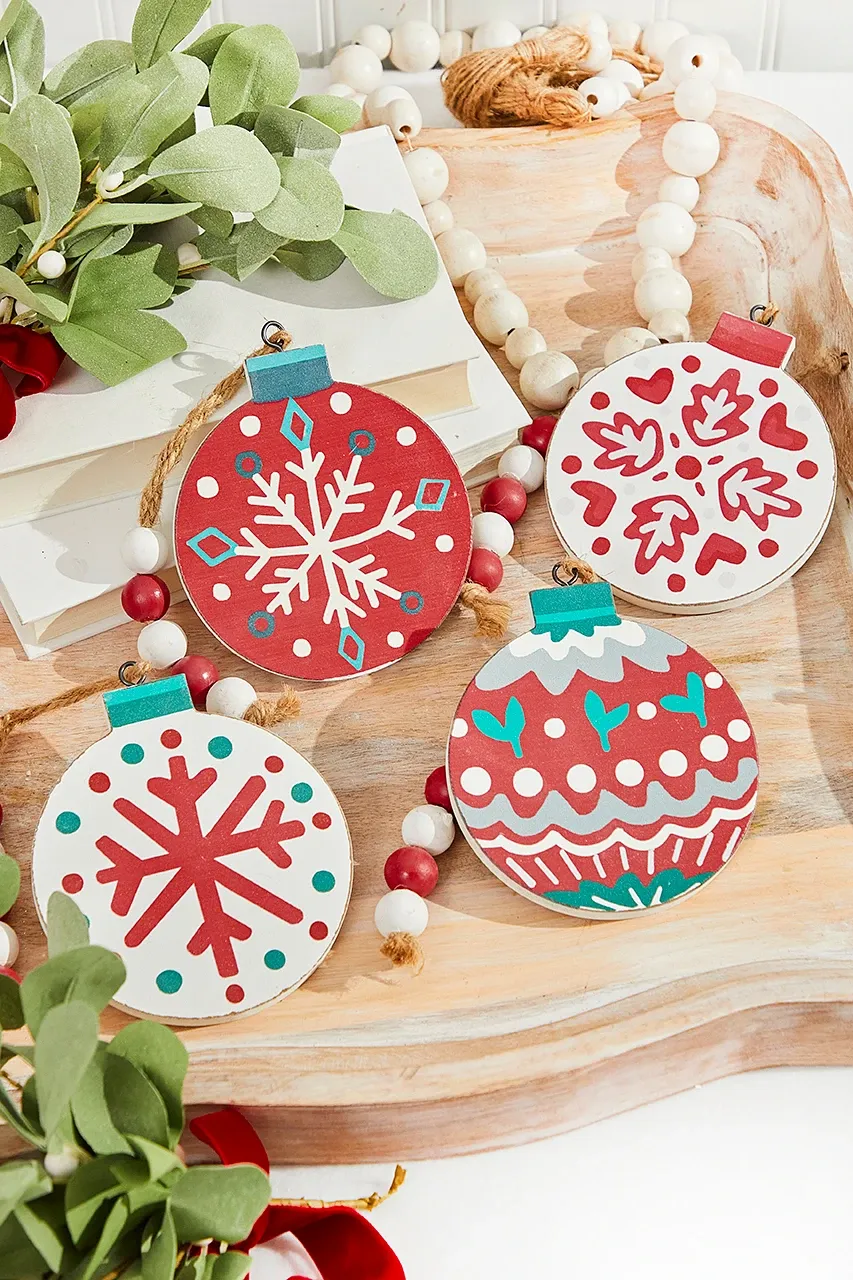
33. Folk-Art Painted Wood Rounds Arranged in a Rustic Tray
Before you paint, verify these:
- Sand each round to 220 grit — paint will not bond to a glossy surface.
- Seal the wood with a sanding sealer or the grain will drink paint unevenly.
- Test your palette on a scrap first; turquoise and red fight if they’re the same value.
- Let each color dry fully before the next so the edges stay sharp.
- Finish with two coats of matte poly if the rounds will ever go outdoors.
What makes this little collection work is repetition with variation. Four rounds, one shape, four different folk-art patterns — your eye reads them as a set instead of four separate projects. The bead garlands and green sprigs are what turn a pile of ornaments into a display: they connect the pieces and give the tray a reason to exist.
34. Stained Wood Round With Jute Rope and a Pinecone Cluster
The dimensional cluster at the bottom is the whole trick. Rather than printing a picture, this sign builds pinecones, greenery, red berries, and acorns physically off the surface, so it casts real shadows and changes as the light moves across it. That’s what separates a door hanger from a poster. Keep the cluster to about a third of the sign’s width — bigger and it overpowers the lettering, smaller and it reads as an afterthought.
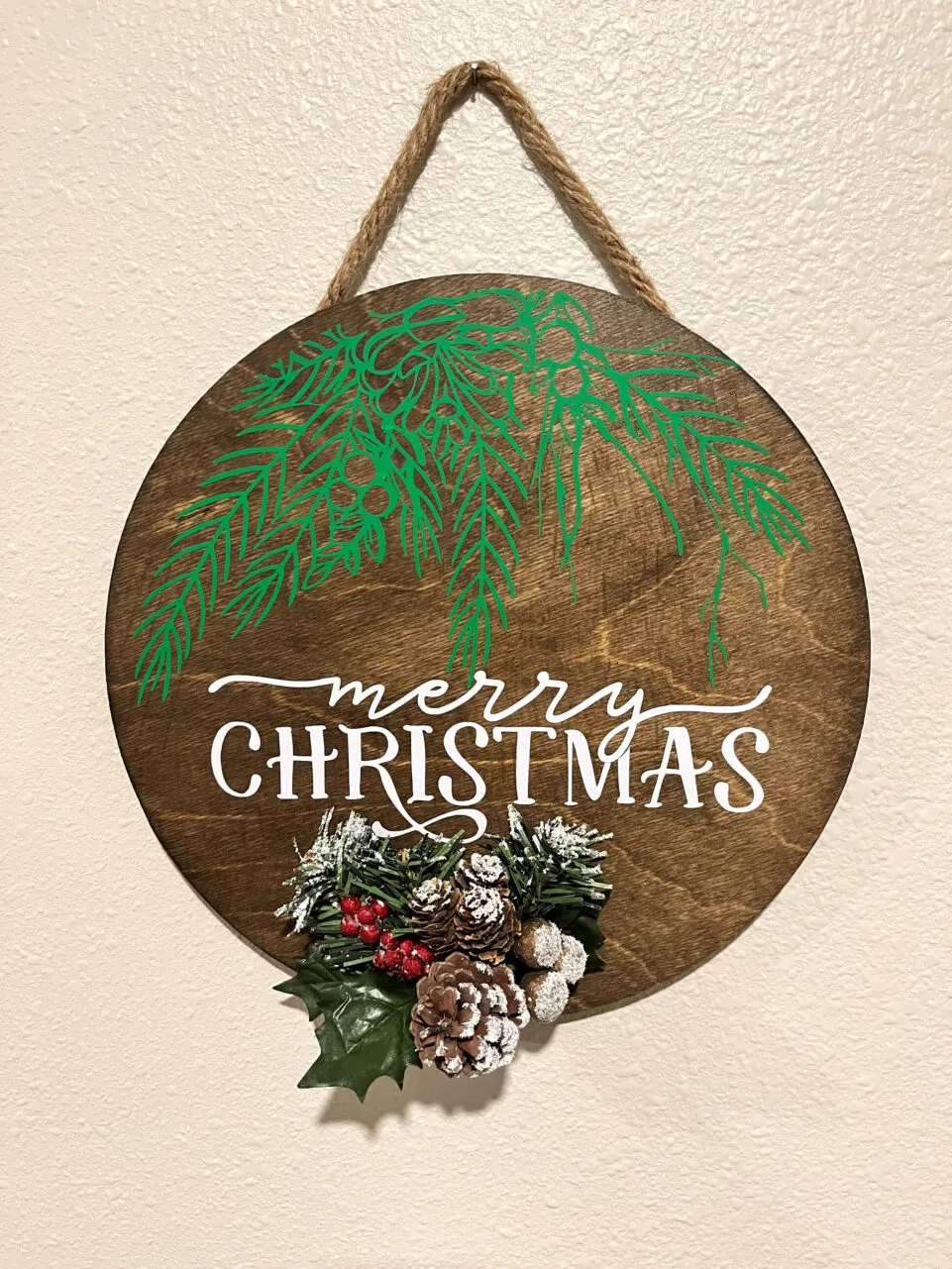
If you’re making this one:
- 14-inch stained wood round: $10–$20
- Jute rope for hanging: $4–$8
- Green acrylic paint for the branch graphic: $4–$8
- Small pinecones, faux greenery, berries, acorns: $12–$22
- Matte exterior sealer: $8–$14
Total: $38–$72 — and you’ll have sealer and paint left for two more signs.
35. Pinecones, a Pale Gold Bow, and a Lion Head Knocker
Working around a decorative knocker takes planning. Hang the wreath so the knocker sits either fully inside the wreath’s opening or fully below it — half-covered hardware looks like an accident, and a gold lion head is too handsome to hide. Counterweight the wreath with the bow on the opposite side of the knocker to keep the composition balanced, and use a hanger that doesn’t scratch the brass. A soft ribbon-wrapped hook costs $5 and saves a knocker that runs $80 to replace.
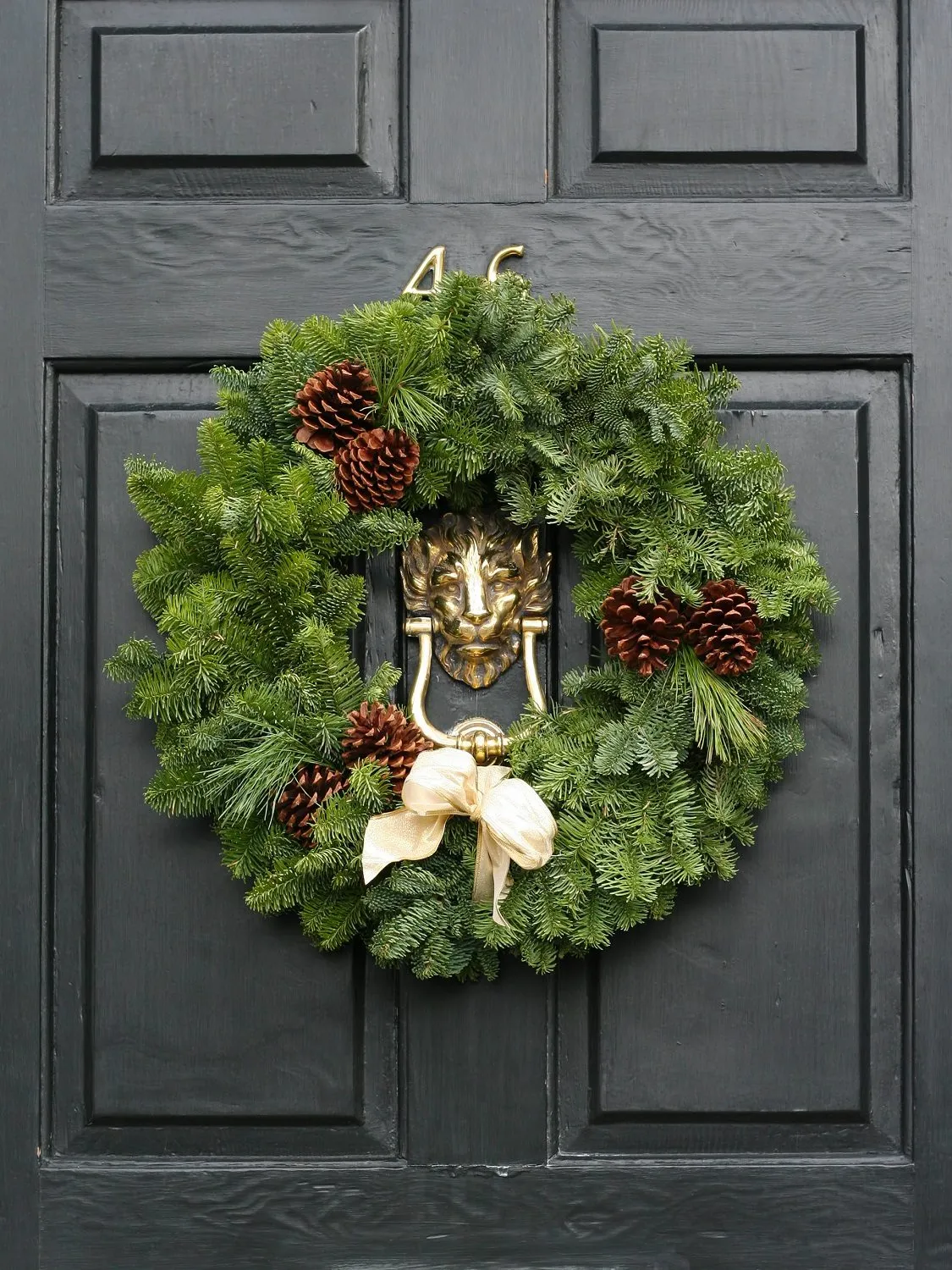
This is a 24- to 26-inch wreath on a standard 36-inch door, and that ratio — roughly two-thirds the door width — is about the visual maximum before a wreath starts swallowing the entry. It needs a minimum 8-foot ceiling to breathe. Larger doors, or double-door entries, should size up to 30 inches. Shorter or narrower entries do better with 20 inches and a tighter, more textured wreath.
Your Front Door Has One Job This December
You don’t need thirty-five ideas — you need one that fits your door, your palette, and the amount of effort you’re actually willing to spend on a Sunday afternoon. Start with the shape and size that suits your entry, pick the bow that makes you smile, and let the rest follow. Save your favorite to Pinterest now so you’re not scrolling in a cold driveway in December trying to remember which one it was.