You know that feeling when you finally find the greenery that looks exactly right for your space — and then you see the price tag? Same. We spent weeks combing through Terrain, Target, Anthropologie, Walmart and Etsy to pull only the 32 greenery ideas actually worth your time this year, and they run from about $18 for a bundle of cedar to roughly $650 for a full mantel-and-tree setup.
Inside you’ll find real rooms and real arrangements — rustic centerpieces with dried oranges, traditional red-and-green wreaths, gold-lit entryways, and a pastel surprise or two. Budget and luxury versions are compared side by side, so you can see exactly where the money matters and where it absolutely doesn’t.
The 2026 shift is toward greenery you can actually touch: mixed branches instead of one uniform faux pine, dried fruit and cinnamon instead of glitter, arrangements that look gathered rather than bought. And stay until the end — we break down the most common mistakes that can ruin these looks. 📌 Save this to Pinterest for later — you’ll want to revisit these ideas.
1. A Gold-Lit Entryway That Makes the Front Door Feel Like a Lobby
Here’s what it realistically costs to build a doorway moment like this one.
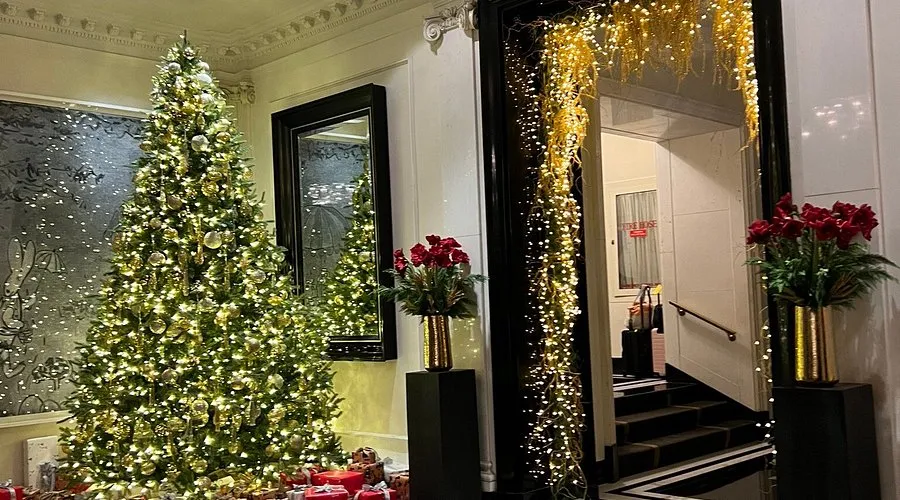
- Black pedestal stands (pair): $120–$280
- Gold string light curtain: $25–$60
- Tree plus ornaments: $180–$500
- Gold vases with red florals: $70–$170
- Wrapped gifts: $20–$50
Total: roughly $415–$1,060. Budget alternative: paint two thrifted plant stands black and swap the florals for a single bundle of branches in one tall vase.
Hang that gold light curtain from cup hooks screwed into the door trim, spaced about 3 inches apart, so each strand falls straight instead of bunching at the top. Plug the whole thing into a smart plug set to come on at 4:30 — with the early sunset, your entryway reads lit the moment anyone pulls into the driveway. One $12 plug does more for this look than another $80 of ornaments.
2. Multicolor Tree Lights Meet an Illuminated Pine Runner
Two light sources at two temperatures is the whole trick. The multicolor tree throws warm yellow and blue from the corner while the table garland runs a single warm white, so the room reads layered instead of flat. The pinecones do the rest — they repeat the wood of the table and sideboard, which is why the cream chairs and runner feel intentional rather than unfinished.
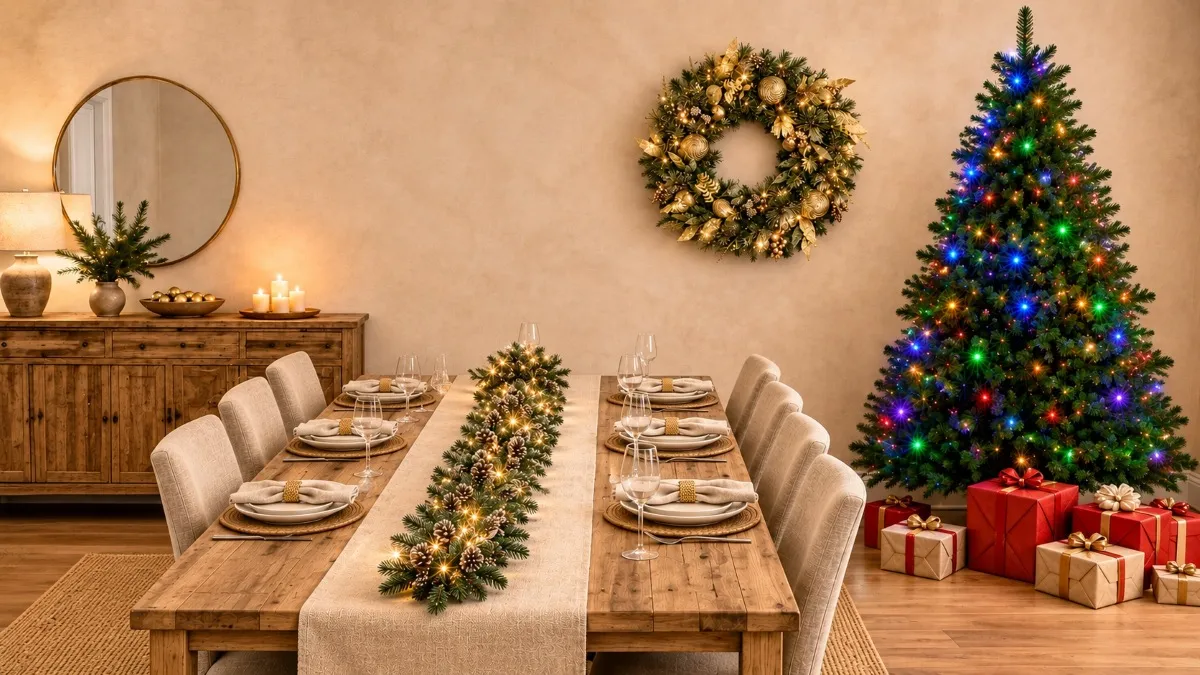
The formula: 55% wood and cream (table, runner, chairs, walls) + 30% deep green foliage + 10% gold (wreath, napkin rings) + 5% multicolor sparkle. Swap the gold for matte black and it turns modern; swap the cream runner for charcoal and the whole room goes moody. Keep that 55/30/10/5 split and any palette survives the holidays.
3. An Evergreen-and-Orange Centerpiece in a Clear Glass Vase
Build the centerpiece in ten minutes, no florist wire required.
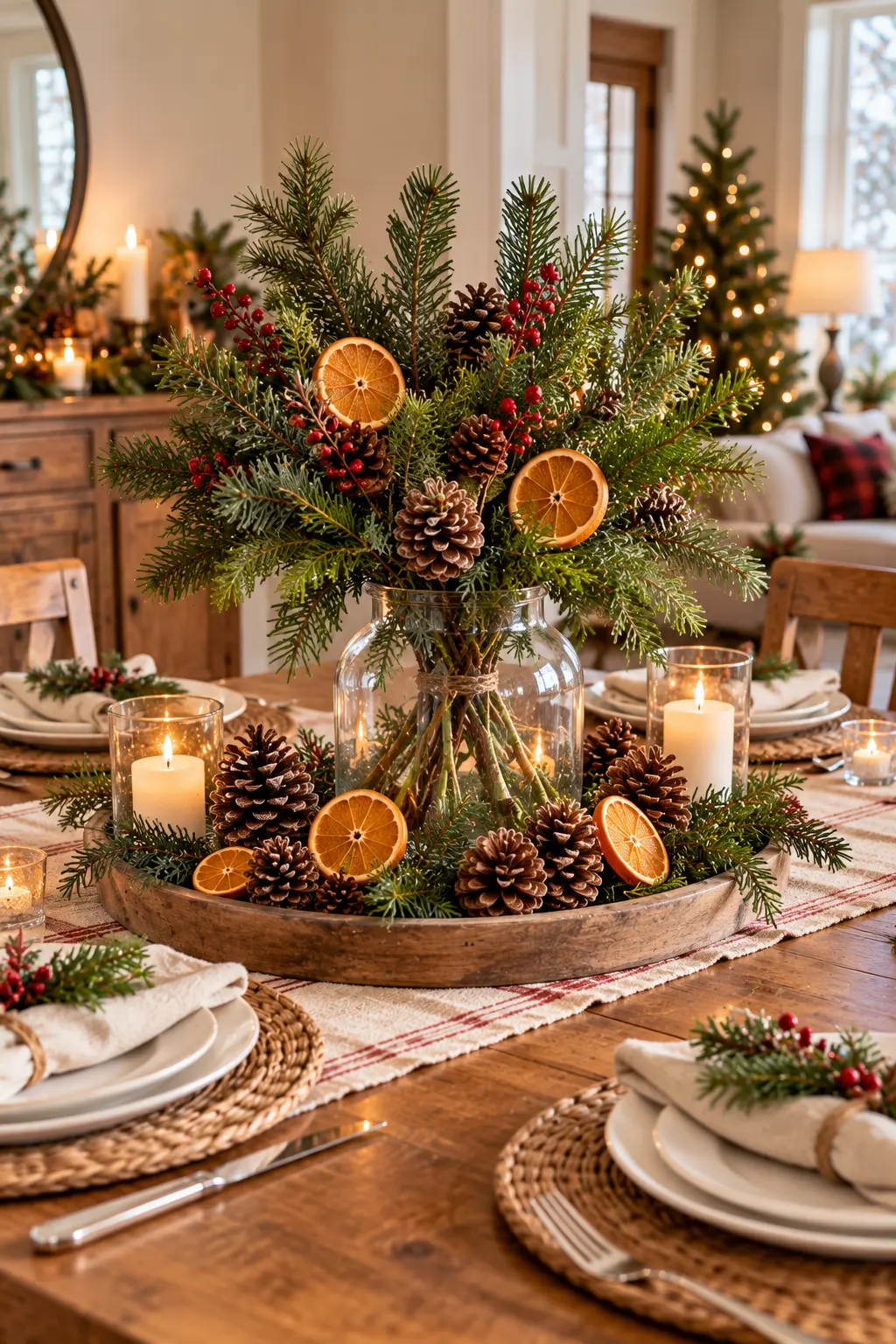
- Set a shallow glass vase on a wooden tray to catch drips.
- Cut evergreens in 10–12 inch lengths and strip the bottom 4 inches of needles.
- Fill the vase halfway with water, then spiral branches in one direction so they fan out.
- Tuck dried orange slices and pinecones into the gaps at the rim.
- Ring three pillar candles around the tray, not inside it.
Time: about 10 minutes. Cost: $25–$45 if the vase is already in your cabinet.
The single element holding this together is the wooden tray under the glass vase. Without it you have a vase, some candles, and a table. With it, everything becomes one composition — the pillar candles sit inside the boundary, the woven placemats read as part of the same zone, and you can lift the entire thing off in one move when it’s time to serve dinner. Look for a tray at least 4 inches wider than the vase on every side.
4. A Hand-Tied Grey Pot of Blue-Green Fir and Cinnamon
Two things will happen within about ten days. The red berries will start dropping, and they stain a light tablecloth, so keep this pot away from anything cream-colored. And if the evergreen is set into floral foam rather than water, it will look tired by New Year’s. Check the pot before you build — a plastic liner inside lets you water every other day and buys you an extra two weeks of green.
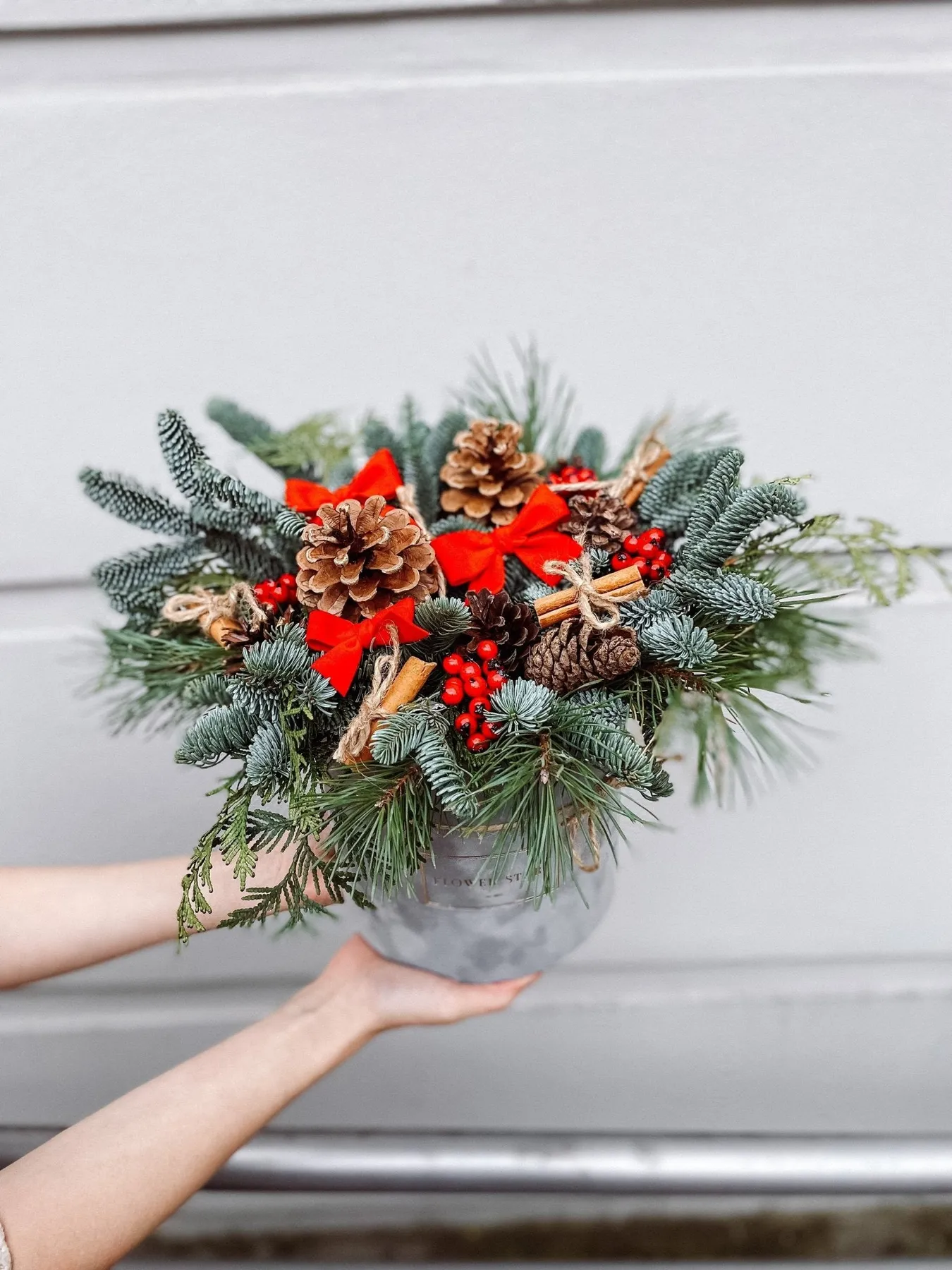
Bundle your cinnamon sticks in threes, tie them with jute, then hot-glue each bundle to a wooden floral pick and push it in so it sits about 2 inches back from the front edge. Cinnamon reads as a detail only at close range — put it at the rim, never buried in the middle. And use odd numbers of everything: three sticks, five pinecones, seven berry clusters. Even counts are what make an arrangement look assembled.
5. Two Red Pillar Candles Wrapped in Velvet and Plaid
60% evergreen (fir, eucalyptus, twigs) + 25% red (candles, velvet bow) + 10% brown (pinecones, cinnamon, woven sphere) + 5% shine. The plaid ribbon is the wild card — it adds pattern without adding a color, because it’s already red and cream. Change the plaid to green-and-cream and you keep the formula while shifting the mood toward something quieter and more woodland.
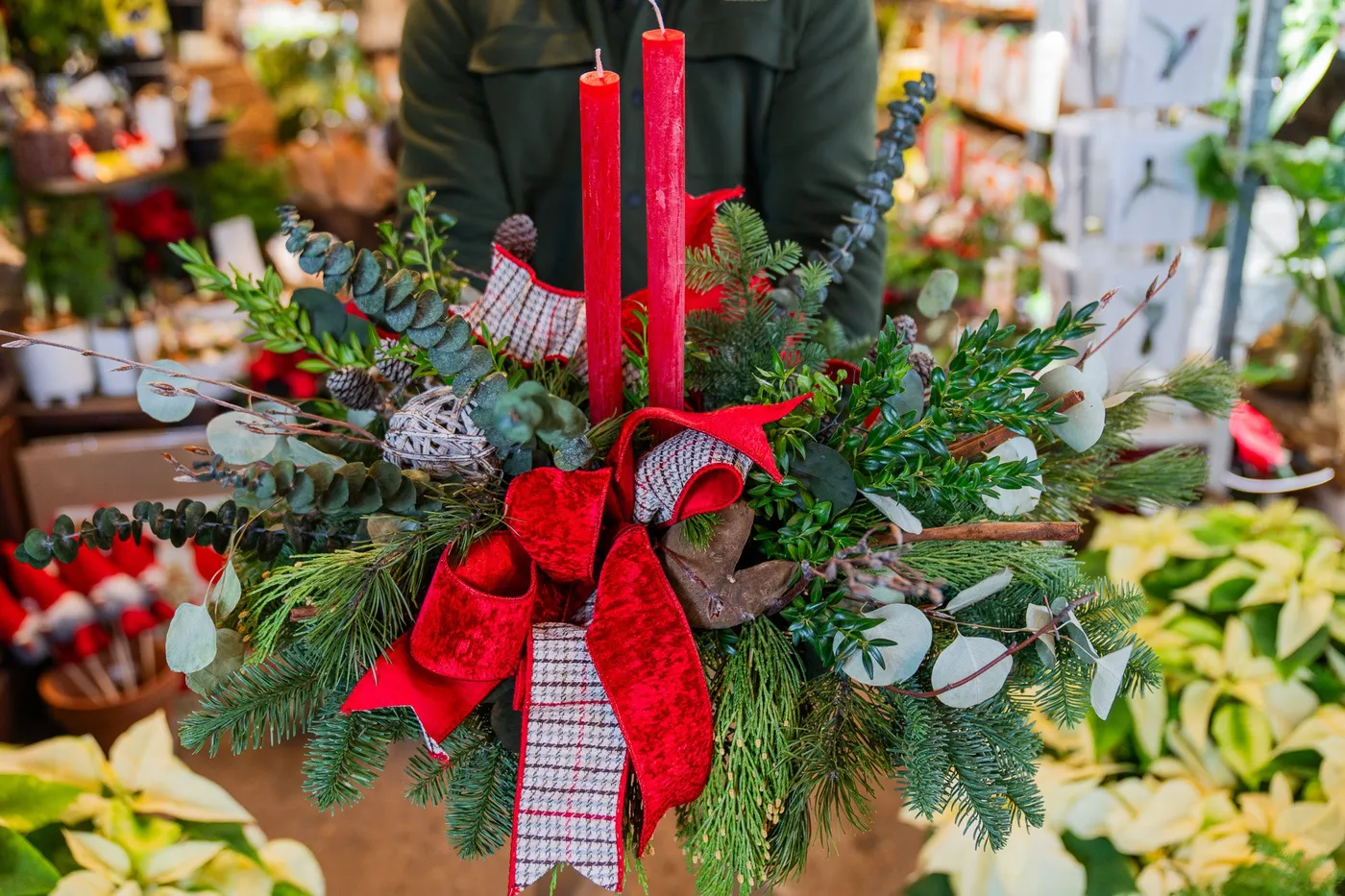
You can build this for under $40 if you shop the right aisles. Two red pillar candles run about $8 at Walmart, a faux fir bundle is $12 at Target, plaid ribbon by the yard is around $6, pinecones are free from a walk, and eucalyptus stems are $9 at Trader Joe’s. That’s roughly $39 for the whole thing. The velvet bow is where you splurge — that’s the piece people actually notice.
6. Cypress, Long Pine, and Gold-Painted Seed Pods
Density is doing the work here, not variety. Three foliage types — dark cypress, long pine needles, and a broad leaf — give you three different silhouettes, so the arrangement looks packed even where it’s airy. The gold-painted pods are the deliberate oddball: one non-green, non-red element that gives the eye somewhere to rest. Without it, this is a nice red-and-green mass. With it, it’s a composition.

An arrangement this dense needs a table at least 60 inches long and 36 inches deep, or a sideboard with 14 inches of clearance behind it. On a 48-inch apartment table it eats the room and leaves nowhere to put a plate. Working smaller? Go with the potted version in Idea #9 — same foliage mix, roughly half the footprint.
7. Frosted Pine Garland That Glows From the Inside
Frosted garland is the lowest-effort thing on this list. It doesn’t drop needles, doesn’t need water, and the white tips hide dust better than plain green. What it does need: a pass with a hair dryer on cool every few weeks to blow out settled dust, and a check that the lights aren’t old incandescents that run hot. Modern LED strands last roughly 20,000 hours versus about 1,500 for the old bulbs.
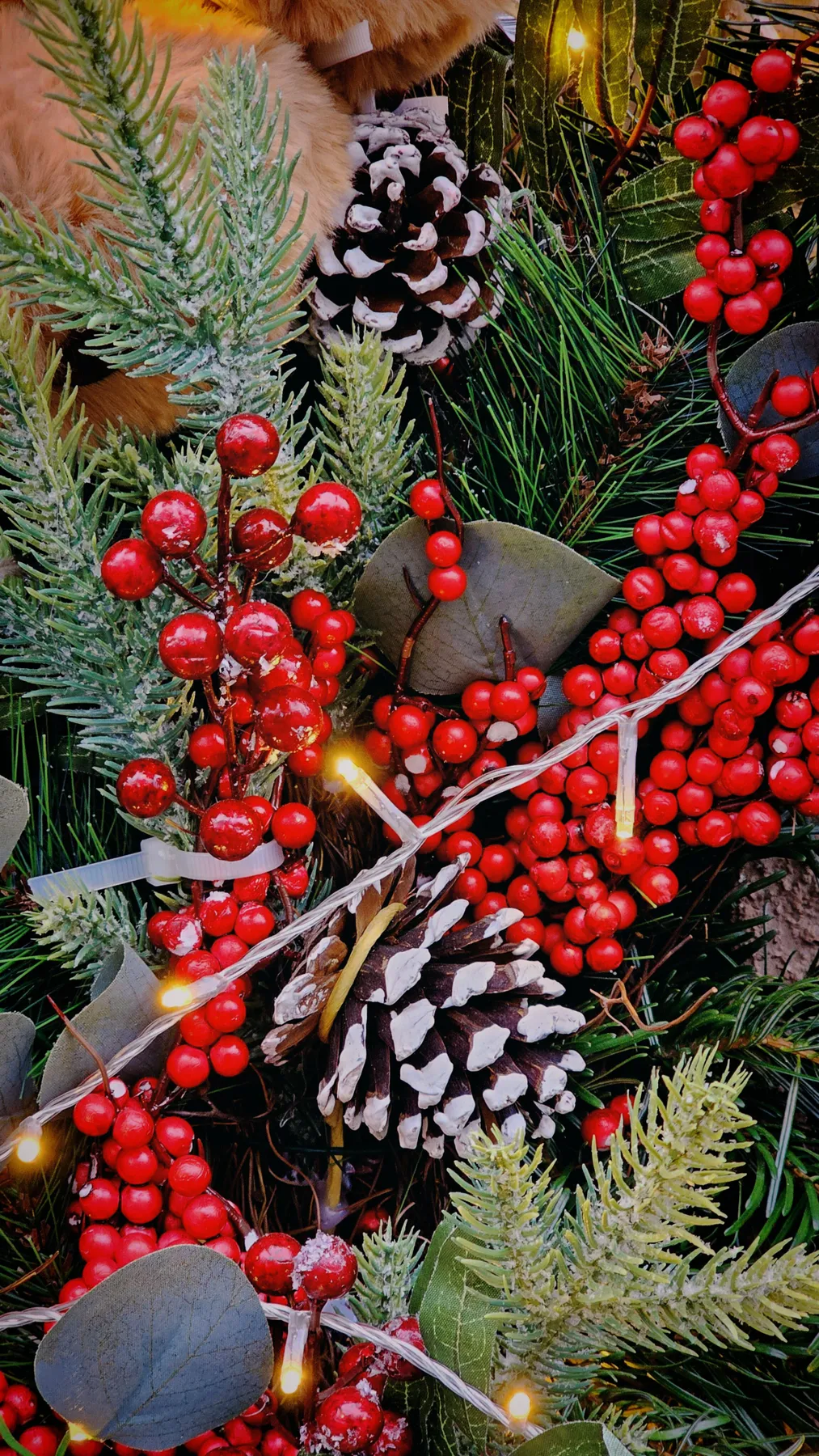
The warm white string lights woven inside — not draped on top — are the one thing that makes this garland feel expensive. Lights buried within the branches glow through the needles and throw shadows; lights laid on the surface just look like a string of bulbs. When you build it, weave in a slow S-curve through the middle third, leaving 6 to 8 inches between passes.
8. A Low Black Trough of Magnolia, Succulent, and Red Berries
This is the arrangement style quietly overtaking the classic red-and-green centerpiece: greenery that looks foraged, with succulents, seed pods, and magnolia leaves mixed in. It tracks with the wider 2026 pull toward biophilic interiors — people want plants in December, not just ornament-covered branches. It also has real staying power, because nothing here is trend-specific. You’ll still like it in 2030.
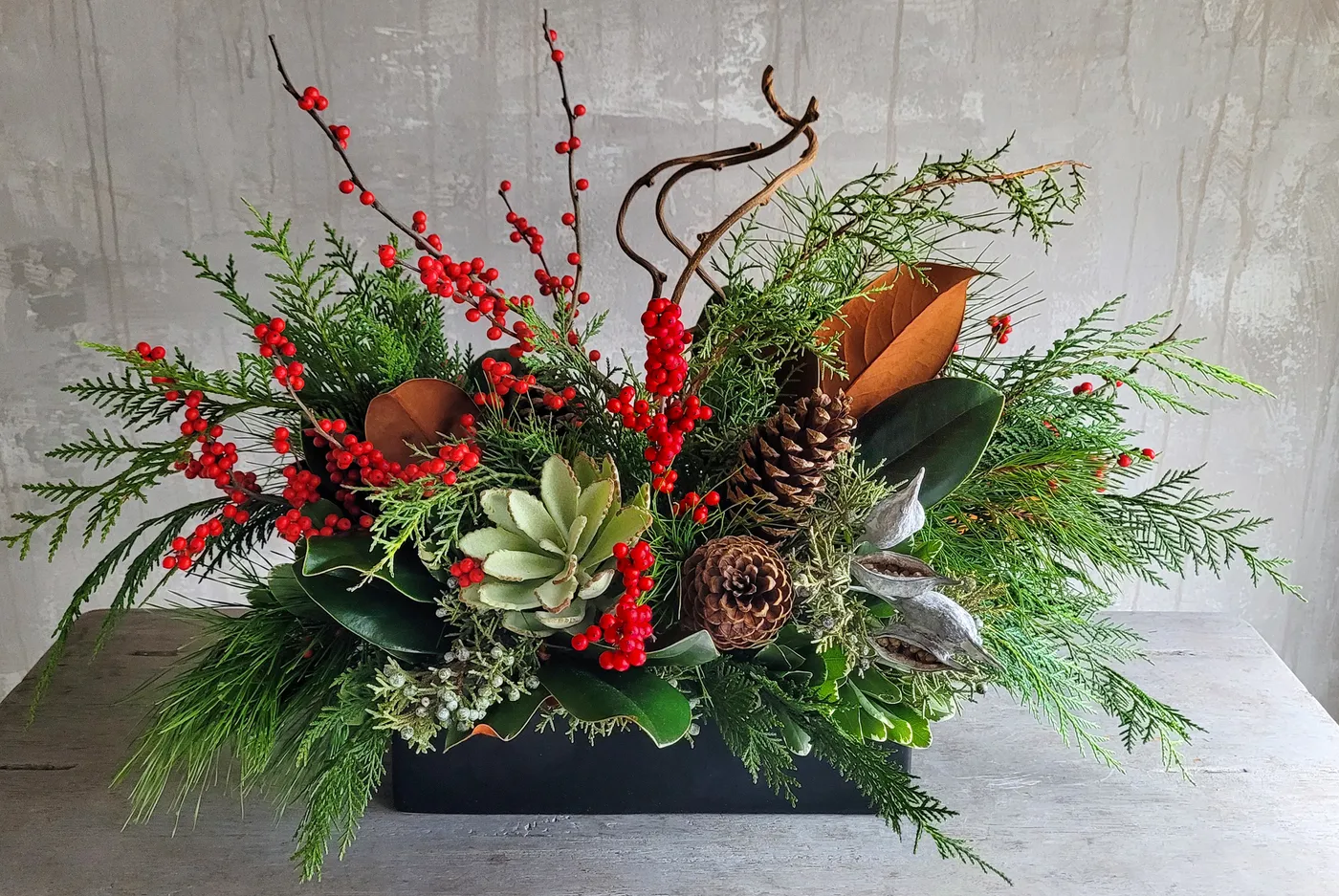
Use a container with a matte finish and an interior that disappears. A black rectangular trough or a dark stoneware bowl lets the foliage be the star; a shiny metallic vessel competes with it. Keep the container to roughly one-third of your table’s length so there’s room for glassware on both sides — on a 72-inch table, that’s a 24-inch trough, no longer. For tighter surfaces, see Idea #25.
9. A Mini Greenery Tree in a Galvanized Bucket
Total spend here is about $22, and most of it is the bucket.
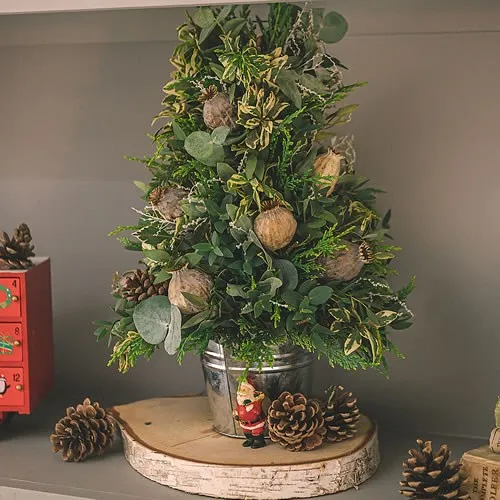
- Galvanized bucket: $7 at a hardware store
- Half brick of floral foam: $3
- Greenery cuttings: free, or $10 in bundles
- Pinecones and dried pods: gathered or $2
A wood slice runs $5 at a craft store, or comes free from a fallen branch. Skip the designer version entirely — this look reads better slightly rough anyway.
Making the mini tree takes about fifteen minutes.
- Soak the foam and cut it to fit the bucket.
- Push a straight center branch in first as your spine.
- Add 6–8 shorter branches around it, angled outward and down.
- Fill gaps with boxwood or cedar to hide the foam.
- Tuck pods and pinecones in at the base last.
Mist the greenery every couple of days and it’ll hold through the season.
10. Red and Gold Bows Tied Straight Onto Pine Branches
Bows on greenery are the fastest way to make an arrangement look cheap or expensive, and there’s no middle ground. Shiny satin at a large scale, as here, works because it’s clearly deliberate. What doesn’t work: small bows in a slightly-off red, spaced evenly down a garland like a school project. If you’re doing bows, go big — 6 to 8 inches across — and place them irregularly, at three or five points.

Contrast of texture, not color, is what you’re seeing. Shiny ribbon against matte needles, metallic gold against flat red, hard bows against soft branches. The palette is only two colors, which is why it doesn’t look busy despite all that ornament. Want the same effect with less shine? Swap the satin for velvet and keep the gold exactly where it is.
11. A Footed Glass Vase Layered With Citrus and Evergreen
- Footed glass vase: $30–$80
- Evergreen branches: $12–$25
- Oranges and limes: $10–$18
- Red berries: $6–$14
- Extra greenery for the spill: $0 if you’re trimming a tree
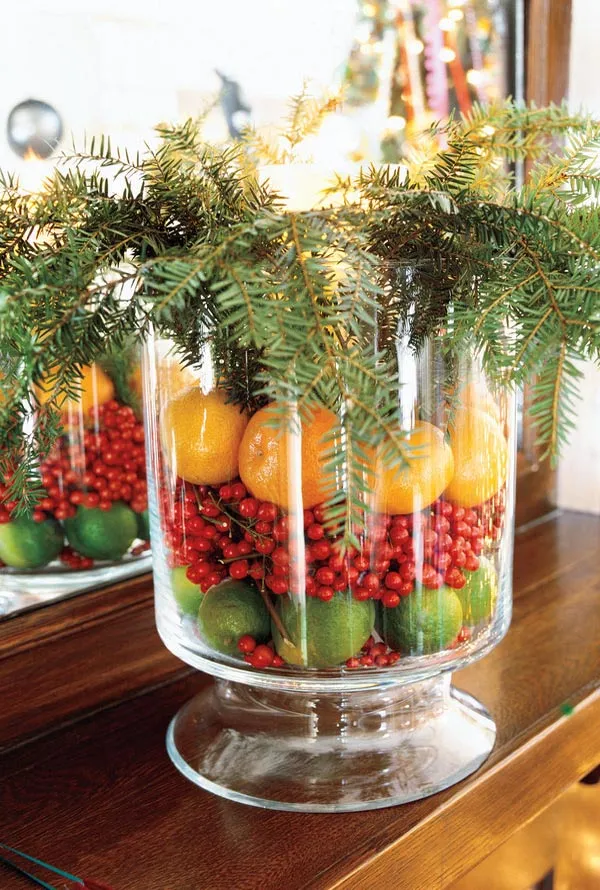
Total: about $58–$137. Budget version: a $12 glass trifle bowl from a discount store gives the same footed silhouette, and nobody looks at the stem.
Layer the fruit against the glass, not on top of the greenery. Oranges and limes pressed right to the inside wall show through as color; the same fruit buried in the middle vanishes. Work in a spiral — one ring of citrus, one of berries — and let the branches break the rim only at the top. Same principle as a layer cake: the cut side is the point.
12. Red Roses and Cotton Bolls in a Log-Textured Vase
The vase is the quiet hero. A log-textured cylinder reads as a piece of wood until you’re close enough to see it’s ceramic, and that’s exactly what sells the arrangement’s gathered-from-the-yard story. Swap in glass and you’d have a pretty flower arrangement. Swap in a shiny silver urn and it turns formal. Matte wood-grain is the one choice that makes dried citrus and cotton bolls make sense together.
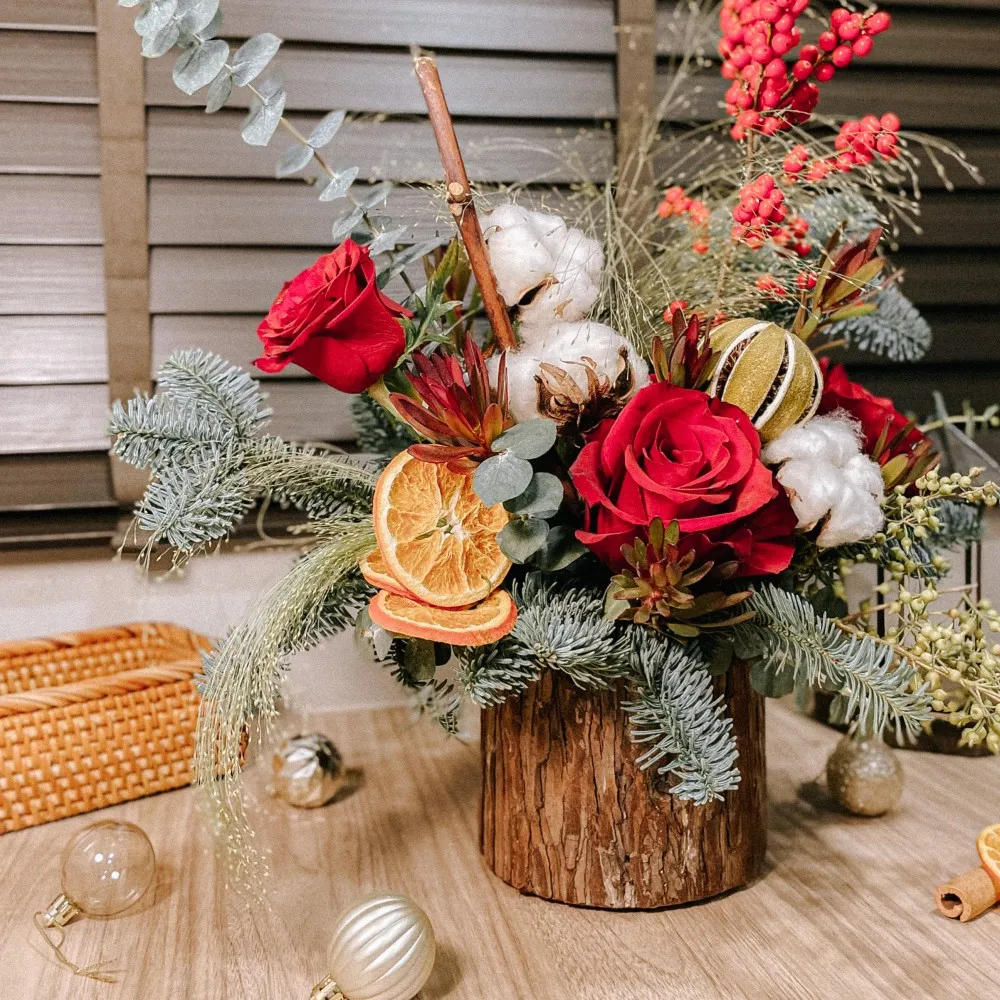
50% green (fir, eucalyptus, foliage) + 25% red (roses, berries) + 15% dried neutrals (orange slices, cotton, cinnamon) + 10% shine. The peach and white blooms don’t count as a separate color — they’re texture. Keep the dried-neutrals share above 10% and the arrangement stays cozy instead of turning into a florist’s cooler display.
13. A Fresh Wreath Built From Roses, Mums, and Orchids
A wreath this full — roughly 22 to 24 inches across — needs a door at least 32 inches wide or it looks like it’s wearing a hat. On a standard 36-inch front door, hang it so the top sits about 6 inches below the top of the door; too high and the bow crowds the frame. Interior doors can drop to 18 inches. And check the weight: fresh flowers plus wet foam can hit 6 or 7 pounds.
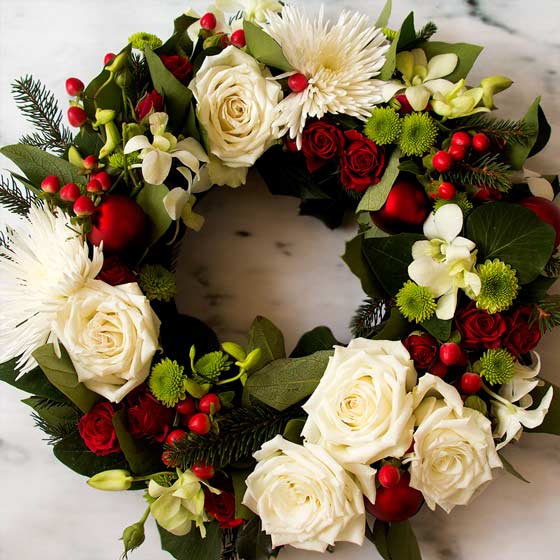
Fresh-flower wreaths are beautiful for about five days and then they’re a science experiment. White roses brown first, orchids go translucent, and by day eight you’re picking petals off the porch. If this hangs in direct sun, plan on replacing it or buying two. For a doorway you’ll photograph on the 24th, build it on the 20th — no earlier, no matter how tempted you are.
14. A Gold Lantern With a Buffalo Plaid Bow on the Runner
You can pull this together for about $45, which is less than one pre-made centerpiece. A gold metal lantern runs $14–$30 at Walmart or Target, a red pillar candle is $6, two yards of buffalo plaid ribbon is $7, frosted greenery stems are $10–$16, and mercury glass votives are around $4 each. Buy one wide ribbon and cut it into three bows rather than buying a pre-tied bow that always looks pressed flat.
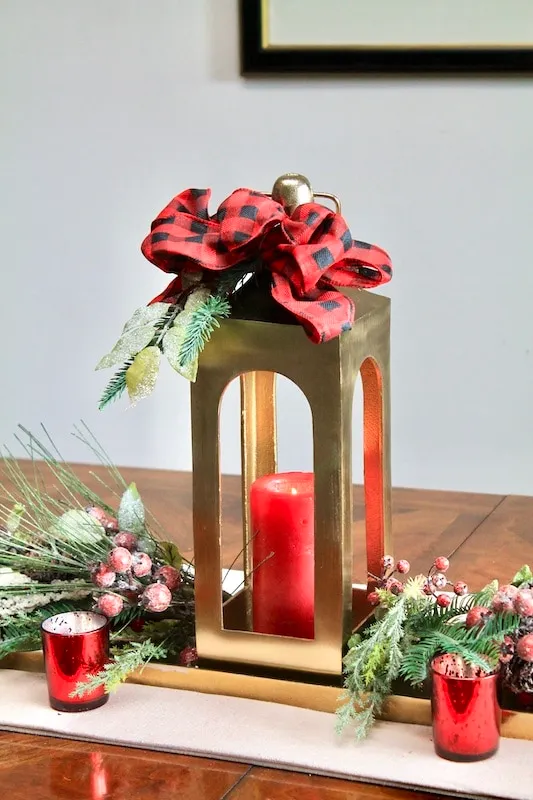
Fifteen minutes and one glue gun.
- Cut a 24-inch length of ribbon and notch the ends in a V.
- Tie a simple bow, then trim the loops so they sit flat against the lantern.
- Wire two frosted stems to the lantern’s top ring.
- Set the candle inside and check clearance before lighting.
- Repeat with smaller bows on the votive holders.
15. Cinnamon Bundles and Dried Oranges on a Green Door
Space your embellishments in clusters of three, not scattered singly. Three pinecones together, a bundle of cinnamon sticks, then a gap of about 8 inches before the next cluster. Scattered evenly, the same elements look like sprinkles; clustered, they look collected. That rhythm — cluster, gap, cluster — is the difference between a wreath that reads handmade and one that reads mass-produced.
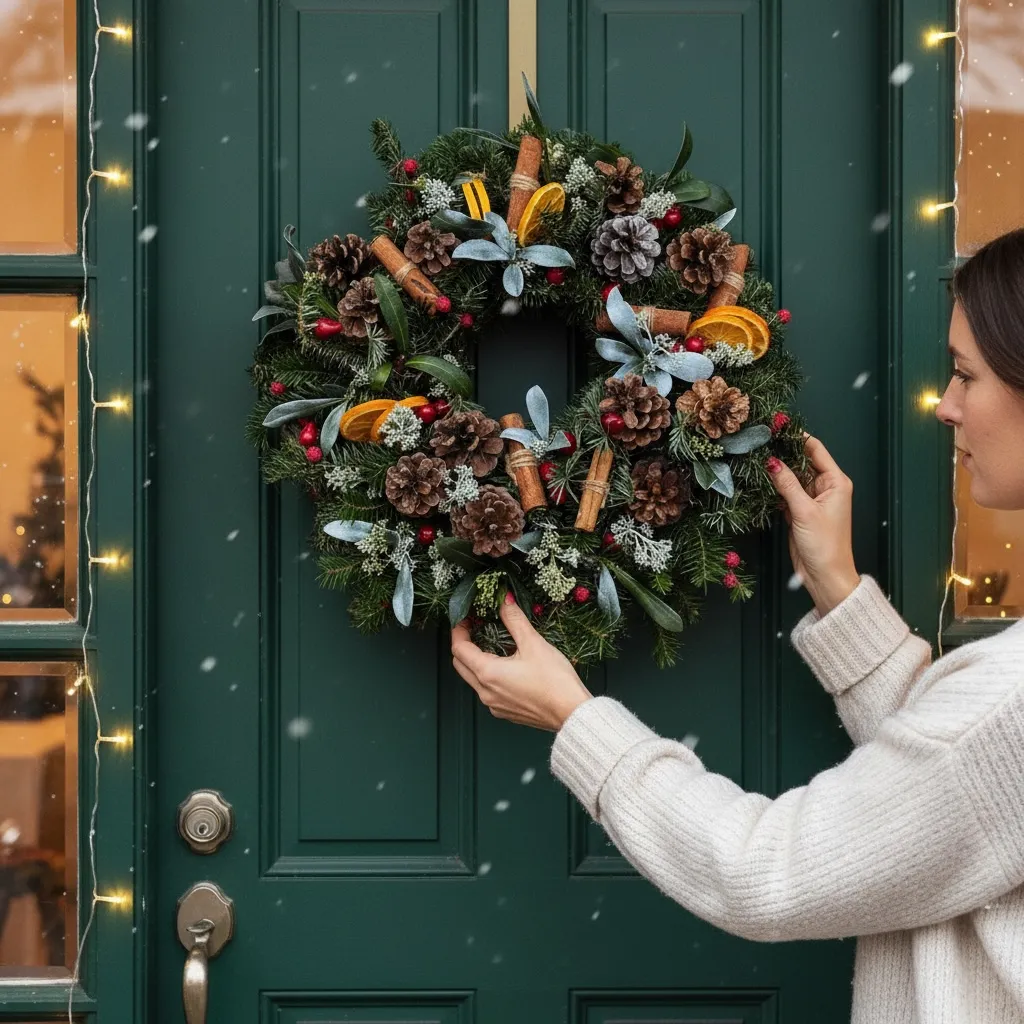
It works because nothing here matches, and everything here belongs. Pinecones, dried oranges, cinnamon sticks, and silver-green foliage all come from the same visual family — matte, warm, dried — so they can pile up without fighting. The dark green door behind it is doing real work too. That same wreath on white siding would lose half its depth; contrast of value is what makes it legible from the street.
16. A Wooden Bowl of Moss and Golden Votives
The moss. It’s the cheapest ingredient here and the only one that makes the whole thing feel alive. A wooden bowl of greenery and ornaments is a centerpiece; a bowl with a green moss base reads as something growing. It also solves a practical problem — moss hides the mechanics, so you can jam pine branches into foam without any of it showing. One $8 bag covers a 14-inch bowl.
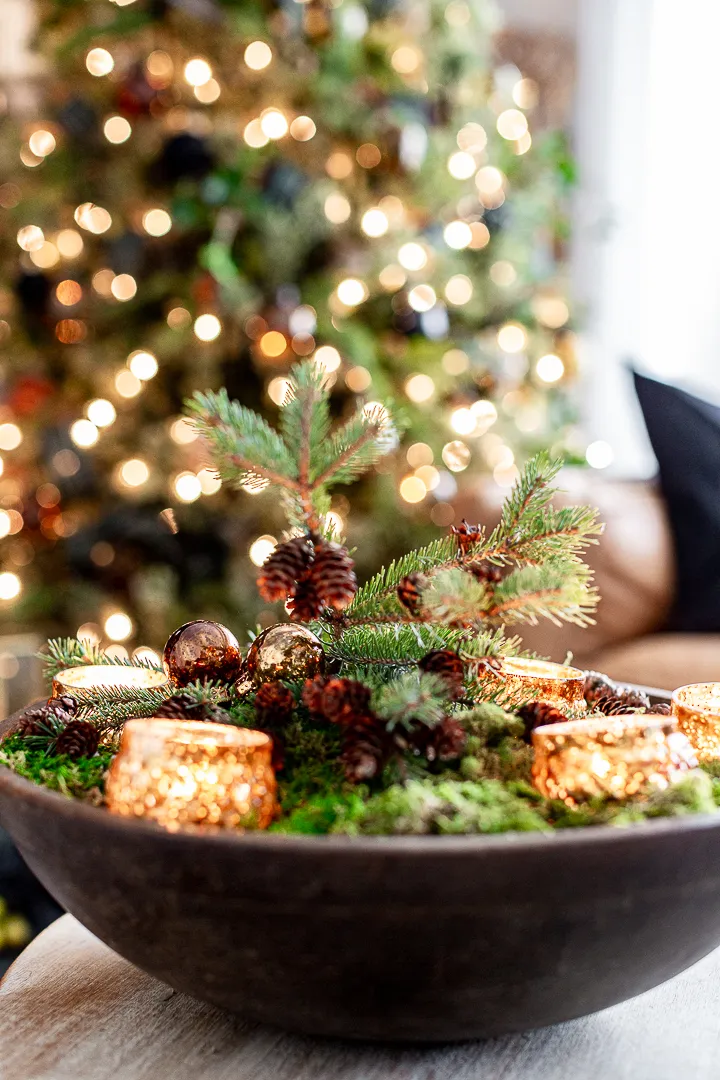
- Wooden bowl: $25–$60
- Sheet moss: $8–$14
- Pine branches: free to $15
- Votive candles and holders: $18–$36
- Small bronze and gold ornaments: $10–$20
Total: $61–$145. Budget version: a thrifted salad bowl and one bag of moss — the small metallic ornaments are where the money actually shows.
17. Driftwood and Sprouting Bulbs on a Gold Oval Platter
45% evergreen + 20% natural (driftwood, pods, pinecones) + 20% white (tablecloth, plates, napkins) + 15% gold. The gold platter unifies it — it echoes the ornaments and lifts the greens off the white linen. If your table is wood, drop the platter share and set the same arrangement directly on a runner; the wood does the unifying job instead.
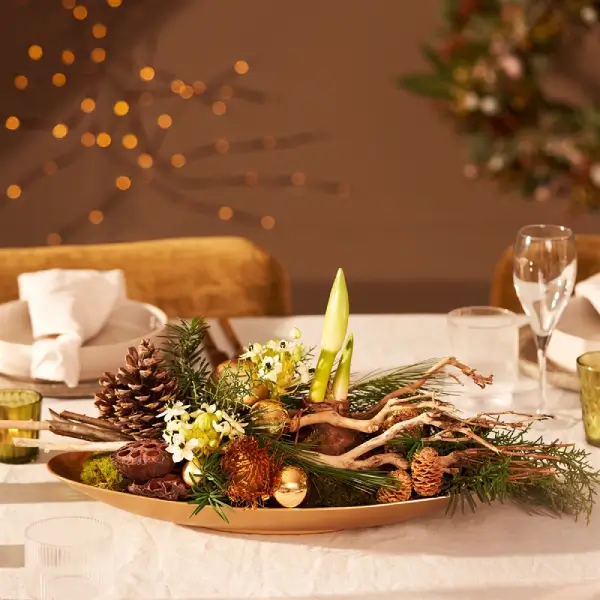
Check these before you commit to the platter approach.
- Measure the platter against the table — it should span no more than a third of the length.
- Confirm it has a raised lip; flat trays slide when someone reaches across.
- Make sure you have 12 inches of plate room on both long sides.
- Check whether your bulbs are pre-chilled or forced.
- Decide now whether you’re willing to water them daily.
18. Pine Branches in a Red Glass Vase by Candlelight
Ten minutes and one trip to the yard.
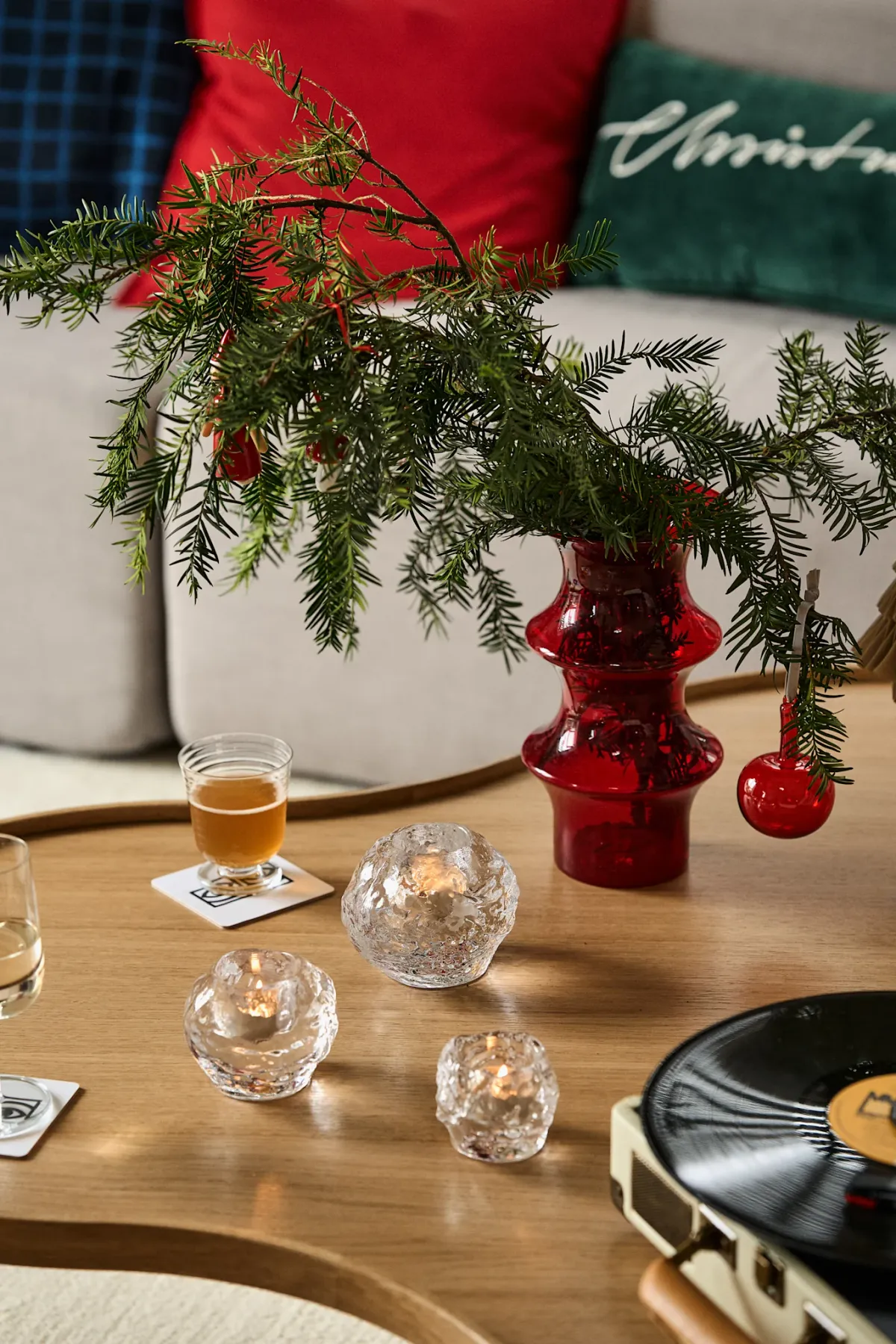
- Fill a red glass vase two-thirds with cool water.
- Cut pine branches at an angle and strip the lower needles.
- Add branches one at a time, rotating the vase a quarter turn each time.
- Drop in four to six small red ornaments and let them settle on the rim.
- Group three textured votives at different heights beside it.
Refresh the water every three days — pine sap clouds glass fast.
Fresh pine in a vase will drop needles. That’s not a failure, it’s what pine does. Keep it away from a heat vent and skip the mantel unless you’re changing the water daily. Real candles plus dry needles is a genuinely bad combination. If the branches are more than a week old, switch to battery tapers — the look survives, the risk doesn’t.
19. Berries With Water Droplets and a Wall of Bokeh
The water-droplet detail is a 2026 thing, and it’s coming from photography more than florals. Now that everyone shoots their own décor for Pinterest, arrangements that photograph well at close range — droplets, backlit berries, warm bokeh — get saved, get shared, get made. It’s a feedback loop. Realistic faux berries with a slight gloss are now formulated specifically for that close-up.
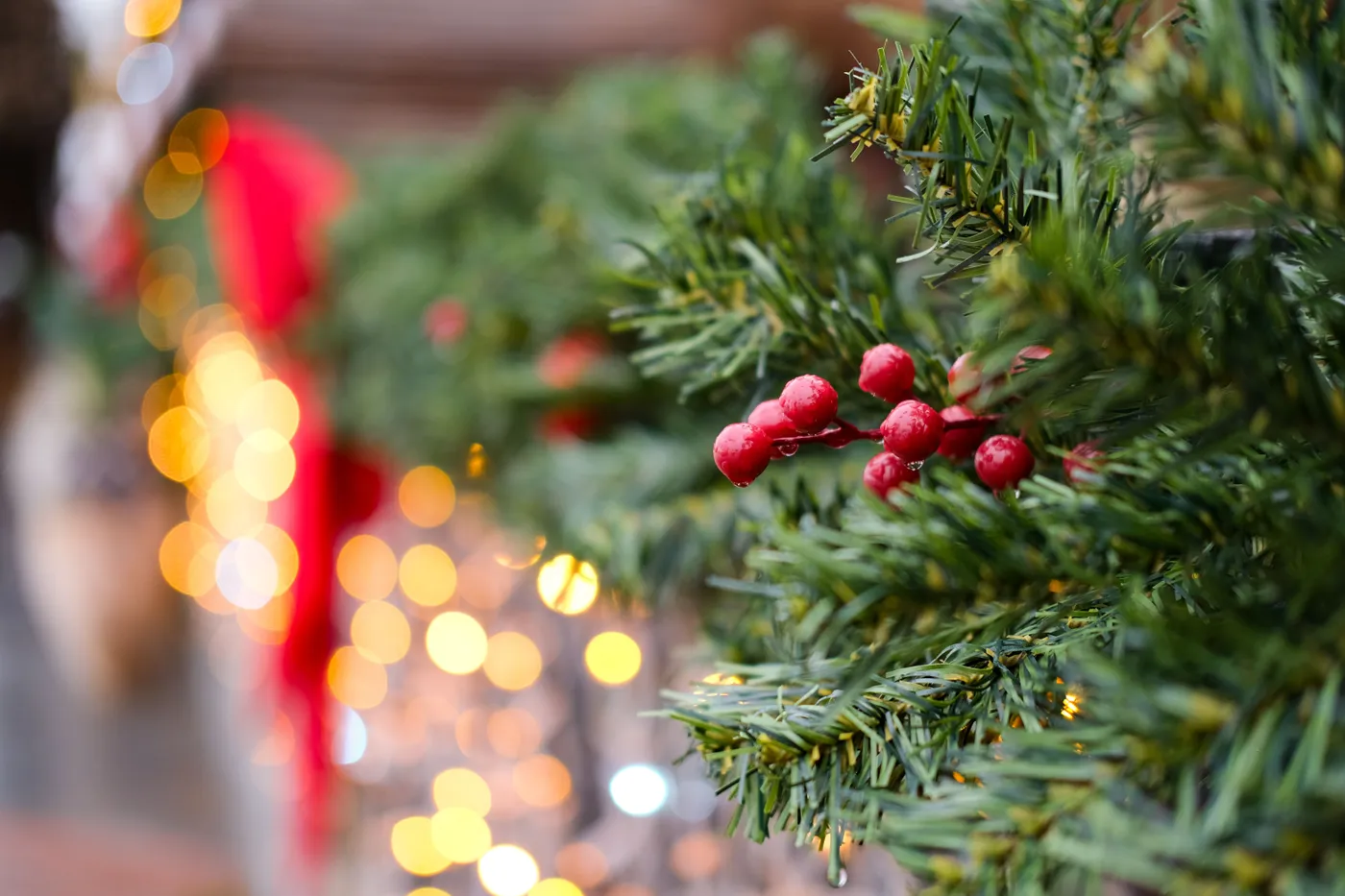
For that glow, put your light source behind the greenery, not in front of it. A single warm strand at the back of a garland throws a halo through the needles and makes the whole thing look lit from within; the same strand in front just looks like bulbs. If you’re using a lamp, a 2700K bulb at 40 watts behind the arrangement beats a 5000K bulb anywhere.
20. One Red Satin Bow on a Red Paneled Door
One bow. That’s the whole idea, and it only works because there’s nothing else. No berries, no ornaments, no picks — just foliage and a single oversized red satin bow. Add three more elements and the door reads busy; keep it to two and it reads confident. The bow should be roughly one-third the width of the wreath, so about 8 inches across on a 24-inch wreath.
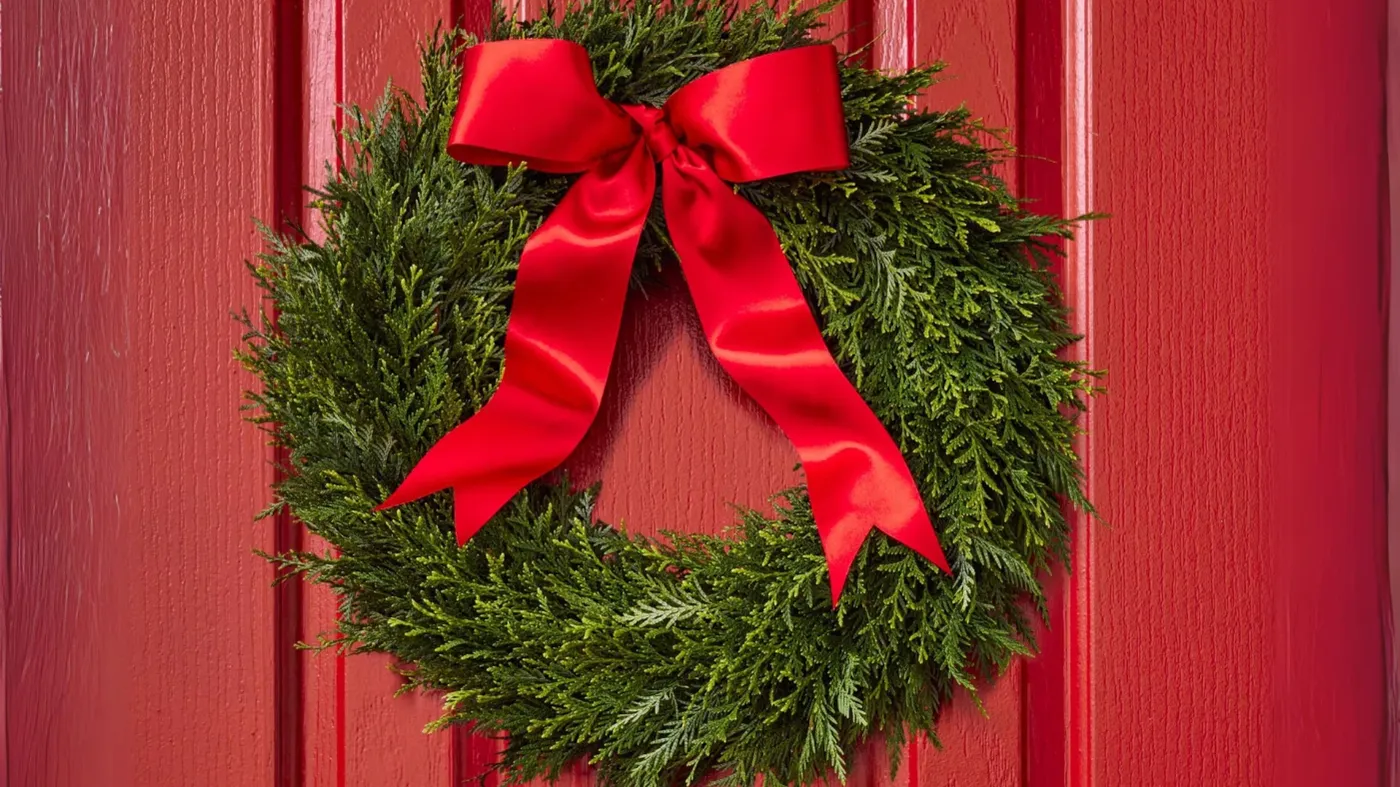
This is the cheapest look in the article and possibly the best. A faux pine wreath runs $12–$25 at IKEA or Walmart, three yards of red satin ribbon is about $6, and a wreath hanger is $4 — under $35 for the whole door. Buy ribbon by the roll instead of a pre-tied bow, and iron it flat before tying, because satin keeps every crease it’s stored with.
21. Red Tapers Rising Out of White Mums and Lilies
- Fresh evergreen base: $20–$40
- Red taper candles and holders: $18–$40
- White mums, lilies, red roses: $45–$90
- Ribbon and gold ball ornaments: $12–$25
- Pinecones and berries: $10–$20
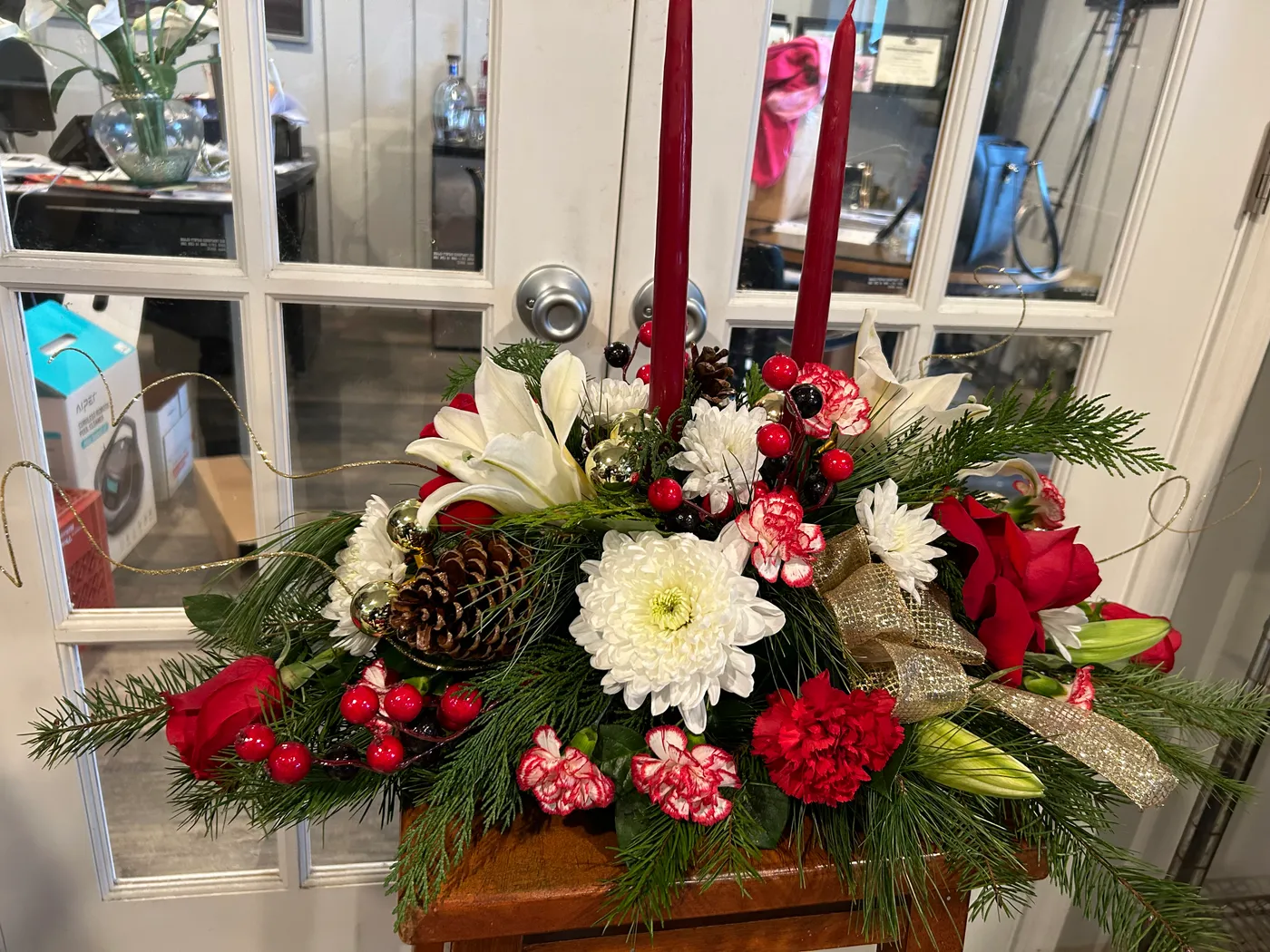
Total: $105–$215. Budget version: skip the lilies and double the carnations — they cost a third as much and hold twice as long in a warm room.
This is a long-table centerpiece, not a round-table one. It wants at least 72 inches of table and 40 inches of width so the tapers don’t sit in anyone’s sightline. On a smaller table, cut to five stems of greenery and two candles, then place it off-center with a bowl of ornaments balancing the other end. Compare with Idea #26 for a boxed version that fits a 60-inch table.
22. A Garland Runner Laced With Dried Orange Slices
Dried orange slices are the rare decoration that improves as it ages — but only if they’re actually dry. Store-bought slices with any softness will mold against greenery. Check by snapping one; it should crack, not bend. Once they’re on the table, keep the garland out of direct sun or the oranges fade from amber to beige by New Year’s. A light coat of matte sealant fixes both problems for about $9.
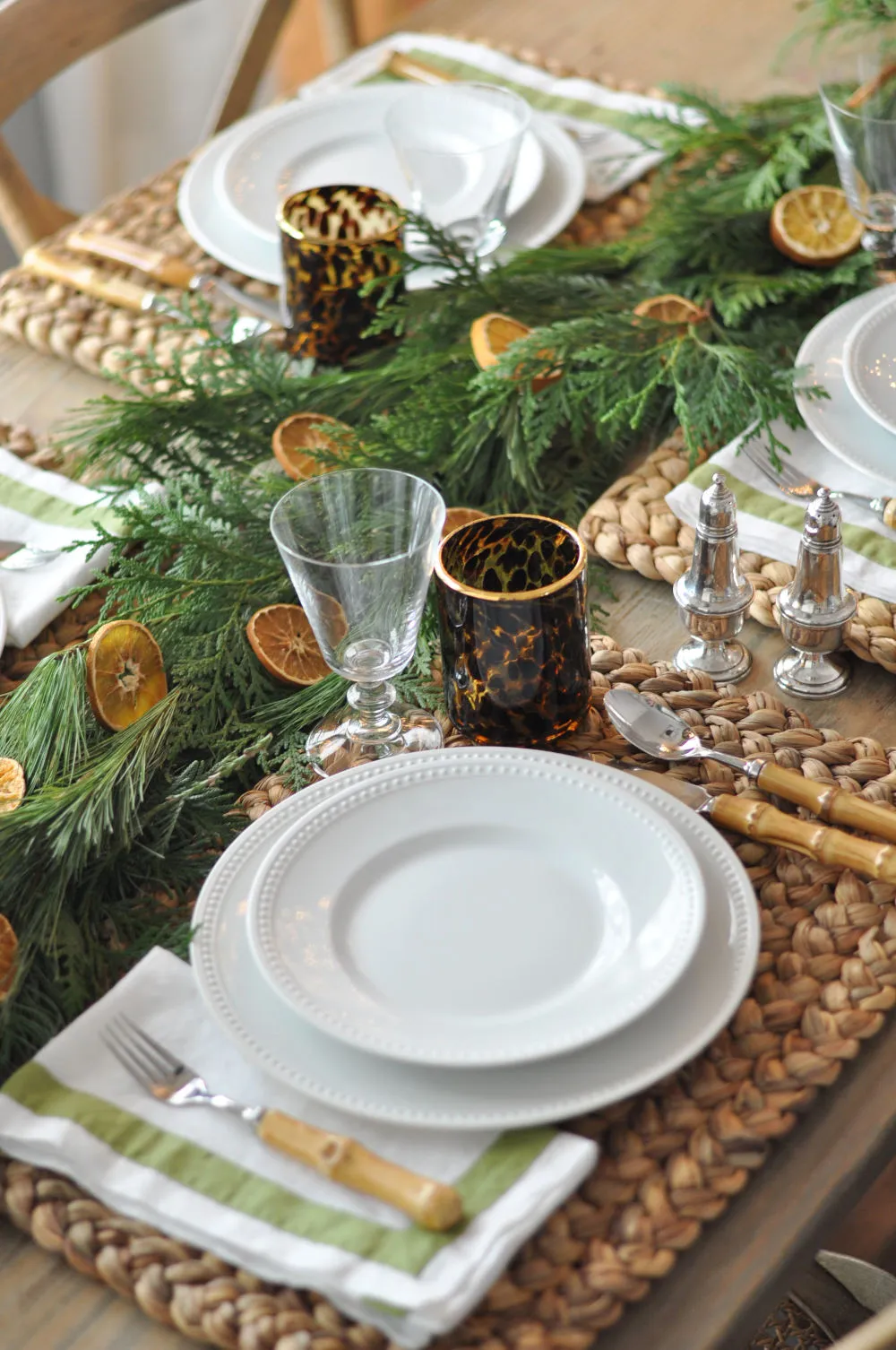
55% natural (woven placemats, wood, bamboo handles) + 30% green garland + 10% white (plates, napkins) + 5% orange. The tortoise-shell glasses are what push this past rustic into designed — they repeat the brown of the placemats in a glossy finish. Swap them for clear glass and the table gets softer and, honestly, less interesting.
23. Cedar and Long-Needle Pine With Champagne Glitter
Scale variety is the principle. Long needles, flat cedar, broad magnolia leaves, and a tight seed pod — four silhouettes at four sizes. When all your foliage is the same scale, an arrangement looks flat no matter how much you use; when the sizes vary, the eye keeps moving. The single cream ribbon works for the same reason: it’s the only matte element at that scale, so it anchors everything.
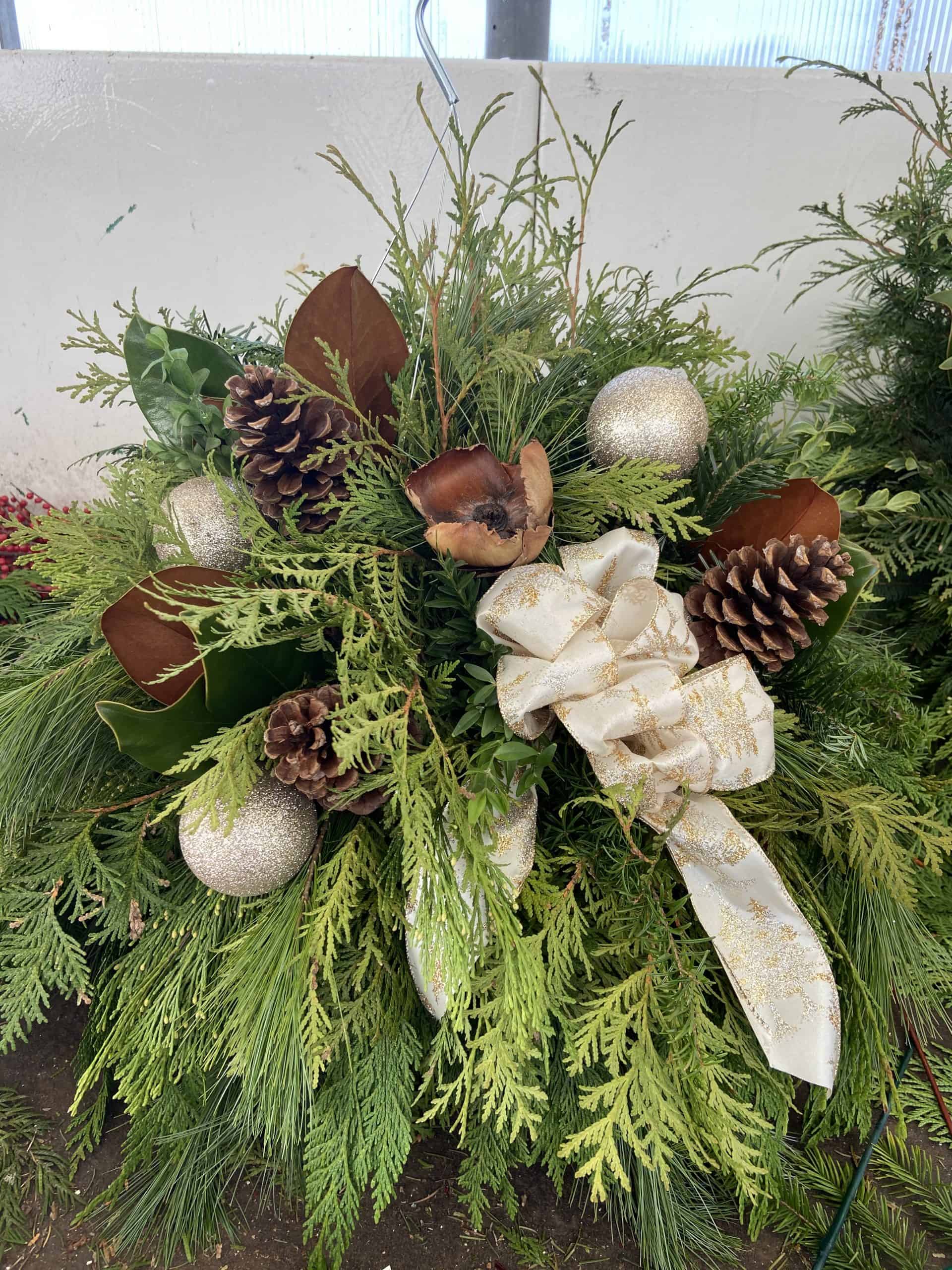
Wire your ribbon onto a floral pick rather than tying it around a branch. Branches flex, ribbons slide, and by Christmas Eve your bow is hanging under the arrangement. A 4-inch wood pick with wire attached, hot-glued to the ribbon’s back and pushed into foam, holds position all season. Cost: about $3 for a pack of 25.
24. A Lit Red Pillar Candle Set Into Deep Green Foliage
A lit candle inside dry greenery is the number-one holiday decoration mistake, and it’s worth saying plainly: keep the flame at least 12 inches from any needle, and never leave it burning in a room you’ve left. If the arrangement has been up more than two weeks, the foliage is tinder. Battery tapers with a flicker setting look nearly identical in photos and let you stop thinking about it. Compare with Idea #31 for a candle setup that keeps flames clear of the greens.

The single lit candle is the whole point. Not the gold ornaments, not the ribbon — one flame, sitting low and centered, is what makes this arrangement feel warm instead of merely decorative. It also forces the composition: everything else has to leave space around it, which is why nothing here looks cluttered. Remove the candle and you have a pile of nice things with nowhere to look.
25. Ivy, Faux Succulents, and a Mercury Glass Votive
Build it on the wood slice so you can move it in one piece.
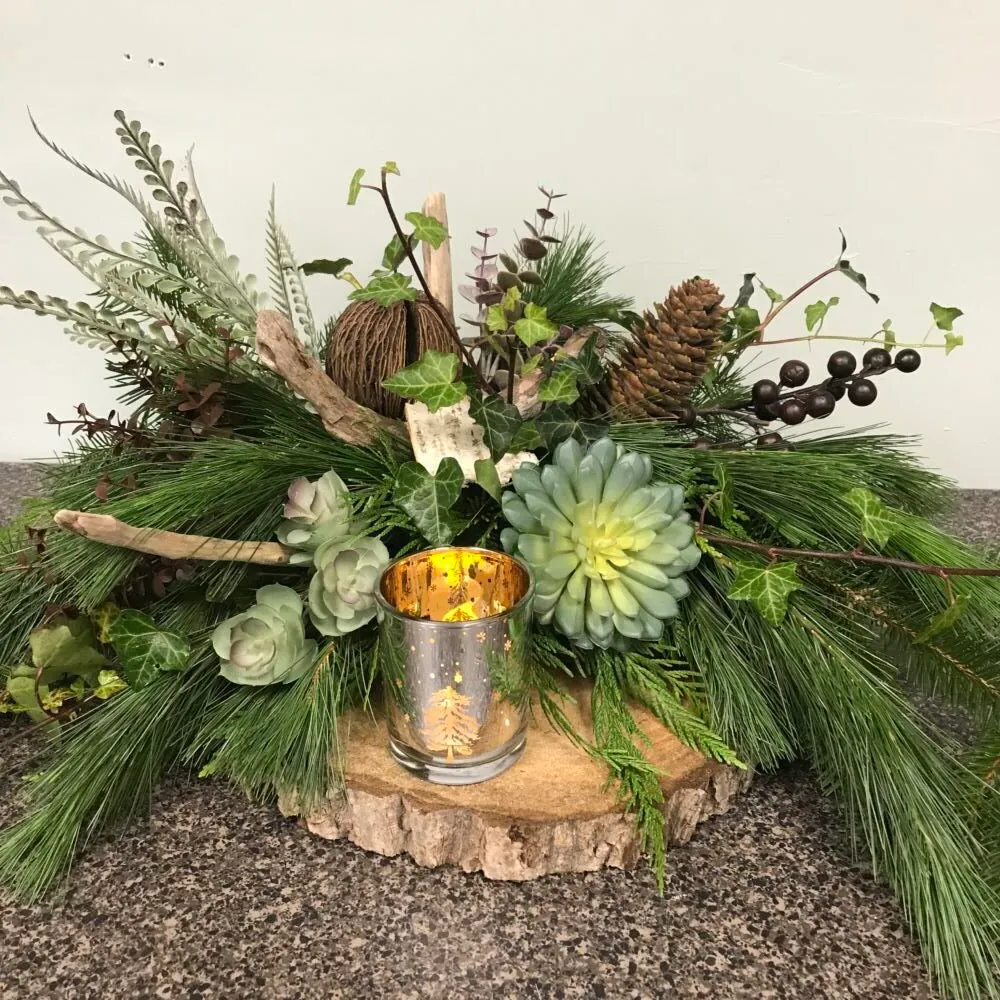
- Set the slice on the table and mark its center with a pencil dot.
- Anchor pine branches in a shallow dish, fanning outward from that point.
- Tuck ivy so it trails toward the front edge only.
- Wire succulents to picks and insert at three uneven heights.
- Nestle the mercury votive slightly off-center.
- Fill remaining gaps with pinecones, berries, and driftwood.
Twenty minutes and about $30 in materials if you own the dish.
A 12-inch wood slice suits a table 42 to 54 inches long — apartment-sized, in other words. If yours runs longer, build two and set them 30 inches apart; one small centerpiece on an 8-foot table looks stranded. For a full-size dining room, see Idea #21, which scales up without needing a second arrangement.
26. Peach Roses and Blue Thistles in a Rustic Wood Box
- Rustic wood box: $18–$45
- Cedar and pine bundles: $15–$30
- Red and peach roses: $35–$70
- Tulip-like blooms and thistles: $20–$40
- Berries and filler: $8–$16
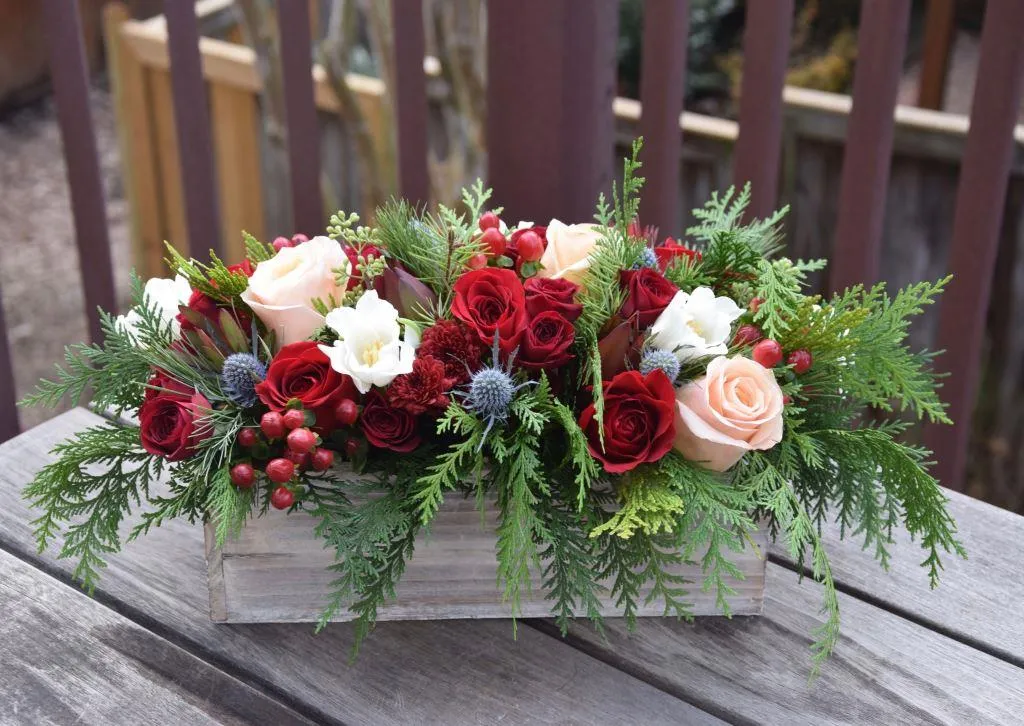
Total: $96–$201. Budget version: swap half the roses for carnations and use a single thistle stem cut into three — the blue-grey is what people remember anyway.
Peach is the surprise that keeps this from being another red-and-green box. Warm peach next to deep red reads as depth rather than contrast, and the blue-grey thistles add a cool note that makes both colors look richer. That’s temperature mixing — one cool element against two warm ones. Without the thistle, this arrangement is lovely and completely forgettable.
27. Gold Chargers and Black Plates Under a Conifer Garland
Place settings are where a table budget quietly doubles, so here’s the honest math. Round woven placemats run $4–$8 each at Target, gold chargers $2–$4, matte black plates $3–$6, cream linen napkins about $3 each in a four-pack, and gold flatware $20–$40 for a set of four. That lands around $14–$22 per setting. Skip the gold flatware and use what you own — nobody notices flatware once the candles are lit.
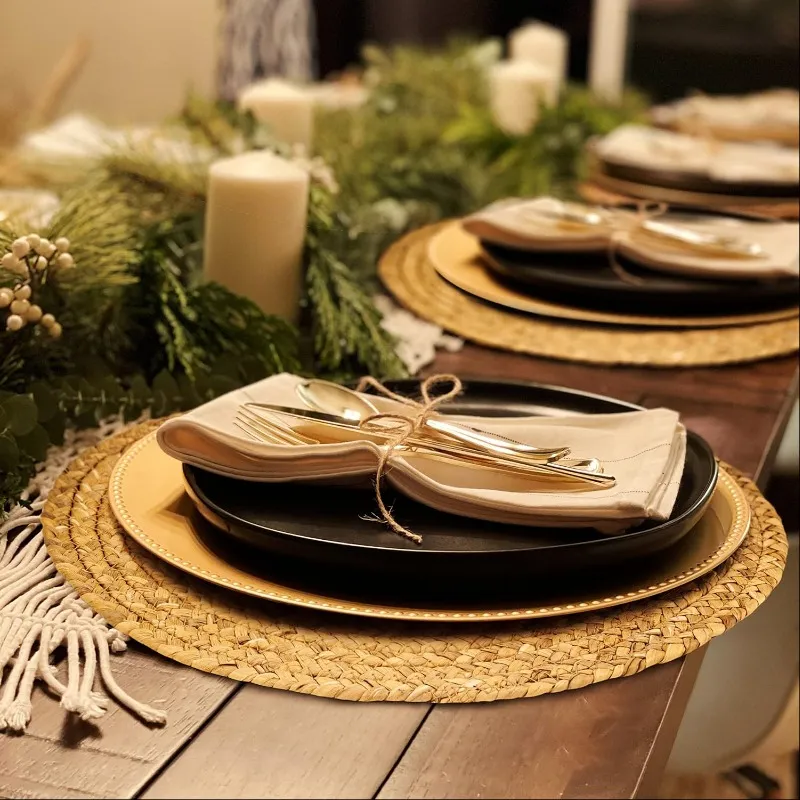
Tie the napkin with twine and tuck a single sprig of cedar under the knot. It costs nothing, takes ten seconds per setting, and repeats the garland’s green at eye level so the table feels connected from top to bottom. Do it after the plates are down, not before — cedar crushed under a charger looks tired within the hour.
28. A Glass Cloche With Moss, Pinecones, and a Tiny Tree
Four things to verify before you buy the glass.
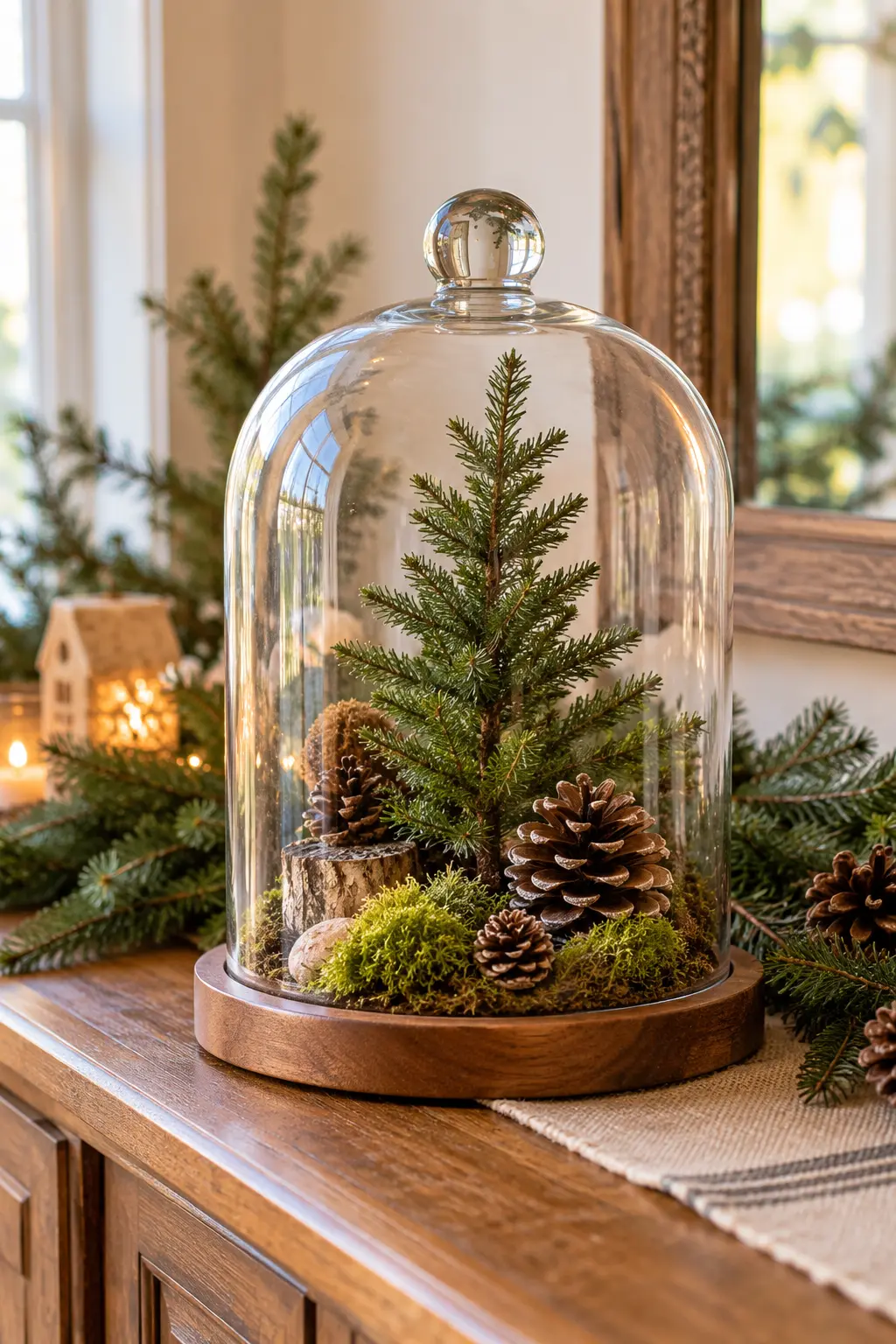
- Measure the cloche’s interior height — the tree needs 2 inches of clearance at the top.
- Confirm the base is sealed; unfinished wood wicks water and stains.
- Use preserved moss, not fresh, or the glass will fog.
- Plan for condensation: a vent gap or a daily wipe.
Cloches look effortless and require a small amount of upkeep. Glass fogs within a day or two over fresh moss, and dust shows on clear glass like chalk on a board. Wipe the inside weekly with a dry microfiber cloth and lift the cover for an hour if you see beads forming. Preserved moss sidesteps most of this — it’s dyed and treated, so it never needs water and never fogs.
29. A Three-Ribbon Bow on a Distressed White Door
50% green + 25% red + 15% white (stripes, distressed door) + 10% glitter. The three ribbons work because they share two colors and differ in pattern: stripes, solid glitter, and a printed phrase. That’s the rule — mix patterns within a two-color family and anything goes; mix patterns across three colors and it turns chaotic fast.
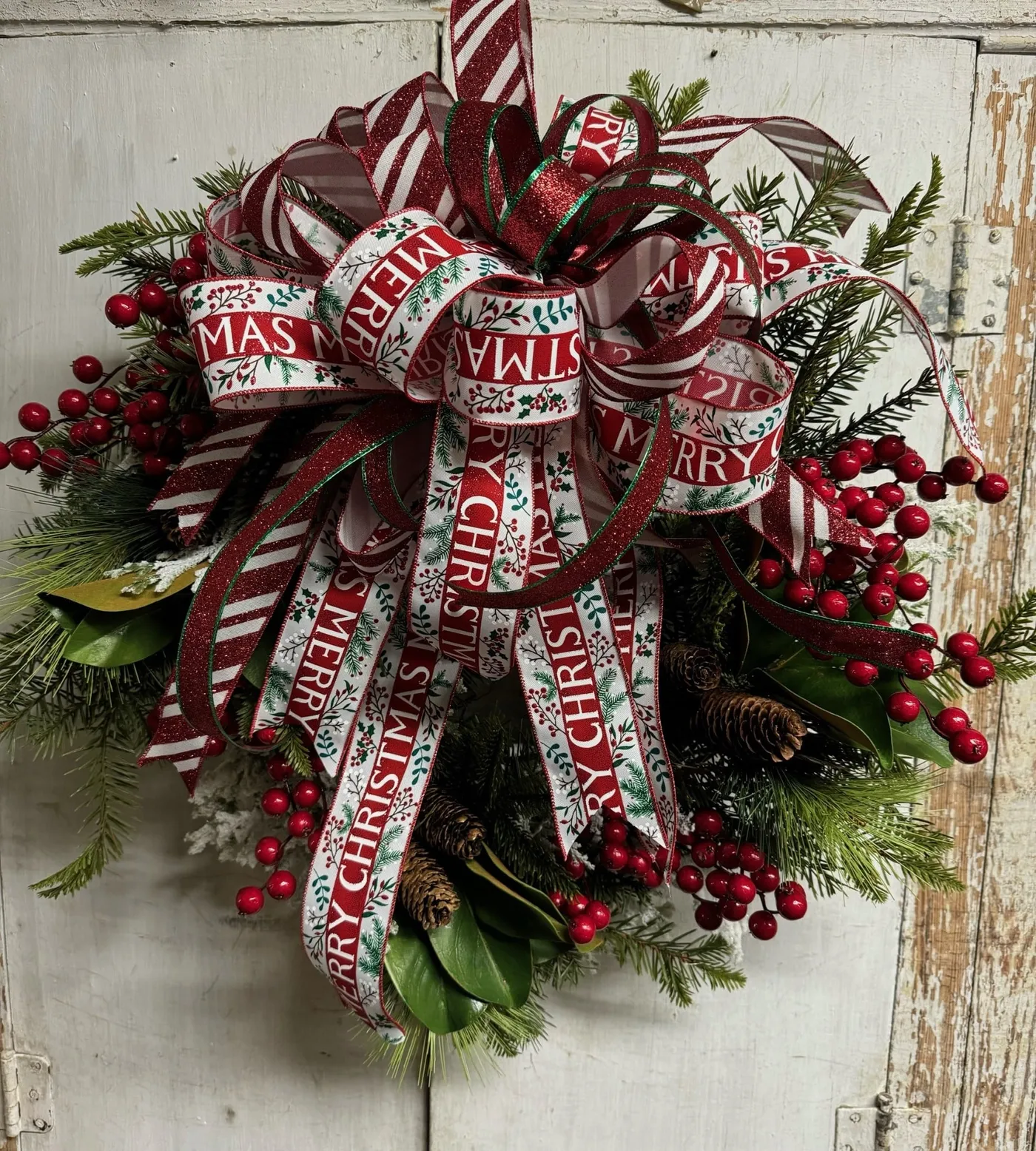
Wired ribbon holds a bow shape, but it also holds whatever shape it was stored in. Unroll it and let it relax for a day, or run a warm iron on low over a towel before you tie anything. And if your door faces south, that glitter ribbon will shed onto the threshold for six weeks — put a mat down and accept it, or choose a matte finish instead.
30. Greenery Piled on a Cast-Iron Wood Stove
Styling greenery on non-traditional surfaces — stoves, shelves, the top of a piano — is a real shift from the mantel-only era. Part of it is practical: people in apartments and older homes don’t have a fireplace, and a wood stove or a console becomes the anchor. Part of it is aesthetic. Greenery on cast iron reads collected and slightly unexpected, which is exactly the kind of thing that gets pinned.
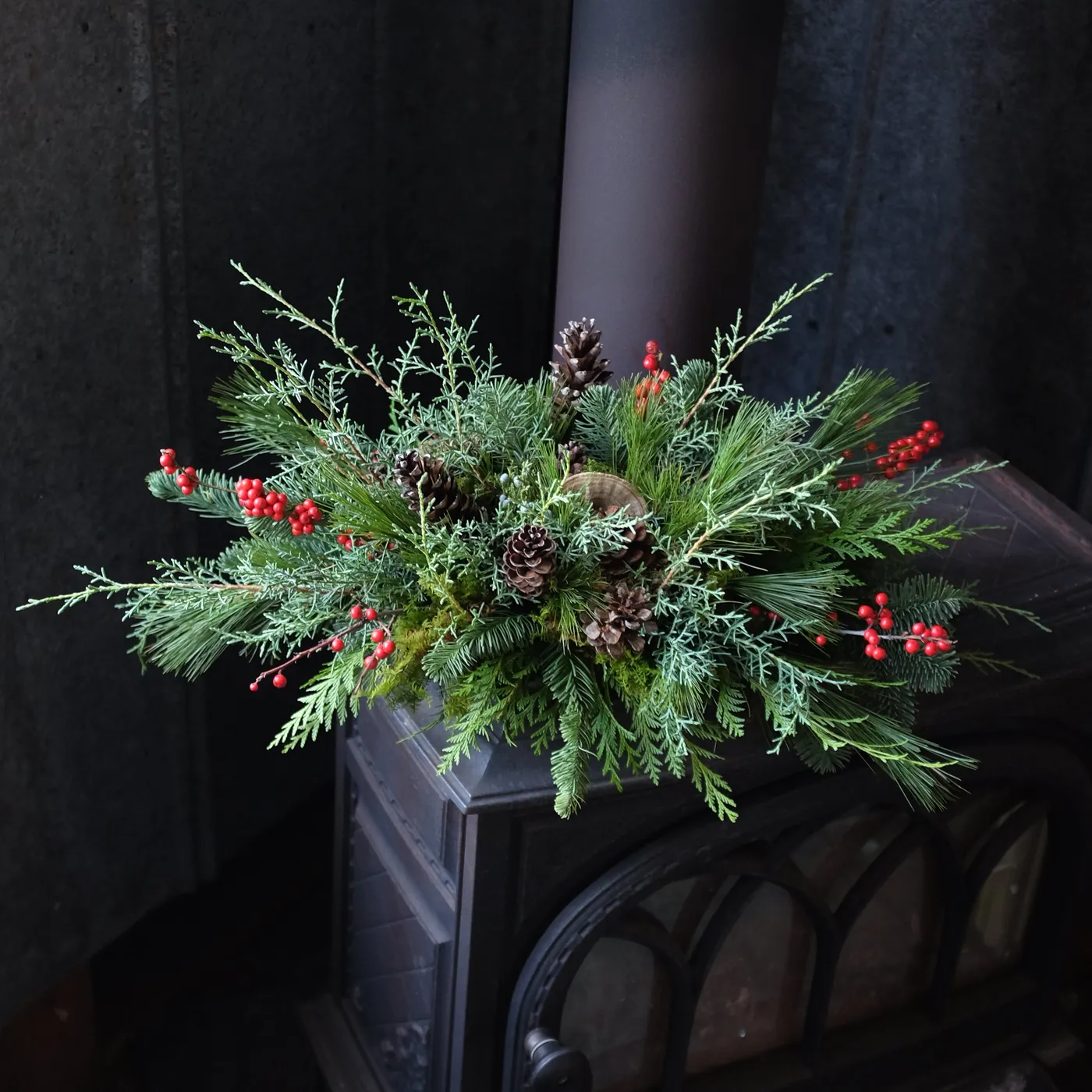
This arrangement is roughly 30 inches wide, the sweet spot for a stove top or sideboard — big enough to register from across a room, small enough to lift off in one piece. It needs a surface at least 36 inches wide and 14 inches deep, and a wall behind it that isn’t busy. If the stove is your only heat source, skip this and use Idea #16 instead.
31. Tall Yellow Tapers in a Row of Dried-Fruit Centerpieces
Taper candles should clear the greenery by at least 6 inches, and they should never be the same height as each other. Odd numbers staggered by 1 to 2 inches give you the vertical rhythm that makes a low centerpiece feel tall. Buy tapers with a dripless finish — a cheap beeswax blend will run down into the greenery and take the whole arrangement with it.
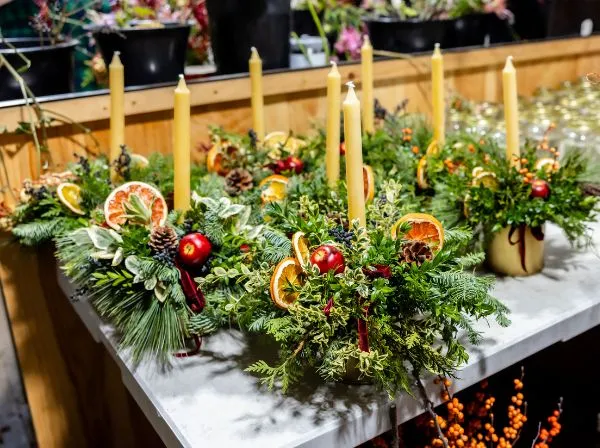
- Evergreen bundles (three): $30–$60
- Yellow taper candles: $8–$16
- Candle holders: $12–$30
- Dried orange slices: $8–$14
- Small apples, berries, pinecones: $10–$18
Total: $68–$138 for all three. That’s $23–$46 each — less than a single florist arrangement.
32. A Flocked Pink Tree Beside a Garland-Draped Mantel
The pastel tree works because the garland doesn’t compete with it. Green pine over the mantel, pink and red on the tree, and nothing trying to bridge the two. When people mix a colored tree with traditional décor and it fails, it’s almost always because they tried to match. Let the tree be its own thing and the room reads playful instead of confused.
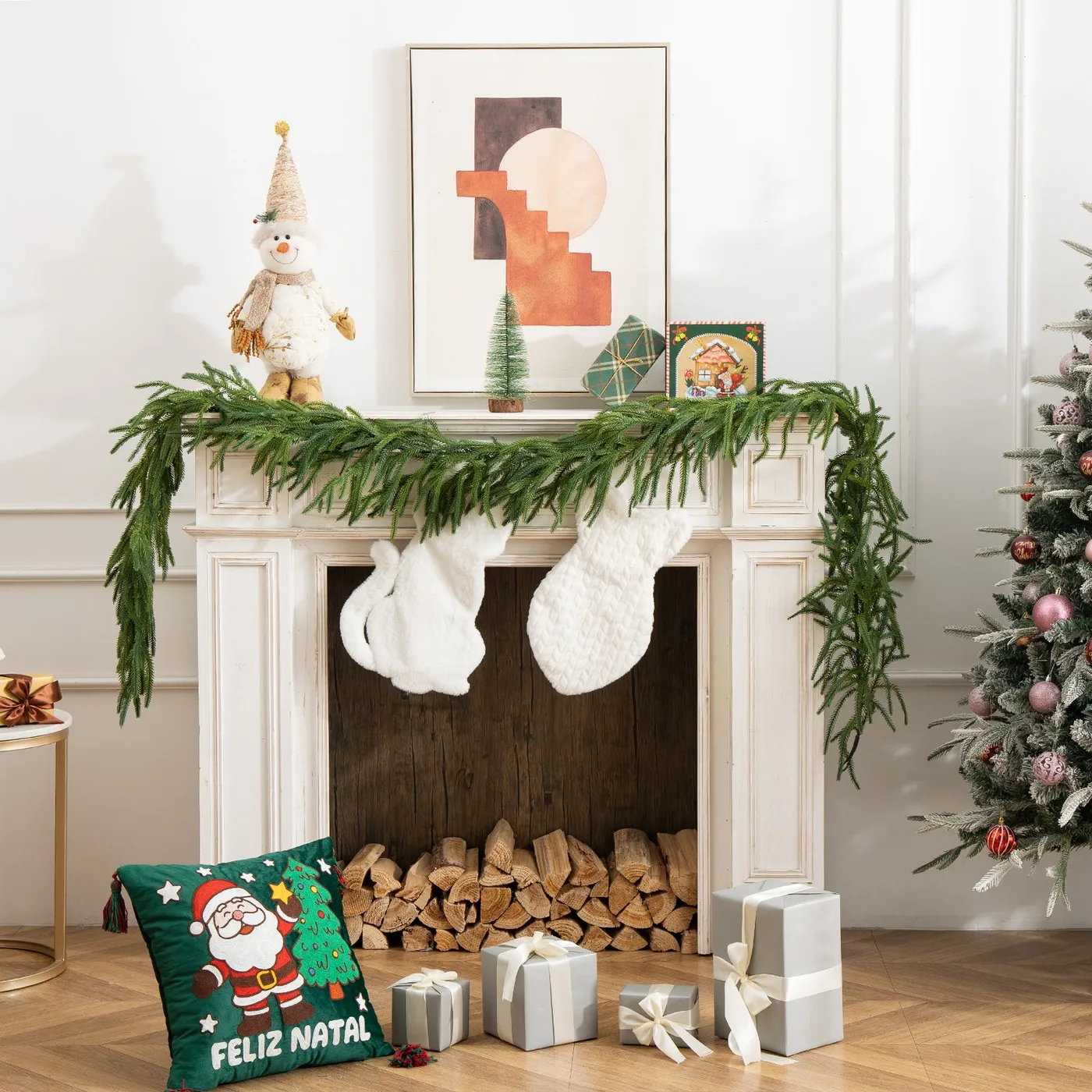
Flocked trees are the affordable half of this look. A 4.5-foot flocked tree runs $45–$80 at Target or Walmart, a pastel ornament set is $15–$25, a nine-foot green garland $18–$35, and plush stockings about $8 each — roughly $110 for the whole scene. Flocking sheds for the first week, so set it up, vacuum once, and you’re done.
Your Greenery Should Look Gathered, Not Bought
The best greenery on this list isn’t the most expensive — it’s the arrangement that looks like someone walked outside, cut a few branches, and made something with them. Start with one idea, buy the branches before you buy the ornaments, and give yourself permission to rearrange it three times before you like it.
📌 Save this to Pinterest now so it’s waiting for you next December — and honestly, probably this one too.