There’s a specific kind of holiday panic that hits when you open the cabinet and realize you’ve been setting the same table since 2019. We’ve all scrolled past a gorgeous Christmas table at 11pm, saved it, and never opened it again.
So we spent a weekend digging through Anthropologie, Target, Williams Sonoma, Etsy, and Amazon — comparing $12 starter plates against $380 six-piece sets — to find the 34 setups that actually hold up when real food lands on them. Inside: traditional holly and plaid, gold-and-white elegance, jewel-tone maximalism, and rustic woodland greenery, with budget and luxury versions side by side and shoppable links for every piece.
2026 is the year tablescaping got personal — mixed vintage plates, non-red palettes, and dinnerware pulled out for everyday use instead of one night in December. And stay until the end, because we break down the most common mistakes that can quietly ruin these looks.
📌 Save this to Pinterest for later — you’ll want to revisit these ideas.
1. Gold-Rimmed Holly Plates on a White Tablecloth
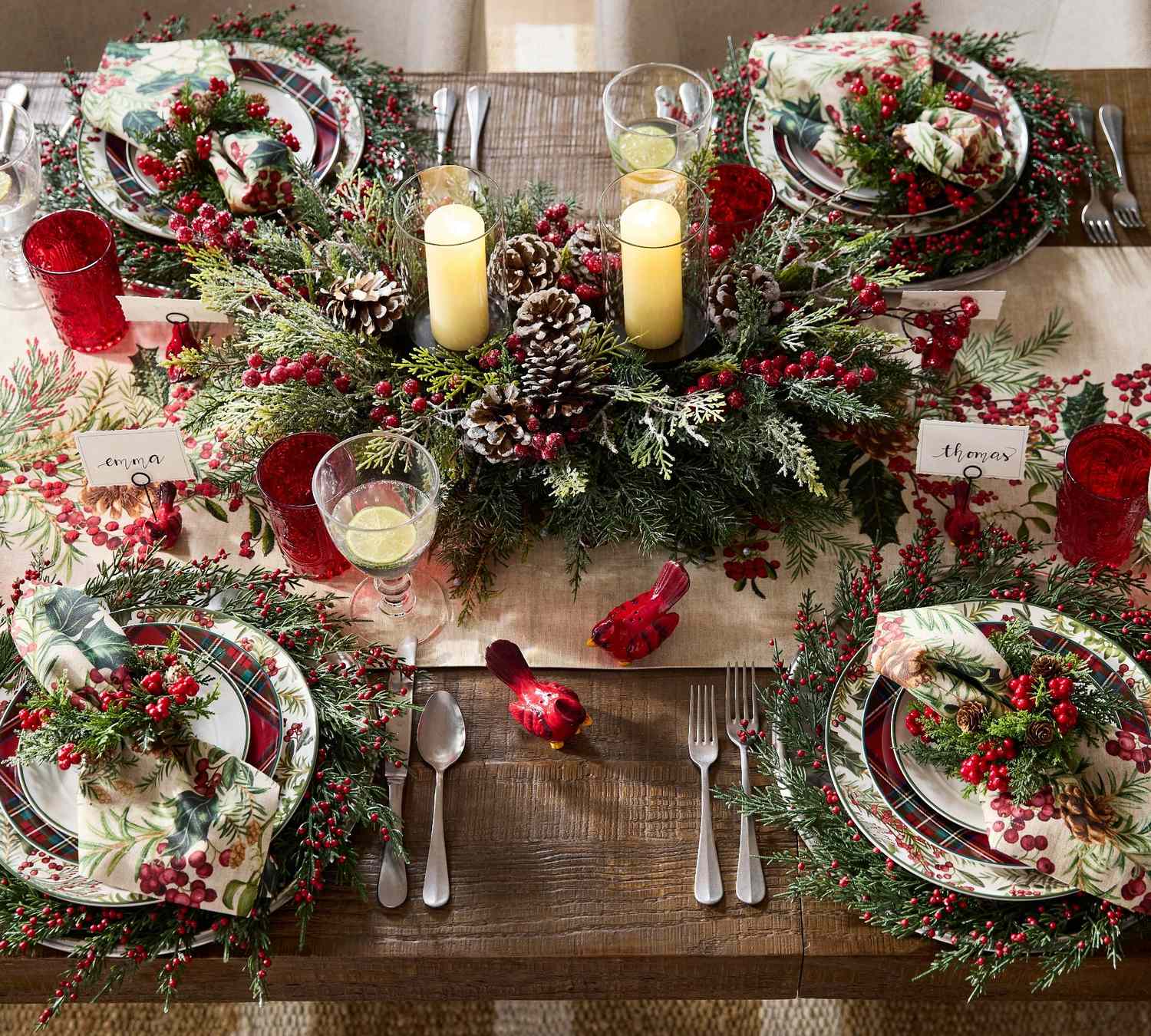
On a round table, the centerpiece sets the ceiling for everything else. Keep it under 12 inches tall so nobody has to lean sideways to see their sister-in-law. A potted evergreen in a 6-inch pot is perfect here — low, living, and it doesn’t shed needles into the gravy. If your table seats six, repeat the candles in pairs opposite each other rather than clustering them; symmetry reads as ‘planned’ even when the rest of the setting is casual.
The gold-rimmed holly plates are doing all the heavy lifting. Everything else — the white cloth, the clear glasses, the plain white napkins tied with green ribbon — exists to let that rim of red and green breathe. Swap them for plain white chargers and the whole table becomes a hotel banquet setup. If you’re on a budget, buy four of those plates instead of twelve and use them only for dessert; the moment of recognition at the end of the meal is worth more than matching everything.
2. Nutcracker Ballet Plates Scattered on Dark Rustic Wood
Three things are working here, and none of them is expensive. First, contrast: bright ceramic reds, greens, and whites against dark, scarred wood — the plates look collected, not purchased. Second, repetition of white as a neutral bridge between all those illustrations. Third, scale play: the Nutcracker characters sit on full-size dinner plates, so the whimsy reads as illustration rather than kitsch. The solid plates layered underneath do the quiet work.
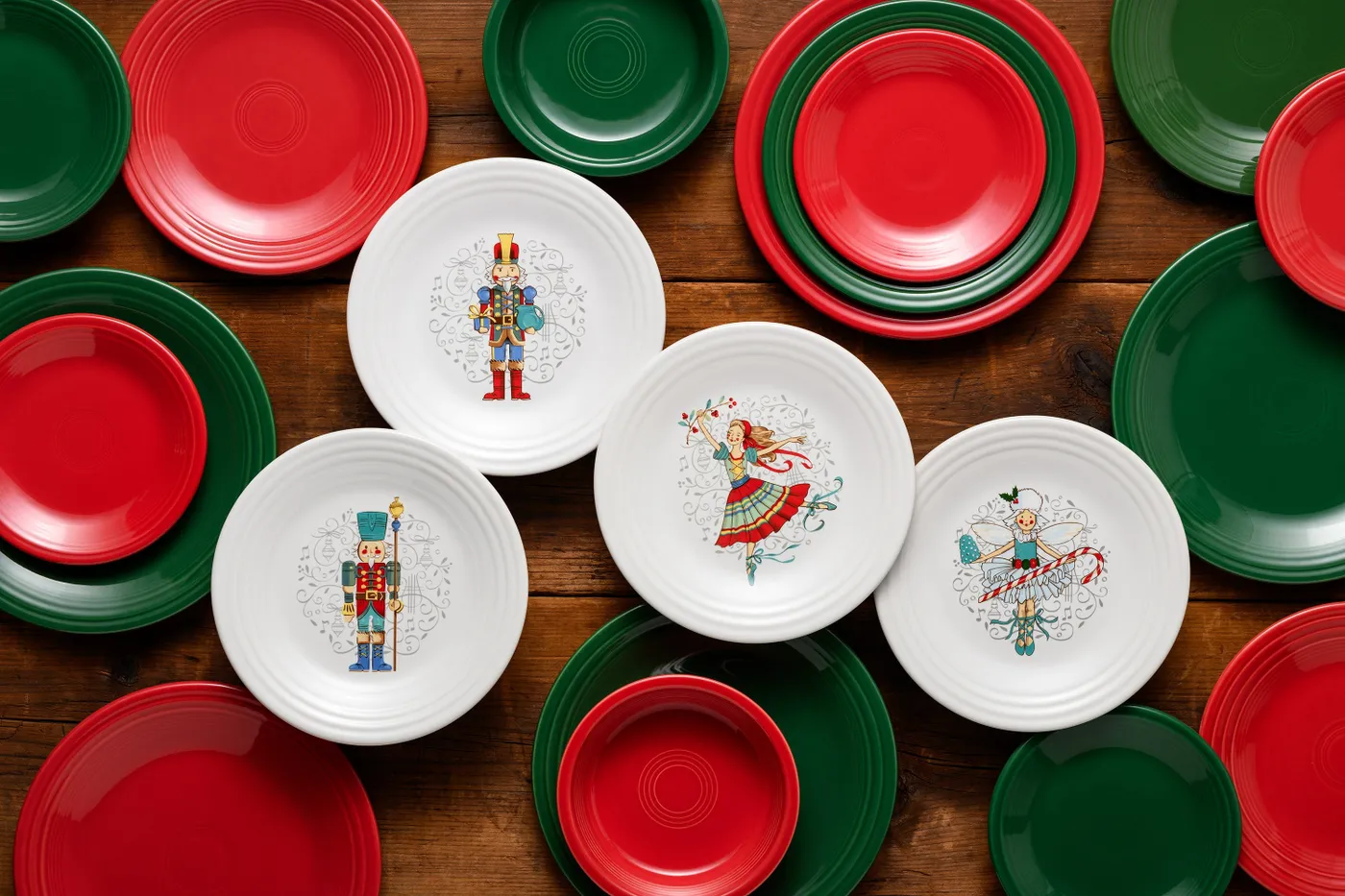
Nutcracker-pattern plates are seasonal and get marked down hard in early January — that’s when you buy next year’s set. Meanwhile, thrift stores and Facebook Marketplace turn up solid red and forest green dinner plates for $2-$4 each, and Target’s holiday aisle does a similar illustrated plate for around $6. Build the collection over two seasons instead of one afternoon. Compare with Idea #12 — same collect-a-set logic, different motif.
3. Red Plaid Cloth With Orange Napkins and Rose Gold
The formula: 50% red-and-green plaid (the cloth), 30% mixed Christmas plates, 15% warm metal in rose gold and gold, 5% surprise — those orange napkins folded at each setting. That last 5% is what keeps the whole thing from looking like a catalog page. Want a different mood? Keep the same percentages but swap plaid for a deep green velvet cloth and the orange napkins for mustard. The math holds; only the ingredients change.
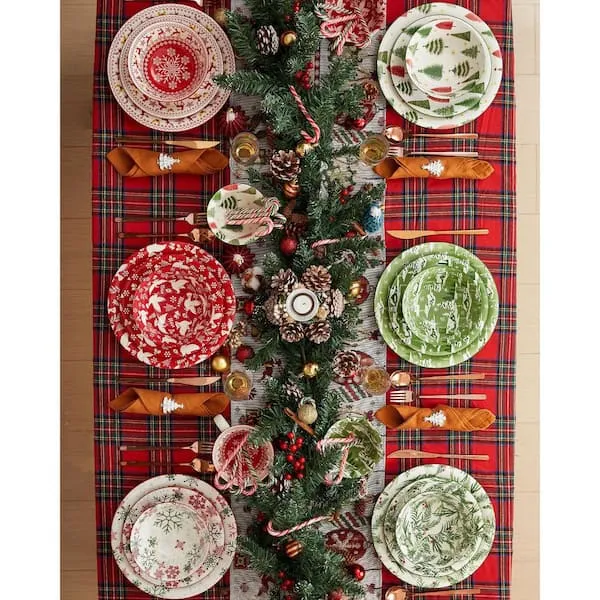
A faux pine garland down the center looks incredible until a guest reaches for the butter dish and drags half of it into their lap. Wire the garland to a narrow piece of driftwood or a dowel underneath so it stays put, and leave a 6-inch gap at each end for serving dishes. Also: candy canes on a centerpiece are decorative, not dessert. Someone will eat one. Buy a second box for actual consumption.
Plaid cotton tablecloths need a wash after every gravy-heavy meal, and the first wash shrinks them by roughly 2%. Buy one size up, pre-wash before the big day, and iron while slightly damp. Faux garlands shed plastic needles for the first two seasons — shake them out in the garage before they come inside. Real pine looks better and costs less, but you’ll be vacuuming needles until Valentine’s Day.
4. Scalloped Green Placemats Under Berry-Relief Plates
It’s the scalloped forest green placemat. A round white plate on a red plaid cloth is fine; the same plate on a scalloped green mat suddenly has a frame. Those curves echo the plate’s berry relief and give the eye somewhere soft to land between all the straight plaid lines. Remove it and the setting loses about 60% of its charm for a cost of roughly $4 per mat. The gold glitter cracker with red bows comes second — it’s the only thing that sparkles.
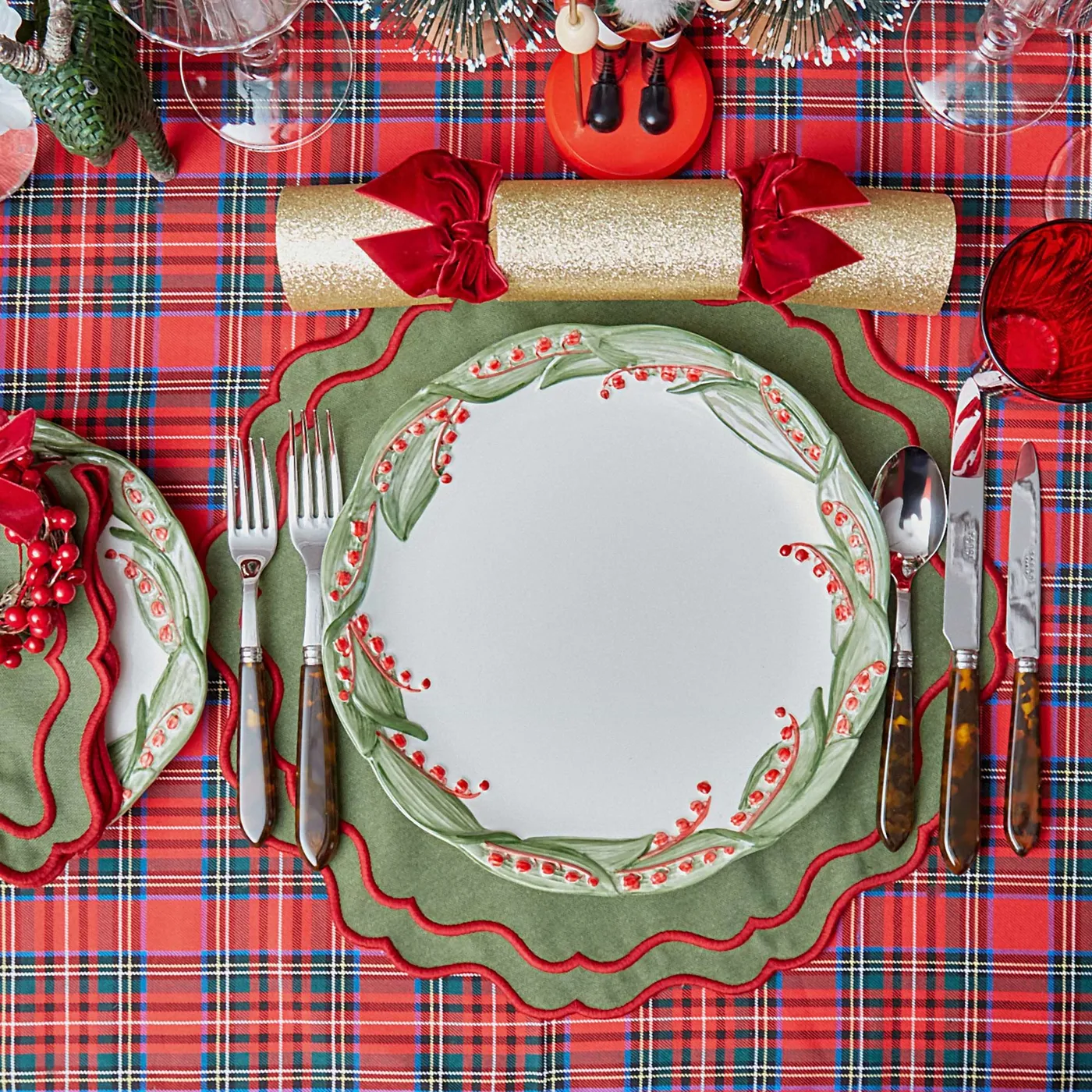
Building this setting takes about 12 minutes and $30-$45 beyond the plates you already own.
- Lay the plaid cloth, then center one scalloped green placemat 1 inch from the table edge.
- Set the white berry-relief plate dead center.
- Place the gold cracker at 10 o’clock, above the plate, angled toward the glass.
- Fork left, knife and spoon right, 1 inch from the plate.
- Add the red glass tumbler at 1 o’clock.
- Step back. If the cracker and glass feel crowded, move the cracker up.
5. Embossed White Plates Topped With a Single Holly Sprig
Fresh holly is the cheapest luxury in holiday tablescaping — a bunch runs $6-$10 at a florist or grocery in December and gives you sprigs for a dozen settings. Wipe each leaf with a dab of olive oil on a paper towel and it stays glossy for three or four days instead of one. Skip the berries if kids are at the table; they’re genuinely toxic. One sprig laid at an angle across the top plate beats a napkin ring every time, especially against those embossed starburst plates.
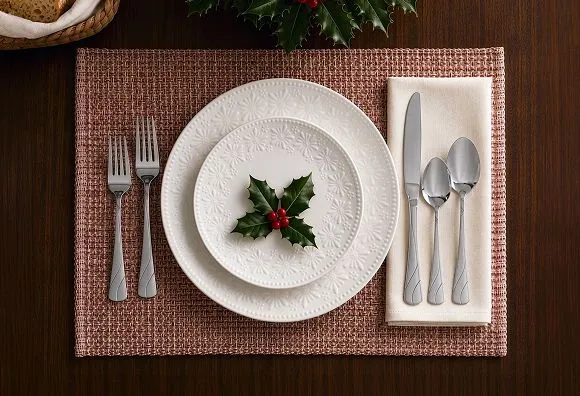
Here’s what this place setting costs to build from scratch:
- White embossed dinner plates (set of 4): $40-$70
- Woven placemats (set of 4): $20-$40
- Silver-toned flatware (service for 4): $30-$60
- Cream linen napkins (set of 4): $20-$45
- Fresh holly and berries: $8-$15
- Total: $118-$230 for four settings
Budget alternative: plain white plates you already own, kraft paper placemats cut into 15-inch rounds, and holly clipped from a neighbor’s hedge (ask first). That lands around $10.
6. Scalloped Red-Border Porcelain With Red Amaryllis
Scalloped edges are the whole trick. A straight-edged plate with a red border reads graphic; a scalloped one reads heirloom, and the eye registers the curves before it registers the pattern. Then there’s the color echo: the red amaryllis and the red-bordered plates are the same red, and the green baubles pick up the green in the border motifs. Nothing here is a new color — just the same two, repeated at different scales.
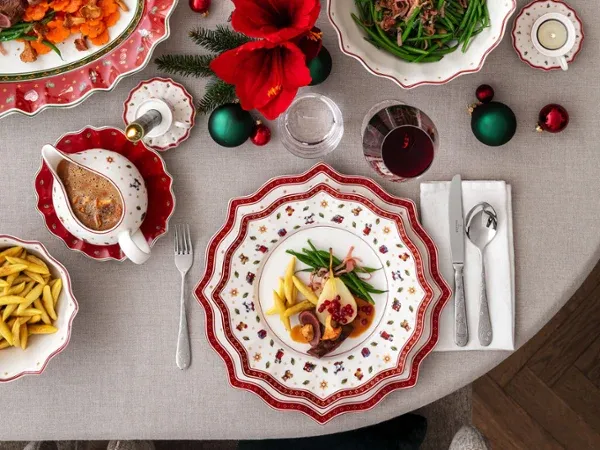
This level of formality wants a table that seats six to eight without stacking plates in your lap — think 60 inches round or 84 inches rectangular minimum. Ceiling height matters less than light: ornate silver pieces need something warm overhead, so a dimmer or a chandelier on low beats recessed cans. In a small dining nook, scale down to four settings and a smaller amaryllis cluster — see Idea #21 for a version that fits tighter rooms.
7. All-White and Gold Table Without a Single Color Pop
An all-white-and-gold table is the easiest scheme to fake. White plates you already have, a plain white cloth, and then put your money into one metallic element — gold flatware, which Target and Amazon both sell by the set for $25-$45. Gold chargers from a dollar store, sprayed matte if they’re too shiny, do the rest. Total for six settings, under $100 if you skip the chargers entirely and let the cloth be the luxury.
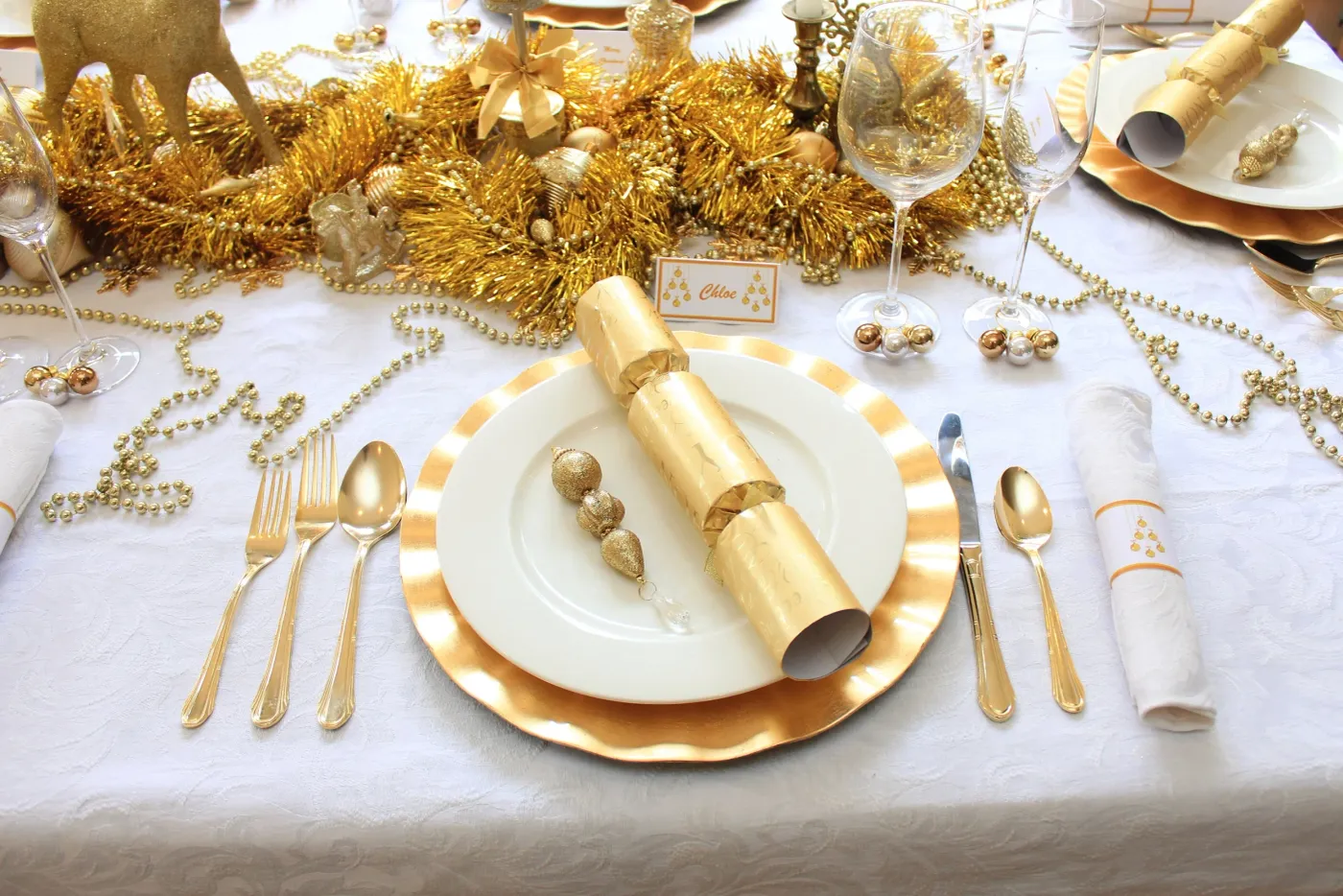
White on white only works if the whites are different. Pair a bright white cloth with warm ivory plates, or a cream cloth with stark white porcelain — the variation is what creates depth. Then add gold in one deliberate place: flatware, candleholders, or a rim. Gold in three competing finishes reads cheap; gold in one finish reads expensive. Take a photo with your phone flash off — if the whites blur together, you need more contrast.
8. Red Dessert Plates Stacked on Woven Round Placemats
The stacked dessert plate is the move, and it takes under a minute per setting.
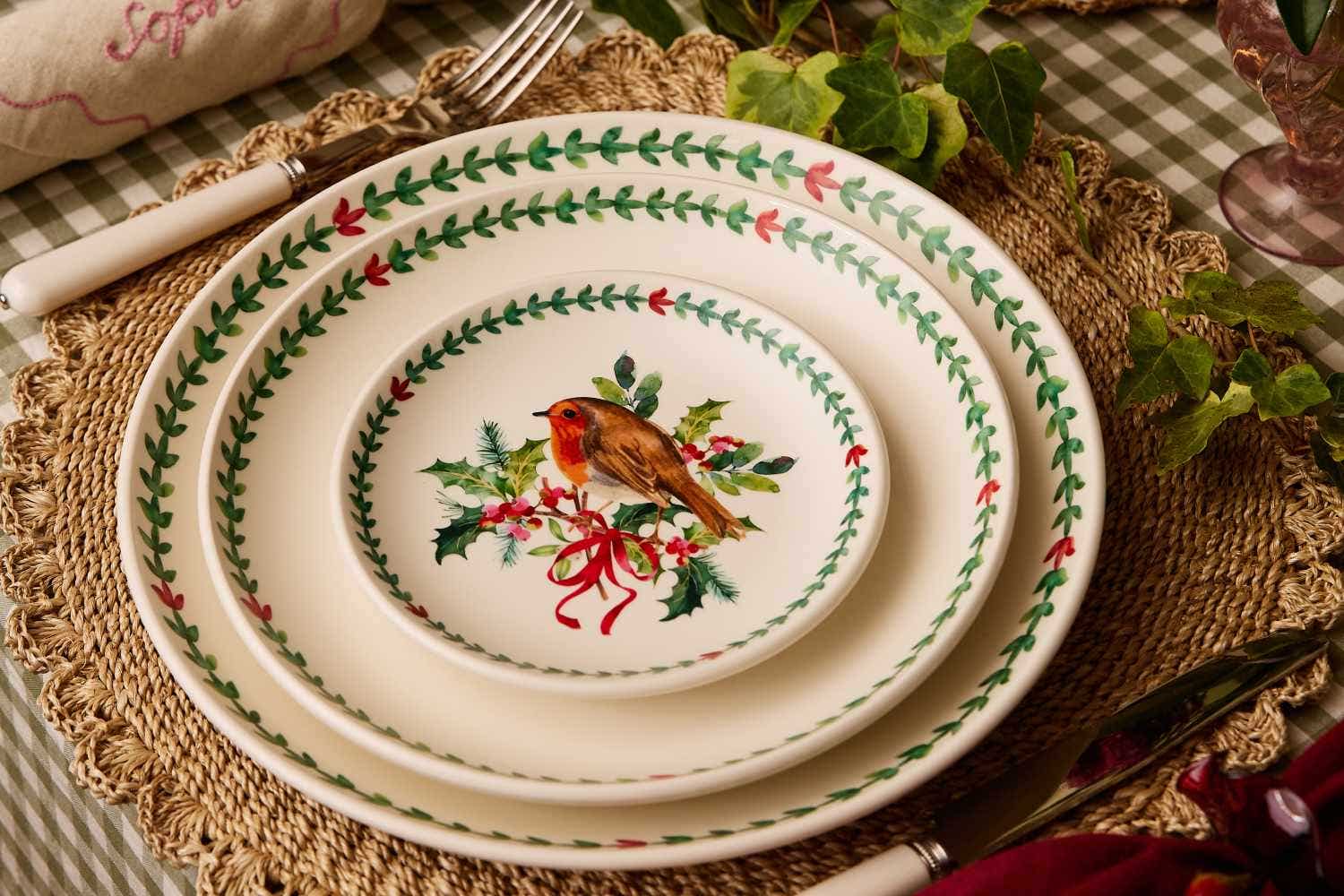
- Set a woven round placemat 1 inch from the edge.
- Center the white dinner plate.
- Offset the red-and-white dessert plate slightly toward the top left — never perfectly centered.
- Fold the white napkin into a narrow band, lay it across the dessert plate, tuck in a green sprig and one red berry.
- Silver left and right, clear stemware at 1 o’clock.
- Run the garland down the middle, then set three pillar candles in clear glass holders at uneven intervals.
About 15 minutes and $25 beyond what you own.
Sixty percent white, 25% red, 15% green — with silver as the metal that refuses to compete. The green arrives almost entirely through the garland and the tiny sprig on each napkin, which is why it reads fresh instead of Christmas-carpet. To push this same formula warmer, swap silver flatware for brass and the red dessert plates for cranberry glass. To cool it down, go silver everything and let red live only in the berries.
9. Blue Striped Cloth, Pink Tapers, and a Chain-Link Plate
The blue-striped-cloth-and-pink-candle thing isn’t random. Non-traditional holiday palettes have been the loudest corner of tablescaping for several seasons now, and 2026 is the year it went mainstream — save counts on ‘non-red Christmas table’ photos climb every November. Part of it is fatigue with red-and-green; part of it is that people own blue-and-white china and want permission to use it in December. You have it.
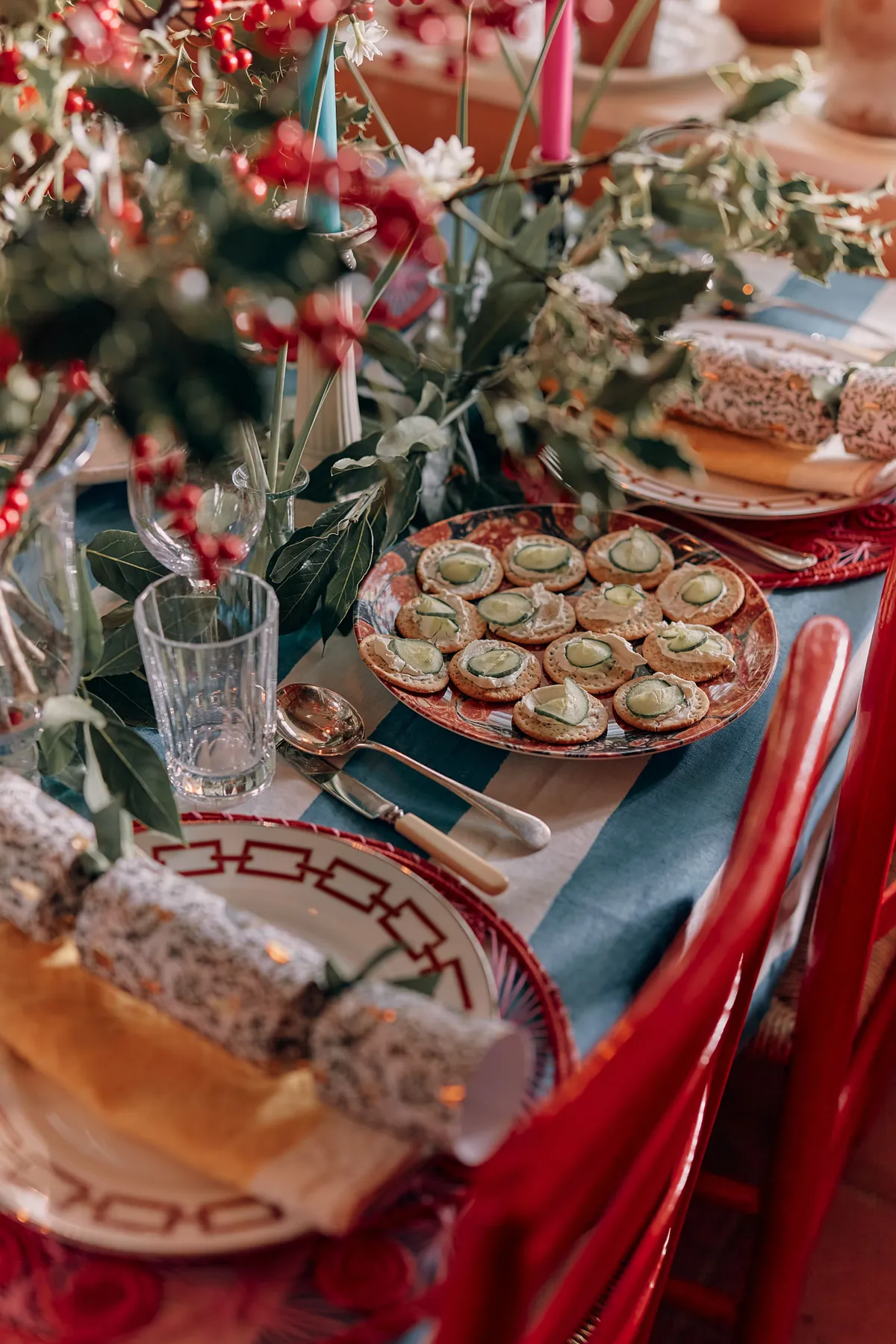
Four colors and it still feels calm, because two of them do all the structural work. Blue and white carry the base — cloth, plates, glassware — and red arrives only as a thin geometric border and a handful of berries. Pink and yellow show up in the tapers and the folded napkin in tiny doses, which is exactly why they feel like a wink rather than a shout. Restrained chaos. That’s the technical term.
10. Gold Scalloped Chargers and Plaid Plates on a Red Runner
This is a long-table setup — the garland-and-candelabra arrangement needs 84 inches or more to breathe, and it wants a ceiling tall enough that the brass doesn’t feel like it’s pressing upward. Ten feet of table is ideal for eight settings. If your table is 60 inches, keep the garland but trade the candelabras for three low pillar candles; a short table with tall flames overhead feels cramped fast.
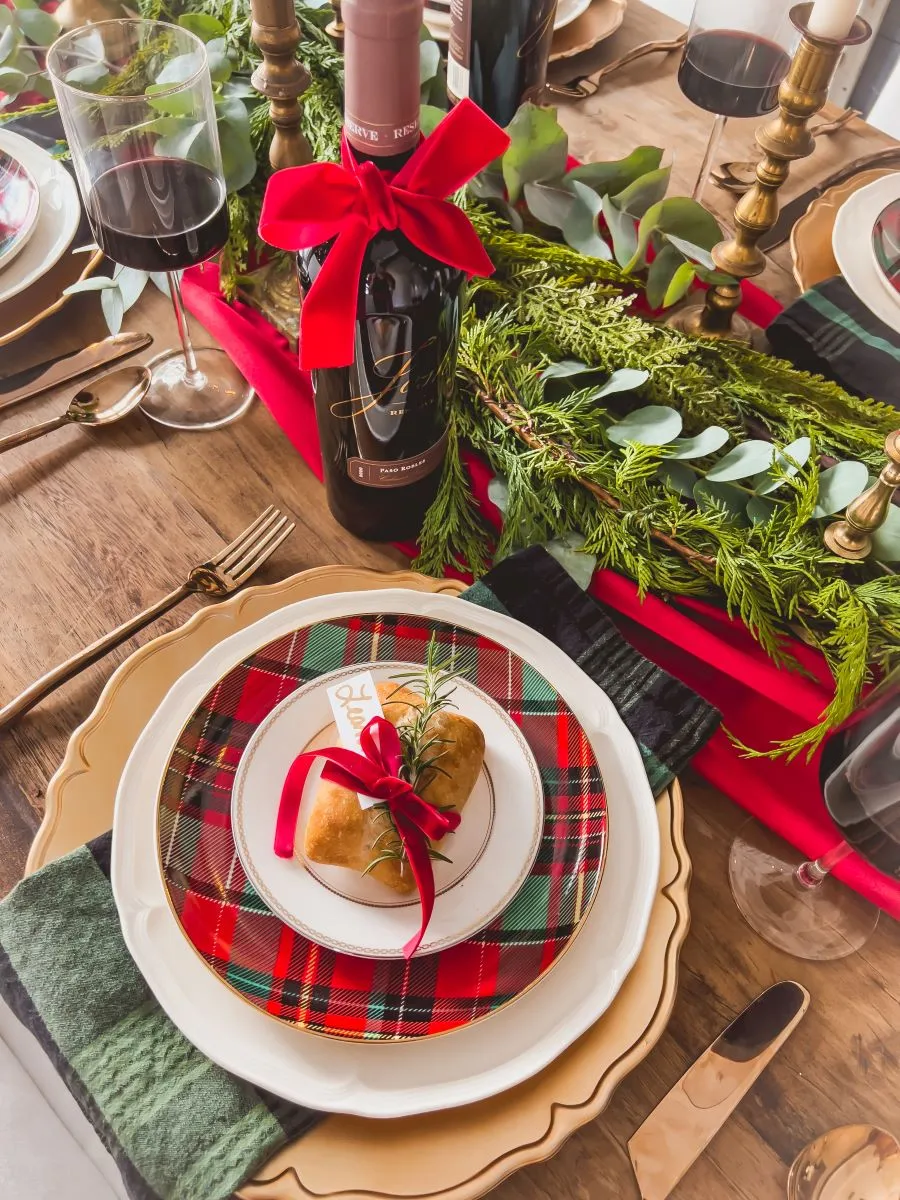
- Gold scalloped chargers (set of 4): $30-$60
- Plaid plates (set of 4): $40-$80
- White dinner plates: $25-$50
- Faux evergreen and eucalyptus garland: $25-$60
- Brass candelabras (pair): $40-$120
- Red velvet ribbon: $8-$15
- Total: $168-$385 for four to six settings
Budget alternative: skip the plaid plates and tie a strip of plaid ribbon around each white plate instead — $12 total and the same visual hit.
- Measure your table’s clear center width — you need 14 inches minimum for a garland without crowding plates.
- Check that the candelabras fit under any pendant with 12 inches to spare.
- Confirm the plaid on your plates doesn’t fight the plaid on your runner.
- Count your chargers before you commit to a setting count.
11. Scalloped Nutcracker Plates With a Santa Napkin Ring
The Santa napkin ring. It’s ceramic, slightly goofy, and the only thing on this table not trying to be elegant. That contrast is the point — a scalloped plate printed with nutcrackers, presents, and snowflakes is charming, but the same plate with a Santa Claus holding your red napkin is a table with a personality. Lose the Santa and you have a very nice department store display. Keep him and people talk about your table for years.
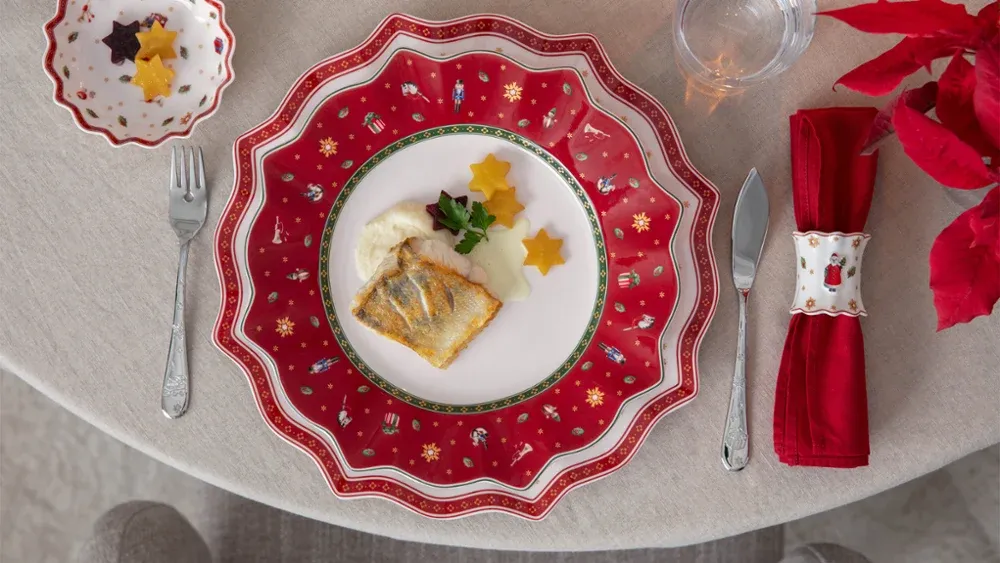
Patterned rims like these hide a lot, but they don’t love a dishwasher’s high heat — hand-wash the dinner plates and the Santa rings and they’ll last decades. The silver needs polishing about twice a season if it lives on display. And that light beige cloth? One glass of red wine and it’s a whole production. Buy a stain stick now, or choose a busier pattern where a spot simply disappears.
12. Red-Bow Starter Plates as the Whole Personality
A red-bow starter plate is a $12-$20 purchase that reads like a whole tablescape. Buy four, use them as the top layer over plain white dinner plates, and let the bow do the talking. Where to hunt: HomeGoods and T.J. Maxx get these in October, Walmart’s holiday line lands under $5 a plate, and Etsy sellers do hand-painted versions for around $18. Pair them with plain white, not more pattern — the bow needs air around it.
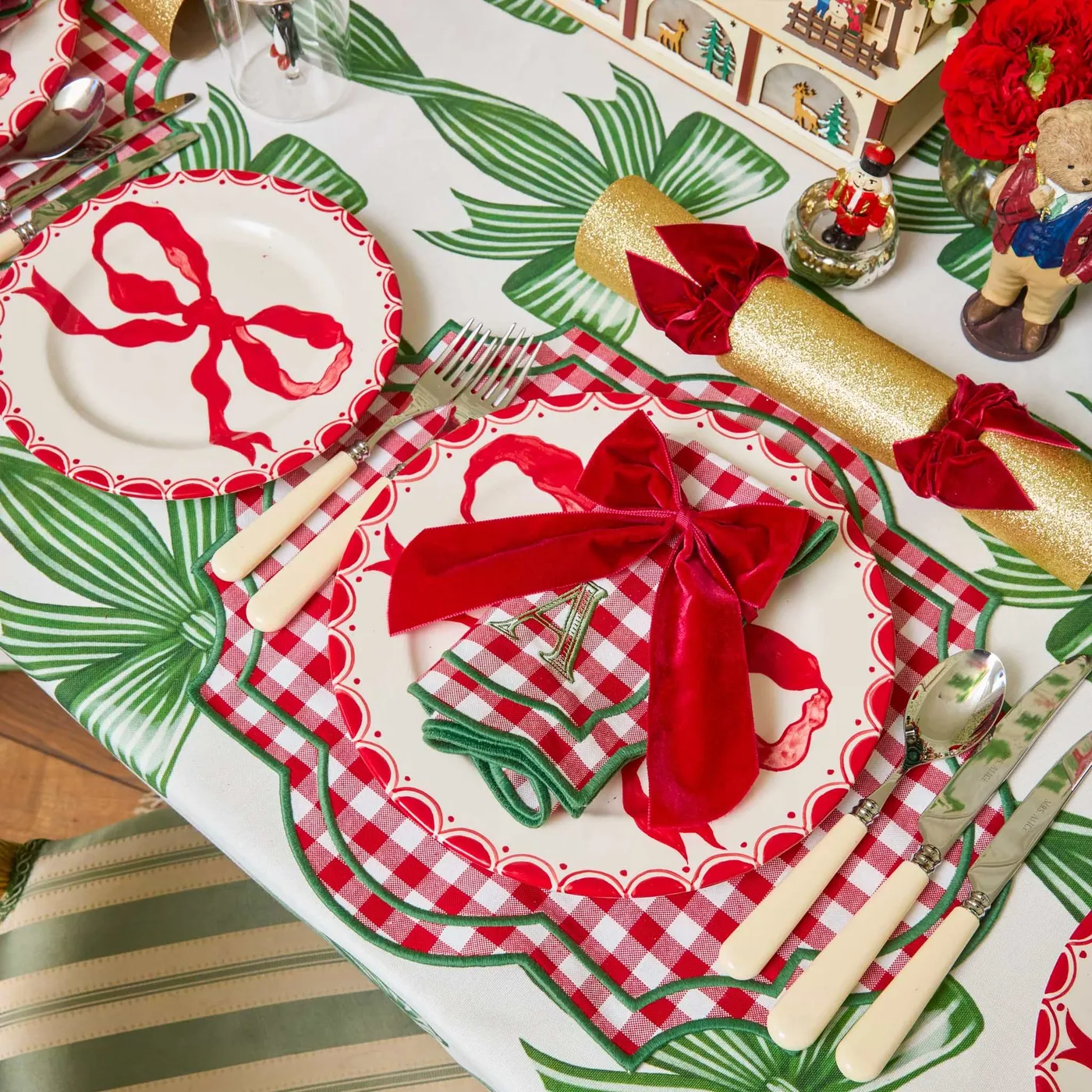
Think 70% white, 20% red, 10% green when your starter plate is the star. The white keeps the red bows from turning into a theme park; the green shows up as a few berries or a sprig, never a full garland. Swap the red bows for tartan and the formula still holds — the number of colors matters more than which ones. Three is the ceiling. Four only works when one of them is tiny.
13. Glossy Green Ceramic Tree Shakers Beside a Lit Pillar
Those glossy green ceramic tree shakers are doing what a centerpiece should: adding height and color without blocking sightlines. The rule is that nothing on a table’s centerline should stand taller than 14 inches above the surface. Cluster three objects of different heights — a candle, a shaker, a small bowl — within a 12-inch circle, and leave the rest of the wooden tabletop empty. Empty space is a design element, not a failure to decorate.
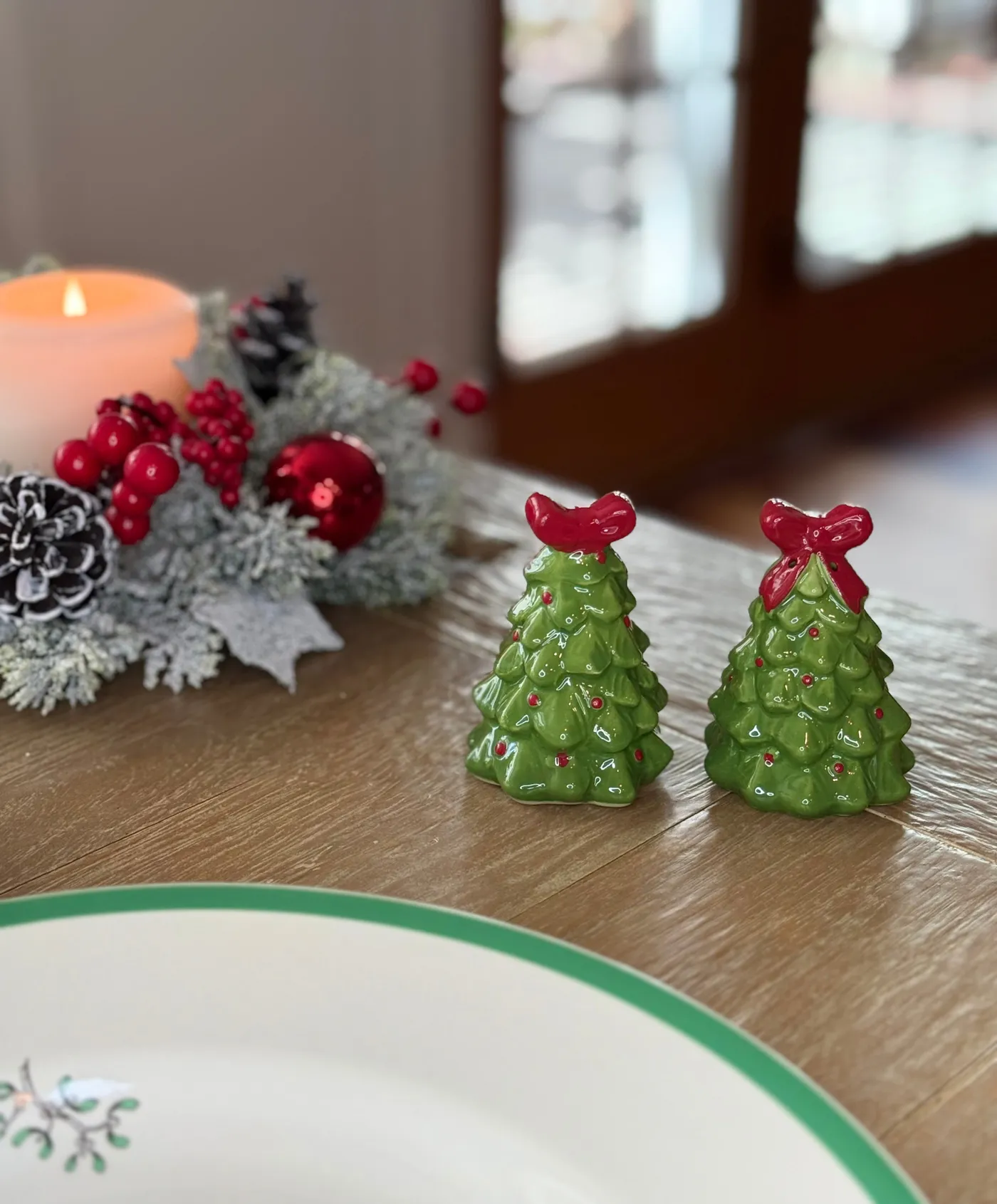
A lit candle tucked inside a greenery centerpiece is beautiful and slightly terrifying. Frosted faux greenery is plastic and will scorch if the flame gets within 4 inches. Use a pillar in a glass vessel that rises above the foliage, trim the wick to a quarter inch, and never leave the table unattended while it’s lit. If kids or a tail-wagging dog are in the room, switch to battery pillars — they’ve gotten genuinely good.
14. Grapevine Chargers Under Layered White Plates
The grapevine charger is the whole personality of this setting.
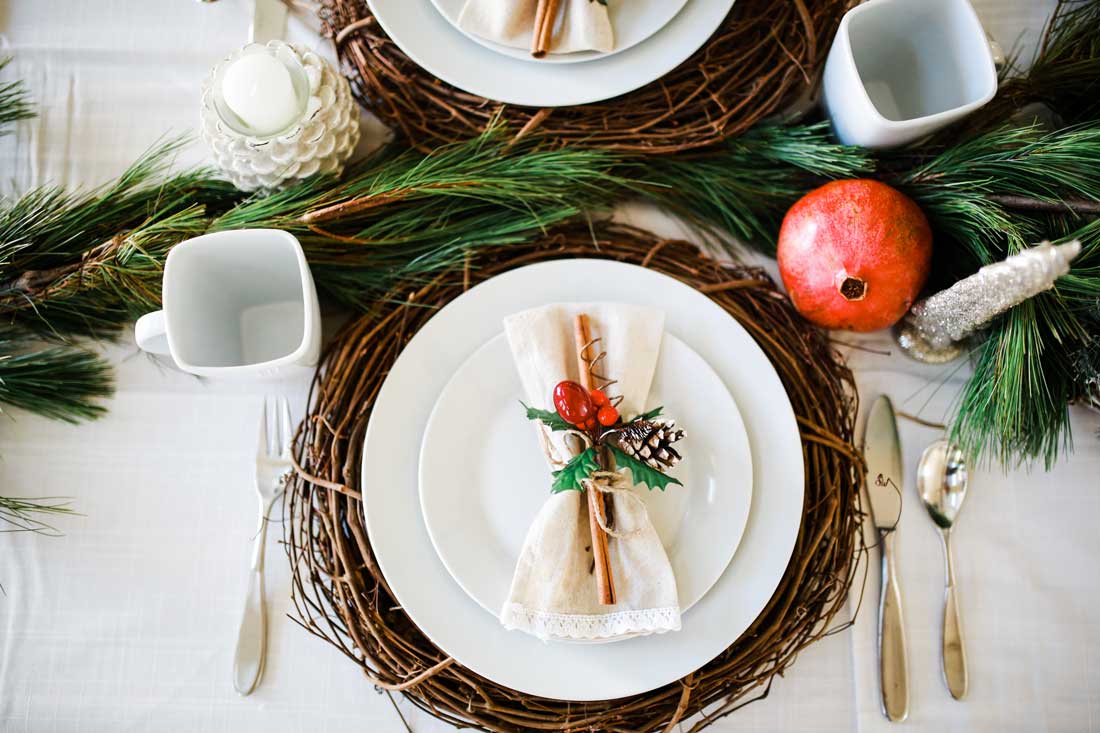
- Lay a white cloth, then set a grapevine wreath flat as a charger — 12 inches across is the sweet spot.
- Stack two white plates on top; the wreath’s uneven edge should peek out all around.
- Fold a lace-trimmed napkin into thirds and lay it across the top plate.
- Add two red berries and a cinnamon stick tucked into the fold.
- Run pine branches down the center with a pinecone candle holder and one pomegranate for color.
Roughly 20 minutes and $15 for the natural bits.
Texture is doing more work here than color. Grapevine, lace, pine bark, the matte white of the plates, the glitter of that one silver ornament — five surfaces, all in the same neutral zone. That’s why a table with essentially three colors feels rich. The single pomegranate is a masterstroke: it’s the only saturated red in the arrangement, so your eye lands there first and then travels outward.
15. Mixed Winter-Scene Plates on a Dark Green Runner
45% white plates, 30% green (runner plus pine branches), 20% red (berries and patterned plates), 5% gold flatware. The dark green runner is what holds the mixed patterns together — without a solid anchor underneath, reindeer, snowflakes, and winter scenes start arguing. To make this scheme feel more modern, trade the pine branches for magnolia leaves and keep everything else. Same math, softer edges, and it smells better.
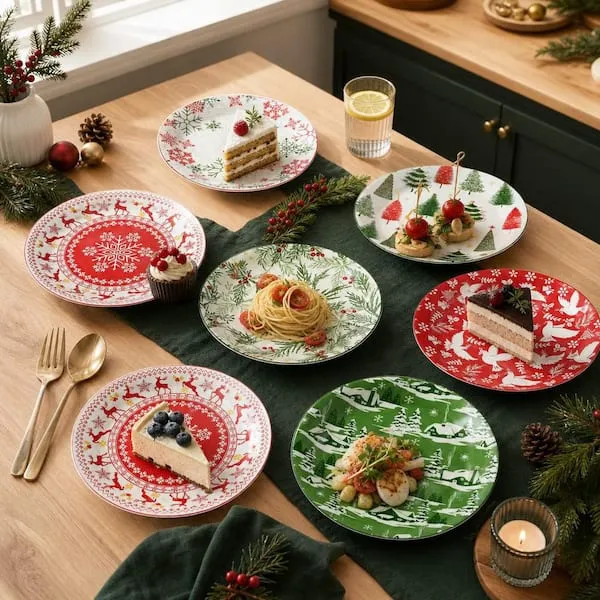
Mixed-pattern tables want room. Plan on 24 inches of table width per person minimum, and if your table is under 40 inches wide, skip the ceramic vase entirely — a vase plus a candle plus branches is three objects too many in a narrow space. This is a great scheme for a 72-to-84-inch table seating six. For tighter rooms, Idea #3 gets a similar layered feel with far less footprint.
16. Evergreen Garland Draped Through a Brass Chandelier
Chandelier garlands are the 2026 version of the wreath on the front door — the decorating moved inside and up. It makes sense: table space is finite, and hanging greenery overhead adds festive volume without sacrificing a single inch of serving room. The red-and-white ikat cloth underneath keeps it from feeling like a forest, and the miniature topiary trees with red bows handle the table itself. Expect a lot of this on Pinterest through December.
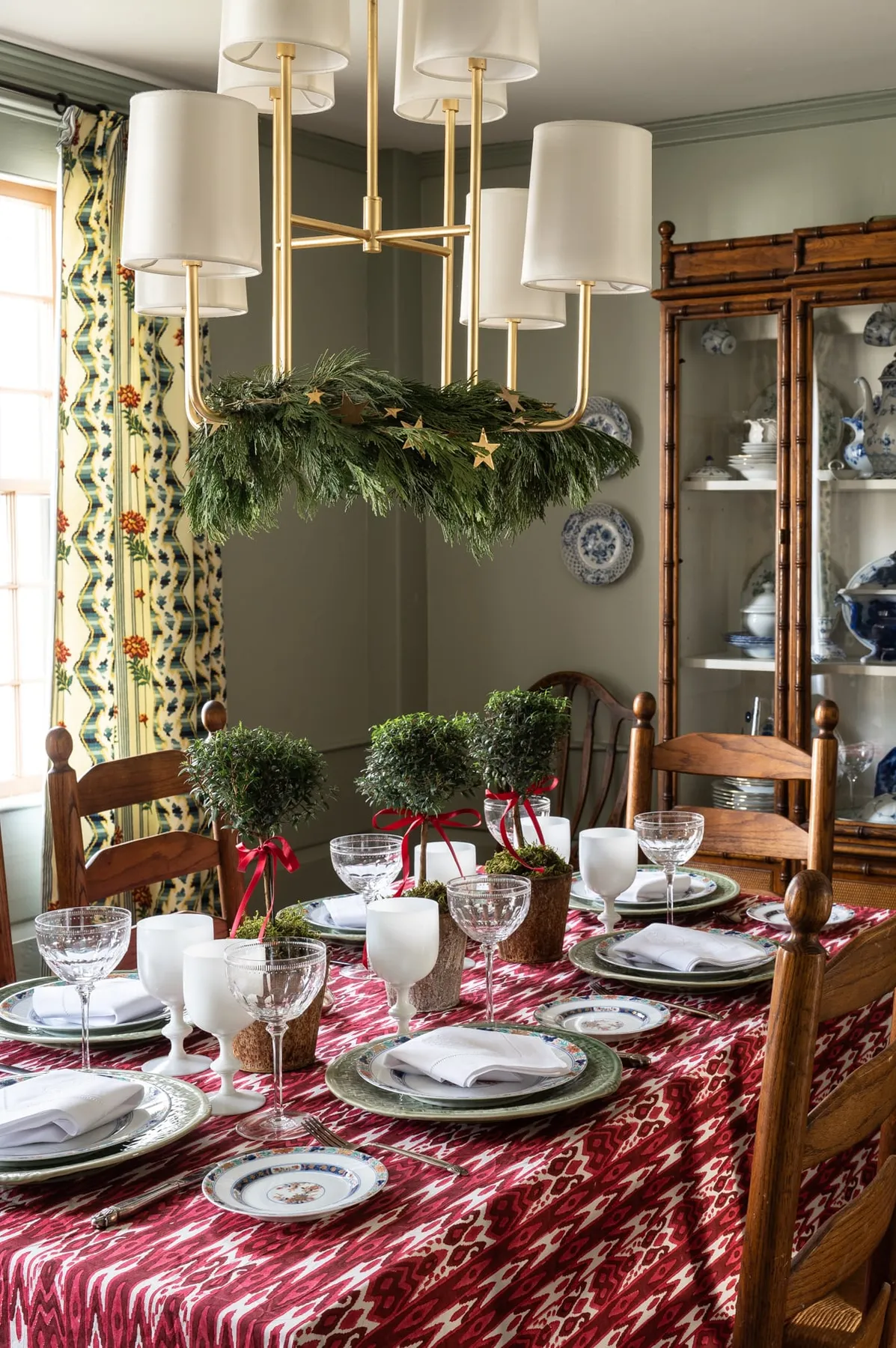
Hanging greenery from a chandelier is easier than it looks. Use 2-inch zip ties in a color close to your fixture, attach garland in 3-foot sections rather than one long strand, and keep the lowest point at least 18 inches above the tabletop so nobody’s hair becomes part of the decor. Battery-operated fairy lights beat cords here — no extension cord across the dining room floor, no tripping hazard at dessert.
17. Silver Chargers, White Porcelain, and a Cluster of Grapes
The cluster of red grapes on the napkin. It’s two bites of fruit, and it changes the entire register of the table from ‘set’ to ‘hosted.’ A silver charger and white porcelain are formal; a grape says someone thought about you five minutes before you sat down. Cost: about 40 cents. Keep the cluster small — three or four grapes, stem trimmed close, resting in the fold of the linen napkin above the beaded silver ring.
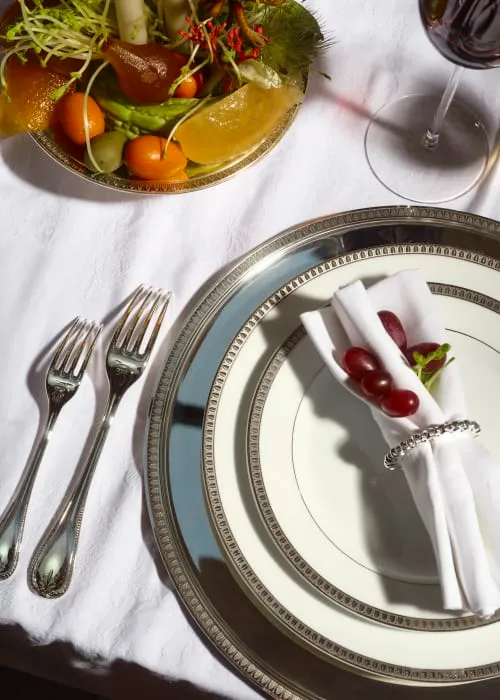
Grapes on a napkin are gorgeous for about 90 minutes and then they’re a wet spot. Set them out right before guests sit, not two hours before. Same rule applies to any fresh element at a place setting — herb sprigs, citrus wheels, edible flowers. If dinner runs long, plan a mid-meal reset where you whisk the perishables away with the salad plates. Nobody notices; everybody appreciates it.
18. Monogrammed Gold-Trim Plates With Pink Ribbon and Jingle Bells
Personalized name scrolls cost about 25 cents each and land harder than any place card you can buy. Get a roll of cream paper, cut 3-by-5-inch strips, write names in a metallic pen, and roll each one around a pencil before tying it with ribbon. Add a small gold jingle bell at the knot. Do this for eight people in under half an hour while watching something. The monogrammed scalloped plates are lovely; the scroll is what people take home.
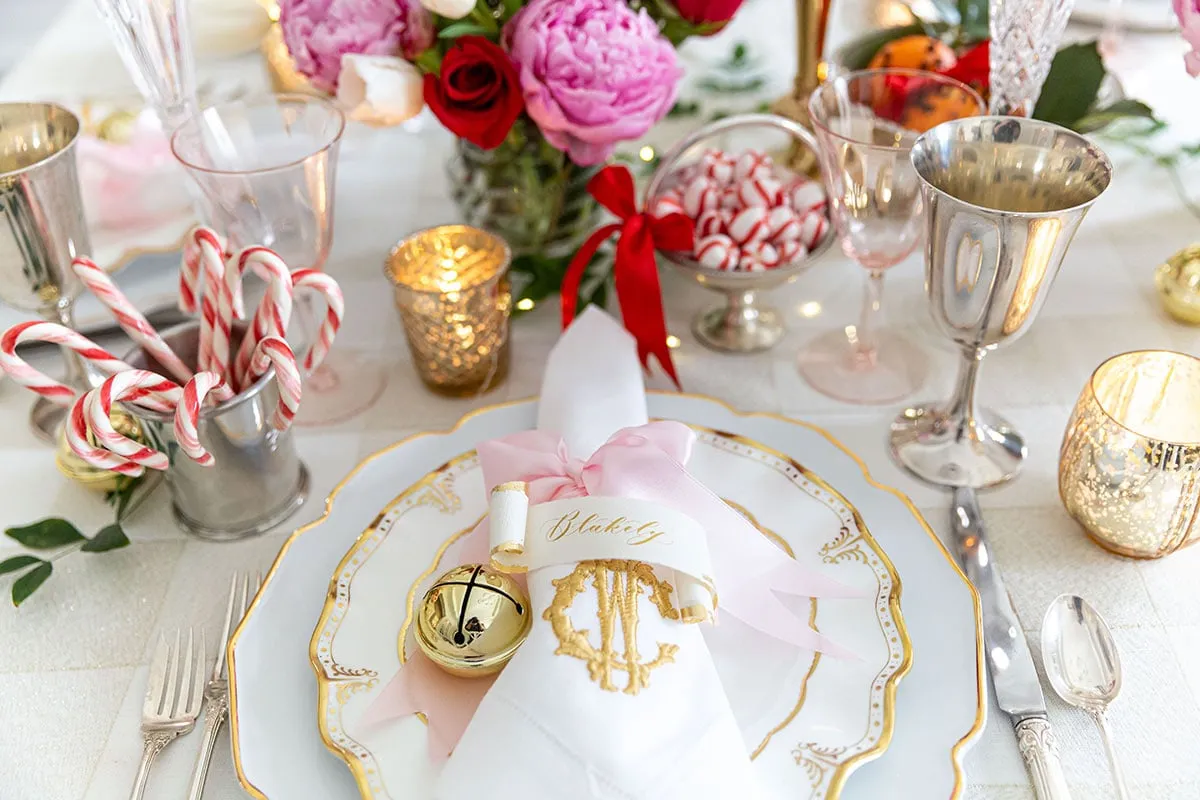
The pink ribbon napkin fold:
- Iron the white napkin flat — this fold shows every crease.
- Fold in thirds lengthwise to make a 4-inch band.
- Wrap the band around the plate’s center, tucking the ends underneath.
- Tie a 12-inch pink ribbon in a simple knot, not a bow.
- Tuck the name scroll under the knot and hang the jingle bell from it.
- Set a mercury glass votive nearby so the gold trim catches light.
Fifteen minutes for eight settings, about $6 in materials.
19. A Beaded Teardrop Ornament Instead of a Napkin Ring
Here’s the cost of this place setting, item by item:
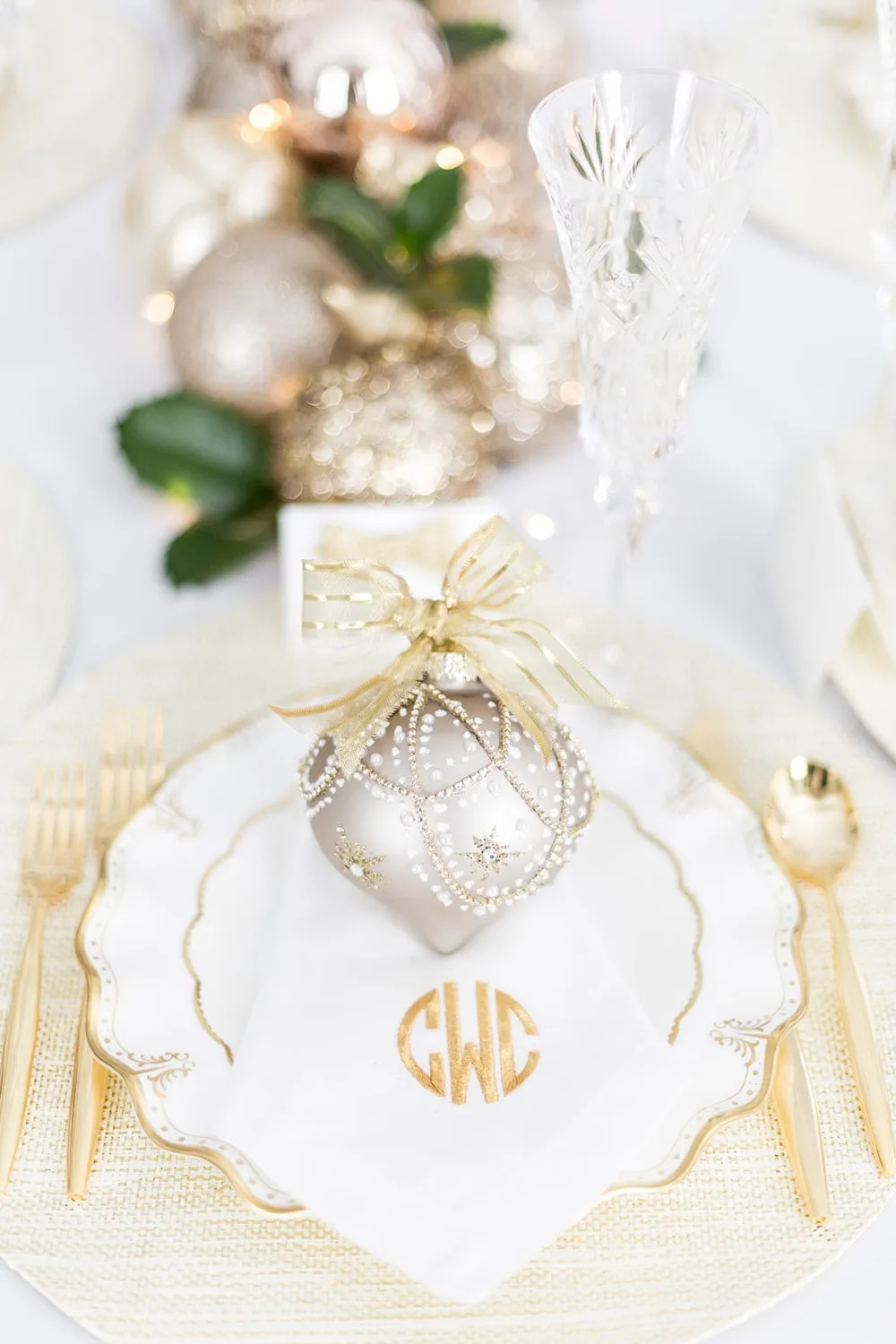
- White scalloped plates with gold trim (set of 4): $50-$90
- Woven gold placemats (set of 4): $20-$40
- Gold flatware (service for 4): $30-$55
- Beaded teardrop ornaments (set of 6): $15-$30
- Gold ribbon: $5-$10
- Total: $120-$225 for four settings
Budget alternative: use ornaments you already own as napkin jewelry, spray plain chargers gold, and buy a spool of satin ribbon from a craft store. Under $30.
The beaded teardrop ornament sitting on the napkin instead of a ring. It costs less than a nice napkin ring, it doubles as a take-home gift, and it adds the one thing a flat table lacks: dangle. Hang it from gold ribbon so it drops slightly over the plate’s edge. The pile of gold and silver ornaments and fairy lights glowing behind it do the rest — that’s reflected light, and it’s free.
20. Deep Blue Cloth With Gold-Beaded Chargers and Candlelight
55% deep blue, 35% gold and white, 10% candlelight. Navy as a holiday base does what black does in fashion — it makes every metallic look more expensive. Keep the gold to two finishes maximum (beaded chargers and flatware counts as two), and let the white plates stay plain. Swap the blue for deep green or aubergine and the formula still reads formal. Only the cloth changes; everything else earns its keep.
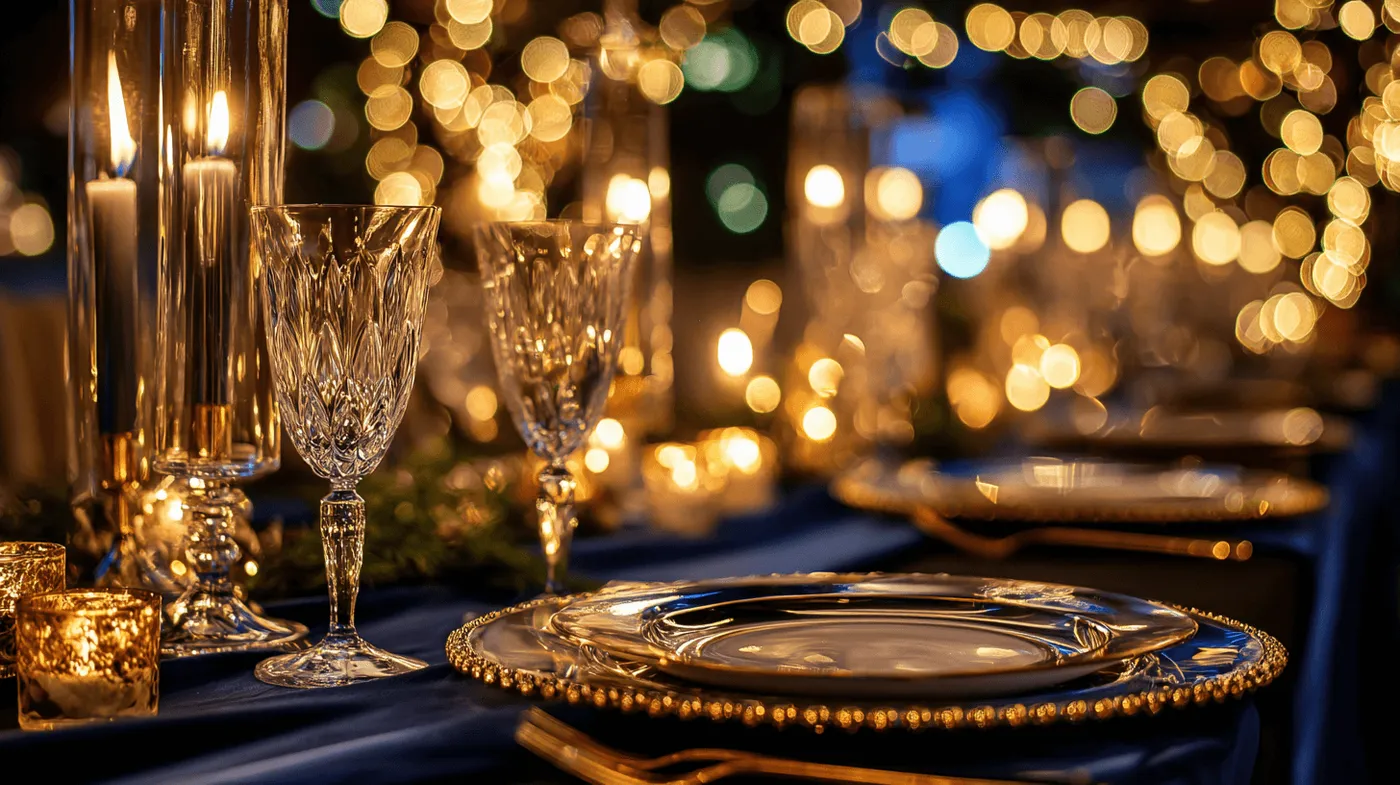
Jewel-tone holiday tables have been gaining on red-and-green for a few years, and 2026 is when navy fully arrived. The appeal is obvious: you can keep the same gold chargers, the same cut-glass stemware, the same candles, and just change the cloth to get an entirely different holiday. It’s the most reusable tablescape on this list — buy the navy one and it carries you through New Year’s.
Candle height makes or breaks a dark table. Flames should sit at eye level or below when seated — roughly 14 to 16 inches from the tabletop for tapers, taller only inside hurricane glass. Cluster three heights, not three identical candles; matching tapers look like a restaurant. And light them 20 minutes before guests arrive so the wax pools and the room warms.
21. Overhead Tree-Motif Plates With Brass Candlesticks and Paper Stars
Symmetry plus one asymmetry. Four identical settings, evenly spaced, all facing the same way — that’s the calm. Then the brass candlesticks sit at uneven spacing and different heights, and the paper stars hang wherever they hang. Structured base, loose top. Also worth noting: these plates carry a tree motif in the center and a berry border at the rim, so the pattern works from above, which is how everyone at a table actually sees them.
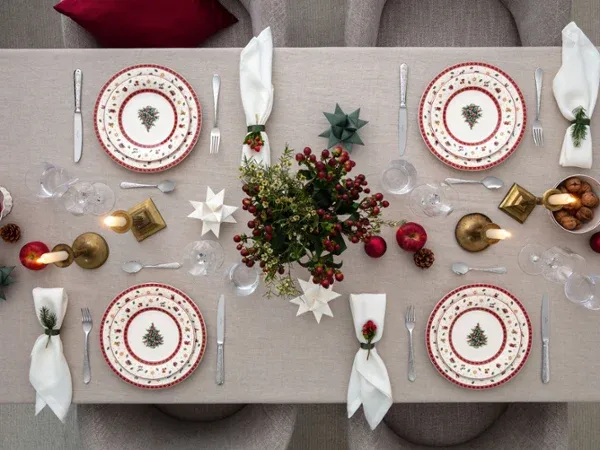
Overhead shots like this one are deceptive — almost nothing on that table is expensive. Brass candlesticks turn up at thrift stores for $4-$8 a pair; check the bottom for a maker’s mark before you pass. Paper star decorations run a few dollars each on Etsy or at a craft store. The tree-motif plates are the only real spend, and they’re the kind you buy four of and use for a decade. See Idea #27 for the long-table version of this same idea.
22. Silver-Rimmed Chargers on Crisp White Linens
Formal silver-and-white settings need breathing room — figure 28 inches of table edge per person, which means a 96-inch table for eight or a 72-inch for six. Low ceilings? Skip tall centerpieces entirely and let the silver work lying down. This scheme also wants decent square footage behind the chairs: 36 inches of clearance for pulling out seats, more if the room is a pass-through between kitchen and living room.
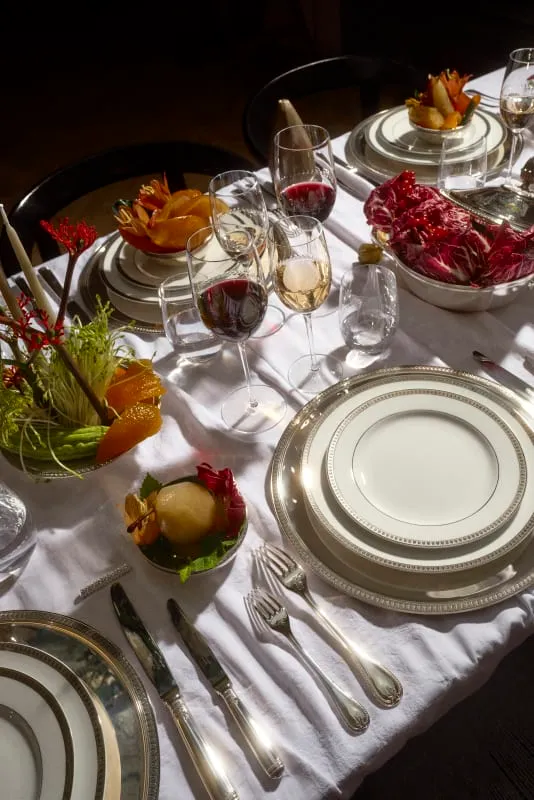
Silver-plated chargers tarnish. There’s no way around it — expect to polish two to four times a year if they’re stored in the open, less if they live in tarnish-proof bags. White tablecloths show every drop of red wine and every bit of orange-peel oil, so treat stains the same night with cold water and dish soap, never hot. And skip the dishwasher for anything with a metallic rim, no matter what the box claims.
23. Red Reindeer Tablecloth With Snowflake Ornament Centerpiece
A patterned tablecloth under patterned plates under patterned napkins is a lot of pattern, and it works here only because the cloth’s print is small. If your cloth has big reindeer, your plates need to be solid. Also: those large spherical ornament centerpieces are heavy. Put a felt pad underneath or you’ll be touching up the table finish in January. And check the height — big spheres block conversation faster than any flower arrangement.
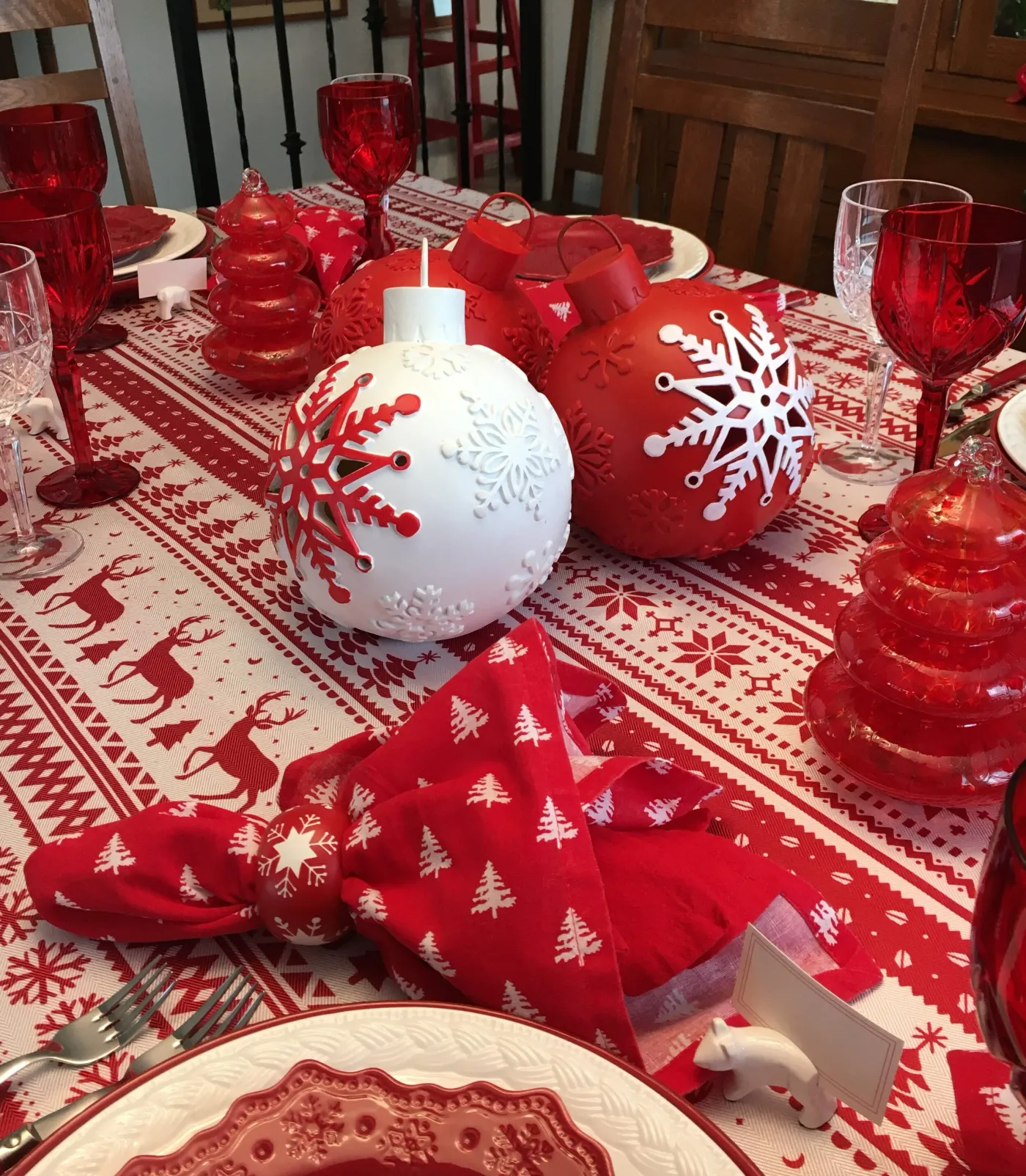
Polar bear place card holders are the cheapest way to make a kids’ table feel intentional. Put the kids’ names in them and the adults will be jealous. One practical note: write names in pencil first, then go over in marker — place cards that have been rewritten three times look it. And if you’re using red patterned stemware, hand-wash in warm (not hot) water; printed patterns lift in a dishwasher within a season.
24. Fluted White Plates With a Gingerbread Reindeer on the Napkin
The gingerbread reindeer cookie is a 10-minute project.
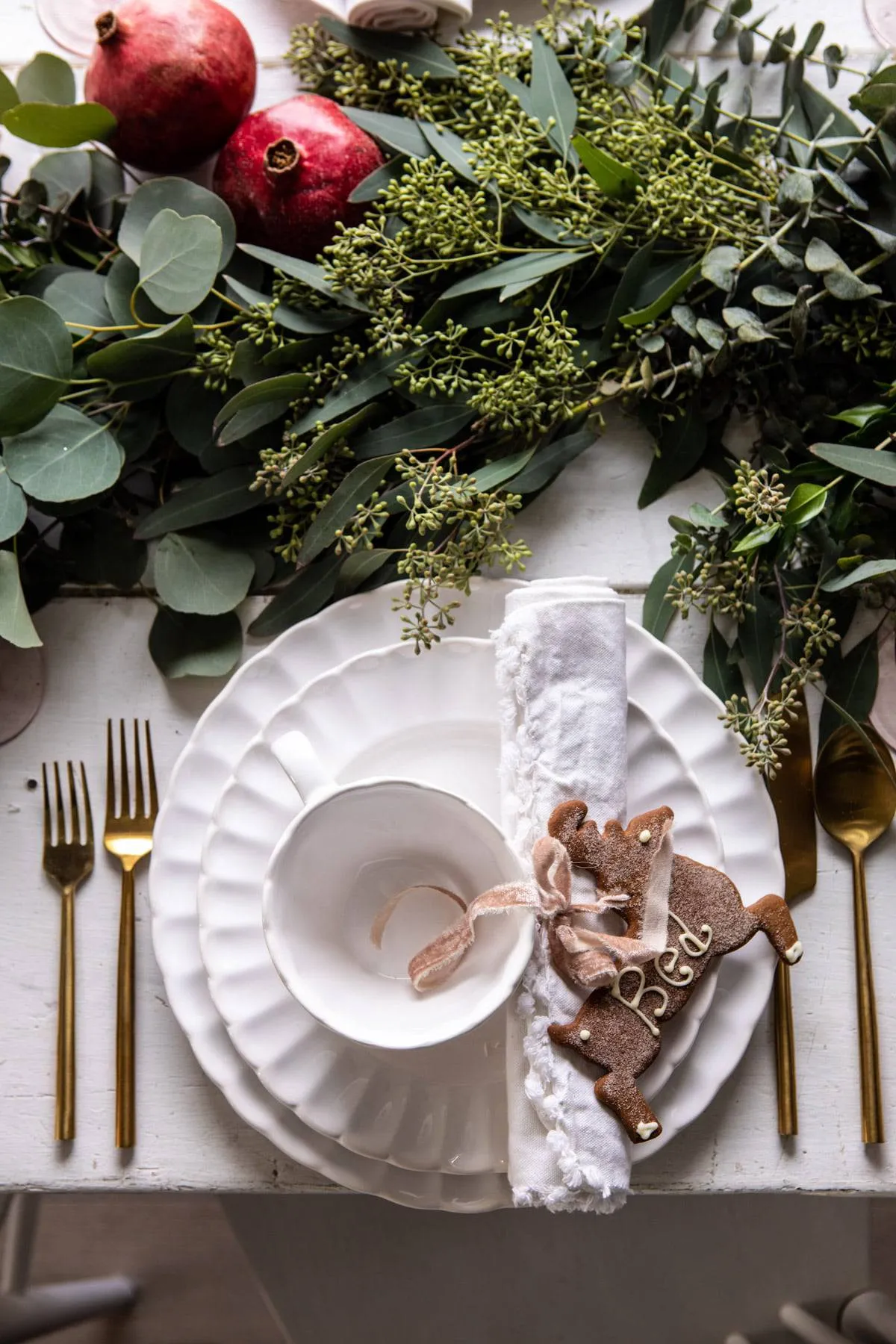
- Bake or buy plain gingerbread cookies — reindeer cutters are on Amazon for under $10.
- Let them cool completely, then pipe one simple white icing antler line. Don’t overdo it.
- Thread a narrow velvet ribbon through the top with a needle.
- Lay a white linen napkin flat, set the cookie on top, let the ribbon trail onto the plate.
- Finish with gold cutlery and a eucalyptus sprig.
About $12 for eight cookies and ribbon.
Eucalyptus is the great budget flower. A bunch runs $5-$8 at Trader Joe’s, lasts two weeks dried, and smells like a spa instead of a candle aisle. Pair it with three pomegranates (about $4 total) and you have a centerpiece that looks like it cost $60. Distressed white wood photographs beautifully with this palette, but any warm table works — just skip the runner and let the garland be the only textile.
25. Gold Tinsel Runner With Glittered Deer and Crackers
The glitter comes at a price, and here’s roughly what it runs:
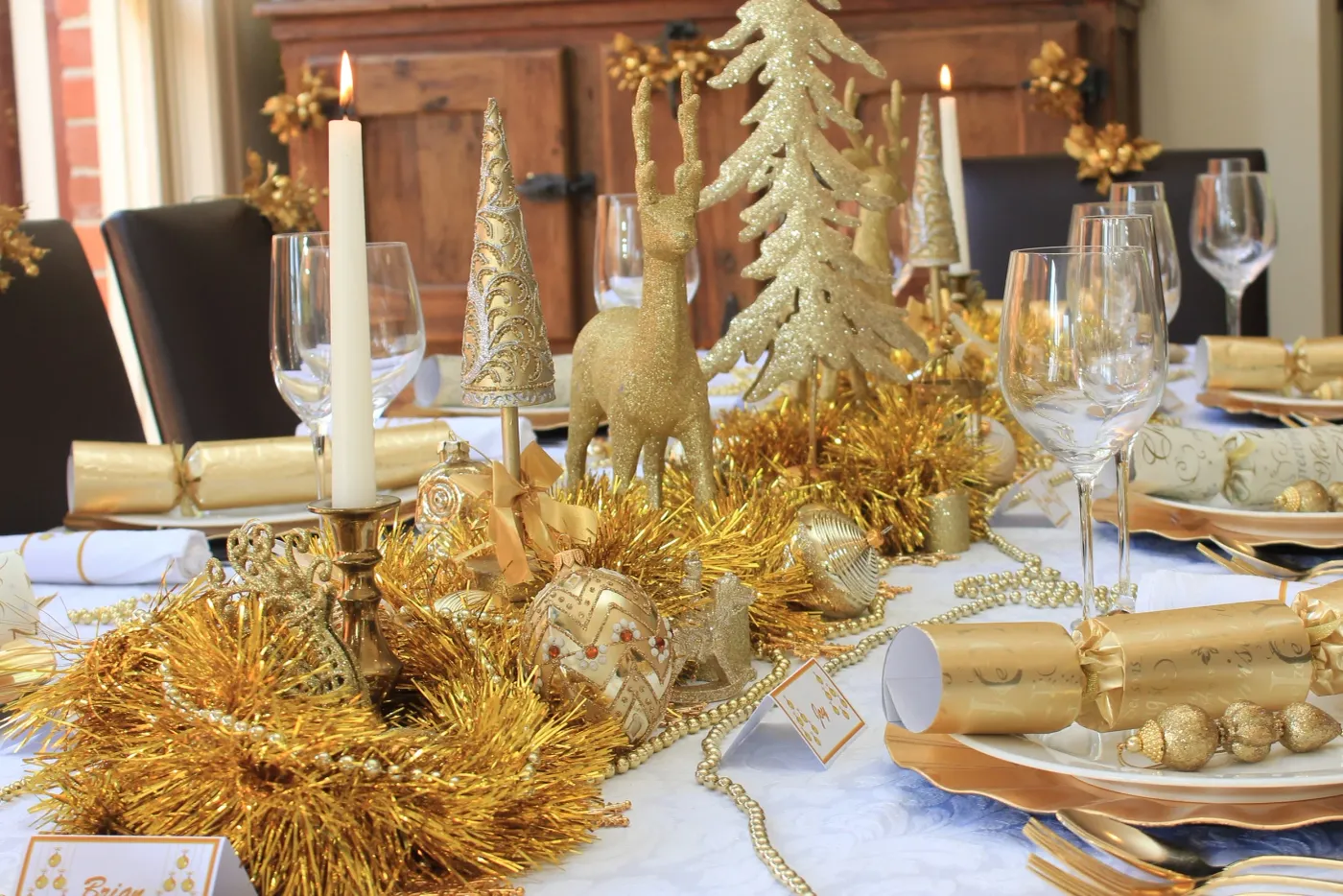
- Gold tinsel table runner: $15-$35
- Gold scalloped chargers (set of 4): $30-$60
- White dinner plates: $25-$50
- Gold crackers (set of 8): $20-$45
- Glittered deer and tree figures: $20-$50
- Brass candleholders (pair): $25-$60
- Total: $135-$300 for four to six settings
Budget alternative: skip the figures and let the tinsel runner plus three brass candlesticks carry it. Around $60 total.
Tinsel sheds. It will be in your carpet, on your dog, and somehow in the bathroom by January. Shake the runner outside before it comes in, and vacuum with a hose attachment rather than a beater bar. Glitter is worse — it never leaves tablecloth fibers, so put a plain white cloth underneath and accept that it’s a holiday cloth now. Keep open flames well away from tinsel; it’s essentially plastic.
An all-gold table goes wrong when every gold is the same finish. Mix matte antiqued brass, bright polished gold, and a soft champagne — three finishes, one color. The eye reads depth instead of a wall of shine. Break up the tinsel every 18 inches with something non-metallic: a white candle, a sprig of greenery, a stack of white plates. Metal needs a neutral to push against or it becomes a jewelry display.
26. A Flat Lay of Solid Blue, Pink, and Green Plates
Solid colors carry 80% of this collection — red, green, light blue, pink — and the two illustrated cream pieces carry the other 20%. That ratio is why a mixed drawer of plates looks curated instead of random. Light blue and pink are the unexpected heroes; they give the red and green somewhere to rest, and they keep a snowman platter from feeling childish. Follow the four-to-one rule: four solids for every one illustrated piece.
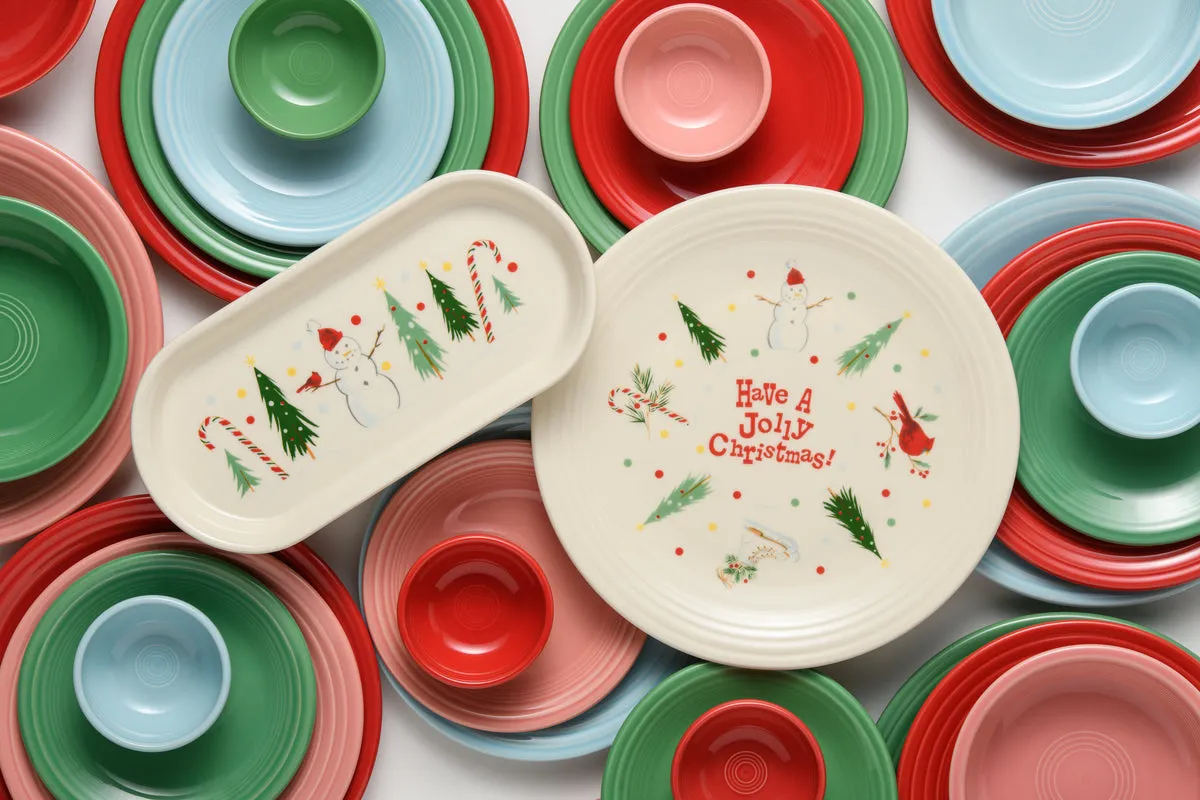
Before you buy another plate, run this checklist.
- Count how many people you actually seat — not how many you’d like to.
- Check that all plates are the same diameter; mismatched sizes make stacking wobbly.
- Confirm nothing is chipped on the food surface, especially vintage finds.
- Test one illustrated plate against your tablecloth before buying four.
- Decide whether you’re genuinely okay with hand-washing.
27. Deep Red Runner and Evergreen on a Long Wooden Table
This is the setup for a genuinely long table — 8 feet or more, seating eight to ten. The deep red runner should stop 12 inches short of each end so the end settings don’t feel crowded, and garland candles should be spaced every 18 to 24 inches so light pools evenly down the length. Ceiling under 8 feet? Use low pillars, not tapers. For a shorter table, see Idea #10 — same concept, compressed footprint.
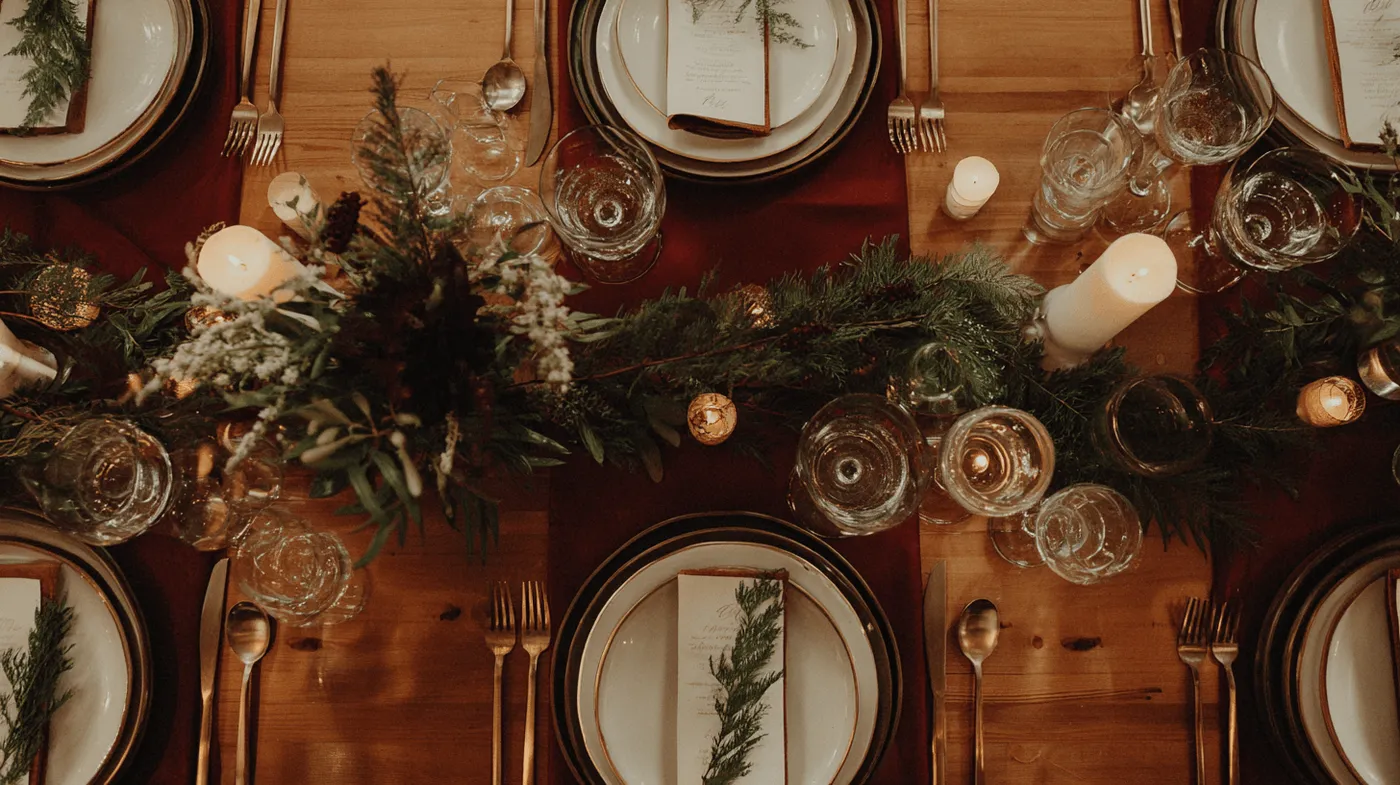
The menu card. It’s a 3-by-5-inch piece of paper with a greenery sprig, and it does more for the sense of occasion than the entire centerpiece. Beyond that: a single continuous red runner gives the eye a line to follow down a long table, which prevents the whole thing from looking like eight separate settings that happen to share a surface. Repeated gold rims tie the far end to the near end.
28. Glass Vessels Filled With Gold and Silver Ornaments
Clear glass vessels filled with ornaments solve the centerpiece-height problem elegantly — volume and sparkle without a solid mass blocking sightlines. Use vessels in three heights (roughly 6, 9, and 12 inches) and fill them only two-thirds full so light moves through. Mixing gold and silver in one vessel is fine; mixing them across the whole table without a plan is not. Pick one metal as dominant, then let the other appear in small doses.
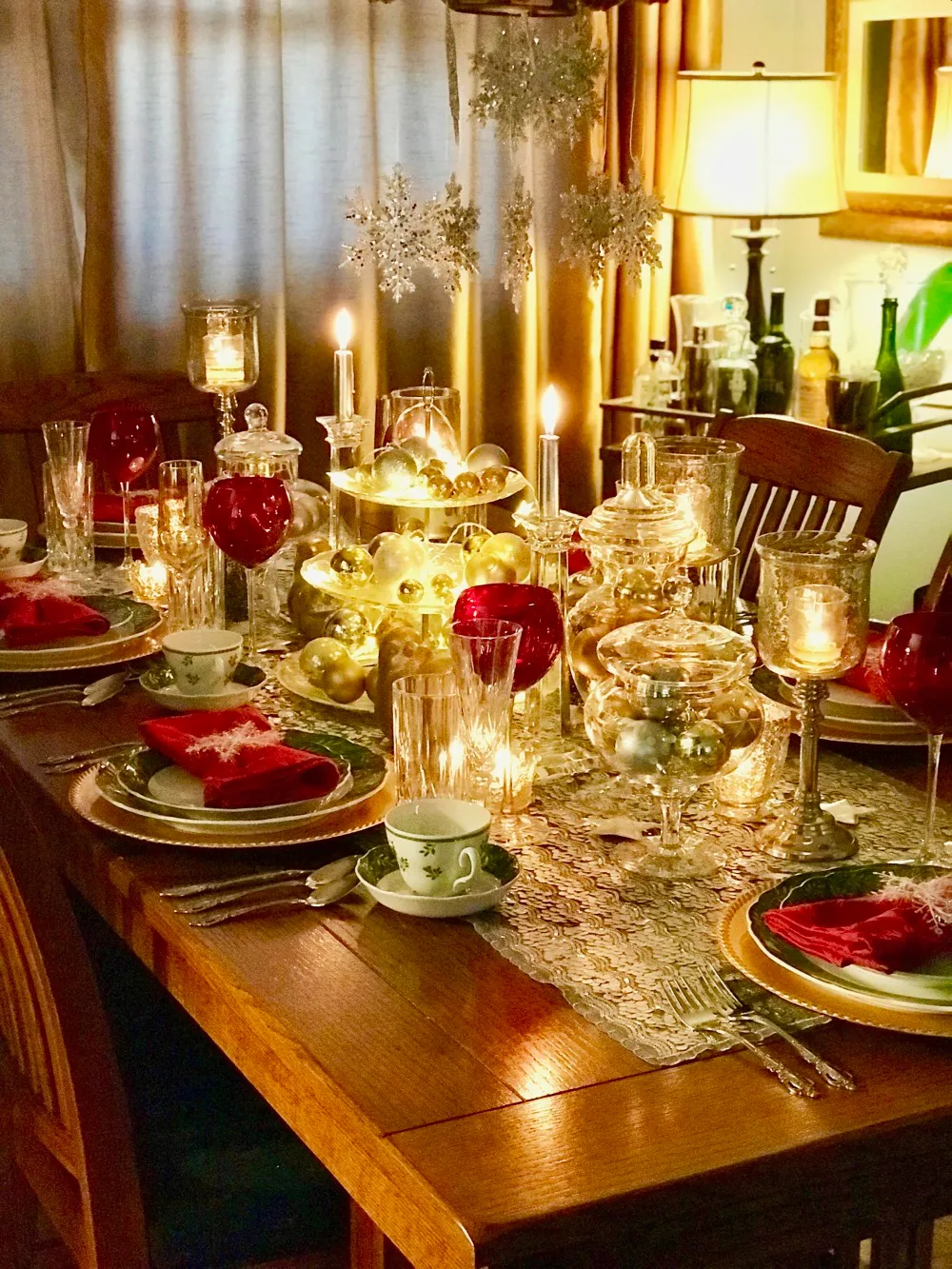
Glass ornament vessels are dust magnets and fingerprint collectors. Expect to wipe them down before every use. Hanging snowflakes overhead need monofilament and a tiny hook — adhesive strips fail on textured ceilings within days, usually at dinner. Store ornaments in egg cartons or original boxes; the shredded-paper approach guarantees you’ll be sweeping up glitter-covered shards in March.
29. Red Tartan Plates on Red Beaded Chargers
The tartan bow on the centerpiece. Red tartan plates on red beaded chargers already make a strong statement, but it’s the soft, slightly oversized bow tucked into the greenery that makes the whole thing feel like a tradition instead of a purchase. Wire-edged ribbon holds a shape that polyester can’t. Buy 3 yards, tie one generous bow, and weave the leftover tails through the evergreen.
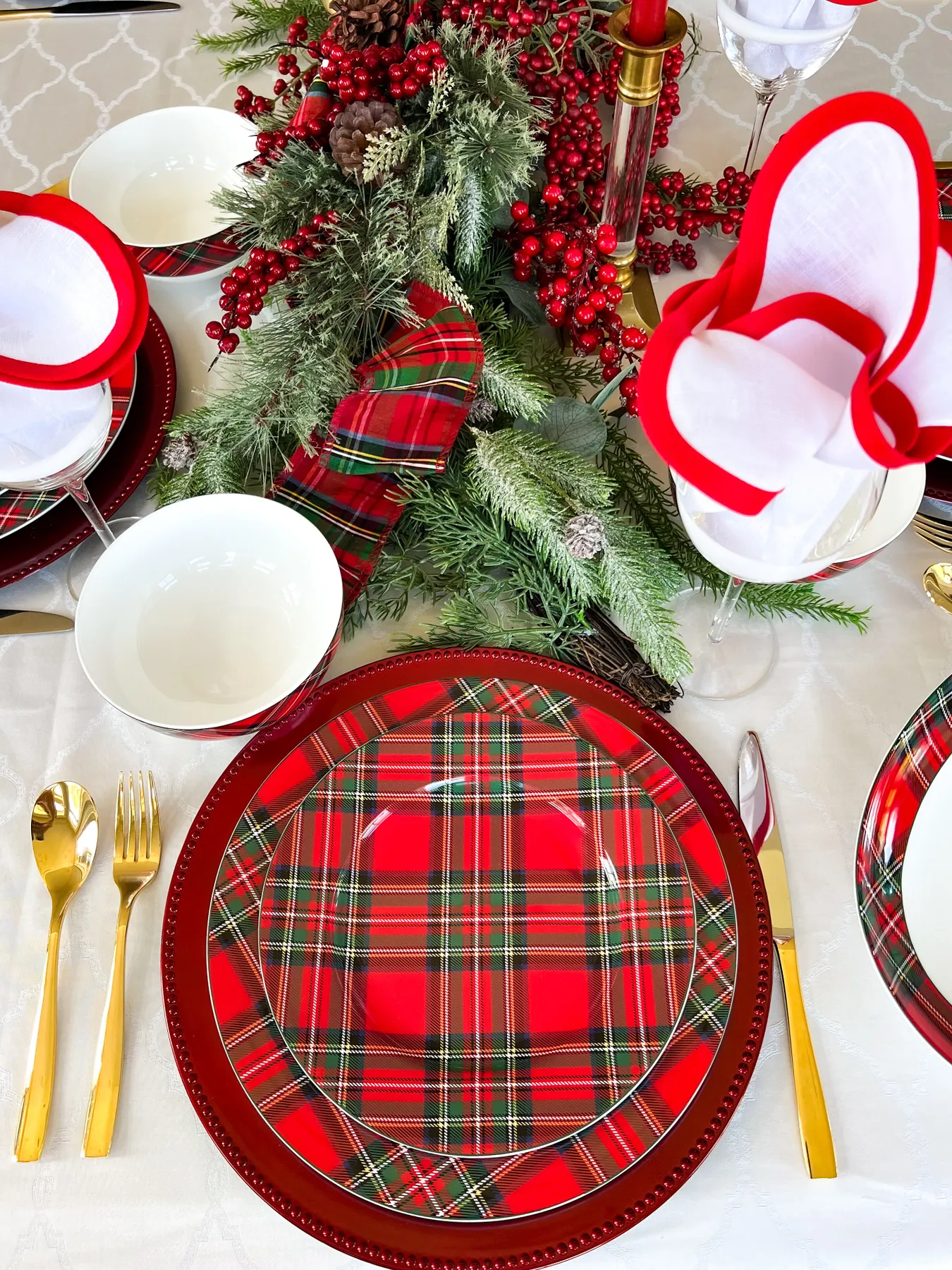
- Red tartan dinner plates (set of 4): $40-$80
- Red beaded chargers (set of 4): $30-$60
- Gold flatware (service for 4): $30-$55
- Evergreen garland with berries and pinecones: $25-$50
- Wire-edged tartan ribbon: $10-$18
- Red candles: $8-$16
- Total: $143-$279 for four settings
Budget alternative: one tartan ribbon tied around plain white plates gives you 80% of the look for $12.
30. Stacked Holly-and-Gold-Rim Porcelain, One Plate Upright
Gold metallic rims are decorative, not structural. They wear off with dishwasher detergent and abrasive sponges — hand-wash, and never stack these plates directly against each other without a felt pad between. Five stacked plates with no protection will scratch the gold on the bottom three within a single season. Store upright if you can, or use paper plate dividers, which cost almost nothing and save the whole set.
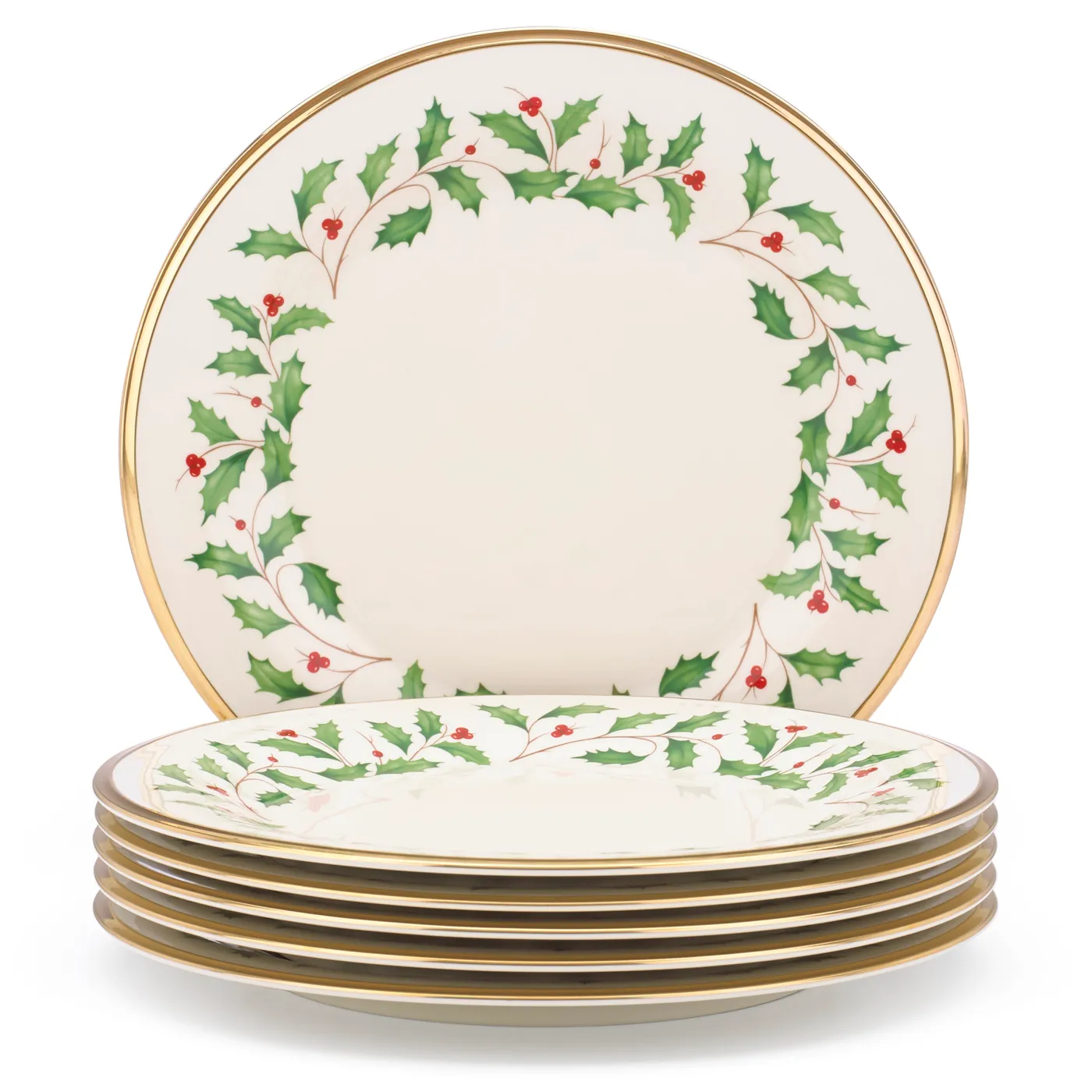
If you want this holly-and-gold-rim look without the porcelain price, IKEA and Target both do a holiday plate with a gold edge for $4-$8 each, and the difference at arm’s length is genuinely small. Where the money shows is weight and how the gold holds up past three Decembers. Buy the inexpensive set now, put the good set on a wish list, and see Idea #1 for how to build a whole table around just four of them.
31. Santa, Tree, and Holly Plates Displayed on Wood
Before you add another plate to the collection:
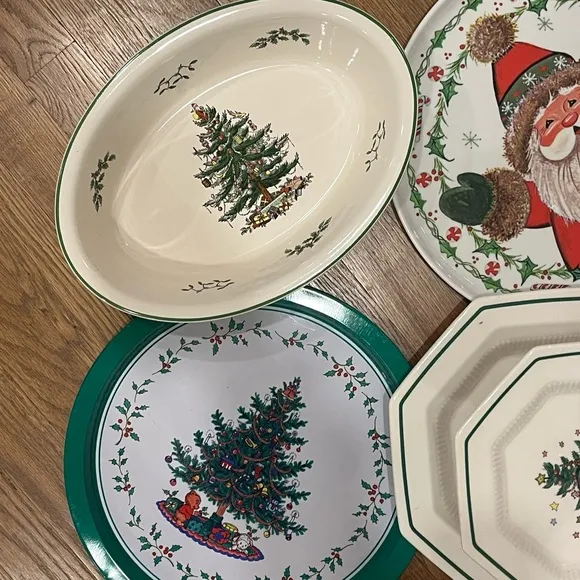
- Lay everything you own on the floor and photograph it together — patterns you love separately can fight.
- Check the plate foot diameter; oval platters need 2 inches more clearance than you think.
- Note which pieces are oven-safe versus display-only.
- Set a color ceiling: are you allowing blue and pink, or red and green only?
- Give yourself permission to display some plates rather than use them.
The collection rule: 60% solid, 30% one motif (trees, or Santas, or holly — pick one), 10% text or novelty. Text plates are the easiest to over-buy and the fastest to tire of. If your collection already skews illustrated, buy solids from here on out. A round metal serving tray in the mix adds a non-ceramic texture that makes the whole display read as a collection rather than a set.
32. White Plates With Just a Thin Red Rim Line
That thin red line on the rim is doing more than it looks like. A band of color at the very edge frames the food and makes a white plate read as deliberate rather than plain. If you’re shopping for a plate that will work for a decade, look for a border under a quarter inch — thin borders survive changing taste, thick ones date instantly. Also check that the red is a true red, not orange-leaning, if you’re pairing it with dark green.
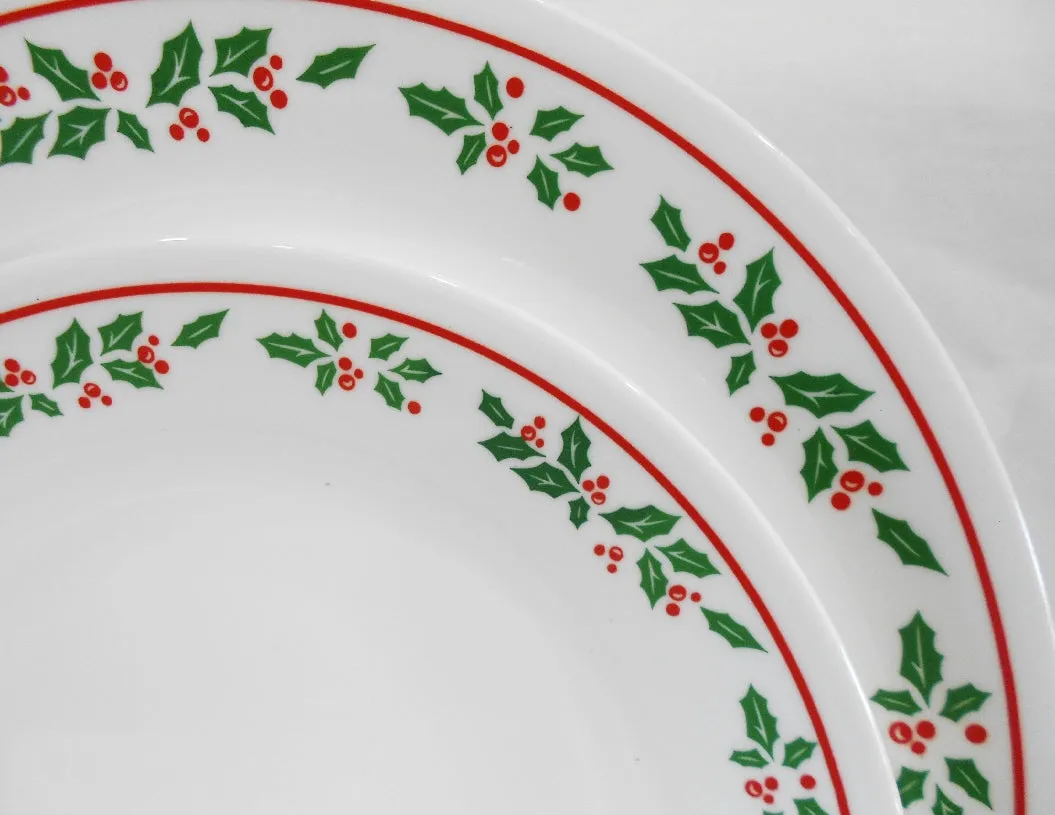
It’s the restraint. Two colors, one motif, one thin border, and absolutely nothing else. This is the plate you can use on December 3rd for leftovers and on December 25th for dinner without it feeling like a costume. If you buy one set of Christmas plates in your life, buy something in this register — it layers under patterned dessert plates, works with any tablecloth, and looks equally right with paper napkins.
33. Four Laurel-Bordered Plates Framing a Red Floral Centerpiece
The plates are arranged around the flowers, not beside them — and that’s the whole composition. Four plates framing a low, saturated red centerpiece creates a wreath effect from above, and the laurel border on each plate echoes the arrangement’s shape. The motifs are small enough (bells, a nutcracker, an urn) that they read as detail rather than illustration. Nothing competes; everything rhymes. See Idea #6 for a quieter take on the same border idea.
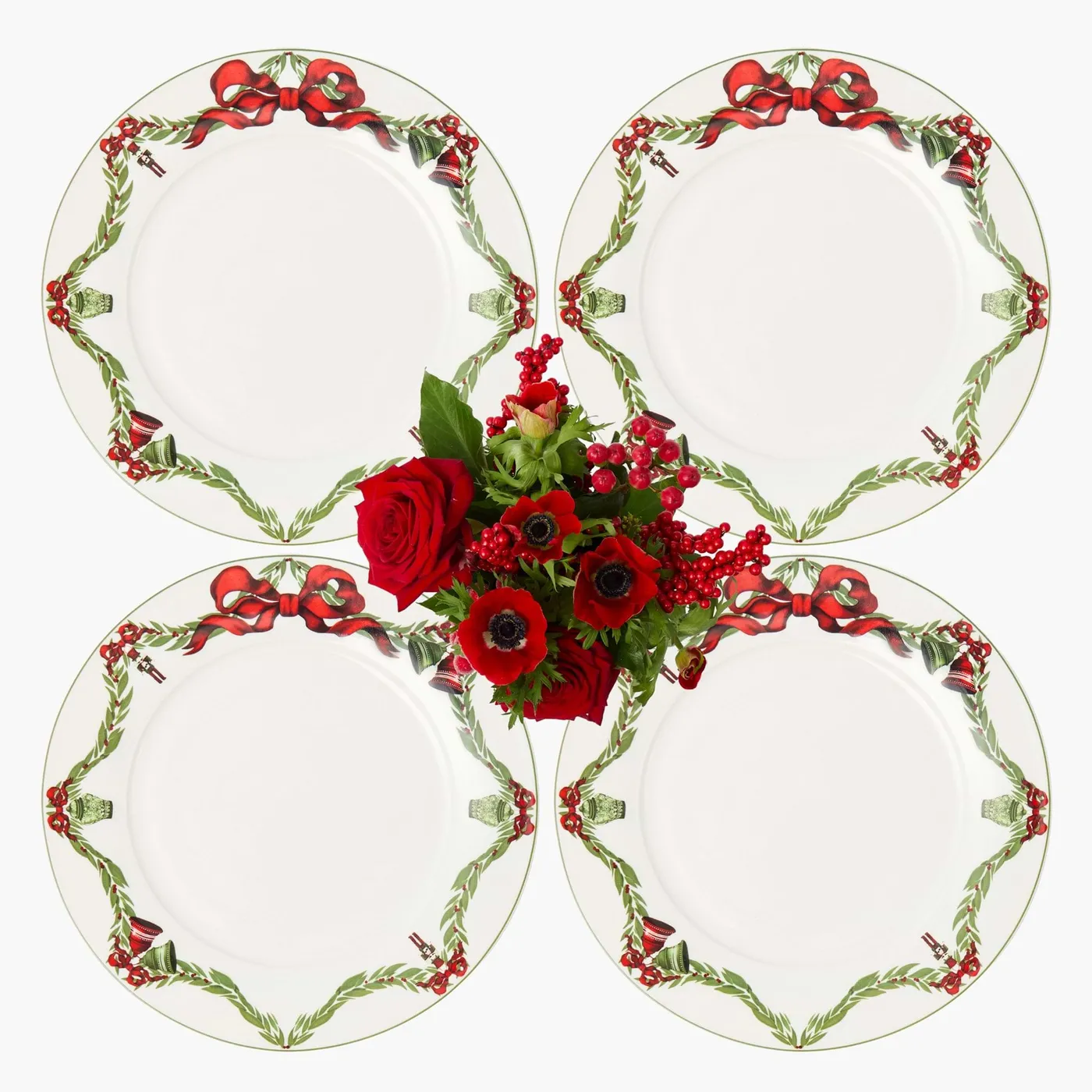
Building the centerpiece:
- Start with a low bowl, 8 inches across, filled with soaked floral foam.
- Place five red roses first, evenly spaced, angled about 30 degrees outward.
- Fill gaps with anemones and berry clusters, keeping the whole thing under 10 inches tall.
- Tuck in gold-sprayed foliage last so it peeks between flowers.
- Set the four plates around it at 12, 3, 6, and 9 o’clock.
About 40 minutes and $45-$70 in flowers.
34. Red Scalloped Placemats on a Gold Patterned Cloth
Maximalism came back and it brought its grandmother’s wallpaper. The 2026 version of a formal holiday table isn’t minimal — it’s layered, patterned, and unapologetically a lot. Red scalloped placemats on a gold-and-white patterned cloth would have read as ‘too much’ five years ago. Now it reads as confident. If your room already has pattern on the walls and a dressed mantel, lean in; matching the volume is the only rule.
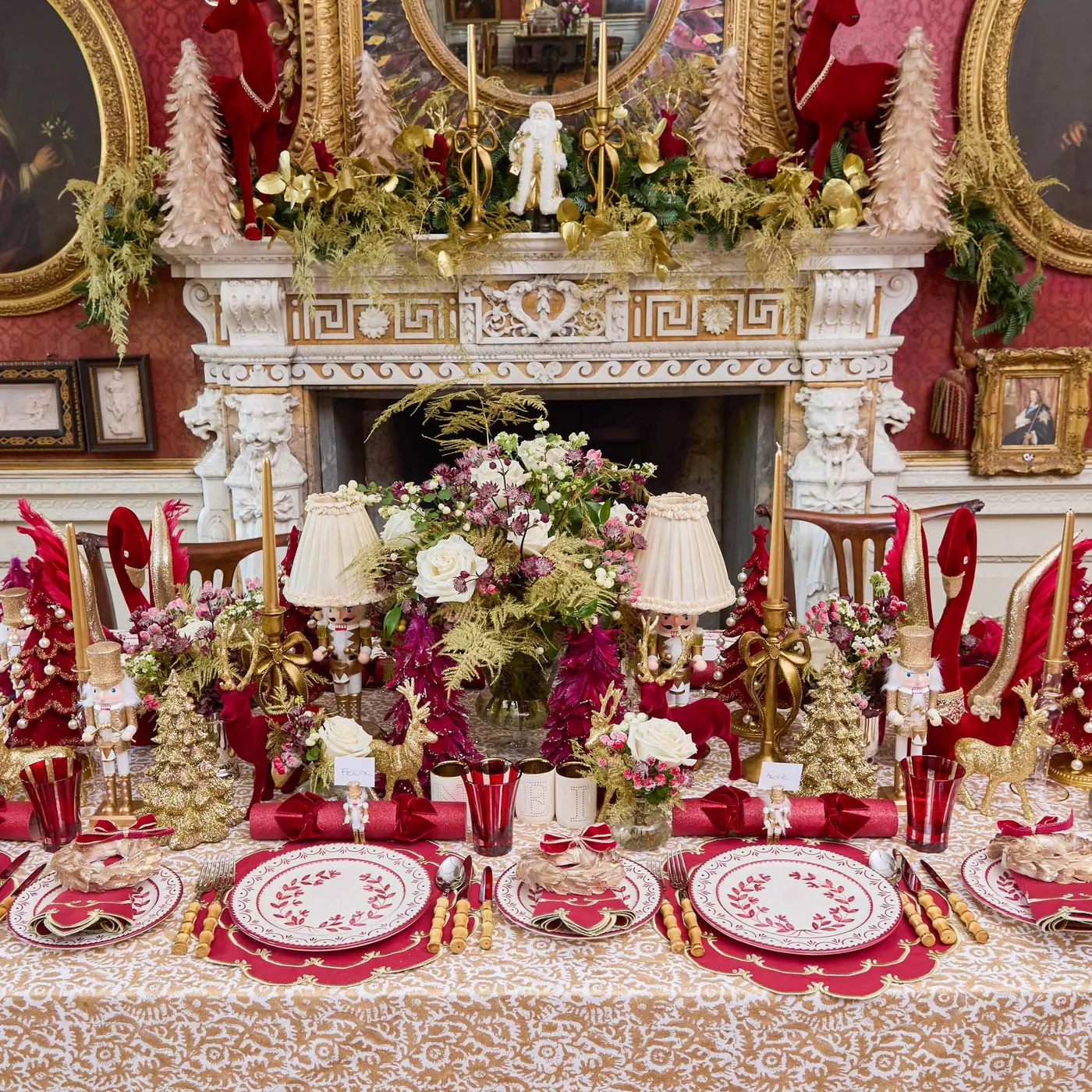
- Gold-and-white patterned tablecloth: $40-$90
- Red scalloped placemats and napkins (set of 4): $35-$70
- White plates with red botanical print (set of 4): $45-$90
- Gold and red crackers (set of 8): $25-$50
- Nutcracker and velvet reindeer figurines: $30-$80
- Total: $175-$380 for four to six settings
Budget alternative: pattern the cloth, keep everything else solid white. $45 and it reads just as grand.
This is a dining room setup, not a nook setup. You need at least 12 by 14 feet to carry a patterned cloth, figurines, a floral centerpiece, and a decorated mantel without the room feeling stuffed. Nine-foot ceilings or better let the arrangement breathe. In a smaller room, cut the figurines and keep the cloth and flowers — the grandeur survives, the clutter doesn’t.
The Plates Are the Easy Part
Here’s the thing nobody tells you: the plates were never the hard part. The plates are just the excuse to sit down together, and every one of these 34 tables works because somebody bothered to put a sprig of holly on a napkin. Pick one idea, buy four plates instead of twelve, and set the table a week early just to look at it.
📌 Pin your favorite setup now — next December you’ll be glad you saved it.