You know that feeling when you finally find the wreath that looks exactly right on your door — and then you see the price tag? Same. This year’s most-saved holiday entryways are leaning traditional: mixed evergreens, real pinecones, velvet ribbon, and a lot of deliberate contrast between the greens and whatever color your front door happens to be.
We spent serious time browsing Etsy, Target, Costco, and Wayfair to bring you only what’s worth your attention this year, across every price point from $18 berry sprays to $340 pre-lit garlands. Some links below are affiliate links, which means we may earn a small commission at no cost to you. Inside you’ll find 30 curated ideas spanning traditional evergreen, frosted winter white, natural foraged, and jewel-toned glam — with budget and luxury versions compared side by side, and every idea shoppable with direct product links.
2026 is the year of the imperfect wreath. Designers are mixing cedar, juniper berries, and eucalyptus instead of buying uniform plastic rings, and saves for foraged and dried-citrus wreaths keep climbing every November.
And stay until the end — we break down the most common mistakes that can ruin these looks. 📌 Save this to Pinterest for later — you’ll want to revisit these ideas.
1. Cottage Entry With Pinecone Wreath and Roofline Garland
The garland follows the peak of the roofline instead of stopping at the door frame, which pulls the eye upward and makes the whole entry read taller than it actually is. The wreath then repeats the same ingredients — pinecones, red berries, mixed evergreen — at a smaller scale, so the two elements feel like one composition rather than two separate decorations. The cream stucco does quiet work here too: against a pale wall, forest green and dark brown wood look rich instead of muddy. Two potted evergreens on the concrete steps carry the greenery down to ground level.
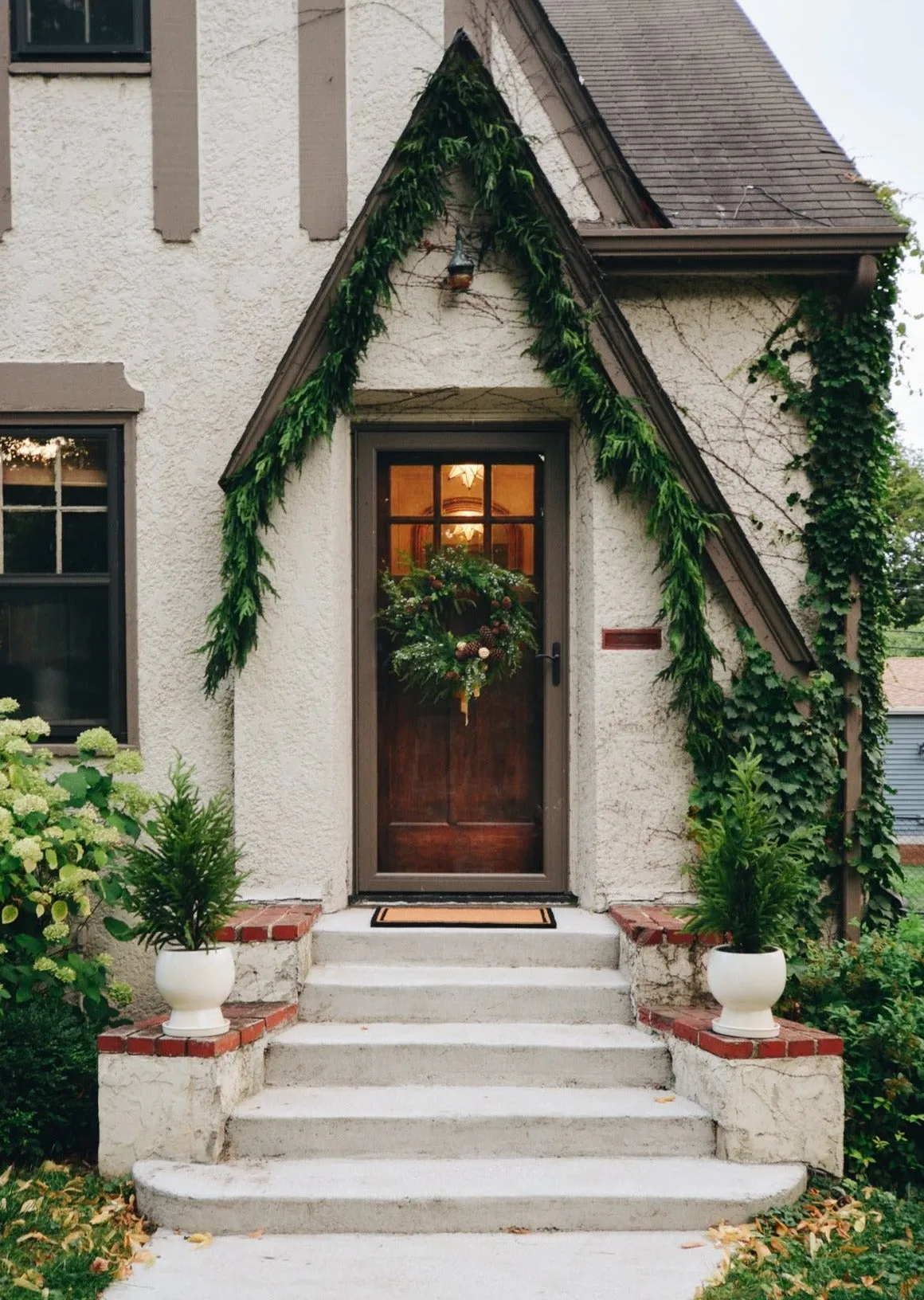
- Faux evergreen garland, 9 ft: $35–$90
- Pinecone and berry wreath, 24 in: $45–$120
- Two potted evergreens, 3 ft: $60–$180
- Outdoor timer and extension cord: $15–$30
- Total: $155–$420
Budget alternative: skip the potted trees entirely and clip real branches from your own yard into two thrifted urns — same silhouette for about 55% less.
2. Velvet Poinsettias and Gold Leaves Against a Navy Door
On a grapevine base, wire the heaviest elements first and work outward. Use 22-gauge paddle wire, attach the velvet poinsettias as a single cluster placed just below the center line — not dead center — and let the gold leaves fan out behind them. Keep the finished wreath under 6 inches deep so it clears a storm door. Anything past that and you’ll be fighting it every time you carry in groceries.
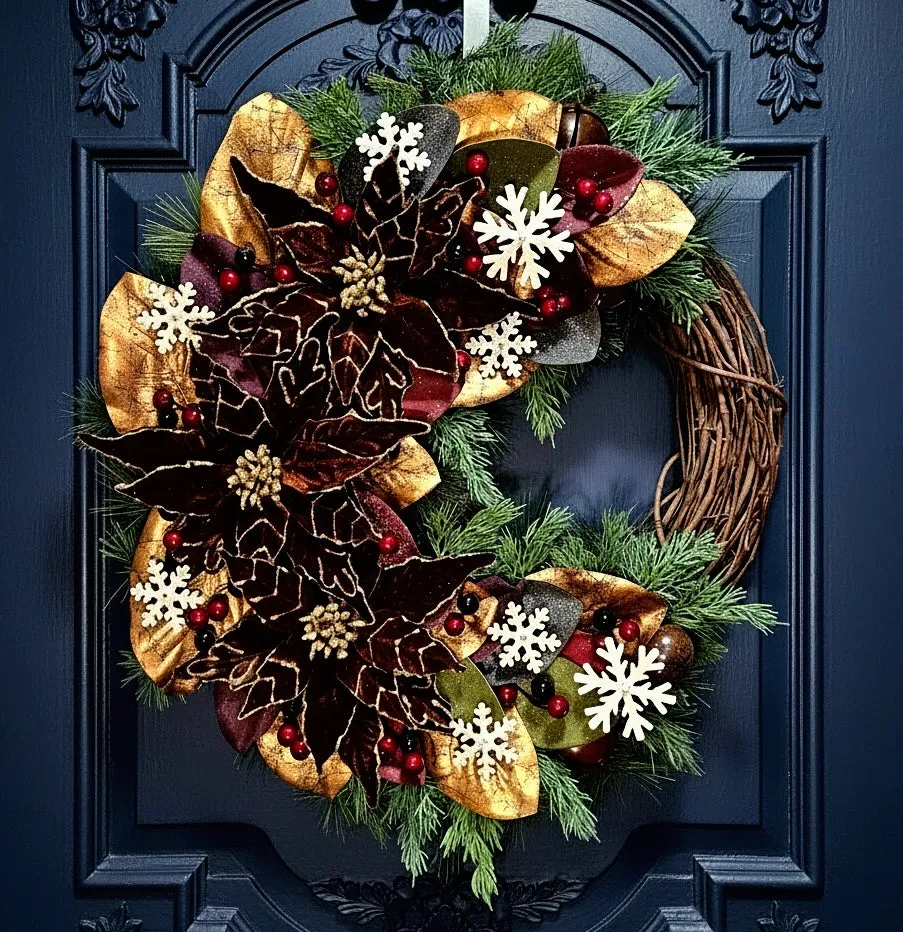
The carved navy blue door is doing more work than you think. Put this exact wreath on a plain white panel and the gold suddenly reads cheap, because there’s nothing deep enough to push against it. That inky backdrop is what makes burgundy velvet look expensive and metallic leaves look like actual gilt. If your door is light, borrow the idea with a dark painted panel or a deep-toned trim surround.
3. Red Door Porch With Layered Garland and Brass Sconces
The formula is roughly 55% forest green, 25% red, 12% white and silver, 8% brass. The garland supplies almost all of the green, the door supplies most of the red, and the ornaments, frosted wreath, and light blue shutters handle the rest. To shift it while keeping the same balance, trade the silver ornaments for matte gold and the shutters for charcoal — the structure holds, the mood turns warmer and quieter.
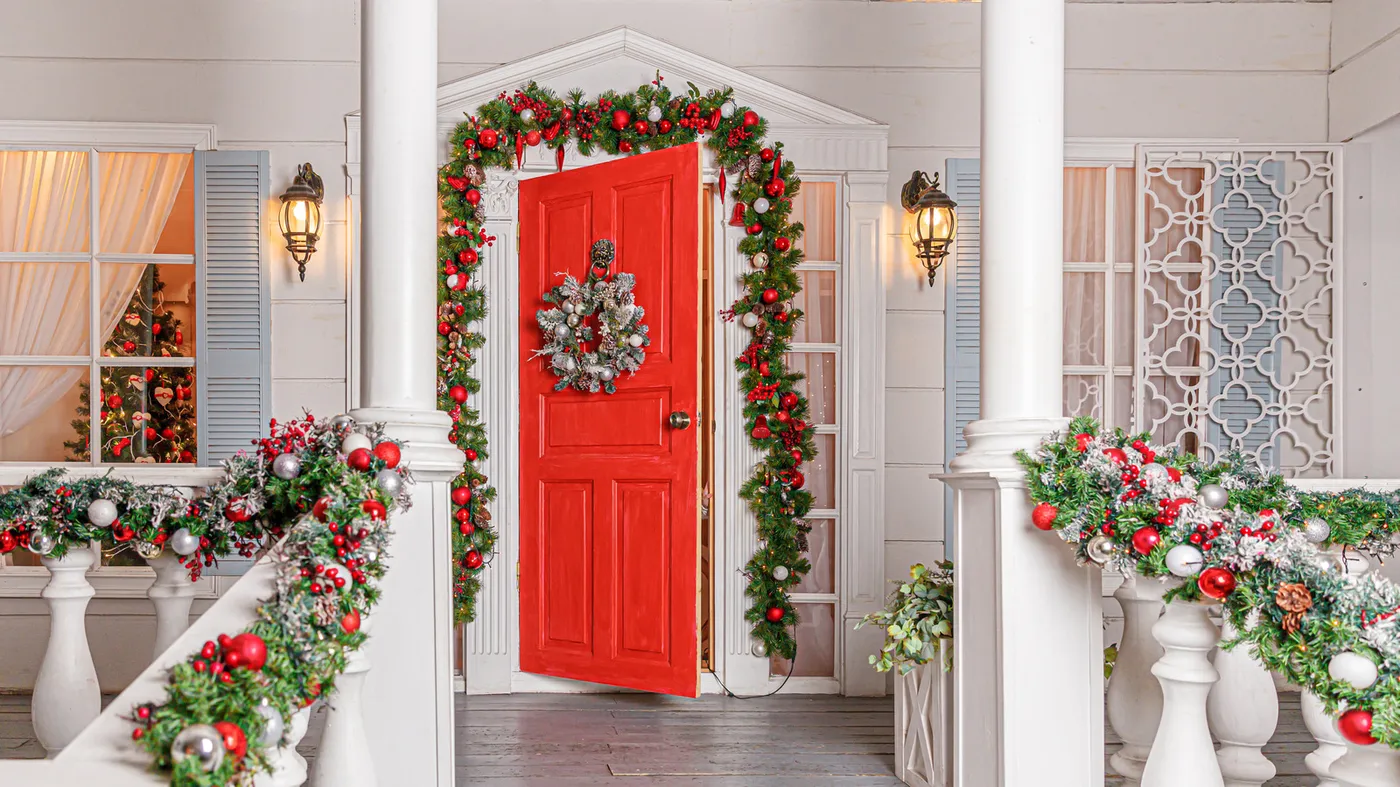
Two things bite people on porches like this. Garland on railings catches every bit of wind and rain, so anything with a wired frame rusts within a season or two — look for powder-coated wire. And brass-toned sconces tarnish fast outdoors unless they’re lacquered; unlacquered brass will patina to a dull brown by February unless you genuinely like that look. Compare with Idea #25, which sidesteps both problems with a covered entry.
4. Red Bow, Red Berries, White Door — The Classic Formula
Rebuilding that top bow takes about 20 minutes and $12 in ribbon.
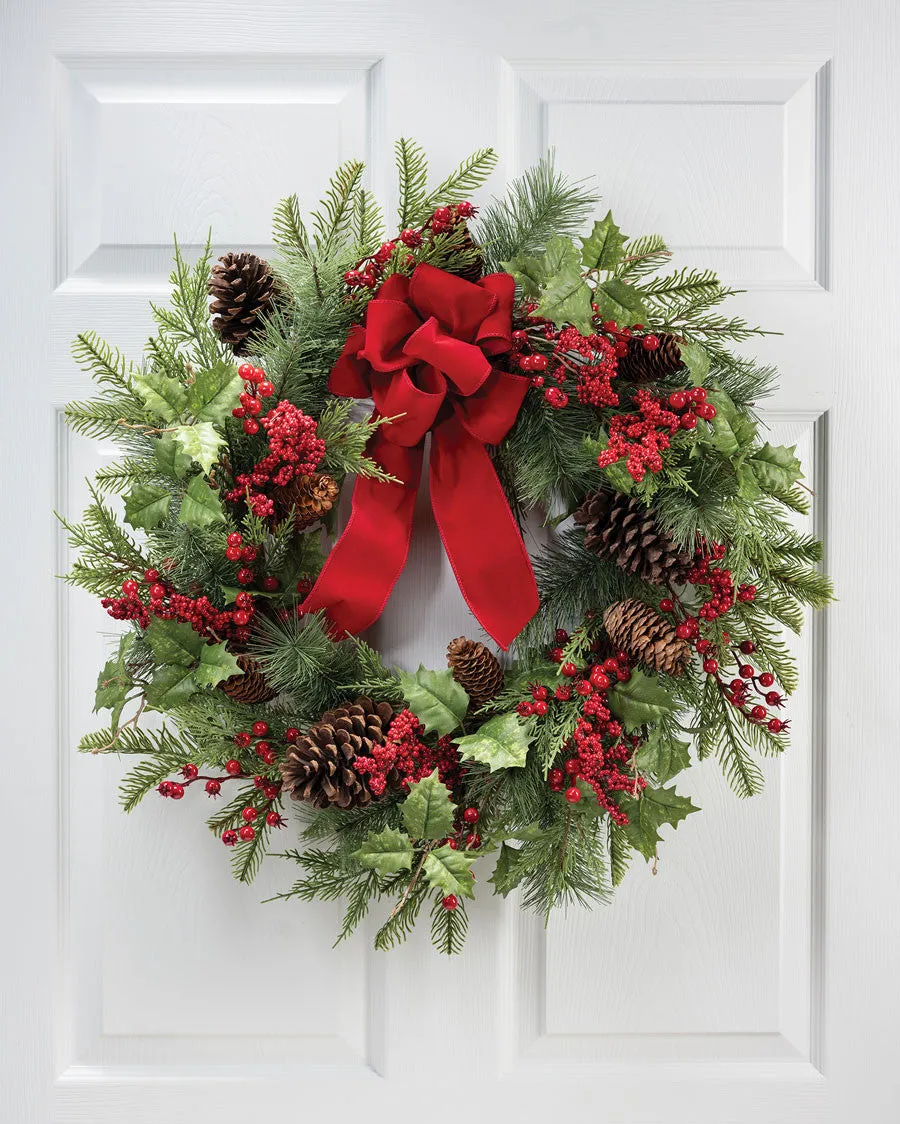
- Cut 3 yards of 2.5-inch wire-edged velvet ribbon.
- Fold the first loop at 10 inches, pinch, and twist the wire to hold it.
- Make a second loop slightly smaller, alternating sides.
- Add two more loops, then trim both tails on an angle.
- Wire the finished bow to the wreath frame, not the greenery — it won’t sag.
- Fluff the loops outward and steam out any packing creases.
Take away that soft red bow and you have a perfectly nice wreath nobody remembers. It’s the only large, matte, fabric element in a composition made entirely of needles, berries, and cones, and that contrast in texture is the whole trick. Swap it for a glittered bow and the wreath loses its calm.
5. Dark Green Door, Crimson Velvet Bow, Brass Hardware
A green wreath on a green door sounds like a mistake until you check the temperature. The door is a cool, deep forest green; the wreath foliage runs warmer and lighter, so the silhouette stays readable instead of dissolving. The crimson bow then gives you one saturated pop, and the polished brass knocker and handle add small reflective hits that bounce porch light around. Three materials, two colors, no clutter.
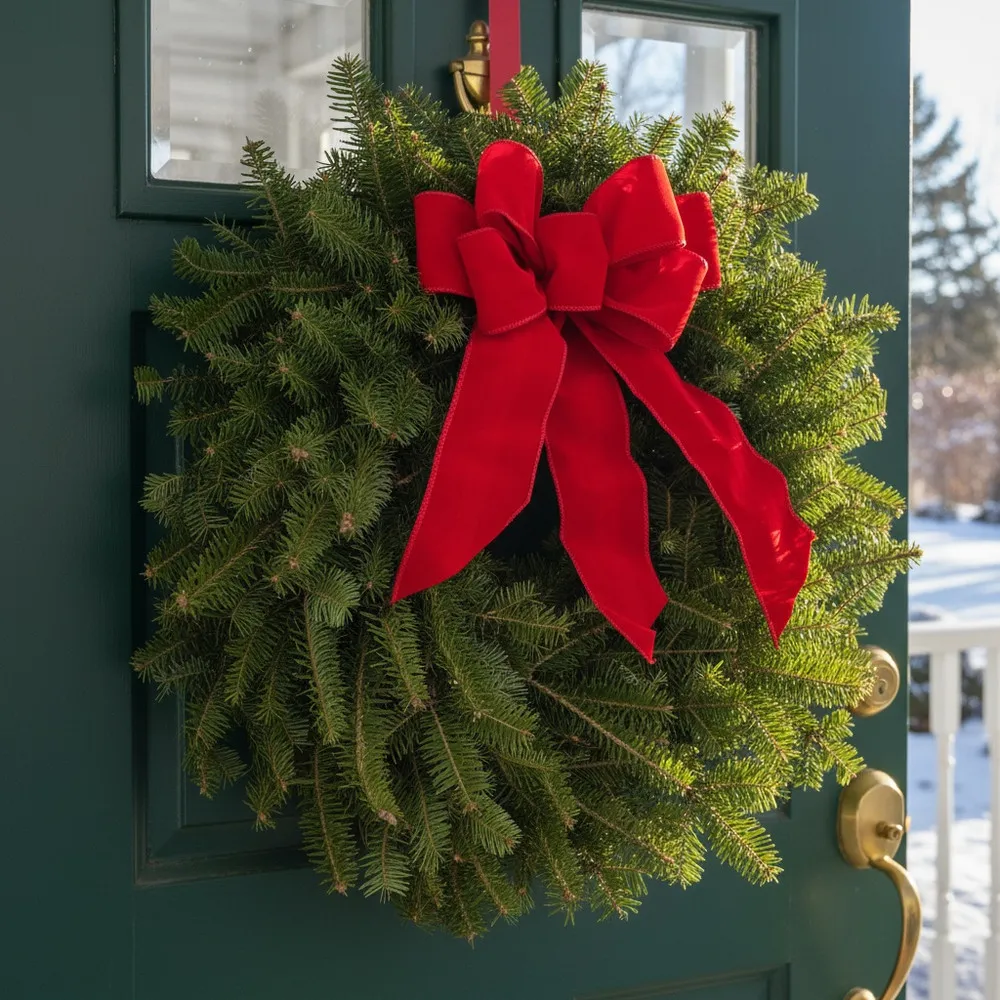
Velvet ribbon is beautiful and completely unforgiving outdoors. Sun fades the red toward pink in about six weeks, and rain leaves water marks that don’t steam out. Plan on replacing the bow each season, or bring the wreath inside during storms. Real brass hardware wants a wipe with a soft cloth every few weeks if you want it bright — otherwise let it age to bronze, which plenty of people prefer anyway.
6. Cedar, Pine, and Juniper Berries Bundled by Hand
Build the mix at roughly 60% base greenery like fir or cedar, 30% texture like long-leaf pine, and 10% accents like juniper berry clusters and pinecones. Cut stems to 8–10 inch lengths, bundle five or six at a time, and bind with 24-gauge wire every 3 inches. Keep accent stems at the outer edge so berries catch light instead of getting buried. That ratio is what makes a handmade wreath look deliberate rather than like a pile of clippings.
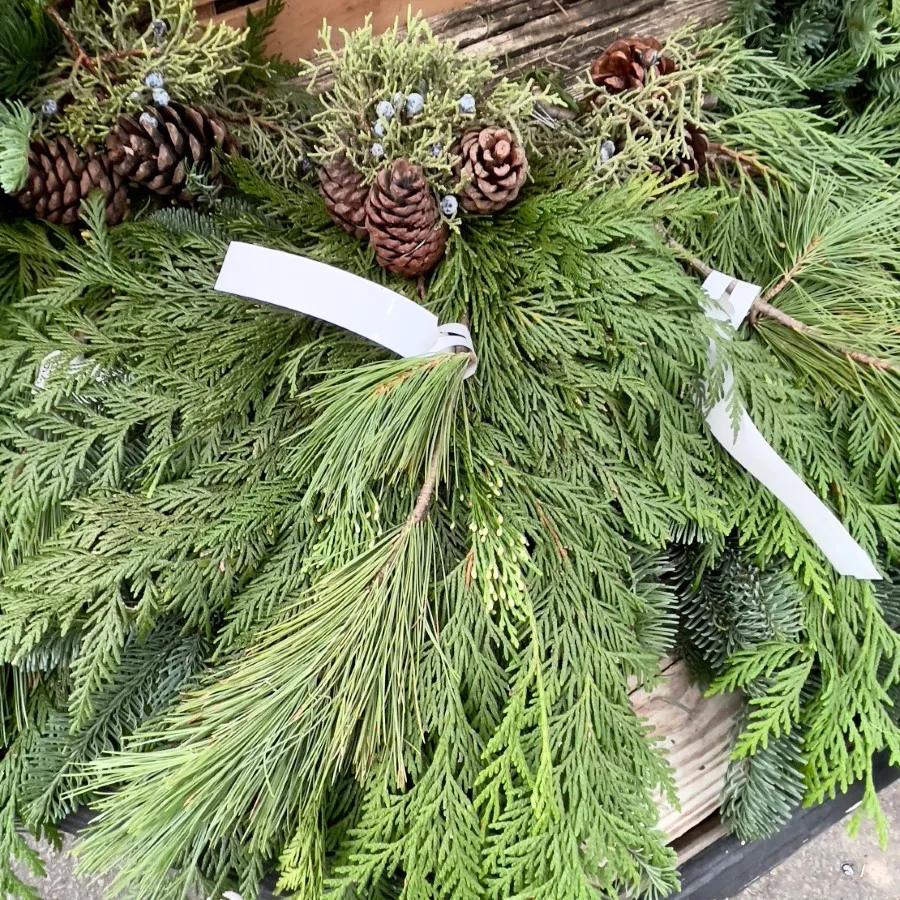
For 2026 the pendulum has swung hard toward foraged. Blue-grey juniper berries, flat cedar, and slightly uneven silhouettes are replacing perfectly uniform plastic rings — partly because they photograph beautifully, and partly because a grocery-store bundle plus wire runs under $30. The look ages gracefully too: as it dries, it goes from fresh green to a muted sage that still reads intentional in January. Even the little white paper tags on bundled stems have become part of the aesthetic.
7. Black-Framed Glass Doors With Bare-Twig Pine Garland
This treatment is built for a double-door entry around 5 to 6 feet wide with ceilings at least 9 feet high. The swag should hang 12 to 14 inches deep at the corners and narrow to about 8 inches at center, so it frames the transom instead of hiding it. Under 8-foot ceilings, scale the swag back to 8 inches and skip the oversized pinecones. Loose bare twigs threaded through the greens are what keep it from looking like a rope.
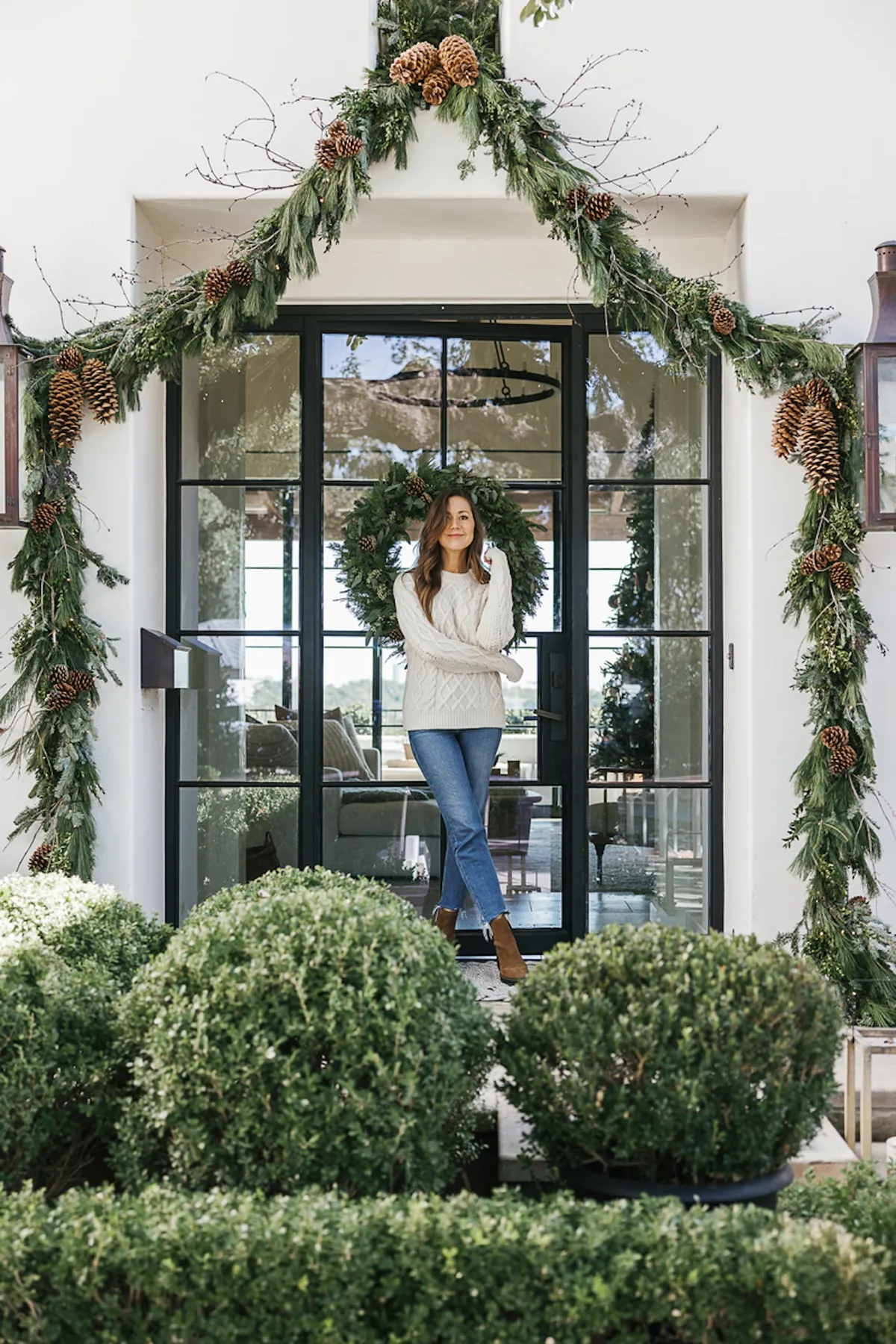
The look is mostly thick greenery, warm lights, and restraint — all of which you can fake. A $30 warehouse-club garland doubled over itself reads twice as full, and bare twig sprays run about $6 for three. Large pinecones are free if you have a park nearby; bake them at 200°F for an hour first. Swap a $200 pre-lit garland for a $40 unlit one plus a $12 string of warm LEDs and you’ve saved roughly 70%.
8. Gold-Lined Velvet Bow on a Mixed Evergreen Wreath
It’s the gold lining, and it’s a small detail doing enormous work. When the ribbon loops over, that metallic underside flashes against the dark red and the bow suddenly looks like it came off a couture gown rather than a craft bin. Without it, this is a nice traditional wreath with a nice bow. With it, the whole arrangement shifts toward evening-party formality. If you can’t find lined ribbon, back a plain velvet with a strip of gold satin.
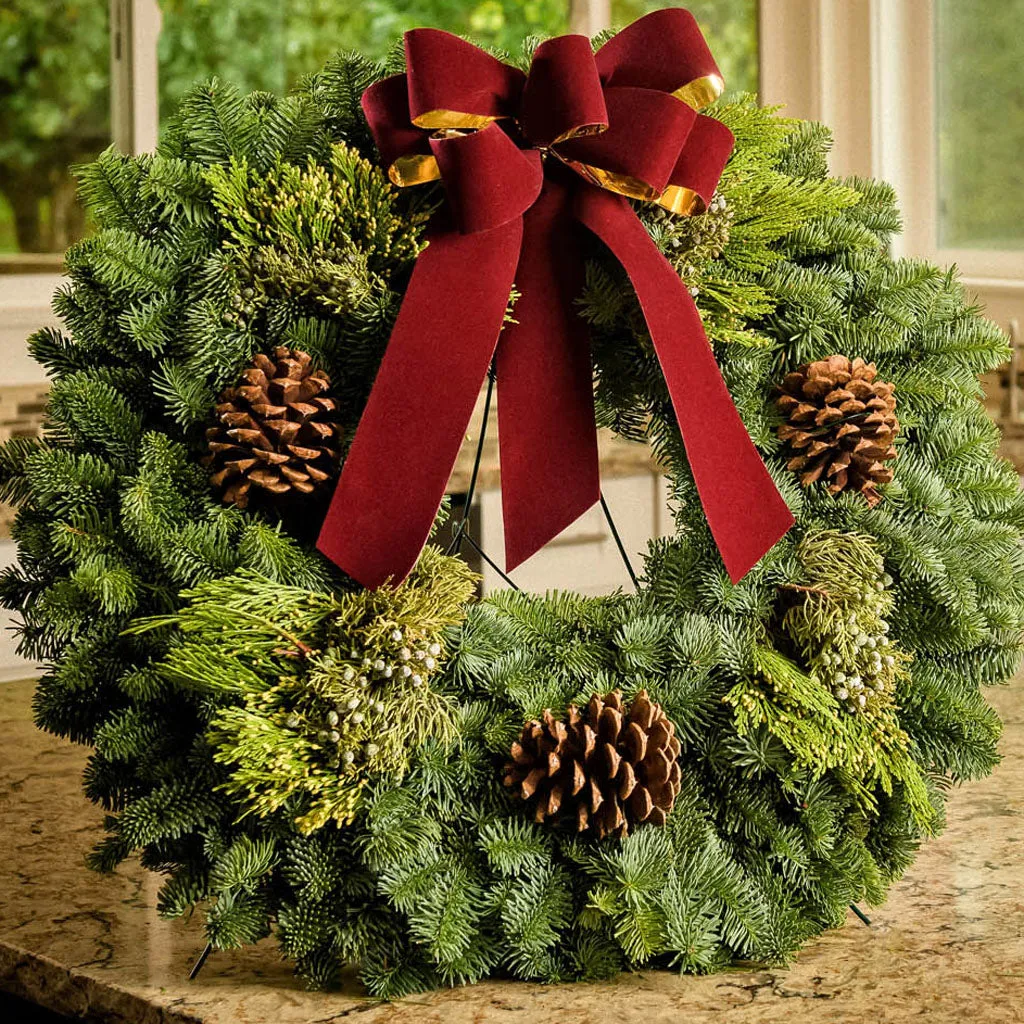
Buy about 2.5 times more ribbon than you think you need — a 24-inch wreath with a full bow and tails eats 4 to 5 yards. Width matters more than length: 4-inch ribbon for a 24-inch wreath, 2.5-inch for anything under 20 inches. Choose wire-edged velvet over the soft stuff. Wire-edge holds a loop through wind and storage, while plain velvet collapses into a sad red puddle by New Year’s.
9. Tone-on-Tone Red: Velvet Bow Against a Red Door
This is a two-color scheme with a cheat code: 70% deep red door, 25% forest green wreath, 5% brown from the pinecones. The reds aren’t identical — the door leans brick, the bow leans crimson — and that slight mismatch is what keeps it from going flat. To adapt it, hold the 70/25/5 split but swap the door red for navy and the crimson bow for gold. Same math, completely different personality. Compare with Idea #5 for the inverse.
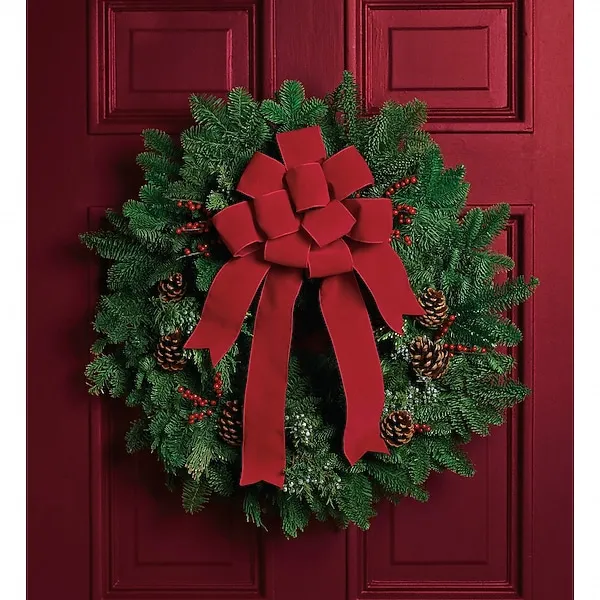
Tone-on-tone only works if the two reds genuinely differ. Stand your ribbon next to the door in daylight before you commit — under warm porch bulbs, brick red and crimson can collapse into one flat mass. Also worth knowing: a wreath this saturated needs the porch lights off or very dim. Bright overhead lighting on a red door with a red bow reads like an alarm. Let the wreath be the brightest thing in the frame.
10. Frosted Berries and Battery LEDs After Dark
Use 30 to 40 warm-white micro LEDs on a 24-inch wreath — any more and it turns into a glowing donut. Run the strand so the battery pack sits at the 4 o’clock position, tucked behind a thick branch, and set the timer to come on at dusk. If the door gets direct afternoon sun, choose matte bulbs; shiny ones flare in photos. Frosted berries plus soft light beats bright light every single time.
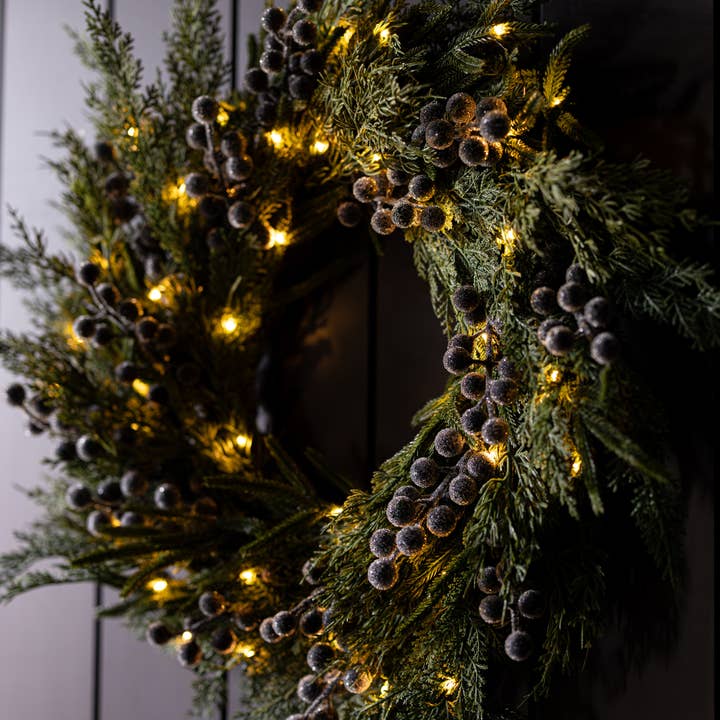
Battery packs are the hidden cost. On a four-hour daily timer, a set of three AAs lasts roughly three to four weeks, so plan on two swaps between Thanksgiving and New Year’s — or buy a rechargeable pack. The frosted berry finish is more fragile than it looks: rubbing them while fluffing knocks the coating off and leaves bald spots. Handle the wreath by the frame, and store it in a bag rather than a box so nothing presses flat.
11. Flocked Pine and Lamb’s Ear With Scarlet Berries
Flocked wreaths are priced like they were made by elves. A 26-inch version runs $90 to $180 retail. Craft stores discount flocked wreaths heavily right after Thanksgiving, and a plain $12 twig base plus a $9 can of spray flock gives you the same snowy texture for around $30 total. Add $6 in red berry sprigs and $8 of lamb’s ear stems, and you’ve cut the price by roughly two thirds.
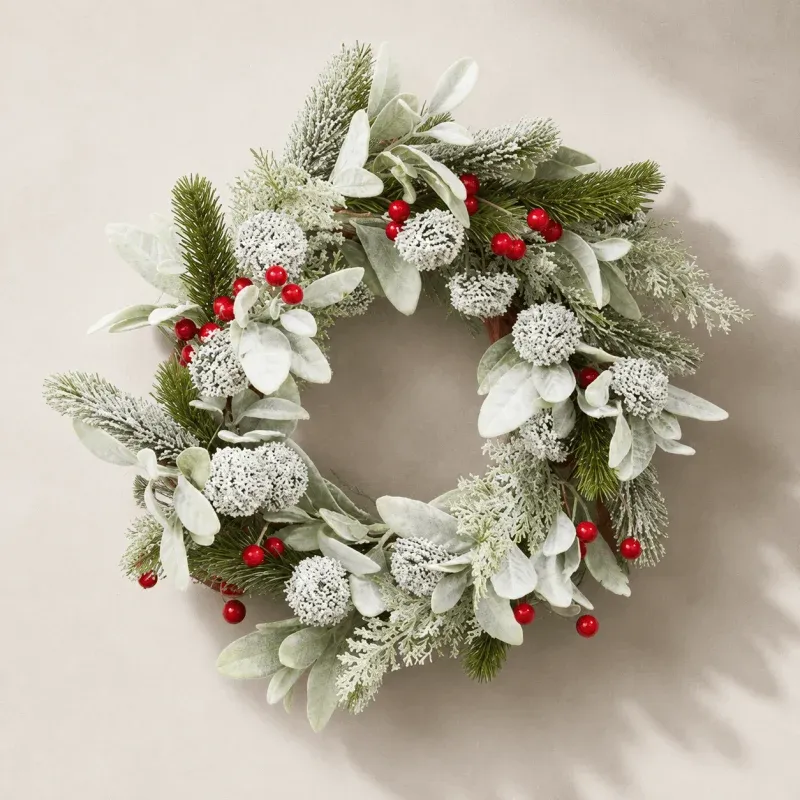
The unexpected move is the lamb’s ear. It’s a soft, fuzzy, grey-green leaf that has no business in a Christmas wreath — which is exactly why it works. That muted, dusty texture softens the hard edges of flocked pine and keeps the whole thing from looking like a snow-dusted plastic ring. The bright red berries then pop harder because they’re sitting next to grey rather than competing with pure white.
12. A Snowman-Printed Bow on Weathered Wood Planks
Novelty bows are back, and not ironically. After several seasons of tasteful neutrals, people are buying ribbon printed with snowmen, plaid, and vintage Santas again — partly nostalgia, partly because a $10 ribbon is the cheapest way to change a wreath’s entire personality. The catch is restraint: one novelty element per wreath. Printed bow plus printed ribbon plus character ornaments and you’ve lost the plot. The weathered planks behind this one keep it grounded.

Weathered wood is a forgiving backdrop, but it isn’t maintenance-free. Real barn wood sheds, and if the wreath presses against it you’ll find a small pile of splinters on the floor by February. Printed ribbon also fades faster than solid — the ink channels break down before the fabric does, so a snowman bow left in direct sun may be a ghost bow next season. Store it flat, not folded, between years.
13. Jewel-Toned Ornaments and Burgundy Satin, Flat-Laid
Count the colors: burgundy ribbon, teal, deep green, silver, gold, plus white snowflakes. That’s six, and it works because four of them are metallic and read as highlights rather than separate hues. The real math is 45% green pine, 20% burgundy, 25% metallic, 10% white. Want it calmer? Drop the teal to silver and the gold to pewter — you keep the richness and lose the party.

A flat-lay wreath for a mantel or wall takes about 45 minutes and $40 in ornaments.
- Lay the pine base on a table, not a door — you’re building flat.
- Wire the largest ornaments first at 12, 3, 6, and 9 o’clock.
- Fill gaps with two sizes of smaller balls, mixing matte and glitter.
- Weave the light strand under the ornaments so bulbs peek through.
- Tuck snowflake cutouts behind branches, half-hidden.
- Lift it by the frame and check the silhouette from three feet back.
14. Figure-Eight Wreath and a Striped Bow on Black Wood Grain
The figure-eight shape is the plot twist. A single ring on a door this graphic would just be a green circle on a black rectangle. Two stacked loops create a vertical line that mimics the door’s paneling and makes the entry feel taller. The crisp black-and-white striped bow then echoes the wood grain in reverse — dark on light instead of light on dark — and picks up the white trim and sidelights on either side.
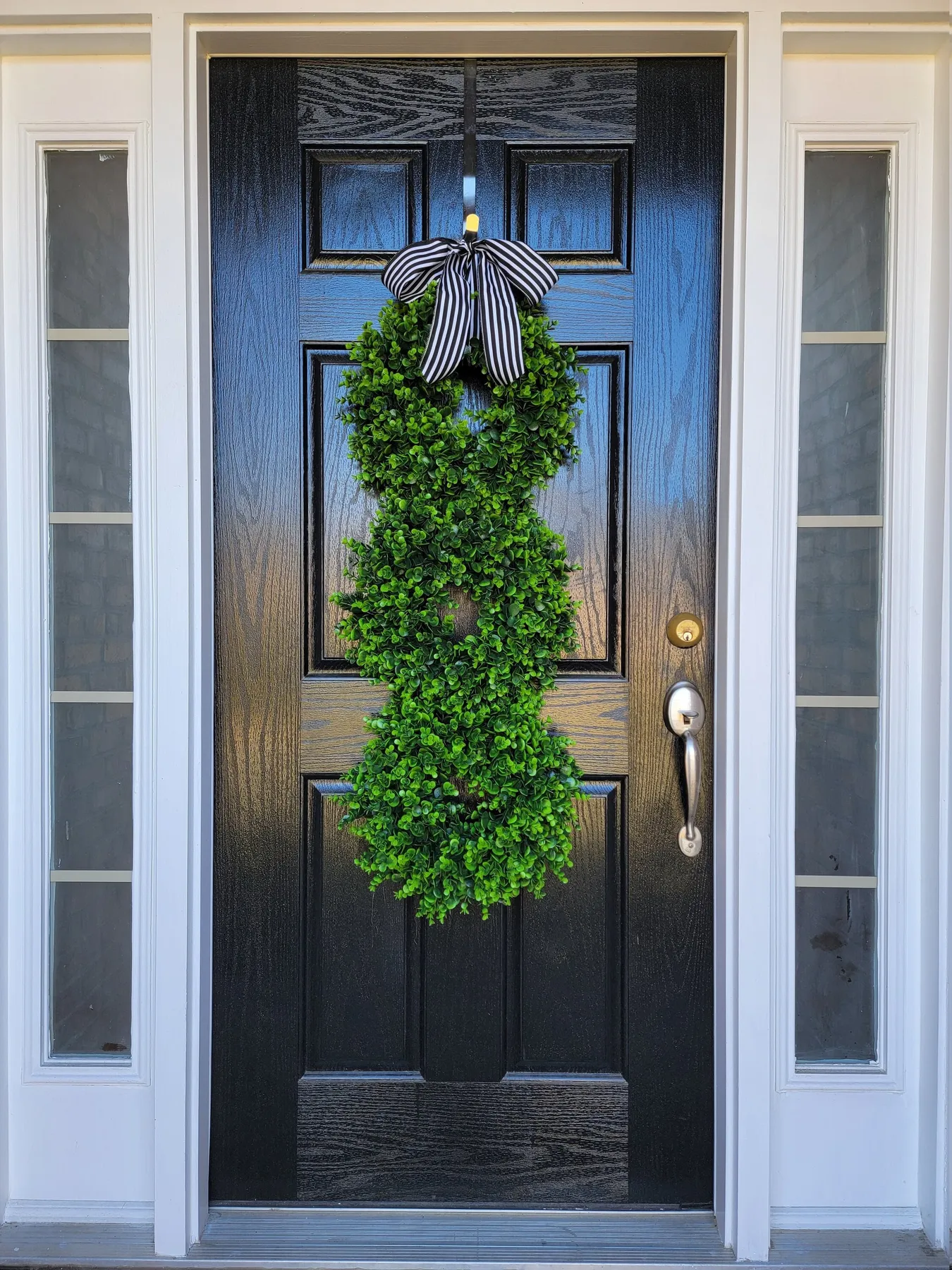
Without that striped bow, the figure-eight just looks like two wreaths stacked by accident. The ribbon is what turns a shape into a decision. Black and white is also doing something specific: it’s the only non-green, non-black element in the frame, so your eye goes straight to the center of the door, which is exactly where a wreath should send it. Swap in a red bow and the whole thing goes generic.
15. Wide Velvet Ribbon Draped, Not Tied
Draping instead of tying is the fastest way to make a $40 wreath look like a $150 one. Cut a 40-inch length of 3-inch velvet, fold it over the top of the frame so the two tails hang unevenly — one long, one short — and pin both ends to the back with floral wire. Keep the tails about two-thirds the wreath’s diameter. Wide ribbon needs fewer folds; anything under 2 inches will look like a shoelace lying on greens.
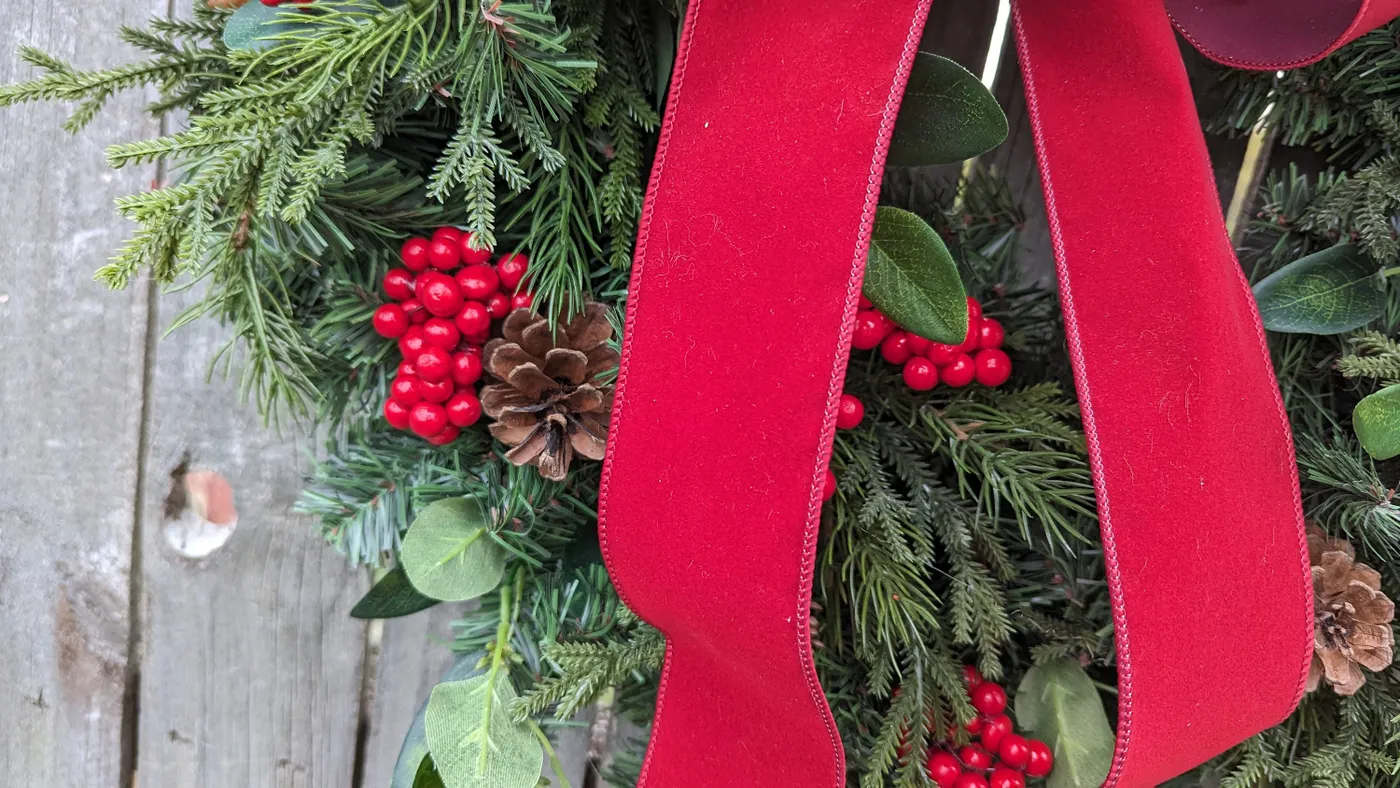
Velvet ribbon is where wreaths get expensive fast — designer rolls run $18 to $35 a yard. Thrift stores and Facebook Marketplace are full of damaged velvet garments after the holidays, and a $6 skirt yields three or four yards once you cut it into strips. Test the back first: if it’s polyester with a plasticky sheen, skip it. Real velvet absorbs light, which is what makes it sing against weathered grey wood.
16. Heavily Flocked Evergreen Against Rustic Planks
Flock sheds. There’s no polite way to say it. Expect a light dusting of white on the floor and windowsill for the first week, and keep the wreath off a door that gets slammed — vibration unloads the coating faster than anything else. Never wipe a flocked wreath with a damp cloth; it turns the coating to paste. A soft dry paintbrush lifts dust. Stored in a bag with tissue between layers, a good flocked wreath lasts four or five seasons.
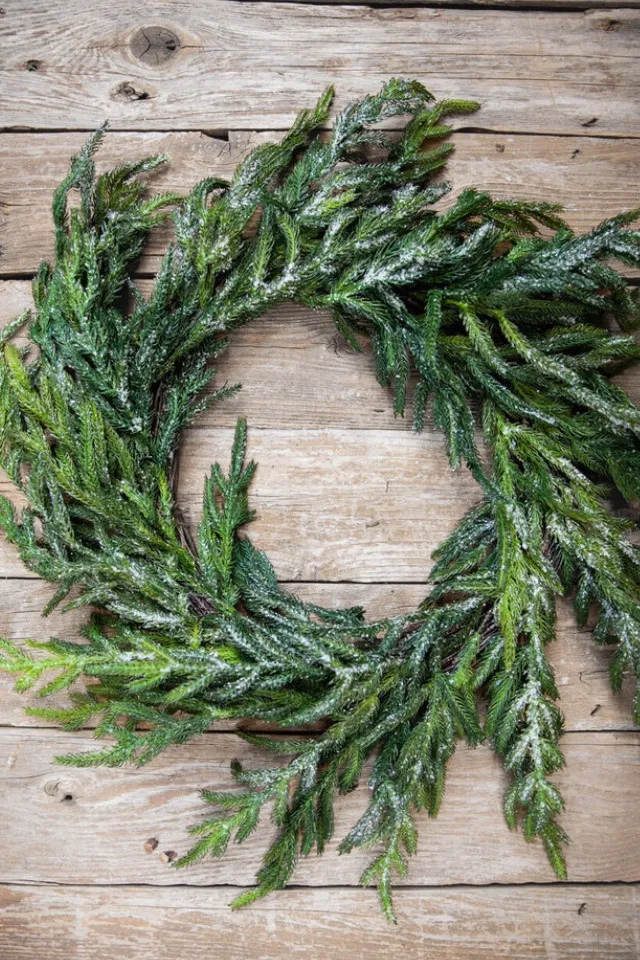
Flocking loves dark backgrounds and hates bright ones. Against the warm light-brown planks here, the white pops and reads as real snow. Against a white door or pale wall, a heavily flocked wreath can disappear into the surface behind it. If your door is light, either step down to a light dusting of frost or add a dark ribbon to anchor it. For the opposite end of the spectrum, see Idea #30.
17. Eucalyptus, Dried Orange, and Grey Velvet Ribbon
Dried citrus is the quiet trend of the season, and it pairs naturally with the foraged look. Silver-green eucalyptus has been showing up in Christmas decor for a few years now, but the addition of one dried orange slice — not a garland of them — is what feels current. It nods to Victorian pomander traditions without going full craft-fair. This palette should have real staying power, because none of it is strictly holiday.
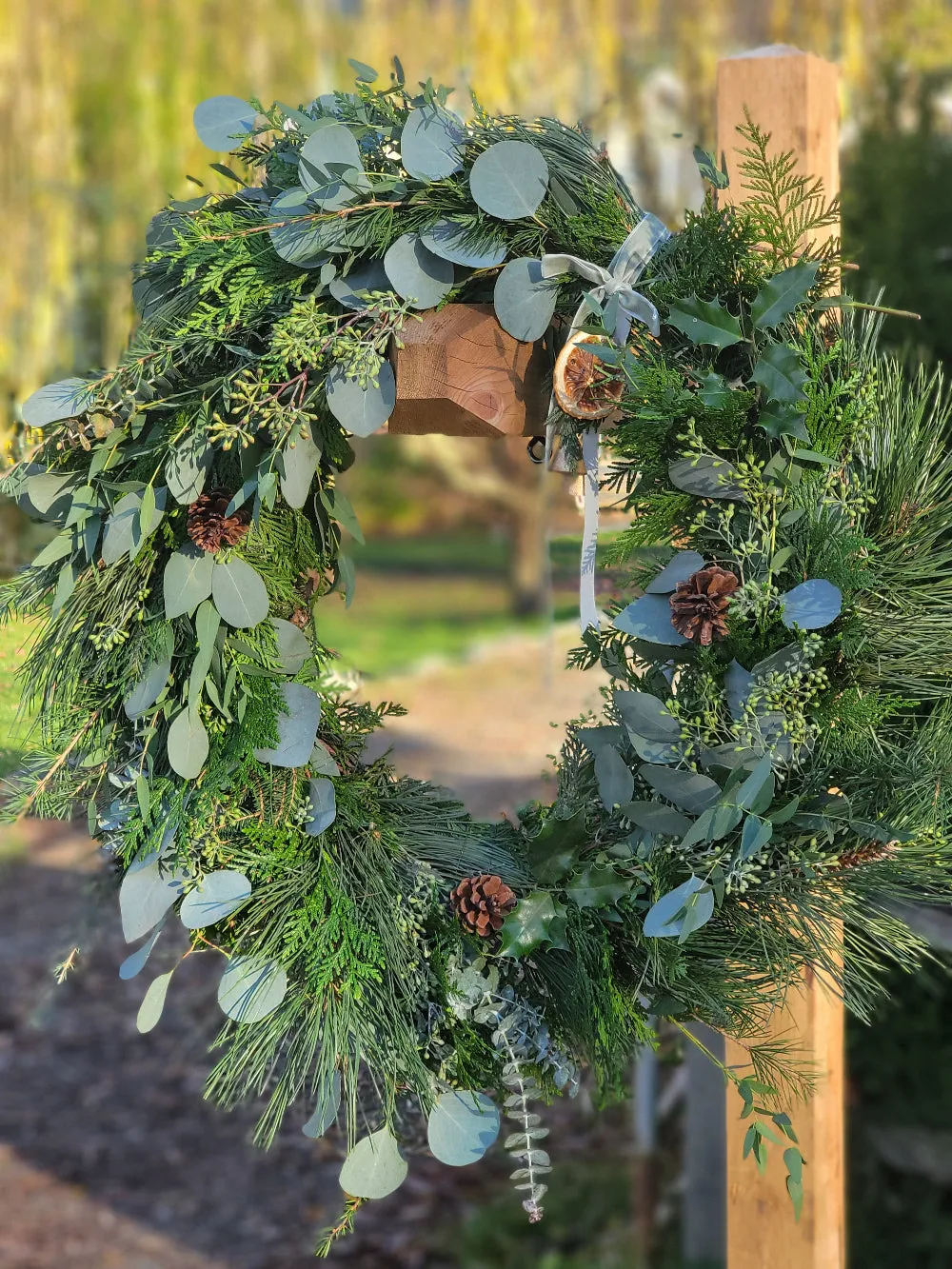
- Mixed evergreen and eucalyptus bunch: $25–$55
- Pinecones and dried orange slices: $8–$20
- Grey velvet ribbon, 2 yards: $14–$30
- Wreath frame and floral wire: $10–$18
- Total: $57–$123
Budget alternative: buy grocery-store eucalyptus at $4 a bunch, dry your own orange slices in a 200°F oven for three hours, and skip velvet for a $3 linen strip — roughly half the cost.
18. Red Plaid Bow, Stacked Stone, and Two Plush Gnomes
Gnomes are polarizing, and that’s fine — but they’re also a tripping hazard. Two plush figures at the base of a door will migrate into the walkway within a week. Put them on a mat you can step around, or move them onto a nearby stool. Also: plaid ribbon in a black-and-red pattern is nearly impossible to find in wide velvet, so most of what’s sold is printed polyester that creases in storage and never quite relaxes.
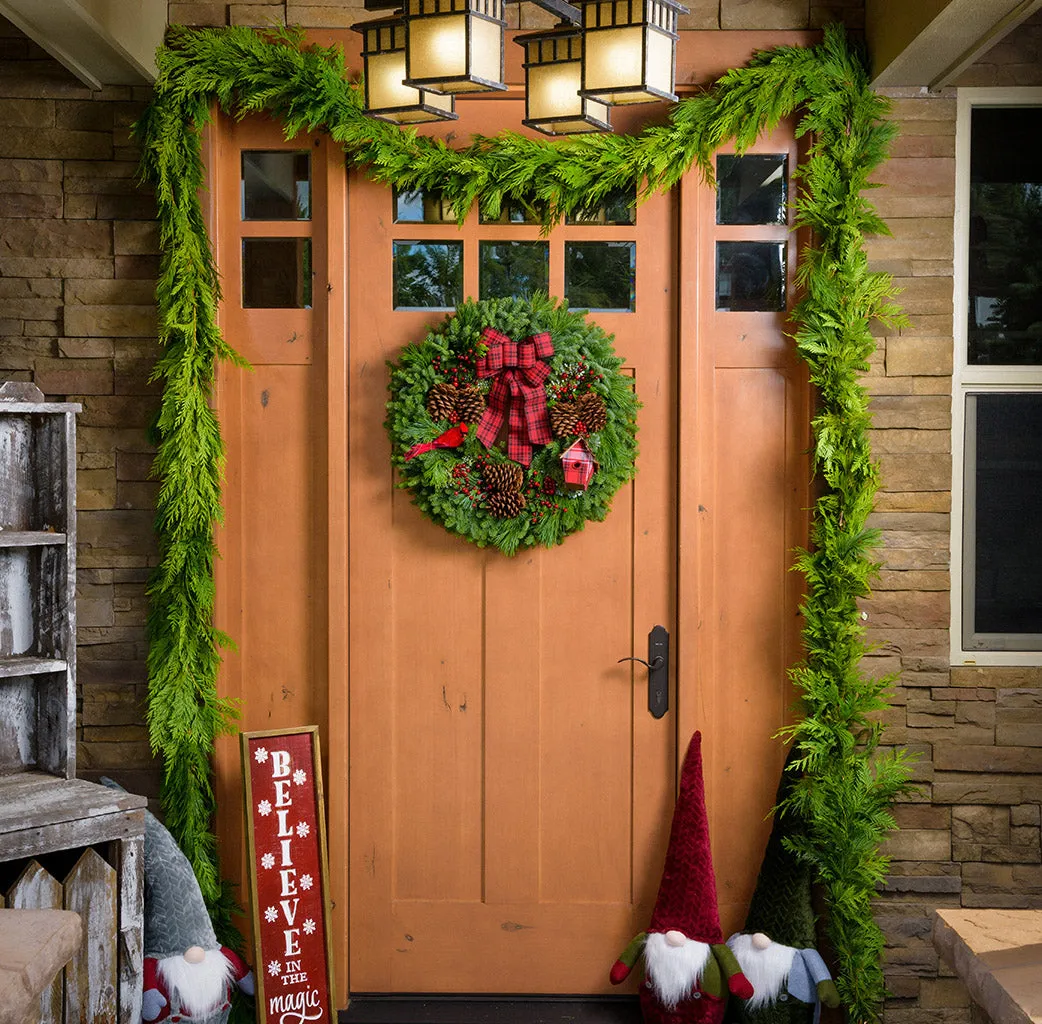
A full garland-plus-wreath frame on a rustic door takes about two hours and $60.
- Measure from the top of the door trim to the floor on both sides.
- Attach swag hooks at the top corners and one at the center peak.
- Start the garland at the left hook and work downward in loose loops.
- Wire pinecones and berry sprays on top of the garland, not behind it.
- Extend one tail down the stone side and anchor it with fishing line.
- Hang the wreath last so you can match the density.
19. Two Greens and One White Berry — A Quiet Winter Wreath
There are only two foliage types here — dark fir-like needles and a lighter feathery cypress — plus small white berry clusters on thin brown stems. That restraint is the design. Two greens create depth without noise, the white berries act as tiny highlights that guide your eye around the circle, and the thin brown stems keep the whole thing from looking packed. Against a soft off-white fabric backdrop, the wreath reads almost like a still life.
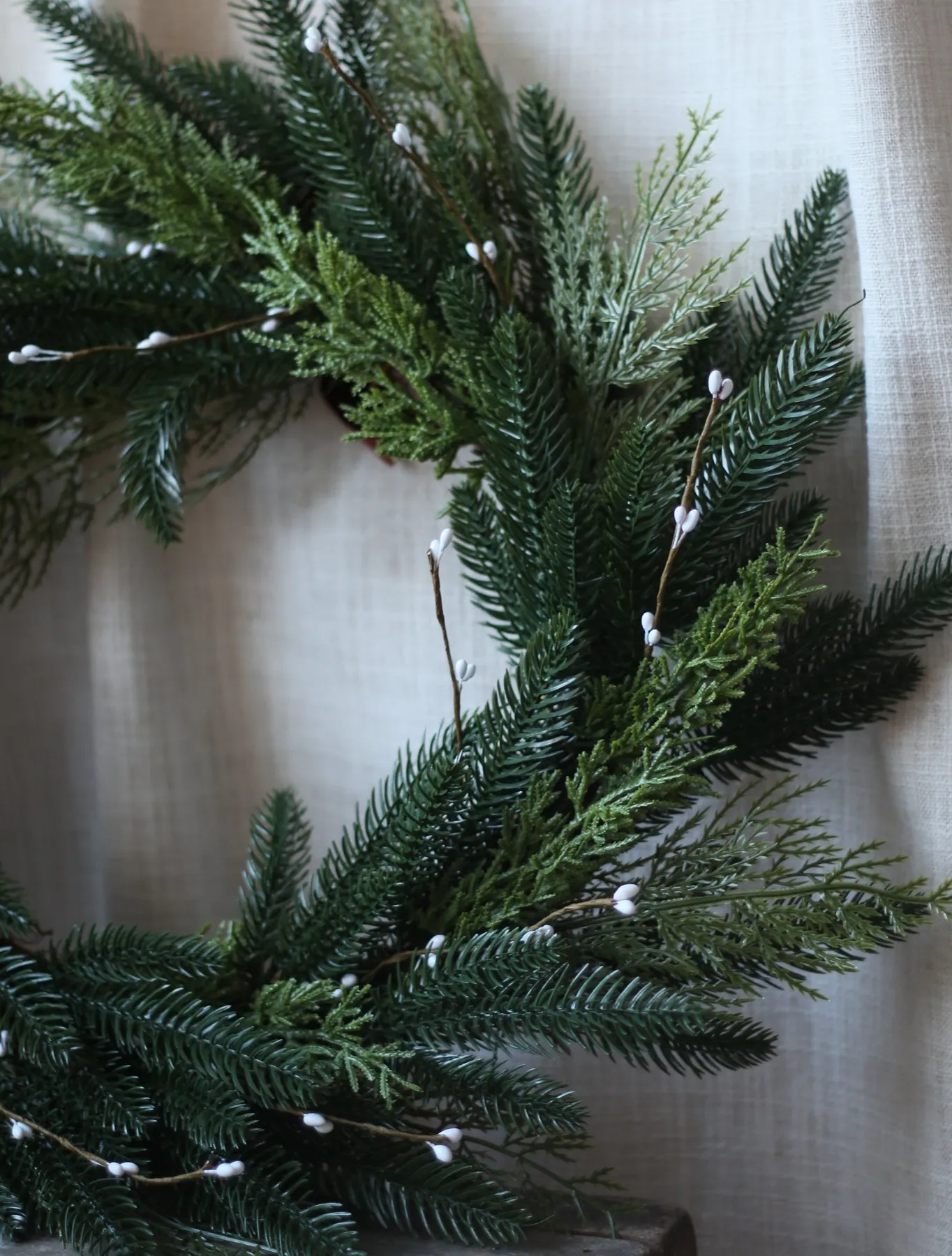
When you mix two greens, aim for a value difference of at least three shades — dark forest next to light sage — or they’ll blur into one flat mass in photos. Wire the lighter foliage slightly forward so it catches light, and cluster white berries in odd numbers of three or five. Odd numbers read natural; even numbers read arranged. This is the one to hang indoors on a mirror or wall, not on a door.
20. Frosted White Berries on a Sage Green Door
The rose gold berry caps. They’re barely half an inch each and most people won’t consciously notice them, but they warm up the whole arrangement. Without them you have a green wreath with white berries on a green door — pleasant, slightly one-note. With them there’s a faint blush running through the composition that ties the frosted berries back to the muted sage door. A $6 detail that reads like a designer spent an afternoon on it.
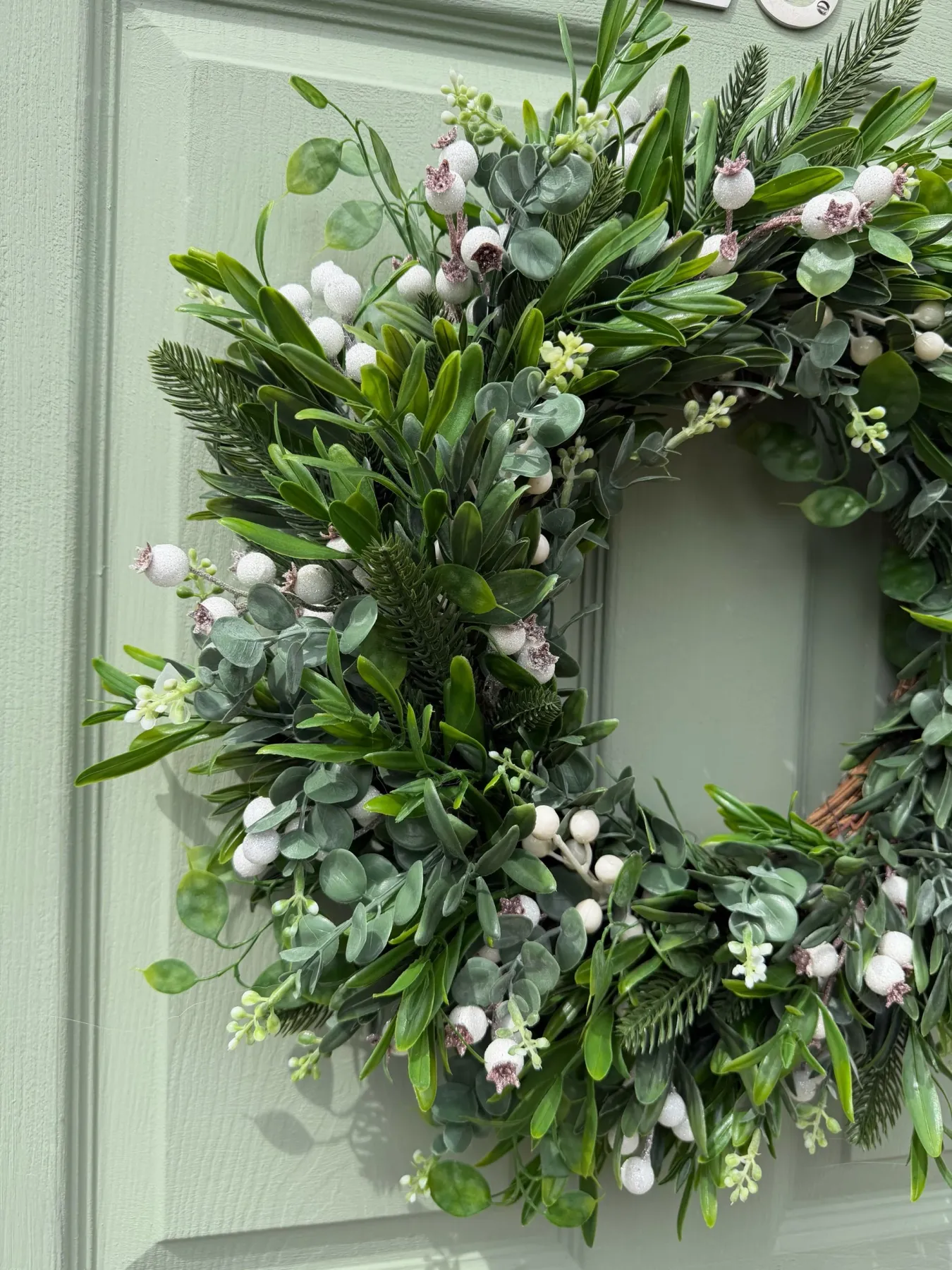
Roughly 60% mixed green foliage, 25% white berries, 10% sage door, 5% rose gold. The sage door and the greens sit close in value, so the white berries carry all the contrast. Warm it up by swapping rose gold for copper, or cool it further with brushed nickel caps and a dusty blue-green ribbon. Compare with Idea #24 — same density, much louder palette.
21. Flocked Pine and Frosted Red Berries on Dark Wood
Flocked wreaths read larger than their actual diameter because the white expands the silhouette. On a standard 36-inch door, stay at 22 to 24 inches so the wreath occupies roughly two-thirds of the width — go bigger and it swallows the panels. On a 32-inch door, drop to 20 inches. If your entry is narrow, under 4 feet, skip the matching garland entirely; two flocked elements in a tight space turn into a white blur.
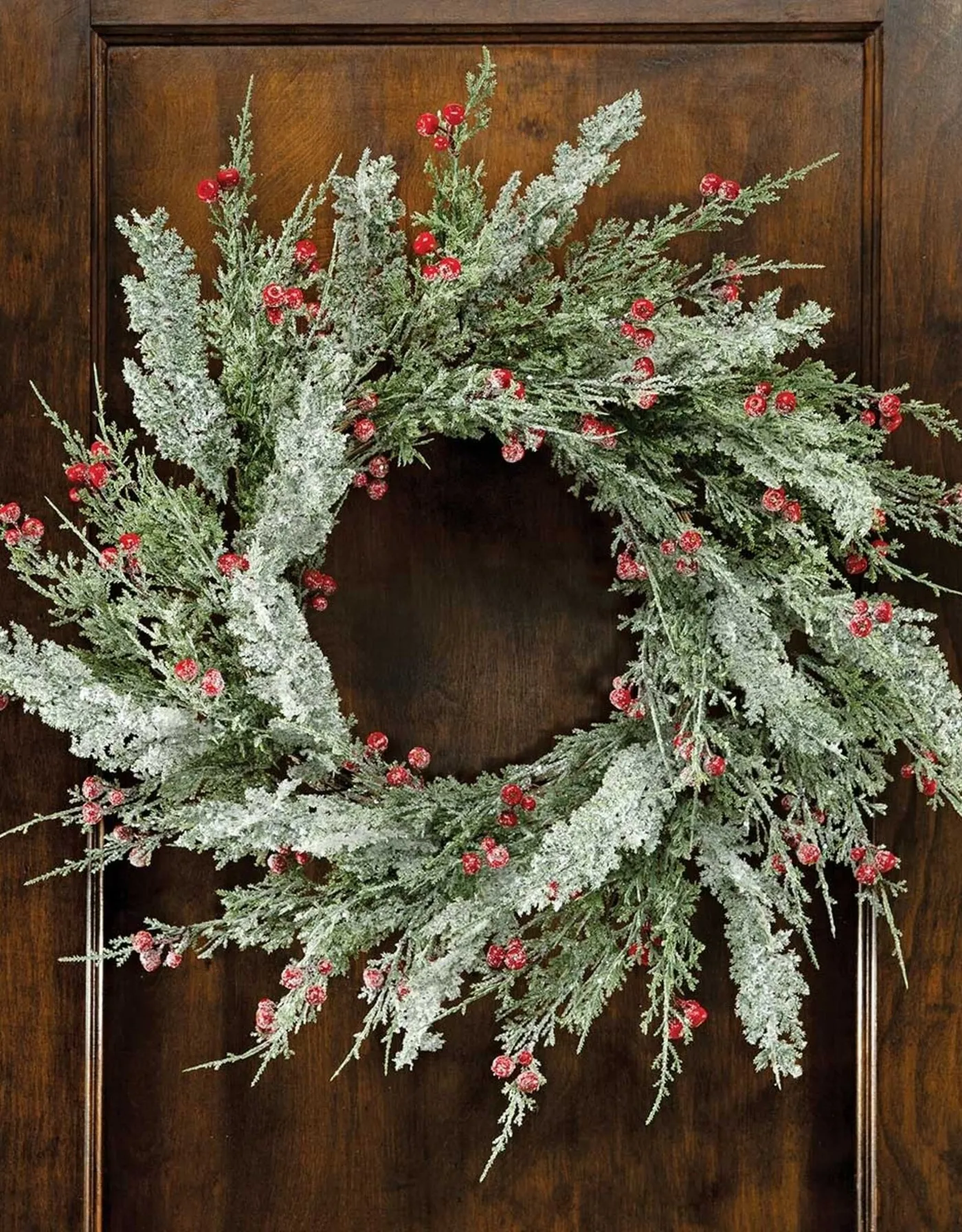
Frosted red berries look festive in a photo and alarming in person when the coating cracks. Cheaper versions use a painted-on finish that flakes the moment you bend the stem, so test one berry before you wire the whole cluster. Heavily flocked wreaths are also magnets for winter grime — salt mist settles into the white and turns it grey by mid-January. A dry, soft brush mid-season helps.
22. Triple-Tier Swag Wreath on a Textured Black Door
This three-part vertical swag takes about 90 minutes and roughly $50 in materials.
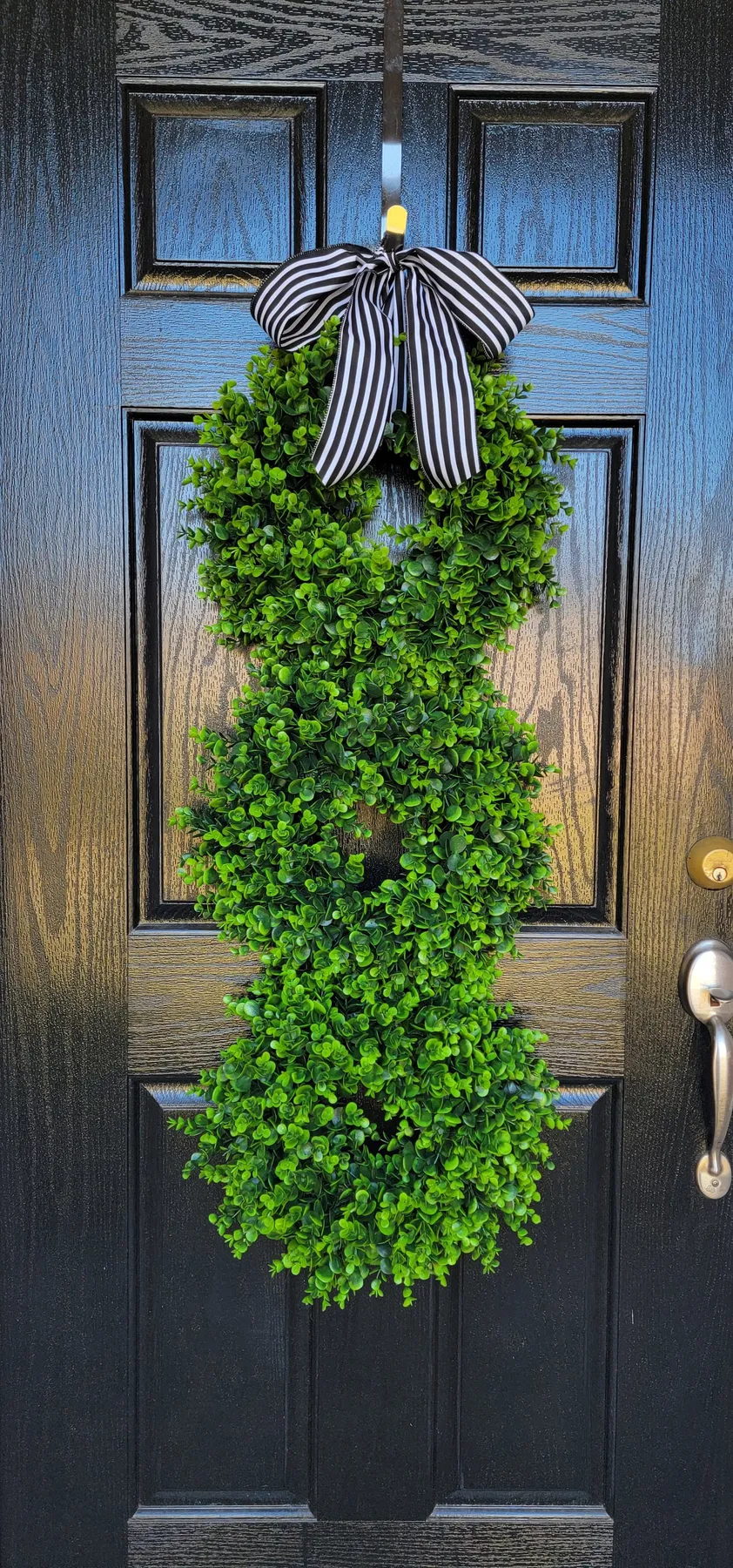
- Measure your door from the top trim to 6 inches above the handle.
- Divide that height into three roughly equal sections.
- Build each green bundle separately on a wire hoop, varying the width.
- Connect the hoops with 18-gauge wire, keeping 3 inches of overlap.
- Use a black metal over-the-door hanger so nothing gets drilled.
- Wire the striped bow to the top hoop last.
Three small wreaths cost more than one big one, which is why people assume this is a luxury look. It isn’t. Three 10-inch plain green wreaths run about $15 total, and black-and-white striped ribbon is $8 at Target. Wire them together with florist wire you already own — under $30 for a treatment that looks custom-built.
23. Sugar-Dusted Pink Berries Against a Dark Door
Pink berries are a commitment — they read as Valentine’s if you’re not careful. Keep them dusty and muted rather than candy-bright, and pair them with a wreath that leans heavily frosty so the pink looks snowed on. Aim for no more than 20% of the wreath’s surface in pink. If the wreath hangs where warm lights glow behind it, the blush warms up nicely; under cool daylight it goes grey fast.
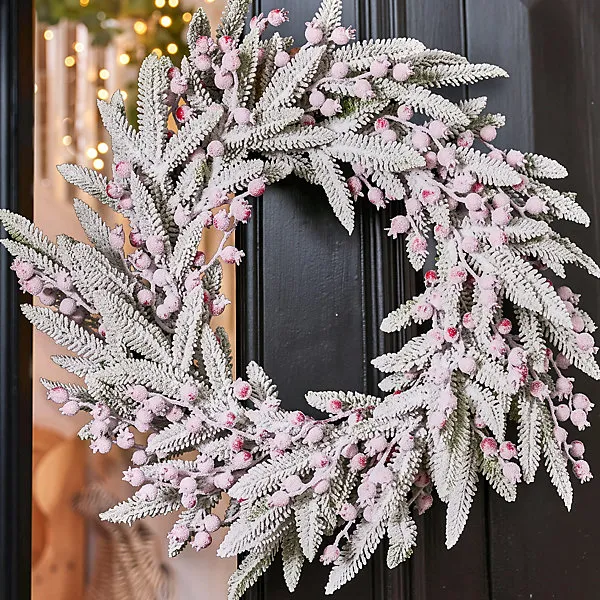
A 24-inch wreath with this much flocking looks closer to 27 inches on a door, so account for that when you measure. It’s happiest on a door at least 34 inches wide with a solid dark finish — the contrast is what makes the pink read at all. In a narrow entry under 3 feet, use a 20-inch version and skip the garland. For a brighter, higher-contrast entry, look at Idea #20.
24. Pinecones, Red Berries, and Silver Leaves on Navy
- Measure your door width — a 24-inch wreath needs at least 34 inches of door.
- Check which way your entry faces; north-facing doors hold reds longer.
- Confirm the wreath’s depth clears your storm door or screen.
- Decide on a hanger now — over-the-door hooks beat adhesive in cold.
- Set a floor of about $70 if you want real pinecones and berry clusters.
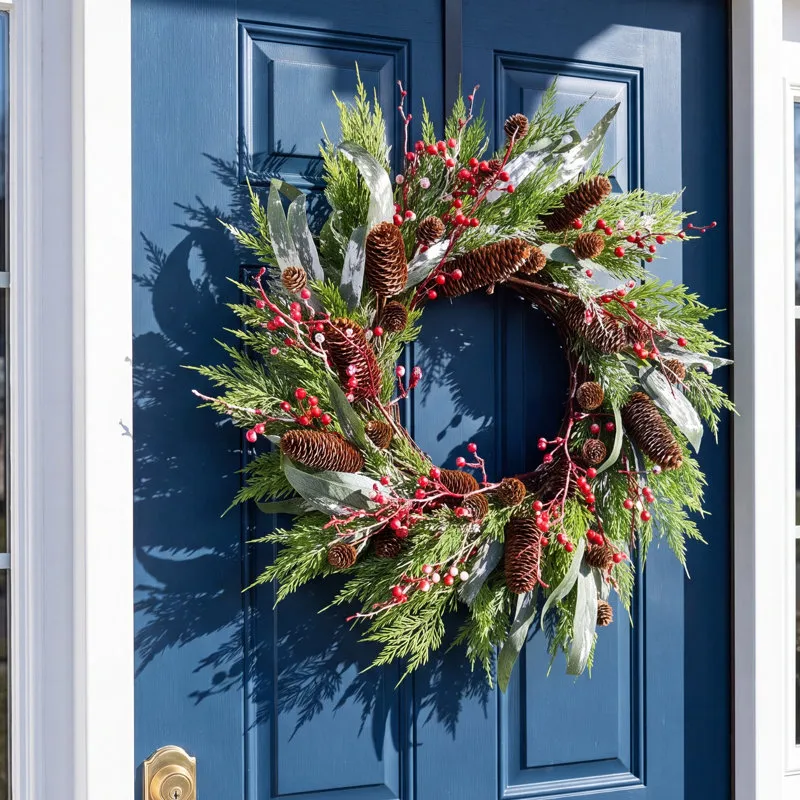
The palette runs 55% deep green foliage, 20% navy door, 15% red berries, 7% brown pinecones, 3% silver accents. The silver is the seasoning — much of its job is keeping the navy from reading black in low winter light. To soften the whole thing, trade navy for slate blue and silver for brushed gold. The proportions stay identical; only the temperature moves.
25. Lighted Garland, Arched Transom, Ornate Gold Planters
- Pre-lit garland, 9 ft: $60–$140
- Matching pre-lit wreath, 24 in: $45–$110
- Two potted evergreens, 4 ft: $90–$260
- Ornate gold planters, pair: $50–$180
- Clips, ties, and outdoor timer: $20–$35
- Total: $265–$725
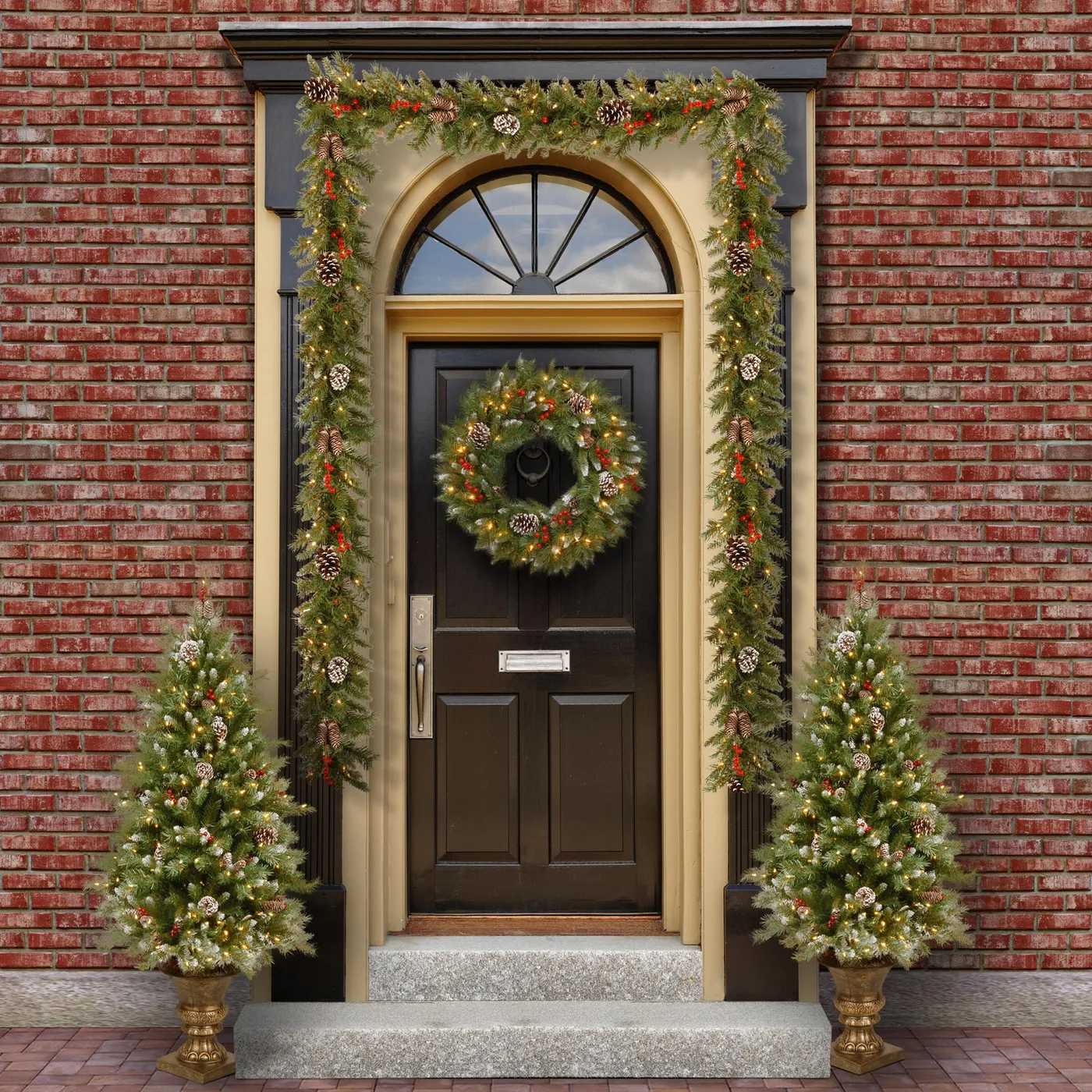
Budget alternative: two thrifted urns spray-painted gold ($15 total) plus unlit garland and your own light strand — about 55% less. Arched transoms are gorgeous and terrible for hanging things, by the way. Garlands need to clear the arch, which means a curved frame or accepting that the swag cuts across it. And potted evergreens on stone steps freeze solid and stop taking water by December.
26. Colorful Ornaments and Warm Lights on a Full Garland
Cap yourself at three ornament colors plus one metallic. Blue, silver-white, and green-gold plus a single warm metallic looks rich; add orange-red and gold and you’ve crossed into carnival. Hang the largest ornaments first, spacing them about 8 inches apart along the front face, then fill the gaps with smaller pieces recessed an inch or two behind. Depth is what separates a decorated garland from a beaded one.
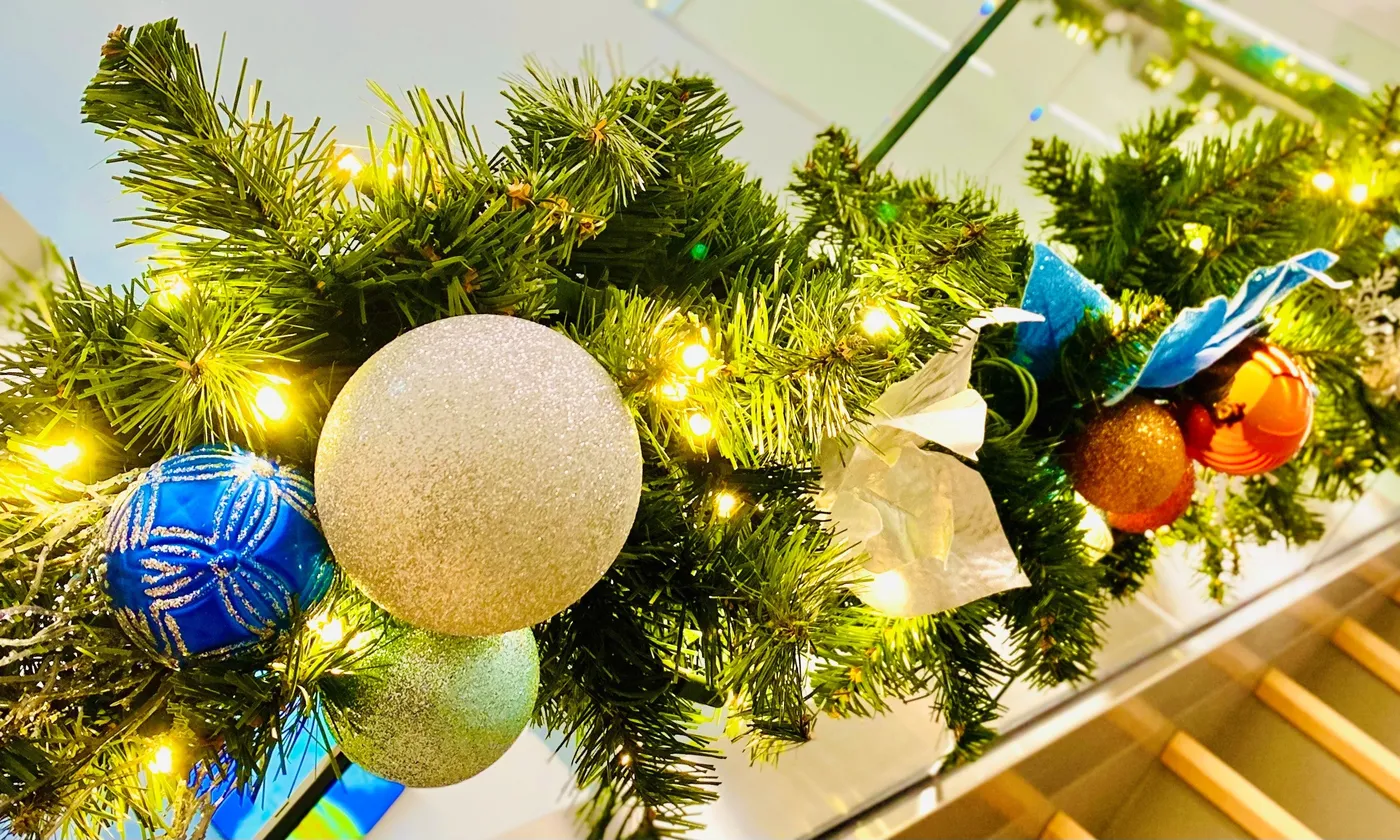
The light strand is the one thing here. Everything else is negotiable — swap the blue ornaments for teal or the fabric flowers for pinecones and it still works. Without the warm-white string lights woven underneath, this is just a green rope with baubles. The lights give it depth, glow, and that blurred warmth that makes holiday entry photos so hard to resist. Compare with Idea #13, where the same idea goes flat-lay.
27. A Round Welcome Sign Wrapped in Frosted Pine
- Measure the sign’s diameter — 12 to 14 inches is the door sweet spot.
- Check that your hanging point is rated for the weight of added greens.
- Sand and seal unfinished wood before it meets wet fir branches.
- Lay out bows and pinecones on a table before attaching anything.
- Test-hang in daylight to confirm the lettering reads from the sidewalk.
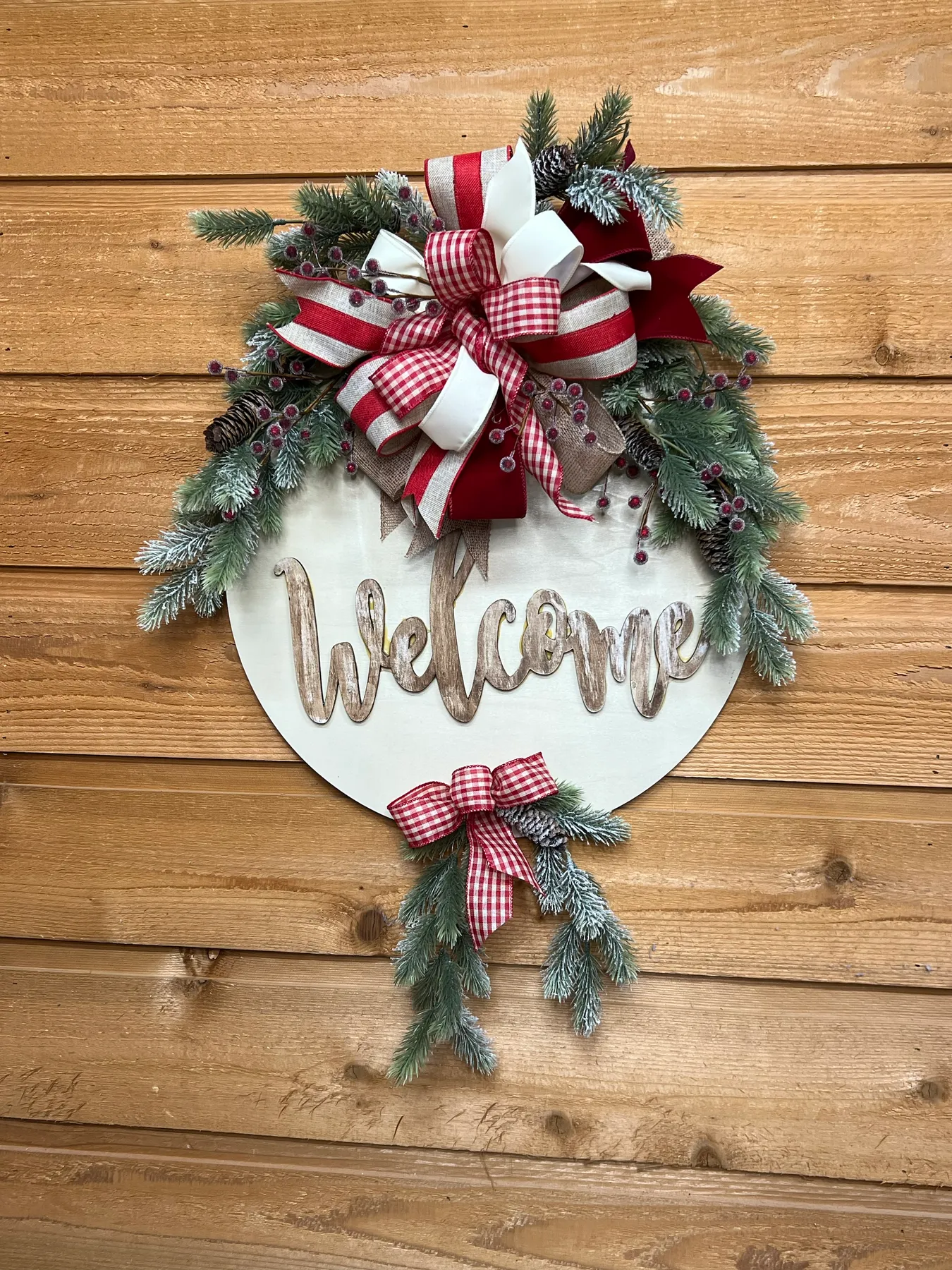
The sign is the expensive part — custom wooden rounds run $40 to $70. A plain craft-store circle is $8 and letter stickers or a stencil add $6. Frosted pine sprays are about $5 each, and pinecones are free if you forage. The red, white, and burlap bow cluster is the one place to spend: layer 2.5-inch ribbon in three widths at roughly $7 each. Total near $45 instead of $140.
28. Gold Hoop Wreath With Mushroom Ornaments
Hoop wreaths look best when the hoop is 12 to 16 inches — much larger and the open ring reads as a picture frame instead of a wreath. Allow about 6 inches of clearance on each side, because the asymmetry means branches extend further from the hoop on one side. This is the right choice for narrow doors, sidelights, and interior walls where a dense evergreen wreath would feel heavy and crowded.
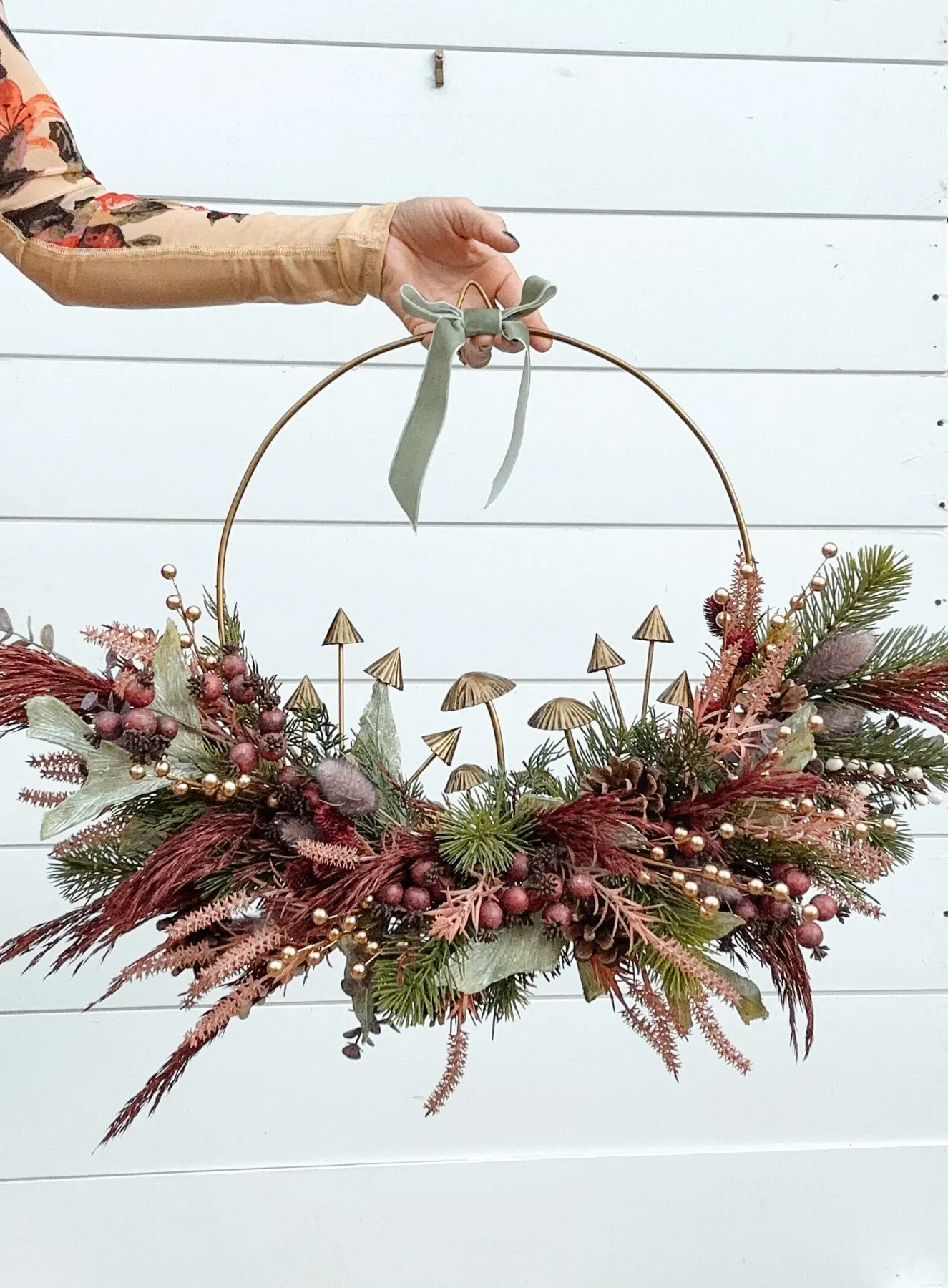
Hoop wreaths took off on Pinterest a few years ago and haven’t slowed down, mostly because they photograph with so much negative space. What’s new for 2026 is the ornament selection — mushrooms, gold pearls, and small ceramic figures instead of the usual baubles. The hoop itself is reusable: buy one brass ring and swap the greenery and accents every season. See Idea #2 for a maximalist take on metallics.
29. All-Red Velvet and Sequin Bow Wreath
There’s essentially no greenery in this wreath’s visible mass — it’s matte red velvet bows layered against sparkling red sequin fabric. That’s a texture study, not a color one. Matte next to glitter at the same hue makes both read stronger, and against the white paneled wall the whole thing becomes a single saturated shape. The cream upholstered chair in the foreground hints at where it really belongs: indoors, near a tree.
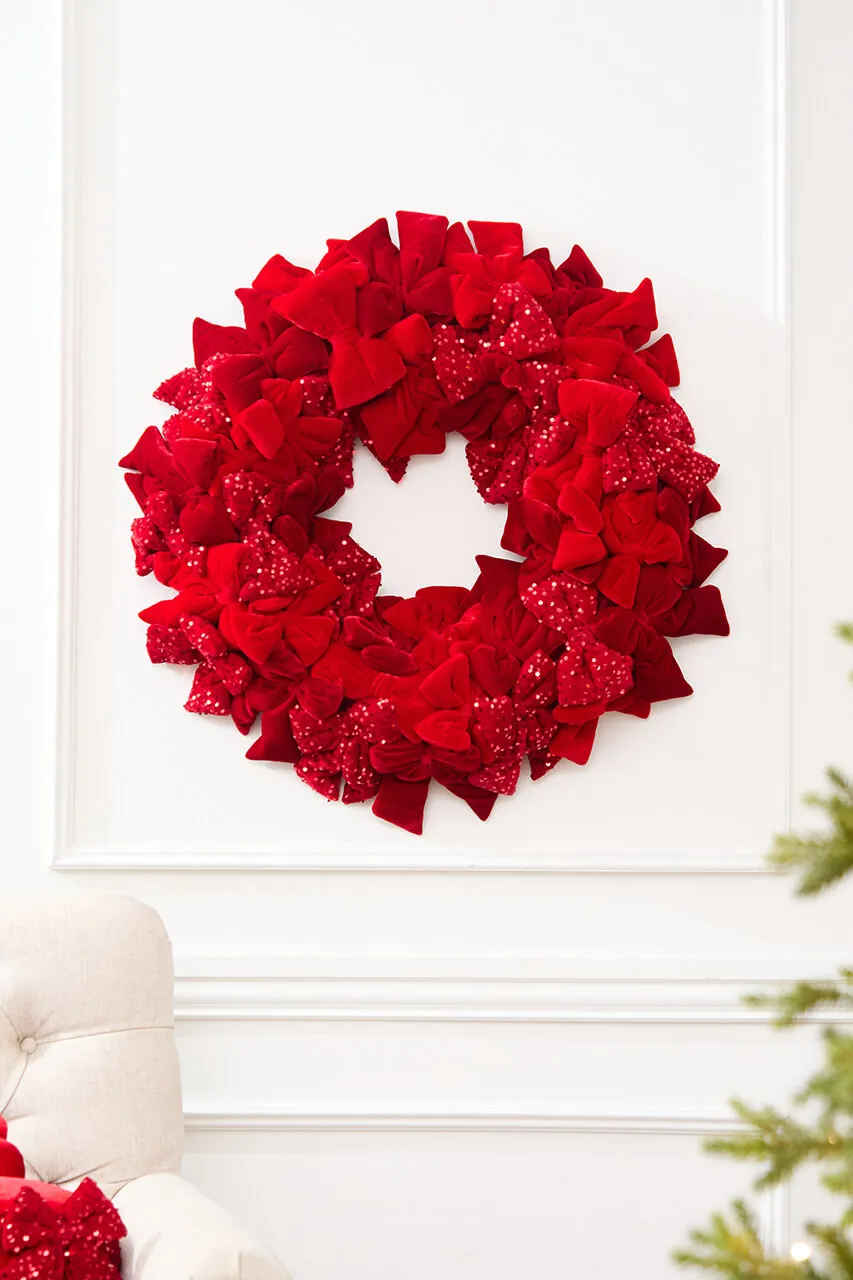
- Velvet ribbon, 6 yards: $24–$60
- Sequin fabric, half yard: $10–$25
- Wire wreath frame, 18 in: $4–$9
- Red berry and greenery filler: $12–$30
- Floral wire and pins: $5–$10
- Total: $55–$134
Budget alternative: hit the after-Christmas sales for velvet ribbon at 70% off and buy sequin remnants from a quilting shop — a similar wreath lands near $30.
30. All-White Frosted Wreath With Silver Pinecones
White decor is the least forgiving thing you can hang. Flocked needles yellow gradually, white berries show dust instantly, and glitter travels — you’ll find sparkle on the door frame for months. Keep it out of direct sun, brush it with a dry soft brush monthly, and never store it in a black garbage bag, which can transfer dye. A cared-for white wreath runs three or four seasons; a neglected one looks grey by February.
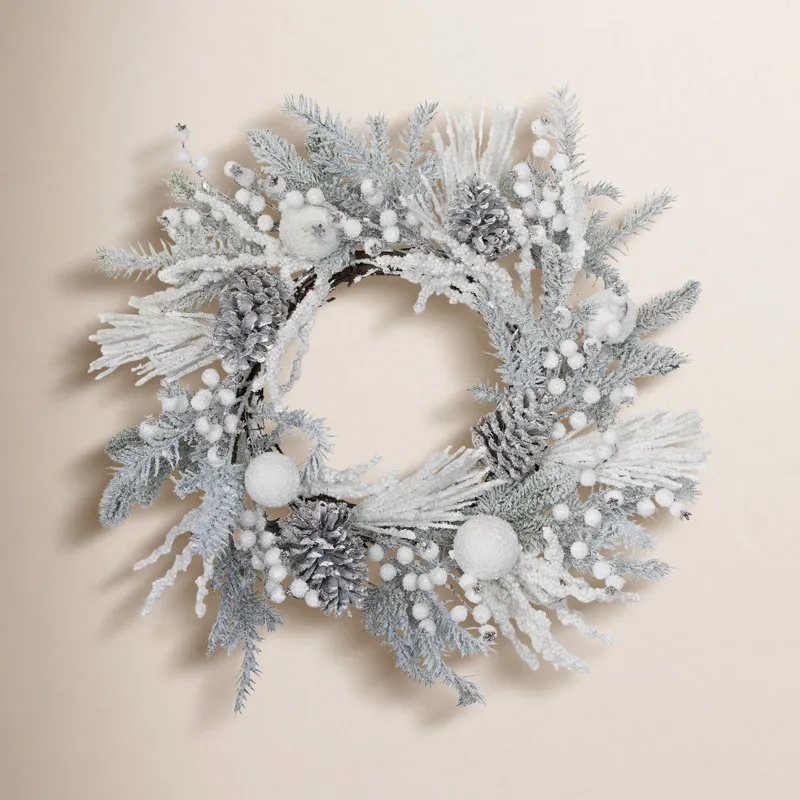
- Confirm your door contrasts — white wreaths vanish on white doors.
- Weigh the wreath; a dense 26-inch white wreath can hit 5 pounds.
- Choose a hanger rated for that weight, not a suction cup.
- Plan storage: a clear bag with tissue, not a cardboard box.
- Decide indoor or outdoor — this finish fades faster outside.
Your Front Door Deserves the First Word
Start with the ribbon, not the greenery — one roll of velvet or plaid will tell you immediately whether your door wants classic red, quiet sage, or full jewel-toned glam, and everything else follows from there. Then photograph the entry from the sidewalk before you commit, because the front door is the one decorating project where the long view is the real view. 📌 Save this to Pinterest for later — you’ll want to revisit these ideas when the wreaths hit the shelves.