You know that feeling when you scroll past a staircase wrapped in a plaid runner and lit by tiny brass lanterns, and your thumb just stops? That’s the Ralph Lauren Christmas aesthetic doing its quiet thing — tartan, warm brass, candlelight, and just enough horse-country nostalgia to make your house feel like a lodge you’d actually want to be snowed into. We spent serious time browsing Target, Amazon, and Etsy to bring you only what’s worth your attention this year, and everything here lands between $18 and $1,200.
Inside you’ll find 30 curated ideas — traditional equestrian, tartan plaid, rustic cabin, and a little blue-and-white chinoiserie — from stair runners and mantels to tablescapes and full-room schemes, with budget and luxury versions compared side by side. And stay until the end — we break down the most common mistakes that can ruin these looks.
The reason this look keeps topping Pinterest saves every November is that 2026 decorating has swung toward rooms that feel collected rather than decorated. This post contains affiliate links — if you buy through them, we may earn a small commission at no extra cost. 📌 Save this to Pinterest for later — you’ll want to revisit these ideas.
1. Plaid Stair Runner, Candlelit Lanterns, and Pine
A staircase is the one spot in the house where you’re forced to slow down and look. The plaid runner sets a vertical stripe up the middle, the garland swags along the rail, and the framed equestrian and wildlife prints on the beige wall repeat those same rectangles in a slower rhythm. Nothing here is loud. It works because almost every element is a clean horizontal or vertical — no curves competing, just a quiet grid of tartan, brass, and pine that reads polished the second you open the front door.
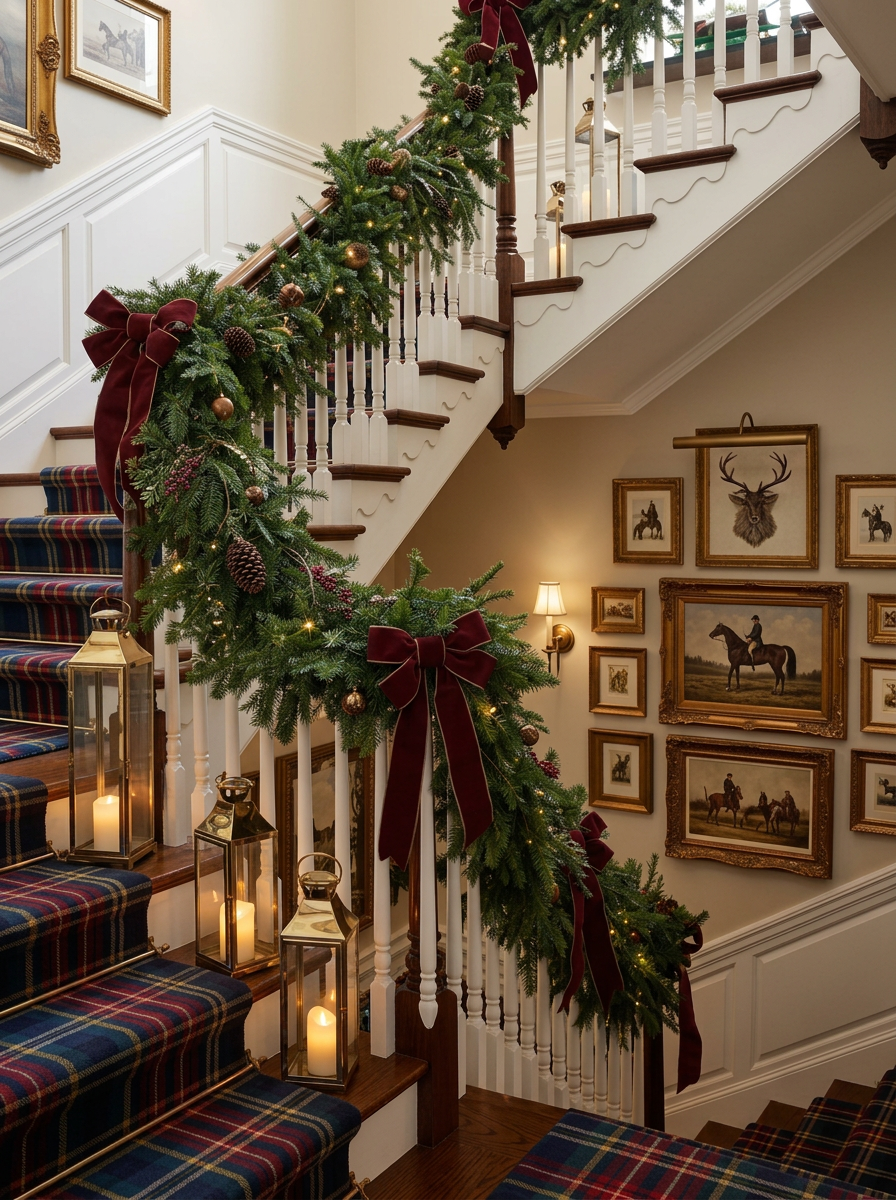
- Wool or wool-blend plaid stair runner: $180–$650
- Pre-lit faux pine garland, 9–12 ft: $45–$150
- Brass candle lanterns, set of four: $60–$240
- Wired velvet ribbon for bows, three rolls: $24–$66
- Framed equestrian and wildlife prints: $90–$400
Total: $399–$1,506. Budget alternative: Facebook Marketplace is full of runners pulled from staging houses, and IKEA’s pre-lit garland plus a set of Amazon brass lanterns lands the whole thing near $220.
Take the runner away and this is just a staircase with some greenery on it. The plaid is what makes the garland look intentional instead of decorative — it gives the pine something to answer to. If you’re doing one thing to your stairs this year, make it the runner, then let the garland follow the same color family. Navy and burgundy will always beat red-and-green here, because they read as textile rather than wrapping paper.
2. Charcoal Paneling, Brown Plaid Stockings, and Hearth Benches
Stagger your stocking hooks instead of hanging them in a straight line. Mount brass hooks 14, 16.5, 19, and 21.5 inches down from the underside of the mantel, left to right, and the stockings fall in a gentle arc that photographs beautifully without any two bottoms landing at the same height. Keep the lowest stocking at least 15 inches above the top of the firebox opening, and use a hook rated for 5 pounds even when the stocking is empty.
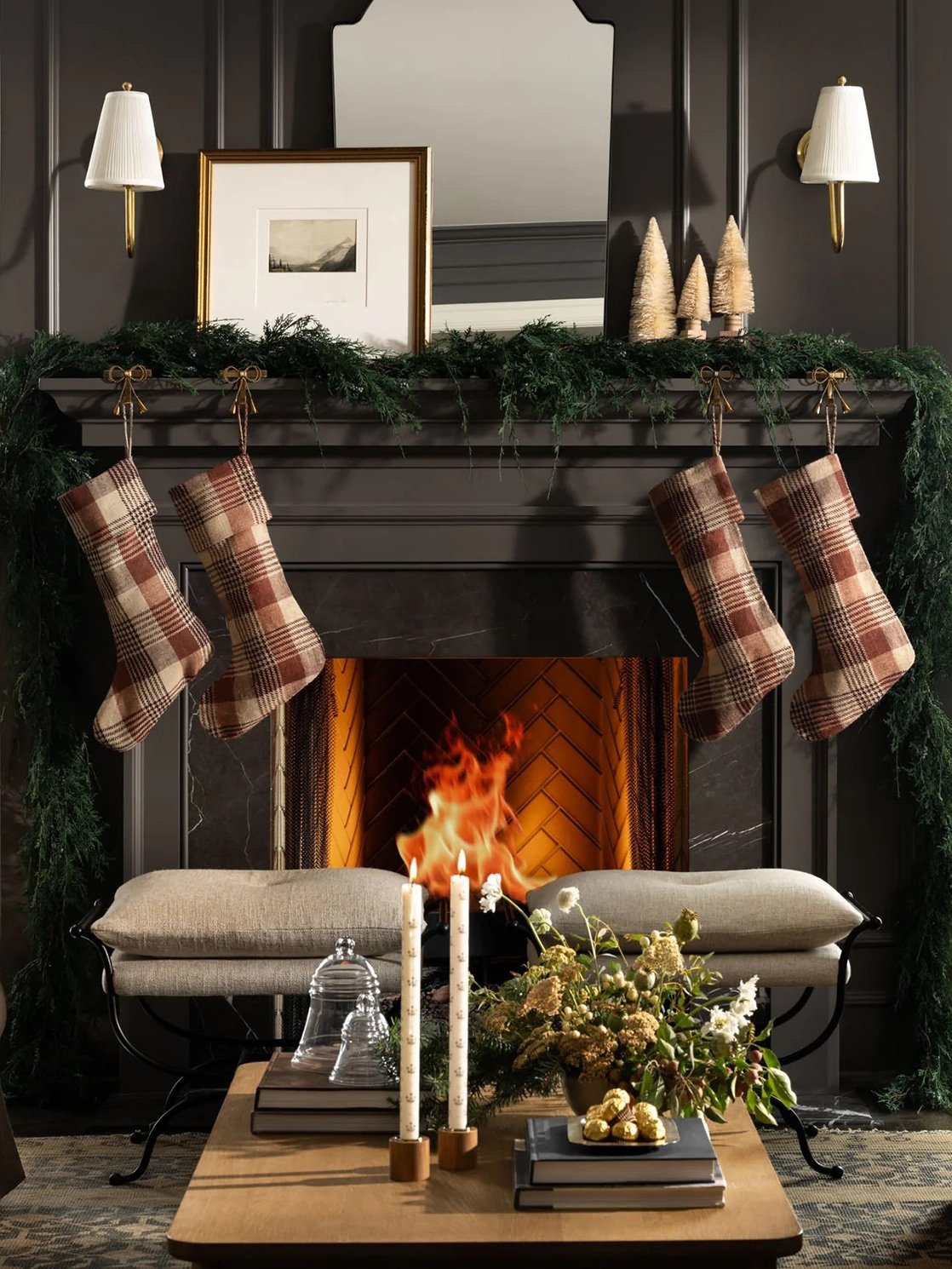
The formula here runs roughly 60% dark charcoal, 25% brown-and-tan plaid, 10% forest green, and 5% brass. Swap the charcoal paneling for deep navy and the whole thing gets dressier; switch the brown plaid to red tartan and it turns traditional Christmas fast. Keep brass constant either way — it’s the only warm note in a cool room, which is exactly why those sconces with white pleated shades read like jewelry instead of hardware.
3. Red Velvet Ornaments and Knit Stockings Against Black
This pairing needs a wall about 9 feet wide to breathe: a 7- to 7.5-foot tree, a 36-inch buffer so you can actually reach the mantel, and an 8-foot ceiling minimum. If the tree lands within 24 inches of the fireplace surround, the ornaments and the garland start fighting for the same visual space. Tighter rooms do better with a slim 6-foot tree tucked into the corner and a shorter garland, like the arrangement in Idea #16.
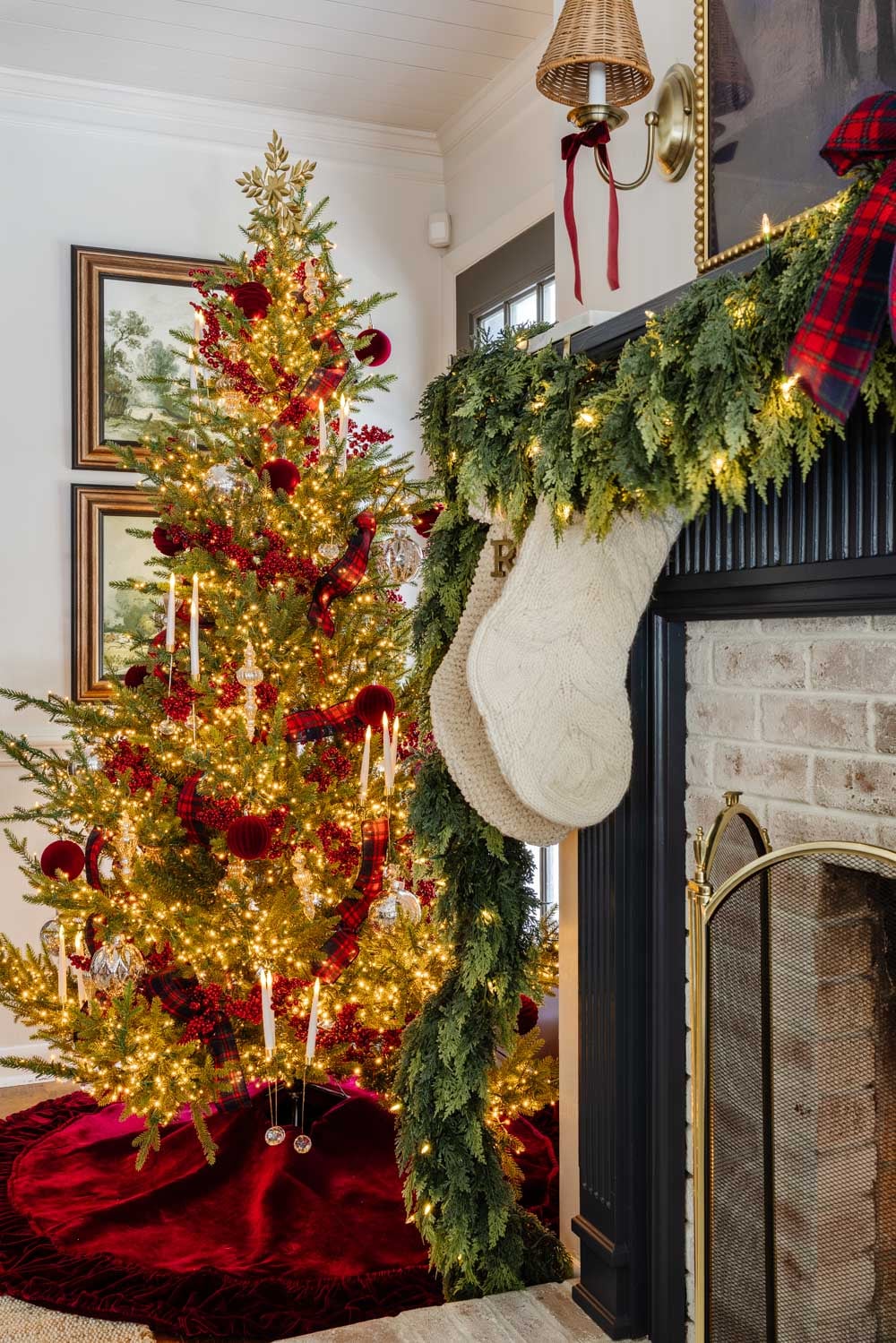
Walmart and Target both sell pre-lit 7.5-foot trees for under $130 most Novembers, and knit stockings run $12 to $18 each at Target. Buy plain red velvet ball ornaments in bulk packs of 24 instead of designer singles, then add one spool of wide plaid ribbon with a 40% off coupon. A brass-toned fireplace screen gets you 90% of the look for roughly $280 total, versus $1,100 to $2,000 for the antique version.
4. An Antler Chandelier Over a Dark Green Plaid Table
- Turn the chandelier off and let the bulbs cool completely.
- Cut faux pine into 4- to 6-inch sprigs and thread them between the antler tines, working from the center outward.
- Secure each cluster with one green zip tie, hidden behind the pine.
- Tuck three or four small berry sprigs near the black shades so they catch the light.
- Trim the ties, then step back and judge it from the doorway.
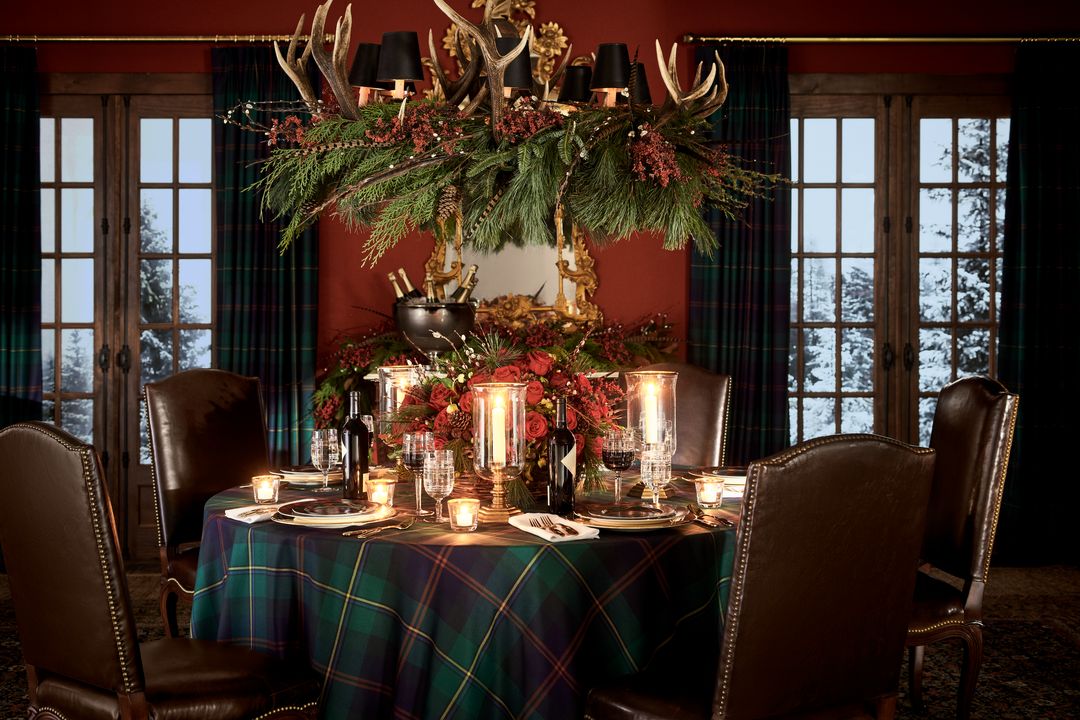
About 25 minutes and $18 to $35 in materials.
The tablecloth. Everything else in that room — the red walls, the plaid curtains, the brown leather nailhead chairs — is heavy on its own. The dark green and navy plaid tablecloth is what pulls the color from the French doors across the room to the center and softens all that furniture into one group. Swap it for plain linen and the room instantly splits into a red half and a brown half. Keep the plaid, and let it drape 10 to 12 inches.
Fresh pine looks best for about nine days, then it starts dropping needles onto your tablecloth. Faux cedar or a mix of faux pine with a few real sprigs on top gets you the same density with none of the cleanup. Leather nailhead chairs want a conditioning wipe twice a year, and deep red walls show scuffs faster than any other color — keep a small touch-up pot in the closet.
5. A Red Exclamation Mark on Your Plaid Plan
Here’s the thing nobody says out loud: tartan is a pattern with volume, and rooms don’t have unlimited volume. If the runner, the stockings, the pillows, the tree skirt, and the napkins are all plaid, the eye has nowhere to rest and the room starts reading as a costume instead of a home. Pick one place per sightline where plaid gets to be the star and let everything else stay solid — pine, brass, cream, leather. The pattern lands harder when it’s rare.
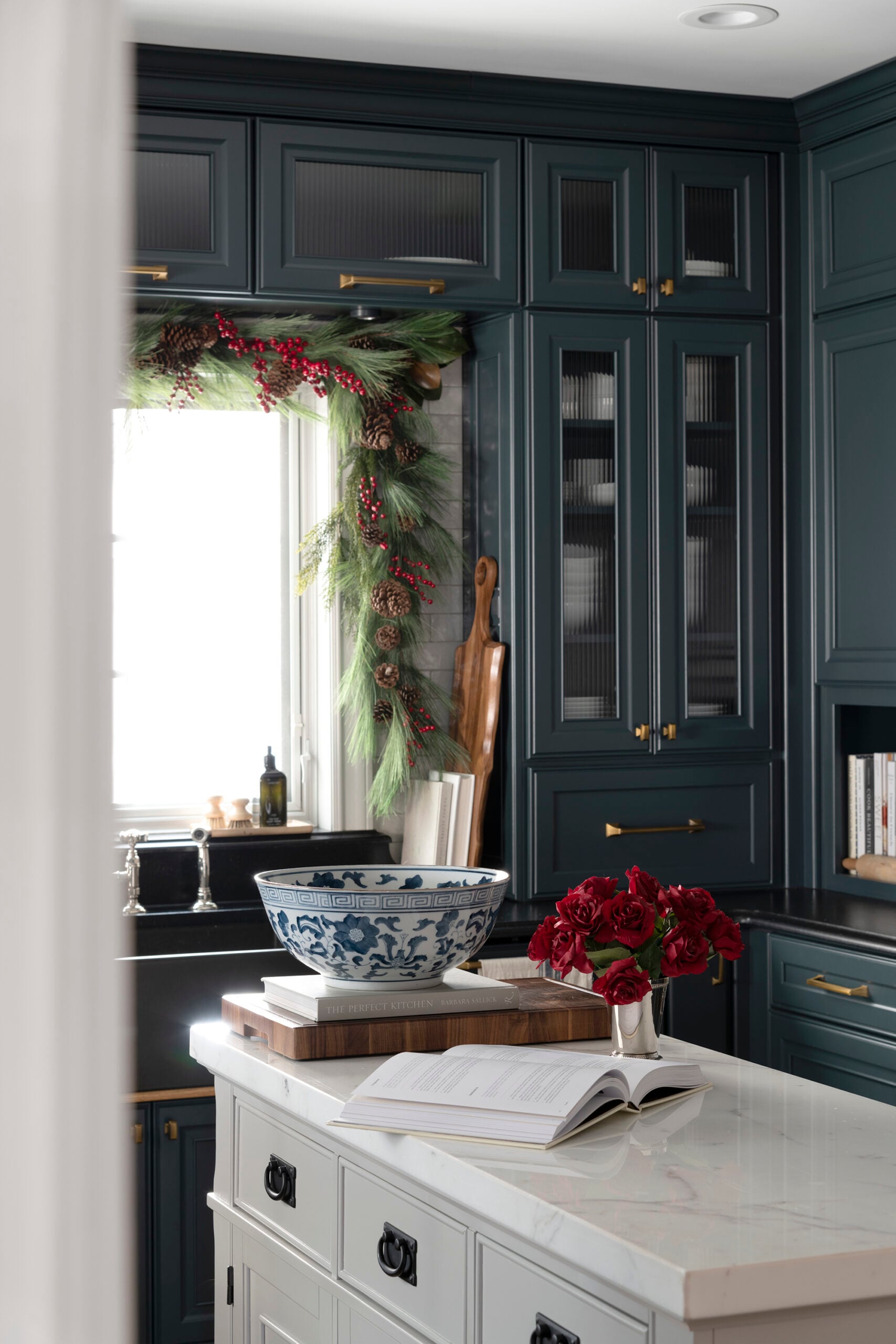
- Stand in each doorway and count how many different plaids you can see at once. More than two is usually one too many.
- Check your plaid scale against the room: small gingham disappears in a big space, giant tartan swallows a small one.
- Confirm your wall temperature (warm cream versus cool gray) before buying tartan — reds go muddy on cool gray.
- Set a hard budget before the after-Christmas sales, or you’ll come home with the fourth plaid throw you don’t need.
6. Evergreen Garland Swagged Across the Ceiling
Hanging garland from a ceiling sounds like a two-person job and a ruined paint job. It’s neither. Use clear adhesive hooks rated for 5 pounds, spaced every 24 to 30 inches along the path you want, and keep the swag depth between 10 and 12 inches — deeper looks dramatic in photos and low in person. Go with lightweight faux cedar or a mixed-tip garland, because fresh pine is heavy enough to pull hooks off drywall. Compare with Idea #1 — same greenery, different altitude.
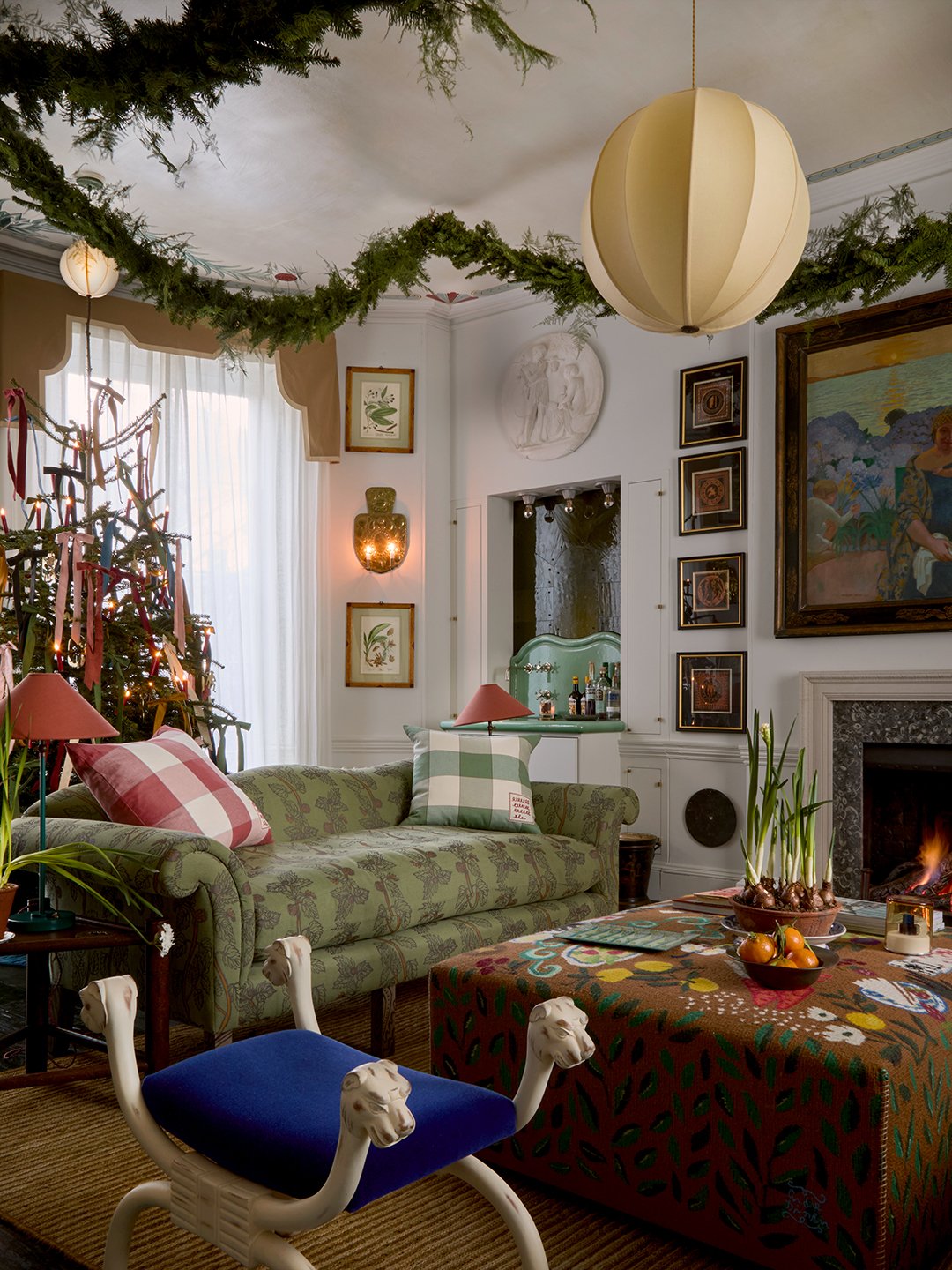
The ceiling line is the most ignored real estate in a living room, and garland up there does something a tree can’t: it frames the entire scene instead of occupying one corner. The round paper globe pendants echo the tree’s round ornaments, so your eye travels up and around rather than stopping dead at the sofa. When the swag, the pendants, and the floral ottoman all sit in different zones, the room reads layered instead of decorated.
7. A Second Red Flag: Greenery That Reads Plastic
Faux greenery has quietly gotten very good. The pieces worth buying in 2026 mix polyethylene needle tips with PVC for shape, which means they hold a bend and don’t reflect light like a shower curtain. The tell is always density — if you can see the wire spine through the branches, it’s too sparse no matter how much you fluff it. Pinterest searches for realistic faux garland climb every November, and the honest reason is that nobody wants to vacuum needles for six weeks straight.
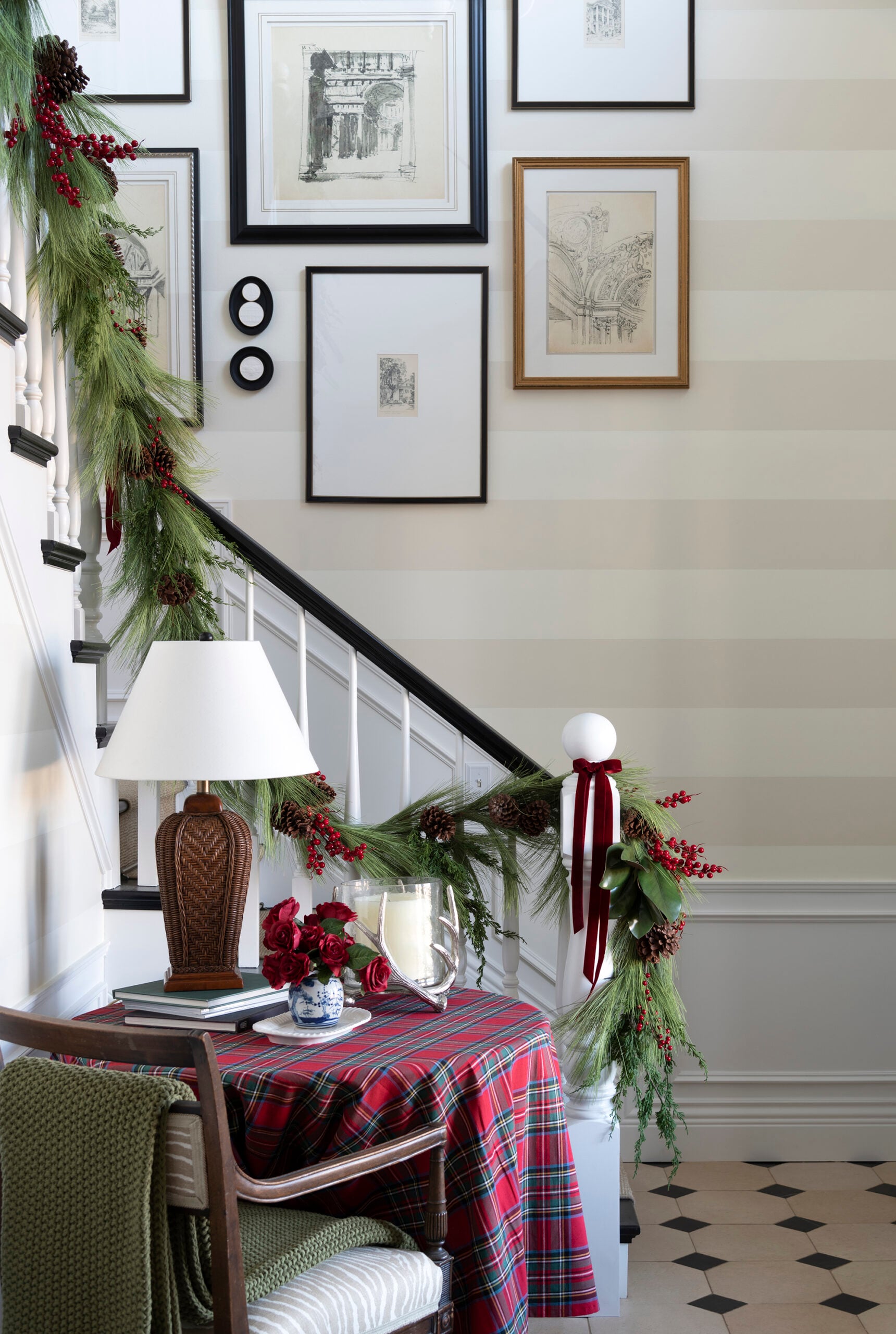
There’s a real gap between a $12 garland and a $90 one, and it shows at about three feet away. Cheap faux pine has a flat, slightly blue-green cast that fights warm brass and burgundy; better greenery has varied tip color and a matte finish. If you’re decorating a mantel you’ll stare at every night, spend the money there and go cheap on the tree skirt. Nobody has ever noticed a tree skirt.
8. A Marquee ‘J’, Bottle-Brush Trees, and Mismatched Stockings
The three mismatched stockings. Green velvet with an initial, red plaid, plain burlap — hung together on a stone mantel, they make the whole thing feel like a real family’s house instead of a catalog page. Match them and you get a display; mismatch them and you get a home. If you’re buying new, deliberately buy in three different materials and keep only the color palette consistent. That’s the entire trick, and it costs nothing extra.
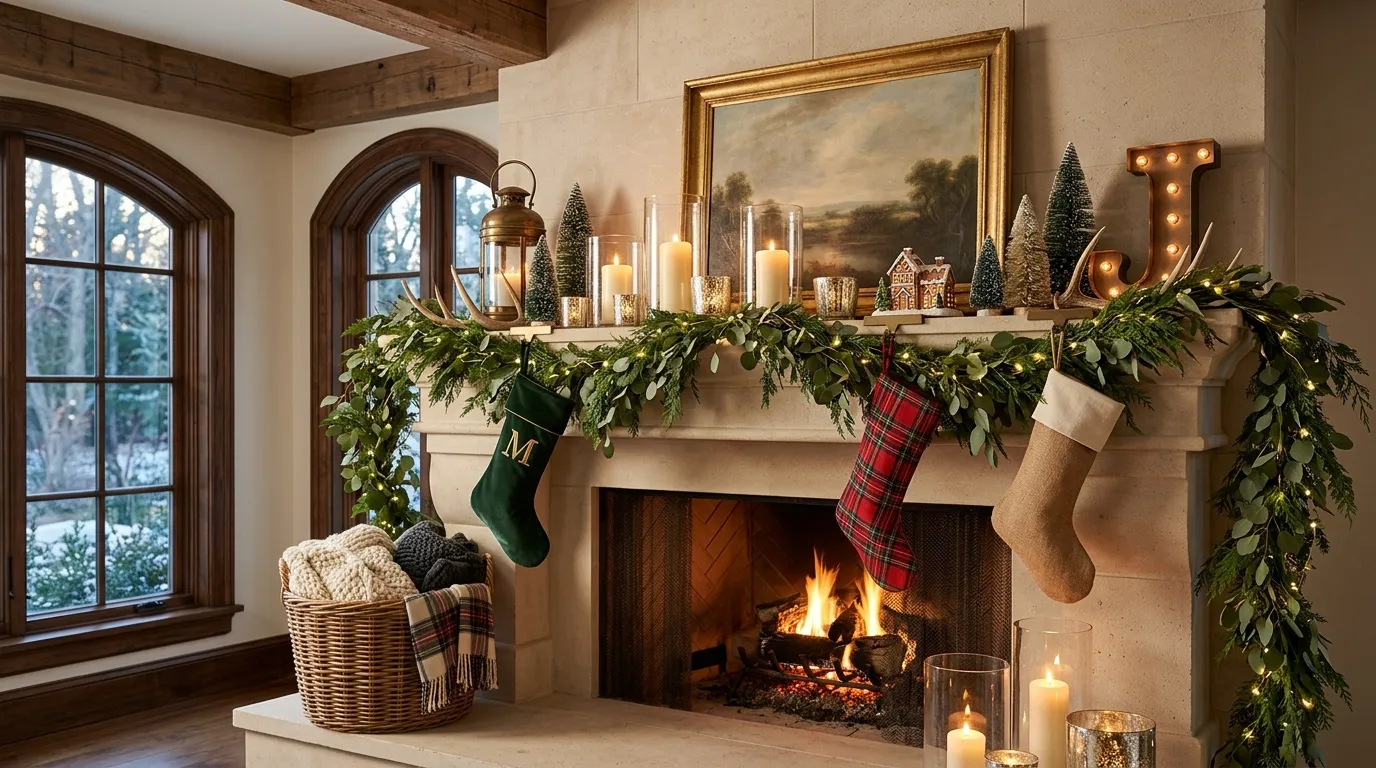
- Lit garland for a 6- to 8-foot mantel: $50–$180
- Three stockings in mixed materials: $45–$150
- Glass cylinder hurricanes and pillar candles: $40–$160
- Bottle-brush trees (set of six) plus a marquee letter: $35–$120
- Woven basket with two knit throws: $60–$220
Total: $230–$830. Budget alternative: thrift the basket and the glass hurricanes, then buy bottle-brush trees in a multi-pack. Around $95 gets you the same mantel.
9. Suzani and Ikat on a Cream Tufted Sofa
Roughly 50% warm neutral base — cream sofa, beige wall — 30% saturated textile in crimson and royal blue, 15% dark wood from the cabinet and picture rails, and 5% gold from the chandelier and frame edges. The formula survives almost any swap: keep the neutral at half, keep the saturated textiles at a third, and you can move from ikat to block print to kilim without losing the room. Gold should never exceed a jewelry amount. It’s the period at the end of the sentence.
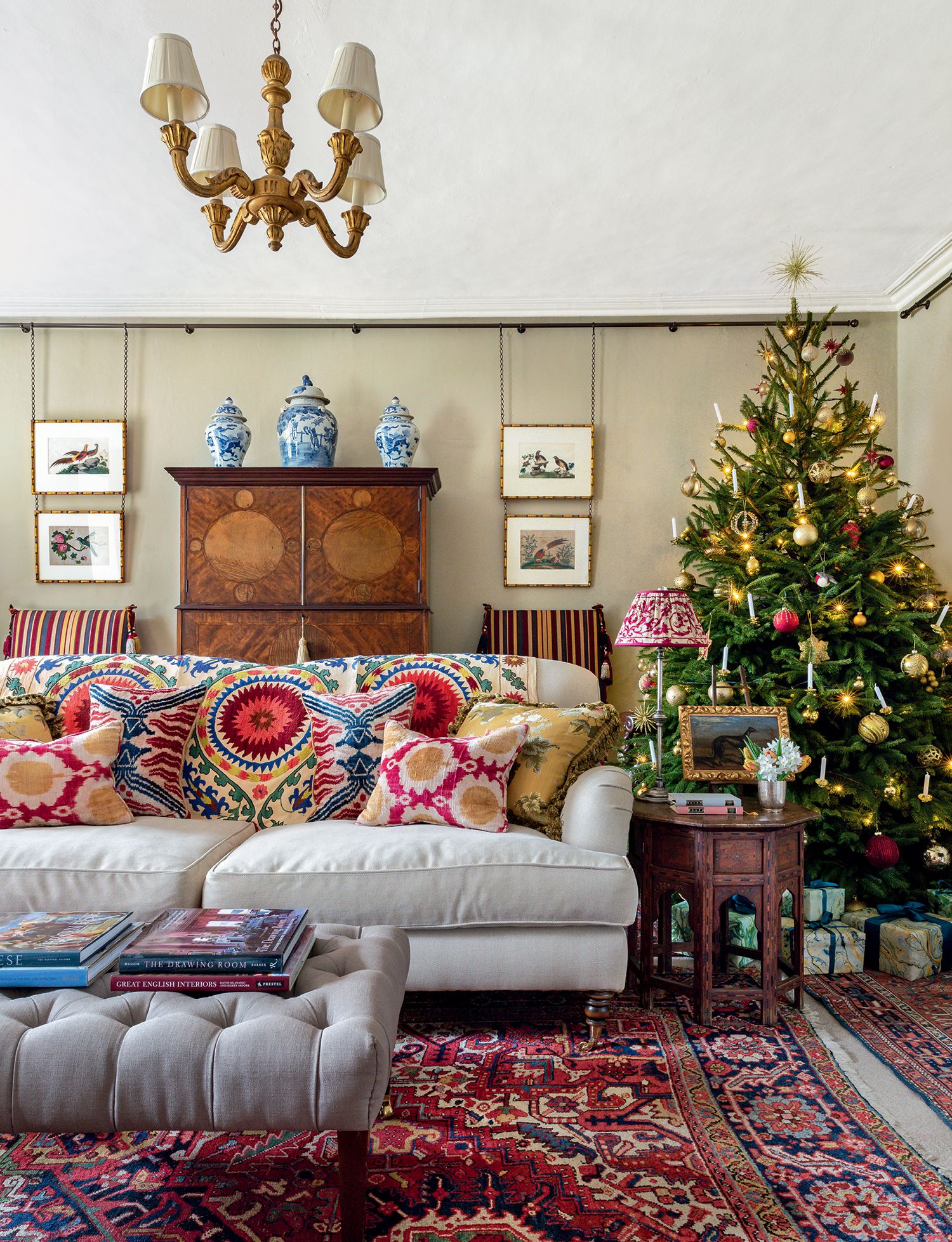
This arrangement wants at least 14 by 16 feet so the tree, the dark wood cabinet, and the sofa each get their own zone. Hang botanical frames from the picture rail at 60 to 66 inches on center, and make sure the red oriental rug extends at least 18 inches past the sofa’s front legs — undersized rugs are the fastest way to make a layered room look accidental. Under 12 feet wide, drop the cabinet and keep the tree.
10. Mustard Leather, a Mirrored Bar, and a Ribbon Tree
Mustard leather armchairs are the expensive part of this room, and you don’t have to play. Target and Wayfair both carry mustard-toned accent chairs in the $180 to $320 range, and a black mirrored bar cabinet can be faked with a plain black console plus two mirrored panels on the doors. Stacked books from a thrift store and a metallic tray finish the coffee table. This is the budget version of Idea #3‘s warmth — more color, less plaid.
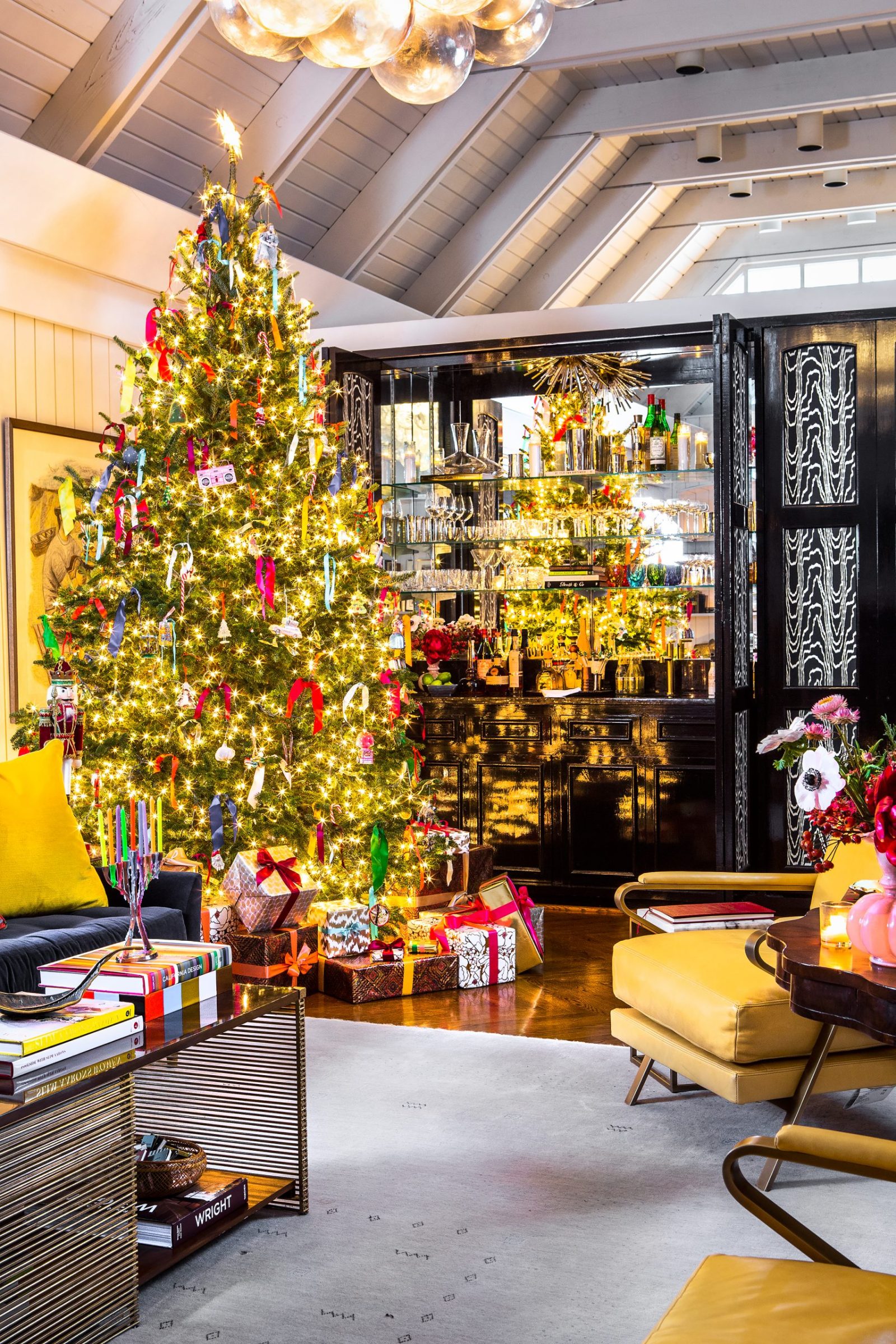
That vaulted white-beamed ceiling is doing quiet work: it gives the tree permission to be eight feet tall without crowding anything. The black mirrored bar cabinet then bounces the tree lights back into the room, which is why the space glows instead of just being lit. Mustard and warm gold sit right next to each other on the color wheel, so the armchairs and the tree read as one warm note rather than two competing colors.
11. A Horse in a Plaid Blanket Above the Fireplace
For a tree in a woven basket, choose a basket 4 to 6 inches wider than the stand and at least 14 inches tall so the mechanics disappear. Line it with a black contractor bag, drop in a 12-inch concrete paver for weight, then set the stand on top. Run the cord out the back through a notch you cut in the liner. A 7-foot tree needs about 30 pounds of counterweight at the base, and this gets you there without a plastic skirt in sight.
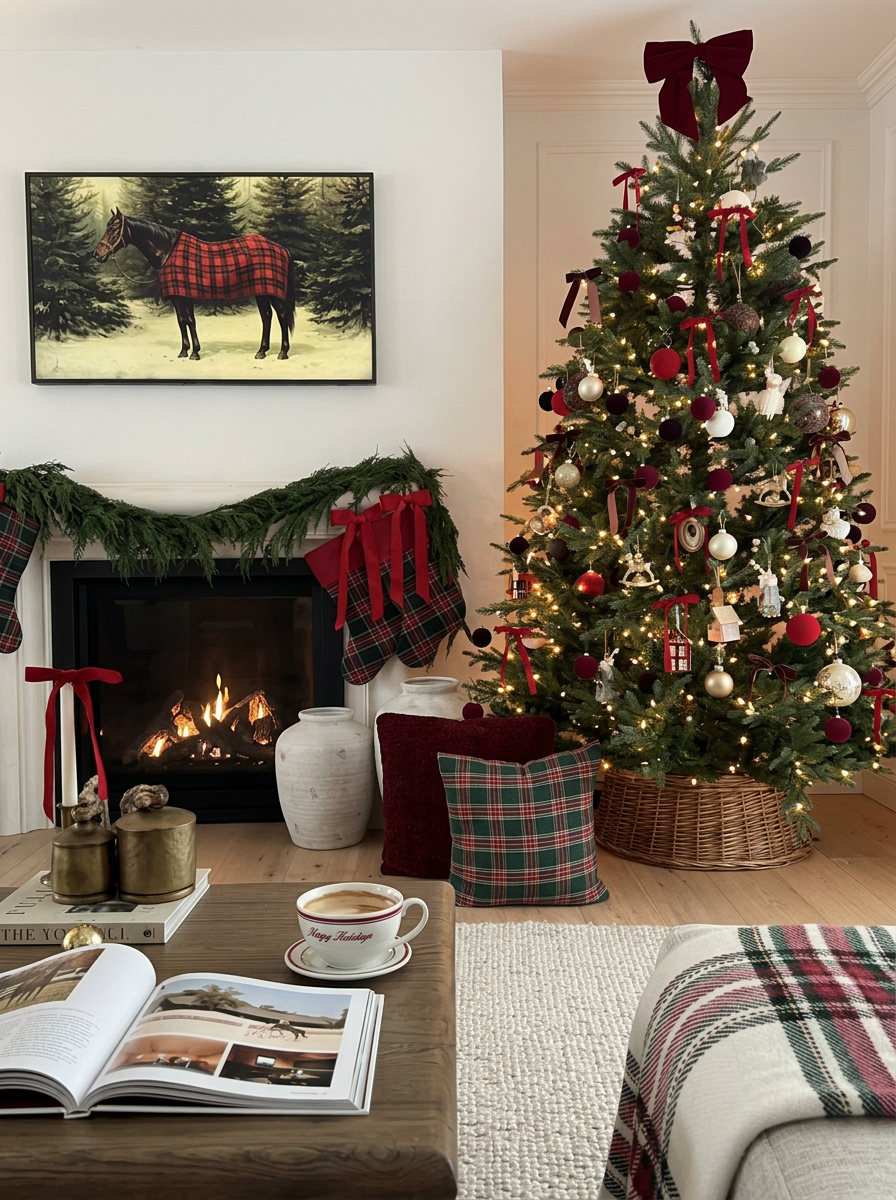
The framed horse in the red plaid blanket. Without it, this is a nice plaid-and-pine living room. With it, the whole scheme has a subject — the plaid in the painting rhymes with the stockings, the bows, and the pillows, and suddenly everything looks collected rather than coordinated. If you can only hang one piece of art this season, hang something with the same pattern vocabulary as your textiles. Cheapest cohesion you’ll ever buy.
12. Tartan Pillows Against Dark Wood Paneling
Wool tartan pills, and it pills faster on a sofa than anywhere else. Plan on a fabric shaver every couple of weeks through December, and dry clean the pillow covers — most tartan blends shrink in a warm machine wash. Layered traditional rugs need rotating twice a year so the traffic path doesn’t fade a stripe into the pile, and dark paneling shows every fingerprint, especially around light switches and the mantel edge. Four minutes a week with a microfiber cloth keeps it.
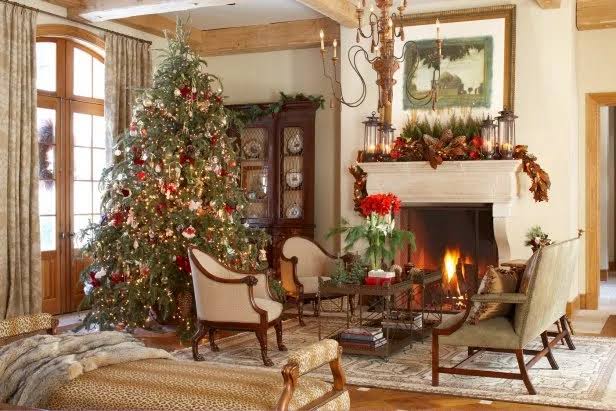
- Pre-lit 7.5-foot tree: $120–$600
- Plaid ribbon and tartan ornaments: $60–$200
- Tartan throw pillows, set of four: $50–$180
- Leather sofa or slipcover upgrade: $400–$2,500
- Layered area rugs: $150–$900
Total: $780–$4,380 — and yes, the leather sofa eats the budget. Budget alternative: keep your existing sofa, add four tartan pillows and a plaid throw, and put the money into the tree and rugs instead. Under $350 for the whole refresh.
13. A Black Candle Chandelier Wrapped in Pine
- Turn the fixture off at the breaker and let the candle sleeves cool.
- Cut faux pine into 5-inch sprigs and tuck them around each candle cup, alternating direction.
- Weave one continuous strand through the arms so the greenery reads as a single garland, not separate bunches.
- Add battery-operated LED tapers so you never have to light anything.
- Check clearance — nothing closer than 6 inches to a bulb.
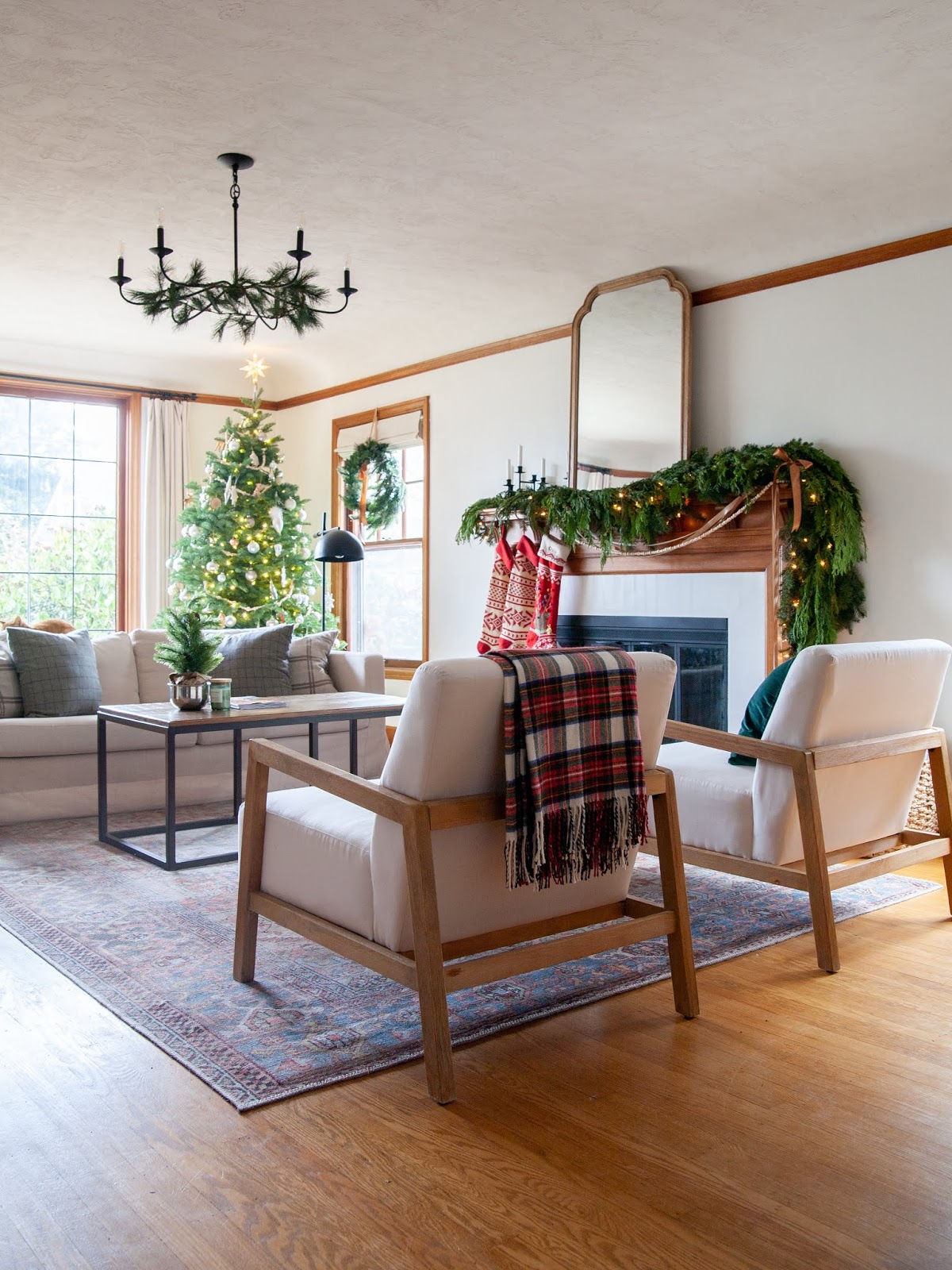
Roughly 30 minutes and $20 to $45 in materials.
Wood-frame armchairs with light cushions can be had at IKEA for a fraction of custom upholstery, and a matching slipcovered sofa runs $600 to $900. Thrift the patterned rug. A plaid throw over one armchair is the only textile you actually need to buy new. Total for the room refresh: about $900, versus $4,000 or more for the designer version — and that chandelier doesn’t care what the sofa cost.
14. A Wreath Hung Over a Round Gold Mirror
Round over round should look redundant, and it doesn’t here — because the wreath is smaller and offset just slightly, it reads as a halo rather than a copy. The gold candlesticks on the mantel echo the frame, the pattern on the beige sofa’s plaid pillows pulls red across the room from the tree, and the tray on the coffee table gives the eye a resting point at knee height. Three heights, three materials, one palette. For the same trick on white brick, see Idea #24.

Hanging a wreath on a mirror means you lose the reflection you hung the mirror for, and that’s fine as long as the wreath doesn’t swallow the glass. Keep it no wider than about half the mirror’s diameter; a 24-inch wreath on a 48-inch mirror is the sweet spot. Skip the sticky hook — run fishing line over the top of the frame and tape it to the back so nothing shifts when a door slams. Real cedar dries fast in heated rooms, so mist it every other day.
Best in a room 12 by 14 feet or larger, with a mantel at least 60 inches long and a 7- to 7.5-foot tree beside it. Under 11 feet wide, the tree and the mantel start competing for the same corner, and you’re better off with a slim pencil tree like the ones in Idea #16 or Idea #18. Ceiling height of 8 feet is the floor here; 9 makes the whole thing feel generous.
15. The Red Flag Before You Buy Another Plaid Throw
- Measure where the throw will actually live — a 50-by-60-inch throw looks lost on a deep sectional.
- Check whether your existing plaids are warm red or cool red before adding a fourth one.
- Decide if the throw is for looking at or for using. Wool tartan is beautiful and scratchy.
- Confirm the return window — holiday textiles sell out fast and exchanges get ugly in December.
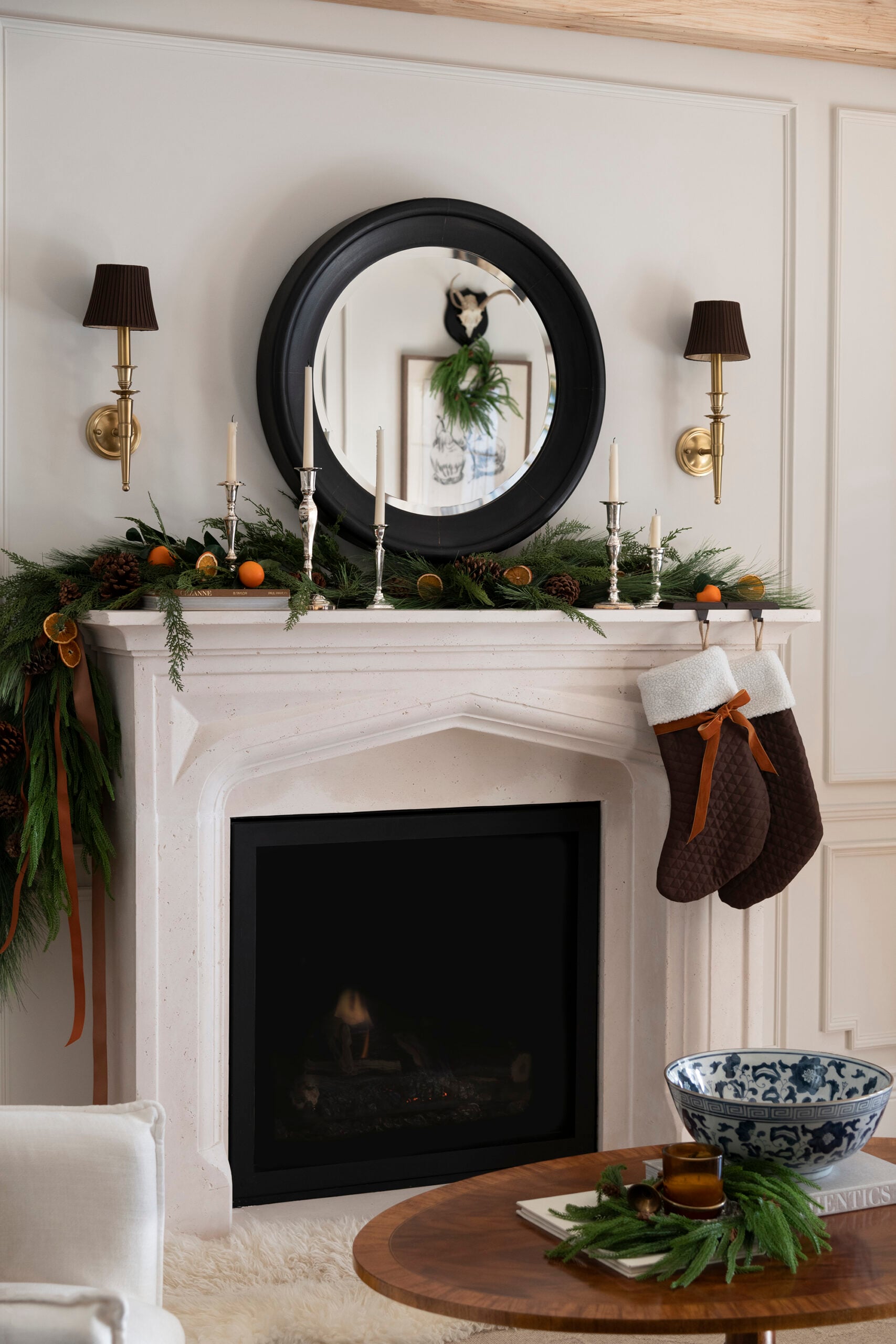
One throw does more than three. Drape it folded in thirds over the arm or back of a chair so the fold line stays visible — a blanket spread flat across a whole sofa flattens the room. If you want the tartan to read as a design choice rather than a laundry pile, keep it to a single item per seating area and let the pillows stay solid. Repeating the same pattern five times doesn’t make a room cohesive. It makes it loud.
16. A Red Tartan Tree Skirt Beside a Lit Stone Fireplace
- 7.5-foot pre-lit tree: $130–$650
- Red tartan tree skirt, 48-inch: $35–$120
- Glossy ornaments in red, gold, and silver, 100-piece: $45–$150
- Two extra strands of string lights: $20–$50
- Fire-screen brush and wood-safe cleaner: $15–$40

Total: $245–$1,010. Budget alternative: a plain red skirt plus plaid ribbon pinned around the hem fakes the tartan border for about $20, and a 100-piece ornament set runs under $40.
The ratio here is simple: about 55% forest green from the tree itself, 25% crimson from the ornaments and skirt, 15% metallic gold and silver, and 5% warm fire orange from the lit stone fireplace. That last 5% is the one people forget to count, and it’s why this room feels warmer than a tree lit in a cold corner. Swap silver for more brass and it goes traditional; swap the gold for all silver and it turns slightly Scandinavian.
17. A Rocking Chair, One Plaid Blanket, and Firelight
A chair pulled out into the room near the fire is lovely in photos and a shin-bruiser in real life. Keep at least 18 inches of clearance between the rocker’s back and the nearest walkway, and if you have small kids or guests over 70, a stationary chair with the same plaid blanket does everything the rocker does without the trip hazard. Also check the rug: deep shag under a rocker will stall the runners, while a low-pile or flatweave lets it move the way it should.

- Fold the plaid blanket in thirds lengthwise.
- Lay it across the seat and over one arm, letting one end fall toward the floor.
- Gather the middle and tuck it loosely behind the backrest so the fold holds.
- Fan the tail end so the fringe shows, then step back three feet to check the drape.
Two minutes, no hardware, and nothing to buy if the blanket is already in the closet.
18. Blue-and-Cream Plaid on a Tufted Cognac Sofa
Scale your pillow plaid to the pillow, not to the sofa. On a 20-inch pillow, a check larger than about 2.5 inches reads as a graphic print from across the room; smaller than 1 inch and it looks like static. Blue-and-cream plaid against cognac leather works because the two sit at nearly opposite ends of the temperature scale — cool pillow, warm hide — and the white fringed throw in between keeps them from actually touching. Three textures, two colors, zero red.

Navy and cognac has quietly become the 2026 alternative to red-and-green, especially in rooms with paneled walls or dark trim. It reads festive without reading holiday-card, which means you can leave it up through January and nobody blinks. The trade-off is that navy needs warm light to feel cozy — hence the lit miniature evergreen and the amber glow on that dark blue paneling. Under cool white LEDs, this palette goes cold and corporate fast.
The white fringed throw. Without it, the brown leather and the navy paneling sit on top of each other with nothing to separate them, and the sofa turns into a heavy brown mass in the middle of a dark room. The throw is a bright horizontal break at exactly the height your eye lands when you walk in. If you swap anything, swap the pillows — but keep the white throw. It’s doing more work than it looks like.
19. Scalloped Plaid Plates on a Rustic Wooden Table
- Start with a dark charger, then stack the scalloped plaid plate on top so the border shows.
- Fold the plaid napkin into a triangle and lay it across the plate, not under it.
- Set gold flatware 1 inch from the plate edge on each side.
- Tuck two evergreen sprigs and one eucalyptus stem behind the napkin fold.
- Finish with a single red rose laid across the top corner.

About 10 minutes per seat and $8 to $15 per setting if you already own the wood board.
Scalloped paper plates in plaid are the best-value tablescape move of the season — sets of eight for under $15, and they hold up to a full dinner. Skip the gold flatware and use what you have, because the plaid is what people notice. Fresh evergreen is free if you snip the bottom branches of your own tree, and a wooden cutting board with blackberries costs whatever the berries cost. Whole table under $60.
20. Stacked Firewood, Stone, and a Cream Slipcover
The stone fireplace runs floor to ceiling and it’s full of stacked firewood, which sounds like clutter and isn’t — it’s texture at a scale that matches the stone. Then a cream slipcovered sofa sits in front of it and the whole room reads calm instead of heavy, because one massive rough element is balanced by one massive soft one. The horizontal wood paneling repeats that calm across the walls. If your room runs smaller, Idea #17 gets the same feeling out of a single chair and a fire.
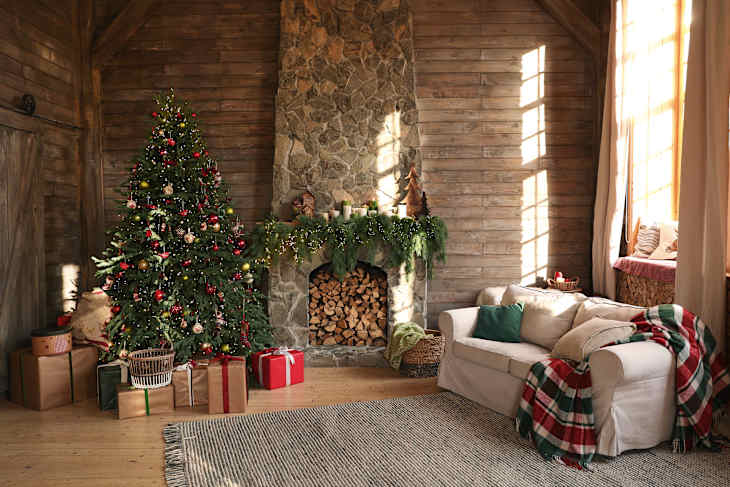
This is a big-room look. Plan on at least 16 by 20 feet, a 9-foot ceiling, and a stone fireplace wall 8 feet wide or more. In anything under 14 feet across, a floor-to-ceiling stone mass will dominate the room and the cream sofa won’t be enough to soften it. The good news: horizontal paneling, a fringe rug, and one tall tree carry the rustic feeling into a smaller space without any stone at all.
21. A Deep Blue Entry Wall With Red-and-Black Plaid Bows
About 45% white wainscoting and trim, 30% deep blue paneled wall, 15% evergreen green, and 10% red-and-black plaid with brass. The white is what keeps a dark entry from feeling like a cave — it’s doing more work than the garland is. Swap the deep blue for charcoal and the bows read more modern and masculine; swap it for hunter green and the whole entry turns traditional in one afternoon. Keep the ribbon red-and-black either way; red-and-green bows vanish against green greenery.
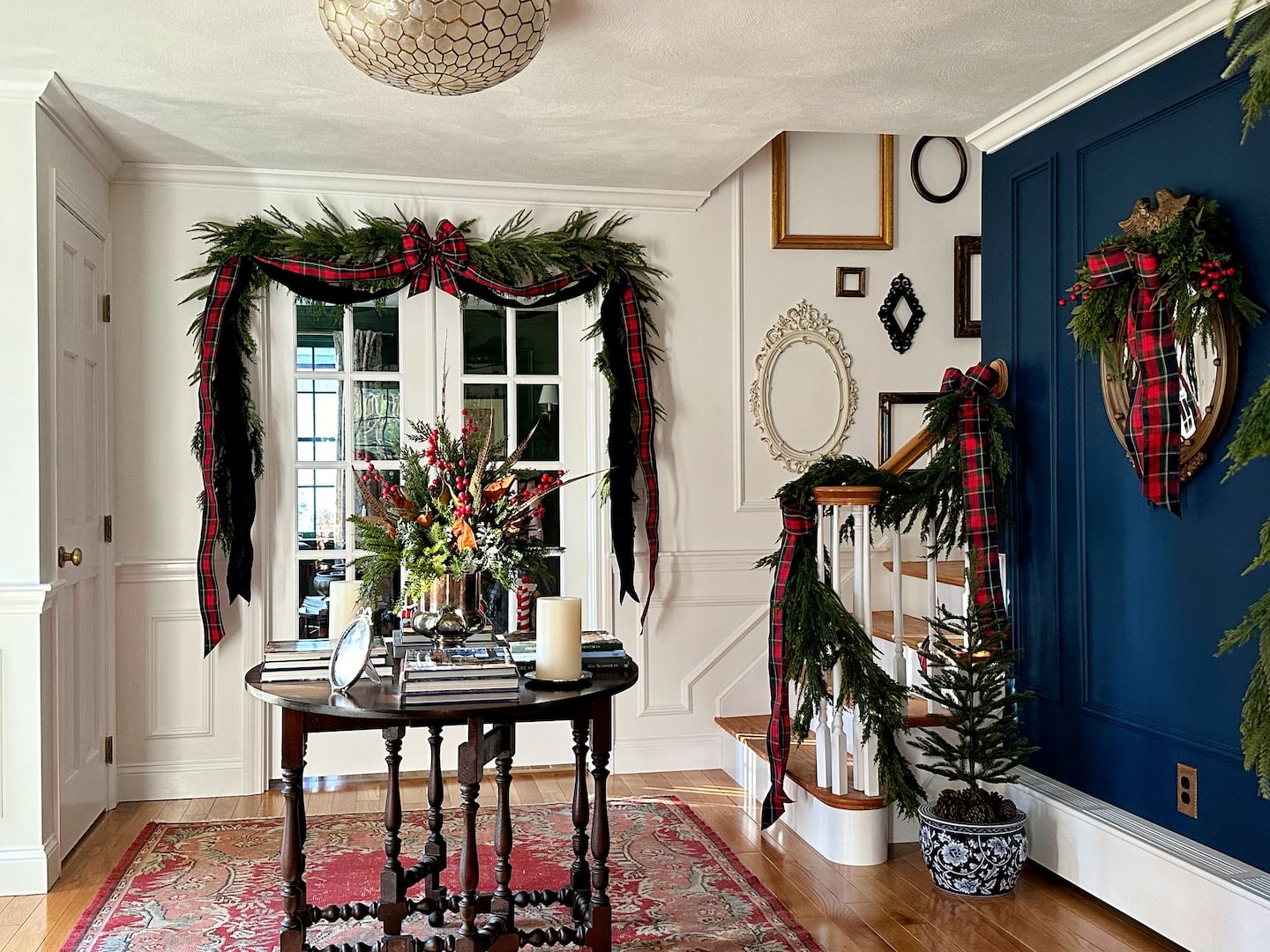
Entry tables are the hardest surface to style because everything gets seen from two feet away. Keep the round table to three objects maximum — tall candles, the potted miniature evergreen, and one flat stack of something. Hang your mirror gallery low, with the bottom frame edges at 40 to 48 inches, so it reads as a composition instead of a row of high art. And check the rug: a vintage red patterned runner should leave 4 to 6 inches of bare floor on each side.
22. Velvet and Tartan, Nothing Else
The 2026 version of this look has tightened up. Instead of plaid everywhere, it’s two materials doing all the work — velvet for shine and tartan for pattern — plus dark wood furniture and white tree lights. That restraint is exactly why it photographs so well and why it still looks good in February. Warm white lights, not multicolor, are non-negotiable here; multicolor bulbs fight the velvet and make the tartan look busy instead of rich.
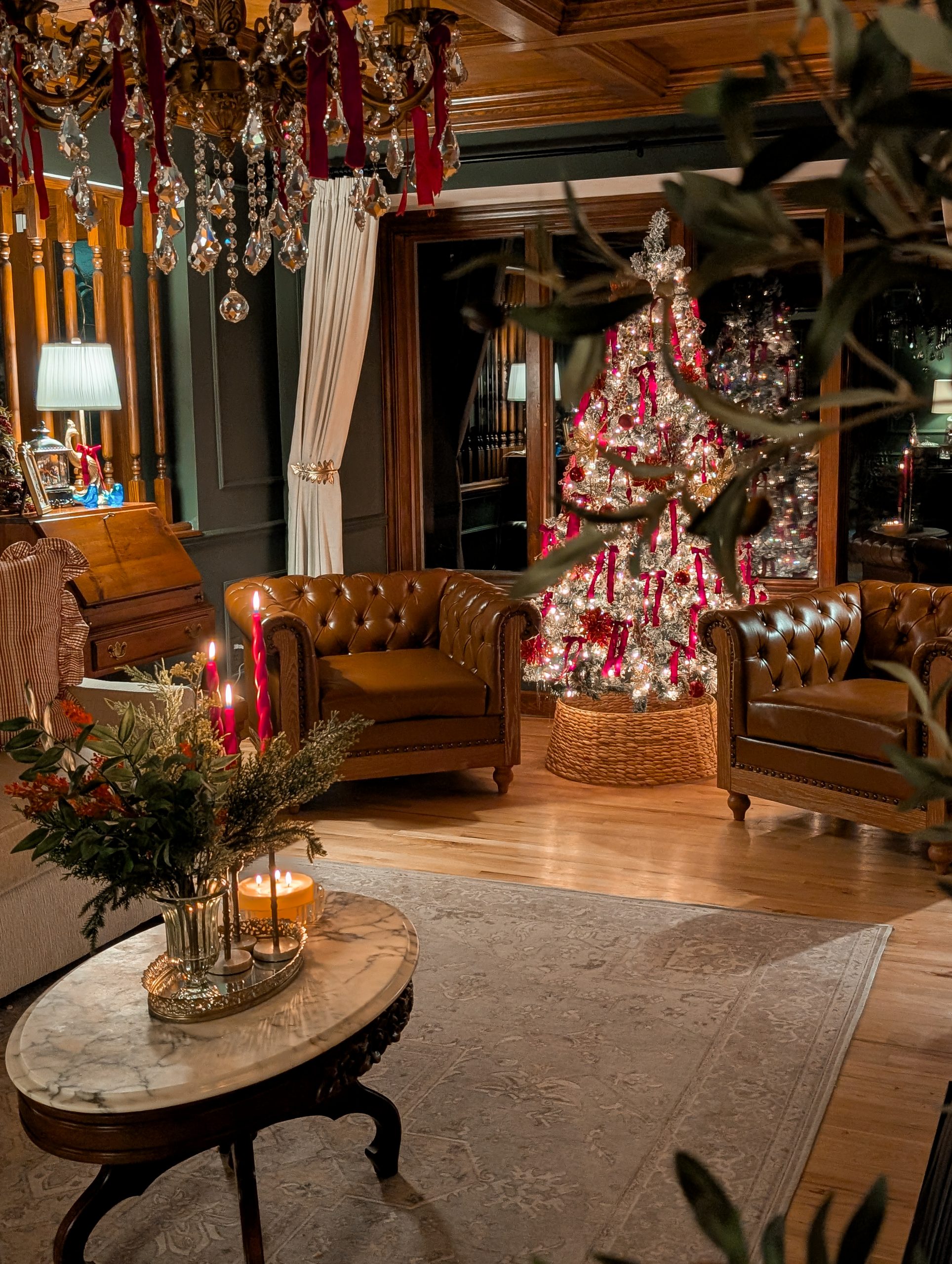
Velvet and tartan are both lint magnets. Keep a roller in the drawer and expect to use it before guests arrive. Velvet pillows also flatten — fluff them by hand, never in a machine, and rotate which side faces out every week or so. And if you have pets, keep the tartan stockings above nose height, because wool blend plus a determined cat is a very short story with a sad ending.
23. Plaid Armchairs Around a Chesterfield Sofa
The plaid upholstered armchairs. A dark leather chesterfield is a confident piece on its own — tufted, low, a little moody — and most rooms lose it against all the greenery. Two plaid armchairs give the leather a counterpart, so the sofa becomes half a conversation instead of the whole thing. If you’re only buying one new piece this year, buy the chair, not the tree. The chair will still be in your living room in July.
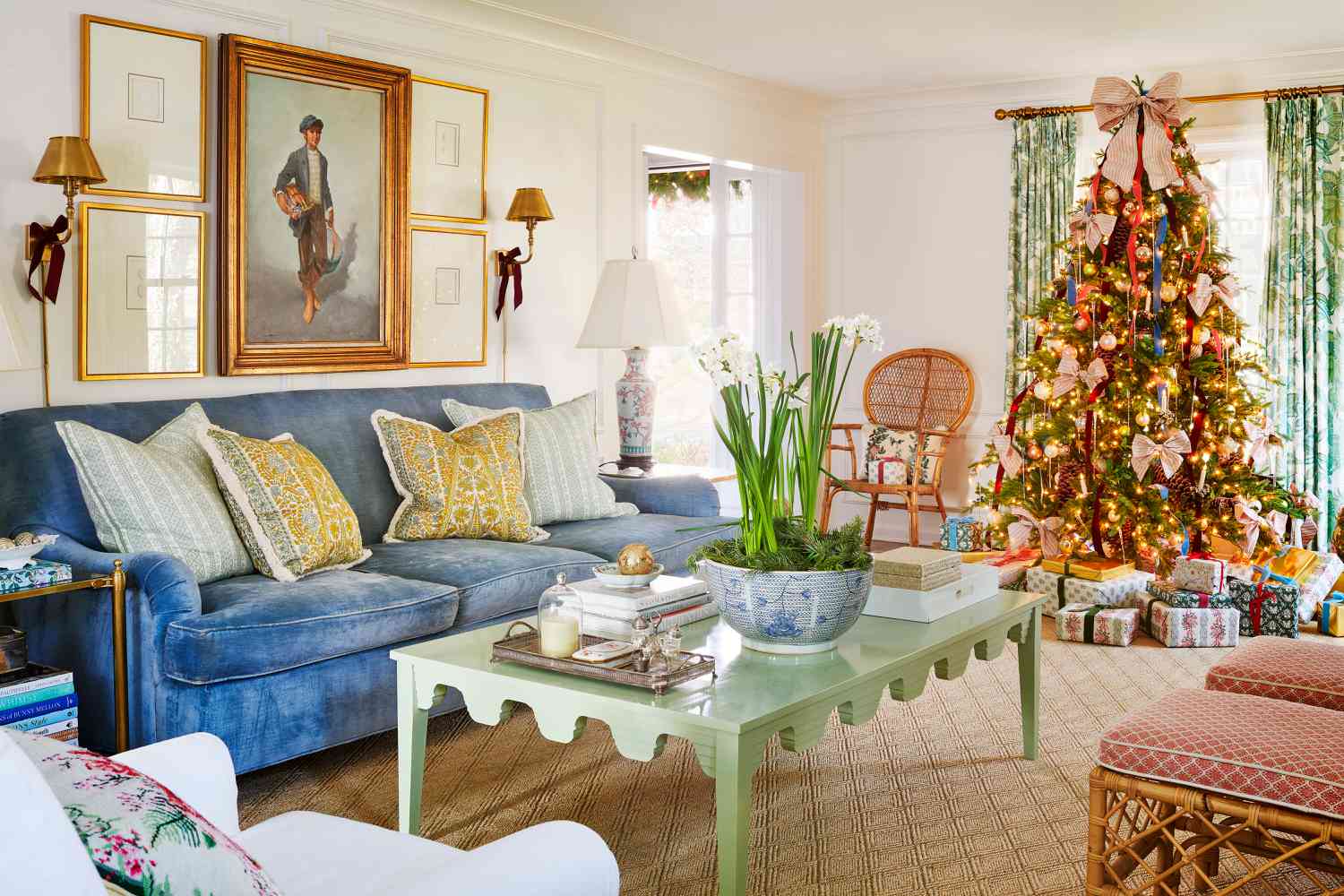
Everything in this room sits at roughly the same height, and that’s the trick — the chesterfield, the plaid armchairs, and the rustic coffee table read as one low landscape, so the tall fir and the stone hearth get to be the only verticals. The traditional patterned rug pulls the reds from the ornaments down to the floor, keeping the color from floating. It’s a classic case of repeating a color three times at three heights and letting scale do the rest.
24. Red Berry Garland on White Brick
A berry-heavy garland is one of the easiest things to fake well. Buy a plain faux pine garland and a few stems of artificial red berries, then wire them in yourself — you control the density and spend about $35 instead of $120. Plaid stockings run $12 to $18. Any wreath looks expensive when it’s tied with wide cream ribbon instead of a hook. Total mantel for about $85, and note the white brick: it makes every red pop twice as hard, so go lighter than you think.
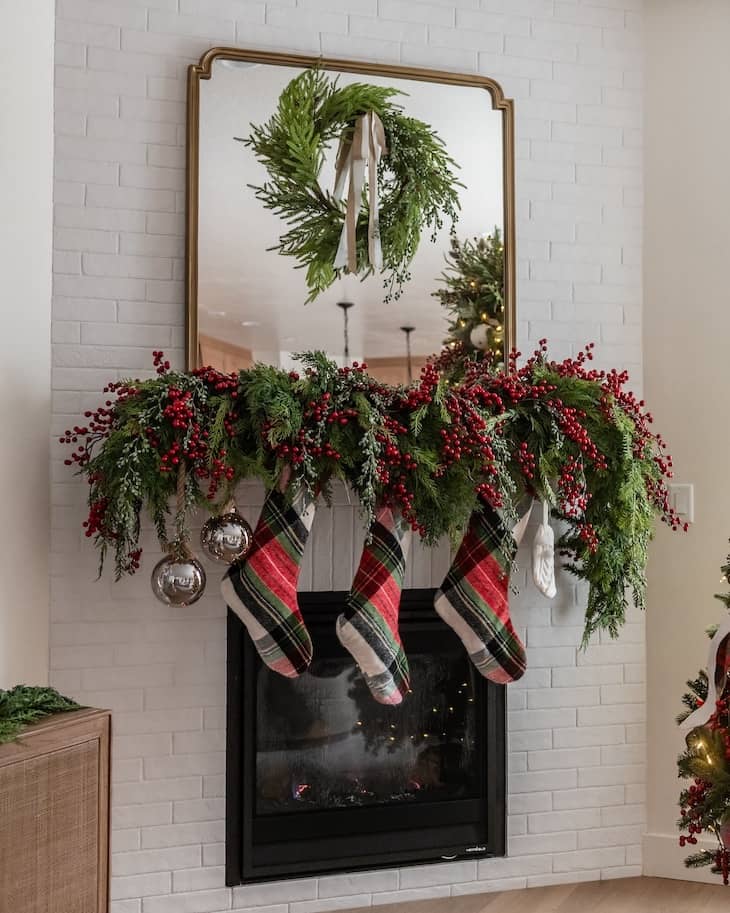
Red berries shed, and cheap artificial ones shed worse — the little foam cores get into everything. Glue the berry clusters onto the garland stems with a dot of hot glue and you’ll never chase them across the hearth again. Silver ornaments tarnish in a humid house; a dry wipe every few weeks keeps them bright. And white brick shows soot around the firebox, so clean it in January, not next November.
25. Nutcrackers, Ginger Jars, and a White Slipcover
White slipcover plus red tartan plus blue-and-white porcelain lands around 50% white, 25% red, 20% blue, 5% green. It’s the same ratio as a classic blue-and-white room, with red swapped in for warmth. The trick is that the red is almost entirely textile — pillows, ribbons, tree ornaments — while the blue is almost entirely ceramic and glass. That split keeps two loud colors from shouting over each other, and it’s why the wooden tray of nutcrackers reads as a collection rather than clutter.
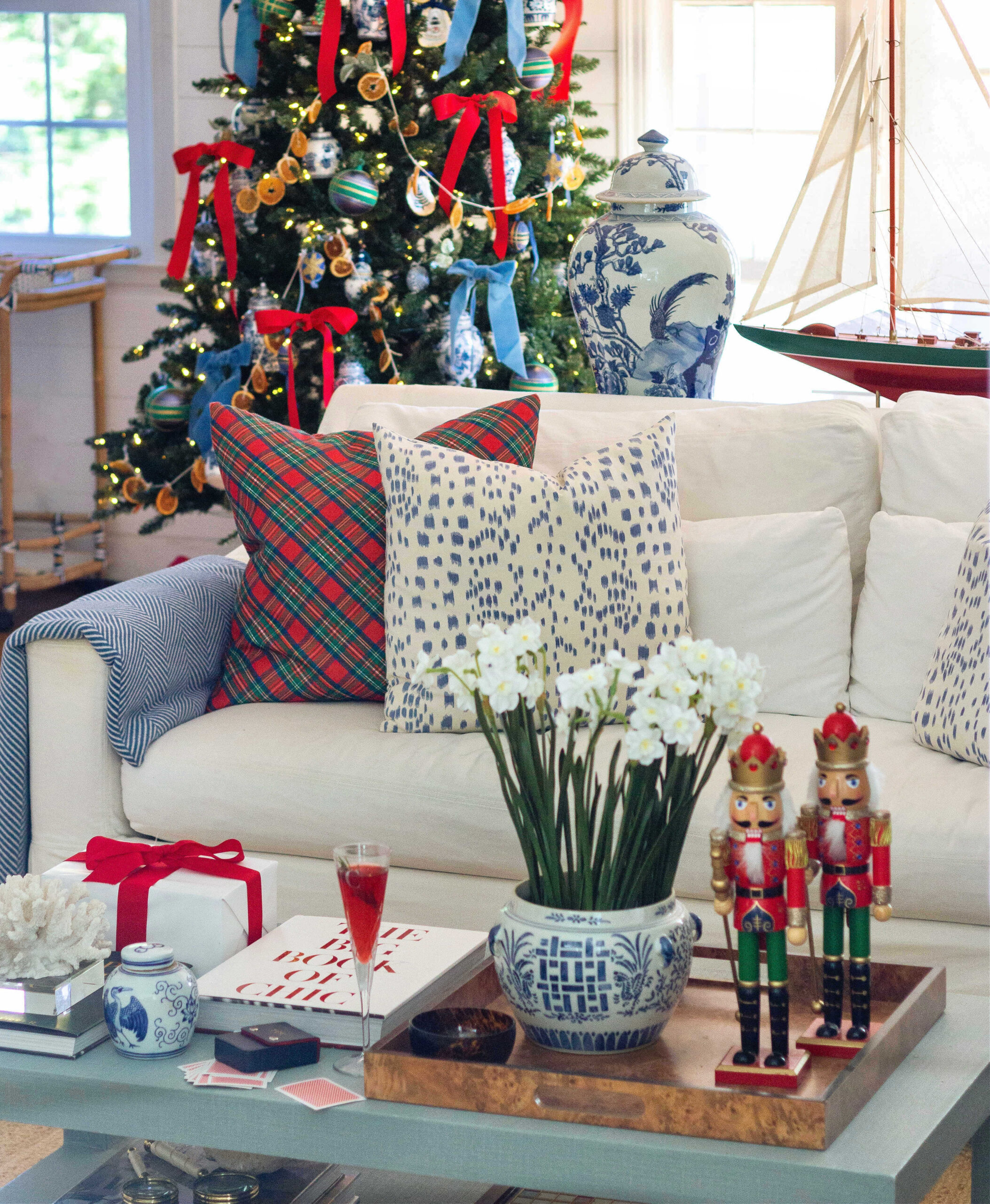
- White slipcovered sofa, or a washable slipcover for yours: $60–$1,400
- Red tartan pillow covers, set of two: $25–$80
- Blue-and-white ceramic vase and ginger jar: $30–$160
- Two traditional nutcrackers: $20–$90
- Wooden serving tray and tree ribbons: $30–$110
Total: $165–$1,840 depending entirely on whether you’re recovering or re-buying. Idea #26 takes the same blue-and-white palette up a notch with dried orange garland.
26. Dried Orange Slices and Blue-and-White Porcelain
Dried orange slices are a two-hour project, not an all-day one. Slice thin — about a quarter inch — blot both sides with a paper towel, and bake at 200°F for three to four hours, flipping once. They should come out leathery, not brittle. String them on cotton twine with a needle, alternating with a few cinnamon sticks, and drape them across the front third of the tree only. Don’t run them near bulbs that get hot. Stored in a sealed bag, they’ll last for years.

The dried orange garland. Red and blue ribbons with blue-and-white porcelain is a very classical combination, and without something warm and matte in the middle, the tree can start to look like a display case. The oranges bring an amber note and a rough texture that softens all that china. It’s also the cheapest element on the tree, which is a nice thing to be able to say about the part people compliment most.
Ribbon-and-porcelain trees need volume to work. This one reads best at 7 feet or taller under 9-foot ceilings, and it needs a full silhouette — a sparse tree just looks like a frame with ribbons on it. Leave 36 inches of circulation around the base so the presents on the hardwood aren’t a pile you have to step over. In a smaller room, scale the ribbons down rather than the tree.
27. Nutcrackers in Front of a Mirrored Gallery Wall
- Assorted nutcrackers, five to eight, mixed sources: $40–$220
- Large mirror with a dark frame: $120–$600
- Gold-framed landscape prints, thrifted: $60–$350
- Evergreen garland with red and silver ornaments: $45–$160
- Table lamp with a black shade and silver candlesticks: $50–$180
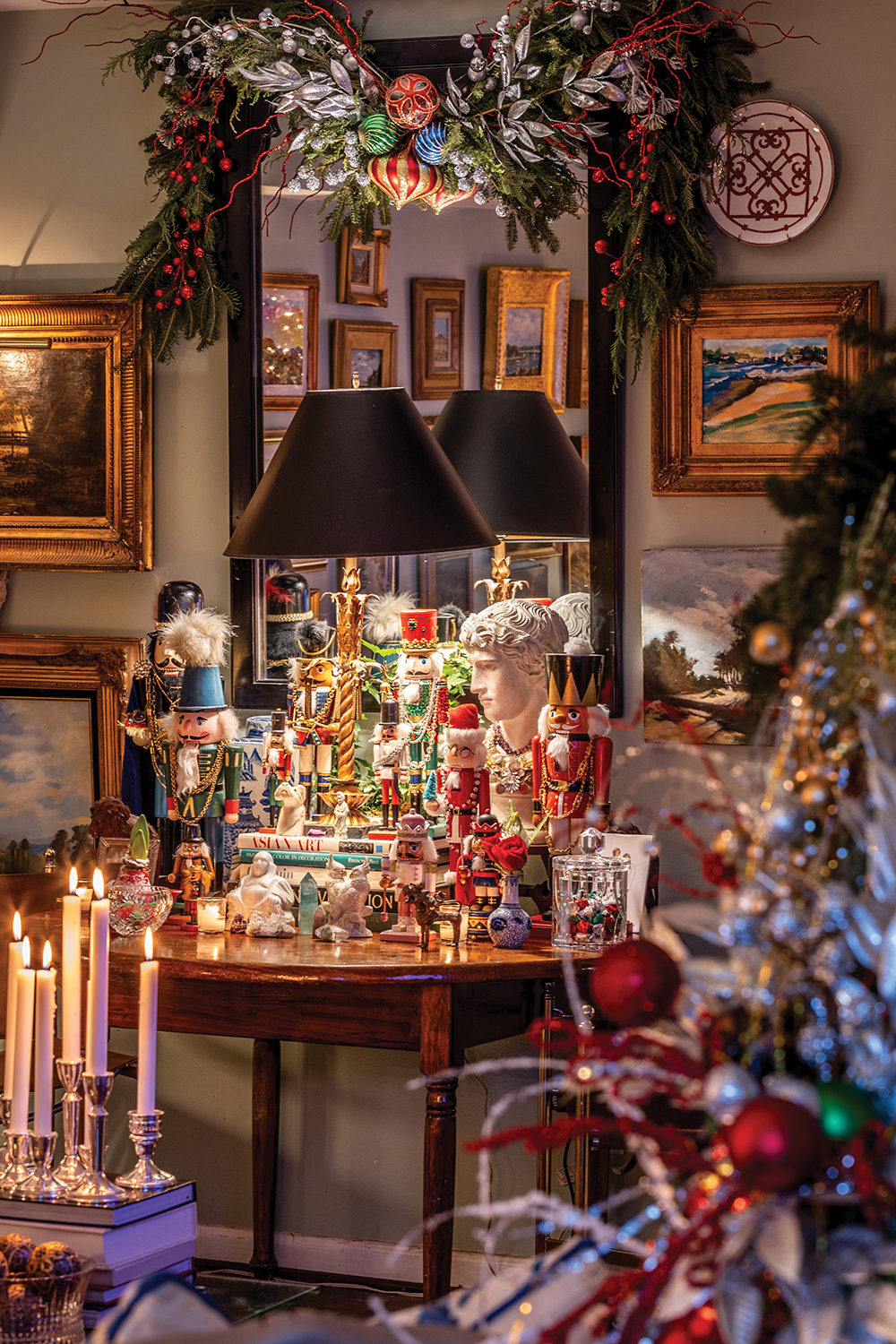
Total: $315–$1,510. Budget alternative: build the gallery wall from thrift-store frames painted one uniform gold, and hunt nutcrackers at estate sales in November — they’re everywhere and cheap. About $120 gets the whole display.
It’s maximalism with rules. Everything is either gold, dark wood, or red, and that large mirror in the middle gives the eye one place to rest. The garland across the top caps the arrangement so it reads as a single composition rather than a shelf of objects, and the classical bust plus the black-shaded lamp add two different heights — which is exactly what keeps a tabletop display from looking like a yard sale.
Dense gallery walls are dust traps, and holiday displays on top of them double the problem. Plan a full dusting in January and skip it in December, because nobody notices. The bigger risk is a tabletop display that blocks the mirror entirely; if you can’t see a single reflection, you’ve built a wall, not a vignette. And real candles in silver holders look spectacular and should never sit within 12 inches of greenery, dried orange, or fabric.
28. A Stone Accent Wall Behind a White Mantel
- Clear the mantel completely and wipe the stone with a dry brush — it sheds grit.
- Anchor the garland at both ends with small clear clips, not nails, so the stone stays whole.
- Hang stockings on adhesive hooks rated for 5 pounds; stone won’t take a screw.
- Layer tree lights first, ornaments second, garland last so nothing tangles.
- Set the wrapped gifts with the largest boxes at the back, against the wall.
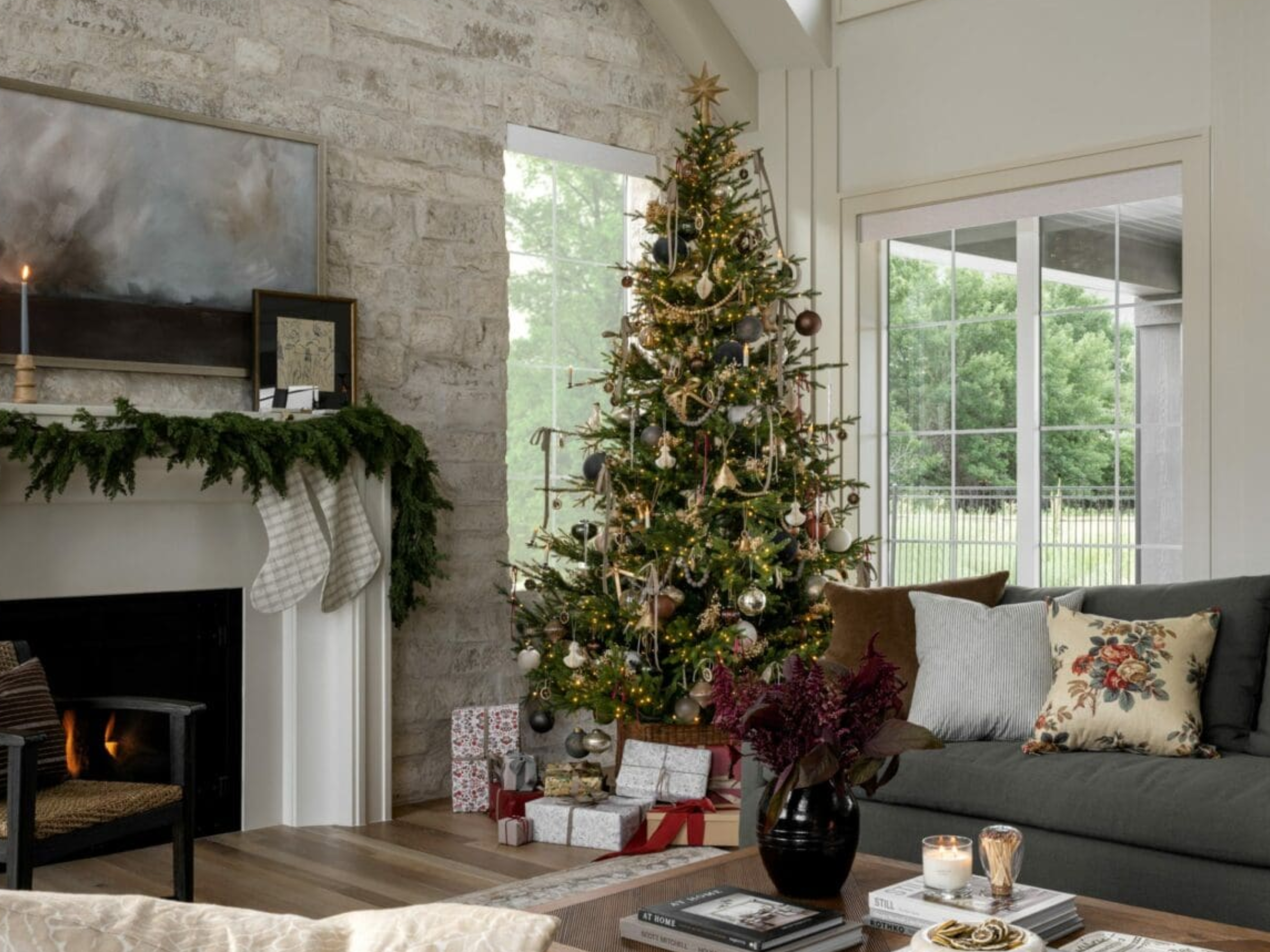
About 90 minutes for the whole wall, plus $25 in hooks and clips.
Real stone is porous and hates water-based cleaners; a dry, soft brush is the right tool, and you’ll use it more often than you think because stone ledges collect dust. The white mantel above will show smoke residue by February, so keep a magic eraser handy. And if the garland is fresh, it’ll drop needles onto that dark gray sofa for weeks. Faux cedar against stone is genuinely the better call.
29. Lit Tapers, Plaid Bows, and a Dog on the Rug
Lit taper candles and evergreen garland are the most photogenic combination in holiday decorating and the easiest way to start a fire. Keep every flame at least 12 inches from greenery and 18 inches from anything hanging above it, or switch to battery tapers with a remote — the good ones flicker convincingly now and run about $25 for a set of six. If you’re using real wax, trim the wicks to a quarter inch and never leave the room.
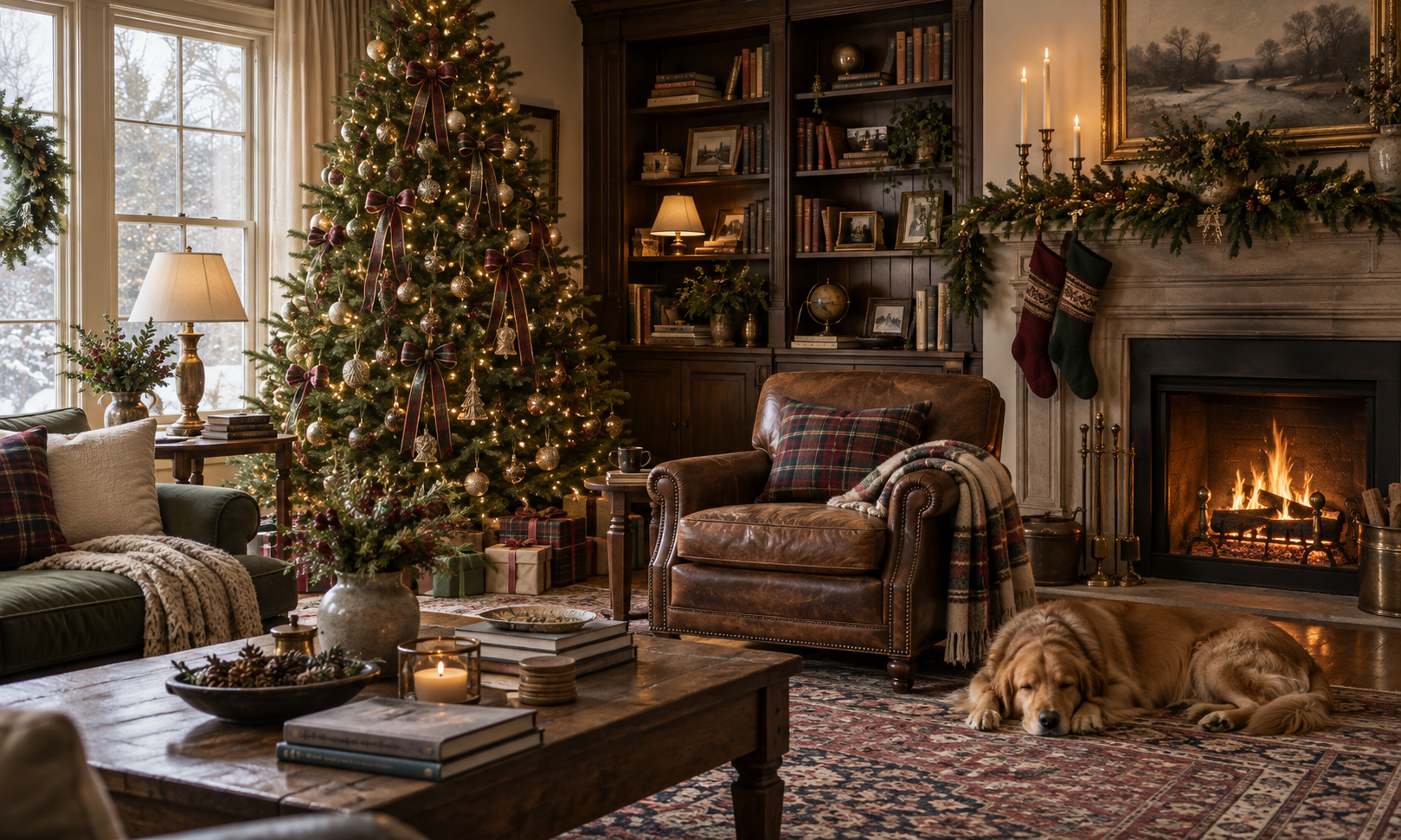
Plaid bows are the most affordable drama in this entire article. A roll of wide tartan ribbon costs $8 to $15, and eight bows will fill a 7.5-foot tree. Add gold ball ornaments in bulk, leave the built-in bookcases exactly as they are, and spend your money on tree lights instead — warm, dense, at least 100 lights per foot of tree. A $400 tree with great lights beats an $800 tree with three strands every single time.
Built-in bookcases behind a tree mean dusting twice as often and a real risk of water rings if you’re using a live tree — a 7-foot tree drinks a gallon of water on day one. Skip the rug under the stand or use a waterproof mat, because vintage-style patterned rugs stain instantly from tree sap. And if you’ve got a golden retriever, expect the lowest branches to become a tail-swept zone by mid-December. Design around the dog.
30. One Tartan Blanket, Pinecones, and Firelight
The tartan blanket, draped — not folded neatly, not spread flat, but thrown over the back of the sofa so it’s obviously been used. That’s what makes a red-and-green room feel warm instead of staged. A perfectly folded blanket on a pristine sofa reads like a showroom; one with a corner trailing toward the floor reads like a house where someone actually sat down with a mug of something. It costs nothing extra to drape it badly. That’s the whole point.
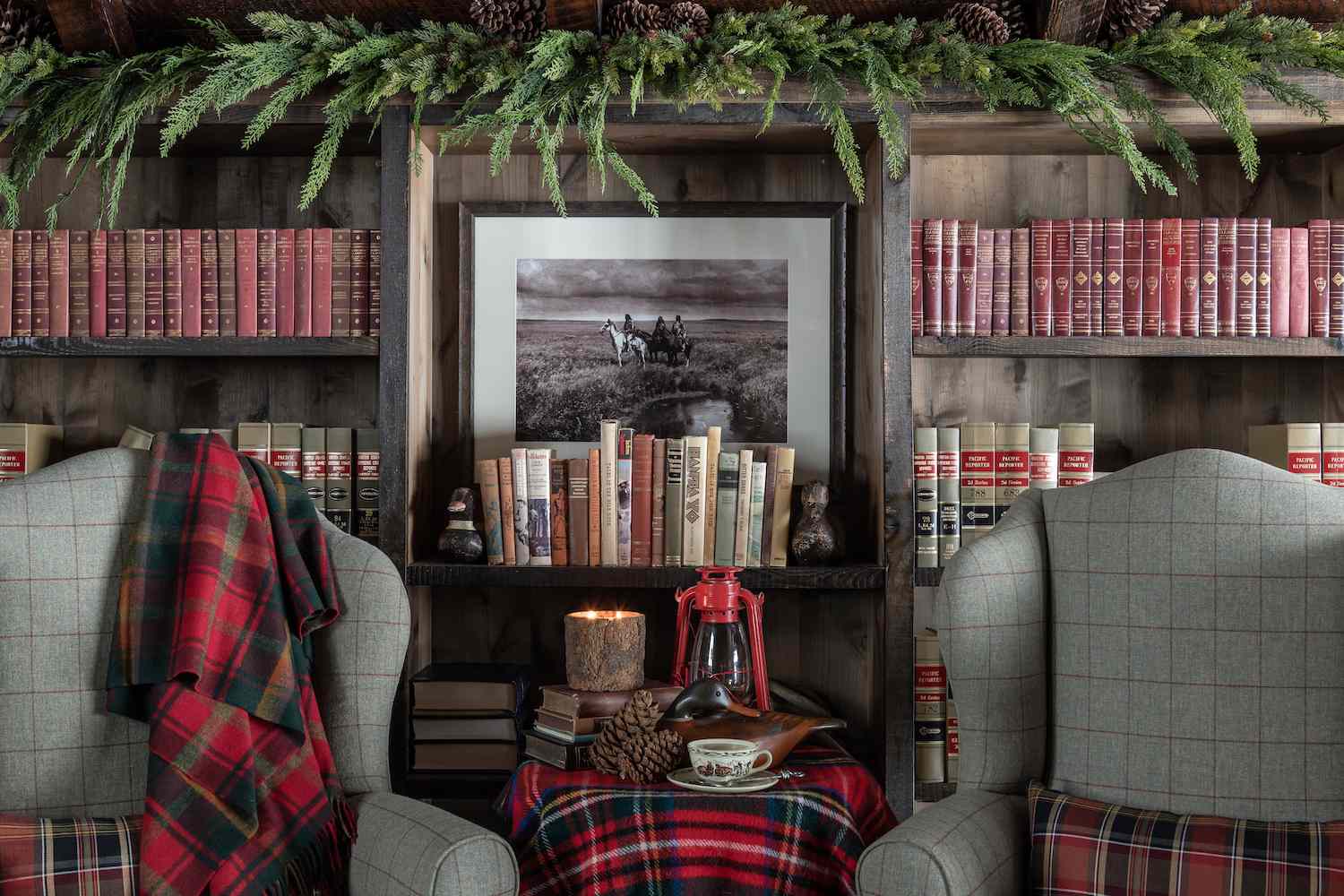
Roughly 55% warm beige and dark wood, 30% tartan in crimson and forest green, 10% evergreen with pinecones, 5% firelight. It’s the same formula as Idea #12, just softer and less paneled. Swap the tartan for solid crimson wool and the room goes modern farmhouse; swap it for a cream cable knit and it turns Scandinavian. Keep the pinecones either way — they’re the roughest texture in the room, and everything else is soft.
- Have the chimney swept before December — crews book out fast.
- Measure the sofa back so the blanket drapes to the floor rather than stopping mid-cushion.
- Test your warm ambient lighting at night before buying anything else; harsh overheads kill this look.
- Confirm the tartan is colorfast before it sits on light beige upholstery for six weeks.
Go Ahead and Hang the Plaid Ribbon
Start with one thing — the stair runner, the mantel, or the blanket over the back of the chair — and let the rest of the room catch up over a season or two. The Ralph Lauren Christmas aesthetic isn’t built in a weekend; it’s layered, and every piece you add makes the next one easier to place.
📌 Save this to Pinterest before you start shopping, and tag us when your staircase is finished — we genuinely want to see it.