You know that feeling when you finally spot the Christmas front door that looks exactly right — and then realize you have no clue how to actually build it? Same. We’ve all stood in the driveway with a phone full of screenshots and a box of tangled lights.
We spent serious time browsing Target, Etsy, HomeGoods, and Walmart to bring you only what’s worth your attention this year. Everything below lives between $12 and $480, so there’s a version of every look that fits a real budget.
Inside: 32 curated ideas spanning traditional red-and-green, frosted flocked greenery, maximalist color, and pared-back modern minimalism. Budget and luxury versions are compared side by side, and every idea is shoppable with direct product links. And stay until the end — we break down the most common mistakes that can ruin these looks.
Why now? Oversized velvet bows, flocked greenery, and quiet-traditional styling are dominating Pinterest saves heading into 2026 — people want warmth and craft this year, not a plastic inflatable. Go ahead and save this — you’re going to want to reference it. 📌 Save this to Pinterest for later — you’ll want to revisit these ideas.
This post contains affiliate links. If you buy through them, we may earn a small commission at no extra cost to you.
1. Light Blue Stucco, Frosted Garlands, Silver Ornaments
Zip-tie garland to iron railings every 12 to 18 inches, not just at the ends. Ironwork is the best armature you’ll ever get for free — let the railing carry the weight and shape the swag for you. Keep ornaments on railing garland between 2.5 and 3 inches; anything larger turns to visual noise when it’s viewed from the street. And run one continuous strand per balcony instead of piecing short sections together, so the frosted tips read as a single clean line.
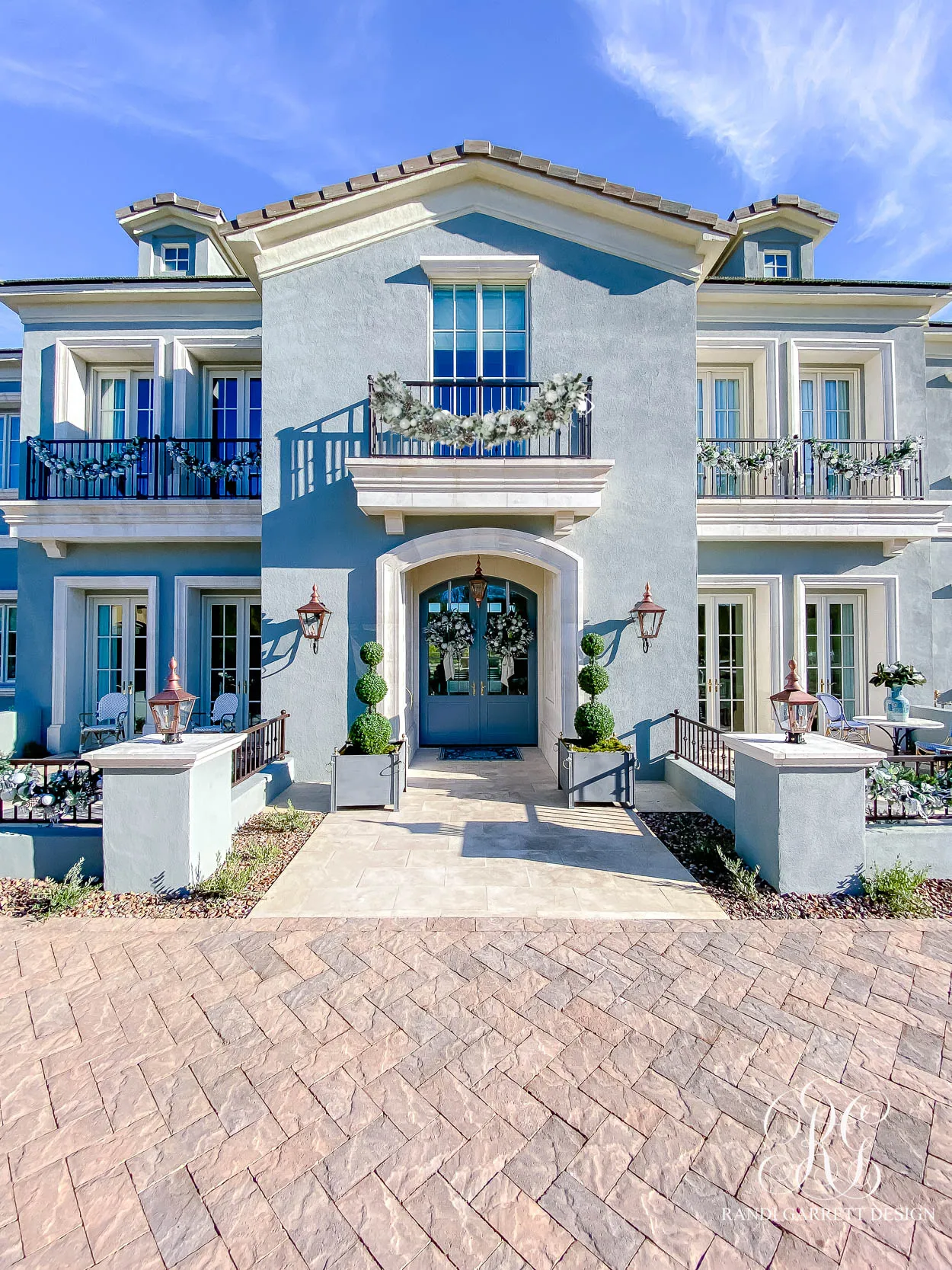
Three things are doing the heavy lifting here. First, contrast: cool light-blue stucco against frosted white and silver keeps the whole facade calm instead of candy-cane loud. Second, repetition — the same wreath, the same garland, the same ornament scale on every balcony, which is what makes a large house feel intentional rather than decorated. Third, those dark blue doors. They’re the darkest element in the composition, so your eye lands there first, exactly where you want it to go.
2. Classic Red-and-Green with Black Urn Planters
- Planters and urn fillers (evergreen, berries): $60–$180
- Lighting (outdoor-rated string lights, clips): $40–$120
- Textiles (doormat, wired ribbon, bows): $25–$70
- Decor (wreath, garland, pinecones, ornaments): $80–$220
- Door refresh (paint touch-up, hardware polish): $0–$50
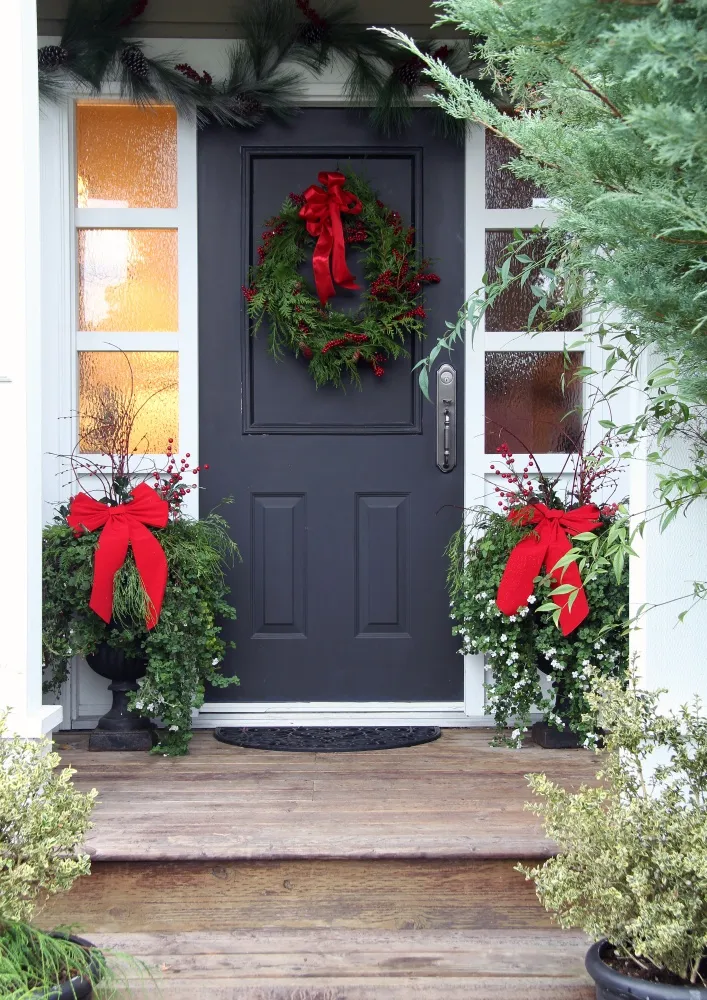
Total: $205–$640 Budget alternative: buy one plain evergreen garland and one undecorated wreath, then add your own pinecones, berries, and ribbon. That runs about $95 total, and it looks custom because it is.
The two black urn planters. Not the wreath — everyone has a wreath. The urns are what stop the door from floating in the middle of the wall. They set the bottom edge of the composition, mirror the round shape above them, and give the eye somewhere to land before it travels up to the garland. Take them away and that same wreath suddenly looks small and slightly lost, no matter how beautiful it is.
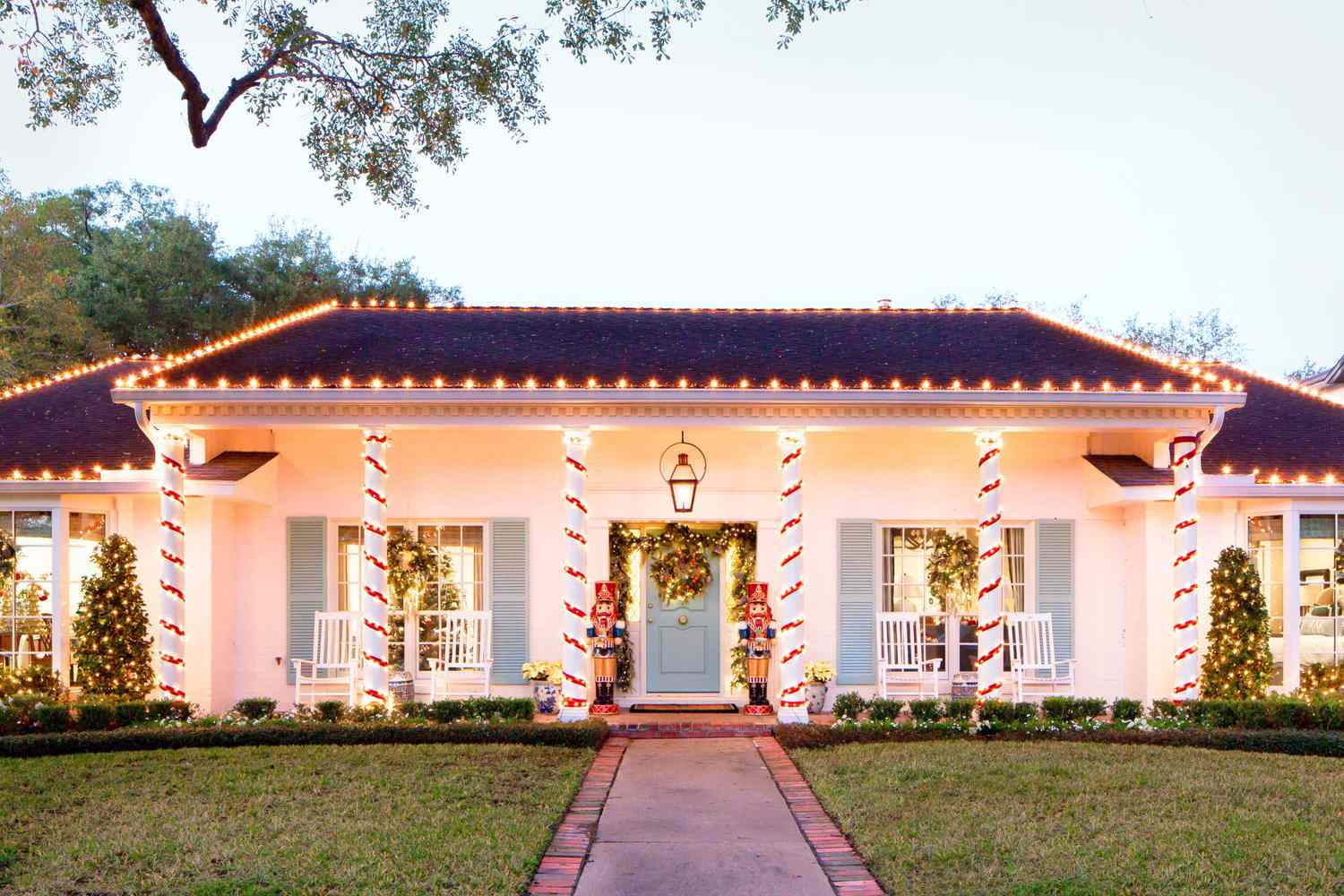
3. Natural Evergreen Wreath with Warm String Lights
Warm-white string lights on a front door pull more current than you’d expect once you’re three strands deep. Use outdoor-rated LEDs only, plug into a GFCI outlet, and never run a cord through the door frame where it gets pinched every time someone comes home. Check clearance, too: garland around a frame should sit at least an inch off the door edge and stay below the threshold sweep, or you’ll be re-hanging it in February. Pair it with the symmetrical planter trick from Idea #2 and your bottom edge sets itself.
- Measure the door frame and order garland at least 10% longer than you think you need.
- Locate the nearest exterior outlet and confirm it’s GFCI protected.
- Test door swing and threshold clearance before committing to placement.
- Choose real or faux — real looks better for two weeks, faux survives the season.
- Set a hard budget number before you walk into the store.
4. Bold Blue Door with Pink Gingham Bows
Here’s the formula: 50% blue (the door plus those patterned ceramic urns), 25% frosted white, 20% multi-color ornaments, 5% hot pink. That last five percent is the entire personality of the door — it’s what makes the gingham bows read as a decision instead of an accident. To swap it out, keep every percentage identical and trade pink gingham for lime green or a blue-and-white ticking stripe. Same math, completely different mood.
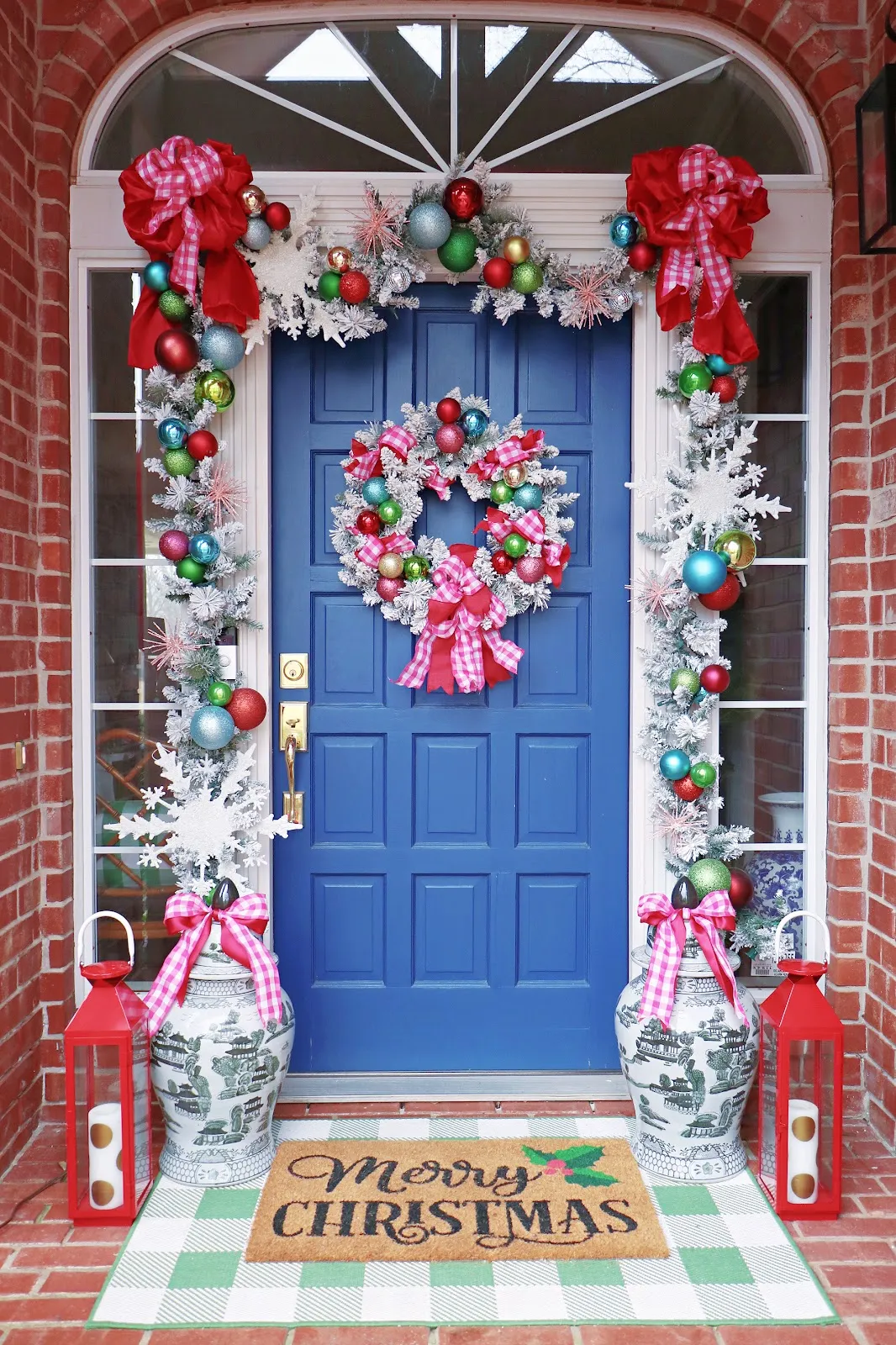
Get this look for far less by shopping the wrong season. Target and Walmart clear gingham ribbon and multi-color ornament tubes to 70% off in early January, so you can buy next year’s door this year for about $30. Blue-and-white ceramic urns? Thrift stores and Facebook Marketplace turn up ginger jars constantly between $8 and $25, and one can of glossy blue spray paint unifies mismatched finds. The layered checkered rug is the only piece worth buying new.
5. Red and Gold Garland with Spiral Topiaries
The oversized baubles. On a normal door they’d be absurd; on this one they’re the reason the garland reads from thirty feet away. Scale is relative — a 6-inch ornament looks enormous on a standard porch and perfectly normal against a 12-foot entry with stone steps. Remove the big baubles and the ribbon and the whole thing flattens into a green stripe. Match ornament size to your architecture, not to the shelf you found it on.
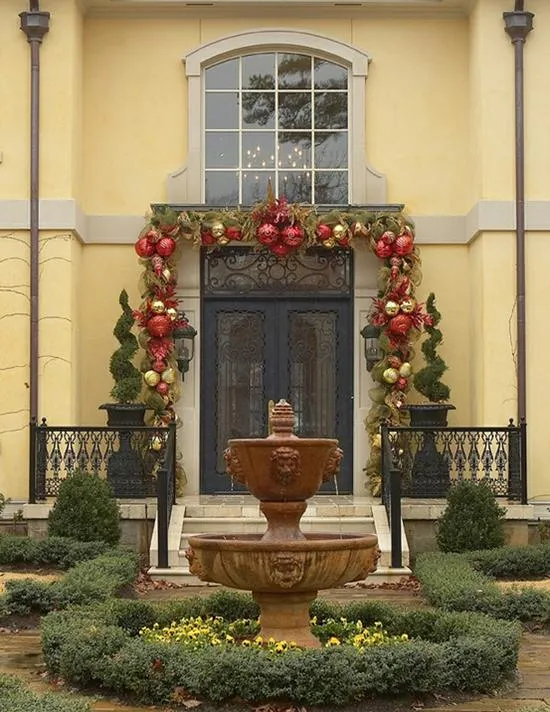
Genuine grandeur is back. After a decade of blush and neutrals, saves for layered traditional Christmas decor keep climbing, and 2026 is the year the spiral topiary stopped being embarrassing. The shift is cultural as much as visual — people are hosting again, taking porch photos again, and they want an entry that photographs like a movie set. Maximalism with taste has real staying power. It just comes with a longer install day.
6. Flocked Wreath and Mini Trees with Faux Presents
Styling faux wrapped presents on a porch step:
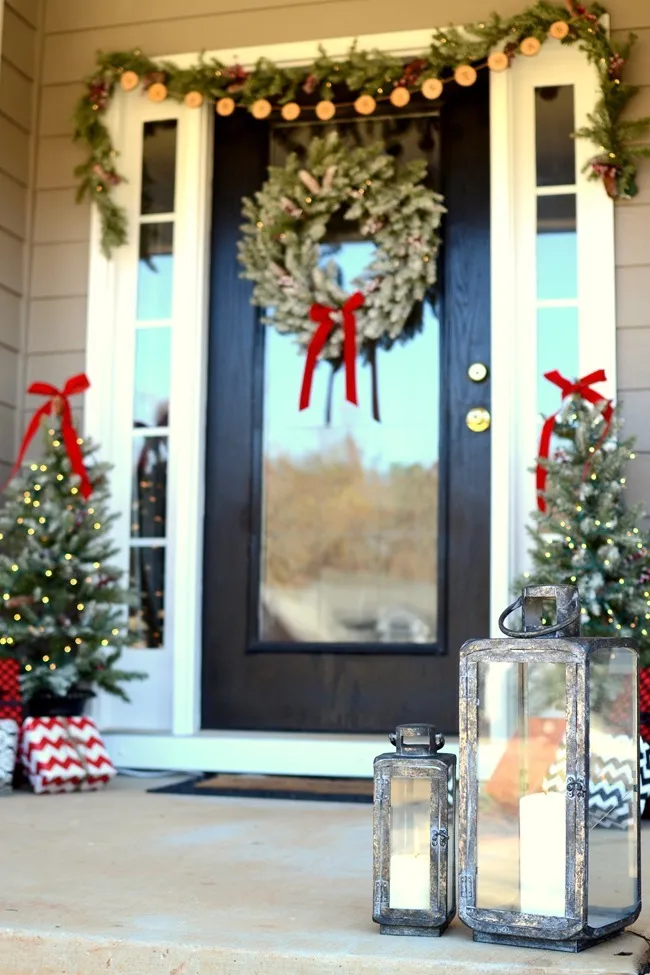
- Wrap empty boxes in paper cut to true gift proportions — a 2:3 ratio reads best.
- Weatherproof with two coats of matte clear spray, or use vinyl-backed paper.
- Group in threes, mixing two large boxes with one small for a natural stack.
- Tuck greenery sprigs under the ribbon knot so the paper doesn’t look pasted on.
- Weigh the bottom box with a brick so wind doesn’t redecorate your street.
Time: about 20 minutes. Materials: $20 to $35 for paper, ribbon, and boxes.
The flocked pieces do something a fully green wreath can’t: they hold a highlight. That pale frost catches whatever porch light you’ve got and gives a black door a soft halo instead of a hard edge. Then the wooden disc ornaments and plaid-wrapped boxes add warmth back in, so it never tips into cold or synthetic. Contrast, texture, temperature balance — three moves, one very small porch.
7. Velvet Bows and Lit Mini Trees on Grey Stone
Velvet ribbon only looks expensive if you shape it. Use 4-inch wired velvet, cut the tails at a sharp 45-degree angle, and pinch each loop with florist wire before tying off — that’s the difference between a bow and a puddle. On grey stone, keep ornaments in the red-and-gold range; silver disappears into the wall behind it. Hang the wreath so its bottom sits roughly a third of the way down the door, not dead center.
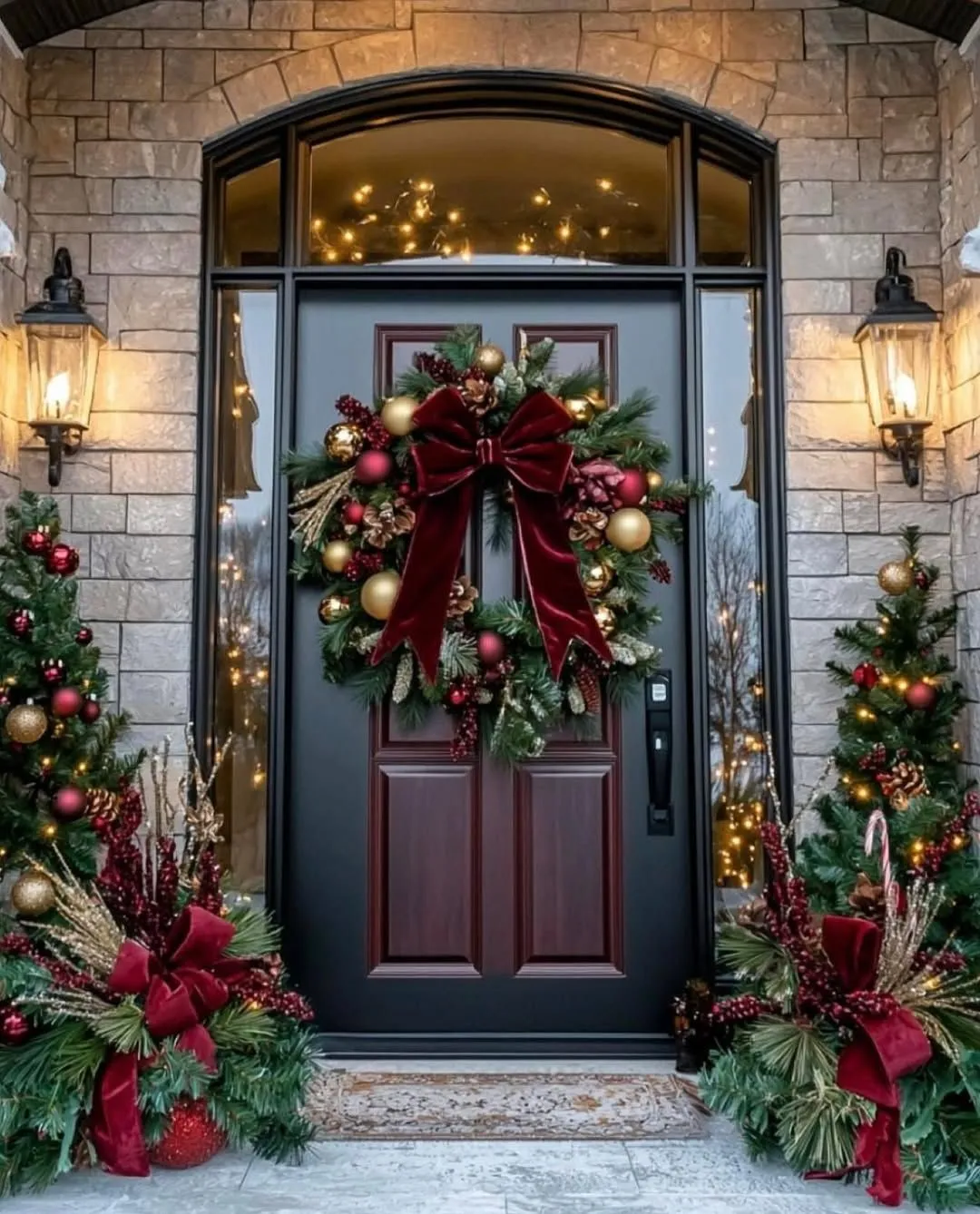
Velvet fades. Six weeks of direct sun dulls a deep red bow down to brick, and rain leaves water spots that don’t brush out. Bring ribbon indoors at the end of the season and store it flat rather than folded. Flocked miniature trees shed a little every time they’re moved, which is normal — just sweep the porch before it rains, or you’ll be scraping green paste off stone. Plan on replacing lit mini trees every three to four seasons.
8. Brass Bells and Evergreen on a White Panel Door
This look wants a wide door and a porch with a ceiling — 8 feet minimum overhead, since the garland needs room to hang above the frame without crowding the header. Give yourself at least 36 inches of clearance on each side for the potted evergreens and lanterns; below that, drop to one tree and keep the lantern cluster tight. Working with a narrow entry or a standard 3-foot door? Idea #12 scales the same restraint down to a single wreath.
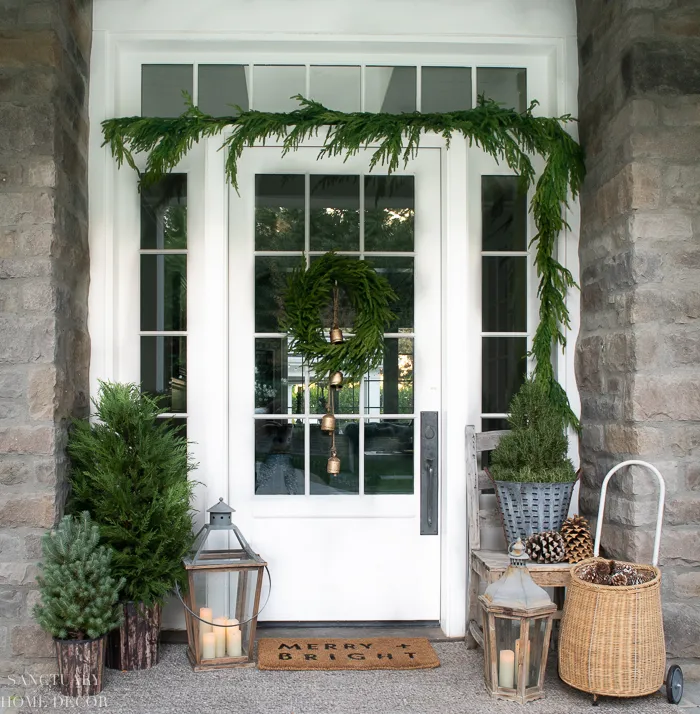
- Long faux garland (9 ft): $35–$90
- Plain green wreath: $20–$60
- Brass bells, set of three: $12–$40
- Two potted evergreens with planters: $60–$180
- Wooden lanterns and LED candles: $40–$110
Total: $167–$480 Budget alternative: skip the potted trees, keep the garland and the bells, and raid your own backyard for greenery. That’s a $70 door that reads like a $400 one.
9. Red and Gold Trees Flanking Double Wood Doors
Skip the specialty stores entirely. Two 4-foot artificial trees run $35 to $60 each at Walmart in early November, and the black planters are $12 galvanized buckets sprayed matte black. Red and gold ornament sets go two-for-one at Target the week before Thanksgiving. The oversized plaid mat is the piece that carries the entire look, and it’s the one thing worth spending $40 on — a cheap mat under big trees looks like a towel.
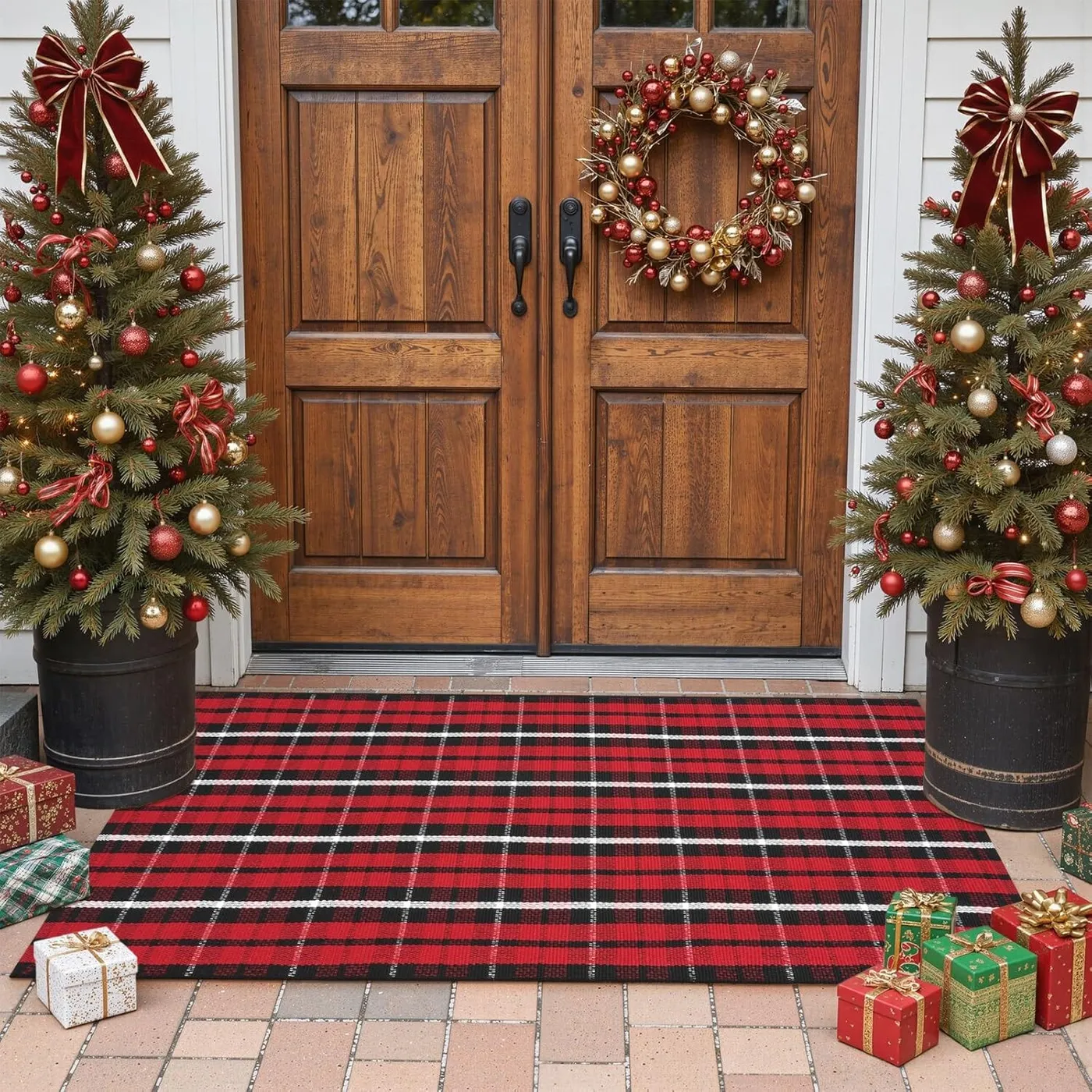
Two things to think about before you copy this. Double doors mean double the decoration, and an asymmetric layout — a wreath on one door only — has to be a deliberate choice or it reads as unfinished. Second, artificial trees on a porch collect dust, cobwebs, and sun damage; budget on replacing them every third year. And check that door swing. A wreath that bumps the second door every time you open it will be on the floor by New Year’s.
10. Buffalo Check Wreath Bow with Lit Grey-Pot Topiaries
The magnolia leaves are the diva here. They look incredible for about ten days, then they curl, brown at the edges, and drop. If you want a full season out of them, buy faux or accept a mid-December refresh. Topiaries in sealed pots need to be tipped and drained after heavy rain, or the roots rot and the lights short out. And buffalo check fabric fades fast in sun — rotate the bow to the shaded side, or just plan on a new one next year.
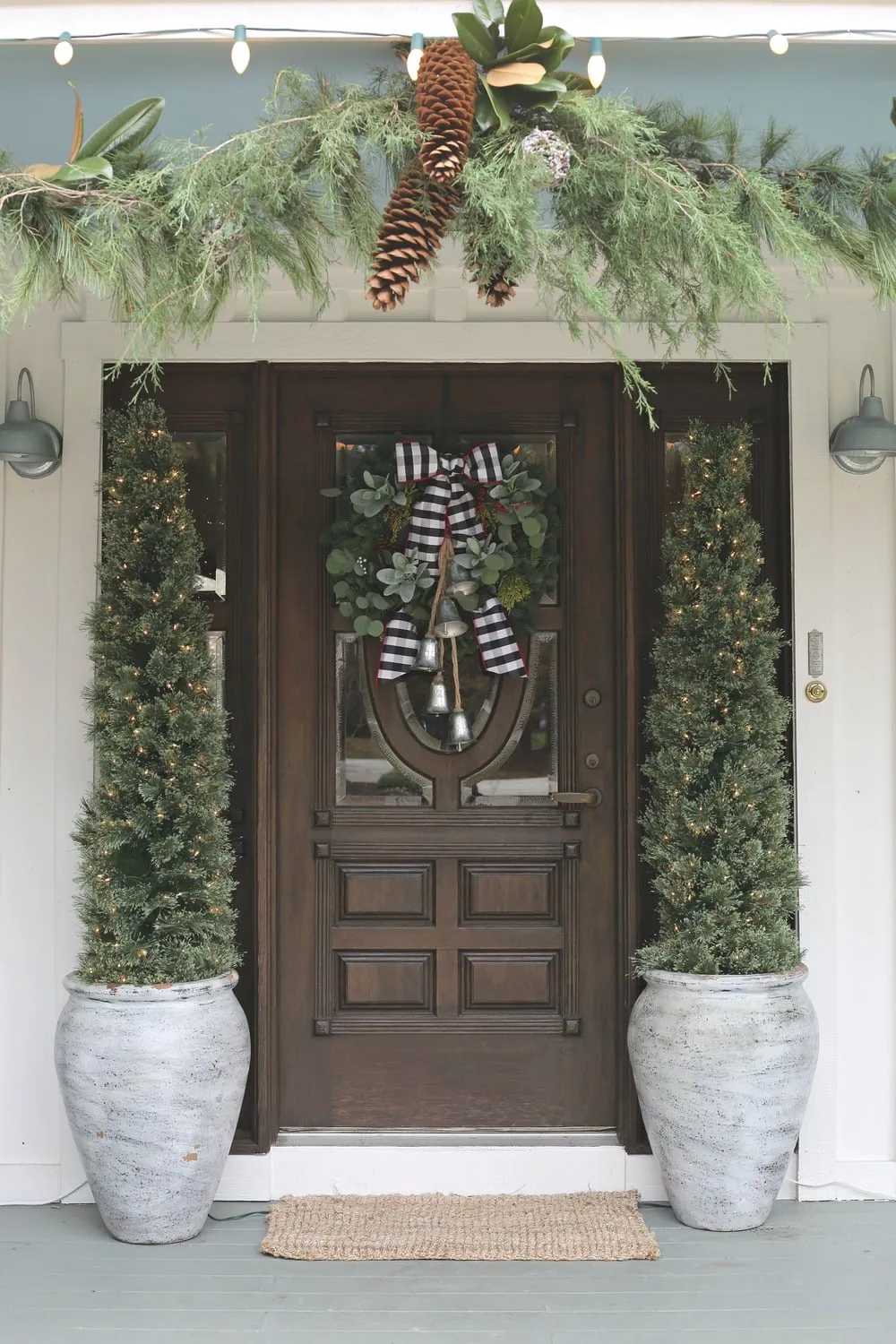
60% dark brown and grey (door, pots, porch) + 25% evergreen + 10% black-and-white check + 5% silver bells and red berries. The check is the pivot point — it’s the only pattern in the composition, which is exactly why it works. Swap it for tartan and you get a warmer, more traditional read. Swap it for solid charcoal ribbon and the whole thing goes modern farmhouse. Keep the accent small, always.
11. Glitter Reindeer and a Red-Gold Gift Stack
Lit reindeer figures used to be the thing everyone quietly apologized for. Not anymore. The 2026 version is glittered, scaled down, and paired with an actual gift stack instead of standing alone on the lawn. It works because the styling does the work: wrapped boxes in red and gold, garland with real bows, lanterns on the floor grounding the figures in something other than a big-box aisle. Nostalgia is the trend. Restraint is what makes it land.
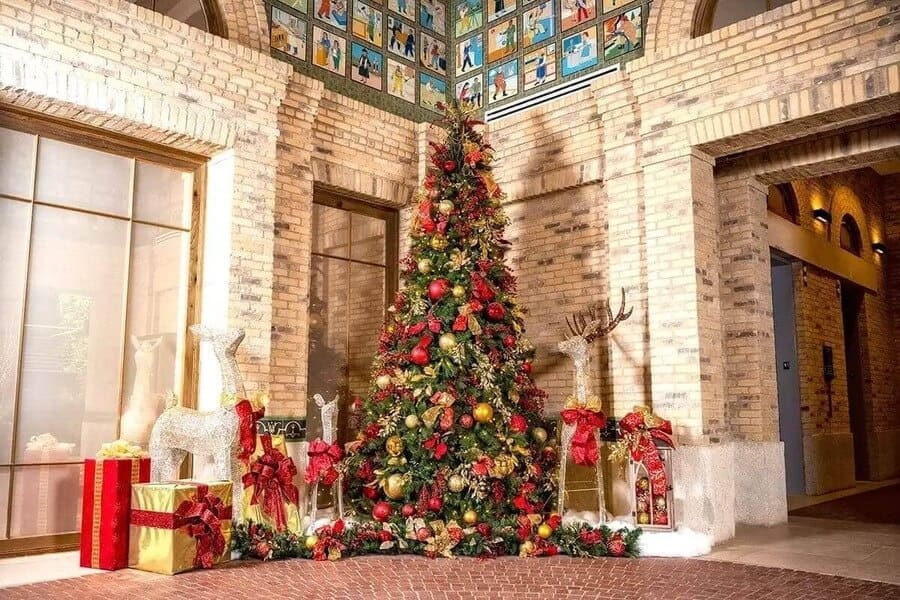
The beige brick wall behind everything. It’s easy to miss, but a warm neutral backdrop is why this red-and-gold display reads rich instead of loud. Point the same tree and reindeer at a cool grey wall and the gold suddenly looks brassy. If your entry is cool-toned, add warmth elsewhere — a wood console, brass lanterns, a jute runner — or shift your palette to silver and green and let the architecture win.
12. Plaid Bow Wreath on a Simple White Door
Hang the wreath from an over-the-door hanger rather than a nail, and pick one with a flat back plate so it doesn’t scratch the paint. Put the bow at twelve o’clock and let the tails fall no lower than about 4 inches — longer tails get caught on the knob and fray. If your door is white with silver hardware, avoid gold accents inside the wreath itself; the metal clash is subtle, but it registers. Match the hanger finish to the doorknob and the whole thing looks considered.
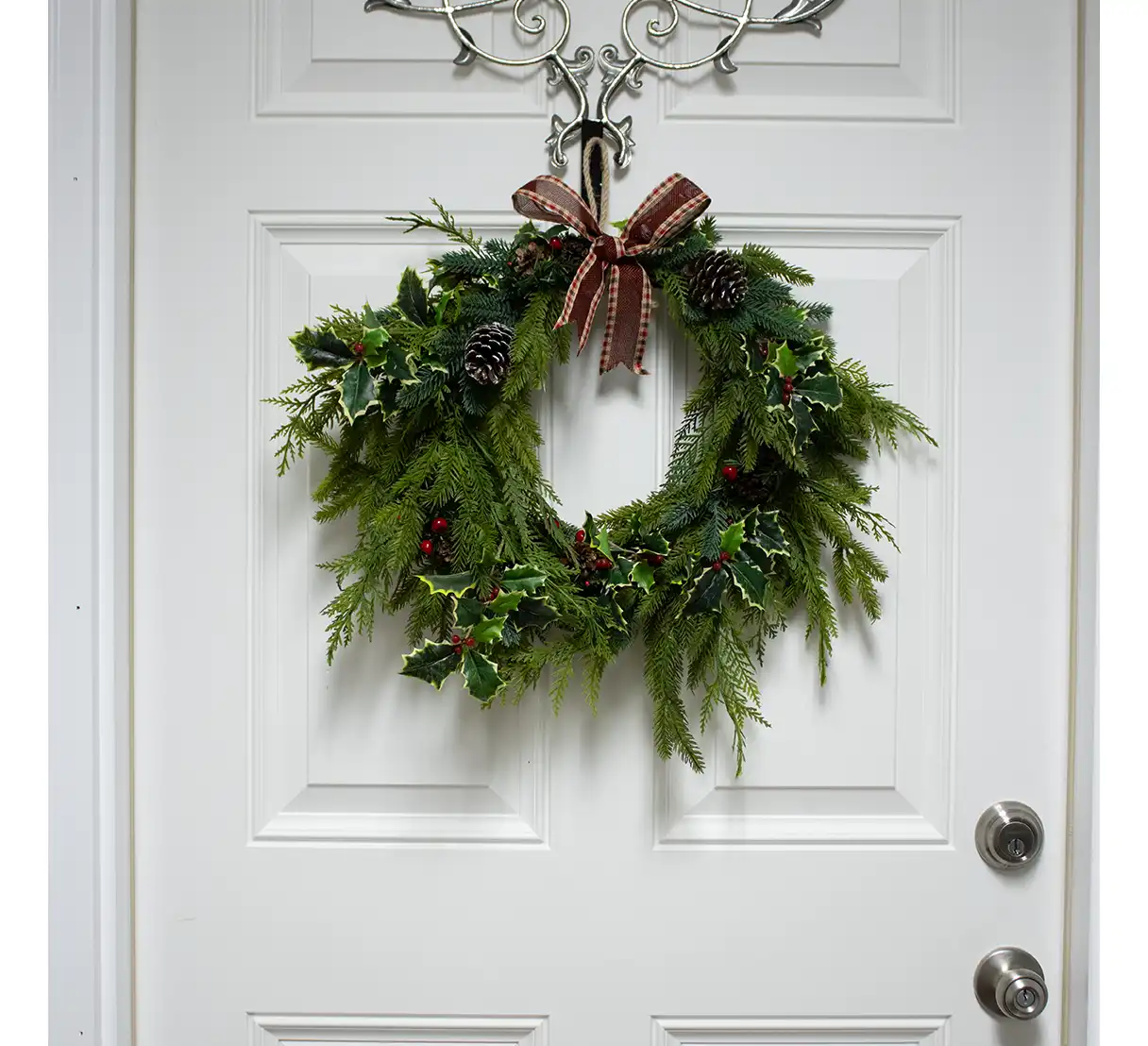
Building a layered wreath on a plain evergreen base:
- Start with a 24-inch base and fluff every branch outward.
- Wire three to five pinecones onto the lower half — clusters look natural, even spacing doesn’t.
- Add berry sprigs in odd-numbered groups of three.
- Tuck holly leaves slightly above the base so they catch light.
- Attach the bow last, so you can size it against everything already there.
Time: 25 to 35 minutes. Cost: around $35 if you’re reusing a base wreath.
13. Lush Evergreen Garland with Black Floor Lanterns
The floor lanterns do more than light the entry — they set the vertical rhythm. Garland frames the top, lanterns fill the bottom third, and the door sits in the middle as a clean dark rectangle. That’s the rule of thirds applied to a doorway, and it’s why this reads calm even with a generous amount of greenery. The brass hardware is the third element: a single warm metal note against dark wood and black iron, so nothing feels flat.
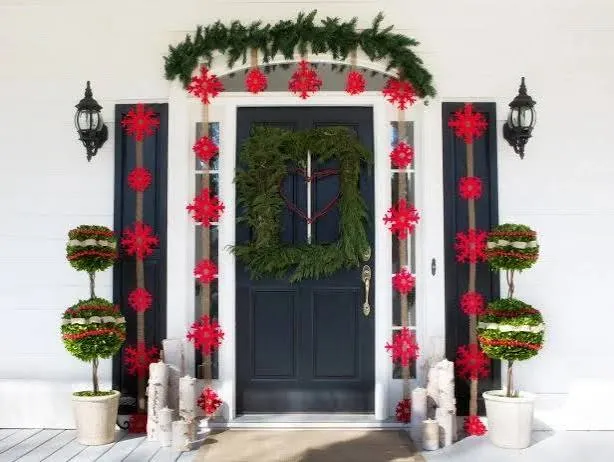
Two oversized black lanterns can run $150 each new. Facebook Marketplace and estate sales are full of them for $20 to $40, and matte black spray paint covers any finish sins. For the garland, buy a 9-foot plain faux cedar strand, then wire in pinecones you collected yourself and a $6 bag of faux berries — real-looking greenery for under $45. The potted evergreens are the one thing worth buying as a matched pair.
14. A Ribbon-and-Sphere Tree for a Modern Wood Door
This is the idea to steal if your entry is compact, because it needs zero floor space. It works on any door at least 32 inches wide, and the sweet spot for the wall tree is 30 to 36 inches tall so it sits below the sightline of the sconce. Ceiling height doesn’t matter, but wall texture does: this reads best on brick, stone, or board-and-batten. On a smooth painted wall it can look unfinished — add a thin wood backing if that’s your setup.
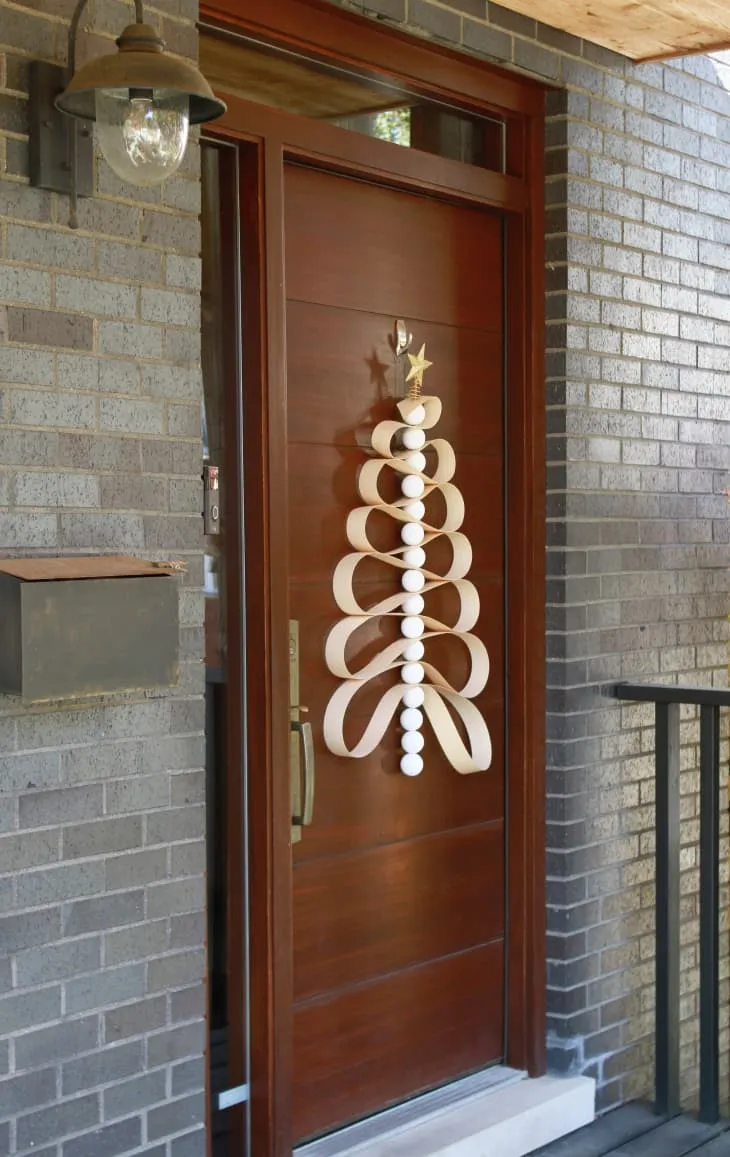
Build the loops from 2-inch satin ribbon, stapled or hot-glued to a foam core, then attach the whole thing with removable adhesive strips. Never put screws in a stained door. Space the white spheres 4 to 5 inches apart and vary them between 2 and 3 inches so the shape doesn’t read as a grid. Keep the topper small — an oversized star will overwhelm a door-mounted tree.
15. Lit Pine Archway with Oversized Red Velvet Bows
- Measure the opening at the top, bottom, and mid-height — archways and grilles are rarely square.
- Confirm an outlet is within reach, or plan for a discreet battery pack hidden in the garland.
- Check head clearance; the arch needs to sit at least 7 feet above the threshold.
- Decide your bow count first — four to six large bows is the usual range for a double door.
- Weigh the garland dry, then add lights. Full pine gets heavy fast.
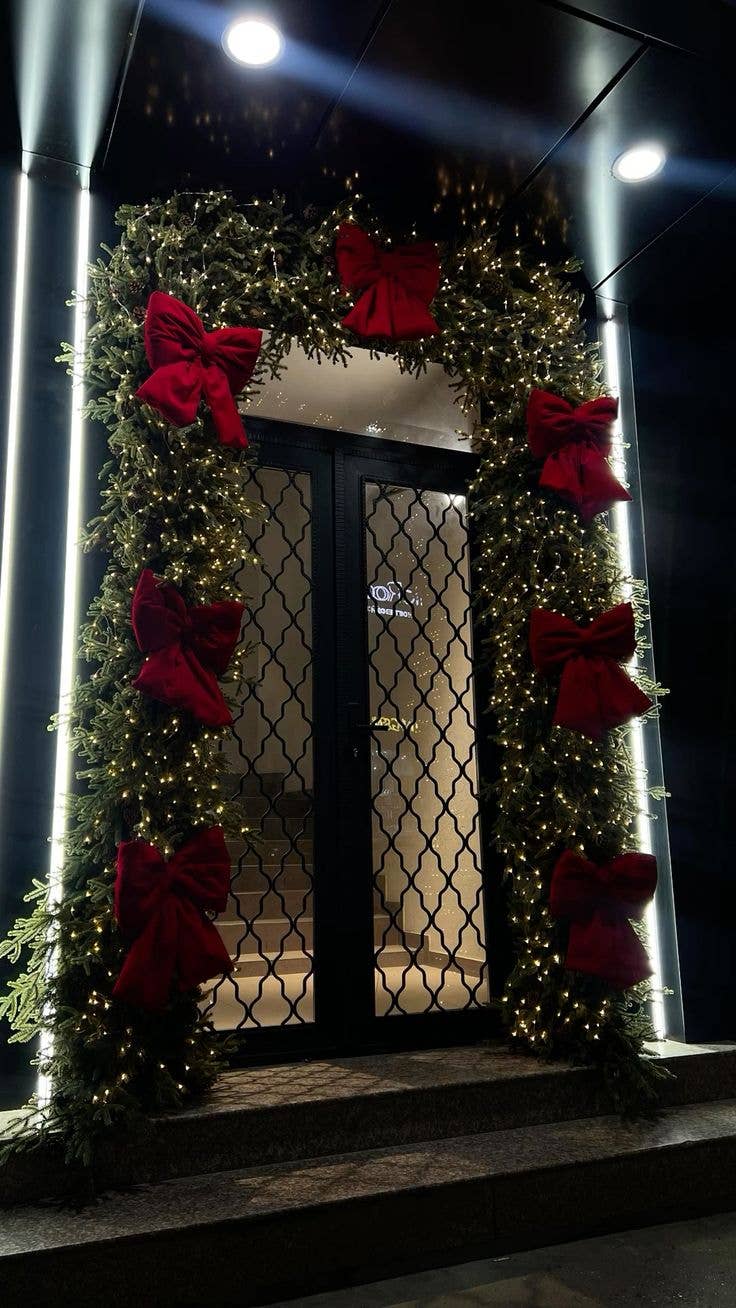
70% greenery + 20% warm light + 10% red velvet. Three ingredients, no ornament clutter. The bows are deliberately large and few; halving their size would double the count and the whole thing would tip into fussy. If you love this structure but want ornaments instead of ribbons, Idea #28 plays the same archway in a completely different key.
16. Cascading Garland on White French Doors
The wooden chair. It’s the least Christmas-y object on this porch and it’s the reason the whole scene looks lived-in instead of merchandised. A potted evergreen on a weathered seat reads like a home someone actually uses; the same plant on the ground reads like a store display. No chair? A bench, a crate, or even a stack of firewood does the same job — anything that says a human was recently here.
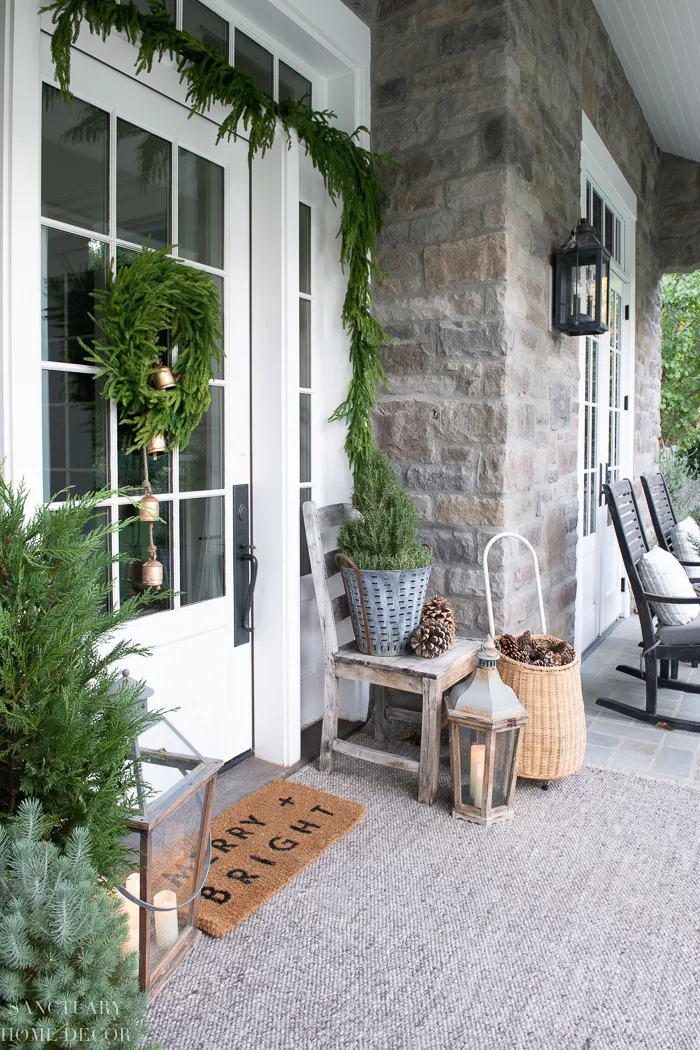
Building a cascading garland that doesn’t look like a scarf:
- Anchor one end at the top corner of the doorframe, not dead center.
- Let the strand fall in a shallow S curve, securing it every 18 inches.
- Pull the tail to one side — asymmetry is what makes it read as cascading.
- Tuck two or three pinecones into the lowest curve to visually weight it.
- Clip a single brass bell where the curve changes direction.
Time: 30 minutes. Cost: $40 to $75, depending on whether you’re reusing garland.
17. White Door, Green Garland, Matching Mini Trees
- Faux garland with pinecones and berries (9 ft): $40–$95
- Two potted miniature evergreens: $50–$140
- Wrap, ribbon, and gift boxes: $15–$35
- Black door hardware upgrade: $25–$70
- Warm-white outdoor LED string lights: $20–$45
Total: $150–$385 Budget alternative: forage real pine and cedar clippings from a tree lot — most will hand you a bag of trimmings for free — and wire them into a $12 garland base. That’s a $60 door.
White doors are unforgiving. Every needle, every drop of sap, every touch of dyed ribbon shows up, and wet evergreen left against painted wood overnight can leave a tan stain you’ll be repainting in spring. Line the inside of your garland with felt or clear adhesive film where it contacts the door. Also watch the light temperature: white door plus warm-white lights plus heavy green can go hospital-corridor at night. A 2700K porch bulb keeps it cozy.
18. Buffalo Check Bows on White Porch Railings
Buffalo check ribbon is stiff, and that’s a gift — you can build real structure with it. Use 3-inch width for railing bows and 4-inch for anything above eye level, and secure with white zip ties so nothing shows from the street. Space railing bows every 4 to 5 feet; any closer and the porch starts to look like a gift shop. On a dark blue house, black-and-white check gives you high contrast without introducing a third color.
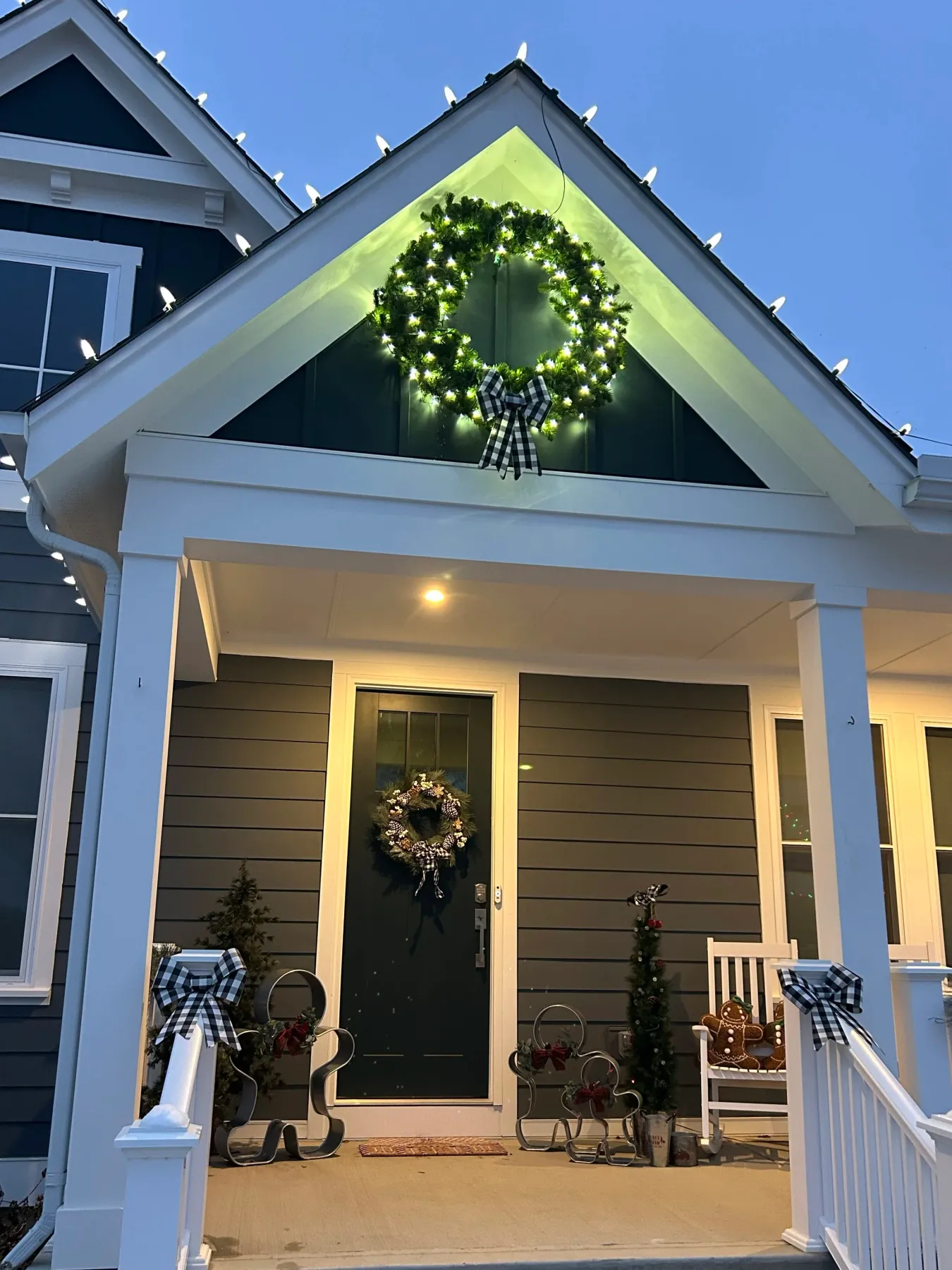
Railing decoration needs a porch, not a stoop — figure at least 8 feet of visible railing for the repeating rhythm to read. On a shorter porch, use two bows total and let the lit wreath in the gable carry the drama instead. That oversized wreath wants a peak at least 10 feet up; any lower and it crowds the door. Small accents like the gingerbread figures work precisely because everything else is so disciplined, so keep them to three or fewer.
19. Red Door with Fruit-and-Pine Garland Above the Pediment
The fruit. It sounds fussy, it is the most old-fashioned thing on this door, and it’s also what keeps the red-and-green from looking like a bank lobby. Apples, oranges, and lemons add three colors and a matte texture that nothing plastic can fake. The rest of the composition is strictly disciplined: identical wreaths, identical bows, one garland repeated above the pediment. Pattern at the top, symmetry below, and one unexpected material to break the rule.
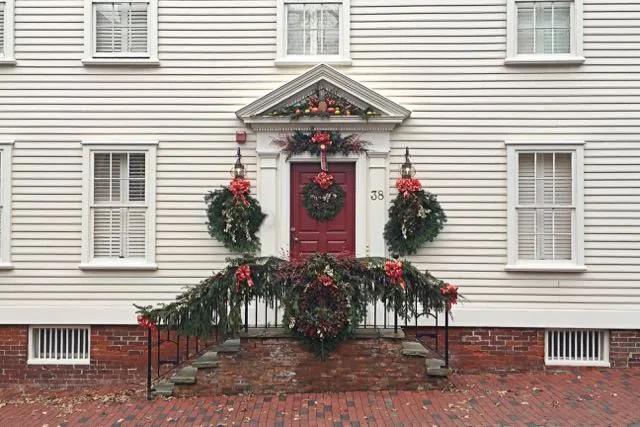
Real fruit garland is expensive and it rots by New Year’s. Better play: buy one plain faux pine garland, then wire in a bag of faux lemons and apples from a craft store plus a few real clementines for scent. Up close it reads homemade; from the sidewalk, nobody can tell. For the swags, dress basic evergreen bunches with dollar store ribbon — a 10-yard roll is $1.25 and there is genuinely no reason to pay more.
20. Frosted Wreath with a Vertical JOY Sign
A tall vertical sign only works if it has room to breathe. Placed right beside the door, it competes with the wreath and the entry starts to feel crowded. Give it 18 to 24 inches of separation, or move it to the corner of the porch so it frames the scene instead of standing in the middle of it. Painted wood in a covered porch will mildew if it never dries out — seal it with exterior polyurethane before the first rain.
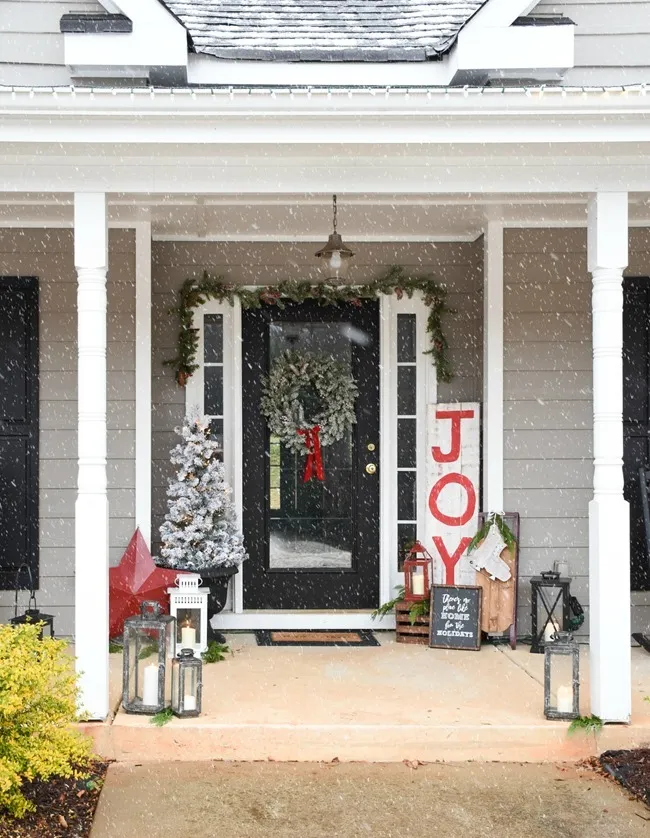
The frosted finish. Everything on this porch is matte black, white, or deep green, and the flocking is what softens that high-contrast palette into something that reads as snow rather than graphic design. Swap the flocked wreath and tree for standard green and the black door goes severe. Frosting is the single warm gesture in an otherwise very disciplined color story.
21. Ornament-Loaded Garland on an Arched Entry
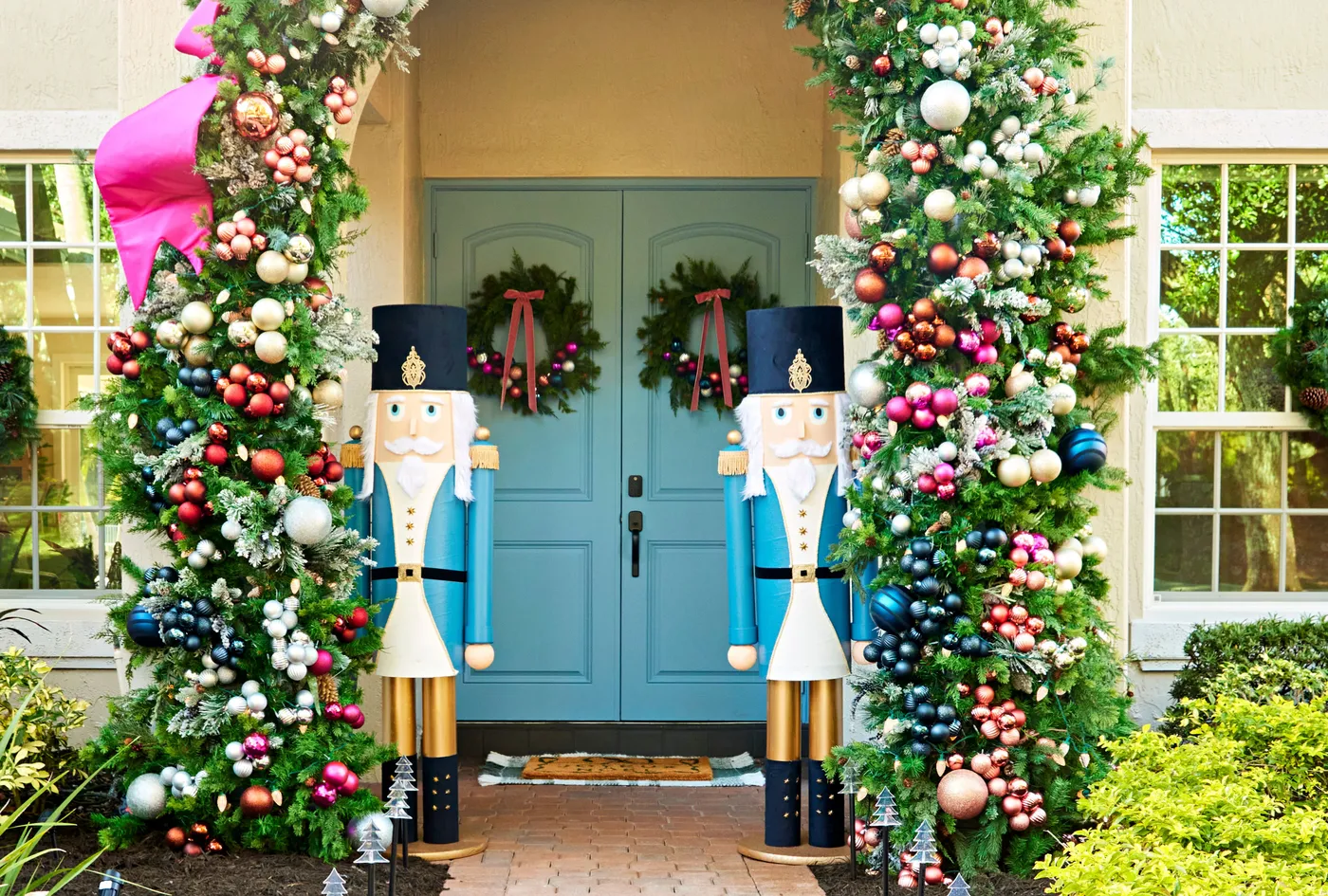
40% greenery + 35% ornaments + 20% warm light + 5% signage. That’s a lot of ornament, and it works because the garland runs an arch — a long curve can absorb density that would look chaotic on a straight doorframe. Follow the curve: cluster the biggest ornaments at the apex where the eye lands, and taper to small ones toward the bottom. Keep the two door wreaths identical; asymmetry between double doors always reads as unfinished.
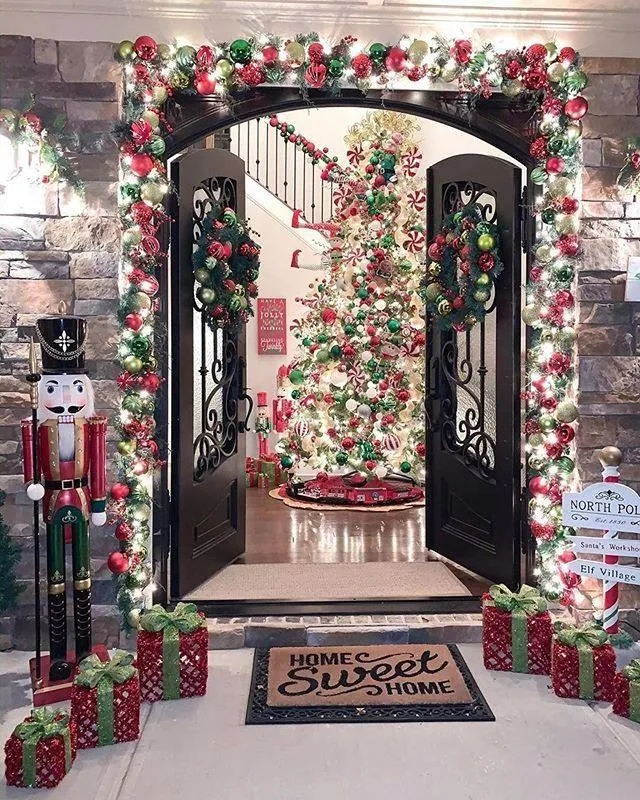
Kitsch is back, but a curated version of it. The nutcracker, the North Pole sign, the ornament-packed arch — this is nostalgic maximalism where objects are deliberately chosen and given space rather than piled up. Boards have shifted from minimal Christmas toward nostalgic entryway, and the biggest driver is photo culture: layered entries simply photograph better. Expect this to hold for several seasons, since it’s built from things people already own. If bows are more your speed, Idea #15 uses the identical archway structure.
22. Columns Wrapped in Lit Pine with Red Bow Wreaths
Wrapping a porch column with garland so it actually stays:
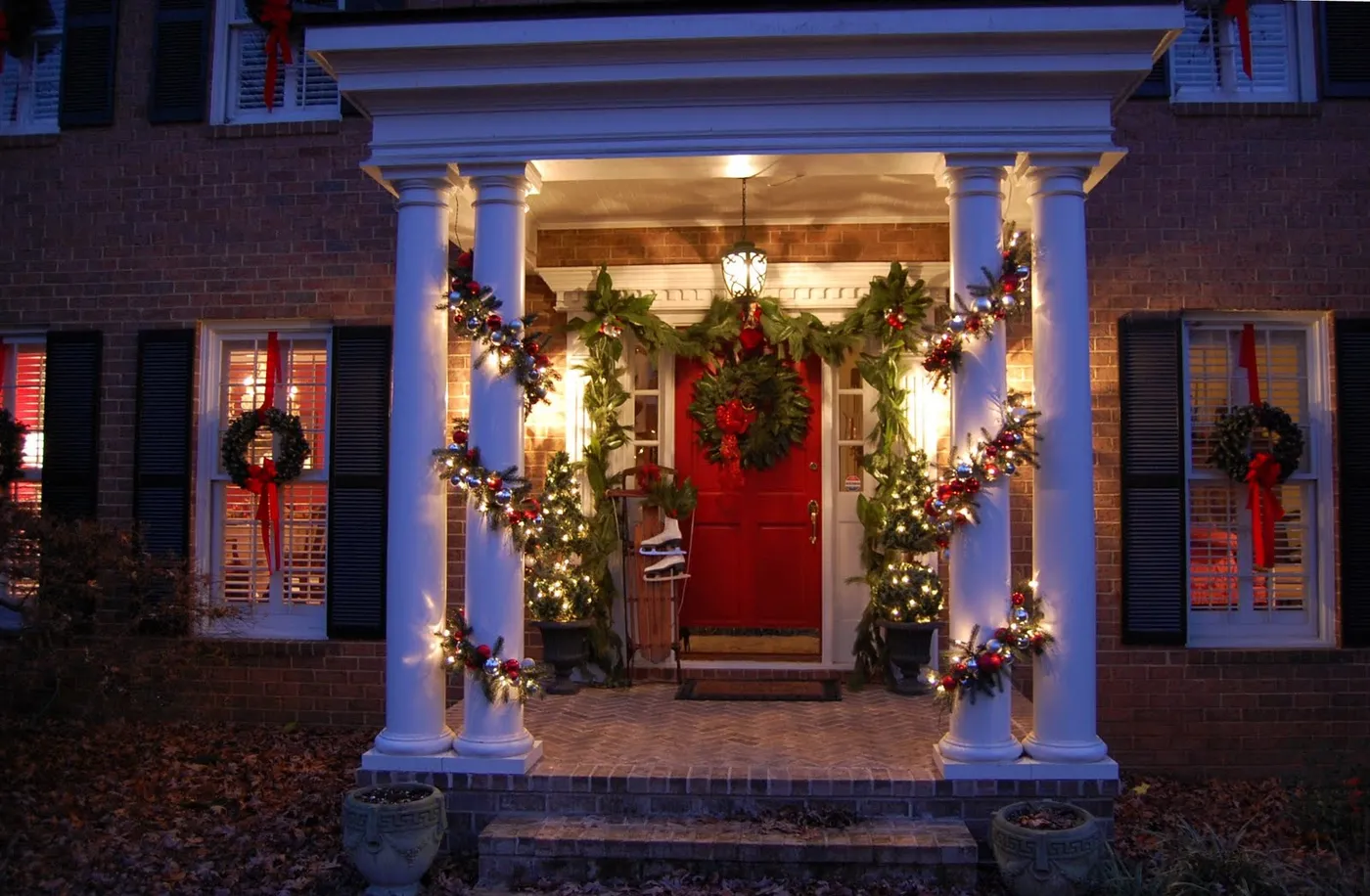
- Start at the bottom and wrap upward — gravity works with you that way.
- Allow a 10-foot strand for every 6 feet of column height.
- Cross the garland over itself at each turn so the seam disappears.
- Zip-tie at three points, not ten — fewer ties means a smoother spiral.
- Run the light strand along the outside of the garland, never buried inside it.
Time: 45 minutes for two columns. Materials: roughly $60 to $120 for garland and lights.
Columns are vertical, so keep your ornaments horizontal. Flattening ornament clusters out to the sides rather than letting them hang forward keeps the wrap looking like an architectural detail instead of a Christmas tree. Use unbreakable ornaments only — anything glass on a column will eventually meet brick. And leave the bottom 18 inches bare so rain splash doesn’t finish off the garland by January.
23. A Frosted Wreath with a Red Cardinal Perched
Wreaths with a lot of accents — frosted tips, berries, a figurine — collect dust and cobwebs faster than plain greenery, and you’ll notice by mid-December. A pass with a hairdryer on cool, held at a distance, handles most of it. Frosted leaves yellow in direct sun, so a west-facing door will fade them twice as fast. If your cardinal is resin, bring it in at the end of the season; UV dulls that red within two seasons.
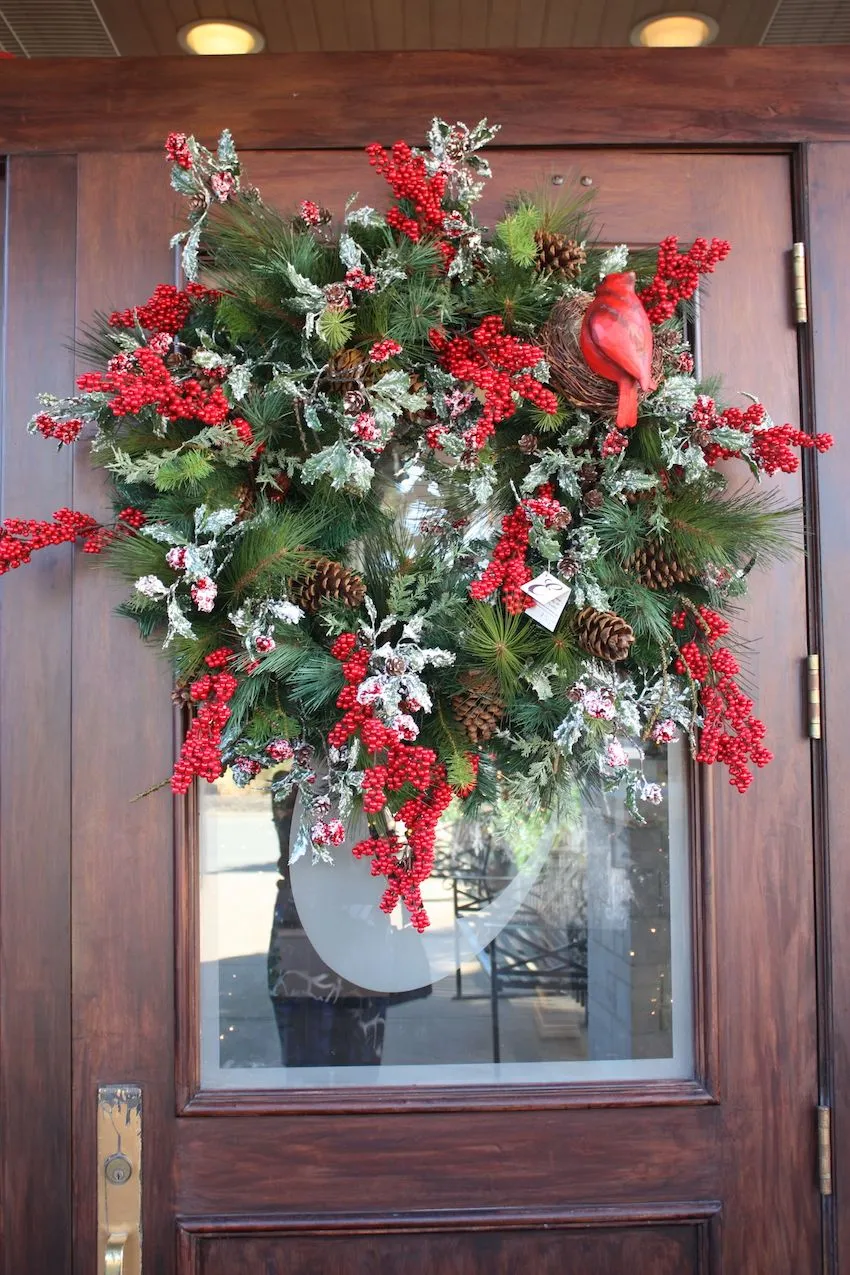
One unexpected object changes everything. Without the cardinal this is a very good, very standard frosted wreath — the kind you’ve walked past a hundred times. The bird gives your eye a story and a stopping point, and it’s the detail guests actually mention. It also does quiet color work: a single note of true red against frosted green and white is a stronger composition than a dozen evenly spaced berries.
24. Sage Green Door with a Monogrammed Wreath
A monogram doesn’t have to cost much if you skip the personalization industry. Buy a plain 24-inch wreath, a wooden letter from a craft store, and a can of white matte spray paint — roughly $35 for something that reads like a $150 boutique order. The sage green door is the real investment, but a gallon of exterior paint is about $45 and a weekend, and sage is one of the few colors that flatters both red bows and silver ornaments.
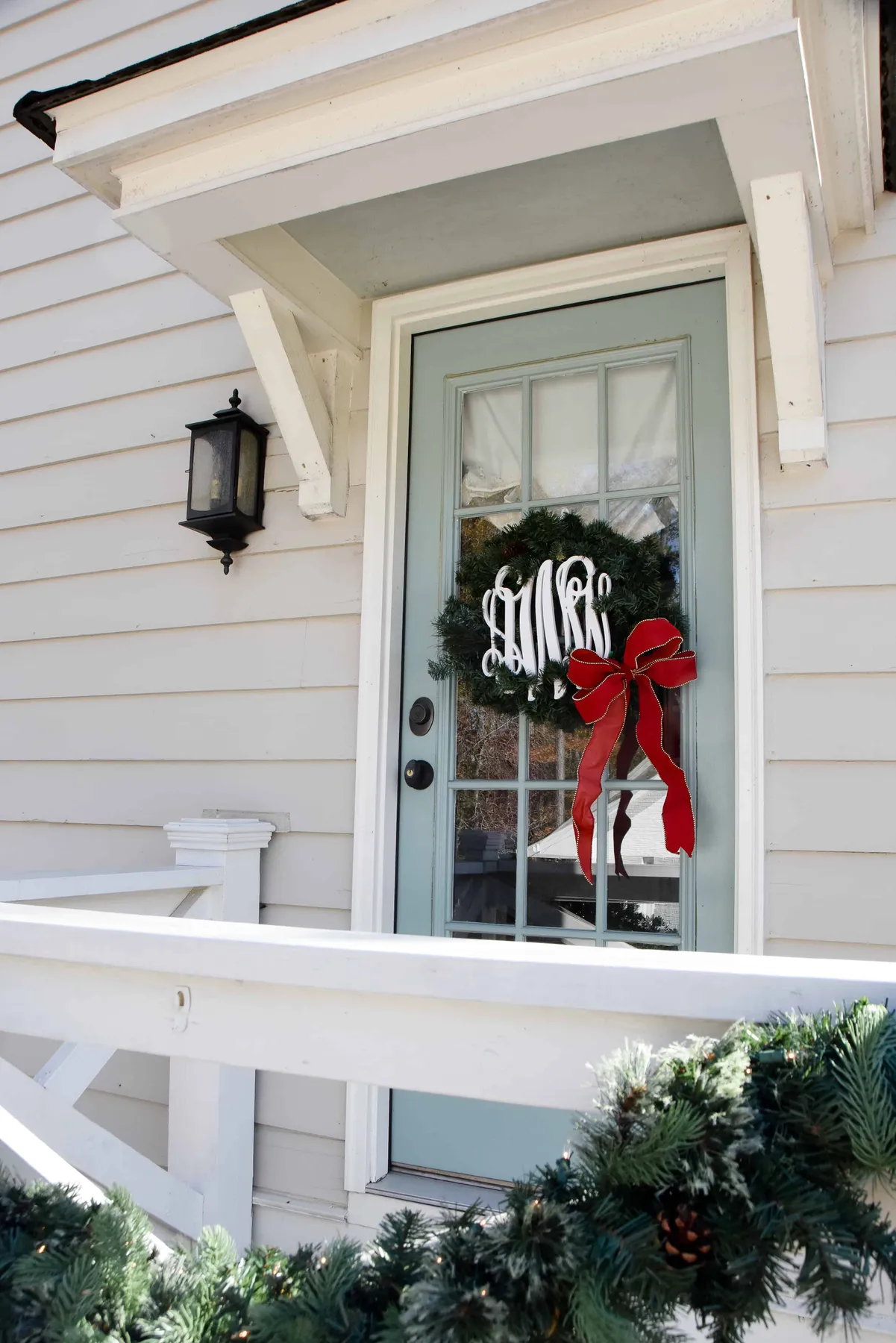
This composition needs a porch with visible railing — about 6 feet of it in frame — plus a door at least 36 inches wide, since the wreath and the monogram both need room. Wall lanterns should sit 66 to 72 inches from the floor and at least 8 inches clear of the door trim. On a narrow or recessed entry, drop the railing garland and keep the monogrammed wreath; the edit will look intentional rather than unfinished.
25. Red Velvet Window Bows and an Arched Entry Garland
Matching window bows are all about identical scale. Measure your window widths and size the ribbon loops at roughly one-quarter the window width — a 9-inch bow on a 36-inch window. Any larger and it looks like a parade float; any smaller and it vanishes from the curb. Use wired 2.5-inch velvet, attach with clear outdoor-rated hooks, and clip the tails so they fall straight instead of curling in the wind.
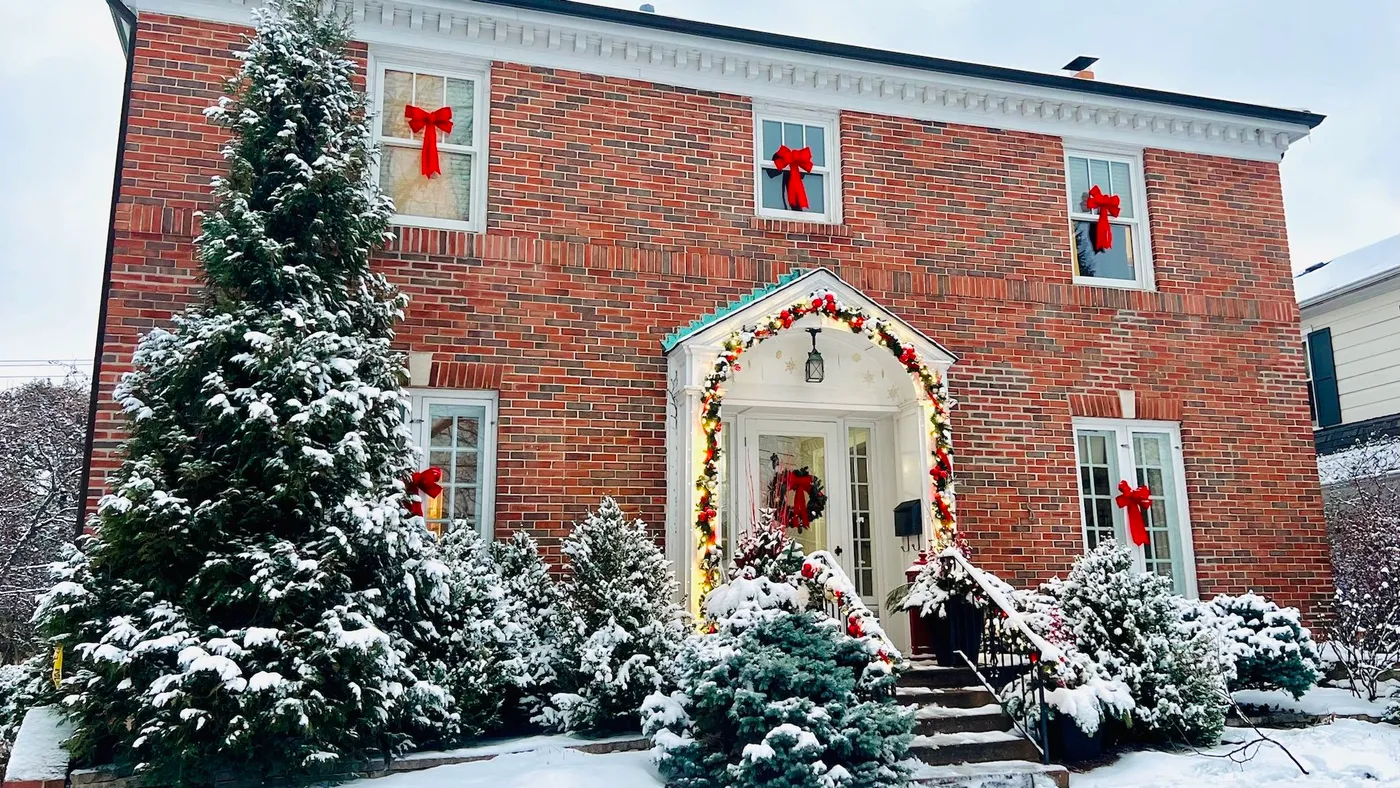
This is a lot of red. On a red brick house, matching bows on every window plus a lit garland can flatten into one solid color field, especially at dusk. Break it with white — trim, door, and warm-white lights rather than colored ones. Be honest about the ladder work, too: bows on second-story windows mean real height and real wind. If you’re not comfortable up there, do the ground floor and the entry only. If you want red without the repetition, Idea #19 concentrates it on the door alone.
26. Tartan Ribbon Bow with Ribbon-Wrapped Topiaries
The wrapped topiaries. Anyone can hang a tartan bow, and most people do. Wrapping the cone topiaries in the same red ribbon and string lights is what turns three separate objects into one composition — the bow, the door, and the pots all repeat the same two materials. It’s the cheapest trick in this entire article: one roll of ribbon, two pots, ten minutes. Copy the ribbon treatment even if you skip the topiaries.
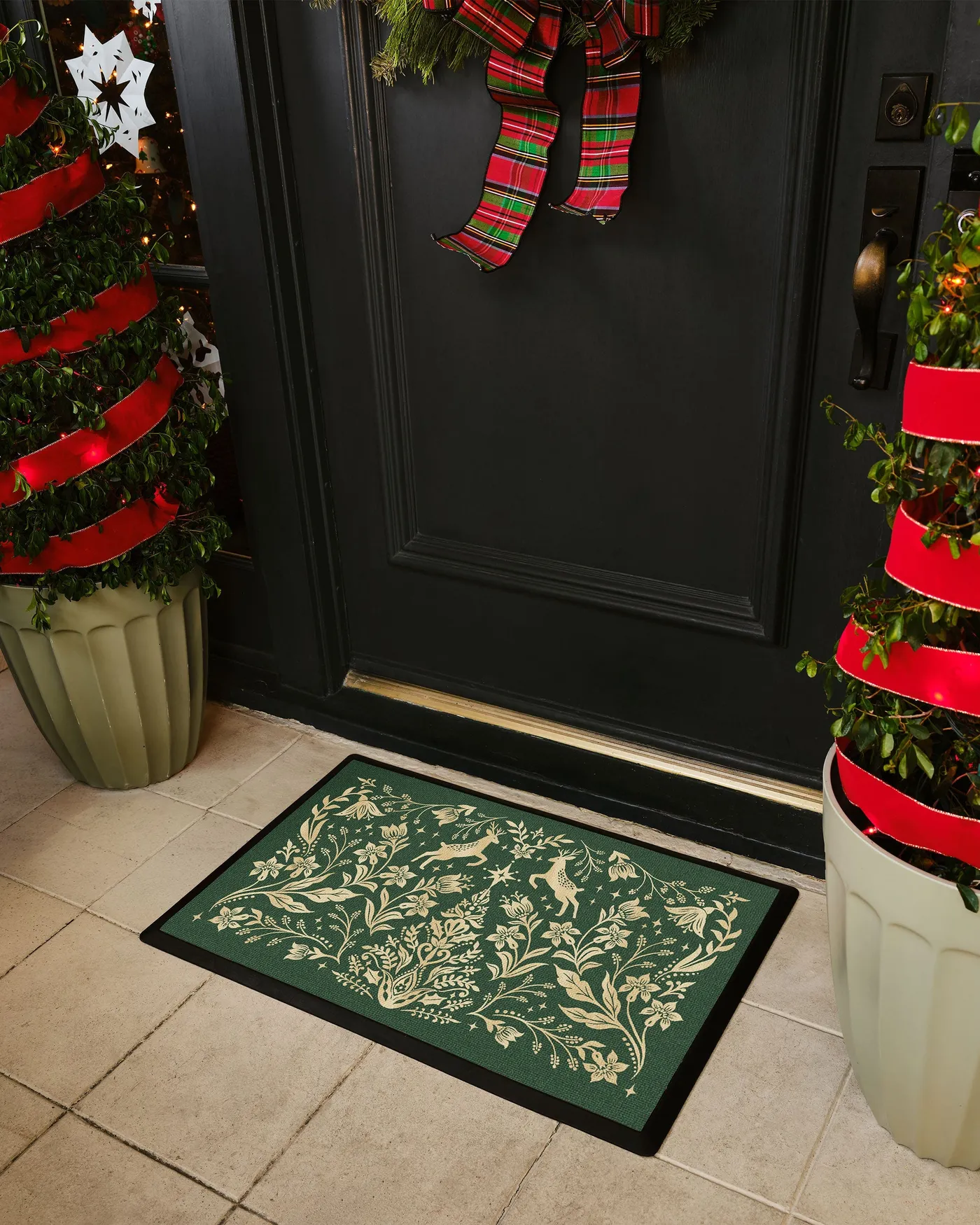
- Potted cone topiaries, set of two: $70–$180
- Tartan ribbon, 10 yards: $15–$35
- Outdoor string lights, two strands: $25–$55
- Evergreen boughs for the door: $30–$80
- Patterned green-and-cream mat: $30–$65
Total: $170–$415 Budget alternative: skip the topiaries and put the wrapped ribbon and lights on two plain potted shrubs you already own. That drops the project to about $90, and honestly, it looks just as good.
27. Plum Satin Bow and a Wicker Sleigh of Gifts
60% evergreen + 25% neutral stone and plaid + 15% plum. The plum is doing something specific: it sits between red and purple, which means it reads festive without matching anything else on your porch. That’s why this doesn’t look like every other red-and-green entry. Swap plum for merlot to go deeper and more traditional, or dusty blue to go cool and modern. Keep the bow oversized — a plum bow that’s too small just looks like a bruise.
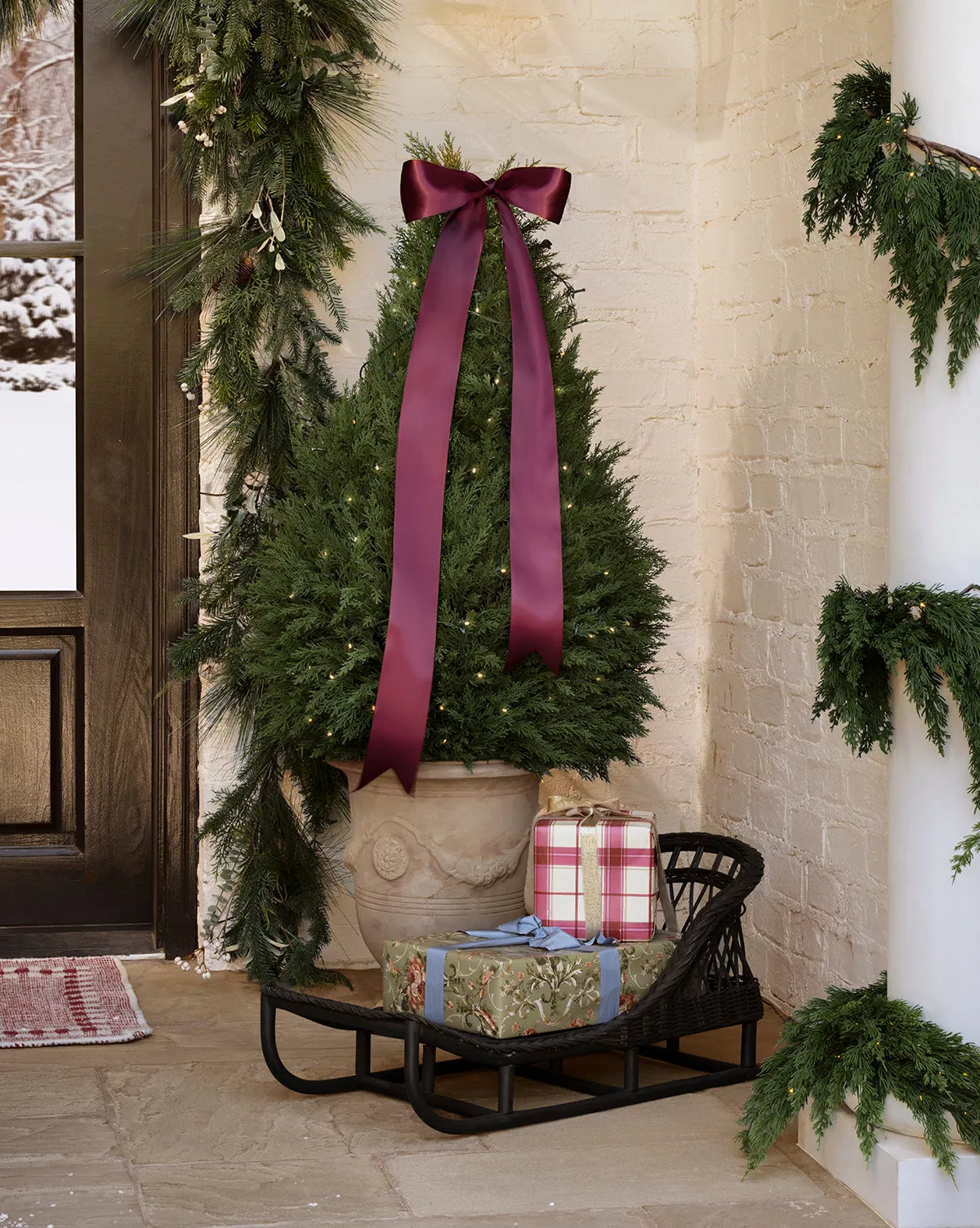
Two ideas are quietly at work. The sleigh gives the arrangement a story — presents weren’t placed here, they were delivered. And the stone urn at the bottom is heavier than the topiary above it, which is what makes the stack look stable instead of top-heavy. Weight at the base, narrative at the eye line. That combination is why styled porch displays photograph so well, and it’s easy to copy with any container you already own.
28. Evergreen Archway Packed with Glossy Red Baubles
- Measure the full opening and add 20% — a packed arch eats length fast.
- Count your baubles: about 25 to 35 medium ornaments per 9 feet of dense garland.
- Test anchor points; a loaded arch can weigh 25 pounds or more.
- Verify outlet access and use an outdoor-rated timer so you’re not unplugging nightly.
- Check head clearance — the garland’s lowest point should stay above 6 feet 8 inches.
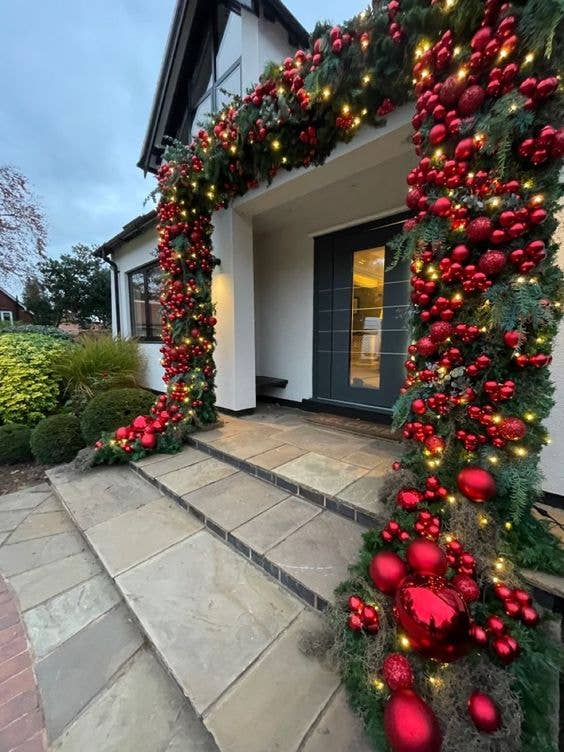
Getting the density right:
- Zip-tie the garland to the frame and fluff it fully before decorating anything.
- Wire ornaments onto inside branches, not the surface, so they nestle in.
- Cluster larger baubles in threes at the corners and the apex.
- Fill remaining gaps with small ornaments last.
- Run lights along the outer edge so the baubles pick up highlights.
Time: 2 to 3 hours for a full arch. Materials: $120 to $260 depending on ornament quality.
29. Square Wreath and Magnolia-Dressed Lanterns
A square wreath on a rectangular door with sidelights is a geometry decision, not just a style one — the straight edges echo the door frame and the sidelight lines, while a round wreath introduces a circle the architecture doesn’t have. Pair it with round lanterns so the curve still shows up somewhere. For the lantern swags, wrap 18-gauge florist wire around the back plate, never over the glass, and keep trailing ribbons above the bulb.
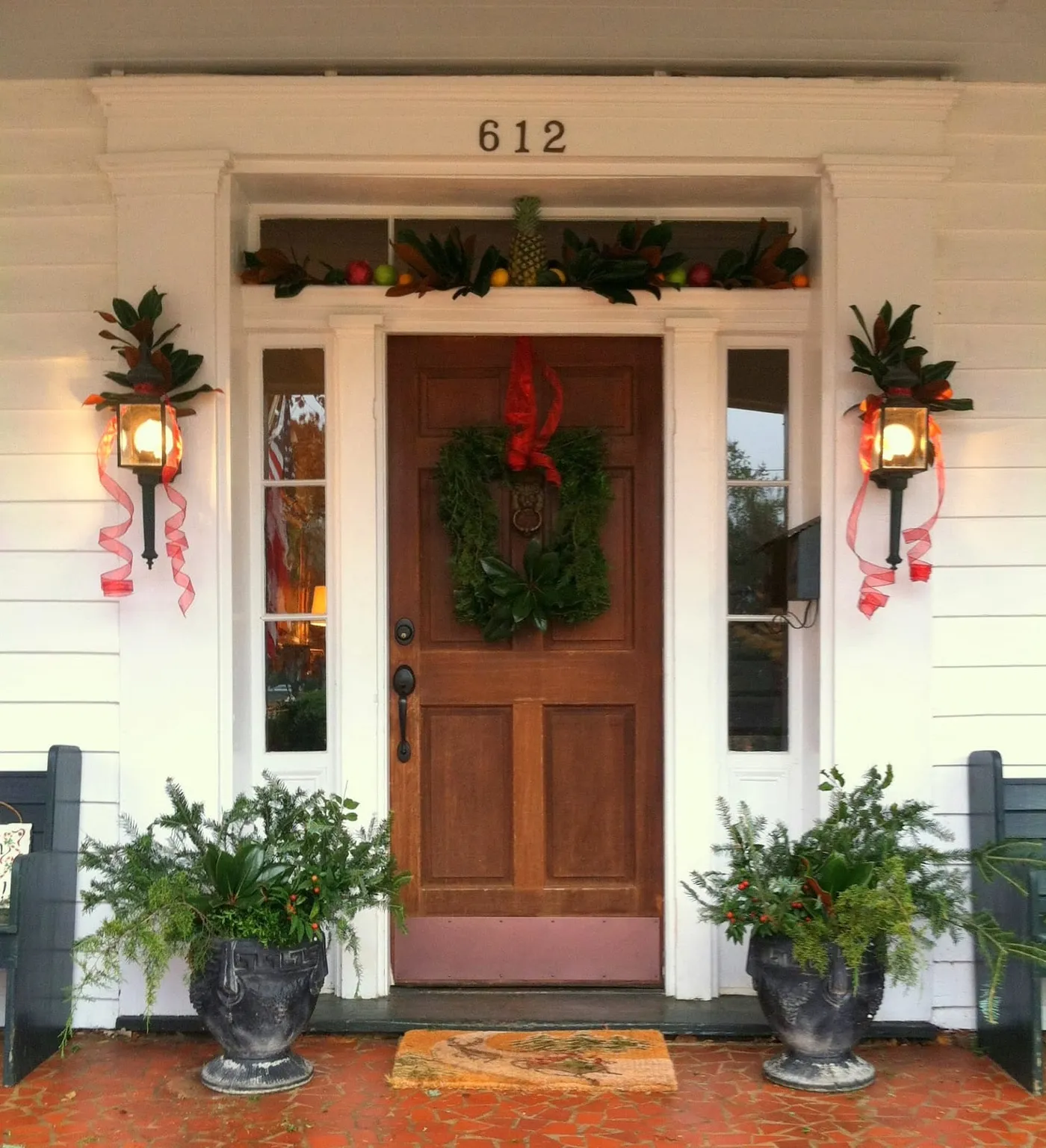
Magnolia is the expensive part and the part where faux looks worst. Real branches are often free — ask a neighbor with a tree, or check the park after a storm. If you buy, a bundle runs $18 to $35 and covers two lanterns. Stone urns are the other splurge; heavy resin urns at $25 to $45 each look identical from four feet away and weigh a third as much. Trailing red ribbon is $3 a roll. This whole door can come in under $100.
30. Oversized Floor Ornaments and a Cozy Bench
Oversized floor ornaments only work when the porch is wide enough to give them negative space. You want at least 5 feet of clear floor on each side of the door, or they’ll crowd the threshold every time you carry in groceries. Tall lit trees need a 9-foot ceiling to avoid looking stunted. On a narrow porch, keep the wreath and the bench and lose the giant ornaments — Idea #14 uses wall space instead of floor space.
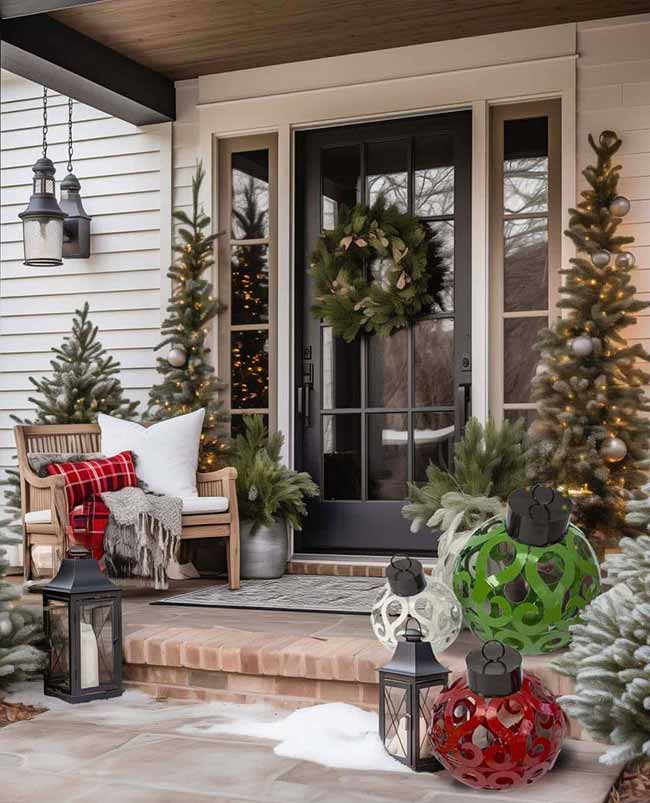
The bench. Not the trees, not the giant glass ornaments — the bench with the pillows and the throw. It’s the only thing on this porch that suggests someone sits here, and that’s what makes the rest look like a home rather than a display. It also softens the black door and adds an upholstered texture that greenery simply can’t provide. Without it, this is a very good store window. With it, it’s a porch.
31. Flocked Trees and a Burlap Bow on a White Door
Layering doormats without the corner curl:
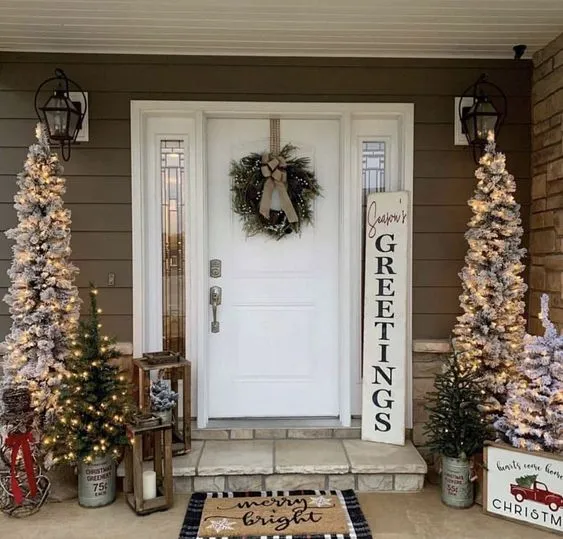
- Start with a 24×36 plain coir mat directly against the door.
- Set a slightly smaller patterned mat on top, offset by 3 inches so both show.
- Secure the top mat with outdoor double-sided tape at two corners.
- Shake both weekly — layered mats trap grit and scratch the sill.
Time: 10 minutes. Cost: $25 to $60 for both mats.
Symmetry is this porch’s entire argument, so anything that breaks it becomes the only thing you see. If one flocked tree is noticeably taller, fuller, or brighter than the other, fix it or accept the lopsidedness. Flocked trees also shed white powder for weeks — keep them off dark tile and away from painted walls you care about. Warm-white LED at 2700K to 3000K keeps the flocking looking snowy instead of grey.
32. Black Wicker Sleds Stacked with Patterned Gifts
Pattern mixing is the quiet trend of 2026. Florals beside plaid beside botanicals would have looked chaotic five years ago; now it’s the thing keeping traditional Christmas decor from feeling dusty. The trick is a shared color story — every paper has the same deep red or forest green running through it. Mixed patterns with a locked palette read intentional. Mixed patterns with a free-for-all palette read like a wrapping paper bin.
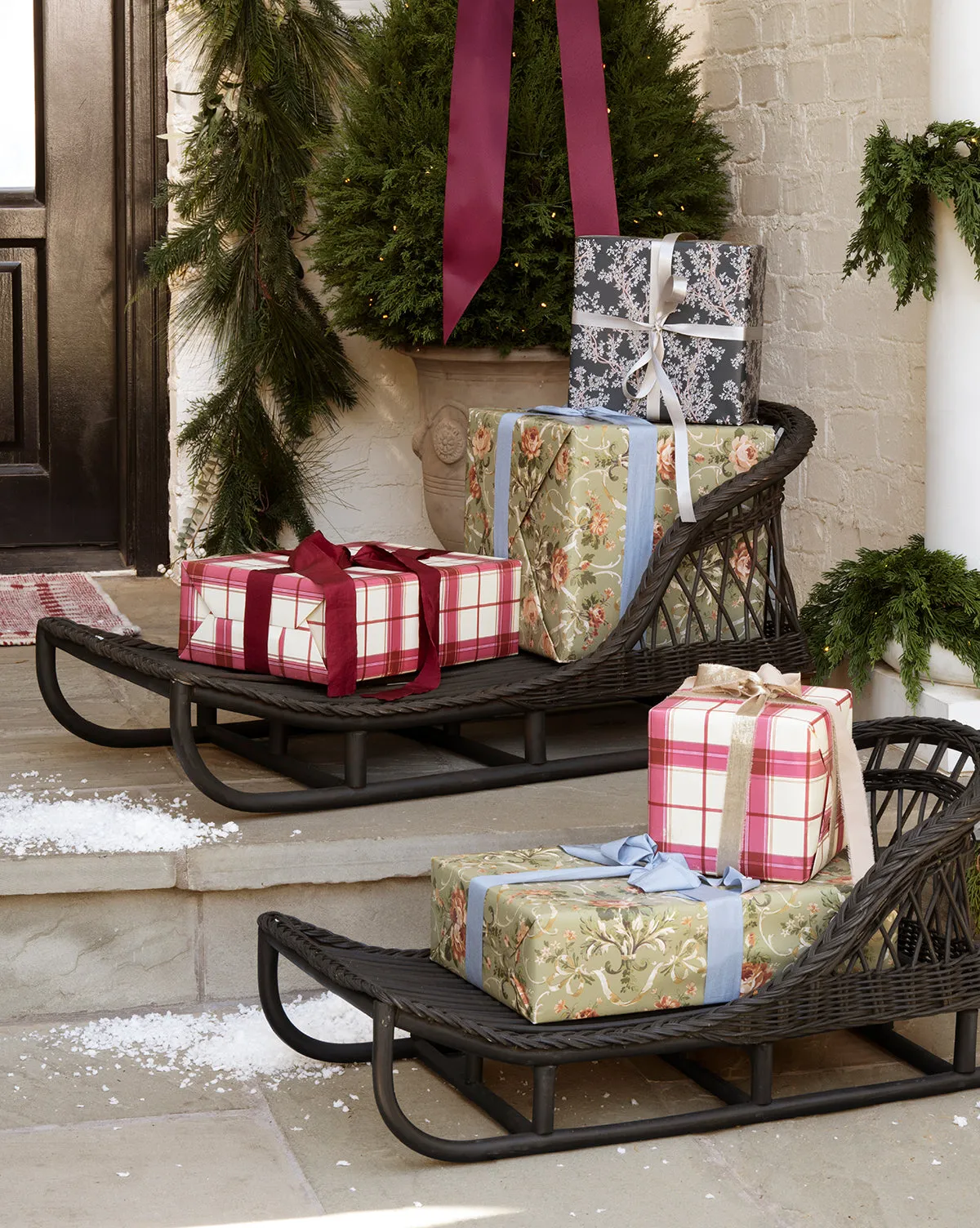
The sleds are the structure. Any container would technically work, but a wicker sled has an angled back that props the gift stack up and a curved runner that makes the arrangement feel like a scene rather than a pile. That’s why this reads charming instead of messy — the presents are contained, so your eye can enjoy the pattern mix without having to organize it. Find containers with a shape and you can style almost anything.
Your Porch Is the First Thing They’ll Photograph
Pick one idea, one palette, and the version of this you’ll actually enjoy doing on a cold Saturday — that’s the entire secret. Start with the door itself, build outward, and stop when it feels finished rather than when the box is empty. Your entry doesn’t have to look like a magazine spread to make people feel welcome; it just has to look like you meant it.
📌 Save this guide to Pinterest before the season gets away from you — and send it to whoever keeps asking what you want for Christmas. (It’s greenery. It’s always greenery.)